Early Performance Testing of
Distributed Software Applications
∗Giovanni Denaro
† Universit ´a di Milano Bicocca Dipartimento di Informatica, Sistemistica e ComunicazioneI-20126, Milano, Italy
Andrea Polini
† Scuola St. Anna Superiore Piazza Martiri della Liberta 156127 Pisa, Italy
Wolfgang Emmerich
University College London Dept. of Computer Science
WC1E 6BT, London, UK
ABSTRACT
Performance characteristics, such as response time, through-put and scalability, are key quality attributes of distributed applications. Current practice, however, rarely applies sys-tematic techniques to evaluate performance characteristics. We argue that evaluation of performance is particularly cru-cial in early development stages, when important architec-tural choices are made. At first glance, this contradicts the use of testing techniques, which are usually applied to-wards the end of a project. In this paper, we assume that many distributed systems are built with middleware tech-nologies, such as the Java 2 Enterprise Edition (J2EE) or the Common Object Request Broker Architecture (CORBA). These provide services and facilities whose implementations are available when architectures are defined. We also note that it is the middleware functionality, such as transaction and persistence services, remote communication primitives and threading policy primitives, that dominate distributed system performance. Drawing on these observations, this paper presents a novel approach to performance testing of distributed applications. We propose to derive application-specific test cases from architecture designs so that perfor-mance of a distributed application can be tested using the middleware software at early stages of a development pro-cess. We report empirical results that support the viability of the approach.
Keywords
Middleware, Software Testing, Distributed Software Archi-tecture, Software Performance, Performance Analysis Mod-els
†
The research was conducted while this author was on study leave at UCL
∗This work has been partially supported by the European Union through the Research Training NetworkSeGraVis.
1.
INTRODUCTION
Various commercial trends have lead to an increasing de-mand for distributed applications. Firstly, the number of mergers between companies is increasing. The different di-visions of a newly merged company have to deliver unified services to their customers and this usually demands an in-tegration of their IT systems. The time available for deliv-ery of such an integration is often so short that building a new system is not an option and therefore existing system components have to be integrated into a distributed system that appears as an integrating computing facility. Secondly, the time available for providing new services are decreasing. Often this can only be achieved if components are procured off-the-shelf and then integrated into a system rather than built from scratch. Components to be integrated may have incompatible requirements for their hardware and operat-ing system platforms; they have to be deployed on different hosts, forcing the resulting system to be distributed. Fi-nally, the Internet provides new opportunities to offer prod-ucts and services to a vast number of potential customers. The required scalability of e-commerce or e-government sites cannot usually be achieved by centralized or client-server chitectures but demand the use of distributed software ar-chitectures.
Given the growing importance of distributed systems, we are interested in devising systematic ways to ascertain that a given distributed software architecture meets performance requirements of their users. Performance can be charac-terised in several different ways. Latencytypically describes the delay between request and completion of an operation. Throughput denotes the number of operations that can be completed in a given period of time. Scalabilityidentifies the dependency between the number of distributed system resources that can be used by a distributed application (typ-ically number of hosts or processors) and latency or through-put. Despite the practical significance of these various as-pects it is still not adequately understood how to test the performance of distributed applications.
Weyuker and Vokolos reported on the weakness of the pub-lished scientific literature on software performance testing in [24]. To this date no significant scientific advances have been made on performance testing. Furthermore the set of tools available for software performance testing is fairly limited. The most widely used tools are workload
genera-tors and performance profilers that provide support for test execution and debugging, but they do not solve many un-clear aspects of the process of performance testing. In par-ticular, researchers and practitioners agree that the most critical performance problems depend on decisions made in the very early stages of the development lifecycle, such as architectural choices. Even though iterative and incremen-tal development has been widely promoted [18, 11, 12], the testing techniques developed so far are very much focused on the end of the development process.
As a consequence of the need for early evaluation of soft-ware performance and the weakness of testing, the great majority of research has focused on performance analysis models [1, 20, 19, 2, 3, 9] rather than testing techniques. This research shares in general the approach of translating architecture designs, mostly given in the Unified Modeling Language (UML [5]), to models suitable for analyzing per-formance, such as, Layered Queuing Networks (e.g. [19]), Stocastic Petri Nets (e.g. [2]) or stocastic process algebras (e.g. [20]). Estimates of performance are used to reveal flaws in the original architecture or to compare different archi-tectures and architectural choices. Models may give use-ful hints of the performance and help identify bottlenecks, however they tend to be rather inaccurate. Firstly, models generally ignore important details of the deployment envi-ronment. For example, performance differences may be sig-nificant when different databases or operating systems are used, but the complex characteristics of specific databases and operating systems are very seldom included in the mod-els. Secondly, models often have to be tuned manually. For example, in the case of Layered Queued Networks, solving contention of CPU(s) requires, as input, the number of CPU cycles that each operation is expected to use. Tuning of this type of parameters is usually guessed by experience and as a result it is not easy to obtain precise models.
With the recent advances in distributed component tech-nologies, such as J2EE [22] and CORBA [17], distributed systems are no longer built from scratch [7]. Modern dis-tributed applications often integrate both off-the-shelf and legacy components, use services provided by third-parties, such as real-time market data provided by Bloomberg or Reuters, and rely on commercial databases to manage per-sistent data. Moreover, they are built on top of middleware products (hereafter referred to asmiddlewares), i.e., middle-tier software that provides facilities and services to simplify distributed assembly of components, e.g., communication, synchronization, threading and load balancing facilities and transaction and security management services [8]. As a re-sult of this trend, we have a class of distributed applications for which a considerable part of their implementation is al-ready available when the architecture is defined (e.g. during the Elaboration phase of the Unified Process). In this pa-per, we argue that this enables performance testing to be successfully applied at these early stages.
The main contribution of this paper is the description and evaluation of a method for testing performance of distributed software in the early development stages. The method is based on the observation that the middleware used to build a distributed application often determines the overall per-formance of the application. For example, middlewares and
databases usually contain the software for transaction and persistence management, remote communication primitives and threading policies, which have great impact on the dif-ferent aspects of performance of distributed systems. How-ever, we note that only the coupling between the middle-ware and the application architecture determines the actual performance. The same middleware may perform very dif-ferently in the context of different applications. Based on these observations, we propose using architecture designs to derive application-specific performance test cases that can be executed on the early available middleware platform a distributed application is built with. We argue that this allows empirical measurements of performance to be suc-cessfully done in the very early stages of the development process. Furthermore, we envision an interesting set of prac-tical applications of this approach, that is: evaluation and selection of middleware for specific applications; evaluation and selection of off-the-shelf components; empirical evalua-tion and comparison of possible architectural choices; early configuration of applications; evaluation of the impact of new components on the evolution of existing applications. The paper is further structured as follows. Section 2 dis-cusses related work and highlights the original aspects of our research. Section 3 gives details of our approach to per-formance testing. Section 4 reports about the results of an empirical evaluation of the main hypothesis of our research, i.e., that the performance of distributed application can be successfully measured based on the early-available compo-nents. Finally, Section 5 summarizes the contributions of the paper and sketches our future research agenda.
2.
RELATED WORK
In this section, we briefly review related work in the areas of performance testing of distributed applications and stud-ies on the relationships between software architecture and middleware.
Performance testing of distributed applications
Some authors exploited empirical testing for studying the performance of middleware products. Gorton and Liu com-pare the performance of six different J2EE-based middle-wares [10]. They use a benchmark application that stresses the middleware infrastructure, the transaction and directory services and the load balancing mechanisms. The compar-ison is based on the empirical measurement of throughput per increasing number of clients. Similarly, Avritzer et al. compare the performance of different ORB (Object Request Broker) implementations that adhere to the CORBA Com-ponent Model [13]. Liu and al. investigate the suitability of micro-benchmarks, i.e., light-weight test cases focused on specific facilities of the middlewares, such as, directory ser-vice, transaction management and persistence and security support [14].
This work suggests the suitability of empirical measurement for middleware selection, i.e, for making decisions on which middleware will best satisfy the performance requirements of a distributed application. However, as Liu et al. remark in the conclusions of their paper ([14]), “how to incorpo-rate application-specific behavior in the equations and how far the results can be generalized across different hardware platforms, databases and operating systems, are still open
problems.” Our research tackles these problems. We study application-specific test cases for early performance evalu-ation (or also comparing) the performance of distributed applications in specific deployment environments, which in-clude middlewares, databases, operating systems and other off-the-shelf components.
Weyuker and Vokolos report on the industrial experience of testing the performance of a distributed telecommunica-tion applicatelecommunica-tion at AT&T [24]. They stress that, given the lack of historical data on the usage of the target system, the architecture is key to identify software processes and input parameters (and realistic representative values) that will most significantly influence the performance.
Our work extends this consideration to a wider set of dis-tributed applications, i.e., disdis-tributed component-based soft-ware in general. Moreover, we aim to provide a systematic approach to test-definition, implementation and deployment that are not covered in the work of Weyuker and Vokolos.
Software architecture and middleware
Medvidovic, Dashofy and Taylor state the idea of coupling the modeling power of software architectures with the im-plementation support provided by middleware [15]. They notice that “architectures and middleware address similar problems, that is large-scale component-based development, but at different stages of the development lifecycle.” They propose to investigate the possibility of defining systematic mappings between architectures and middlewares. To this end, they study the suitability of a particular element of soft-ware architecture, the software connector. Metha, Phadke and Medvidovic himself moreover present an interesting tax-onomy of software connectors [16].
Although they draw on similar assumptions (i.e., the lationships between architecture and middleware), our re-search and that of Medvidovic et al. have different goals: We aim at measuring performance attributes of an architec-ture based on the early available implementation support (which the middleware is a significant part of); Medvidovic and colleagues aim at building implementation topologies (e.g., bridging of middlewares) that preserve the properties of the original architecture. However, the results of pre-vious studies on software connectors and the possibility of mapping architectures on middlewares may be important for engineering our approach.
3.
EARLY TESTING OF PERFORMANCE
In this section, we introduce our approach to early perfor-mance testing of distributed component-based applications. We also focus on the aspects of the problem that need fur-ther investigation. Our long-term goal is to realize a soft-ware tool that supports the application of the approach we describe below.
Our approach comprises a performance testing process that consists of the following phases:
1. Selection of the use-case scenarios (hereafter referred to simply asuse-cases) that relevant to performance, given a set of architecture designs.
2. Mapping of the selected use-cases to the actual deploy-ment technology and platform.
3. Generation of stubsof components that are not avail-able in the early stages of the development life cycle, but are needed to implement the use cases.
4. Execution of the test, which in turn includes: deploy-ment of the Application Under Test (AUT), creation of workload generators, initialization of the persistent data and reporting of performance measurements. We now discuss the research problems and our approach to solving them for each of the above phases of the testing process.
Selecting performance use-cases
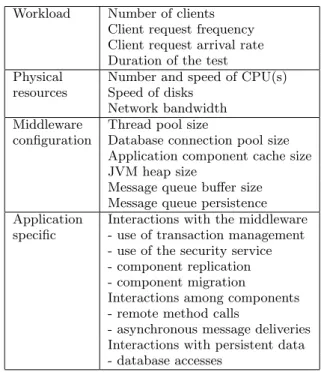
The design of test suites for performance testing is radically different from the case of functional testing. (This has been noticed by many authors, e.g. [24].) In performance testing, the functional details of the test cases, i.e., the actual val-ues of the inputs, are generally of little importance. Table 1 classifies the main parameters relevant to performance test-ing of distributed applications. First, important concerns are traditionally associated with workloads and physical re-sources, e.g., the number of users, the frequencies of inputs, the duration of the test, the characteristics of the disks, the network bandwidth and the number and speed of CPU(s). Next, it is important to consider the middleware configura-tion, for which the table reports parameters in the case of J2EE-based middlewares. Here, we do not comment further on workload, physical resource and middleware parameters, which are extensively discussed in the literature (e.g., [24, 23, 14]).
Workload Number of clients Client request frequency Client request arrival rate Duration of the test
Physical Number and speed of CPU(s) resources Speed of disks
Network bandwidth Middleware Thread pool size
configuration Database connection pool size Application component cache size JVM heap size
Message queue buffer size Message queue persistence Application Interactions with the middleware specific - use of transaction management
- use of the security service - component replication - component migration
Interactions among components - remote method calls
- asynchronous message deliveries Interactions with persistent data - database accesses
Table 1: Performance parameters
Other important parameters of performance testing in dis-tributed settings can be associated with interactions among
distributed components and resources. Different ways of using facilities, services and resources of middlewares and deployment environments likely correspond to different per-formance results. Perper-formance will differ if the database is accessed many times or never. A given middleware may per-form adequately for applications that stress persistence and quite badly for transactions. In some cases, middlewares may perform well or badly for different usage patterns of the same service. Application-specific cases for performance should be given such that the most relevant interactions specifically triggered by the AUT are covered.
The last row of Table 1 classifies the relevant interactions in distributed settings according to whether they take place between the middleware and the components, among the components themselves1 or to access persistent data in a database. This taxonomy is far from complete and we are conducting further studies and empirical assessments in this direction. However, we believe that a taxonomy of dis-tributed interactions is key for using our approach. Based on such a taxonomy, it will be possible to evaluate the performance-relevance of the available use-cases according to the interactions that they trigger. This will allow the se-lection of sets of use-cases adequately representative for the performance of the target application.
Mapping use-cases to middleware
In the initial stages of a software process, software architec-tures are generally defined at a very abstract level. Often, they just describe the business logic and abstract many de-tails of deployment platforms and technologies. One of the expected strengths of our approach is indeed the possibility of driving software engineers through the intricate web of architectural choices, technologies and deployment options, keeping the focus on the performance of the final product. To this end, however, we need to understand how abstract use-cases are mapped to possible deployment technologies and platforms.
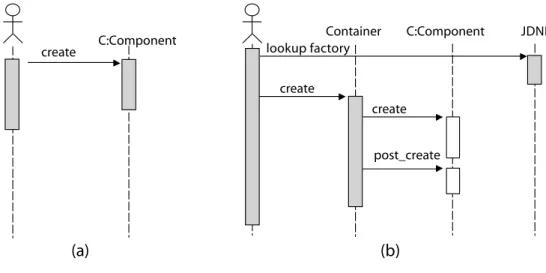
Let us for example consider the use-case fragment in Fig-ure 1(a), which represents in UML the creation of a compo-nentC of typeComponentissued by a client with the
mes-sagecreate. The deployment of such use-case on a
J2EE-based middleware will likely map on a component (namely, an Enterprise Java Bean) with the interactions shown in Figure 1(b). The messagecreatefrom the client will be ac-tually delivered to a component container that is part of the middleware. The middleware will then dispatch the request to the actual componentC with two messages,createand
post create, sent respectively before and after the initial-ization of the support structures for C within the middle-ware. Optionally, the client will use the directory service provided by the middleware, through the Java Naming and Directory Interface (JNDI), to retrieve the component fac-tory responsible for creatingC. Furthermore, we ought to specify the transactional behavior, e.g., whether the method will execute in the context of the client transaction or a newly created (nested) transaction.
1
Although interactions among distributed components map on interactions that take actually place at the middleware level, they are elicited at a different abstraction level and thus they are considered as a different category in our clas-sification.
To address the mapping of abstract use-cases to specific de-ployment technologies and platforms, we intend to leverage recent studies on software connectors [16, 15]. Well charac-terized software connectors may be associated with deploy-ment topologies that preserve the properties of the original architecture. Also, possible implementation alternatives can be defined in advance as characteristics of the software con-nectors. For instance, with reference to example above, we would like to define a component creation connector that provides properties for the case showed in Figure 1(a). Then, we would like to associate with this connector, the J2EE de-ployment topology given in Figure 1(b) and the list of the possible transaction behaviors. Deployment topologies and alternatives might vary for different deployment technologies and platforms. Previous studies on software connectors are precious references in this direction, but further work is still needed to understand the many dimensions and species of software connectors and their relationships with the possible deployment technologies and platforms.
Generating stubs
So far, we have suggested that early test cases of perfor-mance can be derived from instances of architecture use-cases and that software connectors can be exploited as a means to establish the correspondence between the abstract views provided by the use-cases and the concrete instances. However, to actually implement the test cases, we must also solve the problem that not all the application components that participate in the use-cases are available in the early stages of the development lifecycle. For example, the com-ponents that implement the business logic are seldom avail-able, although they participate in most of the use-cases. Our approach usesstubsin place of the missing components. Stubs are fake versions of components that can be used in-stead of the corresponding components for instantiating the abstract use-cases. In our approach, stubs are specifically adjusted to use-cases, i.e., different use-cases will require different stubs of the same component. Stubs will only take care that the distributed interactions happen as specified and the other components are coherently exercised. Our idea of the engineered approach is that the needed stubs are automatically generated based on the information con-tained in use-cases elaborations and software connectors. Of course, many functional details of the missing components are not known and cannot be implemented in the stubs. This results in discrepancies between execution times within the stubs and the actual components that they simulate. The main hypothesis of our work is that performance mea-surements in the presence of the stubs are good enough ap-proximations of the actual performance of the final appli-cation. This descends from the observation that the avail-able components, e.g., middlewares and databases, embed the software that mainly impact performance. The coupling between such implementation support and the application-specific behavior can be extracted from the use-cases, while the implementation details of the business components re-main negligible. In other words, we expect that the discrep-ancies of execution times within the stubs are orders of mag-nitude less than the impact of the interactions facilitated by middleware and persistence technology, such as databases. We report a first empirical assessment of this hypothesis in
create C:Component create Container create post_create C:Component JDNI lookup factory
(a)
(b)
Figure 1: An abstract use-case (a) and its deployment view (b)
Section 4 of this paper, but are aware that further empirical studies are needed.
Executing the test
Building the support to test execution shall mostly involve technical rather than scientific problems, at least once the research questions stated above have been answered. Part of the work consists of engineering the activities of select-ing the use-cases, mappselect-ing them to deployment technologies and platforms, and generating the stubs to replace missing components. Also, we must automate deployment and im-plementation of workload generators, initialization of per-sistent data, execution of measurements and reporting of results. No relevant aspects for research are directly con-nected with this.
4.
PRELIMINARY ASSESSMENT
This section empirically evaluates the core hypothesis of our research, i.e., that the performance of a distributed appli-cation can be successfully tested based on the middleware and/or off-the-shelf components that are available in the early stages of the software process. To this end, we con-ducted an experiment in a controlled environment. First, we considered a sample distributed application for which we had the whole implementation available. Then, we selected an abstract use-case of the application and implemented it as a test case based on the approach described in Section 3. Finally, we executed the performance test (with different amounts of application clients) on the early available compo-nents and compared the results with the performance mea-sured on the actual application.
Experiment setting
As for the target application, we considered theDuke’s Bank applicationpresented in the J2EE tutorial [4]. This appli-cation is distributed by Sun under a public license, thus we were able to obtain the full implementation easily. The Duke’s bank application consists of 6,000 lines of Java code that is meant to exemplify all the main features of the J2EE platform, including the use of transactions and security. We
J2EE Client Application Entity Beans Beans Session Database Table Transactions Customers Accounts EJB Container ClientWeb
Controller Customer Bean
Transaction Bean Customers
Transactions Controller
Accounts
Controller Account Bean
Figure 2: The Duke’s Bank application.
consider the Duke’s bank application to be adequately rep-resentative of medium-size component-based distributed ap-plications. The Duke’s bank application is referred to as DBApp in the remainder of this paper.
The organization of the DBApp is given in Figure 2 (bor-rowed from [4]). The application can be accessed by both Web and application clients. It consists of six EJB (Enter-prise Java Beans [22]) components that handle operations issued by the users of a hypothetic bank. The six compo-nents can be associated with classes of operations that are related to bank accounts, customers and transactions, re-spectively. For each of these classes of operations a pair of session bean and entity bean is provided. Session beans are responsible for the interface towards the users and the en-tity beans handle the mapping of stateful components to un-derlying database table. The arrows represent the possible interaction patterns among the components. All EJBs are deployed in a single container within the application server (which is part of the middleware). For the experiment we used the JBoss application server and the MySql database engine, running on the same machine.
Duke’s Bank Database Update account_from Transfer (account_from, account_to, amount) Update account_to
Log transaction of account_from Log transaction of account_to
Figure 3: A sample use-case for the Duke’s Bank.
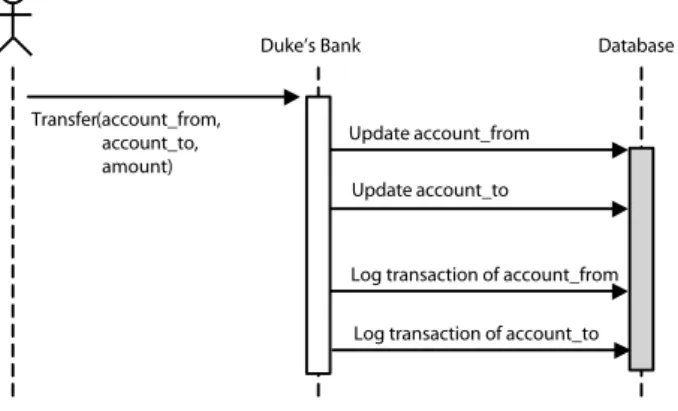
Then, we selected a sample use-case that describes the trans-fer of funds between two bank accounts. Figure 3 illustrates the selected use-case in UML. A client application uses the serviceTransfer provided by the DBApp. This service re-quires three input parameters, representing the two accounts and the amount of money, respectively involved in the trans-fer. The business components of the DBApp realize the ser-vice using the database for storing the persistent data: the database is invoked four times, for updating the balances of the two accounts and recording the details of the corre-sponding transactions. We assume that the database engine is software that is available early in the software process. Thus, for the test, we used the same database engine, ta-ble structure and SQL code than in the original application. This is why we represented the database as a shadowed box in the figure. Differently from the database, the business components of the DBApp are assumed to be not available, thus we had to generate corresponding stubs.
For implementing the stubs, we had to map the abstract use-case on the selected deployment technology, namely J2EE. We already commented on the role that software connectors may play in the mapping. However, our research is not yet mature enough to exploit software connectors for this pur-pose. Presently, we just manually augmented the use-case with the necessary information as follows. As for the inter-action between the clients and the DBApp, we specified that the service Transfer is invoked as a synchronous call and starts a new transaction. As for the interaction between the DBApp and the database, we specified that: the four invoca-tions are synchronous calls that take place in the context of a single transaction and embed the available SQL code; the database connection is initialized for each call; the DBApp uses entity beans and bean managed persistence2 to handle the interactions with the database tables. Based on this in-formation, we implemented the stubs as needed to realize the interactions in the considered use-case and we deployed the test version of the DBApp (referred to as DBTest) on the JBoss application server.
2
Entity beans are J2EE components that represent persis-tent data within an application. Each database table is as-sociated to an entity bean. The data in the entity bean are taken synchronized with the database. In the case of bean managed persistence the synchronization code is embedded in the entity bean.
Finally, we implemented a workload generator and initial-ized the persistent data in the database. The workload gen-erator is able to activate a number of clients at the same time and takes care of measuring the average response time. For the persistent data, we instantiated the case in which each client withdraws money from its own account (i.e., there exists a bank account for each client) and deposits the cor-responding amount to the account of a third part, which is supposed to be the same for all clients. This simulates the recurrent case in which a group of people is paying the same authority over the Internet. Incidentally, we notice that, in an automated test environment, initialization of persistent data would only require to specify the performance sensi-ble part of the information, while the actual values in the database tables are generally of little importance. For ex-ample, in our case, only the number of elements in each table and the relationships with the instanced use-case, i.e., whether all clients access the same or a different table row, are the real concerns.
With reference to the performance parameters of Table 1, we generated a workload, to test both DBApp and DBTest, with increasing numbers of clients starting from one to one hundred. The two applications were deployed on a JBoss 3.0 application server running on a PC equipped with a Pentium III CPU at 1 G-Hz, 512 M-Byte of RAM memory and the Linux operating system. To generate the workload we run the clients on a Sun Fire 880 equipped with 4 Spark CPU at 850 MHz and 8G-Byte of RAM memory. This two machine were linked to a controlled local area network at 100 M-Bit. Moreover, in order to avoid influences among the experi-ments that could be caused by the contemporary existence of a lot of active sessions beans, we restarted the applica-tion server between two successive experiments. JBoss has been used running the default configuration. Finally the specific setting concerning the particular use case, has al-ready discussed in the previous paragraphs, foresaw the use of remote method calls between the components and the use of the transaction management service, in order to handle, consistently, the data shared by the various bean.
Experiment results
We have executed both DBApp and DBTest for increasing numbers of clients and measured the latency for the test case. We repeated each single experiment 10 times and av-eraged the results. The platform for the experiment was a PC equipped with a Pentium III CPU at 1 G-Hz, 512 M-Byte of RAM memory and the Linux operating system. We also used a private network at 100 M-Bit to avoid the bias of the network traffic.
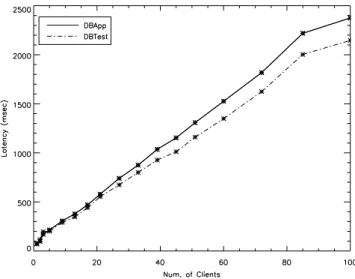
We repeated each single experiment 15 times and measured the average latency time. Figure 4 shows the results of the experiments. It plots the latency time of both DBApp and DBTest against the number of clients, for all the repetitions of the experiment. We can see that the two curves are very near to each other. The average difference accounts for the 9.3% of the response time. The experiments also showed a low value for the standard deviation. The ratio betweenσ and the expectation results, in fact, definitively lower of the 0.15, both for the DBApp and for the DBTest.
Figure 4: Latency of DBApp and DBTest for in-creasing numbers of clients
research because they witness that the performance of the DBApp in a specific use-case is well approximated by the DBTest, which is made out of the early-available compo-nents. However, although the first results are encouraging, we are aware that a single experiment cannot be generalized. We are now working on other experiments to cover the large set of alternatives of component-based distributed applica-tions. We plan to experiment with different use-cases, sets of use-cases for the same test case, different management schemas for transactions and performance, different commu-nication mechanisms such as asynchronous call, J2EE-based application server other than JBoss, CORBA-based middle-wares, other commercial databases and in the presence of other early-available components.
5.
CONCLUSIONS AND FUTURE WORK
Distributed component technologies enforce the use of mid-dleware, commercial databases and other off-the-shelf com-ponents and services. The software that implements these is available in the initial stages of a software process and moreover it generally embeds the software structures, mech-anisms and services that mostly impact the performance in distributed settings. This paper proposed to exploit the early availability of such software to accomplish empirical measurement of performance of distributed applications at architecture-definition-time. To the best of our knowledge, the approach proposed in this paper is novel in software performance engineering.
This paper fulfilled several goals. It discussed the published scientific works related to ours, thus positioning our ideas in the current research landscape. It described a novel ap-proach to performance testing that is based on selecting per-formance relevant use-cases from the architecture designs, and instantiating and executing them as test cases on the early available software. It indicated important research di-rections towards engineering such approach, i.e.: The classi-fication of performance-relevant distributed interactions as a base to select architecture use-cases; The investigation of software connectors as a mean to instantiate abstract use-cases on actual deployment technologies and platforms. It
finally reported on experiments that show as the actual per-formance of a sample distributed application is well approx-imated by measurements based only on its early available components, thus supporting the main hypothesis of our re-search.
Software performance testing of distributed applications has not been thoroughly investigated so far. The reason for this is, we believe, that testing techniques have traditionally been applied at the end of the software process. Conversely, the most critical performance faults are often injected very early, because of wrong architectural choices. Our research tack-les this problem suggesting a method and a class of appli-cations such that software performance can be tested in the very early stages of development. In the long term and as far as the early evaluation of software architectures and ar-chitectural choices are concerned, we believe that empirical testing may outperform performance estimation models, be-ing the former more precise and easier to use. Moreover, we envision the application of our ideas to a set of interesting practical cases:
Middleware selection: The possibility of evaluating and selecting the best middleware for the performance of a specific application is reckoned important by many authors, as we already pointed out in Section 2 of this paper. To this end, our approach provides a valuable support. Based on the abstract architecture designs, it allows to measure and compare the performance of a specific application for different middleware and mid-dleware technologies.
COTS selection: A central assumption of traditional test-ing techniques is that testers have complete knowledge of the software under test as well as of its requirements and execution environment. This is not the case for components off-the-shelf (COTS) that are produced independently and then deployed in environments not known in advance. Producers may fail in identifying all possible usage profiles of a component and there-fore testing of the component in isolation (performed by producers) is generally not enough [21]. Limited to the performance concerns, our approach allows to test off-the-shelf components in the context of a specific ap-plication that is being developed. Thus, it can be used to complement the testing done by COTS providers and thus assist in selecting among several off-the-shelf components.
Iterative development: Modern software processes pre-scribe iterative and incremental development in order to control risks linked to architectural choices (see e.g., the Unified Process [6]). Applications are incremen-tally developed in a number of iterations. During an iteration, a subset of the user requirements is fully im-plemented. This results in a working slice of the appli-cation that can be presently evaluated and, in the next iteration, extended to cover another part of the miss-ing functionality. At the beginnmiss-ing of each iteration, new architectural decisions are generally made whose impact must be evaluated with respect to the current application slice. For performance concerns, our ap-proach can be used when the life cycle architecture is
established during the elaboration phase, because it allows to test the expected performance of a new soft-ware architecture based on the softsoft-ware that is initially available.
We are now continuing the experiments for augmenting the empirical evidence of the viability of our approach, providing a wider coverage of the possible alternatives of component-based distributed applications. We are also working for engi-neering the approach, starting from the study of the research problems outlined in this paper.
6.
ACKNOWLEDGMENTS
The authors would like to thank James Skene for his con-tribution during the preliminary definition of the research ideas presented in this paper.
7.
REFERENCES
[1] S. Balsamo, P. Inverardi, and C. Mangano. An approach to performance evaluation of software architectures. InProceedings of the First International Workshop on Software and Performance, pages 178–190, 1998.
[2] S. Bernardi, S. Donatelli, and J. Merseguer. From UML sequence diagrams and statecharts to analysable Petri Nets models. InProceedings of the 3rd
International Workshop on Software and Performance(WOSP02), pages 35–45, 2002. [3] A. Bertolino, E. Marchetti, and R. Mirandola.
Real-time UML-based performance engineering to aid manager’s decisions in multi-project planning. In Proceedings of the 3rd International Workshop on Software and Performance (WOSP-02), pages 251–261, New York, July 24–26 2002. ACM Press. [4] S. Bodoff et al.The J2EE Tutorial. Addison-Wesley,
2002.
[5] G. Booch, J. Rumbaugh, and I. Jacobson.The Unified Modeling Language User Guide. Addison-Wesley, 1999. [6] G. Booch, J. Rumbaugh, and I. Jacobson.The Unified Software Development Process. Addison-Wesley, 1999. [7] W. Emmerich. Software engineering and middleware.
InProceedings of the 22th International Conference on Software Engineering (ICSE-00), pages 117–132. ACM Press, 2000.
[8] W. Emmerich. Distributed component technologies and their software engineering implications. In Proceedings of the 24th International Conference on Software Engineering (ICSE-02), pages 537–546. ACM Press, 2002.
[9] W. Emmerich and J. Skene. Model driven performance analysis of enterprise information systems. InProceedings of the International Workshop on Testing and Analysis of Component-Based
Systems(TACOS’03), 2003.
[10] I. Gorton and A. Liu. Software component quality assessment in practice: successes and practical impediments. InProceedings of the 24th International Conference on Software Engineering (ICSE-02), pages 555–558, New York, 2002. ACM Press.
[11] I. Jacobson, G. Booch, and J. Rumbaugh.The Unified Software Development Process. Addison Wesley Longman, Reading, MA, USA, 1999.
[12] P. Kruchten.The Rational Unified Process: An Introduction. Addison Wesley Longman, 2000. [13] C. Lin, A. Avritzer, E. Weyuker, and L. Sai-Lai.
Issues in interoperability and performance verification in a multi-orb telecommunications environment. In Proceedings of the International Conference on Dependable Systems and Networks (DSN 2000), pages 567–575, 2000.
[14] Y. Liu, I. Gorton, A. Liu, N. Jiang, and S. Chen. Designing a test suite for empirically-based middleware performance prediction. InFortieth International Conference on Technology of Object-Oriented Languages and Systems (TOOLS Pacific 2002), Sydney, Australia, 2002. ACS.
[15] N. Medvidovic, E. Dashofy, and R. Taylor. On the role of middleware in architecture-based software
development.International Journal of Software Engineering and Knowledge Engineering, 13(4), 2003. To appear.
[16] N. Mehta, N. Medvidovic, and S. Phadke. Towards a taxonomy of software connectors. InProceedings of the 22nd International Conference on Software
Engineering (ICSE-00), pages 178–187. ACM Press, 2000.
[17] P. Merle. CORBA 3.0 new components chapters. Technical report, TC Document ptc/2001-11-03, Object Management Group, 2001.
[18] H. D. Mills. Top-Down Programming in Large Systems. In R. Ruskin, editor,Debugging Techniques in Large Systems. Prentice Hall, 1971.
[19] D. Petriu, C. Shousha, and A. Jalnapurkar.
Architecture-based performance analysis applied to a telecommunication system.IEEE Transactions on Software Engineering, 26(11):1049–1065, 2000. [20] R. Pooley. Using UML to derive stocastic process
algebra models. In Proceedings of the 15th UK Performance Engineering Workshop (UKPEW), pages 23–34, 1999.
[21] D. Rosenblum. Challenges in exploiting architectural models for software testing. InProceedings of the International Workshop on the Role of Software Architecture in Testing and Analysis (ROSATEA), 1998.
[22] B. Shannon. Java 2 platform enterprise edition specification, 1.4 - proposed final draft 2. Technical report, Sun Microsystems, Inc., 2002.
[23] B. Subraya and S. Subrahmanya. Object driven performance testing of Web applications. In Proceedings of the First Asia-Pacific Conference on Quality Software (APAQS’00), 2000.
[24] E. Weyuker and F. Vokolos. Experience with performance testing of software systems: issues, an approach, and case study.IEEE Transactions on Software Engineering, 26(12):1147–1156, 2000.