David A. Shelly
Thesis submitted to the Faculty of the Virginia Polytechnic Institute and State University in partial fulfillment of the requirements for the degree of
Master of Science in
Computer Engineering
Joseph G. Tront, Chair Scott F. Midkiff Randolph C. Marchany
July 29, 2010 Blacksburg, Virginia
Keywords: Black Box Testing, Web Application Security, Web Application Scanners, Vulnerability Detection
David A. Shelly
(ABSTRACT)
The threat of cyber attacks due to improper security is a real and evolving danger. Corporate and personal data is breached and lost because of web application vulnerabilities thousands of times every year. The large number of cyber attacks can partially be attributed to the fact that web application vulnerability scanners are not used by web site administrators to scan for flaws. Web application vulnerability scanners are tools that can be used by network administrators and security experts to help prevent and detect vulnerabilities such as SQL injection, buffer overflows, cross-site scripting, malicious file execution, and session hijacking. However, these tools have been found to have flaws and limitations as well. Research has shown that web application vulnerability scanners are not capable of always detecting vul-nerabilities and attack vectors, and do not give effective measurements of web application security. This research presents a method to analyze the flaws and limitations of several of the most popular commercial and free/open-source web application scanners by using a secure and insecure version of a custom-built web application. Using this described method, key improvements that should be made to web application scanner techniques to reduce the number of false-positive and false-negative results are proposed.
I would like to thank Dr. Joseph Tront for his guidance during the period of my graduate research here at Virginia Tech. I would also like to thank Mr. Randy Marchany for his support during my graduate studies. Their mentorship gave me the confidence I needed to succeed in my research. Additionally, I would like to thank Dr. Scott Midkiff for serving on my advisory commitee and helping me through this involved process. I appreciate the opportunity they provided me with to pursue research in an area which I am interested in, and for allowing me to use the Virginia Tech IT Security Lab and resources for my research. I would like to acknowledge the SANS institute, specifically Johannes Ullrich and Jason Lam, for providing Justin Stein and me with great opportunities in the area of web application security. Working with them ignited my interest in this research area and gave me an excellent starting point for my research. I would also like to thank Justin for being a research colleague of mine while completing his undergraduate research in the IT Security Lab. I would also like to thank the members of the Virginia Tech IT Security Lab, Lee Clagett, Matthew Dunlop, John Paul Dunning, and Stephen Groat, as well as the other members of the IT Security Office, for their friendship and support during my time in the lab. The work I have done would not be the same without their teamwork, insight, and experience.
There are also several commercial vendors who provided trial licenses of their products for my research who I would like to thank. However, due to the stipulations in providing their licenses I will keep their names anonymous.
Last, but not least, I would like to thank my family and friends for their support and encouragement during this process. I would not have been able to succeed if it wasn’t for the inspiration that they provided me.
1 Introduction 1 1.1 Problem Statement . . . 1 1.2 Background . . . 2 1.2.1 Motivation . . . 3 1.2.2 Definitions . . . 4 1.3 Research Questions . . . 5 1.4 Methodology Overview . . . 5 1.5 Expected Results . . . 6
1.6 Results and Organization . . . 7
2 Review of Literature 9 2.1 Web Vulnerability Attacks . . . 10
2.1.1 SQL Injection . . . 11
2.1.2 Cross Site Scripting . . . 14
2.1.3 Session Management . . . 18
2.1.4 Buffer Overflow . . . 21
2.1.5 Malicious File Execution . . . 24
2.2 Web Application Vulnerability Scanners . . . 25
2.2.1 Web Application Scanners in Academia . . . 26
2.2.2 Free/Open-Source Web Application Scanners . . . 27
2.2.3 Commercial Web Application Scanners . . . 29
2.3 Related Evaluation Applications and Techniques . . . 32
2.3.1 Web Vulnerability Scanner Evaluation Applications . . . 32 iv
3.1 Initial Test Bed Prototype . . . 36
3.1.1 Overview and Features . . . 37
3.1.2 Vulnerabilities Implemented . . . 39
3.1.3 Issues . . . 41
3.2 Revised Test Bed Prototype . . . 41
3.2.1 Test Bed Overview . . . 42
3.2.2 Client-Side Features . . . 43
3.2.3 Server-Side Features . . . 45
3.2.4 Vulnerabilities Implemented . . . 46
4 Methodology and Approach 51 4.1 Test Bed Evaluation Method . . . 52
4.1.1 Test Bed Technologies . . . 52
4.1.2 Controlled Environment . . . 53
4.1.3 Black Box and White Box Analysis . . . 54
4.2 Vulnerability Scanner Testing Approach . . . 55
4.2.1 Testing Procedures . . . 56
4.2.2 Limitations of Approach . . . 60
5 Results 62 5.1 Test Techniques . . . 62
5.2 Observations . . . 63
5.2.1 Initial Test Bed Prototype . . . 64
5.2.2 Revised Test Bed Prototype . . . 65
5.3 Analysis . . . 72
5.3.1 SQL Injection . . . 72
5.3.2 XSS Injection . . . 75
5.3.3 Session Management . . . 78 v
5.3.6 Other Findings . . . 83 6 Conclusion 85 6.1 Contributions . . . 86 6.2 Future Work . . . 87 Bibliography 89 vi
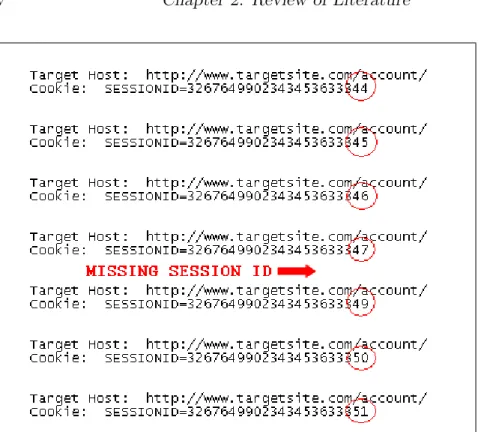
2.1 The output of an example attack to steal a user’s session ID. . . 20
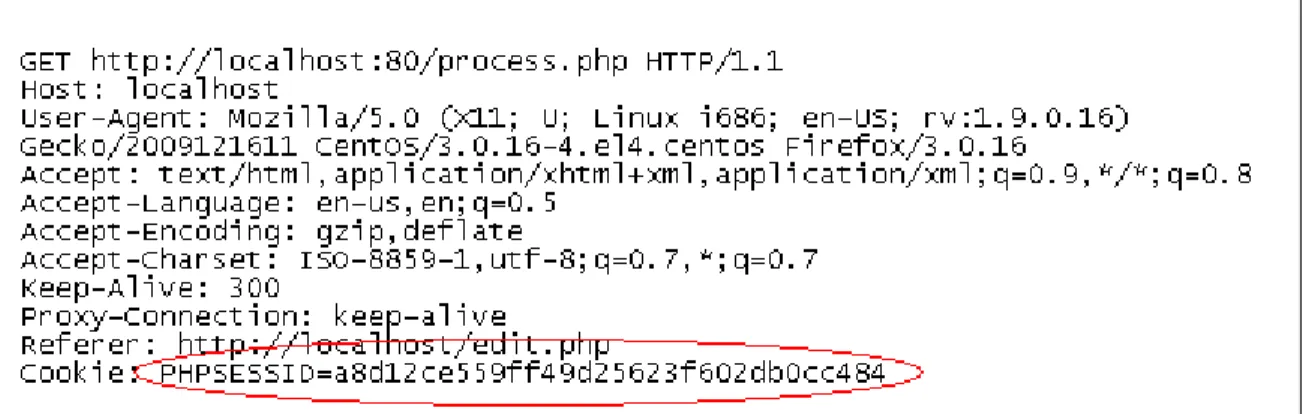
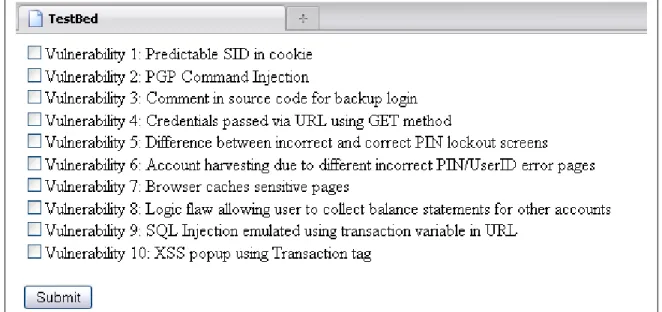
2.2 An example of a cookie using the PHPSESSID variable as a user’s session ID. 21 3.1 The Vulnerability Selection Page for the initial test bed prototype. . . 37
3.2 The main features of the initial test bed web server prototype. . . 38
3.3 The XSS vulnerabilities in the initial prototype. . . 40
3.4 The SQL injection vulnerability in the initial prototype. . . 40
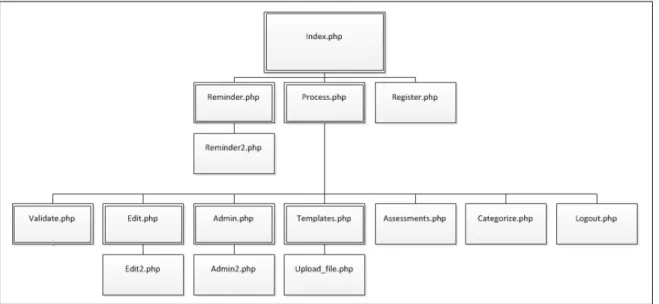
3.5 The layout of the Hokie Exchange web application. . . 44
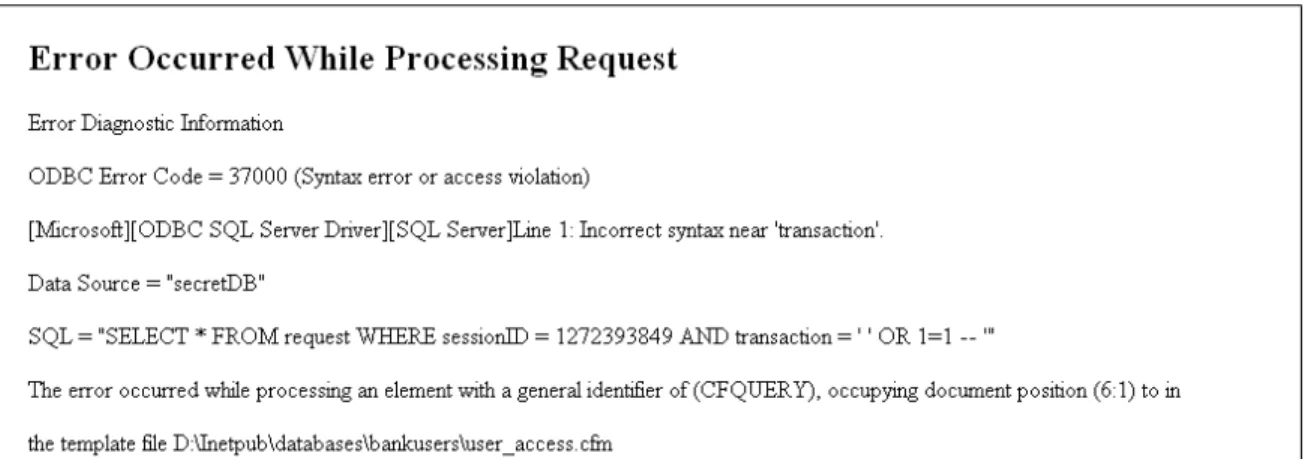
3.6 An SQL injection attack which causes an error message to be displayed that can be used to learn the structure of a table in the Hokie Exchange database. 47 3.7 An alert box which appears due to XSS injection in the DOM of Internet Explorer. . . 47
3.8 A session management vulnerability that allows for the exploitation of unpro-tected cookie variables. . . 48
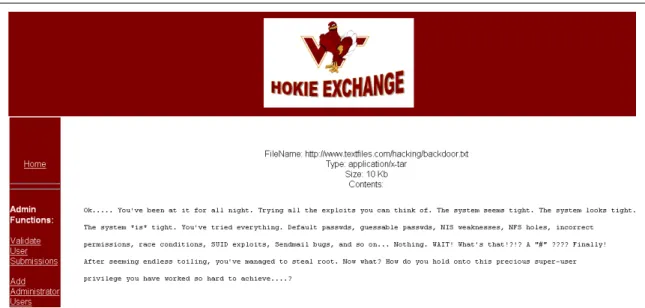
3.9 The result of an RFI attack that retrieves a remote file by exploiting the filename of an uploaded file. . . 49
3.10 The error messages that are displayed after modifying a vulnerable input variable in a function that is susceptible to a buffer overflow. . . 50
4.1 The setup for the experiments connected in a Local Area Network (LAN). . 57
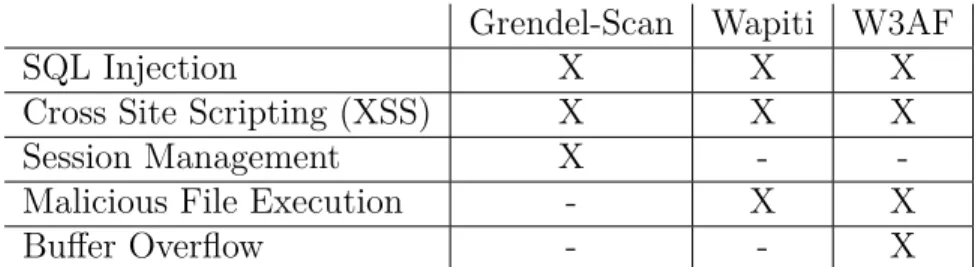
2.1 A comparison of the relevant vulnerabilities detected by free/open-source web
application scanners. . . 28
2.2 A comparison of the relevant vulnerabilities detected by evaluation versions of commercial web application scanners. . . 32
3.1 A summary of vulnerabilities implemented in the Hokie Exchange web appli-cation. . . 50
5.1 Initial Test Bed Prototype Results . . . 65
5.2 SQL Injection Results - Form Inputs . . . 66
5.3 SQL Injection Results - Cookie Variables . . . 66
5.4 XSS Injection Results - Reflected . . . 67
5.5 XSS Injection Results - Stored . . . 67
5.6 XSS Injection Results - DOM-based . . . 68
5.7 Session Management Results - Predictable SID . . . 68
5.8 Session Management Results - Sensitive Cookie Variable . . . 69
5.9 Malicious File Execution Results- Remote File Inclusion . . . 69
5.10 Buffer Overflow Results . . . 70
5.11 False Positives - SQL Injection . . . 70
5.12 False Positives - XSS Injection . . . 71
5.13 False Positives - Remote File Inclusion . . . 71
Introduction
This thesis investigates current limitations in the techniques used by web application vulner-ability scanners. The goal of the proposed method and approach is to test web application scanners to discover where false-negative and false-positive results are being produced, and to analyze these results so that improvements can be made to web application scanner tech-niques. This chapter provides an overview of the research that has been conducted. Section 1.1 states the problem area which this research addresses. Background information regard-ing web application security and web application scanners is presented in Section 1.2. The unique research questions that this thesis addresses are reviewed in Section 1.3. An overview of the methodology used is given in Section 1.4. The expected results are discussed in Section 1.5, and finally, Section 1.6 summarizes the results and describes the outline for the rest of this thesis.
1.1
Problem Statement
Web application vulnerability scanners are preferred by many security auditors and web ap-plication administrators because they are typically very easy to use, perform tests relatively
quickly, and identify a wide variety of web application vulnerabilities. However, these tools lack the ability to detect many types of vulnerabilities that exist today because the level of artificial-intelligence currently implemented in their scanning engines is far below where it needs to be. Every web application scanner is faced with the same set of problems, these being that every web application is different, web application scanners operate based off of syntax, web application scanners do not improvise, and web application scanners are not in-tuitive [41]. Because of these problems, web application scanners are plagued with numerous false-positives and false-negatives. This research develops a secure and insecure version of a web application, so that a method to analyze the limitations of web application scanners can be utilized. Solutions to the problems discovered from this analysis can then be proposed in order to improve the techniques used by web application scanners to detect hard-to-find vulnerabilities.
1.2
Background
A study published by Symantec in 2010 [45] found that 75% of the enterprises surveyed admitted to having experienced a cyber attack within the past 12 months. One particular large-sized enterprised admitted that on average they experience about eight or nine attacks per week. Also, 100% of these enterprises experienced cyber losses in 2009, and reported that they spent an average of $2 million annually due to IT security breaches. In another analysis completed by the SANS Institute in 2009 [37], attacks against web applications accounted for more than 60% of the attacks seen on the Internet. Further, more than 80% of these web application vulnerability attacks were due to SQL injection or Cross-Site Scripting flaws in open-source and custom-built applications. As these numbers show, the cyber attacking business is indeed a thriving and profitable one.
The large number of cyber attacks can partially be attributed to the fact that web ap-plication vulnerability scanners are not used by web site administrators to scan for flaws.
Since the scanners are not being used, the proper adjustments are not being made to web applications, and they remain unprotected against attacks. There are many different types of web application attacks, some of which include SQL injection, buffer overflows, cross-site scripting, malicious file execution, and session hijacking. All of these attacks are very dangerous and can result in the loss of data, functionality, and money. Therefore, web ap-plication vulnerability scanners are necessary tools for administrators to use, and should be used regularly.
Research has shown however, that web application vulnerability scanners are not always capable of detecting vulnerabilities and attack vectors. As a result, they do not give an effective measurement of web application security [3, 16, 17, 44, 52]. Generally, the number of vulnerabilities that scanners cover is low, and the number of false-positives is high [3]. Improvements need to be made to the techniques used by web application vulnerability scanners so that they can provide better protection for web sites and their applications. Further motivation behind this research is given in Section 1.2.1, and definitions the reader should be familiar with are given in Section 1.2.2.
1.2.1
Motivation
Web application vulnerability scanners are tools that are used by network administrators and security professionals to help detect flaws in web sites so that they can be repaired before criminals or adversaries take advantage of them. However, since these tools currently have many flaws and limitations, they are an unsuitable method for detecting all of an application’s vulnerabilities and preventing attacks. The motivation behind this research is to provide an analysis of the false-positives and false-negatives reported by web application scanners so that enhancements and improvements can be made to their techniques and better vulnerability detection can be achieved.
1.2.2
Definitions
In order to clarify the terminology that is used throughout this thesis, the definitions of some key terms and commonly misconstrued terms are given here.
Web Server - A program which manages the HTTP service to receive client requests for web-based content. The server handles client requests to ensure that they are in a valid format and that the requested resources exist, before passing the requests on to the web application for processing. Common web server software packages include Apache HTTP Server and Microsoft IIS [38].
Web Application - An application that handles the server-side logic of a web server, and is accessed over the Internet using the HTTP protocol. The three tiers usually associated with a web application are the presentation tier, logic tier, and data tier. The presentation tier is responsible for displaying or receiving data from the client, the logic tier handles the processing of input received from the presentation or data tier, and the data tier provides a mechanism for storing and retrieving data needed by the logic tier [12, 38].
Web Application Vulnerability Scanner - A type of tool that probes web applications for known flaws and vulnerabilities. Usually a set of signatures is used by the scanner to test against various elements of web applications [11]. This type of scanner utilizes what is referred to as the black-box scanning technique because it has no access to the source code of the application which it is scanning. These tools can also be referred to as web application scanners, web security scanners, web vulnerability scanners, or simply, scanners.
Web Crawling - Also referred to as web spidering, this is the technique of automatically browsing a web site in a methodical way to reveal its structure. In many cases, copies of the visited pages are made so that the web application’s resources, such as embedded links and HTML code, can be accessed more quickly.
Vulnerability- In web applications, this is an area of weakness that is susceptible to attack. In order for a web application element to be vulnerable, it must be accessible by an attacker
who possesses the capability to exploit the underlying flaw.
Exploit- In web applications, this is a piece of computer code that attacks a vulnerability to cause unintended or unanticipated behavior. It may take the form of software, data strings, or command sequences, and is usually aimed at gaining control of a system, escalating user privileges, or denying service to the application.
1.3
Research Questions
The main research questions that this thesis aims to address are provided in this section. These questions are used as the basis behind the design of the test bed web server, and also to formulate the method and approach used to discover the limitations in web application scanning techniques. The test bed web server is designed to investigate the following ques-tions:
1) What are the current limitations of web application vulnerability scanners? 2) How can the limitations of web application vulnerability scanners be improved?
3) Is the use of a controlled web server beneficial in analyzing why web vulnerability scanners produce false-positive and negative results?
1.4
Methodology Overview
This research presents a possible method to discover the limitations of web application vul-nerability scanners by utilizing a test bed web server for vulvul-nerability testing and analysis. The web application vulnerability scanners used for this research were selected based on the number and variety of vulnerabilities they probe for, the significance of the vulnerabilities they detect, and the scanning techniques that they use. The web applications that are hosted on the test bed web server are based on the Linux, Apache, MySQL, and PHP framework
(LAMP). This technology framework was selected because of its popularity and wide-spread use. Each web application vulnerability scanner is tested against the web application follow-ing a prescribed approach that includes a set of initialization, execution, classification, and analysis procedures.
By using both a secure and insecure version of a custom-built web application, false-positive and false-negative results can be linked to the techniques used by the scanners to discover vulnerabilities. This association between the techniques used and the positives or false-negatives reported can be used to suggest improvements for web application scanning tech-niques.
1.5
Expected Results
The web application was designed to have both a secure and insecure version so that both false-positive and false-negative results could be analyzed. The secure version of the web application is expected to return the majority of the false-positive results since no vulnera-bilities are intentionally implemented in this version. Therefore, the only vulneravulnera-bilities that would be reported would be incorrectly identified vulnerabilities.
On the other hand, the insecure version of the web application is expected to produce false-negative results due to the fact that intentionally placed vulnerabilities may be missed by the scanners in this server implementation. Since research has shown that the current techniques used by web application scanners are not capable of detecting all vulnerabilities, it is expected that not all of the implemented vulnerabilities will be detected. Therefore, the false-negative results should show which types of vulnerabilities are not being detected by web application scanners.
Even though the insecure version of the web application server can report false-positives, it is expected that the majority of the false-positives will be identified in the secure version of the web application. A sufficient number of false-positive and false-negative results are
antic-ipated so that an analysis can be conducted for each type of vulnerability, and improvements can be proposed that will benefit web application scanner techniques.
It is also expected that if a web application scanner detects one specific type of vulnerability, then it will find all other instances of that same type of vulnerability. The techniques that web application scanners use should be consistent enough so that if they work to find one vulnerability, then a vulnerability that is caused by a similar server flaw will be detected as well.
1.6
Results and Organization
This research makes three significant contributions to the areas of web application security and web application vulnerability scanning. First, the test bed web server was developed which contains both an insecure and secure version of a web application. These two versions of the web application can be used to perform benchmark tests and analyze the coverage of web application vulnerability scanners. The second major contribution that this research presents is an effective method to analyze the limitations of web application vulnerability scanners. The test bed evaluation method, along with the web vulnerability scanner testing approach, have been shown to be successful techniques to unveil why and where vulnerability false-negatives and false-positives occur. The third, and final, contribution of this research is the proposed web application scanner improvements. The analysis of web application techniques identified the reasons why web application scanner techniques were failing, and allowed for the suggestion of new and improved techniques.
The rest of this thesis is organized as follows. Chapter 2 provides a literature review of im-portant web vulnerability attacks, web vulnerability scanners, and web vulnerability scanner evaluations. Chapter 3 describes the design of both the initial and revised test bed web servers. Chapter 4 discusses the methodology and approach used for the tests conducted in this research. Chapter 5 presents the results and analysis that were obtained from the web
application scanner tests. Chapter 6 provides the conclusions of this research, including the lasting contributions, and the direction of future work.
Review of Literature
According to Curphey and Araujo [13], there are eight categories of web application security assessment tools: source code analyzers, web application (black box) scanners, database scan-ners, binary analysis tools, runtime analysis tools, configuration management tools, HTTP proxies, and miscellaneous tools. The most common of these web application assessment tools are source code analyzers and web application scanners. Source code analyzers gener-ally achieve good vulnerability detection rates, but are only useful if the web application’s source code is available. On the other hand, web application vulnerability scanners are the tools which most closely mimic web application attacks, but have been known to perform rather poorly [16, 17, 44, 52].
The web application vulnerability scanner is the type of tool that is analyzed in this thesis because the techniques that these tools currently use to scan web applications need to be improved. Improving the scanning techniques of these scanners will allow them to achieve better performance and, therefore, increase their credibility. However, in order to understand and improve web application scanners, the common vulnerabilities that they aim to detect must be understood first. This review of literature is organized as follows: some of the specific vulnerabilities that web application scanners attempt to probe for will be discussed in Section 2.1, several of the most popular and researched web application scanners will be
discussed in Section 2.2, and related work regarding web application scanner evaluations and techniques will be discussed in Section 2.3.
2.1
Web Vulnerability Attacks
The number of security vulnerabilities that are being found today are much higher in plications than in operating systems [37]. This means that the attacks aimed at web ap-plications are exploiting vulnerabilities at the application level, and not at the transport or network level like common attacks from the past. The Open Web Application Security Project (OWASP) Top 10 [50] provides one of the most highly regarded documents for web application security. The OWASP Top 10 represents a broad consensus of the current most critical web application security flaws, and the list on the release candidate for the OWASP Top 10 for 2010 includes:
• Injection (SQL, OS, LDAP) • Cross Site Scripting (XSS)
• Broken Authentication and Session Management • Insecure Direct Object References
• Cross Site Request Forgery (CSRF) • Security Misconfiguration
• Failure to Restrict URL Access • Unvalidated Redirects and Forwards • Insecure Cryptographic Storage
This list only includes the ten most critical web application risks that exist today, but other important vulnerabilities exist, including buffer overflow exploits and malicious file execu-tion (included on the previous version of the OWASP Top 10 for 2007 [47]). Because the total number of web application vulnerabilities that exist is extremely large, only the most relevant vulnerabilities are implemented and analyzed in this research. The web application vulnerabilities that are most relevant to this research include SQL injection, cross-site script-ing (XSS), session management, buffer overflow, and malicious file execution. Information about these vulnerabilities has been taken from [12, 36, 38, 41, 50].
2.1.1
SQL Injection
A brief overview of different kinds of SQL injection attacks and their defenses will be dis-cussed in this section. The basic definition and fundamental information regarding SQL injection techniques has been taken from Anley [2], Joshi [21], and Spett [39, 40].
Attacks
SQL injection occurs when malicious input is passed into a database interpreter without being properly validated or encoded. In this type of attack the client is attacking the web server database. The input that the attacker passes into the interpreter is crafted to be a legitimate SQL statement, but instead of returning the data that the application’s developer intended, the interpreter now returns the data requested by the attacker. This type of attack is severe because not only can it expose all sensitive user and business related data, but it could even go as far as executing operating system commands or giving an attacker complete control of a web application. An example of a valid SQL query which displays information for the user “John” is:
An attacker could use the malicious user name “' OR 1=1 – ” to cause the interpreter to display all of the user information data in the database. The corresponding SQL query would be:
SELECT info FROM users WHERE username = '' OR 1=1 –
This is one of the simplest types of SQL injection, but works because the leading single quote causes the query to break out of the single quote delimited data. Therefore the always true “OR 1=1” is appended to the query, and thus displays all of the user information data in the database. The double dashes “–” at the end of the query cause all of the text that would follow it to be commented out, because “–” is the comment symbol in this SQL language. Adding the comment symbol is necessary in this attack because it nullifies the rest of the syntax that the web application would normally append to the end of database query to complete the operation. Therefore, the only query that is being executed is the attacker’s injected sequence, and not the web application’s expected query.
Even more dangerous attacks are possible against certain SQL versions and databases as well. An example of this would be if an attacker took advantage of a web application that implements both regular and administrator users, and therefore normally logs in users with default roles, but could also log in a user with administrator roles. If the administrator user has advanced functionality and has the ability to access all of the web application’s data, then the web application can be completely compromised if an attacker takes control of the administrator account. An SQL injection attack could accomplish this if a web application uses email addresses as user names and associates each user name in the database as either a regular or an administrator user. In this example the attacker will exploit a generic “Change Mailing Address” field on a web page and associate an email address of their choosing to the administrator account. The attacker would enter the following in the “Change Mailing Address” field on the web page:
'; UPDATE users SET username = '[email protected]' WHERE username LIKE '%admin%'; –
The semi-colon “;” will end the first query and allow for the attacker’s query to be exe-cuted. This query will cause the email address that the attacker entered to replace the email address that matches the pattern most like “admin”. All that is necessary to perform this attack is for the attacker to “guess and check” until they know that the table holding the accounts is in fact “users”, and that the field holding the user names is in fact “username”. After this, the user name most closely matching “admin” will be replaced with the attacker’s email address, but will continue to have administrative capabilities. Now that the attacker has replaced the administrator’s email address with his own, he can click the “Forgot Pass-word” button that most user-based web applications provide, and have the administrator’s password sent to him in the convenient “Password Reminder” email.
The previously mentioned attack is not always easy to execute because it is not trivial to find out the name of the table and column being used in the SQL database. This challenge is overcome by using two other types of SQL injection: blind SQL injection and error-based SQL injection. Blind SQL injection uses a series of true and false questions to take advantage of the predictability of the WHERE condition in SQL, since 1=1 will always return true. Therefore, if a record is returned when using blind SQL injection, the attacker’s injected condition must have been true. Error-based SQL injection is a specific type of SQL injection that uses SQL error messages to determine the structure of the database. SQL injection statements are crafted by the attacker in a way such that the attacker can use the error responses to systematically unveil table names, column names, column data types, and even specific data entries.
Defenses
The best way to prevent SQL injection is to have all interpreters separate untrusted data from database queries and to only accept expected input [12, 50]. In order to achieve this, all data originating from a client should have special characters escaped or sanitized into a valid format, should use an API which avoids the use of an interpreter entirely, or should use prepared statements and parameterized interfaces. The “mysqli->prepare” mechanism will create prepared statements for MySQL in PHP, and the following code sequence will escape all special characters:
if ( !get_magic_quotes_gpc() ) {
$safe_string = mysql_real_escape_string( $original_string ); }
Also, to protect against blind SQL injection and error message based SQL injection, SQL error reporting should be disabled in conjunction with the other safety measures mentioned above. In order to disable error reporting for MySQL the “@” character should precede commands to suppress on-screen error reporting. These defensive measures should be im-plemented to mitigate SQL injection attacks.
2.1.2
Cross Site Scripting
Three of the main types of cross-site scripting (XSS) attacks, as well as some defensive techniques to protect against them, will be reviewed in this section. For more detail regarding XSS attacks, refer to Endler [14].
Attacks
XSS occurs when a web application includes malicious code in a web page that is sent to a client’s browser without proper content validation. In this type of attack the web page server is attacking the client machine. When the web page is viewed by the client it will execute the malicious script that the attacker embedded into the web page. XSS is the most prevalent web application security flaw [50] due in a large part to its simplicity and resulting severity. Some of the attacks that this type of vulnerability can result in are the hijacking of a user’s session, the defacement of websites, the insertion of hostile content, and the redirection of users’ requests.
Reflective XSS is a type of XSS attack that can occur when a victim follows a URL which contains malicious scripting that is executed when the web page is rendered. This is com-monly done by sending victims legitimate looking e-mail messages that contain malicious script in the message’s URL. Once the HTTP request from the URL is processed, the HTML content is received and displayed in the victim’s browser, thus executing the malicious script. An example of a URL containing a reflective XSS attack that would execute some type of malicious script included the function “malicious()” would be:
http://www.targetsite.com/display.php?user=<script>malicious()</script>
Stored XSS is another type of XSS attack. This type of attack occurs when the mali-cious script is uploaded into the database back end of a server without input validation, and is later retrieved by the web application to be embedded into a web page. This causes every user who visits the infected web page to execute the malicious script in his or her browser. An example of where this vulnerability can be found is a web application that uses a comment section to allow users to view and leave feedback about a product. If an attacker were to leave a comment which included malicious script, the script would be stored as a comment for that product in the database, and then executed every time a user clicks to
view the page holding the comments for that product. An example of this type of attack is a script crafted to steal a user’s cookie and save it in a remote site for exploitation at a later time so that they can perform actions as if they were the victim (such as bank transactions, e-mail correspondence, etc...). The following script would execute such an attack if stored in a web application’s database and then executed in a client’s web browser:
<script>document.write('<img src=“http://www.attackersite.com '+document.cookie+'“)</script>
A third type of XSS attack is Document Object Model, or DOM-based, XSS. This is a different kind of XSS attack because it occurs on the client side when the user is processing the content, instead of on the server side when the web application is retrieving information to put in a web page. The Document Object Model is the standard model that represents HTML and XML content of a web page. The DOM can be modified in this type of attack to execute a malicious script in the victim’s browser. An example of this type of attack would be to exploit a web page that uses some embedded JavaScript in to set the default language for the client using a variable in the URL. An example of this would be:
http://www.mysite.com/index.html#default=English
The malicious script that would exploit this would simply need to replace the variable “En-glish” in the URL. A URL that shows this type of DOM-based XSS attack would be:
http://www.mysite.com/index.html#default=<script>malicious()</script>
Because everything after the # in a URL is not sent to the server by the browser, the malicious script would not be detected by the server even if the server was performing input validation. Therefore the script would be echoed into the page (DOM) when the browser
renders it, and would result in the attacker’s script being executed [49]. Defenses
The same rules described above that apply to protecting against SQL injection, apply to protecting against XSS as well. All user supplied input should be validated and properly escaped before being included in the output web page [50]. This requires the same escaping technique as before, which in PHP is:
if ( !get_magic_quotes_gpc() ) {
$safe_string = mysql_real_escape_string( $original_string ); }
Also, proper output encoding will ensure that the browser treats the possibly dangerous content as text, and not as active content that could be executed. The “htmlentities()” and “htmlspecialchars()” functions in PHP will check output to make sure that it is HTML encoded.
The best way to avoid DOM-based XSS vulnerabilities is to have all client-side input passed to the server for proper validation. However, if using variables in the DOM cannot be avoided, then input validation should occur in the script itself. A check to confirm that the string being written to the HTML page consists of only alphanumeric characters should be completed so that no scripting characters are allowed. A downside of this defensive technique is that the security check is viewable in the HTML code to the attackers, and therefore is easily understandable and attackable [22]. An example of a script which checks that only alphanumeric characters exist in a string is:
document.write(original_string); }
These defensive techniques, although not infallible due to the mentioned limitations, will add a level of protection against attacks that aim to exploit XSS vulnerabilities.
2.1.3
Session Management
Session management vulnerabilities can exist when a web application does not provide a secure mechanism for maintaining a user’s state, both while the user is interacting with the web application, and after the user finishes his session. Attacks to exploit vulnerable session management schemes, as well as defensive strategies to counter these exploits, will be discussed in this section.
Attacks
Session management attacks use flaws in the authentication or session management func-tionality of a web application to impersonate users by stealing a victim’s session IDs. Session IDs (sometimes referred to as session tokens) are pseudo-unique strings that are generated by web applications to maintain session state [28]. Flaws involving session management can result in an attacker controlling some (or even all) of the accounts registered with an application. This could give an attacker full control of a web application if the session ID of a privileged account, such as an administrator account, becomes compromised. Two of the most common methods used by web applications to handle session management is to either include session IDs in the URL, or to use cookies. Exposing session IDs in URLs or in cookies gives attackers the ability to impersonate other users. An example of a URL that exposes a user’s session ID would be:
If the attacker can convince a user to send this URL to them, or if the attacker can view this URL while it is being transmitted, then the attacker will be able impersonate this user. Using cookies to store session IDs is a better approach then using a URL because the ID value is obfuscated and more difficult to abuse since it is not embedded in the URL [28]. However, cookies are still vulnerable to attacks because they can be logged (e.g., using an XSS attack to remotely store a user’s cookie) or socially engineered.
The way in which session IDs are created may result in vulnerabilities as well. If a session ID is simply created using a trivial process, such as a sequential counter or a time stamp, then it may be possible for an attacker to retrieve the session ID of a particular user. Many web sites limit the number of incorrect user name/password attempts to log into a web page, but do not limit the number of incorrect session ID attempts that may be sent to a web server. If this is the case, then an attacker may be able to launch a brute-force attack against a web server to discover a legitimate session ID, and thus hijack a user’s session.
An example of this type of attack would be if an attacker used a tool which constantly visited a web site to receive a session ID and provided an output of all the session IDs received. If the attacker were to run this tool during a time when a potential victim was logging into a web application, then the attacker would know which session ID the victim received, and would be able to mimic that user. An example of output from a type of attack like this can be seen in Figure 2.1. The output shows that the session IDs are indeed sequential, and since there is a gap between the session ID ending in 47 and the session ID ending in 49, the attacker can infer that a legitimate user was given the session ID ending in 48.
Defenses
There are several ways to protect against session management attacks. Making sure that session IDs are not predictable is the first step in providing security for a user’s session. A trusted source that is capable of providing randomness, such as a pseudo-random number
Figure 2.1: The output of an example attack to steal a user’s session ID.
generator, should be used to generate session IDs [12]. In PHP, the PHPSESSID variable can be used as a random session ID to maintain a user’s state. Figure 2.2 shows an HTTP header of a web application that is using the PHPSESSID variable as the session ID in the cookie.
Session IDs should be destroyed by the web server when a user logs out of the web application. This will prevent an attacker from being able to use a session ID to mimic another user if the user’s session ID was for some reason confiscated. To protect even further, session IDs should have a timeout value that causes them to expire after a certain period of time. This way, if a user does not explicitly log out of a web application, the session will expire anyway, and the session ID will not be reusable if an attacker is able to confiscate it.
Also, to protect session IDs from being stolen while in transit, HTTPS or TLS (SSL) con-nections should be implemented to encrypt and protect session IDs. This is especially true if cookies are used that contain sensitive information such as user names, passwords, or user
Figure 2.2: An example of a cookie using the PHPSESSID variable as a user’s session ID. privileges. If this is the case, a message authentication code (MAC) should be calculated for the cookie to preserve its integrity, and then the cookie should be encrypted to prevent eaves-dropping. All of these defensive measures should be implemented in one way or another to ensure the maximum level of security to protect against session management vulnerabilities.
2.1.4
Buffer Overflow
Buffer overflow vulnerabilities have always been a significant problem in computer security because they provide hackers with an attack vector to gain control of a remote computer system. An explanation of how buffer overflow attacks work, and how to protect against them will be discussed in this section.
Attacks
The buffer overflow attack is a popular attack that affects not only web applications, but all computer programs written without proper bounds checking. The vulnerability occurs when an application copies user supplied data into a memory buffer that is not large enough to hold it. This results in the buffer overflowing and causes the subsequent memory blocks to be written with the attacker’s data. This type of attack can be used to corrupt data, crash programs, or even execute malicious code on a web server. However, these vulnerabilities
are often hard to find, and are even harder to exploit [41, 48].
A common way that attackers find these vulnerabilities is by sending large amounts of data as input to a program, and then analyzing the application’s response to see if anything un-usual occurs. If an attacker suspects that a program is susceptible to a buffer overflow he will craft his input so that the information on the call stack of the vulnerable application is overwritten. This causes the function’s return pointer to be set to a value so that it exe-cutes the malicious code that the attacker just inserted into the victim system as data. An example of where a buffer overflow vulnerability could exist is:
char buf[64]; gets(buf);
This would result in a buffer overflow vulnerability because the “gets()” function reads an arbitrary amount of data into a stack buffer. Since the size of the data being read into “buf[]” is not being checked beforehand, more than 64 characters could be read-in and overflow the stack.
According to [48], almost all web servers, application servers, and web application environ-ments are susceptible to buffer overflow vulnerabilities. Languages such as Java and Python are immune to these attacks, and are only vulnerable if the overflow takes place inside the interpreter itself because they automatically provide bounds checking on their functions. Several buffer overflow vulnerabilities have been found in PHP functions over the years. Some examples of these include the “htmlentities(),” “htmlspecialchars(),” “wordwrap(),” and “popen()” functions. The security expert e.wiZz! discovered that the “popen()” func-tion is vulnerable to a buffer overflow in PHP versions 4.2-5.2 [15]. The proof of concept code that was provided is:
$_buff = str_repeat("A",9999);
echo $handle;
If the user supplied input exceeds the memory buffer, the following warning will be dis-played if a vulnerable version of PHP is being used:
Warning: popen(/bin/ls,): Invalid argument in /var/www/html/buf.php on line 3 If a version of PHP is being used that is not vulnerable to the “popen()” buffer overflow vulnerability, the size of the user supplied input will be checked and the output would be: Warning: popen(/bin/ls,): Result too large in /var/www/html/buf.php on line 3
Defenses
To protect against buffer overflow vulnerabilities, code should be written so that the web application only accepts input that is within a specified boundary or size. For web applica-tions, this means validating all input from HTTP request methods so that if a large amount of data is received it can be handled properly.
Many buffer overflow vulnerabilities are due to insecure functions in development languages or server products. The best way to protect against a buffer overflow in these cases is to not use the vulnerable functions or products at all. If this is not possible, then the user should either upgrade to a newer version of the language or product, or apply a patch (if one exists) that corrects the problem. These defensive measures will protect against buffer overflow vulnerabilities if implemented correctly.
2.1.5
Malicious File Execution
Malicious file execution attacks are possible against vulnerable web applications when user supplied input is processed by a web server’s file or stream functions without properly being inspected for hostile content. Possible malicious file execution attacks, as well as defenses against these attacks, will be described in this section.
Attacks
Malicious file execution attacks allow hackers to achieve internal system compromise, per-form remote code execution, and install remote root kits [47]. These types of attacks can affect both the client and the server and often result in Denial of Service (DoS), data theft, session hijacking, and even complete system compromise. One particular type of malicious file execution attack is the Remote File Include (RFI) attack. This type of attack occurs when a web application is tricked into including non-approved remote files with malicious code by accepting filenames or files from an attacker. An example of PHP code that is vulnerable to this attack is:
$file = $_POST["filename"]; include($file.".php");
If the web application does not sanitize the input, a remotely hosted file containing an exploit could be uploaded instead of an expected local or remote file. This exploit could be uploaded either by a local file name, or a URL, because PHP is configured by default to allow both these types of inclusion. For example, when a server executes a transaction or operation that requests a file, an attacker could upload a malicious script that is hosted on a remote machine by using the following as the filename :
This will result in the remote file being included, and therefore executed, on the server. Other PHP commands that are also vulnerable to this same type of attack are “include_once,” “fopen,” “file_get_contents,” “require,” and “require_once” [4].
Defenses
To defend against these attacks, the same counter-measures should be taken which apply to SQL injection and XSS. Escaping special characters will limit the attacks because URLs will be treated as text, and not as active links. The “get_magic_quotes_gpc()” function in PHP checks if a string should be escaped. An even better approach would be to only accept known good input because this would prevent harmful characters from ever being included in the filename to begin with.
In PHP, the “register_globals”, “allow_url_fopen” and “allow_url_include” properties can be disabled in the PHP configuration file to prevent problems related to malicious file exe-cution as well. These properties allow file system functions to use a URL to retrieve data from remote locations, but their functionality is not necessary in most web applications [47]. Therefore, these mitigation techniques should be followed to prevent attacks caused by malicious file execution vulnerabilities.
2.2
Web Application Vulnerability Scanners
There are several web application vulnerability scanners that test for popular vulnerabilities in web servers and web applications. These tools can either be academic research projects, free/open-source applications, or commercial software products. Tools are developed in academia by members of universities who are interested in improving and studying web ap-plication vulnerability scanners, but are generally not available for purchase or commercial use. The open-source/free tools are available to the public, but are generally not as
up-to-date and accurate as the commercial tools. These tools do however, give users the ability to customize their tool and gain a greater understanding of the security of their web appli-cations. Commercial tools usually give more comprehensive results than open-source/free tools, but can cost anywhere from just under $100.00 to over $6000.00 [1, 9]. Specific web vulnerability scanners from these three categories that automatically scan for and detect the most common web application vulnerabilities will be reviewed in this section.
2.2.1
Web Application Scanners in Academia
One of the categories of web application vulnerability scanners includes those that are de-veloped in academia. These scanners are different from free/open-source and commercial scanners because the researchers who work on them are continuously evaluating them and also discuss not only where their design succeeds, but where their design is limited and requires future work. These scanners are not available for public use, so they cannot be used in this analysis of web vulnerability scanner limitations, but reviewing the techniques and methods used by these scanners will help in understanding how other web application scanners work.
Huang et al. developed a web application scanner called WAVES that attempts to reduce the number of potential side effects of black-box testing [18, 19]. The auditing process of web application scanners can cause permanent modifications, or even damage, to the state of the application it is targeting. This is a drawback that both commercial and open-source/free web application scanners share, and is why the authors introduced a testing methodology that would allow for harmless auditing. Their experimental results found that WAVES was unable to detect any new vulnerabilities that were not already detected by a static source code analyzer they had developed. Also, WAVES was unable to discover all of the vulnerabilities that the static source code analyzer had found (detected only 80% of the vulnerabilities found by the static analyzer). The authors believe their tool failed in part because it did not have complex procedures able to detect all data entry points, and because
it was unable to observe HTML output.
Another academic black-box approach was developed by Antunes and Viera as described in [3]. Their web vulnerability scanner was used to identify SQL injection vulnerabilities in 262 publicly available web services. The first step in their approach was to prepare for the tests by obtaining information regarding the web service in order to generate the workload (valid web service calls). The second step was to execute the tests. This was accomplished by using a workload emulator that acted as a web service consumer, and by using an attack load generator that automatically generated attacks by injecting them into the workload test calls. The final step in their approach was to analyze the responses by using a set of well-defined rules which would identify vulnerabilities and exclude potential false-positives. Their results showed that they achieved a detection coverage rate of 81% in the scenario where they had access to the known number of vulnerabilities, and maintained a false-positive rate of 18% in their optimistic interpretation. These results are better than those of the commercial tools that the authors analyzed, and suggests that it is possible to improve the effectiveness of vulnerability scanners.
2.2.2
Free/Open-Source Web Application Scanners
Many open-source and free web application scanners are available for black-box testing and analysis. Some of these applications provide extensive functionality with the ability to be customized and expanded to meet the needs of users. Others however do not provide a great deal of usability and have a limited amount of functionality, and therefore can only test for a few web application vulnerabilities. Three of the more thorough and robust free/open-source scanners, Grendel-Scan [6], Wapiti [43], and W3AF [35], will be reviewed.
Grendel-Scan [6] is an open-source web application security testing tool which has an auto-mated testing module for detecting common web application vulnerabilities. It has the ability to find simple web application vulnerabilities, but its designers state that no automated tool can identify complicated vulnerabilities, such as logic and design flaws. Grendel-Scan tests
for SQL injection, XSS attacks, and session management vulnerabilities, as well as other vulnerabilities.
Wapiti [43] is a free web application vulnerability scanner and security auditor. It performs black-box analysis by scanning the web pages of a web application in search of scripts and forms where data can be injected. After the list of scripts and forms is gathered, Wapiti injects payloads to test if the scripts are vulnerable. Wapiti scans for remote file inclusion errors, SQL and database injections, XSS injections, and other vulnerabilities.
W3AF [35] is exactly what it stands for, a Web Application Attack and Audit Framework. The goal of the project is to create a framework which can find and exploit web applica-tion vulnerabilities easily. The project’s long term objectives are for it to become the best open source web application scanner, and the best open source web application exploitation framework. Also, the designers want the project to create the biggest community of web application hackers, combine static code analysis and black box testing into one framework, and become the nmap [23] of the web. W3AF incorporates a great deal of plug-ins into its framework, and is capable of testing for SQL injection, XSS attacks, buffer overflow, malicious file execution, and session management vulnerabilities. Table 2.1 provides a com-parison of the vulnerabilities that the free and open source web application scanners search for.
Table 2.1: A comparison of the relevant vulnerabilities detected by free/open-source web application scanners.
Grendel-Scan Wapiti W3AF
SQL Injection X X X
Cross Site Scripting (XSS) X X X
Session Management X -
-Malicious File Execution - X X
2.2.3
Commercial Web Application Scanners
Commercial web application scanners are generally licensed to companies or organizations that wish to test their web applications for vulnerabilities so that they can fix security holes before they are maliciously exploited. Since a data breach can result in the loss of personal information of thousands of customers, and the loss of millions of dollars [45], companies are willing to pay large sums of money for these applications. These commercial applications compete against each other for market share, and therefore do not want to disclose their scanner’s limitations or restrictions. However, an approach to analyze these limitations and restrictions is proposed in this thesis. Some of the features of popular commercial web application scanners will be discussed below.
Cenzic [8] sells a web application scanner tool called Hailstorm which utilizes stateful testing. Stateful testing tools are designed to behave like human testers by taking what seems to be an application’s insignificant or disparate weaknesses, and combining them together into serious exploits [11]. The key benefits that Hailstorm claims are the ability to identify major security flaws in target applications, to help with internal compliance policies, to avoid vulnerabilities that lead to downtime, and to assess applications for commonly known vulnerabilities. Cenzic provides a 7-day free trial of Hailstorm Core which can detect vulnerabilities including SQL injection, XSS , and session management.
Acunetix Web Vulnerability Scanner [1] is another black-box tool which claims in-depth checking for SQL injection, XSS, and other vulnerabilities with its innovative AcuSensor Technology. This technology is supposed to quickly find vulnerabilities with a low number of false-positives, pinpoint where each vulnerability exists in the code, and report the debug information as well. Acunetix also includes advanced tools to allow penetration testers to fine tune web application security tests, and has many more features to scan websites with different scan options and identities. The only vulnerability that the free edition of the software detects is XSS, but a 30-day trial version of the product is available that also can detect SQL injection, file execution, session management, and manual buffer overflow
attacks.
N-Stalker [29] provides a suite of web security assessment checks to enhance the overall security of web applications. It is founded on the technology of Component-oriented Web Application Security Scanning, and allows users to create their own assessment policies and requirements, enabling them to check for more than 39,000 signatures and infrastructure security checks. Vulnerabilities checked for include SQL injection, XSS attacks, buffer over-flows, and session management attacks, but the evaluation edition only lasts for a 7-day period.
Netsparker [24] is a web application vulnerability scanner developed by Mavituna Security Ltd. Netsparker is focused on eliminating false-positives, and uses confirmation and exploita-tion engines to ensure that false-positives are not reported. The engines also allow the users to see the actual impact of the attacks instead of text explanations of what the attack could do. Because of the techniques Netsparker uses, Mavituna Security claims that it developed the first false-positive free web application scanner. Netsparker scans for all types of XSS injection, SQL injection, malicious file execution, and session management vulnerabilities. Burp Scanner [33] is a web application vulnerability scanner that is part of Burp Suite Professional. Burp Suite Professional is the commercial version of Burp Suite, which is an integrated platform for attacking and testing web applications. Burp Suite provides a number of tools, including an interception web proxy, web spider, application intruder, session key analyzer, and data comparer. The professional version includes Burp Scanner which can operate in either passive or active mode, and either manual scan or live scan mode. The vulnerabilities it searches for include SQL injection, XSS injection, and session management vulnerabilities.
Rational AppScan [20] is licensed by IBM for advanced web application security scanning. The AppScan tool automates vulnerability assessments and tests for SQL injection, XSS attacks, buffer overflows, and other common web application vulnerabilities. AppScan can generate advanced remediation capabilities in order to ease vulnerability remediation,
sim-plify results with the Results Expert wizard, and test for emerging web technologies. Rational AppScan provides an unlimited evaluation period for its standard edition; however, with the evaluation license the software is only capable of testing a test web site provided by AppScan. BuyServers Ltd. [5] sells a web vulnerability scanner called Falcove which is a 2-in-1 scanning and penetration tool, meaning that it not only tries to detect vulnerabilties, but is capable of exploiting them as well. Falcove utilizes a crawler feature that checks for web vulnerabilities, audits dynamic content (password fields, shopping carts), and generates penetration reports that explain the security level of the tested web site. However, BuyServers Ltd. no longer supports the trial version of the product that detects SQL injection, XSS, and file execution attacks.
HP’s WebInspect [7] software provides web application security testing and assessment for complex web applications. WebInspect claims fast scanning capabilities, broad security as-sessment coverage, and accurate web application security scanning results. HP also believes WebInspect identifies security vulnerabilities that are undetectable by traditional scanners by using innovative assessment technologies such as simultaneous crawl and audit, and con-current application scanning. HP WebInspect scans for data detection and manipulation attacks, session and authentication vulnerabilities, and server and general HTTP vulnera-bilities, but does not currently provide a working evaluation version of the product.
NT OBJECTives’ NTOSpider [32] is a web application security scanner that claims to pro-vide automated vulnerability assessment with unprecedented accuracy and comprehensive-ness. NTOSpider identifies application vulnerabilities and ranks threat priorities, as well as produces graphical HTML reports. NT OBJECTives’ proprietary S3 Methodology and
Data Sleuth intelligence engine are employed for automation and accuracy, and checks vul-nerabilities on a case-by-case basis, which provides context-sensitive vulnerability checking. NTOSpider checks for SQL injection, XSS attacks, and session management vulnerabilities, but does not provide a trial version for evaluation.
Table 2.2: A comparison of the relevant vulnerabilities detected by evaluation versions of commercial web application scanners.
Hailstorm N-Stalker Netsparker Acunetix Burp Scanner
SQL Injection X X X X X
Cross Site Scripting (XSS) X X X X X
Session Management X X X X X
Malicious File Execution - - X X
-Buffer Overflow - X - X
-versions of the commercial web application scanners detect.
2.3
Related Evaluation Applications and Techniques
Several studies evaluate the usefulness of web application vulnerability scanners. However, no significant previous work has been identified that specifically aims at finding ways for tool improvement by using a vulnerability benchmark system. In Section 2.3.1 some of the web applications available for conducting web vulnerability scanner evaluations will be introduced. Section 2.3.2 describes some of the approaches and results found in the literature regarding web vulnerability scanner evaluations.2.3.1
Web Vulnerability Scanner Evaluation Applications
There are a number of tools such as WebMaven’s BuggyBank [34], and Foundstone’s Hacme Bank [25], Hacme Shipping [26], and Hacme Travel [27] which can be used both to eval-uate web vulnerability scanners and to train users about web application security. These applications emulate several security flaws such as SQL injection, buffer overflows, cross-site scripting, and authentication/authorization flaws. These applications allow users to safely and legally attempt real exploits against web applications so that they can learn about security flaws and fix these issues in their own applications.
vulnerability scanners. Scanners can be evaluated based on the known number of built in vulnerabilities in the web applications, and the corresponding number of vulnerabilities that the scanners detect. However, these applications are not built to mimic the functionality of real web applications, and therefore do not always represent the type of behavior actually seen on the web. Also, some web application scanner vendors are aware of the fact that users test their scanners against these vulnerable applications, and therefore pre-program their tools to report the vulnerabilities that have already been discovered [44].
2.3.2
Web Vulnerability Scanner Evaluation Techniques
Most evaluation techniques consist of using existing web applications that are publicly avail-able on the web for judging web vulnerability scanner performance [17, 44, 52]. This tech-nique is common because it allows researchers to test scanners against multiple websites that they believe include vulnerabilities. Another type of evaluation technique [16] is based on developing a benchmark web application where the features installed and tested are control-lable. The test bed web server approach described in this paper follows this latter technique for conducting its scanner limitation analysis.
Application security consultant, Larry Suto, conducted an experiment in order to find the accuracy and time needed to run several commercially available web application security scanners [44]. The author conducted his tests using a ‘Point and Shoot’ method, as well as a ‘Trained’ scan method, against vendors’ own test sites. In the ‘Trained’ scan, the tools were made aware of all the pages that they were supposed to test in order to mitigate the limitations of the crawler in the results. The ‘Point and Shoot’ method utilized only the default configuration without specifically being made aware of the pages to test. The results found that the best scanners achieved 94%, 62%, and 55% accuracy rates in ‘Trained’ mode, but that the other scanners only averaged a 39% accuracy rate overall (61% false-negatives). The results also showed that only moderate improvements were gained from normal training, and that the scanners that missed the most vulnerabilities tended to also report the most
false-positives.
An experiment comparing web vulnerability scanning tools for SQL injection and cross-site scripting attacks was conducted by Fonseca, Vieira, and Madeira [17]. In order to make clear the coverage and false-positive rates of vulnerability scanning tools, they proposed a method to benchmark and evaluate automatic web vulnerability scanners by using software fault injection techniques. The software faults were injected into the code of two web appli-cations. They were then checked with three commercial web vulnerability scanners to test if the potential vulnerabilities created by the injected faults were detected. Their results showed that the percentage of false-positives is considerably high, ranging from 20% to 77%. The authors’ analysis found that most of the false-positives were caused by errors issued by the web application in normal execution due to the fault injected. The authors’ results also found that 9% of the total vulnerabilities injected were not detected by the automatic vulnerability scanners. The authors believe that some of these false-negatives occurred be-cause the vulnerability scanners were using a black-box approach that has trouble detecting second order vulnerabilities.
Another experiment conducted by Vieira, Antunes, and Madeira used web security scanners to detect vulnerabilities in web services to further show the limitations of scanners due to the high number of false-positives and low coverage of vulnerabilities [52]. The authors evaluated 300 publicly available web services for SQL injection, XPath injection, code execution, buffer overflow, user-name/password disclosure, and server path disclosure vulnerabilities. The number of false-positives reported was high for three out of the four scanners, and the coverage of vulnerabilities was less than 20% for two of the scanners. Further analysis found that all the XPath injection and code execution vulnerabilities were detected (no false-positives), but that all of the user-name/password disclosure vulnerabilities were in fact false-positives. Their results also showed that SQL injection is the most predominant vulnerability (accounting for almost 85% of all the vulnerabilities detected).
vulnera-bility types on and off at different defense levels. The vulnerabilities that were implemented ranged from those easily exploitable to the unbreakable. Their evaluation of the test suite used both open-source and proprietary web application scanners, but the tests were limited to only cross-site scripting, SQL injection / blind SQL injection, and file inclusion. Their results showed that there is a noticeable decrease in the tools’ detection ability as the level of defense increases. This suggests that the test suite is an effective method to distinguish web scanners based on their vulnerability detection rate. The authors also believe that an implementation technique, such as the one utilized, would be useful in identifying areas for tool improvement. This is the objective of the test bed approach presented in this thesis. These evaluations confirm that current web application vulnerability scanner techniques are lacking in their approach. The high number of false-positives and false-negatives that are reported need to be reduced, and a technique to consistently achieve relatively low false-positive and false-negative rates should be developed. The design of a test bed web server that can be used to analyze these limitations is discussed in Chapter 3.
Test Bed Design
Two prototypes were used to conduct the analysis on the limitations of web application vulnerability scanners. The initial test bed prototype only included 11 total instances of 10 different vulnerabilities, but the revised test bed prototype included 50 total instances of five different vulnerabilities. The initial prototype was beneficial for learning different kinds of web application technologies and vulnerabilities, but was not practical for completing a full analysis on the limitations of web application scanners. The revised prototype was therefore developed so that more instances of testable vulnerabilities could be included. A description of the initial test bed prototype is given in Section 3.1, and the design of the revised test bed prototype is discussed in Section 3.2.
3.1
Initial Test Bed Prototype
The initial test bed design is based on the WebMaven BuggyBank web application which was originally developed by David Rhoades of Maven Security and released under the GNU General Public License (GPL) [34]. WebMaven is described as an interactive learning envi-ronment for learning web application security safely and legally. The web site is designed
to mimic an online-banking application, and emulates several security flaws in its operation. BuggyBank is also used as a benchmark application for testing web vulnerability scanners and audit tools, as mentioned previously in Section 2.3.1. Several of the key client and server-side features of the initial test bed prototype are described in Section 3.1.1, the vul-nerabilities and security flaws that exist in the initial prototype are reviewed in Section 3.1.2, and issues with the initial prototype design are discussed in Section 3.1.3.
3.1.1
Overview and Features
The initial prototype was installed on an Apache server and is primarily composed of a combination of different Perl CGI scripts. The web application also includes HTML pages for instructions and documentation, and back-end databases for storing session information, passwords, and account information. In order to build the CGI script that provides the main functionality of the web application, users must select which vulnerabilities they want embedded in the web application. Figure 3.1 shows a screen-shot of the PHP page that is used to build the CGI script. Depending on which vulnerabilities the users choose to