Mathematical Modeling as a Method of Solving
Socio-Ecological Problems
E.N. Chekanushkina
Federal State Budgetary Educational Institution of Higher Education «Samara State Technical University»
D.F. Pirova
Federal State Budgetary Educational Institution of Higher Education «Samara State Technical University»
L.A. Kolyvanova
Federal State Budgetary Educational Institution of Higher Education «Samara State Social and Pedagogical University» [email protected]
Abstract—Time perspective thinking is among professional competence components of future technical specialists with regard to environmental training. The paper substantially focus on learning of the module named “Geographic Information Systems in Environmental Studies and Natural Resources Management” by the students. The mathematical model method is used in teaching of environmental subjects to students. The test method of L.A. Regush called “Forecasting Capability” is the leading method in our study. It allows identifying predictive capabilities of 345 students in two institutions of higher education in the city of Samara. The research findings prove the dependency of development of students’ predictive capabilities on the use of the mathematical model method in learning environmental subjects. This method fosters development of time perspective thinking of students that is crucial for the effective resolution of the professional issues in the field of ecolog.
Keywords—mathematical modeling, time perspective thinking, professional competence, environment
I. INTRODUCTION
Currently, in complicated health conditions, for any Various forms of anthropogenic impact negatively affecting the environment lead to disturbances and changes in ecological systems. After analyzing the state of major water basins in Europe, the World Bank notes that the tributaries of the Volga (Oka, Kama) are very polluted and some parts are “extremely polluted”. According to scientists, a particular responsibility for the sustainable development of nature and society rests with the higher technical schools that highlights the relevance of environmental training of future specialists in modern production conditions.
A. Rationale of the issue
In training of engineers, it is important to ensure the sustainability in acquisition of multidisciplinary environmental knowledge, adequate perceptions about interaction in the
personal qualities required in future professional activities in a context of uncertainty. Scientists note that “in current development conditions, the project engineering is the leading method in training of competitive professionals with high level of expertise meeting market requirements” [8], “project-based training is a necessary component in developing of professional competences” [2].
It is important to emphasize that Russian institutions of higher educations are active in introducing the project-based learning technology that is a part of the process of teaching future specialists. Thus, for more than six years the National Research University “Higher School of Economics” has been implementing project teaching as a compulsory part of bachelor programs. Considerable attention is given to the interdisciplinarity of projects and to the involvement of students in solving project tasks on scientific and social themes. Moscow Polytechnic University “implements introduction of project teaching in the framework of the large-scale transformation of the university and considers bringing the university closer to the needs of economic sectors and real professional practice as its principal objective” [7].
The theoretical analysis of scientific literature shows that “nowadays, project technology is one of effective ways for organizing the educational environment that meets modern conditions and requiremedonts” [5], university ideas turn into successful technological startups around the world [7].
A special attention is given to project activities of students in the process of environment training at the level of higher education.
B. Current trends
The Volga Recovery” project is one of the priority projects at the federal level that is under implementation from 2018 to 2024. The project proposes the objective, specific tasks on its implementation, key planned activities aimed at pollution Modernity and Innovations (ICDATMI 2020)
rehabilitation of water objects and ecosystems. The passport approved by the Presidium of the Council of the President for Strategic Development and Priority Projects presents fundamental provisions, the scope of the project, phases and milestones on its implementation that highlights the importance of the study within the context of the project activities of students.
C. Modern methods of solving environmental problems.
Currently, various methods for solving environmental issues are being implemented such as extrapolation, scrip writing, expert assessments, and mathematical modeling. The works of foreign scientists that consider numerical models of ocean and atmosphere circulation with the application of the data assimilation method [12] and various mathematical methods for forecasting the ocean state are of particular interest [11]. According to V. A. Shepetova “modeling is necessary for accelerating the search for the optimal functioning of natural and technical systems, for reducing the risk of causing irreversible changes in ecosystems. Modeling provides a quantitative description of connections and functioning of complex natural systems in an environment where many factors are inaccessible to observation” [9]. It is impossible to solve a number of important environmental problems without preliminary mathematical modeling.
Therefore, the method of mathematical modeling is the most effective method for forecasting and solving socio-environmental problems and sustainable development of the Volga basin and the Volga river.
The scientists proved that the measurement of the complex parameters of the models under consideration may not be reflected by a single indicator, thus a need appears to use various indicators that allow us to track, analyze the pace of development and key tasks of the government policy in setting up the strategies for the future. These parameters allow, if necessary, to make adjustments in the development strategy of the Volga basin.
Considering some environmental indices we can describe indicators of sustainable development of the Volga basin.
1. Index of anthropogenic load on territory:
* , 1 i аn I n I
where “
is a ratio of actual forest coverage to the optimal one,I
i(
i
1
,
n
)
are indices of anthropogenic pressure
1
i
is a vehicle density,2
is emission ofCO
2,
3
isdisposal by dilution to
V
(total volume of waste water),V
4
to land area,5
is population density,6
is a birthrate,
7
is mortality,8
is overall incidence,9
is disability)” [10].Specific pollution ratios
(
e
z)
and specific consumption of natural resources(
e
N)
: ,
GDP
Z
e
z
GDP
,
N
e
N
where “
Z
is a volume of pollution,GDP
is gross Russian product,N
consumption of natural resources” [1].Algebraic transformation of these indicators may lead to some generalized condition of sustainable development of the Volga basin.
On the grounds of the analysis of various indicators and development characteristics as well as water resources management forecasting, a three-dimensional model of hydrodynamics is designed based on the Navier-Stokes equations and the continuity equation for an incompressible fluid. After transforming the equations, we get a model that describes the characteristics of pollution by modifying various parameters: ( ) 0, h c R kc y c D y x c D x y c v x c u t c h x y
where
h
is depth of water(
m
),
с
is concentration of pollutants(
mg
/
l
),
t
is time(
s
),
U
is speed inx
(
m
/
s
),
v
is speed of movement(
m
/
s
),
D
x
isturbulence diffusivity coefficient in
x
direction
(
/
),
2
s
m
D
y
is turbulence diffusivity coefficient iny
direction(
/
),
2
s
m
k
is a decay constants
1,
isa local source of pollution (measure of concentration/second),
)
(
s
R
precipitation/evaporation (concentration unitx
(
m
/
s
).
We use empirical formulas for determination of turbulence diffusivity coefficients:
D
x
5
,
39
hu
*,
where
h
is depth of water,
0 *u
is a friction velocity,
0
is an average tangential force,
is waterdensity.
where
0.6is Fisher’s coefficient. We select and establish such boundary conditions as flow velocity,
/
3
.
53
3s
m
Q
and H 4.5mgeodetic velocity todetermine the concentration of pollutants.
It has been found that after 7 hours the concentration of the pollutant becomes permanent. Among the “various indicators of water flow quality, two main indicators closely related to each other can be identified:
1) a measurement of the rate of absorption of oxygen by water in the course of decomposition of organic materials (BOD);
2) the amount of oxygen dissolved in a given volume of water (DO).
It should be noted that when the DO parameter falls below a certain level, fish dies in the river” [3].
In countries with developed industry, it happens that waste water is discharged into rivers. The Volga basin is not an exception. It is necessary to clean up polluted water to the required level of BOD for protecting the environment and maintaining the water balance of water basins.
“Considering the water quality, we determine the evels of
BOD (
k
i,
mg
/
l
) and DO (s
i,
mg
/
l
) at a certain mid-pointof this water reservoir” [4]. It is necessary to mention that the flow parameters and current variables have the same values throughout the water reservoir, and the indicators
k
iands
iat the outlet of the water reservoir are equivalent to similar indicators at the inlet. 1
~
;
1 i E i i E i i i E i i i i i i iV
S
m
V
S
k
V
S
S
k
V
S
k
L
k
(
)
1~
1,
2 i i i i i i E i i i i p i iV
k
L
s
V
S
S
s
V
S
s
s
L
s
“where
V
i
is a level of water in the basin,ml
;S
E
inflow speed in the basin,ml
/
day
;L
1i
is the reduction rate ofBOD variable in the basin per day;
L
2i
is the rate of DOchange per day;
S
i
is the speed of water passage throughthe basin,
ml
/
day
;
p is
is the saturation level for DO in
the
i
basin,mg
/
l
;
i iV
is the change in DO due to the formation of precipitation,
mg
/(
1
day
)
;m
i
is theconcentration of BOD in the inflow of the basin,
mg
/
l
; ik
~
and
~
s
i
concentration of BOD and DO,mg
/
l
, that aredetermined by the water characteristics of the basin streams” [3].
We chose the following acceptable coefficient values in the equations:
L
1i
0
.
32
,
L
2i
0
.
29
,
1
.
0
,
i iV
,
19
.
4
i EV
S
s
ip
10
,
0
.
1
,
i EV
S
.
9
.
0
i iV
S
The equations look as follows for the
i
basin: . 9 . 1 ) ( ~ 9 . 0 19 . 4 ) ( ~ 9 . 0 ) ( 0 1 . 0 ) ( ) ( 29 . 1 0 0 32 . 1 ) ( ) ( t s t k t m t s t k t s t k dt d i i i i i i i
This model describes only one basin and considers only one point of discharge of renovated water. In the absence of additional data and the presence of many discharge points, we can assume that in the cascade of many water reservoirs each of them has the properties of the above model. For
)
(
~
),
(
~
t
s
t
k
i i we get:
s j j i j it
a
k
t
k
1 1(
);
)
(
~
s j j i j it
a
s
t
s
1 1(
),
)
(
~
where 1, 1
s j j a
j
0
,
1
2
...
s.
The phase vector of the system has the following view:
x
col
(
k
1(
t
),
s
1(
t
),
k
2(
t
),
s
2(
t
),
k
3(
t
),
s
3(
t
))
x
i(
t
)
T,
i
1
.
6
.
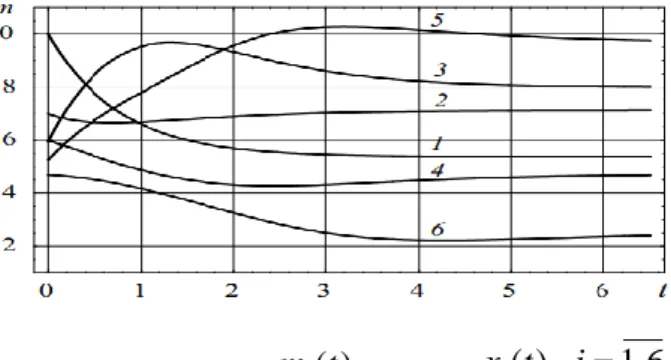
During the calculations, we use the algorithm for phase vector extension, the symbolic construction of the ordinary differential equation system for the vector of mathematical expectations and the covariance matrix, as well as the numerical integration of the constructed ordinary differential equation system. Figure 1 shows the results of these calculations.
Fig. 1. Mathematical expectation
m
i(
t
)
of functionx
i(
t
),
i
1
.
6
.
The above-mentioned theoretical model allows us to analyze the pollution characteristics of the Volga River on substituting various parametersThe numerical models of ocean and atmosphere circulation that we have examined using the data assimilation method, as well as various mathematical models for predicting the state of the ocean are integrated into the development of educational projects for students of specialized universities. The implementation of mathematical modeling methods in the educational process facilitates development of predictive thinking among students, the acquisition of practical experience in solving real social and environmental problems.
In the framework of the study, the predictive capability of students is of particular importance in selecting vital strategies in the professional activity of future specialists.
The main objective of our study is in finding out the relationships between the indicators of predictive capabilities of students in specialized universities and their ability to solve socio-environmental problems with the use of mathematical modeling.
Methodological grounds.
The basis of the study. We have carried out the empirical study on the basis of two universities. They are the Federal State Budgetary Educational Institution of Higher Education “Samara State Technical University” (SSTU), the Department of Petroleum Engineering, programs 21.03.01 Oil and Gas Engineering and 18.03.02 Energy and Resource-Saving Processes in Chemical Engineering, Petrochemistry and Biotechnology and the Federal State Budgetary Educational Institution of Higher Education “Samara State Social and Pedagogical University” (SSSPU), the Department of Natural Science and Geography, program 05.03.06 Ecology and Nature Management, specialization of “Ecology”, “Ecology” discipline under the “Geographic Information System in Ecology and Nature Management” module. Respondents, numbering 345 people, are the students of Years Ι-ΙΙΙ.
Study methodology. The study of the predictive capability of students has been carried out according to the method of L.A. Regush. The scientist notes that these abilities are “the set of characteristics of cognitive processes of students that determine the success of forecasting in any activity, including the predictive one” [6].
According to the author of the method, there are two levels of development of the predictive capabilities of a person: the cognitive one that includes six qualities of thinking (awareness, analyticity, evidentiality, flexibility, prospective viability, profoundness) and the personal one based on responsibility, erudition, organized nature, purposefulness and other characteristics of the respondents.
We have tested the outlined indicators among students of the experimental group with the use of “Forecasting Ability” test that allows identifying the level of forecasting ability (low (L), medium (M), high (H)) at the ascertaining and final stages of the study (Table 1).
TABLE I. DIAGNOSTIC RESULTS OF THE FORECASTING ABILITY OF UNIVERSITY STUDENTS AT THE ASCERTAINING STAGE OF THE STUDY (IN %)
Levels of forecasting ability
Students of the SSTU Students of the SSSPU
L M H L M H awareness 10 28 62 5 30 65 analyticity 51 45 4 45 38 17 evidentiality 48 42 10 50 41 9 flexibility 12 64 24 20 58 22 prospective viability 14 36 50 18 42 40 profoundness 41 45 14 36 50 14
Study results. The analysis of the results obtained has showed the low level of development among students of the SSTU and SSSPU in such mental operations as analyticity (51%; 45%) and evidentiality (48%; 50%) respectively. Based on this, we can conclude that the respondents of two universities experience some difficulties with the implementation of logical analysis and data synthesis (analyticity) and the validity of conclusions and judgments by selecting certain arguments (evidentiality), that leads to difficulties in solving professional tasks (goal setting, planning, goal achievement, etc.).
However, the results demonstrating students' desire to obtain professional knowledge that increase their competitiveness in the labor market (awareness) are as follows: 62% belong to the students of the SSTU and 65% to the respondents from the SSSPU.
In order to increase the above indicators, the method of mathematical modeling was used when teaching the module "Geographic Information System in Ecology and Nature Management" to students studying at the specialization of "Ecology" as this method considers the range of issues related to geographic information systems in environmental studies, computerized mapping, the use of these technologies in landscape design and environmental monitoring.
As the result of using the method of mathematical modeling, students acquire the following: theoretical aspects of the connections of mathematics and geographic informatics with ecology, geosciences and most significantly with cartography and remote sensing; the role of scientific discipline in the study of environmental and socio-natural geosystems, as well as basic practical methods and technologies for collection, storage, processing, analysis,
modeling, presentation of results in geographical information systems.
As is well known, mathematical methods are used in all natural sciences that allows forming the specific content of the methods of analysis to study the theme-based model of research, the nature of its practical relationships. Priority research subjects for students in two universities look as follows: a) geoinformational mapping; b) spatial data models of geographical information systems; c) common methods of geo-analysis and modeling in geographic information systems; d) digital terrain modeling with the use of mathematical methods; e) cartographic visualization; f) development of a systems project for a geographic information system.
Thus, based on our experience in mathematical modeling, we have carried out the joint development of projects on ecological zoning of the Volga basin territory within the framework of which students of the SSTU and SSSPU performed calculation of the influence of industrial and other activities on unique geo-ecological system of this area, evidence-based analysis of priority types of activities not resulting in the violation of the system and so on.
In addition, laboratory studies provided within the study of the discipline have allowed future specialists in the field of ecology to use the tools of hydrological modeling in GIS and to do the following: to analyze surface and underground runoff in order to predict the spread of water pollution in the Samara Region; to create schematic maps of sources of pollutant emissions in the Volga basin territory; to develop the project called "The Landscapes of the Samara Region"; to build mathematical and cartographic models; to carry out zoning, modeling and forecasting in a GIS environment, etc.
An analysis of the results obtained during the final experiment show that students of two Samara universities acquire professional knowledge effectively when they learn the discipline of "Ecology" with the use of the mathematical modeling method. So, taking into account the results of the summative experiment, we can conclude that the indicators “analyticity” and “evidentiality” increased to 72% in the SSTU and to 69% in the SSSPU, to 76% and to 79% respectively, thus demonstrating high predictive capabilities that show the specifics of an environmental-related profession, aimed initially at analyzing existing geo-ecological problems, and only secondly, at choosing methods to solve them.
II. CONCLUSION
Thus, time perspective thinking, being one of the priority components of the professional competence of future
specialists in the field of ecology, is formed in the process of studying of the "Geographic Information System in Ecology and Nature Management" module of the "Ecology" discipline with the use of mathematical modeling methods. This method, based on the ability of students to predict, analyze and model the solution of existing socio-environmental problems, contributes to the development of predictive capability aimed at acquiring practical experience of undertaking professional activities.
References
[1] N. V. Kostina, G. S. Rozenberg and G. R. Khasaev, “Statistical Analysis of the Human Development Index (for Example, Volga Basin)” in Izvestiya of Saratov University. New Series. Series: Chemistry. Biology. Ecology. 2014, vol. 14, no. 3, pp. 54-69.
[2] Y. V. Muhlynkina, “Environmental Network Projects as a Method of Formation of Ecological Culture” in Forestry bulletin, 2015, vol. 19, no. 4, pp. 57-63.
[3] I. E. Polockov, “Computer modeling of river basin pollution dynamics taking into account delay and random factors” in Computational Technologies, 2005, vol. 10, no. 1, pp. 103-115.
[4] I. E. Polockov, “On the Computer Implementation of Phase Space Expansion Schemes for Solving Differential Equations with Deviating Arguments” in Bulletin of the Perm University. Series: Information Systems and Technologies, 2007, vol.10, no.15, pp.64-70.
[5] D. V. Gergert and D. G. Artemyev, “Practical Implementation of Project-Based Learning at the University” in University Management: Practice and Analysis.,2019, vol. 23(4), pp. 116-131. DOI: https://doi.org/10.15826/umpa.2019.04.033
[6] L.A. Regush, "The Psychology of Forecasting: Success in Knowing the Future" in Speech, 2003 p.352.
[7] D. A. Risukhina, V. I. Eroshenko and N. O. Minkova, “Technology for the Formation of Professional Competencies of Future Ecologists” in Social and Environmental Technologies, 2015, no. 1-2, pp. 17-20. [8] G. S. Rosenberg, “Volga basin. Sustainable development: experience,
problems, prospects” in Institute for Sustainable Development of the Public Chamber of the Russian Federation / Center for Environmental Policy of Russia, 2011, p. 45.
[9] V. A. Shchepetova "Fundamentals of mathematical modeling in ecology" in monograph. Penza: PGUAS, 2015, p. 122.
[10] M.B. Beck, “The application of control and systems theory to problems of river pollution control”/ Ph.D. Thesis. Cambridge University, 1974. [11] K. P. Belyaev, A. A. Kuleshov and I. N. Smirnov, “Comparison of Data
Assimilation Methods in Hydrodynamics Ocean Circulation Models” in Math Models Computer Simulation, 2019, vol. 11, pp. 564–574. [12] C. A. Tanajura and K. P. Belyaev, “A sequential data assimilation
method based on the properties of a diffusion-type process” in Appl. Math. Model, 2009, vol. 33, pp. 2165–2174.
[13] Tanajura C. A. S., and K. Belyaev, “A sequential data assimilation method based on the properties of a diffusion-type process,” Appl. Math. Model. 33, 2165–2174 (2009).