Gossip-based distributed stochastic bandit algorithms
B. Szorenyi, R. Busa-Fekete, I. Heged¨
us, R. Ormandi, M. Jelasity, B. K´
egl
To cite this version:
B. Szorenyi, R. Busa-Fekete, I. Heged¨
us, R. Ormandi, M. Jelasity, et al.. Gossip-based
dis-tributed stochastic bandit algorithms. Sanjoy Dasgupta and David McAllester. 30th
Interna-tional Conference on Machine Learning (ICML 2013), Jun 2013, Atlanta, United States. Acm
Press, 28, pp.19-27, 2013.
<
in2p3-00907406
>
HAL Id: in2p3-00907406
http://hal.in2p3.fr/in2p3-00907406
Submitted on 21 Nov 2013
HAL
is a multi-disciplinary open access
archive for the deposit and dissemination of
sci-entific research documents, whether they are
pub-lished or not.
The documents may come from
teaching and research institutions in France or
abroad, or from public or private research centers.
L’archive ouverte pluridisciplinaire
HAL, est
destin´
ee au d´
epˆ
ot et `
a la diffusion de documents
scientifiques de niveau recherche, publi´
es ou non,
´
emanant des ´
etablissements d’enseignement et de
recherche fran¸
cais ou ´
etrangers, des laboratoires
publics ou priv´
es.
Gossip-based distributed stochastic bandit algorithms
Bal´azs Sz¨or´enyi1,2 [email protected]
R´obert Busa-Fekete2,3 [email protected]
Istv´an Heged˝us2 [email protected]
R´obert Orm´andi2 [email protected]
M´ark Jelasity2 [email protected]
Bal´azs K´egl4 [email protected]
1
INRIA Lille - Nord Europe, SequeL project, 40 avenue Halley, 59650 Villeneuve d’Ascq, France 2
Research Group on AI, Hungarian Acad. Sci. and Univ. of Szeged, Aradi v´ertan´uk tere 1., H-6720 Szeged, Hungary 3
Mathematics and Computer Science, University of Marburg, Hans-Meerwein-Str., 35032 Marburg, Germany 4
Linear Accelerator Laboratory (LAL) & Computer Science Laboratory (LRI), CNRS/University of Paris Sud, 91405 Orsay, France
Abstract
The multi-armed bandit problem has attracted remarkable attention in the machine learning community and many efficient algorithms have been proposed
to handle the so-called
exploitation-exploration dilemma in various bandit
setups. At the same time, significantly
less effort has been devoted to adapting bandit algorithms to particular architec-tures, such as sensor networks, multi-core machines, or peer-to-peer (P2P) environ-ments, which could potentially speed up their convergence. Our goal is to adapt stochastic bandit algorithms to P2P net-works. In our setup, the same set of arms is available in each peer. In every iteration each peer can pull one arm independently of the other peers, and then some limited communication is possible with a few random other peers. As our main result, we show that our adaptation achieves a linear speedup in terms of the number of peers participating in the network. More precisely, we show that the probability of playing a suboptimal arm at a peer in
iteration t = Ω(logN) is proportional to
1/(N t) where N denotes the number of
peers. The theoretical results are
sup-ported by simulation experiments showing that our algorithm scales gracefully with the size of network.
Proceedings of the 30th International Conference on Ma-chine Learning, Atlanta, Georgia, USA, 2013. JMLR: W&CP volume 28. Copyright 2013 by the author(s).
1. Introduction
The recent appearance of large scale, unreliable, and fully decentralized computational architectures provides a strong motivation for adapting machine learning algorithms to these new computational ar-chitectures. One traditional approach in this area is to use gossip-based algorithms, which are typi-cally simple, scalable, and efficient. Besides the sim-plest applications, such as computing the average of
a set of numbers (Kempe et al.,2003;Jelasity et al.,
2005;Xiao et al.,2007), this approach can be used to compute global models of fully distributed data. To name a few, Expectation-Maximization for Gaussian
Mixture learning (Kowalczyk & Vlassis, 2005),
lin-ear Support Vector Machines (Orm´andi et al.,2012),
and boosting (Heged˝us et al.,2012) were adapted to
this architecture. The goal of this paper is to pro-pose a gossip-based stochastic multi-armed bandit algorithm.
1.1. Multi-armed bandits
Multi-armed bandits tackle an iterative decision making problem where an agent chooses one of the
K previously fixed arms in each round t, and then
it receives a random reward that depends on the chosen arm. The goal of the agent is to optimize
some evaluation metric such as the error rate (the
expected percentage of playing a suboptimal arm)
or thecumulative regret (the expected difference of
the sum of the obtained rewards and the sum of the rewards that could have been obtained by
se-lecting the best arm in each round). In the
stochas-tic multi-armed bandit setup, the distributions can
vary with the arms but do not change with time. To achieve the desired goal, the agent has to trade off using arms found to be good based on earlier plays
(exploitation) and trying arms that have not been
tested enough times (exploration) (Auer et al.,2002;
Cesa-Bianchi & Lugosi,2006;Lai & Robbins,1985).
According to a result byLai & Robbins(1985), no
al-gorithm can have an error rateo(1/t). One can thus
consider policies with error rateO(1/t) to be
asymp-totically optimal. An example of such a method is
the�-greedyalgorithm ofAuer et al.(2002).
Multi-armed bandit algorithms have generated sig-nificant theoretical interest, and they have been ap-plied to many real applications. Some of these de-cision problems are clearly relevant in a distributed context. Consider, for example, a fully decentralized recommendation system, where we wish to recom-mend content based on user feedback without run-ning through a central server (e.g., for privacy rea-sons). Another example is real-time traffic planning using a decentralized sensor network in which agents try to optimize a route in a common environment. Our algorithm is probably not applicable per se to these settings (in the first example, contextual
ban-dits (Langford & Zhang, 2007) are arguably more
adequate, and in the second example the environ-ment is non-stationary and the agents might be
ad-versarial (Cesa-Bianchi & Lugosi,2006)), but it is a
first step in developing theoretically sound and prac-tically feasible solutions to problems of this kind. 1.2. P2P networks
A P2P network consists of a large collection of nodes (peers) that communicate with each other directly without any central control. We assume that each node has a unique address. The communication is based on message passing. Each node can send mes-sages to any other node assuming that the address of the target node is available locally. This “knows
about” relation defines an overlay network that is
used for communication.
In this paper two types of overlay networks are
con-sidered. In the theoretical analysis (Sections2 and
3) we will use the PerfectOverlay protocol in
which each node is connected to exactly two dis-tinct neighbors, which means that the communica-tion graph is the union of disjunct circles. Within this class, the neighbor assignment is uniform ran-dom, and it changes in each communication round. This protocol has no known practical decentralized
implementation, so in our experiments (Section 5)
we use the practically feasible Newscast protocol
ofJelasity et al. (2007). In this protocol each node sends messages to two distinct nodes selected ran-domly in each round. The main difference between
the two protocols is that inPerfectOverlayeach
node receives exactly two messages in each round
whereas inNewscastthe number of received
mes-sages by any node follows a Poisson distribution with
parameter 2 (whenN is large).
1.3. P2P stochastic bandits and our results In our P2P bandit setup, we assume that each of
theN peers has access to the same set of K arms
(with the same unknown distributions that does not change with time—hence the setting is stochastic), and in every round each peer pulls one arm inde-pendently. We also assume that on each peer, an individual instance of the same bandit algorithm is run. The peers can communicate with each other by sending messages in each round exclusively along the links of the applied overlay network. In this paper
we adapt the stochastic�-greedybandit algorithm1
ofAuer et al.(2002) to such an architecture. Our main theoretical goal is to assess the
achiev-able speedup as a function of N. First, note that
after T rounds of arm-pulling and communicating,
the number of total plays is N T so (recalling the
bound by Lai & Robbins 1985) the order of
mag-nitude of the best possible error rate is 1/(N T).
In Section 3, we show that our algorithm achieves
error rate O(1/(d2N t)) for a number of rounds
T = Ω(logN), wheredis a lower bound on the gap
between the expected reward on i∗ and any
sub-optimal arm. Consequently, the regret is also of
the orderO�log(N T)/d2+Nmin(t,logN)�, where
Nmin(t,logN) is essentially the cost of spreading
the information in the network. 2 The simulation
experiments (Section5) also show that our algorithm
scales gracefully with the size of the network, giving further support to our theoretical results.
1.4. Related research
Gelly et al. (2008) addresses the exploration-exploitation dilemma within a distributed set-ting. They introduce a heuristic for a multi-core
parallelization of the UCT algorithm (Kocsis &
Szepesv´ari, 2006). Note, however, that multi-core parallelization is simpler than tackling fully dis-tributed environments. The reason is that in the multi-core architectures, the individual computa-tional units have access to a shared memory making
1
See SectionE in the Supplementary for a more de-tailed discussion about our choice, and why applying al-gorithms like UCB (Auer et al.,2002) directly would be suboptimal in this setup.
2
If, in each round, each peer communicates with a constant number of peers, it takes Ω(logN) time for a peer to spread information to at least a linear portion of the rest of the peers. See a more detailed discussion in SectionEin the supplementary material.
information exchange cheap, quick, and easy. The large data flow generated by a potentially complete information exchange in a fully distributed environ-ment is clearly not feasible in real-life applications.
Awerbuch & Kleinberg (2008) consider a problem where a network of individuals face a sequential de-cision problem: in each round they have to choose an action (for example, a restaurant for dinner), then they receive a reward based on their choice (how much they liked the place). The individuals can also communicate with each other, making it possible to reduce the regret by sharing their opinions. This dis-tributed recommendation system can be interpreted as a multi-armed bandit problem in a distributed network, just like ours, but with three significant differences. The first is that they consider the ad-versarial setting (that is, in contrast to our stochas-tic setting, the distributions of the arms can change with time). The second is that their bound on the
regret is O((1 +K/N)(logN)T2/3logT) per
indi-vidual, and thus the total regret over the whole
net-work of individuals isO((N+K)(logN)T2/3logT).
This is linear in the number of peers, contrary to our logarithmic dependence. Finally, they allow for
a communication phase of logN rounds between the
consecutive arm pulling, which makes the problem much easier than in our setup.
Both the fact that peers act in parallel, and that we introduce a delay between pulling the arms re-lates our approach to setups with delayed feedback (Joulani,2012). (Similar, but not bandit problem is
considered by (Langford et al.,2009)) In this model,
in round t, for each arm i a random value τi,t is
drawn, and the reward for pulling armi is received
in round t +τi,t. However, the regret bounds in
Joulani(2012) grow linearly in the length of the ex-pected delay, which is unusable in our setup where
the delay grows exponentially withT.
Our algorithm shows some superficial resemblance
with the Epoch-greedy algorithm introduced by
Langford & Zhang (2007). Epoch-greedy is also
based on the�-greedyalgorithm and, just like ours,
it updates the arm selection rule based on new in-formation only at the end of the epochs. However, besides these similarities the two algorithms are very different, and provide solutions to completely
different problems. In epoch-greedy the original
epsilon-greedy algorithm is modified in several cru-cial points, of which the most important is that they decouple the exploration and exploitation steps: ex-ploration is only done in the last round of the epochs. This is favorable in that specific contextual bandit
setting they work with, but would be harmful in our setup, since it would generate too large regret. Finally, it should be stressed that our main
contri-bution is the general approach to adapt�-greedyto
decentralized architectures with limited communica-tion, such as P2P networks. It is not clear though how to do this with other algorithms.
2.
P2P-
�
-greedy
: a peer-to-peer
�
-greedy stochastic bandit
algorithm
In this section, we present our algorithm. Let
N, K ∈N+denote the number of peers and the
num-ber of arms, respectively. For the easier analysis we
assume that N is a power of 2, that is N = 2m for
some m∈N. Throughout the description of our
al-gorithm and its analysis, we use the
PerfectOver-layprotocol which means that each peer sends
mes-sages to two other peers and receives mesmes-sages from the same two peers in each round.
Arms, peers, and rounds will be indexed by i =
1, . . . , K, j, j� = 1, . . . , N, and t, t� = 1, . . . , T,
re-spectively. µi denotes the mean of the reward
dis-tribution for arm i. The indicator Ii
j,t is 1 if peer
j pulls arm i in round t, and 0 otherwise. The
immediate reward observed by peer j in round t
is ξj,t. In the standard setup, if all rewards were
communicated immediately to all peers, µi would
be estimated in round t by ˆµi t = sit/nit where si t = �t t�=1 �N
j�=1Iij�,t�ξj�,t� is the sum of rewards
andnit =
�t t�=1
�N
j�=1Iij�,t� is the number of times
arm i was pulled. Using the PerfectOverlay
protocol, each peer j sends its s and n estimates
to its two neighbors, peer j1 and j2,3 then peer j
updates its estimates by averaging the estimates of
its neighbors. Formally, in each round t, the
esti-mates at each peer j can be expressed as weighted
sums si j,t = �t t�=1 �N j�=1w j�,t� j,t Iij�,t�ξj�,t� and nij,t = �t t�=1 �N j�=1w j�,t�
j,t Iij�,t�, where the weights are
de-fined recursively as wjj,t�,t� = 0 ift < t�∨(t=t�∧j�=j�) N ift=t�∧j=j� 1 2 � wjj�,t� 1,t−1+w j�,t� j2,t−1 � ift > t�. (1)
It is then obvious that fort >1,si
j,1=Iij,1ξj,1 and sij,t= 12(s i j1,t−1+s i j2,t−1) . (2)
Once we have an estimate ˆµi
j,t =sij,t/nij,t, the
stan-3
j1 andj2 can change in every round, so we should writej1,j,tandj2,j,t. We usej1 andj2 to ease notation.
dard �-greedy policy of Auer et al. (2002) is to
choose the optimal arm (armifor which ˆµi
j,tis
max-imal) with probability 1−�t, and a random arm with
probability �t, with�t converging to 0 at a speed of
1/t. The problem with this strategy in the P2P
en-vironment is that rewards received in recent rounds do not have time to spread, making the standard
si
j,t/nij,t biased. To control this bias, we do not
use rewardsξj,timmediately after timet, rather we
collect them in auxiliary variables and work them into the estimates only after a delay that grows exponentially with time. For the formal
descrip-tion, let si j,t(t1, t2) = �t2 t�=t1 �N j�=1w j�,t� j,t Iij�,t�ξj�,t� and ni j,t(t1, t2) = �t2 t�=t1 �N j�=1w j�,t� j,t Iij�,t�, and let T(t) = 2�log(t−1)� the “log
2 floor” (the largest
inte-ger power of 2 which is less then of t). With this
notation, the reward estimate of P2P-�-greedy is
ˆ µij,t=cij,t/dij,t, (3) where ci j,t = sij,t � 1,T(t/2) − 1� and di j,t = ni j,t �
1,T(t/2) −1�. The simple naive
implemen-tation of the algorithm would be to communicate the weight matrix �wjj,t�,t��jt��=1=1,...,t,...,j between
neigh-bors in each round t, and to compute ˆµi
j,t
accord-ing to (3) and (1). This would, however, imply
a linear communication cost in terms of the
num-ber of roundst. It turns out that it is sufficient to
send six vectors of sizeK to each neighbor to
com-pute (3). Indeed, the quantitiesai
j,t=sij,t � T(t), t�, bi j,t = nij,t � T(t), t�, ri j,t = sij,t � T(t/2),T(t)−1�, qi j,t = nij,t � T(t/2),T(t)−1�, ci j,t, and dij,t can be updated by ci j,t=cij,t+rij,t, dij,t=dij,t+qj,ti rij,t=aij,t, qj,ti =bij,t (4) aij,t= 0, bij,t= 0
each time whentis an integer power of 2, and by
aij,t+1=aij,t+NIij,tξj,t andbij,t+1=bij,t+NIij,t (5)
in every roundt. In addition, in each iterationt,
pre-ceeding (5) and (4), all the six vectors are updated
by aggregating the neighbors, similarly to (2).
The intuitive rationale of the procedure is the
fol-lowing. A run is divided into epochs: the�-th epoch
starts in roundt= 2�and ends in roundt= 2�+1−1.
During the �th epoch, the rewardsξj,t are collected
in the vectoraj,t = [aij,t]i=1,...,K and counted in b.
At the end of the epoch, they are copied intorand
q respectively. The rewards and the counts are
fi-nally copied intocandd, respectively, at the end of
epoch (�+ 1). In other words, a reward obtained in
iterationtwill not be used to estimate the expected
reward until the iteration 2·2log�t−1�. This
proce-dure allows the rewards to “spread” in the network for a certain time before being used to estimate te expected reward, which makes is possible to formally control the bias of the estimates.
The pseudocode of P2P-�-greedy is summarized
in Algorithm 1. Formally, a model M is a 6-tuple
(c,d,r,q,a,b) where each component is a vector in
RK. Peer j requests models Mj
1,t and Mj2,t from
its two neighborsj1andj2(Line1), aggregates them
into a new modelMj,t (Line3), chooses an armij,t
based onMj,t (Lines 7–8), and then updatesMj,t
based on the obtained reward (Line10). Whenj is
asked for send a model, it sends its updatedMj,t+1.
3. Analysis
Before stating the main theorem, we introduce some additional notations. The index of the unique
op-timal arm is denoted i∗ = arg max1≤i≤Kµi. Let
∆i = µi∗ −µi. We assume (as Auer et al. 2002)
that there exist a lower bound d on the difference
betweenµ∗
i and the expected reward of the second
best arm, that is, ∃d : 0 < d ≤ mini�=i∗∆i. Our
main result is the following.
Theorem 1. Consider a P2P network of N peers
with aPerfectOverlayprotocol. Assume that the
same K arms are available at each peer and that
the rewards come from [0,1]. Then, for any c > 0, the probability of selecting a suboptimal armi �=i∗
at any peer by P2P-�-greedy after t ≥cK/(d2N)
iterations is at most c d2tN + 2 � c dln N td2e1/2 cK � � cK N td2e1/2 �3cd + +4de2 � cK N td2e1/2 �c2 +4608∆2 i N 32−t/2 . (6)
The first three terms of (6) correspond to the bound
given by Auer et al.(2002) for their version of the�
-greedy algorithm. The last term corresponds to the P2P overhead: it results from the imperfect informa-tion of a peer about the rewards received throughout the network. This last term decays exponentially
and it becomes insignificant afterO(logN) rounds.
The following corollary is a reformulation of
The-orem 1 in terms of the regret. Stochastic bandit
algorithms are usually evaluated in terms of the
ex-pected regretRt=�
i�=i∗∆i�tt�=1P[it� =i], where �t
t�=1P[it� =i] is the expected number of times arm
i is pulled up to roundt. In our P2P setup, an arm
is pulled in each roundt and at each peerj, so we
Algorithm 1P2P-�-greedyat peerj in iterationt
1: Receive Mj1,t andMj2,t from the two current neighbors
2: Let�t= min
�
1, cK
d2tN
�
� c >0 is a real-valued parameter controlling the exploration
3: Mj,t= AGGREGATE(Mj1,t,Mj2,t)
4: if t= 1then
5: Letij,t=j modK � Initial (arbitrary) arm-selection
6: else
7: With probability 1−�tletij,t= arg max{cij,t/dij,t: 1≤i≤K, dij,t>0} � exploitation step
8: and with probability�t letij,t be the index of a random arm � exploration step
9: Pull armij,t and receive rewardξj,t
10: The model to be sent isMj,t+1=UPDATE(Mj,t, ξj,t, ij,t, t)
11: functionAGGREGATE(M�= (c�,d�,r�,q�,a�,b�),M��= (c��,d��,r��,q��,a��,b��))
12: c= (1/2)(c�+c��),d= (1/2)(d�+d��) �Elementwise vector operators
13: r= (1/2)(r�+r��),q= (1/2)(q�+q��)
14: a= (1/2)(a�+a��),b= (1/2)(b�+b��)
15: returnM= (c,d,r,q,a,b)
16: functionUPDATE(M= (c,d,r,q,a,b), ξ, i, t)
17: if t is an integer power of 2then
18: c=c+r, d=d+q,r=a, q=b,a=b=0
19: ai=ai+N ξ, bi=bi+N
20: returnM
are interested in upper bounding the sum of the ex-pected regrets incurred at each peer
Rt=� i�=i∗ ∆i t � t�=1 N � j�=1 P[ij�,t� =i], (7) where P[ij,t=i] = P�Iij,t= 1 � is the probability
that peerjpulls armiin roundt. Since the last term
of (6) becomes close to 0 only afterO(logN) rounds,
we will not bound the total regret starting at round
zero, rather starting at round ˜t(N) = O(logN).
This implies that the total regret will be increased
by aO(NlogN) term, as explained in Section1.3.
Corollary 2. Let Rt (7) denote the expected
re-gret for the whole network after t iterations in the
P2P-�-greedy algorithm. Then Rt − R˜t(N) =
O�log(N t)/d2�for somet˜(N) =O(logN).
We start the analysis by investigatingcj,t in a
par-ticular peerj. For any arm 1≤i≤Kand any peer
1≤j ≤N, each component ofcj,t can be rewritten
as the weighted sum of individual rewards received
up to iterationT(t/2)−1, and then decomposed as
cij,t=sij,t � 1,T(t/2)−1�= T(t/2)−1 � t�=1 N � j�=1 wj,tj�,t�Iji�,t�ξj�,t� = T(t/2)−1 � t�=1 N � j�=1 (wj,tj�,t� −1)Iij�,t�ξj�,t� � �� � zi
j,t,corresponds to (A) in the proof
+ T(t/2)−1 � t�=1 N � j�=1 Ii j�,t�ξj�,t� � �� �
recovered sum ((B) in the proof)
(8)
The following lemma states some important proper-ties of the weights.
Lemma 3. For any rounds t� and t≥ t�, and any
peer j�, the weights of the reward ξ
j�,t� in round t
sum up to N: �Nj=1w
j�,t�
j,t = N. Furthermore, for
any t > t�, the weightwj�,t�
j,t is a random variable, it
is independent ofj andξj�,t�, and the distribution of wj,tj�,t� is identical at each peerj.
Proof. The first statement follows trivially from the
definition of the weights (1). The independence of
the weights of the peer indices and of the rewards is true since the random assignments of neighbors of
the PerfectOverlay protocol is independent of
the bandit game.
The following lemma can be thought of as bound-ing the “horizontal variance”: focusbound-ing on just one
specific reward ξj�,t�, it bounds the variance of its
weights wj,tj�,t� throughout the networkj = 1, . . . , N
in a given iterationt.
Lemma 4. For any t�≥1,t > t�, and1≤j�≤N,
we have E��Nj=1(wjj,t�,t�−1)2 � ≤ N2/2t−t� . Fur-thermore,Ej � (wj,tj�,t�−1)2�≤N/2t−t� .
Proof. The proof of the first statement follows
Kempe et al. (2003) and Jelasity et al. (2005) and it is included in the supplementary material. The
last claim is true because the distributions ofwjj,t�,t�,
j= 1, . . . , N, are identical (Lemma 3).
Using Lemma 4 we can now bound the variance of
the first term on the right hand side in (8), and the
variance of the first term of a similar decomposition
ofdij,t. We start with the latter.
Lemma 5. For any t ≥ 1, any 1 ≤ j ≤ N,
and any 1 ≤ i ≤ K, the random variable yi
j,t = �T(t/2)−1 t�=1 �N j�=1(1−w j�,t�
j,t )Iij�,t� has zero mean and
variance of at most 12N32−t/2.
Proof. The zero mean is a consequence of Lemma3.
For the variance, we have
Var�yj,ti � = T(t/2)−1 � t�,t��=1 N � j�,j��=1 E � Iij�,t�Iij��,t�� � 1−wjj,t�,t� � ×�1−wj,tj��,t��� � ≤N T(t/2)−1 � t�,t��=1 � 1 2t−t� � 1 2t−t�� (9) ≤N32−t/2�1 1 −1/√2 �2 ≤12N32−t/2 ,
where (9) follows from Lemma 4 and the
Cauchy-Schwarz inequality.
Lemma 6. For any t ≥ 1, any 1 ≤ j ≤ N,
and any 1 ≤ i ≤ K, the random variable zi
j,t = �T(t/2)−1 t�=1 �N j�=1(1−w j�,t�
j,t )Iij�,t�ξj�,t� has zero mean
and variance of at most Var�zi j,t
�
≤12N32−t/2.
Proof. The first step is to exploit the fact thatξj,t∈
[0,1]. Then the proof is analogous to the proof of
Lemma5.
Proof. of Theorem 1(sketch) We first control the
first term (A) in (8) by analyzing a version of �
-greedy where N independent plays are allowed
per iteration. We follow closely the analysis of �
-greedyofAuer et al.(2002) with some trivial
mod-ifications. Then in (B) we relate this to P2P-�
-greedyand show that the difference is negligible.
Assume that t ≥ cK/(d2N), let �
j = cK/(d2jN),
and letx0= N
2K
�t
j=1�j. The probability of
choos-ing some armiin roundt at peerj is
P[ij,t=i]≤ K�t + (1−�t)P � cij,t/dij,t≥ci ∗ j,t/di ∗ j,t � ,
wherei∗ = arg max
1≤i≤Kµi. The second term can
be decomposed as P � cij,t/dij,t≥ci ∗ j,t/di ∗ j,t � ≤P �ci j,t di j,t ≥µi+ ∆i 2 � +P � ci∗ j,t di∗ j,t ≤µi ∗−∆2i � . (10) Now let Ci t = �T(t/2)−1 t�=1 �N j�ξj�,t�Iij�,t� ((B) in (8)) and Di t = �T(t/2)−1 t�=1 �N j� I i
j�,t�. Using the union
bound, we bound the first term of (10) by
P �ci j,t di j,t ≥µi+ ∆i 2 � ≤P�Cti−µiDti≥∆8iD i t � +P�cij,t−Cti≥ ∆8iD i t � +P�µi � Dit−dij,t � ≥ ∆i 8 D i t � +P�∆i 2 � Dti−dij,t � ≥ ∆i 8 D i t � =T1+T2+T3+T4
We can upper boundT1followingAuer et al.(2002).
To upper boundT2 recall that, by Lemma6,
cij,t−Cti= T(t/2)−1 � t�=1 N � j�=1 (1−wjj,t�,t�)Iij�,t�ξj�,t� =zj,ti
has expected value E�zi
j,t � = 0 and variance Var�zi j,t �
≤ 12·N32−t/2. Now apply Chebyshev’s
inequality for zi j,tto get T2≤P���zj,ti ��≥ ∆i 8 � ≤ 768 ∆2 iN 32−t/2.
T3andT4can be upper bounded the same way using
Lemma5, soT2+T3+T4≤ 2304∆2
i N
32−t/2, and the
second term of (10) can be upper bounded following
the same steps. The proof can then be completed
by a slight modification of the original proof ofAuer
et al.(2002) (see the supplementary material).
4. P2P-
�
-greedy.slim: a practical
algorithm
InP2P-�-greedy, each peer sends its model to two
other peers, inducing a network-wise communication 6
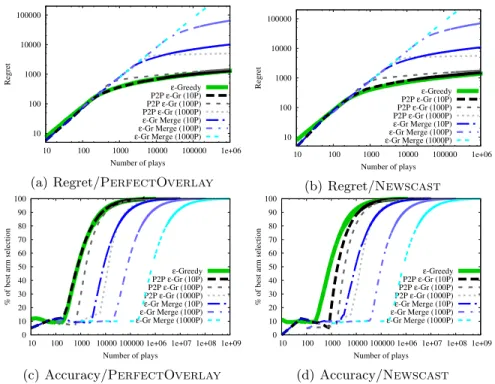
10 100 1000 10000 100000 10 100 1000 10000 100000 1e+06 Regret Number of plays ε-Greedy P2P ε-Gr (10P) P2P ε-Gr (100P) P2P ε-Gr (1000P) ε-Gr Merge (10P) ε-Gr Merge (100P) ε-Gr Merge (1000P)
(a) Regret/PerfectOverlay
10 100 1000 10000 100000 10 100 1000 10000 100000 1e+06 Regret Number of plays ε-Greedy P2P ε-Gr (10P) P2P ε-Gr (100P) P2P ε-Gr (1000P) ε-Gr Merge (10P) ε-Gr Merge (100P) ε-Gr Merge (1000P) (b) Regret/Newscast 0 10 20 30 40 50 60 70 80 90 100
10 100 1000 10000 100000 1e+06 1e+07 1e+08 1e+09
% of best arm selection
Number of plays ε-Greedy P2P ε-Gr (10P) P2P ε-Gr (100P) P2P ε-Gr (1000P) ε-Gr Merge (10P) ε-Gr Merge (100P) ε-Gr Merge (1000P) (c) Accuracy/PerfectOverlay 0 10 20 30 40 50 60 70 80 90 100
10 100 1000 10000 100000 1e+06 1e+07 1e+08 1e+09
% of best arm selection
Number of plays ε-Greedy P2P ε-Gr (10P) P2P ε-Gr (100P) P2P ε-Gr (1000P) ε-Gr Merge (10P) ε-Gr Merge (100P) ε-Gr Merge (1000P) (d) Accuracy/Newscast
Figure 1.Comparison of�-greedyandP2P-�-greedyin terms of regret (upper panels) and accuracy (lower panels). We used thePerfectOverlayprotocol in1(a)and1(c)and theNewscastprotocol in1(b)and1(d).
cost ofO(N K). This is impractical whenKis large
(e.g., K ≈N). In this section we present a
practi-cal algorithm with O(N) communication cost. The
main idea is that each peer sends and receives
mod-els about only one arm in each round. We have
no formal proof about the convergence of the
algo-rithm, but in experiments (Section5) we found that
it worked almost as well asP2P-�-greedy.
In P2P-�-greedy.slim, the model becomes M =
(i, c, d, r, q, a, b), wherei∈ {0, . . . , K}is the index of
the armMstores information about, andc, d, r, q, a
and b are scalar values corresponding to the vector
variables inP2P-�-greedy. In each iteration, peer
j has its current model M corresponding to armi,
and it receives two modelsM1andM2
correspond-ing to arms i1 and i2. Then it proceeds as follows.
(For complete pseudocode see SectionD.)
1. Ifi1 �=i2, then letM� =M1 ifc1/d1> c2/d2,
andM�=M2 otherwise. Go to Step 3.
2. Ifi1=i2, then let M� the result of the
aggre-gation ofM1andM2. Go to Step 3.
3. Ifi�=i, then letM=M� (replace the current
model with the incoming model). Go to Step 5.
4. If i� �= i, then let M be the better (with the
largerc/d) ofMandM�with probability 1−�,
and the worse of the two models with
probabil-ity�. Go to Step 5.
5. Pull the armicorresponding to the new model
M. Observe reward ξ. Add N ξ to a and N
to b. If t is an interger power of 2, update the
model variables analogously toP2P-�-greedy.
Finally, send the updated model to its neighbors according to the particular protocol.
5. Experiments
In the first experiments, we verified our theoreti-cal results in experiments on synthetic data. Our first goal was to verify the main claim of the paper,
namely that the �-greedy algorithm can achieve
logarithmic regret after Ω(logN) iterations in a P2P.
Our second goal was to give empirical support to our epoch-based technique. We compared the
per-formance of�-greedy,P2P-�-greedy, and a
sim-plified version of theP2P-�-greedywhich only
ag-gregates the models in each iteration and works the
rewards into the mean estimates (cj,t/dj,t)
immedi-ately. We will refer to this simplified P2P algorithm
as P2P-�-Gr-merge. Although our regret
analy-sis was carried out by assumingPerfectOverlay
protocol, we also tested the P2P algorithms using
the Newscast protocol. We used P2P networks
with various sizes: N = 10,100,1000. We compared
the performances of the algorithms in terms of their regret and their accuracy (rate of plays on which the best arm is selected). The test problem consisted of 7
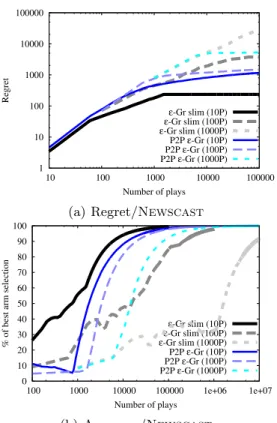
1 10 100 1000 10000 100000 10 100 1000 10000 100000 Regret Number of plays ε-Gr slim (10P) ε-Gr slim (100P) ε-Gr slim (1000P) P2P ε-Gr (10P) P2P ε-Gr (100P) P2P ε-Gr (1000P)
(a) Regret/Newscast
0 10 20 30 40 50 60 70 80 90 100 100 1000 10000 100000 1e+06 1e+07
% of best arm selection
Number of plays ε-Gr slim (10P) ε-Gr slim (100P) ε-Gr slim (1000P) P2P ε-Gr (10P) P2P ε-Gr (100P) P2P ε-Gr (1000P) (b) Accuracy/Newscast
Figure 2.Comparison of the P2P-�-greedy and the
P2P-�-greedy.slim algorithms in terms of (a) regret
and (b) accuracy using P2P networks of various sizes.
TheNewscastprotocol was used in every case.
K= 10 arms with Bernoulli distributions whose
pa-rameters were set toµi= 0.1+0.8(i−1)/(K−1).
Ac-cordingly, we set the parameterdto 0.07<mini∆i.
The only hyperparameter of the �-greedy methods
is set toc= 0.1. The performance measures (regret
and accuracy) of the algorithms are plotted against
number of plays in Figure 1. The results show
av-erages over 10 repetitions of the simulation. We
remark that the P2P adaptations of �-greedy
algo-rithm pullsNarms in each iteration, thus the curves
concerning to P2P algorithms start at theNth play.
The plots show that, first, the performance of
P2P-�-greedyscales gracefully with respect to the
num-ber of peers and its regret grows at the same speed as
that of�-greedyin accordance with our main result
(Corollary 2). Furthermore, their regrets are also
on a par with respect to the number of plays.
Sec-ond,P2P-�-Gr-mergeconverges slower than
P2P-�-greedywhich confirms empirically the need to
de-lay using the rewards in the estimates.4 Third, the
performance ofP2P-�-greedydoes not deteriorate
significantly with theNewscast protocol, which is
4
See more on this in SectionEin the Supplementary.
an important experimental results from a practical point of view. Finally, note that the significant leap
in the regret whenN = 1000 is due to theNlogN
cost of spreading the information.5
In the second experiment, we compared the
perfor-mance of P2P-�-greedy.slimand P2P-�-greedy
using the same stochastic bandit setup as in the first
experiment. We used Newscast in the test runs.
Both algorithms were run with the same
parame-ters (c= 0.1, d = 0.07) using P2P networks of sizes
N= 10,100,1000. Figure2shows the regret and
ac-curacy against number of plays. The results are
av-eraged over 10 repetitions of the simulation. P2P-�
-greedy.slim is slightly worse thanP2P-�-greedy
but asymptotically it performs comparably for aK
times smaller communication cost.
6. Conclusions and Further work
In this paper, we adapted the �-greedy stochastic
bandit algorithm to P2P architecture. We showed
that P2P.�-greedy preserves the asymptotic
be-havior of its standalone version, that is, the regret
bound isO(tN) for the P2P version ift= Ω(logN),
and thus achieves significant speed-up. Moreover,
we presented a heuristic version of P2P.�-greedy
which has a lower network communication cost. Ex-periments support our theoretical results. As a fur-ther work, we plan to investigate how to adapt some
appropriately randomized version of theUCB
ban-dit algorithm(Auer et al.,2002) to P2P environment.
Acknowledgments
This work was supported by the ANR-2010-COSI-002 grant of the French National Research Agency, the European Union and the European Social Fund through project FuturICT.hu (grant no .: TAMOP-4.2.2.C-11/1/KONV-2012-0013), and by the Future and Emerging Technologies programme FP7-COSI-ICT of the European Commission through project QLectives (grant no.: 231200). M. Jelasity was sup-ported by the Bolyai Scholarship of the Hungarian Academy of Sciences.
References
Auer, P., Cesa-Bianchi, N., and Fischer, P. Finite-time analysis of the multiarmed bandit problem.
Machine Learning, 47:235–256, 2002.
Awerbuch, Baruch and Kleinberg, Robert.
Compet-itive collaborative learning. J. Comput. Syst. Sci.,
5
See the discussion before Corollary 2 and in Sec-tionE.1in the Supplementary.
74(8):1271–1288, December 2008. ISSN
0022-0000. doi: 10.1016/j.jcss.2007.08.004. URLhttp:
//dx.doi.org/10.1016/j.jcss.2007.08.004.
Cesa-Bianchi, N. and Lugosi, G. Prediction,
Learn-ing, and Games. Cambridge University Press, NY,
USA, 2006.
Gelly, S., Hoock, J.B., Rimmel, A., Teytaud, O., and Kalemkarian, Y. The parallelization of
Monte-Carlo planning. InProceedings of of the Fifth
In-ternational Conference on Informatics in Control,
Automation and Robotics, pp. 244–249, 2008.
Heged˝us, I., Busa-Fekete, R., Orm´andi, R.,
Jela-sity, M., and K´egl, B. Peer-to-peer multi-class
boosting. In International European Conference
on Parallel and Distributed Computing
(EURO-PAR), pp. 389–400, 2012.
Jelasity, M., Montresor, A., and Babaoglu, O. Gossip-based aggregation in large dynamic
net-works.ACM Trans. on Computer Systems, 23(3):
219–252, August 2005.
Jelasity, M., Voulgaris, S., Guerraoui, R., Kermar-rec, A.-M., and van Steen, M. Gossip-based peer
sampling. ACM Transactions on Computer
Sys-tems, 25(3):8, 2007.
Joulani, Pooria. Multi-armed bandit problems un-der delayed feedback. Msc thesis, Department of Computing Science, University of Alberta, 2012. Kempe, D., Dobra, A., and Gehrke, J. Gossip-based
computation of aggregate information. In Proc.
44th Annual IEEE Symposium on Foundations of
Computer Science (FOCS’03), pp. 482–491. IEEE
Computer Society, 2003.
Kocsis, L. and Szepesv´ari, Cs. Bandit based
Monte-Carlo planning. In Proceedings of the 17th
Euro-pean Conference on Machine Learning, pp. 282–
293, 2006.
Kowalczyk, W. and Vlassis, N. Newscast EM. In 17th Advances in Neural Information Processing
Systems, pp. 713–720, Cambridge, MA, 2005. MIT
Press.
Lai, T.L. and Robbins, H. Asymptotically efficient
allocation rules. Advances in Applied
Mathemat-ics, 6(1):4–22, 1985.
Langford, John and Zhang, Tong. The epoch-greedy algorithm for multi-armed bandits with side
infor-mation. InNIPS, 2007.
Langford, John, Smola, Alex, and Zinkevich, Mar-tin. Slow Learners are Fast. In Bengio, Y., Schu-urmans, D., Lafferty, J., Williams, C. K. I., and
Culotta, A. (eds.), Advances in Neural
Informa-tion Processing Systems 22, pp. 2331–2339. 2009.
Orm´andi, R., Heged¨us, I., and Jelasity, M. Gossip
learning with linear models on fully distributed
data. Concurrency and Computation: Practice
and Experience, 2012. doi: 10.1002/cpe.2858.
Xiao, L., Boyd, S., and Kim, S.-J. Distributed av-erage consensus with least-mean-square deviation.
Journal of Parallel and Distributed Computing, 67
(1):33–46, January 2007.