
Building a “living database” for human-machine
intelligence analysis
Dave Braines, John Ibbotson, Darren Shaw
Emerging Technology Services
IBM United Kingdom Ltd
Hursley Park, Winchester, UK
Alun Preece
School of Computer Science and Informatics
Cardiff University, Cardiff, UK
Abstract – In modern military operations the emphasis ison smaller teams and more ad hoc teamwork. This requires greater agility both in terms of capturing actionable intelligence as well as appropriate dissemination and fusion of that information to coalition team members based on their tasks and need to know. In previous research and development we have explored the potential for a controlled natural language (CNL), acting as the sole knowledge representation language to facilitate cooperative working among human and machine agents. In this paper we envision a “living database” to support situation understanding, enable intelligence reporting, fusion and dissemination based on context. The human and machine users of the system have the ability to add, remove, or edit existing information using the CNL, including extensions to the model (or schema) in real-time. In this paper we describe various examples undertaken using this approach along with initial experiments using a conversational software agent to enable the field user to interact with such information in full natural English language.
Keywords: Controlled Natural Language, Information Fusion, Ontology, Hybrid Teams, Agile Integration.
1
Introduction
This paper gives details relating to a number of recent experiments and prototypes that have been constructed using a hybrid human/machine semantic environment based on the ITA Controlled English (CE) language. This paper does not attempt to define or describe the ITA CE language since this is done elsewhere [12]. The goal in all the examples described in this paper is to create a rich and interactive
valuable environment for human/machine hybrid
processing, and to enable fusion between low level data such as that sourced directly from sensors, low level background “facts” from the field or from intelligence reports, and higher level information such as opinions, plans, sociological and anthropological models. The purpose of the hybrid human/machine environment is to better harness the rich cognitive capabilities of the human agents through provision of simple computational and basic logical inferencing by the machine agents. The purpose is not to replace human cognition and decision-making but to provide
a hybrid team environment in which machine agents and human colleagues can better support this fundamentally human-led cognitive capability. In this paper we take the reader through a short summary of a number of experiments and prototypes that have been developed using this approach, and show the potential for such a rich and capable environment.
The term “living database” attempts to convey the agility and highly dynamic nature of (i) the environment, allowing information to be created by both human and machine agents, either by direct assertion, inference or calculation, and (ii) the model (or schema) that underpins the knowledge base and defines the domain(s) that can be supported. Both information and model can be asserted in real-time in the CE language, thereby allowing a highly flexible and dynamic “living database” that can be evolved to suit the situation as circumstances dictate. In this paper we do not worry about the potential issues of error and complexity that would naturally arise in such a dynamic and flexible environment, but simplistically note that appropriate governance and some training would be a traditional solution and equally applicable here, but any such controls would need to be finely balanced to ensure the agility/risk ratio is appropriately managed.
Throughout this paper we gravitate towards intelligence examples but the approach is applicable in many more contexts. Intelligence examples resonate with both experts and casual readers alike, and provide a multi-dimensional space within which to explore the potential. Also, traditionally only available at the battalion level and above, intelligence operations “are generally informal, providing detailed products only when time and resources permit” [1].
This paper showcases the CE knowledge base concept that can remedy these shortcomings by providing timely and relevant data to users in the field using capabilities that can easily be made available today.
2
Agile Knowledge Representation
Whilst the “living database” concept that is described in this paper should be readily applicable to any domain of operation in which human agents need to interact, one key focus area is that of biographical, situational and social information. To be readily useful to units in the field, this biographical knowledge base must contain a wealth of easily digestible but relevant biographical information, as
well as convenient and timely interaction between the knowledge base and users on the ground. In a recent experiment with two cadets from the West Point Military Academy the task was given to them to use the “ITA Controlled English” (CE) language [12] to build and demonstrate a prototype knowledge base that would be of value to them in an operational environment. These cadets had no formal training in knowledge representation, computer programming or semantic information, so it was important that they were able to design and implement an experimental platform and associated ontologies, tools and datasets with skills typical to domain experts but not knowledge engineers or computer programmers.
For their model they determined that each biographical entry would consist of four main categories of information: the physical description of the person, relevant information concerning their personal life and work, their relationship network, and comments left by previous users. All this information should be presented succinctly to the user in a profile reminiscent of common social media, where relevant information can be easily distinguished. One of the most important aspects of this knowledge base is that it should be editable by a variety of users, from military intelligence officers at the forward operating base, to squad leaders or platoon leaders on the ground with any such edits being made immediately available to others.
The cadets proposed that users in the field could interact with this knowledge base using primarily a speech-to-text translator, a CE interpreter, and a portable display, either through an existing platform such as the Blue Force Tracker or a newer technology like Google Glass. A user should be able to communicate verbally with the knowledge base and create or edit entries real-time. For example, a user should be able to say to the CE conversational interface:
“Create entry on a person named John, who has age 50, and has height 6 feet, and has black hair”.
The knowledge base will then create this new entry in CE with a location and time-stamp, accessible to all units who operate in that same area. The CE form that is automatically computed from the input shown above would look like this:
there is a person named ‘John’ that has ‘50’ as age and
has ‘6 feet’ as height and has ‘black’ as hair colour.1
The user can then go further and say:
“Create entry on person Mike, who has age 45, and has height 5 feet 6 inches, and is the brother of John, member of Hursley village”.
1
Throughout this paper text rendered in this style is valid CE and therefore directly readable by humans and directly processable by machine agents without transformation to a more technical underlying format.
Which would be translated to:
there is a person named ‘Mike’ that has ‘45’ as age and
has ‘5 feet 6 inches’ as height and
belongs to the network ‘Hursley Village’ and is brother of the person ‘John’.
From this simple interaction the knowledge base will then have two entries, with a clearly defined relationship between the two people that can be referenced by anyone else in the system. Realistically, the knowledge base will have thousands of these entries; all populated with information from military intelligence staff and amended by those on the ground who have personal relationships with the subjects. In our more recent work we have demonstrated how information such as this can be obtained in this direct manner as well as through more passive observation of material on public social media [14].
2.1
Potential Benefits
As with all new technologies, this proposed knowledge base must have demonstrable benefits over the current system to warrant the significant research and development investment. First, were this free format and easily interactive and extensible knowledge base to be properly implemented, it would have the potential to bring an unprecedented and persistent wealth of semantic information to hand for every user in the field, greatly increasing a leader’s social effectiveness when interacting with civilians within their area of operations. In a style similar to the population of a wiki on the world wide web this approach could enable contributions from a range of users in the field, but unlike a traditional wiki this information is “semantic” in nature and therefore amenable to machine reasoning and complex queries as well as very specific contextual alerting, summarisation etc. This approach would allow for information persistence from commander to commander, deployment to deployment. Furthermore, this would allow the generation of “fringe information” that would not be traditionally available to a battalion intelligence staff, such as obscure relationship clues.
This “fringe information” could be key in strategic planning. Realistically, a user in the field could update the knowledge base with a piece of knowledge that connects a village’s leadership to a known enemy operative, even if the user adding the linking information does not realise the significance or value of the link they have just created. It is only when this low level information is fused into a higher level context that the potential value of the links can be determined. Friendly commanders would have access to this information immediately and could make educated decisions that would not otherwise be available to them so easily through traditional intelligence gathering. With
information in question may not have been recorded, or it would likely be stored simply as a plain text narrative within a textual report and may not be uploaded immediately. In addition, the knowledge base could analyse a town’s relationship web and annotated biographical entries to provide clues as to their political inclination and friendliness to blue (friendly) forces. When pieced together by a rich query framework, the knowledge base can provide an extremely in-depth relationship web and extrapolate very useful and previously unknown, or hard-to-know intelligence.
2.2
Experiences in building a demonstrator
The West Point cadets created a mock knowledge base system using the CE environment to evaluate this concept. Over the course of a week, they established a biographical framework that defined a person by a variety of attributes, wrote a complex set of rules for a relationship model, and populated this knowledge base with fictional people. They discovered that not only is the CE structure sufficient for creating a relationship model that would be useful for intelligence operations, but that it is easy to learn and straightforward to use and extend further. Based on their prior experiences they felt that typical soldiers would find the CE knowledge base valuable for quickly and easily accessing and manipulating data without anything more than a passing familiarity with computer systems.
On a broader scale, their use of CE in this way shows the potential for groups to define the parameters of their knowledge base to fit their specific needs and then rapidly develop and populate the core of the knowledge base. Since a military intelligence staff may require a subtly different knowledge base than a city police department it is important that without too much work, the CE knowledge base can be quickly redefined to suit their needs without the input of trained computer science professionals.
2.3
Challenges in making this a reality
The cadets also identified three main challenges that they believe exist with such a large and uncontrolled knowledge base in this current form. First, the security of the knowledge base in a combat environment can be a major obstacle to implementation. The risk of enemy forces having access to the knowledge base through lost equipment may be unavoidable, and the availability of rationale and provenance information from sources could be especially problematic. Second, existing speech-to-text technology may not be subtle enough to prevent significant errors in transcribing information to the knowledge base [7], especially names of people and places. Third, negligent or ignorant users could potentially compromise vital data.
The traditional approach to solving the third problem would be through stringent security protocols that restrict users from editing profiles of subjects outside their area of operations or limiting users to only edit information that has not already been confirmed by intelligence officers. The
cadets observed however that there is a balance to be struck between security and flexibility, to enable discovery and exploration beyond a typical area of concern to improve general situational awareness. At the least, each of these issues needs to be individually addressed before the knowledge base could be deployed into a realistic scenario.
In addition to this 4 week long experiment with the West Point cadets we also have undertaken a number of relevant previous exercises that apply the “living database” concept and the underlying CE technology in a wider variety of situations. These are described in the following sub-sections.
3
Hybrid human/machine reasoning
On this project the key principle was that the human users of the system are key components of the system itself, not just users at the end of the chain of events. This is one of the key motivating use cases for a language such as CE, where the aim is to put the human and machine agents together in a rich and effective team, with the human agents having the lead cognitive role, but the machine being more deeply integrated than a traditional simple information system.
This leads to the actions of the users becoming first hand information, and the application of “Collective Intelligence” [17] approaches to determine whether the actions of one or more users may constitute information that could be relevant to others, or may even become new facts in the system.
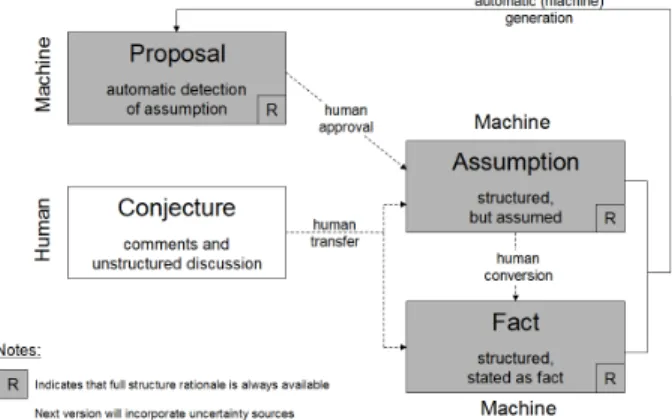
Figure 1 – Human/machine hybrid reasoning
This perspective also supports the use of the collaborative capabilities (ranking, tagging, commenting etc) that can aid a single user in discussing, hypothesizing and communication with their peers before deciding on whether any structured/formal assertions should be made. See figure 1 for a brief outline of the main human/machine interaction in terms of hypothesis and assumption testing. In addition to this collective intelligence perspective we also have the fundamental notion of hybrid inference, specifically in the sense that the user and the machine collaboratively explore the rationale to enable the human user to understand the situation and potentially create further inferences based on the material already present. We do not envisage the machine agents taking such a lead cognitive role and we are not attempting to model human cognition but believe that strong and agile computational support can
enhance cognitive potential. The ability to create a hybrid human/machine environment such as this which is deeply integrated and able to support hybrid reasoning, assumptions, conjecture and proposals is hinged around the use of the CE language as a common human/machine representation language.
In addition to this we also modelled “entities” within the system both as their direct types (e.g. person, place) but also in terms of the actions that can be applied to them within the system. This modelling of primary and contextual information provides and flexible and extensible environment for easily adding new actions and other features that can be directly applied to entities across the system. In our example implementation all entities link to their own “page” (one action) but certain entities can have actions to favourite, like, dislike and use; enabling the basic operations for a collective intelligence through a crowd-sourced voting environment in which the small actions of many human agents can have a profound effect on the perceived weight or value of information, for example as shown in figure 2 below.
Figure 2 – Adding social crowd sourcing
During the architecture and design activities of the Pathfinder project we have evolved from a situation where CE was the core representation format for the inference engine and a minor representation format for the rest of the system, to a point where the CE sentences are the truly fundamental components of the whole system, and this was the starting position for the experiment with the West Point cadets outlined in section 2, although we specifically chose to only provide them the plain CE environment and the lessons learned and principles from the Pathfinder project rather than the specific models and user interface components that we created.
We found that the adoption of this multi-dimensional approach has given us a powerful position when it comes to deciding how information should flow with the system, where it is mastered, and what information format the various interfaces should adhere to. This has also refined the interfaces within the system and helped to identify a key issue in terms of the complex interdependency of the inference engine (which understands these sentences) and the data store (which is the master location for their persistent storage). This usage of CE as a fundamental unit of representation also further challenges the need to use traditional Semantic Web technologies as the underlying representation format for the data store. There are very good reasons to continue to use traditional technologies such as OWL and RDF [11] but they are machine-processable representations that require transformation into
human-readable form for consumption by humans. This is not the case with CE information and whilst it is a subtle difference we believe that this singularity of representation provides a powerful base for such human/machine hybrid systems.
The Pathfinder project was demonstrated and reviewed with operational intelligence analyst users and it was clear that the results of the collective intelligence capability (e.g. hot topics, people or documents of interest, related queries, popular and unpopular items) were of significant interest, with the ability for the machine to reason and compute on the underlying data being of less immediate interest. The desire to work as part of a larger group, but for capabilities to be enabled with explicit action by the individual users is clear, and the combination of the collective intelligence capabilities with the more traditional collaborative capabilities (tag, comment etc.) could be powerful, especially if expressed in a rich semantic form through the CE language rather than in traditional simple flat or hierarchical tagging systems. It is likely that further capabilities can be enabled through fusion of this activity based dataset with the structured data available to the inference engine, for example feeding back the results of unpopular facts to affect the uncertainty value used by the inference engine, perhaps leading to wider ranging conclusions to inferred (based on user stated rules) such as specific sources which regularly provide unpopular facts being downgraded at source, or particular users who downgrade lots of facts having the relative value of their downgrades discounted. A further possibility is that the inference engine could add inferences to the data feeds subscribed to by the analysts.
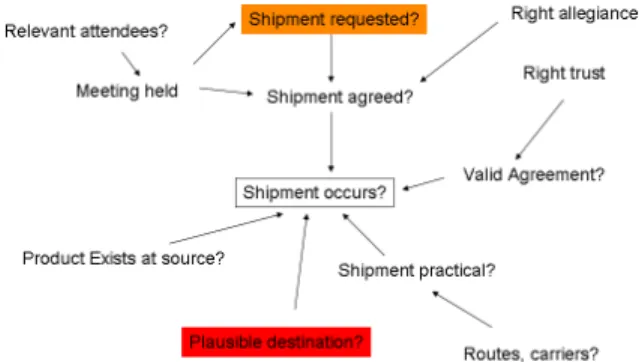
A final focus of the Pathfinder project was the fusion of low-level “observables” to higher-level sociological or anthropological concepts. For example something arising from a sensor or a human report, such as an observed meeting between two individuals or an intercepted conversation, and the implications that the observed interaction may have when higher level knowledge and theories are applied.
Figure 3 – observables and higher-level considerations We had one worked example around the need for a shipment of goods, and the absence or presence of observed behaviours that might indicate such activity (see Figure 3), with the environment allowing higher level rules, proposals and discussions to be had. In this work we identified links to
the topic of argumentation and the potential role for argumentation to further enrich the discussion and iterative modelling approach, and also for the CE language to perhaps serve as a useful semantic layer to represent arguments [4].
4
Conversational Interaction
In our most recent branch of research and experimentation activities with the CE knowledge base we have been looking at rich human/machine conversational interactions. The basic premise of this work is that the human user may wish to interact with the underlying knowledge base and machine-agent environment in the form of a natural language conversation (i.e. plain English, not Controlled English). This can be typed text or spoken voice (transformed to text though voice-to-text processing), and the basic mechanism is that the human user provides entirely natural language but the machine responds in CE in order to clarify the interpretation of the language used. Currently we have a limited implementation that is able to process statements, e.g. field information from users who may not wish to use a screen and keyboard. This system can also respond to a wide variety of simple or complex queries expressed in natural language. Initial results show that untrained human users (university students) were able to repeatedly assert information relevant to the domain of interest using natural language conversation with the environment [15]. In our future research we are investigating engaging in a longer dialogue that keeps the context of the conversation open to allow a more exploratory style of discussion between the human user and machine agent.
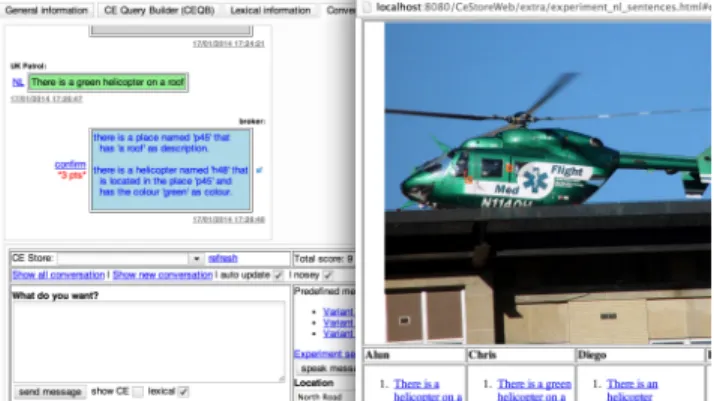
Figure 4 – The experimental conversational interface
In a recent student experiment [15] students were asked to describe the key information they saw when shown different photographs, with the response from the system being the interpretation in CE. If the user is happy with the interpretation they can “confirm” this knowledge to the CE Store at which point it is added to the knowledge base and logical inference rules and triggers can be run in order to infer additional information and share this with other appropriate users etc.
Figure 4 shows a brief example of the very first “field intelligence gathering” experiment that was run, using a team of undergraduate students at Cardiff University. In the image the conversation can be seen in the left hand “Conversation” pane, with the simple natural language provided by the user in the green box and the CE response from the CE Store in the blue box. The underlying domain model loaded into the CE Store determines the concepts, properties and instances that will be checked when trying to determine the “meaning” of the sentence provided by the user in the conversation.
More recent controlled experiments [15] and a field trial exercise at the NATO summit in Newport, Wales in 2014 [14] have further tested and extended the capabilities of the conversational environment.
In the context of the “living database” we envisage the analyst using the conversational interface to explore the main aspects of the intelligence environment by asking questions and following links, either verbally or through a text chat, or as one part of a richer graphical interaction environment. Also the ability to add new local knowledge (as described earlier) would be supported through this conversational mechanism, allowing the analyst to state their knowledge in simple natural language and have the system advise what the interpretation of the corresponding CE is. In both cases we anticipate that this additional conversational capability may further lower the barrier between human user and machine through the use of simple natural language as the starting point for the interaction.
5
Storytelling
The final project that we describe in this paper is focused on storytelling, and specifically aimed at intelligence analysts who wish to build a story about related intelligence material as part of their analysis. This can then be used to share the details with other analysts, to “publish” the work in a consumable format, or to record their own private thoughts and findings for reference in the future.
5.1
Comic strips
One example that is of particular interest is how to visually convey a complex multi-layered set of contextual information in a way that is engaging, informative and familiar to users. The current baseline would be a plain text report describing all of the contextual information in addition to the dialogue, but this may be dense and dull. We use an intercepted telephone call as an example to demonstrate what a richer storytelling approach may look like (see figure 5).
Rather than listing a call transcript in a traditional call log format, we chose to render it as a comic strip in an attempt to provide a richer and more extensible mechanism for communicating the call and any ancillary information that might relate to the various conversation items.
Figure 5 – Comic strip rendering for a telephone call
It has been proposed that that layout is a graphical form of language [2] and we wanted to borrow from this in our experimental use of comic-strip style rendering for conversations such as telephone calls. A more simple and traditional form of layout might be a table of rows and columns containing text, which better organises the information than a sentence and paragraph structure might do. The table helps the reader extract the specific bit of information they are looking for without having to absorb the whole. The idea with the cartoon was to do something similar. In one sense a comic strip is layout taken to its extreme form but with a whole new dimension of possibility for communicating important contextual information pictorially. This mechanism for comic strip rendering actually draws the requisite information from the underlying knowledge base in the CE format, so can be considered simply as a number human-oriented interaction mechanism for information consumption. In this sense the generation of the visual comic strip graphic is simply a transformation of the raw low-level semantic information contained in the CE knowledge base and is aimed specifically at improving consumption of the information by human users.
Depending on the information type there will be different visual mechanisms that are more beneficial than others, and with our focus on storytelling within this project we chose the comic style rendering as a highly experimental and thought provoking mechanism, rather than simple timeline, map-based or social network graph based visualisations which have been subject to extensive research and experimentation already.
Returning to the image in figure 5 you can see that there is a lot of information available from a typical call log: the people on the call, the date and time it happened, where the people were calling from, who called who and the actual words spoken. When displayed in a pure text form it requires mental effort to extract the bits of information you are interested in. A comic strip contains layers of information: who said what, which characters are involved, how the characters are feeling, where the scene is set, what time it is, even the composition and flow of the panels in the strip add information. The layers of information can be densely packed with a vast set of content, and the analyst can overlay their perspective of the meaning of the conversation, or key additional background knowledge or
new information that they know which is relevant to that frame in the dialogue.
The useful thing from our point of view is that each of these information layers can be visually extracted by humans without much mental effort. It is easy to look at a comic strip and just find the words spoken, or just look at the characters involved. Equally, comic strips can be feasibly directly machine-generated from CE since the information contained therein is enough to describe each of the required elements and the overall flow and sequence. This simply requires a rich library of visual artefacts and the ability to intelligently layer them together dynamically to create a visually pleasing environment. There will be many complexities and artistic considerations for this (which we did not investigate) but the ability to link the entities in the knowledge base with the appropriate graphical rendering is a fairly simple exercise.
The pragmatic approach taken to demonstrate the potential in this project was relatively simple: We had two characters involved and the conversation was represented using speech bubbles, with some icons and additional text to show when the call was started.
With more work, this idea could be extended using dynamically generated imagery layered in to the comic strip. If, for example, one of the participants was calling from an airport we could use generic iconic airport imagery in the background. Or if one of the people in the call was using an angry tone of voice that could be represented in the way that character was visually rendered. The comic style of rendering could apply to other instance types: conversations, meetings, events, social media messages etc. Usefully it provides a means for rendering more “thematic” or conceptual content that isn’t best suited to being shown on a map, timeline, graph, or in a generic network visualisation as mentioned earlier.
5.2
Building the story
In addition to the comic strip rendering we also had the higher level goal of supporting the user in forming and sharing their story at the highest level, regardless of what the components and specific visualisations needed to be, thereby allowing users to see the full story, the intelligence information that has been added to it and the annotations made by analysts.
The story begins with a preface, which highlights the characters involved, the user who created it and gives a summary of what the story is about (this comes from the abstract when the user first creates the story). The preface is designed to let users quickly find out what the story is about. Next comes a set of acts that corresponds to the intelligence elements that have been added to the story and their associated annotations (see figure 6 for an example).
Figure 6 – Showing the story
Some of the elements that have been added to the story may have a graphical representation, so where possible this is used to avoid the page being too densely packed with text and to aid more rapid initial comprehension.
The stories act as a mechanism to organise an analysts thoughts and ideas. They provide a means for connecting together different entity types into a narrative: from a flight, to a person, to a telephone call, to a place, for example. They also facilitate collaboration between different analysts. An analyst viewing an entity will see the other stories that the entity belongs to (potentially created by a different analyst) and this may act as a prompt for them to find out why someone else is looking in to that entity.
The concept of a story sits above the actual domain of interest, which is in this example people, places, events, flights and social media. The dynamic and extensible nature of CE means that it can be used in any context with any domain model, and the value of creating distinct and general concepts such as a story is that these can then be used to add a narrative to any domain model and is not just fixed to the specific example outlined in this report.
6
Related Work
The idea of a Controlled Natural Language for knowledge representation is not new, and there have been numerous activities to define and experiment with such languages in the past [9], including some which are directly related to the Semantic Web, such as Attempto Controlled English (ACE) [6]. The ITA CE language mentioned in this paper is a direct derivative of the earlier work on Common Logic Controlled English (CLCE) by John Sowa [19] but extended to enable the model and “facts” to be expressed in the same language, and to allow rationale to be expressed to qualify CE information.
In our earlier research and during the “Pathfinder” project we experimented extensively with the Semantic MediaWiki capability [8] that was created to enable easy acquisition of semantic information in a style similar to existing wiki technology. We found that the need to create “pages” to contain the data was not as clear as the ability to simply assert the knowledge in CE statements, and the complexity
of the markup was troublesome even for computer specialists and knowledge engineers [18], however the ability to capture semantic information in a low-friction way such as a wiki is very appealing.
In terms of human-machine conversations we have built our CE-based model of dialogue on the idea of illocutionary acts from speech act theory [2] and more recent work on Agent Communication Languages (ACLs) [10]. In developing our approach we have also taken inspiration from more closed examples such as Siri and Google Now. The underlying dynamic CE knowledgebase and the ability to rapidly reconfigure enables us to demonstrate similar capabilities but against domain specific models relevant to each experiment or project.
Finally we have been recently working to establish linkages between the on-going development of the “Battle Management Language” (BML), as defined in [4]. In a recent joint publication [16] we identified that the CE language could provide the low level representational and machine reasoning substrate for the higher-level BML language. Looking at this another way we could assert that BML is an example of a higher level language [13] that can be built on top of the core CE language. It is more domain specific and less flexible in other scenarios but is far more tailored to the domain in question and therefore able to convey complex information in a more compact format and BML itself is both machine processable and human readable just like CE.
7
Conclusions
In this paper we have outlined the idea of a “living database” as a form of semantic knowledgebase that is highly agile and extensible and able to be contributed to by both human and machine agents in a rich and deeply integrated manner. We propose that Controlled English is a candidate language for building such an environment, and is especially applicable as it has been design to be directly processable by both human and machine agents without modification or transformation.
We summarise activities on a number of distinct projects and experiments that build upon this idea and show different aspects and approaches that each contribute some value to the larger story:
•Agile knowledge representation (section 2) The specific experiences of visiting West Point cadets when building an example implementation using the CE environment.
•Human/machine hybrid reasoning (section 3) The earlier “Pathfinder” project for the UK DSTL which established the potential value for the CE language to support both low level “fact representation” and higher level complex modelling along with hybrid human/machine reasoning and discussion.
•Conversational interaction (section 4)
Ongoing research and experimentation to enable a more natural interaction between the humans and the knowledge base, enabling natural language question asking, model and fact exploration and assertion of new knowledge.
•Storytelling (section 5)
Supporting the user in creating stories that explain the data in some meaningful narrative. This experimental work ranged from the highest-level storytelling concepts through to more specific and potentially valuable examples such as comic strip style rendering to explain a narrative.
In each of these examples we aimed to enable the human users of the system through some interaction mechanism that is meaningful to them in the context of their problem and information. The machine environment is always the same (CE) but with different models, agents, visualisations and other capabilities that support the specific needs of that environment and the specific users.
It is conceivable that both model-level and interaction-level assets could be created in this environment so that systems could be quickly and easily built from such assets in the future, enabling agile human/machine hybrid teams to work together to understand complex information and share their stories.
Acknowledgment
This research was sponsored by the US Army Research Laboratory and the UK Ministry of Defence and was accomplished under Agreement Number W911NF-06-3-0001. The views and conclusions contained in this document are those of the authors and should not be interpreted as representing the official policies, either expressed or implied, of the US Army Research Laboratory, the US Government, the UK Ministry of Defence or the UK Government. The US and UK Governments are authorized to reproduce and distribute reprints for Government purposes notwithstanding any copyright notation hereon.
The authors would also like to thank cadets Jonathan Thiess and Michael Shares for their research activities during the summer of 2014 at IBM Hursley and their internal ITA short paper titled “Practical Applications of Controlled English in a Tactical Environment” which first coined the phrase “living database” and provides much of the context in the opening part of this paper, leading in to the wider story.
Finally, thanks also go to David Mott from IBM Emerging Technology Services whose work was key to the original Pathfinder project that is mentioned in this paper and has been a thought leader for much of the ITA Controlled English research.
References
[1] Army Publications, “FM 34-8, Chapter 3: S2/G2 Organization and
Functions”, fas.org (2014).
[2] Austin, J. and Urmson., J. How to Do Things With Words. Harvard
University Press, 1975.
[3] Baber, Chris, Dan Andrews, Tom Duffy, and Richard McMaster.
"Sensemaking as narrative: Visualization for
collaboration." VAW2011, University London College (2011).
[4] Biermann, J., Nimier, V., Garcia, J., Rein, K., Krenc, K. and Snidaro,
L. “Multi-level fusion of hard and soft information.” Proceedings of the 17th International Conference on Information Fusion, July 7-10, 2014 Salamanca, Spain.
[5] Cerutti, Federico, Nava Tintarev, and Nir Oren. "Formal arguments, preferences, and natural language interfaces to humans: an empirical evaluation." In 21st European Conference on Artificial Intelligence. 2014.
[6] Fuchs, N. E., Kaljurand, K., & Kuhn, T. (2008). Attempto Controlled
English for knowledge representation. In Reasoning Web (pp.
104-124). Springer Berlin Heidelberg.
[7] Google Voice Recognition, Google Chrome App, chrome.google.com
(2014).
[8] Krötzsch, M., Vrandečić, D., & Völkel, M. (2006). Semantic
mediawiki. In The Semantic Web-ISWC 2006 (pp. 935-942). Springer
Berlin Heidelberg.
[9] Kuhn, T. (2009). Controlled English for knowledge
representation (Doctoral dissertation, University of Zurich).
[10] Labrou, Y. and Finin, T. Semantics and conversa- tions for an agent
communication language. In M. N. Huhns and M. P. Singh, editors,
Readings in agents, pages 235–242. Morgan Kaufman, 1998.
[11] McGuinness, Deborah L., and Frank Van Harmelen. "OWL web
ontology language overview." W3C recommendation 10, no. 10
(2004): 2004.
[12] Mott, David, “Summary of Controlled English,” May 2010,
https://www.usukita.org/node/1411
[13] Mott, D., & Hendler, J. (2009, September). Layered controlled natural
languages. In 3rd Annual Conference of the International Technology
Alliance (ACITA).
[14] Preece, Alun, Will Webberley and Dave Braines. "Tasking the
Tweeters: Obtaining Actionable Information from Human Sensors" (in press), International Society for Optics and Photonics, 2015.
[15] Preece, Alun, Chris Gwilliams, Christos Parizas, Diego Pizzocaro,
Jonathan Z. Bakdash, and Dave Braines. "Conversational sensing." In SPIE Sensing Technology+ Applications, pp. 91220I-91220I. International Society for Optics and Photonics, 2014.
[16] Rein, Kellyn, Mott, David and Braines, Dave. “Enabling Agile
Human-Machine Hybrid Teams through Common Language and Rich Models” In NATO IST-SET-126 Symposium on Information Fusion (Hard and Soft) for ISR, May 2015.
[17] Segaran, Toby. Programming collective intelligence: building smart
web 2.0 applications. " O'Reilly Media, Inc.", 2007.
[18] Smart, P., Bao, J., Braines, D., and Shadbolt, N. A Controlled Natural
Language Interface for Semantic Media Wiki Using the Rabbit Language. In Workshop on Controlled Natural Language (CNL ’09) (Marettimo Island, Italy, June 2009), pp. 206—225
[19] Sowa, J. Common Logic Controlled English (2004). Draft available
![Figure 5 – Comic strip rendering for a telephone call It has been proposed that that layout is a graphical form of language [2] and we wanted to borrow from this in our experimental use of comic-strip style rendering for conversations](https://thumb-us.123doks.com/thumbv2/123dok_us/9044249.2802253/6.918.93.439.89.278/rendering-telephone-proposed-graphical-language-experimental-rendering-conversations.webp)
