Colorado Springs Meeting
June 26–28, 1996
Session 134TS
Disability Insurance (DI) Reserving: Tips and Techniques
Track: HealthKey words: Disability, Disability Insurance
Instructors: PAUL D. HITCHCOX TIMOTHY W. KNOTT
Recorder: PAUL D. HITCHCOX
Summary: Present tips, techniques, and models for Disabled Life Reserve (DLR) and incurred but not reported (IBNR) reserves will be discussed:
Basic table assumptions
Offset assumptions, techniques, and estimates
Timing issues, IBNR, late reporting of recoveries, pending claims, and settlements.
Mr. Paul D. Hitchcox: Formerly with UNUM, I have started my own firm, Salmon Falls Associates. I would like to also introduce Tim Knott, from Fortis Benefits in Kansas City. He’s going to be talking about some special product considerations when you’re dealing with disability reserves. I will discuss some advanced topics a little later.
Mr. Timothy W. Knott: First, the title of the session may be a little misleading. Both Paul and I are group long-term disability (LTD) actuaries. So if you’re
expecting active life reserves you’re probably not going to get much conversation on that.
As Paul said, I will discuss some product features. Merely by coincidence, this seems almost like a follow-up session for the panel and workshop on hot disability products (43PD Hot Products—Individual Disability Insurance). I will be talking about some of the reserve considerations for a lot of the same products that were discussed in that session.
My presentation will start off somewhat basic and then we’ll build into Paul’s more technical presentation. To begin with I want to get some basic terms up on the board. When Paul, Nick Smith, Ed Bailey, and I first started to discuss what we wanted to talk about at our sessions, it was amazing how the terminology differed from company to company. So I thought it might be worthwhile to at least be on the same page when we start off.
In terms of IBNR, basically it’s an estimate of liabilities for claims incurred but not yet reported as of the valuation date. Typically these reserves are calculated using a development method. There are several different methods including claim
completions using projected incurred claims, claim completions using premiums, or percent of premium based on run-out.
There are various levels of sophistication, depending on how big your block is or how well you can split up your data. You can vary it based on qualifying period or elimination period—that’s another term companies refer to differently. I think Fortis is the only company which refers to the elimination period as a qualifying period. You can separate IBNR factors by different types or blocks of business as well. Paul is going to get into some levels of sophistication for IBNR based on seasonality. I’ll discuss disabled life reserves. Typically these are calculated on an individual claim basis according to a standard termination table. The table that’s out there now is the Commissioner’s Group Disability Table (CGDT) 87. Also, and I don’t know if this is the official name of the table yet, there is Nick’s table. Nick Smith is working in conjunction with the Society of Actuaries on developing a new valuation table. His meeting was quite interesting in that it showed some fairly heavy margins in the CGDT 87.
Other considerations for disabled life reserves are benefit streams. Some very important pieces of reserving are the assumptions used for Social Security, workers’ compensation, public employee retirement benefits, return to work earnings,
recovery of over-payments, and so forth. Then, obviously, the interest rate assumption is another key factor.
In keeping with the general theme of the keynote address, this industry is certainly under significant change. There are a lot of mergers and acquisitions, reengineer-ing, partnerships of disability carriers with workers’ compensation carriers,
partnering with managed care providers, and so forth. Obviously, our industry is not immune to change.
Some of these changes, and some of the recent poor experience, are causing a great deal of concern in terms of profit and growth in the industry. As a result of these
concerns, there’s been focus on new product development and claims management. This has caused significant changes in product design and claims tools in recent years. As actuaries, we need to make sure that our reserve valuation is keeping up with these changes. The old way of doing business may no longer be appropriate. I’ll discuss a few of these new initiatives and the special reserve considerations. The first product feature that I’ll talk about is the own occupation definition. Certainly, at our company, this has been a major concern with our senior
management. We’ve been spending a lot of time looking at the implications of own occupation. Traditionally, group disability had a two-year definition of disability. In the first two years, claimants are considered disabled if they can’t perform the duties of their regular occupation; thereafter, they are considered disabled if they cannot perform the duties of any gainful occupation.
Sometime in the 1980s, the industry began to offer long-term own occupation definitions. This was the case particularly for legal firms, doctors, and other
professional groups. I think we were trying to keep up with the individual disability side of the house.
Throughout the 1980s, we really didn’t have any repercussions because of these liberalizations. We started to expand and offer it to more industries. As a result, we’ve recently written a lot of business with long-term own occupation to age 65, and we now have a lot of claims on the books with own occupation to age 65. There are several reserve considerations for claims with own occupation to age 65. First, our claims department simply despises these claims and asks, “How much are you charging for this? Are you sure you’re charging enough, because it really ties our hands. We can’t effectively administer these claims.”
During Nick’s presentation he pointed out some of the termination experience for own occupation. There was a clear spike at the change in definition, where we get rid of a lot of claims due to the change.
Certainly, for our own experience at Fortis, this has been the case. There is a definite difference in termination patterns between claimants with different own occupation definitions. At first I was a little skeptical that termination rates varied a lot by own occupation. My thought was that the people who we offer own
occupation to age 65 are typically highly motivated and earn a lot of money, and they wouldn’t be able to find gainful employment at a 24- or 36-month change of definition. But, even after adjusting for age, sex, and salary level, there remained a significant difference in termination rates among own occupation definitions. I think it’s important. With the data on the new table, we will be able to recognize
some differences between termination patterns on long-term own occupation claims versus 24- or 36-month own occupaton claims, and we will be able to reflect those differences in our reserves.
Another consideration for own occupation claims is Social Security assumptions. Our experience shows that claimants with own occupation to age 65 have
approximately 15–20% lower receipts of Social Security. This is a benefit stream impact that should be considered in reserving for own occupation claims.
Another product feature is partial or residual benefits, claimants who have returned to work on a part-time basis but who are still considered disabled. The theory behind this benefit is that while we may pay a few more claims than we could have denied under a policy without partial benefits, this cost should be more than offset by early intervention and higher termination rates. Partial or residual benefits encourage people to try to return to work on a part-time basis. They ultimately speed up claim termination.
There are a couple of ways which we could reflect this in the reserves. I think Nick is trying to get this information in his table, but I think there are some coding
problems with some of the participating companies’ data. There are a few ways to reflect different termination patterns for partial claims. The first is to develop separate termination-rate assumptions based on company experience. Another approach is to simply reduce the duration assumption. The theory is that these claimants will return to work faster. You could also just simply use a multiplicative reserve-factor adjustment based on run-out tests.
Our experience shows that these claimants return to work significantly faster than those claimants who don’t otherwise return on a partial basis. It’s more significant than you might think. Of our claim portfolio, roughly 12% of claimants, at some point in the period of disability, return to work on a part-time basis.
Another consideration is the benefit stream. Many times this is very difficult to predict. As an example, a claimant may currently be working at 50%, or 20 hours a week. It’s hard to know whether they are going to continue this and for how long. An option would be to assume that the current earnings will continue until the end of the benefit period. One could be a lot more conservative and assume that current earnings will continue only for the current monthly payment. Somewhere between these two options would be to allow the claim analysts to try to estimate how long and for what amount the claimant will likely continue to work on a part-time basis.
In any event, you need to consider the combination of the benefit stream and the termination assumption, rather than taking the liberal approach on both. Certainly, if at all possible, look at overall company experience on those particular claims. The LTD/short-term disability (STD) combination is a form of managed disability, I think. I went to a session on this topic and I think I’m more confused now on what managed disability is than when I started. There are several different forms and different definitions of managed disability. For this presentation, I’m going to refer to it as combination LTD/STD.
Some companies treat this as a single product. Some companies still consider it two separate products, but manage the claim with a single claim analyst, a single claim form, and so forth. Personally, we treat the reserving as STD for the first benefit period, and then call it LTD after the STD payments end and the LTD elimination period is met.
When we first introduced this product, our product people were saying that to properly analyze the experience we should hold a lower incurred but unreported reserve for the LTD benefit. The rationale was that we were getting faster reporting and better claim information by having the STD in place.
As actuaries, we countered with the fact that historically when we sell an LTD case in combination with STD, we have more LTD claims. It’s amazing that having no benefit during the elimination period for LTD creates a much greater incentive for the claimant to return to work versus the early claims intervention from having an STD plan. Hopefully, improved claims management will help to reduce this difference to some degree.
There are arguments on both sides for the impact that combination LTD/STD has on disabled life reserves. Certainly you would expect better terminations on the LTD plan due to earlier intervention. At the same time, you may weed out some of the less severe claims during the STD period and they never make it to become an LTD claim. Thus you are left with only the more serious claims and slower terminations. I think Nick is trying to get that kind of data in his study, so that we can actually see what the experience has been.
One of the new products which we’ve introduced at Fortis in the last three or four years, and a number of other carriers are now also coming out with their version, is what we call the value option. The first type of value option, special conditions, essentially provides for a limited benefit period for specified conditions or
self-reported symptoms. Typically, the benefit period is limited to one, two, or three years.
The other form of a value option is the Social Security qualified option. After a specified duration of two or three years, a claimant is considered disabled if he or she has been awarded a Social Security disability benefit.
A reserve consideration to keep in mind on special conditions is that even though the claimant has a two-year benefit period, many disabling conditions suddenly switch just prior to the two-year point to conditions which are covered to age 65. Reserving this can be reflected in the termination rates or in the benefit period assumption used.
Another consideration which we find occurs often with mental nervous claims that have a two-year benefit period is that the claims analyst will put these claims off to the side and not manage them as aggressively as compared to an age 65 benefit. The rationale is that after two years, we won’t have to worry about it. Obviously, this will have an impact on termination experience as well.
A consideration for the Social Security qualified option is the assumptions used for Social Security offsets in the reserving formula. Make sure the benefit stream
assumptions properly reflect the benefits associated with the probability of receiving Social Security and the benefits associated with not receiving Social Security.
Recently, a number of large employers have become more interested in insuring, rather than self-funding their LTD benefits. I think FAS112 may have led to some of this interest. We’re getting a lot of requests now for front-end administrative
services only.
These plans usually take a couple of different forms. The first is based on a time period for each claim where the employer self-funds for the first two to five years of the claim and then insures the benefits after that point. The second form is based on a dollar amount where the employer self-funds the first $25,000 or $30,000 of benefit payments to a claimant and then insures any benefit amounts over that. Typically, the same insurer administers the self-funded claims as well as the fully insured claims.
A big item to be wary of for these plans is the IBNR reserve. We had one of these front-end ASO groups sneak into our block. Typically they have a material effect because they’re big groups. The IBNR factors which we use are based on a
could be. We finally noticed that we had been underreserving the IBNR for this group, as we started to see the reported claims come through on the insured plan. We’re now using the combination approach. Instead of lumping these types of cases in with the rest of our blocks, we have split them out separately for reserving. We base the fully insured IBNR on the premium equivalent of the self-funded plan, plus the claims which have been reported in the self-funded plan. We use seriatim: DLR reserving of the self-funded claims based on the time period for which these claims will be liabilities of the insured plan.
There are some new product provisions in the marketplace. We just introduced a couple of these about six months ago, and we refer to them as managed disability provisions. The first of these provisions essentially requires claimants to go through a rehabilitation program aimed at gainful employment, if they’re able to do so. If, without good reason, the claimant chooses not to do so, the benefits are ended or reduced based on the projected income that the claimant would have made if he or she had met the goals of the rehabilitation program.
The second type of managed disability benefit is the quality of care plan. This benefit states that if claimants aren’t receiving or aren’t following an appropriate course of treatment then we will develop an appropriate plan. Failure to follow an appropriate plan, once endorsed, results in denial of benefits.
A reserve consideration of these benefits relates to claims administration expenses. Certainly, there’s a lot more claims intervention by the claims department in order to identify potential claimants who these provisions can apply to. Also, there are additional costs of providing training, education, equipment, and so forth to
claimants who have been identified. On the plus side, there are obviously benefit reductions or faster terminations when claimants complete the rehabilitation program or follow an appropriate treatment plan.
We’ve entered the managed disability era. With that has come the hiring of a lot of doctors and nurses in the claims department. There has also been an increase in investigations, more independent medical examinations (IMEs), more Social
Security assistance, more settlement negotiations, and so on. This translates to more expenses, and, hopefully, to a greater reduction in benefit payments.
Many companies probably have not updated their expense reserve assumptions in several years. They probably continue to use the same percentage of claims, or percentage of reserves that they always have. These assumptions may no longer be adequate. The industry is spending a great deal more these days in terms of
Very briefly, here are some of the other optional benefits which deserve some mention. Survivor income benefit provides three or six months of additional benefits if claimants die during their disability.
In the past, I think this benefit has been ignored for reserve purposes. I noticed that Nick’s reserve calculation spreadsheet automatically will calculate reserves for survivor benefits. I think that’s because he has developed the new table with a split between death and recovery termination rates.
The next optional benefit is the work incentive benefit. This benefit allows a claimant to receive return-to-work earnings and disability benefits up to 100% of predisability earnings for the first year or two of a claim. It is important to consider this benefit in the benefit stream when calculating reserves for partial/residual claims.
Pension supplement benefit is an option which provides a benefit to continue to fund a pension plan in the event of disability. Again, this has benefit stream implications for reserving.
Disability Plus is an optional benefit which pays a higher benefit if the disability is so severe that a claimant can’t meet an activity of daily living. These claims will have worse terminations and higher benefit streams.
A number of carriers have education benefits which provide certain benefit
payments to pay for the education of the dependents of claimants. Spouse benefits are also available, and they vary slightly from company to company. Through our rehabilitation program, we may pay for a spouse to receive training or education. The trade-off is that we have an agreement that we’ll offset the claimant’s future benefits with a portion of the increased earnings of the spouse. Again, these options have significant reserve implications.
Finally, for the individual disability actuary, there is a provision that may require a reserve that is somewhat similar to an active life reserve. The standard practice in the industry is a two- or three-year rate guarantee at policy issue. Standards of
practice suggest that the establishment of a reserve should be considered if premium is charged for this benefit. It may be that the actuary sets up some portion of the IBNR to cover this liability.
Mr. Hitchcox: I’m going to discuss three topics. The first is the timing of reserves, which is something that is surprisingly important. As I get into it, you will see many different things which impact the setting up and releasing of reserves. There is a fine study note by Roy Goldman which covers the various reserves and techniques,
as well as Tim’s previous comments. Setting the appropriate reserve is important. I believe the timing of the reserve release is equally important.
The next topic will be something I call seasonal IBNR. Disability claims may be affected by seasonality, and you may want to recognize this in your IBNR. I will grant you that there is general difficulty setting the appropriate IBNR reserve in the first place, much less worrying about seasonal IBNR. It is something worth
considering in disability reserves.
My last topic is on reserve margin. It is probably the most important aspect of the reserves, besides timing. First, you want to set up the reserve and get it to release properly. Second, you want to make sure you set up enough. The critical problem comes in measuring margin.
Before I start, I want to mention some definitions. Your company may use slightly different terms. For example, my comments about IBNR apply equally to reserves for incurred but not paid (IBNP). We really are talking about the same thing. I may use the term “elimination period.” I know that Tim and Fortis refer to this as the “qualifying period.” Again, we are talking about the same thing.
Here’s a simple formula for reserves: reserves equal the present value of what you expect to pay. We all understand the idea of setting up reserves, being comfortable about setting up enough, and having it run out over time.
So really the definition changes a little bit. The reserve needs to be equal to the present value of future benefits at each point over the duration of the claim. Not just at the beginning, but really throughout the period of the claim.
Why is that important? The task of setting reserves is often referred to as a “zero sum” game. Over time, whether or not I set up enough, the reserves will release to zero, and it won’t matter. I will pay what I owe.
To rebut this, I offer up a different view of an income statement (Chart 1). The left side shows the traditional income statement. I’ll take that income statement and I’ll divide it into two pieces. I’ll call the first one an “underwriting company.” And I’ll call the second one a “claim company.” I took components of the traditional
income statement and put them under each of the two companies.
The underwriting company is the only company which is receiving any premium. The underwriting company is out there underwriting the cases and collecting the premium. It turns around and sets up the IBNR. It pays a majority of expenses.
What’s left over is what I will call underwriting gain. Again, this is the only place premium comes into your income statement.
CHART 1
TIMING OF RESERVE RELEASES
If reserves are "zero sum," why care about timing? Because you only collect the premium once Total Company = U/W Company + Claim Company
Premium Premium
Investment Income Investment Income
Paid Claims Paid Claims
Change in Reserves IBNR Case Reserves Expenses Expenses Benefit Expenses Pretax Gain = U/W Gain Reserve Margin
The IBNR reserve is then released over to the case reserves. The reserves and surplus generate the majority of the investment income. The reserves and
investment income pay claims and benefit expenses. Anything left over is reserve margin.
If you accept this as being the two companies within any disability insurer, what is interesting is that you’ve got to be very careful that the claim company has enough money in the beginning to pay claims. That’s the margin issue.
What happens with timing is that you better hope that the case reserve releases are matching the paid claims. You really don’t have a revenue source once the claims are disabled. You may have an ongoing block of business and hopefully
policyholders are renewing. But you can’t look for future premium to pay past claims. It is surprising how many companies will see gains and losses showing up from the claim company, causing fluctuations to their total income statement—all because of poor timing.
You could have a situation where you know underwriting gain is coming in just the way you’d like to have it. New business and renewals are profitable and you’re doing everything correctly. In your claim company, the profit is going positive, then negative, because of your own reserve assumptions. You get swings in your results, due entirely to timing problems in your reserves.
I’ll offer up a few examples. Of course, every time we set an assumption there’s a chance it’s going to be wrong. So there’s always a chance of some timing
The first one is the IBNR reserve and the reporting of claims. You may set up the IBNR reserve as 60–70% of premium, over the duration of an average elimination period, plus a couple of months for any reporting lag. That’s relatively standard. Watch how the IBNR releases. Watch how claims are actually being reported. Try to do a study that actually identifies the claim-reporting pattern.
Quite often, changes occur in your mix of business. Tim mentioned an extended earned premium (EP) case which comes in with an elimination period of two years. That can produce a dramatic change in your reporting pattern. Does your IBNR recognize the individual elimination period for each case? Probably not. So the IBNR has been released long ago for this extended EP case and suddenly in comes all these claims. The underwriting insurer has seen profits from this case for two years and the claim company suddenly takes an enormous loss.
The next example relates to LTD benefits. Say a claim reports late and it has been disabled for nine months already. You go ahead and set up the case reserve for the future payments. Say the elimination period is three months, have you made the provision in your reserves for past due amounts?
Past due amounts should come out of IBNR. IBNR needs to fund case reserves for future payments. You’ve also got to make sure you’re paying for some past due amounts. If you don’t, the claim company takes losses, causing fluctuations in earnings.
The next example is the own occupation definition and the lack of recognition in reserves. Most LTD contracts have a change in definition from own occupation to any occupation at the two-year period. The financial impact of the own occupation definition can be significant. The LTD Experience committee is working on a new disability table which addresses the change in definition from own occuption to any occupation.
When claims arrive at the two-year point, some will be terminated for failure to be disabled under the any occupation provision. The CGDT 1987 table has no
recognition that claims have a higher termination rate at the two-year point. Without recognition in the reserves of this change in definition, there is quite a reserve release taking place at the two-year point. A significant portion of your block likely has this two-year own occcupation definition. So the claim company suddenly looks highly profitable as it terminates claims under the any occupation definition.
One way you could improve the timing of your reserves might be to recognize the higher termination rate at two years, as suggested with the new disability experience table. The higher termination rate allows lower reserves to be set initially, and the release of reserves at the two year point funds claims that remain disabled under the any occupation definition.
The next two examples deal with Social Security awards. An interesting component of many companies’ assumptions is the desire to assume a high rate of Social
Security approvals initially. A company may assume that 80% of the claimants will get Social Security awards. Unfortunately, not that many are going to receive Social Security initially because of the preponderance of shorter term claims initially. So a lower percentage might make sense for claims disabled less than one year.
More claims will be receiving Social Security at the two-year point and beyond. Quite a few companies assume that after two or three years no additional Social Security awards will be made, and they shut off the Social Security assumption altogether.
Thanks to delays in the administration of Social Security benefits and the difference of the definition of disability between LTD and Social Security, some claims may take three years or more to get approved. The claim company takes a loss as the high initial Social Security assumption is not met, then a loss as the assumption is shut off at two or three years. Then a large gain occurs every time a claim receives a late Social Security award. The financial impact of these gains and losses can be dramatic on income.
The same thing occurs in terms of the amount of the Social Security award. Everybody is OK assuming that 80% of the long-term claimants will get Social Security. But when the award arrives, you may have already paid the gross benefit for several years. There should be some credit for these overpayments, and I will call it a Social Security receivable. You should recognize future Social Security awards, and you should recognize that those future awards will likely include a payment for past overpayments.
Again, this is an interesting place where timing becomes important. Either the claimant pays back the overpayment as a lump sum, or as a reduction in the LTD benefit. Few reserves actually take that into account. The claim company looks profitable as overpayments are received. If a Social Security receivable is
established in advance, timing would be improved, and the change in the receivable would be offset by the return of overpayments.
The last example is with reopened claims. When claims close, the thing to do, of course, is to release the reserves. As new claim adjudication techniques are
introduced which try to get claimants back to work earlier and earlier, the potential for a claim to reopen increases dramatically.
You need to be careful releasing that entire reserve when a claim closes. There is some likelihood that the claim will reopen and some portion of the reserve will need to be reestablished.
As above, the claim company will see significant fluctuations as claims are closed and reopened. A reasonable reopen assumption can be used that anticipates reopened claims and greatly improves the timing of reserve releases.
The next topic is seasonality of LTD claims. This can be extremely complicated, and I apologize in advance. First, I would like to inquire how many people believe there is such a thing as seasonality in disability claims? (Several attendees showed hands.) I’m pleased to see this response because seasonality is not generally recognized.
I want to show you that there is some legitimacy to it. For purposes of this
discussion, I want to offer up a conjecture that there is slightly higher incidence of LTD claims in the first half of the year than the second half of the year. If you’ll allow me that conjecture, I’ll show you an example of the impact of seasonality. I believe that seasonality is very real. The first cause may be the seasonality associated with various types of diagnoses. For example, if you live in Maine and Minnesota and you have to shovel two feet of snow every snowstorm, I guarantee more back claims in January and February. I welcome anyone to investigate the seasonality of claim diagnosis.
Now, all back claims don’t become LTD claims. That’s my weakest argument. A strong argument is actually related to the preexisting exclusion and the timing of sales.
A lot of cases have January 1 anniversary dates. A lot of preexisting exclusions have either 3/12 or 6/12/24 as the preexisting provision. You will notice that most
preexisting conditions have a 12-month period in them. The preexisting condition may set up 12-month “harmonics.”
Let’s take an example. Say a case is sold on January 1. Somebody knows they have a claim that would be denied under the case’s 3/12 preexisting clause. This claim may be a “walking wounded,” that is able to modify their filing date. They don’t
have to file tomorrow. They will wait 12 months or more and then file their claim. If the case has a 6/24 or 6/12/24 preexisting exclusion, the claimant will wait two years before filing. If you have a predominance of January 1 sales, you’ll likely see higher incidence in the first and second quarters of the calendar year, as walking wounded claimants file after expiration of the preexisting clause.
This is a large component of the seasonality. You may question how this can be. Do you really see that many people walking around with preexisting conditions? Of course, we are dealing with incidence rates that are approximately three claims per thousand lives. The level of seasonality may only be a 10% increase in
incidence. This would be realized if only one claim from 3,000 active lives is able to affect the timing of their claim. That’s not unreasonable.
The final thing affecting seasonality is selection. A lot of partnership agreements renew on the calendar year. LTD often acts as a pre-retirement vehicle, and nonrenewal of partnership agreements leads directly to first- and second-quarter claims (See Chart 2).
The point here is that seasonality of LTD claims can cause fluctuations in earnings. A modification to your IBNR can greatly reduce the fluctuation. To show you how this impacts IBNR, I’ve set up $1,000 of annual incurrals. I’ve assumed that $250 will be incurred each quarter. I’m splitting my business evenly between 90- and a 180-day business. I have presumed the most efficient claim reporting system in the world. There are no reporting lags whatsoever.
I first show the case where there is no seasonality. Each quarter, IBNR sets up $250 and releases $250 to case reserves. If you go from the incurral pattern to the
reporting pattern, these bars move over either 90 or 180 days, depending on the elimination period of the case. There’s no seasonality in the reporting pattern. I didn’t start with seasonality, and I don’t end up with any seasonality as I go from incurrals to the reporting pattern.
Now we’ll introduce seasonality and see what happens (Chart 3). In the seasonal pattern, I’ve assumed that $300 is incurred in the first two quarters, and $200 is incurred in the third and fourth quarters. Let’s see what happens as we move from the incurral pattern to the reporting pattern: you see a dramatic seasonal reporting pattern.
CHART 2
IBNR RESERVES WITHOUT SEASONALITY*
*Fundamental Assumptions: assume $1,000 of annual incurrals, efficient reporting (no late claims). CHART 3
IBNR RESERVES WITH SEASONALITY
Let’s see what happens to your earnings: in the first quarter, your IBNR is releasing $250 and expecting $250 of reported claims. Seasonality causes only $200 of claims to be reported, due to the lower claims of the previous third and fourth
quarters. So all of a sudden you have $50 of profit, and you pat yourself on the back and say what a great job you did setting those premiums.
Now the second quarter comes along and your IBNR releases another $250 and the seasonal pattern reports $250 of claims. We had a good first quarter, but the
second quarter is coming in where we expected it.
Then the third quarter comes in: IBNR once again releases $250, and suddenly $300 of claims are reported. You take a loss of $50. Management forgets the good first quarter and starts inquiring what actions you’re going to take. However the year ends fine, with the fourth quarter reporting $250 of claims, exactly what IBNR is releasing. So management lets you keep your job for the next year.
If you had a significant block of LTD business and you wanted to adjust for
seasonality, what would you do? The first question is whether seasonality can be applied to both GAAP and statutory reporting. I would offer that it can be applied in either case. In fact, GAAP rules might even require you to make some type of adjustment to your IBNR.
The second question is how to apply seasonality. One way to think of seasonal IBNR is as a “one sided accordion.” Each quarter, premium funds $250 (as shown in Chart 2). In this way, underwriting gain does not fluctuate quarterly.
That’s one side of the accordion. The other side is moving back and forth with the seasonal fluctuations. Your release from IBNR should vary quarterly and follow an expected pattern of claims (such as the $200, $250, $300, $250 pattern in Chart 3). For example, the third quarter would have released $300 to match expected claims. If you follow this, seasonality will be greatly reduced, and you’ll be able to better judge the underlying experience of your block.
The final topic is reserve margin and the measuring of margin. Theoretically, margin should be released in proportion to risk. As you pay claims and as you are released from risk, you should release margin.
In general terms, I will discuss only case reserves and IBNR reserves, but you should review all the components of reserves you are holding. We’re all fairly astute, and we know that you want to hold margin for adverse experience. The adverse
deviation may come from a number of reasons: for example, lower than expected termination rates or fewer Social Security approvals.
The IBNR you hold should have a little additional margin because of fluctuations in incidence. The same thing would be true for reserves for pending claims.
$100
$80
Pay $20
($10) margin Compare release in reserves to
paid claims.
• What was held initially
• What is held at end of period • What was paid during period
Pay $20 $100
$90 Fallacy of test:
• Presumes ending reserve is correct
i.e., any shortage assumed to be with initial reserve
Timing of LTD complicates test
The real question is how do you measure margin?
Chart 4 is from a hybrid from the statutory Schedule O filing. Schedule H is similar in form, but this is my own format. In addition, I’m using zero margin just to keep my numbers simple. But I’m not encouraging anybody to hold zero margins. You need to substitute your own numbers.
CHART 4 SCHEDULE O TEST
I want to show you what happens with this Schedule O test. The Schedule O test compares what you held in the beginning of the period, to what you released
during the period and to what you held at the end of the period. In the beginning of the period, I paid out $20 and I ended the period with $80. I have zero margin left over, as expected.
Now let’s take a second example. I held $100 at the beginning of the period, paid out $20, and ended the period with $90. I perform the Schedule O test and it tells me I’m short $10. I have a deficiency in my reserves.
Now let’s assume the two companies are exactly the same, except that the second company has very conservative assumptions at the end of the first year.
Improved Schedule O Test • Multi-year test or
• Multiple claim blocks
$100 $90
Pay $20
($10) margin
1995 Claims Continues “run-out” of test
• Presumes only oldest claim
block correct $80
$60
Pay $15
$5 margin Steps
• Check margin from oldest block • Adjust next oldest block
• Continue to most recent block 1994 Claims
The Schedule O appears to argue that the second company has a deficiency, even though it has the more conservative assumptions. There is something wrong with the Schedule O test.
Fundamentally, the Schedule O test presumes that the reserves held at the end of the year will exactly match future claim cost. It works well with STD and medical blocks. The point is that the ending reserve for those products is close to zero and an assumption about the future claims has little impact on the test. So you really are testing the beginning-of-the-year reserve with those products.
The problem with LTD is that the ending reserve may be significant, often 85% of the beginning-of-the-year reserve. You really don’t know when you get through a Schedule O test whether or not there is a problem with the ending reserve or the beginning reserve. You have got to keep an open mind.
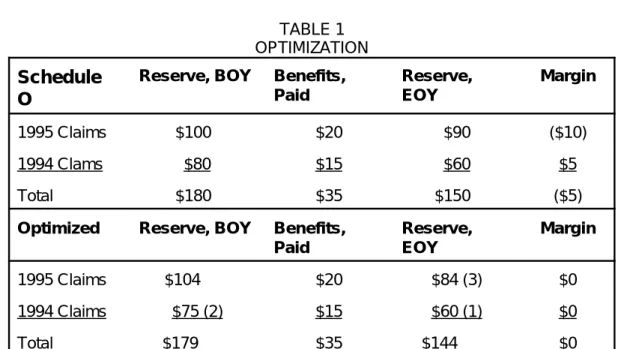
In Chart 5, I’ll try an example of two years of run-out. In 1995, claim reserves went from $100 to $90, paying for $20 of claims. There is the $10 deficiency that we mentioned previously.
CHART 5 OPTIMIZATION
I then have the 1994 claims that are now in their second year. Their reserve goes from $80 to $60, paying for $15 of claims, producing $5 of margin.
My traditional Schedule O is shown in the top half of Table 1. For the two years of claims I start out with $180 of reserves. I pay out $35. I end up with $150. At the end of the two years I end up $5 deficient. There would appear to be a problem with the reserves.
TABLE 1 OPTIMIZATION Schedule
O
Reserve, BOY Benefits, Reserve, Margin
Paid EOY
1995 Claims $100 $20 $90 ($10)
1994 Clams $80 $15 $60 $5
Total $180 $35 $150 ($5)
Optimized Reserve, BOY Benefits, Reserve, Margin
Paid EOY
1995 Claims $104 $20 $84 (3) $0 1994 Claims $75 (2) $15 $60 (1) $0 Total $179 $35 $144 $0
Notes:
(1) Starting point $60 Reserve, EOY presumed correct (2) $75 set equal to Reserve, EOY + Paid Benefits
(3) $84 set equal to ratio of $75 and $80, applied to Reserve, EOY
Let’s look at optimization and see what happens. With optimization, you start at the ending. You look at the oldest claims and follow the analogy to STD and medical: I’m currently holding $60 for 1994 claims at the end of the year, and I’ll trust that this is what is needed for the payment of future claims.
Let’s work backwards. Zero margin is shown in Table 1, but you should include whatever margin you believe is appropriate. We’re going to solve for the reserve we wish we had held at the beginning of the year. In this case, I’m holding $60 at year-end, and paid $15 during the year. I wish I had held $75 at the beginning of the year.
I actually held $80, so maybe my termination assumption or Social Security assumption is too conservative. I don’t know what it is, but that’s something I’ll check into.
Next, I’m going to presume that this conservatism is also present in the 1995 claims’ year-end reserve, which is at the same duration as the 1994 beginning reserves. That would argue that $84 should be held at the end of the year on 1995 claims.
Now I’m going to optimize the reserves for the 1995 claims. I realize that I should have set up $104. Then I could have paid $20 during the year and ended up with the $84 at year-end.
You have your timing down just the way you’d like to have it. What you’re
releasing is what you’re paying. You still have got to do some work to find out why you have differences between the optimized reserves and the reserves actually held. Let’s look at the new Schedule O, presuming you can set new reserves at the
optimized levels. The total reserves at the beginning and end of the year have been reduced $1–$6 respectively, and the margin has improved $5. In other words, you have reduced your LTD reserves and improved margin.
How can that be true? You tell that to the corporate actuary, and he’ll throw you out the door.
Timing is the key. There is a problem with measuring margin using the Schedule O test, but the mistiming of claim payments and reserve releases creates this problem. If you can improve timing, you can reduce this problem and accurately measure margin using the Schedule O test.
So I’ll leave you with these final three points. First, like a good joke, timing is everything. Poorly timed reserves are like poorly timed jokes: you may get to use them only once. Second, claim reserves may have some seasonality. Third, while Schedule O is the standard test for measuring margin, please be careful when you apply it to LTD. Take a look at the optimization example. It will help you to measure margin.