IOS Press
TransCen, Inc.’s WorkLink program: A new
day for day services
Sara Murphy
∗, Eileen Easterbrook, Sonni Bendetson and Scott Lieberman
TransCen Inc., San Francisco, CA, USA
Revised/Accepted January 2014
Abstract. As support forEmployment Firstand the demand for integrated employment grows, the shortcomings of our current service system are becoming more apparent. This article discusses an innovative approach to braiding funding resources and services that addresses programmatic barriers and utilizes the Developmental Disabilities Service (DDS) system to augment Vocational Rehabilitation (VR) services to facilitate direct hire, integrated jobs for people with more significant intellectual disabilities. It describes TransCen, Inc.’s approach to braiding services to promote employment and support customized job placement. Ideas for improving program services and recommendations for system-change are presented.
Keywords: Employment first, vocational rehabilitation, braiding services, intellectual disabilities
Across the country, support for theEmployment First initiative and demand for integrated employment is growing (Martinez, 2013). Many people with disabil-ities and their families are no longer satisfied with segregated work services or day programs that simply help them to “access” the community and stay busy (Migliore, Mank, Grossi, & Rogan, 2007). In many states, although there is growing expressed interest in integrated employment, enrollment rates for day pro-grams are increasing dramatically and the rates of direct hire placements are actually dropping (Butterworth et al., 2011). These declining placement rates make it very clear that our current service system, despite demand and rhetoric to the contrary, does a poor job of encouraging and supporting integrated employment outcomes.
Although most day service providers agree that inte-grated employment is a beneficial and important part of adult life, program services remain focused on social-ization and community outings - not work (Walker ∗Address for correspondence: Sara Murphy, TransCen Inc., 785 Market Street, Suite 670, San Francisco, CA 94103, USA. Tel.: +1 415 979 9520; E-mail: [email protected].
& Rogan, 2007). Barriers such as high consumer to staff ratios and designated program hours make it diffi-cult for day programs to place and support consumers in direct-hire, community employment. With program funding tied to daily attendance, and not outcomes, there is little incentive to encourage participants to become more independent, let alone go to work. To increase employment outcomes for people with more severe disabilities, employment must be seen as a priority, policies and resources must be “rebalanced” to encourage and reward integrated community-based employment (Niemiec, Lavin, & Owens, 2009) and access to customized, person-centered work services and individualized supports must be available and more manageable.
Currently, day (or non-work) services and Supported Employment work services are administered by differ-ent governmdiffer-ent departmdiffer-ents and are two very distinct programs. Because of this, the choice between com-munity integration and integrated employment is often an “either/or” decision. People must often relinquish access to day programs to receive supported employ-ment (SE) and the individualized services needed for placement in the community. For some job seekers and
their families, sacrificing the dependability and struc-ture of a day program to pursue direct hire employment is a difficult decision. Individuals with severe disabil-ities often work fewer hours and still need additional supports to lead active, meaningful lives. The thought of losing their connections to friends and community is a high price to pay in order to go to work. Because of this quandary and the unpredictable nature of employment, people with more significant disabilities do not see SE as a practical or realistic service option. More often than not, the only other work opportunities are enclave sit-uations or sheltered employment. Sadly, there appears to be little middle ground.
Another challenge facing job seekers with significant intellectual or developmental disabilities is access-ing state Vocational Rehabilitation (VR) services and the lack of individualized placement services that uti-lize customized employment strategies. Customized employment is an increasingly identified means of help-ing people with the most complex service needs secure integrated employment (Martinez, 2013). Yet, fund-ing structures and a general lack of understandfund-ing of customized employment principles and methods make integrated employment placement for an individual with more significant disabilities very difficult under the current VR system. Many individuals with significant intellectual disabilities are discouraged from applying to VR because they are deemed unemployable. Others may get a case approved, but then struggle to find a Sup-ported Employment provider who is willing (or able) to devote the time needed to facilitate a customized place-ment. According to Butterworth et al. (2011), 68.2% of people with intellectual or developmental disabilities who apply to VR for help to find a community job do not get one.
Numerous studies have shown that supported employment programs can be a more beneficial and cost effective approach to providing employment ser-vices than sheltered workshops, and that sheltered employment may even be detrimental, producing counter-productive behaviors that require remedia-tion (Cimera, 2011, 2012; Cimera, Wehman, West, & Burgess, 2011). Yet, in our experience in California, Supported Employment (individual placement) contin-ues to be a poorly funded service that is challenging to manage. In today’s economy, with high rates of unemployment, it has become increasingly difficult for service providers to cost effectively place jobseekers using the current funding structure and service rates. Programs are required to make quick and often group placements to generate the revenues needed to cover
program costs. For this reason, many of California’s service providers are reluctant to serve job seekers with more significant disabilities. While customized employment methods have proven to be very successful with this population, it is often a time-intensive process. Many Supported Employment providers cannot afford to invest the upfront time it takes for discovery and to research and negotiate with targeted employers.
1. Combined day and employment services: A hybrid solution
To address these dilemmas and improve employment outcomes for the people enrolled in our commu-nity day program, TransCen’s San Francisco-based employment service, called WorkLink, created a hybrid service that provides the comprehensive supports indi-viduals with more significant disabilities need to be successfully employed—and to lead meaningful lives outside of work. WorkLink has been in operation since 1996. WorkLink’s Integrated Work (IW) pro-gram braids DDS/Medicaid waiver-funded day services with VR employment resources. For our participants, access to both services eliminates the need to choose between community engagement and integrated, direct hire employment. Using day services to complete a discovery process and support the placement process has made it possible to use the VR service system more effectively using an individualized, customized employment approach.
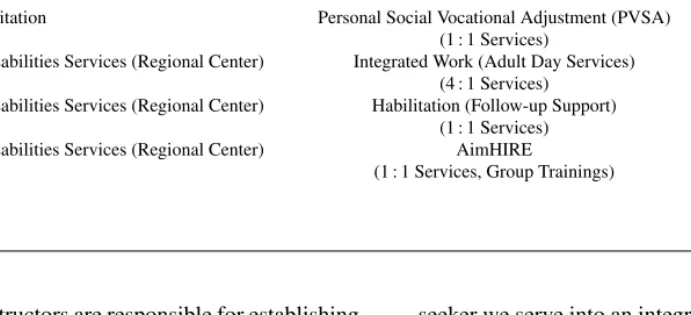
To facilitate the braiding process, WorkLink estab-lished an hourly rate for its day program. Because our day servicesare no longerday-long, participants are not required to attend a program “6-hours per day, Monday through Friday” or attend activities that are not benefi-cial or of interest. With hourly services, participants can work a portion of the day with individualized job coach-ing services through VR and also take advantage of day services, funded by the state I/DD service (Golden Gate Regional Center) before or after work. With our Menu of Program Services (Table 1) participants can create “built to order” schedules that address their needs and interests. Each person receives an individualized com-bination of employment and day services, up to 30 hours of support per week. With a hybrid, hourly approach, WorkLink has created a system of wrap-around sup-port for its participants that sets them on the path to employment.
WorkLink’s day services are 100% community based and are provided at a 3 : 1 staff to consumer service ratio.
Table 1 Menu of program services
Funding agency Program service Amount
Vocational Rehabilitation Competitive Employment Intake $300
(Small group and 1 : 1) Preparation $700 Placement $700 Retention $500
Vocational Rehabilitation Supported Employment Intake $360
(1 : 1 services) Placement $720
Retention $720 Job Coaching $30.82/hr.
Vocational Rehabilitation Personal Social Vocational Adjustment (PVSA) $40/hr.
(1 : 1 Services)
Developmental Disabilities Services (Regional Center) Integrated Work (Adult Day Services) $11.38/hr. (4 : 1 Services) (30 hrs./week maximum) Developmental Disabilities Services (Regional Center) Habilitation (Follow-up Support) $30.82/hr.
(1 : 1 Services)
Developmental Disabilities Services (Regional Center) AimHIRE Person-centered Discovery
(1 : 1 Services, Group Trainings) $34.56/hr. (maximum of 55 hours)
Family Trainings $62.24/person
Community instructors are responsible for establishing training sites and volunteer work experiences that provide opportunities to develop targeted skills. At WorkLink, community instructors are assigned to manage specific activities throughout the day, not a des-ignated group of individuals. Grouping people based on goals, and varying the make-up of the small groups throughout the day, gives participants a chance to meet people who have similar interests and to interact with a wide variety of individuals throughout the week.
Employment is WorkLink’s primary focus. Every person enrolled in day services is required to have an employment objective. WorkLink uses DDS-funded day services to complete a person-centered discov-ery process that informs our customized placement process. Community instructors use volunteer train-ing sites to assess a job seeker’s interests and abilities and help identify potential employment settings where the individual will be most successful. For people who are unsure of their abilities or employment goals, we use community volunteer sites to explore vocational options and develop practical skills. We partner with numerous community organizations to develop a vari-ety of training sites. For example, people can choose to learn clerical/computer skills at San Francisco Museum of Modern Art or the Red Cross, cooking/food service skills at Meals on Wheels, or sorting/assembly skills at the San Francisco Food Bank.
WorkLink strongly embraces customized employ-ment as the overarching service delivery strategy. We use these principles and methods to place each job
seeker we serve into an integrated, direct hire position. Once a person enrolled in day services has completed the person-centered discovery process and determined a vocational goal, we open a case with VR for the job seeker and braid in VR funded SE services. Our job developer then works collaboratively with the commu-nity instructors to follow through on the placement ideas identified during the discovery process. When a posi-tion is found, WorkLink provides a job coach through SE and does not pull a community instructor from day services.
As individual’s work hours increase, their day services are reduced, but can continue seamlessly. Community instructors continue to help employed par-ticipants gain confidence and build skills that will help them grow in their jobs. Over time, as people develop additional skills, their work responsibilities and hours often increase. When people start to work more, they often decide they no longer need “day” services. This then opens the door for WorkLink to start the process with a new participant.
While some individuals Worklink serves become independent over time, other participants who have more severe disabilities continue to need a high degree of support in order to work and participate in commu-nity activities for their entire lives. For these individuals, day service hours function as a touchstone. On-going connection enables community instructors to iden-tify non-work issues that could affect an individual’s work performance or productivity, such as a death in the family, broken wheelchair or a lost wallet. If a
problem persists that could jeopardize a person’s job, the community instructor quickly alerts the person’s job coach, and together they address the situation so the per-son can continue to work. Braiding services creates a safety net that helps make the unpredictable nature of life and employment more manageable for people with complex needs.
Braided services require a high degree of coordi-nation and communication across program teams and providing services at an hourly rate requires careful tracking and billing, but deliver better long-term out-comes. The hybrid model has eliminated programmatic silos, filled service gaps and improved communication on all levels. It has made finding people jobs a con-certed team effort. It has made our program services more responsive and accountable to our customers (job seekers, families, funders and employers) and to our mission.
1.1. Employment and programmatic outcomes Although WorkLink is a small program, the employ-ment outcomes for the individuals enrolled in our hybrid services illustrate its effectiveness. On aver-age, our entire program serves around 80 job seekers each year. Of these, 24 people receive braided ser-vices (hybrid day/SE) and 15 receive only work serser-vices (SE). (40 professional-level job seekers with disabili-ties are served each year through a separate Transitional Employment program.) The 24 individuals enrolled in our hybrid services have significant intellectual or mul-tiple disabilities. At the time of this writing, 46% (11) of these individuals are employed and 25% (6) are actively applying for jobs. The remaining 8 individuals are involved in community activities, internships and completing a discovery process that will ultimately lead to an active job search. All of the individuals who are working are individually placed, directly hired by their employers and are earning competitive wages: $10.55 to $15 per hour (average wage is $12.18/hour). For these people, the number of hours they work is dependent on their skills, stamina and of course, their employers’ needs. The range of hours varies greatly, from 3 to 28 hours per week. On average, people who receive hybrid services are working 10 hours per week. For many of the people enrolled in the Integrated Work program, this is a monumental step due to the complexities associated with their disabilities.
As the chart of WorkLink’s 2012–13 outcomes (Table 2) shows, our program’s successful closure rates are very high. The program’s effective use of
customized employment methods and the time spent completing an in-depth discovery process through day services is a factor. However, our success could also be attributed to the continuation of community based day services for people who are working. Having access to more comprehensive, wrap around support services means we can keep people out of crisis and address non-work issues before a person’s job is affected. The longevity of our placements show that those receiving the braided services continue to retain their positions—at a higher rate than those enrolled in just SE. Obviously there are a number of uncon-trolled factors involved, and our numbers are based on a small sample. But the trend is certainly a favorable one and demonstrates that person-centered discovery com-bined with comprehensive support services promotes employment and keeps people working. As importantly, it insures a meaningful service for non-work hours.
Our braided service approach fosters independence. As people start to work they often require fewer service hours. As individuals gain confidence and skills, their work hours tend to increase. In our hybrid program we have tracked the hours of service for over ten years. We have seen a dramatic drop in day services when people start to work. On occasion, WorkLink participants have opted out of day services all together once they have settled into a job they love and are comfortable in the community.
One example of this is Janice. She came into the pro-gram from a high school transition propro-gram. When she started at WorkLink, she received 30 hours of day sup-port per week and was not employed. When we secured a job, she began to work 15 hours per week, and contin-ued to receive 15 hours of day services. Fourteen years later, Janice is now working 28 hours per week (a 46% increase) and is receiving less than 8 hours of day ser-vices per week (a 73% decrease) and 2 hours per week of job coaching.
1.2. Benefits of braiding services
WorkLink has found braiding services to be immensely beneficial on many different levels. For individuals enrolled, service plans can be tailored to address a variety of needs and can be quickly modified to changing situations. Hybrid wrap-around support encourages people with more significant disabilities to consider employment and makes direct hire jobs a more viable option. Access to individualized Sup-ported Employment services provides more responsive and effective supports for our job seekers and their
Table 2
WorkLink employment outcomes 2012–2013
Outcomes Supported employment Hybrid service (SE + Day Services) Combined
Number Working 11 11 22
Ave. Hours/mth 93 hours/mth 38 hours/mth 66 hours/mth
Range of Wages $10.55–$21.83/hr $10.55–$15/hr $10.55–$21.83/hr
Average wage $14.80/hr $12.18/hr $13.49/hr.
% of Successful Closure (transfer to Habilitation) 100% 100% 100%
% still working 3 yrs. 72% 63% 68%
% still working after 7 years 27% 55% 41%
Number of Placements in 2012–13 2 1 3
In Job Development 2 4 6
employers. For service providers, braiding services addresses numerous programmatic issues and makes it easier to place and support people in direct hire commu-nity employment. Day services can be used to support vocational goals and a customized placement process. For government agencies and funding organizations, providing hourly services increases service account-ability, fosters independence and maximizes the use of limited resources and public dollars.
The hybrid service approach enables WorkLink to cost-effectively use Supported Employment and cus-tomized placement methods to serve jobseekers with significant disabilities. By braiding work and day services, Supported Employment job developers no longer have to spend hours of upfront (unbillable) time to develop a job seeker profile and target poten-tial employment settings. Job developers can rely on the community instructors to do much of the prelim-inary work and address pre-employment issues, such as personal hygiene, soft skills or skill deficits. Using day services to support the customized placement pro-cess enables job developers to hit the ground running. This makes it more cost effective for a SE program to use customized employment methods and provides the information we need to find a good fit and make a quality placement.
Braiding services has also benefited our day services program. Community instructors are no longer called upon to place or coach employees within the group ser-vice model. Individuals in the Integrated Work program typically have more significant intellectual disabilities. Supporting these individuals at a job site within a group service model effectively is not possible. With access to SE services, our day program no longer has to scramble schedules and shuffle personnel to free a staff person to provide intensive on-the-job coaching or respond to an employment situation. Instead, participants in day ser-vices have access to a well-trained job coach whenever needed.
Braiding services streamlined WorkLink’s service approach, eliminated “programmatic silos” and has dramatically altered the agency’s overall culture. It established a “one for all/all for one” attitude that crosses program lines. This “team atmosphere” has created a seamless connection between services the organization provides. When individualized, short term support is needed in day services our job coaches can be called upon to assist. Cross training allows us to more cost effectively use direct service job coaches and makes it easier to manage unanticipated situations. It levels Supported Employment staffing hours and stabi-lizes program revenues, making it easier to manage the unpredictable nature of community employment.
WorkLink’s hybrid approach gives participants access to a team of specially trained, knowledgeable staff who can skillfully address any issue. For employ-ment issues, participants have access to a professional work services staff that is trained in customized employ-ment methods and able to build strong partnerships with businesses and effectively market candidates. For non-work needs, community instructors have an in-depth knowledge regarding public services, benefits and community resources such as adult education classes, volunteer opportunities and recreational facilities.
2. Conclusion
Employment Firstpolicy initiatives are an important step in the right direction to improving employment out-comes for people with significant intellectual disabili-ties. However, if these individuals are to be productive, active members of the workforce and community, it is going to take more than this emerging initiative to impact employment rates and service systems.
At TransCen, Inc. we see hybrid services and cus-tomized employment as fundamental best practice. The importance of wrap around support and customized
placement methods cannot be overstated. Braiding day and work services has enabled our program to creatively use existing services and resources to provide flexible, customized supports, making it possible for people with significant disabilities to be directly employed in the community.
Unfortunately for people with significant disabili-ties, the disability service system was built to care for people who were not working, as opposed to provide the person-centered services and wrap around supports many individuals need to be successfully employed in direct hire jobs. Currently, most day programs are attendance-based and are not able to support commu-nity employment. More often than not, day programs do not even consider work a primary focus. Current funding resources and outcome-based fee structures that characterize Supported Employment services favor rapid placements. Customized employment, with its person-centered discovery and negotiation process is often viewed as far too time-consuming. In addition, customized employment’s discovery and negotiation process is a completely different approach from what most job developers currently use to market and place job seekers with disabilities. Many job developers have only a limited understanding of customized employ-ment and are unsure of how to impleemploy-ment this essential approach. Technical assistance and training in this area are desperately needed.
Across the country there are excellent service providers who have proven that it is possible to be creative and successful with existing resources. It is time to scale up these pockets of excellence and give people access to the services they need to go to work. In order for this to occur, federal and state agencies need to encourage the braiding of services and must incentivize person-centered, customized placements and facilitate its acceptance as a standard practice. Funding needs be reallocated form archaic, ineffective programs (e.g. day activity centers and workshops) and invested in community-based services that can provide person-centered, customized services and wrap-around supports. Fee structures, accreditation processes and invoicing systems need to be revised and consoli-dated so service providers can braid together and cost-effectively provide the services that are needed. Ultimately, it would be a progressive leap forward in the efforts to promote the concept of presumed
employ-ability for all people with disabilities if adult service providers were mandated to provide employment-related supports and were held accountable for their employment efforts and outcomes.
If people with significant disabilities are to lead suc-cessful, productive adult lives, that include integrated employment, we must ensure that they have access to the full level of support that a hybrid model offers. Now that Employment First is gaining momentum, it is time to raise the bar and make this a new day for day services.
Acknowledgments
Partial support for this project came from California Employment Consortium for Youth (CECY), a Project for National Significance Partnerships in Employ-ment Systems Change Grant funded by Administration on Intellectual and Developmental Disabilities, Grant #90D0N0284 (10/01/11 – 9/30/2016).
References
Butterworth, J., Smith, F., Hall, A., Migliore, A., Winsor, J., Domin, D., & Timmons, J. (2011).State data: The national report on employment services and outcomes. Boston: Institute for Com-munity Inclusion, University of Massachusetts Boston. Cimera, R. E. (2012). The economics of supported employment:
What new data tell us.Journal of Vocational Rehabilitation, 37(2), 109–117.
Cimera, R. E. (2011). Does being in sheltered workshops improve the employment outcomes of supported employees with intellectual disabilities?Journal of Vocational Rehabilitation, 35(1), 21–28. Cimera, R. E., Wehman, P., West, M., & Burgess, S. (2011). Do shel-tered workshops enhance employment outcomes for adults with autism spectrum disorder?Autism: The International Journal of Research and Practice, 16(1), 87–94.
Martinez, K. (2013). Integrated employment, EmploymentFirst, and U.S. federal policy.Journal of Vocational Rehabilitation, 38(3), 165–168.
Migliore, A., Mank, D., Grossi, T., & Rogan, P. (2007). Integrated employment or sheltered workshops: Preferences of adults with disabilities, their families and staff.Journal of Vocational Reha-bilitation, 26(1), 5–19.
Niemiec, B., Lavin, D., & Owens, L. (2009). Establishing a national employment first agenda.Journal of Vocational Rehabilitation, 31(3), 139–144.
Walker, P., & Rogan, P. (2007).Make the day matter: Promoting typical lifestyles for adults with significant disabilities. Baltimore, MD: Paul H. Brookes Publishing Co.