ISSN 1440-771X ISBN 0 7326 1065 6
M O N A S H U N I V E R S I T Y
AUSTRALIA
Forecasting for Inventory Control with Exponential Smoothing
Ralph D. Snyder, Anne Koehler and Keith Ord
Working Paper 10/99
August 1999
DEPARTMENT OF ECONOMETRICS
AND BUSINESS STATISTICS
Forecasting for Inventory Control with Exponential Smoothing
Associate Professor Ralph D. Snyder
Department of Econometrics and Business Statistics Monash University
Clayton, Victoria 3168 Australia
Professor Anne Koehler
Department of Decision Sciences Miami University
Oxford, OH45056, USA Professor Keith Ord
Department of Management Science The Pennsylvania State University University Park, PA 16802, USA
(After July 1, 1999: McDonough School of Business, Georgetown University, Washington, DC 20057 USA)
Abstract:
Exponential smoothing, often used for sales forecasting in inventory control, has always been rationalized in terms of statistical models that possess errors with constant variances. It is shown in this paper that exponential smoothing remains the appropriate approach under more general conditions where the variances are allowed to grow and contract with corresponding movements in the underlying level. The implications for estimation and prediction are
explored. In particular the problem of finding the prediction distribution of aggregate lead-time demand for use in inventory control calculations is considered. It is found that unless a drift term is added to simple exponential smoothing, the prediction distribution is largely unaffected by the variance assumption. A method for establishing order-up-to levels and reorder levels directly from the simulated prediction distributions is also proposed.
Key Words: Inventory control, demand forecasting, exponential smoothing, bootstrap
1. INTRODUCTION
The conceptualisation of simple exponential smoothing (Brown, 1959) was an important
development for demand forecasting in inventory control. Yet implementations of this method
have often been surrounded by practices, summarised in Gardner(1985), which possess
questionable theoretical roots and which, at best, have enjoyed a mixed success. This paper is
written on the assumption that good practice emerges from sound theory and that such a
strategy must be built on the statistical models underlying the technique. Our contribution is
to suggest that the theory of simple exponential smoothing can be extended to a broader class
of models where error variances, instead of remaining constant, can change over time. The
implications of this heteroscedasticity for estimation are explored in section 3. Its
consequences for prediction, particularly in relation to aggregate lead time demand, a quantity
of particular interest in inventory control, are outlined in section 4.
In a recent paper (Ord, Koehler and Snyder, 1997) the methods of exponential smoothing
were shown to apply under much more general conditions than those traditionally envisaged
in the literature. In this paper we take a more detailed look at some of the important versions
of exponential smoothing and explore the consequences with reference to the forecasting
requirements in inventory control.
Many expositions of exponential smoothing are related back to associated ARIMA models
(Box and Jenkins, ). It is implicitly assumed in such expositions that the processes under
consideration extend back into the infinite past. Most items carried in a typical inventory
system typically possess a finite life cycle so that this semi-infinite time assumption is
unrealistic. It is assumed in this paper that items are introduced into an inventory at the start
of a period of time that is designated period 1. It is further assumed that n periods have
elapsed since the introduction and that the problem is to forecast demand over a lead-time h
y
t.2.
SIMPLE EXPONENTIAL SMOOTHING
2.1 L
OCALL
EVELM
ODELSDemand over time in basic inventory theory is usually represented by normally and
independently distributed random variables with a common mean
m
and a common standarddeviation
s
. The series is often written asy
t= +
m e
t, (2.1)the
e
t beingNID
2 7
0
,
s
2 random variables. The errorse
t represent unanticipated demand. In this model the impact of each error is restricted to the period in which it occurs. Each erroronly has a transient effect.
In practice unanticipated demand may spill over into later periods. New customers may cause
demand to increase in the long term. New competitors entering a market may permanently
reduce market shares. Assuming that a proportion a of unanticipated demand has a permanent
effect from causes like these, the model (2.1) may be modified to give
y
tm a
e
t je
j t t= +
−+
= −∑
1 1 . (2.2)Muth (1960) introduced this model, albeit with a semi-infinite past and with
m
=
0
, and showed that it underpins simple exponential smoothing. Differencing yields, fort
≥
2
, the process∆
y
t= −
θ
e
t−1+
e
t whereθ
= −1 a. Working in a semi-infinite time context, Box and Jerkins (1976) also demonstrated that this model underlies simple exponential smoothing.A ‘local level’ may be defined as
m
tm a
e
t j j t= +
− = −∑
0 1. The model (2.2) may then be rewritten
in terms of a measurement equation
y
t=
m
t−1+
e
t and a transition equationm
t=
m
t−1+
ae
t. Both the measurement and transition equations define what may be referred to as a local levelmodel (LLM). It is a special case of the linear state space framework in Snyder (1985). The
parameter
a
corresponds to the familiar smoothing constant. An advantage of thisrepresentation over its ARIMA counterpart is that the link with the error correction form of
exponential smoothing is more transparent.
A generalisation of the local level model that accommodates level dependent variability
consists of the measurement equation
y
t=
m
t−1+
m e
tq−1 t (2.3)together with the transition equation
m
tm
tam e
t qt
=
−1+
−1 (2.4)where the parameter q determines the degree of heteroscedasticity. It will be designated
LLM(q). Our primary focus will be on the special cases LLM(0) and LLM(1). LLM(0)
corresponds to the original local level model with additive errors. LLM(1) represents series
with level dependent variability based on relative errors.
The behaviour of the local level in LLM(q) is governed by
m
t=
θ
m
t−1+
ay
t. (2.5)This relationship is obtained by eliminating the error term in the LLM(q) equations (2.3) and
(2.4). Interestingly, it does not depend q. The behaviour of the level is independent of the
m
t tm a
jy
t j j t=
+
− = −∑
θ
θ
0 1 . (2.6)The local level summarises the past behaviour of the demand process. The weights
αθ
j determine the impact of past time series values. Whenθ <
1
these weights decline with increases in the age index j. This discounting of past observations is warranted when marketsare subject to structural change.
The inequality
θ <
1
for LLM(0) corresponds to the invertibility condition for the ARIMA(0,1,1) process (Box and Jenkins, 1976). It is also equivalent to0
< <
a
2
. Thus LLM(0) accomodates structural change for values of the smoothing parameter in excess of 1,a conclusion that is incompatible with the traditional argument above. The importance of this
can be gauged by focussing on the order autocorrelation coefficient of the
first-differences. It can be established that the first-order autocorrelation in the differenced demand
series is given by
corr
1
∆ ∆
y y
t t−16
= −
θ
. Demand series with positively autocorrelated firstdifferences can only be modelled, within the local level framework, if a is allowed to take
values above one.
2.2 S
MOOTHINGO
FT
IMES
ERIESThe unknown smoothing parameter
a
and the seed levelm
may be assigned trialvalues. At the start of typical period
t
the observed values of the seriesy y
1,
2,
!
y
t−1 fromearlier periods are also fixed, known quantities. The information set may be designated by
I
t−1=
;
y y
1,
2,
!
y
t−1, ,
a m
@
. Letm
t−1=
1
m
t−1|
I
t−16
. According to (2.5) successive localm
t=
m
t−1+
a y
1
t−
m
t−16
(2.7)where
m
0=
m
. These conditional local levels are fixed rather than random quantities. Theequation (2.7) corresponds to the simple exponential smoothing updating relationship (Brown,
1959). The traditional view has always been that simple exponential smoothing can only be
rationalised in terms of an ARIMA(0,1,1) process (Box & Jenkins, 1976). A key finding in
this paper is that exponential smoothing is also compatible with models where the variation in
the series is dependent on the underlying level.
2.3
MAXIMUM LIKELIHOOD ESTIMATION
A wide variety of methods (Gardner, 1985) have been suggested in the context of
simple exponential smoothing for estimating the seed level
m
, the smoothing parametera
and the standard deviation s. Holt (1957) recommends the use of the sum of squared one-step
ahead prediction errors as a criterion for selecting the smoothing parameter. It also makes
sense to apply the same criterion when choosing the seed level. Yet we have seen that simple
exponential smoothing is also a legitimate method when demand data is generated by
LLM(1). It might be speculated that the same tactic works with the sum of squared relative
errors. Given that absolute and relative errors are inherently different quantities, one could not
compare both types of sum of squared errors criterion to make the choice between LLM(0)
and LLM(1). This is a serious drawback with the sum of squared errors criterion.
Likelihood functions for different models, in contrast, are comparable quantities. In
forming such likelihood functions we choose to treat the seed level m as a parameter. Under
the semi-infinite life assumption adopted quite widely in expositions of the state space
approach to time series analysis, such a strategy would not be legitimate. Then m would be
represented as an infinite sum of past errors and therefore would be a random variable with an
out of the likelihood. In other words it would be necessary to find the marginal likelihood
function (Kalbfleish & Sprott). Under our finite life assumption for the inventories this
difficulty is avoided because m is a fixed quantity. Under our assumption the likelihood can
be shown to be
A
m a s y y
!
y
ns
m
e
s
n t t n q t i n, , |
1,
2,
exp
2 2 1 1 2 1 22
2
1
6 3 8
=
− −−
= − =∏
∑
π
, (2.8)the one-step ahead prediction errors
e
ty
tm
tm
t q=
1
−
−16
−1 being obtained from theapplication of simple exponential smoothing relationship (2.7). The maximum likelihood of
the variance estimate of the variance is given by the familiar formula
s
e
tn
i n 2 2 1
=
=∑
. Substitution of this into (2.8) yieldsA
m a y y
!
y
ns
nm
tn
t n q, |
1,
2,
2 2 1exp
12
2
1
6 2 7
=
− −1 6
−
= −∏
π
. Thus the maximum likelihoodestimates of a and m may be obtained by minimising the quantity
ω =
− =∏
s
m
t t n n q|
1|
1 . (2.9)For LLM(0)
ω
corresponds to the standard errors
. In other words it is appropriate to minimise the standard error or its equivalent, the conventional sum of squared errorsS
e
t t n=
=∑
2 1. This justifies the extension of Holt’s strategy for the selection of the smoothing
parameter to the problem of choosing the seed level. The criterion (2.9) is
ω =
− =∏
s
m
t t n n 1 1for LLM(1). The second term in this expression is the geometric mean of
the local levels. Its effective purpose is to convert
s
, now measured in relative terms, into afocussing on
ω
rather than s (or the sum of squared errors), comparisons can be made between different models using within sample fit.ω
will be referred to as the generalised standard error. Those values of m and a which minimise the generalised standard error will berepresented by
m
anda
. The corresponding value ofs
will be designated bys
. The statisticsm a
,
ands
are maximum likelihood estimates.It now has been established that simple exponential smoothing can be rationalised in terms of
a broader set of models than has hitherto been appreciated. The form of the updating
relationship remains the same for all versions of the local level model. Only the fitting criteria
change to reflect different possible assumptions about the behaviour of the variance.
Practitioners are therefore faced with the prospect of implementing more elaborate estimation
procedures based on criteria other than the traditional sum of squared prediction errors. The
question is whether such change is really warranted?
To gain insight into this question it is worthwhile considering the stationary model
y
t= +
m m e
q t, a special case of LLM(q) obtained whena
=
0
. In this caseω =
−
=
−
= = =∑
y
tm
nm
∏
m
∑
y
m
n
p t n t n n p t t n1 6
21 6
1 1 2 1. The generalised standard error is
independent of the degree of heteroscedasticity q. The sample average
m
y n
tt n
=
=∑
1minimises the generalised standard error for any value of q. In the stationary case LLM(0) and
LLM(1) have the same maximum likelihood estimate.
This neat simplification of
ω
disappears whena
≠
0
. To gauge the impact of this, a small simulation study was undertaken comparing the estimates obtained from LLM(0) andLLM(1). At each of 1000 replications of the simulation, a time series was generated from
LLM(1) with
m
=
100
, the sample size n, the smoothing parameter a and the standardLLM(1) were fitted to the simulated data and their optimal generalised standard errors
ω
0* andω
1* compared. Apportioning any ties equally between both approaches, it was found that LLM(1) was correctly selected 63 percent of the time. In 28 percent of casesω
0* proved to be more than one percent away fromω
1*.Place Table 1 about here
The LLM(1) generalised standard error
ω
10, when the optimal LLM(0) estimates are used as approximations for the LLM(1) estimates, was also calculated. The ratioλ ω ω
=
10 1* can never be less than 1 because the LLM(0) estimates are not optimal for the LLM(1) model.Nevertheless
λ
averaged 1.0004 and had a standard deviation of only 0.0013. The optimal estimates for both models were usually remarkably close.LLM(1) is more ‘nonlinear’ than LLM(0) and therefore potentially more difficult to estimate.
The above simulation suggests the following estimation strategy for LLM(1):
1. Find the maximum likelihood estimates
m a
,
and the one-step predictionsy
t for the simpler LLM(0).2. Use
m a
,
as approximations for the corresponding quantities in LLM(1) and estimate the standard deviation of the relative errors withs
n
y
ty
ty
t t n=
−−
=∑
1 2 2 11
6
. (2.10)It might be argued, given the above simulation results, that there is little point in using
LLM(1) and that this proposed estimation procedure is largely redundant from a practical
point of view. In the simulation, however,
λ
1 had an average of 1.0166 and a standard deviation of 0.0392. The size of the standard deviation indicates that in some contexts thegains from using LLM(1) may be warranted. From a practical point of view, however, it is
usually the predictive capacity of a model that counts. It is this issue that we now explore.
2.4 L
EADT
IMED
EMANDD
ISTRIBUTIONThe prediction distribution of the typical series value
y
n j+ beyond periodn
is conditioned onthe sample
y y
1,
2,
!
,
y
n. For convenience it is assumed initially that the seed levelm
, thesmoothing parameter
a
, and the standard deviation s are known exactly. The problem thenreduces to finding the distribution of
y
n j+|
I
n.For LLM(0), back-substitution of the recurrence relationship (2.4) yields
m
n jm
na
e
t t n n j + = + +=
+
∑
1where
m
n j+=
3
m
n j+|
I
n8
. The future conditional local levelm
n j+ is arandom rather than a constant quantity. It follows from this future local level equation that
y
n jm
na
e
te
t n n j n j + = + + − +=
+
∑
+
1 1 . (2.11)Thus
E y
3
n j+|
I
n8
=
m
n andVar y
3
n j+|
I
n8 1 6
=
2
j
−
1
a
2+
1
7
s
2.In inventory control applications the primary interest is in total demand over a lead-time
h
.Aggregation of (2.11) gives
y
thm
nja e
j h t n n h n h j=
+
+
= − = + + + −∑
∑
1
0 1 11 6
. Thus the mean lead-time
demand is given by the usual formula
E
y I
t thm
t n n h n
|
= + +∑
=
1. The variance, however, has the
more complex formula
Var
y I
tf h a s
t n n h n = + +
∑
=
1 2 2|
1 6
,
wheref h a
1 6
,
=
h
3
1
+
a h
1 6 1 6
−
1 1
2
+
2
h
−
1
a
6
7
8
. In other words, conditional total lead-time demand is normally distributed with mean hmn and standard deviationf h a s
1 6
,
. In practicethe
h
is often used instead off h a
( , )
. This leads to a serious under-estimation of theprediction standard deviation and this has serious consequences for safety stock determination
and customer service, a matter that is more fully explored in Snyder, Kohler and Ord (1997).
For the LLM(1)
y
n jm
nae
te
n j t n n j + + = + + −=
∏
1
+
1
+
1 11 63
8
. (2.12)Again the conditional mean, which may be used as a forecast, is
E y
3
n j+|
I
n8
=
m
n. Beingexpressed in relative terms the errors are fairly small. Products of the errors are negligible so
that the random variable
y
n j+ in (2.12) can be approximated by the quantity~
y
n j+ defined by~
y
n jm
na
e
te
t n n j n j + = + + − +=
1
+
∑
+
1 1
. The conditional variance may be approximated by
Var y
3
~
n j+|
I
n8 1 6
= + −
2
1
j
1
a m s
27
n2 2. For lead-time demand it can be established that themean is again given by
E
y I
t thm
t n n h n
|
= + +∑
=
1and that the conditional variance can be
approximated by the slightly different formula
Var
y I
tf h a m s
t n n h n n
~ |
( , )
= + +∑
=
1 2 2 2 . It istempting to approximate the lead time demand distribution by a normal distribution with
mean
hm
n and standard deviationf a h m s
( , )
n . Simulation studies indicated that provided itis assumed that
m
n is known with certainty then this approximation works well.From a practical point of view it is probably simpler to bypass normal approximations based
on the above moments formulae and simulate lead-time demand distributions directly from
the relationships (2.11) and (2.12). The quantities
m a
,
ands
are usually unknown. Aparametric bootstrap based on the approximations
m
=
m
,a
=
a
ands
=
s
can be used. Exponential smoothing, seeded with the maximum likelihood estimates, is used to calculatem
n, the corresponding value ofm
n. These quantities are used together with the formulae theLLM(q) formulae to generate bootstrap samples of lead-time demand. A simulation for
comparing the results of the bootstrap method for LLM(0) and LLM(1) was undertaken. First,
a sample was simulated from the LLM(1) with
m
=
100
,s
=
0 05
.
andn
=
30
. Maximum likelihood estimates were obtained for both models. These were then used obtain bothbootstrap samples of 1000 lead-time demands, the lead-time being
h
=
10
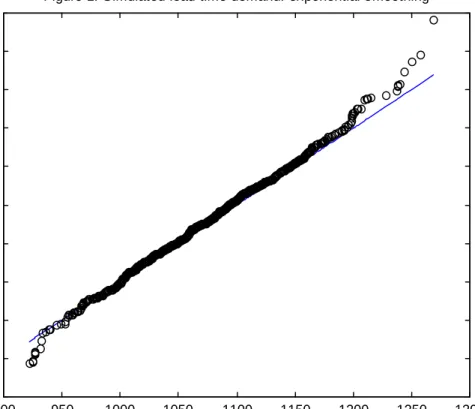
. Figure 1 shows the quantile-quantile plot of the samples. The plot is quite close to the 450 line reflecting thesimilarity of the LLM(0) and LLM(1) lead-time demand distributions. This result is typical of
those obtained when the simulation conditions were varied.
Place Figure 1 about here
The parametric bootstrap approach ignores the effect of estimation error. An appropriate
adaptation of the simulation method described in Ord, Koehler and Snyder (1997) would
account for this source of error. It is anticipated that greater differences would then emerge
between the two models.
3. SIMPLE EXPONENTIAL SMOOTHING WITH DRIFT
3.1
L
OCALL
EVELM
ODELS WITHD
RIFTIntuitively, it makes sense that heteroscedasticity related to the magnitude of the fluctuations
in the mean, may be modest when the mean is locally constant. It is likely to have more of an
impact if there is a tendency for the series to increase or decrease over time. We therefore
introduce a growth rate b into (2.2) to give
y
tm bt
e
je
j t t= + +
+
= −∑
α
1 1 . (3.1)This can be written as
y
t= + +
m bt
u
t whereu
t=
u
t−1−
θ
e
t−1+
e
t. Differencing (3.1) yields∆
y
t= −
b
θ
e
t−1+
e
t so that the associated time series is ‘difference stationary’. Contrast this with the more common case where the trend is accompanied by first-order autocorrelateddisturbances governed by
u
t=
φ
u
t−1+
e
t, the associated series now being ‘trend stationary’ provided that parameterφ
satisfies the conditionφ <
1
.The local level may be defined as
m
tm bt
e
t j t= + +
=∑
α
1. Then (3.1) may be written as
y
t=
m
t−1+ +
b
e
t wherem
t=
m
t−1+ +
b
α
e
t. This local level model with drift is the special case of the model underlying Holts trend corrected exponential smoothing where the growthrate is restricted to a constant value. The generalisation to include heteroscedastic variation is
y
t=
1
m
t−1+ +
b
6 1
m
t−1+
b e
6
q t (3.2)where
m
t=
1
m
t−1+ +
b
6 1
α
m
t−1+
b e
6
q t. (3.3)It will be designated LLDM(q). Again
q
=
1
corresponds to the relative error case.The local level, for any LLDM(q) can be written as
m
t tm
jb
y
j t j t j j t
=
+
+
= = − −∑
∑
θ
θ
α θ
1 0 1 .The local level is still a discounted linear function of series values when the invertibility
condition
θ <
1
holds. In what follows, however, we continue to use the common restriction0
≤ ≤
α
1
.Smoothing and estimation is quite similar to the case where there is no drift. For given values
of
m
,b
andα
the augmented smoothing relationshipm
t=
m
t−1+ +
b
α
1
y
t−
m
t−1−
b
6
may be applied wherem
0=
m
. The errors may be calculated withe
ty
tm
tb
m
tb
q
=
1
−
−1−
6 1
−1+
6
. Using the principle of maximum likelihood, it can be arguedthat
m b
,
andα
should be chosen to minimise the generalised standard errorω =
+
− =∏
s
m
tb
t n n q|
1|
1 .A simulation study similar to the first study described in section 2.3 was again conducted, but
now with a drift of
b
=
0 5
.
. Interestingly the simulated ratioλ
now had a moderately larger average of 1.0015 and standard deviation of 0.0040. It seems that even with a drift term, theLLDM(0) estimates are close enough for most practical purposes to use as approximations for
their LLDM(1) counterparts. Interestingly, the optimal generalised standard error
ω
1 *was
now greater than
ω
*0 about 80 percent of the 1000 replications. Furthermore, the gap betweenω
0 *and
ω
1* now exceeded one percent in 67 percent of the replications. The differences between LLDM(0) and LLDM(1) when there is drift can be quite marked.3.3 L
EADT
IMED
EMANDD
ISTRIBUTIONIt is possible to obtain formulae for the mean and standard deviation of the lead-time
demand distributions. It is simplest, however, to undertake a parametric bootstrap of
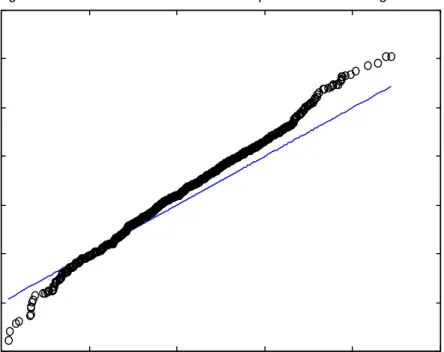
the lead-time distribution. Figure 2 shows the quantile-quantile plot obtained when the
simulation was conducted under essentially the same conditions as those depicted in
section 2.4. The only difference is that now a drift of b
=
0 5
. is assumed. The
quantile-quantile plot of simulated lead-time demands is now steeper than the 45
0line.
This indicates that the lead-time demand distribution for LLDM(1) is more spread
than that for LLDM(0). It suggests that larger safety stocks may be required if level
dependent errors are present and that a pronounced drift is observed in demand.
Place Figure 2 about here
4.
Trend Corrected Exponential Smoothing
Another possible model is
y
tm bt
e
je
e
j t j t j i i t
= + +
+
+
= − = = −∑
∑
∑
α
1α
1 1 2 1 1 1 . It may be written asy
t= + +
m bt
u
t where∆
2u
t= −
e
tθ
1e
t−1−
θ
2e
t−2 fort
>
2
, the parameters being related by the equationsθ
1= −
2
α α
1−
2 andθ
2=
α
1−
1
. It is a trend line with a particular form of autocorrelated disturbances. A local level may be defined asm
tm bt
e
je
j t j j i i t= + +
+
= = =∑
∑
∑
α
1α
1 2 1 1 . Theny
tm
tb
e
je
j t t=
−+ +
+
= −∑
1 2 1 1α
. If, in addition, alocal growth rate is defined as
b
tb
e
j j t= +
=∑
α
2 1, then the model may be written is state space
form as
y
t=
m
t−1+
b
t−1+
e
t wherem
t=
m
t−1+
b
t−1+
α
1e
t andb
t=
b
t−1+
α
2e
t. Unlike LLDM(0), the growth rate is now allowed to change over time. This is the so-called localtrend model.
A generalisation to accommodate heteroscedastic variation is
y
t=
m
t−1+
b
t−1+
1
m
t−1+
b
t−16
qe
t (4.1)b
tb
tm
tb
te
q t
=
−1+
α
21
−1+
−16
(4.3)It will be designated LTM(q). Again
q
=
1
corresponds to the relative error case.Assuming that m, b,
α
1 andα
2 have been assigned trial values, the information available atthe end of typical period t is
I
t=
;
y
1,
!
,
y m b
t, , ,
α α
1,
2@
. Letm
0=
m
andb
0=
b
.Furthermore let
m
t=
1 6
m I
t|
t andb
t=
1 6
b I
t|
t fort
≥
1
. These conditional quantities must be consistent with the equations for LTM(q). They may be computed recursively with therelationships
m
t=
m
t−1+
b
t−1+
α
12
y
t−
m
t−1−
b
t−17
(4.4)b
t=
b
t−1+
α
22
y
t−
m
t−1−
b
t−17
, (4.5)These recurrence relationships are obtained by eliminating the
e
t from the LTM(q) equations.They correspond to the error correction form of Holts trend corrected exponential smoothing
(Gardner, 198*). Thus this traditional method is applicable under much broader conditions
than those traditionally stated in the literature. It applies when the variation depends on the
underlying level.
Maximum likelihood estimates of m, b,
α
1 andα
2 can be obtained by minimising thegeneralised standard error
ω =
+
− − =∏
s
m
tb
t t n n q|
1 1|
1. The standard deviation
s
is stillcalculated from the formula
s
e
tn
i n 2 2 1
=
=∑
but now the errors are obtained from trend
corrected exponential smoothing using the formula e
t=
2
y
t−
m
t−1−
b
t−17 2
m
t−1+
b
t−17
q. LTM(q) reduces to LLDM(q) whenα
2=
0
. Both models have similar properties so theconclusions reached with the simulations for LLDM(q) also apply to LTM(q).
5. Seasonal
Effects
LTM(0) can be augmented by a seasonal cycle of length p if required. Let
c
t denote theseasonal effect associated with typical period t. The resulting model, when the seasonal
effects are additive, is
y
t=
m
t−1+
b
t−1+
c
t p−+
e
t wherem
t=
m
t−1+
b
t−1+
α
1e
t,b
t=
b
t−1+
α
2e
t andc
t=
c
t p−+
α
3e
t. It is easily seen that this model underpins the additiveversion of Holts seasonal exponential smoothing. Its multiplicative counterpart is
y
t=
1
m
t−1+
b
t−16 1 6
c
t p−1
+
e
t wherem
t=
1
m
t−1+
b
t−161
1
+
α
1e
t6
,b
t=
b
t−1+
α
21
m
t−1+
b
t−16
e
t andc
t=
c
t p−1
1
+
α
3e
t6
. If the errors are substituted out of theseequations and the appropriate conditioning on past information is undertaken, the equations
for Winters method of exponential smoothing is obtained (Winters, 1960). The details are
covered in Ord, Koehler and Snyder (1997).
To reduce the number of parameters it is often better to use a Fourier representation of
seasonal cycles (Brown, 196X). Winters method would not be practical if applied to say
weekly demand data. One possibility is a linear local level model with drift and seasonal
cycle LLDSM(0)
y
m
b
c
e
m
m
b
ae
c
t
t
t t t p t t t t t j j j j j r=
+ +
+
=
+ +
=
+
− − − =∑
1 1 1α
sin
3 8
ω
γ
cos
3 8
ω
4
9
where the
ω
j are the frequencies and theα
j andβ
j are coefficients. Note thatr
≤
1 6
p
+
1 2
. Usually r is much smaller than1 6
p
+
1 2
. Otherwise there would be no advantage in using Fourier representations. In this model the seasonal cycle is deterministic.the seasonal cycle follows a random walk, something that is difficult to believe. Another
possible generalisation involves local growth rates as found in the local trend model.
A nonlinear heteroscedastic generalisation of this model is:
y
m
b
c
e
m
m
b
ae
c
t
t
t t t p t t t t t j j j j j r=
+
+
+
=
+
+
=
+
− − − =∑
1 1 11
1
1
1
63
81 6
1
61 6
3 8
3 8
4
α
sin
ω
γ
cos
ω
9
.The seasonal and irregular components increase with the trend. This model will be designated
LLDSM(1).
Again the generalised standard error may be used as the estimation criterion. It is
ω =
−
−− −
− =∑
y
tm
tb
c
t pn
t n 1 2 13
8
andω =
−
+
+
+
+
− − − −+
+
= = − −∑
y
tm
m
tb
b
c
c
t pn
∏
m
b
c
t t p t n t t p t n n 1 1 2 1 1 11
1
1
1
63
8
1
63
8
1
63
8
for LLDSM(0) and LLDSM(1) respectively.
A simulation study similar to the one described in section 3.3 was undertaken to determine the
differences in the estimates for the linear and nonlinear cases. The series for the simulation
were generated from the nonlinear model with
c
t=
0 5
. sin
1
2
π
t
52
6
. This corresponds to a pronounced seasonal cycle in the time series but the size of the amplitude of the cycle is quiteplausible in practice. On average the generalised standard error turned out to be about 20
percent higher for the estimates based on the wrong LLDSM(0). Using the generalised
time. Thus, for the first time, we have detected a major difference between the homoscedastic
and heteroscedastic models. The implications of this will be explored in greater depth using
criteria from inventory control.
INVENTORY CONTROL
In this section we attempt to gauge the impact of differences arising from the linear and
nonlinear seasonal models in the context of an inventory problem. The focus will be on an
order level system with periodic reviews and the backlogging of excess demand.
The state of an order level system at any point of time is represented by the stock position, a
quantity governed by the formula StockPosition = Stock – Backlog + OnOrder. The order
level represents the appropriate level for the stock position following the placement of a new
replenishment order. It is assumed that such orders are placed at the start of each review
period.
The size of the order level determines the service given to customers. It is assumed that
service is summarised by the fill-rate (customer service level), a statistic that measures the
proportion of demand satisfied without delays caused by shortages. It is further assumed that
managers specify a target value for the fill-rate, the problem then being to choose the order
level to meet this target.
A theory for the determination of order levels using the fill-rate (customer service level)
statistic appears to have been first proposed by Brown (19??). The theory involves the use of
exponential smoothing in combination with what Brown refers to as a ‘partial expectation’.
The approach was a major breakthrough in its day and its influence may still be found in
modern inventory control software. It has, however, two weaknesses that can nowadays be
circumvented with the common availability of powerful computers.
lead-time demand.
b) It relied on an approximation for the fill-rate that was a necessary convenience when
calculations were done manually, but which is known to be inaccurate when review
periods are short in length – see below for details.
The theory of this paper provides an opportunity to circumvent the heuristics for measuring
variability while using the exact formula for the customer service level. We now outline a
parametric bootstrap approach that would have been impractical until recent times. It is based
on the assumption that an order placed at time n is delivered at time
n
+
h
and that the problem is therefore to use such an order to influence the performance of the inventory systemin the period
1
n
+
h n
,
+ +
h
1
6
. The fill-rate in this period is defined asβ = −
1
E x
3
n h+ +1|n8 3
E y
n h+ +1|n8
wherex
n h+ +1|n is the excess demand in period n+h+1 andy
n h+ +1|n is the demand in period n+h+1 given the information set In. Sincex
n h+ +1|n≤
y
n h+ +1|nthe fill-rate always lies in the interval [0, 1]. This measure of service should not be confused
with the tail of the lead time demand distribution commonly used in some approaches to
inventory control (Buffa, 19??).
Demand in period n+h+1 may be easily simulated from the model underlying the forecast
method using parameter estimates in place of the unknown parameters. Given a particular
order level S, the corresponding excess demand in the same period can also be calculated with
x
n h+ +1|n=
4
y
1
n+ + +1:n h 16
|n−
S
9 4
+−
y
1
n+ +1:n h n6
|−
S
9
+. Each RHS term, being the excess of lead-time demand over total supply, is a backlog. They correspond to the closing and openingbacklog in period n+h+1 given the information In. Being the increase in the backlog, the RHS
corresponds to the excess demand in period n+h+1. It is possible to follow Brown (1959) and
assume that the opening backlog is small enough to be ignored. The second term on the RHS
periods are relatively short, a delivery may be insufficient to completely eliminate an existing
backlog. It is better not to make this approximation.
A bootstrap involving R replications may be used to estimate the fill rate. Denoting the rth
replication of excess demand and demand by
x
n h1 6
r+ +1|n andy
n h1 6
r+ +1|n respectively, a bootstrapestimate of the fill-rate is
β = −
+ +| |= = + +
∑
∑
1
1 1 1 1x
n hr ny
r R n h n r r R1 6
1 6
.The fill-rate depends on the order level S, a relationship that may be represented by the
function
β
1 6
S
. The problem is to find that value of S which satisfies the conditionβ
1 6
S
=
β
where
β
is the target fill rate. The ‘true’ implicit functionβ
1 6
S
is unknown. Howeverβ
also depends on S, a relationship which that may be designated byβ
1 6
S
. Usingβ
1 6
S
as an approximation forβ
1 6
S
, the problem can be revamped to one of finding the solutionS
ofthe equation
β
1 6
S
=
β
.The parametric bootstrap procedure consists of the following steps:
a) Simulate from the appropriate exponential smoothing demand model the
y
n j n1 6
r+ | forj
=
1
to
h
+
1
,r
=
1
to R.b) Use a binary search procedure to solve the implicit function equation
β
1 6
S
=
β
forS
.Note that
β
1 6
S
is evaluated at step (b) for each trial value of S using the demands from step (a). There is no need to regenerate the demands for each function evaluation.This bootstrap procedure is easily implemented on modern computers. But it is likely to yield
values for the order level slightly below those actually required because the parametric
to largely overcome this problem using a more complex prediction methodology from Ord,
Koehler and Snyder (1997). This option is not pursued here.
The fill rate is an appropriate criterion for evaluating whether there are significant gains from
using a relative error rather than an additive error approach to forecasting when it is known
that demands are generated by a relative error model. Any differences that might occur can be
gauged from a simulation study. Let LLDSM(
q,
θ
) denote the local level with drift and seasonal cycle model with parameter vectorθ
. Furthermore, letθ
q denote the maximumlikelihood estimate of the parameter vector
θ
from LLDSM(q). The steps in each replication of the simulation are:a) Generate a time series of length n from the ‘true’ model LLDSM(1,
θ
).b) Estimate the time series on the assumption that the LLDM(0,
θ
) is the appropriate model to yield estimateθ
0.c) Use LLDM(0,
θ
0) with the bootstrap method to find the order level denoted byS
0.d) Estimate the time series on the assumption that the LLDM(1,
θ
) is the appropriate model to yield estimateθ
1.e) Use LLDM(1,
θ
1) with the bootstrap method to find the order level denoted byS
1.f) Generate an ensemble of future demands from the ‘true’ model LLDM(1,
θ
) and evaluate the fill rates achieved withS
0 andS
1 respectively. These fill rates are designated byβ
0 andβ
1 respectively.The values of
β
0 andβ
1 from each replication of the above steps potentially change. These values can be collected into a sample. The two samples may be compared to determinewhether there are significant differences between the additive and relative error demand
models. They can also be compared with the nominal fill rate
β
to gauge the effect ofignoring the estimation error in the parametric bootstrap or any bias in the forecast procedure.
In the simulation study it was assumed that:
a) The stock position is reviewed at the beginning of each week.
b) Orders are delivered after a delay of 9 weeks. Thus the aim is to control inventories in
the week following the delivery, namely week 114 (2*52+9+1).
c) Deliveries occur at the start of a week, immediately following the review.
d) Weekly demand is governed by the LLDSM(1) with
m
=
100
,b
=
0 1
.
,c
t=
0 5
. sin
1
2
π
t
52
6
,a
=
0 5
.
ands
=
0 05
.
. The growth rate, in annual terms, is 5.2 (ie 0.1 * 52 weeks). This, relative to the initial level, is a little over 5 percent perannum.
e) Weekly demand data for two years is available for forecasting purposes so that the
current review occurs at the beginning of period 105 (ie 2*52+1).
f) The target fill-rate is
β =
95%
.A number of simulation experiments were conducted under a variety of conditions. Each
simulation experiment involved 200 replications. At each replication the bootstrap method for
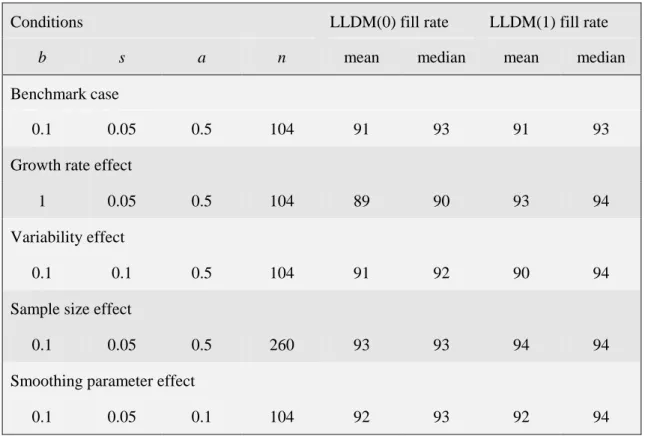
finding the order level itself involved 1000 replications. The results are summarised in Table
2. The benchmark case represents a situation that we think may be fairly typical in the
inventory control context. The other cases were obtained by varying one factor at a time from
its benchmark value.
The following observations can be made.
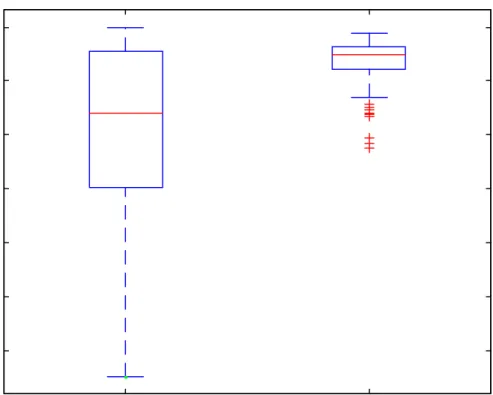
a) The means are generally below the medians. The distributions of the simulated
fill-rate must possess a left skew. This is exemplified by the distribution in Figure 3 for
the benchmark case.
b) The medians obtained with the bootstrap method from LLDM(1) are usually about
one percent below the target fill-rate of 95 percent. This gap is probably due to the
fact that the bootstrap method ignores the effect of estimation error. Given the size of
this gap, refinements geared to eliminating this problem appear to be unwarranted.
c) The median fill-rates associated with LLDM(0) are little lower again. There appear to
be some gains from using the relative error approach when the data generating
process involves relative errors.
d) The gains from using the bootstrap method with LLDM(1) instead of LLDM(0)
increase with higher growth rates. The changes in the underlying level are larger and
the fluctuations of the irregular component increase as a consequence. Nevertheless,
the growth rate has to reach unrealistic levels before the differences become
pronounced.
e) Variations in most factors have little impact on the median fill-rate for the LLDM(1)
bootstrap method.
4. CONCLUSIONS
In this paper we have proposed a generalisation of the additive local level model or its
equivalent, the ARIMA(0,1,1) model, to incorporate a general form of conditional
form, remains the valid updating relationship under this more general class of models. The
only change required is in the form of the criterion function used for selecting the estimates. A
simulation indicated that the maximum likelihood estimates obtained with simple exponential
smoothing under a level dependent form of heteroscedasticity are almost identical to those for
the homoscedastic case. Since the homoscedastic case is inherently easier to estimate than its
multiplicative counterpart we recommend the use of the former for estimation purposes.
The issue of heteroscedasticity becomes more critical in the prediction context. Analytical
formulae become unreliable for the multiplicative case. We therefore recommend a two-stage
procedure:
a) estimate
m
,a
ands
using the additive modelb) use the estimates from the previous step in conjunction with the multiplicative model to
simulate the prediction intervals.
Appendix
This appendix contains the derivation of the formulae for the mean and variance of the linear
and multiplicative local trend/seasonal models. To simplify notation the origin for forecasting,
designated period n in the body of the paper, will be relabelled period 0. The prediction
horizon is designated by h. Thus the random h-vector
y
=
y
1y
2"
y
h′
designates h unknown future values of the time series. Furthermore,A
0 andb
0 denote the local level andlocal rate at the start of the prediction origin. They no longer represent the seed values for
these quantities in the period prior to the sample. These quantities are known exactly. The
vector
γ =
c
− +r 1c
− +r 2"
c
0′
of seasonal factors required for forecasting is also known exactly. The formulae to be derived in this appendix are therefore based on the assumptionThe derivations rely extensively on a matrix B called the ‘backward shift’ matrix. It is the
matrix counterpart of the backward shift operator used so extensively in Box and Jenkins
(19XX). The notation employed, together with explanations, is shown in the following Table.
To simplify matters it is assumed that h is an exact multiple of the seasonal lag r. Let
m
=
h r
. It is the length of the forecast horizon measured in years.Notation
ξ
the unit h-vector
1 0
"
0
′
1
the ones h-vector
1 1
"
1
′
τ
the arithmetic series h-vector
1 2
"
h
′
τ
1 6
2the series h-vector
1 3 6 10
"
h h
1 6
+
1 2
B
the backward shift matrix whereb
ii−1=
1
for i=1,!,n andb
ij=
0
otherwise.eg
0
0
0
1
0
0
0
1
0
0
1 2 3 1 2!
"
$
##
#
!
"
$
##
#
=
!
"
$
##
#
x
x
x
x
x
B
r the backward shift matrix of lag r whereb
ii r−=
1
for i= +r 1,!,n andb
ij=
0
otherwise.eg. if
B
=
!
"
$
##
##
0
0
0
0
1
0
0
0
0
1
0
0
0
0
1
0
thenB
20
0
0
0
0
0
0
0
1
0
0
0
0
1
0
0
=
!
"
$
##
##
and0
0
0
0
0
0
0
0
1
0
0
0
0
1
0
0
0
0
1 2 3 4 1 2!
"
$
##
##
!
"
$
##
##
=
!
"
$
##
##
x
x
x
x
x
x
.S partial sum matrix being a unit lower triangular matrix with all elements below the diagonal equal to 1. eg.
S
=
!
1 0 0
"
$
##
#
1 1 0
1 1
1
so that1 0
0
1 1
0
1 1
1
1 2 3 1 1 2 1 2 3!
"
$
##
#
!
"
$
##
#
=
+
+ +
!
"
$
##
#
x
x
x
x
x
x
x
x
x
. Note thatS
= −
1 6
I
B
−1= + +
I
B
B
2+ +
"
B
n−1S
1 6
r defined byS
1 6
r= −
2 7
I
B
r −= +
I
B
r+
B
r+ +
B
mr 1 2"
Ξ
Ξ =
′
I
rO
r"
O
r is the matrix counterpart ofξ
Z
Z
=
I
rI
r"
I
r′
Useful RelationshipsS
= −
1 6
I
B
−1I
+
BS
= +
I
SB
=
S
S
ξ =
1
S1
= τ
ξ +
B1
=
1
1
+
B
τ τ
=
S
1 6
rΞ =
Z
B S
r1 6
r+ =
I
S
1 6
rLinear Seasonal Model
Proposition
A random vector