Cloud Computing for Libraries
Canan Tavluoglu: TOBB University of Economics and Technology, Ankara/Turkey. [email protected]
Ayse Korkmaz: Hacettepe University Department of Information Management, Ankara/Turkey, [email protected]
Abstract: Cloud computing is a computing platform that allows access over internet by using desktop computers, laptops, tablet PCs and smart phones without any software and storage unit. Mobile devices are provided to access information at anytime from anywhere. Mobile cloud computing is adaptation of the structure of cloud within a mobile environment. Many organizations use this technology and save time and money, such as libraries. Libraries have been adopting their reference services to the new technology and library functions have been moving to the cloud. This paper defines cloud computing, mobile cloud computing, presents the opportunities and challenges, in addition these shows the usage of cloud computing using the references of librarians in university libraries from Ankara, Turkey.
Keywords: cloud computing, mobile cloud computing, reference services. Introduction
Cloud computing refers to a computing platform that is where application services are provided through the internet. At the same time, we can say that it distributes resources over the internet. According to NITS, “cloud is ubiquitous platform that is user friendly, allows on demand access to shared computing resources like storage, servers, networks, applications and services that are fast to launch and implement with minimum interference from management or services providers" (Alizahed and Hassan, 2013). Cloud computing has a service models three type. In order of service models are infrastructure services, platform services and software services. Infrastructure as a Service (IaaS) is offered to customers that storage, network resource, a CPU with their need and configuration to other IT resources. Customers establish applications and operating systems they need. For example: EC2. Second service is platforms as a Service (PaaS). It offer platform that can be developed by the customers. Platform includes environments in which the application is running and development by the customers. Customer is no possibility to edit on the platform infrastructure. Latest model is software services model. Software applications accessed with the web browser. This types of cloud computing delivers a single application through the browser to thousands of customers using a multitenant architecture.(Infoworld, 2013) Such tools are as Dropbox, SkyDrive, Google Apps might think this layer product.
Cloud-based applications simply can run with tools which have low capacity hard disks. Mobile devices are adopting structure of cloud computing and it is becoming powerful and rapid in the growing IT technology. "Mobile cloud computing is defined as a model for providing various IT resources and information services over the mobile network by the means of demand self-services" (Suo and others, 2013).
Opportunities
Cloud computing provides many benefits. These benefits will be arranged in order the following way:
It allocates the resources automatically and allows the user to interact with the cloud the perform tasks like building, deploying maintaining without any interruption of the cloud computing provider (Asrani, 2013).
The organizations save up money,
The organizations need quite less man power, Cloud computing provides elasticity.
Immediate updating allows when the new version of the application used. There is no problem like incompatibility with different operating system.
Challenges
Cloud computing offers several challenges. Two of main problems are security and privacy; because of rising applications and rising numbers of the devices security is going lower. Organizations need uninterrupted services. Therefore services providers must design the way that scalable and render services are continuous when they establish hardware and infrastructure of network. In the meantime organizations have to spend more money on the bandwidth.
Applications are need the constant internet connection to work.
Service providers should make the necessary care and services. Because of a malfunction that may occur in the cloud can result in losing all your data.
Usage of Cloud Computing in Libraries
Cloud computing offers cost effectiveness, flexibility, data safety, high availability (Han, 2011). With developing technologies, librarians need to adapt to the new technologies, develop their skills and open new ideas and approaches to market library services (Grant, 2012).
Libraries use cloud based SaaS tools as OpenURL resolver, online reference, research guides; PaaS tools as integrated library system, interlibrary loan; IaaS as discovery systems, archives management (Shaw, 2013).
In this section, using cloud based SaaS tools in libraries will be explained with some examples in our country;
§Social networks also use libraries to refer to marketing their services. The most known applications are Facebook and Twitter. In Turkey's academic library, the most preferred Web 2.0 tools are social network (Tavluoglu, 2013).
§Libraries can market their services, make announcements, share document as informat ion literacy programs, subject guides via Blog. Reference librarians in Sabancı Universit y Information Centre collect user’s request, suggestions and comments (Baltacı and Öze l, 2010)
§Content management applications such as LibGuides are useful tools for libraries to cr eate subject guides, useful resources for end users. In our country IYTE, Koç, Bilgi… et c. university libraries have been using this platform.
§Several information resource providers offer free bibliographic management applicatio ns for library users. For example, Science Direct’s product is Mendeley which provide s torage unit and allows users to manage resources via the Internet.
dd library lectures, library video, and catalogue search as in Bilkent University from An kara.
Literature Review
The literature about cloud computing in libraries, there is a growing number of articles published. Cloud computing is offer variety application areas for libraries, because it is too broad. In this section, examine some studies that use of different purposes in libraries. California State University libraries’ IT services has moved to the cloud. System librarian Wang (2012) explains some problems that they have come across during and after migration. And he discusses issues and solutions. Similar with this study, Han (2011) shares an experience on the clouds in his article. The University of Arizona Libraries has integrated library systems to move to the open source system Koha. According to the author, the migrations of systems have been very successful. Koury and Jardine (2013) examine advantages of cloud computing applications for library professionals. They explained the use cloud computing in libraries with examples. And they emphasize that Google applications are facilitated collaboration and communication.
Mitchell (2011) was talking about expresses what is cloud computing for libraries. Mitchell has concluded positive view of the role and potential impact of cloud computing in libraries. Luo (2012) conducted a survey to identify how reference librarians use cloud computing technologies. According to results, video services are the most used (~71%) cloud based applications. 59.7% of reference librarian had used information collection services and
calendar services.
Mobile cloud computing is also used by some libraries. Libraries offer SMS services for users using cloud-based web service providers like Twilio, Tropo, SMSified. Paul Smith College library users send SMS via mobile devices to learn computer availability and library hours (Beccaria, 2011).
Methodology
This paper determines the use of cloud computing SaaS models by references to librarians who work at university libraries in Ankara, Turkey. With this aim, a survey was created by Luo’s (2012) study utilizing. The survey was published on the Web by use of Google Forms and remained open for three weeks.
There are 18 universities in Ankara. However 3 new universities don’t have a library website. So this work includes 15 universities’ libraries (5 state universities, 10 private universities). These libraries’ web pages have been visited and mail addresses have been identified. An e-mail message has been sent to the reference librarians’ personal ee-mail addresses. Some university libraries work with less staff and there isn’t a reference unit. In such cases, email messages have been sent to general email addresses .A total of 36 emails have been sent and 29 responses have been received.
Participants were asked demographic information like work experience, number of library users, university type (state or private). Other survey questions identified reference librarians’ use of five types of Saas tools in their work. These five types of SaaS’ were: cloud-based video services such as YouTube, Teacher Tube, Vimeo; cloud-based information collection services such as Google Forms, Survey Monkeys; cloud-based file sharing services such as Google Drive, Dropbox; cloud-based calendar services such as Google Calendar; cloud-based blog services such as Wordpress, Blogger. Besides, participants were asked the advantages and disadvantages of using cloud based applications in their reference services.
The data obtained have been evaluated with SPSS (Statistical Programming for Social Sciences)
Result
Available data has showed normal distribution. 37.9% of respondents work in a state university and 62.1% of respondents work in private universities. Number of user and librarian’s work experience had asked directly. Data were grouped 2 choices by used data median. About half the participants (48.3%) have more than three year of experience. 51.5% of respondents work in institution that have got less than 5000 users.
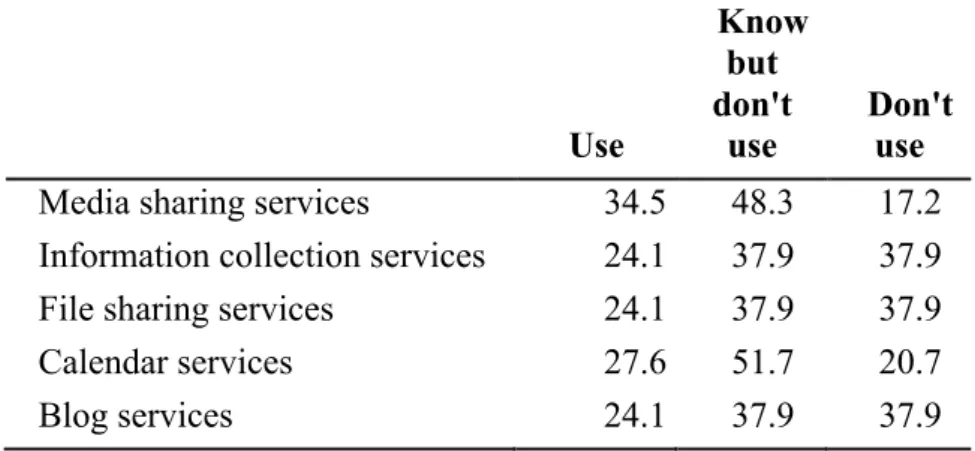
Table 1. Use of 5 types SaaS tools by reference librarian
Use
Know but don't
use Don't use Media sharing services 34.5 48.3 17.2 Information collection services 24.1 37.9 37.9 File sharing services 24.1 37.9 37.9
Calendar services 27.6 51.7 20.7
Blog services 24.1 37.9 37.9
According to respondents’ answers 34.5% (N=10) of them had used video services and the majority of users preferred for orientation services. 50% of the librarians who used video sharing services preferred this service for information literacy.
With the aim of reference librarians’ use of cloud based information collection services, this question was asked. Using this application does not know and doesn’t use even though now that the proportion of participants (37.9%; N=11) are equal. Only 24.1% (N=7) reference librarians had used information collection services. We think that these tools are useful to collect feedback from the users. Reference librarians who had used information collection services chose following purposes: to prepare survey 71.4%, collect request of library orientation 51.1%, get ideas 42.9%, and to receive reference questions 14.3%. Libraries can use Google Forms variety purposes as collect reference questions, survey data. For example, McIntyre Library used Google Form embedded under the “Ask a Question” tab of the LibGuide (Miller, 2011).
File sharing services’ utilization rate is 24% (N=7). Among the participants 66.7% had used file sharing services for accessibility from different environments, 44.4% of respondents used to share content and storage. Users benefit file sharing services saving time, and have opportunity of online backup. If you do not have enough storage capacity, you can have the
advantage of file sharing environments such as GoogleDrive, Dropbox and Skydrive. With these tools you can share your files that you upload there with everyone. We could say briefly that, this service offers new methods of access to information. Bagley was mentioned in (Parting the clouds: use of Dropbox by embedded library) article about Murray State University.
Nearly half of reference librarians, (51.7%; N=15), know calendar services but they don’t use these tools in work. Among the participants 27.6% (N=8) had used calendar services. When analysed purpose of use, all of them, do work plan with these tools. The other aim is planning instructions 50%. To explain the difference rate, not every reference librarian is an instructor. No librarian has chosen “easy to use” choice. But cloud-based calendar services allow access the calendar anytime anywhere.
Many academic libraries prefer Google Calendar for planning. Idaho State University (ISU) has been using Google Calendar to schedule faculty meetings, instruction, training and other events (Koury and Jardine, 2013). Some librarians who worked at Ursula C. Schwerin Library in New York City College of Technology use Google Calendar to communicate about classes, meetings, annual leaves, and the reference desk schedules (Leonard, 2011).
Only 24.1% of participants had used Blog in reference services. We think that, the degree of usage very low because blogs offer many publishing contents like text, video, image and audio files. These tools are used to share and organize course materials. In addition, students can interact with their classmates and librarians and receive student feedback (Luo, 2010). Respondents who use Blog, while 85.7% are purpose of make an announcement and only 28.6% are purpose of sharing video. Nobody use Blog for answering the questions.
Chi-square tests were applied to identify relationship between use of five types of SaaS tools and number of library users with work experience. There is no relationship between the number of users and the use of five types of SaaS tools. The values are as following: Video Sharing (χ2=8,644; p=0,013 > 0.05), information collection services (χ2=2,848; p=0,241 > 0.05), file sharing services (χ2=2,848; p=0,241 > 0.05), Calendar services (χ2=1,163; p=0,559 > 0.05), blog services (χ2=5,877; p=0,053 > 0.05).
Likewise there is no relationship between work experience and use of five types of SaaS tools. The values are as following Video Sharing (χ2=0,898; p=0,638 > 0.05) information collection services (χ2=3,707; p=0,157 > 0.05), file sharing services (χ2=3,707; p=0,157 > 0.05), Calendar services (χ2=3,057; p=0,217 > 0.05), blog services (χ2=0,308; p=0,857 > 0.05).
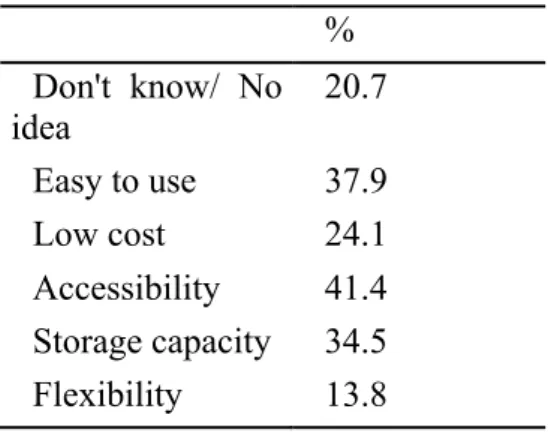
Table 2. Reasons for the use of SaaS tools in reference services % Don't know/ No idea 20.7 Easy to use 37.9 Low cost 24.1 Accessibility 41.4 Storage capacity 34.5 Flexibility 13.8
*Participants chose one or more choice.
Respondents were asked to the reason for using cloud-based SaaS in reference services. Close to 42% of them think accessibility is the most preferred reason using SaaS in reference services. Other reasons are easy to use 37.9%, capacity of storage 34.5%, low cost 24.1%, elasticity 13.8% and 20.7% of them does not have any idea or do not know about how to use SaaS tools.
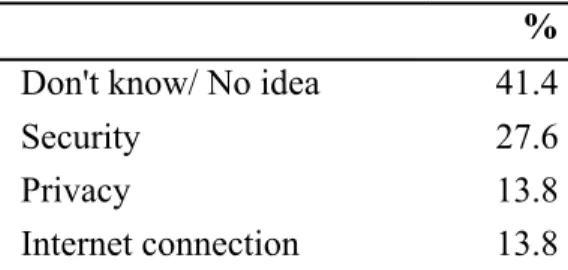
Table 3. Reasons for the not use of SaaS tools in reference services
%
Don't know/ No idea 41.4
Security 27.6
Privacy 13.8
Internet connection 13.8 *Participants chose one or more choice.
41% of respondents do not know or they haven’t any idea about reasons for the not use of SaaS tools in reference services. (Table 3)
Conclusions
Cloud computing offer many advantages for academic libraries. Librarian should use cloud based technologies to promote and market services. This paper defines cloud computing and using SaaS tools in reference services.
Examine use of 5 types SaaS tools in reference services in university libraries in Ankara. According to results, the degree of usage of this tools generally low. More than 65% of the librarians hadn’t used any cloud based SaaS tools.
Libraries should use SaaS tools to improve their services by adopting new technologies. Reference librarian should change their work. They should use SaaS tools instead of traditional tools to provide better reference services. Librarian should receive in-company training or vocational education. When the solution is found to the mentioned problems and informed about that topic, use of this technology will increase.
References
Alizadeh, M., and Hassan, W. H. (2013). Challenges and opportunities of mobile cloud computing. 2013 9th International Wireless Communications and Mobile Computing Conference (IWCMC), 660-666. doi:10.1109/IWCMC.2013.6583636
Bagley, C. (2011). Parting the clouds: Use of Dropbox by embedded librarians. In E. Corrado & H. Moulaison (Eds.), Getting started with cloud computing: A LITA guide (pp. 159–164). New York: Neal-Schuman Publishers.
Baltacı, D., Özel, C. (2010). Sabancı Üniversitesi Bilgi Merkezi Kullanıcı Hizmetlerinde Web 2.0 Uygulamaları, ÜNAK 2010 Bilgi Yönetimi 2.0: Sosyal Ağlarda Bilgi Hizmetleri. 7-9 Ekim 2010 Samsun: On Dokuz Mayıs Üniversitesi (conference paper).
Beccaria, M. (2011). How to provide live library information via SMS using Twilio. Journal of Code4Lib, 14, Retrieved October 05, 2013 from http://journal.code4lib.org/articles/5542
Corrado, E., & Moulaison, H. (2011). Getting started with cloud computing: A LITA guide.New York: Neal-Schuman Publishers.
Goldner, M. (2010). Winds of change: libraries and cloud computing. Retrieved October 04, 2013 from
http://www.oclc.org/content/dam/oclc/events/2011/files/IFLA-winds-of-change-paper.pdf Grant, C. (2012). Construction zones on the library road to the future. Public Library
Quarterly, 31(1), 21-47. doi:10.1080/01616846.2012.654734
Han, Y. (2011). Cloud computing: case studies and total costs of ownership. Information Technology and Libraries, 30(4), 198-206.
Infoworld(2013).Cloud computing from http://www.infoworld.com/d/cloud-computing/what-cloud-computing-really-means-031 Retrieved December 5, 2013
Koury R. and Jardine S. J. (2013). Library instruction in a cloud: perspectives from the trenches. OCLC Systems & Services, Vol. 29 Iss: 3, pp.161 – 169
Leonard, A. (2011). From the cloud, a clear solution: How one academic library uses Google Calendar. In E. Corrado & H. Moulaison (Eds.), Getting started with cloud computing: A LITA guide (pp. 165–172). New York: Neal-Schuman Publishers.
Luo, L. (2010). Web 2.0 integration in information literacy instruction: An overview. Journal of Academic Librarianship, 36(1), 32–40.
Luo, L (2012). Reference Librarians’ Adoption of Cloud Computing Technologies: An Exploratory Study. Internet Reference Services Quarterly, 17:3-4, 147-166, doi:10.1080/10875301.2013.765824
Miller, R. (2011). Integrating Google Forms into reference and instruction. In E.Corrado & H. Moulaison (Eds.), Getting started with cloud computing: A LITAguide (pp. 173–179). New York: Neal-Schuman Publishers.
Mitchell, E. (2011). What cloud computing means for libraries. Getting started with cloud computing: A LITA guide.New York: Neal-Schuman Publishers.
Mitchell E. (2010). Using cloud services for library IT infrastructure. Journal of Code4Lib, 09, Retrieved October 05, 2013 from http://journal.code4lib.org/articles/2510
Prince, E. J. D. (2012). Climate change in libraries : library functions move to the cloud. Journal of Electronic Resources in Climate Change in Libraries, 9 (1), 87-93. doi:10.1080/15424065.2012.651575
Shaw, A. K. (2013). Cloud computing for libraries: an economic strategy. 2013. in International Conference on Academic Libraries, India, 12th - 15th Feburary. [Conference Paper]
Suo, H., Liu, Z., Wan, J., Polytechnic, G. J., and Zhou, K. (2013). Security and Privacy in Mobile Cloud Computing. Wireless Communications and Mobile Computing Conference (IWCMC), 2013 9th International 655-659. Italy: IEEE.
Tavluoğlu, C. (2013). Üniversite kütüphanelerinde Web 2.0 araçlarının kullanımı [unpublished master thesis]. Ankara: Hacettepe University.
Wang, J. (2012). From the Ground to the Cloud : A Practice at California State by California State University, East Bay.CALA OPS (10), 1–8. Retrieved October 05, 2013 from http://cala-web.org/files/ops/OPSMay2012No10.pdf