A Logic Programming Framework for
Possibilistic Argumentation:
Formalization and Logical Properties
1Teresa Alsinet
aCarlos I. Ches˜nevar
cLlu´ıs Godo
bGuillermo R. Simari
ca Departament of Computer Science, Universitat de Lleida C/Jaume II, 69 – 25001 Lleida, Spain – Email: [email protected]
bArtificial Intelligence Research Institute (IIIA), CSIC Campus UAB, Bellaterra,Spain – Email: [email protected]
c Departament of Computer Science & Engineering, Universidad Nacional del Sur Av. Alem 1253 - 8000 Bah´ıa Blanca, Argentina – Email:
{cic,grs}@cs.uns.edu.ar
Abstract
In the last decade defeasible argumentation frameworks have evolved to become a sound setting to formalize commonsense, qualitative reasoning. The logic pro-gramming paradigm has shown to be particularly useful for developing different argument-based frameworks on the basis of different variants of logic programming which incorporate defeasible rules. Most of such frameworks, however, are unable to deal with explicit uncertainty, nor with vague knowledge, as defeasibility is directly encoded in the object language. This paper presents Possibilistic Logic Program-ming (P-DeLP), a new logic programProgram-ming language which combines features from argumentation theory and logic programming, incorporating as well the treatment of possibilistic uncertainty. Such features are formalized on the basis of PGL, a possibilistic logic based on G¨odel fuzzy logic. One of the applications of P-DeLP is providing an intelligent agent with non-monotonic, argumentative inference ca-pabilities. In this paper we also provide a better understanding of such capabilities by defining two non-monotonic operators which model the expansion of a given programP by adding new weighed facts associated with argument conclusions and warranted literals, respectively. Different logical properties for the proposed opera-tors are studied.
Key words: Possibilistic logic, vague knowledge, defeasible argumentation, intelligent systems
1 This paper revises and extends two previous authors’ papers [20] and [22].
1 Introduction and motivations
In the last decade defeasible argumentation frameworks [18,34] have evolved to become a sound setting to formalize commonsense, qualitative reasoning from incomplete and potentially inconsistent knowledge. The logic program-ming paradigm has shown to be particularly useful for developing different argument-based frameworks on the basis of different variants of logic pro-gramming which enrich their object language withdefeasible rules (e.g.[26,7]). Most of such frameworks, however, are unable to deal with explicit uncertainty, nor with vague knowledge, as defeasibility is directly encoded in the object language.
Possibilistic Defeasible Logic Programming (P-DeLP) is a new logic program-ming language which combines features from argumentation theory and logic programming, incorporating as well the treatment of possibilistic uncertainty. These knowledge representation features are formalized on the basis of PGL, a possibilistic logic based on G¨odel fuzzy logic [1,3]. In PGL formulas are built over fuzzy propositional variables and the certainty degree of formulas is ex-pressed with a necessity measure. In a logic programming setting, the proof method for PGL is based on a complete calculus for determining the maximum degree of possibilistic entailment of a fuzzy goal. In P-DeLP formulas will be supported by arguments, which will have an attached necessity measure asso-ciated with the supported conclusion. The ultimate answer to queries will be based on the existence of warranted arguments, computed through a qualita-tive dialectical analysis. The top-down proof procedure of P-DeLP is based on the one used in defeasible logic programming [26,15], which has already been integrated in a number of real-world applications such as intelligent web search [17,19], clustering [27], natural language processing [16] and knowledge management [12], among others.
In the last years, argument-based approaches have proven to be a attractive setting for modelling knowledge and inference in intelligent agents who need to perform defeasible inferences in a computationally effective way [41,32,35]. Given its characteristics, P-DeLP is particularly useful as a tool to achieve this goal, as dealing with uncertainty and fuzziness are common requirements when formalizing Multiagent Systems (MAS). We show a case study where P-DeLP is used in the context of formalizing an agent’s beliefs and perceptions, along with an argumentative inference procedure to determine which of the agent’s beliefs are ultimately accepted (or warranted). In order to provide a better understanding of such reasoning capabilities, we also define two non-monotonic closure operators which model the expansion of a given program
P by adding new weighed facts associated with argument conclusions and warranted literals, respectively. Different logical properties for the proposed operators are studied and contrasted with a traditional SLD-based Horn logic.
We show that this analysis provides useful comparison criteria that can be extended and applied to other argumentation frameworks.
The rest of the paper is structured as follows. First in Section 2 we will dis-cuss the knowledge representation features provided by P-DeLP, including its syntax and semantics at object-language level. Section 3 presents the central notion of argument in P-DeLP as well as an associated procedural mecha-nism for obtaining them. In Section 4 we formalize the notions of attack among arguments and the top-down proof procedure for computing ultimately unde-feated arguments (orwarrants). Section 5 presents a worked example, showing how P-DeLP can be used to model beliefs and reasoning capabilities of an intelligent agent. Section 6 introduces two non-monotonic closure operators
which will allow to analyze the behavior of the P-DeLP framework when a given program is expanded by adding new weighed facts. Section 7 discusses related work, and Section 8 concludes. To make this article self-contained, appendix A provides a brief summary of the fundamentals of non-monotonic inference relationships and their logical properties.
2 Preliminaries on possibilistic G¨odel logic PGL
As already pointed out our objective is to formalize P-DeLP (for possibilistic defeasible logic programming), a system that which combines features from ar-gumentation theory, logic programming and a unified treatment of possibilistic uncertainty and fuzziness. To achieve this objective we combine two logic pro-gramming frameworks: possibilistic logic propro-gramming based on propositional G¨odel logic [2,3] and defeasible logic programming [26].
In this section we describe the basis of the possibilistic logic programming ingredient of P-DeLP. In a first step, as a suitable logical frame to treat (pos-sibilistic) uncertainty and fuzziness, we consider PGL, a general possibilistic logic on top of propositional G¨odel fuzzy logic introduced in [2], and that extends the well-knwon possibilistic logic (see e.g. [23]), defined on top of classical logic. Then, in order to have at one’s disposal an efficient proof pro-cedure, based on a complete calculus and oriented to goals (positive literals), we consider the Horn-rule fragment of PGL as the basis for the definition of a possibilistic logic programming language built up with fuzzy propositional variables [3].
There are three main reasons for choosing PGL as the underlying logic to model both uncertainty and fuzziness. First, it has been proved that many-valued G¨odel logic is fully compatible with an already proposed and suitable extension of necessity measures for fuzzy events, in the sense that G¨odel logic allows us to define a well behaved and featured possibilistic semantics on
top of it. Second, like in classical (propositional) logic programming systems, PGL enables us to define an efficient proof method by derivation based on a complete calculus for determining the maximum degree of possibilistic be-lief with which a fuzzy propositional variable can be entailed from a set of formulas. Finally, PGL can be extended with a partial matching mechanism between fuzzy propositional variables based on a necessity-like measure which preserves completeness for a particular class of formulas [3]. This is a key fea-ture that justifies by itself the interest of such a logic programming system for defeasible argumentation under vague knowledge and possibilistic uncertainty. We provide below a short description of main features of PGL and its Horn-rule fragment.
The language LG of propositional G¨odel infinitely-valued logic G is built in the usual way from a (countable) setV ar ofpropositional variables {p, q, . . .},
connectives ∧ and →, and the truth constant 0. A negation connective ¬ is definable as usual by stipulating that ¬ϕ stands for ϕ→0. A formula of LG will be referred as a G-formula. The semantics of G¨odel fuzzy logic is given byinterpretations Iof propositional variables from V ar into the unit interval [0,1] which are extended to arbitrary formulas by means of the following rules:
I(0) = 0, I(ϕ∧ψ) = min(I(ϕ),I(ψ)), I(ϕ→ψ) = 1, if I(ϕ)≤I(ψ) I(ψ), otherwise.
G¨odel logic G was axiomatized (Hilbert-style) with respect to the given se-mantics by Dummet in the fifties, but it can be also presented as the axiomatic extension of H´ajek’s fuzzy logic BL by the additional axiomϕ→ϕ∧ϕ, forcing the conjunction to be idempotent.
Fuzzy logics, and in particular G¨odel logic, are suitable for evaluation the (partial) truth of vague expressions, as in the statementp=“the engine speed is low”, in complete states of information. For instance, if we know that in given situation the speed is 330 r.p.m., and the concept of “low” is modelled by a fuzzy set with membership function µlow :U →[0,1], with e.g. U = [0,1200], then we can measure the truth of p by the value µlow(330), whatever this value could be. But when there is incomplete information, one cannot evaluate with certainty the truth of p. In order to allow an explicit representation of uncertainty (on top of the fuzzziness), an extension of G¨odel logic with possibilistic (meta) semantics, called PGL (for possibilistic G¨odel logic), was defined in [1]. An expression like
can be represented in the setting of PGL by a certainty-weighted fuzzy propo-sition
(speed low,0.9),
where the certainty value 0.9 expresses how much the fuzzy statement “the engine speed is low” is believed in terms of necessity measures. In general, certainty weights from [0,1] are employed in PGL to model statements of the form
“ϕis certain with a necessity of at least α”
whereϕis a G-formula which represents vague, incomplete or imprecise knowl-edge about the real world, and that will be represented by a pair (ϕ, α).
Definition 1 A PGL formula is a pair of the form (ϕ, α), where ϕ is a G-formula andα ∈[0,1]is a lower bound on the belief on ϕin terms of necessity measures. A PGL-theory will be just a set of G-formulas.
Within the possibilistic model of uncertainty, belief states are modeled by nor-malized possibility distributions on a set of Boolean interpretations. However, in our framework, the truth evaluation of a G-formulaϕin each interpretation
Iis a valueI(ϕ)∈[0,1], and thus, each formula does not induce a crisp set of interpretations, but a fuzzy set of interpretations [ϕ], defining µ[ϕ](I) =I(ϕ), for each interpretationI. Therefore, in this setting, possibilistic models are nor-malized possibility distributions on the set I of all possible G-interpretations
I. Then, to measure the uncertainty induced on a G¨odel logic formula ϕ by a possibilistic model π : I → [0,1], we have to consider some extension of the notion of necessity measure for fuzzy sets, in particular for fuzzy sets of interpretations. In [24] the authors propose to define
N([ϕ]|π) = inf
I∈Iπ(I)⇒µ[ϕ](I),
where µ[ϕ](I) =I(ϕ) ∈[0,1] and ⇒ is the reciprocal of G¨odel’s many-valued implication, which is defined as x ⇒ y = 1 if x ≤ y and x ⇒ y = 1 −x, otherwise. For simplify notation, we will simply write N(ϕ | π) instead of
N([ϕ] | π), when the set of interpretaions I is fixed from the context. Note that, like in classical possibilistic logic, this necessity measure satisfies that
N(ϕ∧ψ |π) = min(N(ϕ|π), N(ψ |π)) and N(ϕ∧ ¬ϕ|π) = 0.
Next we will present some formal definitions which relate the underlying pos-sibilistic model of PGL in the context of our framework.
Definition 2 Let I be the set of (many-valued) G¨odel interpretations over the set V ar of propositional variables. A possibilistic model is a normalized possibility distribution π:I →[0,1] on the set of interpretations I.
that π(I) = 1. In other words, belief states modelled by normalized distribu-tions are consistent belief states, in the sense that at least one interpretation (or state or possible world) has to be fully plausible.
Next we define the notion of possibilistic entailment for PGL.
Definition 3 A possibilistic model π : I → [0,1] satisfies a PGL formula
(ϕ, α), written π |= (ϕ, α), iff N([ϕ] | π) ≥ α. We say that a set of PGL formulas K entails a PGL formula (ϕ, α), writtenK |= (ϕ, α), iff every possi-bilistic distributionπ :I →[0,1]satisfying all the formulas inK also satisfies
(ϕ, α).
When π |= (ψ, β) for each (ψ, β) ∈ K, we say that π is model of K. Since weights in PGL formulas are understood as lower bounds, given a PGL theory
K and a formula ϕ, we may be interested in knowing the maximum degree with which K possibilistically entails ϕ.
Definition 4 The maximum degree of possibilistic entailment of a formula
ϕ from a PGL theory K, is the value kϕkK = sup{α∈[0,1]|K |= (ϕ, α)}. It is easy to show that kϕkK = inf{N(ϕ | π) | π |= K}, i.e. the maximum degree of possibilistic entailment of a G-formula ϕ from a set of PGL theory
K is just least necessity evaluation of ϕgiven by the models of K.
In [1] the authors propose a Hilbert-style axiomatization of PGL, mimicking the axiomatization of (classical) possibilistic logic [23]. Axioms of PGL are axioms of G¨odel fuzzy logic weighted by 1 plus the triviality axiom (ϕ,0), and PGL inference (deduction) rules are a generalized modus ponens rule for necessity measures (from (ϕ, α) and (ϕ → ψ, β) derive (ψ,min(α, β)) and a weight weakening rule (from ϕ, α) derive (ϕ, β) for β ≤ α). The notion of proof in PGL is defined as usual relative to the set of axioms and inference rules. In [1] it is shown the soundness of this PGL axiomatic system, leaving the question of whether it is also complete as an open problem.
In order to define a sublanguage suitable for logic programming, that is, en-abling a proof algorithm both efficient and complete for computing the max-imum degree of possibilistic entailment of atomic propositions (called goals), the authors consider the Horn-rule sublanguage of PGL. We will refer to this sublanguage as HornP GL, which consists of PGL formulas of the form:
(p1∧ · · · ∧pk →q, α)
with k ≥ 0, where p1, . . . , pk, q are propositional variables, in the traditional logic programming style. These weighted Horn rules of formulas will be called PGLclauses. As usual, we will refer to the conclusion qand the set of premises
between two types of formulas in this sublanguage: facts when k = 0 (empty body) and are simply written (q, α); andrules, written as (p1∧· · ·∧pk→q, α) otherwise.
For PGL clauses, a simple and efficient calculus is developed in [1] which does not need the whole logical apparatus of the general possibilistic logic PGL. Moreover, within the restricted framework ofHornP GL a simple and complete calculus for determining the maximum degree of possibilistic entailment of atomic G-formulas can be defined only by means of the following particular instance of the generalized modus ponens rule:
(p1∧ · · · ∧pk →q, α) (p1, β1), . . . ,(pk, βk) (q,min(α, β1, . . . , βk))
[GMP].
Formally, we will writeP `gmp (q, α), whereP is a set of PGL clauses,q∈V ar and α > 0, when there exists a finite sequence of PGL clauses C1, . . . , Cm such that Cm = (q, α) and, for each i ∈ {1, . . . , m}, either Ci ∈ P, or r Ci is obtained by applying the GMP rule to previous clauses in the sequence. The corresponding syntactic counterpart of maximum degree of possibilistic entailment is then as follows.
Definition 5 The maximum degree of deduction of a goal q from a set of PGL clauses P is |q|P = sup{α∈[0,1]|P `gmp (q, α)}.
As the only inference rule of our proof method is the generalized modus po-nens, if P is a finite set of PGL clauses, there exists a finite number of proofs of a propositional variableq fromP, and thus, the above definition turns into
|q|P = max{α ∈ [0,1] | P `gmp (q, α)}. Finally, following [1,3], completeness reads as follows: for any finite set of PGL clauses P and any q∈V ar it holds that
kqkP =|q|P.
Two important consequences of the completeness result are the following ones: - if P ={(p, β),(p→q, γ)},kqkP = min(β, γ), whenever p6=q; and
- if for someP it holds thatα=krkP, thenkqkP =kqk{(r,α),(r→q,γ)}, whenever (r →q, γ)∈P and kqkP >kqkP\{(r→q,γ)}.
3 Argumentation in P-DeLP
After recalling in the previous section the main features of the PGL logic and its Horn rule fragmentHornP GL, we are ready to formalize P-DeLP by extend-ingHornP GLwith defeasible logic programming argumentative capabilities. In
argumentation frameworks, the negation connective allows to identify conflicts among pieces of information, that will be the subject of a deliberative process to determine which one ultimately prevails over the others. In G¨odel logic, the defined negation (¬ϕ is ϕ → 0) is rather special, since ¬ϕ is always a crisp proposition. Moreover, suppose we would like to introduce in the language a new,well-behaved negation connective∼. By well-behaved we only mean that
I(q) and I(∼q) cannot simultaneously take the value 1 for any evaluation I. Then q and ∼q model contradictory information in the following sense.
Proposition 6 LetΓbe a set of satisfiable PGL clauses. For any well-behaved negation ∼, Γ|= (q, α) and Γ|= (∼q, β) iff either α= 0 or β = 0.
Proof: For any possibilistic distribution π such that π |= Γ, it must be that
N(q | π) ≥ α and N(∼q | π) ≥ β. This means that, for each interpretation
I ∈ I,π(I)⇒I(q)≥α and π(I)⇒I(∼q)≥β. Thus,π(I)⇒min(I(q), I(∼
q))≥min(α, β). interpretationI. If Γ is satisfiable, then there exists at least one interpretation I0 such thatπ(I0) = 1, but since min(I(q), I(∼q))6= 1 for each interpretation I ∈ I, we have that 1−π(I0)≥ min(α, β), and therefore
it follows necessarily that min(α, β) = 0. 2
Because of this observation and the fact that we want to keep the simple calculus ofHornP GL, we adopt the following design decisions:
P-DeLP language: the language of P-DeLP is the one of HornP GL but over an extended set V ar∗ of propositional variables where a new a propo-sitional variable “∼p” is added for each p ∈ V ar. Note that the symbol
∼, although intuitively standing for negation, is not considered as a proper negation connective. It is only a syntactic sugar, as “∼p” is treated just as another propositional variable but with a particular status with respect to
p, since it will be only used to detect contradictions at the syntactical level.
Conflict: a set of clauses Γ (in the extended language) will be deemed as
contradictory, denoted Γ ` ⊥, if Γ `gmp (q, α) and Γ `gmp (∼ q, β), with
α >0 and β >0, for some atom q∈V ar.
From now on we shall refer to positive and negative propositional variables fromV ar∗ as P-DeLP literals. Then, P-DeLP clauses will be just PGL clauses defined over the extended set of variables V ar∗, and will be written in the form (q←p1∧ · · · ∧pk, α) more in the style of logic programming languages. The notion of proof for P-DeLP will be therefore the same as for HornP GL, but will write simply` instead of `gmp.
In order to develop an argumentative framework for P-DeLP, we distinguish betweencertain and uncertain clauses. A clause (ϕ, α) is referred as certain if
α = 1 and uncertain, otherwise. Moreover, a DeLP program is a set of P-DeLP clauses in which we distinguish certain from uncertain information. As
additional requirement, certain knowledge is required to benon-contradictory.
Formally:
Definition 7 A P-DeLP program P (or just program P) is a pair (Π,∆), where Π is a non-contradictory finite set of certain clauses, and ∆ is a finite set of uncertain clauses.
Next we will introduce the notion of argument in P-DeLP. Informally, an argument A is a tentative proof (as it relies to some extent on uncertain, possibilistic information) from a consistent set of clauses supporting a given conclusion Q with a necessity measure α.
Definition 8 Given a P-DeLP program P = (Π,∆), a set A ⊆∆ of uncer-tain clauses is an argument for a goal Q with necessity degree α >0, denoted
hA, Q, αi, iff:
(1) Π∪ A is non contradictory;
(2) α = max{β ∈ [0,1] | Π ∪ A ` (Q, β)}, i.e. α is the greatest degree of deduction of Q from Π∪ A;
(3) Ais minimal wrt set inclusion, i.e. there is noA1 ⊂ Asuch thatΠ∪A1 ` (Q, α).
Let hA, Q, αi and hS, R, βi be two arguments. We will say that hS, R, βi is a
subargument of hA, Q, αi iff S ⊆ A. Notice that the goal R may be a subgoal associated with the goal Q in the argument A.
Note that an argument must satisfy certain requirements. First, it should not be the case thatAtogether with Π turns out to be contradictory. Second, the conclusion (Q, α) should follow from Π∪Aandαis the maximum degree with which this happens. The third requirement operates as a kind of Occam’s ra-zor principle [37] on the uncertain information used for concludingQ. It must be remarked that the three conditions in the above definition are inherited from similar definitions in the argumentation literature [37,11,18]. Moreover notice that from the above definition of argument, on the basis of a P-DeLP program P, there may exist different argumentshA1, Q, α1i,hA2, Q, α2i, . . . ,
hAk, Q, αki supporting a given goal Q, with (possibly) different necessity de-grees α1, α2, . . . , αk.
Given a program P = (Π,∆), and from a procedural point of view, an argu-menthA, Q, αifor a given goalQcan be built by computingA andαthrough the (recursive) application of the following construction rules:
(1) Building arguments from facts (INTF): (a) If (Q,1)∈Π
(b) If (Q, β)∈∆ and Π∪ {(Q, β)} 6` ⊥ and Π6`(Q,1).
then A ={(Q, α)} and α=β
(2) Building arguments from program rules by applying the modus ponens rule (MPA):
(a) If (Q ← L1 ∧. . .∧Lk,1) ∈ Π and hA1, L1, β1i, . . . ,hAk, Lk, βki are arguments and Π∪Sk
i=1Ai 6` ⊥ and there is no B ⊂
Sk
i=1Ai such that Π∪ B ` (Q, γ) with γ ≥min(β1, β2, . . . , βk)
then A =Sk
i=1Ai and α = min(β1, β2, . . . , βk)
(b) If(Q ←L1 ∧L2 ∧. . .∧Lk, β)∈∆ andhA1, L1, β1i, . . . ,hAk, Lk, βki are arguments and Π∪ {(Q ←L1 ∧L2 ∧. . .∧Lk, β)} ∪
Sk
i=1Ai 6` ⊥ and there is no B ⊂Ski=1Ai∪(Q ←L1 ∧L2 ∧. . .∧Lk, β) such that Π∪ B `(Q, γ) with γ ≥min(β, β1, β2, . . . , βk)
then A=Sk
i=1Ai∪(Q ←L1 ∧L2 ∧. . .∧Lk, β) and α= min(β, β1,
β2, . . . , βk)
For simplicity, we will write P |∼4hA, Q, αi to denote that there is a (finite) sequence of applications of the INTF and MPA rules leading to the argument
hA, Q, αi.
The basic idea with the argument construction procedure is to keep a trace of the setAof all uncertain information used to derive a given goalQwith (max-imum) necessity degreeα. Appropriate preconditions ensure that the obtained argument is in accordance with conditions (1), (2) and (3) in Def. 8. Namely, given a program P, rule INTF allows to construct arguments from facts. An empty argument can be obtained for any certain fact in P. An argument concluding an uncertain fact (Q, α) inP can be derived whenever assuming (Q, α) is not contradictory wrt the set Π inP and that Q can not be proved from Π with a necessity degree greater or equal thanα. Rule MPA account for the use of modus ponens, both with certain and defeasible rules. It assumes the existence of an argument for every literal in the antecedent of the rule. Then, in a such a case, the MPA rule is applicable whenever no contradiction results when putting together Π, the sets A1, . . . , Ak corresponding to the arguments for the antecedents of the rule and the rule (Q ←L1 ∧. . .∧Lk, β) whenβ <1, and whenever it is strictly necessary to consider all these clauses in order to prove Q with a greater necessity degree.
The completeness of the INTF and MPA rules for constructing arguments is formally stated in the next proposition.
Proposition 9 Let P = (Π,∆) be a P-DeLP program, let A ⊆∆ be a set of uncertain clauses, let Q be a literal, and let α ∈ (0,1]. Then, hA, Q, αi is an argument if, and only if, P |∼4hA, Q, αi.
arguments as conclusions (notice that the pre-conditions of the rules ensure this), hence if P |∼4hA, Q, αi then hA, Q, αi is an argument. Conversely, let us assume thathA, Q, αi is an argument. In particular then α is the greatest degree of deduction ofQ from Π∪ A, that is, Π∪ A `(Q, α) and hence there is a proofκ of (Q, α) from Π∪ Ausing only the GMP rule. Moreover, we can assume that the proof consists of sequence of clauses
κ:=C1, . . . , Cm, Cm+1,
where Ci = (Ri, βi) for 1≤i≤k and Cm+1 = (Q, α), such that:
- as usual, each clause Ci either belongs to Π∪ A or it has been obtained from previous ones by the application of the GMP rule,
- βi is the maximum degree of deduction of Ri from Π∪ A
- the sequence cannot be simplified, in the sense that all clauses Ci are nec-essary in.
For each i = 1, . . . , k, let the set Ai be the minimal subset of A such that Π∪ Ai ` Ci. Then Ai = hAi, Ri, βii is an argument. In particular, by this construction, one has Am+1 =hA, Q, αi. And it is clear that then:
• for each clause Ci = (Ri, βi) ∈ ∆, the argument Ai can be built by the INTF rule;
• for each application of the GMP rule in the proof κ to derive a clause Ci (1 ≤ i ≤ m + 1) from clauses Ci1, ..., Cij one can build the argument Ai from arguments Ai1, ..., Aij by the MPA rule.
Therefore, in this way we have shown that hA, Q, αi can be built by applica-tions of the INTF and MPA rules, and hence that P |∼4hA, Q, αi. 2
4 Computing Warrant in P-DeLP
Given a program and a particular context, it can be the case that there exist arguments supporting contradictory literals. This is formalized next by the notions of counterargument and defeat. In what follows, for a given goal Q, we will write ∼Q as an abbreviation to denote “∼q” if Q ≡ q and “q” if
Q≡ ∼q.
Definition 10 LetP be a P-DeLP program, and lethA1, Q1, α1i andhA2, Q2, α2i
be two arguments wrtP. We will say thathA1, Q1, α1icounterargueshA2, Q2, α2i
iff there exists a subargument (called disagreement subargument) hS, Q, βi of
Since arguments rely on uncertain and hence defeasible information, conflicts among arguments may be resolved by comparing their strength. Therefore, a notion of defeat amounts to establish a preference criterion on conflicting arguments. In our framework, it seems natural to define it on the basis of necessity degrees associated with arguments [20].
Definition 11 LetP be a P-DeLP program and let the argumenthA1, Q1, α1i
counterargue the argumenthA2, Q2, α2i with disagreement subargumenthA, Q, βi.
We say thathA1, Q1, α1iis a proper (resp.blocking) defeaterforhA2, Q2, α2i
when α1 > β (resp. α1 =β).
As already mentioned, argument-based inference involves a dialectical process in which arguments are compared in order to determine which beliefs are ultimately accepted (orwarranted) on the basis of a given knowledge base. In the case of argument-based logic programming, such knowledge base is given by the underlying logic program (in our case, a P-DeLP program). Skeptical argument-based semantics [25,34] are commonly used for computing warranted arguments. The intuition behind such skeptical approaches to the notion of warrant can be defined as follows:
(1) An argumenthA, Q, αi is warranted if hA, Q, αi has no defeaters;
(2) An argument hA, Q, αi is warranted if it has defeaters hB1, Q1, β1i,. . . ,
hBk, Qk, βki, such that every defeater hBi, Qi, βii, (1 ≤ i ≤ k) is in turn defeated by a warranted argument.
In P-DeLP, as in most argumentation systems [18,34], this intuition is for-malized in terms of an exhaustive dialectical analysis of all possible argu-mentation lines rooted in a given argument. An argumentation line starting in an argument hA0, Q0, α0i is a sequence [hA0, Q0, α0i, hA1, Q1, α1i, . . . ,
hAn, Qn, αni, . . . ] that can be thought of as an exchange of arguments between two parties, aproponent (evenly-indexed arguments) and anopponent (oddly-indexed arguments). Each hAi, Qi, αii is a defeater for the previous argument
hAi−1, Qi−1, αi−1i in the sequence, i > 0. Moreover, in order to avoid
falla-cious reasoning, argumentation theory imposes three additional constraints on such an argument exchange to be considered rationally acceptable wrt a P-DeLP program P, namely:
(1) Non-contradiction:given an argumentation lineλ, the set of arguments of the proponent (resp. opponent) should benon-contradictory wrt P.2 (2) Progressive argumentation:every blocking defeater hAi, Qi, αii inλ
is defeated by a proper defeater hAi+1, Qi+1, αi+1i in λ.
2 Non-contradiction for a set of arguments is defined as follows: a set S =
Sn
i=1{hAi, Qi, αii}is contradictory wrt P iff Π∪
Sn
The first condition disallows the use of contradictory information on either side (proponent or opponent). The second condition enforces the use of a stronger argument to defeat an argument which acts as a blocking defeater. An argumentation line satisfying the above restrictions is calledacceptable, and can be proven to be finite. Given a program P and an argumenthA0, Q0, α0i, the set of all acceptable argumentation lines starting in hA0, Q0, α0i accounts for a whole dialectical analysis for hA0, Q0, α0i (i.e. all possible dialogues rooted inhA0, Q0, α0i) that leads to the following definition of warranted goal with a necessity degree. This set is usually represented in a tree structure called dialectical tree for the argument hA0, Q0, α0i. In this dialectical tree every branch corresponds to a possible dialogue starting withhA0, Q0, α0i.
Definition 12 Given a program P = (Π,∆) and a goal Q, we will say that
Q is warranted wrt P with a maximum necessity degree α iff there exists an argument hA, Q, αi, for some A ⊆∆, such that:
(1) every acceptable argumentation line starting with hA, Q, αi has an odd number of arguments; i.e. every argumentation line starting withhA, Q, αi
finishes with an argument proposed by the proponent which is in favor of
Q with at least a necessity degree α; and
(2) there is no other argument of the form hA1, Q, βi, with β > α, satisfying
the above.
We will generalize the use of the term “warranted” for applying it to both goals and arguments: whenever a goal Q is warranted on the basis of a given argumenthA, Q, αi as specified in Def. 12, we will also say that the argument
hA, Q, αi is warranted. Moreover, we will write P |∼whA, Q, αi to denote that the argument hA, Q, αi is warranted wrtP.
For a given programP, a P-DeLP interpreter will find an answer for a goalQ
by determining whetherQis supported by some warranted argumenthA, Q, αi. Different doxastic attitudes are distinguished when providing an answer for the goal Q (according to the associated status of warrant), and additional refinements have been also studied to speed up the inference procedure. An in-depth discussion of these aspects can be found elsewhere [21].
5 A Case Study: modelling an intelligent agent in P-DeLP
Next we will present an example which illustrates how P-DeLP can be used to model the beliefs and reasoning capabilities of an agent. Consider an intelligent agent controlling an engine with three switches sw1, sw2 and sw3. These switches regulate different features of the engine, such as pumping system, speed, etc. This agent may have the following certain and uncertain knowledge about how this engine works, e.g.:
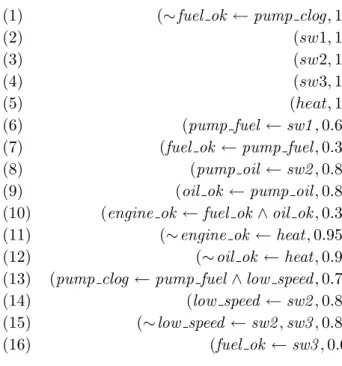
(1) (∼fuel ok ←pump clog,1) (2) (sw1,1) (3) (sw2,1) (4) (sw3,1) (5) (heat,1) (6) (pump fuel ←sw1,0.6) (7) (fuel ok ←pump fuel,0.3) (8) (pump oil ←sw2,0.8) (9) (oil ok ←pump oil,0.8) (10) (engine ok ←fuel ok ∧oil ok,0.3) (11) (∼engine ok ←heat,0.95) (12) (∼oil ok ←heat,0.9) (13) (pump clog←pump fuel ∧low speed,0.7) (14) (low speed ←sw2,0.8) (15) (∼low speed ←sw2,sw3,0.8) (16) (fuel ok ←sw3,0.6)
Fig. 1. P-DeLP programPeng • If the pump is clogged, then the engine gets no fuel.
• When sw1 is on, normally fuel is pumped properly.
• When fuel is pumped properly, fuel seems to work ok.
• When sw2 is on, usually oil is pumped.
• When oil is pumped, usually it works ok.
• When there is oil and fuel, usually the engine works ok.
• When there is heat, then the engine is usually not ok.
• When there is heat, normally there are oil problems.
• When fuel is pumped and speed is low, then there are reasons to believe that the pump is clogged.
• When sw2 is on, usually speed is low.
• When sw2 andsw3 are on, usually speed is not low.
• When sw3 is on, usually fuel is ok.
Suppose also that the agent knows some particular facts: sw1, sw2 and sw3 are on, and there is heat. The knowledge of such an agent can be modelled by the program Peng shown in Fig. 1, where the finite set of certain clauses (i.e. Π) is from clause (1) to (5), and the finite set of uncertain clauses (i.e. ∆) is from clause (6) to (16). Note that uncertainty is assessed in terms of different necessity measures. From the P-DeLP program in Fig. 1 different
arguments can be derived using the procedural rules defined in Section 3. Thus, for example, the argument hB, f uel ok,0.3i can be derived from Peng as follows:
i) h∅, sw1,1i from (2) via INTF. ii) hB0, pump f uel,0.6i from (6) and i) via MPA. iii) hB, f uel ok,0.3i from (7) and ii) via MPA. where
B0 = {(pump fuel ←sw1,0.6)} and
B = {(pump fuel ←sw1,0.6) ; (fuel ok ←pump fuel,0.3)}.
Similarly, an argumenthC, oil ok,0.8ican be derived fromPeng using the rules (3), (8) and (9) via INTF, MPA, and MPA, resp., with3
C = {(pump oil ←sw2,0.8); (oil ok ←pump oil,0.8)}
Finally, an argumenthA1, engine ok,0.3ican be derived from Peng as follows: i) hB, f uel ok,0.3i as shown above.
ii) hC, oil ok,0.8i as shown above.
iii) hA1, engine ok,0.3ifrom i), ii), 10) via MPA.
whereA1={(engine ok ←fuel ok ∧oil ok,0.3)}∪B ∪ C. Note that the argu-ments hC, oil ok,0.8i and hB, f uel ok,0.3i are subarguments of the argument
hA1, engine ok,0.3i (see Def. 8).
Let us assume that the agent is in charge of controlling the engine, answering queries from other agents (e.g. a supervisor agent) about the status of the engine. For instance, the query ?−(engine ok,0.8) corresponds with proving whether the engine works ok with a certainty degree of at least 0.8. In order to answer this query, the agent will apply the procedure described in the previous sections: first will compute an argument supporting engine ok, and then will perform a recursive analysis of defeaters for these arguments, computing its associated dialectical tree.
In this particular example, the agent will find an argument supporting the conclusion engine ok, namely hA1, engine ok,0.3i. A counteragument (see Def. 10) for the argument hA1, engine ok,0.3i can be found, namely the ar-gumenthA2,∼f uel ok,0.6i, obtained from (2), (3), (6), (14), (13) and (1) by applying INTF, INTF, MPA, MPA, MPA, and MPA, resp., with
3 For the sake of clarity, we use semicolons to separate elements in an argument A
A2 = { (pump fuel ←sw1,0.6), (low speed ←sw2,0.8),
(pump clog ←pump fuel ∧low speed,0.7)}.
The argument hA2,∼f uel ok,0.6i is a counterargument for the argument
hA1, engine ok,0.3ias there exists a subargument hB, f uel ok,0.3iassociated with argumenthA1, engine ok,0.3i such that the set
Π∪ {(f uel ok,0.3),(∼f uel ok,0.6)}
is contradictory. It must be remarked as well that hA2,∼f uel ok,0.6i is a proper defeater (Def. 11) forhA1, engine ok,0.3i, ashA2,∼f uel ok,0.6i coun-terargues the argumenthA1, engine ok,0.3iwithhB, f uel ok,0.3ias disagree-ment subargudisagree-ment, and 0.6>0.3.
As the defeater hA2,∼f uel ok,0.6i is also an argument, a recursive analysis can be carried out by the agent, computing an argumentation line rooted in
hA1, engine ok,0.3i. In fact, note that the argument hA2,∼f uel ok,0.6i has the subargument hA20, low speed,0.8i, with A20 = {(low speed ←sw2,0.8)}. From the program Peng given in Fig. 1 a blocking defeater for the argument
hA2,∼f uel ok,0.6i can be derived, namely hA3,∼low speed,0.8i, obtained from (3), (4) and (15) via INTF, INTF and MPA, respectively. In this case we have:
A3 = { (∼low speed ←sw2,sw3,0.8) }
This third defeater hA3,∼low speed,0.8i can be thought of as an answer of the proponent to the opponent which reinstates hA1, engine ok,0.3i, as it defeats the opponent’s defeater hA2,∼f uel ok,0.6i. The above situation can be expressed in the following argumentation line:4
[hA1, engine ok,0.3i,hA2,∼f uel ok,0.6i,hA3,∼low speed,0.8i ]
In order for the preceding analysis to be exhaustive, every possible argumen-tation line rooted in hA1, engine ok,0.3i should be analysed. In this partic-ular case, note that the argument hA2,∼f uel ok,0.6i has a second (block-ing) defeaterhA4, f uel ok,0.6i, computed from (4), (16) via INTF and MPA, respectively. The argument hA1, engine ok,0.3i has also a second defeater 4 Note that the proponent’s last defeater in the above sequence could be on its turn
defeated by a blocking defeater hA20, low speed,0.8i, resulting in
[hA1, engine ok,0.3i,hA2,∼f uel ok,0.6i,hA3,∼low speed,0.8i,
hA20, low speed,0.8i . . . ]
However, such line is not acceptable, as it violates the condition of non-circular argumentation.
hA5,∼engine ok,0.95i, computed from (5), (11) via INTF and MPA, respec-tively. In this case we have:
A4 = { (fuel ok ←sw3,0.9)}
A5 = { (∼engine ok ←heat,0.8) }
There are no more arguments to consider. As a consequence, there are three acceptable argumentation lines rooted in hA1, engine ok,0.3i, namely:
• λ1 = [ hA1, engine ok,0.3i,hA2,∼f uel ok,0.6i,hA3,∼low speed,0.8i ] • λ2 = [ hA1, engine ok,0.3i,hA2,∼f uel ok,0.6i,hA4, f uel ok,0.6i ] • λ3 = [ hA1, engine ok,0.3i,hA5,∼engine ok,0.95i ]
The argument hA1, engine ok,0.3i is the only possible argument the agent can compute supporting the query engine ok. There are three argumenta-tion lines rooted in the argument hA1, engine ok,0.3i, and one of them is of even length. Therefore the argument hA1, engine ok,0.3i is not warranted (Def. 12). On the contrary, note that the agent can compute there exists an ar-gument hA5,∼engine ok,0.95i supporting ∼engine ok, and such argument has no defeaters. Consequently, there is only one argumentation line rooted in
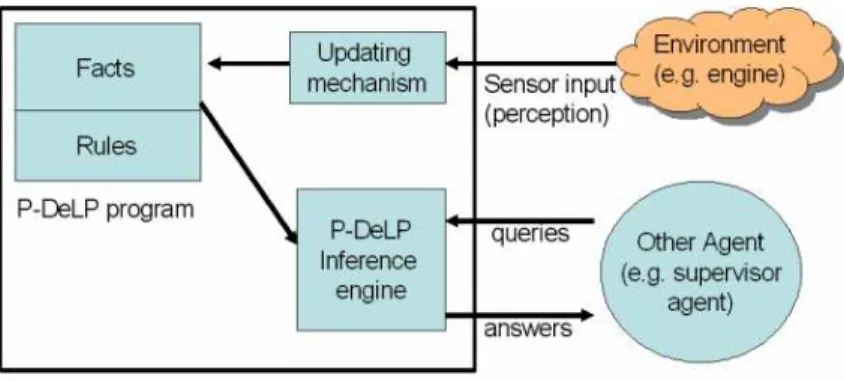
hA5,∼engine ok,0.95i, namelyλ = [hA5,∼engine ok,0.95i], which has odd length. Therefore we can conclude that hA5,∼engine ok,0.95i is warranted. In a MAS context, intelligent agents will encode their knowledge about the world using a P-DeLP program. Figure 2 outlines the different elements associ-ated with a P-DeLP-based agent. Clearly, our agent will be usually performing its activities in a dynamic environment, so that it should also be able to reason, plan, and act according to new perceptions from the outside world. Such per-ceptions will be sensed by the agent, integrating them into its current beliefs. For the sake of simplicity, we will assume that such perceptions constitute new facts to be added to the agent’s knowledge base. As already stated in the introduction, fuzzy propositions provide us with a suitable representation model as our agent will probably have vague or imprecise information about the real world, as its sensors are not perfect devices.
Defining a generic procedure for updating the agent’s knowledge base is not easy, as completely new incoming information (e.g. facts with new predicate names) might result in the strict knowledge Π becoming contradictory (see Def. 7). In some particular cases the agent will only perceive changes in the
Fig. 2. A P-DeLP-based agent in a MAS context
necessity measure of the already known facts (e.g. the agent has a fact (heat,1) in the knowledge base, but the sensed temperature has changed, modelled by a new fact (heat,0.8)). In such cases, a simple but effective strategy can be applied, similar as the one suggested in [14]. We will make the assumption that new perceptions always supersede old ones, so that a if a new perception (p, value) is sensed at timet, and the agent has already a fact (p, value0) in its strict knowledge base Π, then the updated knowledge base will be computed as Π\ {(p, value0)} ∪ {(p, value)}.
6 Logical properties of argument and warrant in P-DeLP
As explained in the previous Section, intelligent agents can encode their knowl-edge about the world in terms of a P-DeLP program P. New perceptions can modify the agent’s current knowledge, altering the set of facts in P. In this context, it is interesting to analyze the existing inference abilities of our agent in terms of deduction, arguments and warrants.
In order to do this, we will define different inference operators associated with deduction based on strict knowledge, argument derivation and computation of warranted goals. We refer to such operators asclosure operators in order to stress the fact that their output is associated with considering all new weighted facts that can be obtained by computing deductions based on strict knowl-edge, arguments or warrants from a given program P. Our aim is to study the inference abilities of a P-DeLP agent in terms of the logical properties associated with these operators.
For our characterization, we will identify three distinguished sets Lit`, Lit4, andLitw associated with any programP, corresponding to those literals which are supported by deduction from strict knowledge, supported by arguments, and supported by warranted arguments, respectively. Formally:
Definition 13 Let P be a P-DeLP program. We define the sets Lit`(P),
Lit`(P) = { (Q,1)| P ` (Q,1) }
Lit4(P) = { (Q, α) | P |∼4hA, Q, αi for some argument A for a goal Q
with necessity degree α }
Litw(P) = { (Q, α) | P |∼whA, Q, αi for some argument A for a goal Q
with necessity degree α }
On the basis of these distinguished sets, we will define three closure operators which, given a program P, compute a new P-DeLP program P0 whose facts are precisely those given by the three distinguished sets given in Def. 13, while the existing rules in P are maintained.
Definition 14 Let P be a P-DeLP program. We define the closure operators
C`, C4 and Cw associated with P as follows:
C`(P) = rules(P) ∪ Lit`(P)
C4(P) = rules(P) ∪ Lit4(P)
Cw(P) = rules(P) ∪ Litw(P) OperatorC` computes a new program P
0 based on the rules of P along with those facts (Q,1) which can be deduced from the strict knowledge in P.5 OperatorC4 computes a new program P0 based on the rules of P along with those facts which are supported by arguments based on P. The output P0 incorporates a new uncertain fact (Q, α) whenever there exists an argument
hA, Q, αi in P. Finally, operator Cw computes a subset of C4, namely the program resulting from the rules in P along with all those new facts which correspond to conclusions of warranted arguments in P. Notice thatC4 may contain contradictory knowledge (i.e. it may be the case that two arguments
hA1, Q, αi and hA2,∼Q, βi could be inferred from a given program P).
Proposition 15 Operators C`, C4 and Cw are well-defined (ie, given a
P-DeLP program P as input, the associated output is also a P-DeLP program
P’). Besides, they satisfy the following relationship:C`(P)⊆Cw(P)⊆C4(P).
Proof: Given a P-DeLP programP, we want to determine thatC`(P),C4(P) and
Cw(P) are also programs. From Def. 13 and Def. 14, it is clear that all operators
return syntactically valid programs as their output, as Lit`, Lit4 and Litw corre-spond always to facts in P-DeLP. From Def. 7, it remains to check that the strict knowledge C`(P)Π (analogously for C
4(P) and Cw(P)) is not a contradictory set
5 OperatorC
`defines in fact a consequence relationship, as it satisfies idempotence,
cut and monotonicity. It can be seen as the SLD Horn resolution counterpart in the context of P-DeLP restricted to certain clauses.
of P-DeLP clauses. Let us suppose that C`(P)Π is contradictory. By definition of C`, this is only possible if PΠ is itself contradictory, which cannot be the case, as P is a P-DeLP program (absurd). Consequently,C`(P) is a P-DeLP program. The same line of reasoning applies forC4(P) and Cw(P).
The inclusion relationshipC`(P)⊆C4(P) holds as it is straightforward to see that
P `(Q,1) iff P|∼4h∅, Q,1i. Since every warranted argument is an argument wrtP, a similar analysis applies to conclude thatCw(P)⊆C4(P). 2 Next we will analyze different logical properties for deduction from strict knowledge, argument construction and warrant in P-DeLP, on the basis of the operators defined before. A summary of the logical properties under con-sideration can be found in the Appendix A.
6.1 Logical properties for C4
Clearly inclusion does not hold for C4. A counterexample suffices; consider
P ={(p,0.5),(∼p,1)}. Then C4(P) = {(∼p,1)}. Hence P 6⊆C4(P).
Proposition 16 The operator C4 satisfies inclusion and idempotence.
Proof: Inclusion holds trivially, asP ⊆C4(P)⊆C4(C4(P)) by definition ofC4.2
Proposition 17 The operatorC4 satisfies idempotence, i.e.C4(P) =C4(C4(P)).
Proof: (By double inclusion)
1)C4(P)⊆C4(C4(P)) holds trivially, by definition ofC4(Def. 14).
2) We must prove thatC4(C4(P))⊆C4(P). In other words, we must prove that if (R, β)∈C4(C4(P)), then (R, β)∈C4(P). By definition,
C4(C4(P)) =C4(P)∪ {(Q, α)|C4(P)|∼4hA1, Q, αi} (1)
Clearly, if (R, β) ∈ C4(P), there is nothing to prove. We can reduce our original
problem to the following formulation:
if (R, β)∈ {(Q, α)|C4(P)|∼4hA1, Q, αi}then (R, β)∈C4(P) (2)
We will prove this statement by induction on the number of steps required for the proof in hA1, Q, αi.
Base case: suppose that hA1, Q, αi is proven in one inference step. (i.e.,C4(P) |∼4 1
hA1, Q, αi via INTF). But note that from the definition of INTF, it follows that C4(P)|∼4hA, Q, αi iff (Q, α)∈C4(P) (3)
Hence equation 2 holds.
Inductive hypothesis: Let us assume that equation 2 holds for all proofs of length 1< k. We will show that it also holds for proofs of length k. Let (R, β) ∈ {(Q, α)
|C4(P)|∼4k+1hA1, Q, αi }. Then it is the case thathA1, Q, αiwas derived via MPA.
If that is the case, then
C4(P)|∼4khA1, L1, α1i,hA2, L2, α2i. . . ,hAk, Lk, αki, (4)
and there is a rule
(L0 ←L1 ∧L2∧. . .∧Lk, γ) (5)
with γ ≤ 1, such that Π∪ {(L0 ←L1∧L2 ∧. . .∧Lk, γ)} ∪
Sk
i=1Ai 6` ⊥, with β
= min(α1, . . . , αk, γ). Clearly, hA1, Q, αi follows from eq. 4 and 5. By inductive
hypothesis, this means that
(L1, α1), . . .(Lk, αk)∈C4(P) (6)
But the rule in eq. 5 also applies here, and hence (L0, β) ∈ C4(P), with β = min(α1, . . . , αk, γ), as we wanted to show. 2 Monotonicity does not hold for C4, as expected. As a counterexample con-sider the program P = { (q,1), (p ←q,0.9) }. Then (p,0.9) ∈ C4(P), as there is an argumenthA, p,0.9ion the basis ofP for concluding (p,0.9), with
A ={ (p ←q,0.9) }. However, (p,0.9)6∈C4(P ∪ {(∼p,1)}) (as no argument for (p,0.9) could exist, as condition 2 in Def. 8 would be violated). Semi-monotonicity is an interesting property for analyzing non-monotonic conse-quence relationships. It is satisfied if all defeasible conseconse-quences from a given theory are preserved when the theory is augmented with new defeasible infor-mation.
Proposition 18 The operator C4 satisfies semi-monotonicity when new de-feasible information is added, i.e. C4(P1)⊆C4(P1 ∪ P2).
Proof: Follows directly from the structure of the inference rules for|∼4. SupposeP1 |∼4hA, Q, αi, and consider the programP1∪P2 as stated above. Clearly,hA, Q, αican
be derived fromP1∪P2 by applying the same sequence of steps as inP1|∼4hA, Q, αi,
since all preconditions in inference rules are defined wrtPΠ
1, the set of strict
knowl-edge inP1, and by hypothesis, (P1 ∪ P2)Π=PΠ
Proposition 19 The operator C4 satisfies cummulativity, i.e. γ ∈C4(Γ)
im-plies φ ∈C4(Γ∪ {γ}) iff φ∈C4(Γ).
Proof: (Sketch) Without loss of generality, we can assumeγ = (Q, α) is not in Γ (otherwise the proof is straightforward). By hypothesis, (Q, α) ∈ C4(Γ) and there
is a sequencesQ1, sQ2, . . . , sQt of application of inference rules in{INTF, MPA, MPA
}such that Γ|∼4hA1, Q, αi. Let us assume now that (R, β)∈C4(Γ∪ {(Q, α)}). This
means that there is a sequencer1, r2, . . . , rnof application of inference rules as before
such that Γ|∼
4hA2, R, βi.Suppose now thathA2, R, βidoes not includehA1, Q, αias
a subargument. This happens iff from the structure of inference rules for|∼4, (Q, α) will not be required as intermediate step in the proof of (R, β) iff (R, β) ∈C4(Γ). Suppose now thathA2, R, βidoes includehA1, Q, αias a subargument. This happens
iff in the sequence r1, r2, . . . , rn we have that ri+k = sQi , for i = 1. . . t, for some
1≤k≤n. But from the initial hypothesis this sequence can be built from Γ alone. Hence Γ|∼4hA2, R, βi or equivalently (R, β)∈C4(Γ). 2 Note that the property of right weakening cannot be considered (in a strict sense) in P-DeLP, since the underlying logic does not allow the application of the deduction theorem. Therefore, wffs of the form (x ←y, α) cannot be derived. However, an alternative approach can be intended, introducing a new property in which right weakening is restricted to Horn-like clauses:
Proposition 20 The operator C4 satisfies (Horn) supraclassicality wrt C`
(i.e. C`(P) ⊆ C4(P)), and (Horn) right weakening, (i.e. if (Y, α) ∈ C4(P)
and (X ←Y,1)∈C`(P), then (X, α)∈C4(P)).
Proof: Supraclassicality follows from Prop. 15. For the case of right weakening, let us suppose (Y, α) ∈ C4(P), i.e. P |∼
4hA1, Y, αi, for some argument hA1, Y, αi. If
(X ←Y,1) ∈ C`(P), then necessarily (X ←Y,1) ∈ PΠ (by def. of C`). From
(X ←Y,1) ∈ P and P |∼4hA1, Y, αi, by applying inference rule MPA we get
hA1, X, αi. 2
Proposition 21 The operatorC4 satisfies subclassical cummulativity,i.e.P1 ⊆
P2 ⊆C`(P1) implies C4(P1) = C4(P2).
Proof: Cleary, by hypothesis and by the def. of C4, it holds that rules(P1) = rules(P2). It can be shown that
P1 ⊆ P2 ⊆C`(P1) (7)
implies that
f acts(P1) =Lit`(P1) (8) Lit`(P1) =Lit`(P2) (9)
From Eq. 7, it follows that P1 ⊆C`(P1). By def. C`,rules(P1)= rules(C`(P1)),
and C`(P1) contains only certain facts. Therefore, as P1 ⊆ C`(P1), the program
P1 has also only certain facts. This proves Eq. 8.
Let us now prove that Eq. 9. From Eq. 7, it follows that every certain fact inP1 is
also a certain fact inP2. As P1 and P2 share the same rules, clearly if follows that
Lit`(P1)⊆Lit`(P2) (10)
Now it remains to show that
Lit`(P2)⊆Lit`(P1) (11)
By contradiction, suppose that (Q,1)∈Lit`(P2) and (Q,1)6∈Lit`(P1). Then two
possible situations occur:
• (Q,1) is not a fact inP1. But this implies (by hypothesis 7) that (Q,1) is not a
fact in P2. Contradiction.
• (Q,1) does not follow fromP1 by successive applications of the MPA and INTF
rules, and it does follow from P2 (by assumption). But from the hypothesis 7, P2 ⊆C`(P1), and hence (Q,1) cannot be derived fromP2 either. Contradiction.
ConsequentlyLit`(P2)⊆Lit`(P1). From Eq. 10 and 6.1, if follows that Eq. 9 holds.
By transitivity from Eq. 8 and 9, we can conclude that P1 and P2 have associated the same set of facts, and that it also holds thatrules(P1) =rules(P2). Therefore,
both programsP1 andP2 are identical, and hence it follows thatC4(P1) =C4(P2),
as we wanted to prove.
2
Most non-pure logical properties for C4 do not hold. In particular, C4 does not satisfy the properties of (LL) left-logical equivalence; (CC) conjunction of conclusions; (LA) left absorption; (RA) right absorption; (RN) rational negation; (RM) rational monotonicity; (DR) disjunctive rationality, as shown next.
LL: Given two programs P1 and P2, C`(P1) = C`(P2) does not imply C4(P1) = C4(P2). Consider P1 = {(y←,1)}and P2 =P1 ∪ {(x ←y,0.9)}.
CC: Arguments supporting conjunctions of conclusions cannot be expressed in P-DeLP language, as goals are restricted to literals.
LA: ConsiderP ={(Q, α)}, whereQis a literal,α <1. ThenC`(C4(P)) =C`({(Q, α)}) =∅ 6=C4(P).
RA: Consider the same counterexample given for LA. Analogously, C4(C`(P)) =
C4(∅) =∅ 6=C4(P).
RN: Consider P1 = { (∼p ←x,1), (∼p ← ∼x,1), (r ←,1), (z ←p,1), (p ←r,0.9)
}. Then P1 |∼4hA1, z,0.9i, withA1 ={(p ←r,0.9)}However,P1 ∪ {(x ←,1) } 6 |∼4 hA1, z,0.9i, and P1 ∪ {(∼x ←,1)} 6 |∼4 hA1, z,0.9i.
RM: Consider the same counterexample as given for RN. Then P1 |∼4hA1, z,0.9i, but
it is not the case thatP1 ∪ {(x ←,1)} |∼4 hA1, z,0.9i norP1 |∼4 (∼x ←,1).
DR: Clearly,C4 does not satisfy property (e), as disjunctions cannot be expressed as wffs in the P-DeLP object language.
6.2 Logical properties for Cw
Next we will analyze the behavior of the Cwoperator for capturing warrant. In fact, most properties do not hold for Cw, as we will see through different counterexamples.
Proposition 22 The operator Cw does not satisfy inclusion, monotonicity
nor semi-monotonicity.
Proof: Different counterexamples suffice.
• Inclusion: LetP ={(p,0.7), (∼p,0.9)}. ThenCwP ={(∼p,0.9)}, and clearly P 6⊆CwP.
• Monotonicity: Monotonicity does not hold, as can be seen from the counterex-ample used for monotonicity in C4; in that case, (q,0.9)∈Cw(P), but (q,0.9)6∈
Cw(P ∪ {(∼p,1)}).
• Semi-monotonicity:Semi-monotonicity does not hold either forCw, as adding new
defeasible clauses cannot invalidate already derivable arguments, but it can enable new ones that were not present before, thus modifying the dialectical relationships among arguments. Arguments that were warranted may therefore no longer keep that epistemic status. Consider a variant of the previous counterexample: letP =
{(q,1), (p ←q,0.9)}. Then (p,0.9)∈Cw(P), as there is an argumenthA, p,0.9i
on the basis of P. However, (p,0.9) 6∈ Cw(P ∪ {(∼p,0.95)}), as hA, p,0.9i is
defeated by hB,∼p,0.95i, with B ={(∼p,0.95)}. There are no more arguments to consider, and hence hA, p,0.9i is not warranted.
2
Moreover, cumulativity, idempotence and right-weakening do not hold forCw, as shown in the following counterexamples.