Estimating Sparse Representations
from Dictionaries With Uncertainty
Vom Fachbereich 18
Elektrotechnik und Informationstechnik der Technischen Universit¨at Darmstadt
zur Erlangung der W¨urde eines Doktor-Ingenieurs (Dr.-Ing.)
genehmigte Dissertation
von
Christian Weiß, M.Sc.
geboren am 21.06.1985 in Wiesbaden, Deutschland
Referent: Prof. Dr.-Ing. Abdelhak M. Zoubir
Korreferent: Prof. Dr. Fulvio Gini
Tag der Einreichung: 06.12.2016
Tag der m¨undlichen Pr¨ufung: 24.03.2017
D 17 Darmstadt, 2017
I
Acknowledgments
I would like to thank all the people who accompanied and supported me during my doctoral study in various ways on a professional and private level.
First, I thank my supervisor, Prof. Dr.-Ing. Abdelhak M. Zoubir, for his trust, for the time and freedom of pursuing my research interests, and for the opportunity of accomplishing my Ph.D. at the Signal Processing Group. I am very grateful for the chance to extend my international experiences by visiting conferences and by spending time in Taiwan for a research visit during the Ph.D program. Hereby, I also thank the Graduate School of Computational Engineering at Technische Universit¨at Darmstadt for the scientific and financial support. In addition, I wish to thank Prof. Dr. Chong-Yung Chi and the members of the Wireless Communications and Signal Processing Laboratory at the National Tsing Hua University, Hsinchu,Taiwan, for their great hospitality during my research visit. It was truly a pleasure.
A special thanks goes to my co-supervisor, Prof. Dr. Fulvio Gini, for offering valuable feedback. I also thank Prof. Dr. Sebastian Sch¨ops and Prof. Dr.-Ing. Ralf Steinmetz for their interest in my work and for being in the Ph.D. committee.
Further, I would like to express my sincere gratitude to Prof. Dr. Shinji Yamashita from the Yamashita laboratory of photonic communication devices at the University of Tokyo, Japan, for providing valuable sensor data that I could use for my research. I also thank Dr. Kevin Brinkmann, Dr. Sebastian Knabe, and Dr. Florian Schulz for the industrial cooperation along with fruitful discussions and support, which have led to interesting results. The accomplishment of the related industry projects would not have been possible without the help of Vineet Kumar, Sebastian Stiefel, and Mark Ryan Balthasar.
A great thanks also goes to all current and former members of the Signal Processing Group at Technische Universit¨at Darmstadt. In particular, I would like to thank J¨urgen Hahn, Adrian ˇSoˇsi´c, Di Jin, Nevine Demitri and Dominik Reinhard for all the interest-ing, funny and fruitful discussions in the office. I will not forget our supper meetings at
El Cid, the special lunch hours with Simon Rosenkranz, and the long working nights with Feng Yin and Fiky Suratman. These are truly memorable experiences.
I also enjoyed working with Sara Al-Sayed, Mouhammad Alhumaidi, Mark Ryan Balthasar, Patricia Binder, Christian Debes, Raquel Fandos, Hauke Fath, Tai Fei, G¨okhan G¨ul, Lala Khadidja Hamaidi, Ulrich Hammes, Philipp Heidenreich, Dr. Roy
Howard, Amare Kassaw, Sahar Khawatmi, Renate Koschella, Michael Lang, Ste-fan Leier, Michael Leigsnering, Zhihua Lu, Marco Moebus, Toufik Mouchini, Ahmed Moustafa, Ivana Perna, Ziliang Qiao, Tim Sch¨ack, Ann-Kathrin Seifert, Waqas Sharif, Sergey Sukhanov, Wassim Suleiman, Gebremichael Teame, Freweyni Teklehaymanot and everyone else whose company I enjoyed during my Ph.D. candidacy.
At this point, I especially thank Michael Fauss and Michael Muma for offering valuable advice and guidance.
Finally, I would like to thank my family and all my friends for being there for me and always believing in me.
My parents, Gisela and Michael, have always supported me in pursuing my personal goals. I sincerely wish to thank them for their love and for their constant, unconditional support in every aspect of my life.
Darmstadt, April 8, 2017 Christian Weiß
III
Kurzfassung
In den letzten zwei Jahrzehnten erhielten sp¨arliche Darstellungen vermehrt Aufmerk-samkeit in zahlreichen ingenieurswissenschaftlichen Anwednungen. F¨ur eine sp¨ ar-liche (sparse) Darstellung eines Signals ben¨otigt man ein W¨orterbuch (dictionary) aus Basiselementen, welche auffallende und diskriminative Merkmale des Signals beschreiben. Wird das W¨orterbuch durch ein analytisches Modell generiert, so h¨angt seine Aussagekraft von der Qualit¨at dieses Modells ab.
In der vorliegenden Dissertation wird das Problem der Sch¨atzung von sp¨arlichen Darstellungen in der Gegenward von Fehlern und Unsicherheiten bez¨uglich des W¨ orter-buchs behandelt. Im ersten Teil wird ein statistisches Rahmenwerk zur sp¨arlichen Regularisierung eingef¨uhrt. Der zweite Teil befasst sich mit der Entwicklung von Methodiken zur Sch¨atzung von sp¨arlichen Darstellungen aus hoch-redundanten W¨orterb¨uchern mit unbekannten W¨orterbuchparametern. Die vorgestellten Methoden werden mit Hilfe von Anwendungen der Richtungsbestimmung und der faseroptischen Abtastung ausgewertet. Diese dienen als illustrative Beispiele zur Erforschung der ab-strakten Probleme in der Theorie der sp¨arlichen Darstellungen.
Das Schtzen einer sp¨arlichen Darstellung schließt oftmals die L¨osung eines regular-isierten Optimierungsproblems mit ein. Das vorgestellte Rahmenwerk zur Regular-isierung bietet ein systematisches Verfahren zur Bestimmung eines RegularRegular-isierungspa- Regularisierungspa-rameters, welcher die Verbundseffekte von Modellfehlern und Messrauschen erfasst. Er wird bestimmt durch eine obere Grenze f¨ur den mittleren quadratischen Fehler zwischen den fehlerhaften Daten und dem idealen Modell. Trotz angemessener Regularisierung bleibt die Qualit¨at und die Genauigkeit der erhaltenen sp¨arlichen Darstellung durch die Modellfehler beeintr¨achtigt und ist durchaus empfindlich bez¨uglich ¨Anderungen des Regularisierungsparameters. Um dieses Problem zu erleichtern wird eine W¨ orter-buchkalibrierung durchgef¨uhrt. Das Rahmenwerk wird f¨ur das Problem der Rich-tungssch¨atzung angewendet.
Redundanz erm¨oglicht es mit dem W¨orterbuch eine breitere Klasse von Beobachtun-gen zu beschreiben. Jedoch wird dadurch auch die ¨Ahnlichkeit zwischen den Eintr¨agen erh¨oht, was zu missverst¨andlichen Darstellungen f¨uhrt. Um das Problem der Redun-danz und der zus¨atzlichen Unsicherheit im W¨orterbuch zu behandeln werden zwei Strategien verfolgt. Zun¨achst wird eine Methode der alternierenden Sch¨atzung zur iterativen Bestimmung der zugrundeliegenden sp¨arlichen Darstellung und der W¨ orter-buchparameter vorgestellt. Ferner werden theoretische Grenzen f¨ur den Sch¨atzfehler hergeleitet. Zweitens wird ein Bayes’sches Rahmenwerk zum Sch¨atzen von sp¨arlicher Darstellungen und zum Lernen von W¨orterb¨uchern entwickelt. Ein hierarchisches Mod-ell wird betrachtet um Unsicherheiten in vorherigen Annahmen zu erfassen. Das
betra-chtete Modell f¨ur die Koeffizienten der sp¨arlichen Darstellung ist speziell f¨ur dem Um-gang mit Redundanz im W¨orterbuch konzipiert. Approximative Inferenz wird unter Verwendung eines hybriden Markov Chain Monte Carlo Algorithmus durchgef¨uhrt. Die Leistungsf¨ahigkeit und die praktische Anwendbarkeit beider Methodiken wird f¨ur ein Problem aus der faseroptischen Abtastung ausgewertet. Dabei wird ein analytis-ches Modell f¨ur das Sensorsignal zusammengestellt, welches dann genutzt wird um ein geeignetes W¨orterbuch zu generieren.
V
Abstract
In the last two decades, sparse representations have gained increasing attention in a variety of engineering applications. A sparse representation of a signal requires a dic-tionary of basic elements that describe salient and discriminant features of that signal. When the dictionary is created from a mathematical model, its expressiveness depends on the quality of this model.
In this dissertation, the problem of estimating sparse representations in the presence of errors and uncertainty in the dictionary is addressed. In the first part, a statistical framework for sparse regularization is introduced. The second part is concerned with the development of methodologies for estimating sparse representations from highly redundant dictionaries along with unknown dictionary parameters. The presented methods are illustrated using applications in direction finding and fiber-optic sensing. They serve as illustrative examples for investigating the abstract problems in the the-ory of sparse representations.
Estimating a sparse representation often involves the solution of a regularized optimiza-tion problem. The presented regularizaoptimiza-tion framework offers a systematic procedure for the determination of a regularization parameter that accounts for the joint effects of model errors and measurement noise. It is determined as an upper bound of the mean-squared error between the corrupted data and the ideal model. Despite proper regularization, the quality and accuracy of the obtained sparse representation remains affected by model errors and is indeed sensitive to changes in the regularization param-eter. To alleviate this problem, dictionary calibration is performed. The framework is applied to the problem of direction finding.
Redundancy enables the dictionary to describe a broader class of observations but also increases the similarity between different entries, which leads to ambiguous rep-resentations. To address the problem of redundancy and additional uncertainty in the dictionary parameters, two strategies are pursued. Firstly, an alternating estimation method for iteratively determining the underlying sparse representation and the dic-tionary parameters is presented. Also, theoretical bounds for the estimation errors are derived. Secondly, a Bayesian framework for estimating sparse representations and dictionary learning is developed. A hierarchical structure is considered to account for uncertainty in prior assumptions. The considered model for the coefficients of the sparse representation is particularly designed to handle high redundancy in the dic-tionary. Approximate inference is accomplished using a hybrid Markov Chain Monte Carlo algorithm. The performance and practical applicability of both methodologies is evaluated for a problem in fiber-optic sensing, where a mathematical model for the sen-sor signal is compiled. This model is used to generate a suitable parametric dictionary.
VII
Contents
1 Introduction 1
1.1 Motivation . . . 2
1.2 Aims and Research Objectives . . . 3
1.3 Contributions . . . 4
1.4 Publications . . . 6
1.5 Overview . . . 7
2 Primer on Sparse Estimation 9 2.1 Sparse Representation of Signals . . . 10
2.1.1 Classes and Properties of Dictionaries . . . 11
2.1.2 Dictionary Learning . . . 13
2.2 Sparse Estimation & Redundant Dictionaries . . . 14
2.2.1 Reconstruction Guarantees and Coherence Measures . . . 15
3 Applications and Signal Models 21 3.1 Direction Finding . . . 21 3.1.1 Signal Model . . . 21 3.2 Fiber-Optic Sensing . . . 23 3.2.1 Sensing Principle . . . 24 3.2.2 Signal Model . . . 24 3.3 Compressed Sampling . . . 27 3.3.1 Signal Model . . . 27
4 Regularization and Dictionary Calibration for Sparse Estimation 29 4.1 Introduction and Motivation . . . 30
4.2 State of the Art and Related Work . . . 31
4.3 Problem Statement . . . 32
4.3.1 Probabilistic Models for Array Imperfections . . . 33
4.4 Sparse Regularization for Direction Finding With Sensor Position Errors 35 4.4.1 Simulations . . . 39
4.5 Sparse Regularization for Direction Finding With Gain/Phase Errors . 43 4.5.1 Simulations . . . 45
4.6 Dictionary Calibration for Direction Finding . . . 49
4.6.1 Simulations . . . 51
4.7 Computational Complexity . . . 53
4.8 Discussion and Findings . . . 55
5 Alternating Sparse Estimation and Dictionary Learning 59
5.1 Introduction and Motivation . . . 60
5.2 State of the Art and Related Work . . . 61
5.3 Problem Statement . . . 63
5.4 Theoretical Performance Limits: The Cram´er-Rao Bound . . . 64
5.4.1 Estimating a Sparse Representation . . . 64
5.4.2 Estimating a Dictionary Parameter . . . 67
5.4.3 Estimating a Sparse Representation and a Dictionary Parameter 68 5.5 A Unified Framework for Compressed Fiber Sensing With Uncertainty . 72 5.5.1 System Architecture . . . 72
5.5.2 A Parametric Signal Model for Fiber-optic Sensing . . . 74
5.5.3 Alternating Sparse Estimation and Dictionary Learning With Highly Coherent Dictionaries . . . 78
5.5.4 The PDL-OIAI/OMP algorithms . . . 79
5.6 Computational Complexity . . . 84
5.7 Simulations and Experimental Validation . . . 85
5.7.1 Fiber-Optic Sensor Simulation . . . 85
5.7.2 Setup and Basic Settings . . . 86
5.7.3 Visualization of the PDL-OIAI/OMP Algorithms . . . 87
5.7.4 Performance Evaluation . . . 89
5.7.5 Experimental Validation Using Real Data . . . 90
5.8 Discussion and Findings . . . 96
5.9 Conclusion . . . 98
6 Dictionary Learning Strategies Using a Probabilistic Sparse Model 101 6.1 Introduction and Motivation . . . 102
6.2 State of the Art and Related Work . . . 104
6.3 Problem Statement . . . 105
6.4 Probabilistic Sparse Model for Localized Signals . . . 106
6.4.1 Local Covariance Model for Augmented Sparsity . . . 110
6.5 Hybrid Markov Chain Monte Carlo Algorithm . . . 112
6.5.1 The Hamilton Monte Carlo Method . . . 114
6.6 Parametric Dictionary Learning Strategies . . . 115
6.6.1 Hybrid Bayesian Dictionary Learning (S1) . . . 115
6.6.2 Bayesian Dictionary Learning (S2) . . . 117
6.7 Simulations and Experimental Validation . . . 120
6.7.1 Simulation Setup . . . 120
6.7.2 Visualization and Working Principle . . . 121
Contents IX
6.7.4 Experimental Validation Using Real Data . . . 127 6.8 Discussion and Findings . . . 128 6.9 Conclusion . . . 129
7 Conclusion and Future Directions 131
7.1 Summary and Conclusions . . . 131 7.1.1 Statistical Sparse Regularization Framework . . . 132 7.1.2 Sparse Estimation and Dictionary Learning Framework for
Fiber-Optic Sensing . . . 132 7.1.3 Probabilistic Model for Sparse Estimation of Localized Signals . 134 7.2 Future Research Directions . . . 135 7.2.1 Sparse regularization and dictionary calibration . . . 135 7.2.2 Sparse estimation and dictionary learning with highly redundant
dictionaries . . . 136
Appendix 139
A.1 Compressed Sampling Using Redundant Dictionaries . . . 139 A.2 The Fisher Information: Estimating Parameters in Gaussian Noise . . . 140
List of Acronyms 143
List of Symbols 145
Bibliography 151
1
Chapter 1
Introduction
The choice of a suitable data representation is an integral aspect of signal processing and machine learning. Depending on the problem at hand, different representations can be used to efficiently describe the data in a compact form and to reveal and extract particular discriminative features that might be hidden otherwise [1, 2].
Basic linear transformations have been widely used to obtain suitable representations. In the 1980’s, a lot of research was designated to transformations that capture local-ized or multiscale features [3]. This also led to the development of popular compression algorithms such as the JPEG2000 algorithm for image compression [4]. In the 1990’s, the concept ofdictionaries emerged, where a representation (or approximation) is ob-tained by choosing a subset of elements from a larger collection, called dictionary [3]. While dictionaries were initially based on existing transformations, the idea ofsparsity
has initiated the development of more general and efficient dictionaries with strong descriptive power [3]. They paved the way for high-accuracy feature estimation by estimating the best underlying sparse representation with respect to the correspond-ing dictionary [5]. Rather than uscorrespond-ing a fixed set of dictionary elements, the aim is to incorporate the data itself to identify the best subset of elements, such that the er-ror between the data and its representation (approximation) is minimized – a general problem that belongs to the field of non-linear approximation theory [6]. This idea has further driven the development of efficient sparse estimation algorithms [7–10].
A sparsity-promoting dictionary that reveals particular features can be created in dif-ferent ways. It can be designed based on a mathematical model for the underlying phys-ical processes generating the data or it can be learned directly from training data [3]. While both approaches have their advantages and limitations, this work is concerned with the former case. Nevertheless, mathematical models are often used as an approxi-mation to describe complicated natural phenomena. Therefore, they can be inaccurate or contain unknown parameters due to imperfect prior knowledge. As a result, the dictionary itself may contain various sources of uncertainty, which leads to inaccurate sparse representations.
The field of estimating sparse representations covers many interdisciplinary topics in mathematics, physics, and computer science. Therefore, it is highly versatile and has accumulated a broad body of literature. Nevertheless, many questions still remain unanswered. This dissertation addresses the problem of estimating sparse represen-tations from dictionaries that are created from mathematical models, where potential sources of uncertainty arise from idealized assumptions or imperfectly known model parameters.
1.1
Motivation
Sparse representations have gained increasing importance and their ubiquitous exis-tence is presumed in various applications such as source localization [5], laser rang-ing [11], sparse codrang-ing [12–15] or imagrang-ing [16–19]. They also play a central role in the advent of compressed sensing [20–22] – an efficient signal acquisition scheme that has been widely studied with the aim to abate the sampling rate as well as to reduce storage requirements and even hardware costs. The assumption (or the constraint) of sparsity can be instrumental to obtain a unique solution of underdetermined linear equation systems, which are omnipresent in general engineering applications [23]. It has been shown that sparse representations are suitable to achieve super-resolution and to estimate quantities at high accuracy [5]. Nevertheless, this property can only hold under the premise that the model used to create the dictionary correctly describes the observed physical processes that generate the data.
In many practical problems, the existence of unknown model parameters or model errors is inevitable, e.g. due to a limited fabrication accuracy in the manufacturing process of devices or due to external factors such as temperature fluctuations or erosion. Estimating a meaningful sparse representation that correctly highlights the features of interest becomes non-trivial in the presence of dictionary defects or uncertainty. Find-ing and evaluatFind-ing solutions for this problem is of general interest.
In order to obtain highly sparse representations, redundancy in the dictionary is imper-ative [3]. It improves the descriptive power, such that complicated natural phenomena can be described by a single dictionary [9, 23, 24]. However, a high level of redundancy increases the similarity between different dictionary elements, which can cause prob-lems in sparse estimation [25]. Methodologies for sparse estimation that are able to obtain meaningful and accurate sparse representations from highly redundant dictio-naries with uncertainty are strongly desirable and of broad practical interest.
The addressed research topics are initially motivated by application-specific problems in direction finding and compressed fiber-optic sensing. Therefore, these applications serve as illustrative examples and are representative for investigating the general and rather abstract problems in the theory of sparse representations. In fact, the problem of direction finding is fundamental and arises explicitly or implicitly in communications, imaging and radar/sonar, just to name a few. For fiber sensing, there exist indeed many sensing technologies. In the scope of this thesis, optical sensors with compressed sensing-based signal acquisition are considered, where the main objective is to estimate the reflection delays of the interrogating signal. This can be generalized to estimating the translation coefficients of localized signals – a frequently encountered problem in different applications, e.g. in laser ranging [11] or radar [19].
1.2 Aims and Research Objectives 3
1.2
Aims and Research Objectives
The aim of this dissertation is the design and development of systematic strategies for estimating sparse representations in the presence of uncertainty or errors in the underlying model that is used to generate the dictionary. The major research objectives are concerned with two particular aspects of this problem as stated below. These are meant to be investigated by means of applications that are representative for frequently encountered problems in research and of broad interest in industry. In particular, direction finding and fiber-optic sensing combined with compressed sensing are in the focus of this work. The research objectives considered in this dissertation are:
1. Sparse regularization and dictionary calibration:
The objective is the development of a statistical framework for sparse regular-ization in the presence of model errors. Estimating a sparse representation often involves the solution of a regularized optimization problem. A suitable regular-ization parameter, however, is usually non-trivial to obtain and often hard to justify, especially when an idealized model is used to describe a complicated phe-nomenon. A common approach is to repeatedly solve the optimization problem for a large range of regularization parameter values at the cost of a high compu-tational load. A statistical regularization framework, in contrast, is intended to yield a suitable regularization parameter prior to sparse estimation, which can be justified by statistical arguments. Since regularization alone can only adjust the tolerance level, the sparse solution can still be inaccurate. Moreover, it is not guaranteed that a solution obtained from an inaccurate model is also a desirable solution. Therefore, in addition to regularization, dictionary calibration is inves-tigated with the aim to improve the quality of the sparse representation and to reduce the sensitivity to the regularization parameter.
2. Sparse estimation and dictionary learning with highly redundant dictionaries:
The objective is to design sparse estimation and dictionary learning methods that are able to accurately estimate an underlying sparse representation along with uncertain dictionary parameters when the entries of the dictionary exhibit high similarity and contain unknown parameters. Redundancy favors highly sparse representations and, in principle, improves the accuracy at which quantities can be estimated. However, the requirements for unique sparse estimation are no longer fulfilled and a desired underlying representation cannot be retrieved using common sparse estimation algorithms. The problem of sparse estimation and
dictionary learning is often addressed by methods that follow the alternating es-timation paradigm or by developing a whole Bayesian framework. The goal is to develop estimation frameworks for both methodologies that are designed to estimate an underlying sparse representation from highly redundant dictionaries along with unknown dictionary parameters. In particular, it is intended to inves-tigate the quality and accuracy of the sparse representation and the dictionary parameters when they are estimated based on a
(a) Deterministic sparse model (b) Probabilistic sparse model.
1.3
Contributions
The main contributions of this thesis are listed below. Contributions related to the first research objective:
• Statistical sparse regularization framework for direction finding: A statistical sparse regularization framework for direction finding in the pres-ence of model errors and measurement noise is developed. To this end, a direct relationship between the model errors and the regularization parameter of the op-timization problem is established. Following a chain of statistical arguments, the regularization parameter is obtained as an upper bound of the mean-squared er-ror between the corrupted data and the idealized model. Different from previous approaches, regularization jointly accounts for measurement noise and particular model errors with pre-specified statistics. Also, it is not necessary to repeatedly solve the optimization problem for a range of parameters, which saves computa-tional costs. It is further shown how dictionary calibration can yield an accurate stable sparse representation with low sensitivity to the regularization parameter. The performance and computational complexity is evaluated in comparison to competing methods in various scenarios.
1.3 Contributions 5
Contributions related to the second research objective:
• Sparse estimation/dictionary learning framework for fiber sensing: A versatile sparse estimation and dictionary learning framework for fiber-optic sensing with compressed sensing-based acquisition is presented. The efficient signal acquisition scheme reduces the average sampling rate and the number of samples to be stored and processed. For the sensor signal, a generic model is provided, which is adapted to match real sensor data for experimental valida-tion. Based on this model, a suitable parametric dictionary for high-resolution sensing is created. The ‘coherence distance’ is introduced as a measure of redundancy for general dictionaries with comparable structure. Different from conventional measures, it emphasizes the similarity of dictionary entries within structured subsets for different parametrizations. Theoretical error bounds are derived for jointly estimating deterministic sparse coefficients and dictionary parameters. They are estimated based on alternating estimation in combination with dictionary pre-processing to handle strong similarity between the entries of the dictionary. The computational complexity of this method is analyzed. The estimation performance is evaluated in simulations, while the practical applicability is verified using real fiber sensing data.
• Probabilistic model for sparse estimation of localized signals:
A probabilistic model for the coefficients of the sparse representation and the dictionary parameters is presented. It is specified for the application of com-pressed fiber sensing but can be generally adopted for estimating the translation coefficients of localized signals. A hierarchical model structure accounts for un-certainty in prior assumptions. Instead of performing dictionary pre-processing, the problem of redundancy is addressed by leveraging the dictionary structure to promote additional collective shrinkage based on a local similarity model. An alternative interpretation of the sparse model is provided in terms of non-convex optimization. Approximate inference is accomplished using a hybrid Markov Chain Monte Carlo algorithm. Dictionary learning is performed by (i) using a variant of alternating estimation and (ii) sampling the posterior distribution of the parameters. Simulations are used to provide a comparative performance analysis between the probabilistic and the deterministic sparse model, and to highlight advantages and limitations. The practical applicability is verified using real fiber sensing data.
1.4
Publications
The following publications have been produced during the period of doctoral candidacy: Internationally Refereed Journals Articles
• C. Weiss and A. M. Zoubir, “Dictionary Learning Strategies for Compressed Fiber Sensing Using a Probabilistic Sparse Model,” submitted to IEEE Transactions on Signal Processing, 2016.
• C. Weiss and A. M. Zoubir, “A Compressed Sampling and Dictionary Learning Framework for Wavelength-Division-Multiplexing-Based Distributed Fiber Sens-ing,” accepted for publication in Journal of the Optical Society of America A, 2017 (assigned issue: vol. 34, no. 5).
Internationally Refereed Conference Papers
• C. Weiss and A. M. Zoubir, “Fiber Sensing Using Wavelength-Swept Lasers: A Compressed Sampling Approach,” inProc. of the 3rd International Workshop on Compressed Sensing Theory and its Applications to Radar, Sonar and Remote Sensing (CoSeRa), Pisa, Italy, June 2015. [Best Student Paper Award, 1st price].
• C. Weiss and A. M. Zoubir, “Robust High-Resolution DOA Estimation with Ar-ray Pre-Calibration,” inProc. of the 22nd European Signal Processing Conference (EUSIPCO), Lisbon, Portugal, September 2014.
• C. Weiss and A. M. Zoubir, “DOA Estimation in the Presence of Array Imper-fections: A Sparse Regularization Parameter Selection Problem,” inProc. of the IEEE Workshop on Statistical Signal Processing (SSP), Gold Coast, Australia, June/July 2014.
• C. Weiss A. M. Zoubir, “A Sparse Regularization Technique for Source Localiza-tion with Non-uniform Sensor Gain,” inProc. of the IEEE 8th Sensor Array and Multichannel Signal Processing Workshop (SAM), A Coru˜na, Spain, June 2014. [Nominated for the Best Student Paper Award]
• C. Weiss and A. M. Zoubir, “Fiber Sensing Using UFWT-Lasers and Sparse Acquisition,” in Proc. of the 21st European Signal Processing Conference
(EUSIPCO), Marrakech, Morocco, September 2013.
• C. Debes, C. Weiss and A. M. Zoubir, “How Good is Your Super-Resolution Image? Quality Assurance in Image Reconstruction Using the Bootstrap,” in
Proc. of the 38th IEEE International Conference on Acoustics, Speech and Signal Processing (ICASSP), Vancouver, Canada, May 2013.
1.5 Overview 7
1.5
Overview
The organization of this thesis and a chapter outline are given below.
In Chapter 2, the relevant fundamentals of sparse estimation and dictionaries are reviewed. Section 2.1 focuses on sparse representations. Besides common types of dictionaries, the task of dictionary learning is introduced. In Section 2.2, theoret-ical reconstruction guarantees for sparse estimation with redundant dictionaries are introduced. Also, coherence measures for redundant dictionaries are presented. The contribution of this chapter is the ’coherence distance’ for general translation-invariant dictionaries.
In Chapter 3, the applications that are relevant in the scope of this thesis and the concept of compressed sensing are introduced. Direction finding is explained in Section 3.1, while fiber-optic sensing is described in Section 3.2. Compressed sensing is intro-duced in Section 3.3. The contribution of this chapter is the definition of a translation-invariant dictionary for fiber-optic sensing along with a mathematical description of the sensing process in the context of sparse estimation.
In Chapter 4, the statistical sparse regularization framework for direction finding is introduced. While Section 4.1 introduces and motivates the topic of sparse regulariza-tion, Section 4.2 offers an overview of relevant state-of-the-art methods and concepts. In Section 4.3, the considered model errors are detailed and the regularization problem is introduced in the context of constrained optimization. Section 4.4 and 4.5 introduce the proposed regularization methods for two kinds of model errors. Dictionary cali-bration is presented in Section 4.6. Section 4.7 analyzes the computational complexity and the results and findings are discussed in Section 4.8. Some concluding remarks are given in Section 4.9. The contribution of this chapter is the above-mentioned statistical sparse regularization framework with dictionary calibration.
InChapter 5, the sparse estimation and dictionary learning framework for fiber sens-ing is presented. Section 5.1 introduces the task of parametric dictionary learnsens-ing and the concept of alternating estimation. In Section 5.2, related work and state-of-the-art techniques are reviewed. Section 5.3 describes the considered problem. Theoretical performance bounds for the particular problem at hand are derived in Section 5.4. In Section 5.5, the unified framework for compressed fiber sensing and dictionary learn-ing is introduced. It includes a description of the system architecture and provides a detailed model for the received sensor signal from which the dictionary for sparse esti-mation is created. In addition, a sparse estiesti-mation and dictionary learning algorithm
for highly coherent dictionaries is presented along with an analysis of the computational complexity. In Section 5.7, the performance is evaluated in simulations and experimen-tal validation is provided using real data. A discussion of the results and findings is given in Section 5.8, while Section 5.9 concludes this chapter. The contribution of this chapter is the above-mentioned sparse estimation and dictionary learning framework for fiber sensing using highly coherent dictionaries.
InChapter 6, a probabilistic model for sparse estimation and dictionary learning with localized signals is presented. Section 6.1 introduces the estimation task along with related topics such as prior selection and approximate inference. Section 6.2 provides an overview of state-of-the-art methods and related work. A description of the considered problem is given in Section 6.3. Section 6.4 introduces a sparse model for estimating the translation coefficients of localized signals, including a local covariance model to deal with high redundancy in the dictionary. Also, a relation to non-convex optimization with `p-norm constraints is established. Section 6.5 given an overview of the complete
hierarchical model and introduces the hybrid Markov Chain Monte Carlo method used for inference in this model. Section 6.6 presents a hybrid and a full Bayesian strategy for dictionary learning. In Section 6.7, the performance is evaluated using simulations and real data. A comparison between the results obtained using the presented probabilistic sparse model and the deterministic sparse model in Chapter 5 is provided. The results and findings are discussed in Section 6.8 and Section 6.9 gives a conclusion for this chapter. The contribution of this chapter is the above-mentioned probabilistic model for sparse estimation of localized signals with highly coherent dictionaries.
Chapter 7 provides a summary and a conclusion for this dissertation along with an outlook of some future research directions.
9
Chapter 2
Primer on Sparse Estimation
Sparse signals have gained increasing attention in various signal processing and machine learning applications. These include, for example, imaging applications such as synthetic aperture radar imaging [18, 19] or medical imaging [16, 17], sparse coding [12–15], source localization [5], direction-of-arrival estimation and laser ranging [11]. Compressed sensing [20, 21, 26] is another popular application in sparse signal processing, where the sparse structure of signals is exploited to alleviate the constraints and requirements imposed on an acquisition system in terms of storage, sampling rate, and hardware costs [20, 22, 26, 27].
The assumption of sparsity can help to solve underdetermined linear equation systems, which are of central importance and often found in engineering applications [23]. It is well-known that most signals encountered in the wild are not exactly sparse but contain only a few significant components. Such signals are called ‘compressible’ [20]. However, they are usually not directly sparse or compressible in the sensing domain. The sparse structure is rather revealed in terms of an appropriate ‘dictionary’, which can represent the signal using only a few non-zero coefficients. Hence, the dictionary is a key component in sparse signal processing and composed of atomic elements that efficiently capture the structure of a certain class of signals. Following the notion in [8, 28], the entries of a dictionary are referred to as ‘atoms’. When a larger class of signals is covered by a single dictionary, the resulting representations are surely less sparse than in cases, where the dictionary is specifically designed for a certain sub-class of signals (cf. redundant dictionaries in [29] and below).
The primary objective in sparse signal processing is the construction or identification of suitable dictionaries as well as the development of intelligent algorithms, that can efficiently exploit the sparse structure of the signal in order to extract the desired information. There exist various ’off-the-shelf’-dictionaries that are applicable to a wide class of signals, e.g. Fourier or wavelet dictionaries [26]. Identifying a dictionary for a particular problem is not a trivial task and requires sufficient knowledge about the signal structure and the physical processes generating the signals.
In this chapter, the foundations of sparse signals, different classes of dictionaries, sparse inverse problems, sparse recovery algorithms as well as some popular reconstruction guarantees and quality measures are briefly reviewed. They serve as prerequisites for the ensuing chapters.
The definition of the coherence distance in Section 2.2.1.4 is partly taken from [30]1.
Chapter Outline
Section 2.1 introduces the concept of sparse representations and describes the properties of common types of dictionaries. Also, dictionary learning is introduced. In Section 2.2, the problem of sparse estimation from redundant dictionaries is discussed, along with theoretical reconstruction guarantees and coherence measures.
2.1
Sparse Representation of Signals
The fundamental assumption in sparse signal processing is, that an observed or mea-sured signal can be sparsely represented with respect to a certain dictionary. Sub-sequently, a signal is described in terms of a generalized vector over the field of real or complex numbers in a Hilbert space, endowed with an inner product. In partic-ular, any observed analog signal is modeled as a member of the Hilbert space L2 of
square-integrable functions. The focus of this thesis is the analysis of discrete sig-nals, that can be represented by finite-dimensional vectors, r ∈ CL, in the Euclidean
space. The signal r may represent the Nyquist samples of an observed analog signal. In this context, a ‘dictionary’, D = [d1, . . . ,dN], is a collection of vectors (atoms),
di ∈CL, i= 1, . . . , N, that form a basis or represent a redundant set of vectors, such that span(d1, . . . ,dN) =CL, N ≥L.
In order to obtain a sparse representation, r is decomposed into a weighted sum of dictionary atoms, that is
r=
N
X
i=1
xidi = Dx, (2.1)
where most of the coefficients in x= [x1, . . . , xN]> are zero (or close to zero for
com-pressible signals). The setSis defined to contain the indices of theKnon-zero elements in x, i.e. the sparse support S = supp(x) (or the indices of the K most significant components in x for compressible signals). Throughout this chapter, real-valued sig-nals and dictionaries are considered. In the complex-valued case, the sigsig-nals and the dictionary can be split up into real and imaginary parts.
1C. Weiss and A. M. Zoubir, “A Compressed Sampling and Dictionary Learning Framework for
Wavelength-Division-Multiplexing-Based Distributed Fiber Sensing,” accepted for publication in Jour-nal of the Optical Society of America A, 2017 (assigned issue: vol. 34, no. 5).
2.1 Sparse Representation of Signals 11
2.1.1
Classes and Properties of Dictionaries
There exist different classes of dictionaries with individual properties. The choice of a certain dictionary usually depends on the application. Some important dictionaries and selection criteria are listed below.
2.1.1.1 Orthogonal Dictionaries
Orthogonal dictionaries are convenient in that the coefficients of a sparse representation can be obtained by a simple projection with the dictionary matrix, i.e. x=D>r. If the dictionary atoms are also normalized, the dictionary itself describes a unitary trans-formation. Despite the convenient analytical properties of orthogonal dictionaries, the single atoms suffer from a limited descriptive power [3]. When specific characteristics of the signal are taken into account during the dictionary design process, more efficient sparse representation can be obtained.
2.1.1.2 Redundant Dictionaries
When the number of dictionary atoms is larger than the dimensionality of the observed signal, i.e. N > L, the dictionary is called ’redundant’. Redundant dictionaries have two major advantages. Firstly, they can yield much sparser representations than or-thogonal dictionaries [3, 9, 12, 29, 31]. Secondly, redundancy allows for high-resolution estimation of quantities directly in the sparse domain [5, 32]. However, a drawback of redundant dictionaries is, that there may exist several ambiguous representations of a signal with the same number of non-zero coefficients. Hence, due to the coherence of the dictionary atoms, the requirements for stable and robust sparse reconstruction may not be fulfilled [9, 25, 27].
In cases, where a signal emerges from different underlying physical processes, its com-plexity can no longer be captured by a single transformation. Such signals, e.g. si-nusoids and spikes, are more appropriately described in terms of mixtures of trans-formations or dictionaries. Such compositions of different sub-dictionaries are called ‘composite dictionaries’ [9, 24, 27, 33].
2.1.1.3 Parametric Dictionaries
Parametric dictionaries are created using basic mathematical functions that are of-ten motivated by a mathematical model to describe the underlying physical processes
generating the signal. Therefore, the dictionary atoms are sometimes referred to as ’parametrized waveforms’ [8, 34]. Their analytical form allows for an efficient imple-mentation and offers the possibility to obtain optimality proofs and error bounds [3]. Further advantages are storage-efficiency and scalability, since only the parameters need to be stored rather than all samples of each atom. Hence, large-scale dictionaries and arbitrarily-sized signals can be effectively represented [3, 35]. Popular parametric dictionaries are based on linear transforms, e.g. the Fourier or Wavelet transform [26]. The physical motivation of a Fourier dictionary is to describe a signal in terms of its frequency components, while a Wavelet dictionary can be used to describe the features of an image over multiple scales. However, the performance of parametric dictionaries is limited by the assumptions made in order to obtain a mathematical model for the signal. This limitation becomes apparent when many simplifications are necessary to describe a natural phenomenon in terms of a convenient mathematical model [3]. For example, a Fourier dictionary is well suited for representing signals that are generated by a finite sum of monochromatic signals. This is no longer true if the observed signal also contains transient components. If an accurate generative signal model is available, parametric dictionaries can efficiently match the structure of certain signals [35]. One important class of parametric dictionaries are ‘translation-invariant dictionaries’. They are created from a parametric function and the dictionary atoms correspond to distinct translations of that function. Such dictionaries are useful in estimating the translation coefficients of localized signals [36–39].
2.1.1.4 Non-parametric Dictionaries
Some complicated natural phenomena cannot be described in terms of a convenient mathematical model. This problem has motivated the idea of constructing the dic-tionary directly from the data based on a training set. It has become a prominent technique in the advent of Machine Learning. Dictionaries constructed in this way can adapt better to specific realizations of the data [3, 40].
2.1.1.5 Dictionaries With Uncertainty
In many practical problems, there exist several sources of uncertainty. They may arise from imperfections in the manufacturing process of devices, errors and incorrect assumptions in the underlying model or incomplete knowledge of the observed signal. Uncertainty can be incorporated in the dictionary in order to account for these effects. When a parametric dictionary is employed, the basic signal structure is usually known
2.1 Sparse Representation of Signals 13
and uncertainty is reflected in terms of unknown or imperfectly known parameters. One major objective in the ensuing chapters is to estimate such parameters along with a sparse representation of the signal.
2.1.2
Dictionary Learning
When a dictionary contains uncertainty, such as unknown parameters, or if the dic-tionary is a priori unknown, the missing information can be extracted from the data under appropriate assumptions and constraints. This particular problem is addressed in Dictionary Learning (DL), although the term ’learning’ sometimes refers to creat-ing non-parametric dictionaries purely from the data, rather than uscreat-ing the data to estimate parameters of an analytical (parametric) dictionary [3].
Non-parametric DL methods do not make use of an analytic form. They cannot ex-ploit available information about the dictionary structure and rely on general con-straints such as the column norms and inter-atom correlation [35,41]. Moreover, purely data-based dictionaries suffer from unknown inner structure and lack of interpretabil-ity. Some popular non-parametric DL methods include the Method of Optimal Direc-tions [42, 43], the generalized principal component analysis [44], the family of iterative least-squares DL algorithms [45], the K-SVD algorithm [46], and the Recursive Least-Squares method [47]. In addition, there also exist robust approaches [48, 49].
Parametric DL methods adapt the parameters of an analytic (parametric) dictionary according to the acquired data. They benefit from the advantages of parametric dictio-naries, such as scalability, efficient implementation and low storage costs, but the per-formance also depends on the quality of the underlying physical model [3,35]. The class of translation-invariant dictionaries is often considered in parametric DL [3, 36, 37, 39]. In order to estimate the parameters of a dictionary given the acquired data, statis-tical methods, such as maximum likelihood (ML) estimation [3, 50] or maximum a posteriori (MAP) estimation [3, 51], can be applied.
In order to benefit from the advantages of both approaches, hybrid DL techniques involve the data-driven training of structured parametric dictionaries. This has sev-eral advantages in reducing the amount of training data, improving the convergence speed, reducing the density of local minima and offering a more compact representa-tion [3, 37, 38, 45].
Alternating estimation (AE) is a prominent heuristic for iteratively solving the result-ing optimization problem in order to estimate both, the dictionary (parameters) and the sparse representation of the signal [52, 53]. AE is also known as ’Block-nonlinear Gauss-Seidel method’ or ’Block coordinate descent method’ [54]. TheExpectation Max-imization (EM) algorithm [3, 55] is one variant of AE-based estimation, which is often
used in a hybrid Bayesian setting to iteratively estimate unknown model parameters. It represents an alternative to a full Bayesian formulation, in which the dictionary pa-rameters are jointly estimated together with all other latent variables in the model [56]. In the ensuing chapters, AE-based and full Bayesian strategies for parametric DL are pursued.
2.2
Sparse Estimation & Redundant Dictionaries
In the theory of sparse representations and redundant dictionaries, one distinguishes two different concepts: ‘sparse analysis’ and ‘sparse synthesis’ [3,12,57]. Sparse analysis attempts to represent the data in terms of a linear transformation, sayT, such that the outcome Tris sparse. Therefore, T is also called the ‘synthesis operator’ [12]. When the dictionary, D, forms a ‘tight frame’, such that r = DD>r (see e.g. [58]), then D and T are related by D> =T and the data is represented by inner products with the dictionary atoms [3]. The sparse synthesis approach, in turn, aims at representing r in terms of a linear combination with the dictionary atoms, i.e. r = Dx as in (2.1). Both representations are equivalent for orthogonal dictionaries but not for redundant dictionaries [3].
In this thesis, the synthesis approach is addressed. It is further assumed, that the signal of interest, r, can not be observed directly. Only a noisy version,y, is available, which leads to the following general signal model:
y = r+n = Dx+n , (2.2)
where n is an additive noise component and D represents a redundant dictionary. The goal is to estimate a sparse representation, x, that minimizes a certain cost func-tion, C(x). Without the sparsity assumption, there exist infinitely many possible representationsx+ ∆x, where ∆xlies in the null-space of D. Therefore, sparsity also helps to obtain a unique representation. The problem of finding the sparsest solution in (2.2) belongs to the field of ‘highly non-linear approximation theory’ [6].
A common choice for the cost function is the squared error, i.e. C(x) =ky−Dxk2 2, and
sparsity can be enforced by minimizing the `0-norm2. This leads to a combinatorical
problem, which is intractable for high-dimensional vectors,x. Under certain conditions (discussed below), an equivalent sparse solution can be obtained using the `1-norm
in-stead [28,59]. Hence, since the`1-norm represents the tightest convex relaxation of the
2Strictly speaking, the term ’norm’ is reserved for operations that fulfill the original axioms of a
true norm. Therefore, operations such askxk0should rather be called a ‘pseudo-norm’. However, due
to the relaxed usage of this term in the general literature of sparse estimation, it is adopted throughout this thesis to describe the general class of operationsk · kp, with 0≤p≤2.
2.2 Sparse Estimation & Redundant Dictionaries 15
`0-norm, the powerful machinery of convex optimization becomes available for
solv-ing the problem. Written in a parametric form, the resultsolv-ing optimization problem resembles the LASSO problem in [60], i.e.
arg min
x ky−Dxk
2
2 + λLkxk1, (2.3)
whereλL is a regularization parameter. The solution of this problem also corresponds
to an MAP estimation problem (c.f. e.g. [61]) with a Gaussian likelihood,
p(y|x) ∝ exp − 1 2σ2 n ky−Dxk2 2 , (2.4)
and i.i.d. zero-mean Laplace-distributed elements xi, i.e.
p(xi) ∝ exp(−λL|xi|), i= 1, . . . , N. (2.5)
By maximizing the log-posterior, log(p(y|x)p(x)), one obtains (2.3).
Another formulation of the sparse estimation problem is that of ‘`1-minimization’
in [9, 25], which is also called ‘Basis Pursuit Denoising’ [8, 25]. It is given by min
x kxk1 s.t. ky−Dxk2 ≤βreg , (2.6)
where βreg is a hyperparameter to account for noise or model errors. Although
`1-minimization can obtain globally optimal solutions with robustness to measurement
errors and noise, the computational complexity of optimization-based methods is often high [25]. Greedy methods, such as OMP [7] or CoSaMP [10], offer another possibility to obtain a sparse solution in (2.2). They usually require lower computational costs but are not guaranteed to obtain the globally optimal solution [25].
2.2.1
Reconstruction Guarantees and Coherence Measures
Whether or not the sparse coefficients can be successfully estimated depends on certain joint conditions on the sparse signal, x, and the dictionary, D. Especially when D is a redundant dictionary, there might exist several equivalent K-sparse representations of the original signal, r, such that robust and stable reconstruction might no longer be possible [9, 27, 31]. A popular reconstruction guarantee is provided by the restricted isometry property (RIP) [13, 25, 62]. It is defined by
(1−δK)kxk 2 2 ≤ kDxk 2 2 ≤(1 +δK)kxk 2 2 , (2.7)
whereδK ≥0 is called the ‘restricted isometry constant’. For a given dictionary,D, and a certain sparsity level of the signal,K, the constantδK is computed in order to assess
the conditions for sparse reconstruction. Intuitively, the RIP states that, if δK is suffi-ciently small, every subset ofs ≤K columns approximately resembles an orthonormal system [27]. In the presence of model errors, or if x is not ideally K-sparse, certain stability and robustness conditions can be derived [25]. For many popular sparse esti-mation algorithms, including`1-minimization and OMP, there exist upper bounds, δ∗,
that guarantee the success of sparse reconstruction. For OMP, the RIP of order (spar-sity level) K+ 1 must be fulfilled with isometry constant δK+1 <1/(3K1/2) =δ∗ [63].
For `1-minimization, error bounds can be derived for the RIP of order 2K with
isom-etry constantδ2K <4/
√
41 =δ∗ [25].
It can be shown that ‘sub-Gaussian random matrices’ fulfill the RIP at a given sparsity level with high probability [20, 25]. A sub-Gaussian random variable, Xsg,
is defined in terms of some constants, βsg, κsg > 0, such that the probability
Pr(|Xsg| ≥t)≤βsge−κsgt, ∀ t > 0. Likewise, the entries of a sub-Gaussian random
matrix are i.i.d. zero-mean Gaussian random variables with variance 1 and sub-Gaussian parameters, βsg and κsg [25]. Examples are Gaussian matrices themselves,
Bernoulli- and Rademacher-matrices [25]. The entries of a Bernoulli matrix take the values {0,1} and those of a Rademacher matrix take values {1,−1}, both with equal probabilities. A useful reconstruction guarantee for sub-Gaussian matrices is given below:
LetSG∈RM×L be a sub-Gaussian matrix with sub-Gaussian parametersβsg, κsg, and
letδ∗ be a given RIP constant. IfM fulfills the relation
M ≥C 1 δ∗ 2 Klog(e N/K) + log(2−SG1) (2.8)
for some constantCsg >0, that depends only onβsg, κsg, thenSG/
√
M satisfiesδK ≤δ∗
with probability at least 1−SG, SG1 [25].
For general dictionaries, however, verifying the RIP is NP-hard and there exist no polynomial-time algorithms, to date, for explicitly constructing a dictionary that meets the RIP requirements [25]. In order to overcome this problem, other computationally tractable quality measures have been proposed. They often rely on the ‘coherence’ between the dictionary atoms, i.e. the level of similarity between dictionary columns. In the case of redundant dictionaries, matrix pre-conditioning can be used to reduce the dictionary coherence problem [27]. Some popular coherence measures are reviewed below.
2.2 Sparse Estimation & Redundant Dictionaries 17
2.2.1.1 The Mutual Coherence
The mutual coherence is a popular and widely used criterion to measure and quantify the dictionary coherence between all pairs of atoms [12, 25, 28]. It is defined by
µMC(D) = max j6=i |d H jdi|= max j6=i |[D > D]ji| , j, i∈Ω , (2.9)
where Ω ={i∈N|1≤N} contains all column indices of the dictionary, D.
2.2.1.2 The Babel Function / `1-coherence
The Babel function, also known as `1-coherence [9, 12], takes into account the
spe-cific subset of s dictionary atoms with indices in ΛB ⊂ Ω, where ΛB has cardinality
|ΛB|=s. This subset shows the maximum cumulative correlation with all remaining
atoms di, i∈Ω\ΛB. The Babel function is defined by
µB(D, s) = max |ΛB|=s max i∈Ω\ΛB X j∈ΛB |dHi dj| ≤ s µMC(D) . (2.10)
It is a non-decreasing function in s and related to the mutual coherence by µB(D,1) = µMC(D). If µB(D, s) increases ’slowly’ in s, then D is called
‘quasi-incoherent’ [12].
2.2.1.3 Spark of a Matrix
According to the definition in [9, 12], the ‘spark’ of a matrix, spark(D), is the smallest number of columns that form a linear dependent set. This is in contrast to the ‘rank’ of a matrix, which is the largest number of linear independent columns [9, 12]. The spark can be used to ensure the uniqueness of a sparse representation. A representation over
K atoms of D is unique if and only if spark(D) < 1/2 [9, 12]. Lower bounds for the spark can be obtained based on the Babel function, µB(D, s) [12].
2.2.1.4 The coherence distance for shift-invariant dictionaries
The presented material for describing the ‘coherence distance’ is partly taken from [30]3.
3C. Weiss and A. M. Zoubir, “A Compressed Sampling and Dictionary Learning Framework for
Wavelength-Division-Multiplexing-Based Distributed Fiber Sensing,” accepted for publication in Jour-nal of the Optical Society of America A, 2017 (assigned issue: vol. 34, no. 5).
Shift-invariant dictionaries are created from a generating mathematical function, e.g. a known signal, and the dictionary atoms represent distinct translations of that function. Then, the dictionary is invariant to translations. Usually, it is also highly redundant. These properties also enable the generation of large-scale dictionaries while keeping the number of parameters small [36–39].
The coherence distance represents a measure to assess the level of difficulty in estimat-ing a unique sparse representation for general translation-invariant dictionaries with strong inter-atom coherence. Common coherence measures are often insufficient for this purpose. For example, similar to the mutual coherence, the Babel function yields the coherence level between the K most similar dictionary atoms. Nevertheless, when
K is small, the obtained value can be similar for two highly coherent dictionaries, although their overall coherence level is very different. In addition, the structure of the dictionary plays an important role. Translation invariant dictionaries are used to estimate the translation coefficients of localized signals. In some applications, it is not likely or even impossible that two localized signals appear very close to each another. However, for such dictionaries, the K most similar atoms usually appear in a burst very close to each other and are related by an incremental change in the translation coefficient. The mutual coherence and the Babel function do not consider such struc-tures. Therefore, they are not suitable to describe the difference between two highly coherent translation invariant dictionaries, especially whenK is small. The coherence distance, in turn, is designed to emphasize small changes in the coherence level of translation-invariant dictionaries. It is an appropriate measure for general dictionaries of the form (5.1), where the similarity between atoms decreases with increasing index difference. Yet, it is possible to establish a relationship between the two measures as shown below.
A redundant, translation-invariant dictionary, D, is considered. The set of atom in-dices is given by Ω = {1, . . . , N}. For some βd ∈ R with 0 < βd < 1, the coherence
distance is defined by dc(D, βd) = max i∈Ω arg min ∆ij=|i−j| |d>i dj| ≤ βd|d>i di| , j ∈Ω , (2.11)
where |d>i di| = 1 ∀ i ∈ Ω since the dictionary atoms are usually normalized. The
factor βd in (2.11), is a threshold for the similarity between subsequent atoms with
respect to the atom self-coherence. dc(D, βd) is the minimally required index distance
for which the atom similarity is reduced byβd. Intuitively, it determines the size of the
largest burst of coherent atoms in a translation-invariant dictionary, where the atom coherence decreases with increasing index distance.
In order to establish a relationship between the coherence distance and the Babel func-tion,µB(D, s+ 1) is calculated for an arbitrary sparsity levels∈N+. Let Λsbe a set of
2.2 Sparse Estimation & Redundant Dictionaries 19
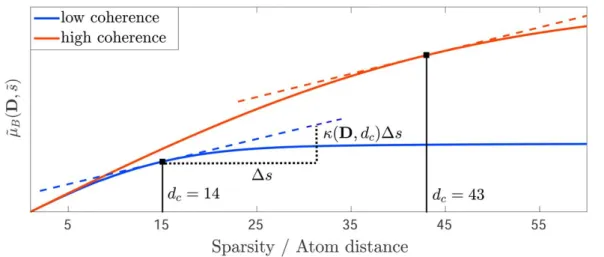
Figure 2.1. Relationship between the Babel function, µB(D, s), and the coherence
distance, dc(D) with βd = 0.5, for high and low coherence levels.
s+ 1 adjacent indices, i.e. Λs={q∈Ω|q0 ≤q ≤q0+s}withq0 ∈ {2, . . . , N −s−1},
and let ΛB = Λs in (2.10). Then, the inner maximum in (2.10) is attained by choosing
i∗ ∈Ω\Λsdirectly adjacent to the indices in Λ, such that|i∗−q0|= 1 or |q0+s−i∗|= 1.
Subsequently, it is assumed that i∗ = q0−1. Next, ˜µB(D,s˜),s˜∈ R+ is defined to be
a continuous extension of µB(D, s), Using a Taylor series, a first-order approximation
can be obtained by µB(D, s+ 1) = s+1 X j=1 |d>i∗di∗+j| ≈ µB(D, s) +κ(D, s)∆s , (2.12) where κ(D, s) = dµ˜B d˜s (A,s˜)|s˜=s . (2.13)
Since µB(D, s) is a concave function, the relation κ(D, s)∆s ≥ |d>i∗di∗+s+1| holds.
Then, by setting ∆s = 1, the relationship between dc(D, βd) and µB(D, s + 1) is
established by
dc(D, βd) = arg min d∈Ω
κ(D, d) ≤ βd|d>i∗di∗|, i∗+dc≤N . (2.14)
Thus,dc(D, βd) can be interpreted as the sparsity level, s, for which the Babel function,
˜
µB(D,˜s), grows at a rateκ(D, dc(D, βd))≤βd|d>i∗di∗|< κ(D, dc−1). The relationship
between the slope of ˜µB(A,s˜) and dc(D, βd) for βd = 0.5 is depicted in Figure 2.1 for
a dictionary with high and low coherence, respectively. In the scope of this thesis, it is assumed that βd = 0.5, such that dc corresponds to the index difference, where the
atom coherence is reduced by 3 dB with respect to the self-coherence,|d>i∗di∗|, for any
i∗ ∈ {1, . . . , N −s−2}. Therefore, the notation dc =dc(D, βd) is subsequently used
of ˜µB(A,˜s) in Figure 2.1 can merely be distinguished. Thus, it yields no information
of the burst size of coherent atoms. However, dc takes very different values when s is
21
Chapter 3
Applications and Signal Models
In this chapter, the relevant applications and corresponding basic signal models are introduced. The applications are representative for frequently encountered estimation problems. They are used to instanciate the abstract formulation of the considered problems in sparse estimation and to evaluate different sparse estimation techniques. In particular, direction finding, fiber-optic sensing and the concept of compressed sensing are introduced.
Chapter Outline
Section 3.1 describes the application of direction finding and the considered signal model. In Section 3.2, fiber-optic sensing is introduced, including the sensing principle and a basic signal model. Section 3.3 details the concept of compressed sampling, which can be combined with either application.
3.1
Direction Finding
Direction finding aims at localizing the source of a signal and has a wide range of applications, e.g. in radar, sonar and communications [64, 65]. Direction-of-arrival estimation is used to estimate the bearing of a source, while this information can be further utilized to determine its actual location [64].
3.1.1
Signal Model
Parts of the presented signal model appear in [66]1, [67]2, [68]3. and are based on the
theoretical foundations in [64, 65].
1C. Weiss A. M. Zoubir, “A Sparse Regularization Technique for Source Localization with
Non-uniform Sensor Gain,” in Proc. of the IEEE 8th Sensor Array and Multichannel Signal Processing Workshop (SAM), A Coru˜na, Spain, June, 2014.
2C. Weiss and A. M. Zoubir, “DOA Estimation in the Presence of Array Imperfections: A Sparse
Regularization Parameter Selection Problem,” inProc. of the IEEE Workshop on Statistical Signal Processing (SSP), Gold Coast, Australia, June/July, 2014.
3C. Weiss and A. M. Zoubir, “Robust High-Resolution DOA Estimation with Array
Pre-Calibration,” in Proc. of the 22nd European Signal Processing Conference (EUSIPCO), Lisbon, Portugal, September, 2014.
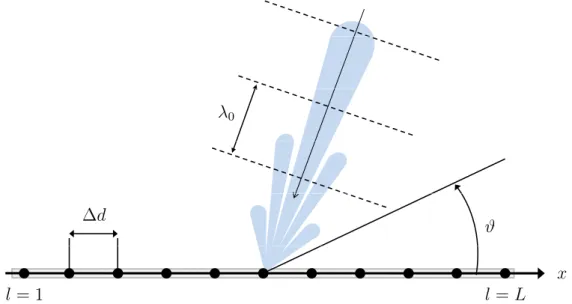
A uniform linear array of L sensors with sensor spacing ∆d is considered to es-timate the incident direction of monochromatic signals. In order to avoid spatial aliasing and to meet the spacial sampling requirements, the sensor spacing is set to half of the signal wavelength, i.e. ∆d = λ0/2, where f0 = cp/λ0 is the frequency of
the signal and cp is the speed of propagation. It is further assumed, that the array
is aligned with the x-axis of a Cartesian coordinate system, according to Figure 3.1. The total signal is modeled as a superposition of plane waves with zero-mean, circular-symmetric complex Gaussian distributed amplitudes of variance σ2
u, i.e.
uk ∼ CN(0, σu2), k = 1, . . . , K. At the l-th sensor, the signal arrives with a delay that
depends on the sensor position: τl = (l−1)∆dcos(ϑ)/cp, l = 1, . . . , L. The variable
ϑ ∈ [0, π] denotes the incident angle of the signal measured in terms of the azimuth angle of the array (c.f. Figure 3.1). The phase-shifts induced by the different delays at the individual sensors are expressed relative to the phase measured at the first sensor with index l = 1, i.e.
φl(ϑ) = ω0τl = 2πf0τl =
2π λ0
(l−1)∆dcos(ϑ), l= 1, . . . , L . (3.1) For a monochromatic source with a certain bearing, the array response is described in terms of the ‘array steering vectors’, a(ϑ) = [a1(ϑ), . . . , aL(ϑ)]>. They are also called
‘array manifold vector’ and depend on the incident direction of the signal, ϑ. Their entries are given by
al(ϑ) = exp −φl(ϑ) = exp −2π λ0 (l−1)∆dcos(ϑ) , l = 1, . . . , L . (3.2) A ‘snapshot’ of the measurements from all sensors can be written by
y=
K
X
k=1
uka(ϑk) +n, (3.3)
where n is a zero-mean, circular-symmetric complex Gaussian distributed Gaussian noise vector with i.i.d. entries nl ∼ CN(0, σn2),l = 1, . . . , L.
In order obtain a sparse representation of this signal, the model in [5] is adopted, where the dictionary represents a collection of closely spaced steering vectors, i.e.
D= [a( ˜ϑ1), . . . ,a( ˜ϑN)]. (3.4)
Assuming that the true DOAs coincide exactly with the angular grid specified in D, one may equivalently write (3.3) in terms of a sparse signal, x, i.e
3.2 Fiber-Optic Sensing 23
Herein, the non-zero elements, xik = uk, appear at the positions ik ∈ S = supp{x}, that correspond to the true DOAs,ϑk, k= 1, . . . , K, according to (3.2).
λ0 ∆d x l =L l = 1 ϑ
Figure 3.1. Direction finding for monochromatic plane-wave signals based on a uniform linear array.
3.2
Fiber-Optic Sensing
Fiber-optic sensors are versatile devices that can be used in a wide range of applications such as structural health monitoring [69, 70], chemical sensing [71], tomography [72] or medical applications [73]. As compared to electrical sensors, fiber-optic sensors ben-efit from different features of optical fibers, including low weight, broad bandwidth, low sensitivity to electro-magnetic interference and robustness to rough environmental conditions [74]. While various sensing technologies exist [75–81], Fiber Bragg grat-ing (FBG) sensors have been extensively studied for high-resolution quasi-distributed temperature or strain monitoring [82–85]. They are particularly useful in ‘smart struc-tures’ [75, 77–80] for an early detection of structural flaws, which can help to prevent accidents and to avoid high maintenance costs. Subsequently, FBG-based fiber optic sensing based onwavelength-division multiplexing (WDM) is considered. As compared to broadband light sources, wavelength-tunable lasers feature high localsignal-to-noise ratios (SNRs) [70, 86].
The sensing principle and the signal model below are partly taken from [87]4, [88]5, [30]6.
3.2.1
Sensing Principle
An FBG describes a local variation of the refractive index [89]. FBGs are trans-parent to wavelengths except for a narrow region around the ‘Bragg wavelength’,
λB = 2neffΛFBG [90], whereneff is the effective refractive index of the propagating mode
and ΛFBG is the grating period. If an FBG experiences a perturbation, typically strain
or temperature variation [74], the grating period is either compressed or stretched. A uniform perturbation along the spatial extent of an FBG causes a total shift, δλB, of
the Bragg wavelength [76, 91]. By measuring this shift, one is able to retrieve infor-mation about the perturbation acting at the FBG. An FBG-based fiber-optic sensor constitutes different FBGs that are imprinted along the fiber core to realize quasi-distributed sensing. In WDM-systems, their Bragg wavelengths are detuned, which enables an individual interrogation of the FBGs at different wavelengths, using either a broadband light source or a wavelength-tunable laser [86]. For an applied strain,s,
or temperature change, ∆T, the wavelength-shift can be quantified by [92–94]
δλB
λB
=Pes+ [Pe(αs−αf) +ηt]∆T, (3.6)
wherePe is the strain-optic coefficient, αs, αf are the thermal expansion coefficients of
the fiber bonding material and the fiber itself, respectively. The variableηtdenotes the
thermo-optic coefficient. Moreover, the two types of perturbation can be unambigu-ously distinguished in the case where the temperature and strain coupling coefficients of two adjacent gratings are known [94].
3.2.2
Signal Model
In the scope of this thesis, a wavelength-tunable laser operating in pulsed mode is con-sidered. Due to a limited bandwidth of the photo-detector and the receiver circuitry, individual short pulses are not resolved and only the pulse-envelope signal is available
4C. Weiss and A. M. Zoubir, “Fiber Sensing Using UFWT-Lasers and Sparse Acquisition,” inProc. of the 21st European Signal Processing Conference (EUSIPCO), Marrakech, Morocco, Sep, 2013.
5C. Weiss and A. M. Zoubir, “Fiber Sensing Using Wavelength-Swept Lasers: A Compressed
Sampling Approach,” inProc. of the 3rd International Workshop on Compressed Sensing Theory and its Applications to Radar, Sonar and Remote Sensing (CoSeRa), Pisa, Italy, June, 2015.
6C. Weiss and A. M. Zoubir, “A Compressed Sampling and Dictionary Learning Framework for
Wavelength-Division-Multiplexing-Based Distributed Fiber Sensing,” accepted for publication in Jour-nal of the Optical Society of America A, 2017 (assigned issue: vol. 34, no. 5).