Set-based Bi-level Optimisation for QoS-aware Service
Composition in Ubiquitous Environments
Nebil Ben Mabrouk, Nikolaos Georgantas, Valerie Issarny
To cite this version:
Nebil Ben Mabrouk, Nikolaos Georgantas, Valerie Issarny. Set-based Bi-level Optimisation for
QoS-aware Service Composition in Ubiquitous Environments. Proceedings of the 22nd IEEE
International Conference on Web Services (ICWS), Jun 2015, New York, United States. 2015,
<
10.1109/ICWS.2015.14
>
.
<
hal-01274038
>
HAL Id: hal-01274038
https://hal.inria.fr/hal-01274038
Submitted on 15 Feb 2016
HAL
is a multi-disciplinary open access
archive for the deposit and dissemination of
sci-entific research documents, whether they are
pub-lished or not.
The documents may come from
teaching and research institutions in France or
abroad, or from public or private research centers.
L’archive ouverte pluridisciplinaire
HAL, est
destin´
ee au d´
epˆ
ot et `
a la diffusion de documents
scientifiques de niveau recherche, publi´
es ou non,
´
emanant des ´
etablissements d’enseignement et de
recherche fran¸
cais ou ´
etrangers, des laboratoires
publics ou priv´
es.
Set-based Bi-level Optimisation for QoS-aware Service
Composition in Ubiquitous Environments
Nebil Ben Mabrouk, Nikolaos Georgantas, and Val´erie Issarny Inria Paris-Rocquencourt, Domaine de Voluceau, Le Chesnay, 78150, France.
E-mail: nebil.ben-mabrouk,nikolaos.georgantas,[email protected]
Abstract—Service composition is a widely used method in ubiquitous computing that enables accomplishing complex tasks required by users based on elementary (hardware and software) services available in ubiquitous environments. To ensure that users experience the best Quality of Service (QoS) with respect to their quality needs, service composition has to beQoS-aware. Establishing QoS-aware service compositions entails efficient service selection taking into account the QoS requirements of users. A challenging issue towards this purpose is to consider service selection under global QoS requirements (i.e., requirements imposed by the user on the whole task), which is of high computational cost. This challenge is even more relevant when we consider the dynamics, limited computational resources and timeliness constraints of ubiquitous environments.
To cope with the above challenge, in this paper we present QASSA, an efficient service selection algorithm that provides the appropriate ground for QoS-aware service composition in ubiquitous environments. The contribution of QASSA is three-fold. First, it formulates service selection under global QoS requirements as a set-based optimisation problem, benefiting from recent proposals in the domain of multi-objective optimisation. Second, QASSA resolves this problem in an efficient way using clustering techniques, namely the K-Means algorithm. Third, QASSA is devised in two versions, viz., centralised and distributed versions, so that it can be executed on top of centralised and decentralised infrastructures in ubiquitous envi-ronments. Results of experimental studies are presented to illustrate the timeliness and optimality of QASSA.
I. Introduction
Ubiquitous (computing) environments enable integrating and
composing, on the fly, services that are offered by (hardware and
software) resources available in the environment in order to fulfil complex tasks required by users. Nevertheless, fulfilling the user’s tasks from the functional point of view only is not enough to gain user satisfaction. Users further require a certain Quality of Service (QoS) when exerting their tasks. For this reason, a lot of
research efforts in ubiquitous computing have been devoted to the
composition of services under the user’s QoS requirements, which is known as QoS-aware service composition. QoS-aware service composition is a broad topic. At the core of this topic is the issue of QoS-aware service selection, which allows determining services available in ubiquitous environments and able to meet the user’s QoS requirements. The problem arises when dealing with complex user tasks formed of multiple (abstract) activities, and each activity can be achieved using several services that are
functionally equivalent, but providing different QoS levels. The
question to be asked is then: “what are the services that should
be selected for each activity in the user’s task in order to meet the user’s QoS requirements and produce the highest QoS?”
Addressing the above question is even more complicated when considering the challenges entailed by the characteristics of ubiquitous computing. These challenges are mainly about: (i) timeliness (i.e., achieving service composition in a timely manner with respect to on-the-fly interaction with users in ubiquitous
environments), (ii) considering QoS variations at run-time, notably during the time elapsing between services’ selection and services enactment, (iii) adaptation support, and (iv) supporting both cen-tralised and distributed infrastructures in ubiquitous environments.
To cope with the above challenges, we introduce an efficient
service selection algorithm called QASSA (Qos-Aware Service Selection Algorithm). Compared to existing solutions, QASSA presents the following contributions:
1) It models QoS-aware service selection under global QoS requirements in a novel way benefiting from recent math-ematical proposals that define multi-objective optimisation as a set-based selection problem [1];
2) Thanks to its underlying model, QASSA resolves
QoS-aware service selection efficiently using clustering
tech-niques, thus executing in a timely manner (on top of both resource-enabled and resource-limited devices) while achieving a nice optimality (further details are given in Section IV);
3) Based on clustering techniques, QASSA can distinguish
several classes of services that represent different tradeoffs
between QoS properties, hence enabling fine-grained
man-agement of these tradeoffs with respect to user preferences;
4) QASSA selects several alternative service compositions (in-stead of only one). That is, it selects several interchangeable services for each activity in the user task, thus enabling service substitution (and accordingly adaptation support) at run-time;
5) QASSA is devised in both centralised and distributed fash-ions, which makes it suitable for both infrastructure-enabled and infrastructure-less ubiquitous environments.
Next, we start by presenting the design rationale of QASSA, its underlying problem definition, as well as its both phases, viz., local and global selection phases (Section II). After that, we introduce a distributed version of QASSA that is able to execute in infrastructure-less ubiquitous environments (Section III). Finally, we give the results of experimental studies illustrating
the efficiency of QASSA in terms of timeliness and optimality
(Section IV), and we conclude in Section VI.
II. TheQASSA Algorithm
A. Notations and Basic Assumptions
QASSA is initialised by taking as input a user request R,
which is defined as a quadruple R = (T,U,P,W), where T
refers to the required task andUrefers to global QoS constraints
U =hu1, ..,uni imposed by the user on a set of QoS properties
P =hp1, ..,pni. For each constraint, the user has to specify the
relative importance of its associated QoS property by giving a
set of weights W =hw1, ..,wni, where wi is the weight of QoS
propertypi. It is worth noting that the sum of all the weights must
be equal to 1, i.e.,Pn
For a user taskT, its structure is specified as a set of activities
T = hA1, ..Azi coordinated by composition patterns. To each
activityAi inT is associated a set of concrete service candidates
S={si,1,si,2, ..,si,mi} that are able to realise Ai. Each service si,k
(1≤k≤mi) is represented by its QoS vectorQoSsi,k =hq1, ..,qni,
whereqj is the advertised value of QoS property pj(1≤j≤n).
In this paper, we do not deal with the way QoS is specified, rather we recall the QoS model presented in our previous work [2] to define QoS properties and preferences, as well as QoS aggregation formulae. Additionally, we consider stateless services that can be bound to one or more abstract activities in the composition. The QoS values advertised by these service are supposed to be specified by the service providers based on the previous executions of the services.
B. Design Rationale
QoS-aware service selection algorithms fall under two broad classes with respect to their selection techniques. On the one hand,
local selection (i.e., greedy selection) proceeds by selecting the best service in terms of QoS for each activity in the user task separately. This technique has a low computational cost but it can not guarantee meeting global QoS requirements. On the other
hand,global selectioncovers the scope of the whole composition
and ensures meeting global QoS requirements. However, it is of high computational complexity.
QASSA combines local and global selection techniques in order to handle the complexity of service selection under global QoS requirements. Specifically, QASSA follows the bi-level optimisa-tion model [3], which is a hierarchy of two optimisaoptimisa-tion problems (upper-level or leader, and lower-level or follower problems). Each problem is optimised separately without considering the objective of the other one. However the decision made at the upper-level
problem affects the objective space of the lower-level as well as
the decision space.
In accordance with the bi-level optimisation model, QASSA
proceeds through two main steps: (1)local selection(representing
the upper-level optimisation problem), which aims at selecting services with the highest QoS for each activity in the user task,
and (2)global selection(representing the lower-level optimisation
problem), which aims at selecting near-optimal compositions of services resulting from the local selection. QASSA further selects several alternative near-optimal compositions. Indeed, selecting only one service composition brings about several shortcomings
such as the lack of choices for the user, the overload ofhot services
(i.e., services with high QoS) [4], and the lack of adaptation support [5] (i.e., deferred final selection and dynamic binding at run-time).
C. Local Selection Phase
We express the local selection as a multi-objective optimisation problem, since it involves numerous optimisation objectives, such as the cost and the delay of services. Additionally, we focus on resolving this problem while producing several solutions (and not a single solution) to enable the global selection phase and allow adaptation at run-time.
1) Problem definition: A recent proposal by Zitzler et al. [1] defines multi-objective optimisation as a set problem having as
goal to identify the Pareto optimal set (i.e., the best solution
set) among several solution sets, each set reflecting a specific
tradeoff between the optimisation objectives [6]. Determining
the Pareto optimal set is typically exponential in the size of
the problem instance [7]. Therefore, resolving set-based multi-objective optimisation is often reduced to identifying a good
Pareto set approximation.
In accordance with Zitzler’s proposal, we define the local se-lection problem as a set-based multi-objective optimisation.
Con-sider the optimisation of the QoS vectorP=hp1, ...,pni:S→n
where all QoS properties pi are, without loss of generality, to
be maximised. Here,S denotes the feasible set of solutions, i.e.,
the set of service candidates of a given activity in the user task.
A single service s ∈S will be denoted as a decision vector or
solution (s=hq1, ...,qni) whereqi=pi(s).
We define the search space S by the set of feasible sets
of services (and not single services). In the context of QoS
optimisation, an element (i.e., a service-set) inS is called QoS
Class, and denoted QC ∈ S. A QoS class represents a set of
services having roughly the same QoS and reflecting the same
tradeoffbetween QoS properties.
To enable the comparison of QoS classes, a set preference
relationmust be defined overS. A set preference relation provides the information on the basis of which the selection is carried out; it says whether a QoS class is better (in terms of QoS) than another one, or not. The set preference relation can be defined in terms of a quality indicator (such as the hypervolume indicator [7]). The quality indicator is a function that assigns, to each solution-set, a scalar value reflecting its quality according to a particular goal, i.e., a fitness function defined over sets. In this paper, we
need to define a quality indicator Iq that is specific to our QoS
optimisation problem (see Equation 2). Our objective is then to
find a solution-set that maximises the value ofIqas defined below
(the operatorargmax returns the QoS class for which Iq attains
its maximum value):
argmaxIq(QC)
where QC∈S (1)
Solving this problem consists in determiningSand its
underly-ing QoS ClassesQC∈S, as well as defining the quality indicator
Iq. Towards this purpose, we propose investigating clustering
techniques, notably the K-means algorithm. Clustering techniques allow for grouping a set of data into several clusters with respect to given criteria. If we apply the same principle to our purpose (i.e., QoS-aware service selection), we can group service candidates associated with an activity into several clusters according to their QoS values. Each cluster includes services having roughly the same QoS. We can further define a quality indicator on these clusters of services based on their respective QoS properties. Next, we show how to solve the local selection problem (defined as a set-based multi-objective optimisation) using K-means, further in-troducing the formal definition of QoS Class and quality indicator.
2) Local selection in QASSA: To select a set of services providing high values for all QoS properties, we perform
one-dimensional clustering appliedntimes (once per QoS property).
That is, we cluster service candidates (i.e., associated with each activity in the composition) for each QoS property separately.
Thus, for each QoS property pj we obtain several clusters
C =hc1,j, ..,cg,ji, going from the clusterc1,j of services having
the lowest values of pj to the cluster cg,j of services with the
highest values for the same property (respecting the definitions of positive and negative QoS properties). After that, by considering the intersection of the clusters with the highest values associated with each QoS property, we obtain the service-set providing high values for all QoS properties jointly. To formally explain
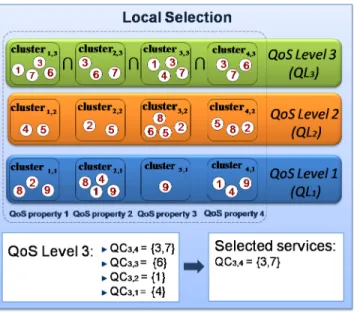
Fig. 1. Local selection in QASSA
the local selection in QASSA, we introduce the concept of QoS
LevelandQoS Class.
The concept of QoS Level is used to group together service clusters having roughly the same quality level for all QoS properties. The number of QoS levels corresponds to the number
of clusters for each QoS property denoted g. For instance, in
Figure 1 we cluster candidate services into 3 clusters, thus obtaining 3 QoS levels (1, 2 and 3) corresponding to the clusters of services having respectively ‘low’, ‘medium’ and ‘high’ QoS values for all QoS properties. As we have 4 QoS properties, each QoS level comprehends 4 clusters. Below, we formally define the QoS level concept.
Definition 1: Given a set of QoS propertiesP=hp1, ..,pniand
a set of services S = {si,1,si,2, ..,si,mi} associated to activity Ai
and grouped intogclustershc1,j, ..,cg,jifor each QoS property pj
(wherec1,j is the cluster of services with the lowest values of pj
and cg,j is the cluster of services with the highest values of pj),
we define a QoS level QLl = {cl,1, ..,cl,n} as the set of clusters
associated with each QoS property pj and having the same level
l(1≤l≤g).
As stated above, a QoS levelQLlis used to group clusters with
the same levelltogether, thus we can perform their intersection
and determine services with QoS values in this level. In particular,
we are interested in the best QoS levelQLg={cg,1, ..,cg,n}which
groups clusters with the highest QoS values. The intersection of these clusters yields services with the highest QoS values for all QoS properties. However, if the intersection produces an empty set, we investigate other combinations (i.e., intersections) of
clusters within QLg. To do so, we introduce the concept of QoS
Class, which represents different intersections of clusters within
a given QoS level. The QoS class concept is formally defined as follows.
Definition 2: Given a QoS levelQLl ={cl,1, ..,cl,n}, we define
a QoS class QCl,e (1 ≤e ≤n) as the intersection ofe clusters
amongQLl. Consequently, a QoS levelQLl comprehends several
QoS classes (e.g.,{QCl,1,..,QCl,n}).
Literally, a QoS classQCl,erepresents the set of services having
exactlyeQoS properties out ofnat the QoS level l. According
to this, the QoS class QCg,n groups the best set of services in
terms of QoS, since they have all their n QoS properties in
the highest QoS level QLg. IfQCg,n is an empty set (i.e., there
are no services with high values for all QoS properties), we
try to find the next best QoS class in terms of QoS (e.g.,QCg,n−1).
Nevertheless, we may obtain several QoS classes having the same level and the same number of QoS properties (e.g., selecting
n−1 QoS properties out ofn). To determine the best QoS class, we
use the quality indicatorIq (already introduced in Section II-C1).
Iqis defined based on the levelland the number of QoS properties
eof the considered QoS class, as well as the weightswjassociated
with these QoS properties. That is, the quality indicatorIq of the
QoS class QCl,e is higher (i.e., it includes services with better
QoS) when: (i) it is associated with a QoS levelQLl of a higher
levell, (ii) it comprehends a higher number of QoS propertiese
in that level, and (iii) the weightswj associated with these QoS
properties are more important for the user.Iq is formally defined
as follows: Iq(QCl,e)=l×e× e X j=1 wj wj∈ {W:cl,j∈QCl,e} (2)
Finally, it is worth noting that QASSA implements the local
selection using a variant of K-means called K-means++[8], which
takes as input only the number of clusters (in opposition to K-means which takes as input the number of centroids and their initial coordinates). The number of clusters is determined before-hand by learning from the previous executions of the considered activity using existing techniques in the literature (viz., the
Davies-Bouldin index [9]) that determine whether a given integergis the
most appropriate number of clusters for classifying a fixed data set. The Davies-Bouldin index mainly uses the distance separating
the clusters as a metric for evaluatingg. The overall execution of
the local selection phase of QASSA is described in Algorithm 1.
D. Global Selection Phase
The global selection phase aims at composing locally selected services and determining near-optimal service compositions, i.e., service compositions that: (i) satisfy the global QoS requirements,
and (ii) maximise the QoS offered to the user. In our approach,
we focus on selecting several alternative service compositions (and not a single composition). Specifically, we aim at selecting many services for each activity in the user task, such that, no matter what is the service finally executed for each activity, the resulting composition satisfies the global QoS requirements imposed by the user on the task.
When dealing with global optimisation problems with multiple objectives and a large number of potential solutions, heuristic algorithms are the only possible choice [10]. We focus on us-ing population-based heuristics (e.g., genetic algorithms (GA),
differential evolution (DE) algorithms [11]) to solve QoS-aware
service selection under global QoS requirements. This class of algorithms consists in recursively optimising an initial solution
using operators such as crossover/mutation. Starting from the fact
that our local selection approach is highly selective in the sense that it selects few services having a high QoS level (which reduces considerably the number of services to be investigated), we argue
input : A set of activitiesT={A1, ..,Az}of sizez;
A set of servicesSi={si,1, ..,si,mi}of sizemifor each activityAi
(i∈ {1, ..,z});
A set of QoS propertiesP={p1, ..,pn}of sizen;
A set of weights on QoS propertiesW={w1, ..,wn}of sizen;
A QoS vectorQoSsi,k=hq1, ..,qnifor each servicesi,k(k∈ {1, ..,mi}).
output: A QoS class for each activityAi
begin
foreachAi∈Tdo
//Services’ clustering foreachpj∈Pdo
(Step 1) Apply K-means++to group the services Siinto g
clusters w.r.t. their values for pj
K-means++(Si,g)⇒ {c1,j, ..,cg,j};
end
//Services’ selection forl=gdownto1do
fore=ndownto1do
(Step 2) Build QLlas the set of n clusters of level l for all
the QoS properties QLl={cl,1,cl,2, ..,cl,n};
(Step 3) Select a combination Ce
|QLl|of e clusters among
those of QLl foreachCe
|QLl|do
(Step 4) Build QoS class e of the level l as the intersection of the clusters belonging to Ce
|QLl|
QCl,e={si,k: si,k∈TCe|QLl|};
(Step 5) Initialise the QoS class to be selected and its quality indicator
Result=∅;
Result Iq=0;
(Step 6) Select the QoS class with the highest quality indicator ifQCl,e,∅then Iq=r×e×Pyj=1wj; ifIq>Result Iqthen Result Iq=Iq; Result=QCl,e; end end end end end return Result; end end
Algorithm 1:The local selection algorithm
that a population-based heuristic can quickly produce near-optimal service compositions.
In accordance with the above, we adopt a population-based approach to solve the global selection phase of QASSA, viz., the Controlled Random Search (CRS) algorithm, which is a population-based global optimisation heuristic like GA and DE. The choice of CRS is motivated by the fact that it is a simple algorithm capable of global optimisation, subject to inequality constraints [12]. CRS initially builds a preliminary service com-position by selecting a service (among those resulting from the local selection phase) for each abstract activity in the user task. The global QoS of the composition is then computed with respect to the structure of the composition and QoS aggregation formulae (as detailed in our previous work [2]. If the global QoS meets the user requirements, the composition is then considered as a solution. The global QoS of the composition is then gradually enhanced by replacing the current worst service in it with a better service.
E. Computational Complexity Analysis
We analyse the computational complexity of the local and global selection phases of QASSA. Concerning the local selection phase, we do not consider the complexity of computing the Davies-Bouldin index (which is used to decide about the number of clusters, see Section II-C2), since the computation is performed
off-line, i.e., after executing QASSA.
As already explained, the local selection phase is performed
using the K-means++ algorithm, the complexity of which is of
O(log(K)) [8] where K denotes the number of clusters. As we
cluster services (i.e., execute K-means++) for each QoS property
and for all the activities in the user task, the overall complexity of
local selection is then ofO(Z.N.log(K)), whereZ and N denote
the number of activities in the user task and the number of QoS properties, respectively. Therefore, the local selection phase runs in a linearithmic time.
Concerning the global selection phase, its computational com-plexity can be determined based on the fact that we proceed similarly to the CRS algorithm [12]. That is, when iteratively checking service compositions, we replace a single service per composition in each iteration. In accordance with this, we first
composeZ services (one service per activity) to build the initial
service composition, then we iterate on checking the remaining
T −Z services (one service per iteration), where T denotes the
total number of services associated with all the activities in the user task. Therefore, the total number of compositions to check
(i.e., more specifically the number of iterations) is T −Z +1.
Additionally, for each composition, we executeZ.Narithmetic
in-structions to aggregate theNQoS values of theZservices forming
the composition. Then, we executeN comparison instructions to
determine whether the N QoS values of the composition satisfy
the global QoS requirements of the user. The global selection
phase runs then in quadratic time ofO((Z.N+N)(T−Z+1)).
Based on the above results, we state that QASSA executes in quadratic time, thus it reduces considerably the computational complexity of service selection under global QoS requirements, known to be NP-hard [13].
III. DistributingQASSA
The version of QASSA presented in Section II assumes the presence of a centralised and stationary infrastructure supporting QoS-aware service composition. Nevertheless, this infrastructure presents several drawbacks, mainly dealing with scalability, fault-tolerance, and privacy [14]. Additionally, within ubiquitous envi-ronments, it is not always possible to assume the support of such an infrastructure. QoS-aware service composition in ubiquitous environments (i.e., more specifically selection algorithms) should
rather rely on ad hoc topologies with no infrastructure support.
For this reason, we present a distributed version of QASSA, which
is capable of operating on top of ad hoc infrastructures formed
of mobile and resource-constrained devices.
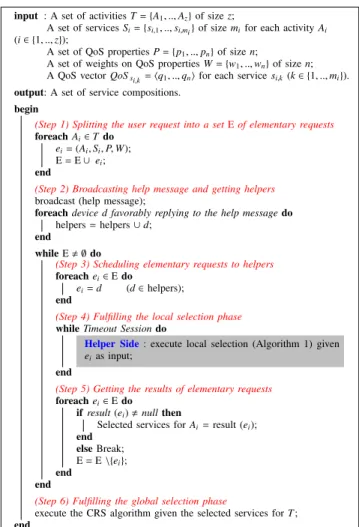
Distributed QASSA enables accomplishing service selection as a synergistic interaction between the user device (referred to as requester) and other devices available in the environment (referred to as helpers). As described in Algorithm 2, the main idea of our distributed QASSA is to perform local selection for each activity in the user task using a helper, thus enabling to execute the whole local selection phase using several helpers simultaneously. After that, the requester collects the local selection results and performs the global selection phase on the user device.
The global service selection is difficult to carry out in a distributed way because it requires a global vision of QoS infor-mation and the structure of the composition [15]. Additionally, it typically requires a resource-rich device, given the computational complexity of the problem. As detailed in Section II-E, our global service selection algorithm has a low computational complexity; thus it can be carried out using only the resource-constrained device of the requester. The timeliness of our distributed algorithm is further validated by experimental results detailed in the next section.
input : A set of activitiesT={A1, ..,Az}of sizez;
A set of servicesSi={si,1, ..,si,mi}of sizemifor each activityAi
(i∈ {1, ..,z});
A set of QoS propertiesP={p1, ..,pn}of sizen;
A set of weights on QoS propertiesW={w1, ..,wn}of sizen;
A QoS vectorQoSsi,k=hq1, ..,qnifor each servicesi,k(k∈ {1, ..,mi}).
output: A set of service compositions.
begin
(Step 1) Splitting the user request into a setEof elementary requests foreachAi∈Tdo
ei=(Ai,Si,P,W);
E=E∪ei;
end
(Step 2) Broadcasting help message and getting helpers
broadcast (help message);
foreachdevice d favorably replying to the help messagedo
helpers=helpers∪d;
end whileE,∅do
(Step 3) Scheduling elementary requests to helpers foreachei∈Edo
ei=d (d∈helpers);
end
(Step 4) Fulfilling the local selection phase whileTimeout Sessiondo
Helper Side: execute local selection (Algorithm 1) given
eias input;
end
(Step 5) Getting the results of elementary requests foreachei∈Edo
ifresult(ei),nullthen
Selected services forAi=result (ei);
end
elseBreak;
E=E\{ei};
end end
(Step 6) Fulfilling the global selection phase
execute the CRS algorithm given the selected services forT;
end
Algorithm 2: Overview of distributed QASSA from the
requester point of view. The coloured box concerns the
execution at thehelper side.
IV. ExperimentalEvaluation
We conducted a set of experiments to assess the centralised and distributed versions of QASSA. Table I describes the experimental set up used in our experiments. It worth noting that we use basic setup (with limited computational and memory resources) that can be readily assumed in the context of ubiquitous environments. For the evaluation of QASSA, we are interested in two metrics:
• Execution time: It measures the timeliness of QASSA with
respect to the size of the selection problem in terms of the number of activities and the number of candidate services per activity.
Centralized algorithm Distributed algorithm
- Machine: Dell - Machine: HTC Desire
- Processor: AMD Athlon 1.80GHz - Processor: Qualcomm QSBD8250 1GHz
- RAM: 1.8 GB - RAM: 576 Mo
- OS: Windows XP - OS: Android 2.2 (Froyo)
- Programming language: J2SE 1.6 - Programming language: Android
SDK 2.2 (based on J2SE 1.5)
TABLE I Experimental set up
• Optimality: It measures how optimal is the QoS utility
provided by QASSA. This is determined by the ratio of the QoS utility resulting from QASSA over the optimal QoS utility given by a brute-force algorithm. The optimality metric is then given by the following formula:
Optimality=F/Fopt (3)
whereFis the QoS utility given by our heuristic algorithm,
andFopt is the optimal QoS utility given by the IBM ILOG
CPLEX Optimiser1.
For the purpose of our experiments, we developed a
Composi-tion Generator, which randomly generates service compositions used for experimenting with QASSA. The Composition Generator
takes as parameters the number of activities a and the number
of candidate services per activity k, and it proceeds through
two steps: (i) yielding an abstract service composition which
comprehends a activities structured with respect to randomly
chosen composition patterns, (ii) binding k concrete services to
each activity in the composition. QoS values associated with these
services are acquired from the QWS dataset available online2. This
dataset consists of 5000 real Web services, each with a set of 9 QoS properties measured using commercial benchmark tools [16]. Further details about the implementation of QASSA are given in [17].
A. Performance of QASSA (the centralised version)
In this section, we present the experimental evaluation of the centralised version of QASSA (using the experimental setup detailed in the left column of Table I). For the sake of precision, we execute each experiment 20 times and we calculate the mean value of the obtained results.
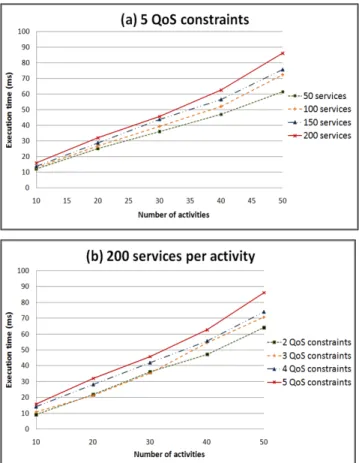
Figure 2 (a) depicts the execution time of QASSA with respect to the number of services per activity. We fix the number of QoS constraints to 5, vary the number of activities between 10 and 50, and vary the number of services per activity between 50 and 200. The obtained results show that the execution time of our algorithm increases (up to 89ms) along with the number of services, which is an expected result.
Figure 2 (b) depicts the execution time of QASSA with respect to the number of QoS constraints. We fix the number of services per activity to 200 and vary QoS constraints between 2 and 5. The obtained results show that the execution time of our algorithm increases (up to 89ms) along with the number of QoS constraints, which is also an expected result, i.e., a higher number of QoS
constraints requires more computational effort, hence a longer
execution time.
Both figures show that the execution time of our algorithm increases almost linearly along with the number of activities
1http://www-01.ibm.com/software/integration/optimization/
cplex-optimizer/about/?S CMP=rnav
Fig. 2. Execution time while varying (a) the number of services per activity, and (b) the number of QoS constraints
in the composition. In general, our algorithm executes in a timely manner (i.e., less than 0.09s) with respect to spontaneous interaction with users aimed at by ubiquitous computing. Indeed, guidelines for response time in interactive applications specify that 1s is the limit to keep the user’s flow of thought seamless [18].
To have a more accurate idea about the efficiency of QASSA
in terms of timeliness, we compare the above obtained results to those published in [13], which is a recent work that also combines local and global selection techniques for service selection under global QoS constraints. The authors study the same dataset (i.e., QWS), as well as the same parameters as in our experiments. Although that the considered work uses an experimental setup (a HP ProLiant DL380 G3 machine with 2 Intel Xeon 2.80GHz processors and 6 GB RAM) that is more powerful than the setup used for evaluating QASSA, both works have roughly the same
execution time (between≈10 ms and≈90 ms).
Concerning the optimality of QASSA, we measure it while varying the number of activities between 5 and 10. Figure 3 (a) depicts the optimality of QASSA while fixing the number of QoS constraints to 5, varying the number of activities between 5 and 10 and varying the number of services per activity between 50 and 200. It shows that the optimality of QASSA is generally more than 90%, and it can reach 100%. However, for the specific case of 5 activities and 50 services per activity, the optimality decreases to 60%, which can be explained by the fact that when the number of services decreases, the probability to find services with a satisfactory value for all QoS properties decreases also, hence yielding a low optimality.
Additionally, we measure the optimality of QASSA while fixing the number of services to 200, varying the number of activities between 5 and 10 and varying the number of QoS constraints between 2 and 5. Figure 3 (b) shows that the optimality of our algorithm is generally satisfactory (more than 90%) and it can reach 100%. Overall, both figures show that the optimality of our algorithm varies between 90% and 100% independently from the number of services and the number of QoS constraints, except for low service populations.
Comparing the optimality of QASSA to the optimality of [13],
for the same configuration (as both works use different ranges of
values), e.g., a user task of 10 activities each having 200 candidate services to be selected under 5 global QoS constraints, both works
produce nearly the same optimality (≈100%).
Fig. 3. Optimality measurements while (a) varying the number of services, and (b) the number of QoS constraints
B. Performance of QASSA (the distributed version)
We now evaluate the distributed version of QASSA using the experimental setup detailed in the right column of Table I. The distributed design of QASSA changes two main factors compared with the centralised version, notably: (i) the communication cost between the devices participating in fulfilling the user task, and (ii) the hardware setup underpinning the execution of the algorithm. Both features do not impact the optimality of QASSA, thus the following experiments focus only on the execution time metric. Additionally, we assume that the communication cost is negligible compared to the overall execution time of the algorithm (further details about the network delay can be found in, e.g., [19]). Thus, the execution time presented in these experiments concerns only
Fig. 4. Execution time of the (a) local selection and (b) global selection of our distributed QoS-aware service selection algorithm
the local and global selection phases of the distributed version of QASSA (see Figure 4). For the local selection, the execution time is measured for only one activity (indeed, each helper device processes in parallel local selection for a single activity in the user task). We fix the number of QoS constraints to 5 and vary the number of services between 50 and 200. Whereas for the global selection, we fix the number of QoS constraints to 5, the number of services to 200, and we vary the number of activities in the user task between 10 and 50.
Despite the relatively limited hardware resources used in these experiments, QASSA shows satisfactory timeliness with respect to on-the-fly service composition in ubiquitous environments. Indeed, the local selection is executed in at most 25 ms, whereas the global selection is executed in at most 1.2 s, thus the overall algorithm can be accomplished in less than 1.5s, depending on the size of the user task and the number of services per activity [18].
V. RelatedWork
Surveying QoS-aware service selection algorithms represents a broad topic. In this section, we focus on algorithms in line with the recent trend of combining local and global selection
techniques. A first research effort in this direction is proposed by
Alrifai et al. [20]. The authors present a selection algorithm that starts from the global level and resolves the selection problem at the local level. Indeed, they proceed by decomposing global QoS constraints (i.e., imposed by the user on the whole composition) into a set of local constraints (i.e., for individual sub-tasks, parts of the whole composition). To do so, they use MILP techniques to find the best decomposition of global QoS constraints. The main drawback of this approach is that it relies on a greedy method for the decomposition of QoS constraints, which produces strict local
QoS constraints that discard a lot of service candidates. In a more recent work [13], the authors attempt to enhance their approach by relaxing the local QoS constraints as much as possible while not violating the global constraints. While their recent approach may improve the obtained results, conceptually it does not resolve the problem of discriminating potential service candidates.
To cope with this issue, the same authors present another ap-proach [21] combining local and global selection techniques, but in another way. The authors start by the local selection phase. They use two techniques to reduce the number of services investigated
for each activity in the user task. First, they use theskylineconcept
[22] as a technique to determine the most interesting services in terms of QoS. Once skyline services are determined, the authors cluster them into several clusters using K-means, and then they select a representative service for each cluster. At the global level, the authors compose the representative services selected at the local level, and check whether the composition meets global QoS requirements using MILP. This approach also presents several drawbacks. Concerning the algorithm itself, the authors claim finding the optimal service composition, because they assume that skyline services are the best services in terms of QoS, which is not true. Indeed, a skyline service is a service that has the highest (i.e., the best) value for one or more QoS properties, whereas for the remaining QoS properties it may have very low values. Regarding this definition, it is possible that a non-skyline service with high values (and not the highest) for all QoS properties yields a higher overall QoS than a skyline service. Concerning the performance of the algorithm, during the local selection phase the
authors execute K-means Z.(T/2) times (whereZ is the number
of activities in the user task, and T is the number of service
candidates investigated for a given activity), which represents a high number of iterations, especially when it deals with a large number of service candidates. In our approach, we execute
K-means++(which already outperforms K-means)Z.Ntimes where
N is the number of QoS properties. The complexity of our local
selection phase is then reduced compared to [21], since the number of QoS properties is always limited compared to the number of service candidates. Additionally, at the global selection phase, the authors execute MILP iteratively until a near-optimal composition is found. In each iteration, the set of representative services with the highest QoS utilities is investigated. This approach may end up
executing MILPαtimes, whereαis the number of representative
services, which means also a high number of iterations when it deals with a large number of representative services.
Another approach combining local and global selection tech-niques is presented by [15]. Similar to [20], the authors decompose global QoS constraints into local constraints using MILP. Based on the local QoS constraints, they select services for each activity in the user task. Then, they compose the locally selected services and check whether the composition meets global QoS constraints, using MILP again. The main advantage of this approach is that it executes local selection in a distributed way similarly to our approach. However, they decompose the global QoS constraint imposed on a given QoS property into the average values of that property associated with the services of each activity, which is not accurate and may discriminate a number of service candidates. A similar approach is presented by Jin et al. [23]. The authors decompose global QoS constraints into local constraints using MILP, then they perform local selection. The main shortcoming of this approach is that it does not guarantee meeting global QoS requirements.
An interesting approach is presented by Liu et al. [24]. The authors propose a QoS-aware service selection algorithm which also combines local and global selection techniques. They use theconvex hullconcept [25] as a local selection technique. At the global level, the authors randomly establish an initial composition, and they try to enhance it using services selected by the convex hull. The main drawback of this approach is that it closely depends on the initial composition.
VI. Conclusion
This paper introduces QASSA, a QoS-aware service selection algorithm. Conceptually, QASSA defines service selection under global QoS requirements as a set-based bi-level optimisation problem, which represents a mathematical model for the problem. Additionally, QASSA handles the complexity of the problem by combining local and global selection techniques, and solves the local selection problem using service clustering in a novel way (i.e., intersection of one-dimensional service clusters). Moreover, QASSA considers jointly: (i) centralised and distributed design fashions, and (ii) support for adaptation at run-time by selecting several alternative service compositions instead of only one. In practise, QASSA shows satisfactory timeliness and optimality,
hence representing an efficient mean for building complex user
tasks in ubiquitous environments.
References
[1] E. Zitzler, L. Thiele, and J. Bader, “On Set-based Multiobjective Optimization,” IEEE Transactions on Evolutionary Computation, vol. 14, no. 1, pp. 58–79, 2010.
[2] N. Ben Mabrouk, S. Beauche, E. Kuznetsova, N. Georgantas, and V. Issarny, “QoS-aware Service Composition in Dynamic Service Oriented Environments,” in Middleware’09: Proceedings of the 10th ACM/IFIP/USENIX International Conference on Middleware. Springer Verlag New York, Inc., 2009, pp. 1–20.
[3] J. Bard,Practical Bilevel Optimization: Algorithms and Applications. USA: Springer, 1998, vol. 30.
[4] W. Jiang, S. Hu, and Z. Liu, “Top K Query for QoS-Aware Automatic Service Composition,” IEEE Transactions on Services Computing, vol. 99, no. PrePrints, p. 1, 2013.
[5] H. Al-Helal and R. Gamble, “Introducing Replaceability into Web Service Composition,” IEEE Transactions on Services Computing, vol. 99, no. PrePrints, p. 1, 2013.
[6] H. Ma, F. Bastani, I.-L. Yen, and H. Mei, “QoS-Driven Service Composition with Reconfigurable Services,”IEEE Transactions on Services Computing, vol. 6, no. 1, pp. 20–34, 2013.
[7] S. Verel, A. Liefooghe, and C. Dhaenens, “Set-based Multiobjective Fitness Landscapes: A Preliminary Study,” inGECCO’11: Proceed-ings of the 13th Annual Conference on Genetic and Evolutionary Computation. New York, NY, USA: ACM, 2011, pp. 769–776. [8] D. Arthur and S. Vassilvitskii, “K-means++: The Advantages of
Careful Seeding,” inSODA’07: Proceedings of the Eighteenth An-nual ACM-SIAM Symposium on Discrete Algorithms. Philadelphia, PA, USA: Society for Industrial and Applied Mathematics, 2007, pp. 1027–1035.
[9] D. L. Davies and D. W. Bouldin, “A Cluster Separation Measure,”
IEEE Transactions on Pattern Analysis and Machine Intelligence, vol. 1, pp. 224–227, 1979.
[10] A. Grosso, M. Locatelli, and F. Schoen, “A Population-based Ap-proach for Hard Global Optimization Problems based on Dissim-ilarity Measures.” Math. Program., vol. 110, no. 2, pp. 373–404, 2007.
[11] M. M. Ali and A. T¨orn, “Population Set-based Global Optimization Algorithms: Some Modifications and Numerical Studies,”Computers and Operations Research, vol. 31, no. 10, pp. 1703–1725, 2004. [12] W. Price, “Global optimization by controlled random search,”
Jour-nal of Optimization Theory and Applications, vol. 40, no. 3, pp. 333–348, 1983.
[13] M. Alrifai, T. Risse, and W. Nejdl, “A Hybrid Approach for Efficient Web Service Composition with End-to-end QoS Constraints,”ACM Transactions on the Web, vol. 6, no. 2, pp. 7:1–7:31, Jun. 2012. [14] H. Fernandez, C. Tedeschi, and T. Priol, “A Chemistry-Inspired
Workflow Management System for a Decentralized Workflow Ex-ecution,”IEEE Transactions on Services Computing, vol. 99, no. PrePrints, p. 1, 2013.
[15] J. Li, Y. Zhao, M. Liu, H. Sun, and D. Ma, “An Adaptive Heuristic Approach for Distributed QoS-based Service Composition,” IEEE Symposium on Computers and Communications, vol. 0, pp. 687– 694, 2010.
[16] E. Al-Masri and Q. H. Mahmoud, “Discovering the Best Web Ser-vice,” inWWW’07: Proceedings of the 16th International Conference on World Wide Web, 2007, pp. 1257–1258.
[17] N. Ben Mabrouk, “Qos-aware service-oriented middleware for per-vasive environments,” Ph.D. dissertation, Universit´e Pierre et Marie Curie - Paris VI, April 2012, uRL: http://hal.inria.fr/tel-00786466. [18] J. Nielsen,Usability Engineering. San Francisco, CA, USA: Morgan
Kaufmann Publishers Inc., 1993.
[19] A. Klein, I. Fuyuki, and S. Honiden, “SanGA: A Self-Adaptive Network-Aware Approach to Service Composition,”IEEE Transac-tions on Services Computing, vol. 99, no. PrePrints, p. 1, 2013. [20] M. Alrifai, T. Risse, P. Dolog, and W. Nejdl, “A Scalable
Ap-proach for QoS-based Web Service Selection,” in QoSCSOA’08: Proceedings of the 1st International Workshop on Quality-of-Service Concerns in Service Oriented Architectures held in conjunction with ICSOC 2008, Sydney, December 2008.
[21] M. Alrifai, D. Skoutas, and T. Risse, “Selecting Skyline Services for QoS-based Web Service Composition,” inWWW’10: Proceedings of the 19th International Conference on World Wide Web. New York, NY, USA: ACM, 2010, pp. 11–20.
[22] S. B¨orzs¨onyi, D. Kossmann, and K. Stocker, “The Skyline Operator,” inICDE’01: Proceedings of the 17th International Conference on Data Engineering. Washington, DC, USA: IEEE Computer Society, 2001, pp. 421–430.
[23] J. Jin, Y. Zhang, Y. Cao, X. Pu, and J. Li, “ServiceStore: A Peer-to-Peer Framework for QoS-Aware Service Composition,” inNetwork and Parallel Computing. Springer Berlin/Heidelberg, 2010, vol. 6289, pp. 190–199.
[24] D. Liu, Z. Shao, C. Yu, and G. Fan, “A Heuristic QoS-Aware Service Selection Approach to Web Service Composition,” in ICIS’09: Proceedings of the 2009 Eighth IEEE/ACIS International Conference on Computer and Information Science. Washington, DC, USA: IEEE Computer Society, 2009, pp. 1184–1189.
[25] M. Mostofa Akbar, M. Sohel Rahman, M. Kaykobad, E. G. Manning, and G. C. Shoja, “Solving the Multidimensional Multiple-choice Knapsack Problem by Constructing Convex Hulls,”Computers and Operations Research, vol. 33, pp. 1259–1273, May 2006.