Modelling the Dynamics of Public Attention
towards Environmental Issues
Jens Newig, Julia Hesselmann,
Institute of Environmental Systems Research, University of Osnabrück, Germany. E-mail: [email protected]
Abstract: Public attention, traced over time, often displays seemingly paradox behaviour: Contrary to what one might expect, public concern is seldom highest when the environmental conditions are the worst. Rather, concern most often rises when conditions have already become better. Furthermore, public atten-tion dynamics frequently shows self-reinforcing behaviour resulting in distinct cycles, e.g. due to some trigger event. In this paper, public attention is viewed as a social macro-level phenomenon that is sought to be explained by the interaction of a multitude of single actors, namely individual citizens, the press, and politicians. First, a causal model based on rational choice theory is constructed in order to elucidate the mechanisms according to which public attention dynamics develop and to address the question of when and why public attention rises and falls. Key variables include the acuteness and visibility of the issue at stake as well as the ability to “solve” the underlying problem. Self-amplifying behaviour of agent interac-tion on different time scales adds to the complexity of the model. In a second step, an agent-based com-puter model is constructed from the conceptual rational choice model. It allows to reproduce the basic features of typical issue-attention cycles such as those analysed in empirical case studies. The model elu-cidates the causal mechanism and clearly displays the emergent structure, i.e. the typical, complex patterns of attention cycles. It thus serves to test and validate the conceptual model. In addition, it allows to incor-porate additional conceptual refinements such as simultaneously tracking attention towards multiple is-sues. However, further research is needed to elucidate the mechanism(s) according to which public atten-tion declines.
Keywords: Agent-based modelling; rational choice, issue-attention, media coverage, public attention
1. INTRODUCTION
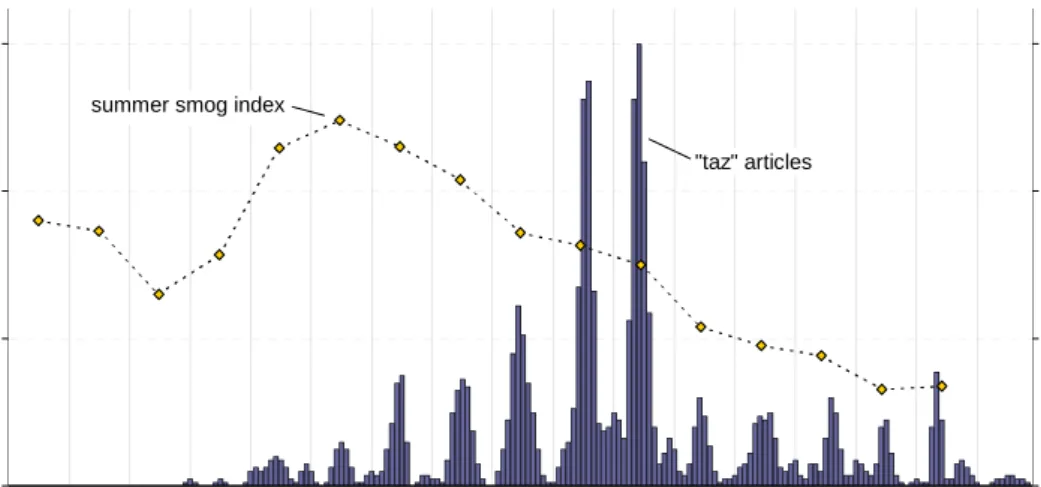
Different environmental problems receive different and varying degrees of public attention. Some issues are high on the public agenda when envi-ronmental conditions are most severe, while others start to be of high public concern only when the problem has already been halfway solved. Certain issues display both characteristics. Summer smog, for instance, is an issue that becomes “popular” each summer season when air concentrations of tropospherical ozone become high due to solar radiation. On a long-term track, however, quite a different picture could be observed (cf. figure 1): In the 1990s, when the issue of summer smog first entered the public arena and year by year became more important, ozone peak values had already begun to gradually decrease due to fewer emissions of ozone precursors by industry and transportation. What is more, public attention dynamics frequently
shows self-reinforcing behaviour resulting in dis-tinctive patterns. Thus, some issues might suddenly come up, often due to some trigger event, rise sharply – no longer in relation to the actual devel-opment of the environmental conditions –, and wane from the public agenda as quickly as they appeared.
Public attention being of chief relevance for politi-cal decision-making (cf. Mahon and Waddock 1992: 22), much research – albeit rather selective – has been conducted and many a theory has been put forward to describe and explain dynamics of public attention.
In this paper, a conceptual model based on previ-ous research by the author will be presented, tested against empirical data and then implemented in the form of an agent-based computer model in order to verify the causal model and compare the model output with empirical data and thus test it on
plau-sibility and to gain further insights into the pro-posed mechanisms. Central research questions to be tackled are: (1) When and why does public attention towards environmental issues rise and fall? (2) By what causal mechanism(s) can the dynamics of public attention be modelled?
2. CONCEPTS AND TERMINOLOGY
In order to avoid confusion with differing results in the literature, the fundamental concepts of “atten-tion”, “public”, and “issue” shall be briefly dis-cussed.
Attention denotes the resources (time and other)
that people dedicate towards an issue and often signifies considerable political pressure. Regarded over time, attention can be conceived as an inten-sity (resource employment per time unit). Attention is also a scarce resource many issues are competing for (cf. Hilgartner and Bosk 1988; Zhu 1992). In contrast, “attitude” is commonly defined as “a learned predisposition to respond in a consistently favorable or unfavorable manner with respect to a given subject” (Fishbein and Ajzen 1975: 5), “opinion” denoting a verbalized attitude (cf. Zimbardo, Ebbesen and Maslach 1977: 20). Both do not necessarily involve resources.
In our model, we distinguish public from political, where the first refers to citizens (as potential vot-ers), special-interest groups and the mass media, whereas the latter refers chiefly refers to politi-cians, parties and governmental officers. Further-more, public attention as a sociological construct certainly involves an element of communication. If
1
The German left-wing newspaper “taz” has been selected for good and early availability of electronic data. Although not representative in terms of its political content and audi-ence, the “taz” follows basically the same attention cycles as all German newspapers (cf. Newig 2003).
a multitude of private individuals devoted their attention towards an issue but there was no com-munication about it, this would not be public atten-tion.
In today’s democracies, public attention, as we conjecture, tends to form around issues. They fo-cus on relatively small-scale problems like summer smog, BSE, ozone depletion, waste incineration and so forth that are sufficiently distinct to still be publicly perceived as units (cf. Dunlap and Jones 2002: 485–486). This is no longer the case with extensive problem areas such as air pollution or waste management, which merely serve as
catego-ries comprising and thereby classifying the
multi-tude of different issues.
3. CONCEPTUAL MODEL
3.1 Theoretical assumptions
Some authors have sought to model public atten-tion dynamics in a purely statistical manner by correlating aggregate measures of public attention with external variables or by regression analysis of attention time series (Henry and Gordon 2001; Soroka 2002). The disadvantage is that explana-tions remain on the aggregate level. Here, we opt for a different approach. Starting from individual actors, we seek to model the emergent phenome-non of public attention by the interaction of multi-ple individual actions. More abstractly speaking, our aim is to explain the social macro-level phe-nomenon by social micro-level processes (cf. Coleman 1990: 13–18). We base our theoretical model on the following general assumptions: - Methodological individualism, i.e. actors
(indi-vidual or collective) are the basic elements of analysis (not social systems).
0 10 20 30 m o n th ly n u m b e r o f "t a z " a rt ic le s 0 3 6 9 s u m m e r s m o g i n d e x summer smog index
"taz" articles
1985 1986 1987 1988 1989 1990 1991 1992 1993 1994 1995 1996 1997 1998 1999 2000 2001
Figure 1: Public attention towards the “summer smog” issue, measured by monthly numbers of press articles1, and an annual summer smog index. For both time series, 3-period centred moving averages have
- utility/interest-maximization under conditions of limited resources and cognitive capacity (“boun-ded rationality”, cf. Simon 1972).
In order to keep our theory as simple as possible (and thus attain a high degree of generality, appli-cability and relevance), we distinguish only two different types of relevant actors whose interests and preferences, resources and restrictions will be portrayed in the following. In an earlier version of the conceptual model, we included four different types, adding politicians and interest groups to the ones presented here (cf. Newig forthcoming). For the sake of simplicity, we left out all interactions with political action in this first version of the computer model.
Citizens are generally interested in maintaining or
improving the environmental conditions which affect them. As rational individuals, they dedicate their time and attention preferably towards those issues which they have an interest in. At the same time, however, citizens try to minimize the costs – monetary as well as cognitive – involved in finding out about how different political actors will deal with a specific environmental issue, which often requires understanding the environmental problem and the effect of proposed measures. Avoiding these (mental) costs, most citizens remain “ration-ally ignorant” (Downs 1957) towards most issues. The mass media, considered as media enterprises free of any outward political influence, seek to maximize print runs or viewer levels. Therefore, they tend to cover the issues they believe the audi-ence is interested in or concerned with. The pub-lisher will discover whether or not a newspaper, for example, meets the expectations of its readers by monitoring print runs (“voting at the kiosk”) and letters to the editor. Following this economic ra-tionale, the mass media in our theory do not pursue any genuine political interests in the issue at stake.
3.2 Central causal mechanisms2
Possibly the most simple approach to issue-attention regarding environmental problems is the
problem-reaction model employed in political
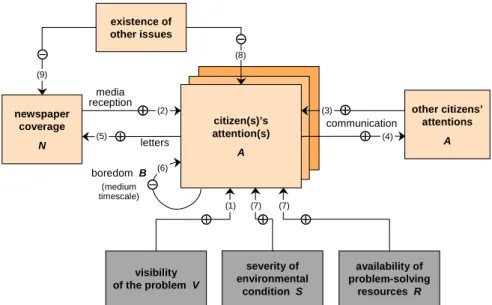
science (cf. v. Prittwitz 1990: 103). According to this, public attention directly depends on the sever-ity of the environmental condition (cf. figure 2): The higher the costs caused by the environmental problem (in terms of shortcomings in health or quality of life, or of the costs required to rectify these), the greater the stakeholders’ discontent with the situation (cf. Opp 1996: 361–363, 368) and their interest in embarking on measures to improve the deficient situation and thus the greater the
2
For a detailed empirical test of basic model propositions cf. Newig forthcoming.
tention of all stakeholders towards the issue. This approach may be particularly applicable for threat-ening catastrophic events that are directly percepti-ble by the broad public and consequently lead to an immediate response in public attention. It particu-larly applies to environmental problems that have a direct effect on human health.
By contrast, the capacity model derived from so-cial psychology tries to ascribe public attention to existing capacities for action, i.e. to resources for solving the problem at stake. The basic proposition is that deteriorations in environmental conditions remain unperceived unless they are or become technically solvable at economically viable costs. This is explained by the theory of cognitive disso-nance (Festinger 1957). Accordingly, people gen-erally strive to even out discrepancies between different perceptions – i.e. cognitive dissonances – or do not permit them to enter conscious reasoning in the first place (v. Prittwitz 1990). Environmental conditions that are significantly worse than the level of aspiration may constitute such discrepan-cies. Depending on the available resources, they can be resolved in different manners: When ade-quate resources to deal effectively with the prob-lem are lacking, the aspirational level may be ad-justed, or information regarding the actual state of the problem may be ignored or believed to be un-true in order to avoid cognitive dissonance and psychological stress. If, on the other hand, suffi-cient options for action are perceived, then actors will seek to implement measures to improve envi-ronmental quality, thus contributing to a rising public attention (cf. Opp 1996: 363).
In addition to these static mechanisms (both mod-els hold independently of the temporal, historical development), public attention dynamics generally involves processes of self-organization as well (cf. Downs 1972: 38).
A completely new issue will at the beginning have difficulty to rise in public attention – even when the environmental conditions are quite severe and problem-solving resources are at hand –, because the mental costs of understanding the issue are often quite high, and the time needed to pay atten-tion to an issue is scarce (cf. Zhu 1992; Neumann 1990). Every individual (or collective) actor can only receive a limited amount of information per time unit. In order to receive public attention, an environmental problem issue must be publicly perceptible and/or sufficiently simple to compre-hend (visibility of the problem). Those already aware of the problem must both be willing and able to spread their knowledge and insight about the subject. In modelling issue-attention, this “stage” is the most sensitive. It is difficult to predict if and when the “critical mass” of theme-promoters is reached; “random” factors may be essential in determining whether or not and when an
issue-attention cycle is triggered. In such a non-linear dynamic system, small changes in initial conditions may lead to great changes in the resulting trend. Once a critical mass is reached, the issue becomes a “fast-selling item” and attention towards it grows in an exponential manner, involving both interper-sonal and mass media communication: The more individuals dedicate their attention to the issue and discuss it with others, the more individuals will be informed and possibly feel concerned about it. Thus, information costs decrease as more and more information becomes readily available, so it be-comes rational for individuals to devote their atten-tion to this issue rather than to others. An impor-tant factor in amplifying public attention are the mass media who – as rational agents – take up those issues they anticipate people to be interested in and in turn facilitate communication and infor-mation about the issue. The media thus act as
cata-lysts: they increase the speed of news
dissemina-tion, but do not lead the discussion down a particu-lar road3. Mathematically, this mechanism of self-amplification could be modelled in terms of diffu-sion theory (cf. Krampe 1989; Rogers 1995; Dearing and Rogers 1996).
Regarding the further “fate” of the issue-attention cycle, two different mechanisms exist: One is the “zero-sum game” of public attention (cf. Zhu 1992). Hence, when other issues gain in public attention, one issue may decrease simply due to
3
As much research as has been done to clarify whether the media influence the citizens or vice versa, it seems now that both are too closely intertwined to be able to decide on this: “In sum, there is considerable evidence that the direction of causality in the media-public relationship cannot be as-sumed” (Soroka 2002: 10). This may differ of course, from case to case.
increasing competition. The other, more important, mechanism acknowledges the fact that citizens get “fed up” and “bored” with an issue after having spent much attention on it for a long period of time (cf. Neumann 1990): Marginal benefits decrease, spending further attention on the issue provides less and less new information. This mechanism clearly introduces a negative feedback effect (cf. figure 2) on a medium time scale. The model thus becomes path-dependent, for it depends on the amount of time an issue has already received high public attention, whether it will continue to rise or start to decline. A third possible mechanism may consist in political action being taken (cf. Newig forthcoming) – this task will be left for further improvements of the model.
4. AGENT-BASED COMPUTER MODEL
4.1 Model structure
On the basis of the above considerations a com-puter model has been implemented in Java, using the social simulation environment Quicksilver4. The model represents a community of 20 citizens c and a newspaper company interacting with one another on a daily timescale. A number of n differ-ent issues i are modelled simultaneously. Every citizen has a fixed number of friends that are cho-sen randomly at the beginning of each model run. For each issue, every citizen has a level of basic interest I0 that depends on the issue’s visibility V:
Values of I0 are randomly assigned between 0 and
1 according to a Gaussian distribution with mean V
4
For more information, see http://java4u.sourceforge.net/ and http://www.usf.uos.de/projects/quicksilver/. citizen’s attention citizen’s attention severity of environmental condition S availability of problem-solving resources R visibility of the problem V existence of other issues newspaper coverage N other citizens’ attentions A communication letters media reception boredom B (medium timescale) citizen(s)’s attention(s) A (3) (8) (9) (4) (6) (5) (7) (2) (7) (1)
Figure 2: Elements of the causal model. Plus signs indicate positive, minus signs indicate negative feed-back. Numbers in brackets refer to the equations governing the computer model.
and standard deviation 0.1. They influence both the citizens’ actual interests in the course of the model run Ii,c and a level of tolerance towards the
envi-ronmental condition regarding the same issue
Ti,c=1−I0,i,c. (1)
The citizens’ attention, defined on the interval [0,1], is determined in each time step t according to c i c i i c i t c i t c i t c i I B N C A A A , , , , , , , 1 , , ) (κ +ν −β + = + (2) with Greek letters indicating – throughout the pa-per – model parameters that weight the influencing factors according to their (relative) importance.
Ci,c denotes a citizen’s intensity of communication
about an issue, given by
∑
∑
= +− = − = 7 1 1 , , 7 1 1 , , 1 ) 1 ( τ τ τ τ τ t c i t c i F C (3)with Fi,c,t being the number of friends an actor talks to on day t, that depends on the actual Ai,c:
Fi,c,t =0.6Ai,c,t +0.4random[0..1]. (4)
Thus, the attention a citizen devotes to an issue depends on the intensity of communication not only of the present day but also – to a lessening extent – on the communication within the last week.
The intensity of newspaper coverage
∑
∑
= +− = − + = + 7 1 1 7 1 1 1 1 1 τ τ τ τ τ λN ( ) L . N Ni,t i,t i,t i,ct, (5)depends on the number of letters to the editor Li,c,t within the previous seven days. Whether or not a citizen writes to the editor is depends on whether his/her Ai,c,t is greater than a randomly generated number between 0 and 1.
Boredom of an issue
∑
∑
= +− = − = 365 1 1 , , 365 1 1 , , 1 ) 1 ( τ τ τ τ τ t c i t c i A B (6)grows the more attention a citizen has already devoted to it, the “memory” lasting for one year with decreasing intensity.
The interest in an issue, which is initially given by the basic interest I0, is altered according to the severity of the environmental problem Si, the avail-ability of problem-solving resources Ri and the individual level of tolerance versus a particular environmental problem Ti:
Ii,c,t+1=Ii,c,t+σ(Si,t−Ti,c)+ρSi,tRit,. (7) Both A and N are conceived as a “zero-sum” game. I.e., in each time step, after all other actions have been taken, both variables are normalized to the effect that the sums of all Ai,c and all Ni, respec-tively, become equal to 1:
∑
= − = n j c j c i c i A A A 1 1 , , , ( ) ; (8) 1 1 ) ( − =∑
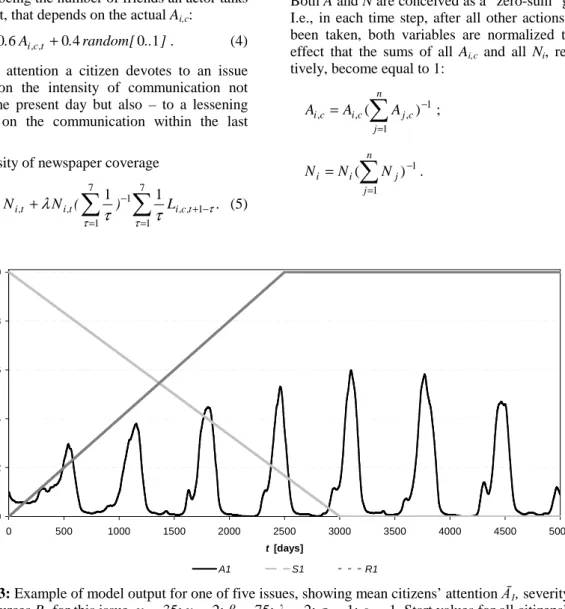
= n j j i i N N N . (9) 0,0 0,2 0,4 0,6 0,8 1,0 0 500 1000 1500 2000 2500 3000 3500 4000 4500 5000 t [days] A , S , R [ re la ti v e u n it s ] A1 S1 R1Figure 3: Example of model output for one of five issues, showing mean citizens’ attention
à
1, severity S1 and resources R1 for this issue. ̃ = .35; ̆ = .2; ˻ = .75; ̄ = .2; ̌ = .1; ̊ = .1. Start values for all citizens’ Ai:
.1, .15, .15, .35 and .25, and Ni: .05, .1, .2, .4 and .25. Vi are .3 for issues 2 to 5, V1 = .8. Si and Ri are constant at .5 for issues 2 to 5.
4.2 Model results and discussion
The computer model being still in the test and validation phase, some preliminary results may already be shown. Figure 3 provides an example of a typical model output where n = 5 issues were tracked. It represents a scenario of rising problem-solving resources and a decreasing severity of the environmental situation, as often encountered in reality. The cyclical, yet not completely ordered time series of aggregated public attention5 reflects well the non-linear, partly self-organising system of actors that is due to the positive feed-back mecha-nisms among citizens and the press, and the nega-tive feed-back mechanisms of boredom and issue competition. However, public attention seems also susceptible to external variables: Both factors that positively influence attention – i.e., S1 and R1, – develop in an antagonistic way, with maximum positive influence expected at the intersection of both curves (cf. equation 7). Interestingly, the model output shows a time lag in the dynamics of the attention peaks, showing the largest attention cycle two to three periods after highest external influence. Only after some time, the lessening external stimulus becomes apparent in the attention dynamics.
5. CONCLUSIONS AND OUTLOOK FOR
FURTHER RESEARCH
The proposed agent-based model, although still in its infancy, already reproduces basic features of empirical issue-attention time series, including (1) complex dynamics due to self-organisation of agents and agent communities, (2) the influence of external stimuli, i.e. the severity of the environ-mental condition and the availability of problem-solving resources, and (3) competition among issues. It thus supports the theoretical basis of the conceptual model.
It should be stressed, however, that the model in its present state of development does not yet allow to reproduce empirical time series of public (media or citizen) attention towards particular issues. Nor may the model parameters be attributed a specific meaning. Rather, it is expected that a further, sys-tematic analysis of the model behaviour will yield relevant information regarding the (relative) impor-tance of the model parameters and thus of the vari-ous influencing factors. Only then may the model be validated for specific historical issues. More-over, an analysis of the actor network may result in deeper insights of the self-amplifying mechanism. Possible improvements of the model structure will be to enlarge the number of issues in order to
5
The model output for aggregated citizens’ attention and for media coverage is typically very similar.
dampen the competition effect of each single issue, to allow new issues to appear in the course of a model run, and to refine the “boredom” mechanism which is still poorly understood on a conceptual level.
Thus, further research is needed to empirically test (and perhaps change) specific model assumptions, such as the boredom mechanism, the zero-sum game effect or the way in which external variables effect both media and citizens’ attention.
6. REFERENCES
Dearing, J.W. and E.M. Rogers. 1996. Agenda-setting, Communication Concepts. Thousand Oaks, Calif.: Sage.
Downs, A. 1957. An Economic Theory of Democracy. Dunlap, R.E. and R.E. Jones. 2002. Environmental
Con-cern: Conceptual and Measurement Issues. In Hand-book of Environmental Sociology, eds. R.E. Dunlap and W. Michelson. Westport, Connecticut; London: Greenwood Press.
Festinger, L. 1957. A theory of cognitive dissonance. Fishbein, M. and I. Ajzen. 1975. Belief, attitude, intention
and behavior : an introduction to theory and research. Reading, Mass.: Addison-Wesley.
Henry, G.T. and C.S. Gordon. 2001. 'Tracking issue atten-tion. Specifying the dynamics of the public agenda.' Public Opinion Quarterly 65:157-77.
Hilgartner, S. and C.L. Bosk. 1988. 'The rise and fall of social problems: A public arenas model.' American Journal of Sociology 94 (1):53-78.
Krampe, G. 1989. Ein Früherkennungssystem auf der Basis von Diffusionsfunktionen als Element des strategi-schen Marketing. In Strategisches Marketing, eds. H. Raffée and K.-P. Wiedmann. Stuttgart: Poeschel. Mahon, J.F. and S.A. Waddock. 1992. 'Strategic issues
management: An integration of issue life cycle per-spectives.' Business and society 33 (1):98-101. Neumann, W.R. 1990. 'The Threshold of Public Attention.'
Public Opinion Quarterly 54:156-76.
Newig, J. 2003. Symbolische Umweltgesetzgebung. Rechts-soziologische Untersuchungen am Beispiel des O-zongesetzes, des Kreislaufwirtschaft- und Abfallge-setzes sowie der Großfeuerungsanlagenverordnung. Vol. 84, Schriften zur Rechtssoziologie und Rechts-tatsachenforschung. Berlin: Duncker & Humblot. Newig, J. forthcoming. 'Public Attention, Political Action -
the Example of Environmental Regulation.' accepted for publication in 'Rationality and Society'.
Opp, K.-D. 1996. Aufstieg und Niedergang der Ökologie-bewegung in der Bundesrepublik. In Umweltsoziolo-gie, eds. A. Diekmann and C.C. Jaeger. Opladen: Westdeutscher Verlag.
Prittwitz, V.v. 1990. Das Katastrophenparadox. Elemente einer Theorie der Umweltpolitik.
Rogers, E.M. 1995. Diffusion of innovations. 4th ed. New York: Free Press.
Simon, H.A. 1972. Theories of Bounded Rationality. In Decision and Organization: A Volume in Honor of Jakob Marschak, eds. C.B. McGuire and R. Badner. Soroka, S.N. 2002. Agenda-setting dynamics in Canada.
Vancouver: UBC Press.
Zhu, J.-H. 1992. 'Issue competition and attention distrac-tion: A zero-sum theory of agenda-setting.' Journal-ism Quarterly 69 (4):825-36.
Zimbardo, P.G., E.B. Ebbesen and C. Maslach. 1977. Influencing attitudes and changing behavior: an in-troduction to method, theory and applications of so-cial control and personal power. 2nd ed, Topics in social psychology. Reading, Mass.: Addison-Wesley.