Radians
mc-TY-radians-2009-1 At school we usually learn to measure an angle in degrees. However, there are other ways of measuring an angle. One that we are going to have a look at here is measuring angles in units called radians. In many scientific and engineering calculations radians are used in preference to degrees.
In order to master the techniques explained here it is vital that you undertake plenty of practice exercises so that they become second nature.
After reading this text, and/or viewing the video tutorial on this topic, you should be able to:
• use radians to measure angles
• convert angles in radians to angles in degrees and vice versa
• find the length of an arc of a circle
• find the area of a sector of a circle
• find the area of a segment of a circle
Contents
1.
Introduction
2
2.
Definition of a radian
2
3.
Arc length
3
4.
Equivalent angles in degrees and radians
4
5.
Finding an arc length when the angle is given in degrees
5
6.
The area of a sector of a circle
6
1. Introduction
At school we usually learn to measure an angle in degrees. We are well aware that a full rotation is 360◦ as shown in Figure 1.
360o
Figure 1. A full rotation is 360◦.
However, there are other ways of measuring an angle. One way that we are going to have a look at here is measuring angles in units calledradians. In many scientific and engineering calculations radians are used in preference to degrees.
2. Definition of a radian
Consider a circle of radius r as shown in Figure 2.
r
r
r
1 rad
Figure 2. The arc shown has a length chosen to equal the radius; the angle is then 1 radian. In Figure 2 we have highlighted part of the circumference of the circle chosen to have the same length as the radius. The angle at the centre, so formed, is 1 radian.
Key Point
An angle of one radian is subtended by an arc having the same length as the radius as shown in Figure 2.
3. Arc length
We will now use this definition to find a formula for the length of an arbitrary arc.
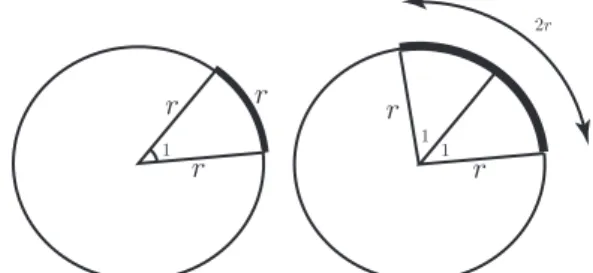
We have seen that an angle of 1 radian is subtended by an arc of length r as illustrated in the
left-most diagram in Figure 3. By extension an angle of 2 radians will be subtended by an arc of length 2r, as shown. r r r 1 r 1 1 1 2r r
Figure 3. An angle of 2 radians is subtended by an arc of length 2r.
Note from these diagrams that the length of the arc is always given by the angle in radians × the radius
In the general case, the lengths, of an arbitrary arc which subtends an angleθis rθas illustrated
in Figure 4.
r
r s
θ
Figure 4. The arc length s, is given by r×θ
This gives us a way of calculating the arc length when we know the angle at the centre of the circle and we know its radius.
Key Point
arc lengths=rθ(note: θ must be measured in radians)
Exercise 1
Determine the angle (in radians) subtended at the centre of a circle of radius 3cm by each of the following arcs:
a) arc of length 6 cm b) arc of length 3πcm
4. Equivalent angles in degrees and in radians
We know that the arc length for a full circle is the same as its circumference, 2πr.
We also know that the arc length = rθ.
So for a full circle
2πr=rθ
that is
θ= 2π
In other words, when we are working in radians, the angle in a full circle is 2π radians, in other
words
360◦ = 2π radians
This enables us to have a set of equivalences between degrees and radians.
Key Point
360◦ = 2π radiansfrom which it follows that
180◦=π radians 90◦= π 2 radians 45◦= π 4 radians 60 ◦= π 3 radians 30◦= π 6 radians
The Key Point gives a list of angles measured in degrees on the left and the equivalent list in radians on the right. It is important in mathematical work that you record correctly the unit of measure you are using.
Another useful relationship is given as follows:
π radians = 180◦
so
1 radian = 180
π degrees= 57.296
◦ (3 d.p.)
So 1 radian is just over 57◦.
Some notation.
There are various conventions used to denote radians. Some books and some teachers use ‘rads’ as in 2 rads. Others use a small c as in 2c
. Some others use no symbol at all and assume that radians are being used. When an angle is expressed as a multiple of π, for example as in the
expression sin3π
Exercise 2
1. When each of the following angles is converted from degrees to radians the answer can be expressed as a multiple ofπ (note that it may be a fractional multiple). In each case state
the multiple (e.g for an answer of 4π
5 the multiple is 4 5). a) 90o b) 360o c) 60o d) 45o e) 120o f) 15o g) 135o h) 270o
2. Convert each of the following angles from radians to degrees. a) π 2 radians b) 3π 4 radians c) π radians d) π 6 radians e) 5π radians f) 4π 5 radians g) 7π 4 radians h) π 10 radians
3. Convert each of the following angles from degrees to radians giving your answer to 2 decimal places.
a) 17o
b) 49o
c) 124o
d) 200o
4. Convert each of the following angles from radians to degrees, giving your answer to 1 decimal place.
a) 0.6 radians b) 2.1 radians c) 3.14 radians d) 1 radian
5. Finding an arc length when the angle is given in degrees
We know that if θ is measured in radians, then the length of an arc is given by s=rθ.Suppose θ is measured in degrees. We shall derive a new formula for the arc length.
r
r s
o
θ
Figure 5. In this circle the angle θ is measured in degrees.
Referring to Figure 5, the ratio of the arc length to the full circumference will be the same as the ratio of the angle subtended by the arc, to the angle in a full circle; that is
s 2πr =
θ◦
360◦
So, when θ is measured in degrees we can use the following formula for arc length: s= 2πr× θ
◦
360◦
6. The area of a sector of a circle
A sector of a circle with angle θ is shown shaded in Figure 6.
r
r
θ
Figure 6. The shaded area is a sector of the circle.
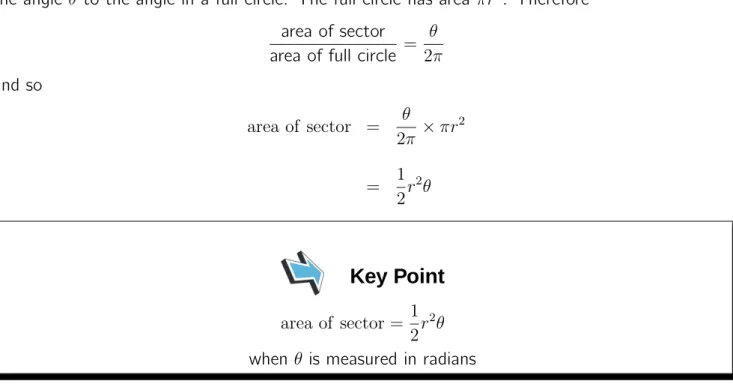
The ratio of the area of the sector to the area of the full circle will be the same as the ratio of the angle θ to the angle in a full circle. The full circle has area πr2
. Therefore area of sector
area of full circle =
θ 2π and so area of sector = θ 2π ×πr 2 = 1 2r 2 θ
Key Point
area of sector = 1 2r 2 θwhen θ is measured in radians
7. Miscellaneous Examples
Example
Consider the circle shown in Figure 7. Suppose we wish to calculate the angle θ.
10
10 25
θ
We know the arc length and radius. We can use the formula s = rθ. Substituting the given values 25 = 10θ and so θ = 25 10 = 2.5rads
What is this angle in degrees ? We know
π rads = 180◦ and so 1rad = 180 π ◦ It follows that 2.5 rads = 2.5×180 π ◦ = 143.2◦ Example
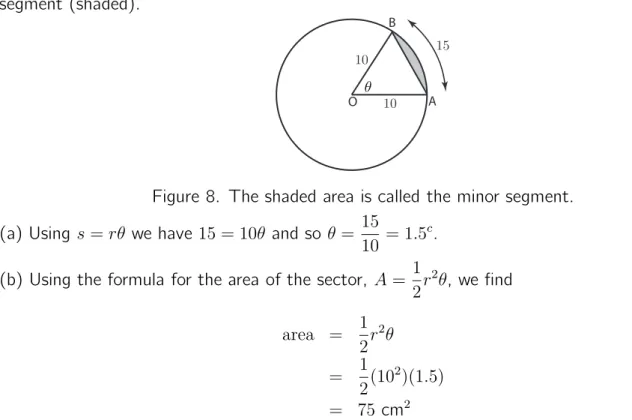
Refer to Figure 8. Suppose we have a circle of radius 10cm and an arc of length 15cm. Suppose we want to find (a) the angle θ, (b) the area of the sector OAB, (c) the area of the minor
segment (shaded). O A B 10 10 15 θ
Figure 8. The shaded area is called the minor segment. (a) Using s=rθ we have 15 = 10θ and so θ= 15
10 = 1.5 c
. (b) Using the formula for the area of the sector, A= 1
2r 2θ , we find area = 1 2r 2 θ = 1 2(10 2 )(1.5) = 75 cm2
(c) We already know that the area of the sector OAB is 75cm2
. If we can work out the area of the triangle AOB we can then determine the area of the minor segment. (Recall the formulae
for the area of triangle, A= 1
2absinC.) area of triangle = 1 2r 2 sinθ = 1 210 2 sin 1.5 = 49.87 cm2
Therefore the area of the minor segment is
75−49.87 = 25.13 cm2 (to 2 dp.)
Example
Suppose we have an angle of 120◦. What is this angle in radians ? We know that
πrads = 180◦ and so π 180rads = 1 ◦ then 120◦ = π 180 ×120 rads
This can be written as 2π
3 radians (= 2.094 radians).
Exercise 3
A sector of a circle is an area bounded by two radii and an arc. A sector has an angle at the centre of the circle. All the questions below relate to a circle with radius 5cm.
1. Determine the length of the arc (correct to 2 decimal places) when the angle at the centre is a) 1.2 radians b) π
2 radians c) 45 o
2. Calculate the area (correct to 2 decimal places) of each of the three sectors in Question 1.
3. A sector of this circle has area 50 cm2
. What is the angle (in radians) at the centre of this sector? Answers Exercise 1 a) 2 b) π c) 0.5 d) 2π Exercise 2 1. a) 1 2 b) 2 c) 1 3 d) 1 4 e) 2 3 f) 1 12 g) 3 4 h) 3 2 2. a) 90o b) 135o c) 180o d) 30o e) 900o f) 144o g) 315o h) 18o
3. a) 0.30 radians b) 0.86 radians c) 2.16 radians d) 3.49 radians 4. a) 15.3o b) 120.3o c) 179.9o d) 57.3o Exercise 3 1. a) 6 cm b) 7.85 cm c) 3.93 cm 2. a) 15 cm2 b) 19.63 cm2 c) 9.82 cm2 3. 4 radians