11
thInternational Research/Expert Conference
”Trends in the Development of Machinery and Associated Technology”
TMT 2007, Hammamet, Tunisia, 5-9 September, 2007
MACHINING STABILITY AND MACHINE TOOL DYNAMICS
Erhan Budak
Sabanci University
Tuzla, Istanbul
Turkey
ABSTRACT
Machining is a common manufacturing process in industry due to its high flexibility and ability to produce parts which excellent quality. The productivity and quality in machining operations can be limited by several process constraints one of which is the self-excited chatter vibrations. Under certain conditions, the process may become unstable yielding oscillations with high amplitudes which result in poor surface finish and damage to the cutting tool, part and the machine tool itself. Stability analysis of the dynamic cutting process can be used to determine chatter-free machining conditions with high material removal rate. Since chatter is a result of the dynamic interactions between the process and the structures both cutting and machine tool dynamics are important elements of the stability analysis. In this paper, methods developed for stability analysis of cutting processes and machine tool dynamics will be presented. Implications of these methods in the selection of process parameters and machine tool design will be also discussed with example applications.
Keywords: Machining, machine tool dynamics, chatter stability 1. INTRODUCTION
Machining is one of the most common manufacturing processes in industry due to its ability to produce high quality parts with outstanding flexibility. These characteristics have been further enhanced in last several decades due to the advances in CAM, CNC, machine tool and cutting tool technologies. However, the productivity and quality in machining operations can be limited due to the process mechanics. One of the most common problems in machining is the process instability caused by the chatter vibrations. Under certain conditions, the process may become unstable yielding oscillations with high amplitudes which result in poor surface finish and damage to the cutting tool, part and the machine tool. Stability analysis of the dynamic cutting process can be used to determine chatter-free machining conditions with high material removal rate. In this paper, the analytical methods developed for chatter stability will be presented with applications. In addition, the modeling of the frequency response of machine tool structures will also be demonstrated. The formulations and the applications will be given for turning and milling processes which are the most commonly used machining operations in industry.
Chatter is the result of the dynamic interactions between the cutting process and the machine-tool-part structures. Chatter vibrations develop due to dynamic interactions between the cutting tool and workpiece, and result in poor surface finish and reduced tool life. Tlusty et al. [1] and Tobias [2] identified the most powerful source of self-excitation which is associated with the structural dynamics of the machine tool and the feedback between the subsequent cuts on the same cutting surface resulting in regeneration of waviness on the cutting surfaces, and thus modulation in the chip thickness [3]. Under certain conditions the amplitude of vibrations grows and the cutting system becomes unstable. Although chatter is always associated with vibrations, in fact it is fundamentally due to instability in the cutting system. For a certain cutting speed there is a limiting depth of cut
above which the system becomes unstable, and chatter develops. Additional operations, mostly manual, are required to clean the chatter marks left on the surface. Thus, chatter vibrations result in reduced productivity, increased cost and inconsistent product quality.
Although the basic theory of chatter was developed about five decades ago, the application in industry has been limited due to several reasons. First of all, in most operations the cutting is not orthogonal due to the geometry of the tool and the process. Thus, improved methods are necessary to include the important process parameters in the stability analysis. For example, in the stability analysis of milling the rotating tool, multiple cutting teeth, intermittent cutting action, varying chip load direction and multi-directional dynamics must be considered in the modeling. Similarly, for turning and boring stability, the inclination and side edge cutting angles, and insert nose radius must be included in the analysis. In the early milling stability analysis, Tlusty [3] used his orthogonal cutting model considering an average direction as an approximation. Minis et al. [4, 5] used Floquet's theorem and the Fourier series for the formulation of the milling stability, and numerically solved it using the Nyquist criterion. Budak and Altintas [6, 7] developed a stability method for milling which leads to analytical determination of stability limits. The method was verified by experimental and numerical results, and demonstrated to be very fast for the generation of stability lobe diagrams. More recently, the special case of low immersion milling has been investigated in several studies where added lobes were also presented [8-11]. Kaneko et al. [12] modeled the self excited chatter and chatter marks left on the surface in turning by a 2D model using a numerical solution where the results were mostly based on experimentation. Minis et al. [13], on the other hand, used an oriented transfer function approach where the 3D turning geometry was not fully included into the model. Later, Rao et al. [14] used the multi dimensional approach presented in [7] to model the stability in turning. Atabey et al. [15, 16] proposed an analytical model for force and surface prediction in boring, but the solution was achieved using time domain simulations. In one of the recent works, Budak and Ozlu [17, 18] proposed an analytical stability model for turning and boring operations. The stability model considers the effects of important geometrical parameters such as the rake, inclination and side edge cutting angles and the insert nose radius, and was verified through extensive testing covering different cases.
The other significant part of the chatter stability analysis is the dynamics of the machine tool structure. The frequency response function (FRF), or the transfer function, at the cutting tool-material contact point is required to obtain stability diagrams. Using experimental approach, these FRFs can be obtained directly by impact testing [19]. However, for a different combination of the system components, a new test will be required since the system dynamics will change. Schmitz et al. [20, 21] implemented the well known receptance coupling theory of structural dynamics in order to couple the dynamics of the spindle-holder assembly and the tool by using the dynamical properties at the holder-tool interface. It is suggested that the dynamics of the spindle-holder subassembly can be obtained experimentally at the holder tip for once, then, it can be coupled with the dynamics of the tool which is obtained analytically. In a recent study, Ertürk et al. [22, 23] presented an analytical approach to predict the tool point FRF by modeling the spindle-holder-tool dynamics. They also used the model to analyze the effects of bearing supports and spindle-holder and tool-holder interfaces on the FRF [24], and demonstrated the use of the model in fast and practical generation of the stability diagrams [25].
A common method of chatter suppression is to determine the chatter free cutting conditions, i.e. the cutting depth and speed, through stability analysis or diagrams as described above. However, there are alternative methods of chatter suppression for different applications. One practical method is to use the noise spectrum of the chatter to determine the spindle speeds for higher stability. The dynamic contact between the cutting tool and the work material due to chatter generates high amplitude noise which is one of the undesired results of chatter. However, the spectral analysis of the chatter noise generates a unique opportunity for the detection, and in some cases, suppression of chatter [26-28]. Another alternative method of chatter suppression is the use of variable pitch cutters in milling which may improve the stability significantly [29]. The effectiveness of variable pitch cutters was first demonstrated by Slavicek [30], and then by Opitz et al. [31] and Vanherck [32]. Recently, Altintas et
al. [33] adapted the analytical milling stability model to the case of variable pitch cutters. Budak [34] developed an analytical method for the optimal design of variable pitch cutters, and implemented them in the milling of turbine engine impellers and fans made out of titanium alloys [35].
The present paper is organized as follows. The basic orthogonal chatter stability is presented in the next section which is followed by the detailed formulations for turning and milling using multi directional models. After these, the analytical calculation of the FRFs of spindle – tool holder – tool assembly are given. Finally, suppression of chatter using sound spectrum is presented with examples. 2. STABILITY OF ORTHOGONAL CUTTING
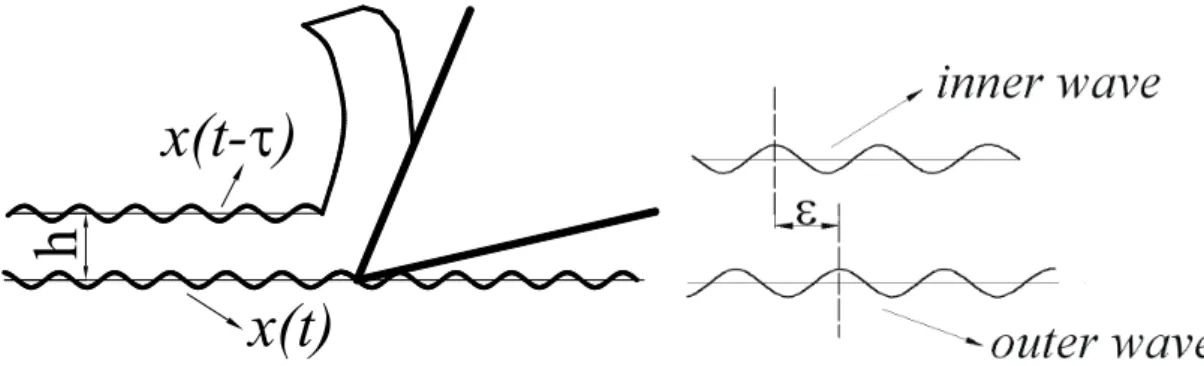
In dynamic cutting, a vibrating tool removes a chip from an undulated surface which was generated during the previous pass as shown in Figure 1. The process can be visualized as a superposition of these two distinct mechanisms, i.e. wave removing (outer wave) and wave generation (inner wave). The physics of dynamic cutting can be explained in terms of chip thickness, shear, rake and clearance angle oscillations, and variation of friction forces and flank contact. However, the most important factor for the stability of the process is the regeneration of the chip thickness (h) resulting from the two waves and the phase (ε) between them as shown in Figure 1.
x(t-
τ
)
x(t)
h
Figure 1. Dynamic chip thickness and regeneration in orthogonal metal cutting. The dynamic cutting force in the feed, or chip thickness, direction can be written as follows:
bh K
Ff = f (1)
where b is the depth of the cut (in the third direction, i.e. into the plane of paper in Figure 1), h is the instantaneous chip thickness and Kf is the cutting force coefficient in the feed direction which is measured or calibrated through testing [36]. Under the influence of the vibrations, the dynamic chip thickness can be expressed as follows
( )
0( ) (
)
h t
=
h
−
x t
+
x t
−
τ
(2)where ho is the static chip thickness defined by the feed rate of the tool, x(t) and x(t-τ) are the vibration amplitude in the chip thickness direction during the current and previous passes on the same cut surface, and τ is the time delay between the two waves corresponding to the time to reach to the same position on the surface between two subsequent passes. The dynamic cutting force takes the following form when (2) is substituted in (1)
( )
(
) ( )
f f
F t =K b x t⎡⎣ − −
τ
x t ⎤⎦ (3) The static part of the force due to ho has been neglected in (3) as it does not contribute to the regeneration of the chip thickness, and thus the stability of the process. In machining there may be vibrations present due to cutting forces, however if the process is stable their amplitudes are bounded. In general, the vibration amplitude increases exponentially if the system is unstable whereas it decreases exponentially for a stable system. At the stability limit, the amplitude neither increases nor decreases. Thus, at the stability limit the vibration and the dynamic force can be expressed as follows( )
(
)
( )
( )
,
c c c i t i t i t fx t
Xe
x t
Xe
F t
Fe
ω τ ω ωτ
−=
−
=
=
(4)where X and F are the amplitudes of the vibration and the dynamic force, respectively, and ωcis the vibration, or chatter, frequency. Using the resultant FRF in the chip thickness direction, G(ωc), the vibrations can be expressed as
( )
cX
=
FG
ω
(5) Substituting (4-5) into (3)( )
(
1)
c c i t i i t f c Feω =K bGω
e−ω τ − Feωc (6)From which the following condition is obtained for the stability limit
( )
(
)
1 1 i c
f
K bG
ω
e−ω τ+ − =0 (7)
The exponential term due to the delay can be expressed using trigonometric identities:
(
)
(
)
1+K b Gf R +iGI ⎡⎣1− cos
ω τ
c −isinω τ
c ⎤⎦=0 (8) where Gr and GI are the real and imaginary parts of the FRF, respectively. The real and imaginary parts of (8) must be equated to 0 separately:(
)
(
)
sin
cos
0
sin
1 cos
0
f R c I I c R c I cK b G
G
G
G
G
ω τ
ω τ
ω τ
ω τ
+
−
=
+
−
=
(9)The second equation due to the imaginary part of (8) results in the following:
sin cos 1 c I R c G G
ω τ
ω τ
= − (10)Using the trigonometric identities, the following is obtained:
(
) (
)
(
)
(
)
(
)
(
)
2
2sin / 2 cos / 2 cos / 2
tan 3 / 2 / 2 sin / 2 2sin / 2 c c c I c R c c G G
ω τ
ω τ
ω τ
π
ω τ
ω τ
ω τ
= = − = − − + (11)Finally, the following condition is obtained
1 2 tan I 3 c R G G
π ω τ
− + = (12)The number of waves between two subsequent cuts can be described as follows:
2
c
k
ω τ
=
π
+
ε
(13)Substituting (12) into (13), the following is obtained for the phase
1 2 tan I R G G
ε π
= + − (14)Thus, for a certain chatter frequency the corresponding phase and the speed (or delay) can be determined from (14) and (13), respectively.
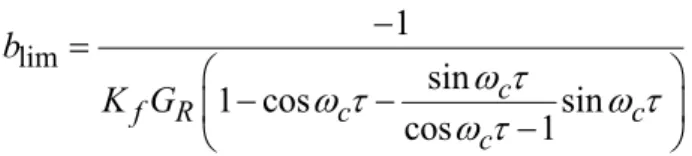
From the first equation of (9) due to the real part of (8), the limiting depth of cut can be obtaind as follows:
(
)
lim
cos
1
sin
f R R c I c
b
K
G
G
ω τ
G
ω τ
−
=
−
−
(15)lim
1
sin
1 cos
sin
cos
1
c f R c cb
K G
ω τ
ω τ
ω
cω τ
τ
−
=
⎛
⎞
−
−
⎜
−
⎟
⎝
⎠
(16)Using trigonometric identities again, the following simple equation is obtained for the stability limit:
lim
2
1
f Rb
K G
−
=
(17)Therefore for a given chatter frequency, or speed due to (14), the limiting depth of cut can be predicted using equation (17). For stable cutting, the depth of cut must be lower than blim in the process. As expected, the stability limit is inversely proportional to the cutting force coefficient and the dynamic flexibility of the system. As GR is function of the frequency, blim also varies with the frequency, or with the cutting speed resulting in stability lobes as illustrated in the following sections. The minimum value of the stable depths which is referred to as the absolute stability limit is obtained as follows:
( )
lim2
min
1
f Rb
K
G
−
=
(18)The cutting process is stable for all speeds if the depth of cut is lower than the absolute stability limit given by (18).
3. STABILITY OF TURNING PROCESS
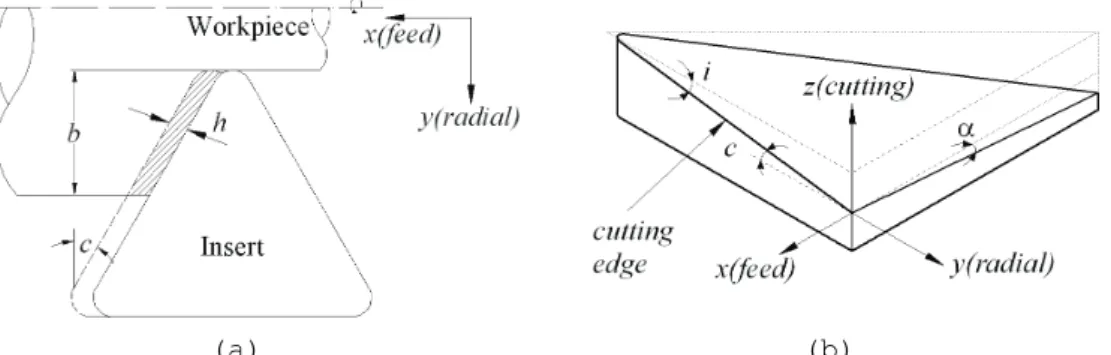
The general overview of a turning process is given in Figure 2 where the tool generates cutting action by moving in the feed direction towards the workpiece which rotates around its axis. The surfaces generated in stable and unstable cuts are also shown in Figure 2. It can easily be seen that chatter results in very poor surface quality. In order to formulate the relationship between dynamic turning forces and dynamic chip thickness, all components of the dynamic problem are transformed into the machine axes as shown in Figure 3. From Figure 3 one can deduce that the dynamic displacements ain the cutting (z) direction do not affect the dynamic chip thickness. By this observation, the dynamic problem is reduced to a 2D model.
f V F F ,V Workpiece Chip Tool feed tang Frad
Stable
Chatter
3.1. Dynamic turning forces
The modulated chip thickness resulting from vibrations of the tool and workpiece can be written as follows [17, 18]:
( )
cos cos sinh t = f c+ Δx c− Δy c (19)
where f represents the feed per revolution, c is the side edge cutting angle, and the dynamic displacement terms are defined as
( )
( )
(
)
(
)
( )
( )
(
τ
)
(
τ
)
τ
τ
− + − − − = Δ − + − − − = Δ t y t y t y t y y t x t x t x t x x w c w c w c w c (20) where, xc(t) ,xw(t) and yc(t), yw(t) are the cutter and workpiece dynamic displacements for the current pass respectively, and xc(t-τ) ,xw(t-τ) and yc(t-τ), yw(t-τ) are the cutter and workpiece dynamic displacements for the previous pass in x and y directions respectively, and τ is the delay term which is equal to the one spindle revolution period in seconds.(a) (b)
Figure 3. (a) Chip thickness in turning, b) 3D view of the three cutting angles on the insert.
The forces in the feed, Ff, and the radial, Fr, directions contribute to the regeneration whereas the tangential force in the cutting speed direction does not affect the dynamic chip thickness. The dynamic cutting forces on the tool can be expressed as follows:
[
cos
sin
]
cos
f f r rF
b
K
x
c
c
y
c
F
K
⎧
⎫
⎡
⎤
⎧ ⎫
Δ
⎪
⎪ = −
−
⎨
⎬
⎢
⎥
⎨ ⎬
Δ
⎪
⎪
⎩ ⎭
⎩
⎭
⎣
⎦
(21)where, Kf, and Kr are the corresponding cutting force coefficients and b is the depth of cut. Through coordinate transformation the forces in the x and y directions can be obtained as follows:
{ }
F =b[ ]
A{ }
Δd (22)where
{ }
F is the dynamic force vector containing Fx and Fy and{ }
Δd is the dynamic displacement vector both defined in the lathe coordinates. The directional coefficients matrix [A] can be expressed as:[ ]
[
c]
K K c c c c A r f 1 tan cos sin sin cos − ⎥ ⎦ ⎤ ⎢ ⎣ ⎡ ⎥ ⎦ ⎤ ⎢ ⎣ ⎡− = (23) 3.2. Stability limitSimilar to the formulation in Section 2, the response of the cutter and the workpiece at the chatter frequency, ωc can be expressed as follows:
( )
{
}
[
( )
]
{ }
i t c j c j i G i F e c dω
=ω
ωj
=
c
,
w
;d
=
x
,
y
(24)Substituting in (22) considering the delay terms:
{ }
(
)
[ ]
[
( )
]
{ }
i t c i t i cb
e
cA
G
i
F
e
ce
F
ω=
1
−
−ωτω
ω (25)Equation (25) has a non-trivial solution if and only if its determinant is zero, yielding:
[ ]
[
( )
]
[
0
where
[
G
0( )
i
ω
c] [ ]
=
A
[
G
( )
i
ω
c]
, and the eigenvalue is defined asΛ
=
b
(
e
−iωcτ−
1
)
. The solution of Eq. (13) results in the following:(
)
[
+ +=
Λ 1/Gyy Kf sin2ccosc Krsinccos2c G
(
K c K c)
]
rf
xx cos3 − cos2 (27)
Finally, the stability limit, blim, at a certain chatter frequency can be obtained as follows:
1 sin cos lim − − Λ + Λ =
τ
ω
τ
ω
c R i I c i b (28)Since b is a real number, the imaginary part of Eq. (16) has to vanish yielding:
(
2 lim2
1
1
Λ
+
κ
−
=
Rb
)
(29) where:τ
ω
τ
ω
κ
c c R I cos 1 sin − = Λ Λ = (30)Equation (30) can be used to obtain a relation between the chatter frequency and the spindle speed [7]:
ψ
π
ε
=
−
2
,ψ
=
tan
−1κ
(31)π
ε
τ
ω
c=
+
2
k
, n=60/τ
(32)where ε is the phase difference between the inner and outer modulations, k is an integer corresponding to the number of waves in a period, and n is the spindle speed in (rpm). The stable depth of cut of the system can be obtained from by equation (29) for different chatter frequencies. These frequencies can be searched around the natural frequency of the most flexible structural mode of the system. Then, the corresponding spindle speeds can be determined from equation (32) for different lobes, i.e. for k=1,2,3…etc. Thus, the stability lobe diagram of the dynamic system can be obtained by plotting the stable depth of cut vs. the corresponding spindle speeds for different lobes.
This multi directional turning stability model can also be adapted to the boring process stability as well as to the cases with round inserts or inserts with large nose radii [18]. In those cases, the effective side edge cutting angle varies along the cutting depth resulting in different FRF contributions from the x and y directions, i.e. from the tool and the workpiece. This is handled in [18] by dividing the cutting zone into small elements and combining them in a global matrix equation for the stability. However, since the stable depth of cut is not known in the beginning of the solution, the number of elements to be included in the matrices is not known either. This is solved by following an iterative solution [17, 18].
3.3. Experimental results
The stability lobes in turning and boring operations are very narrow compared to milling stability lobes due to the lower spindle speeds and the single cutting tooth. Thus, chatter tests were conducted in order to obtain the absolute stability limit of the dynamic system experimentally. In the chatter tests, the depths of cut were selected to verify the stable and unstable cutting zones, and absolute stability limit. In order to confirm the absolute stability limit prediction, a fine variation of the depths is used. A conventional manual lathe is used during the experiments, which allows for specific spindle speeds. A modal test setup is used to measure the transfer functions of the workpiece and the tool as shown in Figure 4. The modal test setup consists of an impact hammer, an accelerometer and a data acquisition system. In addition, a sound frequency measurement setup was prepared in order to measure and verify the chatter frequency (Figures 4.c and 4.d). The setup consists of a microphone and a data acquisition setup. As a second check the finished surface is observed by the naked eye for chatter marks in order to verify the unstable cutting operation. The workpiece material used during the tests is a medium carbon steel (AISI 1040), and an existing orthogonal database was used for the cutting force coefficients [36, 19].
(a) (b)
(c) (d)
Figure 4. (a), (b) Modal test setup, (c), (d) Frequency measurement setup.
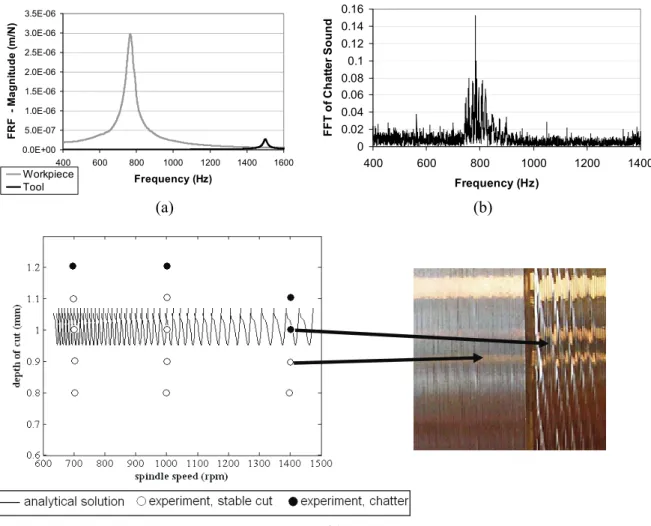
This first set of experiments is conducted in order to verify the proposed stability model for the case where the workpiece is more flexible than the tool. The parameters that are used specifically for the verification of flexible workpiece turning chatter experiments and stability predictions are listed in Table 1 under Case 1. The workpiece diameter and the length were 39 mm and 75 mm, respectively. Moreover, the comparison between the tool and workpiece transfer functions is shown in Figure 5.a.
Table 1: Parameters used in the turning chatter experiments. Case 1 Case 2 Side edge cutting angle 30° 25°
Rake angle 5° 5°
Inclination angle 5° 5°
Insert nose radius 0.4mm varying Cutting force coefficients, Kf 632 Mpa 632 MPa
Cutting force coefficients, Kr 44 Mpa 44 MPa
Natural frequency of the workpiece 770 Hz 707 Hz Stiffness of the workpiece 6.6x10⁶N/m 6.5x10⁶N/m
Damping ratio 0.025 0.023
The predicted stability lobes and experimental results are given in Figure 5.c where a sample finished surface after a stable and unstable operation can be seen. Also, the measured chatter sound for 1400 rpm is given in Figure 5.b. Reasonable agreement is observed between the experimental and analytical results.
0.0E+00 5.0E-07 1.0E-06 1.5E-06 2.0E-06 2.5E-06 3.0E-06 3.5E-06 400 600 800 1000 1200 1400 1600 Frequency (Hz) FRF M a gni tu de ( m /N ) Workpiece Tool 0 0.02 0.04 0.06 0.08 0.1 0.12 0.14 0.16 400 600 800 1000 1200 1400 Frequency (Hz) FFT of C ha tt e r S ound (a) (b) (c)
Figure 5. (a) Transfer functions of the tool and the workpiece, (b) chatter sound measurement results for 1400 rpm tests, and (c)chatter test results for model verification and the surface finish of a stable
vs. unstable cut.
In the second set of experiments of this case, the effect of the insert nose radius on the stability limit is demonstrated. The cutting conditions and angles used during the chatter tests and the stability predictions are listed in Table 1 under Case 2. The spindle speed used during experiments is 1400 rpm. As in the previous tests, the workpiece diameter was 39 mm and the length was 75 mm.
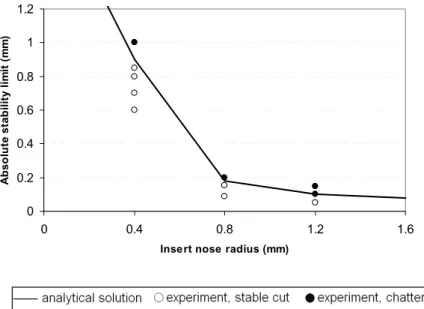
The analytically predicted stability diagram along with the experimental results is given in Figure 6. As the insert nose radius increases, the effect of workpiece dynamics (which is more flexible) on the chip thickness also increases. Therefore, the dynamic system becomes more flexible resulting in a decrease in the absolute stability limit. In order to explain this situation, firstly it should be noted that when the side edge cutting angle and insert nose radius are zero, the system dynamics are only controlled by the transfer function of the tool in the feed direction. The workpiece dynamics can only affect the dynamics of the cutting system if there is a side edge cutting angle, or the insert has a nose radius. In that case, if the workpiece is more flexible than the tool, the flexibility introduced to the dynamic system reduces the stability limit drastically. Comparing the experimental results and the analytical predictions presented in this section, a close agreement can be concluded.
4. MILLING DYNAMICS AND STABILITY
Milling is a very common process in industry due to its unmatched capability to produce complex 3D surfaces. Dynamics and stability of milling will be presented here with experimental results and applications.
0 0.2 0.4 0.6 0.8 1 1.2 0 0.4 0.8 1.2 1.6
Insert nose radius (mm)
A b so lu te st ab il it y lim it ( m m )
Figure 6. Chatter test results for the case with inserts having different nose radii.
4.1. Dynamic milling forces
The milling cutter and work piece are considered to have two orthogonal modal directions as shown in Figure 7. Milling forces excite both cutter and workpiece causing vibrations which are imprinted on the cutting surface. Each vibrating cutting tooth removes the wavy surface left from the previous tooth resulting in modulated chip thickness which can be expressed as follows:
( ) [
sin
cos
]
h
j
φ
= Δ
x
φ
j
+ Δ
y
φ
j
(33)where φj=(j-1)φp+φ is the angular immersion of tooth (j) for a cutter with constant pitch angle φp=2π/N and N teeth. φ=Ω.t is the angular position of the cutter measured with respect to the first tooth, Ω (rad/sec) being the rotational speed of the tool.
(a) (b)
Figure 7. (a) Cross sectional view of an end mill showing regeneration and dynamic forces, and (b) a closer look up to the dynamic chip thickness.
The static part of the chip thickness is neglected in the stability analysis. The dynamic displacements are defined as follows:
( ) ( ( ) ( o o c c w w o o c c w w ) ) x x x x x y y y y y Δ = − − − Δ = − − − (34)
where (xc, yc) and (xw, yw) are the dynamic displacements of the cutter and the work piece in the x and y directions, respectively. The superscript (o) denotes the dynamic responses in the previous tooth period which are imprinted on the cut surface. The dynamic cutting forces on tooth (j) in the tangential and the radial directions can be expressed as follows:
( )
( ) ;
( )
( )
j j
t t j r r t
F
φ
=
K ah
φ
F
φ
=
K F
jφ
(35)where a is the axial depth of cut, and Kt and Kr are the cutting force coefficients which are experimentally identified. After substituting hj from equation (33) into (35), and summing up the forces on each tooth (F=Σ Fj), the dynamic milling forces can be resolved in x and y directions as follows:
1
2
xx xy x y yx yya
a
F
x
aKt
F
a
a
y
⎡
⎤
⎧ ⎫
⎧ ⎫
Δ
⎪ ⎪ =
⎢
⎥
⎨ ⎬
⎨ ⎬
Δ
⎪ ⎪
⎢
⎥
⎩ ⎭
⎩ ⎭
⎣
⎦
(36) where α values are the directional coefficients due to the rotation of the tool which makes equation (36) time-varying :{
( )
}
1
[
( )
]
{
( )
2
tF t
=
aK A t
Δ
t
}
(37)[A(t)] is periodic at the tooth passing frequency ω=NΩ and with the corresponding period of T=2π/ω. The directional coefficient matrix [A(t)] is periodic at the tooth passing frequency ω=NΩ and can be expanded into its Fourier series:
[
( )
]
[ ]
r ir t r rA t
A e
ω =∞ =−∞=
∑
;[ ]
[
]
01
( )
T ir t rA
A t e
T
ω −=
∫
dt
) c (38) Thus, the stability problem has to be solved considering all significant frequencies. Budak and Altintas [7] used two different approaches to the stability solution of milling which will be given separately in the following.4.2. Stability of dynamic milling-Multi Frequency Solution
If the periodic components of [A(t)] are considered in the solution, then the response of the dynamic forces to these variations should also be included:
{
( )
}
i tc{ }
ik t{ }
( k it k k k kF t
e
ωF e
ωF e
ω ω ∞ ∞ + =−∞ =−∞=
∑
=
∑
(39)which is equivalent to Floquet’s theorem. The dynamic displacements can also be written as follows using the principle of superposition:
{ }
(
)
{ }
( c k )it(
p p c k kr
G i
ω
ik
ω
F e
ω ωp
∞ + =−∞⎡
⎤
=
∑
⎣
+
⎦
=
c w
, )
(40)[Gc(iω)] and [Gw(iω)] are the structural transfer function matrices of the cutter and the workpiece. The dynamic displacements for previous and current passes can be expressed as
{ }
o{
(
)
}
i Tc{ }
(
,
p p p
r
=
r t T
−
=
e
−ωr
p c
=
w
)
(41) Substituting into equation (37) the following is obtained:
{ }
[
]
[
]
{ }
{ }
[ ]
[
]
{ }
( ) ( ( )1
(1
)
( )
(
)
2
1
(1
)
(
)
2
c c c k it i t k it k t c k k k i t ik t i r k t k t r c k k r kF e
K a
e
A t
G i
ik
F e
F e
K a
e
A
G i
ik
F e
) c ω ω ω ω ω ωω
ω
ω
ω
∞ ∞ + − =−∞ =−∞ ∞ ∞ ∞ − + =−∞ =−∞ =−∞=
−
+
=
−
+
∑
∑
∑
∑ ∑
ω + ω (42)where the total transfer function can be determined by summing tool and workpiece transfer functions., i.e.
[
G i( )ωc] [
=G ic( )ωc] [
+G iw( )ωc]
. If both sides of (42) are multiplied by 1/Te-ipωt, and integrated from 0 to T, using the orthogonality principle the following is obtained:{ }
1
(1
)
[
(
)
]{ }
(
0, 1, 2,...)
2
c i t p t p k k kF
K a
e
ωA
G i
ω
ik
ω
F
p
∞ − − =−∞⎡
⎤
=
−
∑
⎣
⎦
+
= ± ±
(43)The above equation can be written in an infinite matrix form as:
{ }
{ }
{ }
[ ][
]
[ ]
[
]
[ ]
[
] [ ][
]
[ ]
[
]
[ ]
[
]
{ }
{ }
{ }
1 1 1 1 1 1 1 2 ( ) ( ) ... 1 (1 ) ( ) ( ) ... 2 ( ) ( ) ... ... ... c o o o c c i t t c o c c c F F A G i A G i i F F K a e A G i A G i i F F A G i A G i i ωω
ω
ω
ω
ω
ω
ω
ω
ω
− − − − − − ⎧ ⎫ ⎧ ⎫ ⎡ + ⎤ ⎪ ⎪ ⎪ ⎪ ⎢ ⎥ ⎪ ⎪= − + ⎪ ⎪ ⎢ ⎥ ⎨ ⎬ ⎨ ⎢ ⎥ ⎪ ⎪ + ⎪ ⎪ ⎢ ⎥ ⎪ ⎪ ⎣ ⎦⎪ ⎪ ⎩ ⎭ ⎩ ⎭ ⎬ (44)Equation (43) has nontrivial solutions if the determinant is zero:
[ ]
1
[
det
(1
)
(
)
0
2
c i T pkI
K a
te
ωA
p kG i
cik
δ
− −ω
⎡
−
−
⎡
⎤
+
⎤
⎢
⎣
⎦
⎥
⎣
ω
]
⎦
=
(45)where δpk is the Kronecker delta. Equation (45) defines an infinite determinant which is a characteristic of the periodic systems. A truncated version of this equation must be used to obtain approximate solutions. For the first order approximation, p, k=0, ±1, the following truncated determinant is obtained:
[ ]
[ ][
]
[ ]
[
]
[ ]
[
]
[ ]
[ ][
]
[ ]
[
]
[ ]
[
]
1 1 1 2(
)
(
)
...
det
(
)
(
)
...
(
)
(
) ...
o c c c o c c cI
A
G i
A
G i
i
A G i
I
A
G i
i
A
G i
A
G i
i
ω
ω
ω
ω
ω
ω
ω
ω
− − −⎡
+ Λ
Λ
+
⎤
⎢
⎥
+ Λ
+
⎢
⎥
⎢
⎥
Λ
Λ
+
⎢
⎥
⎣
⎦
ω
(46)where the eigenvalue
1
(1
)
2
c i T t
K a
e
−ωΛ = −
−
. The Fourier coefficients can be determined byintegrating equation (38) in the angular domain,
[
]
0( )
2
T iqN qN
A
A
θ
e
θπ
−⎡
⎤ =
⎣
⎦
∫
(47)Resulting in the following
1 2 1 2 1 2 1 2 ( ) 1 2 ( ) 1 2 ( ) 1 2 ( ) 1 2
2
1
2
1
2
2
ex st ex st ex st ex st ip ip q iqN xx o r ip ip q iqN xy o r ip ip q iqN yx o r ip ip q iqN yy o ri
c K e
c e
c e
c iK e
c e
c e
c K e
c e
c e
i
c K e
c e
c e
φ θ θ θ φ φ θ θ θ φ φ θ θ θ φ φ θ θ θ φα
α
α
α
− − − − − − − −⎡
⎤
=
⎣
−
+
−
⎦
⎡
⎤
=
⎣
−
+
+
⎦
⎡
⎤
=
⎣
+
+
⎦
⎡
⎤
=
⎣
−
−
+
⎦
(48) where 1 2 1 2 1 22
,
2
2
,
r,
op
Nq
p
Nq
K
i
K
c
c
c
Nq
p
p
= +
= −
ri
−
+
=
=
=
(49)
4.3. Stability of dynamic milling-Single Frequency Solution
In chatter stability analysis the inclusion of the higher harmonics in the solution may not be required for most cases as the response at the chatter limit is usually dominated with a single chatter frequency. Thus, it is sufficient to include only the average term in the Fourier series expansion of [A(t)] in which case the directional coefficients take the following form:
[
]
[
]
[
]
[
]
1
1
cos2
2
sin 2
;
sin 2
2
cos2
2
2
1
1
sin 2
2
cos2
;
cos2
2
sin 2
2
2
ex ex st st ex ex st s xx r r xy r yx r yy r rK
K
K
K
K
φ φ φ φ tK
φ φ φ φα
φ
φ
φ
α
φ φ
φ
α
φ φ
φ
α
φ
φ
=
−
+
= −
−
+
= −
+
+
= −
−
−
φ
(50)Then, equation (37) reduces to the following form:
{
( )
}
1
[ ]
0{
( )
2
tF t
=
aK A
Δ
t
}
(51) By substituting the response and the delay terms in equation (51), the following expression is obtained:{ }
F e
i tωc=
2
1
aK
t(1
−
e
−i Tωc)
[ ][
A G i
0(
ω
c)
]
{ }
F e
i tωc (52) Equation (52) has a non-trivial solution only if its determinant is zero,[ ]
[
0]
det
⎣
⎡
I
+ Λ
G i
(
ω
c)
⎤
⎦
=
0
(53) where [I] is the unit matrix, and the oriented transfer function matrix is defined as:
[ ] [ ]
G0 = A0[ ]
G (54) and the eigenvalue (Λ) is the same as in multi frequency solution:
(
1
)
4
c i T tN
K a
e
ωπ
−Λ = −
−
(55)4.4. Analytical generation of stability lobes in milling
The chatter stability limit can be determined by solving the characteristic equation of the closed loop milling system. For the single frequency solution, analytical determination of the chatter limit is possible whereas for the multi frequency solution an iterative algorithm needs to be used as both the chatter frequency and the spindle speed, which are dependent, appear in the determinant. Therefore, the formulation for single frequency solution is presented here, however similar procedure can be used for a general solution as it was shown by Merdol and Altintas [37].
If the cross transfer functions, Gxy and Gyx, in equation (54) are neglected, the eigenvalue can be obtained as flows 1 12 0 0
1
4
2
a
a
a
a
⎛
⎞
Λ = −
⎜
±
−
⎟
⎝
⎠
(56) where 0(
)
1 ( ) ( ) ( ) ( ) xx c yy c xx yy xy yx xx xx c yy yy c a G i G i a G i G iω
ω α α
α α
α
ω α
ω
= − = + (57)Since the transfer functions are complex, Λ will have complex and real parts. However, the axial depth of cut (a) is a real number. Therefore, the complex part of the equation has to vanish yielding
sin
1 cos
c I R cT
T
ω
κ
ω
Λ
=
=
Λ
−
(58)The above can be solved to obtain a relation between the chatter frequency and the spindle speed [7]: c
T
2
k
,
2
,
tan
1,
n
60
NT
ω
= +
ε
π
ε π
= −
ψ ψ
=
−κ
=
(59) where ε is the phase difference between the inner and outer modulations, k is an integer corresponding to the number of vibration waves within a tooth period, and n is the spindle speed (rpm). After the imaginary part in equation (55) is vanished, the following is obtained for the stability limit:lim
2
R( )
1
2 ta
NK
π
Λ
κ
= −
+
(60)Therefore, for a given cutting geometry, cutting force coefficients, tool and work piece transfer functions, and a chatter frequency ωc, ΛI and ΛR can be determined from equation (56), and can be
used in equations (59) and (60) to determine the corresponding spindle speed and the stability limit. When this procedure is repeated for a range of chatter frequencies and number of vibration waves, k, the stability lobe diagram for a milling system is obtained.
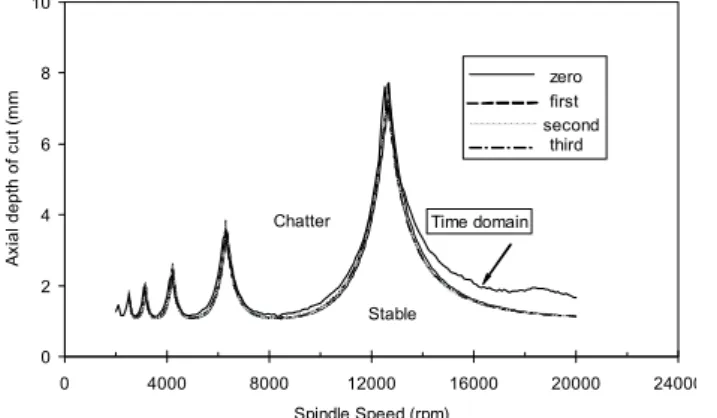
The analytical stability model presented can be used to generate stability lobe diagrams where variation of the stable axial depth of cut with the spindle speed can be shown. Figure 8 shows a sample stability diagram for a milling system analyzed in [38]. As the figure shows, the chatter free material removal rate can be increased substantially by using the high stability pockets. For example, in the first lobe (close to 12 000 rpm), the stability limit is about 5 times the critical (or minimum) stability limit. Note that the stability pockets become larger at higher speeds which is one of the impacts of high speed machining. The figure also shows that the analytical or single frequency solution, multi frequency solution and time domain simulations all converge to the same stability limit for this application.
0 2 4 6 8 10 0 4000 8000 12000 16000 20000 24000 Spindle Speed (rpm) A xial d ept h of cut ( m m Chatter Stable Time domain zero first second third
Figure 8. A sample stability diagram for a milling application.
As a second example, a case considered by Merdol and Altintas [37] is presented where the stability diagram is given in Figure 9. In this case, the stability of a very low radial immersion milling is analyzed. For those cases, the predictions of the single frequency solution may not be as accurate. This is mainly because of the increased Fourier series content in the directional coefficients, and thus in matrix [A], due to very short contact between the tool and the material resulting in a very short pulse-width waveform. Thus, higher harmonics in the Fourier series need to be included, and the truncated version of (46) must include more terms. As a result, many different combinations of the tooth frequency and the chatter frequency affect the system response, i.e. G(ikω±ωc), resulting in deviations from the single frequency solution. The stability diagram shown in Figure 9 demonstrates one major deviation from the single frequency solution, i.e. the added lobe which occurs only for very small radial immersion cases. However, the multi frequency solution is able to predict this phenomenon precisely.
4.5. Chatter suppression using variable pitch end mills
Variable pitch cutters have non uniform pitch spacing between the cutting teeth and may be very effective suppressing chatter. The non uniform pitch may disturb the regeneration mechanism, and if the angles selected appropriately the phase between the inner and outer modulation can be minimized. The fundamental difference in the stability analysis of milling cutters with non-constant pitch angle is that the phase delay is different for each tooth:
( 1,.., )
j c jT j N
ε
=ω
= (61)where Tj is the jth tooth period corresponding to the pitch angle φpj. The dynamic chip thickness and the cutting force relations given for the standard milling cutters apply to the variable pitch cutters, as well. The eigenvalue expression will take the following form due to the varying phase:
(
)
1 1 4 c j N i T t j a K e ωπ
− = Λ =∑
− (62)The stability limit can be obtained from equation (62) as:
lim
4
vp ta
K N C iS
π
Λ
= −
− +
(63) where (64) 1 1 cos ; sin N N c j c j j j Cω
T S = = =∑
=∑
ω
TAs alim is a real number, the imaginary part of equation (63) must vanish yielding [34]
limvp
4
I ta
K S
π
Λ
= −
(65)The optimization of pitch angles for a given milling system has more practical importance than the stability analysis for an arbitrary variable pitch cutter. Equation (65) indicates that in order to maximize the stability limit, ⏐S⏐ has to be minimized. From equation (64), S can be expressed as follows:
1 2 3
sin
sin
sin
...
S
=
ε
+
ε
+
ε
+
(66) where εj=ωcTj. The phase angle, which is different for every tooth due to the non-constant pitch, can be expressed as follows:1 ( 2,.., )
j j j N
ε
= + Δε
ε
= (67) where Δεj is the phase difference between tooth j and tooth (1) corresponding to the difference in thepitch angles between these teeth. The pitch angle variation ΔP corresponding to Δε can be determined as:
2
cP
ε θ
ε
π
ω
Δ
Ω
Δ =
=
Δ
(68)There are many solutions to the minimization of ⏐S⏐, i.e. (S=0). It can be found out by intuition that S=0 for the following conditions [34]
2
(
1, 2,...,
1
k
k
N
N
)
π
ε
Δ =
=
−
(69)The corresponding ΔP can be determined using equation (68).
The increase of the stability with variable pitch cutters over the standard end mills can be determined by considering the ratio of stability limits. For simplicity, the absolute or critical stability
0 2 4 6 8 1 0 0 0 ,2 5 0 ,5 0 ,7 5 1 Δ ε r ε1= π/4 ε1= π ε1= 3/2π x 2π
limit for equal pitch cutters, i.e. the minimum stable depth of cut regardless of the spindle speed, are considered. The absolute stability limit is the minimum stable depth of cut without the effect of lobing which can be expressed as follows:
4
I cr ta
NK
π
Λ
= −
(70)Then, the stability gain can be expressed as limvp cr
a
N
r
a
S
=
=
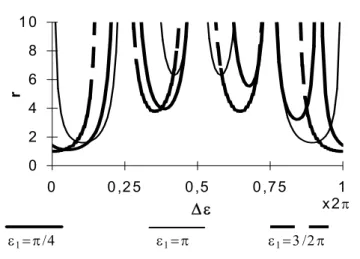
(71) r is plotted as a function of Δε in Figure 10. for a 4-tooth milling cutter with linear pitch variation. The phase ε depends on the chatter frequency, spindle speed and the eigenvalue of the characteristic equation. Therefore, the stability analysis has to be performed for the given conditions. Three different curves corresponding to different ε1 values are shown in Figure 10 to demonstrate the effect
of phase variation on r. r is maximized for integer multiples of 2π/N, i.e. for (1/4, 1/2, 3/4)x2π.
Δε+k2π (k=1, 2, 3,... ) are also optimal solutions, however, they result in higher pitch variations which is not desired.
Figure 10. Effect of ε1 on stability gain for a 4-fluted end mill with linear pitch variation.
5. MACHINE TOOL DYNAMICS
Dynamic rigidity is one of the most critical characteristics of machine tools especially for high precision and high performance machining applications. It determines the dynamic response of the machine structure to cutting forces and inertial loads during the acceleration and the deceleration of the axes. High amplitude vibrations in response to these loads may result in poor machined part quality and potential damage to the machine. A machine tool’s dynamic rigidity depends on many factors such as its configuration, size, construction method etc. The overall dynamic rigidity in a machining system depends on all of the components involved, i.e. machine tool, tooling, fixtures, workpiece etc. Therefore, the rigidity of all components in a machining system is critical as the one with the lowest rigidity usually determines the rigidity of the whole system.
Machine tool vibrations exhibit some special characteristics compared to other machinery. The most important type of machine tool vibrations, chatter, is a result of the interaction between the cutting process and the machine structure. It must be noted that chatter may develop even if there is no external periodic excitation. Thus, chatter is a self-excited vibration type which develops at one of the natural modes of the structures, normally the most flexible one at the point of contact between the cutting tool and the work material. Therefore, the dynamic rigidity, which can be represented by the receptance or frequency response function of the structure at the point of interest, is the fundamental information to be used in the machine tool dynamics and chatter stability analyses. This is different than most other structural analysis applications where the focus is mainly on the modal frequencies in
order to predict and avoid the resonance. In the analysis of machine tool dynamics, the amplitude of the dynamic response is the most relevant and important information. In this section, important aspects of experimental methods will be reviewed, and a novel analytical method based on structural dynamics methods for machine tool dynamics modeling will be presented.
5.1. Experimental methods
Dynamic testing has been the most common method of machine tool dynamic analysis. The frequency response function (FRF) or the Transfer Function (TF) can be generated using several experimental methods. The main idea is to excite the structure at a certain frequency and location, and determine its dynamic response at the same or a different point. When this is repeated for a range of frequencies, the frequency response or the transfer function at the relevant point is obtained. The excitation to the structure can be provided by an electromagnetic or hydraulic shaker where its tip is fastened to the point of interest. Although the response can be measured by many different sensor types such as displacement or velocity transducers, the most common method is to use accelerometers. As the shaker generates a harmonic force at a certain frequency both force and the response signals are recorded. Then, the frequency response at this particular frequency can be directly determined from the ratio of the response amplitude to the force amplitude. The phase information can also be obtained from the recorded data. Although the data processing part is quite straightforward, this method has several disadvantages. First of all, the shaker can be a costly instrument compared to other alternatives. Also, it needs to be fastened to the structure which requires some sort of permanent modification such as drilling and threading a hole. Furthermore, the test can be quite time consuming as it needs to be repeated for many frequencies in the range of interest.
A more practical approach is to use Fourier analysis where an impulsive force instead of a harmonic one can be used to excite a wide range of frequencies in one test. This can be done since theoretically an ideal impulse function with infinitesimal impulse period, i.e. 0+, contains infinite number of
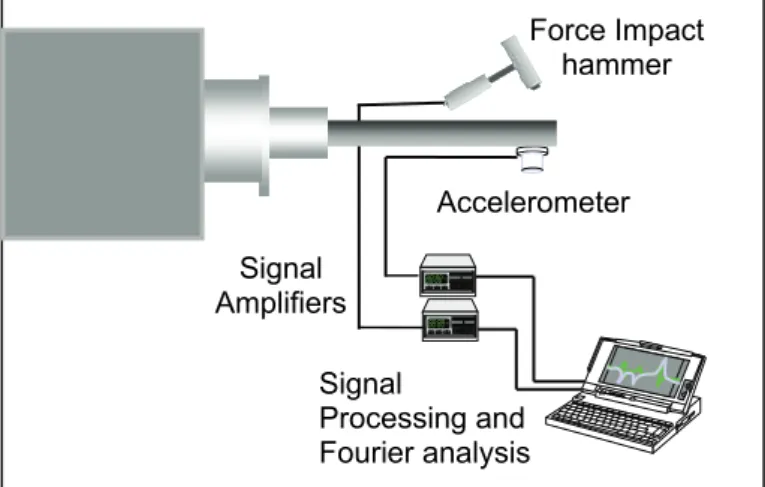
frequencies which can be shown by Fourier analysis. Thus, the idea is to use the Fourier transform of input and output signals to determine the entire frequency response function in one test. This approach has been commonly used in impact tests where a point on the structure is excited using an instrumented hammer and the response at the same or another point is measured by a sensor, usually an accelerometer. A schematic view of a typical impact test set-up is shown Figure 11. The impact hammer is instrumented with a force sensor to capture the applied impact force. Piezoelectric crystals are commonly used sensor types for the force and acceleration measurements, and they may need charge amplification before the data can be acquired by a computer through analogue to digital conversion. It should e noted that An accelerometer with a large mass will affect the dynamics of the structure due to the added mass yielding erroneous measurements whereas a very small accelerometer may not have the required sensitivity especially in the low frequency range. The hammer size and its tip geometry are other important decisions in the dynamic tests. The hammer size and the tip must be selected properly to provide sufficient excitation to the structure for the required frequency range.
Signal Processing and Fourier analysis Accelerometer Signal Amplifiers Force Impact hammer
In order to obtain the FRF, the measured input and the output are transferred to the frequency domain using the Fourier analysis. As a result, the TF between the response measurement point (i) and the force application point (j) can be obtained as follows:
( )
( )
( )
i ij jX
G
F
ω
ω
ω
=
(72)When the response and the excitation at the same point (i) are considered, then the direct FRF at this point is obtained. Note that since usually the transfer function in terms of displacement, X, is needed in the dynamic analysis, the accelerometer signal needs to be integrated. In general, in an FRF there can be contributions of many structural modes of the measured structure. Therefore, for a general case, multi mode identification methods using curve fitting and error minimization techniques must be used. However, for most structures these modes are well separated, and only a couple of modes (sometimes even just one) dominate the dynamic response of the structure at the point of interest. Although for chatter stability analysis only the transfer function at the tool tip is required, the measurements at different points, and between different points, should be performed to determine the full dynamic behaviour of the machine tool. By performing the impact test at different points either by moving the response or the impact points the FRF matrix, [G], can be obtained where:
{ } [ ]{ }
X
=
G F
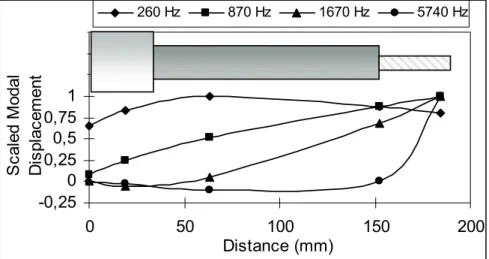
(73) The FRF matrix is also useful to determine the mode shapes. In many cases it is necessary to determine the component which is responsible for vibrations. This cannot be determined through a single FRF measurement whereas it can easily be identified from mode shapes. If for example, the excitation is given at point 1, the amplitudes of G11, G12, G13 etc. at the first resonance peak can be used to determine the first mode shape, and in the second peak for the second mode shape etc. Figure 12 shows the mode shapes of tool assembly on a horizontal machining center. The assembly includes a long tool adapter which is necessary for accessibility to deep pockets on the part but makes the system very flexible. As it can be seen from the figure, the first mode (260 Hz) is the spindle mode as the displacement in the rest of the assembly is relatively small. The second and the third modes belong to the holder and the adapter, respectively. The last mode shown at 5740 Hz is the tool mode where the elastic displacement of the tool can be clearly seen.-0,25 0 0,25 0,5 0,75 1 1,25 1,5 1,75 0 50 100 150 200 Distance (mm) S cal ed M odal D isp la ce m en t 260 Hz 870 Hz 1670 Hz 5740 Hz
Figure 12. Mode shapes of a tool assembly on a horizontal machining center. 5.2. Analytical modeling of machine tool dynamics
The use of experimental modal analysis may not be very practical always especially for production applications where many combinations are possible. In order to reduce experimentation, the receptance coupling theory of structural dynamics can be used [20-25]. This method is based on the coupling of component dynamics analytically, and can be used effectively for modeling dynamics of complex structures provided that the component dynamics are known.
Ertürk et al. [22-25] presented an analytical model to predict the tool point FRF by modeling all components of the spindle-holder-tool assembly analytically. They used Timoshenko beam theory, receptance coupling and structural modification techniques. Due to the high length to diameter ratios of many spindle and tool sections, Euler-Bernoulli beam model may result in considerable errors in prediction of modal frequencies which is significantly improved using Timoshenko beam formulation. Spindle, holder and tool are modeled as multi-segment beams by using Timoshenko beam theory. The individual multi-segment components are formed by coupling the end point receptances of uniform beams rigidly. Determination of the end point receptances of a uniform Timoshenko beam with free end conditions is given in [22] in detail. The end point receptance matrix of a beam A can be represented as
[ ]
11
12
21
22
A
A
A
A
A
⎡
⎡
⎣
⎤ ⎡
⎦ ⎣
⎤
⎦
⎤
⎢
⎥
=
⎢
⎡
⎣
⎤ ⎡
⎦ ⎣
⎤
⎦
⎥
⎣
⎦
(74) where sub matrices of the above matrix include the point and transfer receptance functions of the segment end points (1) and (2). For example, the point receptance matrix of node A1 in beam A is given as[ ]
11 1 1 1 1 (75) 1 1 1 1 A A A A A A A AH
L
A
N
P
⎡
⎤
= ⎢
⎥
⎣
⎦
The receptance functions, which are denoted by letters H, N, L and P, are defined as follows:
j jk k j jk k j jk k j jk k
y
H
f
N
f
y
L
m
P
m
θ
θ
=
⋅
=
⋅
=
⋅
=
⋅
(76)where y and θ represent the linear and angular displacements, respectively, and f and m are the forces and the moments, respectively, at the points i and j. Two beams, A and B, can be coupled dynamically using rigid receptance coupling and the receptance matrix of resulting two-segment beam C can be obtained as follows:
[ ] [ ] [ ]
[ ] [ ]
11 12 21 22C
C
C
C
C
⎡
⎤
= ⎢
⎥
⎣
⎦
(77) where[ ] [ ] [ ] [ ] [ ]
[ ]
[ ] [ ] [ ] [ ]
[ ]
[ ] [ ] [ ] [ ]
[ ]
[ ] [ ] [ ] [ ] [ ]
[ ]
1 11 11 12 22 11 21 1 12 12 22 11 12 1 21 21 22 11 21 1 22 22 21 22 11 12C
A
A
A
B
A
C
A
A
B
B
C
B
A
B
A
C
B
B
A
B
B
− − − −⎡
⎤
=
−
⋅
⎣
+
⎦
⋅
⎡
⎤
=
⋅
⎣
+
⎦
⋅
⎡
⎤
=
⋅
⎣
+
⎦
⋅
⎡
⎤
=
−
⋅
⎣
+
⎦
⋅
(78)By following the same formulation, one might continue coupling more segments like a chain to form an n-segment beam. In order to include the dynamics of bearings, A structural modification technique presented by can be used as shown in detail in [22]. In this case, the dynamic structural modification matrix represents the translational and rotational, stiffness and damping information of the bearings. The final step is to couple the main system components to obtain the tool point FRF. However, these components should be coupled elastically due to the flexibility and damping at the contacts. When the end point receptances of the spindle on bearings (S) are coupled with those of the holder (H), the end point receptance matrices of the spindle-holder assembly (SH) can be obtained from:
[
] [ ] [
] [
]
[ ]
1[ ] [
111 11 12 22 sh 11 21
[Ksh] is the complex stiffness matrix representing the spindle-holder interface dynamics. Note that the receptance matrix [SH11] is very similar to [C11] given in equation (78) with the addition of [Ksh]-1 only. Finally, the tool (T) can be added to the spindle-holder (SH) system to obtain the end point FRFs of spindle-holder-tool (SHT) assembly. The FRF required for the stability lobe diagram of a given spindle-holder-tool assembly is the one that gives the relation between the transverse displacement and force at the tool tip, which is the first element of the following
[
] [ ] [ ] [ ]
[ ]
1[
] [
111 11 12 22 ht 11 21
SHT
=
T
−
T
⎡
⎢⎣
T
+
K
−+
SH
⎤
⎥⎦
−T
]
(80) As an example application, consider the geometry of the spindle-holder-tool combination shown in Figure 13. Each of the system components, i.e. spindle, holder and tool are composed of several sections with different diameter and lengths which are modeled as multi-segment beams. The dimensions of the components, bearing and interface dynamical properties are given [22]. In order to verify the results of the model, the vibration modes of this assembly were calculated using the finite element method using ANSYS® 9.0. The beam element, which is based on Timoshenko beam theory, is used by restricting the degrees of freedom other than motion in one transverse direction and flexural rotation so that the finite element model is consistent with the model. The natural frequencies obtained by the analytical model and the finite element solution are tabulated in Table 2. As can be seen from the table, the natural frequencies of the assembly obtained by the model presented in this paper and those obtained by using the finite element software are in good agreement and the maximum difference observed for the first seven modes is about 5 %.Table 2. Natural frequencies of the assembly. Mode Model [Hz] FEA [Hz] Diff. [%] 1 71.7 71.6 0.14 2 195 193.8 0.62 3 877.8 867.5 1.19 4 1438.3 1424.3 0.98 5 1819.5 1752.6 3.82 6 3639.3 3442.5 5.72 7 3812.5 3634.8 4.89 Figure 13. Components of the assembly used
in the example.
5.3. Interface parameters
One important element of machine tool dynamics modeling, or the receptance coupling method in general, is the connection parameters between the components. They may affect the overall response, however there is no accurate modeling methods to predict them. Even experimental identification of these parameters can be quite challenging due to the existence of many unknown parameters in an assembly. However, this task can be simplified by analyzing the effects of parameters in each individual connection on the total response. It was observed [24] that the dynamics of the front bearings primarily control the first rigid body mode whereas the rear bearings mainly affect the second rigid body mode. This also implies that if chatter develops in one of the first two modes, changing the holder or the tool may not help. It is also observed that the translational stiffness at the spindle-holder interface dominantly affects the first elastic mode of the FRF. Furthermore, the rotational stiffness at the same interface has almost negligible effect on the FRF [24]. A similar analysis is performed in order to study the sensitivity of FRF to the holder-tool interface dynamics. It is observed that the translational stiffness strongly controls the second elastic mode. Similar to the spindle-holder interface, the rotational stiffness at this connection has negligible effect on FRF. Therefore, the observations made so far indicate that, for the first elastic mode, spindle-holder interface is the most important link in the chain, whereas the same is true for holder-tool interface for
the second elastic mode in this case study. The connection damping values have similar effects, but on the FRFs peak amplitudes instead of the frequencies. For example, it is observed that the front bearing damping affects the FRF values at the first rigid body mode, translational contact damping at the spindle-holder interface mainly alters the peak value of the first elastic mode etc. [24].
5.4. Example case
A BT40 type holder in which a carbide tool of 12.7mm diameter and 175mm length is inserted with an overhang length of 74 mm is assembled to the free spindle shown in Figure 14. The measured FRF and the model simulation of the tool point FRF are given in Figure 15. The interface parameters were identified experimentally [23]. The agreement between the measured and the predicted FRF can be considered as satisfactory.
Figure 14. Spindle suspended for free-free measurements.
Figure 15. Measured and predicted tool point FRF of the assembly.
5.5. Application to chatter suppression
The analytical machine tool dynamics model presented can be effectively used in chatter suppression which is presented in this section. An SK40 type holder, in which a 4-teeth HSS tool of 110.7 mm length and 12 mm diameter is inserted, is assembled to the 5-axis machining center shown in Figure 16. Tool point FRF of the assembly is measured by impact test at the tool tip using a low mass accelerometer and an instrumented hammer. It is aimed in this section to predict the variations in the resulting FRF for different overhang lengths in order to improve chatter stability by selection of the tool length. The predictions are compared with experimental results for the verification of the approach employed. The translational interface dynamic parameters are identified by following the approach suggested in [24] using the experimental results for L=60 mm. The average values given in the literature are used for the rotational dynamic parameters at spindle-holder and holder-tool connections, since the required FRF values are insensitive to these values as concluded in the above
referred paper. The experimentally obtained tool point FRF and the model prediction for L=60 mm for are shown in Figure 16.b.
Figure 16. (a) 5-axis machining center with the experimental modal analysis setup and (b) measured and predicted tool point FRF for the overhang length L=60 mm.
Figure 17. Experimental and predicted tool point FRF; (a) 70 mm overhang length and (b) 80 mm overhang length.
The dominant mode appearing at 1594 Hz is the tool mode, and thus its frequency can simply be altered by changing the overhang length of the tool. Overhang length of the tool is changed from 60 mm to 80 mm with an increment of 10 mm while keeping the clamping torque constant at 40 N.m. It is assumed that holder-tool interface dynamic parameters do not change with changing overhang length. Figure 17a and 17b show the predicted and measured tool point FRFs for 70 mm and 80 mm tool overhang lengths, respectively. Note that, accurate knowledge of the variation in contact dynamics (especially damping) with tool overhang length would certainly improve the accuracy of the FRF predictions. That is, a mathematical model for contact stiffness and damping, or a methodology which provides this information for different clamping lengths, torques and tool types by using a limited set of experiments would yield more accurate theoretical results for FRF predictions. As the overhang length of the tool is increased to 70 mm, the tool mode approaches to the small amplitude spindle mode seen around 1220 Hz, which slightly increases amplitude of the latter. Furthe