A Radically Assembled Design-Engineering Education
Program with a Selection and Combination of Multiple
Disciplines*
KWANMYUNG KIM, NAMHUN KIM,1SEONHEE JUNG, DUCK-YOUNG KIM,
YOUNGSHIN KWAK and GYOUHYUNG KYUNG
School of Design and Human Engineering, Ulsan National Institute of Science and Technology, Ulsan, Korea
A radically assembled design-engineering program in the school of Design and Human Engineering (DHE) at Ulsan National Institute of Science and Technology (UNIST), newly founded in 2009, is presented. The most distinctive feature in DHE is that all students are required to select two disciplines for their major among three major disciplines, which are; (i) Integrated Industrial Design, (ii) Affective and Human Factors Engineering, and (iii) Engineering and Systems Design. The DHE’s major system of the new design-engineering program was developed to foster the next generation designers and engineers, having talent in not only creative ideation but also systematic realization. In this paper, we first describe the founding background, educational rationale and curriculum structure. The curriculum includes students’ selective curriculum paths based on their talent and aptitude; collaborative education structure as well as multidisciplinary team-based project courses taught by groups of instructors from different disciplines. Then, the new design-engineering education program is assessed in both quantitative and qualitative ways. The first step of the research is to assess the students’ core competencies required in design-engineering combined program by using K-CESA (Korea Colligate Essential Skill Assessment) with 32 students enrolled in DHE. A phenomenological study is also conducted to understand the problems in the current program via in-depth interviews with representative students in DHE. Also, a creative trans-disciplinary short course for students from other universities with various majors (e.g., engineering and design) was offered and tested to evaluate the combined educational system. Finally, we propose the direction for curriculum improvement and follow-up assessment plans, including assessments for students and faculty.
Keywords: combined design and engineering education; interdisciplinary education; education curriculum
1. Introduction
The rapid change of technology, society, and global economy requires integrated knowledge and skills in different areas. Especially, in design and engineer-ing fields, integration among heterogeneous knowl-edge and skills is the key to achieving the successful creation of new products or systems that result from solving multi-faceted problems. The competencies required in these areas should not be independent or static but dynamically integrated among a variety of components [1]. They are trained with common principles between design and engineering disci-plines; 1) learning by doing, 2) teaching from exemplars to generalizations, and 3) learning from each other and respecting each other’s skills and perspectives [2]. Engineering & design education has been changed on these principles to meet the requirements so that related educational programs have provided students with the opportunities to learn and practice from multiple disciplines. How-ever, there are limitations in current interdisciplin-ary design and engineering education systems.
Many of them provide combined educational pro-grams in course/class level but not in discipline/ program level. Even a few progressively combined educational streams in discipline level stick to mostly physical connection between different pro-grams, like a dual degree system with a major and a minor [3].
In industry, designers and engineers are working together in product development processes with different perspectives; designers focus on develop-ing conceptual ideas while engineers are more inter-ested in physical and technical feasibilities. Even though demands from markets and product requirements are becoming increasingly complex, smooth collaboration between design and engineer-ing fields have never been more emphasized [4]. Traditionally, for instance, industrial designers and human factors engineers have a responsibility of utility, appearance, ease of maintenance for a product while engineering designers and manufac-turing engineers work on product performance, functionality and production cost. However, in modern engineering design, the heterogeneous design activities should be joined together within a closed loop by communicating with each other [4–6].
* Accepted 4 March 2012.
904
In academia, however, most curriculums related to product development process are traditional and single-discipline-based. Industrial design and pro-duct design usually are educated in two different schools; an engineering school, and an arts and/or architecture school. The first stresses technical or engineering expertise and the second on aesthetic or arts expertise [7]. Even though some design schools teach engineering knowledge and skills, they are still isolated from systematic engineering-based approaches [8–10].
The expert we aim to produce through integrated design engineering education is a -shaped (inter-disciplinary T-shaped) person, who already has a deep interdisciplinary knowledge with holistic perspectives across two different disciplines. A T-shaped person is described as an expert in a specific field with general knowledge across disciplines [11]. This has been considered as an ideal person since the 1990s, and companies want to hire them more and more in service-product combined industries. In the 21st century, often referred to as a ‘knowledge-based society,’ a knowledge circulation cycle is getting shorter and fused knowledge gradually emerges. Not only technical skills but also concep-tualization skills, communication skills, teamwork, creativity and strategic thinking are what designers and engineers should have along with more than two specialties [10]. In this reason, DHE at UNIST designed its own curriculum with a radical combi-nation of design and engineering disciplines. UNIST, newly founded in 2009, started with multi-disciplinary educational systems. Each school con-sists of three or four tracks (disciplines) which have the potential to make a synergy among different disciplines by radical academic integration and collaboration [12, 13]. DHE has three major tracks on product development; Integrated Indus-trial Design, Affective and Human Factor Engineer-ing, and Engineering & Systems Design. The curriculum provides selective curriculum paths through combined double majors. Students can select two disciplines and integrate them as an interdisciplinary major.
The DHE design-engineering combined program has been offered since 2009 and improved upon over the past three years. However, a program assess-ment or evaluation has yet to be performed. Thus, in this paper, assessment methods for the program evaluation and future control plans for continuous curriculum improvement are also suggested to bridge the gap between industry needs and educa-tional systems. To this end, the assessment methods used in this research are introduced, including K-CESA and phenomenological study with in-depth student interviews. The data acquired using these assessment methods are analyzed with
considera-tion of student performance (GPA and reputaconsidera-tion by faculty). The assessment results are presented and carefully investigated. Then, based on these analysis results, the extensive program improve-ment plan is proposed at the end of this paper. The continuous improvement and assessment plan for the proposed education program can help us to raise the next generation design-centric engineers and engineering-centric designers.
The remainder of this paper is organized as follows: In section 2, the background and rationales of the DHE curriculum design are presented. Curri-culum structure is detailed in Section 3 followed by the program assessment methods including both quantitative and qualitative studies in Section 4. We analyze and discuss the evaluation results in Section 4 as well, followed by the assessment and future follow-up plans in Section 5. Finally, we provide concluding remarks in Section 6. By sug-gesting assessment and future control plans for the newly developed design-engineering assembled edu-cational program proposed in this paper, we offer a novel and extensive approach to develop a multi-disciplinary design-centric engineering program.
2. Setting up an educational direction
To come up with a radically assembled design and engineering program, surveying and benchmarking the world leading schools in design and engineering fields were performed by interviewing professors including chair professors or department heads and students. Opinions of senior experts in design and engineering were collected as well. Conse-quently three principles for DHE education direc-tion have been established.
2.1 Benchmark
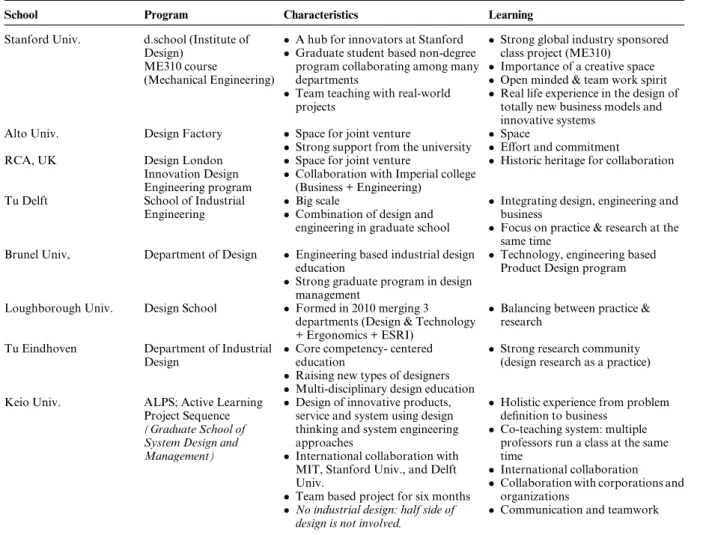
Eight leading schools in interdisciplinary education in design and engineering fields were selected for benchmarking (Table 1). We visited the campuses and interviewed with professors and students. Fol-lowings are some of the key findings from the visits. 1. Holistic experience from ‘problem definition’ through ‘problem solving’ to ‘proposing busi-ness models’ is essential in interdisciplinary design and engineering education.
2. Real life experience rather than class-based experience is needed in the design of totally new business models and innovative systems. 3. Collaboration with companies and universities
is pursued to support the preceding two princi-ples.
4. In order to have success in building and running a combined education system, devoted educa-tors and colleagues’ mutual understanding and
collaboration toward common goals are essen-tial.
5. Physical space is vital to support combining disciplines and connecting education, research and business.
6. Outcomes of student activities are commercia-lized.
7. A balanced program of research and practice is sought.
8. Openness toward other disciplines and courses is promoted.
9. Flexible courses are created based on student ability and condition.
We realized that many design and engineering schools had reformed their curriculums to a certain extent to cope with society and industry demand (e.g. [4, 7, 14–17] ). Many of them are focused on communication skills, teamwork, lifelong learning and ethics which are thought as required elements for being engineers [7]. Some schools started new courses to utilize the above elements through acad-emy and industry collaboration, active learning, and problem-based learning [14–15]. There were many cases of education reforms at the course
level but not in the overall curriculum structure. Moreover few had radically reformed curriculums.
2.2 Consultancy from experts
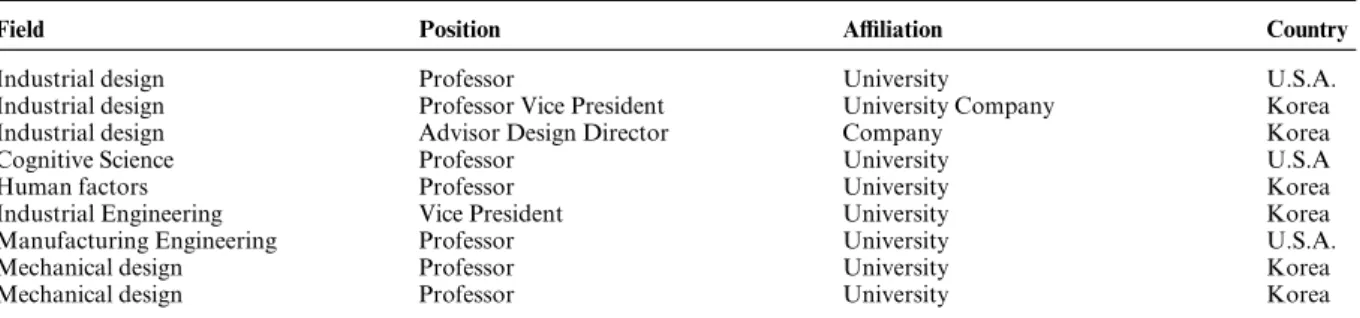
Interviewed with outside experts to get advice about DHE’s education direction has been conducted and the list of the expert advisors is as shown in Table 2. Some of them were well-known senior professors in either the design or engineering field and the others were industry experts in senior management. Their advice was as diverse as their academic backgrounds and industrial experiences. Most of them agreed that a combination of industrial design, human factors engineering and systems engineering is necessary and promising. Advisors from design fields pointed out the weakness of art-based design education and mentioned that knowledge about engineering and technology should be taught to design students. A professor of cognitive scientist, actively working in the field of design, raised ques-tions on drawing-based education in design schools and insisted that the meaning of sketching and prototyping should be changed in this era. He argued that design ideas can be expressed with Table 1.Benchmarked education programs
School Program Characteristics Learning
Stanford Univ. d.school (Institute of Design)
ME310 course
(Mechanical Engineering)
A hub for innovators at Stanford
Graduate student based non-degree program collaborating among many departments
Team teaching with real-world projects
Strong global industry sponsored class project (ME310)
Importance of a creative space
Open minded & team work spirit
Real life experience in the design of totally new business models and innovative systems
Alto Univ. Design Factory Space for joint venture
Strong support from the university
Space
Effort and commitment
RCA, UK Design London
Innovation Design Engineering program
Space for joint venture
Collaboration with Imperial college (Business + Engineering)
Historic heritage for collaboration Tu Delft School of Industrial
Engineering
Big scale
Combination of design and engineering in graduate school
Integrating design, engineering and business
Focus on practice & research at the same time
Brunel Univ, Department of Design Engineering based industrial design education
Strong graduate program in design management
Technology, engineering based Product Design program Loughborough Univ. Design School Formed in 2010 merging 3
departments (Design & Technology + Ergonomics + ESRI)
Balancing between practice & research
Tu Eindhoven Department of Industrial Design
Core competency- centered education
Raising new types of designers
Multi-disciplinary design education
Strong research community (design research as a practice) Keio Univ. ALPS; Active Learning
Project Sequence (Graduate School of System Design and Management)
Design of innovative products, service and system using design thinking and system engineering approaches
International collaboration with MIT, Stanford Univ., and Delft Univ.
Team based project for six months
No industrial design: half side of design is not involved.
Holistic experience from problem definition to business
Co-teaching system: multiple professors run a class at the same time
International collaboration
Collaboration with corporations and organizations
logical diagrams and electronic prototyping beyond traditional paper-based sketch and dummy mock-ups. He asked us if students in a new curriculum should even follow a balanced between design and engineering. Another professor from Industrial Design worried about the difficulty of combining design and human factors engineering, arguing that the two fields had extremely different perspectives on product design; one uses institution and creativ-ity but the other relies on a very direct and mathe-matical measure. Most advisors emphasized that a faculty’s effort to pursue the expected education curriculum based on a strong understanding of one another was the most important factor for successful implementation of an education system.
2.3 Three principles
Based on our discussion, benchmarking results, and consultancy from experts, we set up three principles to establish a new education curriculum as follows: 1. Radically assembled education through inte-gration of adjacent disciplines related to pro-duct development, Industrial Design, Human Factors Engineering and Systems Engineering. New designers and engineers should be educated in a combined area of the three so that they can play a leading role in a product development team. 2. Selective curriculum paths through combined
double major systems.
Students’ abilities and aptitudes are different from one another even if they work in the same major. However, most current educational systems cannot provide a variety of students with adaptive curricu-lums for their characteristics. Therefore, the curri-culum should be able to provide several paths for students to select based on their ability, aptitude and future vision. This is possible through a combined double major. To do this, we classified several curriculum paths and defined combined courses that support them. They are co-taught by multiple instructors with different academic backgrounds. For example, design methods can be taught in a product design course by a group of instructors
whose backgrounds are industrial design, engineer-ing design, manufacturengineer-ing design, and ergonomics, respectively.
3. Holistic experience, teamwork, communication skill, professional attitude for leading designers and engineers.
Students need to experience real world problems through team-based course projects, in which they can learn the above skills by collaborating with team members coming from different backgrounds. While doing projects, they should experience a complete product development cycle from problem finding to business launching by blending various design and engineering skills.
3. Curriculum structure
UNIST offers two semesters in a year. Each seme-ster has 16 weeks and students normally take eight semesters for four years in order to graduate. In the first year, students take courses about general science, math, and liberal arts. From the second year, students choose a major to pursue.
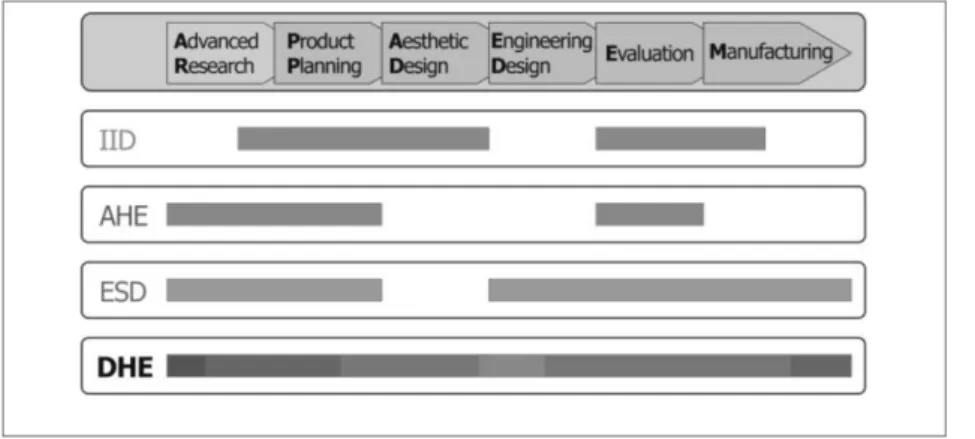
3.1 Track introduction
DHE tracks (majors) are defined based on the three principles under a theme, ‘product development’ in order that they have close connection to one another (Figs 1 and 2). They are Integrated Industrial Design Track (IID) covering new design concept development, Affective and Human Factors Engi-neering Track (AHE) dealing with human perfor-mance and limit and Engineering & Systems Design Track (ESD) working on system performance and manufacturing. Thus DHE education structure is lined up with three different disciplines along the product development process.
(1) Integrated Industrial Design (IID)
The IID track is designed to foster creative designers who can lead the innovative design of product and product-service systems. It provides interdisciplin-ary courses on design knowledge, methods and techniques across the entire product development Table 2.Expert advisors
Field Position Affiliation Country
Industrial design Professor University U.S.A.
Industrial design Professor Vice President University Company Korea
Industrial design Advisor Design Director Company Korea
Cognitive Science Professor University U.S.A
Human factors Professor University Korea
Industrial Engineering Vice President University Korea
Manufacturing Engineering Professor University U.S.A.
Mechanical design Professor University Korea
process, which relate to analyzing users and mar-kets, searching unmet needs, generating creative ideas, developing form and function, prototyping and starting up new business.
(2) Affective & Human Factors Engineering (AHE) The AHE track is designed to produce experts who have expertise in human behavior, mental pro-cesses, anatomy and physiology as well as design development, evaluation of work method, environ-ments, technologies, and systems. Students learn interdisciplinary knowledge and functions of human physical/cognitive systems and HCI (human computer interaction) as well as general ergonomics, and affective engineering.
(3) Engineering & Systems Design (ESD)
The ESD track is designed to foster systems designers who have a viewpoint of the design activity from sketching to the logical engineering process of creating something new and think not only creatively, but also systematically for the design of products, processes or other systems.
The track provides the student with essential engi-neering design knowledge and tools to begin a productive professional career. Furthermore, it teaches the student how to plan and manage the entire product development process.
In this structure, we aim to educate the student whole product development process while they learn related discipline-specific expertise from two particular majors.
3.2 Selective curricular paths in a double major system
All UNIST students must select two tracks as their major. Track selection is made after the second semester. They can change their tracks at the con-clusion of year one. Most students have determined their majors after finishing the second semester, but changing their major is an available option after the first year to the third year, with the ratio of change lesser at higher years of study.
In the combined double major system with three disciplines in DHE, there can be six combined curricular paths which are student-selective (Fig. 3). For example, a student can select IID as the first track and ESD as the second track (the fifth case in Fig. 3) or vice versa (The second case in Fig. 3). The first track is differentiated from the second by which students take more courses from the first. In the fifth case in Fig. 3, students (IID as the first track and ESD as the second) can be ‘Industrial Designers with Engineering and System Design expertise’. They will learn field-specified knowledge of Indus-trial Design and Engineering and Systems Design through courses provided by IID and ESD tracks, integrated knowledge of Industrial Design and Engineering and Systems Design through combined courses co-taught by instructors from the two tracks, and interdisciplinary knowledge covering whole product development process by taking DHE required courses co-taught by multiple Fig. 1.Three tracks in DHE.
instructors from three tracks. In this way, they can acquire design and engineering expertise in depth and breadth. This will have the students play leading roles in product development teams because they will already understand whole product develop-ment process from a specialized knowledge level to the holistic. This is the approach UNIST takes to raise-shaped experts.
3.3 Five course categories
To effectively strengthen the combined double major system, the curriculum structure was created as shown in Fig. 4. We analyzed commonalities and differences among three disciplines and classified and defined five course categories; DHE combined courses, two-track combined courses, each track required courses, each track elective courses, and required courses only for the first track.
3.3.1 DHE combined courses
DHE Combined Courses are those all students in DHE, regardless of their majors, must take to learn and experience whole product development process by doing design projects in an interdisciplinary team basis; courses defined as the triangular area in the center of Fig. 4. Through the courses, students define problems, use design and engineering meth-ods to solve problems and finally show solutions with prototypes as well as business models. A group of professors from three tracks collaboratively teach the courses together with team teaching and co-teaching methods. Two courses are designed; ‘Designing Thinking’ and ‘Creative design’. Design thinking: This course is offered in the first
semester of the 2nd year as an introductory course of ‘Design’ and ‘Design Thinking’. Professors from three disciplines join together to run this course. Students will learn various problem-sol-ving methods from design and engineering per-spectives and the roles of each discipline in the Product Development Process through lectures and projects.
Creative design: This course is offered in the last semester- the 2nd semester for 4th year students. All DHE students join to complete this team project-based course. They are required to con-ceive a novel idea, which will be realized by designing, engineering, fabricating and propos-ing a business model by uspropos-ing the best under-graduate level knowledge. Lastly, students will present their work in public for evaluation.
3.3.2 Two-track combined courses
Two-Track Combined Courses are co-taught in at least two different perspectives by two tracks with Fig. 3.Student selective six curricular paths.
the same subject; courses defined as overlapping areas between two disciplines are illustrated as white areas in Fig. 4. There are three different types of courses according to a combination of two tracks among three. Students selectively take them based on their majors.
(a)IID & AHE combined courses:courses taught in IID and AHE perspectives at the same time. Stu-dents majoring in IID and AHE take these courses and professors from IID and AHE tracks teach together.
Color Science & Design: It teaches both of scientific knowledge about color with advanced mathematics and practical skill for color design and composition like harmony, contrast and etc. Offered in the 1st semester of 3rd year.
High touch design: A process that tries to develop a user friendly, compatible, and aesthetic product based on human factors, psychophysiological and industrial design knowledge gained through designing a non-existing product. Offered to 3rd year students.
UI/UX Design: Fundamentals and application of user interface / user experience design are taught as well as analytical methods and processes from AHE and creating and designing methods of Interaction and User Experience from IID. Offered in the first semester of the 4th year. (b)AHE & ESD combined courses:courses taught in AHE and ESD perspectives at the same time. Students majoring in AHE and ESD take these courses and professors from AHE and ESD tracks teach together.
Digital Human: This course deals with theories and applications of CAD (Computer-Aided Design) and DHM (Digital Human Model). ESD provides knowledge for designing systems with CAD and AHE teaches about testing the system with DHM. Offered in the 2nd semester of 3rd year.
Creativity & Innovation: This course is a project-based course teaching human creativity, theory of invention and creativity/innovation by designing a novel product or system. Offered in the 2nd semester of 3rd year.
(c)ESD and IID combined courses:courses taught in
ESD and IID perspectives concurrently. Students majoring in ESD and IID take these courses and professors from ESD and IID tracks teach together. 3D CAD & Prototyping: Students learn CAD methods and processes related to product design; transforming design sketches to 3D CAD data, visualization, design engineering, kinematics
simulation and workable prototyping methods with machining and rapid prototyping techni-ques. Final outcome is a working model. Offered in the 1st semester for 3rd year students.
Design management: Two foci are on design management related to design organization and business in IID perspective and design manage-ment related to product quality in entire product development process and along the value chain over the whole product lifecycle in ESD perspec-tive. Offered in the 2nd semester for 4th year students.
3.3.3 Required courses for each track
Each track has its own essential disciplinary knowl-edge and skill that students should learn for their future professional lives. They are the courses matched with IID, AHE, and ESD track required courses respectively in Fig. 4.
(a)IID track required courses:they are designed in order to educate students to be professional indus-trial designers by providing essential knowledge and skill of product design through project based studio activity. Five courses are offered sequentially in each semester from the first semester in the 2nd year to the spring semester of the 4th year. A prior course to a following course is a prerequisite so that students can be educated step by step. At the first stage, students learn basic elements and principles of 2D visual and 3D form design dealing with aesthetic and functional properties of artifacts. After that, students are introduced to product design through designing simple low-tech products. During the 3rd year, product design regarding technology and engineering perspective is learned by doing a product design project which is followed by a market related product design. Finally, stu-dents experience problem solving of complex pro-ducts and systems. The design problems that will be dealt with in the courses are expected to come from real world scenarios from industry and the out-comes of the courses are tangible or intangible models or prototypes.
(b) AHE track required courses: Expertise that
human factors engineers and ergonomists require is taught. There are five courses from an introduc-tory course to a system design course. Through the introductory course in the first semester in the second year, students learn basic human factors research and design methods used for designing workplaces and products. After that, four specia-lized courses are offered. ‘Engineering Psychology’ teaches how products and systems can be improved by understanding human cognitive characteristics. Students tests theories of psychology against design
and engineering problems. Experiment design methods and techniques that are essential for human factors and ergonomics research and prac-tices are taught in the ‘Experimental Design’ course. In the third and fourth year, ‘Usability Engineering’ and ‘System Engineering’ are offered to teach quan-titative methods along with user-centered design methods and systematic approaches for designing product and system. Each course emphasizes a balance of theory and practice by providing design projects to which students apply the theories and methods they learned through the course.
(c)ESD track required courses:These are designed
to provide students with the essential knowledge and skills required to be professional system engi-neers. The concepts, methods, techniques and skills of engineering design including design, production and other product life-cycle issues are taught through five courses. Through the introductory course, students study basic and overall theories and methods on system engineering and engineering design. In the ‘Mechanical Drawing and Lab’ course students learn mechanical drawing methods and techniques. They utilize CAD software to per-form a creative mechanical drawing project. Essen-tial engineering methods for each of the design processes such as QFD, optimization techniques and Multiple Criteria Decision Analysis are taught in the ‘Engineering Design Methods’ course. In the third and fourth years, students work in design teams and undertake product design projects invol-ving the product specification, system integration, detailed design and prototype-making/testing while they learn advanced knowledge and skills dealing with engineering and systems design such as manu-facturing and simulation methods.
(d) An all track required course: A course titled
‘Interdisciplinary Project’ is an individual research course supervised by two advisors from two tracks. Students lead the project by themselves from shap-ing a project theme to findshap-ing a solution by utilizshap-ing combined knowledge from previous courses. This is replaced with thesis research for a Bachelor degree. It is offered to 4th year students.
3.3.4 Elective courses for each track
Courses classified as IID, AHE, and ESD elective courses in Fig 4. Each track provides courses on field-specific knowledge and skill. The basic concept of the courses is to reinforce each track’s theoretical teaching. (Detailed course list and descriptions are at http://dhe.unist.ac.kr/main/sub43.htm) To sup-port the combined double major system, we intro-duced the concept of recommended elective courses, which guide student to select elective courses
according to their two combined majors; see Fig. 5. For example if a student takes AHE as the first track and ESD as the second track, courses classi-fied as ‘Recommended for ESD’ and ‘Recom-mended for AHE’ are suggested for the student to take among elective courses. (The both sides of the circle in the bottom of Fig. 5) Three groups of the courses are 1) IID track elective courses, 2) AHE track elective courses, and 3) ESD track elective courses.
3.3.5 Required courses only for the first major track
These are classified as elective courses in a track but required for students who take the track as the first major. Two courses are offered from each track with six in total; design knowledge & skill 1 and 2 in IID, work measurement methods and safety engineering in AHE, and system control and design for X in ESD. (see Fig. 5)
3.4 Credit requirement
All students must earn at least 63 credits in a combined double major, a minimum of 33 credits from the 1st track and 27 credits from the 2nd. They must also do 45 credits from fundamental courses classified into mathematics and science, Informa-tion Technology and management courses. Mathe-matics and science courses include ‘Calculus’, ‘Applied Liner Algebra’, ‘Statistics’, ‘Physics’, ‘Chemistry’ and ‘Biology’. Information technology related courses include ‘Engineering Programming’ and ‘Dynamics of IT’. Management courses include ‘Leadership and Teamwork’ and ‘Innovation and Entrepreneurship’. In addition, 27 credits can be acquired from several courses in liberal arts as well as 2 credits from the UNIST Leadership program. In total, a student requires 135 credits for graduation. All schools except DHE have three course cate-gories: (i) track required courses, (ii) track elective courses, and (iii) 1st track required only courses, while DHE has two additional categories: (iv) DHE required courses and (v) DHE elective courses. These provide combined courses among three dis-ciplines of DHE which encourages multidisciplin-ary design-engineering education. The five course categories however create complex cases in assign-ing required course credits for the combined double major system of DHE. Three possible cases are as follows: (i) a student selects two DHE tracks for the major, (ii) a student selects a DHE track for the 1st track and another track from the other schools as the 2nd track, and (iii) a student selects a DHE track for the 2nd track and another track from the other schools as the 1st track. In any case, students are obliged to take two DHE required courses and at least one DHE elective course, each of which
includes holistic and team-based combined design and engineering projects (Table 3).
4. Program assessment
This section aims to present a follow-up program evaluation procedure and analyze pre-assessment data from students enrolled in the program. Two assessment methods used in this research include K-CESA and phenomenological study with in-depth student interviews. The data acquired using these assessment methods are analyzed with considera-tion of student performance (GPA and reputaconsidera-tion by faculty). The continuous assessment of the pro-gram should help us to improve the current DHE education program for the next generation design-centric engineers and engineering-design-centric designers.
4.1 Methodology
4.1.1 K-CESA: introduction and descriptions
Design activities require the integration of hetero-geneous disciplines to make a set of poorly defined problems into an artifact containing aesthetics, rationale, techniques, and logics. Thus, core com-petencies in design areas are essential for successful designers. Competency is not an independent ele-ment but integration among several different com-ponents [18]. In the case of design area, the paradigm of the core competencies includes mana-ging complex social networks and integrating dif-ferent levels of design activities all together. As the complex design activities normally happen in coop-erative and itcoop-erative ways, smooth communication, information processing, and global competency are Fig. 5.Combined Design-Engineering Education Curriculum. ** The number in parentheses after a course title shows the offered semester for the course. For example ‘(2-1)’ means that the course is offered at the first semester in the second year.
mainly regarded as core competencies for good designers [1–4].
In 2010, the Korea Collegiate Essential Skills Assessment (K-CESA) was developed and the Ministry of Education, Science and Technology (MEST) in Korea encourage universities to use the K-CESA examination tool to test the six core competencies of university students. It has been developed under the financial support from the MEST and measures six core competencies includ-ing; 1) communication skill, 2) resources-informa-tion-technology processing & application skill, 3) interpersonal & cooperative skills, 4) global compe-tency, 5) higher-order thinking, and 6) self-manage-ment [18]. K-CESA is designed to measure these six
different metrics for evaluation of the core compe-tencies for college students to be a good member of society in their majoring fields. It also provides suggestive ideas for a certain skill development which one might lack.
For example, questions for measuring their global competencies in K-CESA are; 1) Do you have any foreign internship experience? 2) Did you live in a foreign country more than one year? 3) Do you have any volunteer experience in any foreign country? The dimensions and criteria of K-CESA questions are summarized as shown in Table 4. K-CESA is a web-based test tool to examine the level of six core competencies for college students. The main research question for our purpose as it relates Table 3.Credit requirement
Classification DHE Required DHE Elective Required only for 1st Track Track Required Track Elective Credit (minimum) 1st track and 2nd track from
DHE 1st track (IID/AHE/ESD) 6 6 16 5 33 2nd track (IID/AHE/ESD) 6 16 5 27
1st track from DHE and 2nd track from other schools
1st track (IID/AHE/ESD)
6 3 6 16 2 33
2nd track
(from other schools)
In conformity with the 2nd track credit requirement
27
1st track form other schools and 2nd from DHE
1st track
(from other schools)
In conformity with the 1st track credit requirement
33 2nd track
(IID/AHE/ESD)
6 3 16 2 27
Table 4.K-CESA Questions [19]
Dimension Sub-dimension # of Questions Style of Questions Time (min)
Communication Listening comprehension/ Discussion and moderation/ Reading/Writing/Speaking
32 Multiple choice &Writing/Speaking
80
Resource-Information-Technology Processing & Application
Resources processing and application/Information processing and application/ Technology processing and application
30 Multiple choice 45
Interpersonal & Cooperative Skills
Works with diversity, teamwork/Leadership/System thinking
50 Five-point Likert Unlimited
Global Competency Attitude to diverse culture/ Understanding of diversity/ Understanding of globalization/Experience of globalization
48 Multiple choice 30
Higher-order Thinking Analytical thinking/ Inferential thinking/ Evaluative thinking/ Alternative thinking
8 Writing 90
Self-management Self-directed learning/Goal-oriented planning and organization/Personal, social, civic responsibility/Emotional self-control
to K-CESA is what core competencies are desirable to DHE students aiming to be good design-engi-neers or engineering-designers after graduation.
We evaluated the students’ general capabilities by using K-CESA. In total, 32 DHE sophomores and juniors (the number of all DHE students enrolled is 53) participated in this research in order to deter-mine the core competencies for good design & engineering students. After the tests, the individual results were carefully investigated by our faculty group to find the correlations between student performance (e.g., GPA, advisor’s opinions) and core competencies. Analysis of variance (ANOVA) is conducted for this research.
4.1.2 Phenomenological study: in-depth interview with students
A phenomenological study is a study that attempts to understand people’s perceptions, perspectives, and understandings of a particular situation [19]. In some cases, the researcher has had personal experience related to the phenomenon in question and wants to gain a better understanding of the experiences of others. By looking at multiple per-spectives of the same situation, the researcher can then make some generalizations of what something is like from an insider’s perspective.
Phenomenological researchers depend almost exclusively on lengthy interviews (one to two hours) with a carefully selected sample of partici-pants. The researcher listens closely as participants describe their everyday experiences related to the phenomenon and must be alert for subtle yet mean-ingful cues in the participants’ expressions, ques-tions, and occasional sidetracks. A typical interview looks more like an informal conversation, with the participant doing most of the talking and the researcher doing most of the listening.
The central task during data analysis is to identify key ideas in participants’ descriptions of their experience. The final result is a general description of the phenomenon as seen through the eyes of people who have experienced it firsthand. The focus is on common themes in the experience, despite diversity in the individuals and setting studied.
For this study, we interviewed several students enrolled in the design-engineering program and find out the students’ perception of and experiences in the program. This stage is expected to help us to have some key findings for program improvement in the future.
The main point of this study is to induce their truthful answers throughout free talking, so that we have not asked formal questions in the interview process. Three main points that we intended to capture from the conversations were; 1) DHE
students’ expectation from the DHE program, 2) their perceived competencies and weaknesses in product development fields, 3) their satisfaction/ dissatisfaction of the DHE program and 4) future improvement directions in perspectives of future job seekers.
4.1.3 Pilot test: creative trans-disciplinary design contests
In addition, we also provide the pilot test results obtained from a ‘creativity multi-disciplinary design contest’ with student participants from out-side of UNIST DHE. For the purpose of offering the design-engineering combined program, a short pilot course was offered in the summer of 2011. In total, 51 students from various majors enrolled in the 12 hour short project course designed by DHE faculty. During the program, participants were asked to create new ideas on ‘near future living/ automotive systems.’ After providing basic design and engineering knowledge, and a special lecture on creative design collaborations, they worked on team projects and presented their results (either concep-tual ideas or prototypes). At the end of the program, comprehensive surveys were performed with objec-tive questions to measure their satisfaction, and comprehensive interviews were done to analyze their perceptions and subjective opinions on this program.
By use of both quantitative (K-CESA) and qua-litative (phenomenological) approaches, the current DHE program is assessed. The data from K-CESA and interview transcriptions from phenomenologi-cal study have been analyzed by the DHE faculty group.
4.2 Assessment results
4.2.1 K-CESA results: Analysis of DATA
Total 32 students performed K-CESA tests and the results were analyzed as shown in Table 2.
As shown in Table 5, over 60% of the students were evaluated as good/excellent in resource & information processing competencies and coopera-tive skills, which is a lot higher than the typical averages of university students in Korea. From the results, we can infer that students who have high competencies in applications of their knowledge and collaboration with others seem to be dominant in the field of design-engineering combined pro-gram. In this program, students are required to have basic understandings of both engineering and design processes in a product development cycle, which are normally competing areas in real industry. The students enrolled in the DHE School have been educated emphasizing to emphasize collaboration between product design and product engineering
sides, so that their information/resource processing and collaboration skills seem to be more highly evaluated comparing with other metrics.
Due to the small number of subjects who partici-pated in this study, it may be difficult to confirm that the analysis results are valid. However, when enough data is accumulated over several years, we expect that the statistics will be very helpful for professors and students.
Among the DHE students group, individual data also contain some interesting aspects. The correla-tion between their K-CESA results and GPAs in DHE School is analyzed as shown in Table 6 using ANOVA. The results show that the global compe-tency metric seems to have a strong positive correla-tion (F-statistics, p-value = 0.03 < 0.05, in 95% confidence interval) with their overall performance (GPA) in the design-engineering combined pro-gram, which indicates that students who show their strong competencies in experience/under-standing diverse cultures can be expected to perform better in the curriculum. One of the possible reasons is that the DHE School offers many combined courses with most of them requiring understanding of completely heterogeneous content within the design and engineering disciplines.
The correlation data between performance metrics in the program and the K-CESA results for individual students may not be accurate enough to prove the strong dependency between them at this point. Thus, we are going to analyze the correlation data for several years and study the correlation quantitatively in the future. In spite of this limitation,
we expect the K-CESA results can be used for the reference index when students choose their major as the design-engineering combined program.
4.2.2 Phenomenological study results: interviews with DHE representative students
The main purpose of the phenomenological study is to investigate how the students perceive and per-form in the design-engineering combined program. In this regard, in-depth interviews with students and free discussions among students and the DHE faculty group were conducted and tape-recorded. After hours of discussions, the DHE faculty ana-lyzed the recorded conversations to find out; 1) what DHE students expected in this design-engineering combined curriculum, 2) how they felt and thought about this program, 3) what are the problems in this educational system, and 4) how the program can be improved using student perspectives, as educational service receivers.
To conduct this study, a total of three research participants, who had shown the best performances over two years and had enrolled in the DHE program with the design-engineering combined major, were selected as interviewees. The recorded conversations, an hour in length for each student, are written and analyzed by a group of DHE faculty. From the conversations, the DHE faculty group came up with several key findings as follows:
(1) Self-confidence in their uniqueness:
All of the students who participated in this study pointed out that their strong
compe-Table 6.ANOVA: correlation between overall Students’ performance (GPA) and K-CESA metrics
Analysis of Variance
DF Seq SS Adj SS Adj MS F P
Model 6 1.14844 1.14844 0.191407 1.79657 0.140640
Global Competency 1 0.29895 0.55077 0.550774 5.16963 0.031833
Cooperative Skills 1 0.29242 0.00080 0.000801 0.00752 0.931593
Resource & Information 1 0.38695 0.23627 0.236274 2.21770 0.148944
Self Management 1 0.09820 0.12418 0.124177 1.16554 0.290625
Communication 1 0.01785 0.00300 0.003001 0.02817 0.868061
High-order Thinking 1 0.05408 0.05408 0.054077 0.50757 0.482788
Error 25 2.66351 2.66351 0.106540
Total 31 3.81195
Table 5.K-CESA results for the DHE students
Percentage
# of students #of students Good &
AVG Score in Good & Excellent/
Dimension Poor Fair Average Good Excellent (out of 5) Excellent total
Communication 1 7 16 7 1 3.00 8 25%
Resource & Information 0 2 7 10 13 4.06 23 72%
Cooperative Skills 0 4 8 13 7 3.72 20 63%
Global Competency 0 7 17 6 2 3.09 8 25%
High-order Thinking 1 7 11 10 3 3.22 13 41%
tency lie in understanding of both design processes and engineering processes. Thus, they perceive that they can hold a special position in the product/service industry as a designer understanding engineering require-ments well or an engineer understanding design necessities well.
(2) Lack of professional skills in either Design or Engineering:
Although they are mostly satisfied with the curriculum structure, the participants claimed that four years of study in this design-engineer-ing program may not be enough to be ready to work in professional positions. In particular, all of the students pointed out that their professional skills in design or engineering might not be better than those of competitors who study in a single major (design or engi-neering). For instance, one of the participants was worried that she was not good at drawing and sketching even though she was studying design subjects. To overcome this weakness, she was willing to stay a couple of more semesters to catch up with the in-depth skills in design/engineering required in professional positions.
4.2.3 Creative trans-disciplinary design contests: pilot test for the combined program
To verify the effectiveness of the proposed design & engineering combined program and to test the competencies of the DHE students, the DHE School held the two-day creative trans-disciplinary design contest event in the summer of 2011. In this short pilot program, a total of 51 sophomores and seniors from all over South Korea, including four UNIST DHE students, participated. They worked in groups of five to six people to come up with creative conceptual products or services for human living environs in the near future (10 years later). With the exception of the DHE students majoring in the design-engineering combined discipline, 60% of them majored in engineering disciplines including mechanical, electrical, and industrial engineering, while 40% of them studied design-related majors. Each project team was composed of almost 5:5 ratios of engineering based students and design based students.
Under the direction of the DHE faculty, students were allowed to create any conceptual ideas and their prototypes to illustrate the ideas. The main purpose of this short program was to test their ability to collaborate with other discipline and how they can come up with an agreement with different ideas.
After this pilot program, we surveyed the experi-ence of participants and conducted in-depth inter-views with them to analyze their perspectives in these collaborative projects. As shown in Table 7, over 90% of students responded that they felt a huge gap in their perspectives (as design students and engineering students) to come up with an initial idea and found the collaboration among different back-grounds is the key in new product/service develop-ment fields. Also in the interviews with the DHE students who participated in the program, all of them responded that the major roles they played in their team-based projects were as mediators between engineering-based students and design-based students to agree and mutually understand one another.
5. Improvement and follow-up plans
After a short period of running the new education program, we have experienced that students bene-fited from the easy acquisition of multidisciplinary knowledge, and they freely debated the merits of diverse future career paths. Furthermore, through two creative design workshops where DHE students and students from outside design and engineering fields attended, we also found that DHE students had good communication skills and were open minded to other disciplines in general. In short, it can be said that they understood how to effectively utilize combined knowledge for their design pro-jects.
We are still developing appropriate teaching methods, especially for the combined courses, for which multidisciplinary instructors are collabora-tively engaged in co-teaching classes. We also have to investigate collaborative teaching methods and instructors’ roles in order to entice students in various ways to actively participate in team-based design projects, as well as to create innovative ideas using DHE style design thinking. Class times must Table 7.The survey results—2011 UNIST creative trans-disciplinary design contest
Dimension Results (Responses)
Satisfaction 92% (satisfied)
Will apply for the DHE graduate program 53% (positive) Will recommend this program to friends 89% (positive) Will attend this program again 41% (positive)
be carefully scheduled in a way that all students are able to take required courses without class time conflict. In order to reduce overlapping class times and allow students to have more flexibility in taking courses, we are planning to change the current semester system to the quarter system.
From the assessment results in the previous section 4.2, we can confirm that improvement and control of the current engineering-design program is required. Some critical aspects of the current pro-gram are summarized as follows:
(1) Desirable students who are expected to perform well in the design-engineering program tend to have high competencies on global competency which means the ability to understand diverse cultures and disciplines.
(2) The design-engineering combined curriculum provides students with opportunities to experi-ence two different areas, design and engineer-ing, which enhances their confidence in unique professional fields as design-engineers or engi-neering-designers.
(3) The curriculum provided in the DHE School is not specified as either design or engineering, which gives students an anxiety of not having enough specialties in design/engineering fields as normal college graduates (with a specific major) do.
(4) However, from the investigation of the pilot program study, the students who study in the design-engineering combined program may potentially play a key role in mediating the opinions between designers and engineers in product/service development processes. As a result, we confirm that the presented assess-ment methods can provide some significant infor-mation for continuous improvement and control of the current engineering-design program. Based on the findings from the assessments, we plan to con-duct the program self-evaluation from students, faculty, and graduates annually, and update the program structure and curriculum operation strat-egy in dynamic ways. As a result, two major pro-gram improvements currently under consideration are being processed as follows.
(1) K-CESA tests and in-depth interviews before and after enrollment of the program. In order to direct students in the right way for their future vocations, the DHE faculty group will provide them with extensive advice before and after choosing their majors. Based on the K-CESA results and advice from the faculty, student can spot their strengths and weaknesses, and plan the courses to improve their capabilities for the future.
(2) Operating on a quarter system: by operating the school year-around, students can take more courses within four years, which may take more than five years in normal semester sys-tems. In the proposed design-engineering pro-gram, students are required to experience actual product development process as well as learn in-class knowledge. Thus, to give them more opportunities to be exposed to various disci-plines and experiences, UNIST is planning to offer the quarter system from 2012.
(3) Mandatory internship programs. A total of three credits for on-campus internship experi-ence and one credit for industry internship are required for graduation from UNIST. The school now helps students have real product development experiences and enhance their basic design/engineering skill by doing active projects. Over 80% of juniors have been work-ing as on-campus interns helpwork-ing with projects. Next year, when they become seniors, industry internship opportunity will be provided. Faculty size is also an important issue to effec-tively run the program. When the curriculum was designed, we had six faculty members and four more joined by the end of 2011. We have a plan to increase the faculty size to 24 by 2013 and up to 40 by 2020, keeping a balanced number of professors among disciplines.
6. Conclusion
This paper presented the founding background, educational rationale and curriculum structure of the recently developed design-engineering educa-tion program in DHE. The main features of the program are as follows: students’ selective curricu-lum paths based on their talents and aptitudes; collaborative education structure; and multidisci-plinary team-based course projects advised by groups of instructors from different disciplines.
DHE consists of three major disciplines, each of which had an independent curriculum initially. In order to redesign a new integrated design-engineer-ing curriculum, all courses were re-defined and classified into five categories: 1) DHE required courses; 2) two-track combined courses, 3) required courses for each track, 4) elective courses for each track, and 5) required courses only for the first track. Furthermore, most students were intrigued by collaborative and combined courses such as the DHE combined courses and the two-track com-bined courses, for which multidisciplinary instruc-tors are actively engaged in co-teaching classes. This co-teaching approach drastically improved educa-tional effectiveness by providing students with diverse integrated knowledge.
In addition, the program assessment framework and evaluation procedure for improvement of UNIST DHE’s combined design-engineering edu-cation system was also presented. Due to its unique-ness, the DHE faculty suffers from a lack of background data (no graduates) to design and improve the curriculum and course structures. The students’ assessment and program self-evaluation became necessary to check if the program is was on the right track and what/how it could be improved. To this end, the design-engineering combined program was evaluated by using both quantitative and qualitative approaches. For the quantitative study, K-CESA and students’ performance metrics (e.g., GPA) were analyzed to test the correlation between them; and phenomenological study of in-depth interviews and conversations between stu-dents and faculty group were performed and ana-lyzed to come up with key findings from the experienced students.
As a result, collaboration skill and information/ resource application skill were found to be core competencies of current DHE students. Also, we analyzed a correlation between students’ K-CESA evaluation data and surveyed results, and global competency was shown as the key component of desirable DHE students performing well in this program. From the quantitative study, pros and cons of the current design-engineering program structure were analyzed. The evaluated students experienced in design-engineering combined educa-tion had strongly positive attitudes on collaboraeduca-tion and communication with other disciplines to come up with new outputs. However, at the same time they seemed to suffer from a lack of self-confidence in basic presentation skills such as hand drawing and painting. Also, all of the student participants worried about their future professional careers, because of the perceived lack of time to learn more about specific knowledge/skills in either engineering or the design field.
To solve the latent problems in the school of DHE, several improvements and new systems are being considered, which includes 1) K-CESA tests and in-depth interviews, 2) operating on a quarter system, and 3) providing internal and external internship opportunities. In addition, we are planning to recruit new faculty based on the analysis results from the future assessment data. For example, if students seem to feel they are lacking in Information Technol-ogy skills, we are going to reflect the demand (IT application and education background) in the job description of faculty openings.
We admit that the assessment results with a small number of student participants may not be signifi-cant. Currently, 63 students are enrolled in DHE and around 60% of students participated in this
research. However, we are going to conduct the program evaluations annually and utilize the find-ings as a basic reference for advising a students’ future career path and improving/developing new courses in the program. The assessment framework proposed in this research will be also used to help advise a students’ major selection as well as lend support during a students’ future job search.
Acknowledgement—This work was supported by the National Research Foundation of Korea Grant funded by the Korean Government (NRF-2010-076-G00002).
Reference
1. E. Bonjour, J. Micae¨lli, O. Hlaoittinun and I. Deniaud, Design and Core Competency, The Missing Links., 4th IFAC Conference on Management and Control of Production and Logistics, Sibiu, Romania, 2007.
2. E. Subrahmanian, A. Westerberg, S. Talukdar, J. Garrett, A. Jacobson, C. Paredis, C. Amon, P. Herder and A. Turk, Integrating Social Aspects and Group Work Aspects in Engineering Design Education, International Journal of Engineering Education,19(1), 2003, pp. 75–80.
3. T. R. Kurfess, Producing the Modern Engineer,International Journal of Engineering Education,19(1), 2003, pp. 118–123. 4. P. Hirsch, B. Shwom, J. Anderson, J. E. Colgate, S. Jacob-son, D. Kelso, J. Lake and C. Yarnoff, Collaborating with Design Professionals and Industry to Build a Design Course for Freshmen,International Journal of Engineering Educa-tion,19(1), 2003, pp. 103–109.
5. R. Evans, Design Design: A Theory of Design,International Journal of Engineering Education,19(1), 2003, pp. 81–93. 6. K. Kim and K. Lee., Two Types of Design Approaches
Regarding Industrial Design and Engineering Design in Product Design,International Design Conference —Design 2010, Dubrovnik, Croatia, 2010.
7. F. Bronet, R. Eglash, G. Gabriele, D. Hess and L. Kagan, Product Design and Innovation: Evolution of an Interdisci-plinary Design Curriculum,International Journal of Engi-neering Education,19(1), 2003, pp. 183–191.
8. D. Talbot,The problem with Design Education. Technology Review, 2011.
9. M. Daniels, A. Carbone, A. Hauer and D. Moore, Panel—ill-structured problem solving in engineering education, Fron-tiers In Education Conference—Global Engineering: Knowl-edge Without Borders, Opportunities Without Passports, 2007. FIE ’07. 37th Annual, 2007.
10. W. Sun,Types of persons enterprise requires, Physics and new technology, November 2004.
11. T-shaped skills, http://en.wikipedia.org/wiki/T-shaped_ skills, Accessed 28 June 2011.
12. UNIST, http://unist.ac.kr, Accessed 30 September 2011. 13. School of Design and Human Engineering, http://dhe.unist.
ac.kr, Accessed 30 September 2011.
14. 15ME310 Design innovation, Stanford University, http:// www.stanford.edu/group/me310/me310_2010/about.html, Accessed 28 June 2011.
15. Active Learning Project Sequence, SDM, Keio University, http://www.sdm.keio.ac.jp/en/collaborations/alps.html, Accessed 28 June 2011.
16. The Loughborough Design School. Available: http:// www.lboro.ac.uk/departments/lds/, Accessed 28 June 2011 17. Industrial Design Engineering, TUDelft, http://www.io.
tudelft.nl/en/, Accessed 28 June 2010.
18. M. S. Jin and K. Lee, An investigation into the analysis system of university graduates’ basic vocational competen-cies,Seoul: Korea Research Institute for Vocational Training and Education, 2007.
19. P. Liamputtong, Qualitative research methods,Oxford Uni-versity Press, 2009.
KwanMyungKim is an assistant professor in the School of Design and Human Engineering (DHE) at Ulsan National Institute of Science and Technology (UNIST), Ulsan, Korea. He received B.Sc. and M.Sc. and completed Ph.D. course in Industrial Design from Korea Advanced Institute of Science and Technology (KAIST) in 1992, 1994 and 2010 respectively. He has strong practical background covering from design to engineering to business since he involved in developing products and machine systems such as medical equipment, robot, industrial equipment, commercial vehicle etc. for 13 years as a product design engineer or a founder of a venture company. As a researcher and practitioner, he is interested in integrating design and engineering knowledge for product and product-service innovation.
Namhun Kimis an assistant professor in DHE at UNIST. He earned his B.S. and M.S. in Mechanical Engineering from KAIST in 1998 and 2000, respectively. He joined UNIST after getting his Ph.D. in Industrial Engineering from the Pennsylvania State University, University Park, PA, U.S.A. in 2010. His research and teaching interests lie in adaptive process engineering, engineering design and human-machine interaction.
SeonHee Jungis the Head of in DHE at UNIST. Before she joined UNIST for setting this new trans-disciplinary design-engineering education program, she had worked as a principal designer at Samsung Electronics where she was responsible for a strategic design team (HA) and led multi-disciplinary innovative product development projects. She earned her B.S. in Industrial Design from KAIST and M.Arch in Architecture from Harvard University, U.S.A. in 1991 and 1999, respectively.
Duck-Young Kimis an assistant professor in DHE at UNIST. He obtained his Ph.D. from E´cole Polytechnique Fe´de´rale de Lausanne. He got B.S. and M.S. in Industrial Engineering at Pohang University of Science and Technology (POSTECH) in South Korea. Before he joined UNIST in 2010, he worked at the Digital Lab of the University of Warwick and at the Chair of Logistics Management of ETH Zurich. He has also solid industrial experience as a research engineer in automotive and shipbuilding industries. He specializes in engineering design theory, intelligent failure analysis, and digital manufacturing. His current research interests lie in design from failures and remote laser welding process control.
Youngshin Kwakis an assistant professor in DHE at UNIST. She received her B.Sc. (physics) and M.Sc. (physics) in 1995 and 1997 from Ewha Womans University, Seoul, South Korea. After completing her Ph.D. study at Colour & Imaging Institute, University of Derby, UK, in July 2003, she worked for Samsung Electronics, South Korea. In 2009, she joined UNIST. Her main research interests include color and affective engineering and STEAM education.
Gyouhyung Kyungis an assistant professor in DHE at UNIST, Ulsan, Korea. He received his PhD from Industrial and Systems Engineering at Virginia Tech in 2008. His research interests include human factors engineering and vehicle ergonomics.


![Table 4. K-CESA Questions [19]](https://thumb-us.123doks.com/thumbv2/123dok_us/10582020.2945251/10.892.103.782.735.1131/table-k-cesa-questions.webp)