THE PERCEPTIONS OF NEWLY QUALIFIED NURSES OF
THEIR READINESS TO PRACTICE IN AN ACADEMIC
HOSPITAL IN GAUTENG
Sithembile Siphiwe Shongwe
A research report submitted to the Faculty of Health
Sciences, School of Therapeutic Sciences, University of the
Witwatersrand, Johannesburg, in partial fulfilment of the
requirements for the degree of Master of Science in Nursing
(Nursing Education)
ii
DECLARATION
I, Sithembile Siphiwe Shongwe, declare that this research report submitted for the partial fulfilment of the degree; Master of Science in Nursing (Nursing Education), at the University of the Witwatersrand, Johannesburg, is my own work and has not been submitted before for any other degree at any other institution.
………..
Signature of candidate
…28… Day of …May…2018…in The Faculty Health Sciences……
iii
DEDICATION
This research report is dedicated to:
My
Jehovah Yahweh
for His unfailing love, which has made this venture a prosperous journey.
iv
ABSTRACT
Background: The literature reveals that newly qualified nurses are faced with challenges during their first year of professional practice. These challenges are attributed to the nursing education programme’s inability to adequately equip them with the necessary skills for the role, lack of support during the transition to practice and a negative working environment.
Purpose: The purpose of the study was to explore the perceptions of newly qualified nurses of their readiness to practice in an academic hospital in Gauteng.
Methodology: a qualitative, exploratory research design, using semi-structured interviews was used to guide the study. Sixteen (16) newly qualified nurses (NQNs) working in an academic hospital in Johannesburg were interviewed. The interviews were digitally recorded and analysed using Braun and Clarke’s phases of thematic analysis.
Results: The data were analysed under four themes: the transition from education to practice, support, working environment and settling in. The newly qualified nurses felt that their educational programme concentrated more on theoretical than practical knowledge. As a result, they were not ready for practice and expressed an inability to handle their professional responsibilities. Adapting to the professional role was further compounded by the lack of support, as indicated by complaints about the quality and the duration of on-the-job orientation, lack of supervision from some of the operational managers and senior nursing staff. The shortage of material and human resources was also cited as hindrances. However, their initial feelings of being overwhelmed gradually dissipated resulting in role acceptance and finally growth.
Recommendations: The researcher suggests that both theory and practical learning should be given equal value to avoid over prioritisation of one educational aspect to the other. The nursing education delivery systems and the healthcare delivery system must be restructured to facilitate a seamless transition of newly qualified nurses to practice.
v
ACKNOWLEDGEMENTS
Special thanks go to my Supervisor, Lecturer Dr Sue Armstrong, who inspired me greatly throughout this journey. Thank you for the guidance, which you provided tirelessly and with great compassion. The past two years have been an excellent time for my career because of you. Unfortunately, words cannot adequately express my most profound gratitude to you. Thank you for believing in me.
I humbly, thank all the newly qualified nurses (com serve nurses) who participated in this study. I would not have done it without your input.
Many thanks as well to Christmal Jonah Kpodo for formatting my research work.
My wonderful husband, Nkululeko Gwebu, I owe everything to you sweetheart. Thank you for believing in me from the beginning of my career. Indeed, I have tested your unconditional love throughout this adventure, despite having many things to handle on your own. I feel so honoured to have a selfless husband. Greatest appreciating your assistance in proofreading my work.
To Lubelihle and Nonkululeko, I am so sorry girls for robbing you some of your early childhood privileges of being with your mom. It was not easy for me to miss some of your milestones. I will make it up to you.
Also not forgetting my sister, Hlengiwe who looked after my kids during my absence. Thank you, sister, God will take care of your needs too.
Finally, my great appreciation goes to Pam, Tolu, Nakedi, and Simangele who made my academic life and stay at Wits enjoyable through their company, encouragement and prayers. May God bless you.
vi
TABLE OF CONTENTS
DECLARATION………ii
DEDICATION ... iii ABSTRACT ... iv ACKNOWLEDGEMENTS ... v TABLE OF CONTENTS ... vi LIST OF ANNEXURES ... ix LIST OF TABLES ... xCHAPTER ONE: OVERVIEW OF THE STUDY ... 1
1.1 INTRODUCTION ... 1
1.2 BACKGROUND OF THE STUDY ... 1
1.3 PROBLEM STATEMENT ... 5
1.4 RESEARCH QUESTION ... 5
1.5 PURPOSE OF THE STUDY ... 5
1.6 THE SIGNIFICANCE OF THE STUDY ... 5
1.7 OBJECTIVES OF THE STUDY ... 6
1.8 OPERATIONAL DEFINITIONS ... 6
1.9 CONCLUSION ... 7
CHAPTER TWO: LITERATURE REVIEW ... 8
2.1 INTRODUCTION ... 8
2.2 ACADEMIC PREPARATION FOR PRACTICE READINESS ... 8
2.2.1 Strategies to address the educational challenges... 9
2.2.2 Curriculum models to promote innovative teaching and learning ... 10
2.2.3 The constructivism approach benefits ... 11
2.2.4 Clinical learning ... 11
2.2.5 Integration of theory with practice ... 12
2.3 TRANSITION TO PRACTICE ... 12
2.3.1 The transition stages ... 13
2.4 SUPPORT DURING THE TRANSITION PERIOD ... 14
2.4.1 Barriers to support for newly qualified nurses in clinical settings ... 16
2.5 THE WORKING ENVIRONMENT ... 16
vii
CHAPTER THREE: RESEARCH METHODOLOGY ... 18
3.1 INTRODUCTION ... 18
3.2 RESEARCH DESIGN ... 18
3.2.1 Qualitative Research ... 18
3.2.2 Exploratory Research ... 19
3.3 RESEARCH SETTING ... 19
3.3.1 The Context of the Research ... 19
3.4 THE SAMPLING PROCESS ... 20
3.4.1 Population ... 20
3.4.2 Sampling ... 20
3.4.3 Purposive sampling ... 20
3.3.4 Inclusion and exclusion criteria ... 21
3.3.5 Sample size ... 22
3.5 DATA COLLECTION ... 23
3.5.1 Data Collection Method ... 23
3.5.2 The process of data collection ... 23
3.6 DATA ANALYSIS ... 25
3.6.1 Braun & Clarke’s Phases of Thematic Analysis ... 25
3.7 TRUSTWORTHINESS ... 27 3.7.1 Credibility ... 28 3.7.2 Dependability ... 29 3.7.3 Confirmability ... 30 3.7.4 Transferability ... 30 3.8 ETHICAL CONSIDERATIONS ... 30
3.8.1 Permission to conduct the study ... 30
3.8.2 Informed consent ... 31
3.8.3 The principle of respect for persons ... 31
3.8.4 The principle of beneficence ... 32
3.8.5 The principle of justice ... 32
3.8.6 Anonymity and confidentiality ... 32
viii
CHAPTER FOUR: RESULTS ... 34
4.1 INTRODUCTION ... 34
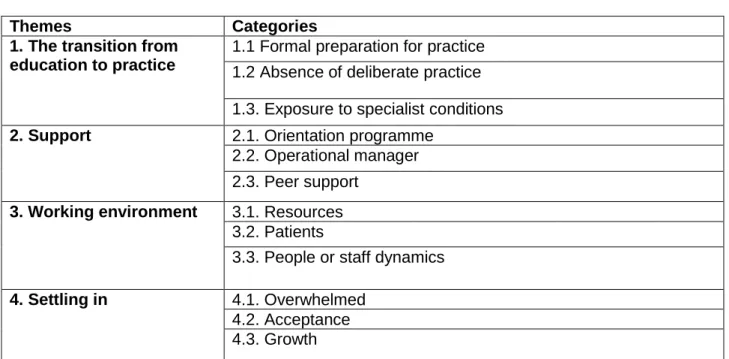
4.2 DESCRIPTION OF THE THEMES ... 34
4.2.1 Theme 1: Transition from education to practice ... 34
4.2.2 Theme 2: Support ... 41
4.2.3 Theme 3: Working environment ... 45
4.2.4 Theme 4: Settling in ... 48
4.3 CONCLUSION ... 50
CHAPTER FIVE: DISCUSSION ... 51
5.1 INTRODUCTION ... 51
5.2 COMPARISON OF THE FINDINGS OF THE STUDY WITH THE LITERATURE . 51 5.1.1 The transition from education to practice ... 51
5.1.2 Support ... 53
5.1.3 Working environment ... 55
5.1.4 Settling in ... 56
5.2 CONCLUSION ... 57
CHAPTER SIX: SUMMARY, MAIN FINDINGS, LIMITATIONS, RECOMMENDATIONS AND CONCLUSION ... 58 6.1 INTRODUCTION ... 58 6.2 SUMMARY ... 58 6.3 MAIN FINDINGS ... 58 6.4 LIMITATIONS ... 60 6.5 RECOMMENDATIONS ... 61
6.5.1 Recommendations for nursing education ... 61
6.5.2 Recommendations for clinical practice ... 62
6.5.3 Recommendations for research ... 62
6.6 CONCLUSION ... 63
ix
LIST OF ANNEXURES
ANNEXURE 1: AN INTERVIEW GUIDE……….75
ANNEXURE 2: INFORMATION SHEET……….77
ANNEXURE 3: CONSENT FORM………79
ANNEXURE 4: CONSENT TO DIGITAL RECORDING………80
ANNEXURE 5: SAMPLE OF DATA TRANSCRIPTS AND ANALYSIS: FORMATION OF CATEGORIES……….81
ANNEXURE 6: ETHICS CLEARANCE CERTIFICATE………82
ANNEXURE 7: PERMISSION TO CONDUCT THE STUDY FROM CMJAH………83
x
LIST OF TABLES
CHAPTER THREE:
Table 3.1: sample of data saturation matrix……….21
Table 3.2: departments and units where participants were sampled………22
CHAPTER FOUR:
1
CHAPTER ONE: OVERVIEW OF THE STUDY
1.1 INTRODUCTIONSeveral studies have shown that newly qualified nurses (NQNs) find the transition period from university or college to the world of work stressful and challenging due to failure to meet the expectations of the role (Al Awaisi, Cooke, & Pryjmachuk, 2015; Duchscher, 2008, 2009; El Haddad, Moxham, & Broadbent, 2016; Freeling & Parker, 2015; Monaghan, 2015). A study by (Al Awaisi et al., 2015) concluded that nursing educational programmes, formal support structures, and the working environment seem to influence the transition experience of the newly qualified nurses to practice. These three issues highlighted in the above study form the basis of this study. Understanding the practice-readiness of newly qualified nurses for practice would add valuable information in the era of nursing education reformation. In this study, the term newly qualified nurses (NQNs) refers to nurses who have recently graduated from a nursing education institution and are doing their community service year.
This chapter discusses the background of the study, the problem statement, research question, the purpose of the study, its significance, research objectives and the operational definitions.
1.2 BACKGROUND OF THE STUDY
Practice readiness of newly qualified nurses is a cause of concern in the nursing profession (El Haddad, Moxham, & Broadbent, 2013; Strauss, Ovnat, Gonen, Lev-Ari, & Mizrahi, 2016). However, the concept “practice readiness” has an unclear meaning as it reflects the divergent views of academic staff and clinical practice staff regarding the professional capabilities of newly graduated nurses (El Haddad et al., 2016). In a report by Wolff and The Coalition on Entry-level Registered Nurse Education (2007), a consensus was reached that practice readiness entails having broad foundational knowledge with some specific job abilities, delivery of safe patient care and demonstration of well-balanced cognitive and psychomotor skills.
A study by (Casey et al., 2011) which examined the readiness for the practice of senior nursing students showed that this group of student nurses had difficulty in performing specific skills. To their surprise, they found that the skills that they had challenges in performing were similar to those that graduate nurses who were undergoing their
2
residency program were incapable of doing as reported in their previous research work (Casey et al., 2011). The skills that the senior nursing students had difficulty in performing included managerial and leadership tasks such as delegation of duties, conflict management, decision making, assertiveness in handling negative behaviours or mistreatment. Also, fulfilment of multiple responsibilities and management of a massive number of patients, communicating with physicians, and making good and sound clinical judgments in response to the patients’ needs also viewed as challenging responsibilities (Casey et al., 2011).
Del Bueno (2005) and Edward et al. (2017) stated that NQNs meet all the qualification requirements, but they have limited clinical experience, competence, and confidence to deliver safe patient care immediately. Glen (2009) said despite the repeated efforts to reform and refocus the nursing profession criticism persisted. The disapprovals originate back from the transfer of nursing education from the apprenticeship model to the academic institutions. The institutionalised educational model requires nurse educators’ to be the ‘jack of all trades;’ being responsible for equipping student nurses with both academic and clinical knowledge (Glen, 2009). However, observations reflect that clinical practice gets less priority (Brandon & All, 2010).
Patricia Benner, in her theory “From Novice to Expert,” revealed that novices lack organisation of knowledge to manage changes in the various situations during the first months of professional practice hence they require ongoing support from experienced nurses (Benner 1982). Dyess & Sherman (2009) held the same view and stated that supporting the NQNs in their first year of practice is necessary to ensure that the future nurses will serve the community safely. Several countries, especially those that are outside the African continent, have fully incorporated support structures to assist NQNs to transition with ease into the working environment. Support structures such as mentoring or coaching, preceptorship programs and formal support from experienced workmates are highly recommended (Whitehead, Owen, Henshaw, Beddingham, & Simmons, 2016). However, the global crisis of nursing shortages and the increasing burden of disease has led to the hastening or overlooking of such programs during the transition period (Dyess & Sherman, 2009; Sönmez & Yıldırım, 2016).
Duchscher (2008) gave an account of the experiences of the NQNs during the transition period so that health care stakeholders could adopt appropriate approaches when integrating the newly graduated nurses to practice. According to Duchscher
3
(2009), the NQNs adaptation journey is characterised by changing experiences, which take them through personal and vocational, emotional and intellectual skills, roles, and relationship alterations during the first twelve months.
Throughout the transition, the NQNs experience a honeymoon phase in which they show full excitement, but that does not last because they suffer from “reality shock” as they discover the true meaning of professional practice. The latter experience leaves the new nurses disoriented and disheartened. Duchscher (2008) stated that the NQNs eventually progress to the reclamation and resolution phase that leads to the regaining of the sense of professional maturity. The transition process of the NQNs is undeniably a complex experience as already highlighted. Hence, it was necessary to explore the perceptions of NQNs within the South African healthcare context, which has a different approach from the international context.
The South African Nursing Council (SANC) is responsible for setting the standards for basing the nursing education programme outcomes, and the accreditation of all learning programs including clinical learning programmes that meet the requirements of the Council (SANC, 2018). The regulatory Council (SANC) took an initiative to revitalise the nursing profession and the healthcare sector following a call for strengthening the nursing profession by the World Health Assembly (WHA) in 2001 (SANC, 2005). Efforts were directed to the resetting of the nursing profession learning systems to produce graduates who will adequately respond to the ever-changing healthcare needs. The 4-year diploma or degree programme, which leads to the registration of professional nurses and midwives served as a benchmark and was developed to produce a standard competency-based nurse (SANC, 2005). Furthermore, a model for clinical nursing education and training was proposed to strengthen the education and training systems (The Nursing Education Stakeholders (NES) Group, 2012).
South Africa has three basic categories of nurses: auxiliary nurses, who have completed one year in a training hospital. Then there are enrolled nurses who have completed two years in a nursing college. Lastly, some professional nurses qualify with a 4-year diploma at a nursing college while others with a 4-year baccalaureate degree at a university (Blaauw, Ditlopo, & Rispel, 2014). The professional nurse category is of interest to the current study. The South African Nursing Council (SANC) ensures the competency of all nurses upon qualification, safeguard quality and safe delivery of
4
healthcare services to the public in terms of section 31 of Nursing Act (33 of 2005) (SANC, 2005). The mandate applies equally to the NQNs, and as such, they are expected to assume full roles, responsibilities, and accountabilities as per their scope of practice as promulgated in the regulation: R 756 of 24 August 2007 (SANC, 2007).
A mandatory pre-licensure service called community service is undertaken by all South African nurses who intend to register their four- year diploma or degree qualification with the South African Nursing Council (Govender, Brysiewicz, & Bhengu, 2017). The community service was an initiative taken by the country to retain newly qualified health professionals in under-resourced healthcare sectors to ensure equitable distribution of human resource to all South Africans. The community service period also serves as an opportunity for developing and acquiring professional skills (Hatcher et al., 2014). The words community service nurses and newly qualified nurses will be used interchangeably as their first exposure to practice after qualification is community service.
The compulsory community service is seen as fulfilling by newly qualified health professionals in the country. However, there are some concerns raised about the implementation process of the service (Govender, Brysiewicz, & Bhengu, 2015; Govender et al., 2017; Hatcher et al., 2014; Roziers, Kyriacos, & Ramugondo, 2014). As a result, strategies to improve the implementation of the pre-requisite registration service were recommended. These included the initiation of a structured orientation programme and clarity on the roles and responsibilities, development of sustainable strategies to improve job satisfaction that will enhance retention of health professionals in rural areas and clarity on the issue of placement (Govender et al., 2017; Hatcher et al., 2014).
The compulsory community service is served in public healthcare sectors that are designated by the Republic of South Africa (RSA)-Department of Health (DoH) (SANC, 2007). The (Department of Health, 2012) has categorised public hospitals into; district, regional, academic, central and specialised hospitals. Newly qualified nurses upon qualification are deployed in any of these public hospitals, including primary healthcare settings to accomplish their mandatory community service duty. In this research, the researcher explored the perceptions of newly qualified nurses of their readiness to practice in an academic hospital in Gauteng. An academic hospital is a hospital that provides specialised healthcare services, serves as a centre for training health
5
professionals, and a platform for conducting research, as well as a specialist referral centre for regional hospitals and nearby health facilities (Department of Health, 2012).
1.3 PROBLEM STATEMENT
The transition period from the student nurse role to the role of a newly qualified nurse is a stressful experience. Studies demonstrate that formal support structures, academic preparation, and the working environment influence the transition period (Al Awaisi et al., 2015; Duchscher, 2009; Freeling & Parker, 2015; Monaghan, 2015).
According to the researcher’s observations and personal experience newly qualified nurses at the workplace commonly receive negative criticism instead of being supported. However, there are few studies, which have explored the perceptions of newly qualified nurses in the South African setting regarding their readiness to practice during the transition period. This study aims to explore the perceptions of the newly qualified nurses of their readiness to practice in an academic hospital.
1.4 RESEARCH QUESTION
What are the perceptions of newly qualified nurses regarding their readiness to practice in an academic hospital?
1.5 PURPOSE OF THE STUDY
The purpose of the study was to explore the perceptions of newly qualified nurses of their readiness to practice in an Academic Hospital in Gauteng.
1.6 THE SIGNIFICANCE OF THE STUDY
The results of the study will help to create a better understanding of the perceptions of newly qualified nurses of their readiness to practice in an academic hospital in Gauteng during the transition period. The findings of this study will help in the future, guide nurse educators and healthcare stakeholders to develop an orientation program to prepare students who are in their fourth year of study for their community service year.
6
1.7 THE OBJECTIVES OF THE STUDY WERE TO EXPLORE
The feelings of newly qualified nurses of their readiness to practice in the academic hospital.
The educational preparation received by the newly qualified nurses from their nursing education institutions (NEIs).
The formal support structures available in the academic hospital to assist newly qualified nurses during their community service period.
The views of newly qualified nurses about the working environment in the academic hospital.
1.8 OPERATIONAL DEFINITIONS
Clinical preceptor: is a qualified professional nurse employed by a higher education institution to work closely with a group or groups of student nurses in a particular clinical facility or facilities to maximise the clinical learning experience of student nurses in formal nursing education programmes (The Nursing Education Stakeholders (NES)-Group, 2012).
Community service (CS): is a mandatory service for “any person who is a citizen of South Africa intending to register for the first time as a professional nurse in terms of the Nursing Act (33 of 2005). The individual is expected to perform remunerated service for a period of one year at a designated public healthcare facility” (SANC, 2007).
Newly qualified nurses: nurses who have recently graduated from a nursing education institution and are doing their community service year.
Orientation programme: refers to the structured support given to the newly qualified nurses after the induction process. The aim of having an orientation programme is to facilitate the transition process.
Practice readiness: entails having broad foundational knowledge with some specific job abilities, delivery of safe patient care and demonstration of well-balanced cognitive and psychomotor skills (Wolff & The Coalition of Entry-Level Registered Nurse Education 2007).
7
The transition period: time spent when a newly qualified nurse is adapting from the student nurse role to the role of an independent professional nurse during community service.
1.9 CONCLUSION
The next chapter will present the literature surrounding the practice-readiness of newly qualified nurses for practice.
8
CHAPTER TWO: LITERATURE REVIEW
2.1 INTRODUCTIONIn the previous chapter, the research plan was outlined. In this chapter, the literature surrounding practice readiness of newly qualified nurses (NQNs) is presented. The following issues are covered: academic preparation for practice readiness, the transition to practice, support systems, and the working environment.
2.2 ACADEMIC PREPARATION FOR PRACTICE READINESS
Preparing graduate nurses who are ‘work ready’ is the primary concern for nursing education institutions, health organisations and the regulatory council (Wolff, Pesut, & Regan, 2010). Edward et al. (2017) reported that ever since the shift from hospital-based training to institutions of higher education, the nursing profession has advanced in knowledge, but that came with a cost of loss of “work readiness.” Work readiness was defined as the extent to which the newly qualified nurses demonstrate knowledge, skills, and ability to work independently upon placement. Practice readiness is believed to be the possession of basic knowledge and skills of a specific job and demonstration of reasonable balance between knowing, thinking and doing.
Differing perspectives between clinical practitioners and those who are in academia regarding the issue of practice readiness of newly qualified nurses are recorded in the literature (Dlamini et al., 2014; Wolff et al., 2010). Nurse educators view newly qualified nurses as work ready while nurses in practice felt that they are not fully equipped to handle the contemporary health care needs of the patients (Dlamini et al., 2014; Wolff et al., 2010). Wolff et al. (2010) reported that the existing nursing shortage crisis compels managers to expect the newly qualified nurses to “hit the ground running.” The health sector is troubled by several issues other than the nursing shortages they include financial constraints, high demand for quality and patient safety. Also, the complex patient needs the influx of information and the use of advanced technology (Benner, Sutphen, Leonard, & Day, 2010; Dyess & Parker, 2012; Giddens & Brady, 2007; Wolff et al., 2010). However, the implementation of innovative teaching and learning strategies will assist in resolving the challenges that affect the readiness of newly qualified nurses (Benner, 2012; Glen, 2009; Spector & Odom, 2012).
9
2.2.1 Strategies to address the educational challenges
Stanely & Dougherty (2010) stated that nurse educators are in the process of reviewing the nursing education delivery systems. The focus is now on a student-centered approach, as advocated by the National League for Nursing (2003) as opposed to the traditional teacher-centred approach (Cadorin, Bagnasco, Rocco, & Sasso, 2014). The belief is consistent with that of Benner (2012) who pursued the call for the radical renovation of nursing education programs. The educational transformation move focuses on addressing the widely debated practice-education gap or the lack of clinical expertise among newly qualified nurses to better prepare nurses who are responsive to the complex health care needs of the society (Benner, 2012; Benner et al., 2010)
Similar to the international community of nursing education, authors in South Africa have advocated the transformation of their nursing education system by adopting the framework that was established by the World Health Organisation (WHO) (Armstrong & Rispel, 2015). Several issues were addressed in their study using the WHO six building blocks for transformative education. Two of those elements were of interest to this discussion: the national standards on accreditation, regulations and vocational qualifications and the curricula, faculty, and education. Their study participants found the existing nursing curriculum unresponsive to the health needs of the people of South Africa and that of the healthcare system (Armstrong & Rispel, 2015).
The concerns about the unfulfilling nursing curriculum were associated with the progressing perceptions about the lack of competencies of the newly qualified nurses. Newly qualified nurses were said to be lacking in social skills, assertiveness, integrating theory with practice to solve patient problems, foundational nursing skills and aspects of professionalism (Armstrong & Rispel, 2015; Rispel, 2015). The curricular issues were coupled with the absence of innovative teaching strategies among nurse educators, especially those who are based in nursing colleges (Armstrong & Rispel, 2015).
10
Despite the progressive changes noted within the nursing profession and the healthcare environment, the use of traditional teaching techniques that is dominated by the rearrangement of the same content material and static PowerPoint presentations were highlighted (Benner et al., 2010; Dalley, Candela, & Benzel-Lindley, 2008). However, this approach can be changed if nurse educators could become forward thinking when creating the nursing curriculum (Dlamini et al., 2014; Giddens & Brady, 2007). Armstrong & Rispel (2015) suggested the incorporation of social accountability to the new nursing education reforms to improve the professional competencies of new nursing graduates. Armstrong & Rispel (2015) defined social accountability as a necessary mandate, which requires medical schools to ensure that their teaching, research and service undertakings address the leading health concerns of the people that are under their context.
2.2.2 Curriculum models to promote innovative teaching and learning
“Nurses are far more than beings of memorisation” (Brandon and All, 2010, p. 89). Duane & Satre (2014) claim that learning in nursing occurs through social interaction and collaboration with others within and outside the learning environment. As already mentioned, the radical reformation of nursing education supports the move from traditional educational approaches to innovative approaches which are founded on the constructivism learning theory (Benner et al., 2010) rather than cognitivism and behaviourism (Cadorin et al., 2014). Constructivism is a learning model that seeks to provide opportunities for creative learning (Duane & Satre, 2014). In this approach, learners work interdependently to construct their knowledge in a supportive learning environment, and the educator facilitates the learning process (Duane & Satre, 2014).
The literature supports the view of basing the nursing curricula on constructivism because its characteristics are suited for preparing learners who will be responsive to the ever-changing needs exhibited by the profession as well as the healthcare sector. Constructivism empowers the learner to be self-directed, to self-critique, and to engage in reflective practice, to become critical thinkers who can synthesise information, link concepts and become lifelong learners (Brandon & All, 2010). In addition to those features, constructivism ensures that meaningful learning takes place (Cadorin et al., 2014), as well as collaborative learning (Duane & Satre, 2014). Constructivism can form the basis of various approaches such as concept-based curriculum (Sportsman & Pleasant, 2017); competency-based curriculum (Spector & Odom, 2012);
problem-11
based learning (Nyback, 2013) and case-based learning (Kantar & Massouh, 2015). Furthermore, constructivism is easily incorporated into the clinical learning settings because the students are taught concepts rather than vast amounts of content-loaded materials (Brandon & All, 2010).
2.2.3 The constructivism approach benefits
Nurses who are produced under the constructivism learning frameworks would adapt better during the transition from the student nurse status to becoming experienced practitioners (Peters, 2000). The same view was proclaimed by Hein (1991), who highlighted that the constructivism approach prepares learners for the ‘real’ world as opposed to learning that is based on rigid structures. Also, education is accomplished through collaboration rather than individualistic learning, which is integral to the nursing profession (Duane & Satre, 2014). Constructivism enables seamless collaboration within the nursing education fraternity, including clinical learning to ensure that students achieve the programme outcomes (Brandon & All, 2010). Collaborative learning, which forms part of the constructivism model, was found to enhance student-learning abilities by promoting the development of essential nursing skills (Duane & Satre, 2014).
Other features that are effective in responding to the dynamism of the health sector are that the constructivism approach incorporates the development of critical thinking skills and encourages spontaneous adaptation to changes in evidence-based practice (Brandon & All, 2010). The use of the constructivism approach was also found responsive in limiting content-laden curriculum, which restricts time for processing information critically and the use of scientific knowledge in practice (Dalley et al., 2008). In this case, students are taught concepts, which enhance clinical learning as well (Brandon & All, 2010).
2.2.4 Clinical learning
Acquisition of clinical skills is mandatory for student nurses who are expected to achieve a specified number of clinical hours during their nursing education program (Cant & Cooper, 2017). The clinical environment is crucial in the preparation of student nurses for their professional roles because it gives them exposure to the realities of the profession (Henderson, Cooke, Creedy, & Walker, 2012; Papathanasiou, Tsaras, & Sarafis, 2014). Effective clinical learning can be assured by having clinical nurses
12
who are knowledgeable about handling the dynamics of the working environment (Papathanasiou et al., 2014). However, simulation-based learning can offer student nurses similar clinical experience. Several studies have confirmed that simulation-based education improves students’ clinical knowledge (Cant & Cooper, 2017).
2.2.5 Integration of theory with practice
The literature shows that nurse educators struggle to equip student nurses with the knowledge to facilitate the translation of theoretical knowledge to practical experience (EL Hussein & Osuji, 2016). Integrating theoretical knowledge with practice is imperative in gaining clinical credibility (Handley & Dodge, 2013) or the art and science of nursing (Mabuda, Potgieter, & Alberts, 2008). Student nurses should be assisted in achieving this integration (The Nursing Education Stakeholders (NES)-Group, 2012).
According to Brandon & All (2010) integration of theory with practice is the primary responsibility of nurse educators. During clinical learning, nurse educators take on the role of coaches, or facilitators and develop innovative teaching methods that will produce competent professionals. The clinical instructor collaborates with the course coordinator to promote meaningful learning in each clinical placement or before a clinical rotation (Brandon & All, 2010). A similar proposition was made in the new model for clinical nursing and training in South Africa (The Nursing Education Stakeholders (NES)-Group, 2012). Kirschling & Erickson (2010) revealed that recent studies have indicated that there is a disconnection between nurse leaders in academia and those who are in clinical practice. The lack of association between the two sectors is attributed to the transformation of nursing from hospitals to nursing education institutions or universities. Even though the change yielded good results, some unintended effects emerged such as the failure to implement clinical practice initiatives for students and aligning the course content with current clinical practices commented (Kirschling & Erickson, 2010).
2.3 TRANSITION TO PRACTICE
In South Africa, newly qualified nurses undergo a one-year mandatory service called community service before licensure (SANC, 2007; Roziers, Kyriacos & Ramugondo, 2014; Govender, Brysiewicz & Bhengu, 2015, 2017). The community service period marks the newly qualified nurses’ transition period to professional practice. The community service period is perceived as fulfilling because it offers an opportunity to
13
gain work experience and development of professional roles and responsibilities (Govender et al., 2015, 2017; Roziers et al., 2014). However, some newly qualified nurses felt overwhelmed, expressing feelings of dissatisfaction due to the lack of clarity of their roles as community service nurses. Such experiences were compounded by insufficient orientation and support from registered nurses (Govender et al., 2015, 2017; Roziers et al., 2014; Thopola, Kgole, & Mamogobo, 2013).
Challenges associated with the transition experience were not unique to the South African setting.Whitehead who explored the preparedness of British newly qualified nurses for practice uncovered that they have a fear of the accountability status; not being supported; new clinical setting; and the loss of security from being a student. These findings confirm some of the challenges that were articulated by Duchscher (2009) who reiterated that the transition from student nurse to employment generates a considerable amount of pressure due to exposure to extensive change, coupled with an environment that has a new set of rules and regulations, responsibilities. Duchscher (2008) summarised the transition process into three stages as the doing stage, the being stage and the knowing stage. While several authors (Gentile, 2012; Liou, Cheng, Tsai, Chang, & Liou, 2014) have completed studies using the work of Duchscher (2008), none has suggested an alternative classification of these stages.
2.3.1 The transition stages
Duchscher (2008) identified, and named, the transition stages, in her study involving fourteen female undergraduate nurses within the first year of professional practice role, in a hospital setting in Canada. The transition stages described the experiences of graduate nurses during the process of becoming registered nurses.
2.3.1.1 The doing stage
According to Duchscher (2008), the newly qualified nurses upon entry to practice face a wide range of intense and fluctuating emotions. They come in with a lot of enthusiasm, but all that disappears as they learn about the realities of the workplace as well as their role expectations. All the knowledge they acquired during their educational preparation melt away due to lack of self- confidence, which is compounded by clinical experience deficit, and the dynamics of the healthcare environment. In response to this “mysterious” situation, the newly qualified nurses manoeuvre through the processes of discovering, learning, performing, concealing,
14
adjusting and accommodation. This first stage approximately encompasses the first three to four months of the transition period.
2.3.1.2 The being stage
The being stage commences after the initiation phase. It is characterised by progressing development of nursing knowledge, skills, and critical thinking abilities. The nurses became aware of their professional identity, and they begin to challenge the pre-graduate philosophies of nursing by revealing the inefficiencies, and the inadequacies of the healthcare system. During this stage, the newly qualified nurses start to disengage, question, search, show, recover, accept and ultimately re-engage with their chosen career. Another vital aspect of this stage is that the newly qualified nurses begin to interpret everything from their perspective. This stage approximately starts after the fourth month up to the eighth month (Duchscher, 2008).
2.3.1.3 The knowing stage
The knowing stage is the final stage of the transition process. This stage is a continuation of the second stage whereby the newly qualified nurses continue with the recovery process. Towards the middle period of this stage, the newly qualified nurses take some time exploring and examining their professional landscape. Some moderate stress occurs at this stage, due to the realisation of the hierarchal organisation of the healthcare system, which shows that nurses exist at the bottom of this chain of command of authority and power. Finally, by the twelfth-month, all the newly qualified nurses feel more comfortable and confident in performing their professional roles and responsibilities.
2.4 SUPPORT DURING THE TRANSITION PERIOD
A structured transition programme guided by skilled and experienced preceptors foster the acquisition of expert nursing skills (Bratt & Felzer, 2011). Whitehead et al. (2013) revealed that the United Kingdom Central Council for Nursing, Midwifery and Health Visiting decreed that all newly qualified nurses should undergo a preceptorship programme to support them during the transition period. This consensus was reached following a belief that nurses who are educated outside the apprenticeship model would not be adequately equipped for the realities of nursing practice. Preceptorship in the context of the United Kingdom refers to the process whereby registered nurses
15
and midwives provide support to newly qualified nurses and midwives (Whitehead et al., 2013). The council further specified that the preceptors should have at least one-year clinical experience and hold a teaching qualification. These specifications vary from country to country (Whitehead et al., 2013).
In South Africa, a clinical preceptor is only responsible for supporting and teaching nursing students. The clinical preceptor should be a registered nurse, licensed to practice, have at least three years clinical experience, above-average clinical knowledge and have excellent communication and interpersonal skills. They should be computer literate, having a positive attitude to self, students, the nursing profession and clinical environment, and lastly, must possess a valid driver’s license (The Nursing Education Stakeholders (NES)-Group, 2012). However, to some healthcare stakeholders, the introduction of preceptorship programs to support newly qualified nurses appeared to be accidentally telling employers that their products were not yet ready for work despite obtaining qualifications from an accredited nursing program (Candela & Bowles, 2008).
Support during the transition period is deemed necessary for the facilitation of skills acquisition, as articulated by Benner (1982) in her theory from “Novice to Expert.” Newly qualified nurses are categorised as advanced beginners in Benner’s theory. At this level, the newly qualified nurses need support because they rely on classroom knowledge, which may not be easy to apply in different challenging clinical situations upon placement (Benner, 1982). The author further stated that novice nurses have limited ability to prioritise patient care. Ongoing support throughout the first- year of practice, which is inclusive of debriefing sessions would improve the development of clinical judgement, and enhance the acquisition of skills necessary to provide safe and quality care to patients (Bratt & Felzer, 2011; Dyess & Sherman, 2009; Strauss et al., 2016). Zhang et al. (2017) supported this idea and stressed that mentoring programs promote nursing competency and good work relations that contribute to positive patient outcomes. Dyess & Parker (2012) stated that nurse managers are in a better position and are well suited for providing support to the newly qualified nurses during the transition period. However, running a support program is very costly, taking into consideration the existing fiscal constraints within the health care sector and the gross shortage of nurses (Dyess & Parker, 2012).
16
2.4.1 Barriers to support for newly qualified nurses in clinical settings
Ebrahimi et al. (2016) linked the perceived lack of support during the transition period to the attitudes of the newly qualified nurses towards their profession. In their study, licensed nurses highlighted that some new graduates showed no interest at all in their nursing profession. The lack of interest was demonstrated by self-exclusion from ward routines, spending too much time sitting, overuse of mobile phones, no behavioural change after in-service education and the lack of assertiveness regarding support-seeking behaviour to enhance skill acquisition (Ebrahimi et al., 2016). In a study by Dlamini et al. (2014), the lack of passion for the profession was associated with laziness and dislike of bedside nursing.
On the other hand, the lack of support was attributed to the work overload, which originates from the nursing shortages. The experienced nurses become too exhausted, and that leaves them with no desire or strength to support the newly qualified nurses (Ebrahimi et al., 2016). However, some nurses tend to withhold their support because they believe that the nursing education institutions had equipped the new graduate with the necessary skills and knowledge for the role (Ebrahimi et al., 2016).
2.5 THE WORKING ENVIRONMENT
The healthcare sector demands nursing education programmes that produce graduates who are work ready to remain profitable, effective and efficient (Bradshaw & Merriman, 2008; Hofler & Thomas, 2016). The stresses of the working environment have compelled nurse leaders in practice to shorten the orientation periods for the new workforce and move them rapidly to acceptance of professional roles and responsibility (Dyess & Sherman, 2009). A study conducted in Norway reported that newly qualified nurses enter into the professional world with a lot of enthusiasm but that suddenly disappears because of the experienced nurses neither respect nor inspire them. As a result, they are forced to learn and cope on their own (Bjerknes & Bjørk, 2012; Meleis & Price, 1988).
Studies conducted in South Africa reported a variety of factors that affect the newly qualified nurses in the working environment. These included inadequate orientation and supervision by senior personnel, lack of teamwork, shortage of human resources, deficiency of equipment, heavy workloads, high patient acuity and negative staff attitudes (Govender et al., 2017; Roziers et al., 2014; Thopola et al., 2013).
17
Sönmez & Yıldırım (2015) revealed that newly qualified nurses encounter two types of factors that influence their levels of stress in the working environment. Chandler (2012) and Feng & Tsai (2012) grouped these elements as professional and organisational factors. Professional components consist of role ambiguity, inadequate knowledge and skills, demanding responsibilities, and awareness of professional accountabilities. Regulatory factors comprise of time pressure when caring for patients, narrowed job description, nursing staff shortage, heavy workload, task-oriented operations rather than patient-oriented activities, shift work, high expectation for competency, limited peer support, difficulties in communicating with physicians and a shortage of material resources. Furthermore, workplace bullying, lack of access to mentors and coaches as well as generational diversity are other issues that negatively impact on the newly qualified nurse's experience in the working environment (Hofler & Thomas, 2016).
Workplace bullying is a destructive force in human relations, affect work performance (Vogelpohl, Rice, Edwards, & Bork, 2013) and hinders workplace socialisation of newly qualified nurses (Hofler & Thomas, 2016). Victims experience an inferiority syndrome, which progresses to noticeable psychological effects such as insomnia, diminished self-confidence, isolation, poor work ethics, absenteeism reflected by the excessive use of sick leave (Longo & Sherman, 2007; Wilson, 2016). However, the education of nurse managers and staff enables recognition of workplace bullying, and this might help in preventing harmful acts from happening (Vogelpohl et al., 2013).
The lack of a conducive working environment causes enormous stress to all nursing professionals. Work stress causes detachment and burnout which results in reduced work performance thus compromising patient safety and care (Hofler & Thomas, 2016). However, a variety of factors have led to the health sector inability to retain experienced nurses who will assist the newly qualified nurses to adjust seamlessly to practice; these include retirement, increased workloads, lack of career advancement, availability of flexible work opportunities and scarcity of resources (Hofler & Thomas, 2016).
2.6 CONCLUSION
The literature surrounding practice readiness of newly qualified nurses during their transition period was discussed. In the next chapter, a detailed research process and methodology used in the study will be explained.
18
CHAPTER THREE: RESEARCH METHODOLOGY
3.1 INTRODUCTIONThis section discusses the research design, research setting, sampling process, data collection, data analysis, trustworthiness, and the ethical considerations.
3.2 RESEARCH DESIGN
A research design is a systematic plan used by a researcher to solve the research problem. It entails the logical steps, which guide the research process (Polit & Beck, 2010). The study aimed at exploring the perceptions of the newly qualified nurses of their readiness to practice in an academic hospital. A qualitative, exploratory research design was deemed adequate for achieving the objectives of this study. An explanation of why this research design is ideal follows.
3.2.1 Qualitative Research
The selection of a particular research method finds its basis on the nature of the research question (Brink, Van der Walt, & Van Rensburg, 2012). In this study, the researcher wanted to find out the perceptions of the newly qualified nurses of their readiness to practice in an academic hospital. The study of human experiences, feelings and subjective views is associated with qualitative research studies (Brink et al., 2012; Gray, Grove, & Sutherland, 2011; Polit & Beck, 2010).
Qualitative research is a systematic approach that allows the researcher to interact with individuals or groups to study their life experiences and to infer meaning from them (Gray et al., 2011). The use of a qualitative research approach enabled the researcher to engage with the participants gathering information about their perceptions of their readiness to practice as qualified nurses.
Another critical characteristic feature of this design is that it allows the use of words instead of numbers. Researchers who intend to provide an in-depth understanding of human experiences from the participants’ point of view would find it challenging to quantify this type of data (Brink et al., 2012). Conclusions drawn from the data gathered from the verbal information provided by the participants were presented in a word form instead of a numerical format to delineate an in-depth narrative view of their perceptions.
19
3.2.2 Exploratory Research
The adoption of an exploratory research design shades light on the different ways in which a particular problem can manifest (Polit & Beck, 2010). Botma et al. (2010) stated that exploratory research design adoption occurs when there is limited information known about the problem under study. As already indicated in the research problem, the literature search has yielded fewer research works that have explored the perceptions of newly qualified nurses of their readiness to practice in an academic hospital in the South African context. Thus, the exploratory research approach is suitable for addressing the problem under investigation in this study.
3.3 RESEARCH SETTING
The research setting is a specific location where data are collected (Brink et al., 2012). Choosing a research site depends on the nature of the problem under investigation and the type of the data required for solving the problem (Brink et al., 2012). In qualitative studies, data collection occurs in a natural setting where the experiences are lived (Botma et al., 2010). A natural setting, for research purposes, is an environment free of alterations (Brink et al., 2012).
An academic hospital in Johannesburg was the research site for this study. The hospital was purposefully selected because it is one of the largest accredited public health academic hospitals used for the placement of newly qualified nurses for community service. This site was chosen for its convenience to the researcher regarding accessibility.
3.3.1 The Context of the Research
The context of the research is another important aspect of qualitative research. According to (Brink et al., 2012) background information about the research context is essential in qualitative research because it informs the readers about the uniqueness of the research setting.
The research setting is an academic hospital used by various faculties of health science for clinical teaching and research.
20
3.4 THE SAMPLING PROCESS
The sampling process entails selecting the appropriate group of objects, subjects or events from which the research answers or information are sourced (Brink et al., 2012). Hence, the need for the researcher to define his or her population and sample (Brink et al., 2012).
3.4.1 Population
A population is a targeted group for the study (Polit & Beck, 2010). The study population was the newly qualified nurses who were doing their compulsory community service. The population consisted of all newly qualified nurses (N=65) who were working in the academic hospital during the time of the study. The population consisted mainly of new graduate nurses from two nursing education colleges and three universities in the Gauteng province.
3.4.2 Sampling
In qualitative research, sampling continues until data saturation is reached because the total number of participants to be included is not known in advance (Brink et al., 2012). Sampling is the process of selecting a representative subset of the entire population (Polit & Beck, 2010). A commonly used sampling method in qualitative research is purposive sampling.
3.4.3 Purposive sampling
Purposive sampling permits the investigator to select participants who have been through a particular experience and are conversant with the subject matter (Brink et al., 2012; Polit & Beck, 2010). Purposive sampling is also known as a ‘judgmental’ or ‘selective’ sampling because participants have to fall within a predetermined sampling criterion of the study (Gray et al., 2011).
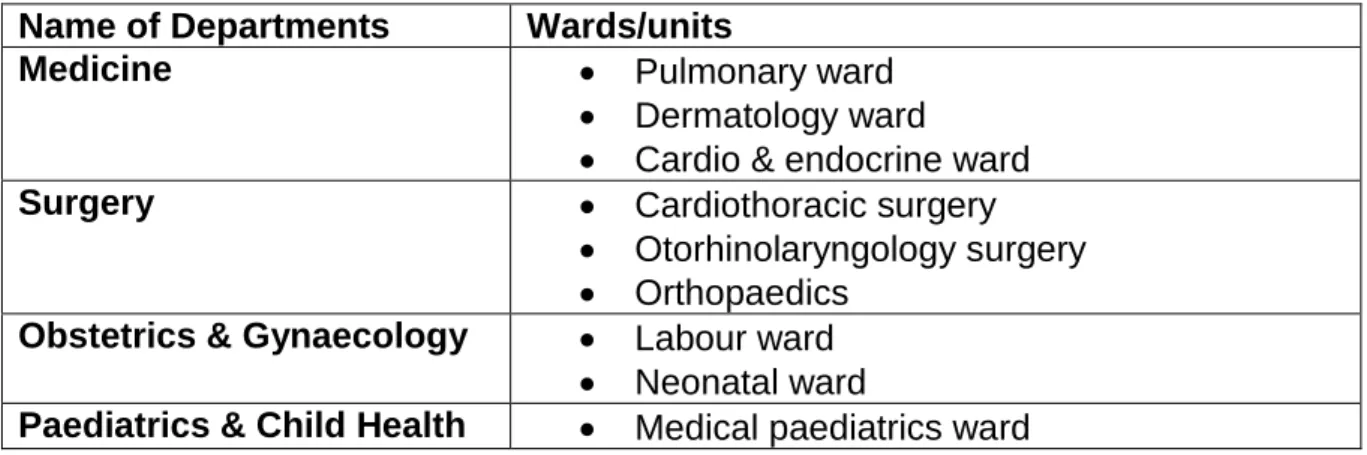
The participants were purposefully sampled from the departments of Medicine, Surgery, Obstetrics and Gynaecology, and Paediatrics and Child Health. These departments were selected because the educational preparation of undergraduate nursing students focuses mainly on these areas of practice. Therefore, newly qualified nurses placed in these units would be able to provide in-depth knowledge about the
21
research problem. Table 3.1 below presents the departments and the specific units in which the participants were sampled.
Table 3.1: Departments and Units where Participants were sampled
Name of Departments Wards/units
Medicine Pulmonary ward
Dermatology ward
Cardio & endocrine ward
Surgery Cardiothoracic surgery
Otorhinolaryngology surgery Orthopaedics
Obstetrics & Gynaecology Labour ward Neonatal ward
Paediatrics & Child Health Medical paediatrics ward
3.3.4 Inclusion and exclusion criteria
The inclusion and exclusion criteria enable the researcher to decide whether an individual or an object can be classified as a member of a study population (Brink et al., 2012).
Included in the study were:
Professional nurses who completed their training in 2016.
Professional nurses who were engaged in community service at the academic hospital.
Excluded were all:
Newly qualified nurses who were working in intensive care units (ICUs) and other highly specialised units because they spend little time during training in these units hence their knowledge would be limited.
22
3.3.5 Sample size
In qualitative studies, the sample size is not known in advance, but it is established when saturation of information is reached in the area of study (Brink et al., 2012; Gray et al., 2011). Data saturation is the point whereby there is no new information, ideas, and views gathered from the participants when collecting the data (Brink et al., 2012; Gray et al., 2011; Polit & Beck, 2010). The purpose of using data saturation is to get thick (quantity) and rich (quality) data from the population of interest (Fusch & Ness, 2015).
In this study, a minimum of three participants was selected within the sampling framework until data saturation was reached at a sample of 16 (n=16) participants. The sample comprised of three males and thirteen females.
The following aspects enabled the researcher to reach and determine data saturation; asking the participants similar questions, using open-ended questions, probing for more information and using a data saturation matrix. A data saturation matrix facilitates easy identification of recurring concepts or themes across the dataset (Fusch & Ness, 2015). The figure (3.1) below is a sample of the data saturation matrix designed and used by the researcher in this research.
Table 3.2: Saturation Matrix Sample
Interview Questions
Participant’s responses (themes)
P 01 P 02 P03 P05 P 06 P 07 P 08 Q1 Q2 Q3 Q4 Q5
23
3.5 DATA COLLECTION
3.5.1 Data Collection Method
A semi-structured face-to-face interview was the data collection method used in this study. Semi-structured interviews allow the researcher to prepare in advance a set of questions or topics that need to be covered during the interview (Polit & Beck, 2010). Therefore, an interview guide was used to guide the researcher when conducting the interviews.
3.5.1.1 Data collection tool
In qualitative research, the researcher is instrumental in gathering the data (Gray et al., 2011; Polit & Beck, 2010). Moreover, an interview guide helps the researcher to focus the interview on the specific objectives of the study and encourages the participant to give more in-depth information freely (Polit & Beck, 2010).
3.5.1.2 Interview guide
The researcher designed an interview guide with the help of the research supervisor who refined and validated the questions before being pretested. The interview questions were pretested to determine their validity and reliability among three participants. The pretesting of the tool also gave the researcher an opportunity to improve her interview skills, refine the questions and estimate the time for completing an interview session. The pretest results were not included in the primary study.
The interview guide (Annexure 1) comprised of five open-ended questions that were accompanied by a list of probes to assist in eliciting more in-depth information. Additional probes were generated during the interviews as guided by the participant responses.
3.5.2 The process of data collection
During the time of requesting permission to conduct the study, the researcher met the head of departments of the selected departments and asked for permission to interview the newly qualified nurses who were under their management. The head of departments provided the researcher with either a list of all the newly qualified nurses and or a list of the names of the operational managers and units in which the study
24
participants were stationed. Also, the researcher met with some of the operational managers in one departmental meeting and presented a brief overview of the research proposal. All of these measures facilitated access to the newly qualified nurses.
3.5.2.1 Gaining access to the participants
In all the units, the researcher introduced herself to the operational manager and asked for permission to have access to the newly qualified nurses. Most of the in-charge nurses were very welcoming and assisted in directing the researcher to the potential participant.
The prospective participant was approached. Firstly, the researcher introduced herself, gave a verbal explanation of the purpose of the study and invited the individual to participate in the study. An information sheet (Annexure: 2) was presented to all candidates who showed interest in the research. Questions that arose about the purpose and the study processes were answered to the satisfaction of the participants.
3.5.2.2 During the interview
Before the commencement of the interview, a consent form for participating in the study (Annexure: 3) and consent for digital recording (Annexure: 4) was issued and voluntarily signed by every participant.
All interviews were held in locations that were chosen by the participant and at a time that was suitable for him or her. The majority of the participants preferred to be interviewed at their workstations, during less hectic days like Fridays and the weekend and less busy hours such as lunchtime and in the afternoon. Fewer participants preferred off days and or after working hours. The most commonly used venues for the interviews were, the staff kitchen, operational manager’s office, and doctors call room, an empty ward, and the nursing residence or nursing home.
The exact time or preferred time for conducting the interview sessions were not decided during the first contact due to the nature of the job. The
25
times were communicated via WhatsApp or by continuing to revisit the ward at the various times that were proposed by the participants.
The duration of the interviews varied from person to person. The minimum time spent on each session was 24 minutes and the maximum time was 43 minutes.
3.5.2.3 Challenges encountered in some units:
It was difficult to find a room that had low levels of noise
Controlling the up and down movement of staff members was difficult.
However, such disruptions were resolved by pausing the recorder for a while, shutting the door, and asking the other staff members to lower their voices and requesting for fewer visits to the interview site.
At the end of the interview session, the researcher thanked the participant for voluntarily participating in the study and offered him or her two candies as a token of appreciation.
3.6
DATA ANALYSISThe purpose of data analysis is to organise, provide structure and to draw meaning from the data (Polit & Beck, 2010). In qualitative research, data analysis is carried out concurrently with data collection.
In this research, the data were analysed using Braun and Clarke’s phases of thematic analysis; transcription, reading and familiarisation, coding, searching for themes, reviewing themes, defining and naming themes and report writing (Braun & Clarke, 2006).
3.6.1 Braun & Clarke’s Phases of Thematic Analysis
Thematic analysis is a method for categorising, analysing, and reporting patterns within the dataset (Braun & Clarke, 2006). The authors further contended that it is a comprehensible and theoretically flexible method of analysing qualitative data.
26
3.6.1.1 Data transcription
Data transcription refers to turning audio information into text notes by writing verbatim what the participant said during the interview (Braun & Clarke, 2006). All the interviews were recorded using a digital voice tape recorder to capture the exact words or phrases reported by the participants. The information shared by each participant was saved using a number that was allocated by the researcher for identity purposes. The researcher transcribed all the interviews verbatim herself. A sample of a transcript can be found as (Annexure: 5). All the data transcripts were checked for completeness and accuracy by concurrently listening and reading all the written scripts before they were further analysed. Transcribing the interviews also helped with data familiarisation.
3.6.1.2 Reading and familiarisation
During this phase of data analysis, the researcher immerses himself or herself to be familiar with the data by reading the scripts (Braun & Clarke, 2006). The data scripts were repeatedly read while listening to the voice recordings to gain the sense of the data and to be familiar with the content. The researcher was also able to search for meanings and patterns of the entire data for easy categorisation.
3.6.1.3 Coding
Coding is a process of identifying concepts of interest within the data that can be assessed in a more meaningful way concerning the research problem (Braun & Clarke, 2006). The research question and the objectives were then reviewed. Illuminating ideas that contained related information were highlighted using the same colour font and pasted into a table for easy identification and categorisation of the coded data. A long list of codes was produced from the dataset.
3.6.1.4 Identification of themes
The coded data were analysed and sorted in preparation for theme identification. The sorted data were presented in a table to help to group the codes into themes. Potential themes were deduced, and relevant coded data extracts were unified under the identified themes to establish theme categories.
27
3.6.1.5 Reviewing themes
Reviewing themes is about determining whether candidate themes fit well with the coded data (Braun & Clarke, 2006). In this phase, the themes were examined to verify if they were coherent with the coded data. The researcher also checked if they were enough data segments that supported the major themes. Finally, a thorough data check was undertaken to validate if the themes were an accurate reflection of the perceptions of the participants using a thematic map. Information that was not analogous was reshuffled and or redefined until there were no new discrepancies noted.
3.6.1.6 Defining and naming themes
Defining and naming themes refers to theme refinement. Themes are refined to ensure that they provide a comprehensive description of the data content (Braun & Clarke, 2006). The themes were refined to ensure that they broadly define the scope and content of the data provided by the participants. The refinement of the themes was achieved by reviewing and evaluating the collated data extracts with the analysis drawn by the researcher. The analysis was presented to the research supervisor who, together with the researcher, examined the whole analysis process, refined the work and confirmed the relevance of the themes to the data context.
3.6.1.7 Report writing
Report writing is the final phase of the qualitative thematic analysis phase. This phase is the write-up of the research report (Braun & Clarke, 2006). In the write-up, an analytic review of the study findings was presented, which included capturing data extracts to substantiate the credentials of the themes. A detailed report of the above information will be presented in the subsequent chapters.
3.7 TRUSTWORTHINESS
According to (Lincoln & Guba, 1985), the primary focus of qualitative research is trustworthiness. It helps in evaluating the consistency and quality of the methods used when conducting the study. Trustworthiness has four evaluative criteria, which are credibility, dependability, confirmability, and transferability.
28
3.7.1 Credibility
Credibility means confidence in the veracity of the data and the meanings attached to them (Polit & Beck, 2010). The following criteria were satisfied to ensure the credibility of the research findings: prolonged engagement, member checking and peer- debriefing.
3.7.1.1 Prolonged engagement
Prolonged engagement allows the participants to get accustomed to the researcher (Braun & Clarke, 2006). The interviews did not all take off immediately in the first contact. Arrangements were made, and during that period rapport was established with the participants. As a result, the participants were comfortable to share their personal feelings and experiences encountered during their first year of professional practice.
Another aspect, which encouraged openness was emphasising that all their inputs, would be kept confidentially and that there were no right or wrong answers to the questions that would be asked during the interview.
3.7.1.2 Member checking
Member checking refers to the sharing of the data interpretation with the participants to determine its accuracy (Brink et al., 2012). Member checking can be done informally or formally, that is during the interview session or after the data analysis respectively (Polit & Beck, 2010). In this study, member checking was carried out during the interview session. The researcher frequently analysed the participant’s responses and asked for comments to ascertain if the conclusions drawn reflect their perspectives.
3.7.1.3 Iterative questioning
Specific strategies should be incorporated to discover false information (Shenton, 2004). Data quality was ensured by the use of probes, rephrasing questions and returning to previously discussed extracts to elicit more detailed information, which also helped in detecting any emerging discrepancies.
3.7.1.4 Researcher’s credentials
In qualitative research, the researcher becomes the data collection ‘instrument’ and plays a major role in the analysis of the data (Polit & Beck, 2010). Therefore, the