IHS Working Paper 17
July 2020
Deviations from Triangular Arbitrage
Parity in Foreign Exchange and
Bitcoin Markets
Julia Reynolds
Leopold Sögner
Martin Wagner
Author(s)
Julia Reynolds, Leopold Sögner, Martin Wagner
Editor(s)
Robert M. Kunst
Title
Deviations from Triangular Arbitrage Parity in Foreign Exchange and Bitcoin Markets
Institut für Höhere Studien - Institute for Advanced Studies (IHS)
Josefstädter Straße 39, A-1080 Wien T +43 1 59991-0
F +43 1 59991-555 www.ihs.ac.at ZVR: 066207973
License
„Deviations from Triangular Arbitrage Parity in Foreign Exchange and Bitcoin Markets“
by Julia Reynolds, Leopold Sögner, Martin Wagner is licensed under the Creative Commons: Attribution 4.0 License (http://creativecommons.org/licenses/by/4.0/) All contents are without guarantee. Any liability of the contributors of the IHS from the content of this work is excluded.
Deviations from Triangular Arbitrage Parity in Foreign Exchange and
Bitcoin Markets
Julia Reynolds
∗Leopold S¨
ogner
†Martin Wagner
‡This Version: July 2020
Abstract
This paper applies recently developed procedures to monitor and date so-called “financial market dis-locations”, defined as periods in which substantial deviations from arbitrage parities take place. In particular, we focus on deviations from the triangular arbitrage parity for exchange rate triplets from a cointegration perspective. Due to increasing attention on and importance of mispricing in the mar-ket for cryptocurrencies, we include the cryptocurrency Bitcoin in addition to fiat currencies. We do not find evidence for substantial deviations from the triangular arbitrage parity when only traditional fiat currencies are concerned, but document significant deviations from triangular arbitrage parities in the newer markets for Bitcoin. We confirm the importance of our results for portfolio strategies by showing that a currency portfolio that trades based on our detected break-points outperforms a simple buy-and-hold strategy.
Keywords: Triangular Arbitrage Parity, Foreign Exchange Markets, Cryptocurrencies, Cointegration,
Monitoring
JEL Classification: G12, G15, C22, C32
∗
Corresponding Author. Institute of Finance, Universit`a della Svizzera Italiana (Via Giuseppe Buffi 13, 6900 Lugano, Switzerland),[email protected].
†
Department of Economics and Finance, Institute for Advanced Studies (Josefst¨adter Straße 39, 1080 Vienna, Austria), Vienna Graduate School of Finance and NYU Abu Dhabi,[email protected].
1
Introduction
Many empirical studies demonstrate that pricing identities following from no-arbitrage conditions – called arbitrage parities – often fail to hold exactly in real-world data. To explain such deviations, the limits to arbitrage literature considers restrictions or constraints on trading such that no profitably exploitable arbitrage opportunities exist (see, e.g., Shleifer and Vishny, 1997; Gromb and Vayanos, 2010). Trading costs, illiquidity, and short-sale constraints are prominent examples of phenomena causing such market imperfections (see, e.g., Gagnon and Karolyi, 2010). In extreme cases, such as during periods of disaster or financial crisis, substantial arbitrage parity deviations can be observed for many asset types (see, e.g., Veronesi, 2004; Barro, 2006; Barro, 2009; Bollerslev and Todorov, 2011). Such periods of significant deviations from arbitrage parities are also referred to in the literature as “financial market dislocations”, defined more precisely by Pasquariello (2014) as “circumstances in which financial markets, operating under stressful conditions, cease to price assets correctly on an absolute and relative basis” (p. 1868).
Given the omnipresence of deviations from arbitrage parities even under normal market conditions, the empirical literature has turned to asking whether and under which circumstances these deviations are large enough to represent market dislocations (see, e.g., Matvos and Seru, 2014; Fleckenstein et al., 2014; Pasquariello, 2014). The typical empirical method for calculating arbitrage parity deviations is to calculate them directly from prices and then check whether prevailing market conditions allow for arbitrage profits. However, this method requires the availability of quotation-level data, along with exact transaction costs, often for multiple markets – data that is notoriously difficult to obtain. One part of the literature, such as Akram et al. (2008), Ito et al. (2012) and Foucault et al. (2016), use high-frequency data to investigate deviations from the law of one price and the existence of arbitrage profits. Our methodology is based on the simple idea that, under normal circumstances, prices should share similar stochastic trends, i.e., should be (co)integrated, and observed arbitrage parity deviations, i.e., deviations from the equilibrium, should be stationary. In particular we consider deviations from the triangular arbitrage parity, which specifies a parity relationship between a triplet of currencies such that agents cannot profit from an instantaneous transaction between these currencies. From an econometric perspective, we consider a stochastic version of (the log-form of) the triangular arbitrage parity, with integrated exchange rate series and, in case of cointegration, a stationary error term. Clearly, in this case, the parameter values of the cointegrating relationship are fully specified by the no-arbitrage parity
relationship.
Our empirical methodology is able to detect both changes in the time series properties of the error terms (e.g., a transition from stationary to I(1) or explosive, typically considered to describe so-called “bubbles”) and changes in the parameters. That is to say, our analysis tests whether market forces result in significant deviations from a stochastic version of the triangular parity with stationary innovations and/or parameters consistent with the exact parity. Our method for detecting financial market dislocations therefore effectively monitors structural breaks in the joint properties of time series. Specifically, we apply the monitoring tools of Wagner and Wied (2015) and Wagner and Wied (2017). The monitoring procedure uses an expanding window detector to monitor residuals from a cointegrating regression for either a break from a cointegrating to a spurious regression, or a break in the parameters of the cointegration regression. The so-called detection time, i.e., the time point where the monitoring procedure signals a break-point by becoming significant for the first time is, of course, the natural estimate of a potential break-point. By examining historical circumstances around the break-point dates, we are able to explore the variables and/or events that may have caused the financial market dislocation. In addition, we use bid-ask spreads to proxy no-arbitrage bounds, effectively limits within which the cost of an arbitrage trade is larger than its profit, to identify whether triangular arbitrage parity deviations can be explained by spread-implied transaction costs.
While deviations from the triangular arbitrage parity have been shown to occur in the market for fiat currencies (see, e.g., Lyons and Moore, 2009; Kozhan and Tham, 2012), they are usually rather rare. On the other hand, there is increasing media attention towards the potential for arbitrage in the market forcryptocurrencies (see, e.g., Osipovich and Jeong, 2018). We include Bitcoin, the most well-known and liquid cryptocurrency, in our analysis in addition to traditional fiat currencies. Arbitrage opportunities in the market for Bitcoin have also been examined by Dong and Dong (2014), who document persistent deviations of Bitcoin exchange rates from those implied by fiat currency markets, as well as Pieters and Vivanco (2017), who find evidence for substantial price deviations across Bitcoin exchanges. Makarov and Schoar (2020) show that there is substantial price dispersion across Bitcoin exchanges in different regions. Pieters (2016) and Yu and Zhang (2018) explore cross-country differences in Bitcoin mispricings, and find that countries with stricter capital controls exhibit higher degrees of mispricing. In order to explore the potential for mispricing in cryptocurrencies, we focus in particular on a potential source of market dislocation in the market for Bitcoin: the February 2014 bankruptcy and collapse of Mt. Gox, a Tokyo-based Bitcoin exchange that, at that time of its collapse, was handling
around 70% of the world’s Bitcoin trades (see, e.g., Decker and Wattenhofer, 2014). The bankruptcy resulted in the overnight loss of $473 million worth of Bitcoin, which substantially damaged investor confidence in Bitcoin (see, e.g., Fink and Johann, 2014).
Our results show that break-points in deviations from the triangular arbitrage parity are rare when only fiat currencies are included in the currency triplet. We find deviations in only two out of the 72 currency triplets that include only fiat currencies. On the other hand, we detect a break-point in the majority of the 18 currency triplets that include Bitcoin. We document that our detected break-points generally correspond to major market events, in particular the collapse of Mt. Gox. Our results show that particularly this event led to significant deviations from the triangular arbitrage parity for a wide range of currency triplets that include Bitcoin. Furthermore, while triangular arbitrage parity deviations for fiat currency triplets are virtually never outside of our measures of no-arbitrage bounds, deviations for Bitcoin currency triplets are often outside of no-arbitrage bounds implied by mean bid-ask spreads. Overall, our results confirm the relative rarity of triangular arbitrage within the market for fiat currencies, while highlighting financial market dislocations on the newer market for cryptocurrencies. We confirm the potential implications of our results on portfolio strategies by showing that a currency portfolio that trades based on our detected break-points outperforms a simple buy-and-hold strategy.
Our dataset is described in Section 2, while Section 3 defines and provides more details on the triangular arbitrage parity. Section 4 describes the utilized approach to cointegration monitoring as our tool to detect deviations from the triangular arbitrage parity. The empirical results are presented and discussed in Section 5, and finally Section 6 concludes.
2
Data
The daily spot rates for fiat currencies used in this study are obtained from the Pacific Exchange Rate Service, which provides nominal noon spot exchange rates as observed and reported by the Bank of Canada. The data are available throughhttp://fx.sauder.ubc.ca/. These exchange rates represent averages of transaction prices and price quotes from financial institutions recorded between 11:59am and 12:01pm Eastern time (ET). Since we are primarily interested in the behavior of currency markets around the February 2014 collapse of Mt. Gox, our sample period ranges from 1 May 2013 to 31 December 2015.
foreign exchange markets, as well as – for comparison – with three relatively inactively traded currencies. The considered currencies are given by the U.S. dollar (USD), the euro (EUR), the Japanese yen (JPY), the British pound (GBP), the Australian dollar (AUD), the Canadian dollar (CAD), the Swiss franc (CHF), the Swedish krona (SEK), the Mexican peso (MXN) and the South African rand (ZAR). The trading shares, ranging from about 87.6% for the U.S. dollar to only about 1% for the South African rand, as well as the abbreviations used are given in Table 1.
[Insert Table 1 about here.]
In addition, Bitcoin (XBT) exchange rates are obtained from bitcoincharts, a service that collects historical trade data from a cross-section of Bitcoin exchanges. The complete trade history data is available publicly athttp://api.bitcoincharts.com/v1/csv/. In order to be listed on bitcoincharts, Bitcoin exchanges – which typically operate 24 hours a day – voluntarily submit their complete trade and orderbook history to bitcoincharts. Similar datasets are used in Fink and Johann (2014), Dong and Dong (2014) and Pieters and Vivanco (2017). In order to match these data with our fiat currency sample, we collect all exchange-reported transaction prices and volumes between 11:59am and 12:01pm ET. Daily noon exchange rates are then calculated by taking the volume-weighted average transaction prices across exchanges. In this way, our Bitcoin rates should reflect the prices available to Bitcoin traders at relatively the same time as our fiat currency observations. We collect Bitcoin exchange rates against all ten fiat currencies in our sample, as listed above. To limit the effects of “extreme” prices, a minimum of three transaction prices is required to calculate the noon exchange rate. The sparser nature of Bitcoin trading leaves us with missing values. To treat missing values, we proceed as follows: If less than three transactions occur between 11:59am and 12:01pm ET, our algorithm processes the next-closest observations to the target window in terms of time, until a minimum of three observations are found. More details regarding this procedure and the resulting precision of Bitcoin exchange rates is discussed in Appendix A.2. Throughout, our notation for exchange rates is thatSt,A/B denotes units
of currencyA received for one unit of currencyB in periodt.
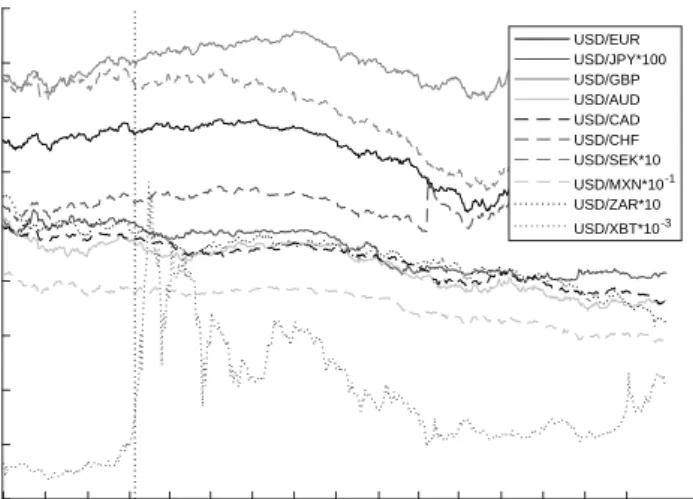
Figure 1 plots exchange rates relative to the USD during our sample time period from 1 May 2013 until 31 December 2015. Note that the XBT/USD exchange rate exhibits much higher volatility than traditional fiat currency exchange rates. The largest peak corresponds to 29 November 2013, after a surge in retailer announcements that they would soon be accepting Bitcoin as payment (see, e.g., Jopson and Foley, 2013), and after a hearing by the U.S. Senate demonstrated that they would take a
more neutral position regarding digital currencies (see, e.g., Eha, 2013).
[Insert Figure 1 about here.]
We collect fiat currency bid and ask quotes provided by the exchange rate service WM/Reuters for our sample time period. Bid and ask quotes are available for 60 out of 90 possible combinations of fiat currencies. The quotes are downloaded from Thomson Reuters Datastream, and are originally sourced from wholesale electronic currency platforms, including Thomson Reuters Matching, EBS, and Currenex, to reflect an average of interbank quotes between 3:59:30pm and 4:00:30pm GMT (10:59:30am and 11:00:30am ET). Based on theaskandbidquotes,Sa
t,A/B andS b
t,A/B, the absolute spread is given
by their difference,Sa t,A/B−S
b
t,A/B, and the percentage spread as the absolute spread relative to the ask
quote, S a t,A/B−S b t,A/B Sa t,A/B
. Additionally, percentage bid-ask spreads for Bitcoin for the same time period are downloaded from Bitcoinity (data.bitcoinity.org/); the data includes percentage bid-ask spreads for all exchange rates except for against the Mexican peso (MXN) and the South African rand (ZAR). Bid-ask spreads are provided separately for each Bitcoin exchange, so we take the median bid-ask spreads across exchanges. Bitcoinity calculates percentage bid-ask spreads as the percentage difference between the daily minimum ask quote and maximum bid quote; thus, these spreads do not represent a spread that would be available to a trader at a particular time, but represent an upper bound on bid-ask spreads in the Bitcoin market.
Table 2 presents summary statistics for percentage bid-ask spreads for the nine fiat exchange rates against the USD, as well as the eight exchange rates against Bitcoin. From the table, it is clear that Bitcoin spreads tend to be much higher than those of fiat currencies. For example, the percentage spread for trading EUR against XBT is more than 40 times larger than the spread for trading EUR against USD. Our estimates of Bitcoin spreads tend to be larger than those in the existing literature (see, e.g., Kim, 2017; Brauneis et al., 2019), for several reasons. First, most studies only consider highly liquid Bitcoin pairs, such as USD/XBT, while we additionally consider other, less liquid, pairs. Secondly, our data only extends until 2015, so other studies using more recent data may show lower spreads as liquidity in Bitcoin markets has grown over time.
Figure 2 plots the average percentage bid-ask spreads for exchange rates involving fiat currencies only and the average percentage bid-ask spreads for Bitcoin exchange rates over our sample time period. The plot again highlights the difference in magnitude between the two groups of spreads, and also shows that they tend to follow different dynamics. Spreads for Bitcoin begin to rise in early February 2014,
i.e., right around the Mt. Gox bankruptcy, spiking at 8.1% several weeks later on 31 March 2014. Interestingly, both Bitcoin and fiat currency spreads peak in January-February 2015, likely a result of the Swiss National Bank’s abrupt announcement on 15 January 2015 that it would end its cap on the CHF/EUR exchange rate (see, e.g., Jolly and Irwin, 2015).
[Insert Table 2 and Figure 2 about here.]
3
The Triangular Arbitrage Parity
A consequence of no-arbitrage pricing, which is a cornerstone in modern financial theory, is that there are strong theoretical predictions concerning the relationships between the prices of financial assets. In this paper, we consider no-arbitrage prices between triplets of exchange rates. Consider three currencies
A,B, and so-called “vehicle currency”V, that trade in a foreign exchange market that is absent trading constraints and costs, in which agents are perfectly informed and have no market power. In the absence of arbitrage, for any triplet of spot exchange rates St,A/B,St,A/V andSt,V /B, we obtain thetriangular
arbitrage parity:
St,A/B = St,A/VSt,V /B or, equivalently, lnSt,A/B = lnSt,A/V + lnSt,V /B . (1)
In a hypothetical frictionless and arbitrage-free market, we therefore should always observe lnSt,A/B−
lnSt,A/V −lnSt,V /B= 0 exactly. However, for our empirical exchange rate data described in Section 2,
we observe lnSt,A/B−lnSt,A/V −lnSt,V /B̸= 0 for all periodstand all currency triplets in our sample.
Under “normal” market conditions, small deviations from arbitrage parities are, of course, expected to persist, for example, due to transaction costs. The presence of transaction costs creates so-called “no-arbitrage bounds”, within which the cost of an “no-arbitrage trade is larger than its profit and thus these deviations persist in the market (see, e.g., Modest and Sundaresan, 1983; Klemkosky and Lee, 1991; Engel and Rogers, 1996). Therefore, such deviations do not necessarily constitute tradable arbitrage opportunities in practice.
Therefore, in a first step, we explore whether our observations that lnSt,A/B−lnSt,A/V−lnSt,V /B̸=
0 can be explained by transactions costs implied by bid-ask spreads. Specifically, we investigate whether the deviations from the triangular parity stay within no-arbitrage bounds implied by transaction costs as measured using bid-ask spreads. As the difference between bid and ask prices represents the profit
earned by brokers to facilitate the market between buyers and sellers, the bid-ask spread represent a significant cost for a “round-trip” trade, and therefore the bid-ask spread is often used as a measure of transaction costs.
To calculate no-arbitrage bounds, we follow equation (6) of Kozhan and Tham (2012) and consider the following “bid-ask adjusted” no-arbitrage conditions, given 0< Sb
t,A/B ≤S a t,A/B:
St,A/Ba ≥Sbt,A/VSt,V /Bb and St,A/Bb ≤St,A/Va Sat,V /B. (2)
Assuming that the midquote (i.e., the mean bid and ask quote) represents the true underlying value of the exchange rate, and assuming non-zero spreads, the implied cost of a transaction is equal to the half-spread, e.g., Ct,A/B :=
Sa
t,A/B−St,A/Bb
2 ≥ 0. Define the implied transaction costs relative to the
midquote for the three currency pairs by ct,A/B,ct,A/V andct,V /B. Then,Sat,A/B=St,A/B+Ct,A/B=
St,A/B
(
1 +ct,A/B
)
andSt,A/Bb =St,A/B−Ct,A/B =St,A/B
(
1−ct,A/B
)
. By using these equations and the no-arbitrage conditions in (2), we obtain the no-arbitrage bounds:
( 1−ct,A/V ) ( 1−ct,V /B ) ( 1 +ct,A/B ) ≤ St,A/B St,A/VSt,V /B ≤ ( 1 +ct,A/V ) ( 1 +ct,V /B ) ( 1−ct,A/B ) . (3)
By taking logarithms we get:
ct,L≤lnSt,A/B−lnSt,A/V −lnSt,V /B≤ct,R, (4)
where the lower boundct,L is given by ln
( 1−ct,A/V ) + ln(1−ct,V /B ) −ln(1 +ct,A/B )
and the upper boundct,R is given by ln ( 1 +ct,A/V ) + ln(1 +ct,V /B ) −ln(1−ct,A/B ) .
To obtain conservative no-arbitrage bounds, we consider the minimum of the lower bound ct,L,
denoted ¯cL, and the maximum of the upper bound ct,R, denoted ¯cR in the following. In addition,
we obtain the 10% percentile, the mean, the median and the maximum of the lower bound (denoted
cL,10%, cL,mean, cL,median and cL), and the minimum, the mean, the median and the 90% percentile
of the upper bound (denoted cR, cR,mean, cR,median and cR,90%). Since the Bitcoin bid-ask spreads
are obtained from various exchanges and include some extreme realizations, the 10%/90% percentile measures are calculated in order to exclude possible effects arising from such spikes in the bid-ask spread.
from zero exceed our bid-ask spread-implied measures of no-arbitrage bounds. For all fiat currency triplets, we find that the deviations stay well within the no-arbitrage bounds implied by bid-ask spreads. Interestingly the deviations remain within the interval [cL, cR]. One caveat to this result might be the different time windows use for the calculation of spot rates (12pm ET) and bid and ask quotes (4pm GMT/11am ET). Studies such as Marsh et al. (2017) and Evans (2018) have focused on the fact that fiat currency markets display vastly different market microstructure dynamics during the “4pm London Fix”, as large banks flood the market with liquidity in attempts to influence this benchmark spot rate. However, these studies show that spreads during the 4pm GMT window are muchlower than at other times during the trading day. This would therefore bias our results towards finding more deviations outside the bounds.
On the other hand, Bitcoin currency triplets are shown to exceed the no-arbitrage bounds much more often. Whenever the currency Bitcoin is included a modest proportion of the deviations lnSt,A/B−
lnSt,A/V −lnSt,V /B does not meet the conservative no-arbitrage bounds described by ¯cLand ¯cR. This
is particularly striking, considering that the maximum spread measure is much higher for Bitcoin (see Table 2). By using the percentile based no-arbitrage bounds we observe that a substantial proportion of the deviations is outside the interval [cL,10%, cR,90%].
The tendency of fiat currency non-zero deviations of lnSt,A/B−lnSt,A/V−lnSt,V /Bto stay within
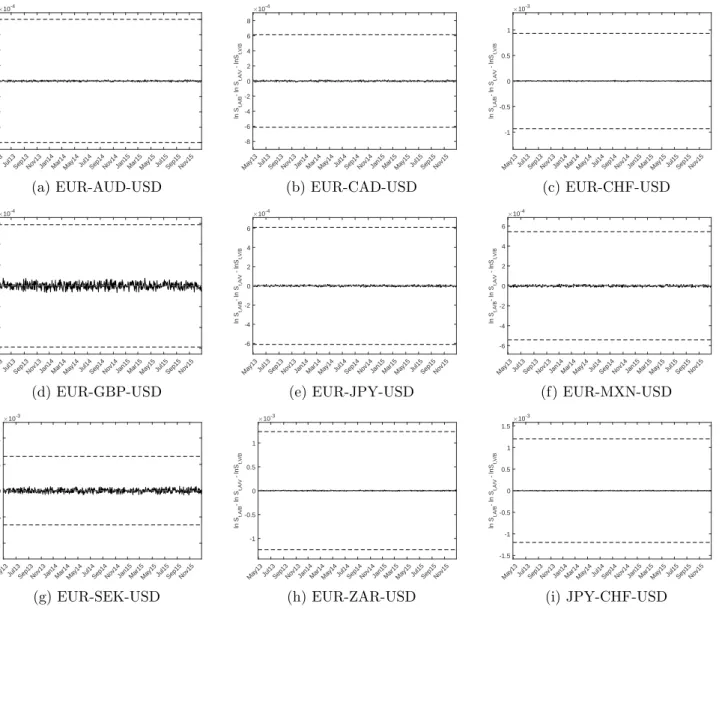
no-arbitrage bounds can also be seen by plotting these deviations over time. Figure 3 presents deviations, along with the no-arbitrage bounds implied by the 10%/90% percentiles of spreads, for a representative sample of currency triplets including only fiat currencies, in which the U.S. dollar is used as the vehicle currency. Deviations for fiat currency triplets in which the euro is used as the vehicle currency look very similar. These deviations are quite small in magnitude, remaining in the interval [−0.0001,0.0001] or even smaller, and are fluctuating around zero with no clear episodes of being positive or negative only. Emphasizing the results from Table 3, the deviations remain far way from the no-arbitrage bounds. This holds even for currencies such as the Mexican peso and South African rand, which likely have higher transactions costs due to their relatively low trading volumes.
[Insert Figure 3 about here.]
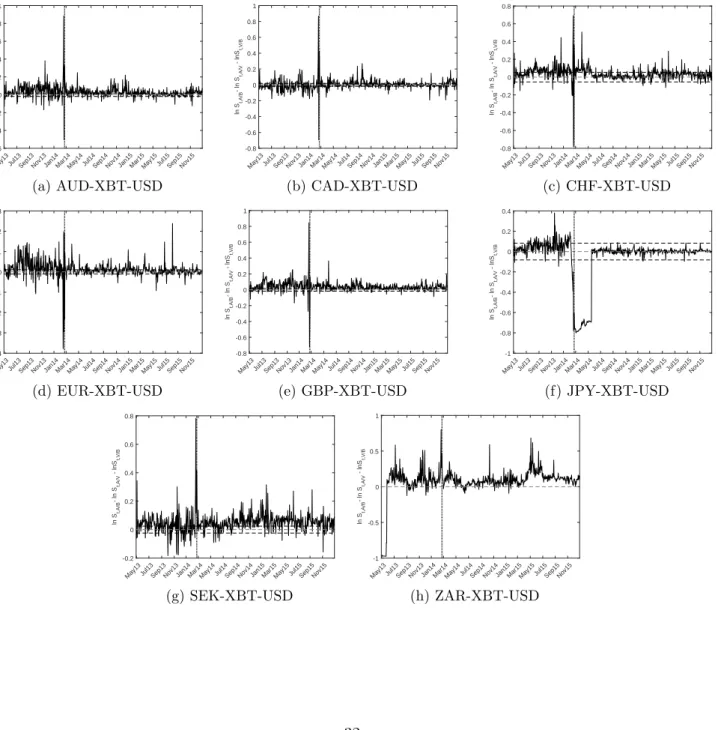
For comparison, Figure 4 presents all deviations for triplets including Bitcoin, in which USD is used as the vehicle currency, along with our measures of no-arbitrage bounds implied by the 90% percentiles of spreads. It is clear that including Bitcoin into the currency triplets leads to both higher magnitudes
and higher volatility of the deviations. These deviations are often shown to exceed the no-arbitrage bounds. Furthermore, we observe time spans in which the deviations remain systematically positive or negative, pointing to persistent over- and underpricing in the market for Bitcoin. Such mispricings may persist, for example, due to the relatively low rate of informed institutional trading on Bitcoin exchanges. Anecdotal evidence puts the amount of Bitcoin held by institutional investors at about 1% as of 2017 (see, e.g., Lielacher, 2017). Furthermore, the most recent data from the Bitcoin trading services provider
itBitshows that institutional investors make up a majority of OTC Bitcoin transactions, implying that
when they do trade, they may prefer to do so off-exchange (see Hamilton, 2016). Interestingly, most Bitcoin triplets experience a spike in their deviations around the Mt. Gox bankruptcy on 24 February 2014 (marked by the blue dotted line in the plots), showing the impact that this event had on the market for Bitcoin. By contrast, for fiat currency triplets we do not observe spikes around this date.
Therefore, it may be that profitable arbitrage opportunities exist in the market for Bitcoin. However, it may also be that there are additional trading costs or frictions for Bitcoin that are not captured by bid-ask spreads, which limit the profitability of correcting deviations from the triangular arbitrage parity. Such trading costs may come, for example, from high exchange fees; Kim (2017) estimates a maximum Bitcoin exchange fee of about 0.5%, while Fink and Johann (2014) document Bitcoin exchange fees up to 2%. Another factor is the high latency of Bitcoin trading; Courtois et al. (2014) show that Bitcoin transactions can take up to ten minutes, making it difficult to engage in simultaneous transactions with lower latency fiat currency markets. Bitcoin traders can opt for more speed, but this requites the payment of a so-called “mining fee”, which Fink and Johann (2014) estimate as about 1%-4% for Bitcoin. There are also a number of additional risks that are relatively unique to Bitcoin – such as higher risks of exchange insolvency and theft (see, e.g., Moore and Christin, 2013), or its association with illegal activity (see, e.g., Foley et al., 2019).
After examining deviations from the log-form of the triangular arbitrage parity, i.e., of lnSt,A/B−
lnSt,A/V −lnSt,V /B from zero, and a brief comparison of these deviations to the no-arbitrage bounds
implied by bid-ask spreads, the next section will analyze whether these deviations are connected to sig-nificant market dislocations, in terms of deviations from a stochastic version of the triangular arbitrage parity with cointegrated exchange rates and stationary errors and with parameter values as implied by the exact parity.
4
Monitoring Market Dislocations
In this section we discuss the logarithmic form of the triangular arbitrage parity from a cointegration perspective, as a basis to identify market dislocations as breakdowns of the prevalence of a cointegrating relationship with parity-implied values of the parameters. To be precise, we consider:
lnSt,A/B = µ+β⊤ ⎛ ⎝ lnSt,A/V lnSt,V /B ⎞ ⎠+ut, yt = µ+β⊤xt+ut, (5)
in which the three involved exchange rates St,A/B, St,A/V andSt,V /B are integrated and the errorsut
stationary. The I(1) properties of the exchange rates are discussed and confirmed in Appendix A.1. The triangular arbitrage parity implies thatµ = 0 and β = (1, 1)⊤. With the parameter values implied by the parity, the unobserved errorsutbecome in fact observed quantities. The idea of the
mon-itoring procedure of Wagner and Wied (2015) and Wagner and Wied (2017) is to assess the stochastic properties of the residuals ˆut,m, defined as:
ˆ
ut,m=yt−µˆm−(1, 1)xt, t= [mT] + 1, . . . , T, (6)
with ˆµm:= [mT1 ]∑
[mT]
t=1 (yt−(1, 1)xt), the OLS estimate of µfor the given value ofβ= (1, 1)⊤ over
thecalibrationperiod 1, . . . ,[mT] for some 0< m <1. The calibration periodt= 1, . . . ,[mT] is known
to be or assumed to be free of structural breaks. Note that we estimate the intercept µrather than setting it equal to µ= 0, as implied by the triangular arbitrage parity. This is to allow for rounding errors, as the convention of quoting exchange rates at only four decimals places (two decimal places in the case of the yen) typically leads to small non-zero means in (6). Note also that the variant of the monitoring procedure we use is treated in full detail only in Wagner and Wied (2015), since we monitor a cointegrating relationship with known, i.e., given from the arbitrage parity condition, parameters rather than estimated parameters.
As long as the relationship in (5) continues to hold after the calibration period, the residuals ˆutwill
continue to be stationary. Should the relationship break down, however, either because the parameters change (away from the parity-implied values) or because cointegration breaks down altogether, the residuals will become “big”. This suggest to consider, e.g., a stationarity test statistic as the basis for a
monitoring statistic. Wagner and Wied (2017) consider as starting point the Kwiatkowski et al. (1992) test statistic, which is transformed into a monitoring statistic given by:
ˆ Hm(s) := 1 ˆ ω2 m 1 T [sT] ∑ j=[mT] ( 1 √ T j ∑ t=1 ˆ ut,m )2 , (7) withm≤s≤1 andωˆ2
mis an estimator of the long-run variance ofut, i.e., of 0< ω2=∑
∞
j=−∞Eut−jut<
∞, calculated over the calibration period 1, . . . ,[mT]. In our application we estimateω2non-parametrically,
using the Bartlett kernel and the bandwidth rule of Andrews (1991). The test statistic has to be nor-malized by the long-run variance to take into account potential serial correlation inut. Under the null
hypothesis of no structural change, it holds that:
ˆ Hm(s)⇒Hm(s) := 1 ω2 ∫ s m ω2W˜(r)2dr= ∫ s m ˜ W(r)2dr , (8)
with ˜W(r) =W(r)−mrW(m) andW(r) standard Brownian motion. The monitoring statisticHˆm(s)
is calculated for all [mT] + 1≤[sT]≤T and a weighted version of it is compared with critical values obtained from Wagner and Wied (2015). A structural break is identified when a weighted test statistic,
ˆ
Hs(m)
g(s) , exceeds, in absolute value, the corresponding critical value, i.e.:
τm:= { min s: [mT]+1≤[sT]≤T ⏐ ⏐ ⏐ ⏐ ⏐ ˆ Hm(s) g(s) ⏐ ⏐ ⏐ ⏐ ⏐ > c(α, g(s), m) } , (9)
where τm, referred to as the detection time, is a natural estimator of the break-point. In our case we
use the weighting function g(s) = s3 as in Wagner and Wied (2017). The critical values c(α, g(s), m)
depend upon the significance levelα, the weighting functiong(s) and the length of the calibration period
m. They are constructed such that P
( supm≤s≤1 ⏐ ⏐ ⏐ ⏐ ∫s mW˜(r)2dr g(s) ⏐ ⏐ ⏐ ⏐ > c(α, g(s), m) ) =α. Throughout our empirical analysis we use a significance level ofα= 5%. The functioning of the monitoring procedure is illustrated in Figure 5, with a break-point detected at time pointtτm := [τmT].
[Insert Figure 5 about here.]
Looking at (6) is informative for understanding why the monitoring procedure has power against both a change in the stochastic behavior of the errors as well as against changes in the parameters oc-curring in the monitoring period. Consider for brevity the omnibus case thatpotentially all parameters
change at some time point [rT], with the new parameters from [rT] + 1 onward equal toµ1̸=µ0, with
µ0 the true value in the calibration period, andβ1̸= (1, 1)
⊤
. This implies that, for the residuals, the partial sum process:
1 √ T T ∑ t=[rT]+1 ˆ ut= 1 √ T T ∑ t=[rT]+1 ut− T−[rT] √ T (ˆµm−µ1)− 1 √ T T ∑ t=[rT]+1 ((1, 1)−β⊤1)xt (10)
will diverge. In case ut changes its behavior from I(0) to I(1) or to an explosive process, the partial
sum process √1
T
∑T
t=[rT]+1utdiverges, and in case the intercept changes toµ1, the corresponding term
will diverge as ˆµm−µ1 will in this case not converge to zero due to ˆµm converging to the true value
prior to the change, µ0. The same argument applies if the slope parameter vectorβ changes, since in
that case ((1, 1)−β1⊤) is not equal to zero and the corresponding term involvingxtdiverges. Thus, in
either case of structural change, the partial sum process √1
T
∑T
t=[rT]+1uˆt, which converges under the
null hypothesis, will diverge, being either an integrated or explosive process or including a deterministic trend or both.
Of course, the first step in assessing whether the posited parity relationship in (5) is supported by the data is to estimate the parameters µandβ and to verify whether the estimated parameters are in line with the no-arbitrage valuesµ= 0 andβ= (1, 1)⊤. When estimating the parameters in (5) one has to resort to estimators that have limiting distributions that allow for asymptotic standard inference. These estimators correct for the effects of error serial correlation and regressor endogeneity that contaminate the limiting distribution of the OLS estimator. In our analysis, we use the so-called fully modified OLS (FM-OLS) estimator of Phillips and Hansen (1990). In particular, we performrolling estimation of the parameters with FM-OLS to assess the stability of the parameters visually in the following Section 5. A detailed discussion of modified least squares estimators in cointegrating regressions is contained, e.g., in Wagner (2018). Since the limiting distribution of the FM-OLS estimator allows for asymptotically valid inference, we also use the FM-OLS estimates over the full sample period to test several hypotheses related to whether the parameters are equal to the parity-implied values. This is, of course, nothing but an additional way to assess whether the parameters are close to the parity-implied values. Neither of these tools, however, allows for asymptotically valued detection of break-points, the reason being that monitoring is inherently a multiple testing problem and this has to be taken into account in the construction of a valid monitoring procedure, not least in the construction or simulation of valid critical values that allow for asymptotic size control. See Chu et al. (1996) for a detailed discussion of these
issues.
5
Results
This section describes the results from our empirical investigation of the triangular arbitrage parity in the foreign exchange and Bitcoin markets. Recall that the triangular arbitrage parity examines the relationship between a triplet of exchange rates. Like Pasquariello (2014) we include only currency triplets in which either USD or EUR serve as vehicle currency. Furthermore, each currency triplet is only included once, irrespective of the ordering. This leaves us with 72 fiat currency triplets and 18 currency triplets involving Bitcoin. Furthermore, we choose a calibration period of m= 0.2. As our sample period ranges from 1 May 2013 until 31 December 2015, this means that our calibration time period lasts from 1 May 2013 until 8 November 2013, which corresponds to a relatively stable period for exchange rates.
First, we want to see whether estimates of the parametersµandβfrom (5) correspond to the values implied by the triangular arbitrage parity, µ= 0 andβ = (1, 1)⊤. We estimate the parameters over the full period, 1 May 2013 to 31 December 2015, using fully modified least squares (FM-OLS), which corrects for possible serial correlation as well as endogeneity in a cointegration regression (see Phillips and Hansen, 1990). We subsequently analyze Wald-type tests to separately test the parameters for
µ= 0,β1= 1, and β2= 1. The results for these Wald tests are presented in Table 4.
[Insert Table 4 about here.]
We are much more likely to find deviations fromµ= 0 in the currency triplets that include Bitcoin, For the USD triplets, the Wald-type test rejects (at a 5% confidence level) the null hypothesis that
µ = 0 for only 4 out of 36 (11%) of the fiat-only currency triplets, but for 7 of the 9 (77%) of the currency triplets that include Bitcoin. Similarly, for the EUR triplets, we reject the hypothesis that
µ= 0 in only one (2.7%) of the fiat-only triplets, and in seven of the Bitcoin triplets. Meanwhile, we are also more likely to find deviations fromβ= (1, 1)⊤ in Bitcoin triplets, though there are overall fewer deviations than for µ. Combining both the USD and EUR triplets, we reject the hypothesis β1 = 1
only twice (2.7%) out of the possible 72 fiat-only triplets, and in 6 (33%) of the Bitcoin triplets. The hypothesis β2 = 1 is never rejected for the fiat-only triplets and is reject for 4 (22%) of the Bitcoin
values for currency triplets that include Bitcoin.
Next, we examine the stability of the parameter estimates over time, using rolling window regressions to visually inspect whether the parameter estimates are close to the values implied by the triangular arbitrage parity. We consider rolling window parameter estimates for the regression model (5), using a window size m = 0.2 as a proportion of the total time series length, and abbreviate the estimated parameters byµˆm andβˆm= ( ˆ β1m,βˆ2m )⊤ .
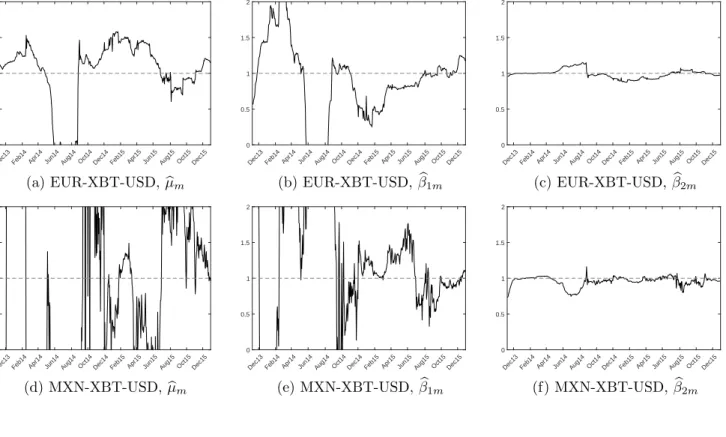
Representative results for the estimatesµˆmandβˆmare provided in Figures 6 and 7. Figure 6 shows
rolling window estimates for currency triplets in which only fiat currencies are included, and reveals that the estimated parameters hardly deviate from their theory-implied values over our sample period, and that the variation of the estimates is small. On the other hand, the rolling window estimates for currency triplets involving Bitcoin, shown in Figure 7, show high variation in the estimates and large deviations away from the theory-implied parameter values.
[Insert Figures 6 and 7 about here.]
In a next step, we perform stationarity monitoring as described in Section 4, which will also allow us to identify dates around which structural breaks-points are more likely to have occurred. Overall, given the frequent observation of deviations outside of no-arbitrage bounds for currency triplets involving Bitcoin (see Figure 4), as well as deviations of parameter estimates away from their theory-implied values from the rolling window regressions (see Figures 6 and 7), we might expect that our monitoring tool will be more likely to reject the null hypothesis of “no structural breaks” in the cointegrating relationship for Bitcoin currency triplets. In our stationary monitoring procedure, we fix β =β∗ = (1,1)⊤ and
monitor the OLS residualsˆut:=yt−µˆm−β ∗ ⊤x
t. The detected break-points are presented in Table 5.
[Insert Table 5 about here.]
The results indeed indicate that we are much more likely to detect a break-point in the triplets that include Bitcoin. With the USD as the vehicle currency, we observe six break-points in the triplets that include Bitcoin (XBT) (i.e., in two-thirds of the Bitcoin triplets), and only two break-points when the triplet is composed of fiat currencies only (5.5% of the fiat-only triplets). Interestingly, the two breaks in the fiat-only triplets both include the Mexican peso (MXN), with break-point dates in October 2014. The Mexican peso experienced a rapid decline at the end of 2014 due to a drop in oil prices and strengthening of the U.S. dollar, which might have generated these deviations (see, e.g., Bain, 2013).
Similarly, using the EUR as the vehicle currency leads to seven break-points in the Bitcoin triplets, and to zero breaks in the fiat-only triplets.
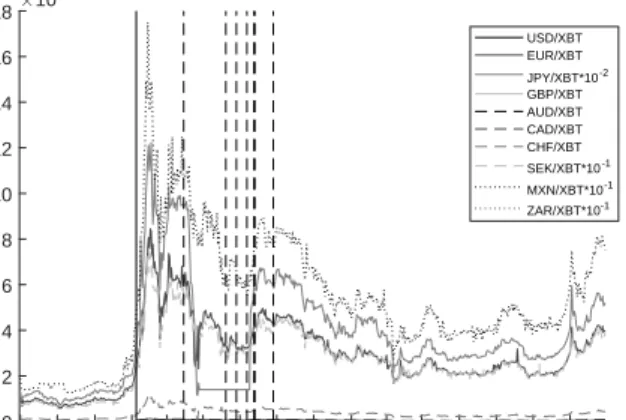
As we have shown that a high number of break-points are detected in the Bitcoin triplets, the next question is whether the detected break-points tend to be clustered in time. Figure 8 plots the Bitcoin exchange rates, with dashed vertical lines representing the detected break-points for currency triplets using either the USD or EUR as vehicle currencies. The detected break-point of 26 February 2014 for the triplet JPY-XBT-USD comes just days after the Mt. Gox bankruptcy. That the bankruptcy should hit the market for JPY/XBT the hardest is no surprise; the shut-down of the Tokyo-based exchange represented a massive disruption to the market for Bitcoin against the yen, as Bitcoin dropped 17.41% against the yen within a single day. Furthermore, as Mt. Gox is the only exchange in our dataset that offered JPY/XBT transactions at the time, its bankruptcy meant a virtual halt on exchange-based trading of yen for Bitcoin. However, it’s important to note that there may have been more exchanges offering JPY/XBT that have chosen not to self-report in the bitcoincharts dataset, and furthermore that traders could search for counterparties in JPY/XBT via OTC markets.
[Insert Figure 8 about here.]
Other break-points for USD triplets do not seem to be clustered in time, although all take place after the Mt. Gox bankruptcy. It is not clear whether these later detection dates are due to a lagged reaction of our detector, or reactions to other market events. For example, it is likely that the break-point of 19 January 2015 for the triplet CHF-XBT-USD is a result of the Swiss National Bank’s abrupt ending to its cap on the CHF/EUR exchange rate just a few days earlier.
For the triplets using EUR as a vehicle currency, depicted in Figure 8b, interestingly we see that the break-points indeed tend to be clustered in time, with most break-points clustered around the bankruptcy of Mt. Gox and the subsequent recovery. The only exception is JPY-XBT-EUR; for this triplet, we already detect a break-point on 29 January 2014, before the Mt. Gox bankruptcy. Mt. Gox was experiencing problems throughout early 2014 in the lead-up to its bankruptcy, as customers complained about withdrawal delays and poor service (see, e.g., Weisenthal, 2014). Meanwhile, the break-points for almost all remaining Bitcoin triplets occur during the weeks and months after the Mt. Gox bankruptcy, when trading was likely much more restricted due to the collapse of the major ex-change. Our results imply that these trading restrictions may have led to deviations from the triangular arbitrage parity for Bitcoin traders in a variety of currencies. However, given difficulties in trading, it is
possible that Bitcoin traders were not able to take advantage of these potential arbitrage opportunities. Figure 9 plots the OLS residualsuˆt:=yt−ˆµm−β
∗ ⊤x
tas described in Section 4, for two examples
of triplets: one in which a break-point is detected (JPY-XBT-USD, Figure 9a), and one in which no break-point is detected (JPY-SEK-USD, Figure 9b). In the figures, the solid lines correspond to the cut-off between the calibration and monitoring time periods, and the dashed lines correspond to the detected break-point (if any) for the currency triplet shown. In Figure 9a, the break-point of 26 February 2014 corresponds to a downward spike in the residuals; furthermore, after the detected break-point, the residuals remain consistently negative. For comparison, Figure 9b shows a triplet for which no break-point is found. These residuals remain clustered around zero.
[Insert Figure 9 about here.]
Note that break-point detected by means of our monitoring tool does not automatically imply that exploitable arbitrage opportunities exist. The deviations from triangular arbitrage could be due to costs and trading constraints that would prevent a profitable trade based on the deviations. For example, as mentioned above, small deviations in µ from zero can be justified by rounding errors or measurement effects. However, a break-point detected by our monitoring tool implies a break down in the cointegrating relationship between exchange rates, and thus indicates a substantial dislocation between the markets for these currencies.
5.1
Portfolio Trading Strategy
In a final step, we check whether our results could be used to construct a profitable trading strategy. The idea is to compare two portfolios: one based on a simple buy-and-hold strategy, and one that trades once a break in triangular arbitrage parity deviations is detected according to the Wagner and Wied (2017) monitoring procedure. If detected break-points indeed represent market dislocations, then a break may signal higher expected uncertainty in currency markets. Thus, it may be profitable to re-balance the portfolio away from the implicated currencies and back into their domestic currency. This strategy is similar to those explored in Wied et al. (2012) and Wied et al. (2013), and is furthermore similar to the portfolio re-balancing channel of Hau and Rey (2006), in which investors shift their portfolios away from foreign currencies and into their domestic currency when their exposure to exchange rate risk increases. We consider either USD or EUR as the domestic currency. Furthermore, the initial and liquidation dates for both portfolios are defined as the first and last dates of the monitoring period in
our sample, such that the total duration of both portfolios is from 11 November 2013 until 31 December 2015, i.e., t = [mT] + 1, ..., T. We further assume that any trade can be executed at the noon spot exchange rates described in Section 2.
The first portfolio (denoted by Portfolio A) consists of a simple buy-and-hold strategy that divides 100 units of the domestic currency equally between the eleven currencies in our sample (USD, EUR, JPY, GDP, AUD, CAD, CHF, SEK, MXN, ZAR, and XBT), and never trades the currencies after the initial purchase. We assume that currencies are deposited and earn the local risk-free rate, taken as the local one-month deposit rate, as collected from Thomson Reuters Datastream and transformed to a daily interest rate such that daily returns can be compounded. As there is no risk-free Bitcoin-denominated asset, we assume that the risk-free rate for Bitcoin is zero. We assume that the units of foreign currency are exchanged for the domestic currency only on the liquidation date, leading to buy-and-hold return RA, which denotes the return of Portfolio A over the entire portfolio duration.
Note that changes in the value of the buy-and-hold portfolio are, in addition to compound interest, driven by currency revaluations over the portfolio duration. Hence, Portfolio A captures the mean performance of a domestic currency against the other ten currencies considered, after accounting for compound interest.
The second portfolio (denoted by Portfolio B) similarly divides 100 units of the domestic currency equally between the eleven currencies, but trades on the day(s) on which our monitoring procedure detects any break-point in the triangular arbitrage parity deviations. Specifically, it exchanges those holdings in the foreign currencies involved in the triangular arbitrage triplet implicated by the break-point to the domestic currency. For example, let USD be the domestic currency. From Table 5, the first breakpoint is experienced by the triplet JPY-XBT-EUR on dateτ1=29 January 2014. On this date, the
spot rates were Sτ1,U SD/J P Y = 0.0098, Sτ1,U SD/XBT = 834.9783 and Sτ1,EU R/U SD = 0.7320. Given
the yen-denominated risk-free rate, the initial units of 905.8119 JPY will be worth 905.9270 JPY by time
τm,1. The trading strategy will then exchange the 905.9270 units of JPY for 905.9270×Sτ1,U SD/J P Y =
8.8659 units of USD. The strategy will also convert the units of XBT and EUR into units of USD. For all subsequent breaks, if one of the implicated foreign currencies was already involved in any prior break, the investor already converted the corresponding holdings into the domestic currency and so does not trade in that currency. Finally, at the liquidation date, all remaining foreign currency holdings are converted to the domestic currency. A summary of the dates on which Portfolios B trades can be found in Table 6, for both the USD and EUR as the domestic currency. The return earned by Portfolio
B is denoted byRB.
[Insert Table 6 about here.]
In addition to portfolio returns, we also consider the Sharpe ratio as a risk-adjusted measure of portfolio performance. For portfolio P, the Sharpe ratio is calculated as the ratio of mean daily portfolio excess returns to the standard deviation of portfolio daily returns:
SharpeRatioP =√T −[mT]−1 1 T−[mT]−1 ∑T t=[mT]+1 ( RP t−1:t−RDOMf,t−1:t ) ˆ σ(RP t−1:t) , (11)
where ˆσ(·) denotes the sample standard deviation of the daily portfolio returns, RP
t−1:t denotes the
return for portfolio P over the period t−1 tot, and RDOM
f,t−1:tis the domestic risk-free rate.
It is important to note that both trading strategies exclude trading costs. However, note also that each portfolio trades a given currency exactly once: at the liquidation date in the case of Portfolio A, or at either a break-point date or the liquidation date in the case of Portfolio B. If trading costs are assumed to be constant over time, the total number of trades is thus the same for both portfolios, such that they will experience the same trading costs.
Table 7 compares the returns and Sharpe ratios of the two portfolios, for the different domestic currencies USD (Panel I) or EUR (Panel II). In both panels, Portfolio B is shown to significantly outperform Portfolio A, both in terms of returns and in terms of the Sharpe ratio. In fact, Panel I shows that, when the USD is the domestic currency, the buy-and-hold Portfolio A earns a strongly negative return, while Portfolio B achieves a positive return. We perform additional robustness checks in which the portfolios do not earn interest, i.e., pure cash portfolios are held, and in which the JPY or CHF are used as the domestic currency. The result that Portfolio B outperforms Portfolio A both in terms of returns and Sharpe ratios remains qualitatively unchanged.
[Insert Table 7 about here.]
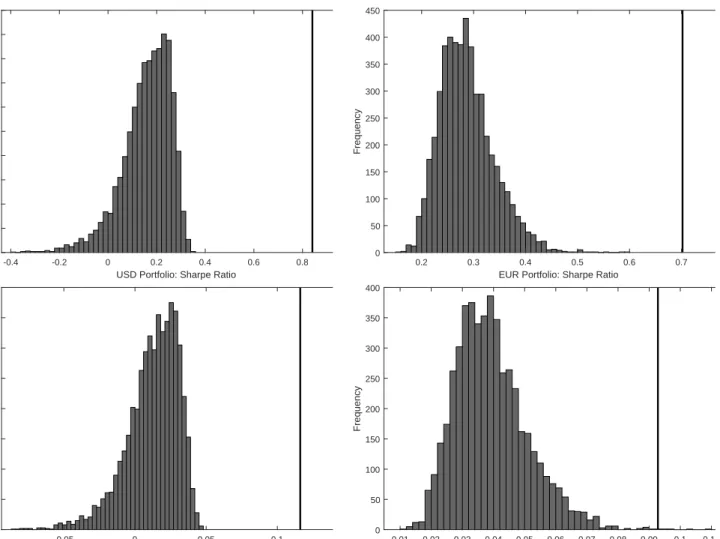
It could be that the higher profits of Portfolio B simply reflect general movements and appreciations in currency markets, rather than a result of optimally-timed market trades. Therefore, as a robustness check, we next perform a stability analysis in which we compare the performance of our Portfolio B with a portfolio that trades on randomly chosen dates. In these “placebo” portfolios, the number of break-points is chosen from a Poisson distribution with mean equal to the observed number of break-break-points,
associated currency triplets are chosen from a uniform distribution without replacement. For the two domestic currencies considered, the portfolios are simulated a total of 5,000 times; the distributions of resulting portfolio returns and Sharpe ratios are shown in Figure 10. In each figure, the vertical line corresponds to the return or Sharpe ratio from the portfolio that trades based on the break-points as detected by our monitoring procedure. It is clear that the portfolios that apply the monitoring procedure significantly outperform those portfolios that trade based on randomly assigned dates, further strengthening the argument that our monitoring procedure indeed detects periods of instability in which it is optimal to exit currency markets.
[Insert Figure 10 about here.]
Overall, this exercise is meant as a simple illustration that our methodology could lead to portfolio strategies that outperform, e.g., a simple buy-and-hold strategy. The fact that our portfolio consistently outperforms the buy-and-hold portfolio supports the idea that our monitoring tool indeed detects financial market dislocations, which represent instances of heightened uncertainty in foreign exchange markets. This characteristic of the monitoring tool should allow its use for constructing profitable investment strategies. Finally, note that, once a foreign currency is sold, we do not allow the trader to buy back the currencies afterwards. A trading strategy based on an econometric tool would require estimating the particular duration of a financial market dislocation, for example by monitoring the triangular arbitrage parity deviations for a break from no cointegration to cointegration.
6
Summary and Conclusions
This paper uses new econometric tools to investigate deviations from the triangular arbitrage parity in foreign exchange markets. To examine this issue, we collect spot exchange rates for ten fiat currencies, and use transaction data to construct spot rates for the cryptocurrency Bitcoin. Using the stationarity monitoring tool from Wagner and Wied (2017), which monitors the stability of a cointegrating rela-tionship over time, our results confirm that non-zero deviations from the triangular arbitrage parity for fiat currencies tend to stay inside no-arbitrage bounds calculated from bid-ask spreads. Furthermore, from a total of 72 different triplet permutations of traditional fiat currencies, we find a structural break in the relationship implied by the triangular arbitrage parity in only two cases.
no-arbitrage bounds in the majority of cases. Furthermore, we detect break-points in the majority of cases. Most of the detected break-points closely correspond to market events, most notably to the bankruptcy of and the resulting trading halt on Mt. Gox, which at the time of its bankruptcy was the largest Bitcoin-trading platform in the world. This perhaps reflects the finding as in Baur et al. (2018) that Bitcoin is more a speculative asset than it is a currency.
In a final step, we compare a simple buy-and-hold strategy to a portfolio strategy that trades once a break in triangular arbitrage parity deviations is detected, and show that the latter strategy outperforms in all cases. This confirms that, by detecting periods of instability in which it is optimal to exit currency markets, our results could be used to construct a profitable trading strategy.
Acknowledgements
The authors appreciate helpful comments from Alexander Brauneis, Lin William Cong, Thomas Jo-hann, Igor Pozdeev, Christian Wagner, Gloria Yu, Jinyuan Zhang and from conference and seminar participants at the University of Cologne, the 11th International Conference on Computational and
Financial Econometrics (CFE 2017), the 2nd Vienna Workshop for High-Dimensional Time Series in
Macroeconomics and Finance, the 30th Workshop of the Austrian Working Group on Banking &
Fi-nance (AWG), the 2017 ECDA Conference, the 2018 Bergen Fintech Conference, the XXVI FiFi-nance Forum, and the 2018 Meeting of the German Finance Association. We thank Etienne Theising for his help in collecting and compiling the Bitcoin data used in this study. Furthermore, we thank Dominik Wied for discussions and the suggestion to perform the portfolio comparison. The authors gratefully acknowledge financial support from the Jubil¨aumsfonds of the Oesterreichische Nationalbank under grant No. 17053. The authors gratefully acknowledge financial support by Deutsche Forschungsgemein-schaft via the Collaborative Research Center SFB823 (Projects A3 and A4). The views expressed do not necessarily reflect the views of the Bank of Slovenia/Banka Slovenije or the European System of Central Banks. On top of this the usual disclaimer applies.
References
Akram, Q. F., Rime, D. and Sarno, L., (2008), Arbitrage in the foreign exchange market: Turning on the microscope,Journal of International Economics76, 237–253.
Andrews, D. W. K., (1991), Heteroskedasticity and autocorrelation consistent covariance matrix esti-mation,Econometrica59, 817–854.
Bain, B., (2013), Mexican peso falls to two-year low as central bank dims outlook, Bloomberg, avail-able at: https://www.bloomberg.com/news/articles/2014-12-05/mexican-peso-falls-to-five-year-low-as-central-bank-dims-outlook.
Barro, R. J., (2006), Rare disasters and asset markets in the twentieth century,The Quarterly Journal
of Economics121, 823–866.
Barro, R. J., (2009), Rare disasters, asset prices, and welfare costs, The American Economic Review
99, 243–264.
Baur, D. G., Hong, K. and Lee, A. D., (2018), Bitcoin: Medium of exchange or speculative assets?,
Journal of International Financial Markets, Institutions and Money54, 177–189.
Bollerslev, T. and Todorov, V., (2011), Tails, fears, and risk premia,The Journal of Finance66, 2165– 2211.
Brauneis, A., Mestel, R., Riordan, R. and Theissen, E., (2019), A high-frequency analysis of bitcoin markets, Unpublished Manuscript.
Campbell, J. Y., Serfaty-De Medeiros, K. and Viceira, L. M., (2010), Global currency hedging, The
Journal of Finance65, 87–121.
Campbell, J. Y., Viceira, L. M. and White, J. S., (2003), Foreign currency for long-term investors,The
Economic Journal113, C1–C25.
Chu, C.-S. J., Stinchcombe, M. and White, H., (1996), Monitoring structural change, Econometrica
64, 1045–1065.
Courtois, N. T., Emirdag, P. and Nagy, D. A. (2014), Could Bitcoin transactions be 100x faster?, [in:] Proceedings of the 11th International Conference on Security and Cryptography (SECRYPT), [ed.:] M. S. Obaidat, A. Holzinger and P. Samarati, Vienna, 426–431.
Decker, C. and Wattenhofer, R. (2014), Bitcoin transaction malleability and MtGox, [in:] Proceedings of the 19th European Symposium on Research in Computer Security, [ed.:] M. Kutylowski and J. Vaidya, Wroclaw, 313–326.
Dickey, D. A. and Fuller, W. A., (1979), Distribution of the estimators for autoregressive time series with a unit root,Journal of the American Statistical Association74, 427–431.
Dong, H. and Dong, W., (2014), Bitcoin: Exchange rate parity, risk premium, and arbitrage stickiness,
British Journal of Economics, Management & Trade5, 105–113.
Eha, B. P., (2013), Why regulate bitcoin?, The New Yorker, available at: https://www.newyorker.com/business/currency/why-regulate-bitcoin.
Engel, C. and Rogers, J., (1996), How wide is the border?,American Economic Review86, 1112–1125.
Evans, M. D., (2018), Forex trading and the WMR fix,Journal of Banking and Finance87, 233–247.
Fink, C. and Johann, T., (2014), Bitcoin markets, Unpublished Manuscript.
Fleckenstein, M., Longstaff, F. A. and Lustig, H., (2014), The TIPS-treasury bond puzzle,The Journal
of Finance69, 2151–2197.
Foley, S., Karlsen, J. R. and Putnins, T. J., (2019), Sex, drugs, and bitcoin: How much illegal activity is financed through cryptocurrencies?,The Review of Financial Studies32, 1798–1853.
Foucault, T., Kozhan, R. and Tham, W. W., (2016), Toxic arbitrage,The Review of Financial Studies
30, 1053–1094.
Gagnon, L. and Karolyi, A., (2010), Multi-market trading and arbitrage, Journal of Financial
Eco-nomics97, 53–80.
Gromb, D. and Vayanos, D., (2010), Limits to arbitrage: The state of the theory, Annual Review of
Financial Economics2, 251–275.
Hamilton, E., (2016), itbit bitcoin otc market recap: May 2016 infographic, itBit, available at: https://www.itbit.com/blog/itbit-bitcoin-otc-market-recap-may-2016-infographic.
Hau, H. and Rey, H., (2006), Exchange rates, equity prices, and capital flows,The Review of Financial
Studies19, 273–317.
Ito, T., Yamada, K., Takayasu, M. and Takayasu, H., (2012), Free lunch! Arbitrage opportunities in the foreign exchange markets, Unpublished Manuscript.
Jolly, D. and Irwin, N., (2015), Swiss franc soars after central bank drops cap, The New York
Times, available at :
https://www.nytimes.com/2015/01/16/business/swiss-national-bank-euro-franc-exchange-rate.html?auth=login-google.
Jopson, B. and Foley, S., (2013), Big US online retailer to accept bitcoin, Financial Times, available at: https://www.ft.com/content/d5f2f096-6907-11e3-996a-00144feabdc0.
Kim, T., (2017), On the transaction cost of bitcoin,Finance Research Letters23, 300–305.
Klemkosky, R. C. and Lee, J. H., (1991), The intraday ex post and ex ante profitability of index arbitrage,Journal of Futures Markets11, 291–311.
Kozhan, R. and Tham, W. W., (2012), Execution risk in high-frequency arbitrage,Management Science
58, 2131–2149.
Kwiatkowski, D., Phillips, P. C., Schmidt, P. and Shin, Y., (1992), Testing the null hypothesis of stationarity against the alternative of a unit root,Journal of Econometrics 54, 159–178.
Lielacher, A., (2017), Bitcoin 2018: ’Show me the (institutional) money!’, Brave New Coin, available at: https://bravenewcoin.com/insights/bitcoin-2018-show-me-the-institutional-money.
Lyons, R. K. and Moore, M. J., (2009), An information approach to international currencies,Journal
of International Economics79, 211–221.
Makarov, I. and Schoar, A., (2020), Trading and arbitrage in cryptocurrency markets, Journal of
Financial Economics135, 293–319.
Marsh, I. W., Panagiotou, P. and Payne, R., (2017), The WMR fix and its impact on currency markets, Unpublished Manuscript.
Matvos, G. and Seru, A., (2014), Resource allocation within firms and financial market dislocation: Evidence from diversified conglomerates,The Review of Financial Studies27, 1143–1189.
Modest, D. M. and Sundaresan, M., (1983), The relationship between spot and futures prices in stock index futures markets: Some preliminary evidence,Journal of Futures Markets3, 15–41.
Moore, T. and Christin, N. (2013), Beware the middleman: Empirical analysis of Bitcoin-exchange risk, [in:] Financial Cryptography and Data Security, 17th International Conference, FC 2013, [ed.:] A.-R. Sadeghi, Okinawa, 25–33.
Osipovich, A. and Jeong, E.-Y., (2018), Bitcoin’s crashing? That won’t stop arbitrage traders from raking in millionsThe Wall Street Journal, available at: https://www.wsj.com/articles/bitcoins-crashing-that-wont-stop-arbitrage-traders-from-raking-in-millions-151774920.
Pasquariello, P., (2014), Financial market dislocations,Review of Financial Studies27, 1868–1914.
Phillips, P. C. B. and Hansen, B. E., (1990), Statistical inference in instrumental variables regression with I(1) processes,Review of Economic Studies57, 99–125.
Phillips, P. C. B. and Perron, P., (1988), Testing for a unit root in time series regression, Biometrika
75, 345–356.
Pieters, G. C., (2016), Does bitcoin reveal new information about exchange rates and financial integra-tion?, Unpublished Manuscript.
Pieters, G. and Vivanco, S., (2017), Financial regulations and price inconsistencies across Bitcoin markets,Information Economics and Policy39, 1–14.
Saikkonen, P., (1991), Asymptotically efficient estimation of cointegration regressions, Econometric
Theory7, 1–21.
Shleifer, A. and Vishny, R., (1997), The limits of arbitrage,Journal of Finance52, 35–55.
Stock, J. H. and Watson, M. W., (1993), A simple estimator of cointegrating vectors in higher order integrated systems,Econometrica61, 783–820.
Veronesi, P., (2004), The peso problem hypothesis and stock market returns, Journal of Economic
Dynamics and Control28, 707–725.
Vogelsang, T. J. and Wagner, M., (2014), Integrated modified OLS estimation and fixed-b inference for cointegrating regressions,Journal of Econometrics178, 741–760.
Wagner, M., (2018), Estimation and inference for cointegrating regressions, [in:] Oxford Research
Enyclopedia in Economics and Finance.
Wagner, M. and Wied, D., (2015), Monitoring stationarity and cointegration, SSRN Research Paper (No. 2624657).
Wagner, M. and Wied, D., (2017), Consistent monitoring of cointegrating relationships: The US housing market and the subprime crisis,Journal of Time Series Analysis38, 960–980.
Weisenthal, J., (2014), Bitcoin plunges as major exchange Mt. Gox halts all withdrawals,
Business Insider, available at:
https://www.businessinsider.com/mtgox-halts-withdrawals-2014-2?r=US&IR=T.
Wied, D., Arnold, M., Bissantz, N. and Ziggel, D., (2012), A new fluctuation test for constant variances with applications to finance,Metrika75, 1111–1127.
Wied, D., Ziggel, D. and Berens, T., (2013), On the application of new tests for structural changes on global minimum-variance portfolios,Statistical Papers54, 955–975.
Yu, G. and Zhang, J., (2018), A revisit to capital controls policies when bitcoin is in town, Unpublished Manuscript.
A
Appendix
A.1
Times Series Properties of Exchange Rate Data
The econometric analysis of the paper commences from treating the triangular arbitrage parity in its logarithmic form – under the null hypothesis at least – as a cointegrating relationship. This necessitates as a pre-requisite that the logarithms of the exchange rates are integrated processes of order one, i.e,
I(1).
To investigate the integration properties we use two unit root tests – the augmented Dickey-Fuller (ADF) test of Dickey and Fuller (1979) and the PP test of Phillips and Perron (1988) – as well as the KPSS stationarity test of Kwiatkowski et al. (1992), with the results reported in Table 8. Panel A shows that, as expected, the augmented Dickey-Fuller (ADF) and Phillips-Perron (PP) tests fail to reject the null hypothesis of a unit root when testing all log exchange rates in levels. Likewise, the Kwiatkowski et al. (1992) (KPSS) test rejects the null of stationarity for all log exchange rates. On the other hand, the test results from Panel B show that the first-differences of all log exchange rates exhibit stationarity. Therefore, evidence from these tests affirms that log exchange rates are indeed I(1).
[Insert Table 8 about here.]
A.2
Precision of Bitcoin Data
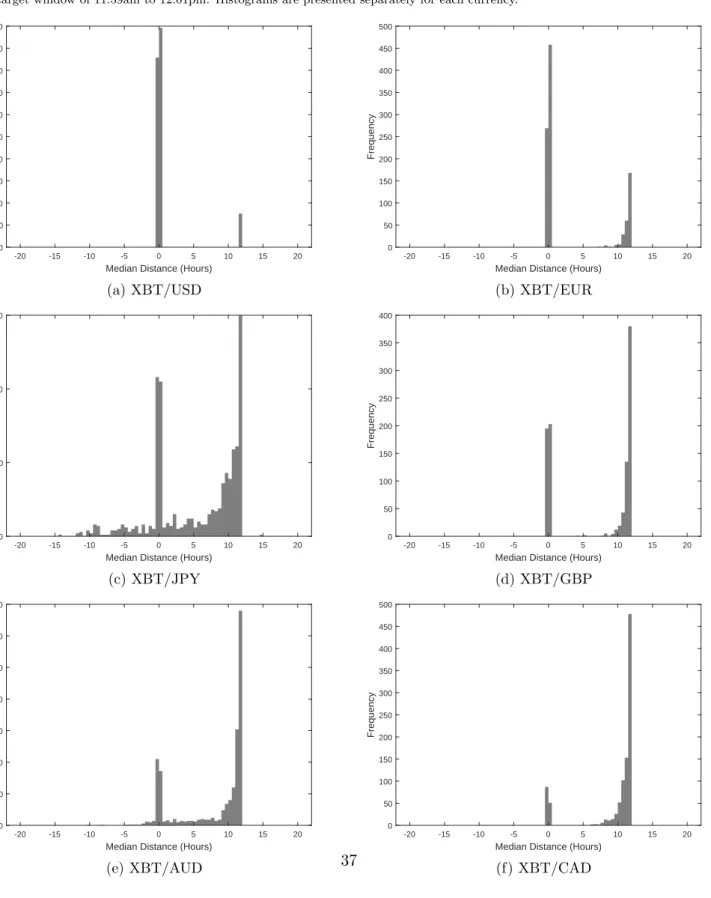
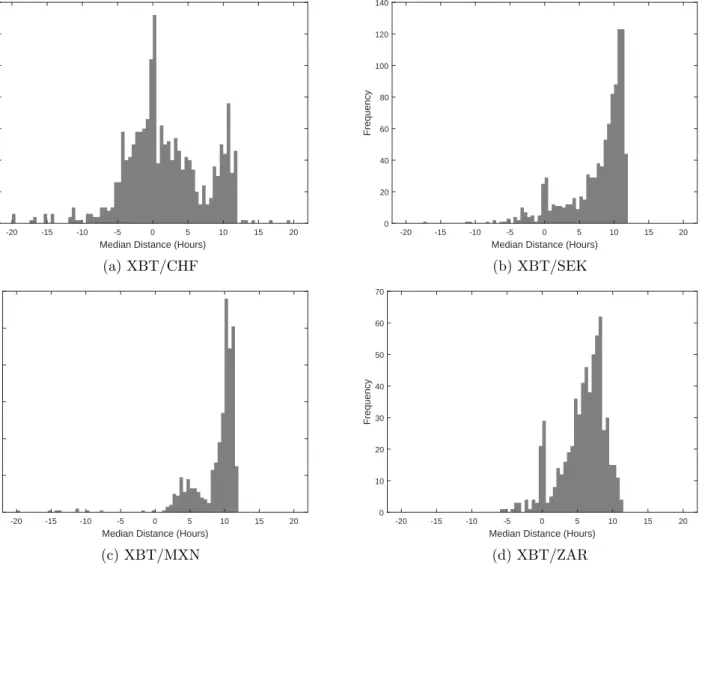
Table 9 shows summary statistics for the precision of our Bitcoin noon exchange rates with respect to the target window of 11:59am and 12:01pm ET. As expected, USD/XBT and EUR/XBT are the most precise: 88% and 65% of our noon exchange rates capture only observations within the target window, and typically more than three observations are found within the window (an average of 65 observations for USD/XBT, and 13 for EUR/XBT). The Bitcoin rate against the Mexican peso, MXN/XBT, is the least precise: results show that a MXN/XBT observation never occurs during the target window, and the median time distance of observations away from the target window is about ten hours. All-in-all, the results show that our methodology captures rates that on average occur at least within a 12-hour window around the target window. Figure 11 plots the histogram of observations used to calculate Bitcoin noon exchange rates that fall outside of the target window. Observations are binned according to hours away from the target window. As expected, USD/XBT and EUR/XBT are clustered around 0, while other currencies have wider tails. Interestingly, most currencies see a spike around 12 hours
after the target window; this might be because of Bitcoin exchange operating hours, or due to time zone effects of the countries in which the paired fiat currency is traded.
[Insert Table 9 and Figure 11 about here.]
We believe that this approach is superior to using daily averages of Bitcoin prices. Using only the Bitcoin prices that are within or closest to the same two-minute window as our fiat currency spot rates allows us to more accurately capture prices that would be present in the market at approximately the same time, and thus be available simultaneously to traders looking to engage in triangular arbitrage. However, there are a few drawbacks. First, given the 24-hour nature of Bitcoin exchange trading and the dominance of non-U.S. exchanges (Fink and Johann (2014) find that, of the top five most liquid Bitcoin exchanges, none are based in the United States), a 11:59am-12:01pm ET time window may not necessarily be a representative time period for Bitcoin markets. Secondly, Bitcoin transactions have a much higher latency than transactions in fiat currencies, due to the need to verify and confirm Bitcoin transactions within the blockchain network (see, e.g., Courtois et al., 2014). Therefore, traders may only be able to exploit arbitrage opportunities with some amount of lag in Bitcoin markets that is longer than the two-minute window.
B
Tables and Figures
Figure 1: Time Variation in Exchange Rates
The figure plots exchange rates for ten currencies against the U.S. dollar (USD) over the sample period 1 May 2013 – 31 December 2015. The vertical dotted line corresponds to the cut-off between the calibration time period and the monitoring time period.
May13 Jul13Sep13Nov13Jan14Mar14May14 Jul14Sep14Nov14Jan15Mar15May15 Jul15Sep15Nov15 0 0.2 0.4 0.6 0.8 1 1.2 1.4 1.6 1.8 FX Rate USD/EUR USD/JPY*100 USD/GBP USD/AUD USD/CAD USD/CHF USD/SEK*10 USD/MXN*10-1 USD/ZAR*10 USD/XBT*10-3
Figure 2: Percentage Bid-Ask Spreads: Fiat Currencies vs. Bitcoin
The figure plots the average percentage bid-ask spread for fiat currencies (left axis), as well as average percentage bid-ask spreads for Bitcoin (right axis) over the sample period 1 May 2013 – 31 December 2015.
May13Jul13Sep13Nov13Jan14Mar14May14Jul14Sep14Nov14Jan15Mar15May15Jul15Sep15Nov15 0.045 0.05 0.055 0.06 0.065 0.07 0.075 0.08 0.085 0.09
Average Fiat Percentage Bid-Ask Spreads (%) 0 1 2 3 4 5 6 7 8 9
Average Bitcoin Percentage Bid-Ask Spreads (%)
Fiat Bitcoin
Figure 3: Deviations of ln
S
t,A/B−
ln
S
t,A/V−
ln
S
t,V /Bfrom Zero for USD-Fiat Currency Triplets
The subfigures plot the deviations of lnSt,A/B−lnSt,A/V −lnSt,V /Bfrom zero for a variety of currency triplets that only include fiat currencies, in which the U.S. dollar (USD) is used as the vehicle currency. The time period spans from 1 May 2013 to 31 December 2015. Horizontal black dashed lines correspond to the no-arbitrage bounds calculated from implied transaction costs: the upper bound corresponds tocR,90%and the lower bound corresponds tocL,10%as described in Section 3. The horizontal gray dashed line is positioned at 0.
May13 Jul13Sep13Nov13Jan14Mar14May14 Jul14Sep14Nov14Jan15Mar15May15 Jul15Sep15Nov15 -8 -6 -4 -2 0 2 4 6 8 ln S t,A/B - ln S t,A/V - lnS t,V/B 10-4 (a) EUR-AUD-USD
May13 Jul13Sep13Nov13Jan14Mar14May14 Jul14Sep14Nov14Jan15Mar15May15 Jul15Sep15Nov15 -8 -6 -4 -2 0 2 4 6 8 ln S t,A/B - ln S t,A/V - lnS t,V/B 10-4 (b) EUR-CAD-USD
May13 Jul13Sep13Nov13Jan14Mar14May14 Jul14Sep14Nov14Jan15Mar15May15 Jul15Sep15Nov15 -1 -0.5 0 0.5 1 ln S t,A/B - ln S t,A/V - lnS t,V/B 10-3 (c) EUR-CHF-USD
May13 Jul13Sep13Nov13Jan14Mar14May14 Jul14Sep14Nov14Jan15Mar15May15 Jul15Sep15Nov15 -6 -4 -2 0 2 4 6 ln S t,A/B - ln S t,A/V - lnS t,V/B 10-4 (d) EUR-GBP-USD
May13 Jul13Sep13Nov13Jan14Mar14May14 Jul14Sep14Nov14Jan15Mar15May15 Jul15Sep15Nov15 -6 -4 -2 0 2 4 6 ln S t,A/B - ln S t,A/V - lnS t,V/B 10-4 (e) EUR-JPY-USD
May13 Jul13Sep13Nov13Jan14Mar14May14 Jul14Sep14Nov14Jan15Mar15May15 Jul15Sep15Nov15 -6 -4 -2 0 2 4 6 ln S t,A/B - ln S t,A/V - lnS t,V/B 10-4 (f) EUR-MXN-USD
May13 Jul13Sep13Nov13Jan14Mar14May14 Jul14Sep14Nov14Jan15Mar15May15 Jul15Sep15Nov15 -1 -0.5 0 0.5 1 ln S t,A/B - ln S t,A/V - lnS t,V/B 10-3 (g) EUR-SEK-USD
May13 Jul13Sep13Nov13Jan14Mar14May14 Jul14Sep14Nov14Jan15Mar15May15 Jul15Sep15Nov15 -1 -0.5 0 0.5 1 ln S t,A/B - ln S t,A/V - lnS t,V/B 10-3 (h) EUR-ZAR-USD
May13 Jul13Sep13Nov13Jan14Mar14May14 Jul14Sep14Nov14Jan15Mar15May15 Jul15Sep15Nov15 -1.5 -1 -0.5 0 0.5 1 1.5 ln S t,A/B - ln S t,A/V - lnS t,V/B 10-3 (i) JPY-CHF-USD