Florida International University
FIU Digital Commons
FIU Electronic Theses and Dissertations University Graduate School
3-28-2012
VHITS: Vertical Handoff Initiation and Target
Selection in a Heterogeneous Wireless Network
Faisal KaleemFlorida International University, [email protected]
Follow this and additional works at:http://digitalcommons.fiu.edu/etd
This work is brought to you for free and open access by the University Graduate School at FIU Digital Commons. It has been accepted for inclusion in FIU Electronic Theses and Dissertations by an authorized administrator of FIU Digital Commons. For more information, please [email protected].
Recommended Citation
Kaleem, Faisal, "VHITS: Vertical Handoff Initiation and Target Selection in a Heterogeneous Wireless Network" (2012).FIU Electronic Theses and Dissertations.Paper 602.
FLORIDA INTERNATIONAL UNIVERSITY Miami, Florida
VHITS: VERTICAL HANDOFF INITIATION AND TARGET SELECTION IN A HETEROGENEOUS WIRELESS NETWORK
A dissertation submitted in partial fulfillment of the requirements for the degree of
DOCTOR OF PHILOSOPHY in
ELECTRICAL AND COMPUTER ENGINEERING by
Faisal Kaleem
ii To: Dean Amir Mirmiran
College of Engineering and Computing
This dissertation, written by Faisal Kaleem and entitled VHITS: Vertical Handoff Initiation and Target Selection in a Heterogeneous Wireless Network, having been approved in respect to style and intellectual content, is referred to you for judgment. We have read this dissertation and recommend that it be approved.
________________________________________ Jean H. Andrian ________________________________________ Hai Deng ________________________________________ Deng Pan ________________________________________ Kaushik Dutta ________________________________________ Abolfazl Mehbodniya ________________________________________ Kang K. Yen, Major Professor Date of Defense: March 28, 2012
The dissertation of Faisal Kaleem is approved.
________________________________________ Dean Amir Mirmiran College of Engineering and Computing ________________________________________ Dean Lakshmi N. Reddi University Graduate School
iii DEDICATION
I dedicate this dissertation to Hasan, Sameen, Maleeha, and to our parents, whose love, understanding, and sincere support gave me the inspiration to complete this overdue work.
iv
ACKNOWLEDGMENTS
I am grateful to Allah for providing me with the capability to finish this difficult task. My sincere gratitude goes to my advisor, Dr. Kang K. Yen, for his candid advice, support, and for helping me successfully finish my dissertation; thank you for believing in me. I would like to also acknowledge the guidance and moral support provided to me by Dr. Jean H. Andrian as he pushed me to complete this work. I greatly enjoyed his good humor and political talks. I cannot thank Dr. Abolfazl Mehbodniya enough, who in a very difficult time, and with short notice, held my hand and helped me succeed; thank you for your dedication, enormous help, and for the guidance you provided towards my dissertation. Thanks to Dr. Kaushik Dutta who agreed to attend my dissertation defense from Singapore, regardless of the immense time difference. Thanks are also due to Dr. Hai Deng and Dr. Deng Pan who agreed to become my dissertation committee members at the last moment. I cannot forget to thank Dr. Shekhar Bhansali, who supported and guided me since the day he took charge of the Department of Electrical and Computer Engineering at FIU; thanks for providing me all the opportunities to further my career.
I am also grateful to Dr. Christos Koulamas, Dr. Nicole Wishart, Dr. Manoel Oliveira, Dr. Zuzana Hlavacova Gurung, Ms. Maria Benincasa, Ms. Pat Brammer, Ms. Adelaida Ojedaa, Ms. Janey Sardinas, and Stefan Schins for their continuous support.
Finally, I would like to thank my wonderful wife Maleeha, and my parents, whose endless prayers and support helped me finish this tedious and challenging task.
v
ABSTRACT OF THE DISSERTATION
VHITS: VERTICAL HANDOFF INITIATION AND TARGET SELECTION IN A HETEROGENEOUS WIRELESS NETWORK
by Faisal Kaleem
Florida International University, 2012 Miami, Florida
Professor Kang K. Yen, Major Professor
Global connectivity, for anyone, at anyplace, at anytime, to provide high-speed, high-quality, and reliable communication channels for mobile devices, is now becoming a reality. The credit mainly goes to the recent technological advances in wireless communications comprised of a wide range of technologies, services, and applications to fulfill the particular needs of end-users in different deployment scenarios (Wi-Fi, WiMAX, and 3G/4G cellular systems). In such a heterogeneous wireless environment, one of the key ingredients to provide efficient ubiquitous computing with guaranteed quality and continuity of service is the design of intelligent handoff algorithms.
Traditional single-metric handoff decision algorithms, such as Received Signal Strength (RSS) based, are not efficient and intelligent enough to minimize the number of unnecessary handoffs, decision delays, and call-dropping and/or blocking probabilities.
This research presented a novel approach for the design and implementation of a multi-criteria vertical handoff algorithm for heterogeneous wireless networks. Several parallel Fuzzy Logic Controllers were utilized in combination with different types of ranking algorithms and metric weighting schemes to implement two major modules: the
vi
first module estimated the necessity of handoff, and the other module was developed to select the best network as the target of handoff.
Simulations based on different traffic classes, utilizing various types of wireless networks were carried out by implementing a wireless test-bed inspired by the concept of Rudimentary Network Emulator (RUNE).
Simulation results indicated that the proposed scheme provided better performance in terms of minimizing the unnecessary handoffs, call dropping, and call blocking and handoff blocking probabilities. When subjected to Conversational traffic and compared against the RSS-based reference algorithm, the proposed scheme, utilizing the FTOPSIS ranking algorithm, was able to reduce the average outage probability of MSs moving with high speeds by 17%, new call blocking probability by 22%, the handoff blocking probability by 16%, and the average handoff rate by 40%. The significant reduction in the resulted handoff rate provides MS with efficient power consumption, and more available battery life. These percentages indicated a higher probability of guaranteed session continuity and quality of the currently utilized service, resulting in higher user satisfaction levels.
vii
TABLE OF CONTENTS
CHAPTER PAGE
INTRODUCTION ... 1
1.1 Motivation and Significance of Research ... 4
1.2 Research Contributions ... 6
1.3 Justification of Using “AI” in Vertical Handoffs ... 8
1.4 Organization of The Dissertation ... 10
BACKGROUND AND RELATED WORK ... 11
2.1 Handoff Process Background ... 11
2.1.1 Handoff Classification ... 11
2.1.2 Desirable Features of Handoff ... 12
2.1.3 Vertical Handoff Process ... 13
2.1.4 Vertical Handoff Criteria and Metrics ... 14
2.1.5 Classification of Vertical Handoff Algorithms ... 19
2.1.6 Performance Evaluation of Handoff Algorithms ... 22
2.1.7 IEEE 802.21 Framework ... 24
2.2 Literature Review ... 25
2.2.1 RSS Based Algorithms ... 25
2.2.2 SIR Based Algorithms ... 25
2.2.3 Velocity Based Algorithms ... 25
2.2.4 Direction Biased Algorithms ... 26
2.2.5 Minimum Power Algorithms ... 26
2.2.6 User Preference Based Algorithms ... 26
2.2.7 Context Aware Based Algorithms ... 27
2.2.8 Cost Function Based Algorithms ... 27
2.2.9 Multiple Criteria Based Algorithms ... 28
2.2.10 AI Based Approaches ... 33
2.2.10.1 Fuzzy Logic Based Approaches ... 33
2.2.10.2 Artificial Neural Network Based Approaches ... 38
2.2.10.3 Combination Algorithms ... 40
2.2.11 Brief Comparison of the Approaches ... 45
DESIGN OF VHITS ... 49
3.1 Comparison of VHITS with other Schemes ... 50
3.2 VHITS Handoff Necessity Estimation Module ... 54
3.2.1 System Attributes ... 55
3.2.2 Weights Calculations for System Attributes ... 58
3.2.2.1 Weights Calculations using AHP ... 59
3.2.2.2 Weights Calculations using FAHP ... 69
3.2.2.3 Weights Calculations using Linguistic Variables ... 78
3.2.3 Brief Comparison of Weights Calculations Schemes ... 83
viii
3.2.5 Normalization of Attributes using Fuzzy Techniques ... 86
3.2.6 Calculation of Degree of QoS for Current PoA ... 89
3.2.7 VHO Factor Calculation using Fuzzy Logic ... 91
3.2.7.1 Design of Fuzzy Logic Controller 1 ... 91
3.2.7.2 Design of Fuzzy Logic Controller 2 ... 96
3.2.7.3 Design of Fuzzy Logic Controller 3 ... 98
3.2.7.4 Design of Fuzzy Logic Controller 4 ... 101
3.2.8 Handoff Necessity Estimation ... 105
3.3 VHITS Target Network Selection Module ... 105
3.3.1 System Attributes ... 107
3.3.2 Weights Calculations for System Attributes ... 108
3.3.3 RSS Prediction Using Grey Prediction Theory ... 108
3.3.4 Normalization of Attributes using Fuzzy Techniques ... 108
3.3.5 Significance Of Individual Parameters ... 109
3.4 Network Selection (Ranking) Algorithms ... 110
3.4.1 Network Selection using TOPSIS ... 111
3.4.2 Network Selection using Fuzzy TOPSIS ... 113
3.4.3 Network Selection using Fuzzy VIKOR ... 121
SIMULATIONS AND RESULTS ... 125
4.1 Numerical Examples ... 125
4.2 Simulation Setup and Environment ... 142
4.3 Simulation Results: Single Mobile User ... 153
4.3.1 TOPSIS Based Network Selection ... 154
4.3.2 FTOPSIS Based Network Selection ... 162
4.3.3 FVIKOR Based Network Selection ... 166
4.4 Simulation Results: Single Mobile User Preferences ... 168
4.4.1 TOPSIS Based Network Ranking with User Preferred Cost ... 168
4.4.2 TOPSIS Network Ranking with User Preferred Security ... 171
4.4.3 FTOPSIS and FVIKOR Rankings with User Preferred Cost ... 173
4.4.4 FTOPSIS And FVIKOR Rankings with User Preferred Security ... 175
4.5 Simulation Results: Multiple Mobile Users ... 176
4.5.1 Average Outage Probability with TOPSIS Based Selection ... 179
4.5.2 Average Outage Probability with FTOPSIS and FVIKOR ... 182
4.5.3 Average Handoff Blocking Probability Based on TOPSIS ... 183
4.5.4 Average Handoff Blocking Probability, FTOPSIS and FVIKOR ... 186
4.5.5 Average New Call Blocking Probability based on TOPSIS ... 188
4.5.6 Average New Call Blocking Probability, FTOPSIS and FVIKOR ... 190
4.5.7 Average Handoff Rate Based on TOPSIS ... 191
4.5.8 Average Handoff Rate Based On FTOPSIS and FVIKOR ... 193
4.5.9 Percentage Of Network Connections –TOPSIS ... 194
4.5.10 Percentage Of Network Connection— FTOPSIS and FVIKOR ... 202
ix
CONCLUSIONS AND FUTURE WORK ... 214
5.1 Summary ... 214
5.2 Future Work ... 217
REFERENCES ... 219
x
LIST OF TABLES
TABLE PAGE
Table 2.1: Overall Comparison of Handoff Approaches ... 47
Table 2.2: The Comparison of Handoff Algorithms ... 48
Table 3.1: Traffic Classes with varying QoS requirements ... 60
Table 3.2: AHP Fundamental Scale of Importance ... 62
Table 3.3: AHP Decision Matrix for Level-1 Criteria ... 65
Table 3.4: AHP Decision Matrix for QoS Sub-criteria for Conversational Traffic ... 65
Table 3.5: AHP Decision Matrix w.r.t Delay ... 65
Table 3.6: AHP Decision Matrix w.r.t Jitter ... 65
Table 3.7: AHP Decision Matrix w.r.t PLR... 66
Table 3.8: AHP Interdependence Matrix for QoS parameters ... 66
Table 3.9: AHP Decision Matrix for QoS Sub-criteria for Interactive Traffic ... 67
Table 3.10: AHP Decision Matrix for QoS Sub-criteria for Background Traffic ... 68
Table 3.11: AHP Decision Matrix for QoS Sub-criteria for Streaming Traffic ... 69
Table 3.12: TFNs and Reciprocal TFNs for FAHP Levels of Importance ... 73
Table 3.13: FAHP Decision Matrix for Leve-1 Criteria for Conversational Traffic ... 74
Table 3.14: FAHP Decision Matrix for QoS Sub-criteria for Conversational Traffic ... 74
Table 3.15: FAHP Decision Matrix w.r.t Delay ... 74
Table 3.16: FAHP Decision Matrix w.r.t Jitter ... 75
Table 3.17: FAHP Decision Matrix w.r.t PLR ... 75
Table 3.18: FAHP Interdependence Matrix for QoS parameters ... 75
xi
Table 3.20: FAHP Decision Matrix for QoS Sub-criteria for Background traffic ... 77
Table 3.21: FAHP Decision Matrix for QoS Sub-criteria for Streaming traffic ... 77
Table 3.22: Linguistic Variables with TFNs and Crisp Values ... 80
Table 3.23: Linguistic Variables and Weights for Level-1 Criteria ... 80
Table 3.24: Linguistic Variables and Weights for QoS criteria, Conversational traffic ... 80
Table 3.25: Linguistic Variables and Weights w.r.t Delay ... 81
Table 3.26: Linguistic Variables and Weights w.r.t Jitter ... 81
Table 3.27: Linguistic Variables and Weights w.r.t PLR ... 81
Table 3.28: Linguistic Variables Interdependence Matrix for QoS parameters ... 81
Table 3.29: Linguistic Variables & Weights for QoS Sub-criteria, Interactive traffic ... 81
Table 3.30: Linguistic Variables & Weights for QoS Sub-criteria, Background traffic .. 82
Table 3.31: Linguistic Variables & Weights for QoS criteria, Streaming traffic ... 83
Table 3.32: Comparison of Different Weighting Schemes ... 84
Table 3.33: Predicted Values of RSS using GPT for Different Network Types ... 86
Table 3.34: Parameter Ranges for Different Network Types ... 88
Table 4.1: Different Parameters for Current PoA ... 126
Table 4.2: New Parameter Set When User Walks Away from Current PoA ... 130
Table 4.3: Parameter Set for Available Networks in-Range of Walking User ... 131
Table 4.4: Normalized Parameter Set and AHP based Weights for All Networks ... 132
Table 4.5: Fuzzy Decision Matrix for FTOPSIS ... 145
Table 4.6: Linguistic Weights used with FTOPSIS for Different Traffic Classes ... 145
Table 4.7: Normalized weighted Matrix, Streaming Class, showing FPIS and FNIS .... 146
xii
Table 4.9: FVIKOR Decision Matrix, showing FBV and FWV, Streaming traffic ... 147
Table 4.10: FVIKOR Calculations for All Traffic Classes ... 148
Table 4.11: Network Parameters used for VHITS Simulation ... 153
Table 4.12: System Parameters used for VHITS Simulation ... 154
Table 4.13: VHITS Selection Schemes Comparison for Conversational Traffic ... 210
Table 4.14: VHITS Selection Schemes Comparison for Streaming Traffic ... 211
Table 4.15: VHITS Selection Schemes Comparison for Background Traffic ... 212
xiii
LIST OF FIGURES
FIGURE PAGE
Figure 1.1: Evolution of Wireless Communications (from 1G to 4G) ... 3
Figure 1.2: Handoff Management Concept ... 3
Figure 2.1: Horizontal and Vertical Handoff in Heterogeneous Wireless Networks ... 15
Figure 2.2: Handoff Classification Tree ... 16
Figure 2.3: Desirable Handoff Features ... 17
Figure 2.4: Metrics used in Vertical Handoff Decisions ... 17
Figure 2.5: Traffic Classes and Handoff Metrics ... 23
Figure 3.1: VHITS Overall Scheme... 57
Figure 3.2: VHITS Handoff Necessity Estimation Module ... 58
Figure 3.3: AHP Hierarchal Structure for VHITS ... 63
Figure 3.4: Fuzzy Set Representing RSS (WWAN) ... 87
Figure 3.5: Fuzzy Set Representing RSS (WMAN) ... 88
Figure 3.6: Fuzzy Set Representing RSS (WLAN) ... 88
Figure 3.7: FLC for RSS (WMAN) ... 90
Figure 3.8: Fuzzy Ruleset for RSS (WMAN) ... 90
Figure 3.9: FLC for Latency (WMAN) ... 90
Figure 3.10: Fuzzy Ruleset for Latency (WMAN) ... 90
Figure 3.11: Fuzzy Logic Controllers for VHO Necessity Estimation ... 92
Figure 3.12: Design for FLC-1 ... 92
Figure 3.13: Membership Function for MS-Velocity for FLC-1 ... 93
xiv
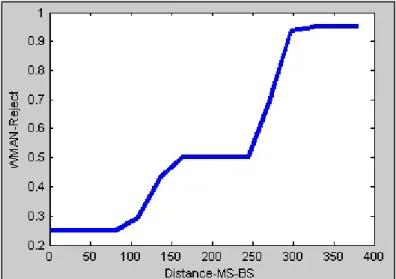
Figure 3.15: The Control Surface of the Output Variable WWAN-Reject for FLC-1 ... 94
Figure 3.16: Rules Evaluation for FLC-1 ... 94
Figure 3.17: Design of FLC-2 (WLAN) ... 94
Figure 3.18: Membership Functions for FLC-2 (WLAN) ... 95
Figure 3.19: Membership Functions for FLC-2 (WMAN) ... 95
Figure 3.20: Membership Functions for FLC-2 (WWAN) ... 95
Figure 3.21: Inference Rules for FLC-2 (WLAN) ... 96
Figure 3.22: Inference Rules for FLC-2 (WMAN) ... 96
Figure 3.23: Inference Rules for FLC-2 (WWAN) ... 96
Figure 3.24: The Control Surface of the Output Variable WMAN-Reject for FLC-2 ... 97
Figure 3.25: Rules Evaluation for FLC-2 (WWAN) ... 97
Figure 3.26: Design of FLC-3 (WLAN) ... 99
Figure 3.27: Membership Function for Input Variable PRSS of FLC-3 (WLAN) ... 99
Figure 3.28: Membership Function for Input Variable QoS of FLC-3 (WLAN) ... 99
Figure 3.29: Inference Rules for FLC-3 (WLAN) ... 100
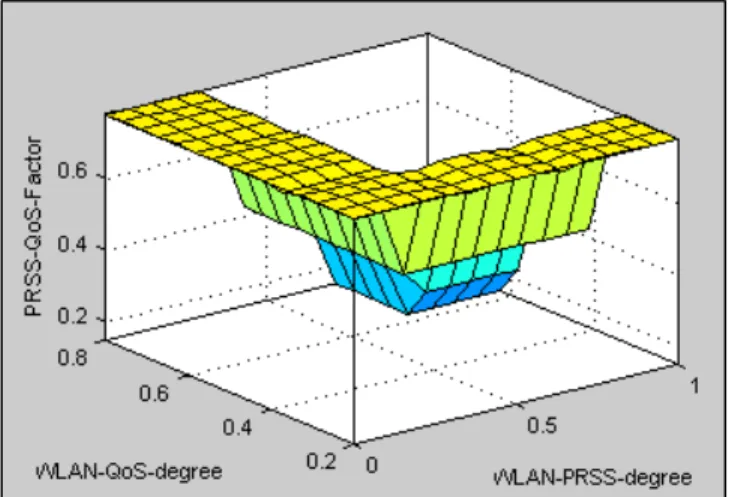
Figure 3.30: Control Surface of the Variable PRSS-QoS-Factor of FLC-3 (WLAN) .... 100
Figure 3.31: Rules Evaluation for FLC-3 (WLAN) (Low RSS and High QoS) ... 100
Figure 3.32: Rules Evaluation for FLC-3 (WLAN) (High RSS and Low QoS) ... 101
Figure 3.33: Design for FLC-4 ... 102
Figure 3.34: Membership function for MS-PoA-Distance-Factor for FLC-4 ... 102
Figure 3.35: Inference Rules for FLC-4 ... 102
Figure 3.36: Control Surface for the Variable WLAN-HO-Factor for FLC-4 ... 103
xv
Figure 3.38: Control Surface for the Variable WWAN-HO-Factor for FLC-4 ... 103
Figure 3.39: Rules Evaluation for FLC-4 (High Handoff Probability) ... 104
Figure 3.40: Rules Evaluation for FLC-4 (Low Handoff Probability) ... 104
Figure 3.41: VHITS Target Network Selection Scheme ... 107
Figure 4.1: First-Level Weights based on All Weighting Schemes ... 127
Figure 4.2: AHP-based Weights for QoS Parameters ... 128
Figure 4.3: FAHP-based Weights for QoS Parameters ... 128
Figure 4.4: Linguistic-Variables based Weights for QoS Parameters ... 129
Figure 4.5: Normalized Networks Parameters (Velocity = 2 m/s) ... 131
Figure 4.6: TOPSIS Ranking of Networks based on AHP (Vel = 2 m/s) ... 135
Figure 4.7: Normalized Networks Parameters (Velocity = 5 m/s) ... 135
Figure 4.8: TOPSIS Ranking of Networks based on AHP (Vel = 5 m/s) ... 136
Figure 4.9: TOPSIS Ranking of Networks based on AHP (Vel = 10 m/s) ... 136
Figure 4.10: TOPSIS Ranking of Networks based on FAHP (Vel = 2 m/s) ... 137
Figure 4.11: TOPSIS Ranking of Networks based on FAHP (Vel = 5 m/s) ... 137
Figure 4.12: TOPSIS Ranking of Networks based on FAHP (Vel = 10 m/s) ... 138
Figure 4.13: TOPSIS Ranking of Networks based on TFN (Vel = 2 m/s) ... 138
Figure 4.14: TOPSIS Ranking of Networks based on TFN weighting (Vel = 5 m/s) .... 139
Figure 4.15: TOPSIS Ranking of Networks based on TFN (Vel = 10 m/s) ... 139
Figure 4.16: TOPSIS Ranking with AHP (Vel = 5 m/s, WWAN-Loading = 100%) ... 141
Figure 4.17: TOPSIS with AHP (Vel = 5 m/s, WWAN, WMAN-Loading = 100%) .... 141
Figure 4.18: FTOPSIS Ranking for Available Networks (Velocity = 5 m/s) ... 144
xvi
Figure 4.20: System Model for VHITS Simulation ... 151
Figure 4.21: System model (zoomed-in) Depicting the Mobility of Single User ... 151
Figure 4.22: Distribution of MSs across Different Networks ... 152
Figure 4.23: Percentage of NW-Connection, TOPSIS, AHP, for Conversational ... 155
Figure 4.24: Percentage of NW-Connection, TOPSIS, AHP, for Interactive ... 156
Figure 4.25: Percentage of NW-Connection, TOPSIS, AHP, for Background ... 156
Figure 4.26: Percentage of NW-Connection, TOPSIS, AHP, for Streaming ... 157
Figure 4.27: Percentage of NW-Connection, TOPSIS, FAHP, for Background ... 158
Figure 4.28: Percentage of NW-Connection, TOPSIS, FAHP, for Conversational ... 158
Figure 4.29: Percentage of NW-Connection, TOPSIS, FAHP, for Interactive ... 159
Figure 4.30: Percentage of NW-Connection, TOPSIS, FAHP, for Streaming ... 159
Figure 4.31: Percentage of NW-Connection, TOPSIS, TFN, for Background ... 160
Figure 4.32: Percentage of NW-Connection, TOPSIS, TFN, for Conversational ... 160
Figure 4.33:Percentage of NW-Connection, TOPSIS, TFN, for Interactive ... 161
Figure 4.34: Percentage of NW-Connection, TOPSIS, TFN, for Streaming ... 161
Figure 4.35: Percentage of NW-Connection, FTOPSIS for Background Traffic ... 164
Figure 4.36: Percentage of NW-Connection, FTOPSIS for Conversational traffic ... 164
Figure 4.37: Percentage of NW-Connection, FTOPSIS for Interactive Traffic ... 165
Figure 4.38: Percentage of NW-Connection, FTOPSIS for Streaming Traffic ... 165
Figure 4.39: Percentage of NW-Connection, FVIKOR for Background Traffic ... 167
Figure 4.40: Percentage of NW-Connection, FVIKOR for Conversational Traffic ... 167
Figure 4.41: Percentage of NW-Connection, FVIKOR for Interactive Traffic ... 169
xvii
Figure 4.43: Percentage Connections, Preferred Cost, TOPSIS, AHP, Streaming ... 170
Figure 4.44: Percentage Connections, Preferred Cost, TOPSIS, FAHP, Streaming ... 170
Figure 4.45: Percentage Connection, Preferred Cost, TOPSIS, TFN, Streaming ... 171
Figure 4.46: Percentage of NW, Preferred Security, TOPSIS, AHP, Streaming ... 172
Figure 4.47: Percentage of NW, Preferred Security, TOPSIS, FAHP, Streaming ... 172
Figure 4.48: Percentage of NW, Preferred Security, TOPSIS, TFN, Streaming ... 173
Figure 4.49: Percentage of NW, Preferred Cost, FTOPSIS, Streaming ... 174
Figure 4.50: Percentage of NW, Preferred Cost, FVIKOR, Streaming ... 174
Figure 4.51: Percentage of NW, Preferred Security, FTOPSIS, Streaming ... 175
Figure 4.52: Percentage of NW, Preferred Security, FVIKOR, Streaming ... 176
Figure 4.53: Average Outage Probability, TOPSIS, AHP, Conversational ... 180
Figure 4.54: Average Outage Probability, TOPSIS, FAHP, Conversational ... 181
Figure 4.55: Average Outage Probability, TOPSIS, TFN, Conversational ... 181
Figure 4.56: Average Outage Probability, FTOPSIS, Conversational ... 182
Figure 4.57: Average Outage Probability, FVIKOR, Conversational ... 183
Figure 4.58: Average Handoff Blocking Probability based on TOPSIS-AHP ... 184
Figure 4.59: Average Handoff Blocking Probability based on TOPSIS-FAHP ... 185
Figure 4.60: Average Handoff Blocking Probability based on TOPSIS-TFN ... 185
Figure 4.61: Average Handoff Blocking Probability based on FTOPSIS ... 187
Figure 4.62: Average Handoff Blocking Probability based on FVIKOR ... 187
Figure 4.63: Average New Call Blocking Probability based on TOPSIS-AHP ... 188
Figure 4.64: Average New Call Blocking Probability based on TOPSIS-FAHP ... 189
xviii
Figure 4.66: Average New Call Blocking Probability based on FTOPSIS ... 190
Figure 4.67: Average New Call Blocking Probability based on FVIKOR ... 191
Figure 4.68: Average Handoff Rate based on TOPSIS-AHP ... 192
Figure 4.69: Average Handoff Rate based on TOPSIS-FAHP ... 192
Figure 4.70: Average Handoff Rate based on TOPSIS-TFN ... 193
Figure 4.71: Average Handoff Rate based on FTOPSIS ... 195
Figure 4.72: Average Handoff Rate based on FVIKOR ... 196
Figure 4.73: Percentage of NW per Average Calls, TOPSIS-AHP, Vel= 1 m/s ... 196
Figure 4.74: Percentage of NW per Average Calls, TOPSIS-AHP, Vel = 5 m/s ... 198
Figure 4.75: Percentage of NW per Average Calls, TOPSIS-AHP, Vel = 9 m/s ... 199
Figure 4.76: Percentage of NW per Average Calls, TOPSIS-FAHP, Vel = 1 m/s ... 199
Figure 4.77: Percentage of NW per Average Calls, TOPSIS-FAHP, Vel = 5 m/s ... 200
Figure 4.78: Percentage of NW per Average Calls, TOPSIS-FAHP, Vel = 9 m/s ... 200
Figure 4.79: Percentage of NW per Average Calls, TOPSIS-TFN, Vel= 1 m/s ... 201
Figure 4.80: Percentage of NW per Average Calls,TOPSIS-TFN, Vel = 5 m/s ... 201
Figure 4.81: Percentage of NW per Average Calls, TOPSIS-TFN, Vel = 9 m/s ... 202
Figure 4.82: Percentage of NW per Average Calls, FTOPSIS, Vel = 1 m/s ... 204
Figure 4.83: Percentage of NW per Average Calls, FTOPSIS, Vel = 5 m/s ... 204
Figure 4.84: Percentage of NW per Average Calls, FTOPSIS, Vel = 9 m/s ... 205
Figure 4.85: Percentage of NW per Average Calls, FVIKOR, Vel = 1 m/s ... 205
Figure 4.86: Percentage of NW per Average Calls, FVIKOR, Vel = 5 m/s ... 206
xix
LIST OF ABBREVIATIONS 3G: Third Generation
4G: Fourth Generation
ABC: Always Best Connected
AGO: Accumulated Generating Operation AHP: Analytical Hierarchy Process
AI: Artificial Intelligence AN: Access Network AP: Access Point
ANFIS: Adaptive Neuro-Fuzzy based Inference System ANN: Artificial Neural Network
BER: Bit Error Rate BS: Base Station
CDMA: Code Division Multiple Access
CINR: Channel to Interference plus Noise Ratio EDGE: Enhanced Data for GSM Evolution
ELECTRE: Elimination and Choice Translating Priority FAHP: Fuzzy Analytical Hierarchy Process
FIS: Fuzzy Inference System FLC: Fuzzy Logic Controller FLS: Fuzzy Logic System
FNQD: Fuzzy Normalized Quantitative Decision FQDA: Fuzzy Quantitative Decision Algorithm
xx FTOPSIS: Fuzzy TOPSIS
FVIKOR: Fuzzy VIKOR GA: Genetic Algorithm
GERAN: GSM EDGE Radio Access Network GPRS: General Packet Radio Service
GPT: Grey Prediction Theory GRA: Grey Relational Analysis GRC: Grey Relational Coefficient
GSM: Global System for Mobile Communications HAPS: High Altitude Platform Cellular system
HSDPA/HSUPA: High Speed Downlink/Uplink Packet Access JRRM: Joint Radio Resource Management
MADM: Multi Attribute Decision Making MCDM: Multi Criteria Decision Making MODM: Multiple Objective Decision Making MEW: Multiplicative Exponent Weighting MLP: Multi-Layer Perceptron
MS: Mobile Station
MUSIC: MUltiple SIgnal Classification PAN: Personal Area Network
PBNN: Probabilistic Neural Network PEV: Performance Evaluation Value PLR: Packet Loss Ratio
xxi PoA: Point of Attachment
PNN: Probabilistic Neural Network PRSS: Predicted RSS
QoS: Quality of Service
QDV: Quantitative Decision Value RBFN: Radial-Basis Function Network RRM: Radio Resource Management RSS: Received Signal Strength
RUNE: Rudimentary Network Emulator RSSI: Received Signal Strength Intensity SAW: Simple Additive Weighting SIR: Signal to Interference Ratio
SINR: Signal to Interference plus Noise Ratio SMART: Simple Multi-Attribute Rate Technique TFN: Triangular Fuzzy Number
TOPSIS: Techniques for Order Preference by Similarity to Ideal Solution UMTS: Universal Mobile Telecommunication Systems
UoD: Universe of Discourse
VANET: Vehicular Ad-hoc Network
VHITS: Vertical Handoff Initiation and Target Selection VHO: Vertical Handoff
VIKOR: {Serbian: VIseKriterijumsa Optimizacija I Kompromisno Resenje, meaning: multi-criteria optimization and compromise solution}
xxii VoIP: Voice over IP
Wi-Fi: Wireless Fidelity
WiMAX: Worldwide Interoperability for Microwave Access WLAN: Wireless Local Area Network
WMAN: Wireless Metropolitan Area Network WWAN: Wireless Wide Area Network
1 CHAPTER 1 INTRODUCTION
Over the past few years, there have been several exciting innovations in wireless network technology [1]. As can be seen from Figure 1.1, the current trends and demands in the area of wireless communications are to deliver real-time multimedia applications over heterogeneous wireless networks with guaranteed Quality of Service (QoS). The consumer demand, to access such applications and services anywhere and anytime, is continuously on the rise. New technological developments, such as the Fourth Generation (4G) wireless systems [2, 3] and their integration, offer these rich services and applications at high data transfer rates and allow for global roaming and seamless mobility over a diverse range of heterogeneous wireless networks [4-6].
Mobile Stations (MSs) in a typical 4G network will be equipped with multiple interfaces, and will have the required intelligence to make improved decisions to be able to connect to a variety of Access Networks (ANs) in order to provide rich multimedia services. These access networks include different types of cellular networks such as Code Division Multiple Access (CDMA), Global System for Mobile Communication (GSM), High Speed Downlink/Uplink Packet Access (HSDPA/HSUPA), General Packet Radio Services (GPRS) [7, 8], Bluetooth-based Personal Area Network (PAN) [9], IEEE 802.11 Wireless Local Area Network (WLAN) [10], IEEE 802.16 Worldwide Interoperability for Microwave Access (WiMAX) [11], Vehicular Ad-hoc Network (VANET), and Satellite networks. These wireless networks often have overlapping coverage in the same service areas and can offer innovative services based on user demands. The ultimate goal of such an environment is to provide simple, uninterrupted accesses to any type of
2
desired service at any time, independent of devices, locations, and available networks, [12] while also maintaining satisfactory user experience in a cost-efficient manner.
The wireless technologies in a heterogeneous wireless network are usually different from each other from a technological point of view. Most of them usually differ in terms of, but not limited to, their offered bandwidths, operating frequencies and costs, coverage areas, and latencies. Currently, no single wireless technology claims to provide cost-effective services, which offers high bandwidths and low latencies to all mobile users in a large coverage area. This is where the need for well-organized vertical handoffs (VHOs) between heterogeneous wireless technologies becomes evident.
The term “handoff”, or “handover” [13], refers to the process of transferring a mobile station from one base station or channel to another. One example is a seamless transfer of an ongoing voice or video conversation from one channel served by a core network to another. More clearly, handoff is the process of changing communication channel (frequency, data rate, modulation scheme, spreading code, or their combination) associated with the current connection, while, a communication session (or call) is in progress.
A handoff process can be thought of as having two major stages: handoff initiation and handoff execution [13]. In the first phase, a decision is made regarding the selection of the new Base Station (BS), or Access Point (AP), to which the MS will be transferred. In the execution phase, new radio links are formed between the BS/AP and MS, and resources are allocated. A comprehensive overview of handoff management is provided in [14] and depicted in Figure 1.2.
3
Figure 1.1: Evolution of Wireless Communications (from 1G to 4G)
Figure 1.2: Handoff Management Concept [14]
This chapter begins with Section 1.1 describing the motivation and significance of this research work, followed by Section 1.2, providing a quick overview of related research contributions. Section 1.3 explains how techniques, based on Artificial Intelligence (AI), can be used to perform handoff necessity estimation and target network
4
selection in a more intelligent and efficient manner. Finally, Section 1.4 provides an outline of the dissertation.
1.1 MOTIVATION AND SIGNIFICANCE OF RESEARCH
So far, significant research has been done to achieve seamless mobility while an MS moves across different heterogeneous wireless networks. However, this research mainly focuses on an important aspect of seamless mobility: vertical handoff initiations and decisions. Horizontal handoff decisions between homogeneous wireless networks are made mainly on the basis of Received Signal Strength (RSS), whereas decisions for vertical handoffs are typically performed based on more than one network’s parameters, including, but not limited to, RSS, MS-Velocity, Security, Cost, and QoS parameters. These decisions often incorporate network-operators’ policies and end-users’ preferences as well. Automating these handoff decisions in a heterogeneous environment is a complex task compared to homogeneous wireless networks due to several reasons including varying network characteristics, environmental conditions, and mobility patterns.
Many of the existing handoff algorithms, which are based on single metric such as RSS, do not exploit the benefits of multi-criteria and the inherent knowledge about the sensitivities of these handoff parameters in a heterogeneous wireless environment. In addition, while performing vertical handoffs, these algorithms do not take into account the QoS of an ongoing session to maximize the end-users’ satisfaction based on their preferences, location and/or application contexts. Factors like available network bandwidth, latency, security, usage cost, power consumption, battery status of MS, and
5
user preferences should be thoroughly considered while performing these handoff decisions.
In nearly all the existing multi-criteria handoff schemes, assigning different weights helps prioritize network parameters. Most of the time, the assignment of these weights is done manually without considering how much of a weight is needed for a certain network parameter. This could lead to a degraded handoff performance if one parameter is given higher weight value as compared to another, especially during an ongoing user-session, such as a Voice over IP (VoIP) conversations, where achieving a minimum level of quality of service is essential. Thus, calculation for the correct weights for network parameters is an important task when operating in a heterogeneous wireless environment. Furthermore, nearly all handoff schemes utilize crisp values for these weights, ignoring the fact that typical values of parameters in a wireless network are not precise and are characterized by inherent uncertainty. Therefore, in order to guarantee the quality of the currently utilized service, proper weight assignment, especially for QoS-related parameters, is of utmost importance and should be done very carefully. In addition, the fuzzy nature of these values should be kept in mind while assigning these weights.
The handoff can be divided into handoff initiation and target network selection. Most of the research work deals with the target network selection, ignoring the handoff initiation and necessity estimation that is of equal importance, as handoff initiation and its necessity estimation play a critical role in maximizing end-user’s satisfaction. Just like the values of weights associated with network parameters, the calculations to perform handoff necessity estimation and target network selection are usually done using raw or
6
crisp values of parameters provided by different networks, without paying much attention to the vagueness and fuzziness contained in this information.
1.2 RESEARCH CONTRIBUTIONS
In this research work, an intelligent, scalable, and flexible hybrid scheme is proposed to perform intelligen and efficient handoff necessity estimations and target network selection decisions. The proposed scheme is divided into two parts. The first part examines the existing conditions of current PoA to estimate the necessity of handoff using Fuzzy Logic (FL). In the second stage, different parameters of all available candidate networks are utilized to determine a new PoA, or an access network, that can best fulfill the end-user’s requirements. The target network selection scheme utilizes certain ranking algorithms to rank the available networks based on multiple criteria.
The proposed scheme intends to maximize the end-user’s satisfaction, taking into account the quality of the currently utilized service that the end-user experiences at the mobile terminal. The following are the main contributions of this research work:
• A comprehensive survey of current network selection algorithms in heterogeneous wireless networks is provided.
• A module based on Grey Prediction Theory (GPT) is designed to predict the future values of the measured RSS in order to minimize the call dropping probability of the MS due to a sudden drop of RSS common in wireless networks.
• Several parallel Fuzzy Logic Controllers (FLCs) are developed to estimate the necessity of handoffs. The necessity estimation module is important, as
7
a handoff that is done too early is costly in terms of valuable network resources. Similarly, a handoff that is performed too late increases the call-dropping probability of MS. Furthermore, parallel FLCs offer reduced rule-sets, are more efficient, and less complex than a single FLC containing bulky rule set.
• Since a heterogeneous wireless network is comprised of many different wireless technologies with varying parameter ranges, the proposed scheme also utilizes FLCs to normalize the incoming data to a common scale. Consequently, benefit-type parameters such as RSS, and cost-type parameters such as network latency, measured from different networks, are normalized using FLCs.
• Different weight calculation methods are developed to calculate priority weights for network parameters. These methods include Analytic Hierarchy Process (AHP), Fuzzy AHP (FAHP), and Linguistic Variables and Triangular Fuzzy Numbers (TFNs). FAHP and Linguistic Variables are utilized to demonstrate the weight calculations, keeping in mind the vagueness and fuzziness of these subjective values.
• Several Multi-Attribute Decision Making (MADM) ranking algorithms are utilized to demonstrate the selection of best target network among other available candidate networks based on the measured values of different parameters from each network. These include algorithms such as Techniques for Order Preference by Similarity to Ideal Solution (TOPSIS), Fuzzy extension of TOPSIS (FTOPSIS), and Fuzzy extension
8
of VIKOR (Serbian: VIseKriterijumsa Optimizacija I Kompromisno Resenje, i.e.: multi-criteria optimization and compromise solution) (FVIKOR).
• A simulation test-bed for a heterogeneous wireless network is created for evaluating the performance of the proposed scheme. Simulation is carried out for three different types of networks providing four different types of services. This test-bed simulates in detail a real heterogeneous wireless environment with all the Radio Resource Management (RRM) modules such as channel assignment, mobility and propagation modules, etc.
To the best of our knowledge, this research work is a first attempt to utilize FAHP, TFNs and Linguistic Variables to calculate weights for network attributes and to apply FTOPSIS and FVIKOR to perform target network selection in the context of a heterogeneous wireless environment. It is also important to mention that this research work attempts to distinguish between the different types of traffic classes based on the QoS parameters and tries to find an improved weighting schemes based on these types. 1.3 JUSTIFICATION OF USING “AI” IN VERTICAL HANDOFFS
Fuzzy logic and Artificial Neural Networks (ANNs) are extensively used in literature to perform vertical handoff decisions in order to select the best access network for an MS. The application of these complicated algorithms is necessitated by the complexity of vertical handoff decisions and dynamic conditions of wireless networks. Unlike the traditional vertical handoff decision approaches where the decisions are solely
9
based on RSS, fuzzy logic and ANN-based approaches can combine various design parameters to perform such decisions, which are inherently optimized.
The fact that fuzzy logic can mimic human expert reasoning and that many of the terms used to describe a signal (weak, far, strong, close) are fuzzy in nature, makes fuzzy logic a strong candidate for performing vertical handoff decisions. Fuzzy logic can adapt easily to these decisions as it can overcome radio environment uncertainty, fluctuations, and can deal with heterogeneous inter-system parameters (shadowing effect, traffic variations, etc.).
Artificial neural networks on the other hand, have the ability to handle large sets of data in an environment that demands fast processing. They can interpret complex data and learn typical trends from it. The learned system can then be used to predict the response of an arbitrary input signal. Hence, ANN can be trained to predict an MS’s handoff to the best available access networks.
Another possibility exists where a hybrid solution of fuzzy logic and neural networks can be utilized to perform vertical handoff decisions. Known sensitivities of handoff parameters are used to create a Fuzzy Logic System (FLS) rule base, but this demands large storage and high computational complexity. These demands can be circumvented by replacing the rule base in FLS by an ANN to derive an adaptive algorithm that retains the high performance of FLS and provides an efficient architecture for storage and computational requirements. An ANN can be trained to learn complex relationships among the multiple inputs and output of a handoff system. After the ANN is trained, its parameters can be used to predict or estimate the outputs for given inputs.
10
1.4 ORGANIZATION OF THE DISSERTATION
The organization of this dissertation is as follows. Chapter 2 provides a brief background on the process of handoff, followed by a comprehensive overview of the related work in the area of vertical handoff decisions. In Chapter 3, an overall framework of the proposed handoff scheme is presented. Simulation and experimental results are presented in Chapter 4, and finally, Chapter 5 concludes this research work with suggested future research directions.
11 CHAPTER 2
BACKGROUND AND RELATED WORK
This chapter begins by providing a background related to the handoff process followed by a comprehensive survey of different approaches to make vertical handoff decisions. Through the literature review, the available handoff algorithms can be grouped into different categories based on the main handoff decision criterion used [14]: RSS-based, multiple-criteria decision RSS-based, user-preference RSS-based, context-aware approaches, cost-function based, and AI based approaches. Since this research is focused on the usage of AI based approaches, a detailed overview of the related work will be provided mainly for this category while briefly mentioning the others. Sections 2.2.1-2.2.8 briefly categorize different handoff decision algorithms. In Section 2.2.9, a brief overview of multiple criteria based algorithms, is provided. Section 2.2.10 provides a detailed overview of the related works using the AI based approaches. Finally, in Section 2.2.11, a comparison among few of these techniques is provided.
2.1 HANDOFF PROCESS BACKGROUND
2.1.1 HANDOFF CLASSIFICATION
Handoffs can be classified in several ways as discussed below:
Horizontal and Vertical Handoff:Depending on the type of network technologies involved, handoff can be classified as either horizontal or vertical [15]. Traditional handoff, also called horizontal or intra-system handoff, occurs when the MS switches between different BSs or APs of the same access network. For example, this typically happens when the user moves between two geographically adjacent cells of a third
12
generation (3G) cellular network. On the other hand, vertical handoff or inter-system handoff involves two different network-interfaces representing different wireless access networks or technologies, e.g., BS in IEEE 802.16 and an AP in IEEE 802.11. Figure 2.1 [16] depicts the two types of handoffs in heterogeneous wireless networks where horizontal handoff occurs between two WLANs, and vertical handoff occurs between a WLAN and a CDMA network.
Hard and Soft Handoff: This classification of handoff depends upon the number of BSs and/or APs to which an MS is associated with at any given moment. Hard handoff, also called “break before make”, involves only one BS or AP at a time. The MS must break its connection from the current access network before it can connect to a new one. In a soft handoff, also called “make before break”, an MS can communicate and connect with more than one access network during the handoff process [15, 17].
Mobile-controlled, Mobile-assisted, and Network-controlled Handoff: As the names suggest, these types of handoff classifications are based on the entity, MS or access network, which make the handoff decisions [18]. Mobile-assisted handoff is the hybrid of mobile-controlled and network-controlled handoff where the MS makes the handoff decisions in cooperation with the access network. A detailed handoff classification tree can be found in [18] and is shown in Figure 2.2.
2.1.2 DESIRABLE FEATURES OF HANDOFF
Figure 2.3 [18] describes several desirable features of handoff algorithms as mentioned in the literature [18, 19]. Some of these features are described below:
13
• Speed: Handoff should be fast enough to avoid service degradation and/or interruption at the MS. Mobility of an MS at a high speed requires the handoff to be done promptly.
• Reliability: Handoff should be reliable such that the MS will be able to maintain the required QoS after handoff.
• Successful: Free channels and resources must be available at the target access network in order to make the handoff successful.
• Number of Handoffs: The number of handoffs must be minimized. Excessive number of handoffs results in poor QoS and excessive processing overheads as well as power loss, which is a critical issue in MSs with limited battery power.
• Multiple Criteria Handoffs: The target access network should be intelligently chosen based on multiple criteria. Identification of a correct AN prevents unnecessary and frequent handoffs.
2.1.3 VERTICAL HANDOFF PROCESS
The traditional horizontal handoff research involves handoff decisions based on the manual evaluation of RSS measured at the MS to support the “Always Best Connected” communications. These traditional handoffs are triggered when the RSS value of the serving BS falls below a specified threshold. On the other hand, an MS in a heterogeneous wireless environment can move between different ANs with different functionality and characteristics (bandwidth, latency, power consumption, cost, etc.) which cannot be directly compared. Hence, in case of vertical handoffs, RSS itself is not
14
sufficient for making efficient and intelligent handoff decisions; other system metrics including, but not limited to, cost, network-load and performance, available bandwidth, security, and user preferences should be taken into consideration as well. On the other hand, the inclusion of multiple metrics increases the complexity of vertical handoff decisions and makes the entire process more challenging. A vertical handoff comprises of three phases as follows [20]:
Network Discovery: An MS with multiple active interfaces can discover several wireless networks based on broadcasted service advertisements from these wireless networks. However, keeping all these interfaces active all the time can significantly affect the battery power of the MS.
Handoff Triggering and Decision: This is the phase where the decision regarding “when” to perform handoff is made. In this phase, the target wireless access network is selected based on multiple criteria, as discussed before.
Handoff Execution: This is the last phase of the vertical handoff process where the actual transfer of the current session to the new AN takes place. This requires the current network to transfer routing and other contextual information related to the MS to the newly selected AN as quickly as possible.
2.1.4 VERTICAL HANDOFF CRITERIA AND METRICS
Figure 2.4 [18] and Figure 2.5 [21] describe different traffic classes and several handoff metrics that are used as inputs to the various vertical handoff algorithms. These metrics are described below:
15
Figure 2.1: Horizontal and Vertical Handoff in Heterogeneous Wireless Networks [16]
• Received Signal Strength: This criterion is simple, direct, and widely used in both horizontal and vertical handoffs. This network metric is easy to measure and is directly relevant to the QoS of an application. Also, RSS readings are inversely proportional to the distance between the MS and the BS, and could result in excessive and/or unnecessary handoffs.
• Available Bandwidth: Measured in bits/sec (bps), available bandwidth is used to determine traffic-loading conditions of an AN, and is a good measure of available communication resources at the BS.
16 Figure 2.2: Handoff Classification Tree
Handoff Classifications Network Types Involved Horizontal Handoff Vertical Handoff Downward Upward Frequencies Used Intra-Frequency Handoff Inter-Frequency Handoff Number of Connections Involved Hard Handoff Soft Handoff Softer Handoff Administrative Domains Involved Intra-Administrative Handoff Inter-Administrative Handoff Necessity of Handoff Voluntary Handoff Obligatory Handoff User Control Allowance Proactive Handoff Passive Handoff
17 Figure 2.3: Desirable Handoff Features
Desirable Handoff Featur
es Maximize Performance Reliability Maintain Seamless Mobility Load Balancing Minimize Interference Number of Handoffs V ertical Handoff Decisions Availability Signal Strength Quality of Service Network Conditions System Performance Cost of Service Power Requirements Mobile Node Conditions Geographical Information Velocity Security Proactive Handoff
18
• Network Connection Duration: This is the amount of time that the MS remains connected to a specific AN. This time duration depends on the location and velocity of the MS, which in turn affect its RSS. Due to different coverage areas in heterogeneous wireless networks, the evaluation of this criterion is very important to determine two factors: 1) the triggering conditions required for the handoff at the right time in order to maintain a satisfactory QoS while avoiding wastage of network resources and 2) to reduce the number of unnecessary handoffs. For example, a hasty handoff from an IEEE 802.11 WLAN to a 3G cellular network would result in network resources being wasted. On the other hand, delaying the handoffs between these networks would result in handoff failures and subsequent call drops. Statistics, such as total time spent in an AN and arrival time of a new call in the network, can also be used as handoff criteria.
• Monetary Cost: Different operators may operate heterogeneous wireless networks and may have varying costs associated with them. The network with the least cost should be a preferred target of handoff.
• Handoff Latency: For an MS, handoff latency is defined as the elapsed time between the last packet received from the old AN, and the arrival of the first packet via the new AN after a successful handoff. This metric varies considerably between various heterogeneous wireless technologies.
• Security: Certain applications require that the confidentiality, and/or the integrity of the transferred data be preserved. This metric can be used to
19
handoff to a network that offers higher security as compared to other available networks.
• Power Consumption: Handoff process demands a fair amount of power consumption. If an MS were running low on battery power, it would be preferable to handoff to a target AN that would help extend the MS’s battery life [18].
• Velocity: Velocity is an important decision factor as it relates to the network-connection-duration metric and location of the MS. An MS travelling at a very high speed may result in excessive handoffs between wireless networks.
2.1.5 CLASSIFICATION OF VERTICAL HANDOFF ALGORITHMS
Handoff algorithms can be classified based on handoff criteria and their processing. In the following paragraphs, we will categorize these algorithms. A detailed literature review of these categories is presented in Section 2.2.
• Signal Strength Based Algorithms: The RSS is used as the main criterion to perform handoffs [1]. Different variations of this category exist as follows:
o Relative Signal Strength Algorithms: This is based on the comparison of
RSS of the current AN with that of the target network. The advantage of this algorithm is the ability of the MS to connect and remain connected with the BS that has the strongest RSS. However, excessive handoffs are possible due to shadow variations associated with the RSS. A variation of this algorithm incorporates hysteresis [22], where a handoff is initiated
20
only if the RSS measured from the target BS exceeds the RSS from the current BS by an amount of hysteresis. Hysteresis reduces the number of unnecessary handoffs but can also introduce delay and prevent required and necessary handoffs that could result in call drops.
o Absolute Signal Strength Algorithms: In this type of algorithm, a handoff
is requested as soon as the measured RSS drops below a certain threshold level. For a noise and interference limited system, the typical threshold values in a cellular system are -100 dbm and -95 dbm, respectively [23]. Varying these threshold values may result in better handoffs. The disadvantage of this category of algorithms is the setting of the thresholds based on the RSS. When RSS is high due to interference, a desirable and necessary handoff will not take place. Similarly, a low value of RSS will result in unnecessary handoffs regardless of the signal QoS. A variation of this scheme is to utilize multiple thresholds to initiate and execute handoffs.
For vertical handoffs, relative RSS is not applicable. This is due to the fact that RSSs from different wireless technologies in a heterogeneous environment cannot be directly compared against each other.
o Combined Absolute and Relative Signal Strength Algorithms: These
algorithms must satisfy two conditions to perform handoffs [24]: The average RSS of the current BS must fall below an absolute threshold value and the average RSS of the target BS must exceed the average RSS of the current BS by an amount of hysteresis.
21
• Bandwidth Based Algorithms: The available bandwidth offered by the AN to the MS is used as the main criterion for these algorithms [1]. Handoff can also be initiated based on both criteria, i.e., available bandwidth and RSS [1, 25].
• Distance Based Algorithms: In this category, the MS is always connected to the nearest BS. Propagation delays from different networks are compared for relative distance measurement.
• Signal to Interference Ratio (SIR) Based Algorithms: SIR is a measure of communication quality. These algorithms trigger the handoff when the SIR of the current BS drops below a certain threshold and another BS is available to provide a better SIR. Just like relative-RSS based algorithms, hysteresis can be incorporated into these algorithms as well.
• Velocity Adaptive and Direction Biased Algorithms: Handoff requests from fast moving MSs must be processed quickly and with minimal delays. Handoffs to the BSs, towards which an MS is moving, are encouraged in this category of algorithms. A variation of this is a pre-selection direction biased algorithm [26].
• Cost Function Based Algorithms: In this category, several performance metrics (usage cost, available bandwidth, delay, security offerings and power consumption, etc.) are used to calculate an overall network cost for all available candidate networks. Handoff is then performed to the network with the smallest calculated cost [27]. Weights and biases may be used with different performance metrics to simulate different network conditions and user preferences.
22
• Pattern Recognition Based Algorithms: These types of algorithms can identify meaningful regularities in noisy or uncertain environments. The handoff problem is studied as a pattern recognition problem in [28, 29].
• Prediction Based Algorithms: Estimated future values of different handoff metrics are used to predict the behavior of the system [30].
• Fuzzy Logic and Neural Network Based Algorithms: These algorithms are suitable for multi-criteria handoffs. Sometimes, it is not possible to develop the analytical model for the handoff process, especially when a richer set of input parameters are involved. This is where machine-learning techniques are used to model the complex handoff process.
Fuzzy logic based techniques allow us to model the qualitative aspects of human experts’ knowledge and reasoning behind the handoff process to be encoded as handoff algorithms [31]. On the other hand, Neural Networks, using a comprehensive set of inputs and desired output(s), can be trained to perform optimal handoff decisions [32].
A third possibility is where adaptive versions of the above mentioned algorithms can be created where the system can monitor its performance and modify its internal structure to create highly effective and optimal handoff decisions [33].
2.1.6 PERFORMANCE EVALUATION OF HANDOFF ALGORITHMS
The performance of different vertical handoff algorithms can be evaluated and compared by measuring the following metrics:
23
Figure 2.5: Traffic Classes and Handoff Metrics
Vertical Handoff Decisions
Traffic
Classes
Conversational Str eaming Interactive Backgr oundHandoff Metrics
BandwidthMaximum Minimum Average
Latency End-to-End Delay Jitter Round T rip Delay Reliability Bit Err or Rate Packet Err or Rate Retransmissions Power Tr an sm it M od e
Receive Mode Idle Mode
Price Per -Use Cost Per -Unit Cost Security Confidentiality Integrity Availability SINR RSS
24
• Handoff Delay: This metric represents the time elapsed between the handoff initiation and completion. The complexity of the handoff algorithm has a direct effect on this metric; a simple algorithm results in a smaller value of this metric. A smallest possible value of handoff delay is desired for real-time, delay-sensitive applications.
• Number of Handoffs: Unnecessary handoffs should be minimized as they waste network resources and increase processing overheads.
• Number of Handoff Failures: A handoff failure occurs when the target network fails to allocate sufficient resources for the MS that is handed over from a previous network. This failure is also possible when a moving MS goes out of the coverage area of the target network before the completion of the handoff process. This metric affects the quality of service of an ongoing session.
2.1.7 IEEE 802.21 FRAMEWORK
To complete the discussion relating vertical handoffs, it is important to mention the emerging IEEE 802.21 framework. This standard provides a media-independent framework and associated services to enable seamless handoffs between heterogeneous wireless access technologies [34]. The aim of this framework is to improve end-users’ satisfaction by enabling seamless handoffs between different wireless technologies, while maintaining session continuity. It is important to note that the standard only provides a framework and that all the implementation details regarding handoff decision-algorithms and executions are left to the design engineers.
25
2.2 LITERATURE REVIEW
2.2.1 RSS BASED ALGORITHMS
In this approach, the RSSs of the different candidate ANs are measured over time and the BS or AP with the strongest signal strength is selected to carry out a handoff. A number of studies [1, 25, 35] have been conducted in this area due to the simplistic nature of this approach. Since heterogeneous wireless networks comprise of different wireless technologies, their RSSs cannot be compared directly, and thus relative RSS does not apply to vertical handoff decisions. On the other hand, other network parameters such as bandwidth, are typically combined with RSS when making decisions for vertical handoffs. It is important to mention that the possible signal fluctuations due to multipath fading can result in the undesirable so-called “ping-pong effect”, i.e., unnecessary handoffs that increases the probability of call failures and drops during the handoff process.
2.2.2 SIR BASED ALGORITHMS
Signal to interference ratio is typically used to measure the quality of communication. In this approach, a handoff is initiated if the SIR of the current PoA, BS or AP, is lower than the threshold as compared to the SIR of the target network.
2.2.3 VELOCITY BASED ALGORITHMS
Different techniques [36-38] have been presented to perform handoffs, using velocity as the main decision criterion. If the MS in a heterogeneous environment moves with a relatively high velocity, the probability of a call drop may be higher due to excessive delays caused by the handoff process. Based on the velocity of the MS,
26
different values of the velocity threshold can be used to make handoff decisions. This is due to the fact that the sojourn time of slower moving MS is much higher than the MS travelling with a relatively higher speed.
2.2.4 DIRECTION BIASED ALGORITHMS
For high mobility MSs, this category of algorithms can make effective handoff decisions based on whether the MSs are moving towards or away from the network (BS/AP). This can improve handoff performance by lowering the mean number of handoffs, thus reducing the overall handoff delays. Details of this category of algorithms can be found in [26, 39, 40].
2.2.5 MINIMUM POWER ALGORITHMS
The research work in [41] proposes the use of network’s transmission power as a handoff criterion. The proposed technique attempts to find a pair of networks with available channel that has a SIR based on minimum transmitted power. This algorithm reduces call-dropping probability, but increases the number of unnecessary handoffs.
2.2.6 USER PREFERENCE BASED ALGORITHMS
These approaches [42-45] mainly take into account the end-users’ preferences in terms of MS’s power consumption, associated service cost, offered security, and the QoS provided by a candidate network. Most of these approaches are developed to maximize the end-user’s satisfaction while utilizing non-real-time applications.
27
2.2.7 CONTEXT AWARE BASED ALGORITHMS
The approaches presented in [46-52] use context information to perform intelligent handoff decisions. Contextual changes are also taken into account to determine the necessity of handoffs. Context information is collected from the following:
• Mobile Station: Capabilities, remaining battery power, location, and velocity.
• User: User’s preferences in terms of preferred network usage-cost, security, and desired QoS.
• Candidate Network: Provided QoS, coverage area, available bandwidth, security offerings, cost of usage, and latency.
• Application: QoS requirements based on the type of service (Conversational, Background, and Streaming, etc.) needed.
2.2.8 COST FUNCTION BASED ALGORITHMS
The cost function based approaches [15, 27, 53-59] combine different system’s metrics in a cost function that represents a measure of the benefit obtained by handing off to a particular candidate network. For every candidate network, the sum of weighted functions of specific parameters is evaluated to produce the final cost of the network. The general form of a cost function for a wireless network is given by:
= ∑ ∑ ,. , (2.1)
where , is the cost related to the parameter for providing service on network ,
28
Two commonly used cost functions found in literature are provided in Equations (2.2) and (2.3).
= ∑ , , s. t. , ≠ 0 ∀ , (2.2)
where is the per-service cost for network , , is the normalized QoS provided by network for parameter and service , , is the weight which indicates the impact of the QoS parameter on the user or the network, and , is the network elimination factor, indicating whether the minimum requirement of parameter for service can be met by network . The second cost function represents the total cost as the sum of all the weighted cost associated with all QoS parameters used.
= + + + + (2.3)
where is the quality factor of network ; , , , , and are the cost of service, offered security, MS’s power consumption, and network conditions & performance, and
, , , , and are the associated weights to the network parameters used. A
normalization process
= ( )
( ,…, )+ ( ,…, )+
( )
( ,…, )+ ( ,…, )+ ( ,…, ) (2.4) is used to calculate a normalized quality factor for network . This is required as each network’s parameter has a different unit.
2.2.9 MULTIPLE CRITERIA BASED ALGORITHMS
This approach is based on a typical MADM problem where the selection of an access network is performed based on multiple attributes measured from all available
29
candidate networks. Some of these MADM techniques [21, 60-73] are discussed as follows:
• Simple Additive Weighting (SAW): SAW is the best known and widely used scoring method utilized by [21, 27, 61, 62, 64, 70, 74] to rank candidate networks. A weighted sum of all the network attributes is used to determine the overall score of each candidate network.The score of the candidate network is obtained by adding the normalized contributions from each metric multiplied by the weight assigned to the metric. The selected network has the highest score and is given by:
= arg max ∑ ∈ (2.5) = where ∈ (2.6) or = where ∈ (2.7) = max∈ (2.8) = min∈ (2.9) ∑ = 1 (2.10)
where is the attribute of the network, is the number of parameters, denotes the number of candidate networks, B represents benefit type criteria (like throughput), and C represents cost type criteria (like delay).
30
• Multiplicative Exponent Weighting (MEW): In these techniques [21, 34, 61], a handoff decision matrix is formed where a particular row and column corresponds to the candidate network and attribute of that network, respectively. The weighted product of the attributes is used to determine the score of the network as follows:
= ∏ (2.11)
where denotes attribute of the candidate network, denotes the weight of attribute , and ∑ = 1. The rank of the selected network is given by:
= arg max ∈ (2.12)
where denotes the number of available candidate networks.
• Techniques for Order Preference by Similarity to Ideal Solution: The selected network in the TOPSIS schemes [21, 61, 64-67, 69, 75] is the one that is closest to the ideal solution and the farthest from the worst-case solution. This ideal solution is obtained by using the best value for each metric. The selected network is given by:
= − arg max ∈ (2.13)
where denotes the relative closeness (similarity) of the candidate network to the ideal solution. This technique can be applicable to problems spaces for the attributes with monotonically increasing or decreasing levels of utility. The algorithm calculates perceived
31
positive/negative ideal solutions based on the range of attribute values available for the alternatives.
• Elimination and Choice Translating Priority (ELECTRE):This is another scheme [60, 61, 69, 74] used to rank the alternatives. The authors in [60] utilize a reference vector of attributes as an ideal alternative to adjust the raw attributes of the candidate networks. A matrix containing the difference between the attribute values of this reference vector and other alternatives is formed, and normalized. The resultant matrix contains attributes that have a monotonically decreasing utility. Weights are assigned to each attribute to take into account their relative importance. Finally, the concept of concordance (measure of satisfaction) and discordance (measure of dissatisfaction) is applied during the comparison of each alternative network with others. A candidate network with the highest value of concordance index and lowest value of discordance index would be the preferred network.
• Analytic Hierarchy Process and Grey Relational Analysis (GRA): The AHP [67, 68, 70, 72-74, 76] decomposes the network selection problem into several smaller problems and assigns a weight value to each of them. GRA [77-79] is then used to rank the candidate networks, and the network with the highest rank value is chosen. The Grey Relational Coefficient (GRC) of each network, which describes the similarity between each candidate networks and the ideal network, is calculated. The selected network is given by: