A Routing and Spectrum Assignment Problem
in Optical OFDM Networks
Miros aw Klinkowski and Davide Careglio
yZ-14, National Institute of Telecommunications, 51-501 Wroc aw, Poland, [email protected]
y
CCABA, Universitat Politècnica de Catalunya, 08034 Barcelona, Spain
Abstract— Optical Orthogonal Frequency Division Multiplex-ing (O-OFDM) is a novel and attractive modulation technology enabling exible sub-wavelength and super-channel transmission in optical networks. In an OFDM-based optical network with elastic bandwidth provisioning, the problem of Routing and Spectrum Assignment (RSA) emerges. RSA is N P-hard and it can be computationally exhaustive even for small network scenarios. In this paper, we both formulate RSA as an Integer Linear Programming (ILP) problem and propose an heuristic method to nd a sub-optimal solution. Numerical results show the heuristic performs ef ciently even for larger problem instances.
I. INTRODUCTION
O-OFDM has recently emerged as a very promising modu-lation technology to cope with the 100Gb/s and beyond data
transmission in optical networks [1][2]. This enabling technol-ogy allows for exible bandwidth allocation and, in particular, it can provide, at the same time, sub-wavelength granularity for low-rate transmission and the super-channel provisioning for accommodating ultra-high capacity client signals. In this context, a spectrum-ef cient and scalable elastic optical path (SLICE) network architecture has been proposed [3].
As an analogy to the Routing and Wavelength Assignment (RWA) problem in Dense Wavelength Division Multiplexing (DWDM) optical networks [4], the Routing and Spectrum Assignment/Allocation (RSA) problem emerges in the O-OFDM-based SLICE network [5]. RSA concerns assigning a contiguous fraction of spectrum to each connection request subject to the constraint of no frequency overlapping in network links. An heuristic approach initially proposed to solve the problem makes use of the Fixed-Alternate routing and First-Fit frequency assignment (FA-FF) algorithm [5]. As the authors of [5] noticed, FA-FF is not very ef cient because it tends to produce unstaffed spectrum occupancy. Indeed, although the FA-FF strategy results in low overall frequency resources usage since it favors shorter routing paths, still the spectrum of frequencies that are used in different network links is wide.
The RSA problem is novel and, to the best of our knowl-edge, there is little work that addresses this problem in the literature. In the very recent work by Christodoulopoulos et al. [6], the RSA is formulated as an Integer Linear Programming (ILP) problem. Heuristic solutions are obtained by means of a decomposition method that breaks RSA into the routing and spectrum allocation subproblems and with the assistance of a sequential algorithm.
In this paper, we address the RSA problem by means of an alternative, to the one presented in [6], ILP formulation. The problem objective is to minimize the set of different frequency slots, which represent the frequency sub-carriers, in the frequency spectrum that are occupied in the network. RSA isN P-hard and, as the results show, it is computationally dif cult even for small network scenarios. Anticipating large problem instances in real networks due to the high number of frequency slots supported in O-OFDM, we propose an ILP-based heuristic method to improve FA-FF. The main idea behind the heuristic is to release certain (low-occupied) frequencies in the network and rearrange the frequency assign-ment with the assistance of the RSA problem formulation. Numerical experiments show such strategy can effectively reduce the required frequency spectrum and still maintain the low overall frequency usage in the network.
The reminder of this paper is organized as follows. In Section II we present our assumptions regarding the network scenario and the optical switching node architecture. In Section III we de ne the RSA problem and in Section IV we formulate it as an ILP problem. In Section V we describe the heuristic algorithm and in Section VI we present numerical results that allow us to evaluate its performance. Finally, in Section VII we conclude obtained results.
II. NETWORK ANDNODEARCHITECTURE
The application of OFDM as a modulation technique in optical networks has been proposed recently [1]. In an O-OFDM-based transmission system, a high-rate data stream is split into a number of low-rate streams that are transmitted si-multaneously over a number of frequency sub-carriers through the optical ber link. The high number of frequency sub-carriers that are maintained in O-OFDM ensures ner con-nection granularity when compared to DWDM. At the same time, the connection capacity can be provisioned elastically by allocating a required number of subcarriers, in accordance to connection demands.
In this paper, we consider the O-OFDM-based network im-plements the SLICE architecture [3][5]. The concept of SLICE is to allocate exibly appropriate-sized optical bandwidth, by means of contiguous concatenation of optical spectrum, to an end-to-end optical path and according to the offered traf c volume. In this approach, the requested spectral resources on a given route are sliced off and allocated to the end-to-end optical path. Figure 1 shows an illustrative example.
Fig. 1. The O-OFDM-based bandwidth elastic optical network.
The red (continuous) and green (dotted) super-channel paths are established in the network with two different allocated bandwidths (i.e. different number of contiguous frequency sub-carriers). The Internet Service Provider on the bottom, left hand side of the gure is able to add two allocations in the frequency spectrum, next to the red path allocation, one of them transporting optical signal to the Campus client and the other to the Enterprise client. Each of these paths may allocate different number of sub-carriers, e.g. to transport 20 Gb/s and 10 Gb/s bandwidth, as presented in the gure.
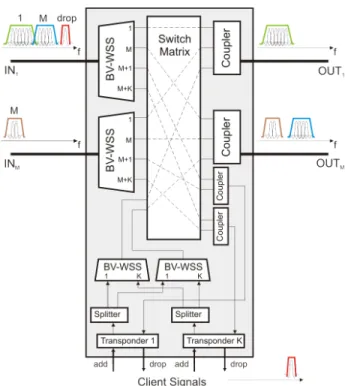
To provide these features the network should be equipped with the bandwidth-variable transponders at the network edge and the bandwidth variable wavelength cross-connects (WXCs) in the network core as discussed in [3]. The role of the bandwidth-variable transponder is to introduce the add/drop functionality able to adapt the client data signal to be sent to/received from the optical network using the required number of subcarriers. Concurrently, the bandwidth variable WXC allows to create an optical routing path by switching the subcarriers to an appropriate switch output port.
In Figure 2 we present an exemplary architecture of the optical cross-connect with the add-drop functionality. Such network element can be built with the already existing technol-ogy such as the WaveShaper programmable optical processor [7] acting as a bandwidth variable wavelength-selective switch (BV-WSS). The WaveShaper makes use of the Liquid Crystal on Silicon (LCoS) spatial phase modulator to perform exible narrow-band ltering of the optical signal. Accordingly, by means of ltering only the frequency spectrum corresponding to the data signal is transferred to the proper switch output port.
Alternative switching node architectures can be also con-sidered. For instance, a broadcast-and-select con guration is discussed in [3]. In such architecture, the optical signal is rst split and forwarded to all output interfaces where BV-WSSs provide grooming, routing and ltering functions.
III. PROBLEMDEFINITION
In order to represent spectral resources, the concept of frequency slot (FS) has been proposed in [5] as an extension
Fig. 2. An architecture of the elastic optical switching node.
to the current ITU-T DWDM rigid frequency grid speci ed in the G.694.1 recommendation [8]. In the proposal, the ITU-T frequency grid is further divided into a number of narrow spectrum segments (i.e., the FSs). Each FS represents an optical channel and, accordingly, an optical path can be es-tablished by assigning the required number of contiguous FSs according to the user signal spectrum width. The authors of [5] consider each ITU-T-de ned100GHz-spaced wavelength channel corresponds to up to8FSs and, as a consequence,72
DWDM channels might result in 576 FSs. Such ne
granu-larity improves the network exibility and resource utilization but, on the other hand, it puts additional requirements on the network equipment and connection provisioning mechanisms. In this paper, we assume a static (off-line) RSA problem, where traf c demands (i.e., the set of connection requests) are known in advance. We assume, the volume of traf c can be translated into a number of requested FSs (as discussed in [5]). The RSA problem objective is to nd, for a given set of demands, the end-to-end optical paths and assign the requested FSs in a contiguous way with a constraint to avoid FS overlapping in network links. In the version of problem addressed, we consider the network has capacity suf cient to serve all offered demands, i.e., there is no connection blocking.
IV. RSA PROBLEMFORMULATION
We formulate RSA as an ILP problem. For the sake of simplicity, we make use of the so-called path-link approach
[4] for the network ow representation of RSA. In such
formulation, a set of paths is prede ned between network nodes, where each path is identi ed by a subset of network links.
A. Notation
We use G = (V;E) to denote the graph of an O-OFDM
network; the set of nodes is denoted as V, and the set of unidirectional links is denoted as E. In each link an ordered setF = f1; f2; : : : ; fjFj of frequency slots is given.
Let D denote the set of demands, where each demand
corresponds to a connection request. Demand dis determined
by a triple (sd; td; nd), where sd and td are source and
termination nodes, and nd 2 Z+ is the number of FSs
requested by the connection. Let Pd denote the (non-empty) set of prede ned candidate paths for demandd2 D. Each set
Pdcomprises a number of paths, e.g.,kshortest paths, which have the origin insd and the termination intd. LetP denote the set of all paths, i.e., P =Sd2DPd. Each path p2 P is
identi ed with a subset p E. Adequately, subset Pe P identi es all paths that go through linke.
Remark: For the sake of simplicity, we consider nd to be independent on the path length. As discussed in [5], the path-length dependency starts to play a role when jpj 10.
B. ILP formulation
We introduce a set of problem variables:
xpf 2 f0;1g - equal to 1 if FS f 2 F on path p 2 P is selected to be the lowest indexed slot that is assigned to a demand, and equal to 0 otherwise,
ypf 2 f0;1g - equal to 1 if FS f 2 F on path p 2 P is assigned to a demand, and equal to0 otherwise,
xef 2 f0;1g - equal to 1 if FS f 2 F is occupied in link
e2 E, and equal to0 otherwise,
xf 2 f0;1g - equal to 1 if FS f 2 F is assigned to at least one demand in the network, and equal to0 otherwise,
F 2Z+ - number of FSs in the frequency spectrum that are assigned to at least one demand in the network.
We formulate RSA as an ILP optimization problem:
minimize F (ILP1) subject to P p2Pd P f2F xpf = 1; 8d2 D; (1a) xpfi ypfj 0; 8d2 D;8p2 Pd;8fi; fj 2 F; wherei= 1; : : : ;jFj nd+ 1; andj=i; : : : ; i+nd 1; (1b) xpfi = 0; where8d2D;8p2 Pd;8fi2 F; i=jFj nd+ 2; : : : ;jFj; (1c) P p2Pe ypf xef = 0; 8e2 E;8f 2 F; (1d) P e2E xef jEjxf 0; 8f 2 F; (1e) P f2F xf F = 0; (1f) xpf; ypf; xef; xf 2 f0;1g; F 2Z+; 8p2 P;8f 2 F; 8e2 E: (1g)
The problem objective is to minimize the number of FSs in the frequency spectrum that are assigned to at least one demand in the network. Constraints (1a) are the path and FS selection constraints. For each demand a path is selected from the set of candidate paths and, concurrently, a FS is selected on this path as the lowest indexed slot assigned to this demand. Constraints (1b) are the contiguous FS assignment constraints. Indeed, whenever there is a FS fi selected as the lowest indexed slot for demand d, the consecutive slots fj, where j = i; : : : ; i+nd 1, should be assigned to this demand. Note, that the spectrum continuity constraint along a route is imposed implicitly since the assignment of a FS concerns the entire path and, therefore, each link on the path. Constraints (1c) aim to exclude such FS selection options for which there is no enough space for the FS assignment in the frequency spectrum. Constraints (1d) are the capacity constraints and they say that each FS in each network link can be assigned to at most one demand, what is guaranteed by the binarity of
xef. Constraints (1e) state that a FS is used if it is used in at least one network link. Consequently, constraint (1f) counts the total number of such FSs. Finally, (1g) are the variable range constraints.
Remark: The main dif culty of formulation ILP1 comes from the large number of FSs (equal to jFj) in some O-OFDM network scenarios. As a result, there is a huge number of constraints (1b), which is of the order of O(jPj jFjXn), where Xn = jDj 1Pd2Dnd is the mean number of slots requested by demands. Indeed, the presence of the contiguous FS assignment constraints (1b) is the main difference between RSA and RWA. In fact, the special case of RSA, in which
nd = 1;8d 2 D, is equivalent with the RWA problem. As a consequence, the RSA optimization problem is N P-hard in general.
V. HEURISTICS
Although, the optimal RSA solution may be unattainable even for small networks with large number of FSs and demands, still ILP1 may be employed to improve the solution provided by FA-FF. According to [5], FA-FF searches (itera-tively for all demands) for the requested number of unoccupied and contiguous FSs starting from the lowest indexed FS inF, rst on the primary and, if not found, on alternative paths. Having the solution of FA-FF, the proposed heuristic method: 1) selects a subset ofD, denoted as D0, 2) maintains all the FS assignments ford2 D D0, and 3) optimizes RSA forD0.
Let F , U , xpf, ypf, and xef be the solution of
FA-FF representing, respectively, the overall number of diverse FSs that are assigned, the overall usage of FSs in all network links, and the solution vectors corresponding to the vectors of variablesxpf,ypf, andxef in ILP1. According to the rst- t strategy, only rstF FSs are assigned in the network.
There-fore, we can reduce set F to F = ff1; f2; : : : ; fF g F without impact on the problem solution.
We consider two strategies to form D0, namely:
1) include demands that have assigned the FSs which
Scenario ILP1 FA-FF Heur FA-FF vs. Heur ULB No Network jDj jFj L K F U T G F U T F U T F 1 SIMPLE 30 21 10 16 142 7 0% 21 134 0:01 16 134 1:7 24% 134 2 30 21 15 16 142 7 0% 21 134 0:01 16 134 1 24% 134 3 60 38 10 30 283 95 0% 38 259 0:01 31 259 15 18% 259 4 60 38 20 30 283 95 0% 38 259 0:01 32 259 8 16% 259 5 90 45 10 35 454 171 0% 45 391 0:02 35 391 20 22% 391 6 90 45 20 35 454 171 0% 45 391 0:02 35 391 3 22% 391 7 120 87 10 54 688 13525 0% 87 545 0:02 60 545 568 31% 545 8 120 87 70 54 688 13525 0% 87 545 0:02 60 545 386 31% 545 9 150 108 10 85 832 36000 21% 108 679 0:03 74 679 720 31% 679 10 150 108 70 85 832 36000 21% 108 679 0:03 83 679 35 23% 679 11 NSFNET 210 88 17 85 1631 36000 31% 88 1502 0:02 76 1502 292 14% 1502 12 210 88 20 85 1631 36000 31% 88 1502 0:02 73 1502 2059 17% 1502 13 210 88 30 85 1631 36000 31% 88 1502 0:02 76 1502 15 14% 1502 14 210 88 50 85 1631 36000 31% 88 1502 0:02 76 1502 567 14% 1502 15 420 141 15 no solution found after 10h 141 2875 0:02 134 2875 37 5% 2875 16 420 141 16 no solution found after 10h 141 2875 0:02 134 2875 201 5% 2875 17 420 141 30 no solution found after 10h 141 2875 0:02 139 2875 963 1% 2875 18 420 141 50 no solution found after 10h 141 2875 0:02 134 2875 100 5% 2875 19 420 141 70 no solution found after 10h 141 2875 0:02 134 2875 2040 5% 2875 20 UBN24 138 47 30 36 1376 26245 0% 47 1294 0:03 39 1294 3219 17% 1294 21 138 47 30 36 1376 26245 0% 47 1294 0:03 40 1294 2723 15% 1294 22 552 170 20 out of memory 170 5204 0:03 142 5204 1767 16% 5204 23 552 170 50 out of memory 170 5204 0:03 145 5204 637 15% 5204
TABLE I
PERFORMANCE OFRSAALGORITHMS.
d:d2 D; ypf = 1; p2 Pd; f 2 F ;P e2E
xef L ,
2) include demands that have assigned any
of the K most indexed FSs, i.e., D0 =
fd:d2 D; ypf = 1; p2 Pd; f2 ffF K+1; : : : ; fF gg. Our choice of D0 is based on the low occupation of the corresponding FSs and a relatively low number of demands, together with the expectation both these FSs can be released and the demands reallocated more easily.
Now we solve ILP1 subject to the constraints: P p2Pd P f2F xpf = 1; 8d2 D0; (1h) xpf =xpf; 8d2 D D0;8p2 Pd;8f 2 F ; (1i) P e2E P f2F xef U ; (1j) and constraints (1b), (1c), (1d), (1e), (1f), and (1g), where we substitute F withF . Constraints (1h) and (1i) are used instead of (1a) so that to release the assignment of FSs for the demands in D0 and keep it unchanged for the rest of demands. Constraint (1j) guarantees that the overall FS usage is not worse than that in FA-FF.
The above method reduces the complexity of ILP1 since we keep partially unchanged the FS assignment. Obviously, the solution is sub-optimal but, on the other hand, we guarantee that it is at least as good as the one provided by FA-FF with respect to both the overall FS usage and the diversity of the FSs assigned. Eventually, in the obtained solution the occupied frequency spectrum can be compressed by shifting the assignment of frequencies over the FSs that are not used anymore in the network.
VI. NUMERICALRESULTS
In Table I, we present RSA performance results, expressed in terms of FS diversi cation (F), the overall FS usage (U),
and the computation time (T, in seconds). Additionally, we
provide the duality gap (G) for ILP1 and the percentage of
improvement ofF when performingHeurand with respect to FA-F(denoted as F). The results are obtained for SIMPLE (6 nodes,16 links), NSFNET (15nodes,46links), and UBN (24 nodes, 86 links) mesh network topologies [9]. We use
IBM ILOG CPLEX v.12.2 [10] on an Intel i3 2.27GHz 2GB
computer to solve optimization problems. The demand pairs
(sd; td) are generated randomly and the number of FSs re-questednd is uniformly distributed onf1; : : : ;5g. We assume
jPdj= 3;8d2 Dand the paths are shortest paths. Parameters
LandKare selected arbitrarily so that to observe their impact
on the algorithm performance.
ILP1 has dif culties even for a small network (SIMPLE) with large number of demands and FSs. Indeed, in Scenario
9 the optimality gap is still equal to 21% after ten hours of
calculation. In moderate size networks the gap is even higher and equal to 31% after ten hours of performance (Scenario 11), whereas with large number of demands and FSs either
a feasible solution is not found (Scenario 15) or there is the
out-of-memory problem (Scenario22).
On the other hand,Heur improves always the solution (F)
ofFA-FF(up to30%) and it maintainsU, which for both
FA-FFandHeurattains the lower boundULB = P d2D
nd minfjpj:
p2 Pdg. Both parametersLandKhave impact on theHeur performance and there is a trade-off betweenF andT. Both
versions ofHeur offer similar performance.
Comparing Heur and ILP1, we can see that in most of
the scenarios the optimality was attained (Scenarios 1 8
and 20 21) the results obtained with Heur are satisfying
and do not differ signi cantly. Some difference may result from the constraints (1j) introduced inHeur, which limit the solution space. On the other hand, thanks to these constraints the overall FS usage (U) is much better inHeurthan inILP1.
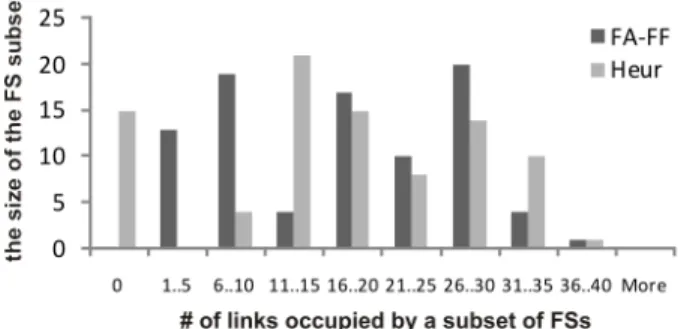
Fig. 3. FS occupancy in network links (for Scenario12in Table I).
Concurrently, in larger scenarios, when ILP1is computation-ally expensive, Heur can provide improved solutions, with respect to FA-FF, in reasonable time of several hundreds of seconds.
In Figure 3 we can see a histogram of the FS occupancy in network links for both FA-FF andHeur. In particular, the x-axis represents the number of links which are occupied by a subset of FSs, where the cardinality of the FS subset is represented in the y-axis. For instance, for FA-FF, there are
15FSs that do not occupy any link and, forHeur, there are13
FSs that occupy between1to5links. As we can observe, some
FSs are released and, consequently, the remaining FSs are utilized more frequently in network links in order to support reallocated connection demands after Heuris performed.
VII. CONCLUDINGREMARKS
Although the proposed heuristic method improves the ef -ciency of RSA, when compared toFA-FF, still the assignment of individual FSs is not completely balanced in the network and, therefore, some further savings might be possible. Also, the memory requirements of the solver are high when solving the heuristic for very large problem instances (of some hun-dreds of FSs and demands). Development of more effective RSA solutions is left for future work.
ACKNOWLEDGEMENT
This work has been supported by the Polish Ministry of Science and Higher Education under the contract 643/N-COST/2010/0 and by the Spanish Ministry of Science and Innovation through the "DOMINO" project (TEC2010-18522). The authors express their appreciation for very fruitful inter-actions with the members of COST Action IC0804 - Energy Ef ciency in Large Scale Distributed Systems.
REFERENCES
[1] W. Shieh and I. Djordjevic,OFDM for Optical Communications, Aca-demic Press, 2009.
[2] H. Masuda et al., "13.5-Tb/s (135 x 111-Gb/s/ch) no-guard-interval coherent OFDM transmission over 6,248 km using SNR maximized second-order DRA in the extended L-band", in Proc. OFC/NFOEC 2009.
[3] M. Jinnoet al., "Spectrum-ef cient and scalable elastic optical path net-work: Architecture, bene ts, and enabling technologies",IEEE Comm. Mag., vol. 47, no. 11, pp. 66-73, Nov. 2009.
[4] M. Pióro and D. Medhi, Routing, Flow, and Capacity Design in Communication and Computer Networks, Morgan Kaufmann, 2004. [5] M. Jinno et al., "Distance-Adaptive spectrum resource allocation in
spectrum-sliced elastic optical path network",IEEE Comm. Mag., vol. 48, no. 9, pp. 138-145, Aug. 2010.
[6] K. Christodoulopoulos, I. Tomkos, and E. Varvarigos, “Routing and Spectrum Allocation in OFDM-based Optical Networks with Elastic Bandwidth Allocation”, IEEE Global Conference on Communications
(GLOBECOM), 2010.
[7] "Finisar: Programmable narrow-band ltering using the WaveShaper 1000E and WaveShaper 4000E",White Paper, http://www. nisar.com. [8] ITU-T G.694.1, “Spectral grids for WDM applications: DWDM
fre-quency grid,” May 2002.
[9] M. Klinkowskiet al., "An Overview of Routing Methods in Optical Burst Switching Networks", Elsevier OSN Journal, vol. 7, no. 2, pp. 41-53, Apr. 2010.
[10] “IBM ILOG CPLEX: High-performance mathematical programming engine.”, http://www.ibm.com/, 2010.