with Good Behaviour in Practice
Dissertation
zur Erlangung des Doktorgrades
der Naturwissenschaften
vorgelegt beim Fachbereich Informatik und Mathematik
der Johann Wolfgang Goethe Universit¨
at
Frankfurt am Main
von
Andrei Laurian Negoescu
aus Bukarest
Frankfurt am Main 2013
D(30)
der Johann Wolfgang Goethe Universit¨at als Dissertation angenommen.
Dekan: Prof. Dr. Thorsten Theobald
Gutachter:
1. Prof. Dr. Ulrich Meyer 2. Prof. Dr. Georg Schnitger 3. Prof. Dr. Alejandro L´opez-Ortiz
Paging is one of the most prominent problems in the field of online algorithms. We have to serve a sequence of page requests using a cache that can hold up to k pages. If the currently requested page is in cache we have a cache hit, otherwise we say that a cache miss occurs, and the requested page needs to be loaded into the cache. The goal is to minimize the number of cache misses by providing a good page-replacement strategy. This problem is part of memory-management when data is stored in a two-level memory hierarchy, more precisely a small and fast memory (cache) and a slow but large memory (disk). The most important application area is the virtual memory management of operating systems. Accessed pages are either already in the RAM or need to be loaded from the hard disk into the RAM using expensive I/O. The time needed to access the RAM is insignificant compared to an I/O operation which takes several milliseconds.
The traditional evaluation framework for online algorithms is competitive
analysiswhere the online algorithm is compared to the optimal offline solution.
A shortcoming of competitive analysis consists of its too pessimistic worst-case guarantees. For example LRU has a theoretical competitive ratio of k but in practice this ratio rarely exceeds the value 4. Reducing the gap between theory and practice has been a hot research issue during the last years. More recent evaluation models have been used to prove that LRU is an optimal online algo-rithm or part of a class of optimal algoalgo-rithms respectively, which was motivated by the assumption that LRU is one of the best algorithms in practice. Most of the newer models make LRU-friendly assumptions regarding the input, thus not leaving much room for new algorithms. Only few works in the field of online paging have introduced new algorithms which can compete with LRU as regards the small number of cache misses.
In the first part of this thesis we studystrongly competitive randomized pag-ing algorithms, i.e. algorithms with optimal competitive guarantees. Although the tight bound for the competitive ratio has been known for decades, current algorithms matching this bound are complex and have high running times and memory requirements. We propose the algorithm OnlineMin which processes a page request in O(logk/log logk) time in the worst case. The best previously known solution requires O(k2) time.
stores information about the k pages in the cache. In addition it can also store information about pages not in cache, denoted bookmarks. We answer the open question of Bein et al. [9] whether strongly competitive randomized paging algo-rithms using only o(k) bookmarks exist or not. To do so we modify the Parti-tion algorithm of McGeoch and Sleator [60] which has an unbounded bookmark complexity, and obtain Partition2which uses Θ(k/logk) bookmarks.
In the second part we extract ideas from theoretical analysis of randomized paging algorithms in order to design deterministic algorithms that perform well in practice. We refine competitive analysis by introducing the attack rate pa-rameter r, which ranges between 1 and k. We show that r is a tight bound on the competitive ratio of deterministic algorithms. We give empirical evidence that r is usually much smaller than k and thus r-competitive algorithms have a reasonable performance on real-world traces. By introducing the r-competitive priority-based algorithm class OnOPT we obtain a collection of promising al-gorithms to beat the LRU-standard. We single out the new algorithm RDM and show that it outperforms LRU and some of its variants on a wide range of real-world traces.
Since RDM is more complex than LRU one may think at first sight that the gain in terms of lowering the number of cache misses is ruined by high runtime for processing pages. We engineer a fast implementation of RDM, and compare it to LRU and the very fast FIFO algorithm in an overall evaluation scheme, where we measure the runtime of the algorithms and add penalties for each cache miss. Experimental results show that for realistic penalties RDM still outperforms these two algorithms even if we grant the competitors an idealistic runtime of 0.
After years of work I have managed to polish the last details of my Ph.D. Thesis. In achieving this I was not alone. A lot of people supported me in this engaging, yet difficult endeavour, and I would like to take this opportunity to show my gratitude to all of them.
First and foremost thank you, Ulrich Meyer, my Doktorvater, for being an excellent professor, and for the freedom you gave me in choosing the topic of my liking. As a result, I was able to pursue a theme that is both dear and appealing to me, which made the research process more interesting and engaging.
Gabriel Moruz, thank you for the brainstorming sessions and for the re-search done together, and also for your input in the studies we have carried out over the years.
This thesis was co-funded by MADALGO (Center for Massive Data Algorith-mics) and DFG (Deutsche Forschungsgemeinschaft), and I would like to thank both organisations for their support.
I would also like to thank my other co-authors: Annam´aria Kov´acs, Gerth Stølting Brodal, Volker Weichert, Christian Neumann for a great collaboration and bright ideas. My appreciations also go to my colleagues: Matthias Poloczek, Bert Besser, Georg Schnitger, Andreas Beckmann, Claudia Schwarz, Claudia Heinemann, David Sabel and Conrad Rau.
I am grateful to Scott F.H. Kaplan (Department of Computer and Science at Amherst College), Alejandro L´opez-Ortiz and Reza Dorrigiv (University of Waterloo) for providing us with experimental data.
I also owe a debt of gratitude to Edgardo Deza, for his insights on subjects relevant to my papers, and to David Veith, my colleague who made the office a work-fit environment and who has reviewed my thesis, providing me with a very valuable feedback.
My thanks also go to my family and my girlfriend Anda for always believing in me, for their unconditional love, understanding and support in all the decisions I have made.
Andrei Negoescu, Frankfurt, October 28, 2013.
1 Introduction 1
2 Definitions and Basics 7
2.1 Online Algorithms . . . 7
2.2 The Paging Problem . . . 9
2.2.1 Paging Algorithms . . . 11
2.2.2 Fault Rate Analysis . . . 13
2.2.3 Cache Configurations of OPT . . . 15
3 Contributions 21 3.1 Randomized Algorithms . . . 21
3.1.1 New Results . . . 22
3.1.2 Constructing Valid Configurations . . . 23
3.1.3 OnlineMin . . . 25
3.1.4 Improving Space . . . 26
3.2 Deterministic Algorithms . . . 29
3.2.1 Input Parametrization . . . 30
3.2.2 Recency Duration Mix . . . 32
3.2.3 An Overall Evaluation . . . 35
3.3 Conclusions . . . 38
4 OnlineMin 41 4.1 Introduction . . . 43
4.2 Randomized Selection Process . . . 45
4.2.1 Preliminaries . . . 45
4.2.2 Selection Process for OnlineMin . . . 47
4.2.3 Probability Distribution of Ck . . . 50
4.3 Algorithm OnlineMin . . . 51
4.3.1 Algorithm . . . 51
4.3.2 Algorithm Implementation . . . 53
4.3.3 Pointer-Based Structures . . . 56
4.3.4 RAM Model Structures . . . 58 vii
5.2 Preliminaries . . . 67
5.3 Better Bounds for Equitable2 . . . 69
5.3.1 Approximation of Φ . . . 71
5.3.2 Competitiveness and Bookmarks . . . 74
5.4 Partition . . . 77 5.4.1 Algorithm . . . 78 5.4.2 Partition2 . . . 80 5.5 Conclusions . . . 84 6 Outperforming LRU 87 6.1 Introduction . . . 89 6.2 Input Parametrization . . . 92 6.2.1 Preliminaries . . . 93 6.2.2 Attack Rate . . . 93
6.3 Input-Parametrized Competitive Ratio . . . 96
6.3.1 Priority-Based Paging Algorithms . . . 96
6.3.2 Competitive Analysis . . . 97
6.4 An Algorithm Better than LRU . . . 101
6.4.1 RDM . . . 101
6.4.2 RDM on Real-World Traces . . . 102
6.5 Conclusions . . . 103
7 Engineering Efficient Paging Algorithms 107 7.1 Introduction . . . 109
7.1.1 Preliminaries . . . 111
7.1.2 Revealed Requests . . . 113
7.2 Compressed Layers . . . 114
7.3 Engineering an implementation forRDM. . . 116
7.3.1 Implementation . . . 117 7.3.2 Experimental results . . . 120 7.4 Conclusions . . . 123 Bibliography 131 Zusammenfassung 137 Curriculum Vitae 142 viii
Introduction
This thesis deals with theoretical and practical aspects of the paging problem. Paging is part of the memory management in systems with a hierarchy of memory levels, where the faster the memory the more expensive it is. Paging strategies manage the arrangement of accessed data between two memory levels. The small and fast memory is denotedcacheand the slow and large one is calleddisk. When data is accessed it is desirable to be contained in the cache in order to avoid time penalties for disk access. Data is considered to be organized in chunks of equal size, calledpages and we denote byk the number of pages that fit into the cache. The most prominent application area is the virtual memory management of modern operating systems [18, 24, 59, 63], where the cache corresponds to the limited-size RAM (Random-Access Memory). When the needed memory space exceeds the size of available RAM a part of the data is stored on the much slower hard disk. When a page is accessed and it is in the cache we have acache hitand nothing has to be done. Otherwise we say that acache missoccurs and the page has to be loaded into the cache which involves time-consuming I/O operations. Upon a cache miss a paging algorithm decides which page to replace from the cache. Other examples where paging algorithms are used to manage the same data splitting between RAM and hard disk are database systems [22, 55, 58, 62], web caching [19, 56, 64] and tools for external memory algorithms like the C++ library STXXL [25].
Competitive Analysis. The major difficulty regarding paging algorithms is given by the fact that usually little is known about future data access patterns. Thus paging is one of the most studied problems in the field of online algorithms, namely algorithms which have to make irrevocable decisions without knowing the whole input in advance. The first part of this thesis focuses on theoretical analysis of randomized paging algorithms. We use the classical quality measure for online algorithms, namely the competitive ratio [60]. A deterministic online algorithm A isc-competitive if for any input sequence it holds that
cost(A)≤c·cost(OP T) +b, 1
where cost(A) and cost(OP T) denote the cost of A and the optimal offline cost respectively, andb is a constant. In the case of randomized online algorithms the expected number of misses is taken into consideration. An online algorithm is said to be strongly competitiveif it has the best possible competitive ratio.
For deterministic algorithms the lower bound on the competitive ratio isk[60]. Three of the most prominent k-competitive paging algorithms are LRU (Least Recently Used), FIFO (First In First Out) and FWF (Flush When Full) [60]. Fiat et al. [32] proved that randomized algorithms cannot perform better than Hk-competitive, where Hk =
∑k
i=11/iis thek-th harmonic number. In the same work the randomized algorithm Mark was proposed and proven to be 2Hk
-competitive. Although not optimal, Mark has the advantage of being a simple and fast algorithm. Later, Achlioptas et al. [1] determined the exact competitive ratio of 2Hk−1 for Mark.
The first strongly competitive randomized algorithm Partition was pro-posed by McGeoch and Slater [48]. The memory requirement and runtime com-plexity of Partition are not bounded by the cache size k. Although the cache miss performance is the primary issue in competitive analysis, memory require-ment and runtime also play an important role. The first strongly competitive algorithm improving efficiency was Equitable [1] which can be implemented in O(k2) time per request and O(k2logk) memory. Borodin and El-Yaniv [14] stated the open question ifHk-competitive algorithms exist with onlyO(k)
mem-ory. Bein et al. [10] show thatO(k) memory is possible by providing the algorithm Equitable2, a variant of Equitablewhich uses only 2k bookmarks, i.e. pages not in cache that the algorithm keeps track of. In the same work it was conjec-tured that o(k) bookmarks are possible. Although Equitable2 uses only O(k) memory it still requires O(k2) time per request.
Contributions I. In this thesis we propose the strongly competitive random-ized algorithm OnlineMin which processes a page request inO(logk) time [20] while preserving the O(k) memory requirement of Equitable2. We further im-prove the runtime to O(logk/log logk) [21] by exploiting the power of the RAM model. We refine the analysis of Equitable2 and show that it can be imple-mented using only approximately 0.62k bookmarks and show that Equitable2 cannot achieve o(k) bookmarks. Instead we present a variant of Partition, which we denote Partition2, and show that Partition2 requires Θ(k/logk) bookmarks, thus proving the o(k) bookmark conjecture [10].
Theory vs. Practice. The second part of this thesis deals with the gap be-tween theory and practice of competitive analysis which was often criticized for its too pessimistic quality guarantees for deterministic paging algorithms. Young [67] investigated theempirical competitive ratio, i.e. the ratio between the cost of the online algorithm and the optimal cost on real-world inputs. The empirical
com-petitive ratio of LRU is a small constant, almost independent of the cache size, whereas its competitive ratio is k. Multiplicative factors in the hundreds have been observed between the theoretical worst-case bound and the experimental results. Another criticized issue is the fact that competitive analysis does not sep-arate algorithm LRU from FWF or FIFO, although in practice it is well-known that LRU performs substantially better than the other two algorithms [14].
Recent theoretical research focused on new methods for analyzing online al-gorithms in general and paging in particular. One line of research is concerned with restricted versions of competitive analysis, such as thediffuse adversary [44]
or loose competitiveness [68]. Other approaches consider comparing algorithms
directly, without relating them to an optimal offline algorithm. Relevant exam-ples include the Max/Max ratio [13], the random order ratio [42], the relative
worst order ratio [17], andbijective analysis and average analysis [6]. A detailed
survey of alternative performance measures can be found in [29]. Many of these approaches are concerned with separating existing paging algorithms in order to explain the differences noticed in practice. In particular, several approaches (e.g. diffuse adversary, bijective analysis combined with locality of reference [7]) single out LRU as the best algorithm in the respective setting. In certain cases, these models also resulted in the design of new algorithms. Examples include RLRU (Retrospective LRU) [17] and FARL (Farthest-To-Last-Request) [14, 33] which were designed according to the relative worst order ratio and access graph model [15, 31, 38] respectively.
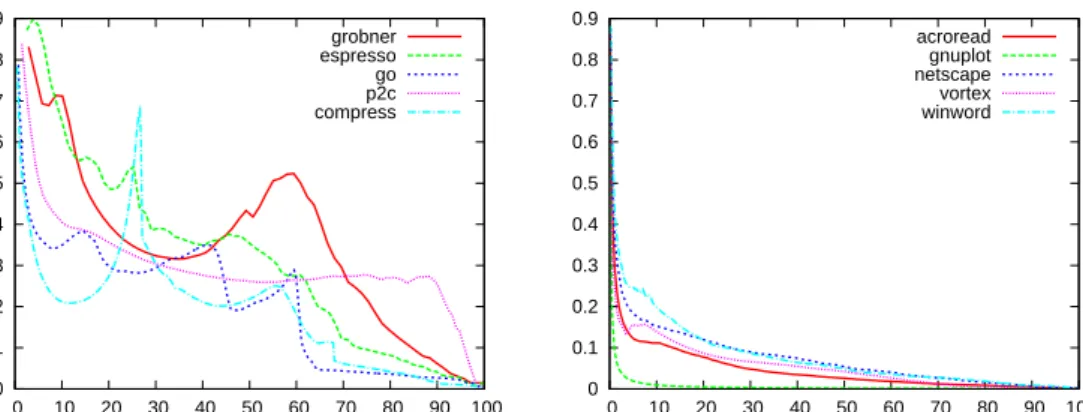
Contributions II. We propose a refinement of competitive analysis for the paging problem by introducing the attack rate r [51]. The attack rate is an input parameter which ranges between 1 and k and roughly corresponds to the extent of uncertainty regarding which pages the optimal offline algorithm has in cache. In contrast to many other approaches we do not use the LRU-friendly assumption of locality of reference. We prove thatr is a lower and upper bound on the competitive ratio of deterministic algorithms. This bound is matched by LRU and FIFO but not by FWF. Experiments on real-world traces reveal that the value ofris in many settings much smaller than k, thus the gap between the observed empirical competitive ratio and r is much smaller for LRU and FIFO compared to classical competitive analysis. Our parametrization also allows us to give an upper bound on the fault rate of r-competitive algorithms. We show experimentally that our parametrized bound explains better the low fault rate of LRU than the fault rate predictions using parametrizations based on locality of reference.
Separating known algorithms and/or predicting their performance is one as-pect of a cost model which is (at least partially) addressed successfully by many new approaches. Another desirable property is to find new algorithms with a good behaviour in practice. We define the OnOPT algorithm class which
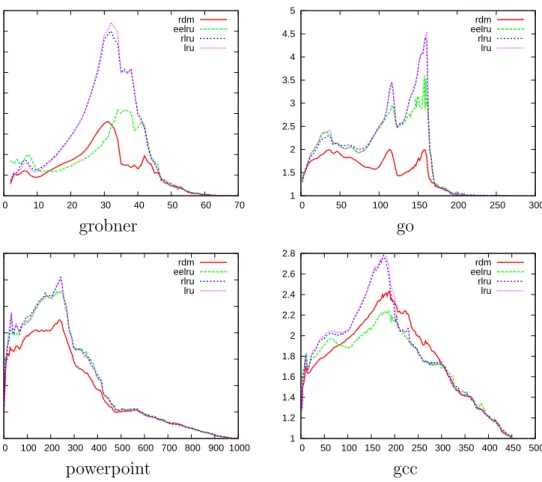
con-tains only r-competitive algorithms, including LRU. From this class we single out the new algorithm RDM and perform experiments on real-world traces. The experimental results show that RDM can outperform LRU and other algorithms thus contradicting newer theoretical models that single out LRU as the best pag-ing algorithm. We note that the attack rate model and the OnOPT class are inspired by the research of strongly competitive paging algorithms. This shows that insights from classical competitive analysis can help design algorithms per-forming few cache misses on real world inputs.
The main goal of a practical paging algorithm is to minimize the cost in terms of cache misses since cache misses can cause several milliseconds time penalties in the program execution which is up to ten thousand times more than the access time for the main memory. Yet the running time of paging algorithms cannot be ignored. We engineer an efficient implementation of RDM [54]. Further we provide an overall evaluation which simulates page requests from traces and determines a so-called total cost. The total cost consists of the runtime of the paging algorithm and a typical additional penalty of 9ms [63, Chapter 1.3.3] for each cache miss. The experimental results show that RDM can outperform LRU and FIFO as regards the total cost.
Publications. The results in this cumulative thesis are based on four peer-reviewed conference publications, two peer-peer-reviewed (invited) journal publica-tions, and one technical report. I was the main contributor of all six publications. [20] G. S. Brodal, G. Moruz, and A. Negoescu. Onlinemin: A fast strongly com-petitive randomized paging algorithm. InProc. 9th International Workshop on Approximation and Online Algorithms:, WAOA 2011, Revised Selected
Papers, pages 164–175. Springer, 2012
I contributed with the design and and the main part of the competitive analysis of algorithm OnlineMin. The proposed data structures are a contribution which belongs to all authors in the same proportion.
[21] G. S. Brodal, G. Moruz, and A. Negoescu. Onlinemin: A fast strongly competitive randomized paging algorithm. Journal Theory of Computing Systems, Special issue of the 9th Workshop on Approximation and Online
Algorithms, 2013
My share in this paper is the design and the main part of the competi-tive analysis of algorithm OnlineMin, including the improvements over the conference version [20]. The pointer-based data structures are a joint contribution of all the authors in the same amount. The input regarding the data structures in the RAM model mainly belongs to my co-author Gerth Stølting Brodal.
[51] G. Moruz and A. Negoescu. Outperforming LRU via competitive analysis on paramterized inputs for paging. InProc. 23rd Annual ACM-SIAM
Sym-posium on Discrete Algorithms, pages 1669–1680, 2012
My contribution contains the attack rate model, the OnOPT class and the RDM algorithm. The experimental evaluation is a joint contribution which belongs to both authors in the same proportion.
[54] G. Moruz, A. Negoescu, C. Neumann, and V. Weichert. Engineering effi-cient paging algorithms. In Proc. 11th International Symposium on
Exper-imental Algorithms, pages 320–331, 2012
The compressed layer representation, the improved implementation of On-lineMin and the overall evaluation method are the part I brought to this paper. The experimental evaluation was performed together with the other authors of the paper: Christian Neumann, Gabriel Moruz, and Volker We-ichert.
[53] G. Moruz, A. Negoescu, C. Neumann, and V. Weichert. Engineering ef-ficient paging algorithms. Journal of Experimental Algorithmics, Special issue of SEA 2012 (to appear)
The part I bring in this paper is the compressed layer representation, the improved implementation of OnlineMin, the overall evaluation method, and the equivalence proof of the layer representation, which was omitted in the conference paper [54] due to space limitations. The contribution of the more detailed experimental results (compared to the conference paper) belongs to all authors in the same proportion.
[50] G. Moruz and A. Negoescu. Improved space bounds for strongly competi-tive randomized paging algorithms. In Proc. 40th International Colloquium on Automata, Languages, and Programming, ICALP 2013 (to appear)
My share in this work is the design and analysis of algorithm Partition2 (the main result of this paper) and the lower bound on algorithms using deterministic forgiveness methods. The tighter analysis of Equitable2 belongs to both authors in the same proportion.
[52] G. Moruz and A. Negoescu. Improved space bounds for strongly compet-itive randomized paging algorithms. Technical report, Goethe-Universit¨at Frankfurt am Main, 2013
This technical report is the full version of paper [50]. It contains the same results as the conference paper. Additionally it contains proofs omitted due
to space limitation in the conference paper. My contribution is the design and analysis of algorithm Partition2 (the main result of this paper) and the lower bound on algorithms using deterministic forgiveness methods. The tighter analysis of Equitable2 belongs to both authors in the same proportion.
Beside my research on the classical paging problem I have also studied two other topics, which are not covered by this thesis. The first is α-paging, a variation of paging tailored for flash memory devices. The second is about lower bounds on the average-case complexity for classic single-source shortest-paths algorithms. The two resulted peer-reviewed publications are listed next.
[45] A. Kov´acs, U. Meyer, G. Moruz, and A. Negoescu. Online paging for flash memory devices. InProc. 20th International Symposium on Algorithms and
Computation,, ISAAC 2009, pages 352–361, 2009
[49] U. Meyer, A. Negoescu, and V. Weichert. New bounds for old algorithms: On the average-case behavior of classic single-source shortest-paths ap-proaches. In Proc. First International ICST Conference on Theory and
Practice of Algorithms in (Computer) Systems, TAPAS 2011, pages 217–
228, 2011
Outline. The rest of this thesis is structured as follows: In Chapter 2 we intro-duce relevant concepts of online algorithms in general and the paging problem in particular. This covers a brief description of the most popular paging algorithms in the theoretical framework of competitive analysis. As a preliminary step for our experimental results, we also introduce three known models for analyzing the fault rate. This chapter ends with a survey on the concept of the so-called valid
configurations, a crucial ingredient for our results.
In Chapter 3 the results of our research are presented. We begin with theoret-ical improvements of runtime [20, 21] and memory requirement [50] for strongly competitive paging algorithms. Next we introduce a refinement of competitive analysis leading to a new algorithm named RDM which outperforms LRU on real-world traces [51]. At the end of the chapter we engineer fast implementations for RDM [53, 54].
Definitions and Basics
2.1
Online Algorithms
Optimization Problems. A well-known optimization problem we deal with on a daily basis when driving our car, is to find the shortest path from the starting point to the destination. There are many feasible solutions, namely each path that may take us to our destination, and each solution has a cost, in this case -the distance. We are interested in -the solution with -the minimal distance.
Formally an optimization problem consists of a set I of possible inputs; for every input I we have a set F(I) of feasible solutions and a quality measure function f : F(I) → R. Depending on the problem we are dealing with we have either to minimize or to maximize the value off over the set of all feasible solutions. Thus we callf acost or a profit function.
Usually we are provided with the complete input of finite size and the task is to find good solutions for the given instance. In the case of the shortest path problem our input is a weighted graph G which models the street map. We can find an optimal solution with Dijkstras algorithm [28] in a number of computation steps, which is polynomial in the input size. There are also harder problems, which we cannot solve in polynomial time. One prominent example is Clique, where provided with an unweighted graphGwe have to find a subgraph G′ such that each node in G′ is connected to all other nodes in the subgraph. The profit function is the number of nodes in G′ and has to be maximized. This kind of problems can also be solved optimally although not in reasonable time.
The basic challenge in design and analysis is finding algorithms which are efficient in terms of running time and space consumption. If we cannot compute the optimum in polynomial time we are seeking for good approximations.
Online Optimization Problems. Consider that a person goes skiing, where the durationd of the trip is not known in advance, due to weather conditions for example. There exists the possibility to rent skis for 1 price unit per day or buy them for 10 price units. Each day our vacationist has to decide if he rents the
skis or buys them. If he buys the skis no other expenses need to be done in the remaining days. The goal is to minimize the amount of money spent during the holiday. Ifd ≥10 he should buy the skis on the first day; otherwise renting (each day) is more profitable. It is easy to see that an optimal decision strategy does not exist since we do not know din advance. The described problem is known as
the ski rental problem [40].
We call this kind of problems online problems. They differ from offline prob-lems by the property that irrevocable decisions have to be made with only partial knowledge of the input. More precisely an online algorithm A has to process an input sequence σ = (σ1, . . . , σn), where at each step i the element σi is
pre-sented. Algorithm A has to base its decisions in stepionly on the firstielements σ1, . . . , σi. Due to the lack of information about the future an online algorithm
cannot solve the given problem optimally for every request sequence, even with-out any constraints on computation time or memory space. In the following we assume online problems to be minimization problems, i.e. f is a cost function and the goal is to minimize the value of f over all feasible solutions. We denote by A(σ) the cost of A on input σ.
Optimal Offline Algorithm (OPT). Offline algorithms for online optimiza-tion problems can base their decisions on the whole request sequence, including the items yet to be presented. Although not implementable for an online prob-lem in practice, they allow for a comparison of the online solution with the best possible solution. The optimal cost for a given input σ is defined as:
OP T(σ) = min
A {A(σ)},
where A is an arbitrary algorithm. For the ski rental problem, assume that the inputσis a binary sequence, where the first 1 indicates the ending of the vacation. At the beginning, the optimal offline algorithm identifies the index d such that
σ1 =σ2 =· · ·=σd= 0 andσd+1 = 1. Ifd≥10 it decides to buy on the first day;
otherwise it rents skis for the entire period. Note that not all online problems have such simple optimal offline solutions.
Competitive Analysis. Let A be a deterministic online algorithm. How can we decide whether A is a good algorithm or not? Competitive analysis is doing this by comparing A to the optimal offline algorithm.
Definition 2.1 Online algorithm A is c-competitive if there exists a constant b
such that:
∀σ :A(σ)≤c·OP T(σ) +b.
In the case that A is a randomized algorithm, A(σ) stands for the expected cost of A on σ. As an alternative to A is c-competitive we can say that A has
a competitive ratio of c. Algorithm A is said to be strongly competitive if its competitive ratio is minimal, and thus the best possible for the given online problem.
Competitive analysis can be seen as a two-player game between the online
player and the adversary. The adversary creates an input which maximizes the
ratio between the online and the optimal offline cost. When creating a worst-case input the adversary knows exactly the decisions of a deterministic algorithm. In the case of randomized algorithms it knows only a probability distribution over all possible decisions.
For the ski rental problem consider the following strategy: rent skis for the first 9 days and buy them at the beginning of the 10th day. What valued for the duration would be chosen by the adversary? For sure it would not choose d≤9 since the online strategy is optimal in this case. The valued = 10 is a good one since the online player pays 19 whereas the optimal solution is 10. A higher value for d does not increase any of the two costs. We conclude that the worst-case ratio is 1.9. This online algorithm is known as thebreak-even algorithm [41] and is strongly competitive.
2.2
The Paging Problem
Paging is a prominent, well studied problem in the area of online algorithms. It is a special case of thek-server problem [46], one of the most challenging problems in the field of online algorithms.
Problem Definition. We are provided with a slow but large memory, the so-called disk, and a fast but small memory, the so-called cache. Data is assumed to be organized in blocks of equal size which we denotepages. We assume pages to be represented by numbers 1, . . . , m. The size of the cache is k. The input consists of a request sequence σ= (σ1, σ2, . . . , σn), where σi ∈ {1, . . . , m}.
An online algorithm A for the paging problem has to process the requests online and it is allowed to update its cache content CA upon each request. We
have that CA is a subset of {1, . . . , m} under the constraint |CA| ≤ k. Upon
request σi we distinguish two possibilities. If σi ∈ CA we say that a cache hit
occurs and we have cost 0 for processingσi. Otherwise we get acache miss, which
is also denoted page fault and the cost is 1. Algorithm A needs to load σi into
the cache, where a page replacement has to be performed if the cache contains already k pages. More precisely, A has to determine a page q∈CA and perform
the updateCA =CA\ {q} ∪ {σi}. The decision of A is based only on the input
seen so far, namelyσ1, σ2, . . . , σi.
Bookmarks. Every paging algorithm needs to keep track of all k pages in its cache. Some more sophisticated algorithms also need to store information about
a part of the pages on the disk. The pieces of information about those pages are called bookmarks. If an algorithm does not use bookmarks at all it is denoted
trackless.
The Optimal Offline Solution. An optimal offline algorithm for paging is known for decades, namely LFD (Longest-Forward-Distance) [12]. Upon a page replacement it evicts the page which is requested farthest in the future. Consider the request σi which triggers a cache miss. Assign each page p in the cache the
the value v[p] = j, where j is the smallest index j > i such that σj =p. In the
case that p is never requested again, assign v[p] = ∞. Determine q as the page with the highest v-value in the cache and replace it by σi.
In the following we refer to LFD as OPT. Although not implementable in real-world scenarios due to its offline character it is important to compare the performance of online algorithms to the best possible result.
Competitive Ratio Lower Bounds. Sleator and Tarjan [60] showed a lower bound of k on the competitive ratio for deterministic algorithms, where k is the cache size. A proof for this lower bound is summarized in the following.
Consider an arbitrary online algorithm A. The adversary requests at the beginningk distinct pages p1, p2, . . . , pk. We assume these pages to be contained
in both the cache of OPT and A. Then the adversary requests a page pk+1 and A has to evict some page pi1 from the cache. Next he requests pi1 which has
to be brought back by A and another page currently in the cache pi2 has to
be evicted. This continues until the request of pik−1. Each of the k requests
(pk+1, pi1, pi2, . . . , pik−1) triggers one cache miss for A. In this sequence at least
one page pj from the initial cache content {p1, . . . , pk} is not requested. Thus
upon the first request of pk+1 the optimal algorithm can replace page pj and has
a total cost of 1 for this sequence. We request pages from {p1, . . . , pk+1} \ {pj}
until A evicts pj and thus A has the same cache content as OPT. Now we can
repeat our attack scheme which incurs cost at least k for A and cost 1 for OPT. We conclude that no deterministic online algorithm can achieve a competitive ratio smaller thank. Algorithms like LRU and FIFO arek-competitive and thus strongly competitive.
When considering randomized algorithms life becomes harder for the adver-sary. When creating a worst-case input, it does not know the precise cache content of the online algorithmA. In the previous lower bound proof the adversary knew exactly the cache content of A and could always request a page not in the cache of A. If A uses randomization the adversary can only determine the probability of a page not being in the cache of A.
Fiat et al. [32] showed that randomized algorithms cannot perform better thanHk-competitive, whereHkis the k-th harmonic number: 1 +21+13+· · ·+1k.
lower bounds for randomized algorithms) is given in [14]. It is an adaptation of the lower bound proof for uniform task systems [16].
Empirical Competitive Ratio. Competitive ratio guarantees are worst-case guarantees, which do not necessarily reflect the behaviour of online algorithms in practice and especially not for paging. Empirical competitive ratio is the ratio between the cache misses of an online algorithm divided by the cache misses of the optimal solution on real-world traces. Usually this ratio is plotted on a chart wherek varies from 2 to the amount of all distinct pages requested in the trace. LRU is known to have a very small empirical competitive ratio.
Fault Rate. The fault rate is the measure often used in practice in order to evaluate the performance of paging algorithms. Let A be an arbitrary paging algorithm andσ a request sequence of length |σ|. If A(σ) is the number of cache misses ofA when processingσ, we define the fault rate of Aonσ by the quotient
FA(σ) =A(σ)/|σ|,
which ranges between 0 and 1. Reasonable theoretical worst case results for the fault rate are not possible if we do not restrict the class of possible inputs, as every algorithm can be forced to fault on each request by always requesting a page that has never been requested before.
2.2.1
Paging Algorithms
In this section we give a brief description of the most popular paging algorithms. All the following deterministic algorithms are trackless.
LRU. The strategy Least Recently Used maintains the cache content sorted by the timestamp when the pages were requested last time. The more recently a page was requested the higher is its priority to be kept in the cache. Upon a page replacement LRU evicts the least recently accessed page. LRU is k-competitive and thus strongly competitive. Its empirical competitive ratio is usually below 4 and thus it is often regarded as the algorithm with the best performance in practice.
FIFO. The paging algorithm First In First Out evicts upon a page replacement the page which first entered the cache. Although FIFO is also k-competitive it performs worse than LRU in practice as regards the number of cache misses. Nonetheless it has the big advantage that an implementation of this algorithm needs only a simple FIFO Queue, which handles each request inO(1) time. FIFO is one of the fastest paging algorithms.
LIFO, MRU, LFU. Last In First Out evicts upon a cache miss the page which was loaded last in the cache and Most Recently Used replaces the most recently accessed page. These two strategies can be seen as the counterpart of FIFO and LRU. Both have in common that their competitive ratio is not bounded by the cache size k. To see this consider the initial sequence p1, . . . , pk. We continue
requesting pk+1, pk arbitrarily often. The optimal solution can evict p1 and the whole sequence has cost 1 whereas LIFO and MRU have an unbounded cost. On real-world traces both strategies have a disastrous performance. Least Frequently Used has a counter for each page in cache and upon each request of page p it increases the counter of p. Upon a page replacement the page with the lowest value of the counter is chosen to be evicted. The competitive ratio of LFU is also unbounded.
Random. This is the simplest randomized paging algorithm. Whenever a page needs to be evicted, we choose one uniformly at random from the cache. This strategy yields a competitive ratio of k [57]. Although it uses randomization it does not perform better than good deterministic algorithms. Random is a trackless algorithm.
Mark, FWF. A simple randomized paging algorithm which almost matches the lower bound ofHkon the competitiveness of paging algorithms is Mark. By
using one bit for each page in the cache, it divides pages into marked and
un-marked. Whenever a page is requested it gets marked. Upon a page replacement,
if not all k pages are marked,Markevicts one unmarked page uniformly at ran-dom and the actually accessed page gets marked. In the case where all k pages are marked, they are first unmarked, one is chosen uniformly at random to be evicted and the newly requested page gets marked. SinceMarkuses information only about pages in the cache it is also trackless.
A first analysis showed thatMarkis 2Hk-competitive [32]. The analysis was
improved later [1] and a tight bound of 2Hk−1 was proven. Due to its simplicity,
the question arises if another probability distribution on the unmarked pages can improve the competitive ratio. Chrobak et al. [23] addressed this question by proving that, for any constant ε > 0, no randomized marking algorithm can perform better than (2−ε)Hk-competitive.
Deterministic marking algorithms evict upon a page replacement one un-marked page using a deterministic rule. Algorithms in this class arek-competitive. One special algorithm is FWF (Flush When Full), which evicts allkpages upon a page replacement. It is often used to point out the limits of competitive analysis, since it reaches the optimal bound of k but its behaviour in practice is rather poor compared to LRU and FIFO.
Partition, Equitable. The randomized algorithmPartition[48] was the first one that matched the lower bound of Hk. This algorithm is much more
compli-cated than the Mark algorithm. Both memory and runtime are bounded only by the input size n and not by the cache size k. This was improved by Achliop-tas et al. [1] who presented the Equitable algorithm which uses O(k2logk) bookmarks. Bein et al. [11] further improved the memory requirement, where a variant of Equitable, denoted Equitable2, uses only 2k bookmarks. Both variants of Equitable process a page request in O(k2) time.
In order to achieve the optimal bound of Hk, Partition and Equitable
maintain a probability distribution over allvalidconfigurations. Valid configura-tions are all possible cache contents of the optimal offline algorithm after having processed the requests so far. Especially if a page is in none of the valid con-figurations it has 0 probability to be in their cache. Keeping track of all valid configurations is the main bottleneck for runtime and space of Partition and Equitable.
Unlike the strongly competitive randomized algorithms we can easily force Markto keep a page in the cache with non-zero probability although this page is not contained in any valid configuration. To see this let us look at the following request sequence:
(p1, p2, . . . , pk, pk+1, pk+2, p1, p2, . . . , pk−1).
Upon the request of pk+1 the optimal offline algorithm evicts pk and upon the
request of pk+2 it evicts pk+1. After processing the given sequence we know for sure that the cache of OPT containsp1, p2, . . . , pk−1 andpk+2. Thus we have only one valid configuration. Right before the last request Mark has the k marked pagespk+1, pk+2, p1, p2, . . . , pk−2 in its cache. After the last request the pagepk+1 has a probability of 1−1/k to reside in the cache of Mark.
2.2.2
Fault Rate Analysis
As mentioned before, the fault rateis often used in order to evaluate the perfor-mance of paging algorithms on real-world traces. Reasonable theoretical worst-case results for the fault rate are not possible if we do not restrict the class of possible inputs. Observations from practice tell us that request sequences have regularities which make them easy to handle. The most important behaviour for the paging problem is called locality of reference, which tells us that there is a small set of pages that is requested very often within a certain time inter-val [24,63]. This partially explains the very good performance of LRU in practice. In the following we present three approaches for modelling locality of reference and analyzing the fault rate under this parametrization. The Max-Model and
the Average-Model were introduced by Albers et al. [2] and a measure for the
pro-Max-Model Average-Model Online ≥ f−1(kk−+1)1 −2 ≥ f(k+1)−1 k LRU = k−1 f−1(k+1)−2 = f(k+1)−1 k FIFO ≥ f−1k(−k1+1)/k−1, ≤ k f−1(k+1)−1 = f(k+1)−1 k Marking ≤ f−1(kk+1)−1 ≤ 4 3 f(k) k
Table 2.1: Fault rates of online algorithms [2].
vides upper bounds on the fault rate which is based on one easy-to-measure input parameter.
Locality of Reference [2]. The underlying characterization of locality of ref-erence is given by a function f which assigns to a window size n the number of distinct pages requested. The functionf is assumed to be increasing and concave. First we summarize the Max-Model. In the Max-Model an input σ is said to be consistent with f if during every subsequence of n requests at most f(n) distinct pages are accessed. The inverse function f−1 is defined as follows:
f−1(m) = min{n ∈N|f(n)≥m}.
The key parameter in the theoretical results on the fault rate (see Table 2.1) is the value f−1(k+ 1), which is the minimal window size for k + 1 distinct page requests. In the Max-Model it was shown that LRU achieves the best possible worst-case guarantee for the fault rate of online algorithms. FIFO and FWF were proven to have worse guarantees than LRU, although the difference is very small. In the Average-Model an input is consistent with f if the average number of distinct pages in a window of n requests is at most f(n). The crucial parameter for the results (see Table 2.1) is f(k+ 1), the average number of distinct pages in frames of size k+ 1. Although the Average-Model does not separate LRU from FIFO, the parametrized guarantees are closer to the observed fault rate than in the case of the Max-Model.
Non-Locality of Reference [30]. This parametrization of the input sequences reflects the non-locality of reference. For a given inputσ the non-locality param-eter ¯λ(σ) is defined as the average of the number of distinct pages between two consecutive requests to the same page. For the i-th requested page σ[i] letdσ[i]
be k+ 1 if page σ[i] was requested for the first time. Otherwise let dσ[i] be the
number of distinct pages requested since the last request to σ[i]. ¯ λ(σ) = 1 |σ| ∑ 1≤i≤|σ| dσ[i]
online alg. LRU FIFO FWF LFU LIFO lower bound λ¯ k+1 ¯ λ k+1 ¯ λ k+1 2¯λ k+3 2¯λ k+3 ¯ λ 2 upper bound λ¯2 k+1λ¯ k+1λ¯ k2+3¯λ - λ¯2
Table 2.2: Upper and lower bounds on the fault rates of deterministic online algorithms [30].
One strength of this model is the simple analysis of standard algorithms. LRU and FIFO both achieve the best possible guarantee on the fault rate. Although it does not separate LRU from FIFO, it manages to clearly separate LRU from FWF and LFU, namely by a multiplicative factor of almost 2. Algorithm LIFO which performs disastrously on inputs with high locality of reference has the worst possible guarantee. A summary of the theoretical results is given in Table 2.2.
2.2.3
Cache Configurations of OPT
Given the request sequence σ seen so far, in an online setting it is of interest to know the actual cache content COP T of an optimal offline solution, which
processes the whole input with minimal cost. Although in an online scenario COP T is not known since it depends also on the future request sequence τ, we
are provided with partial information (from the processed sequenceσ) about the structure of COP T, e.g. it contains for sure the most recently requested page,
and pages not requested in σ are not in COP T. We say that immediately after
processing σ the cache content C of some algorithm A containing k pages is a
valid configurationiffσhas been processed byAwith minimal cost. It was shown
that the set of all valid configurations, in the following denoted V, contains all possible configurations COP T [44] (Lemma 2.3) . This means that an optimal
solution for the whole sequence στ has minimal cost after processing σ. As we will see in Lemma 2.4, V contains exactly the set of all possible configurations of the optimal offline algorithm. We give a brief overview of existing representations ofV. We start with one of the first characterizations used in the context of work functions which can be seen as a mathematical utility for algorithm analysis. Then we present some changes which lead to representations more favorable for algorithm design and implementation.
Set Inclusion. One of the first representations of V, denoted in the following
set inclusion, was provided by Koutsoupias and Papadimitriou [44]. It uses a
sequence of non-disjoint sets containing pages which is updated after each request. It was used to prove that LRU is optimal in thediffuse adversary model.
Lemma 2.1 ( [44], Lemma 2.3) For each request sequence σ there is an
in-creasing sequence of sets S = (S1 ( S2 ( · · · ( Sk), with S1 = {p} the most
recent request, such that V is precisely
{C :|C∩Sj| ≥j for all j ≤k}.
The sets are initially Sj = {p1, . . . , pj} given that p1, . . . , pk is an arbitrary
order of the first k pairwise distinct requested pages. Note that this initial set representation isnot uniqueand each of thek! permutations ofp1, . . . , pkdescribes
the same set of valid configurations. IfSis the representation ofV for inputσ, let Sp denote the representation ofV forσp, the sequence resulting from the request of page p after processing σ. The sets are updated as follows [44]:
Sp = ({p}, S| {z }1∪ {p} S2p , S| {z }2∪ {p} Sp3 , . . . , S|j−1{z∪ {p}} Spj , Sj+1, . . . , Sk) p∈Sj, p /∈Sj−1 ({p}, S| {z }2∪ {p} S2p , S| {z }3∪ {p} Sp3 , . . . , S| {z }k∪ {p} Skp ), if p /∈Sk
In the case p ∈ Sk there exists always an index j such that p belongs to
Sj, . . . Sk but not to S1, . . . , Sj−1 due to the property S1 (S2 (· · · (Sk. Since
Sk always contains at least k items we conclude that valid configurations never
contain pages which are not in Sk.
Layer Representation. Having information about the cache content of the optimal solution is a powerful tool to analyze algorithms in models where the cost of the online algorithm is compared to the optimal cost. However this in-formation can also be tracked and used in the design of online algorithms. The first such algorithms were Partition[48] andEquitable [1]. Both are optimal randomized algorithms as regards the competitive ratio. Equitableuses a space efficient version of the set inclusion representation ofV, presented in the previous paragraph. It maintains a sequence of k so-called layers L = (L1|L2|. . .|Lk),
where L1 = S1 and Lj = Sj \Sj−1. Note that the layer representation provides complete information to compute each set Sj since Sj =L1∪ · · · ∪Lj.
The initialization and update rule of the layers can be directly adapted from the set inclusion representation. Initially we have L= (p1|p2|. . .|pk) and upon a
request of a page p the following update rule [1] ensues:
Lp = ({p}|L1|. . .|Lj−1|Lj ∪Lj+1\ {p}|Lj+2|. . .|Lk) if p∈Lj and j < k ({p}|L1|. . .|. . .|Lk−1) if p∈Lk ({p}|L1∪L2|L3|. . .|Lk) if p /∈L1∪ · · · ∪Lk
Lemma 2.2 ( [1], Lemma 1) If (L1|. . .|Lk) is the layer representation of the
actual set of valid configurationsV, a setC of k pages is a valid configuration iff:
|C∩(∪i≤jLi)| ≥j for all 1≤j ≤k.
Lemma 2.2 is a direct adaptation of Lemma 2.1 to the layer representation. Let indexr be maximal such that L1, . . . , Lr are singletons. Achlioptas et al. [1]
denote the pages in L1, . . . , Lr as revealed. It follows directly from Lemma 2.2
that revealed pages are always contained in a valid configuration independent of the future request sequence. Thus revealed pages are always in the cache of any optimal offline algorithm. Requests to revealed pages play a crucial role in designing online paging algorithms with few cache misses in practice and low runtime overhead [51, 54].
Inversed Layer Representation. Given a set C of k pages and the layer representationLof V, we can easily check if C is in V by testing allk conditions from Lemma 2.2. However if we are given only Land want to construct all valid configurations it seems there is no simple and intuitively direct way to do so. The requirement of having to chooseat leastan amount ofj pages fromL1, . . . Lj
does not help deciding which page to exclude and which not. We recall that the configuration C contains exactlyk pages, and the k conditions from Lemma 2.2 can be stated the following way:
|C∩(∪i>jLi)| ≤k−j+ 1 for all 1 ≤j ≤k.
By using the reindexationj =k−j+1 and by adding a new layerL0containing all pages not in L1∪ · · · ∪Lk we obtain the representation that we introduced in
order to define and analyze OnlineMin[21].
Lemma 2.3 ( [21], Lemma 1) IfL= (L0|L1|. . .|Lk)is the inversed layer
rep-resentation of V then a set C of k pages is a valid configuration, iff
|C∩(∪i≤jLi)| ≤j for all 0≤j ≤k.
Initially each layer Li, where i > 0, consists of one of the first requested k
pairwise distinct pages. The layerL0 contains all pages not inL1, . . . , Lk. Adding
the layer L0 the update rule from the original layer partition (considering the reindexation) simplifies to only two cases [21]:
Lp =
{
(L0\ {p}|L1|. . .|Lk−2|Lk−1∪Lk|{p}) if p∈L0, (L0|. . .|Li−2|Li−1∪Li\ {p}|Li+1|. . .|Lk|{p}) if p∈Li, i >0.
Note that in the inversed representation the revealed pages are the rightmost singletons. The main strength of this representation is that the layer index j
bounds the amount of pages from L0∪L1 ∪ · · · ∪Lj in a valid configuration C.
We provide a priority-based incremental selection process which constructs valid configurations [21]. The goal is to maintain the cache content of an optimal offline algorithm under the assumption that the priorities reflect the order of future requests, namely the higher the priority of a page p, the sooner we assume p to be requested again in the future. For some setSlet minj(S) and maxj(S) denote
the subset ofS of sizej with the smallest and the largest priorities, respectively.
Definition 2.2 ( [21], Definition 1) We construct iteratively k + 1 selection sets C0, . . . , Ck from the layer partition L = (L0|. . .|Lk) as follows: we first set
C0 =∅ and then for j = 1, . . . , k we set Cj = maxj(Cj−1∪Lj).
By construction the set Ck is a valid configuration and thus contains all
re-vealed pages and no page fromL0. For designing an online algorithm which stays in valid configurations it is desirable to have a simple update rule for Ck. Under
the assumption that we change only the priority of the currently requested page, we show that Ck can be updated the following way without recomputing the
selection process from the beginning:
Theorem 2.1 ( [21], Theorem 1) Let p be the requested page. Given Ck, we
obtain Ckp as follows:
1. p∈Ck: Ckp =Ck
2. p /∈Ck and p∈L0: Ckp =Ck\min(Ck)∪ {p}
3. p /∈ Ck and p ∈ Li, i > 0: Ckp = Ck \min(Cj)∪ {p}, and j ≥ i is the
smallest index with |Cj ∩Ck|=j.
Initially, the update rule from Theorem 2.1 was used with random priority as-signment and resulted in the runtime efficient strongly competitive randomized algorithm OnlineMin. The algorithm class using deterministic priority assign-ments is denoted OnOPT [54]. Algorithms from this class have been shown to adapt to easy inputs regarding the attack rate [54]. We use the properties of the OnOPTclass to show that optimal offline algorithms perform cache misses only on requests to pages in L0.
Lemma 2.4 Let p be the actually requested page andL the inversed layer
repre-sentation of V. Page p is in the cache of an optimal offline algorithm iff p /∈L0.
Proof. Let COP T denote the cache content of an optimal offline algorithm and
L = (L0|L1|. . .|Lk) be the layer representation after processing σ. Recall that
due to Lemma 2.1 optimal offline algorithms are always in valid configurations. By Lemma 2.3 we immediately conclude that if p is in L0 it cannot be in COP T.
We use an (offline) algorithm A from the OnOPT class where we define the priority assignment to be the following: upon request of page q we assign q the negated timestamp of its future request as priority. Recall that OnOPT algorithms use the update rule from Theorem 2.1. Since the cache of anOnOPT algorithm is identical to the outcome Ck of the priority based selection process
from Definition 2.2 and p has the highest priority of all pages L1, . . . , Lk we
conclude thatp is in the cache of A. Since each optimal offline algorithm faults on requests fromL0 and Afaultsonlyon requests from L0 we get a contradiction to the optimality of OPT if we assume p /∈COP T. 2
Compressed Layer Representation. Given a fixed set of valid configura-tions V, all the three previously introduced approaches do not have an unique representation. The simplest way to see this is the initialization step after the firstk pairwise distinct pagesp1, . . . , pk have been requested. In this case V
con-tains only the configurationC={p1, . . . , pk}and does not depend on the request
order. The layer representations use an arbitrary permutation and assign each page to one layer. Assigning pages with identical characteristics with respect to
V in different layers or sets seems to be counterintuitive. We propose an unique representation of V. Given the inversed layer representation L, a compressed representationL [54] is defined which groups all consecutive singletons of L. An algorithmic description of this compression process is given in Algorithm 1.
Algorithm 1Layer compression
procedure Layer compression(Layers L= (L0|. . .|Lk)) ◃ Compress L
L0 =L0;
T =∅;
for i= 1 to k−1 do
if |Li|= 1 then ◃ Li is singleton
Li =∅; T =T ∪Li;
else ◃ Li is not singleton
Li =Li∪T; T =∅;
end if end for
Lk =Lk∪T;
end procedure
Here is an example for k = 7:
L= (3,10|2|5,7|4|1,11|8|9|6), L = (3,10|∅|2,5,7|∅|1,4,11|∅|∅|6,8,9) We have shown that L is consistent with Lemma 2.3 and thus it inherits all results for the inversed layer representation excepting the layer update rule. Like
in the inversed layer representation, L0 contains the pages which are not in any valid configuration and all revealed pages are grouped in Lk. Unrevealed pages
are pages whose presence in COP T depends not only on σ but also on the future
request sequence. These pages are in L1, . . . ,Lk−1. Note that if a page p is requested from such a layer it is for sure in the cache of OPT due to Lemma 2.4. An update rule maintaining the compressed layer representation is also pre-sented [54]. Initially it assigns Lk the first k pairwise distinct requested pages;
L1, . . . ,Lk−1 contain no pages. Let L and Lp be the compressed representation of L and Lp respectively. Lp can be obtained directly fromL as follows:
Lp = (L0\ {p}|L1|. . .|Lk−2|Lk−1 ∪ Lk|{p}), if p∈ L0 (L0|. . .|Li−2|Li−1∪ Li \ {p}|Li+1|. . .|∅|Lk∪ {p}), if p∈ Li,0< i < k (L0|L1|. . .|Lk−1|Lk), if p∈ Lk
The compressed layer representation has the advantage that upon requests to revealed pages nothing changes. Experiments on real-world traces have shown that usually more than 99% of the requests are to revealed pages. This leads to significant runtime improvements of OnOPT algorithms [54]. Another advan-tage is that the number of non-empty layers is much smaller thank on real-world traces. This allows for more efficient implementations.
Contributions
In this chapter the most relevant parts of our published papers are summarized. We listed for each subsection in Table 3.1 the corresponding published paper and its location within this thesis.
Subsection Paper Corresponding Chapter 3.1.1. [20], [21], [50] 4,5
3.1.2, 3.1.3 [20], [21] 4
3.1.4 [50], [52] 5
3.2.1, 3.2.2 [51] 6
3.2.3 [54], [53] 7
Table 3.1: Connection between the contents of this chapter and the published work.
3.1
Randomized Algorithms
The first part of our research focuses on strongly competitive randomized paging algorithms. We propose algorithms which match the lower bound of the com-petitive ratio and improve the previous results in terms of runtime [20, 21] and
memory requirement[50]. The memory requirement is usually analyzed in terms
of bookmarks, i.e. the number of pages not in cache that an online algorithm keeps track of.
Although the tight bound of Hk on the competitive ratio of randomized
algo-rithms is known for decades, known algoalgo-rithms matching this bound are rather complex. It is not an easy task to mathematically capture the simplicity of al-gorithms. Chrobak et al. [23] proposed to limit the memory requirement and runtime of algorithms in order to make them simpler. In the case of memory consumption the best case occurs if an algorithm is trackless, namely it does not use any bookmarks. Bein et al. [9] proved that no trackless randomized
algorithm can be Hk-competitive. The Mark algorithm is trackless and fast,
but it was shown that no variant of this algorithm can perform better than (2Hk −1)-competitive [23]. The memory requirement and runtime per request
of the strongly competitive algorithm Partition[48] can be linear in the size of the request sequence, and thus not bounded by the cache size k. Equitable [1] usesO(k2logk) memory and processes a page request inO(k2). A variant of
Eq-uitable, denoted Equitable 2 [11], further improves the memory requirement to O(k), while the running time still remains O(k2). This memory improvement solved an open problem stated by Borodin and El-Yaniv [14]. Bein et al. [11] conjectured that a better result, namely o(k) bookmarks, is possible.
3.1.1
New Results
We propose the algorithm OnlineMin [20] that handles each page request in O(logk) time in the worst case and we improve it toO(logk/log logk) [21]. This is a significant improvement over the fastest known algorithm, Equitable2, which needs O(k2) time per request.
The key element of our algorithm is a new priority-based incremental selec-tion process which always yields a cache content, that is identical to the cache of the optimal offline algorithm under the assumption that page priorities reflect the order of future requests. The analysis of this process results in a simple cache update rule which is different from the Equitable algorithms [1, 11], but leads to the same probability distribution of the cache content for random priori-ties. A simple implementation of our update rule requiresO(k) time per request. Additionally we design data structures that result in two more efficient implemen-tations: the first implementation uses pointer-based data structures to achieve O(logk) worst-case time per page request, whereas the second implementation exploits the power of the RAM model to achieve O(logk/log logk) worst-case time per request. The main contribution concerning the data structures in the RAM model belongs to my co-author Gerth Stølting Brodal.
In our paper [50] we address the o(k) bookmark conjecture [10]. We first provide a tighter analysis of algorithm Equitable2 reducing the number of bookmarks from 2k to ≈ 0.62k, which is the first solution using less than k bookmarks. We give a negative result showing thatEquitable2 cannot achieve a competitive ratio of Hk using o(k) bookmarks. Nonetheless, we show that it
can trade competitiveness for space: if it is allowed to be (Hk+t)-competitive, it
requiresk/(1 +t) bookmarks. We propose the new algorithmPartition2which is a variant of the Partition algorithm. Partition2 improves the bookmark requirements of Partition from Θ(n) to Θ(k/logk) where n is the input size. This proves the o(k) bookmark conjecture.
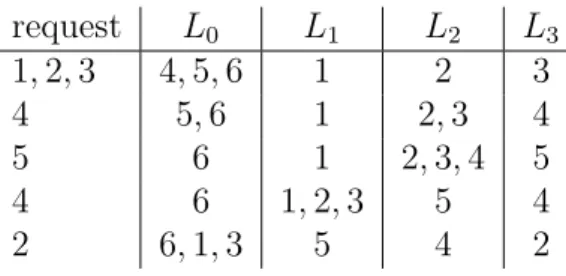
request valid configurations 1,2,3 {1,2,3} 4 {1,2,4},{1,3,4},{2,3,4} 5 {1,2,5},{1,3,5},{2,3,5},{1,4,5},{2,4,5},{3,4,5} 4 {1,4,5},{2,4,5},{3,4,5} 2 {2,4,5}
Table 3.2: An example of valid configurations.
3.1.2
Constructing Valid Configurations
Acache configurationC is a subset ofk pages. ThePartitionand Equitable
algorithms maintain a probability distribution over the set of all possible cache contents. Ideally only configurations which might correspond to the cache content of the optimal offline algorithm should have non-zero probability; we call these configurations valid. An overview on valid configurations including a formal def-inition is given in Section 2.2.3. In the following we give an intuitive explanation and restate needed properties from Subsection 2.2.3.
We do not know the precise cache content of OPT since it depends on the future request sequence but, given the sequence so far, we can restrict the pos-sible configurations. We give an intuitive example for cache size k = 3 and the pageset{1,2, . . . ,6}. Consider the following requests:
σ = 1,2,3,4,5,4,2, . . .
Starting with the initial request sequence 1,2,3 we list in Table 3.2 the set of valid configurations V after each request. If V contains only one configuration we say that we are in a cone. In a cone we know the precise cache content of OPT. Given V, we distinguish between three types of pages. A page p is called OPT-miss ifp is not contained in any configuration C ∈ V, which means thatp is for sure not in the cache of OPT (independent of the future request sequence). In the given example page 6 is always OPT-miss. A page p is called revealed
if it is contained in all configurations C ∈ V, which means that it is for sure in the cache of OPT. In our example 4, and 5 are pages revealed directly after the second request of 4. All other pages are called unrevealed. These pages are contained in at least one configuration but not in all of them.
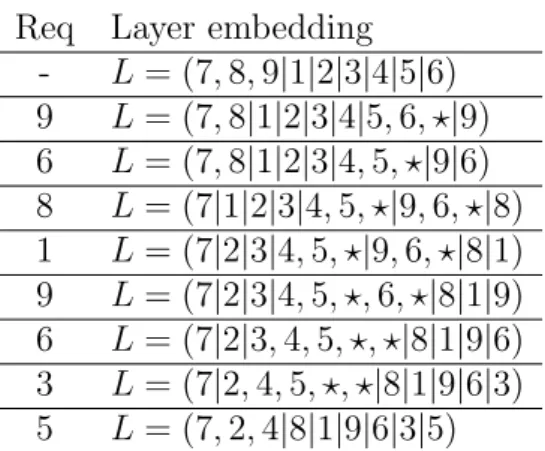
Inversed Layer Representation. A characterization of the setV of all valid configurations was first given by Koutsoupias and Papadimitriou [44]. We intro-duced an equivalent variant of this, denotedinversed layer representation[20,21]. It partitions the pageset into k+ 1 sets L0, L2, . . . , Lk denoted layers. Initially
![Table 2.1: Fault rates of online algorithms [2].](https://thumb-us.123doks.com/thumbv2/123dok_us/10172760.2919551/22.892.239.681.160.301/table-fault-rates-of-online-algorithms.webp)