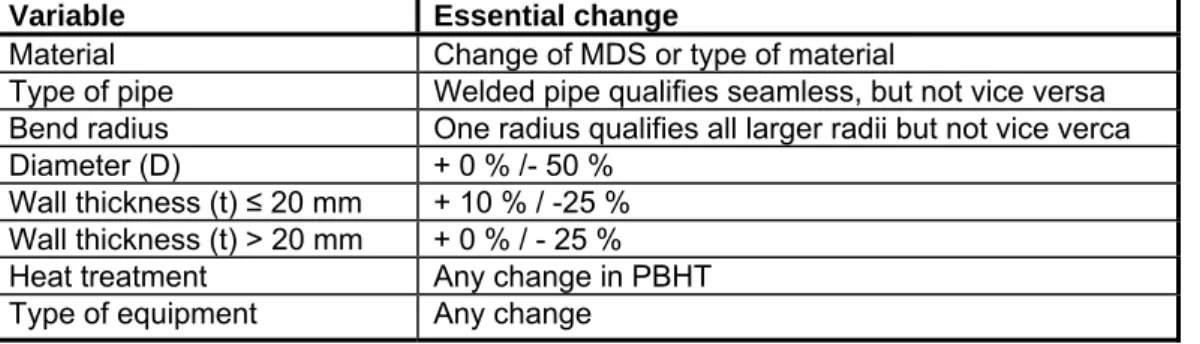
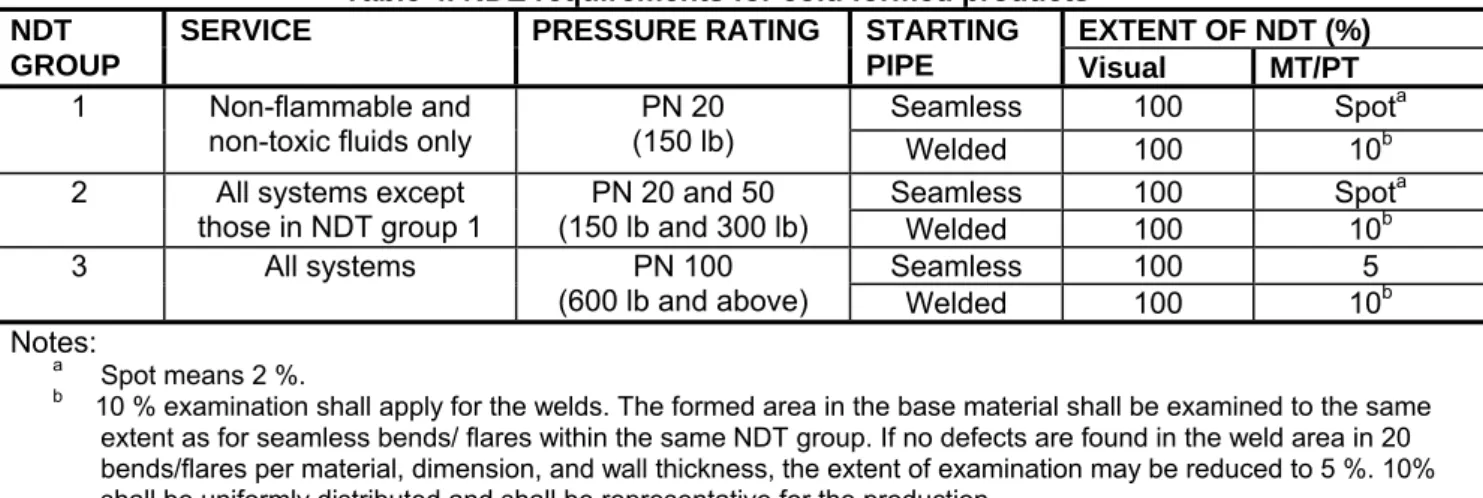
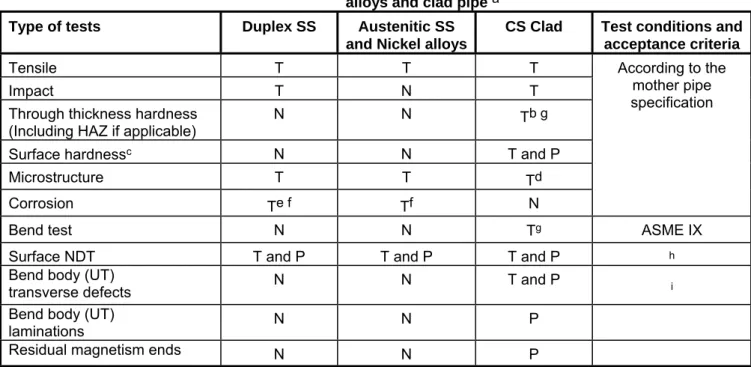
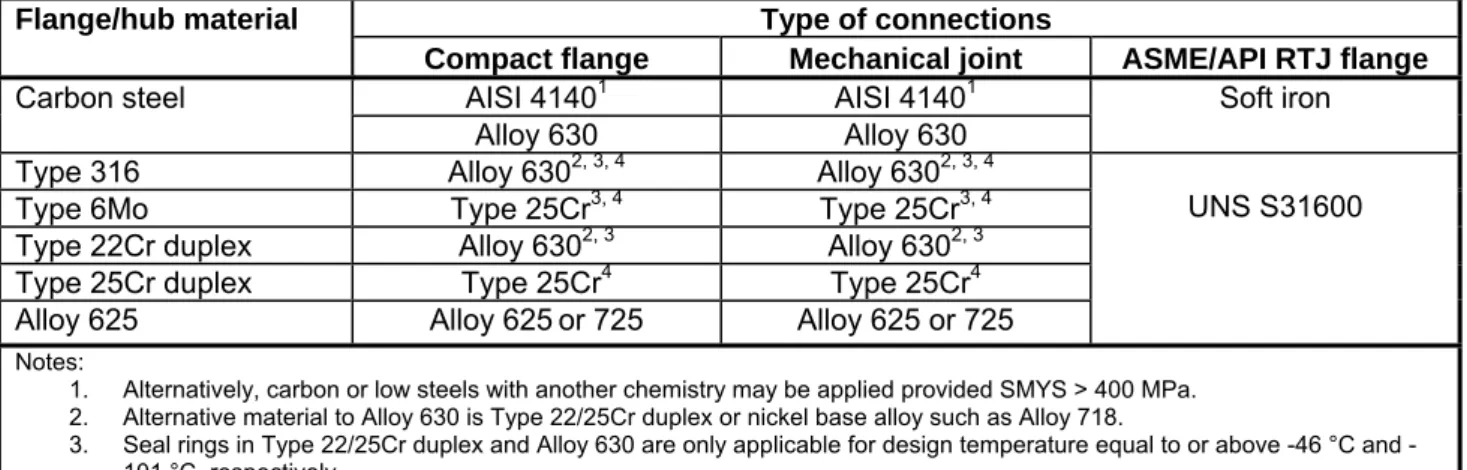
This NORSOK standard is developed with broad petroleum industry participation by interested parties in the Norwegian petroleum industry and is owned by the Norwegian petroleum industry represented by The Norwegian Oil Industry Association (OLF) and The Federation of Norwegian Industry. Please note that whilst every effort has been made to ensure the accuracy of this NORSOK standard, neither OLF nor The Federation of Norwegian Industry or any of their members will assume liability for any use thereof. Standards Norway is responsible for the administration and publication of this NORSOK standard.
NORSOK STANDARD
M-630
Draft Edition 5, June 2009
Material data sheets and element data sheets for
piping
NORSOK standard M-630
Draft Edition 5, June 2009
Foreword
4
Introduction
4
1
Scope
5
2
Normative and informative references
5
2.1
Normative references
5
2.2
Informative references
5
3
Terms, definitions and abbreviations
5
3.1
Terms and definitions
5
3.2
Abbreviations
6
4
Collection of material data sheets (MDSs)
6
4.1
General
6
4.2
Implementation of Pressure Equipment Directive (PED)
7
4.3
Compliance with ISO 15156-series
8
4.4
Representative test sampling
8
4.5
Deviations from ASME B31.3 code requirements
8
4.6
MDSs with referenced standards
12
5
Collection of element data sheets (EDSs)
14
Annex A (normative) Collection of material data sheets (MDSs)
15
Annex B (normative) Collection of element data sheets (EDSs)
87
NORSOK standard M-630
Draft Edition 5, June 2009
Foreword
The NORSOK standards are developed by the Norwegian petroleum industry to ensure adequate safety,
value adding and cost effectiveness for petroleum industry developments and operations. Furthermore,
NORSOK standards are, as far as possible, intended to replace oil company specifications and serve as
references in the authorities’ regulations.
The NORSOK standards are normally based on recognised international standards, adding the provisions
deemed necessary to fill the broad needs of the Norwegian petroleum industry. Where relevant, NORSOK
standards will be used to provide the Norwegian industry input to the international standardisation process.
Subject to development and publication of international standards, the relevant NORSOK standard will be
withdrawn.
The NORSOK standards are developed according to the consensus principle generally applicable for most
standards work and according to established procedures defined in NORSOK A-001.
The NORSOK standards are prepared and published with support by The Norwegian Oil Industry
Association (OLF), The Federation of Norwegian Industry, Norwegian Shipowners’ Association and The
Petroleum Safety Authority Norway.
NORSOK standards are administered and published by Standards Norway.
Annex A and Annex B are normative.
Introduction
This edition of NORSOK M-630 replaces edition 4 and is an update to include the following main changes:
•
the material certification requirements are revised to implement changes in EN 10204 and information to
be stated at the material certificates;
•
the specific requirements related to 3
rdparty organizations being “recognized by an EC member state” for
certain pressure categories to facilitate compliance with PED are deleted;
•
include MDSs (R2x) established for high alloyed austenitic stainless steel grades; typical UNS S34565;
•
include MDS P41 established for pipes in polyethylene;
•
MDS C21 is split in two MDSs, C21 for flanges to A 694 F52 and C23 for fittings to A 860 WPHY 52;
•
more specific requirements for location of test specimens for flanges;
•
flanges to A 105 shall be delivered in normalized condition for all pressure classes;
•
for components in carbon steels delivered in quenched and tempered condition and with thickness above
19,0 mm the minimum tempering temperature shall be 620 ºC;
•
for carbon steel to MDS C21, requirement of maximum V+Nb
≤
0,07 is deleted;
•
all MDSs are collected in Annex A;
•
a new Annex B is prepared and includes EDSs related to cold forming, hot induction bending of pipe,
weld overlay, hard facing, metallic seal rings and stud bolts all these EDSs were previously included in
NORSOK L-001.
NORSOK standard M-630
Draft Edition 5, June 2009
1
Scope
This NORSOK standard includes material requirements in a collection of MDSs and EDSs for use in piping
systems selected according to NORSOK L-001.
NOTE The MDS can also be applied for components other than piping, e.g. pressure vessels, pumps, strainer, etc.
2
Normative and informative references
The following standards include provisions and guidelines which, through reference in this text, constitute
provisions and guidelines of this NORSOK standard. Latest issue of the references shall be used unless
otherwise agreed. Other recognized standards may be used provided it can be shown that they meet the
requirements of the referenced standards.
2.1
Normative references
ISO 15156-2,
Petroleum and natural gas industries
―
Materials for use in H
2S-containing environments in oil
and gas production
―
Part 2: Cracking-resistant carbon and low alloy steels, and the use of cast irons
(including ISO 15156-2:2003/Cor1:2005)
ISO 15156-3,
Petroleum and natural gas industries -- Materials for use in H
2S-containing environments in oil
and gas production
―
Part 3: Cracking-resistant CRAs (corrosion-resistant alloys) and other alloys
(including ISO 15156-3:2003/Cor1:2005 and ISO 15156-3:2003/Cor2:2005)
2.2
Informative references
ASME B31.3,
Process Piping
EN 10204,
Metallic products
―
Types of inspection documents
NORSOK L-001,
Piping and Valves
NORSOK M-601,
Welding and inspection of piping
NORSOK M-650,
Qualification of manufacturers of special materials
3
Terms, definitions and abbreviations
For the purposes of this NORSOK standard, the following terms, definitions and abbreviations apply.
3.1
Terms and definitions
3.1.1
shall
verbal form used to indicate requirements strictly to be followed in order to conform to this NORSOK
standard and from which no deviation is permitted, unless accepted by all involved parties
3.1.2
should
verbal form used to indicate that among several possibilities one is recommended as particularly suitable,
without mentioning or excluding others, or that a certain course of action is preferred but not necessarily
required
3.1.3
may
verbal form used to indicate a course of action permissible within the limits of this NORSOK standard
3.1.4
can
verbal form used for statements of possibility and capability, whether material, physical or casual
3.1.5
NORSOK standard M-630
Draft Edition 5, June 2009
3.1.6
carbon steel type 235LT
carbon steel with SMYS
≤
275 MPa and impact tested at - 46 °C
3.1.7
carbon steel type 360LT
carbon steel with 300 MPa < SMYS
≤
360 MPa and impact tested at - 46 °C
3.1.8
stainless steel type 316
austenitic stainless steel alloys with approx. 2,5 % Mo of type AISI 316
3.1.9
stainless steel type 6Mo
austenitic stainless steel alloys with 6 % Mo and PRE
≥
40
3.1.10
stainless steel type 565
austenitic stainless steel alloys with SMYS
≥
450 MPa and PRE
≥
40
3.1.11
stainless steel type 22Cr duplex
ferritic/austenitic stainless steel alloys with 22 % Cr, e.g. UNS S32205
3.1.12
stainless steel type 25Cr duplex
ferritic/austenitic stainless steel alloys with 25 % Cr and PREN
≥
40
NOTE Often also referred to as "super duplex".3.2
Abbreviations
API
The American Petroleum Institute
ASTM
The American Society of Testing and Materials
ASME
The American Society of Mechanical Engineers
CE carbon
equivalent
EDS
element data sheet
EN European
Standard
ISO
International Organization for Standardization
MDS
material data sheet
NDT
non destructive testing
NPS
nominal pipe size
SMYS
specified minimum yield strength
PED
Pressure Equipment Directive
PREN
pitting resistance equivalent number
UNS
Unified Numbering System
WPQR welding procedure qualification record
4
Collection of material data sheets (MDSs)
4.1
General
Materials/components manufactured in accordance with previous editions of this NORSOK standard may be
accepted. This shall be agreed with the actual project/company.
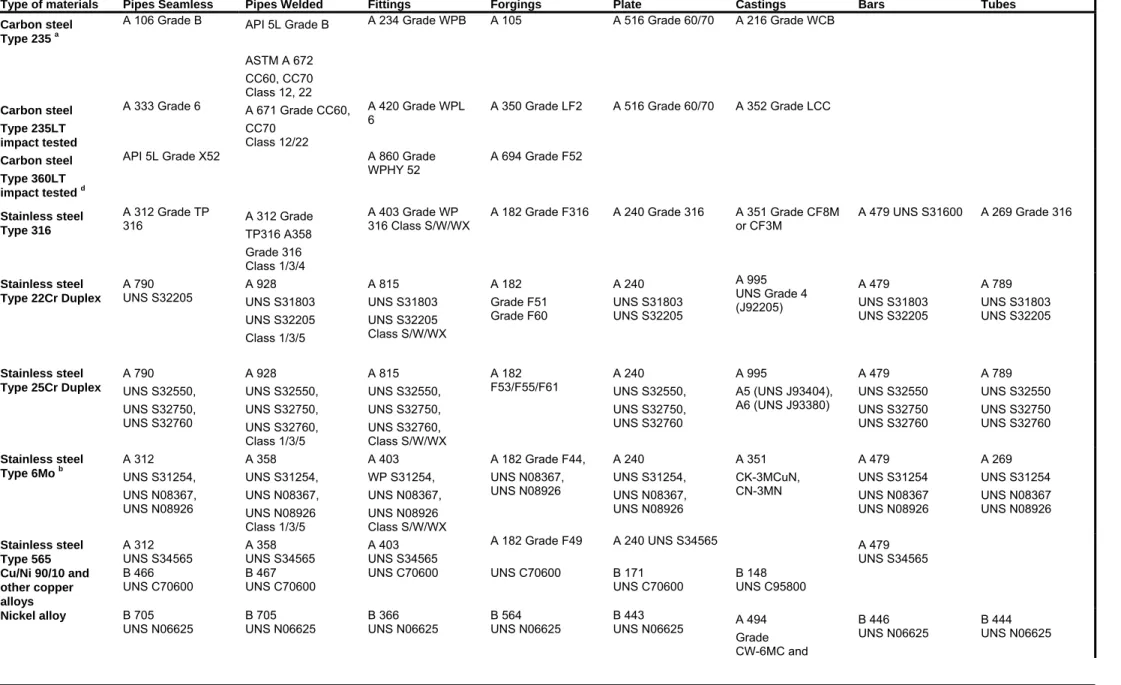
The material selection menu for product standards and material grades relevant for the piping systems is
shown in Table 1. The actual material grades to be used with respect to piping design shall be stated on the
piping class sheet in the respective project piping and valve specification.
NORSOK standard M-630
Draft Edition 5, June 2009
The materials shall be delivered in accordance with the standard referred to. In addition the MDS specifies
the selected options in the referred standard and additional requirements which shall be added or supersede
the corresponding requirements in the referred standard. The latest issue of the reference standard shall in
apply unless a specific year of issue is specified by the purchaser.
The actual types of materials covered are as follows:
C
-
Carbon steels: Type 235, Type 235LT, Type 360LT
D
- Ferritic/austenitic
stainless steels: Type 22Cr, Type 25Cr
K
-
Copper/nickel 90/10 and other copper alloys
N
-
Nickel base alloys: Type 625
P
-
Polymers including fibre reinforcement
R
- Austenitic
stainless
steels: Type 6Mo, Type 565
S
-
Austenitic stainless steels: Type 316
T
- Titanium
X
-
High strength low alloyed steels
NOTE Welded products according to MDS C11, MDS D42, MDS D43, MDS D52, MDS D53, MDS R12, MDS R13, MDS S01 and MDS T01 have acceptance classes, which give welding factors 0,8 or 1,0. The correct class is specified on the piping class sheet. The purchase order shall specify acceptable class for each item.
4.2
Implementation of Pressure Equipment Directive (PED)
The provision of the NORSOK standards are intended to comply with the requirements of the EC “Pressure
Equipment Directive (PED)” and the Norwegian implementation regulation “Forskrift for trykkpåkjent utstyr”,
issued 9 June 1999. When this NORSOK standard refers to PED only, it is implicit that it also refers to the
Norwegian implementation regulation. In those applications where PED is governing, it is therefore
necessary to apply the PED and to involve a notified body to obtain the required approvals dependent of the
selected conformity assessment module applicable to each specific project.
The PED specific requirements for materials to be used for pressure equipment classified to PED category
III are related to the following:
•
no less than 14 % elongation and no less than 27 J absorbed energy measured on Charpy V-notch
specimen at the lowest scheduled operating temperature;
•
approval of welders and welding procedures by a 3
rdparty organization recognized by an EC member
state for Category II-IV;
•
approval of NDT operators for Category III-IV by a 3
rdparty organization recognized by an EC member
state;
•
certification of specific product control;
•
the material manufacturer shall have an appropriate quality-assurance system, certified by a competent
body established within the Community and having undergone a specific assessment for materials.
All the above requirements are included in the collected MDSs covering iron based alloys, i.e. C-, D-, S-, R-
and X-series, except for the following:
a) carbon steels specified at MDS C01 and C02 do not include impact test requirements;
b) the requirement for that the 3
rdparty organization for approval of welders and welding procedures and
approval of NDT operators shall be recognized by an EC member is not included;
c) the requirement for a quality-assurance system certified by a body established within the Community is
not included.
Polymer products specified by the MDSs in the P-series are not classified as pressure bearing parts, except
for PE-pipe covered by MDS P41. Pipes to this MDS are only intended used for civil piping systems
designed to sound engineering practise within category 0.
For installation projects to the PED requirements the above listed exceptions to the PED requirements
should be considered, and added to the collected MDSs as found necessary in agreement with the selected
notified body, when applicable.
NORSOK standard M-630
Draft Edition 5, June 2009
4.3
Compliance with ISO 15156-series
The specified requirements of ISO 15156-2 and ISO 15156-3 are included in the relevant MDSs as defined
below:
Carbon steel MDS C- series
•
All the carbon steels grades covered by the MDS C-series have all nickel content less than 1 %.
•
All components are specified to be delivered in heat treated condition such as normalised, normalised
and tempered, or quench and tempered condition.
•
Since all components are specified to be delivered in heat treated conditions, hardness testing is not
specified unless hardness is a mandatory requirement of the relevant reference standard such as A 105
and A 350.
•
The recommended requirement in ISO 15156-2 regarding sensitivity to HIC and SOHIC for carbon steel
is not implemented since the sulfur content of wrought products (e.g. plate, welded pipes, seamless
pipes, and fittings made thereof), are not specified to comply with the recommended maximum sulfur
values.
Austenitic stainless steels and nickel base alloys MDS N-, R- and S-series
•
The MDSs specifies all components to be manufactured and certified in solution heat treated condition.
•
No hardness measurement is specified since all components are specified to be certified in solution
annealed condition.
Ferritic/Austenitic stainless steels; D-series
•
The MDS specify all components to be manufactured and certified in solution heat treated condition
except for welded pipes in Type 6M0 with wall thickness less than 7,11 mm, which are to be made from
solution annealed plates and delivered in welded condition.
•
The ferrite content is specified to be in the range 35 % to 55 % for base material and 35 % to 65 % for
weld metal in welded products.
•
The microstructure shall be free from inter metallic phases and precipitates.
Low alloyed steels MDS X- series
•
All the low alloyed steels grades covered by the MDS C-series have all nickel content less than 1 %.
•
The MDSs specifies components to be delivered in normalised or austenite, quench and temper
conditions.
•
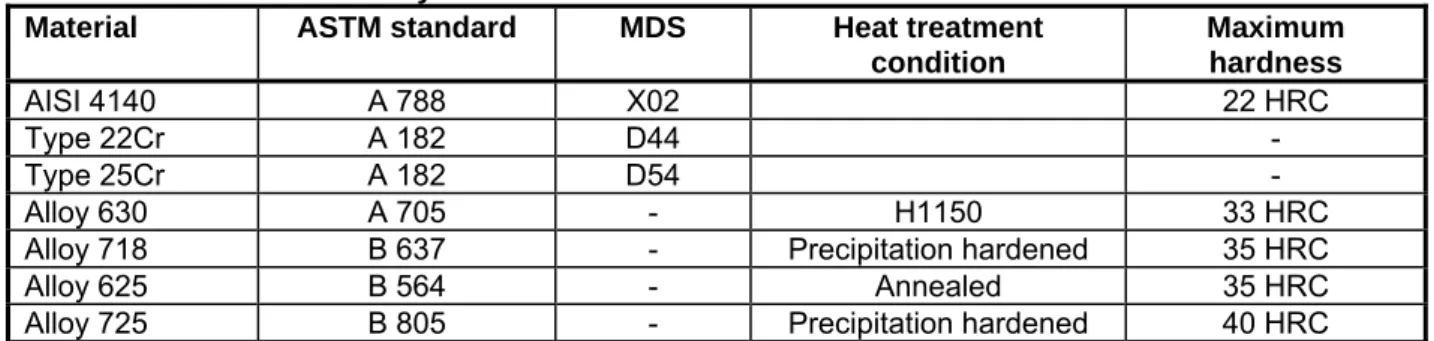
Hardness measurements are specified and maximum hardness values are included in all the relevant
MDSs in compliance with ISO 15156-2.
4.4
Representative test sampling
Test samples shall be representative for the properties of the products/components it represents. It is
important that the thermo-mechanical history of the test samples is equivalent with that of the actual
products/components.
Representative testing shall be taken from a sacrificial component, from an integral prolongation of the
product with same thickness as the section of the product to be represented. Alternatively, another test
sampling may be qualified, but only after agreement with end user. Such alternative test sampling should be
qualified in accordance with NORSOK M-650, and the qualification test shall comprise comparative testing of
sacrificial forgings and the proposed alternative test sample.
The test sample shall be from the same heat of material and same heat treatment batch/lot as it represents.
4.5
Deviations from ASME B31.3 code requirements
The use of the piping materials according to NORSOK L-001, NORSOK M-601 and this NORSOK standard
will result in some deviations from ASME B31.3. All deviations have been carefully considered, and they are
in line with European PED harmonised standards. The deviations are as follows:
NORSOK standard M-630
Draft Edition 5, June 2009
•
if sub-size Charpy V-notch impact test specimens are used, the energy requirement is increased instead
of lowering the test temperature;
•
eddy current examination is accepted as replacement for spot radiography of longitudinal welds in
stainless steel pipes for wall thickness less than 4.0 mm;
•
thin walled (thickness up to 7 mm) longitudinal welded pipes in 6 Mo austenitic stainless is accepted in as
welded condition provided the plate material used is solution annealed.
NORSOK standard M-630
Draft Edition 5, June 2009
Table 1 – Material selection menu for piping systems
Type of materials Pipes Seamless Pipes Welded Fittings Forgings Plate Castings Bars Tubes
Carbon steel Type 235 a
A 106 Grade B API 5L Grade B ASTM A 672 CC60, CC70 Class 12, 22
A 234 Grade WPB A 105 A 516 Grade 60/70 A 216 Grade WCB
Carbon steel Type 235LT impact tested A 333 Grade 6 A 671 Grade CC60, CC70 Class 12/22 A 420 Grade WPL 6
A 350 Grade LF2 A 516 Grade 60/70 A 352 Grade LCC
Carbon steel Type 360LT impact tested d
API 5L Grade X52 A 860 Grade
WPHY 52 A 694 Grade F52 Stainless steel Type 316 A 312 Grade TP 316 A 312 Grade TP316 A358 Grade 316 Class 1/3/4 A 403 Grade WP 316 Class S/W/WX
A 182 Grade F316 A 240 Grade 316 A 351 Grade CF8M or CF3M A 479 UNS S31600 A 269 Grade 316 Stainless steel Type 22Cr Duplex A 790 UNS S32205 A 928 UNS S31803 UNS S32205 Class 1/3/5 A 815 UNS S31803 UNS S32205 Class S/W/WX A 182 Grade F51 Grade F60 A 240 UNS S31803 UNS S32205 A 995 UNS Grade 4 (J92205) A 479 UNS S31803 UNS S32205 A 789 UNS S31803 UNS S32205 Stainless steel Type 25Cr Duplex A 790 UNS S32550, UNS S32750, UNS S32760 A 928 UNS S32550, UNS S32750, UNS S32760, Class 1/3/5 A 815 UNS S32550, UNS S32750, UNS S32760, Class S/W/WX A 182 F53/F55/F61 A 240 UNS S32550, UNS S32750, UNS S32760 A 995 A5 (UNS J93404), A6 (UNS J93380) A 479 UNS S32550 UNS S32750 UNS S32760 A 789 UNS S32550 UNS S32750 UNS S32760 Stainless steel Type 6Mo b A 312 UNS S31254, UNS N08367, UNS N08926 A 358 UNS S31254, UNS N08367, UNS N08926 Class 1/3/5 A 403 WP S31254, UNS N08367, UNS N08926 Class S/W/WX A 182 Grade F44, UNS N08367, UNS N08926 A 240 UNS S31254, UNS N08367, UNS N08926 A 351 CK-3MCuN, CN-3MN A 479 UNS S31254 UNS N08367 UNS N08926 A 269 UNS S31254 UNS N08367 UNS N08926 Stainless steel Type 565 A 312 UNS S34565 A 358 UNS S34565 A 403 UNS S34565 A 182 Grade F49 A 240 UNS S34565 A 479 UNS S34565 Cu/Ni 90/10 and other copper alloys B 466 UNS C70600 B 467 UNS C70600 UNS C70600 UNS C70600 B 171 UNS C70600 B 148 UNS C95800 Nickel alloy B 705 UNS N06625 B 705 UNS N06625 B 366 UNS N06625 B 564 UNS N06625 B 443 UNS N06625 A 494 Grade CW-6MC and B 446 UNS N06625 B 444 UNS N06625
NORSOK standard M-630
Draft Edition 5, June 2009
Type of materials Pipes Seamless Pipes Welded Fittings Forgings Plate Castings Bars Tubes
CX2MW Titanium Grade 2 c B 861 Grade 2 B 862 Grade 2 B 363 Grade WPT2
/ WPT2W B 381 Grade F2 B 265 Grade 2 B 367 Grade C2 B 348 Grade 2 B 338 Grade 2 High strength low
alloyed steel A 234 AISI 4130 ASTM A 788 AISI 4140 API 6A 60K (AISI 4130) A 182 F22 ASTM A 487 Gr 2B/2C
a Type 235 should be used in piping systems with minimum design temperature above or equal to -29 °C in accordance with ASME B31.3, Table 323.2.2A. b The grades UNS N08367 and N08926 are considered equivalent to UNS S31254. The grade CN-3 MN is considered equivalent to CK-3MCuN.
c GOST VT-1-0 is considered equivalent to Grade 2.
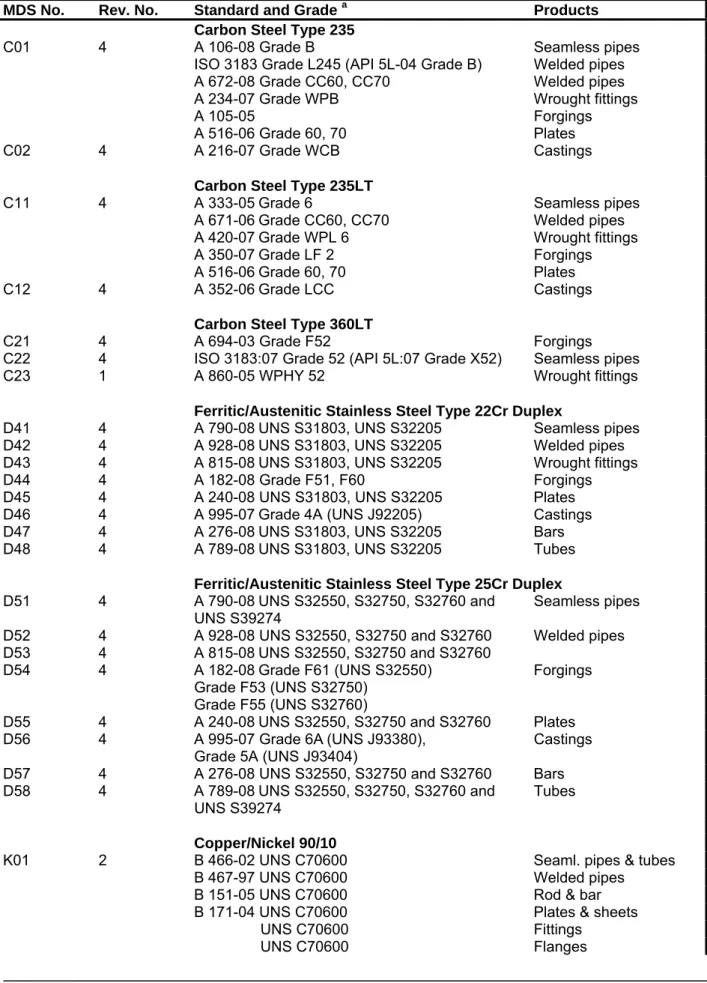
4.6
MDSs with referenced standards
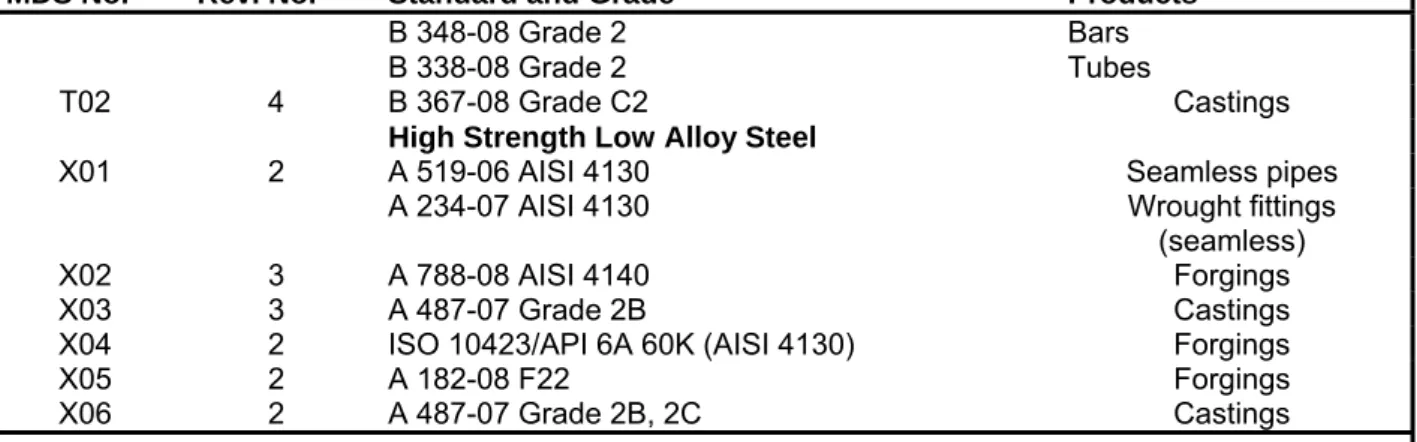
The established MDSs are listed in Table 2. They are collected within Annex A.
Table 2 – List of MDSs for each type of material collected in Annex A
MDS No.
Rev. No.
Standard and Grade
aProducts
Carbon Steel Type 235
C01
4
A 106-08 Grade B
Seamless pipes
ISO 3183 Grade L245 (API 5L-04 Grade B)
Welded pipes
A 672-08 Grade CC60, CC70
Welded pipes
A 234-07 Grade WPB
Wrought fittings
A
105-05
Forgings
A 516-06 Grade 60, 70
Plates
C02
4
A 216-07 Grade WCB
Castings
Carbon Steel Type 235LT
C11 4
A
333-05
Grade 6
Seamless pipes
A
671-06
Grade CC60, CC70
Welded pipes
A
420-07
Grade WPL 6
Wrought fittings
A
350-07
Grade LF 2
Forgings
A
516-06
Grade 60, 70
Plates
C12 4
A
352-06
Grade LCC
Castings
Carbon Steel Type 360LT
C21
4
A 694-03 Grade F52
Forgings
C22
4
ISO 3183:07 Grade 52 (API 5L:07 Grade X52)
Seamless pipes
C23
1
A 860-05 WPHY 52
Wrought fittings
Ferritic/Austenitic Stainless Steel Type 22Cr Duplex
D41 4
A
790-08
UNS S31803, UNS S32205
Seamless pipes
D42 4
A
928-08
UNS S31803, UNS S32205
Welded pipes
D43 4
A
815-08
UNS S31803, UNS S32205
Wrought fittings
D44
4
A 182-08 Grade F51, F60
Forgings
D45
4
A 240-08 UNS S31803, UNS S32205
Plates
D46 4
A
995-07
Grade 4A (UNS J92205)
Castings
D47 4
A
276-08
UNS S31803, UNS S32205
Bars
D48 4
A
789-08
UNS S31803, UNS S32205
Tubes
Ferritic/Austenitic Stainless Steel Type 25Cr Duplex
D51 4
A
790-08
UNS S32550, S32750, S32760 and
UNS S39274
Seamless pipes
D52
4
A 928-08 UNS S32550, S32750 and S32760
Welded pipes
D53 4
A
815-08
UNS S32550, S32750 and S32760
D54 4
A
182-08
Grade F61 (UNS S32550)
Forgings
Grade F53 (UNS S32750)
Grade F55 (UNS S32760)
D55 4
A
240-08
UNS S32550, S32750 and S32760
Plates
D56
4
A 995-07 Grade 6A
(UNS J93380),
Grade 5A (UNS J93404)
Castings
D57
4
A 276-08 UNS S32550, S32750 and S32760
Bars
D58 4
A
789-08
UNS S32550, S32750, S32760 and
UNS S39274
Tubes
Copper/Nickel 90/10
K01
2
B 466-02 UNS C70600
Seaml. pipes & tubes
B 467-97 UNS C70600
Welded pipes
B 151-05 UNS C70600
Rod & bar
B 171-04 UNS C70600
Plates & sheets
UNS C70600
Fittings
MDS No.
Rev. No.
Standard and Grade
aProducts
Aluminium - Bronze Sand Castings
K02
2
B 148-08 UNS C09580
Castings
Nickel Alloy 625
N01
4
B 366-04 UNS N06625
Wrought fittings
B 705-05 UNS N06625
Pipes
B 564-06 UNS N06625
Forgings
B 443-05 UNS N06625
Plates
B 446-08 UNS N06625
Bars
B 444-06 UNS N06625
Pipes and tubes
N02
4
A 494-08 Grade CW-6MC, CX 2MW
Castings
Polymers
P11
3
Hydrogenated Nitrile (HNBR)
O-ring
P12
3
Fluorocarbon terpolymer (FKM)
O-ring
P13
3
Fluorocarbon low T terpolymer (FKM GLT)
O-ring
P14 2
Nitrile
(NBR)
O-ring
P21
3
PEEK (Poly-ether-ether-ketone)
Back-up rings and seal
inserts
P22 3
PTFE
(Poly-tetra-fluoro-ethylene) Lipseals,back-up
rings
and seal inserts
P23
2
PEEK (Poly-ether-ether-ketone) with PTFE added
Seal inserts
P41
1
Polyethylene Piping
Pipes, Fittings, Flanges,
and welded products
Austenitic Stainless Steel Type 6Mo
R11 4
A
312-08
UNS S31254, UNS N08367, N08926
Seamless pipes
R12 4
A
358-08
UNS S31254, UNS N08367, N08926
Welded pipes
R13
4
A 403-07 UNS S31254, N08367, N08926
Wrought fittings
R14 4
A
182-08
Grade F44, UNS N08367, N08926
Forgings
R15 4
A
240-08
UNS S31254, N08367, N08926
Plates
R16 4
A
351-06
Grade CK-3MCuN, CN-3MN
Castings
R17 4
A
276-08
UNS S31254, N08367, N08926
Bars
R18 4
A
269-08
UNS S31254, N08367, N08926
Tubes
Austenitic Stainless Steel Type 565
R21 1
A
312-08
UNS S34565
Seamless pipes
R22 1
A
358-08
UNS S34565
Welded pipes
R23
1
A 403-07 UNS S34565
Wrought fittings
R24 1
A
182-08
Grade F49
Forgings
R25 1
A
240-08
UNS S34565
Plates
R27 1
A
276-08
UNS S34565
Bars
Austenitic Stainless Steel Type 316
S01
4
A 312-08 Grade TP316
Seaml. & welded pipes
A
358-08
Grade 316
Welded pipes
A
403-07
Grade WP316
Wrought fittings
A
182-08
Grade F 316
Forgings
A 240-08 Grade 316
Plates
A
276-08
Grade 316
Bars
A 269-08 Grade 316
Tubes
S02 4
A
351-06
Grade CF3M, CF8M
Castings
Titanium
Grade
2
T01
4
B 861-08 Grade 2
MDS No.
Rev. No.
Standard and Grade
aProducts
B 348-08 Grade 2
Bars
B 338-08 Grade 2
Tubes
T02
4
B 367-08 Grade C2
Castings
High Strength Low Alloy Steel
X01
2
A 519-06 AISI 4130
Seamless pipes
A 234-07 AISI 4130
Wrought fittings
(seamless)
X02
3
A 788-08 AISI 4140
Forgings
X03
3
A 487-07 Grade 2B
Castings
X04
2
ISO 10423/API 6A 60K (AISI 4130)
Forgings
X05
2
A 182-08 F22
Forgings
X06
2
A 487-07 Grade 2B, 2C
Castings
a The ASTM standards current year of issue at the date of issue of this NORSOK standard is shown for
information only. The latest year of issue of relevant ASTM standard shall be used unless otherwise specifically agreed.
5
Collection of element data sheets (EDSs)
EDSs are established to cover the scope material selection of valve trim parts, cold forming and hot
induction bending of pipe operations and to special coating and welding applications. All EDS established to
cover the needs defined in connection to fabrication of valves and piping systems are summarised in Table 3
and are collected in Annex B.
These EDSs are reference to by valve data sheets and piping classes enclosed by NORSOK L-001.
However, these documents may be specified and used in other connections as found applicable by
responsible designer.
Table 3 – List of EDSs collected in Annex B
EDS No.
Rev. No.
Title
NBE1
4
Cold forming of pipe
NBE2
1
Induction bending of pipe
NBO1 2
Stud
bolts
NBO2
1
Body/Bonnet bolting for valves
NHF1
3
Hardfacing by overlay welding
NHF2
3
Hardfacing by thermal spraying
NHF7
1
Corrosion resistant overlay welding - Optional requirement
NTR1
1
Trim materials for carbon steel valves
NTR2
1
Trim materials for Type 316 SS valves
NSR1
1
Metallic seal ring
Annex A
(normative)
Collection of material data sheets (MDSs)
INDEX
MDS No.
Rev. No.
Standard and Grade
1)Products
Carbon Steel Type 235
C01
4
A 106-06 Grade B
Seamless pipes
ISO 3183:07 Grade L245 (API 5L-04 Grade B)
Welded pipes
A 672-01 Grade CC60, CC70
Welded pipes
A 234-07 Grade WPB
Wrought fittings
A
105-05
Forgings
A 516-06 Grade 60, 70
Plates
C02
4
A 216-04 Grade WCB
Castings
Carbon Steel Type 235LT
C11 4 A
333-05
Grade 6
Seamless pipes
A
671-04
Grade CC60, CC70
Welded pipes
A
420-07
Grade WPL 6
Wrought fittings
A
350-04
Grade LF 2
Forgings
A
516-06
Grade 60, 70
Plates
C12 4 A
352-06
Grade LCC
Castings
Carbon Steel Type 360LT
C21
4
A 694-03 Grade F52
Forgings
A 860-05 WPHY 52
Wrought fittings
C22
4
ISO 3183:07 Grade (API 5L-04 Grade X52)
Seamless pipes
Ferritic/Austenitic Stainless Steel Type Lean Duplex
D31 1 A
790-05
UNS S32003, S32101
Seamless pipes
D32 1 A
928-05
UNS S32003, S32101
Welded pipes
D33 1 A
815-04
UNS S32003, S32101
Wrought fittings
D34
1
A 182-07 UNS S32003, S32101
Forgings
D35
1
A 240-07 UNS S32003, S32101
Plates
D37 1 A
276-06
UNS S32003, S32101
Bars
D38 1 A
789-05
UNS S32003, S32101
Tubes
Ferritic/Austenitic Stainless Steel Type 22Cr Duplex
D41 4 A
790-05
UNS S31803, UNS S32205
Seamless pipes
D42 4 A
928-05
UNS S31803, UNS S32205
Welded pipes
D43 4 A
815-08
UNS S31803, UNS S32205
Wrought fittings
D44
4
A 182-07 Grade F51, F61
Forgings
D45
4
A 240-07 UNS S31803, UNS S32205
Plates
D46 4 A
995-03
Grade 4A (UNS J92205)
Castings
D47 4 A
276-06
UNS S31803, UNS S32205
Bars
D52
4
A 928-05 UNS S32550, S32750 and S32760
Welded pipes
D53 4 A
815-07
UNS S32550, S32750 and S32760
D54 4 A
182-07
Grade F61 (UNS S32550)
Forgings
Grade F53 (UNS S32750)
Grade F55 (UNS S32760)
D55 4 A
240-07
UNS S32550, S32750 and S32760
Plates
D56
4
A 995-03 Grade 6A
(UNS J93380),
Grade 5A (UNS J93404)
Castings
D57
4
A 276-06 UNS S32550, S32750 and S32760
Bars
D58 4 A
789-05
UNS S32550, S32750, S32760 and
Tubes
Copper/Nickel 90/10
K01
2
B 466-02 UNS C 70600
Seaml. pipes & tubes
B 467-97 UNS C 70600
Welded pipes
B 151-05 UNS C 70600
Rod & bar
B 171-04 UNS C 70600
Plates & sheets
UNS C 70600
Fittings
UNS C 70600
Flanges
Aluminium - Bronze Sand Castings
K02
2
B 148-97 UNS C 9580
Castings
Nickel Alloy Type 625
N01
4
B 366-04 UNS N06625
Wrought fittings
B 705-00 UNS N06625
Pipes
B 564-00 UNS N06625
Forgings
B 443-00 UNS N06625
Plates
B 446-02 UNS N06625
B 444-00 UNS N06625
Bars
Pipes and tubes
N02
4
A 494-03 Grade CW-6MC, CX 2MW
Castings
Polymers
P11
3
Hydrogenated Nitrile (HNBR)
O-ring
P12
3
Fluorocarbon terpolymer (FKM)
O-ring
P13
3
Fluorocarbon low T terpolymer (FKM GLT)
O-ring
P14 2 Nitrile
(NBR)
O-ring
P21
3
PEEK (Poly-ether-ether-ketone)
Back-up rings and seal
inserts
P22 3 PTFE
(Poly-tetra-fluoro-ethylene) Lipseals,back-up
rings
and seal inserts
P23
2
PEEK (Poly-ether-ether-ketone) with PTFE added
Seal inserts
P41
1
Polyethylene Piping
Pipes, Fittings, Flanges,
and welded products
Austenitic Stainless Steel Type 6Mo
R11 4 A
312-07
UNS S31254, UNS N08367, N08926
Seamless pipes
R12 4 A
358-05
UNS S31254, UNS N08367, N08926
Welded pipes
R13
4
A 403-07 UNS S31254, N08367, N08926
Wrought fittings
R14 4 A
182-07
Grade F44, UNS N08367, N08926
Forgings
R15 4 A
240-07
UNS S31254, N08367, N08926
Plates
R16 4 A
351-06
Grade CK-3MCuN, CN-3MN
Castings
R17 4 A
276-06
UNS S31254, N08367, N08926
Bars
R18 4 A
269-07
UNS S 31254, N08367, N08926
Tubes
Austenitic Stainless Steel Type 565
R21 1 A
312-07
UNS S34565
Seamless pipes
R23
1
A 403-07 UNS S34565
Wrought fittings
R24 1 A
182-07
Grade F49
Forgings
R25 1 A
240-07
UNS S34565
Plates
R27 1 A
276-06
UNS S34565
Bars
Austenitic Stainless Steel Type 316
S01
4
A 312-06 Grade TP316
Seamless & welded
pipes
A
358-05
Grade 316
Welded pipes
A
403-07
Grade WP316
Wrought fittings
A
182-07
Grade F 316
Forgings
A 240-07 Grade 316
Plates
A
276-06
Grade 316
Bars
A 269-07 Grade 316
Tubes
S02 4 A
351-06
Grade CF3M, CF8M
Castings
Austenitic Stainless Steel Type 316 Marine
environments
S03
1
A 312-06 Grade TP316
Seamless & welded
pipes
A
358-05
Grade 316
Welded pipes
A
403-07
Grade WP316
Wrought fittings
A
182-07
Grade F 316
Forgings
A 240-07 Grade 316
Plates
A
276-06
Grade 316
Bars
A 269-07 Grade 316
Tubes
Titanium Grade 2
T01
4
B 861-02 Grade 2
B 862-02 Grade 2
Seamless pipes
Welded pipes
B 363-03 Grade WPT2/WPT2W
Wrought fittings
B 381 Grade F2
Forgings
B 265-02 Grade 2
Plates
B 348-02 Grade 2
Bars
B 338-02 Grade 2
Tubes
T02
4
B 367-93 Grade C2
Castings
High Strength Low Alloy Steel
X01
2
A 519-01 AISI 4130
Seamless pipes
A 234-07 AISI 4130
Wrought fittings
(seamless)
X02
3
A 788-05 AISI 4140
Forgings
X03
3
A 487-03 Grade 2B
Castings
X04
2
ISO 10423/API 6A 60K (AISI 4130)
Forgings
X05
2
A 182-07 F22
Forgings
X06
2
A 487-01 Grade 2B, 2C
Castings
Note 1: The current year of issue of standards referenced is shown for guidance only. The latest year of issue shall be used unless otherwise specifically agreed.
MATERIAL DATA SHEET
MDS C01
D4Rev. 4
TYPE OF MATERIAL:
Carbon Steel Type 235
PRODUCT
STANDARD
GRADE
ACCEPT. CLASS
SUPPL. REQ.
Wrought fittings
Welded pipes
Welded pipes
Seamless pipes
Forgings
Plates
ASTM A 234
ISO 3183 (API 5L)
ASTM A 672
ASTM A 106
ASTM A 105
ASTM A 516
WPB
L245 SAWL
C60, C70
B
-
60, 70
-
PSL 1
t < 19 mm: Class 12
t > 19 mm: Class 22
-
-
-
S3
-
-
-
S5
S4
-
1. SCOPE This MDS specifies the selected options in the referred standard and additional requirements which
shall be added or supersede the corresponding requirements in the referred standard.
2. MANUFACTURING All welded products: Welding shall be carried out by qualified welders according to qualified
procedures approved by a 3rd party organization.
3. HEAT TREATMENT Forgings to A 105: Normalized.
Welded pipes to ISO 3183: Stress relieved when the nominal thickness t ≤ 19 mm.
4. CHEMICAL
COMPOSITION All products: C ≤ 0.20 %, S ≤ 0.025 %, P ≤ 0.030 %,
CE(IIW) = C+Mn/6+(Cr+Mo+V)/5+(Cu+Ni)/15 ≤ 0.43.
5. MECHANICAL PROPERTIES
All products: Elongation, A > 20%.
6. TEST SAMPLING Samples for production testing shall realistically reflect the properties in the actual component. 7. NON DESTRUCTIVE
TESTING Pipes to ISO 3183Fittings to A 234: : RT of weld seam or RT at ends and US/Eddy Current of the remaining weld. UT is not acceptable as replacement of RT. All products: NDT operators shall be certified in accordance with EN 473 or equivalent.
8. REPAIR OF DEFECTS Weld repair of base material is not acceptable.
9. CERTIFICATION The material manufacturer shall have a quality system certified in accordance with ISO 9001 and the
system shall have undergone a specific assessment for the relevant materials.
The material certificate shall be issued in accordance with EN 10204 Type 3.1, and shall include the following information:
- Heat treatment condition (For QT condition, austenitisation and tempering temperature and quenching media shall be stated.)
MATERIAL DATA SHEET
MDS C02
D4Rev. 4
TYPE OF MATERIAL:
Carbon Steel Type 235
PRODUCT STANDARD
GRADE ACCEPT.
CLASS
SUPPL. REQ.
Castings
ASTM A 216
WCB
-
S4, S5
1. SCOPE This MDS specifies the selected options in the referred standard and additional requirements which shall be added or supersede the corresponding requirements in the referred standard.
2. CHEMICAL
COMPOSITION C ≤ 0.20 % and CE(IIW) = C+Mn/6+(Cr+Mo+V)/5+(Cu+Ni)/15 ≤ 0.43 3. EXTENT OF TESTING One set of tensile test is required for each melt and heat treatment load.
4. TEST SAMPLING Samples for mechanical testing shall realistically reflect the properties in the actual components. For castings with weight 250 kg and above the test blocksshall be integrally cast with the casting. The test blocks shall be heat treated together with the castings they represents.
5. NON DESTRUCTIVE
TESTING NDT operators shall be certified in accordance with EN 473 or equivalent. Magnetic particle testing:
Supplementary requirement S4 shall apply to all surfaces (including internal surfaces) of all castings. The examination shall be carried out after final machining. The acceptance criteria shall be ASME VIII, Div.1, Appendix 7.
Radiographic testing:
- Extent of radiographic testing (RT) shall be according to table below.
- Castings shall be radiographed in accordance with ASME VIII div.1 appendix 7.
- All critical sections as agreed. For valve castings the definition of critical areas in ASME B16.34 shall be used.
- When spot examination (10%) is specified, minimum one casting in any order shall be examined.
Extent of RT based on pressure class and valve size:
Pressure Class: ≤ 150 300 600 900 1500 ≥ 2500
10% ≥ 26” ≥ 26” ≥ 2” ≥ 2” ≥ 2” ≥ 2” Extent of
RT 100% NA NA ≥ 32” ≥ 22” ≥ 12” ≥ 8”
NA = Not Applicable
6. CERTIFICATION The material manufacturer shall have a quality system certified in accordance with ISO 9001 and the system shall have undergone a specific assessment for the relevant materials.
The material certificate shall be issued in accordance with EN 10204 Type 3.1, and shall include the following information:
- Heat treatment condition (For QT condition austenitisation and tempering temperature and quenching media shall be stated.)
MATERIAL DATA SHEET
MDS C11
D4Rev. 4
TYPE OF MATERIAL:
Carbon Steel Type 235LT
PRODUCT
STANDARD
GRADE
ACCEPT. CLASS
SUPPL. REQ.
Wrought fittings
Welded pipes
Seamless pipes
Forgings
Plates
ASTM A 420
ASTM A 671
ASTM A 333
ASTM A 350
ASTM A 516
WPL 6
CC60, CC70
6
LF2
60, 70
-
t
≤
19 mm: Class 12
t > 19 mm: Class 22
-
Class 1
S51, S53, S59, S69
S2, S7, S14
S2, S7, S14
-
S6, S55
S5
1. SCOPE This MDS specifies the selected options in the referred standard and additional requirements which shall be added or supersede the corresponding requirements in the referred standard.
2. MANUFACTURING All welded products: Welding shall be carried out by qualified welders according to qualified procedures approved by a 3rd party organization.
3. CHEMICAL
COMPOSITION All products: C ≤ 0.20 %; S ≤ 0.025 %; P ≤ 0.025 %; CE
(IIW) = C + Mn/6 + (Cr+Mo+V)/5 + (Cu+Ni)/15 ≤ 0.43.
Seamless pipes to A 333: Cr ≤ 0.40, Ni ≤ 0.40, Mo ≤ 0.15, Cu ≤ 0.40, (Nb+V+Ti) ≤ 0.010.
4. IMPACT TESTING Charpy V-notch testing at - 46°C is required for the thickness > 6 mm. For flanges apply the thickness at the weld neck. The minimum absorbed energy for full size specimens shall be 27 J average and 20 J single. Reduction factors for sub-size specimens shall be: 7.5mm - 5/6 and 5 mm - 2/3.
5. EXTENT OF
TESTING Fittings to A 420: Supplementary Impact testing shall be carried out to the same extent as tensile testing. requirement ASTM A 960, S51 shall apply.
Pipes to A 671: Supplementary requirement S14 shall apply.
Supplementary requirement S2 shall apply to the same extent as for tensile testing.
Forgings to A 350: One set of tensile and impact testing shall be carried out for each heat and heat treatment load. A test lot shall not exceed 2000 kg for forgings with as forged weight
≤ 50 kg, and 5000 kg for forgings with as forged weight > 50 kg.
6. TEST SAMPLING All products: Samples for production testing shall realistically reflect the properties in the actual component.
Forgings to A 350:
For products forged by closed die method, the test specimen shall be obtained from a sacrificial product. For products forged by open die and/or by ring rolling method, the test specimen shall be obtained from a sacrificial forging or from an integral prolongation.
For flanges tensile test specimens shall be taken as specified in ASTM A 694. Impact test specimens shall be taken at same location as the tensile test specimens, but oriented longitudinally with respect to the bore of the flange.
For other products with section thickness T ≤ 50 mm, the test specimen shall be taken at T/2 thickness, where T is the maximum heat treated thickness, and its mid-length shall be at least T or 50 mm, whichever is less, from any second heat treated surface. When section thickness is T > 50 mm, the test specimens shall be taken at T/4 or deeper position from the nearest surface and mid-length of test specimens at least T or 100 mm, whichever is less, from any second surface.
Other test sampling shall be qualified as agreed with the purchaser.
Sketches shall be established showing type, size and location of test samples and extraction of test specimens.
MATERIAL DATA SHEET
MDS C11
D4Rev. 4
TYPE OF MATERIAL:
Carbon Steel Type 235LT
PRODUCT
STANDARD
GRADE
ACCEPT. CLASS
SUPPL. REQ.
Wrought fittings
Welded pipes
Seamless pipes
Forgings
Plates
ASTM A 420
ASTM A 671
ASTM A 333
ASTM A 350
ASTM A 516
WPL 6
CC60, CC70
6
LF2
60, 70
-
t
≤
19 mm: Class 12
t > 19 mm: Class 22
-
Class 1
S51, S53, S59, S69
S2, S7, S14
S2, S7, S14
-
S6, S55
S5
7. NON DESTRUCTIVETESTING All products: NDT operators shall be certified in accordance with EN 473 or equivalent. Fittings to A 420: Ultrasonic testing is not acceptable as replacement of radiographic testing.
Supplementary requirement ASTM A 960, S53 and S69, magnetic particle testing, shall apply to 10 % of all fittings (same test lot as defined for mechanical testing) for nominal thickness < 12.7 mm and 100 % of all fittings for nominal thickness ≥ 12.7 mm. The testing shall be carried out after calibration.
The acceptance criteria shall be to ASME VIII, Div. 1, Appendix 6.
Forgings to A 350: Supplementary Requirement ASTM A 961, S55, magnetic particle testing shall apply to 10 % of all forgings (same test lot as defined for mechanical testing) with NPS > 2. The testing shall be carried out after final machining.
The acceptance criteria shall be to ASME VIII, Div. 1, Appendix 6.
8. REPAIR OF
DEFECTS Weld repair of base material is not acceptable.
9. MARKING Heat treatment load number shall be permanently marked on the component where testing is required per heat treatment load.
10. CERTIFICATION The material manufacturer shall have a quality system certified in accordance with ISO 9001 and the system shall have undergone a specific assessment for the relevant materials.
The material certificate shall be issued in accordance with EN 10204 Type 3.1, and shall include the following information:
- Heat treatment condition (For QT condition austenitisation and tempering temperature and quenching media shall be stated.)
MATERIAL DATA SHEET
MDS C12
D4Rev. 4
TYPE OF MATERIAL:
Carbon Steel Type 235LT
PRODUCT STANDARD GRADE ACCEPT.
CLASS
SUPPL. REQ.
Castings
ASTM A 352
LCC
-
S4, S5
1. SCOPE This MDS specifies the selected options in the referred standard and additional requirements which shall be added or supersede the corresponding requirements in the referred standard.
2. CHEMICAL
COMPOSITION C ≤ 0.20 %; S ≤ 0.025 %; P ≤ 0.030 %; CE = C+Mn/6+(Cr+Mo+V)/5+(Cu+Ni)/15 ≤ 0.43 3. IMPACT TESTING The minimum absorbed energy for full size specimens shall be 27 J average and 20 J single.
4. EXTENT OF
TESTING One set of tensile and impact test is required for each melt and heat treatment load. A test lot shall not exceed 5 000 kg.
5. TEST SAMPLING Samples for mechanical testing shall realistically reflect the properties in the actual components. Thickness of the test block shall be equal to the thickness of the actual components as heat treated up to a maximum thickness of 100 mm. For flanged components the largest flange thickness is the ruling section.
Test specimens shall be cut from the T/4 x T location from the surface where T is the thickness of the test block.
Test block shall be integrally cast or gated onto the castings and shall not be removed from the castings until after the final quality heat treatment.
6. NON DESTRUCTIVE TESTING
NDT operators shall be certified in accordance with EN 473 or equivalent.
Magnetic Particle testing:
Supplementary requirement S4 shall apply toall surfaces (including internal surfaces) of all castings. The testing shall be carried out after final machining. The acceptance criteria shall be to ASME VIII, Div. 1, Appendix 7.
Radiographic testing:
Supplementary requirement S5 shall apply.
- The extent of shall be according to table below.
- Castings shall be radiographed in accordance with ASME VIII div.1 appendix 7.
- All critical sections as agreed. For valve castings the definition of critical sections in ASME B16.34 shall be used.
- When spot examination (10%) is specified, minimum one casting in any order shall be examined.
Extent of RT based on pressure class and valve size:
Pressure Class: ≤ 150 300 600 900 1500 ≥ 2500 10% ≥ 26” ≥ 26” ≥ 2” ≥ 2” ≥ 2” ≥ 2” Extent of RT 100% NA NA ≥ 32” ≥ 22” ≥ 12” ≥ 8” NA = Not Applicable 7. REPAIR OF DEFECTS
A cast plate shall be used in the qualification of the repair welding procedure.
8. MARKING The component shall be marked to ensure full traceability to melt and heat treatment lot.
9. CERTIFICATION The material manufacturer shall have a quality system certified in accordance with ISO 9001 and the
system shall have undergone a specific assessment for the relevant materials.
The material certificate shall be issued in accordance with EN 10204 Type 3.1, and shall include the following information:
- Heat treatment condition (For QT condition austenitisation and tempering temperature and quenching media.)
MATERIAL DATA SHEET
MDS C21
D4Rev. 4
TYPE OF MATERIAL:
Carbon Steel Type 360LT
PRODUCT
STANDARD
GRADE
ACCEPT. CLASS
SUPPL. REQ.
Forgings
ASTM A 694
F52
A 961 S55
1. SCOPE This MDS specifies the selected options in the referred standard and additional requirements which shall be added or supersede the corresponding requirements in the referred standard.
2 HEAT TREATMENT For products delivered in quenched and tempered condition and with weld end thickness > 19.0 mm the minimum tempering temperature shall be 620 ºC.
3. CHEMICAL COMPOSITION
C ≤ 0.20 %; Mn = 0.90 - 1.60 %; Si = 0.10-0.35 %; S ≤ 0.025 %; P ≤ 0.035 %; Ti ≤ 0.05 %; Nb ≤ 0.04 %; Al ≤ 0.06 %; N ≤ 0.015 %; V+Nb+Ti ≤ 0.10 %; CE = C+Mn/6+(Cr+Mo+V)/5+(Cu+Ni)/15 ≤ 0.43.
4. IMPACT TESTING Charpy V-notch testing according to ASTM A 370 at - 46 °C is required for the thickness ≥ 6 mm. The minimum absorbed energy for full size specimen shall be 40 J average and 30 J single. Reduction factors for sub-size specimens shall be: 7.5 mm - 5/6 and 5 mm - 2/3.
5. EXTENT OF TESTING A test lot shall not exceed 2000 kg for forgings with as forged weight ≤ 50 kg, and 5000 kg for forgings with as forged weight > 50 kg.
6. TEST SAMPLING Samples for production testing shall realistically reflect the properties in the actual components.
For products forged by closed die method, the test specimen shall be obtained from a sacrificial product. For products forged by open die and/or by ring rolling method, the test specimen shall be obtained from a sacrificial forging or from an integral prolongation.
For flanges tensile test specimens shall be taken as specified in ASTM A 694. Impact test specimens shall be taken at same location as the tensile test specimens, but oriented longitudinally with respect to the bore of the flange.
For other products with section thickness T ≤ 50 mm, the test specimen shall be taken at T/2 thickness, where T is the maximum heat treated thickness, and its mid-length shall be at least T or 50 mm, whichever is less, from any second heat treated surface. When section thickness is T > 50 mm, the test specimens shall be taken at T/4 or deeper position from the nearest surface and mid-length of test specimens at least T or 100 mm, whichever is less, from any second surface.
Other test sampling shall be qualified as agreed with the purchaser.
Sketches shall be established showing type, size of test specimens and locations for extraction of test specimens.
.
7. NON DESTRUCTIVE
TESTING Supplementary requirement of A 961 S55 shall apply to all forgings. The acceptance criteria shall be to ASME VIII Div. 1, Appendix 6. NDT operators shall be certified in accordance with EN 473 or equivalent.
8. REPAIR OF DEFECTS Weld repair of base material is not acceptable.
9. MARKING The component shall be marked to ensure full traceability to melt and heat treatment lot.
10. CERTIFICATION The material manufacturer shall have a quality system certified in accordance with ISO 9001 and the system shall have undergone a specific assessment for the relevant materials.
The material certificate shall be issued in accordance with EN 10204 Type 3.1, and shall include the following information:
- Heat treatment condition (For QT condition, austenitisation and tempering temperature and quenching media shall be stated.)
MATERIAL DATA SHEET
MDS C22
D4Rev. 4
TYPE OF MATERIAL:
Carbon Steel Type 360LT
PRODUCT
STANDARD
GRADE
ACCEPT. CLASS
SUPPL. REQ.
Seamless pipes
ISO 3183 (API 5L)
L360N (X52N)
L360Q (X52Q)
PSL 2
1. SCOPE This MDS specifies the selected options in the referred standard and additional requirements which shall be added or supersede the corresponding requirements in the referred standard.
2. STEEL MAKING Fine grain treatment shall be carried out.
3. HEAT TREATMENT For pipes delivered in quenched and tempered condition and with thickness > 19.0 mm the minimum tempering temperature shall be minimum 620 ºC.
4. CHEMICAL COMPOSITION
C ≤ 0.16 %; Ti ≤ 0.04 %; Nb ≤ 0.05 %; Al ≤ 0.06 %; N ≤ 0.015 %; V+Nb+Ti ≤ 0.10 %;
5. IMPACT TESTING Charpy V-notch testing according to ASTM A 370 at - 46 °C is required for the thickness ≥ 6 mm. The minimum absorbed energy for full size specimens shall be 40 J average and 30 J single. Reduction factors for sub-size specimens shall be: 7.5 mm - 5/6 and 5 mm - 2/3.
6. TEST SAMPLING Samples for production testing shall realistically reflect the properties in the actual component.
7. NON DESTRUCTIVE TESTING
UT with notch calibration on N5 notch. Electro magnetic testing shall not be used in lieu of UT.
8. SURFACE FINISH Acceptance criteria for surface examination by magnetic particle and ultrasonic methods:
Defects, with depths exceeding 5% of the nominal wall thickness or 1.5mm, whichever is the lesser, are not acceptable. Cracks or linear defects are not acceptable regardless of dimensions.
Parts shall be subject to rejection if surface imperfection acceptable above are not scattered, but appear over a large area in excess of what is considered a workmanlike finish.
9. REPAIR OF
DEFECTS Weld repair is not acceptable.
10. CERTIFICATION The material manufacturer shall have a quality system certified in accordance with ISO 9001 and the system shall have undergone a specific assessment for the relevant materials.
The material certificate shall be issued in accordance with EN 10204 Type 3.1, and shall include the following information:
- Melting and refining practice,
- Heat treatment conditions (For QT condition austenitisation and tempering temperature and quenching media shall be stated.)
MATERIAL DATA SHEET
MDS C23
D4Rev. 1
TYPE OF MATERIAL:
Carbon Steel Type 360LT
PRODUCT
STANDARD
GRADE
ACCEPT. CLASS
SUPPL. REQ.
Wrought fittings
ASTM A 860
WPHY 52
Seamless and welded
S69
1. SCOPE This MDS specifies the selected options in the referred standard and additional requirements which shall be added or supersede the corresponding requirements in the referred standard.
Note: This MDS is developed from MDS C21 Rev. 3.
2 HEAT TREATMENT For products delivered in quenched and tempered condition the minimum tempering temperature shall be minimum 620 ºC.
3. CHEMICAL COMPOSITION
V+Nb+Ti ≤ 0.10 %
4. WELDING Welding shall be carried out by qualified welders according to qualified procedures approved by a 3rd party organization.
The WPQ shall be qualified in accordance with ASME IX or ISO 15614-1.
5. HARDNESS TESTING
Hardness test shall be made for each test lot.
6. TEST SAMPLING Samples for production testing shall realistically reflect the properties in the actual component. The impact test specimens shall be taken from mid-thickness position.
Sketches shall be established showing type, size of test sample and locations for extraction of test specimens.
7. NON DESTRUCTIVE
TESTING Supplementary requirement S69, magnetic particle testing, shall apply to. The testing shall be carried out after calibration. NDT operators shall be certified in accordance with EN 473 or equivalent.
8. MARKING The component shall be marked to ensure full traceability to melt and heat treatment lot.
9. CERTIFICATION The material manufacturer shall have a quality system certified in accordance with ISO 9001 and the system shall have undergone a specific assessment for the relevant materials.
The material certificate shall be in accordance with EN 10204 Type 3.1, and shall include the following information:
- Manufacturer of the starting material for the finished product shall be stated on the certificate.
- Heat treatment conditions (For QT condition, austentisation and tempering temperature and quenching media shall be stated.)
MATERIAL DATA SHEET
MDS D41
D4Rev. 4
TYPE OF MATERIAL:
Ferritic/Austenitic Stainless Steel, Type 22Cr duplex
PRODUCT
STANDARD
GRADE
ACCEPT. CLASS
SUPPL. REQ.
Seamless pipes
ASTM A 790
UNS S31803
UNS S32205
- -
1. SCOPE This MDS specifies the selected options in the referred standard and additional requirements which shall be added or supersede the corresponding requirements in the referred standard.
2. QUALIFICATION Manufacturers of product to this MDS shall be qualified in accordance with NORSOK Standard M-650.
3. STEEL MAKING The steel melt shall be refined with AOD or equivalent.
4. CHEMICAL
COMPOSITION UNS S31803: N = 0.14 - 0.20 %
5. IMPACT TESTING Charpy V-notch testing (3 specimens) according to ASTM A 370 at - 46 °C is required for the thickness
≥ 6 mm. The minimum absorbed energy shall be 45 J average / 35 J single. Reduction factors for sub-size specimens shall be: 7.5 mm - 5/6 and 5 mm - 2/3.
Impact test specimens shall be taken from mid-thickness position.
6. MICROGRAPHIC
EXAMINATION The micrographic examination shall cover the near surfaces and mid-thickness region of the pipe. The ferrite content shall be determined according to ASTM E 562 or equivalent and shall be within 35-55 %. The microstructure, as examined at 400 X magnification on a suitably etched specimen, shall be free from intermetallic phases and precipitates.
7. EXTENT OF TESTING
Charpy V-notch impact, microstructure, hardness and tensile testing shall be carried out for each lot as defined in the referred standard. For batch furnace a lot is defined as maximum 60 m of pipe of the same heat, size and heat treatment charge.
8. SURFACE FINISH White pickled.
9. REPAIR OF
DEFECTS Weld repair is not acceptable.
10. MARKING The component shall be marked to ensure full traceability to melt and heat treatment lot.
11. CERTIFICATION The material manufacturer shall have a quality system certified in accordance with ISO 9001 and the system shall have undergone a specific assessment for the relevant materials.
The material certificate shall be in accordance with EN 10204 Type 3.1, and shall include the following information:
- Steel producer, melting and refining practice