THE MARVINMESSAGE AUTHENTICATION CODE AND THE LETTERSOUP
AUTHENTICATED ENCRYPTION SCHEME
MARCOS A. SIMPLICIO JR, PEDRO D’AQUINO F. F. S. BARBUDA, PAULO S. L. M. BARRETO†, TEREZA C. M. B. CARVALHO, AND CINTIA B. MARGI
Abstract. We present Marvin, a new parallelizable message authentication code based on
the ALRED family. The new algorithm is designed with resource-constrained platforms in mind and explores the structure of an underlying block cipher to provide security at a small cost in terms of memory needs. Also, we show how Marvincan be used as an
authentication-only function or else in an Authenticated Encryption with Associated Data (AEAD) scheme. We define a new AEAD proposal called LetterSoup, which is based on
the LFSRC mode of operation. Finally, we analyze the security and performance of the resulting schemes.
Keywords:cryptographic algorithms, message authentication codes, authenticated encryp-tion with associated data.
1. Introduction
Consider the problem of computing a message authentication code (MAC) for a mes-sageM under ak-bit key K. For convenience, assume that M is partitioned int blocks M1. . .Mt, where all blocksMiexcept possiblyMtarenbits long. If ann-bit block cipher Eis available, a commonplace and economical strategy is to construct a MAC based onE. Conventional block cipher based MAC schemes invoke the underlying block ciphert+ε times, whereεstands for a small fixed number. Typically, the ancillary processing in such schemes is much simpler and computationally less expensive than the cost of the block cipher invocations. This is important for space-constrained platforms like smart cards or cheap dedicated hardware, since the extra code storage or circuit area needed for the MAC algorithm is small, say, within 10% of the space needed byE itself. Examples of such schemes are CMAC [15, 21] and PMAC [6].
In contrast, Carter-Wegman [30] schemes potentially reduce the number of block cipher invocations toε. This happens when the Carter-Wegman structure can be implemented more efficiently than oneE call per message block, which is the case on platforms with large storage spaces. The overhead per message block is then typically around 10%–20% of a block cipher call. Besides, Carter-Wegman is fully parallelizable. However, space-constrained platforms must resort to space-saving but much slower implementation tech-niques, which nevertheless increase code storage or circuit area requirements as compared to conventional schemes and thus constitute an overall efficiency degradation.
The ALRED construction [11] provides a trade-offfor iterated block ciphers that pro-cess data blocks in chunks of fixed bitlength, notably (but not exclusively) the ciphers of the Square[8] or Shark[22] family, which includes AES [20]. The cost of processing a message block is typically 25%–40% of a block cipher call. This is slower than the Carter-Wegman approach when storage is abundant, but since the ancillary processing is directly †Supported by the Brazilian National Council for Scientific and Technological Development (CNPq) under grant 312005/2006-7.‡Special thanks to Ericsson Research for the valuable support on this work.
based on the block cipher components, the extra code storage or circuit area is compa-rable to conventional schemes and thus far smaller. The ALRED construction is thus a good midway option to either conventional or Carter-Wegman MAC schemes, combining reasonable efficiency with platform flexibility. However, it has the disadvantage of being strictly sequential. This is particularly undesirable when we consider a situation where cheap dedicated hardware is available, leading to a scenario combining the limitations of code/area constrained devices with the large processing power of a highly parallel system. Our main contributions in this paper are the definition of a new, fully parallelizable MAC called Marvin, based on the ALRED family and designed with resource-constrained platforms in mind, as well as a new Authenticated Encryption with Associated Data (AEAD) scheme based on Marvin, called LetterSoup, which is based on the LFSRC mode of operation and shows a high performance according to our benchmarks. We also present an initial work concerning the security analysis of the resulting schemes, giving the basis for a formal security proof.
This paper is organized as follows. Section 2 defines the mathematical background and notation used herein. We define Marvin structure and justify the design decisions on section 3. Section 4 discuss how the algorithm can be used in an AEAD scheme and describe LetterSoup. We present our security analysis for both algorithms on sections 5 and 6. Section 7 briefly covers the overall performance of the algorithm, while section 8 complements the discussion by showing our benchmark results. Finally, we conclude in section 9.
2. Preliminaries and notation
In what follows,E :{0,1}k×({0,1}w)b →({0,1}w)bstands for an iterated block cipher structured as a substitution-permutation network (SPN) with a key size ofk bits and a block size ofn=bwbits, andEK(B) denotes the encryption of blockBunder keyK. Here we assume that then-bit data blocks are organized and processed asbbundles of wbits each (typicallyw = 4 orw =8, meaning that the data is organized in nybbles or bytes, respectively); we say thatEis ab-bundle block cipher.
A substitution table or S-box is a nonlinear mappingS :{0,1}w→ {0,1}w. S-boxes are the usual way to introduce nonlinearity in iterated block ciphers.
We represent the finite field with 2n elements as GF(2n) ≡ GF(2)[x]/p(x), for a irre-ducible polynomialp(x) of degreensuch thatxwis a generator modulop(x).
We write bin(`) for the binary representation of the integer` if` > 0, or the empty string if`=0. The length of a bitstringBis denoted|B|. If|B|6n, thenrpad(B)≡Bk0∗ (resp. lpad(B) ≡0∗kB) is the bitstring consisting ofBleft-padded (resp. right-padded) with as many binary zeros as needed (possibly none) to produce ann-bit string. Also,B[τ] is the string consisting of the leftmostτbits ofB. Finally, ifBis a bitstring of fixed length w, the expressions B m,B m, and Brotlmstand respectively forB left-shifted, right-shifted, and left-rotated bymbits (with its length preserved, and padded with zero bits where needed).
2.1. Square-complete transforms.
Definition 1. Let E be a b-bundle iterated block cipher. Asquare-complete transform (SCTfor short): ({0,1}w)b→({0,1}w)bis the shortest sequence of unkeyed rounds of E such that any differential characteristic of E spanning that number of rounds contains at least b active S-boxes.
SCTs are the kernel of ALRED message authentication codes. Ciphers of the Square[8] family have block sizeb=(d−1)2bundles wheredis the distance of a certain linear error correcting code, and one can show [10] that any 4-round differential characteristic of such a cipher contains at leastd2active S-boxes, even though there are 3-round differential char-acteristics containing no more than 2d−1 active S-boxes. This is the reason why Pelican adopts 4-round SCTs derived from these ciphers1. Similarly, ciphers of the Shark[22] family have block sizeb=d−1 and any 2-round differential characteristic of such a
ci-pher contains at leastdactive S-boxes, hence one could define ALRED schemes based on 2-round SCTs derived from these ciphers.
Other ciphers are handled analogously, although determining the number of rounds of an SCT may not be straightforward. For instance, Present[7] is a 16-bundle cipher known to contain at least 10 active S-boxes at each 5 rounds, so an SCT necessarily spans between 6 and 10 rounds, but computing the exact number (namely, 7 rounds) is somewhat involved. The same holds for Noekeon[9], which is a 32-bundle cipher containing at least 20 active S-boxes at each 4 rounds; here an SCT would span between 5 and 8 rounds but the exact number is not currently known.
3. TheMarvinMACstructure
The Marvin structure closely follows the randomize-then-combine paradigm, intro-duced by Bellare and Micciancio in the context of incremental hash function design [4]. The advantage of this approach is twofold: the resulting MAC function is both incremental and parallelizable. The concept of incrementality can be better explained through an ex-ample: suppose one computes the MAC of a messageM, resulting in the tagT, and later this message is modified, becomingM0. With an incremental MAC function, the new tag M0can be computed fromT at a cost proportional the amount of modification made inM to getM0, thus avoiding the need of computingT0from the scratch. This is particularly interesting when we consider huge messages (an entire hard disk, for example).
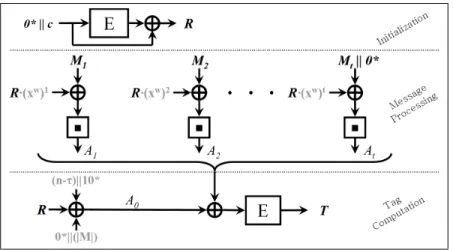
Marvinadopts a variant of Krawczyk’shp(M) cryptographic CRC [16] to generate se-cret offsets, and a square-complete transform to mix the offsets with message blocks. These operations are applied to each message block in parallel and accumulated. The encrypted (and then possibly truncated) accumulation result defines the MAC tag. Marvinuses a con-stantcleft-padded tonbits to generate the offset seed. Algorithm 1 describes the Marvin message authentication code, written as Marvin(M,K, τ). It is also depicted on Figure 1. 3.1. On the choice ofc. To ensure that the offsets Oi are non-zero it is necessary that R itself be non-zero. Assuming that the block cipher E has no weak key ˜K such that EK˜(B)=Bfor any blockB, or that finding such a key is infeasible for any fixed blockB,
it is clear thatEK(B)⊕B,0n. All things being equal, the simple choicec=0 would be
suitable. Indeed, many MAC constructions and other modes of operation for block ciphers adopt the encryption of a block of null bits,EK(0n), as the seed for offset generation.
However, it is essential thatRremain secret, yet disclosure ofEK(0n) for key confirma-tion purposes is widespread if not recommended in many scenarios, especially financial applications. It is therefore advisable to choosec ,0 for the sake of robust deployment
in real-world systems. Any non-zero constant would seems to do equally well, a small (say, 1-byte) value being preferred not to impart efficiency on constrained processors. The actual value isc=0x2A, which was chosen largely at random, although it might be better justified in certain contexts [1].
1The Alpha-MAC scheme is somewhat different in that it adopts 1-round transforms, applying them to partial
blocks of sized−1.
Figure1. The Marvinmessage authentication code Algorithm 1The Marvinmessage authentication code
Input: M .message to authenticate, with|M|<2bn/2c.
Input: K .MAC key.
Input: τ .desired MAC length (τ6n).
Output: T .MAC of messageMunder keyK, truncated toτbits.
1: Partition the message as M = M1k. . .kMt, where|Mi|=nfori=1, . . . ,t−1, and 06|Mt|6nwith|Mt|=0 iff|M|=0.
2: R←EK(lpad(c))⊕lpad(c)
3: fori←1totdo.incrementally or in parallel 4: Oi←R·(xw)i ; Ai←(rpad(Mi) ⊕Oi) 5: end for 6: A0←R ⊕rpad(bin(n−τ)k1) ⊕lpad(bin(|M|)) 7: A←Lt i=0Ai .incrementally or in parallel 8: T ←EK(A)[τ] 9: returnT
3.2. Offset generation. Computing offsets involves multiplication in a finite field GF(2n), and hence has to be designed carefully to avoid unnecessary burden on a variety of plat-forms, particularly those where MAC computation must be carried out incrementally in-stead of in parallel.
The original Krawczyk proposal involves multiplication by the polynomialxnand hence a shift by the full block lengthn followed by ann-step reduction, which is likely to be overkill. The variant employed in CS mode [26] and PMAC1 [24] consists of multiplica-tion by the polynomialxand hence a shift by a single bit; although the ensuing reduction is very simple, this choice destroys bundle alignment and incurs costly operations on many platforms, particularly 8-bit smart cards and SSE2 processors. Such drawbacks are clearly undesirable.
Marvinadopts the middle way: since the underlying block cipher organizes the data in w-bit bundles (supposedly fit for efficient implementation on the target platform), the most natural shift distance isw: it preserves bundle alignment, and as a consequence the offset generation involves multiplication by xw. The polynomial reduction is potentially more
complex than that incurred by 1-bit shift; however, this can be remedied by using a small table, as described in appendix 12 for the special case where the block cipher is the AES. 3.3. Message padding. Perhaps the most popular padding method used in MAC schemes consists of replacing the last blockMt byrpad(Mtk1) when|Mt| <n, and adding a new block when|Mt| =b. This method ensures that no two distinct messages are padded to the same string, which would trivially lead to a MAC collision. A related method avoids adding an entire new block when|Mt|=nby handling the last block in a different manner, for instance by using a different offset.
Marvinadopts a different approach. The last block is simply completed with zero bits; however, the message length and also the truncation length are separately included in the MAC tag computation. This avoids both the block addition and the need for a different block treatment.
4. Authenticated encryption with associated data
An authenticated-encryption (AE) scheme is a symmetric-key mechanism that provides both confidentiality (through the encryption of M) and authentication (through its MAC calculation). Certain modes of operation can authenticate messages consisting of both plaintext and ciphertext. This is the case when one desires to authenticate not only the encrypted message but also its packet header (a TCP/IP header, for example). A scheme of this kind is called an authenticated encryption mode with associated data (AEAD), where the “associated data” in the previous example is the packet header.
4.1. Using Marvinin an authenticated encryption mode with associated data. To date,
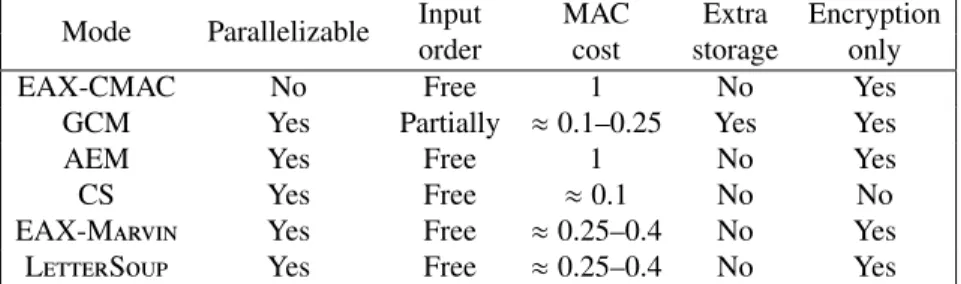
many AE schemes have been proposed and analyzed, such as EAX [5], GCM [18] and AEM [24]. However, one problem with EAX is that it is not entirely parallelizable due to the use of CMAC. GCM is parallelizable in principle, but the definition of its internal MAC, GHASH, makes it necessary to either implement finite field exponentiation to combine the authentication tags of the plaintext and ciphertext parts computed in parallel, or else to impose that the full plaintext part be authenticated before processing of the ciphertext part begins, thus preventing complete parallelizability. AEM is fully parallelizable without the need of expensive arithmetic, but authentication costs one full cipher invocation per block. CS mode is almost ideal in this regard, but it needs both encryption and decryption block cipher functionalities to be available (all other modes considered here only need the encryption direction) and, according to its authors, it is not recommended to use with involutional block ciphers (a restriction not present in the other modes).
It turns out that one can avoid all these drawbacks by simply substituting Marvinfor CMAC in the definition of EAX. Another possibility is to use Marvinin a new AEAD construction, discussed in the following.
4.2. A new AEAD-mode proposal: LetterSoup. It is interesting to notice that the linear
feedback shift register counter (LFSRC) mode for block ciphers [25] could also be based on, and benefit from, the Marvin choice of offsets. This way, it is possible to maintain a single counter and use it both for the encryption and authentication sub-processes. The LFSRC mode is not only length-preserving (|C|= |M|) but also involutional: applying it twice recovers the original plaintext (cf. Algorithm 8).
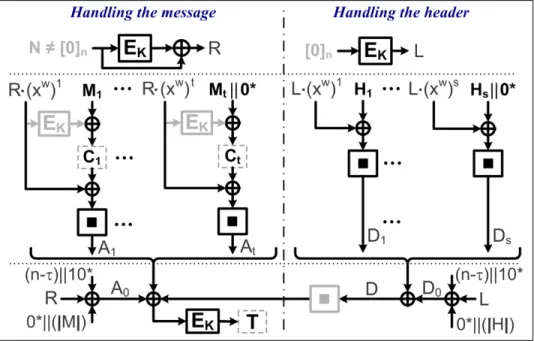
Algorithm 2 describes the resulting LFSRC-Marvinauthenticated-encryption mode of operation that, for the sake of pronunciation, we call LetterSoup(N,M,H,K, τ). For con-venience, we write∗(R,C, τ) as the valueAaccumulated by steps 3 to 7 of the Marvin algorithm for (encrypted) messageCand tag lengthτ. Also, LFSRC(N,M,K) denote the
LFSRC mode of operation, as described in Algorithm 8 and depicted in Figure 2. It is important to notice that the specific way the nonce is preprocessed ensures that the offset seedsRandLpassed as parameters to∗and LFSRC are nonzero, as long as the under-lying block cipher does not have weak keys as discussed in section 3.1. Also, the nonce N=0nis not allowed, since it is reserved for the computation ofL.
Figure2. LetterSoup: AEAD mode
Algorithm 2LetterSoup: AEAD mode
Input: N .nonce, an integer value in range 0<N<2n.
Input: M .message to encrypt and authenticate, with|M|<2bn/2c. Input: H .associated data, with|H|+|M|<2bn/2c.
Input: K .cipher key.
Input: τ .desired MAC length (τ6n). Output: C .ciphertext ofMunderK.
Output: T .MAC of the message, truncated toτbits.
1: Partition the message as M = M1k. . .kMt, where|Mi|=nfori=1, . . . ,t−1, and 06|Mt|6nwith|Mt|=0 iff|M|=0
2: R←EK(lpad(bin(N)))⊕lpad(bin(N)) 3: C←LFSRC(R,M,K) ; A←∗(R,C, τ)
4: if(H,εand|H|>0) then
5: Partition the header asH =H1k. . .kHs, where|Hi|=nfori=1, . . . ,s−1, and
0<|Hs|6n 6: L←EK(bin(0n)) ; D←∗(L,H, τ) ; A←(A⊕ (D)) 7: end if 8: T ←EK(A)[τ] 9: returnCkT 6
It is also possible to further extend this idea to allow for associated data. Suppose the authentication tag for some confidential message M under key K and nonceN isA ←
LetterSoup(N,M, ε,K, τ), and the authentication tag for some associated (cleartext) data HisD←LetterSoup(0n,H, ε,K, τ). The simplest way to combine them would be setting T =A⊕D, as is the case with for the AEM mode [24]. However, if the same keyKis used to authenticateHin a contextdistinctfrom that whereKis used to encrypt and authenticate M (so that actually M andH are semantically unrelated to each other), an attacker can semantically linkMandHby intercepting the authenticated encrypted message (N,C, ε,A) corresponding toMand forging the authenticated encrypted message with associated data (N,C,H,A⊕D) without knowing the key.
This undesirable situation could be prevented by using one-time keys, but the whole point of using nonces is to avoid the need to change keys too often. Another possible solution would be similar to the one adopted by EAX, which prepends a different constant tto the OMAC algorithms (OMACt) used for authenticatingHandM, but this could bring a negative impact to performance. We decided to adopt a more elegant e efficient way to thwart the problem, combining the accumulated tags before the final encryption using the
operation either onAorD, the tags computed fromMand fromH, respectively.
5. On theSecurity ofMarvin
We evaluate the Security of Marvinconsidering both key recovery attacks and message forgery. Most attacks are based in the notion ofaccumulation collisions, which generalize internal collisions as defined in [11, section 2.2] for parallelizable MAC schemes. Two messagesM =M1. . .Mr andM0=M10. . .M
0
sare said to cause an accumulation collision if there exists a subset of indicesI⊆ {1, . . . ,min(r,s)}such thatMk=M0kfor allk∈Iand
L
i<IAi =
L
j<IA
0
j, whereAi(resp. A0j) denotes the internal state of the MAC algorithm corresponding to the processing of message blockMi (resp. M0j). Clearly such messages have the same MAC value, and hence given the tag of either of them one can forge the tag of the other. Finding the collision on theAiandA0jinternal state is equivalent to solving the balance problem [4] in the additive group of a binary fieldwithoutknowing the group elements, since these states depend on a secret key.
This phenomenon is unavoidable regardless of the details of the (parallelizable) MAC: if the same key is used to authenticate a large enough number of messages, namely,O(2n/2)
messages for ab-bit underlying block cipher, the birthday paradox [28] makes the condi-tionLi
<IAi=
L
j<IA
0
jlikely to occur, opening the way to forgery. Therefore, the number of messages authenticated under any particular key must be much smaller than 2bn/2c.
As stated in the ALRED original security analysis, two general approaches to exploit the iteration function must be considered in order to generate Accumulation Collisions: Extinguishing DifferentialsandFixed Points. The use of Extinguishing Collisions is simi-lar to Differential Cryptanalysis of Block Ciphers. It consists in creating pairs of messages of equal length having a difference (with respect to some group operation at the choice of the attacker) that, with a high probability, results in a zero difference in a state following the difference injection. As the use of SCTs prevents differential trails with high probability, it assures a high resistance of the ALRED construction to this kind of attack. On the other hand, Fixed Points refer to words that can be inserted in the message sequence without impacting the state value after the insertion point. To avoid the viability of finding such a word using the MAC function as an oracle, the number of times a message can be authen-ticated under the same key is upper-bounded by 2blc/2c, where the parameterlcis named the
capacity. Preliminary studies of the ALRED design show thatlc=b−8 is usually a good approximation for the capacity, withbthe block size of the underlying cipher.
Given anadversary(a program with access to one or more oracles), the following the-orems generalize the provable security properties satisfied by strictly sequential instances of the ALRED construction [11, section 3.3] in a straightforward fashion.
Theorem 1. Every key recovery attack onMarvinrequiring q (adaptively) chosen mes-sages can be converted to a key recovery attack on the underlying block cipher requiring q+1adaptively chosen plaintexts.
Proof. LetEbe an encryption oracle that yields the ciphertext of a given message under the same (unknown) keyK, and letAbe a MAC adversary that, given the authentication tags (of lengthτ) corresponding toq adaptively chosen messagesM(j), yields the MAC key. The key recovery attack on the underlying block cipher proceeds as follows.
(1) Requestc0=EK(lpad(c)) from the encryption oracleEand setR=c0⊕lpad(c). (2) For j=1 toq:
(a) Request the adaptively chosen messageM(j)fromA. (b) ComputeA(j) =∗(R,M(j), τ).
(c) RequestT(j) =EK(A(j)) fromEand inputT(j)[τ] toA.
(3) Request the MAC key (which is also the cipher key)KfromA.
Theorem 2. Every forgery attack onMarvinnot involving accumulation collisions and re-quiring q (adaptively) chosen messages can be converted to a (known plaintext) ciphertext guessing attack on the underlying block cipher requiring q+1adaptively chosen plaintexts. Proof. LetEbe an encryption oracle that yields the ciphertext of a given message under the same (unknown) keyK, and letAbe a MAC adversary that, without involving accumu-lation collisions, given a messageMand the authentication tags of lengthτcorresponding toqadaptively chosen messagesM(j), yields the authentication tag of lengthτ correspond-ing toM. The ciphertext guessing (fake encryption) attack on the underlying block cipher proceeds as follows.
(1) Requestc0=EK(lpad(c)) from the encryption oracleEand setR=c0⊕lpad(c). (2) Input the messageMand the lengthτtoA.
(3) For j=1 toq:
(a) Request the adaptively chosen messageM(j)fromA.
(b) ComputeA(j) =∗(R,M(j), τ).
(c) RequestT(j) =E
K(A(j)) fromEand inputT(j)[τ] toA.
(4) Request fromAthe authentication tagT of lengthτcorresponding toM. (5) ComputeA=∗(R,M, τ).
(6) If there is an index jfor whichA =A(j), thenAhas generated an accumulation
collision, which conflicts with the assumption that the attack perpetrated by A
does not involve any such circumstance. Otherwise the tag T is the ciphertext (truncated to lengthτ) corresponding to the known plaintextA.
Loosely speaking, Theorems 1 and 2 state that Marvinis no less secure than the under-lying block cipher, since an attacker capable of breaking the MAC (by either recovering the key or simply forging a tag) using the cipher as a black box is necessarily also capable of breaking the cipher itself (by either recovering the key or faking a ciphertext) with roughly the same effort.
6. On theSecurity ofLetterSoup
In this section we introduce formal security definitions and build our security analysis of LetterSoup. We follow mainly [5] for the set of definitions presented here.
6.1. Definitions. AEAD Schemes. Aset of keysis a nonempty set of strings having a dis-tribution (the uniform disdis-tribution when the set is finite). A (nonce-based) authenticated-encryption with associated data(AEAD) scheme is a pair of algorithmsΠ=(D,E) where E is a deterministic encryption algorithm E : Key×Nonce×Header×Plaintext →
CiphertextandDis a deterministicdecryptionalgorithmD : Key×Nonce×Header×
Ciphertext → PlaintextSI
nvalid. TheKey space Keyis a set of keys while thenonce space Nonce and the header spaceHeader (also called the space ofassociated data) are non-empty sets of strings. We will writeEN H
K (M) forE(K,N,H,M) andD N H K (CT) for D(K,N,H,CT), with K ∈ Key, N ∈ Nonce, H ∈ Header, M ∈ Plaintext, and CT ∈ Ciphertext. We require that DN H
K (E N H
K (M)) = M for all M ∈ Plaintext. For notational simplicity, we assume along this document thatNonce,Header,Plaintextand Ciphertextare all{0,1}∗and that|EN H
K (M)|=|M|.
Nonce-Respecting. Suppose A is an adversary with access to an encryption or-acle E· ·K(·). This oracle, on input (N,H,M), returns EN HK (M). Let the tuples (N1,H1,M1), . . . ,(Nq,Hq,Mq) denote its oracle queries. AdversaryAis said to be
nonce-respectingif it never repeatsN, i.e. ifN1, . . . ,Nqare always distinct, regardless of oracle
responses and ofA’s internal coins. Adversaries for AE and AEAD schemes are always assumed to be nonce-respecting [23]. We writeAe(·)to indicate thatAuses oraclee(·).
Privacy ofAEAD Schemes. We consider nonce-respecting adversaries with access to an encryption oracleE· ·K(·). The advantage of such an adversaryAin violating the privacy of an AEAD schemeΠ=(D,E) having key spaceKeyis:
AdvPRIVΠ (A)=Pr[K←$ Key:AE· ·K(·)=1]−Pr[K←$ Key:A$
· ·(·) =1].
where $· ·(·) denotes an oracle that, on input (N,H,M), returns a random string of length
|M|.
Authenticity ofAEAD Schemes. We provide the adversary Awith two oracles: an encryption oracleE· ·K(·) as the one above and averification oracleDˆ· ·K(·). The latter ora-cle takes as input (N,H,CT), returning 1 ifDN H
K (CT) ∈ Plaintextand 0 ifD N H K (CT)= Invalid. The adversary is assumed to satisfy the following three conditions, which must hold regardless of the response to the its oracle queries orA’s internal coins:
• AdversaryAmust be nonce-respecting concerning its encryption oracle; a nonce used in an encryption oracle query may be used in a query to its verification oracle, though.
• AdversaryAmay never make a verification oracle query (N,H,CT) such that the encryption oracle previously returnedCTin response to a query (N,H,M).
• Adversary Amust call its verification oracle exactly once, and may not subse-quently call its encryption oracle. (That is, it makes a sequence of encryption oracle queries, then a verification oracle query, and then halts).
We say that an adversary forges if its verification oracle returns 1 in response to the single query made to it. The advantage of such an adversaryAin violating the authenticity of an AEAD schemeΠ=(D,E) having key spaceKeyis:
AdvAUT HΠ (A)=Pr[K←$ Key:AE· ·K(·),Dˆ
· ·
K(·)f orges].
IV-based encryption. An IV-based encryption scheme (IVE scheme) is a pair of al-gorithmsΠ = (E,D), whereE : Key×IV×Plaintext → Ciphertextis a deterministic encryptionalgorithm andD : Key×IV×Ciphertext → PlaintextSI
nvalidis a deter-ministic decryptionalgorithm. The key space Keyis a set of keys, while the plaintext spacePlaintext, theciphertext spaceCiphertextand theIV spaceIVare all nonempty sets of strings. We writeER
K(M) forE(K,R,M) andD R
K(C) forD(K,R,C). We require that
DR K(E
R
K(M)) = M for allK ∈ KeyandR ∈ IV andM ∈ Plaintext. We assume, as be-fore, thatPlaintext=Ciphertext={0,1}∗and that|ER
K(M)|=|M|. Also, we assume that IV={0,1}nfor somen>1 called theIV length.
Pseudorandom functions. Afamily of functions, or apseudorandom function(PRF) is a mapF : Key×D → {0,1}n whereKeyis a set of keys and Dis a nonempty set of strings. We callntheoutput lengthofF. We writeFKfor the functionF(K,·) and we write f ←$ Fto meanK←$ Key; f ←FK. We denote byRαn the set of all functions with domain
{0,1}α and range{0,1}n. We identify a function with its key, makingRα
n pseudorandom functions. The advantage of adversaryAin violating the pseudorandomness of the PRF F :Key× {0,1}α→ {0,1}nis given by
AdvFpr f(A)=Pr[K←$ Key:AFK(·)=1]−Pr[ρ← R$ α
n :A ρ(·) =1].
A family of functionsE :Key×D→ {0,1}nis ablock cipherifD={0,1}nand eachEK is a permutation. We letPndenote all the permutations on{0,1}nand define:
Advpr pE (A)=Pr[K←$ Key:AEK(·)=1]−Pr[π← P$
n:Aπ(·)=1].
Resources. Ifxxx is an advantage notion for whichAdvxxxΠ (A) has been defined, we writeAdvxxx
Π (R) for the maximal value ofAdvxxxΠ (A) over all adversariesAthat use re-sources at mostR. When counting resource usage of the adversary, one maximizes over all possible oracle responses, including those that could not be returned by any experiment we have specified for adversarial advantage. Resources of interest are the ones named:t– the running time;q– the total number of oracle queries;σ– the aggregate length of these queries; ˆσ– the length of the longest query. The running timetof an algorithm is its ac-tual running time (relative to some fixed RAM model of computation) plus its description size (relative to some standard encoding of algorithms). The data complexityσis defined as the sum of the lengths of all strings encoded in the adversary’s oracle queries. In this document, the length of the strings will be measured inn-bit blocks, for some understood valuen. The number of blocks in a stringMis defined as||M||n=max{1,d|M|/ne}, so that the empty string counts as one block. When the big-O notation is used, it is understood that the constants hidden by the notation are absolute constants.
6.2. Security Results. In the following, we analyze the pseudorandomness of Letter -Soup, which is essential to show why we can use a single key when using Marvinand LFSRC together. We do not provide all elements for a complete security proof, but rather the ones on which a formal security analysis can be based upon.
Theorem 3. Pseudorandomness ofLetterSoupwith a random pseudorandom function.
LetAbe a nonce-respecting attacker using resources at most(q, σ)aiming to distinguish LetterSoupfrom a random function. Then we have
AdvLpr f etterSoup[Rn
n](q, σ)67q
2
( ˆσ2+1)/2n+1
Proof. LetAbe a nonce-respecting attacker trying to distinguish LetterSoup[Rnn] from a random function. Assume thatAuses resourcesσand makes no repeated queries. We
simulate the behavior of LetterSoup[Rnn] oracle in gameQ1, depicted in Algorithm 3. As a standard,Q1 avoids choosingρ ← R$ n
n at the initialization and instead fills in values incrementally. We writeDomain(ρ) for the set of allX ∈ {0,1}nsuch thatρ(X) has been set previously. Any time we need aρ(X) value that has not yet been defined, we choose a random value from{0,1}nand make this to beρ(X). When we need aρ(X) that has already been defined, we use that old value. In the latter case, we also set a flag tobad, which is not visible to an adversary but is of central importance for the security analysis. Let Q1be another game, equivalent toR1, where we dropped the statements that immediately follow the setting of the flagbadand we record the domain ofρin a variableRinstead of usingρitself. This is a standard way to deal with security analysis using the game-playing technique. With these definitions, we have thatAdvpr fL
etterSoup[Rn
n](A) = Adv
dist
Q1,R1(A) 6
Pr[AR1setsbad]. Thus, all we need is to understand the adversary’s chance of settingbad
in gameR1.
Algorithm 3GameQ1, which simulates LetterSoupρ, withρa random function fromRnn 1: L← {$ 0,1}n ; ρ(0n)← {L} ; bad← f alse
2: On query (N,H,M), whereM=M1k. . . kMtandN=N1k. . .kNu, do the following
3: R← {$ 0,1}n
4: ifN ∈Domain(ρ)then
5: bad←true ; R←ρ(N) ; ρ(N)←R .Due to Nonce 6: end if 7: fori←1totdo 8: Si $ ← {0,1}n ; Oi←(R⊕N)·(xw)i 9: ifOi∈Domain(ρ)then
10: bad←true ; Si←ρ(Oi) ; ρ(Oi)←Si .Due to Offset 11: end if 12: Ai←(Mi⊕Oi) 13: end for 14: A0←R ⊕rpad(bin(n−τ)k1) ⊕lpad(bin(|M|)) 15: A←Lti=0Ai 16: fori←1toudo 17: Oi←L·(xw)i ; Di←(Hi⊕Oi) 18: end for 19: D0←L ⊕rpad(bin(n−τ)k1) ⊕ lpad(bin(|H|)) 20: D←Lti=0Di ; A←(A⊕(D)) 21: T ← {$ 0,1}n 22: ifA∈Domain(ρ)then
23: bad←true ; T ←ρ(A) ; ρ(A)←T .Due to Accumulation Collision 24: end if
25: returnTkS0. . .St
There are three ways forAto setbadin gameR1: using a NonceNthat happens to be inR(step 4), generate a valueAithat leads to an Accumulation Collision (step 22) or to generate an offsetOithat is already defined inR(step 9). In the first case,Aknows which value has been added, but this information is not particularly useful becauseAis not able to ask another query using N (which would certainly set bad) and, thus, Ahas to use another of the two methods that involves variablesAiandOiwhichAcan not manipulate
Algorithm 4GameR1, which simulates LetterSoupρ, withρa random function fromRnn 1: L← {$ 0,1}n ; R ← {L} ; bad← f alse
2: On query (N,H,M), whereM=M1k. . .kMtandN=N1k. . . kNu, do the following: 3: R← {$ 0,1}n
4: ifN ∈ Rthenbad←true .Due to Nonce
5: R ← R ∪N 6: end if 7: fori←1totdo 8: Si $ ← {0,1}n ; Oi←(R⊕N)·(xw)i
9: ifOi∈ Rthenbad←true .Offset already defined 10: end if 11: Ai←(Mi⊕Oi) 12: end for 13: R ← R ∪ {O0, . . .Ot} 14: A0←R ⊕rpad(bin(n−τ)k1) ⊕lpad(bin(|M|)) 15: A←Lt i=0Ai 16: fori←1toudo 17: O0i←L·(xw)i ; Di←(Hi⊕O0 i) 18: end for 19: D0←L ⊕rpad(bin(n−τ)k1) ⊕ lpad(bin(|H|)) 20: D←Lti=0Di ; A←(A⊕(D)) 21: T ← {$ 0,1}n
22: ifA∈ Rthenbad←true .Accumulation Collision 23: end if
24: R ← R ∪ {A}
25: returnTkS0. . .St
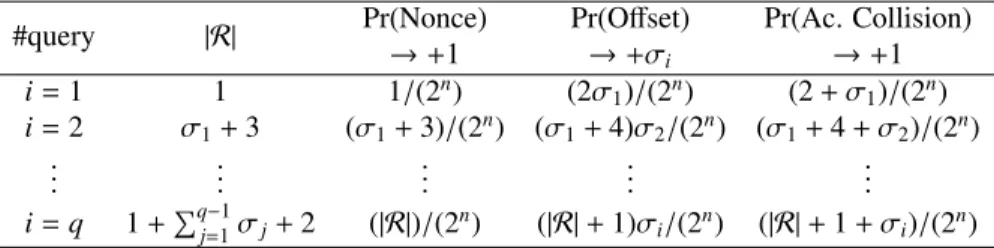
directly. In fact,Oiis dependent ofR, which is randomly defined on each query, whileAi also depends onRand uses thetransform exactly to prevent manipulations ofHor M that could lead to an accumulation collision. With these remarks in mind, we can calculate the probability associated to each method in a queryqas shown in Table 1.
During the calculations we assumed that the values of the offsetsOigenerated inside a query are always different, which should hold true since we consider thatxwis a generator for GF(2n). To facilitate the calculations, we will use ˆσ = max
i{σi}instead of eachσi. Thus, we can write Pr(Nonce)[q, σ] 6 (2q2 +qσˆ(q−1))/2n+1 and Pr(Offset)[q, σ] 6
ˆ
σ(2q(1+q)+qσˆ(q−1))/2n+1and Pr(Ac. Collision)[q, σ]6q(1+q)(2+σˆ)/2n+1, which
leads to the conclusion of the proof: AdvLpr f
etterSoup[Rnn](A)=Adv
dist
Q1,R1(A)
6Pr[AR1setsbad]
=(4q2+4q2σˆ+2qσˆ +q2σˆ2−qσˆ2+2q)/2n+1
67q2( ˆσ2+1)/2n+1.
This result is of fundamental importance to evaluate the security of the final LetterSoup scheme. For that, we describe attackerP, (in Algorithm 5), which has an oracle zthat
responds to queries (N,M,H) with a stringR S0S1· · ·St(where t =|M|) and simulates LetterSoup[Rnn]. With this attacker, we are able achieve the following results:
AdvPRIVL etterSoup[Rn n,τ](q, σ)67q 2( ˆσ2+1)/2n+1 AdvAUT H LetterSoup[Rnn,τ](q, σ)67q 2( ˆσ2+1)/2n+1+σ2/2n+1/2τ
Algorithm 5AdversaryPzfor attacking L
etterSoup[Rnn, τ] 1: RunA
2: fori←1toq do
3: WhenAmakes oracle queryQi(N,H,M), answer the query as follows: 4: TkS0S1· · ·St←z(N,H,M) .with|T|=n
5: C← Mi⊕(S0S1. . .St)
6: returnCT ←(CkT[τ]) as the oracle response 7: end for
8: WhenAhalts and outputs a bitb,returnb
9: WhenAmakes a forgery attempt (N,H,C,T), and halts, do the following: 10: Tag←z(N,H,M) .with|Tag|=n
11: ifTag[τ]≡Tand(N,H,C||T),(Ni,Hi,Ci||Ti) for all 16i6q then 12: return1
13: else
14: return0 15: end if
We omit the proof, that can be constructed usingPlike in EAX [5, Theorem 5] when one considers the LFSRC mode instead of CTR as IVE scheme. Moving to the usage of a block cipherE:Key×D→ {0,1}ninstead ofRn
n, we can achieve the following result in a completely standard way (t0=t+O(σ)):
AdvPRIVL
etterSoup[E,τ](q, σ)6Adv pr p E (t
0, σ)+(σ2+7q2( ˆσ2+1))/2n+1
AdvAUT HL
etterSoup[E,τ](q, σ)6Adv pr p E (t
0, σ)+(σ2+7q2( ˆσ2+1))/2n+1+σ2/2n+1/2τ
7. Efficiency considerations
Ignoring setup time, the computational cost incurred by a Galois-Carter-Wegman MAC like GHASH to process one message block can be as small as that needed to compute one round of the block cipher. This is achieved by usingw-bit lookup tables (LUTs), which may be very large:O(2wb)n-bit blocks of extra storage, or about 64 KiB per key for a 128-bit underlying block cipher and 8-128-bit lookup indices. In storage-constrained environments the cost of a plain GHASH implementation is likely to be comparable to a full encryption. In contrast, Marvintypically consists of 2 rounds of a Shark-like cipher or 4 rounds of a Square-like cipher, and hence it is 2 to 4 times slower than GHASH. However, Marvin does not require any extra storage space since it simply reuses part of the already available block cipher implementation itself. Thus on storage-constrained platforms Marvincan easily match Galois-Carter-Wegman schemes.
On the other hand, Marvinis typically 2.5–4 times faster than MAC constructions that need a full cipher invocation per message block. Furthermore, contrary to strictly sequen-tial MAC constructions like CMAC or Pelican [12], Marvinis fully parallelizable.
Table 2 summarizes the features and efficiency considerations for the authentication schemes discussed here, while Table 3 does the same for all the AEAD modes considered.
8. Benchmark results
In this section, we provide a preliminary benchmark of our Marvinimplementations, comparing it to CMAC, EAX and GCM both in constrained and powerful platforms. The underlying block cipher chosen for the following tests is AES with 128-bit keys, for which we haveR=4 rounds instead of the usual 10 rounds.
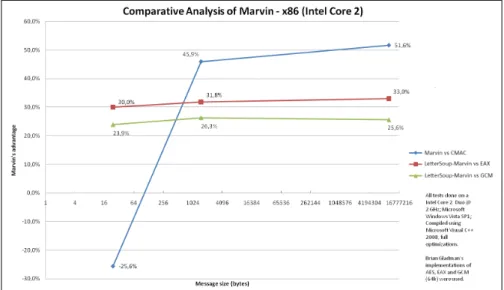
8.1. 32-bit Platform: x86. The AES, EAX and GCM implementations used for the tests are the ones developed by Gladman [13], while Marvin, LetterSoup and CMAC were developed according to specification. All the implementation are written in C++and com-piled using Visual Studio. The results of our tests, performed on a Intel Core 2 Processor, are depicted in Figure 3.
Figure3. Marvinperformance on 32-bit platform
We note that Marvin is slower than CMAC for very short messages, which is due to Marvin’s offset multiplication overhead: for short messages, e.g. 24 bytes, Marvin per-forms 2 full encryptions and 2 square-complete transper-forms, which adds up to 28 unkeyed AES rounds. On the other hand, CMAC performs 3 full encryptions, or 30 full rounds. In this scenario, the overhead introduced by the offset multiplication (which enable it to be parallelizable) become more visible. As shown in Figure 4, the break-even point for the Marvin vs. CMAC comparison is achieved around 80 bytes. As the difference is at most a few milliseconds, it should not be considered a problem in most 32-bit platforms. We note two performance peaks, for 80 and 160-byte messages, which are explained by the lack of padding in the measured points, since they are multiple of the cipher block size.
On the other hand, Marvin’s performance in 32-bit platforms is of much higher interest when we consider larger messages. On a preliminary calculation, where only the number of rounds of the underlying cipher is taken into account, Marvin’s advantage over CMAC should be 10/10−4/10 = 60% as presented in Table 2. In practice, we have achieved
Figure4. Detail of Marvinvs. CMAC on 32-bit platform, for short messages 52% in our tests. Furthermore, using LetterSoupwe were able to achieve a substantial advantage compared to both EAX and GCM (using 64KiB tables), for all message sizes.
We point out that, in the present benchmark, we did not take advantage of Marvin’s intrinsic parallelism. For short messages this approach would most probably not be the best choice, since the overhead involved in creating a thread would overshadow the perfor-mance improvement from the concurrent processing; nonetheless, for large messages (e.g. 10MiB), a significant performance enhancement could be achieved.
8.2. 8-bit platform: Avrora Sensor Simulator. As testbed, we adopted the Avrora Sim-ulator version 1.6.0 - Beta [29], simulating a microcontroller from the ATmega128 [2] series; as recommended by Avrora documentation, we adoptedavr-objdumpandavr-gcc (both GNU utilities) as compilation tools. We also developed CMAC, AEX and Mar -vin/LetterSoup implementations, aiming at investigating the effect of size- and speed-optimizations in the comparison. The underlying AES code is the C implementation orig-inally developed by Martins and Barreto [17], which is tailored to constrained platforms.
The results of our tests are presented on Table 4, which shows that Marvinhas a slight advantage over CMAC in terms of performance, but has a considerably bigger code size. Based on these results, our recommendation is for an implementation which does not use tables and is speed-optimized.
We have also tested LetterSoupand compared its results with EAX. Due to the reduced memory available on the platform, all tests were performed without using precomputed ta-bles. The results, presented in Table 5, show that LetterSoupoutperforms EAX-CMAC by 29-28% in all tested scenarios. Thus, our recommendation is for a size-optimized im-plementation.
9. Conclusions
We have presented Marvin, a new parallelizable message authentication code based on the ALRED family, and LetterSoup, an AEAD scheme that explores some interesting properties of LFSRC block-cipher mode of operation. Both algorithms are interesting when one needs platform flexibility: on the one hand, they need about 25%–40% of a block cipher call per processed block and may be implemented using a reduced space in memory, interesting features in constrained scenarios such as mobile and sensor networks; on the other hand, they can take advantage of scenarios where higly parallel systems are available and can be further optimized using extra memory.
Also, we analyzed the security and provided a benchmark comparing their performance with other important algorithms both on limited and resourceful platforms. Our security analysis is not completely developed, but presents the essential elements that support the security of the proposed schemes, providing the basis for a formal security proof. Our preliminary benchmark shows that Marvinis an attractive alternative to CMAC when one needs to authenticate fairly big messages in 32-bit platforms; for more constrained plat-forms, Marvin has a bigger code size than CMAC, but is an advantageous algorithm in terms of processing speed for all message sizes. Finally, LetterSoup benchmark shows that the algorithm is an interesting option both in resource-constrained and in powerful platforms.
10. Future andOngoingWork
We are currently evaluating the performance of Marvin and LetterSoup with other underlying ciphers, especially those of the Curupira[3, 27] family, which were developed with constrained platforms in mind. In fact, the adoption of the Curupira-2 [27] should considerably decrease the amount of code needed by the algorithms proposed here, as they present similar instructions in their structure.
References
[1] D. Adams.The Hitchhiker’s Guide to the Galaxy. Completely Unexpected Productions Ltd, 1979. [2] Atmel.AVR 8-Bit RISC processor - ATmega128 e ATmega128L, 2007.
[3] P. Barreto and M. Simplicio. Curupira, a block cipher for constrained platforms. InAnais do25oSimpsio Brasileiro de Redes de Computadores e Sistemas Distribudos - SBRC 2007, volume 1, pages 61–74, Belm, Brazil, 2007. SBC.
[4] M. Bellare and D. Micciancio. A new paradigm for collision-free hashing: Incrementality at reduced cost. InAdvances in Cryptology – Eurocrypt’97, volume 1233 ofLecture Notes in Computer Science, pages 163–192, Heidelberg, Germany, 1997. Springer.
[5] M. Bellare, P. Rogaway, and D. Wagner. The EAX mode of operation: A two-pass authenticated-encryption scheme optimized for simplicity and efficiency. InFast Software Encryption 2004, pages 389–407, February 2004.
[6] J. Black and P. Rogaway. A block-cipher mode of operation for parallelizable message authentication. In Advances in Cryptology – Eurocrypt’2002, volume 2332 ofLecture Notes in Computer Science, pages 384– 397, Heidelberg, Germany, 2002. Springer.
[7] J. Black and P. Rogaway. Present: An ultra-lightweight block cipher. InCryptographic Hardware and
Em-bedded Systems – CHES’2007, Lecture Notes in Computer Science, Heidelberg, Germany, 2007. Springer. To appear.
[8] J. Daemen, L. R. Knudsen, and V. Rijmen. The block cipher Square. InFast Software Encryption – FSE’97, volume 1267 ofLecture Notes in Computer Science, pages 149–165, Heidelberg, Germany, 1997. Springer. [9] J. Daemen, M. Peeters, G. Van Assche, and V. Rijmen. The Noekeonblock cipher. InFirst open NESSIE
Workshop, pages 384–397, Leuven, Belgium, November 2000. NESSIE Consortium.
[10] J. Daemen and V. Rijmen.The Design of Rijndael: AES – The Advanced Encryption Standard. Springer, Heidelberg, Germany, 2002.
[11] J. Daemen and V. Rijmen. A new MAC construction Alred and a specific instance Alpha-MAC. InFast Soft-ware Encryption – FSE’2005, volume 3557 ofLecture Notes in Computer Science, pages 1–17, Heidelberg, Germany, 2005. Springer.
[12] J. Daemen and V. Rijmen. The Pelican MAC function. Cryptology ePrint Archive, Report 2005/088, 2005.
http://eprint.iacr.org/2005/088.
[13] B. Gladman. Aes and combined encryption/authentication modes. http://fp.gladman.plus.com/AES/, 2008. [14] IEEE.Standard Specifications for Public-Key Cryptography – IEEE Std 1363:2000. IEEE P1363 Working
Group, 2000.
[15] T. Iwata and K. Kurosawa. OMAC: One-key CBC MAC. InFast Software Encryption – FSE’2003, volume 2887 ofLecture Notes in Computer Science, pages 129–153, Heidelberg, Germany, 2003. Springer. [16] H. Krawczyk. LFSR-based hashing and authentication. InAdvances in Cryptology – Crypto’94, volume 839
ofLecture Notes in Computer Science, pages 129–139, Heidelberg, Germany, 1994. Springer.
[17] G. Y. Martins. Projeto de um dispositivo de autenticao e assinatura. Master’s thesis, Escola Politcnica da Universidade de So Paulo, 2007.
[18] D. McGrew and J. Viega. The galois/counter mode of operation (GCM). Submission to NIST Modes of Operation Process, January 2004.
[19] A. J. Menezes, P. C. van Oorschot, and S. A. Vanstone.Handbook of Applied Cryptography. CRC Press, Boca Raton, USA, 1999.
[20] NIST.Federal Information Processing Standard (FIPS 197) – Advanced Encryption Standard (AES). Na-tional Institute of Standards and Technology – NIST, November 2001.
[21] NIST.Special Publication 800-38B – Recommendation for Block Cipher Modes of Operation: The CMAC Mode for Authentication. National Institute of Standards and Technology, May 2005.http://csrc.nist. gov/CryptoToolkit/modes/800-38_Series_Publications/SP800-38B.pdf.
[22] V. Rijmen, J. Daemen, B. Preneel, A. Bosselaers, and E. De Win. The cipher Shark. InFast Software
Encryption – FSE’96, volume 1039 ofLecture Notes in Computer Science, pages 99–111, Heidelberg, Germany, 1996. Springer.
[23] P. Rogaway. Authenticated-encryption with associated-data. InCCS ’02: Proceedings of the 9th ACM con-ference on Computer and communications security, pages 98–107, 2002.
[24] P. Rogaway. Efficient instantiations of tweakable blockciphers and refinements to modes OCB and PMAC. InAdvances in Cryptology – Asiacrypt’2004, volume 3329 ofLecture Notes in Computer Science, pages 16–31, Heidelberg, Germany, 2004. Springer.
[25] R. Schroeppel. Comment for AES cipher selection. Email Comments on Block Cipher Modes of Operation (NIST document), 2000. http://csrc.nist.gov/CryptoToolkit/modes/workshop1/ email-comments.pdf.
[26] R. Schroeppel, W. E. Anderson, C. L. Beaver, T. J. Draelos, and M. D. Torgerson. Cipher-state (CS) mode of operation for AES. Submission to NIST’s Computer Security Resource Center (CSRC) forum on modes of operation for symmetric key block ciphers, 2004.csrc.nist.gov/groups/ST/toolkit/ BCM/documents/proposedmodes/cs/cs-spec.pdf.
[27] M. Simplicio, P. Barreto, T. Carvalho, C. Margi, and M. N¨aslund. The Curupira-2 block cipher for
con-strained platforms: Specification and benchmarking. InProceedings of the 1st International Workshop on Privacy in Location-Based Applications - 13th European Symposium on Research in Computer Security (ESORICS’2008), volume 397, Malaga, Spain, 2008. CEUR-WS.
[28] D. R. Stinson.Cryptography: Theory and Practice. Chapman & Hall/CRC Press, Boca Raton, USA, 2nd edition, 2002.
[29] B. Titzer, D. Lee, and J. Palsberg. Avrora scalable simulation of sensor networks with precise timing. Center for Embedded Network Sensing Posters - Paper 93, 2004.
[30] M. N. Wegman and J. L. Carter. New hash functions and their use in authentication and set equality.Journal of Computer and System Sciences, 22:265–279, 1981.
11. Tables
Table1. Probability to setbad in gameR1. The arrows indicate how many items are added to the setR
#query |R| Pr(Nonce) Pr(Offset) Pr(Ac. Collision)
→+1 →+σi →+1 i=1 1 1/(2n) (2σ1)/(2n) (2+σ1)/(2n) i=2 σ1+3 (σ1+3)/(2n) (σ1+4)σ2/(2n) (σ1+4+σ2)/(2n) .. . ... ... ... ... i=q 1+Pq−1 j=1σj+2 (|R|)/(2 n) (|R|+1)σ i/(2n) (|R|+1+σi)/(2n)
12. Appendix: Incremental generation of offsets
The Marvinoffsets are incrementally defined asO0←R,Oi+1←Oi·xw. Let GF(2n)=
GF(2)/p(x) where p(x) is a primitive pentanomial over GF(2) such thatxwis a primitive
Table2. Efficiency comparison between some MACs
MAC Parallelizable? Encryptions/block Storage (blocks)
CMAC No 1 O(1)
Pelican No ≈0.25–0.4 O(1)
GHASH (LUTs) Yes ≈0.1–0.25 O(2wb)
GHASH (plain) Yes ≈1 O(1)
Marvin Yes ≈0.25–0.4 O(1)
Table3. Features and Efficiency of AEAD modes
Mode Parallelizable Input MAC Extra Encryption
order cost storage only
EAX-CMAC No Free 1 No Yes
GCM Yes Partially ≈0.1–0.25 Yes Yes
AEM Yes Free 1 No Yes
CS Yes Free ≈0.1 No No
EAX-Marvin Yes Free ≈0.25–0.4 No Yes
LetterSoup Yes Free ≈0.25–0.4 No Yes
Table4. Marvinperformance on the 8-bit platform
Marvin Cycles Adv. CMAC Code Size Adv. CMAC
Using tables, speed-optimized 44414 4.6% 1412 −192.9% No tables, speed-optimized 44433 4.5% 942 −95.4% Using tables, size-optimized 45302 2.7% 1322 −174.3% No tables, size-optimized 45334 2.6% 846 −75.5%
Table5. LetterSoupperformance on the 8-bit platform
LetterSoup Cycles Adv. EAX Code Size Adv. EAX
Speed-optimized 76907 29.2% 2098 −24.7%
Compromise 77972 28.2% 1662 1.2%
Size-optimized 78099 28.1% 1364 18.9%
root ofp(x). We choose a pentanomial basis representation because primitive pentanomials are available for allnof practical interest [14]; primitive trinomials would result in a better performance but are seldom available, and do not exist at all in the important case 8 |
n[19]). The motivation for a multiplication byxwinstead ofxis the result of the following theorem:
Theorem 4. Let p(x) = xn+xk3 +xk2 +xk1 +1 be a primitive pentanomial of degree
n=bw overGF(2)such that k3>k2 >k1, k3−k1 6w, and either w|k3or w|k1. Then
multiplication by xwinGF(2n)=GF(2)[x]/p(x)can be implemented with no more than 5 XORs and 4 shifts on w-bit words. Moreover, if2×2wbytes of storage are available, the cost drops to no more than 2 XORs on w-bit words and 2 table lookups.
Proof. Foru=Lnd=−01udxd ∈GF(2n) letUi=uwi
+w−1xw−1+· · ·+uwi,i=0, . . . ,b−1, so
thatu=Ub−1xw(b−1)+Ub−2xw(b−2)+· · ·+U0, which for brevity we writeu=(Ub−1, . . . ,U0). 18
Then one can computeu·xwas:
(Ub−1xw(b−1)+Ub−2xw(b−2)+· · ·+U0)·xw=
Ub−1xn+Ub−2xw(b−1)+· · ·+U0xw=
Ub−2xw(b−1)+· · ·+U0xw+Ub−1(xk3+xk2+xk1+1)=
(Ub−2, . . . ,U0,Ub−1)⊕ Ub−1(xk3+xk2+xk1).
Assume thatk1=wkfor somek; the casew|k3is handled analogously. Thus:
u·xw=(Ub−2, . . . ,U0,Ub−1) ⊕Ub−1(xk3−k1+xk2−k1+1)xwk.
Since deg(Ub−1) 6w−1 and deg(xk3−k1+xk2−k1 +1) 6w, their product is a polynomial
of degree not exceeding 2w−1, and hence it fits twow-bit words for any value ofUb−1.
Besides, multiplication of this value byxwkcorresponds to simply displacing itkwords to the left. Let
T1[U] ≡ (U(w−(k3−k1)))⊕(U(w−(k2−k1))),
T0[U] ≡ (U(k3−k1))⊕(U(k2−k1))⊕U;
these values can be either computed on demand or else precomputed and stored in two 2w -entry tables. Thenu·xw=(Ub−2, . . . ,Uk⊕T1[Ub−1],Uk−1⊕T0[Ub−1], . . . ,U0,Ub−1). One
easily sees by direct inspection that the computational cost is that stated by the theorem.
As an illustration of this method, the following polynomials are especially well suited for implementation according to the above theorem, tailored for commonplace block sizes and data organized in 8-bit bytes:
• x64+x8+x7+x5+1: (U7, . . . ,U0)·x8=(U6, . . . ,U1,U0⊕T1[U7],T0[U7]), where T1[U]≡U⊕(U1)⊕(U3), T0[U]≡U⊕(U7)⊕(U5). • x96+x16+x13+x11+1: (U11, . . . ,U0)·x8=(U10, . . . ,U1⊕T1[U11],U0⊕T0[U11],U11), where T1[U]≡U⊕(U3)⊕(U5), T0[U]≡(U5)⊕(U3). • x128+x29+x27+x24+1: (U15, . . . ,U0)·x8=(U14, . . . ,U3⊕T1[U15],U2⊕T0[U15],U1,U0,U15), where T1[U]≡(U3)⊕(U5), T0[U]≡(U5)⊕(U3)⊕U.
In fact, the circular byte permutation does not need to be effectively implemented: the same effect can be achieved if we keep track of the indeximsb corresponding to the most significant byte of U. Thus, if we use the imsb-th byte as the first byte ofU in every calculation, it suffices to updateimsb after each multiplication byxw. Using this strategy, word permutations within a block can be performed essentially for free.
We point out that these observations do not impair implementation on platforms that are not byte-oriented. For instance, if a block fits one machine word, then clearly mul-tiplication byxw incurs only 1 rotation, 1 AND, 3 shifts, and 3 XORs, as illustrated by algorithm 6. Then again, we can improve the computation performance by means of a single 2w-word tableTw[U]=(Uk3)⊕(Uk2)⊕(Uk1)
Algorithm 6Wordwise multiplication byxwin GF(2n) Input: V .n-bit word to multiply byxw.
Output: V·xw.
1: V ←V rotlw ; R←V &bin(2w−1) 2: V ←V⊕(Rk3)⊕(Rk2)⊕(Rk1)
3: returnV
For the sake of comparison, algorithm 7 describes bytewise multiplication by x in GF(2n), assuming that deg(p(x)−xn) < 8 (so that the maskZ computed at the begin-ning of the algorithm fits one byte). One sees that the cost isbXORs, 2b−1 shifts, and one bit test. In other words, the cost of multiplying byxis proportional to the block size, while that of multiplying byxwis constant.
Algorithm 7Bytewise multiplication byxin GF(2n) Input: B .n-bit word to multiply byx.
Output: B·x. 1: iftestbit(Bb−1,7)=1then 2: Z← p(x)−xn 3: else 4: Z←0 5: end if 6: fori←b−1downto1do 7: Bi←(Bi1)⊕(Bi−1 7) 8: end for 9: B0←(B01)⊕Z 10: returnB
13. Appendix: OtherAlgorithms
Algorithm 8Linear feedback shift register counter (LFSRC) encryption-only mode. Input: N .nonce, an integer value in range 0<N<2n.
Input: K .cipher key.
Input: M .message to encrypt. Output: C .ciphertext ofMunderK.
1: Partition the message as M = M1k. . .kMt, where|Mi|=nfori=1, . . . ,t−1, and 06|Mt|6nwith|Mt|=0 iff|M|=0.
2: fori←1totdo .incrementally or in parallel 3: Oi←N·(xw)i ;Ci← Mi ⊕EK(Oi)[|Mi|] 4: end for
5: returnC←C1k. . .kCt
Departamento deEngenharia deComputac¸ ˜ao eSistemasDigitais(PCS), EscolaPolitecnica´ , Universidade deS˜aoPaulo, Brazil. E-mail:{mjunior,paquino,pbarreto,carvalho,cbmargi}@larc.usp.br