Agricultural Engineering
2 014 : 2 (150 ):1 13 -1 23Homepage: http://ir.ptir.org
IMPACT OF WORKING PARAMETERS OF THE PIN SOWING UNIT AND SOWING PARAMETERS ON THE REGULARITY
OF DOSING OATS SEEDS
Piotr Markowski∗, Tadeusz Rawa, Andrzej Anders, Paweł Bagiński Department of Woorking Machines and Reseach Methodology
Univesrity of Warmia and Mazury in Olsztyn
∗Contact details: ul. M. Oczapowskiego 11, 10-757 Olsztyn, e-mail: [email protected]
A R T I C LE I N F O A B S T R A C T Article history:
Received: September 2013 Received in the revised form: December 2013
Accepted: February 2014
The paper presents the research results concerning the impact of rotational speed of a sowing shaft (4-34 rot∙min-1), width of a sowing
opening (1-5 mm) in a pin sowing unit and width of interrows (7-15 cm) and sowing speed (4-12 km∙h-1) on the regularity of dosing
Flämingsprof oat seeds at the fixed amount of sowing 156 kg∙ha-1,
which results from the accepted, recommended stock density of 400 seeds∙m-2. Tests were carried out on the laboratory stand in two
stages. In the first one, measurements related to determination of the performance characteristic of the tested sowing unit was carried out, in the second one, measurements related to determination of the longitudinal irregularity index of seeds sowing was performed. It was proved that from among the investigated factors, regularity of dosing seeds has significant impact (α=0.05) on the width of interrows, rotational speed of the sowing shaft and the width of the sowing opening. From analysis of regression of many variables with stepwise procedure of elimination of non-significant variables, a second degree equation was obtained, which included independent variables - the width of interrows and the width of the sowing opening. The value of irregularity index of seeds sowing at the change of interrows width from 7 to 15 cm decreased by approx. 35% – from value 0.72 to 0.46.
Keywords: pin sowing unit, seeds, oat, regularity of dosing
Introduction and the objective of the paper
Sowing, next to soil cultivation, fertilization and plant protection treatments is an agro-technical treatment, which influences the size and quality of plant cropping. The quality of its performance is particularly important i.e. maintenance of the constancy of the accepted amount of dissemination and regularity of seeds distribution in soil - in vertical and hori-zontal plane of a field and performance of sowing within optimal time limit is particularly significant.
The basis for assessment of the quality of sowing grains and plants, similar to grains sown with seed drills (universal), is regularity of their distribution in a row, i.e.
nance of constant or close to constant distance between seeds in a row. However, due to lack of proper mathematical formula which allows determination of the index of seeds sowing regularity, regularity is determined indirectly through determination of the dosing (or sowing) irregularity index (PN-84/R-55050):
a k j j k j j j x x f f x 2 1 1 2 − =
∑
∑
= = δ (1) where:fj – number of line segments with Xi (class variant) number of seeds
xj – number of seeds in a row on fj 0.1 m line segments, a
x – arithmetic mean of the number of seeds in a row, for a line segment fj,
x – mean value.
Arithmetic mean of the number of seeds in a row xa, per a line segment fj is calculated
from the formula:
∑
∑
= = = k j j k j j j a f f x x 1 1 (2)Procedure of testing irregularities of dissemination acc. to the Polish Norm (PN-84/R-55050) consists in: dissemination of seeds on a plate which is at least 2.20 long, the surface of which is covered with smear in order to immobilize sown seeds. A measurement plate should be divided into twenty 10-cm elementary fields (sections). After sowing of seeds, their number is counted on 20 line segments and the obtained results are collated into num-ber classes xj, which contain from the lowest to the highest number of seeds, stating
multi-plicity fj of their occurrence, e.g.: 6 seeds disseminated in 2 sections, 8 seeds in 4 sections,
etc.
Value of index is affected by structural features of working elements of a seed drill (a sowing unit, seed conduit and a drill opener), physical properties of seeds as well as working parameters of a seed drill, i.e. sowing speed, or width of interrows (Kogut, 1998; Rawa and Markowski, 2001).
From among seed drill components which influence the manner of seeds distribution in a row (value of the index of irregularity of dosing seeds), the sowing unit is the most signif-icant (Heege, 1993; Lipiński, 2001; Kogut, 2005; Grudnik, 2006). Thus, increased interest in improvement of structure of sowing units and sowing techniques has been reported in recent years. However, there is not much information concerning the impact of structural and working parameters of the sowing unit on the quality of its performance (Lejman and Owsiak, 1994; Rawa and Lipiński, 2001; Rawa and Markowski, 2001; Lipiński et al., 2004, 114
Rawa et al., 2005; Markowski and Rawa, 2009b; 2010). Mainly, general recommendations stated in user's manuals for seed drills concerning settings of the sowing unit during dis-semination of specific variety of seeds, are known.
Therefore, the objective of this paper was assessment of the impact of working elements of the selected pin sowing unit and width of interrows and sowing speed on the regularity of dosing oat seeds for the same stocking density of seeds on a field which results from the accepted size of sowing 156 kg∙ha-1.
Object and methodology of research
Laboratory experiment was carried out on the research position (Markowski et al., 2007) comprising a single pin sowing unit produced by PIMR (Markowski and Rawa, 2008) with a seed box, a unit of a sticky tape "endless" with a measuring end for determina-tion of sowing regularity of 2 metres length and a driveline on the first and the second unit. All controls which occur in a typical universal seed drill were maintained in a sowing unit. A sowing unit was driven from an electric engine by the v-belt transmission unit. Siemens „Micromaster 420” frequency converter was used for the change of rotational speed of the sowing unit whereas for the drive of sticky belt an electric engine controlled by frequency converter „Invertron GMI S13”.
Experimental material comprised oat seeds of Flämingsprof variety purchased in Olszt-yńska Hodowla Ziemniaka i Nasiennictwa OLZNAS-CN Sp. z o.o. of 100% cleanness, 13.0% moisture and thousand seeds mass of 38.93 g.
The following results were accepted in the research: 1. Constants:
– amount of sowing Q – 156 kg∙ha-1, resulting from the accepted stock density 400 seeds∙m-2,
– height of a supplying slot in the seed box sz – 35 mm.
2. Variables:
– width of the sowing slot (working) sw – 1-5 mm, in step manner every 1 mm,
– width of interrrows mm – 7-15 cm, in step manner every 2 cm,
– sowing speed (sticky tape) vs – 4-12 km∙h-1, changes in stepwise manner every 2 km∙h-1,
– rotational speed of the pin sowing shaft by PIMR nw – arranged in an experiment so the
amount of sowing in each combination of factors was constant. 3. Resultant:
– irregularity of dosing seeds – δ.
Research was carried out in two stages. In the first stage of research, measurements re-lated to determination of performance characteristics of the pin sowing unit by PIMR were carried out, based on which, rotational speeds of a sowing shaft at the maintenance of the accepted amount of sowing of 156 kg∙ha-1 were determined for the accepted working pa-rameters (speed of a sticky tape – which simulates the seed drill motion, width of the sow-ing opensow-ing and the width of interrows). On the second stage related to determination of irregularities of dosing seeds, research was carried out in three repeats pursuant to norm PN-84/R-55050. Ordinates of seeds location on a two-meter measurement length of a sticky tape, werte determined with precision up to 1 mm, positioning the index with a milimetre 115
scale over the geometrical centre of a seed and then a readout of location of the index was carried out on the sticky tape with precision to 1 mm (corresponding to the seed location). Before a subsequent test the tape was cleaned of seeds and then covered with a thin (ap-prox. 1-2 mm) layer of smear. Moreover, level of seeds was supplemented in the seed box, maintaining their fixed level during research.
The results of measurements were subjected to statistical analysis in which analysis of variance, analysis of correlation of factors and analysis of regression of many second de-gree variables with the stepwise procedure of elimination of insignificant variables and the degree of polynomial, were included
Research results
The analysis of correlation of factors shows that the performance of the sowing is in-fleunced by only one variable – rotational speed of the sowing shaft (coefficient of correla-tion 0.99 - at the critical value approx. 0.19). The second factor – width of the sowing slot – at the level of statistical significance α=0.05, has no significant impact (coefficient of corre-lation 0.15). Thus, the performance of the sowing unit may be described by the linear equa-tion with one independent variable (rotaequa-tional speed of the sowing shaft). The equaequa-tion obtained from the analysis of linear regression of many variables, is characterized with high percentage of the explained variability – above 97%.
Table 1 presents rotational speeds of the dosing shaft indispensable for obtaining the ac-cepted (156 kg∙ha-1) amount of oat seeds sowing depending on the accepted speed of sow-ing (speed of the sticky tape), width of interrows and set width of a worksow-ing opensow-ing of the sowing unit of a seed drill. For the whole experiment, rotational speeds of the sowing shaft were within 4.0 and 34.0 rot∙min-1. The lowest rotational speed of the shaft was used re-spectively for the lowest speed of sowing and the interrows width and the highest width of w sowing opening used in the research (5 mm). Whereas, the maximum rotational speed was used for the highest width of itnerrows and sowing speed (respectively 12 km∙h-1 and 15 cm) and the lowest width of a sowing slot (1 mm). The value of the index of irregularity of dosing seeds for the whole experiment is within approx. 0.28 and approx. 0.99 but its mean value is approx. 0.56 (tab. 2). The lowest value of index was obtained from the big-gest (15 cm) and the highest for the smallest width of interrows (7-9 cm).
When analysing the value of standard deviation and coefficient of variability for the in-terrows widths used in the research, one may notice that they are similar and they do not depend on the intterrows width accepted in the research. The lowest values of these statisti-cal parameters were obtained for the biggest interrows widths i.e. 13 and 15 cm.
Table 1
Rotational speed of the sowing shaft nw for the amount of sowing oat seeds 156 kg∙ha-1
Sowing opening width sw (mm) Sowing speed vs (km∙h-1) Interrows width mm (cm) 7 9 11 13 15
Rotational speed of a sowing shaft nw(rot∙min-1)
1 4 5.3 6.8 8.3 9.8 11.4 6 8.0 10.2 12.5 14.7 17.0 8 10.6 13.6 16.6 19.6 22.6 10 13.2 17.0 20.8 24.5 28.3 12 15.9 20.4 24.9 29.4 34.0 2 4 4.9 6.4 7.8 9.2 10.7 6 7.5 9.6 11.7 13.9 16.0 8 10.0 12.8 15.7 18.5 21.4 10 12.5 16.0 19.6 22.5 26.8 12 15.0 19.3 23.5 27.8 32.1 3 4 4.6 6.0 7.3 8.7 10.1 6 7.0 9.0 11.1 13.1 15.2 8 9.2 12.1 14.8 17.5 20.2 10 11.8 15.2 18.6 22.0 25.4 12 14.1 18.2 22.3 26.4 30.5 4 4 4.3 5.6 6.9 8.2 9.5 6 6.6 8.5 10.5 12.4 14.4 8 8.8 11.4 14.0 16.6 19.2 10 11.1 14.4 17.6 20.9 24.1 12 13.4 17.3 21.5 25.1 29.0 5 4 4.0 5.3 6.5 7.7 9.0 6 6.2 8.0 9.9 11.8 13.6 8 8.4 10.8 13.3 15.8 18.3 10 10.5 13.6 16.7 19.8 23.0 12 12.7 16.4 20.2 23.9 27.6 117
Table 2
Statistical parameters δ of irregularity index of dosing oat seeds at the amount of sowing of 156 kg∙ha-1, sowing speed within the scope of 4-12 km∙h-1, the width of a supplying opening
in the sowing unit 1-5 mm and rotational speed of the sowing shaft 4-34 rot∙min-1
Interrows width
mm (cm)
Index of regularity of dosing seeds δ (–)
min.
value value max. mean value deviation standard
coefficient of variation (%) 7 0.4232 0.9985 0.7145 0.1291 18.07 9 0.3662 0.9368 0.6143 0.1231 20.04 11 0.3222 0.8562 0.5292 0.1129 21.33 13 0.2898 0.6961 0.5010 0.0903 18.03 15 0.2778 0.6845 0.4612 0.0845 18.33 mean 0.3358 0.8344 0.5640 – –
Analysis of factors correlation (tab. 3) shows that the interrows width (coefficient of correlation - approx. -0.62) and rotational speed of the sowing shaft (coefficient of correla-tion – approx. -0.46) have the biggest impact on the irregularity of dosing oat seeds. Nega-tive value of correlation coefficient for both independent variables shows that along with the increase of rotational speed of the dosing shaft the value of the index of sowing irregu-larity decreases and thus reguirregu-larity of sowing improves. It results form higher intensity of influence of pulling elements of the dosing shaft on the sown stream of seeds and thus their more regular feed to the seed conduit (smaller pulsation of the seed stream). Also a third variable i.e. width of a sowing slot (coefficient of correlation 0.31) have significant impact on the regularity of dosing oat seeds. In case of this independent variable, positive value of the index of irregularity of sowing seeds indicates that along with the increase of the size of the sowing opening, regularity of sowing deteriorates. It follows from the nature of moving seeds in the outside layer (which includes the space between outside edges of pulling ele-ments of the dosing shaft and the edge of a bottom) as a result of friction between seeds. Too high value of the opening is a reason for even less motion of seeds in the outside layer and thus deterioration of the regularity of dosing seeds. Impact of the fourth independent variable (sowing speed) proved to be insignificant at the level of statistical significance
α=0.05. It should be emphasised that from among four factors, accepted as independent variables, the following couples are strongly and significantly correlated: the sowing speed and rotational speed of the sowing shaft (coefficient of correlation – approx. 0.78) and the interrows width and rotational speed of the sowing shaft (coefficient of correlation – ap-prox. 0.57). Second degree equation was obtained from the analysis of regression of many variables with stepwise procedure of insignificant variables elimination (table 3) where interrows width and width of the sowing opening appear as independent variables. The third factor - rotational speed of the sowing shaft - significantly correlated with irregularity of dosing seeds with a pin sowing unit was eliminated from the equation in the stepwise procedure of regression analysis because it is considerably correlated with the speed of a sticky tape (coefficient of correlation 0.78) and the width of interrows (0.56) and less with 118
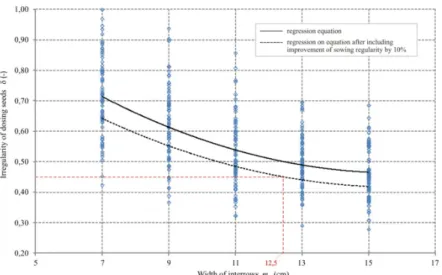
the width of the sowing slot (-0.17). Graphic image of the regression equation given in table 3 was presented in figure 1.
Table 3
Analysis of correlation and regression of irregularity of dosing oat seeds for four variable factors at the amount of sowing of 156 kg∙ha-1
Item Variable Mean value deviation Standard Coefficient of variation (%)
1. Width of sowing opening sw (mm) 3.00 1.4161 47.20
2. Sticky tape speed (sowing) vs (km∙h-1) 8.00 2.8322 35.40
3. Interrows width mm (cm) 11.00 2.8322 25.75
4. Rotational speed of a sowing shaftn
w(rot∙min-1) 14.89 6.8417 45.95
5. Irregularity of dosing seeds δ 0.5640 0.1416 25.10
Correlation matrix sw vs mm nw δ sw 1.000 0.000 0.000 -0.169 0.308 vs 0.000 1.000 0.000 0.779 -0.086 mm 0.000 0.000 1.000 0.556 -0.620 nw -0.169 0.779 0.566 1.000 -0.456 δ 0.308 -0.086 -0.620 -0.456 1.000
Verification of hypothesis on the significance of regression equation coefficients
The accepted level of significance 0.05
Critical value of correlation coefficient 0.1013 Value of statistics F172.3700
Probability of exceeding F statistics p(F)=0.0000
Percent of explained variability 48.10
Standard deviation of remainders 0.1021
Regression equation
0.8490
+
0.0051
-0.0310
2 w ms
m
+
⋅
⋅
=
δ
As it can be seen (fig. 1) irregularity of dosing oat seeds below the required value of 0.45 included in PN-84/R-55050 is obtained at the interrows width above 15 cm. It should be added that the obtained value of seeds dosing irregularity refers to the same sowing unit without a seed conduit and a drill opener. Research carried out by Lejman and Owsiak (1994) proves that at their use, irregularity of dissemination of seeds should improve by approx. 10%. Then, upon including favourable impact of a seed conduit and a drill opener requirements concerning the quality of sowing with the sowing unit used in the research should be met as soon as from the interrrows width which is approx. 12.5 cm. Thus, for interrows width below 12.5 cm it is recommended to use sowing shafts of a multi-sectional structure with three or more sections (Rawa and Markowski, 2001; Markowski and Rawa, 2009a). In such shafts during dosing seeds in reduced amounts there is a possibility of
cluding specific sections and thus adjustment of their working volume to the amount of sown seeds. The use of additional elements in the form of screens for reduction of active length of pulling pins is another solution which allows reduction of the working space of dosing shafts (Rawa and Markowski, 2001). Backward shafts mounted directly behind the sowing unit designated for equalization of the stream of seeds, known from mechanical and pneumatic seeders by Sulky company, may also be used (Markowski et al. 2011, 2012).
Figure 1. Coefficient δ of irregularity of dosing oat seeds with a pin sowing unit at the amount of sowing 156 kg∙ha-1 depending on the width m
m of interrows
Due to low percentage of the explained variability – approx. 48% the obtained regres-sion equation has a low suitability for forecasting regularity of dosing seeds. Thus, analysis of variance was carried out with the use of double classification with interaction (table 4) considering the following statistical hypotheses:
1. For the width of the sowing opening sw:
Hypothesis H0 – mean values of irregularity of dosing oat seeds at five various widths
of a sowing opening are equal,
2. For the sowing speed (sticky tape) vs:
Hypothesis H0 – mean values of irregularity of dosing oat seeds at five various speeds
of sowing are equal,
3. For interaction of the width of a sowing opening sw and sowing speed vs:
HipothesisH0 – mean values of irregularity of dosing oat seeds at five various widths of
a sowing opening and five sowing speeds are equal,
For such hypotheses H0 alternative hypotheses H1 on the lack of equality of mean values of irregularity of dosing oat seeds at accepted levels of variability of independent variables were considered.
Results of statistical analysis presented in table 4 also confirm the significant impact on irregularities of dosing oat seeds, presented in the linear correlation analysis. It presents that mean irregularity of dosing seeds obtained at the sowing opening width of 4 and 5 mm is 120
significantly (α=0.05) and highly significantly different than the obtained at the sowing opening width of 1, 2 and 3 mm. In case of the other change – the width of interrows – highly significant differences (α=0.01) occur between the smallest width (7 cm) and the remaining interrows widths and also between interrrows of 9 cm width and interrows of widths 11, 13 and 15 cm and between an interrow of 11 cm width and interrows with widths of 13 and 15 cm. On the other hand, a significant difference at the level of α=0.05 was reported between the widest interrows used in the experiment i.e. between 13 and 15 cm. Moreover, the analysis of variance with interraction of two independent variables i.e. the width of a sowing opening and the width of interrows did not prove their significant impact on average value of the index of irregularity of dosing oat seeds.
Table 4
Irregularity analysis of variance of dosing oat seeds with a pin sowing unit of PIMR structure (double classification – fixed orthogonal model)
Item Sowing openingwidth sw (mm)
Factor A Number Mean value (–) Standard deviation (–) Coefficient of variation (%) S1 1 75 0.5154 0.1274 24.71 S2 2 75 0.5233 0.1233 23.57 S3 3 75 0.5456 0.1331 24.39 S4 4 75 0.6104 0.1492 24.45 S5 5 75 0.6256 0.1396 22.32
Item Interrows width mm (cm)
Factor B Number Mean value (–) Standard deviation (–) Coefficient of variation (%) M1 7 75 0.7145 0.1291 18.07 M2 9 75 0.6143 0.1231 20.04 M3 11 75 0.5292 0.1129 21.33 M4 13 75 0.5010 0.0903 18.03 M5 15 75 0.4612 0.0845 18.33
Accepted significance level α 0.05
Value of statistics FA for factor A 19.5674
Probability of exceeding value FA 0.0000
Because p(FA) < α – hypothesis H0should be rejected for the benefit of alternative hypothesis H1 Results of significance of differences (of Duncan's test): S4, S5 > S1, S2, S3*
Value of statistics FBfor factor B 77.6966
Probability of exceeding value FB 0.0000
Because p(FB) < α – hypothesis H0should be rejected for the benefit of alternative hypothesis H1 Results of significance of differences (of Duncan's test):
M1 > M2, M3, M4, M5* M2 > M3, M4, M5* M3 > 5* M4 > M5**
Value of statistic FABfor combination of factors A×B 1.2727
Probability of exceeding value FAB 0.2116
Because p(FAB) > α – has no basis for rejection of zero hypothesis H0 * – statistically significant differences at the significance level α= 0.01 ** – statistically significant differences at the significance level α= 0.05
Conclusions
1. From among four factors – the interrows width, sowing speed (of sticky tape), rotational speed of a sowing shaft and sowing opening width – three factors: interrows width, width of a sowing opening and rotational speed of a sowing shaft have significant im-pact on irregularity of dosing oat seeds with a pin sowing unit at the size of dissemina-tion of 156 kg∙ha-1 .
2. Irregularity of dosing seeds with a pin sowing unit may be described with a second degree polynomial, where interrows width and width of a sowing opening appear as in-dependent variables. The third from among the factors, that is rotational speed of the sowing shaft – significantly correlated with irregularity of dosing seeds – in the analysis of regression with stepwise procedure, was not added to the equation due to its correla-tion with the interrows width, sowing speed and width of the sowing opening.
3. A pin sowing unit by PIMR at sowing oat seeds in the amount of 156 kg∙ha-1 meets the requirements of the Polish Norm (PN-84/R-55050), acc. to which coefficient of length-wise irregularity of sowing should be below the value of 0.45 only at the interrows width above 12.5 cm.
References
Grudnik, P. (2006). Równo w rzędzie. Pozyskano z: http://www.farmer.pl/_/archiwum/2006/
Row-no_w_rzedzie/?id=375.
Heege,H. J. (1993). Seeding methods performance for cereals, rape, and beans. American Society of
Agricultural Engineers, Vol. 36, 653-661.
Kogut, Z. (1998). Wskaźniki jakości wysiewu w ocenie pracy siewników rzędowych. Problemy
inżynierii Rolniczej, 4, 23-38.
Kogut, Z. (2005). Regulacja siewników uniwersalnych. Pozyskano z: http://raport.noip.org/ i
n-dex.php?option=com_contetnt&task=view&id=612&Itemid=43
Lejman, K.; Owsiak, Z. (1994). Badania podłużnej nierównomierności wysiewu siewników rzęd
o-wych. Roczniki Nauk Rolniczych, T 80 C-1, 127-133.
Lipiński, A. (2001). Badania podłużnej nierównomierności wysiewu nasion zbóż na wyjściu z prz
e-wodu nasiennego o eliptycznym zakończeniu. Materiały XI Międzynarodowej Konferencji Na u-kowej nt.: „Problemy inżynierii rolniczej na progu III tysiąclecia”, 367-370.
Lipiński, A.; Markowski, P.; Rawa, T. (2004). Próba oceny wydajności i równomierności dozowania nasion pszenicy kołeczkowymi zespołami wysiewającymi przy wysiewie górnym i dolnym. Inż
y-nieria Rolnicza, 4(59), 171-180.
Markowski, P.; Letki, Ł.; Rawa, T.; Kaliniewicz, Z.; Anders, A.; Zarajczyk, J. (2012). Próba wyró
w-nania strugi nasiennej w siewniku rzędowym z grawitacyjnym transportem nasion. Inżynieria
Rolnicza, 3(138), 119-126.
Markowski, P.; Lewicki, M.; Rawa, T. (2011). Analiza równomierności dozowania nasion pszenicy zespołem wysiewającym systemu reguline. Inżynieria Rolnicza, 8(133), 215-222.
Markowski, P.; Rawa, T. (2009a). Kołeczkowy zespół wysiewający. Część I. Budowa i zasada
funk-cjonowania. Inżynieria Rolnicza,5(114),.201-209.
Markowski, P.; Rawa, T. (2009b). Kołeczkowy zespół wysiewający. Część II. Wpływ wybranych parametrów na wydajność i równomierność dozowania nasion rzepaku. Inżynieria Rolnicza,
5(114), 211-218. 122
Markowski, P.: Rawa, T. (2008). Porównanie parametrów geometrycznych dwusegmentowych k
o-łeczkowych zespołów wysiewających. Inżynieria Rolnicza, 10(108), 175-183.
Markowski, P.; Rawa, T. (2010). Kołeczkowy zespół wysiewający. Część III. Wpływ wybranych parametrów na równomierność dozowania nasion pszenicy. Inżynieria Rolnicza, 2(120), 49-56. Markowski, P.; Rawa, T.; Warych G. (2007). Próba określenia wpływu przewodu nasiennego i redl
i-cy siewnika na równomierność wysiewu nasion pszenii-cy. Inżynieria Rolnicza, 7(95), 137-143. Rawa, T.; Lipiński, A. (2001). Badania nierównomierności dozowania nasion pszenicy zespołami
wysiewającymi wybranych firm. Problemy Inżynierii Rolniczej, 1(31), 13-20.
Rawa, T.; Markowski, P. (2001). Analiza kołeczkowych zespołów wysiewających w aspekcie ich konstrukcji i równomierności dozowania nasion. Inżynieria Rolnicza, 13(33), 383-389.
Rawa, T.; Markowski, P.; Lipiński, A. J. (2005). Próba określenia wpływu parametrów roboczych kołeczkowego zespołu wysiewającego oraz szerokości międzyrzędzi i prędkości siewu na ró
w-nomierność dozowania nasion pszenicy. Inżynieria Rolnicza, 7(67), 255-263.
PN-84/R-55050:1985. Metody badań siewników polowych rzędowych i rzutowych.
WPŁYW PARAMETRÓW ROBOCZYCH KOŁECZKOWEGO ZESPOŁU
WYSIEWAJĄCEGO ORAZ PARAMETRÓW SIEWU NA RÓWNOMIERNOŚĆ DOZOWANIA NASION OWSA
Streszczenie.W pracy przedstawiono wyniki badań dotyczące wpływu prędkości obrotowej wałka wysiewającego (4-34 obr∙min-1), szerokości szczeliny wysiewającej (1-5 mm) w kołeczkowym zesp o-le wysiewającym oraz szerokości międzyrzędzi (7-15 cm) i prędkości siewu (4-12 km∙h-1) na równ o-mierność dozowania nasion owsa odmiany Flämingsprof przy stałej ilości wysiewu 156 kg∙ha-1, wynikającej z przyjętej, zalecanej obsady 400 nasion∙m-2. Badania przeprowadzono na stanowisku laboratoryjnym w dwóch etapach. W pierwszym wykonano pomiary związane z wyznaczeniem ch
a-rakterystyki wydajnościowej badanego zespołu wysiewającego, w drugim przeprowadzono pomiary związane z wyznaczeniem wskaźnika nierównomierności podłużnej wysiewu nasion. Wykazano, że spośród badanych czynników istotny wpływ (α=0,05) na równomierność dozowania nasion, ma szerokość międzyrzędzi, prędkość obrotowa wałka wysiewającego oraz szerokość szczeliny wysiew
a-jącej. Z analizy regresji wielu zmiennych z krokową procedurą eliminacji zmiennych nieistotnych otrzymano równanie stopnia drugiego, zawierające dwie zmienne niezależne – szerokość międzyrzę-dzi i szerokość szczeliny wysiewającej. Wartość wskaźnika nierównomierności wysiewu nasion przy zmianie szerokości międzyrzędzi z 7 na 15 cm zmniejszyła się o ok. 35% – z wartości 0,72 do 0,46.
Słowa kluczowe:kołeczkowy zespół wysiewający, nasiona, owies, równomierność dozowania