Evaluation toolkit
for museum practitioners
Acknowledgements
Acknowledgements
This toolkit was written by Harriet Foster, Evaluation Officer for the East of England Museum Hub. Special thanks must go to all individuals who commented on early drafts of the toolkit and to Esther Morgan and Amanda Burke for their valuable input when it came to revising the draft document for publication.
This publication has been made possible through funding from Renaissance. Renaissance is the Museums, Libraries and Archives (MLA) Council’s £150 million programme to transform England’s regional museums. For the first time ever,
investment from central government is helping regional museums across the country to raise their standards and deliver real results in support of education, learning, community development and economic regeneration. Groups of up to five flagship museums in each English region, known as Hubs, are working alongside the MLA Regional Agencies and Museum Development Officers to promote good practice and provide advice and support. Renaissance is helping museums to meet people’s changing needs – and to change people’s lives.
The East of England Museum Hub are:
Norfolk Museums & Archaeology Service (lead partner) www.museums.norfolk.gov.uk
Colchester and Ipswich Museum Service www.colchestermuseums.org.uk
The Fitzwilliam Museum, University of Cambridge www.fitzmuseum.cam.ac.uk
Museums Luton
www.luton.gov.uk/museums Publication information
Published by the East of England Museum Hub, February 2008 Copyright: East of England Museum Hub 2008
All cartoons © Noel Ford; for photo credits, see p. 90 Further copies of the publication are available from: The East of England Museum Hub
Norfolk Museums & Archaeology Service Shirehall Market Avenue Norwich NR1 3JQ Tel: 01603 495881 Web: www.renaissance-east.org.uk
This publication is also available in large print and computer disc
formats on request from the East of England Museum Hub.
Please note: All internet links given in this toolkit were correct at the time of publication. Some websites may change their address or be removed from the internet at any time and the author cannot be held responsible for these changes.
1. Introduction 5
2. What is evaluation? FAQs 7
3. How can evaluation help me? 13
4. The basics 17
What you need to know before you get started
5. Getting started 23
Planning your evaluation and using the evaluation checklist
6. What data collection methods
are out there? 27
6.1 Introduction 28
6.2 How to phrase a ‘good’ question 29
6.3 Questionnaires 31
6.4 Interviews 33
6.5 Focus groups 36
6.6 Observation 39
6.7 Creative data collection methods 43
6.8 Other ideas for simple or less commonly used data collection methods 47
7. Analysing the results 53
7.1 Introduction 54
7.2 Dealing with mainly quantitative data and closed-question responses 54 7.3 Dealing with mainly qualitative data and
open-question responses 58
8. Reporting and acting on the results 59
8.1 Reporting the results 60 8.2 Acting on the results 63
9. Other issues: ethical and
lawful evaluation 65
9.1 The Data Protection Act (1998) 66 9.2 Gaining consent from participants 67 9.3 Keeping participants informed of the
evaluation brief 67
9.4 Maintaining a subject’s anonymity 68
9.5 Being accessible 68
10. Where to go for more help or information 71
11. Index of key terms 75
Appendices 79
Appendix 1: About Renaissance and
the East of England Hub 80
Appendix 2: ILFA 81
Appendix 3: Demographic categories 83 Appendix 4: Focus group topic guide 85 Appendix 5: Observation sheets 86 Appendix 6: Participant information sheet
and consent form 88
0. Chapter heading 5
Text Bold
Text San utpat. Ut aliquatet, sum qui te dunt nummole ssequipit ulput ipsum augue veriusto enit augue commodi onsectem vulputem erosto dolorper aut laoreet umsandigna faccum nonum nostionse tate del dolendiam vel ullandiam zzriure te do eriure conullaorper sustrud min voloborero od modigni ssequatie mod tat. Aliquis iscillandio odigna feuisi ex ea cortis el in utpat, vulputat. Ut lum accumsa ndignisis alisl ea alit vero od ea consecte feugue verosto odio commod min eril el dolobor acilla facilit, commod tet wis nonsequam, quat alisis nim zzril ut alis nonsenim augiat. Ut illaorem ea faciliquis aliqui te faccummy non veril delisi eliquipis euis nisisl ullut prat
Stage 1
Before starting the project
Stage 2
During the project
Stage 3
At the end of the project
Plan the evaluation
Record the activity
Evaluate outcomes Link to the toolkit
Monitor quality
Evaluate impact
Text_Small for captions, diagrams figures and notes etc.
Introduction
1. Introduction 6
Several toolkits and books have already been produced on evaluation, many of which are useful and practical sources of information (Section 10). However, a review of these revealed that some were not specific enough to museums, and few, if any, provided the full range of current information needed for a museum practitioner to carry out, commission or manage evaluation at the present time.
So, this toolkit has been put together by compiling all the relevant information in these sources, as well as answers to the many practical evaluation questions often posed by museums, in the hope that it will be a fully comprehensive document for museum practitioners.
This toolkit has been produced through investment by Renaissance East of England (Appendix 1) and has been devised principally for museums in the East of England, but it may have wider appeal within the museum, library and archive sector. It grew out of a need for museums in this region to demonstrate the effectiveness of their work, both within their organisations and to external stakeholders, so that they could carry forward and share the lessons learned. Learning is one of the most important outcomes that evaluation can offer organisations, not only so that they can develop effectively and keep pace with current agendas but also so that they can garner valuable support for the worthwhile services that they offer.
Two key points are worth bearing in mind before you use this toolkit:
1. Evaluation doesn’t have to be expensive or time-consuming, however, you do need to commit a realistic amount of time to evaluation. The amount of time you put in when planning your evaluation will have a direct bearing on the quality of your results. A quickly and poorly written questionnaire, for example, is likely to yield poor data. Evaluation should be considered at the planning stages of your project or activity.
2. This toolkit contains examples of different evaluation methods (e.g. a
questionnaire, topic guide, observation sheet, etc.) but these are all included as reference material, rather than as templates that should be adopted as they stand. It is not advisable to use an existing template for any evaluation if it does not ask the questions you would like answered.
Finally, it should be stressed that your opinions on the usefulness and content of the toolkit are very much welcomed, as additional electronic content may be provided at a later date. To provide feedback, please get in touch with:
The Evaluation Officer,
Renaissance: East of England Hub, Norfolk Museums & Archaeology Service, Shirehall, Market Avenue, Norwich NR1 3JQ.
0. Chapter heading 7
Text Bold
Text San utpat. Ut aliquatet, sum qui te dunt nummole ssequipit ulput ipsum augue veriusto enit augue commodi onsectem vulputem erosto dolorper aut laoreet umsandigna faccum nonum nostionse tate del dolendiam vel ullandiam zzriure te do eriure conullaorper sustrud min voloborero od modigni ssequatie mod tat. Aliquis iscillandio odigna feuisi ex ea cortis el in utpat, vulputat. Ut lum accumsa ndignisis alisl ea alit vero od ea consecte feugue verosto odio commod min eril el dolobor acilla facilit, commod tet wis nonsequam, quat alisis nim zzril ut alis nonsenim augiat. Ut illaorem ea faciliquis aliqui te faccummy non veril delisi eliquipis euis nisisl ullut prat
Stage 1
Before starting the project
Stage 2
During the project
Stage 3
At the end of the project
Plan the evaluation
Record the activity
Evaluate outcomes Link to the toolkit
Monitor quality
Evaluate impact
Text_Small for captions, diagrams figures and notes etc.
7
What is evaluation? FAQs
2. What is evaluation? FAQs 8
Monitoring and evaluation: are they different? Monitoring and evaluation are two different things but are often confused. Monitoring is about the ongoing collection and analysis of information to ‘spot check’ the progress of an activity at any given time. For example, this might be the collection of visitor figures over a period of time and noting month by month whether they go up or down. Evaluation, on the other hand, occurs at a specific point in time. It may use monitoring information as well as other data to look at the progress made against benchmarks set earlier in the activity. It is a way of measuring the effect and/ or performance throughout the activity and may question its overall direction and the benchmarks themselves. For example, in looking at your visitor figures, you might then question whether or not
you have achieved your aim of increasing visitor figures and if so, why this is the case. Evaluation, when done well, can also be about the ‘how’ and ‘why’ of what worked and what didn’t. In this way it can help you and others to understand what it is that you need to continue to do, modify or completely overhaul in future if you are to carry out a similar project or activity.
What are the different kinds of evaluation?
The index of key terms (Section 11) covers some of the different types of evaluation but it is also worth explaining them here in more detail.
Front-end evaluation occurs during the planning stages of a project or activity, when data is analysed to help assess the value of plans before resources are committed to developing the project. It is used particularly during the planning stages of museum and gallery redevelopment. Front-end evaluation includes: • The process of consulting people as to their expectations of the project’s outcomes
and their needs (e.g. how can this museum be developed in a way that is inclusive and accessible to everyone).
• Existing national or local data that may provide information about your baseline audience and target audience.
• Surveys set up specifically for the project to gauge your target audience’s current knowledge.
Formative evaluation occurs during the process or development of your project or activity. It may involve testing out a prototype or mock-up (e.g. display, text panel) with your users and refining the model until it is sufficiently improved. This means that you do not commit all of your resources to the final product without knowing if it works in practice (e.g. is accessible, readily understood or works mechanically,
2. What is evaluation? FAQs 9
in the case of interactive exhibits). It can also include other kinds of evaluation that take place while a project is underway, such as staff team meetings to monitor and assess how well a project is progressing with a view to making amendments to the plan if needed. At this point you are considering the question, ‘are we getting to where we want to be?’
Summative evaluation occurs at the end of your project or activity, when you may wish to assess the impact of the ‘finished product’, be it a new gallery, an outreach session or a new brochure. At this point, you are looking back at the project to ask questions such as ‘Did we meet our aims and objectives?’ or ‘What worked well and what didn’t?’
The diagram on the following page sets out the different stages of evaluation. Not all projects or activities will need to be evaluated using all three stages but particularly where you are running a large project it can be a good idea to incorporate front-end and/or formative evaluation with summative evaluation. Retrospective evaluation happens when you realise that it is too late to even carry out summative evaluation, for example, following the closure of a temporary exhibition. Retrospective evaluation is not recommended, as it will probably mean that you have gaps in your data sources (leading to an unbalanced evaluation). For example, you may find that you have to use visitors’ quotes given in a newspaper article but you will have had no control over how these quotes were gathered or presented. Hence you will not know how representative or reliable they are of the visitors’ feedback.
Learning from evaluation
Sometimes, different types of evaluation can become blurred. For example, if the results from summative evaluation are subsequently used in planning a similar exercise in the future, then they become a form of front-end evaluation (looking back at what was successful or needed developing from past experience).
Evaluation should be about learning. If you do not seek to learn from evaluation, then it is a lost opportunity for you and your organisation.
2. What is evaluation? FAQs 10
Case study: A fictional example of a gallery redevelopment
Front-end evaluation
• What lessons learned can we carry
forward from the last redevelopment?Redevelopment of a new gallery on the ancient Egyptians
Redevelopment of a new gallery on the Romans
Summative evaluation
• Did we meet our aims?
• Did we develop the new gallery
according to visitors and non- visitors’ needs and desires?• What were the unexpected
outcomes?Project aims Front-end evaluation
• Who visits the museum currently? • Are our museum visitors
representative of our local population?
• What are the needs of these visitors and any non-visitor groups?
• How would they like to see material displayed and interpreted?
Formative evaluation
• Do the proposed interactives: • work mechanically? • help visitors learn? • get the intended message
2. What is evaluation? FAQs 11
I wish to run a certain type of activity or project. Is there a ‘right’ evaluation method to use?
The answer to this is not straightforward. It all depends on the resources you have for the evaluation, the people that you are consulting for feedback, and the type of activity or project you are running. So, your evaluation method should be tailored to your activity and your audience. To put this in context, if you are working with children, then you cannot expect them to complete a long and detailed questionnaire. You might instead choose to observe the children’s progress, gather informal feedback from parents or teachers and ask simple questions of the children to which they could respond with a ‘show of hands’. These methods are simple but if done well, asking ‘good’ questions (Section 6.2), they will provide you with valid information that can be analysed and interpreted for the purposes of evaluation. Similarly, if you are running a long-term project, then you should expect to carry out a more detailed evaluation (relying on several types of data collection) than would be the case with the assessment of a single event.
Does evaluation need to be complicated to be valid?
The simple answer to this is ‘no’. Evaluation can be as simple or as sophisticated as you make it. What makes evaluation valid and robust is giving yourself enough time to devise an effective plan (Section 5), phrasing your questions appropriately (Section 6.2), giving due consideration to the various perspectives of those involved (Section 4) and analysing and presenting the outcome in a way appropriate to your audience (Sections 7 and 8).
Which is better: in-house evaluation or commissioned evaluation?
Both have their merits and disadvantages. Commissioned evaluation is likely to cost more but will provide you with an independent and impartial assessment. However, your external evaluator may not have the necessary insight into museums and how they work to produce recommendations that will be suitable and practical in this context. In-house evaluation or ‘self-evaluation’ can be deemed to be less objective or robust, as people may tell you things that they think you want to hear or because you are less able to judge yourself or your organisation objectively. However, you may have a deeper understanding of how and why things worked or did not work and may be better placed to make recommendations for the future that are realistic for your organisation to achieve.
0. Chapter heading 13
Text Bold
Text San utpat. Ut aliquatet, sum qui te dunt nummole ssequipit ulput ipsum augue veriusto enit augue commodi onsectem vulputem erosto dolorper aut laoreet umsandigna faccum nonum nostionse tate del dolendiam vel ullandiam zzriure te do eriure conullaorper sustrud min voloborero od modigni ssequatie mod tat. Aliquis iscillandio odigna feuisi ex ea cortis el in utpat, vulputat. Ut lum accumsa ndignisis alisl ea alit vero od ea consecte feugue verosto odio commod min eril el dolobor acilla facilit, commod tet wis nonsequam, quat alisis nim zzril ut alis nonsenim augiat. Ut illaorem ea faciliquis aliqui te faccummy non veril delisi eliquipis euis nisisl ullut prat
Stage 1
Before starting the project
Stage 2
During the project
Stage 3
At the end of the project
Plan the evaluation
Record the activity
Evaluate outcomes Link to the toolkit
Monitor quality
Evaluate impact
Text_Small for captions, diagrams figures and notes etc.
How can evaluation
help me?
3. How can evaluation help me? 14
Evaluation, as has already been pointed out, is about the ‘how’ and ‘why’ of what worked well or what did not work well. For example, rather than just telling you that people enjoyed or did not enjoy the outreach session, if you ask the right questions, you will find out why they did or did not enjoy it and how you can repeat your successes or improve upon the less successful aspects of the session in future. This sort of insight, about the ‘how’ and ‘why’, is often the most useful learning to share with others. It provides them with tangible building blocks for their own work, knowing what they can repeat or what mistakes they should try to avoid making. It also means that we are not continually ‘reinventing the wheel’ when it comes to project design.
Here are just some of the things that evaluation can help museum practitioners do, many of them are interrelated. This list has been compiled based on the author’s own experiences, a review of various sources consulted (Section 10) and from feedback by participants at training sessions delivered by the author:
Determine if a project or activity’s aims, objectives and outcomes are being or have been met
When planning a project or activity, you will set yourself aims, objectives and outcomes, ideally including ‘learning outcomes’ or ‘social outcomes’ (Section 4). Evaluation can help you assess to what extent you are achieving or have achieved these goals and what factors affect their success. It can also reveal unexpected outcomes, those outcomes or ‘nuggets’ of information which you couldn’t have foreseen but which are often the most interesting to find out about. This leads on to another key point that demonstrates why it is important to consider your evaluation at the start of your project or activity, when you are planning your goals. At this stage, you need to make sure that there will be some way of assessing whether or not you have achieved your goals. If you aren’t going to be able to do this, then your evaluation will be flawed. Admittedly, not all aims, objectives or outcomes are easily measured, but you do need to consider, for each of your goals, what your measure of success will be. This is covered in Section 4.
Particpating in Consult/Result, a conference on disability and museums run by Colchester and Ipswich Museum Service
3. How can evaluation help me? 15
Enable us to understand our visitors/users or non-visitors/non-users better (being more user-focused) and improve the services we offer them
This is important as museums can play a key role by actively engaging with the public. All museums should therefore strive to ensure that they are user-focused. This includes considering current users and non-users. So, some questions that evaluation might help to answer in this respect are:
• Are our visitors representative of local or wider communities? If they aren’t, is this because we are not presenting ourselves in an accessible way?
• Do visitors understand our intended message, for example, how we interpret our collections through text panels? If they don’t, then why is this?
• How do users and non-users learn in an informal learning setting? If we aren’t able to understand our visitors’ and non-visitors’ informal learning processes, then we won’t be able to cater for their needs.
Identify strengths and weaknesses (and where resources should be directed in future)
This will provide you with an insight into what contributed to the effectiveness of the project or activity and how you could make future projects or activities more effective. You may decide that no improvements could be made and so resources would be best used elsewhere. In short, evaluation can help inform the development of future projects and set their direction.
Ensure that learning is shared and acted upon within the organisation
Learning has already been stressed as an important outcome of evaluation. Just as important as this is acting upon and sharing the learning, so that it is carried forward in the future and communicated to your colleagues. If learning is not shared, it will be lost when individuals leave the organisation and take their learning elsewhere. A learning organisation is one that demonstrates to outsiders that it keeps pace with the needs of society.
Defines the quality of what we do
Often when it comes to evaluation and demonstrating impact, it can be easy simply to report against the quantity of what we offer, such as the number of visitors to an exhibition or the number of events held. This doesn’t necessarily get to the crux of what museums can offer people but evaluation can go one step further and offer an insight into the quality of what we do. This means that we are able to articulate what our intrinsic value is, not only in terms of what outputs we deliver (e.g. visitors, exhibitions, events) but also in terms of the difference that these things make to people’s lives (e.g. offering opportunities to learn new skills, build new relationships or even improve community spirit).
3. How can evaluation help me? 16
Anticipate problems that can be resolved early on
If you always leave evaluation until the very end, then sometimes it can be too late to act on the findings, particularly if you are not going to repeat the exercise again. Formative evaluation, for example, can help shape the final product, so that your resources are not invested in a product that is unusable. Often, monitoring will help you to assess the performance of what you are doing. However, it’s a good idea to take time to think in more detail at the early or mid stages of your project about the data collected so far: whether it suggests you are on track to meet your aims or flags up any unexpected outcomes. This does not apply only to long-term activities. If, for example, you are running a series of outreach sessions, then you could get a simple idea of how well they are going by looking briefly at the evaluation results following each session to help shape subsequent sessions.
Strengthen accountability and motivate staff and users
Evaluation can demonstrate to you, your organisation and external stakeholders how effectively you are running a project, programme or activity. This can help make individuals delivering or managing the work more confident and focused on how it should develop. It gives them something to aim for and a framework against which to measure progress, therefore helping to build team vision. Knowing that you are achieving your goals, or knowing what you need to do differently to achieve them, can also be motivational for staff and team morale. If museum users and other stakeholders are aware that you take their feedback into account, it can motivate them, and in some cases new users, into engaging more with museum practitioners. It therefore creates the opportunity in museums for dialogue between colleagues and with users.
Demonstrate to funders the impact of the organisation
Funders usually require some level of evaluation of projects or activities that they sponsor. Sometimes this can be very basic, relying on a standard pro forma that may not allow you to include all the information you wish to. In these cases, if you are to demonstrate further impact, then submitting additional information that has arisen from your evaluation can be a good idea. Funders are unlikely to refuse such additional evidence and it could stand you in good stead should you wish to make future applications for funding, by justifying the reasons for continuing or developing your project or other activities.
0. Chapter heading 17
Text Bold
Text San utpat. Ut aliquatet, sum qui te dunt nummole ssequipit ulput ipsum augue veriusto enit augue commodi onsectem vulputem erosto dolorper aut laoreet umsandigna faccum nonum nostionse tate del dolendiam vel ullandiam zzriure te do eriure conullaorper sustrud min voloborero od modigni ssequatie mod tat. Aliquis iscillandio odigna feuisi ex ea cortis el in utpat, vulputat. Ut lum accumsa ndignisis alisl ea alit vero od ea consecte feugue verosto odio commod min eril el dolobor acilla facilit, commod tet wis nonsequam, quat alisis nim zzril ut alis nonsenim augiat. Ut illaorem ea faciliquis aliqui te faccummy non veril delisi eliquipis euis nisisl ullut prat
Stage 1
Before starting the project
Stage 2
During the project
Stage 3
At the end of the project
Plan the evaluation
Record the activity
Evaluate outcomes Link to the toolkit
Monitor quality
Evaluate impact
Text_Small for captions, diagrams figures and notes etc.
The basics: what you
need to know before
you get started
4. The basics: what you need to know before you get started 18
Quantitative and qualitative data
Quantitative data, as its name suggests, is information presented in numeric form, which can be counted or compared on a scale. Quantitative data is easily measured, e.g. the number of participants at an event, the number of people who agree with a statement. Qualitative data on the other hand relates to information presented in narrative form that is usually textually or verbally rich in description. Inputs, outputs and outcomes*
Inputs, outputs and outcomes are covered more fully in the ‘Index of key terms’ (Section 11). A quick summary is also given here. Inputs are all the resources put in to deliver the outputs (e.g. time, funding). Outputs are all the things that are delivered as a result, such as courses, exhibitions, talks. Outcomes are all the things that happen as a result of your outputs, such as the fact that people are more likely to return to attend another course, exhibition or talk.
Aims and objectives
Aims and objectives are often confused. Aims are about the overarching things that you are setting out to achieve. For example,
‘To increase the range of visitors to the museum’
Objectives set out what needs to be done to achieve your aims and are the means by which you will evaluate the project or activity. For example,
‘To sustain the participation of existing visitor types as identified in the last exit survey’
‘To increase participation by younger people (16–25) by 5% within the following 12 months ’
Your objectives should always be ‘SMART’ which stands for: Specific
Measurable Achievable Relevant Time-specific
For example, it is not possible to demonstrate that you have achieved an objective if it is not measurable. A ‘woolly’ objective will be difficult to measure. An unachievable objective is one that is setting you up to fail. An irrelevant or non-time specific objective (e.g. one that extends beyond the life of your project) should not feature in your plans as time and resources should not be committed trying to fulfil it.
* Terms such as impact, outputs and outcomes can be defined in a number of ways. The explanations given define the use of these terms in this toolkit.
4. The basics: what you need to know before you get started 19
Baseline
Your baseline is a measurement that you take or have to hand before you start your evaluation. It is the reference data that you compare future measurements or observations against. It gives you an idea of the state of the situation before your project or activity begins. In some situations, you need to be able to demonstrate the amount of progress made, or ‘distance travelled’, by participants or the organisation during the life of your project, for example how
training may have given front-of-house staff more knowledge and confidence about specific museum collections. It would help to have a measurement of their knowledge and confidence before and after the training to identify what change, if any, there had been.
Measure of success
This refers to how you will demonstrate you have met your objectives; what will you measure the success or otherwise of your objective against? They are much the same as ‘outcomes’ or ‘performance indicators’, for example, the number of people who respond positively to an exhibition or the fact that people become repeat visitors. If you are working as part of a team, it is a good idea to decide early on who will take responsibility for monitoring and assessing which measures of success.
Open and closed questions
An open question allows for the respondent to give a spontaneous and
unstructured response. They are characterised by opening with ‘how’ and ‘what’ as well as descriptive verbs such as ‘describe’ and ‘explain’ (e.g. ‘Describe how you felt when ....’). Open ended questions are useful when you need to gather a rich narrative of feedback from your respondents, e.g. in interviews, focus groups and sometimes in questionnaires. A closed question, however, forces respondents to chose either a ‘yes’ or ‘no’ answer or an answer from a set of predefined categories (e.g. ‘Do you like this exhibit?’, ’Do you prefer this exhibition or the previous exhibition?’). Responses to closed questions are easier and less time-consuming to collate and analyse, but will usually not provide you with an understanding of why the person answered the way that they did. This can only be achieved by following up with an open question asking them to explain their response.
Leading questions
These are questions that are phrased in such a way as to suggest that there is a right answer. They bias the respondent to reply in a desired way. So, for example, if you asked someone, ‘When are you next planning to visit this museum?’, without having established if they are intending to visit the museum again, you are only allowing for the respondent to answer affirmatively. Asking leading questions should always be avoided.
4. The basics: what you need to know before you get started 20
Sampling
Sampling is a way of choosing participants for an evaluation, in some cases so that they are representative of a wider population. There are different methods of sampling, which include the following:
Random sampling is where a group of subjects is selected entirely by chance and each member of the population has an equal chance of being included in the sample. One way of doing this would be to use a list of the individuals in the population you are investigating, e.g. all the children in a school, and go down the list selecting participants using a random number table.
Systematic sampling is similar to the above, however, selection is done using a systematic method, e.g. every tenth person on a list. You need to make sure there is no pattern in the population or on your list that distorts your sample.
Stratified sampling is where the total population are grouped according to
characteristics (e.g. age, gender, ethnicity) and you select randomly from each group so that your overall number of target participants are proportionate to those in the total population.
Quota sampling is similar to stratified sampling, however, in this case, an
interviewer will have been instructed as to how many people from each sub-group of the population to select (or observe), e.g. 30 females and 30 males. It is not considered ‘random’ sampling, since, for example, if you are stopping people in the museum or in the street, it is tempting to select people who look more helpful or who are more like yourself.
Recruiting participants
You need to consider which groups of people you wish to consult and why. For example, do you need to target certain groups of people (such as museum staff and volunteers, non-users and current users, teachers and parents, children and young people, older people, students) because you are specifically seeking the views of these people? Some of these groups may be easily reached through contacts that already exist, such as your current users, or more specifically, teacher panels and any friends or museum pass holders (if you have these schemes).
Alternatively, you may wish simply to sample the views of your users and then to involve non-users or under-represented groups too. When it comes to the latter two groups, it is likely that you will have to spend more time eliciting their views, not only in finding participants but in gaining their trust too. Try approaching local community groups to see if you can make contact with their representatives. Also consider speaking to your local authority about any public engagement panels that they may have already set up for other previous or current consultations to see whether you could approach people in this way. Under ‘Variations on interviews’ in Section 6.4, two methods are described which have been used by Ipsos-MORI to solicit the views of under-represented groups.
Being more inclusive in your consultation also means that you should consider any extra support that your participants may need in order to take part, for
example, providing child care, hearing loop systems, translators and sign language interpreters and holding any meetings in venues or at times that are convenient for your participants.
4. The basics: what you need to know before you get started 21
Case study: The Children’s Consultancy Project, Ancient House Museum of Thetford Life
Source: internal NMAS report by George Middleton, 2007
Over one week of the school summer holidays in 2007 the Ancient House Museum ran a summer school with ten children, aged between 9 and 14. This summer school was delivered as a Children’s Consultancy Project, with the aim of generating ideas for the improvement of the museum from the point of view of young visitors. Although the whole of the museum was considered by the young participants, there was a particular focus on the Ancient Inhabitants Room, a display relating to the lives of four people known to have lived in the Ancient House in the past.
The week took the following format: • A tour of the museum.
• Group discussion around the question, ‘What is a museum for?’, putting the various functions of museums (conservation, research, entertainment etc.) in order of importance.
• An exercise involving the use of coloured post-it notes which the children used to identify areas of the museum that were attractive or not; green ones were for immediately attractive and appealing things, yellow ones for things that they might go back to and look at further, and red ones for things that lacked any appeal for them. This was followed by a walk round the museum, analysing the results and a discussion of the reasons for their selections.
• Work on the Ancient Inhabitants Room, including the decision to present the story of the four individuals featured through shadow puppets and to improve the signage with new designs featuring the names of the four people and their trade drawn and coloured in letters formed from relevant objects.
• A visit to the Bridewell Museum in Norwich to discuss: • What could be done to improve this museum?
• Did the children consider this a better museum than the Ancient House?
• Short dramatic scenes involving the use of shadow puppets for a presentation to the children’s families at the end of the week.
In addition to observing the children and noting down their feedback, the children’s thoughts were also captured via video and evaluation forms. There were some important outcomes for the museum and children:
• Enthusiasm and a strong sense of enjoyment was expressed by the children.
• The museum gained a valuable depth of insight into the reasoning behind the children’s suggestions for improvements and modifications to the museum.
• The use of a comparative museum (The Bridewell) worked well, allowing the children to develop analytical skills as external observers.
Two children’s consultants get into the past
4. The basics: what you need to know before you get started 22
Inspiring Learning For All (ILFA) ILFA is a framework that helps practitioners to plan for, improve and articulate the learning that occurs in the context of museums, libraries and archives. This relates to informal learning which is defined in Section 11. ILFA is designed to improve services in museums, libraries and archives and to measure the impact of this on people’s learning.
Central to the framework are four key principles that describe the organisational process leading to an accessible and inclusive museum, archive or library that stimulates and supports learning (see diagram):
People
Providing more effective learning opportunities
Places
Create inspiring and accessible learning environments Partnerships Building creative learning partnerships Policies, plans, performance
Placing learning at the heart of the museum,
archive or library
Further information about these four processes can be found in Appendix 2. Underpinning the framework are outcomes for users and for museums, libraries and archives (Appendix 2). ILFA can help you to demonstrate that you are achieving these outcomes. Museums, libraries and archives are particularly interested in the learning outcomes for users that take place in these settings
through informal learning experiences. To help practitioners evidence such learning, and to give them a common and recognised language to articulate this learning, ILFA advocates the use of generic learning outcomes (GLOs). There are five GLOs: • Knowledge and understanding
• Skills
• Attitudes and values
• Enjoyment, inspiration and creativity • Action, behaviour and progression.
It is possible therefore to map the learning outcomes for users against these GLOs, to produce evidence of impact that can be measured across an organisation and between organisations. Further information about the GLOs is given in Appendix 2 and Section 7.3 briefly covers how outcomes for users can be analysed against the GLO framework.
More recently, generic social outcomes (GSOs) have been developed which can be used to look at the broader impact of museums, libraries and archives on groups of people or communities. These are currently being piloted across organisations and the prototype social outcomes framework is available for download from the Museums, Libraries and Archives Council website (see Section 10).
0. Chapter heading 23
Text Bold
Text San utpat. Ut aliquatet, sum qui te dunt nummole ssequipit ulput ipsum augue veriusto enit augue commodi onsectem vulputem erosto dolorper aut laoreet umsandigna faccum nonum nostionse tate del dolendiam vel ullandiam zzriure te do eriure conullaorper sustrud min voloborero od modigni ssequatie mod tat. Aliquis iscillandio odigna feuisi ex ea cortis el in utpat, vulputat. Ut lum accumsa ndignisis alisl ea alit vero od ea consecte feugue verosto odio commod min eril el dolobor acilla facilit, commod tet wis nonsequam, quat alisis nim zzril ut alis nonsenim augiat. Ut illaorem ea faciliquis aliqui te faccummy non veril delisi eliquipis euis nisisl ullut prat
Stage 1
Before starting the project
Stage 2
During the project
Stage 3
At the end of the project
Plan the evaluation
Record the activity
Evaluate outcomes Link to the toolkit
Monitor quality
Evaluate impact
Text_Small for captions, diagrams figures and notes etc.
Getting started: planning
your evaluation and using
the evaluation checklist
5. Getting started: planning your evaluation and using the evaluation checklist 24
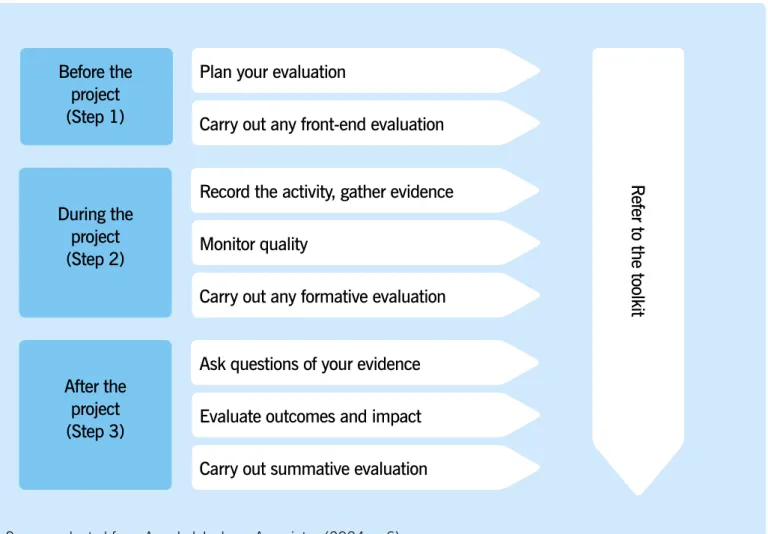
It is very important to ensure that any evaluation being carried out by museums in the East of England is planned and implemented to the same framework. This will ensure that the evaluation process and results are robust and consistent and that different studies can be compared to one another, as they are of the same high quality. There are three stages to carrying out your evaluation. These are set out in the
diagram below and relate to what you need to do before (Step 1), during (Step 2) and after (Step 3) the project.
In thinking about Step 1, remember that the more time committed to planning your evaluation, the more effective it is likely to be. That is why there is a checklist opposite to help you think about all the important issues before you start your evaluation. Each item in the checklist is referenced against sections in this toolkit where you can go for more detailed help. At the back of this pack there is also a pull-out planning tool that will enable you to ensure you have covered all the relevant issues when planning your evaluation. As well as a blank planning tool, an example of a completed one is included using case study information.
For Step 2 of your evaluation (i.e. ‘During the project’) refer to Section 6 and for Step 3 (‘At the end of the project’) refer to Sections 7 and 8 of this toolkit.
Carry out summative evaluation Before the
project (Step 1)
Plan your evaluation
Carry out any front-end evaluation
Record the activity, gather evidence Monitor quality
Carry out any formative evaluation
Ask questions of your evidence Evaluate outcomes and impact During the project (Step 2) After the project (Step 3) R
efer to the toolkit
5. Getting started: planning your evaluation and using the evaluation checklist 25
The checklist: What to think about before starting the project For more help go to
Rationale and context for evaluation
• What type of evaluation is it (front-end, formative and/or summative)? If your evaluation will cover more than one of these, how will your stages of evaluation link to one another?
• Why are you carrying out the evaluation – what is its purpose?
• Why will the findings be of interest and who will they be of interest to?
• Set your baselines – establish what quantitative information you have currently that relates to your project.
• Decide how you will plan your evaluation and measure any outcomes using the Inspiring Learning for All framework.
Section 2 Section 3 Section 8 Section 4 Section 4 & Appendix 2
Aims, objectives, outcomes and outputs
• What are the aims and objectives of this activity/project?
• What are the proposed outputs of this activity/project?
• What are the proposed outcomes of this activity/project?
Section 4 Section 4 Section 4
Methods
• What are the proposed evaluation methods and how will these capture information that can measure your aims, objectives, outputs and outcomes?
• What quantitative baseline information do you have or need in order to demonstrate the progression or ‘distance travelled’ by your project or activity?
Section 6 Section 2 & Section 4
Participants
• Who are your intended participants/target groups and how many people do you need to recruit or involve?
• What are your proposed sampling methods?
• Are your methods accessible to your intended audience?
• Do you need to consider any ethical issues? (e.g. are you working with vulnerable groups, do you need informed consent?)
• How will you collect feedback from people delivering the service to your visitors?
Section 4 & Section 9 Section 4 Section 9 Section 9 Section 6 Recording data
• What methods do you propose to use to record the data gathered?
• Will these allow you to interrogate the data easily?
• Will the storage of data comply with the Data Protection Act 1998?
• Would it be useful to compare your results to other data? If so, does your design allow for this (e.g. comparable categories for age, ethnicity etc.)?
Section 6 Section 7 Section 9 Appendix 3
5. Getting started: planning your evaluation and using the evaluation checklist 26
Other important considerations
• What are your time and resources?
• Is there already information available that would save you from duplicating data?
At the very least, in devising a good evaluation design you should:
• Establish the key question the evaluation is seeking to answer.
• Discuss the project/activity with any stakeholders as they can help to shape and design the study.
• Use data collection methods which are feasible in the time available and which will provide robust and meaningful results.
• Feed back your results in an appropriate way (different audiences can call for different styles) and make sure you fulfil any reporting requirements (e.g. progress reports, evaluation reports).
• Ensure you keep the Evaluation Officer informed during the planning, delivery and reporting stages of the process, if you work for a museum in the East of England Hub.
What data collection
methods are out there?
6. What data collection methods are out there? 28
6.1 Introduction
Which method should I use?
Evaluation does not need to rely solely on the more typical methods such as questionnaires and interviews. There are in fact a wide range of methods that can be used, depending on your resources and the audience you wish to survey. It is key to consider both your resources and your audience(s) as these factors will shape your choice of survey method. For example, a written questionnaire will not work well with young children and, although it might be more suited to use with adult users, if you do not have the time or resources to compile the results, then it will not be suitable either. In many situations, however, questionnaires still do prove to be a useful tool for gathering user feedback.
How many methods should I use?
It is often a good idea to use more than one evaluation method to survey your users, particularly if you are running a large project. This means that your methods are more accessible to a range of people (i.e. what might suit one person may not suit another), but can also provide you with more robust results because you are able to overcome data that may be unrepresentative or unreliable. Whether or not you use more than one method will be very much dependent on your resources and on what activity or service you wish to gather feedback on. It would be realistic to use just one method for a one-hour outreach session with young children, but a 12-week exhibition for example, should really seek to use two to three or more methods.
Whichever method you use, remember that you should be realistic at the start about how much time will be needed for the analysis. Quality of feedback (i.e. from a few well-thought out questions) is more important than quantity (i.e. from lots of poorly written questions).
What methods are available?
The diagram opposite covers some of the evaluation methods (types of data collection) that are suited to use in museums, although it is not exhaustive. It is set out to explore the evaluation methods that tend to be commonly used by museums, as well as those that are less often or rarely used. It should be stressed that many museums do already have in place many of the uncommonly or rarely used types of data collection methods in this diagram, but that the information which arises from these is not being utilised fully or coherently for evaluation purposes.
Do bear in mind that evaluation can be fun and can be built into the activities or services you deliver, so that the two become seamless, rather than evaluation becoming an ‘add-on’ at the end. This too, is covered in Section 6.7 below, under ‘Creative data collection methods’.
6. What data collection methods are out there? 29
Diaries Meetings (debrief)
Verbal comments Postcodes Take-up of offers (e.g. vouchers) and repeat bookings E-mails/letters of thanks or complaint Presentation/ artwork of user group Observation of users* Photographs & DVDs Media coverage Mystery shopping (Staff) facilitated visits Creative (‘fun’) methods Enquiries by members of the public Focus groups Questionnaires* Interviews*
* data collection methods covered in detail in the toolkit Comments books/forms Mentoring & peer review Commonly used Types of data collection Less commonly used Rarely used
6.2 How to phrase a ‘good’ question
One of the most important elements that will have a bearing on the quality of your feedback is the quality of your question. Ambiguous, poorly structured questions are likely to yield equally ambiguous and poor responses. So there are some basic principles that need to be followed in phrasing a ‘good’ question.
General advice
• Use simple language:
• Short sentences are best (containing 15 to 20 words maximum). • Write in the active voice rather than the passive voice.
• Avoid jargon or abbreviations and don’t use double negatives.
• Avoid leaving out articles (e.g. ‘a’, ‘the’) and pronouns (e.g. ‘it’, ‘them’ This usually happens when there is a lack of space but including them can actually help the reader arrive at the meaning more easily. It is better to omit a question if you have run out of space, than to squeeze it in and lose clarity of expression or presentation.
• Make sure your questions are not ambiguous, e.g. ‘In the last week ...’ – depending on the person, this could mean the previous seven days or the previous number of days to the last Monday.
• Ask one question at a time (e.g. ‘How would you rate your experience today?’ rather than ‘How would you rate your experience and enjoyment today?’).
• If you would like an open or closed response to the question, use appropriate language when asking the question (Section 4).
• Test out your questions on colleagues, family or friends before using the question with ‘real’ participants to check that the questions are understood in the way that they were intended.
6. What data collection methods are out there? 30
• It seems quite obvious but … don’t ask any
questions that you do not need the answers to! For example, you might decide to save time by using a survey written by another museum. However, just because that museum has asked for people’s postcodes on the survey, there is no reason to include this question on your survey if you are going to do nothing with this data. If you are going to ‘borrow’ questionnaires devised by others:
• Make sure in the first instance that their questionnaire has followed the guidelines stated here.
• Be prepared to spend time tweaking and improving it to suit your own needs.
Attitudinal questions
• If you want to ask attitudinal questions, you can use what is commonly referred to as ‘Likert’-style questions. This will measure graduated responses to a statement. For example, for the statement ‘I enjoyed my visit to the museum today’, you might have the response choices: (1) Strongly disagree, (2) Disagree, (3) Neither agree nor disagree, (4) Agree, (5) Strongly agree.
• You can use an even or odd number of responses. Using an even number by removing the middle, or neutral, category (‘Neither agree nor disagree’) constitutes a ‘forced choice method’. This has the advantage of encouraging respondents to engage with the statement where they may be tempted to go for the middle category as the easy, non-committal option. It may be, however, that the respondents are genuinely neutral about the statement and are being forced to express an opinion where they have none. Whether to use odd or even scales is a topic of debate amongst academics and there is no clear answer, so either approach is acceptable. You should ensure, however, that you are consistent with the number and definition of categories, i.e. you should stick to four, five or six- point scales throughout the survey.
• When using a Likert-style question, it is generally recommended that you use a five or six-point scale. Using a smaller number can mean that your results are less valid (because there is less choice) whereas using a larger number may put people off completing your survey.
• Providing a ‘Don’t know’ or ‘Can’t remember’ category is advisable when asking some questions, such as those that ask people to remember something, or to indicate their knowledge or understanding of a topic.
6. What data collection methods are out there? 31
6.3 Questionnaires About questionnaires
This method includes self-completion questionnaires (i.e. the respondent completes the survey him/herself) and facilitated questionnaires (i.e. used in structured interviews where the interviewer fills in the respondent’s answers). For the purposes of this toolkit, where
‘questionnaires’ are referred to, this equates to
self-completion questionnaires, although the advice presented below is just as applicable to facilitated questionnaires. Questionnaires are one of the most commonly used evaluation methods. They are particularly suitable when you would like to get a response from a large number of
people in a relatively short time (that wouldn’t be possible through interviews, for example), or if you would like to have a rolling survey (i.e. one that is ongoing or repeated at regular intervals during the year). They can ask for information about people’s knowledge, awareness, satisfaction, expectations, behaviour, preferences and beliefs, as well as demographic data (e.g. respondents’ age, ethnicity,
gender, etc).
It is not always necessary to collect demographic information, but it can be useful, particularly with longer surveys where you would like to analyse the results to see if certain groups of people are more likely to respond in a certain way (e.g. ‘younger people (aged under 25) tended to agree more strongly that they enjoyed the outreach session than older people (aged over 55)’). Don’t be fooled into thinking that a questionnaire left in a space for people to complete on their own whim will provide you with a representative picture of the demographics or opinions of your user group. In these instances, the response to the survey is entirely self-selecting (i.e. reliant on the desire of individuals to participate). It tends to be highly motivated people who do participate, often having had polarised experiences (‘I had a fantastic time and I want to tell you how wonderful your galleries are’ versus ‘I had an awful experience and I want to tell you how rude your staff were’) or people with the time and inclination to write their response (for example, a mother with three young children in tow is unlikely to be able to do this).
Top tips for writing and using questionnaires Top tips Basic formatting and content
• Questionnaires can be designed to be relatively short, asking a minimum of questions that would fit on a postcard, or they can ask more detailed questions that warrant more space. Ideally, questionnaires should be no longer than one double side of A4.
• In addition to the actual questions you wish to ask, a good questionnaire should also contain:
6. What data collection methods are out there? 32
*If you are not collecting personal information then you can omit the last sentence. • An introduction explaining the reason for the questionnaire and what
will happen with the results (e.g. ’We welcome your feedback on this exhibition. Your response will be treated in strictest confidence and will help us to make continual improvements to our future exhibition programme. Any personal information you provide will be stored and processed according to the Data Protection Act 1998’*).
• Instructions that tell respondents what to do with the questionnaire when they have completed it – do they post it in the box provided (where is the box situated?), do they hand it in to a member of staff (where and how?) or do they post it back to you (what is your address, is a pre-paid envelope provided?). Also indicate how a respondent is to answer a question (‘Tick or put a cross in the relevant box’, ‘Write your answer in here:’).
• A note thanking the person at the end for completing the questionnaire (and perhaps indicating how valuable their feedback is to you).
• Use upper case for whole words sparingly. If you want to emphasise importance use bold text.
• If you have a double-sided questionnaire, ask people to turn over at the bottom of the first page to make sure that questionnaires are fully completed.
• Number your questions and use Arabic numerals (1, 2, 3) rather than Roman numerals (i, ii, iii).
• Use text that can be easily read – Arial in point size 12 is best.
• Structure your questionnaire so that it asks more general questions first and moves on to specific questions further on.
Top tips Phrasing questions
• Employ a mix of closed and open questions. For example, asking if someone enjoyed their visit (eliciting a ‘yes/no’ answer) can be usefully supplemented by a question asking them to explain their answer (that way you know why they did or did not enjoy their visit).
• If you include demographic questions and are using pre-defined response categories (e.g. ❏ Male ❏ Female), make sure these fit with categories that are already widely used (such as those by the Office for National Statistics or local government offices). This means that you can compare your respondents’ characteristics to datasets that already exist (see Section 7 and Appendix 3).
• Questionnaires can seem more approachable if demographic questions are left to the end of the survey.
• Be consistent throughout the questionnaire with your method of selecting a pre-defined category (‘Tick’ or ‘Cross the relevant box’ or ‘Circle the relevant answer’). Don’t mix and match as this will cause confusion.
Top tips Resource implications
• Never underestimate the amount of time it will take to analyse the results. The longer the questionnaire and the more respondents you have, the more likely it is that you will need to input the data into a spreadsheet for analysis. Data entry can be very time consuming or costly, if you employ someone to do it for you. This is another reason for only asking questions for which you would like a response.
6. What data collection methods are out there? 33
Top tips Other considerations
• If you are collecting personal information on the questionnaire (see Section 9 if you aren’t sure what constitutes ‘personal information’), the questionnaire and any databases containing the questionnaire data must be stored and processed according to the Data Protection Act (1998). This means, for example, that you cannot leave questionnaires containing personal information out in galleries for public view.
• Trial your questionnaire before you use it properly. This can be as simple as asking a few colleagues, family members or friends to read it through and have a go at completing it. Questions that seem straightforward to you might not to others. Even a quick trial can save you from results that are unusable later on because respondents did not understand questions, leaving them blank or reading their meaning in a way that you did not intend.
6.4 Interviews About interviews
Interviews can take place informally (e.g. a conversation between a visitor and front-of-house member of staff) or more formally, where the interviewer has a predefined set of questions to ask of the interview participant. Structured interviews involve using only the set of pre-defined questions; semi-structured interviews involve using a set of pre-defined topics but allowing for the interviewer to ask them in his/ her own way, depending on how the interview progresses. Interviews
can take place face-to-face or via the telephone. With face-to-face interviews it can be easier for the interviewer to read the participant’s body language, whereas telephone interviews can have the added benefit of enabling the interviewing of non-users.
Top tips for planning and running interviews Top tips Planning the interview
• Decide how you will identify and chose your participants. Are you seeking views from non-users and/or a specific type of user? Will you need a sampling strategy (Section 4)? Will you need to approach people in advance to arrange their participation or will you approach people ‘cold’ at the time of the interview?
• Decide on your list of questions. Remember that interviews offer you the chance to gather a richer narrative of feedback from participants and so your questions should reflect this; take the opportunity to ask a few more open questions than would be possible with a questionnaire.
• Only ask personal questions if you absolutely need to do so.
• Decide whether or not you will take notes or make a recording during the interview.
Meeting the past at the Fitzwilliam Museum
6. What data collection methods are out there? 34
Top tips During the interview
• Make sure the interview isn’t any longer than necessary. An exit survey or gallery interview should last no more than 15 minutes maximum.
• Be upfront and honest with your participant at the start of the interview (or when recruiting participants) about the length of time it will take and how their comments will be used.
• If your interview is semi-structured, then it is appropriate to probe the
participants for further information if you feel that their first answer doesn’t give you the depth of information you were hoping for.
• Leave any personal questions to the end of the interview, when a rapport has been built up and the participant is likely to feel more comfortable about providing you with this information. Try to use pre-defined categories for as many personal questions as possible (e.g. age, ethnicity) to avoid causing any embarrassment. Don’t try to cajole participants into providing any personal information they are not comfortable giving!
• Hold the interview in an appropriate place, away from any disruptions but not in an isolated place. Ensure that you have colleagues nearby, should you or the interviewee need to call upon them suddenly.
Top tips Resource implications
• Following the interview, you will need to write up any notes or transcripts promptly to ensure that information is not forgotten. Although this is not as time consuming as with focus groups, it can still take more time than using self-completion questionnaires, particularly if you have used a lot of open-ended questions. Make sure that the necessary resources to do this are considered in the planning stages.
Top tips Other considerations
• If you are collecting personal information during the interview (see Section 9 if you aren’t sure what constitutes ‘personal information’), the notes/transcripts and any databases containing this information must be stored and processed according to the Data Protection Act (1998).
• Interviews should start off with the interviewer explaining the purpose of the discussion and the rights of the participants under any legislation (e.g. the Data Protection Act 1998) or according to best practice guidance (e.g. the right to withdraw from the research at a later date). Participants should be provided with an information sheet and two copies of a consent form (see Appendix 6). Both copies of the latter should be signed and one returned to the evaluator.
6. What data collection methods are out there? 35
Plan the evaluation
Link to the toolkit
Case study: Analysis of gallery questionnaires at the Fitzwilliam Museum, University of Cambridge
The Fitzwilliam evaluated visitors’ impressions of their visit to the Fitzwilliam Museum during Museums and Galleries Month Welcome Weekend 2007. Information was collected through a self-completion questionnaire and interviews. Using the data from 122 completed questionnaires, a report was drawn up looking at visitor satisfaction; it included the use of charts and tables. Examples of these for the following question can be seen below:
‘How do you feel about your overall visit today compared with your expectations?’ The following table and chart shows the responses to this question for all visitors:
The data was further broken down for ‘first-time’ visitors. You can see from the chart and table below, that many more first-time visitors found the experience better or much better than expected:
This is explained by the fact that regular visitors are likely to know what to expect and therefore find that the visit meets their expectations. This approach illustrates the usefulness in interrogating the data according to different categories of visitor and of visually representing numerical data so that it can be easily understood by the audience. Expectation rating (all) Number (Total=122) % Much worse 0 0 Worse 0 0
About the same 56 46
Better 47 38 Much better 19 16 Expectation rating (first time) Number (Total=122) % Much worse 0 0 Worse 0 0
About the same 14 29
Better 24 49
6. What data collection methods are out there? 36
6.5 Focus groups About focus groups
Focus groups involve discussion among a group of people on a subject that is the focus of conversation. They are usually facilitated discussions (i.e. the convener will have a set of questions for the group to explore). Focus groups are good at providing you with qualitative information and, when facilitated well, will allow you to tease out a greater depth of information about people’s attitudes, experiences and beliefs on your subject of focus. For example, if participants make certain statements, you can follow these up with a series of probing questions that ask them to explain and qualify their opinions in a way that would not be possible with a self-completion questionnaire (Section 6.4). Focus groups are good at providing you with a rich source of narrative, expressed in your participants’ own words; these quotes often provide useful ‘sound bites’ in reports. Focus groups are unsuitable for providing you with quantitative
information because you are generally surveying a relatively small group of people whose views are not necessarily representative of the whole population. The quality of information that comes out of focus groups is reliant on the skills and experience of the facilitator(s).
Variations on interviews
There are two variations on interviews that have been used successfully by the consultants Ipsos-MORI to solicit the views of under-represented groups. These are ‘pyramid interviewing and peer interviewing.
With pyramid interviewing a ‘seed’ participant is identified. This might be a user with whom the museum already has contact or it could be a non-user, who is then interviewed by the organisation. If they are willing, they are then tasked with interviewing a handful of people, such as non-users, from their friends, family and acquaintances. The seed participant is fully briefed about the issues for feedback and is reimbursed for their time. They then feed back the results of all the interviews to the organisation concerned.
Peer interviewing is slightly more formal but similar in that it involves identifying a person from a specific group of people whom the museum would like to gather feedback from but with which they have no links. One person from this group is fully briefed about the project and given training in best practice skills for interviews, including the themes and questions on which the museum would like a response, and then has the flexibility to interview their peers in the most appropriate way for that group. The results are then fed back to the museum. The peer interviewer is reimbursed for their time.