I
I
m
m
p
p
l
l
e
e
m
m
e
e
n
n
t
t
a
a
t
t
i
i
o
o
n
n
S
S
t
t
r
r
a
a
t
t
e
e
g
g
i
i
e
e
s
s
:
:
“
“
C
C
o
o
l
l
l
l
a
a
b
b
o
o
r
r
a
a
t
t
i
i
o
o
n
n
i
i
n
n
P
P
r
r
i
i
m
m
a
a
r
r
y
y
C
C
a
a
r
r
e
e
–
–
F
F
a
a
m
m
i
i
l
l
y
y
D
D
o
o
c
c
t
t
o
o
r
r
s
s
&
&
N
N
u
u
r
r
s
s
e
e
P
P
r
r
a
a
c
c
t
t
i
i
t
t
i
i
o
o
n
n
e
e
r
r
s
s
D
D
e
e
l
l
i
i
v
v
e
e
r
r
i
i
n
n
g
g
S
S
h
h
a
a
r
r
e
e
d
d
C
C
a
a
r
r
e
e
”
”
:
:
D
D
i
i
s
s
c
c
u
u
s
s
s
s
i
i
o
o
n
n
P
P
a
a
p
p
e
e
r
r
W
W
r
r
i
i
t
t
t
t
e
e
n
n
f
f
o
o
r
r
T
T
h
h
e
e
O
O
n
n
t
t
a
a
r
r
i
i
o
o
C
C
o
o
l
l
l
l
e
e
g
g
e
e
o
o
f
f
F
F
a
a
m
m
i
i
l
l
y
y
P
P
h
h
y
y
s
s
i
i
c
c
i
i
a
a
n
n
s
s
Authors
Daniel Way, Linda Jones, Nick Busing
Contacts:
Dr. Daniel O. WayDirector, Postgraduate Education Department of Family Medicine
University of Ottawa 43 Bruyere Street Suite 375, Floor 3JB Ottawa ON K1N 5C8 Phone: (613) 562-6335 Fax: (613) 562-6336 Email: [email protected] Linda Jones Past Chair Nurse Practitioner’s Association of Ontario 43 Bruyere Street Suite 375, Floor 3JB Ottawa ON K1N 5C8 Phone: (613) 562-0050 ext. 1614 Fax: (613) 562-6014 Email: [email protected] Dr. Nick Busing Chair
Department of Family Medicine
University of Ottawa 43 Bruyere Street Suite 375, Floor 3JB Ottawa ON K1N 5C8 Phone: (613) 562-6335 Fax: (613) 562-6336 Email: [email protected]
May 18, 2000
I
I
N
N
D
D
E
E
X
X
1.0
Background
2.0
Overview of the Research Project
3.0
A Definition of Collaborative Practice
4.0
Structured Collaborative Practice: A Core Model for Family Physician/Nurse Practitioner
Collaboration
5.0
Summary and References
Appendix 1
Table 1
. Primary Healthcare Services: FP/NP Shared and Separate Functions
Appendix 2
1.0 Background
In the recent past, more than twenty major papers have described the need to establish Primary Healthcare as the foundation for an integrated delivery system. In June of 1999, the Ontario College of Family Physicians (OCFP) continued the dialogue by releasing a discussion document entitled “Family Medicine
in the 21st Century: A Prescription for Excellent Healthcare”1 The following September, the Board of the
OCFP hosted Family Medicine Forum I. The forum brought together all the major players in Primary Care Reform in Ontario for the first time. The purpose of the meeting was to generate further dialogue regarding the key proposals of the document. The end result was a commitment by government, the Health Services Restructuring Commission, and the major healthcare organizations to continue working together towards an enhanced primary healthcare delivery system.
The end goal of the OCFP discussion paper is to ensure that every person in the province has access to comprehensive family medicine services and continuity of care. The basket of services that need to be provided were first described in the 1996 PCCCAR report “New Directions for Primary Healthcare”.2 If Family Doctors are to deliver these comprehensive services they require the support of a Family Healthcare infrastructure. The infrastructure would include community-based group practices or practice networks composed of Family Physicians and Nurse Practitioners supported by other healthcare professionals depending upon the needs of the practice population. A similar model was described by the Health Services Restructuring Commission in their December 1999 report entitled “Primary Health Strategy”.3 Both papers recommended that Family Doctors and Nurse Practitioners establish a “collaborative practice” to provide the PCCCAR basket of services within a group practice or practice network.
While supporting collaborative practice, the OCFP identified some major concerns regarding the establishment of such practices, including the rigidity of adopting a single model for collaboration, funding mechanisms and the liabilities of physicians entering into a shared care relationship.
To address these concerns, the OCFP agreed to establish a joint Task Force with the Registered Nurses Association of Ontario to review collaborative between Family Physicians and Nurse Practitioners. The research project team involved with “Improving the Effectiveness of Primary Healthcare Delivery through
Nurse Practitioners / Family Physicians Structured Collaborative Practice” were contacted to develop an
initial paper or primer on collaborative models, as a vital first step in this process. Issues related to funding mechanisms and shared liability will be discussed in future papers.
1.0 Background and 5.0 Summary refer to OCFP positions and proposed activities related to Primary Health care improvement and collaborative practice with Nurse Practitioners. For further information contact:
Ms. M. Janet Kasperski, RN, MHSc, CHE
Executive Director
THE ONTRIO COLLEGE OF FAMILY PHYSICIANS
357 Bay Street, Suite 800 Toronto, Ontario M5H 2T7
Phone: (416) 867-9646 • Fax: (416) 867-9990
Email: [email protected]
2.0 Overview of the Research Project
The research project is sponsored jointly by the University of Ottawa’s Department of Family Medicine and the School of Nursing. Funding is provided by the Health Transition Secretariat of Health Canada.4 The project involves the development and evaluation of case studies that focus on (a) collaborative nurse practitioner / family
physician practice models and (b) postgraduate education for student nurse practitioners and family medicine residents.
The research projects intervention was used to develop this paper that provides a description of collaborative practices that build appropriately upon the strengths that each professional partner brings to the practice. The paper does not attempt to offer one model that must be used in each practice setting; rather, it describes the seven elements that form the framework or structure found in successful collaborations and a process for determining the roles and functions of the collaborative partners based on role guidelines.
The description of this structure and of partner functions is expected to serve as the foundation for specific practice groups to develop an optimal collaborative practice. By emphasizing flexibility in model design and implementation, the practice groups will be able to adapt the structure and function of successful collaborative practice in a manner that preserves the characteristics of the partners’ preferred practice styles and respects the needs of the patient population and any geographical variations or limitations.
3.0 A Definition of Collaborative Practice
Current Medical and Nursing literature, various federal and provincial policy statements, and several task force reports have emphasized the need for healthcare reform to include interdisciplinary teams working in “collaboration” to provide integrated healthcare. According to Kyle, collaboration “is a concept that has come of age. Whether in the healthcare area, or in the global context, the players are urged to pull together to add to each one’s individual part to learn from one another. Collaboration has potential to involve the client, energize the professional and integrate the healthcare system.”5
Unfortunately, collaboration has become a buzzword that too few healthcare planners or providers can accurately define. The research team reviewed the Medical and Nursing literature and received input from Nurse Practitioners and Family Physicians who are experienced in collaborative practice to develop the following definition:
“Collaborative Practice is an inter-professional process for communication and decision making that enables the separate and shared knowledge and skills of care providers to synergistically influence the client/patient care provided.”
While collaboration is certainly about positive working relationships amongst professionals, it is much more. Collaboration is a way of working, organizing, and operating within a practice group or network in a manner that effectively utilizes the provider resources to deliver comprehensive primary healthcare in a cost-efficient manner to best meet the needs of the specific practice population. Successful collaboration benefits patients, providers and the healthcare setting, as illustrated by the following comments of providers experienced in collaboration.
Patients:
“Patients win because they have two providers they can turn to.”
“Our client care is so complex. I can focus on treatment knowing my partner will pick up on prevention.”
Providers:
“Lightens the load especially with complex patients.”
“Putting our minds together and coming up with new ideas is enriching.”
Healthcare settings:
“Gives more flexibility with scheduling – more choice.” “Better use of professional skills.”
Collaborative relationships are based on provider equality. The relationships are not hierarchical, nor are they dependent upon the supervision of one professional group by another. Likewise, collaborative practice is neither a “physician replacement” nor “physician extender” model. The model recognizes the strengths and integrity of each of the professional partners’ approach to care delivery.6,7 Within a shared practice,
“Nurses practice nursing. Physicians practice medicine.”
While efforts to provide patients with “shared care” are the essence of the Collaborative Practice model, not all patient encounters require the input of the other discipline. Experienced Family Doctors and Nurses Practitioners quickly learn when an integrative approach is needed and when it is not.
In summary, collaborative practice involves working relationships and ways of working that fully utilizes and respects the contribution of all providers involved.
4.0 Structured Collaborative Practice: A Core Model for Family Physician/ Nurse
Practitioner Collaboration:
Ontario is a diverse province. Models of collaboration need to be flexible to meet the needs of the various practices; however, a common structure and a process for identifying the roles and functions of the practice partners will facilitate the education of the partners and lead to success in the implementation of practice collaboration.
4.1 Essential Elements for a Successful Collaborative Practice
The literature has identified seven elements that are deemed essential for optimum collaboration.8,9,10 Further discussions with collaborating Family Doctors and Nurse Practitioners confirmed their importance. The elements of responsibility / accountability, ordination, communication, co-operation, assertiveness, autonomy and mutual trust and respect serve as a framework or structure. A core model for collaboration is one based on implementation of these elements and is, thus, termed “structured collaborative practice.”
The essential elements for successful collaboration are described as follows: .1 Responsibility and Accountability
Involve both independent and shared accountability. Shared accountability means that both partners actively participate in decision making and accept shared responsibility for the outcomes of the care plan.
.2 Co-ordination
Includes efficient and effective organization of the necessary components of the treatment plan. The collaborating providers need to make joint decisions about who will do what to ensure that the treatment plan is carried out in a manner that reduces duplication of effort and prevents fragmentation of care. Mechanisms used to increase co-ordination include bi-directional consultation, referral and transfer of care. Appropriate use of these mechanisms increases the
likelihood that comprehensive Primary Healthcare will occur and guarantees that the most appropriately qualified professional is addressing the patients’ problem.
.3 Communication
Includes the communication of both content and relationship. Each professional is responsible for sharing with the other provider critical information regarding the patient and issues relating to decision-making. The ability to present information in a manner that is relevant, concise, and timely is critical to the development of a collaborative relationship. As well, the content must be presented and received in context of a relationship.
The message will be received differently depending upon how the partners view one another. Feeling superior or inferior, rather than equal, will influence how the information is sent and received. Clear articulation of the purpose for sharing information to provide an overview of what is expected from the partner and the ability to convey knowledge and skill through concrete information sharing are essential components of positive communication between partners.
Collaborative communication may sound like “positive arguing” as each partner feels free to voice ideas and concerns; however, respectful listening ensures that both partners receive the joint input needed to make effective patient care decisions. A key component of effective communication is mutual support and affirmation that the partnership is working well. Verbal communication fosters relationship building. Successful collaboration partners build these opportunities into their practice.
.4 Co-operation
Involves acknowledging and respecting other disciplines’ professional opinions and view points while being willing to examine and alter your own professional views and perspectives
.5 Assertiveness
Involves individual providers supporting the views and perspectives of their won profession with confidence, assured of the value of their won contribution.
Assertiveness goes hand in hand with co-operation. The partners’ respect for one another’s professional approach includes the ability to present opinions and viewpoints in a manner that fosters the integration of the two approaches resulting in a unique or synergetic solution.
Integration of individual approaches = synergism 1 + 1 = 3 Collection of individual approaches = addition 1 + 1 = 2
The co-operation and assertiveness of each partner means that decisions are made based on consensus. Each provider agrees to support the decision and the resulting integrative plan. Consensus is facilitated by the full participation of the partners using a balance of co-operation and assertiveness.
.6 Autonomy
Autonomy involves the authority of the individual providers to independently made decisions and carry out the treatment plan. Autonomy is not contrary to collaboration and serves as a complement to shared work. Without the ability to work independently, the provider team becomes inefficient and work becomes unmanageable. As members of self-regulated health professions, Family Physicians and Nurse Practitioners are autonomous providers under the Regulated Health Professionals Act. Both providers have independent authority to act within their
respective scopes of practice and to initiate assigned controlled acts. In so doing, they are liable for their own decision-making and the outcomes of their own actions. The College of Nurses of Ontario’s “Standards of Practice for the RN (EC)” describes the specific circumstances in which a Nurse Practitioner must consult with a physician.6 Both partners need to fully understand and support practice autonomy, as well as, shared decision making from a liability perspective.
.7 Mutual Trust and Respect
This is common to and binds all of the other elements together. Each provider must be able to depend upon the integrity of the other as the foundation for their professional relationship.
Without trust and respect, co-operation cannot exist. Assertiveness becomes threatening, responsibility is avoided, communication is hampered, autonomy is suppressed and co-operation is haphazard (Norsen, 1995).10
These seven elements form the framework or structure for collaboration, however, the challenge for Nurse Practitioners and Family Physicians who wish to successfully work together is to determine how to implement and maintain these elements in day-to-day practice.
4.2 Process for Determining the Roles and Functions of the Collaborating Partners
Individual collaborative practices differ depending upon the work that needs to be done and the decisions about who is best suited to perform which component of care. Each practice needs to review the day-to-day functions that will best meet the needs of the practice population. The essential elements need to be implemented in a manner that reflects the needs of the practice population, the operational logistics prescribed by the practice site, the legislation, policies and licensing requirements of the provincial jurisdiction, and the skill mix of the collaborating partners.
The process for identifying the roles and functions of the collaborating partners includes a review of the services the partners wish to deliver. Common to all recent papers on Primary Healthcare is a delineation of the list of primary healthcare services. The PCCCAR list is the most widely known and accepted.2 It is anticipated that each group practice or practice network will be provided with incentives for providing the complete basket of PCCCAR services. In most communities, Family Doctors provide much more than these Primary Healthcare services. The list of added services and the time devoted to each of the PCCCAR services is dependent upon the infrastructure of the local healthcare setting and the expressed needs of the practice population. As an example, Family Doctors in a rural setting may need to perform minor surgeries to reduce travel time for patients due to the distance of the community from the nearest hospital. An inner-city practice may need to develop a strong focus on mental health and addiction services to meet the needs of the homeless population. In deciding upon the role and functions of the practice partners, the group practice or practice network partners will need to identify the needs of the practice population and the specifics of the practice setting. They will then make clear decisions regarding the services that need to be offered by the groups, as well as the services that will be provided by individual practice members including the collaborating Family Physician and Nurse Practitioner.
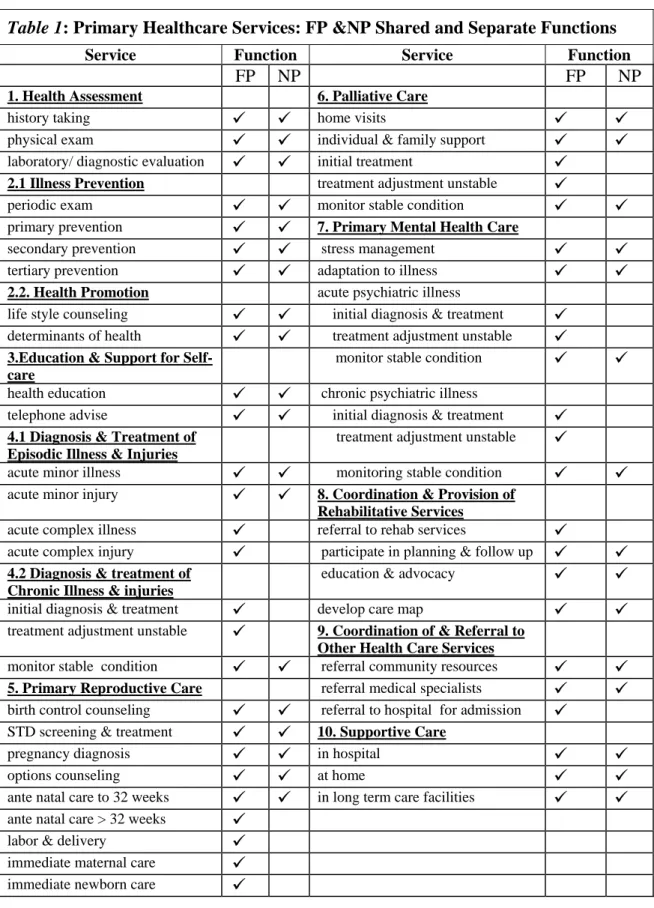
In reviewing the role and functions of the Nurse Practitioner, the partners need to understand the distinct and overlapping strengths that both disciplines bring to the table. Family Doctors and Nurse Practitioners, as respective medical and nursing specialists in Primary Healthcare, share knowledge and skills and beliefs and values regarding care delivery.11,12 Table 1 (Appendix 1) lists the activities associated with Primary Healthcare services and identifies the separate and shared functions.
“Function” is defined as having both the knowledge and skills and the legislated autonomy to participate in an activity.
Family Physicians are able to provide the complete PCCCAR basket of services within their scope of practice. As experienced Registered Nurses, Nurse Practitioners contribute nursing’s approach to health promotion, disease prevention, patient education, and supportive care and co-ordination. Within the scope of practice of their extended role, the Nurse Practitioners contribute to periodic health exams for people of all ages, the diagnosis and management of acute minor illnesses and injuries, many of the reproductive and mental illness services, screening and early detection of chronic illness, as well as, the monitoring of stable chronic illnesses, including psychiatric disorders, palliative care and rehabilitative care. The functions of the Nurse Practitioner could be expanded further through medical delegation and the use of medical directives, especially in the area of medication renewal or adjustment for persons with chronic disorders.
The process for identifying the primary roles and functions of the collaborating partners would include a review of the list of services being offered by the group. Each partner would identify the unique knowledge, skills and preferences that he/she brings to the practice. In keeping with the goal of fully utilizing provider resources in the most effective and efficient manner possible, the group members would make decisions resulting in a clear understanding about who will do what.
The end result of the review process would be unique collaborative practices throughout the province that will result from a conscientious review of the practice population, the practice setting and the unique talents and preferences of the collaborating partners. This thoughtful process to tailor the collaborative practice model to the unique needs of the practice replaces a cookie-cutter approach, but is key to building a positive relationship incorporating the seven essential elements described in the structure of a successful collaborative practice. Appendix 2 describes two examples of such unique practices.
5.0 Summary
This paper describes a core model for establishing a successful collaborative practice. The core model is based on a framework or structure that consists of seven essential elements. The model includes a process for identifying the roles and functions of the collaborating partners. The model allows each group practice or practice network to design or tailor its operations according to the needs of the practice population, the geographic location of care and the talents of the practice partners. By so doing, each practice will be able to deliver the most effective and efficient care in a manner that fully utilizes the knowledge, skills and preferences of its provider resources.
The establishment of a collaborative practice that supports the essential seven structural elements requires a funding model that reflects the equality of the partners. Models that include an employer-employee relationship are, therefore, not viewed favorably. The use of a process to clearly identify roles and functions will help to address some of the liability issues. Successful demonstration models will help to address the rest. The OCFP remains committed to working with its nursing colleagues to provide guidance, advice and leadership in the establishment of successful collaborative practices throughout the province to provide patients with better access to comprehensive services and continuity of care.
Appendix I
Table 1: Primary Healthcare Services: FP &NP Shared and Separate Functions
Service Function Service Function
FP
NP
FP
NP
1. Health Assessment 6. Palliative Care
history taking
9
9
home visits9
9
physical exam
9
9
individual & family support9
9
laboratory/ diagnostic evaluation
9
9
initial treatment9
2.1 Illness Prevention treatment adjustment unstable
9
periodic exam
9
9
monitor stable condition9
9
primary prevention
9
9
7. Primary Mental Health Caresecondary prevention
9
9
stress management9
9
tertiary prevention
9
9
adaptation to illness9
9
2.2. Health Promotion acute psychiatric illness
life style counseling
9
9
initial diagnosis & treatment9
determinants of health9
9
treatment adjustment unstable9
3.Education & Support for Self-care
monitor stable condition
9
9
health education9
9
chronic psychiatric illnesstelephone advise
9
9
initial diagnosis & treatment9
4.1 Diagnosis & Treatment of Episodic Illness & Injuries
treatment adjustment unstable
9
acute minor illness
9
9
monitoring stable condition9
9
acute minor injury
9
9
8. Coordination & Provision of Rehabilitative Servicesacute complex illness
9
referral to rehab services9
acute complex injury
9
participate in planning & follow up9
9
4.2 Diagnosis & treatment of Chronic Illness & injuries
education & advocacy
9
9
initial diagnosis & treatment
9
develop care map9
9
treatment adjustment unstable
9
9. Coordination of & Referral to Other Health Care Servicesmonitor stable condition
9
9
referral community resources9
9
5. Primary Reproductive Care referral medical specialists
9
9
birth control counseling
9
9
referral to hospital for admission9
STD screening & treatment9
9
10. Supportive Carepregnancy diagnosis
9
9
in hospital9
9
options counseling
9
9
at home9
9
ante natal care to 32 weeks
9
9
in long term care facilities9
9
ante natal care > 32 weeks9
labor & delivery
9
immediate maternal care
9
immediate newborn care
9
Table list of services adapted from PCCCAR & HSRC Reports2,3
Appendix 2
E
XAMPLES OFF
LEXIBILITY IN THED
ESIGN OFC
OLLABORATIVEP
RACTICESExample #1
The Aboriginal population served by a Family Healthcare practice has a type II diabetes rate of 42%. Considering the needs of this population, the physicians, nurse practitioners, and clinical nurses have received added education in diabetes management. One day a week has been set aside for diabetic appointments during which the NP and FP work together closely. The FP sees unstable patients with multi-system problems and the NP monitors patients with stable conditions and, supported by medial directives, makes treatment adjustments for less complex patients. The NP spends a second day making home visits to housebound patients and/or facilitating a diabetic support group or giving community presentations. The rest of the week for the NP consists of two days for periodic health exams, appointments for episodic and stable chronic illness, and life-style and supportive counseling; and tow half days for walk-in appointments.
Example #2
An urban practice serves a multi-cultural population with large youth and seniors populations. The practice is located between two large high schools and three seniors’ apartment buildings. One Nurse Practitioner and one Family Physician have a special interest and have acquired added knowledge and skills related to adolescent care. The two providers run a late afternoon-early evening youth clinic twice a week. A second Family Physician/Nurse Practitioner pair is involved in senior and palliative care.
References
1. Ontario College of Family Physicians. (1999) Family Medicine into the 21st century: a prescription for excellent healthcare.
2. Subcommittee on Primary Care of the Provincial Co-ordinating Committee on Community and Academic Health Science Centre Relations (1996) New Directions in Primary Health Care. PCCCAR report to the Minister of Health Ontario, 21–31.
3. Health Services Restructuring Commission. (1999) Primary Healthcare Strategy. Report to the Minister of Health and Long Term Care, 61–66.
4. Way, Daniel, Baskerville, Bruce, Busing, Nick, Jones, Linda, Humbert, Jennie, Doucette, Suzanne. (1998)
Improving the effectiveness of Primary Health Care delivery through Nurse Practitioner / Family Physician
structured collaborative practice. Research proposal to Health Transition Fund Secretariat, Health Canada.
5. Kyle, Marie. (1995) Collaboration Chapter 12 in Synder, M & Mirr M.P. (eds.) Advanced Practice Nursing, A Guide to Professional Development. New York: Springer Publications, 169–181.
6. Way Daniel O., Jones Linda M. (1994) The family physician-nurse practitioner dyad: indications and
guidelines. CMAJ 151(1) 29–34.
7. Jones, L, Way D. O. (1997) Is there room for NPs and MDs … in a community health centre. Chapter 4 in Patterson, Chris (editor) Visions and Voices: the Nurse Practitioner Today. Toronto: Lugus , 112-128. 8. Weiss Sandra J, Davis H. Paul. (1985) Validity and reliability of a collaborative practice scales. Nursing
Research, Sept/Oct: 299–305.
7. Baggs Judith Gedney. (1994) Development of an instrument to measure collaboration and satisfaction about care decisions. Journal of Advanced Nursing, 20:176–82.
9. Norsen, Lisa , Opladen, Janice & Quinn, Jill.. (1995) Practice model: Collaborative practice. Critical Care Nursing Clinics of North America, 7(1): 43–52.
10. College of Nurses of Ontario (1998) Standards of practice for Registered Nurses in the Extended Class (Primary Health Care Nurse Practitioners). www.cno.org
11. Canadian Medical Association. (1994) Strengthening the Foundation.
12. Nurse Practitioners’ Association of Ontario. (1993) Standards of practice for Nurse Practitioners. Conceptual Framework.