A Comparative Analysis of In-house and Outsourced
Development in Software Industry
Syed Aitzaz Haider
Dept. of Software Engineering
University of Lahore
Lahore, Pakistan
Ghulam Samdani
Dept. Of Software Engineering
University of Lahore
Lahore, Pakistan
Mubashir Ali
Dept. of Computer Engineering
Bahria University
Islamabad, Pakistan
Muhammad Kamran
Dept. of Computer Engineering
College of EME, NUST
Islamabad, Pakistan
ABSTRACT
These days, many software companies handover their software projects to outsourcing organizations. Outsourcing refers to handing over some or complete business process activities to some outside manufacturer. Many software companies now have started feeling the need of outsource development due to numerous factors that include high cost of experienced in-house developers, tough project schedules, lack of knowledge about domain and technology of certain complex software systems. Outsourcing is causing globalization, knowledge sharing, achieving quality and minimizing production cost. Software project outsourcing is common in many software companies, this makes it an active and interesting research area. This paper investigates the current state of the art in software project outsourcing. An effort has been made to answer an important question about outsourcing “Is software outsourcing a gain or loss?” A detailed comparison of in-house software development and outsourced software development has been conducted to show when and where outsourcing is useful for an organization and where it is not.
Keywords
Software Project Outsourcing, Offshore Software Development, Global Software Development
1.
INTRODUCTION
During the industrial revolution from 1750-1900 Europe was booming. It was dire need of outsourcing that pushed many companies to hire third-parties for performing different functions[1]. The topic of outsourcing has changed face overtime. Offshore outsourcing became popular in the 1950’s[1]. From the last few decades outsourcing in software industry has been a very hot topic of discussion. Outsourcing has been studied by several researchers. The most prominent work is done by Smith and Angela[1] in which they comprehensively describe the need of outsourcing and its various perspectives. Another important research about outsourcing has been conducted by Marvin Taylor[2] in which they elaborate the global trends of outsourcing and their impacts. They have described how outsourcing has greatly affected software and IT industry. The necessity of IT Outsourcing has been illustrated by Bott [3] in which author clearly describe how outsourcing is providing its benefits in different industries especially in IT related projects. Outsourcing driving innovation has been depicted by Gordon and Mack [4].
Outsourcing has been supposed to minimize the cost of production as well as complexities of tasks which are either not feasible to be performed in-house or some time not achievable through in-house activities due to lack of infra-structure, required expertise or other technical aspects[5]. It may also allow firms to concentrate on their core activities[6]. Today many business activities are mostly outsourced to different specialized organizations in that domain. It allows organizations to concentrate on their core and mitigate risk. Outsourcing is mostly fruitful in those areas where face-to face interaction is not needed[1]. On one hand where people argue that outsourcing is a cause of across the borders relationships and organizational benefits in terms of cost, quality and goodwill; others negate the benefits of outsourcing by saying that outsourcing is a cause of huge job loss, cultural and national conflicts and damage to reputation[7]. Outsourcing impact is not only confined to organizations and businesses that involve in this activity but government, public, country and economy also enjoy its positive or negative impacts. Due to this activity LDC’s are also getting fruitful effects on their economy[8].
This paper provides a comprehensive study about different motivational factors of outsourcing especially in software industry. It elaborates the scenarios in which outsourcing is more beneficial than in-house software development. In this paper we have tried to present the various positive and negative aspects of outsourcing in political, economic and organizational aspects.
This paper has been organized in the following sections:
Section 1: Introduction
Section 2: Motivational factors of software outsourcing
Section 3: Advantages of software outsourcing
Section 4: Disadvantages of software outsourcing
Section 5: Comparative study of software outsourcing and in-house software development.
2.
MOTIVATIONAL FACTORS OF
SOFTWARE OUTSOURCING
While considering the need of outsourcing we generally consider several key factors which are strategic, economic, political and technological factors. Outsourcing is generally preferred for more than one reason. Outsourcing in many cases is done due to lack of expertise in some specific software engineering process[8]. While in other cases outsourcing is considered due to cost saving and technological factors[9].
19
2.1
Cost factor
The most important factor that is considered is cost factor[10]. Sometimes it is very expensive in terms of cost to hire some in-house expert especially if the project is to be completed in very short time duration. In addition to this software cost of development in some countries is too high that software organizations feel it better to transfer their software project to some external offshore software company that accomplish this task in relatively less cost[11].
2.2
Core expertise/ Specialty
In many cases when a software company gets such type of software in which it doesn’t have enough expertise then performing this process in-house will lead to goodwill and quality compromise risk[12].The complete project failure can also occur if the project is completed in-house in spite of having lack of expertise in the relevant domain. In such cases companies prefer to hand over such type of projects to some outside software company which have enough skill and expertise in that particular sort of software project.
2.3
Global Access Factor
Software companies desire to penetrate into global market to widespread their business. This factor also motivates software companies to outsource some of their projects to offshore software companies in order to access global markets[13][2]. In this era of competition software companies tend to widespread their goodwill into global market by penetrating into different geographical markets and regions.
2.4
Success Factor
Outsourcing increases the software success ratio because of deployment of highly expert team on project which otherwise was not available in home organization.
2.5
Quality factor
When a software company doesn’t have expertise in some project then it will outsource this project to some software company which has high expertise in that particular sort of project[14][9]. This will lead towards quality software project.
2.6
Goodwill factor
Increase in project success ratio will ultimately lead toward more good will in the software market thus increasing company revenue by getting more projects
2.7
Time Factor
Software companies consider outsourcing extremely beneficial when projects are to be completed in very short duration. Time is an important factor to be considered in any project. When it is not sure whether company will meet the required objective in specified time duration they generally outsource the software project to external expert software organization[15].
2.8
Speed factor
This is another factor where software outsourcing is considered vital in software industry. Due to tight and busy schedule of software organizations most of the software projects exceed their deadlines. In this case software outsourcing provides a solution for the organizations to complete their software projects within due time[16].
3.
ADVANTAGES OF SOFTWARE
OUTSOURCING
This section explains main benefits associated with software outsourcing.
3.1
Services from native born employees
Outsourcing allows firms to penetrate in foreign markets. Getting the services from native-born employees can assist firms to adjust to the customs and traditions of the foreign market [14].
3.2
Around the clock working
Outsourcing allows firms to work 24 hours a day when home and outsource organizations are in different geographical regions or continents. If there is a lot of time difference then outsource organization and home organizations will have to work more than just working hours and in some cases they will work 24 hours a day. In this way they will be able to complete the project quickly[14].
3.3
Less development cost
Software projects are mostly outsourced when cost of in-house development is more than other regions due to higher wage rates and salaries. In such situations home organization will decide to outsource the software project to some organization in other regions where cost of production or development is less.
3.4
Beneficial for both organizations
Software outsourcings is highly beneficial for both home and outsource organizations. Home organization gets expertise of external highly experienced workers which will yield a better quality software. Also home organization reduces the cost of software project as well as it is able to shift the risk. On the other hand outsource organizations gets the business and earns revenue which will ultimately increase business of the firm.
3.5
Diversified Projects
Outsourcing is a cause of diversity in software projects for many software organizations. Any organization which has expertise in some particular projects cannot work on other sort of software project with same level of expertise. Such organization definitely does not want to lose the projects in which it does not have expertise because in this way they will lose market share. Such organizations get diverse sort of projects and handover these projects to some other organization which has specialty in that sort of projects. In this way home organization can capture the larger share of market by getting diverse projects.
3.6
Capturing larger market share
If any organization works only with some specific projects and lose the other sort of projects then it will definitely lose much of the market share. To increase its market share organizations prefer to work in many different sort of projects. Home organization will work in-house with only those projects in which it has enough expertise, infra-structure and resources and outsource the rest of the projects to some specialist outsourcing organizations.
3.7
Availability of talent pool
Outsourcing allows forms to get services from best talent pool all around the globe hence producing high quality projects with less effort and time[6][13].
4.
DISADVANTAGES OF SOFTWARE
OUTSOURCING
4.1
Geographical and lingual barriers
When home organization and outsourcing organization are in different geographical regions then there may be lingual and communication barriers which may cause misinterpretation of some business processes specially requirement understanding[18]. This will ultimately cause poor software project.
4.2
Goodwill at stake
If the outsourcing organization does not meet the required standard of the project or does not work properly then it can be a great threat to the home organization’s goodwill. In many cases it has been observed that home organizations in such cases suffer a lot by losing valuable customers.
4.3
Privacy / confidentiality risk
When an organization outsources any project to outsource organization then confidentiality and privacy of the organizational data and customer’s privacy is also at stake because a lot of confidential data has to be provided to the external organization[19]. Sometimes due to secrecy, security or to minimize risk the things are not provided in black & white form so due to this the result never meet up to the maximum. This may cause loss or damage the reputation of the parent organization.
4.4
Loss of control
Giving away the projects to someone else outside the organizations means losing control over the project. When project is handed over to outsourcing organization the controls ultimately shifts to the hands of the outsider organizations which means home organization cannot manage and control the things or business processes according to their own or customer’s wish[19][18].
4.5
Losing valuable customers
When outsourced organization is failed to deliver the expected quality or in-time delivery of the project it will hurt the trust and reputation of the parent organization which will be ultimately the cause of loss of valuable customers.
4.6
Maintenance Issues
In case of any maintenance or update required by the customer, the home organization has to get the services from the outsourcing organization again. If the outsourcing organization does not have enough time or not willing to provide the required service due to some financial or contractual matters the home organization will suffer a lot.
5.
COMPARATIVE STUDY
In this section comparative study of in-house software development and outsource software development has been conducted.
5.1
Feature Comparison
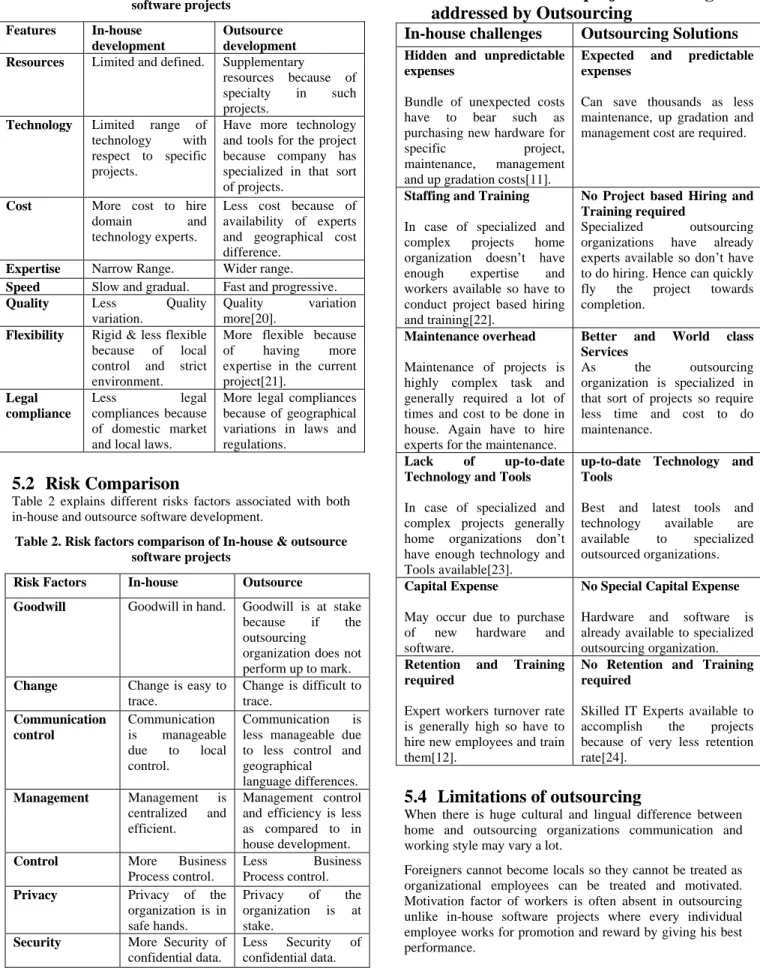
Table 1 throws light on the different features and aspects of both house and outsource software development. Both in-house and outsource software projects has superiority over each other in different aspects. In some aspects in-house software project development is preferable while in others aspects outsourcing has clear edge over in-house development.
21
Table 1. Feature comparison of In-house & outsource software projects
Features In-house development
Outsource development Resources Limited and defined. Supplementary
resources because of specialty in such projects.
Technology Limited range of technology with respect to specific projects.
Have more technology and tools for the project because company has specialized in that sort of projects.
Cost More cost to hire domain and technology experts.
Less cost because of availability of experts and geographical cost difference.
Expertise Narrow Range. Wider range.
Speed Slow and gradual. Fast and progressive.
Quality Less Quality
variation.
Quality variation more[20].
Flexibility Rigid & less flexible because of local control and strict environment.
More flexible because of having more expertise in the current project[21]. Legal compliance Less legal compliances because of domestic market and local laws.
More legal compliances because of geographical variations in laws and regulations.
5.2
Risk Comparison
Table 2 explains different risks factors associated with both in-house and outsource software development.
Table 2. Risk factors comparison of In-house & outsource software projects
Risk Factors In-house Outsource
Goodwill Goodwill in hand. Goodwill is at stake because if the outsourcing
organization does not perform up to mark.
Change Change is easy to trace. Change is difficult to trace. Communication control Communication is manageable due to local control. Communication is less manageable due to less control and geographical language differences. Management Management is centralized and efficient. Management control and efficiency is less as compared to in house development.
Control More Business
Process control.
Less Business Process control.
Privacy Privacy of the organization is in safe hands.
Privacy of the organization is at stake.
Security More Security of confidential data.
Less Security of confidential data.
5.3
In-House software projects challenges
addressed by Outsourcing
In-house challenges
Outsourcing Solutions
Hidden and unpredictable expenses
Bundle of unexpected costs have to bear such as purchasing new hardware for specific project, maintenance, management and up gradation costs[11].
Expected and predictable expenses
Can save thousands as less maintenance, up gradation and management cost are required.
Staffing and Training
In case of specialized and complex projects home organization doesn’t have enough expertise and workers available so have to conduct project based hiring and training[22].
No Project based Hiring and Training required
Specialized outsourcing organizations have already experts available so don’t have to do hiring. Hence can quickly fly the project towards completion.
Maintenance overhead
Maintenance of projects is highly complex task and generally required a lot of times and cost to be done in house. Again have to hire experts for the maintenance.
Better and World class Services
As the outsourcing organization is specialized in that sort of projects so require less time and cost to do maintenance.
Lack of up-to-date Technology and Tools
In case of specialized and complex projects generally home organizations don’t have enough technology and Tools available[23].
up-to-date Technology and Tools
Best and latest tools and technology available are available to specialized outsourced organizations.
Capital Expense
May occur due to purchase of new hardware and software.
No Special Capital Expense
Hardware and software is already available to specialized outsourcing organization.
Retention and Training required
Expert workers turnover rate is generally high so have to hire new employees and train them[12].
No Retention and Training required
Skilled IT Experts available to accomplish the projects because of very less retention rate[24].
5.4
Limitations of outsourcing
When there is huge cultural and lingual difference between home and outsourcing organizations communication and working style may vary a lot.
Foreigners cannot become locals so they cannot be treated as organizational employees can be treated and motivated. Motivation factor of workers is often absent in outsourcing unlike in-house software projects where every individual employee works for promotion and reward by giving his best performance.
6.
CONCLUSION
Both in-house and outsourcing practices have been in use all over the world since last few decades with all their advantages, disadvantages and risks associated with them. The environments where projects are highly complex, cost is too high to build them, technology is not sufficient, expertise are not enough, Outsourcing plays a vital role to meet the expectations. It also plays a key role to complete the task in time, due to this organizations can save their production cost and they can focus on their core. It is a good tool to transfer the risk. While on other hand it also has some risks associated with it like data privacy issue, goodwill compromise risk, loss of potential employees and loss of potential customers. In future we would like to explore ways to minimize the risks associated with software outsourcing.
7.
REFERENCES
[1] Smith, Angela, 2012. “The Pros and Cons of Outsourcing,” UNLV Theses/Dissertations/ Professional Papers/Capstones. Paper 1478
[2] K. Marvin, 2014 “Global Trends in Outsourcing and their Impact.”
[3] Protiviti, Apics 2004. “Managing the Risks of outsourcing”
[4] M. Gordon and H. Revel, “Where In The World,” 1938. [5] Tibor Kremic, Oya Icmeli Tukel and Walter O. Rom
,2003 “Outsourcing decision support : a survey of benefits, risks, and decision factors”.
[6] H. Rochester, H. Rochester 1995, "Advantages and disadvantages of outsourcing," Professional Communication Conference, 1995. IPCC '95 Proceedings. Smooth sailing to the Future., IEEE International, Savannah, GA, pp. 77-82.
[7] G. Krishna, S., Sahay, S., Walsham, 2004 “Managing cross-cultural issues in Global Software Outsourcing,”
Commun. ACM, vol. 47, no. 4, pp. 62–66, 2004.
[8] Shahnam Taheri, August 2013. “Advantages and Disadvantages of outsourcing".
[9] Rob. Aalders, 2002 “IT OUTSOURCING : Making it work,” Fujitsu Aust. Ltd.
[10]K. Garrett, 2011. “Outourcing performance objectives" [11]Dogerlioglu 2012. "Outsourcing vs inhouse: A modular
organizational approach".
[12]Cynthia Doyle, David Tapper, 2007 “Evaluating the Benefits of IT Outsourcing,” no. 508.
[13]Satwik Seshasai, Amar Gupta ,2004 “Global Outsourcing of Professional Services,” p. p 1–12.
[14]New York state department of labor 2010."The offshore outsourcing of information technology jobs in new york state".
[15]T. Kremic, O. I. Tukel, and W. O. Rom, 2006. “Outsourcing decision support: a survey of benefits, risks, and decision factors,” Supply Chain Manag. An Int. J., vol. 11, no. 6, pp. 467–482.
[16]G. Grossman and E. Helpman,2005 “Outsourcing in a global economy,” Rev. Econ. Stud., vol. 72, no. 1, pp. 135–159.
[17]Gonzalez, Gasco 2010. “Information system outsourcing Reasons and Risks.”
[18]R. A. Khan and S. U. Khan, 2014 “Communication and Coordination Challenges in Offshore Software Development Outsourcing Relationship From Vendors ’ Perspective :,” vol. 2014, no. October, pp. 1425–1429. [19]B. Rowe, 2008 “Will Outsourcing IT Security Lead to a
Higher Social Level of Security?,” pp. 1–22.
[20]Fish, Seydel, 2006. "Where IT outsourcing is and where it is going" A study across functions and department sizes. Journal of Computer Information Systems, 46(3), pp.96-103
[21]Saini, Chou, 2003 “Information Technology Outsourcing: Issues and Future Analyses,” pp. 400–407. [22]Bersin 2004,"Economics of outsourcing, training
technology and operations".
[23]A.Gonzales, D. Dorwin 2008. Outsourcing, Past, Present and Future.
[24]Harvey, Nash, 2015. “In or out? The Shape of It Outsourcing in 2015 ,” vol. 1, 2015.
![Fig 1: Motivational Factors of software outsourcing[17]](https://thumb-us.123doks.com/thumbv2/123dok_us/10058744.2905565/2.893.210.691.625.1099/fig-motivational-factors-of-software-outsourcing.webp)