DOCTORAL (PhD) THESES
UNIVERSITY OF KAPOSVÁR
FACULTY OF ECONOMIC SCIENCES DEPARTMENT OF FINANCE AND ACCOUNTING
Head of Doctoral School,
DR. GÁBOR UDOVECZ, DSc
Doctor of the Hungarian Academy of Sciences
Supervisor,
DR. JÓZSEF VARGA, PhD Co-supervisor,
DR. LAJOS KÖRMENDI, CSc
VENTURE CAPITAL FINANCING OF DOMESTIC
SMALL AND MEDIUM-SIZED ENTERPRISES
Author,
ANITA KOVÁCSNÉ ANTAL
KAPOSVÁR
1
1.
PRELIMINARIES AND OBJECTIVES
The dissertation aims to facilitate the more efficient utilisation of a special type of external funding, venture capital financing by domestic SMEs to finance their growth and expansion and, at the same time, help in alleviating the shortage of capital typical of the sector. It is a problem that smaller funds aiming to invest typically less than EUR 5 million and targeted at smaller entrepreneurs, are practically missing from the choice venture capital funds active in the Hungarian market. With respect to the above mentioned segment of enterprises, publicly-backed funds are more active. The analytical work is significantly encumbered by the typical lack of public information related to venture capital markets and funds, which is due to the fact that this information qualifies as trade secret.
In the scope of the research I wished to find answers to the following questions,
1. What are the general characteristics (correlations, trends) of public venture capital funding of SMEs?
2. What objective set of criteria and valuation aspects could be applied to appointing and selecting the potential subjects of venture capital investments in the SME sector and is the resulting valuation system expected to be used efficiently?
3. What system of marketing concepts and methods to reach the target groupwould encourage the use of venture capital financing most? 4. What is enterprises’ attitude to funding like within the target group,
and what constraints can be identified that discourage businesses from utilising venture capital?
2
5. What universal experience, recommendations, suggestions, conclusions could be formulated based on the investments realised within the target group?
6. What SWOT analysis could be put forward with respect to venture capital financing?
The analyses carried out in the scope of the dissertation were basically two-directional. Their structure complete with the respective objectives are the following (Figure 1),
Figure 1, Research areas and related objectives
Source: own construction Target: to encourage venture capital
financing in SMEs Evaluation model Marketing concept Test 1. objective: Exploration of general characteristics
2. objective: Development of an objective evaluation model
3. objective: Development of a
marketing concept
4. objective: Identifying the constraints of venture
capital financing
5. objective: Experience gained general recommendations 6. objective: Compilation of a SWOT analysis
Raising problems
Methods and objectives
3
2.
MATERIAL AND METHODS
The thesis is essentially based on primary research. The dissertation is completed by collecting secondary data and elaborating the technical literature closely linked with the topic. In the scope of primary data collection I paid personal visits and made in-depth interviews in order to collect qualitative information (Majoros, 2004) primarily. Quantitative information is analysed on the basis of the data made available by a publicly-backed venture capital fund (Kisvállalkozás-fejlesztő Pénzügyi Zrt., KvfP) on the one hand and data derived from the financial reports filed with the Zala County Court acting as Court of Registration on the other hand. A part of primary data collection comprises a survey conducted among SMEs based in Zala County.
The methodology of processing quantitative data is based on an extensive use of statistical tools, in the scope of which relative numbers, mean values and scatter metrics were calculated. I formulated hypotheses to reveal the relationships between the various criteria and verified them by means of
relationship tests (variance expansion, correlation analysis and association test).
In order to analyse the venture capitalist's portfolio and quantify the results of Part 4 of the developed model, I stated binary regression functions
(Babbie, 2001). Also an accounting method was employed to analyse the quantitative information stated in the balance sheets and income statements of the analysed enterprises (Bíró et al, 2007). Chapter 3, Results furthermore includes empirical analyses based on case studies thatare rarely used in the domestic research of venture capital financing. Finally, I set up two SWOT analyses.
4
3.
RESULTS
3.1. The analysis of public venture capital financing
I prepared a detailed analysis of public venture capital financing through the investment portfolio of a publicly-backed fund (based on investments realised by Kisvállalkozás-fejlesztő Pénzügyi Zrt. up to 15 April 2008) that has a determinant role in the equity financing of the SME sector. I concluded that the findings of the portfolio analysis can enrich the missing experience of domestic research related to state-backed investments, and that some of the conclusions can contribute to setting up the evaluation model formulated in Objective 2.
Mainly the investment ideas of small businesses were supported by public venture capital. The average value of investments (HUF 62 million) was significantly higher than the minimum amount (normally HUF 20 million) of funding that could be applied for, while larger enterprises showed higher specific investment values. The average percentage of the capitalist's share was 42%, and share per enterprise figures were inversely proportional to the sizes of enterprises in consideration of the classification of SMEs. It was indicative of the extent of businesses’ demand for capital that they most frequently utilised the maximum rate obtainable from public venture capitalists (49%). Venture capital contributed to improving the competitiveness of the processing industry firstly and of the service sector secondly. Which group of economic sectors enterprises belong to had no significant influence either on the amount of invested capital, the pre-investment value of subscribed capital or the extent of ownership share obtained by the venture capitalist. The classification of enterprises by their size had no statistical influence on the amount of invested capital or the percentage of the capitalist’s share, it, however, had a major influence on the
5
pre-investment value of subscribed capital (average correlation). In the event the pre-investment value of subscribed capital increased, the absolute amount of invested capital also increased statistically (positive average correlation). I described the relationship between these factors by an exponential regression function. The underlying equation is = 7,69 ∙ ,
(Figure 2).
Figure 2, The relationship between subscribed and invested capital Source: own construciton
Figure 3, The relationship between subscribed capital and the persentage of the capitalist’s share
Source: own construciton
0 20 40 60 80 100 120 140 160 0 100 200 300 400 500 600 700 In ve st ed c ap it al (m ill io n H U F)
Subscribed capital (million HUF)
Alapsokasági értékek Regressziós értékek
Hatvány (Regressziós értékek)
Regression values Exponential regression values
y = -0,0008x + 0,5073 0% 5% 10% 15% 20% 25% 30% 35% 40% 45% 50% 0 100 200 300 400 500 600 700 Th e p e rs e n ta ge o f ca p it al is t' s sh ar e ( % )
Subscribed capital (million HUF)
Alapsokasági értékek Regressziós értékek Lineáris (Regressziós értékek) Base population values Regression values Linear regression values
6
If the pre-investment value of subscribed capital decreased, the percentage of the capitalist’s share also decreased statistically (negative close correlation); I described the principal of the relationship between these factors by a linear regression function. The underlying equation is = 0,5073 − 0,0008 ∙
(Figure 3).
In relation to financial adequacy (objective indicators) I found that the enterprises with a history achieved an average 61 per cent of all the obtainable scores. The company obtaining capital with the lowest score obtained 31 per cent of all the obtainable points. I demonstrated that the scores enterprises gained scatter significantly, while the performance of businesses active in the same economic group is closer to one another. The distribution of enterprises according to size was similar to that of the total scores obtained, and the specific scores per enterprise increased in parallel with business size.
I confirmed that developing an evaluation system by business size or groups of economic sectors was not justified, since the degree of financial risk was not statistically influenced either by the classification of enterprises according to groups of economic sectors or size, that is, they had no significant influence on their objective assessment. The capital adequacy of businesses could be assessed the best of the objective evaluation criteria (indicators). Of the tested criteria, medium-sized enterprises showed the worst liquidity figures, small businesses had the lowest debt-to-equity figures and micro businesses demonstrated the worst return on sales figures. However, the “strength” of medium-sized enterprises lied in their return on sales, of small businesses in adequate liquidity, and the smallest businesses realised better results with respect to liquidity and return on equity indicators (as compared with the other two categories of businesses). I found a
7
statistically verifiable relationship between classification according to groups of economic sectors and the scores obtained for capital adequacy and return on equity (average correlation). This suggests that classification according to groups of economic sectors can influence the assessment of
the secure operation of a business (capital adequacy) and
the return on equity.
None of the indicators were influenced statistically by classification according to SME categories.
Until the analysed period, nearly a quarter of the invested venture capital had fully been repaid to the publicly-backed fund. The majority of exits by repurchase were effected by the original owners (sometimes not all) and in some instances, by companies. I showed that the average repurchase period was 2.37 years, which is shorter than the option period stated in the contracts. The motives for exercising the option prior to the predetermined dates (3 or 5 years) were the following; the company wanted to carry out further projects that required additional loans and the lending bank or another company financed also KvfP’s share. Another reason was the resale of the company invested in, and there were cases in which the owner or the company decided to buy out because they had accumulated retained earnings, their business policy changed or they identified cheaper sources of finance. The number of partial buyouts also increased because, with effect from 2005, not longer a repurchase option but an obligation is set forth in the contracts under which companies are obliged to pay yields calculated at annually determined nominal rates generally from the third year.
Based on the exits realised, I calculated an average rate that indicates the repayment rate per unit of capital. The calculation covers a 5-year period with a 0.25% scale within the limits of the high-risk premium and assumes a
8
repayment obligation of 20% of the nominal value from year 3 and of 25 % from year 4. Average repayment rates rise in parallel with the increasing high-risk premia (Table 1).
Table 1, Average repayment rate indicators for unit of capital plus yield with different risk premia
High risk premium (%) Average repayment rate
0,25% 1,47 0,50% 1,49 0,75% 1,51 1,00% 1,53 1,25% 1,54 1,50% 1,56 1,75% 1,58 2,00% 1,60 2,25% 1,62 2,50% 1,64 2,75% 1,66 3,00% 1,68 3,25% 1,69 3,50% 1,71 3,75% 1,73 4,00% 1,76 4,25% 1,78 4,50% 1,80
Source: own calculation based on KvfP’s data
3.2 Evaluation model
I set up an objective evaluation model to select potential subjects of the SME sector for venture capital investments and concluded that a unique, useful and practical solution had been developed that may be used by venture capitalists as a useful decision support tool.
9
The model contains a selection mechanism or system based on Companies’ reported data. My guiding principle when developing the model was that the eligibility criteria would be built on an information source that is widely and relatively easily accessible (as of 2009 annual reports are to be filed electronically). After we set the parameters and run the model on the reported data, we obtain a group of enterprises as the output that, based on their reported data, could be considered as potential investment targets. Compliance with the criteria can be also checked in MS Excel by modifying the argument of the function.
Parts 1-3 of the model serve preselection while Part 4 is part of the information mechanism.
The elements of the evaluation model and objective eligibility criteria
1. Compliance with the criterion on SME category as defined by Act XXXIV of 2004 on Small and Medium-sized Enterprises and subsidizing SME development
The Company Information database of the Hungarian Central Statistical Office (Company-Code-Register) can help select SMEs of domestic enterprises as the target population. Based on this, compliance with the criteria set forth in Sections 1-3 of Article 3 of the above-mentioned law can be verified.
2. Compliance with the efficient transaction size criterion
Efficient transaction size based on the minimum amount of invested capital per enterprise (which is put down in the venture capitalist’s regulations in writing) can be defined as the minimum amount of capital increase made possible up to the sum of the subscribed capital available to the enterprise and any assets in excess of the nominal capital (retained earnings, capital reserves, net profit on operation) that determines the minimum amount of capital to apply for.
10 It is calculated as follows,
= − , ∶ = ∙ ( − 1), where
H, efficient transaction size (HUF)
Kmin, the minimum amount of invested venture capital per enterprise
(HUF)
xmax, the maximum percentage of the venture capitalist’s share (%)
Companies complying with the following logical test will meet the criterion related to efficient transaction size,
( + + + ) ≥
Jt, Subscribed capital as per latest approved balance sheet (HUF) Tt, Capital reserves as per latest approved balance sheet (HUF) Et, Retained earnings as per latest approved balance sheet (HUF) Me, Net profit as per latest approved balance sheet (HUF)
3. Assessment of financial adequacy
In order to evaluate companies’ financial status, it is necessary to select indicators, determine their minimum expected values, set up a scoring system depending on their value and define a threshold value for the total score. The proposed indicators based on the evaluation system of the given venture capitalist are the following,
Current ratio
Quick ratio
Capital adequacy ratio ∙ 100
Earnings before taxes on sales
Debt-servicing capacity
11
Based on the conclusions drawn from the analysis of the venture capitalist’s portfolio, the proposed threshold value (xlimit) for the assessment of financial
adequacy was determined at 30 per cent.
Therefore, the financial risks belonging to those companies will be considered as acceptable whose scores per indicator total > xthreshold.
4. Assessment of the ability to produce the expected yield
The net income after taxes to be generated during the repayment term is defined for a predetermined investment period, projected to the amount of expected yield and the amount of venture capital employed, and this will guide the enterprise when assessing the feasibility of a planned project provided it is financed by venture capital. In order to calculate the net income after taxes for the investment period, it is necessary to give the following parameters; the investment period, the expected yield, the way yield is calculated and the minimum and maximum amount of venture capital available. The following facts and figures are available for companies in relation to the given amount of venture capital. These outputs of Part 4 of the model are summarized in Table 2.
Table 2, Output table for Part 4 of the model
Amount of venture capital (in thousand HUF) Requared capital increase (in thousand HUF) Percentage of the venture capitalist’s share (%) Average growth rate of net income after taxes (growth/year)
Net income after taxes to generate (in thousand HUF) Year 1 … Year n
Source: own construciton
At the end of the investment period, the capital obtained plus the expected yield thereon has to be repaid, which is calculated as follows,
12 KÉ, exit value (HUF)
K, the amount of venture capital that may range between Kmin and
Kmax-individual for the given enterprise (HUF)
rexpected, average annual percentage of venture capitalist’s expected
yield (%)
n, the number of investment period (year)
Two maximum rates of the obtainable capital will also need to be distinguished between; one of them is specified as a parameter and is valid for all businesses as an upper limit (Kmax) and the other is a maximum
amount calculated for every single enterprise with a view to their capabilities for capital increase (Kmax-individual). The calculation of the latter combined
with a logical test is as follows,
if( + + + ) ∙ ( 1
1− − 1) ≤ ,
then = ( + + + ) ∙ ( − 1)and
if ( + + + ) ∙ − 1 ≥ ,
then .
The calculation of the required capital increase (Tem(sz)) for the given amount
of funding, K combined with a logical test is as follows,
if < − ∶ ∙ ( − 1), ℎ ( ) = ∙ − 1 − ,
if ≥ ∙ − 1 , ℎ ( )= 0, where
Tem(sz), the required capital increase for the given amount of funding,
K (HUF)
In order for an amount of capital increase to be considered, it is necessary that it would not exceed the potential maximum amount of capital increase and therefore, following the earlier ones, it is necessary to perform the following test too,
13
if ( )≤ ( ) = + + , ℎ ( )= ( ) and
if ( )> ( ) = + + , ℎ ( )= ( ), where
Tem(m), the capital increase that can be realised in relation to a given
amount of capital (HUF),
Tem(max), the maximum amount of potential capital increase at a given
enterprise (HUF) that is the total of Tt, Et and Me if any one is more than 0. The average annual growth rate of net income after taxes can be calculated as follows,
a) If we want to define the required growth rate irrespective of the business’ prior accumulated earnings, that is the increase solely
required by the invested capital, it is ü = É − 1, where
ü: The average annual growth rate of net income after taxes (growth/year)
b) If we consider any retained earnings and balance sheet profits not used for capital increase as a basis for generating the amount of capital required for the exit, the formula shall be adjusted as follows,
( )− ( )− > 0, ℎ ü =
É
( ) ( ) − 1
If the previous year’s balance sheet profit and/or retained earnings show a deficit or equal 0, it means that the company has no earnings that could be considered to meet the exit value. In that case, again the calculation method mentioned under point a) can be used, that is
( )− ( )− ≤ 0, ℎ ü = É − 1
We must consider that only the solution mentioned under point a) may provide a basis for comparison with the respective investment plan, while the latter indicates how sure the repayment of the exit value is.
14
If only the required net income after taxes increment is shown irrespective of any prior accumulated earnings of the business, as in case a) and only as required by the invested capital, the formula is
( ) = ( ) ∙ (1 +ü), where
Elevel(n) = the level of increased net income after taxes in year n (HUF)
Elevel(n-1)= the level of increased net income after taxes in year n-1 (HUF)
If we also consider unused disposable earnings to calculate the growth rate as shown under point b),
( ) = ( )− ( )− ∙ (1 + ü) and
( … ) = ( )∙ (1 + ü), where
Elevel(1) = the level of increased net income after taxes in year 1 (HUF)
In each version, the net income after taxes increment to generate within the respective periods of the total investment period is calculated as follows
Eincrement(n) =Elevelt(n) – Elevel(n-1), where
Eincrement(n), net income after taxes increment in year n
In the output table, the percentage of venture capitalist’s acquired share is also stated for the given amount of capital, which is considered as useful information for businesses. Its calculation is as follows,
=
( )
, where
xK, the percentage of venture capitalist’s share for the given amount of
capital, K (%)
I tested the developed objective evaluation model among small and medium-sized enterprises based in Zalaegerszeg. My conclusion is that
the effective utilisation of the evaluation system was in fact verified since it could be run on the data of all analysed businesses, generated meaningful results and made the adequate classification of enterprises possible.
15
According to the test, a large majority, that is 65% of Zalaegerszeg-based small and medium-sized enterprises proved to be eligible to receive venture capital financing based on the specified parameters.
3.3. The marketing concept
I developed a marketing concept customized for businesses in order to encourage their utilisation of venture capital funding, in the implementation of which intermediaries, primarily credit institutions participate. The reason for developing this model was that a proper dialogue and communication with businesses is of crucial importance in utilising the model efficiently, and also that I found that a proper marketing strategy for publicly-backed funds was missing and there is a severe restriction on marketing expenses. I worked out two scenarios for implementing the developed marketing concept. In the case of the scenario involving intermediaries, I analysed the benefits of participation from the point of view of credit institutions, because, on the one hand, banks already have the contact data within their own client database of a part of their potential target group selected, and, on the other hand, they are interested in retaining, let alone expanding their SME customer base, since this sector holds high growth potentials. I identified the benefits that can be gained by credit institutions through their participation: an enhanced level of customer loyalty generated by their information service and benefits and profits on the products chosen by customers as part of the product development. The information received though creditable advisors can generate cost and time savings for the selected businesses, not to mention the potential benefits arising out of being invited to obtain funds from a source unknown to the business up to that time. Now the question whether the bank is interested in mediating a so-called ’competitive product’
16
arises. Is not the promotion of venture capital financing disadvantageous for the demand for credit products offered by banks? I found that credit and venture capital financing solutions give rise to different obligations (commitments) for recipients and to what extent one or the other can be assumed can basically decide which alternative to opt for. Credit and venture capital financing solutions may be considered as complementary rather than competitive products, which is verified by Table 3.
Table 3, The main differences between credit and venture capital financing
Features Credit Venture capital
Type liability share
The investor participates in the
ownership structure no yes
Repayment obligation during the
investment period yes generally no
Disinvestment affects the business
(through repayment)
does not affect the business in certain cases (e.g. through sale
to other investors) Business risks assumed by funding
usually acceptable with a view to traditional financing by bank.
usually unacceptable with a view to traditional financing. Professional experience, expertise
and business relations are made available
no generally yes
Source: own construction
In the scenario in which no intermediary is involved, the parties interested in enhancing venture capital financing (companies or persons) can implement the model and execute the marketing tasks as well, and may expect to realise returns on potentially increasing utilisation.
I determined two main elements of the offer, which are
emphasising the essential characteristics, funding mechanism and advantages of venture capital financing, which aims to provide missing information and raise awareness; and
17
sharing the results generated for the given enterprise by the developed model. Its aim is to support their eligibility based on objective data by quantitative data.
I find it necessary to integrate the positive business experience identified in the case studies (see Chapter 3.5) in the first element of the offer, which may contribute to promoting this source of funding. The relevant tools to reach businesses are Direct Mail or the Internet knowing the size of the information material and the costs of delivery and that businesses are more and more accessible electronically.
3.4. Constraints on SME venture capital financing – the
findings of a questionnare survey
I prepared a questionnaire to assess SMEs’ attitude to funding and identify the constraints on utilising venture capital financing. I had this questionnaire completed by Zala County-based businesses that qualify as small and medium-sized enterprises in accordance with the law defining their classification. The findings prompted the conclusion that I can enrich the scarce research experience on the demand of Hungarian businesses for venture capital financing and, respectively, I can justify the necessity of setting up an evaluation model and developing a marketing concept.
The findings based on the questionnaire survey are the following,
the use of internal sources is primary to that of external sources;
of external sources, capital-type sources were the least ’popular’ ones;
the order as per the hierarchy theory was not completely realised, namely capital-type sources have precedence over credit-type sources in financial decisions;
18
businesses do not seek to optimize their structure of liabilities;
of external sources, companies mainly make selections with a view to the length of their availability periods;
the vast majority of businesses (85% of the sample) did not have adequate information about venture capital;
a target group of a significant size can be identified as potential users of venture capital financing based on their expressed interest (half the businesses);
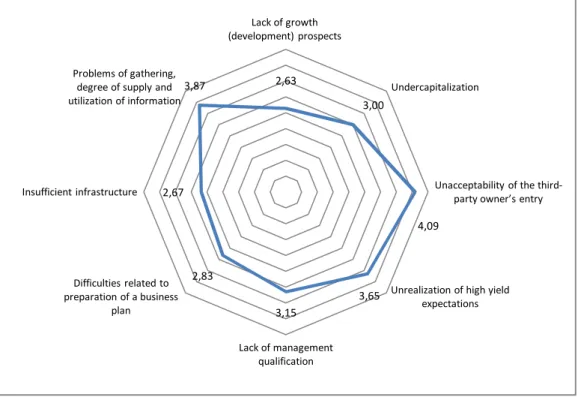
the main reasons for rejecting venture capital financing: the unacceptability of a third-party owner’s entry, conviction that the yield expectation cannot be met and the lack of related information (Figure 4);
businesses basically have investment and development concepts that are considered as essential conditions to obtaining venture capital financing;
to some extent, the business’s life cycle, the group of economic sector it operates in, the age and size of the enterprise has a certain influence on the extent venture capital is known to them (average correlation);
businesses’ disposition to utilizing venture capital was influenced by groups of economic sectors to a lesser extent (average correlation) and the age of businesses to a larger extent (close correlation).
19
Figure 4: The evaluation of constraints on the utilization of venture capital financing on a 5-point Likert scale
Source: own construction based on a questionnaire survey
3.6. Case studies
I made case studies to formulate universal experience, recommendations, suggestions and conclusions based on three invested businesses of the target group, one of which operates in engineering and two in the food industry. I highlighted the positive experience related to venture capital financing that I feel necessary to integrate in the first element of the offer developed as part of the marketing concept (see Chapter 3.3) in order to promote this source of funding,
2,63 3,00 4,09 3,65 3,15 2,83 2,67 3,87 Lack of growth (development) prospects Undercapitalization
Unacceptability of the third-party owner’s entry
Unrealization of high yield expectations Lack of management qualification Difficulties related to preparation of a business plan Insufficient infrastructure Problems of gathering, degree of supply and utilization of information
20
public funding sets yield requirements on the capital invested that are actually similar to market prices (just like business loans);
in consequence of the regular reporting obligation, businesses are forced to monitor their results and therefore potential future risks can be better foreseen and prepared for,
the profit expectations of the venture capital business also stimulates the company by that it makes the company interested in making a profit (or else sanctions are applied),
flexible and simple administration is implemented, the reporting obligation can be fulfilled relatively simply by uploading the necessary data via the Internet in a predetermined format;
businesses’ rejection of a third-party owner’s entry can be resolved by emphasising its transitory character.
A further advantage of venture capital financing on the level of the national economy is that businesses are forced to work in a legal way and therefore it can contribute to reducing the share of the shadow economy and enhancing the transparent operation of businesses. Based on my results, I make a number of recommendations in order to encourage venture capital financing with respect to the SME sector, public venture capitalists and the government, which are summarized under Chapter 6, Recommendations.
3.7. SWOT analysis
I completed two SWOT analyses in relation to venture capital financing
from the point of view of both SMEs and public venture capitalists. I concluded that these structured summaries are suitable for arranging our findings, indicating trends of development and justifying the necessity of the
21
developed model. The contents of the completed tables were analyzed by means of interrelation matrices and, based on these, I concluded that they were completed well since each strength and weakness could answer to at least one opportunity or threat (Faragó, 2001). Since SWOT tables reflect static information, I suggest their regular revision.
SWOT analysis from the SMEs’ aspect
Strengths Weaknesses
Investment willingness
Conclusive force of personal touch
Low number of persons with financial/ economic qualifications in the management (lack of professional qualification)
Lack of information (problems with gathering and utilizing information) Relatively low earning capacity and productivity
Opposition to a third-party owner’s entry
Opportunities Threats
Relative oversupply of venture capital Low expected yield on public funds Potential to open new markets Site inspection
Possibility of transformation into other company forms
Training opportunities to improve the management’s human resources erudition Narrowing the information gap by efficient information, marketing communication and the participation of intermediaries
Linking venture capital financing with working capital financing
Reducing procedural time Legal harmonisation
Yield asymmetry
Incalculable regulatory environment Delay in introducing the euro
22
SWOT analysis from the public venture capitalists’ aspect
Strengths Weaknesses
Adequate supply of capital Good networking practices Flexible administration
Appropriate investment practices Relatively low yield expectations
Lack of a marketing strategy
Cost-conscious operation Requirements partly differing from those of private venture capitalists’
Opportunities Threats
An expressed interest in venture capital financing Businesses’ increasing electronic accessibility
Improving marketing communication through the participation of trustworthy intermediaries with efficient information
Appropriate level of consistency within the criteria set on the different levels of public venture capital financing Setting criteria that are closer to private venture capitalist practices
Business development policies encouraging venture capital investments
Restraint on marketing expenses
Underutilisation of venture capital sources for the lack of related information Top down approach to setting rules
23
4. CONCLUSIONS
The main objective of the doctoral dissertation was to make external funding from venture capital sources more accessible for SMEs, the direct target group of this study, thereby facilitating their growth and development. Based on secondary data it was verified that publicly-backed venture capital funds having a relatively important role in the private equity financing of small businesses was only able to mitigate the shortage of capital in a very low percentage of SMEs. The declining tendency of inquiries about venture capital investments and the number of approved applications also justifies the need for improving the system by implementing a mechanism to help parties find one another more efficiently.
Developmental and investment projects realized via capital reconstruction can contribute to long-term survival, functionality, retaining or even expanding market shares, withstanding competition and the further development of SMEs. On the macroeconomic level, the expansion of venture capital financing may strengthen innovation, bolster GDP growth, exports and employment expansion through the growth of businesses. On the regional level, it can support reconciling economic (social) disparities within the country. By means of the selection mechanism and the related customised marketing concept both public and private venture capitalists (investment funds, corporations, and individuals) can directly identify their potential target groups. The conclusions drawn and recommendations made based on the findings of the questionnaire and case studies can contribute to making the delivery and availability of venture capital more efficient both for venture capitalists and businesses potentially involved in this form of financing.
24
5. NEW SCIENTIFIC RESULTS
1. I verified various correlations and explored tendencies in relation to public venture capital financing in SMEs, of which the most important ones are the following,
I showed that public venture capital mainly supported the investment ideas of small businesses and contributed to improving the competitiveness of the processing industry firstly and of the service sector secondly. I revealed a positive average correlation between subscribed and invested capital, which can be described by exponential regression with the equation, = 7,69 ∙ , . I determined a negative close correlation between subscribed capital and the percentage of the venture capitalist’s share, the equation of this relationship described by a linear regression function is = 0,5073 − 0,0008 ∙ . Investment value per enterprise grew in parallel with the size of business while the average percentage of the venture capitalist’s share changed inversely. I explored the ‘strengths’ and ‘weaknesses’ of the individual size categories as compared with one another as follows,
Size category ’Weaknesses’ ’Strengths’
Medium liquidity return on sales Small debt to equity ratio liquidity Micro return on sales return on equity
I concluded that the financial performance of businesses active in the same branch of economic sectors was closer to one another, and within this, businesses achieved the best results with respect to capital adequacy. I confirmed that there is no reason to develop an evaluation system per business size category or groups of economic sectors either.
I furthermore showed that the average repurchase period was 2.37 years, and that it was shorter than the average period stated in the contracts to
25
exercise options and I identified its main reasons. I calculated an average indicator that shows the repayment rate per unit of capital.
2. I set up an objective evaluation model in order to select potential subjects from the SME sector for venture capital investments. The model is based on numerical data gained from annual reports (that are already available electronically) as well as parameters determined by venture capitalists. The highlights of the adequacy criteria are: compliance with the criteria of SME category and efficient transaction size, assessment of the ability to manage the related financial risks and produce the yield expected by venture capitalists. I proved that the objective evaluation model with parameter settings adjusted in accordance with the requirements of the party involved, could be used effectively because it could be run on the data of all analysed businesses, generate meaningful results and make the adequate classification of enterprises possible. The test showed that 65% of Zalaegerszeg-based small and medium-sized enterprises are eligible for venture capital financing based on the specified parameters.
3. I developed a marketing concept and method to reach the target
group that is customized for businesses (and meets the evaluation criteria) in the implementation of which intermediaries, primarily credit institutions participate, and the related information material includes the data generated by the developed evaluation model. The relevant means to contact businesses are Direct Mail and the Internet, respectively. I determined the two main elements of the offer that emphasise the essential characteristics, the funding mechanism and the advantages of venture capital on the one hand with the aim of closing the information gap and raising awareness, and informing the given enterprise about the results generated by the developed model, on the other hand, which is
26
meant to verify objective eligibility based on quantitative data. I suggested that the positive business experience specified under point 5 below be integrated in the first element of the offer. My conclusion is that the developed system can in fact contribute to reducing the lack of information so typical of the market, to narrowing the information gap and to effectively utilising the developed model.
4. I identified the constraints on utilising venture capital financing
by SMEs, the three most critical of which in order of priority are, the unacceptability of a third-party owner’s entry, the lack of related information (problems with gathering information, the degree of their supply and utilisation) and the belief that the required yield cannot be realised. The management’s lack of qualification and undercapitalisation are moderately pressing problems, the difficulties of preparing business plans and the level of existing infrastructure are less problematic. The lack of investment and development ideas keep away businesses from this source the least. I concluded that the vast majority of businesses (85% of the sample) did not have adequate information related to venture capital and a significant part of the target group can be considered as potential users of venture capital based on their expressed interests (half the businesses). I proved that which life cycle the business is in, the group of economic sectors it operates in, the age and size of the enterprise did in fact have an effect on the level of awareness of the availability of venture capital (average correlation). Furthermore, the attitude to venture capital utilisation was influenced by the group of economic sectors (average correlation) and the age of the given business (close correlation). I found that the chances of utilization can be increased by adequate information, eliminating the lack of
27
financial/economic qualifications within businesses and reducing the venture capitalists’ procedural time.
5. I formulated experience, made recommendations and arrived at
general conclusions on the basis of investments realized in the target group. I identified the positive experience of venture capital financing regards SMEs that may also contribute to promoting this source of finance (as part of the information provision referenced under Point 3) as follows, the yield expectations related to public funding are similar to market prices; flexible and simple administration is implemented; due to the reporting obligation potential future risks can be better forseen, profit expectation may act as incentives. The contribution to reducing the share of the shadow economy and improving the transparency so much lacking in the SME sector can be seen as advantages on the level of the national economy.
I suggested to venture capitalists giving more weight to professional skills than to the number of managers; performing a site inspection in every case; determining the date of exit more flexibly and making it independent of the amount of invested capital to some extent and also considering the rate of return typical of the given economic sector; linking venture capital financing with a certain level of working capital financing; reducing the overstandardization of contracts; eliminating the ‘implied credit’ character of public venture capital financing; emphasising the transitory character of the entry of venture capitalists as owners; and to businesses, optimising the tax burden linked with the buyback technique in advance. I concluded that the change in ownership due to venture capital financing of SME investment projects ruling out the possibility of reducing the tax base in accordance with Point a of Paragraph 11 of Section 7 of Act LXXXI of 1996 on Corporation and
28
Dividend Taxes; filling in the information gap relating to venture capital (even with respect to the financial sphere), eliminating the asymmetry in the different yields of financial instruments, enhancing calculability and the earliest possible introduction of the euro can enhance the spread of venture capital financing.
6. I set up two SWOT analyses in relation to venture capital financing from the points of view of SMEs and public venture capitalists, respectively. I concluded that these structured summaries can be suitable for arranging the findings logically, indicating the direction of development, and justifying the necessity of the developed model. I suggest the regular revision of the SWOT tables to reflect changing conditions.
29
6. RECOMMENDATIONS
I suggest applying the developed evaluation model both to public and private investment groups (investment funds, corporations and individuals) in order to directly select the enterprises that qualify as potential subjects of capital investments.
I further categorised my additional suggestions into three groups as follows, 1. From the SMEs’ point of view,
strengthening the management’s qualification in finance/economics;
providing information relating to venture capital to enterprises seeking funding sources (even for the financial sphere) and granting access to the positive business experience explored in the case studies;
resolving owners’ rejection of a third-party owner’s entry by emphasising its transitory character and certain exit from the prospering business;
considering transformation into Limited Liability Companies or Joint-Stock Companies in the case of businesses without separate legal entity in order to receive venture capital;
considering tax burden optimisation regarding the buyback in advance. 2. From venture capitalists’ point of view,
reducing the procedural time of applying for venture capital;
ranking the professional skills higher than the number of managers in the course of evaluating the management of a business;
performing site inspections in the scope of awarding venture capital in each and every case (to check whether the data described in the financial statements are realistic and to allow for a personal touch to facilitate positive decisions);
30
setting the exit date more flexibly and making it independent of the amount of invested capital to some extent while also considering the rate of return typical of the given economic sector;
linking venture capital financing to a certain amount of working capital financing in order to ensure production and consequently the generation of the expected yield;
reaching a consensus in the criteria systems of the various levels of public venture capital financing;
eliminating the ‘implied credit’ character of public venture capital financing, modifying the requirements characterising credit lines (especially with respect to the required collateral and disinvestment during the investment period), determining criteria more similar to the ones used in the practices of private venture capitalists (for example, the state should determine the way and maybe even the date of exit in each case);
slackening the overstandardization of contracts and setting more customized terms and conditions;
assessing the possibility of expanding range of company forms that could join the venture capital programme;
developing a more efficient marketing mechanism and communication content in order to fill in the information gap prevalent in several areas, and applying the marketing concept developed in the dissertation and integrating credit institutions in its implementation, addressing businesses with the improved communication content mainly electronically, also integrating the positive business experience identified in the case studies into the communication content.
31
3. From the government’s (economic political) point of view,
focusing on a wider publicity of this resource as an aspect of SMEs development policy because it is a general problem that businesses know about neither venture capital funding nor the institutions providing such sources of finance;
defining the change in ownership related to venture capital financing of SME investment projects as an exception with respect to eligibility for reducing the tax base in accordance with Point a of Paragraph 11 of Section 7 of Act LXXXI of 1996 on Corporation and Dividend Taxes;
eliminating the asymmetry between the differing yields of financial instruments, directing capital towards enterprises rather than the budget in order to improve their capital adequacy and ability to receive funding;
making a genuine calculation of the advantages and disadvantages of state funding, quantified and determined from a structural perspective, of both multinational companies and domestic SMEs, and consequently adjusting the state support policy;
classifying SMEs in two categories according to business policy (for example, based on their life cycle, earning capacity, etc.); one is the category of innovative businesses with high growth potentials whose operative efficiency should be improved by venture capital financing and the other is the category of backward businesses whose operative efficiency should be improved by means of non-repayable sources of finance;
improving the regulatory environment and calculability,
introducing the euro as soon as possible so that enterprises could reallocate their funds to investments rather than maintaining liquidity (which can worsen significantly due to bank charges and exchange risks resulting from conversion).
32
7.
SCIENTIFIC PUBLICATIONS ON THE PhD TOPIC
Articles in Hungarian language published in scientific journals
1. Kovácsné Antal, A. (2006), A kockázati tőke megjelenése és kínálati oldalának vizsgálata hazánkban Budapesti Gazdasági Főiskola Külkereskedelmi Főiskolai Kar SZAKMAI FÜZETEK 2006, 16. szám, pp. 48-60, ISSN 1587-5881
2. Kovácsné Antal, A. (2006), KKV fejlesztési politika ma és 2007-2013 között, EU WORKING PAPERS A Budapesti Gazdasági Főiskola Külkereskedelemi Főiskolai Karának szakmai folyóirata 2006/4. (IX. évfolyam, 4. szám 2006.), pp. 31 – 44, ISSN 1418-6241
3. Kovácsné Antal, A. (2008), A kockázati tőkefinanszírozás hozzájárulása a kis- és középvállalkozások fejlesztéséhez, II. Terület- és vidékfejlesztési konferencia, Kaposvári Egyetem, 2008. május, pp. 79-84, ISBN 978-963-06-5394-7
4. Kovácsné Antal, A. (2008), A KKV szektor kockázati
tőkefinanszírozásának fejlesztéséhez kapcsolódó tájékoztatási mechanizmus, marketing kommunikáció, Acta Scientiarum Socialium, Kaposvár, XXVIII./2008., pp. 23-42, ISSN 1418-7191
5. Kovácsné Antal, A. (2009), Kockázati tőkefinanszírozási lehetőségek a KKV szektorban – empirikus vizsgálat, II. Nemzetközi Gazdaságtudományi Konferencia, Kaposvári Egyetem, 2009. április 2-3, Pénzügyi tevékenységek és adómorál 16, pp. 1-10 (CD)
6. Kovácsné Antal, A. (2009), Lehetőségek és kitörési pontok a KKV szektorban, alkalmazott stratégiák a gyakorlatban, Budapest, 2009. november 5-16., Tudományos konferenciasorozat a Magyar Tudomány Ünnepe 2009 tiszteletére, Pénzügy és számvitel szekció (CD: pdf/08_penzugy/8_080_kovacsne.pdf)
33
Foreign languge articles published in scientific journals,
1. Antal Anita (2007), The experience of private equity investment through a practical example, Acta Scientiarum Socialium, Universitas Kaposváriensis 2007, pp. 3-11, ISSN 1418-7191
2. Anita Kovácsné Antal (2007), New aspects for financing of Small and Medium-sized enterprises, BGF Tudományos évkönyv 2007, pp. 277-291., ISSN 1558-8401
3. Anita Kovács-Antal (2008), Enhancing the funding position of the Small and Medium-Sized Enterprises sector, Üzlet és tudomány 2008, pp. 139-146, ISBN 978-963-7167-08-9
4. Anita Kovácsné Antal (2008), An analysis of venture capital investments in Small and Medium-Sized enterprises, Acta Oeconomica Kaposváriensis 2008, Vol 2 No 1, pp. 49-63, ISSN 1789-6924
5. Anita Kovács-Antal (2010), Opportunities and breakout points in the small and medium-sized enterprises sector, applied strategies in practice, Proceedings of BBS 2010, pp. 69-83, ISBN 978-963-7159-36-7
Abstracts published in Hungarian conference publications,
1. Kovácsné Antal, A. (2005), A kockázati tőke megjelenése és kínálati oldalának vizsgálata hazánkban, Tudományos konferencia a Magyar Tudomány Napja 2005 tiszteletére (A prioritások és a konvergencia kölcsönhatása a magyar gazdaságban) Budapest, 2005. november 10-11. Pénzügy és Számvitel szekció, Programfüzet pp. 96
2. Kovácsné Antal, A. (2006), KKV fejlesztési politika ma és 2007-2013 között, Tudományos konferencia a Magyar Tudomány Napja 2006 tiszteletére (Stratégiák 2007 és 2013 között) Budapest, 2006. november 9-10., Pénzügy és számvitel szekció, pp. 130
3. Kovácsné Antal, A. (2007), Új szemlélet a KKV-k finanszírozásában, Tudományos konferencia a Magyar Tudomány Napja 2007 tiszteletére
34
(Reformok útján) Budapest, 2007. november 9-10., Programfüzet, pp. 131
4. Kovácsné Antal, A. (2008), A kockázati tőkefinanszírozás hozzájárulása a kis- és középvállalkozások fejlesztéséhez, II. Terület- és vidékfejlesztési konferencia 2008. április 25. Kaposvár, A szekcióelőadások és poszterek összefoglalói, pp. 17
5. Kovácsné Antal, A. (2008), A kis- és középvállalkozói szektor finanszírozási helyzetének fejlesztése, Tudományos konferencia a Magyar Tudomány Napja 2008 tiszteletére (Kultúraközi párbeszéd az üzleti világban), Budapest, 2008. november 6-7., Pénzügy és számvitel szekció, Programfüzet, pp. 142
6. Kovácsné Antal, A. (2009), Kockázati tőkefinanszírozási lehetőségek a KKV szektorban, empirikus vizsgálat, II. Kaposvári Gazdaságtudományi Konferencia, 2009. április 2-3., pp. 54
7. Kovácsné Antal, A. (2009), Lehetőségek és kitörési pontok a KKV szektorban, alkalmazott stratégiák a gyakorlatban, Tudományos konferenciasorozat a Magyar Tudomány Ünnepe 2009 tiszteletére (Válság és megújulás), Budapest, 2009. november 5-16., Fény az alagút végén, versenyképesség fejlesztése szekció, Programfüzet, pp. 121 8. Kovácsné Antal, A. (2010), A továbblépés egy lehetséges útja a KKV-k
kockázati tőkefinanszírozási helyzetének javításában, 10. Tudományos konferenciasorozat a Magyar Tudomány Ünnepe 2010 tiszteletére (Merre tovább? Gazdaság és társadalom, realitás és esély), Budapest, 2010. november 4-5., Pénzügy és számvitel szekció, Pénzügy alszekció, Programfüzet, pp. 116
35 Presentations,
1. Kovácsné Antal, A. (2005), A kockázati tőke megjelenése és kínálati oldalának vizsgálata hazánkban, Budapest, 2005. november 11., Magyar Tudomány Napja, Pénzügy és Számvitel szekció
2. Kovácsné Antal, A. (2006), KKV fejlesztési politika ma és 2007-2013 között, Budapest, 2006. november 9., Tudományos konferencia a Magyar Tudomány Napja 2006 tiszteletére, Pénzügy és számvitel szekció
3. Kovácsné Antal, A. (2007), Új szemlélet a KKV-k finanszírozásában, Budapest, 2007. november 8., Tudományos konferencia a Magyar Tudomány Napja 2007 tiszteletére, Pénzügy és számvitel szekció
4. Kovácsné Antal, A. (2008), A kockázati tőkefinanszírozás hozzájárulása a kis- és középvállalkozások fejlesztéséhez, Kaposvár, 2008. április 25., II. Terület- és vidékfejlesztési konferencia
5. Kovácsné Antal, A. (2009), Kockázati tőkefinanszírozási lehetőségek a KKV szektorban, empirikus vizsgálat, II. Kaposvári Gazdaságtudományi Konferencia, 2009. április 2-3.
6. Kovácsné Antal, A. (2009), Lehetőségek és kitörési pontok a KKV szektorban, alkalmazott stratégiák a gyakorlatban, Budapest, 2009. november 13., Tudományos konferenciasorozat a Magyar Tudomány Ünnepe 2009 tiszteletére, Fény az alagút végén, versenyképesség fejlesztése szekció
7. Kovácsné Antal, A. (2010), A továbblépés egy lehetséges útja a KKV-k kockázati tőkefinanszírozási helyzetének javításában, Budapest, 2010. november 5., 10. Tudományos konferenciasorozat a Magyar Tudomány Ünnepe 2010 tiszteletére, Pénzügy és számvitel szekció, Pénzügy alszekció