Learning Agreement form
Student’s name
LEARNING AGREEMENT FOR STUDIES
The Student
Last name (s) First name (s)
Date of birth Nationality1
Sex [M/F] Academic year 2015/2016
Study cycle2 Subject area,
Code3
Phone E-mail
The Sending Institution
Name University of Veterinary and
Pharmaceutical Sciences Brno Faculty
Erasmus code (if applicable)
CZ BRNO 06 Department Science,Research and International Relations
Office
Address Palackeho tr. 1/3,
612 42, Brno
Country,
Country code4 Czech Republic,
CZ
Contact person5
name Bc. et Bc. Katerina Pavlickova Contact person e-mail / phone [email protected]
+420541562019
The Receiving Institution
Name Faculty Erasmus code (if applicable) Department Address Country, Country code4 Contact person
name Contact person e-mail / phone
For end notes, please look at Annex 1, for guidelines, please look at Annex 2.
Uveďte své jméno a
příjmení namísto
„Student’s name“
Bc. – EQF level 6 Mgr./MVDr.– EQF level 7 PhD. – EQF level 8Vepište kód dle oboru studia: 0841 Veterinary 0721 Food processing 0916 Pharmacy
Viz „Seznam bilaterálních smluv“ na: http://www.vfu.cz/studium /informace-pro-studenty/mobility/bilateral ni_dohody.html html
Viz „Seznam zapojených zemí“ na: https://www.vfu.cz/studium/in formace-pro- studenty/mobility/erasmus-pro-vyjizdejici/sms/index.html l
Ostatní informace
naleznete na webu
partnerské instituce
Section to be completed BEFORE THE MOBILITY
I. PROPOSED MOBILITY PROGRAMMEPlanned period of the mobility: from [month/year] ………. till [month/year] ……… Table A: Study programme abroad
Component6
code (if any) Component title (as indicated in the course catalogue) at the receiving institution
Semester [autumn / spring] [or term]
Number of ECTS credits to be awarded by the receiving institution upon successful completion
Total: …………
Web link to the course catalogue at the receiving institution describing the learning outcomes: [Web link(s) to be provided.]
Table B: Group of educational components in the student's degree that would normally be completed at the sending institution and which will be replaced by the study abroad NB no one to one match with Table A is required. Where all credits in Table A are recognised as forming part of the programme at the sending institution without any further conditions being applied, Table B may be completed with a reference to the mobility window (see guidelines).
Component code
(if any) Component title (as indicated in the course catalogue) at the sending institution
Semester [autumn / spring] [or term]
Number of ECTS credits
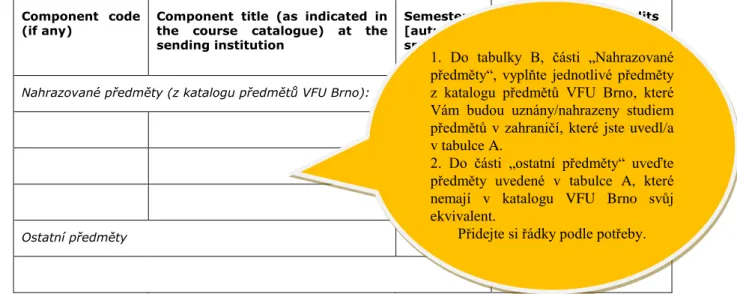
Nahrazované předměty (z katalogu předmětů VFU Brno):
Ostatní předměty
Total: …………
If the student does not complete successfully some educational components, the following provisions will apply:
Vyplňte plánované
období Vašeho
studijního pobytu
Do tabulky A vyplňte všechny
předměty a kurzy, které budete v
zahraničí studovat. Přidejte si
řádky podle potřeby.
Vyplňte odkaz na webovou stránku, ze které si vybíráte předměty1. Do tabulky B, části „Nahrazované předměty“, vyplňte jednotlivé předměty z katalogu předmětů VFU Brno, které Vám budou uznány/nahrazeny studiem předmětů v zahraničí, které jste uvedl/a v tabulce A.
2. Do části „ostatní předměty“ uveďte předměty uvedené v tabulce A, které nemají v katalogu VFU Brno svůj ekvivalent.
Learning Agreement form
Student’s name
Language competence of the student
The level of language competence7 in [the main language of instruction] that the student already has or agrees to acquire by the start of the study period is:
A1 A2 B1 B2 C1 C2 II. RESPONSIBLE PERSONS
Responsible person8 in the sending institution:
Name: Function:
Phone number: E-mail:
Responsible person9 in the receiving institution:
Name: Function:
Phone number: E-mail:
III. COMMITMENT OF THE THREE PARTIES
By signing this document, the student, the sending institution and the receiving institution confirm that they approve the proposed Learning Agreement and that they will comply with all the arrangements agreed by all parties. Sending and receiving institutions undertake to apply all the principles of the Erasmus Charter for Higher Education relating to mobility for studies (or the principles agreed in the inter-institutional agreement for institutions located in partner countries).
The receiving institution confirms that the educational components listed in Table A are in line with its course catalogue.
The sending institution commits to recognise all the credits gained at the receiving institution for the successfully completed educational components and to count them towards the student's degree as described in Table B. Any exceptions to this rule are documented in an annex of this Learning Agreement and agreed by all parties.
The student and receiving institution will communicate to the sending institution any problems or changes regarding the proposed mobility programme, responsible persons and/or study period.
The student
Student’s signature Date:
The sending institution
Responsible person’s signature Date:
The receiving institution
Responsible person’s signature Date:
FVHE: doc. MVDr. Vladimíra Pištěková, PhD. Departmental Erasmus+ Coordinator
+420 541 562 776 [email protected]
FVL: prof. MVDr. Vladimír Celer, PhD. Departmental Erasmus+ Coordinator
+420 541 562 280 [email protected]
FaF: Mgr. Dalibor Levíček, MBA Departmental Erasmus+ Coordinator
+420 541 562 806 [email protected]
Pokuste se zjistit na fakultě, na
kterou vyjíždíte odpovědnou osobu,
která má pravomoc schvalovat
program mobility studentů a je
zavázána poskytnout jim
akademickou podporu v průběhu
jejich studia na přijímací instituci.
Pokud se Vám nepodaří najít,
nevyplňujte.
Nezapomeňte
podepsat a nechat si
podepsat od oprávněné
osoby: viz výše
Pro určení úrovně jazyka, ve kterém budete v
zahraničí studovat, použijte tabulku v odkaze
poznámky č. 7. na poslední straně tohoto dokumentu.
Section to be completed DURING THE MOBILITY
CHANGES TO THE ORIGINAL LEARNING AGREEMENTI. EXCEPTIONAL CHANGES TO THE PROPOSED MOBILITY PROGRAMME
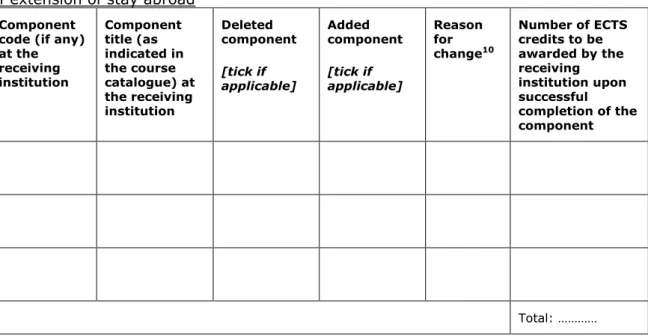
Table C: Exceptional changes to study programme abroad or additional components in case of extension of stay abroadComponent code (if any) at the receiving institution Component title (as indicated in the course catalogue) at the receiving institution Deleted component [tick if applicable] Added component [tick if applicable] Reason for change10 Number of ECTS credits to be awarded by the receiving institution upon successful completion of the component Total: …………
Table D: Revised group of educational components in the student's degree that will be replaced at sending institution
Component code
(if any) Component title (as indicated in the course catalogue) at the sending institution
Semester [autumn / spring] [or term]
Number of ECTS credits
Nahrazované předměty (z katalogu předmětů VFU):
Ostatní předměty
Learning Agreement form
Student’s name
The student, the sending and the receiving institutions confirm that they approve the proposed amendments to the mobility programme.
Approval by signature of the student and of the sending and receiving institution responsible persons.
The student
Student’s signature Date:
The sending institution
Responsible person’s signature Date:
The receiving institution
Responsible person’s signature Date:
II. CHANGES IN THE RESPONSIBLE PERSON(S), if any:
New responsible person in the sending institution:Name: Function:
Phone number: E-mail:
New responsible person in the receiving institution:
Name: Function:
Section to be completed AFTER THE MOBILITY
RECOGNITION OUTCOMESI. MINIMUM
INFORMATION
TO
INCLUDE
IN
THE
RECEIVING
INSTITUTION'S TRANSCRIPT OF RECORDS
Start and end dates of the study period: from [day/month/year] till
[day/month/year].
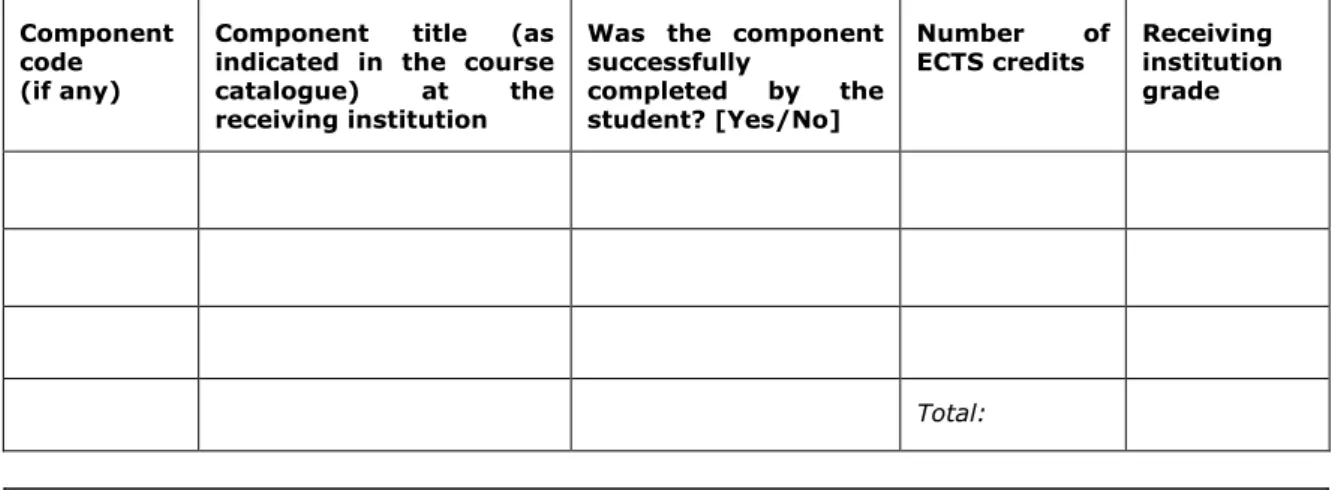
Table E: academic outcomes at receiving institution Component
code (if any)
Component title (as indicated in the course catalogue) at the receiving institution
Was the component successfully
completed by the student? [Yes/No]
Number of
ECTS credits Receiving institution grade
Total:
[Signature of responsible person in receiving institution and date]
II. MINIMUM INFORMATION TO INCLUDE IN THE SENDING INSTITUTION'S
TRANSCRIPT OF RECORDS
Start and end dates of the study period: from [day/month/year] till
[day/month/year].
Table F: recognition outcomes at the sending institution Component
code (if any)
Title of recognised component (as indicated in the course catalogue) at the sending institution
Number of
ECTS credits Sending institution grade, if applicable
Total:
Learning Agreement form
Student’s name
Annex 1: Guidelines
The purpose of the Learning Agreement is to provide a transparent and efficient preparation of the study period abroad and to ensure that the student will receive recognition in his/her degree for the educational components successfully completed abroad.
It is recommended to use this template. However, if higher education institutions already have an IT system in place to produce the Learning Agreement or the Transcript of Records, they can continue using it. What is important is that all the information requested in this template is provided, no matter in which format, provided that it respects certain requirements outlined in the sections below.
How to use the Learning Agreement:
Before the mobility, it is necessary to fill in page 1 with information on the student, the sending and the receiving institutions and the three parties have to agree on the section to be completed before the mobility (pages 2 and 3). On page 1, all the information mentioned will have to be encoded in the Mobility Tool. Institutions can decide to add more information (e.g. additional contact person in the coordinating institution of a consortium) or to request less in case some of the information is already provided in other documents internal to the institution. However, it should at least include the names of the two institutions, and names and contact details of the student and persons of contact in both the sending and receiving institutions.
The section to be completed during the mobility (page 4) should only be used if there are changes in the responsible persons or in case it is necessary to introduce changes to the original mobility programme. This section and the section before mobility (pages 1 to 4) should always be kept together in all communications.
After the mobility, the receiving institution should send a Transcript of Records to the student and the sending institution (page 5). Finally the sending institution should issue a Transcript of Records (page 5) to the student or record the results in a database accessible to the student.
PROPOSED MOBILITY PROGRAMME
The proposed mobility programme includes the indicative start and end months of the agreed study programme that the student will carry out abroad.
The Learning Agreement must include all the educational components to be carried out by the student at the receiving institution (in table A) and it must contain as well the group of educational components that will be replaced in his/her degree by the sending institution (in table B) upon successful completion of the study programme abroad. Additional rows can be added as needed to tables A and B. Additional columns can also be added, for example, to specify the study cycle-level of the educational component. The presentation of this document may also be adapted by the institutions according to their specific needs. However, in every case, the two tables A and B must be kept separated, i.e. they cannot be merged. The objective is to make clear that there needs to be no one to one correspondence between the courses followed abroad and the ones replaced at the sending institutions. The aim is rather that a group of learning outcomes achieved abroad replaces a group of learning outcomes at the sending institution, without having a one to one correspondence between particular modules or courses.
A normal academic year of full-time study is normally made up of educational components totalling 60 ECTS* credits. It is recommended that for mobility periods shorter than a full academic year, the educational components selected should equate to a roughly proportionate number of credits. In case the student follows additional
educational components beyond those required for his/her degree programme, these additional credits must also be listed in the study programme outlined in table A. When mobility windows are embedded in the curriculum, it will be enough to fill in table B with a single line as described below:
Component code
(if any) Component title (as indicated in the course catalogue) at the sending institution Semester [autumn / spring] [or term] Number of ECTS* credits
Mobility window … Total: 30
Otherwise, the group of components will be included in Table B as follows: Component code
(if any) Component title (as indicated in the course catalogue) at the sending institution Semester [autumn / spring] [or term] Number of ECTS* credits Course x … 10 Module y … 10 Laboratory work … 10 Total: 30
The sending institution must fully recognise the number of ECTS* credits contained in table A if there are no changes to the study programme abroad and the student successfully completes it. Any exception to this rule should be clearly stated in an annex of the Learning Agreement and agreed by all parties. Example of justification for non-recognition: the student has already accumulated the number of credits required for his/her degree and does not need some of the credits gained abroad. Since the recognition will be granted to a group of components and it does not need to be based on a one to one correspondence between single educational components, the sending institution must foresee which provisions will apply if the student does not successfully complete some of the educational components from his study programme abroad. A web link towards these provisions should be provided in the Learning Agreement.
The student will commit to reach a certain level of language competence in the main language of instruction by the start of the study period. The level of the student will be assessed after his/her selection with the Erasmus+ online assessment tool when available (the results will be sent to the sending institution) or else by any other mean to be decided by the sending institution. A recommended level has been agreed between the sending and receiving institutions in the inter-institutional agreement. In case the student would not already have this level when he/she signs the Learning Agreement, he/she commits to reach it with the support to be provided by the sending or receiving institution (either with courses that can be funded by the organisational support grant or with the Erasmus+ online tutored courses).
All parties must sign the document; however, it is not compulsory to circulate papers with original signatures, scanned copies of signatures or digital signatures may be accepted, depending on the national legislation.
* In countries where the "ECTS" system it is not in place, in particular for institutions located in partner countries not participating in the Bologna process, "ECTS" needs to be replaced in all tables by the name of the equivalent system that is used and a weblink to an explanation to the system should be added.
Learning Agreement form
Student’s name
CHANGES TO THE ORIGINAL LEARNING AGREEMENT
The section to be completed during the mobility is needed only if changes have to be introduced into the original Learning Agreement. In that case, the section to be completed before the mobility should be kept unchanged and changes should be described in this section.
Changes to the mobility study programme should be exceptional, as the three parties have already agreed on a group of educational components that will be taken abroad, in the light of the course catalogue that the receiving institution has committed to publish well in advance of the mobility periods and to update regularly as ECHE holder. However, introducing changes might be unavoidable due to, for example, timetable conflicts.
Other reasons for a change can be the request for an extension of the duration of the mobility programme abroad. Such a request can be made by the student at the latest one month before the foreseen end date.
These changes to the mobility study programme should be agreed by all parties within four to seven weeks (after the start of each semester). Any party can request changes within the first two to five-week period after regular classes/educational components have started for a given semester. The exact deadline has to be decided by the institutions. The shorter the planned mobility period, the shorter should be the window for changes. All these changes have to be agreed by the three parties within a two-week period following the request. In case of changes due to an extension of the duration of the mobility period, changes should be made as timely as possible as well.
Changes to the study programme abroad should be listed in table C and, once they are agreed by all parties, the sending institution commits to fully recognise the number of ECTS credits as presented in table C. Any exception to this rule should be documented in an annex of the Learning Agreement and agreed by all parties. Only if the changes described in table C affect the group of educational components in the student's degree (table B) that will be replaced at the sending institution upon successful completion of the study programme abroad, a revised version should be inserted and labelled as "Table D: Revised group of educational components in the student's degree that will be replaced at sending institution". Additional rows and columns can be added as needed to tables C and D.
All parties must confirm that the proposed amendments to the Learning Agreement are approved. For this specific section, original or scanned signatures are not mandatory and an approval by email may be enough. The procedure has to be decided by the sending institution, depending on the national legislation.
RECOGNITION OUTCOMES
The receiving institution commits to provide the sending institution and the student with a Transcript of Records within a period stipulated in the inter-institutional agreement and normally not longer than five weeks after publication/proclamation of the student’s results at the receiving institution.
The Transcript of Records from the receiving institution will contain at least the minimum information requested in this Learning Agreement template. Table E (or the representation that the institution makes of it) will include all the educational components agreed in table A and, if there were changes to the study programme abroad, in table C. In addition, grade distribution information should be included in the Transcript of Records or attached to it (a web link where this information can be found is enough). The actual start and end dates of the study period will be included according to the following definitions:
- The start date of the study period is the first day the student has been present at the receiving institution, for example, for the first course, for a welcoming
event organised by the host institution or for language and intercultural courses.
- The end date of the study period is the last day the student has been present at the receiving institution and not his actual date of departure. This is, for example, the end of exams period, courses or mandatory sitting period.
Following the receipt of the Transcript of Records from the receiving institution, the sending institution commits to provide to the student a Transcript of Records, without further requirements from the student, and normally within five weeks. The sending institution's Transcript of Records must include at least the information listed in table F (the recognition outcomes) and attach the receiving institution's Transcript of Record. In case of mobility windows, table F may be completed as follows:
Component code (if any)
Title of recognised component (as indicated in the course catalogue) at the sending institution
Number of
ECTS credits Sending institution grade, if applicable
Mobility window Total: 30 …..
Where applicable, the sending institution will translate the grades received by the student abroad, taking into account the grade distribution information from the receiving institution (see the methodology described in the ECTS Users' Guide). In addition, all the educational components will appear as well in the student's Diploma Supplement. The exact titles from the receiving institution will also be included in the Transcript of Records that is attached to the Diploma Supplement.
Learning Agreement form
Student’s name
Steps to fill in the Learning Agreement for Studies
Page 1 – Information on the student and the sending and receiving institution
Before mobility
Pages 1-3
During mobility
Page 4
After mobility
Page 5
Provide
mobility programme
Identify
responsible persons
Commitment
of the three parties with
original / scanned/ digital signatures.
Receiving institution provides
Transcript of
Records
to student and sending institution
in period stipulated in IIA (normally
max. 5
weeks
after results).
Additional educational components above
the number of ECTS credits required in his/her curriculum are listed in the LA and if the sending institution will not recognise them as counting towards their degree, this has to be agreed by all parties concerned and annexed to the LA
Provisions for recognition in case some
educational components are not
successfully completed are included
Modifications
are NOT needed
Modifications
ARE needed
A party requests changes in the first 2 to
5-week period after the start of regular
classes/educational components (after the start of each semester)
Agreement by email by the three parties within a two-week period after the request
Exceptional changes to mobility programmeshould
be agreed within 4 to 7 weeks after the start date
of the studies (request for extension of the duration
to be made up to one month before the foreseen end date)
Sending institution provides the
Recognition
Document to the student
within
5 weeks.
It includes not only ECTS but also the grades provided by the
Annex 2: End notes
1Nationality: Country to which the person belongs administratively and that issues the ID card
and/or passport.
2 Study cycle: Short cycle (EQF level 5) / bachelor or equivalent first cycle (EQF level 6) / master or equivalent second cycle (EQF level 7) / doctorate or equivalent third cycle (EQF level 8).
3 The ISCED-F 2013 search tool available at http://ec.europa.eu/education/tools/isced-f_en.htm should be used to find the ISCED 2013 detailed field of education and training that is closest to the subject of the degree to be awarded to the student by the sending institution.
4 Country code: ISO 3166-2 country codes available at: https://www.iso.org/obp/ui/#search. 5 Contact person: a person who provides a link for administrative information and who, depending on the structure of the higher education institution, may be the departmental coordinator or will work at the international relations office or equivalent body within the institution.
6 An "educational component" is a self-contained and formal structured learning experience that features learning outcomes, credits and forms of assessment. Examples of educational components are: a course, module, seminar, laboratory work, practical work, preparation/research for a thesis, mobility window or free electives.
7 For the Common European Framework of Reference for Languages (CEFR) see http://europass.cedefop.europa.eu/en/resources/european-language-levels-cefr
8 Responsible person in the sending institution: an academic who has the authority to approve the mobility programme of outbound students (Learning Agreements), to exceptionally amend them when it is needed, as well as to guarantee full recognition of such programmes on behalf of the responsible academic body.
9 Responsible person in the receiving institution: an academic who has the authority to approve the mobility programme of incoming students and is committed to give them academic support in the course of their studies at the receiving institution.
10Reasons for exceptional changes to study programme abroad:
Reasons for deleting a component Reason for adding a component
A1) Previously selected educational component is not available at receiving institution
B1) Substituting a deleted component A2) Component is in a different language than
previously specified in the course catalogue B2) Extending the mobility period A3) Timetable conflict B3) Other (please specify) A4) Other (please specify)