warwick.ac.uk/lib-publications
Manuscript version: Author’s Accepted Manuscript
The version presented in WRAP is the author’s accepted manuscript and may differ from the published version or Version of Record.
Persistent WRAP URL:
http://wrap.warwick.ac.uk/109517
How to cite:
Please refer to published version for the most recent bibliographic citation information. If a published version is known of, the repository item page linked to above, will contain details on accessing it.
Copyright and reuse:
The Warwick Research Archive Portal (WRAP) makes this work by researchers of the University of Warwick available open access under the following conditions.
Copyright © and all moral rights to the version of the paper presented here belong to the individual author(s) and/or other copyright owners. To the extent reasonable and
practicable the material made available in WRAP has been checked for eligibility before being made available.
Copies of full items can be used for personal research or study, educational, or not-for-profit purposes without prior permission or charge. Provided that the authors, title and full
bibliographic details are credited, a hyperlink and/or URL is given for the original metadata page and the content is not changed in any way.
Publisher’s statement:
Please refer to the repository item page, publisher’s statement section, for further information.
CONCURRENT LEARNING:
HOW FIRMS DEVELOP MULTIPLE DYNAMIC CAPABILITIES IN PARALLEL
CHRISTOPHER B. BINGHAM
Kenan-Flagler Business School
The University of North Carolina at Chapel Hill 4200 Suite, McColl Building
Chapel Hill, NC 27599 Tel: +1 (919) 923-8413 Email: [email protected]
KOEN H. HEIMERIKS
Rotterdam School of Management, Erasmus University Department of Strategic Management & Business Environment
Burg. Oudlaan 50, T7-49 NL-3062, The Netherlands
Tel: +31 (10) 408-1951 Email: [email protected]
MARIO SCHIJVEN
Mays Business School, Texas A&M University Department of Management
401H Wehner Building College Station, TX 77843-4221
Tel: +1 (979) 845-8581 Email: [email protected]
STEPHEN GATES
Audencia – PRES LUNAM 8 route de la Jonelière, BP 31222
44312 Nantes France Tel : + 33 2 40 37 34 34 Email: [email protected]
ABSTRACT
Much is known about the importance of dynamic capabilities. Yet, surprisingly little is known about how multiple dynamic capabilities might be developed in parallel, since most existing work explores a particular dynamic capability in isolation. Using rich quantitative and qualitative data on Dow Chemical’s acquisitions, joint ventures, and divestitures over the past 20 years, we seek to address this gap. Besides contributing by adding fresh insights about managing growth and the utility of distributed practice, and by shedding light on positive and negative experience transfer, our core contribution is an emergent theoretical framework that develops the concept of
“concurrent learning.”
The concept of dynamic capability – defined as “the capacity of an organization to purposefully
create, extend, or modify its resource base” (Helfat et al., 2007: 4) – is central to the field of strategic
management (Helfat, 1997; Teece, Pisano and Shuen, 1997; Eisenhardt and Martin, 2000; Helfat et al.,
2007). The reason is that dynamic capabilities can enable firms to profitably enter new product (Gilbert,
2006; King and Tucci, 2002) and geographic markets (Bingham and Eisenhardt, 2011), revitalize resource
portfolios (Helfat and Raubitschek, 2000), streamline underperforming divisions (Galunic and Eisenhardt,
2001), restructure industry relationships (Dyer and Hatch, 2006; Kale and Singh, 2007), and foster
innovation (Iansiti and Clark, 1994; Rothaermel and Hess, 2007). Further, scholars suggest that dynamic
capabilities promote economically significant change not only in more dynamic environments and in new
ventures, but also in less dynamic environments and in large established firms (Helfat and Winter, 2011).
Given the importance of dynamic capabilities, much research focuses on how they might be learned
(Dosi et al., 2000; Eisenhardt and Martin, 2000; Helfat et al., 2007). Empirical work in this stream focuses
on one dynamic capability in particular such as an acquisition (Capron, Anand, and Mitchell, 2007;
2009), country entry (Bingham et al., 2007), or divestiture (Brauer, 2006; Moliterno and Wiersema, 2007)
capability. Yet, while understanding how a particular dynamic capability develops in isolation is
important, such an isolationist view offers little insight into the links among dynamic capabilities. To the
extent that firms build multiple dynamic capabilities over time, there will likely be overlap between the
firm members and learning activities involved. Missing from the literature, therefore, is an empirically
grounded understanding of how learning one dynamic capability might influence the learning of others
and, in turn, what implications this has for the firm. We address this gap.
We explore whether and how dynamic capabilities are learned concurrently. Consistent with existing
research (Cyert and March, 1963; Levitt and March, 1988; Huber, 1991; Argote and Miron-Spektor,
2011), we define “learning” as being an observable change in behavior based on experience.1 Given the
state of extant theory, we rely primarily on theory-building and theory-elaboration methods (Strauss and
Corbin, 1990; Lee, 1999; Eisenhardt and Graebner, 2007). The empirical setting is the development of
acquisition, joint venture (JV), and divestiture capabilities within Dow Chemical, the world’s largest
producer of plastics and the world’s second largest chemical company. We show that concurrent learning
of dynamic capabilities is aided by three activities: “initiating structure,” “generalizing structure,” and
“backward-chaining structure.” Concurrent learning begins as firms form a dedicated group to codify
knowledge. That emerging structure is idiosyncratic to one phase (e.g., implementation) of one process
(e.g., acquisition) but then is quickly leveraged into multiple processes (e.g., JV and divestiture) and
further elaborated in a reverse chronological way to address additional phases (e.g., transaction and due
diligence). Overall, besides setting forth an emergent theoretical framework that develops the concept of
“concurrent learning” we contribute by adding insights about effective growth and distributed practice,
and by shedding light on the nature of experience transfer.
THEORETICAL BACKGROUND
1Like others, we acknowledge that learning can occur through changes in cognition without a corresponding change
Dynamic capabilities enable firms to modify their resource position. They include those that pertain
to doing acquisitions, product development, country entry, alliances and divestitures (e.g., Brown and
Eisenhardt, 1997; King and Tucci, 2002; Helfat and Peteraf, 2009; Bingham and Eisenhardt, 2011). These
activities foster significant change (Helftat and Winter, 2011) and so are less tied to operational
capabilities that allow firms to sustain current actions and make a living in the present.2
Although the existing literature does not address how different dynamic capabilities might be
learned concurrently, it does suggest how a particular dynamic capability can be learned. One way is via
the accumulation of experience. Experience provides individuals with information that can help them
better understand the causal linkages between actions and outcomes (Zollo and Winter, 2002). More
experience with JVs, for example, should allow managers to gain an understanding of how to select new
partners, manage contract negotiations, and terminate agreements (Anand and Khanna, 2000; Sampson,
2005). The logic, therefore, is that skill and capacity build through practice (Argote, 1999).
The timing of experience also appears to influence the learning of dynamic capabilities. Scholars
argue that too much new knowledge, as well as too little, inhibits effective learning (Hayward, 2002). The
rhythm of experience may thus regulate its benefits (Brown and Eisenhardt, 1997; Gersick, 1994;
Vermeulen and Barkema, 2002). To illustrate, Hayward (2002) used data on 535 publicly disclosed
acquisitions and found that the benefits from acquisitions depend on their pacing. Hayward argued that
acquiring firms learn less from their experience when that experience is accumulated in a rapid sequence
of acquisitions. Instead, firms were more likely to learn how to perform acquisitions when executives
paced their acquisition experience and had six-to-twelve-month time intervals between their acquisitions.
The similarity of experience may likewise impact the way firms learn dynamic capabilities. For
example, Zollo, Reuer, and Singh (2002) studied 145 alliances in the bio-technology industry and found
2
that alliance experience with the same partner appeared to be important to learning an alliance capability.
The creation of new alliance agreements with prior alliance partners seemed to allow firms the opportunity
to exploit prior learning and avoid additional relationship-specific investments in incentive alignment,
monitoring and formal controls. Likewise, Haleblian and Finkelstein (1999) analyzed data from 449 large
acquisitions and found a positive relationship between acquisition similarity and acquisition performance.
The more similar the focal target’s industry was to those of the firm’s prior targets (measured by four-digit
SIC code), the better the focal acquisition performed (as measured by abnormal stock returns).
Research also suggests that the codification of experience impacts the learning of dynamic
capabilities (Zollo and Winter, 2002). Codification is defined as the written documentation of knowledge
in tools such as manuals and rule books (Zollo and Winter, 2002; Zollo and Singh, 2004). Codification
helps capture the tacit knowledge embedded in individuals’ experiences about how to manage key
activities (Eisenhardt and Martin, 2000; Zollo and Winter, 2002). The exercise of reflecting on past
actions to create a tool for the execution of a particular task can improve understanding of
cause-and-effect relationships. For example, using a sample of 228 acquisitions Zollo and Singh (2004) found that
codification of acquisition experience into detailed rule books and manuals for each phase of an
acquisition led to higher-performing focal acquisitions (as measured by ROA improvement post
acquisition). Similarly, using a sample of 78 firms with alliance experience, Kale and Singh (2007) found
that knowledge codification positively influences alliance performance (as measured by abnormal stock
returns). The authors argue that codification helps firms build and exploit alliance know-how and thus,
develop the capacity to extend and modify its resource base via alliances.
Overall, theoretical and empirical studies suggest that dynamic capabilities are learned from
experience, and that similar, paced, and codified experience is particularly helpful. Yet, while this research
is valuable, it focuses attention on the learning of one particular dynamic capability (e.g., an acquisition or
of others3. From a theoretical perspective, understanding the potential for concurrent learning of dynamic
capabilities is important because this would help provide deeper insight into learning, knowledge, and
experience transfer effects in activities of high strategic value. For example, scholars argue that
acquisitions, alliances or country entry are not just important to strategy but may actually constitute the
very essence of strategy for many firms (Bingham, Eisenhardt, and Furr, 2007). From a managerial
perspective, learning how to develop multiple dynamic capabilities concurrently is important as using
several capabilities together generates more shareholder value than emphasizing one in particular
(Dranikoff, Koller, and Schneider, 2002). As one illustration, Shi and Prescott (2011) discovered that
firms using both acquisitions and alliances to drive corporate development outperformed other firms who
relied only on acquisitions. In summary, the literature lacks an in-depth, longitudinal study that explores
whether firms learn multiple dynamic capabilities concurrently and how that learning might take place.
METHODS
To gain in-depth understanding of how firms learn multiple dynamic capabilities concurrently, we
rely on the extended case method. This method uses an in-depth historical analysis of a single firm to
reconceptualize, build and extend theory (Burawoy, 1998; Danneels, 2010) 4. The extended case method
thus involves constant cycling between theory and data to help provide novel accounts of organizational
behavior over a protracted period of time. In our study, we focus on the development of acquisition, joint
venture (JV), and divestiture capabilities within Dow Chemical Corporation over multiple years.
3 Some recent work has started to address this gap by examining experience spillovers across activities. For example,
Zollo and Reuer (2010) used data from the U.S. banking industry and found that alliance experience improves the performance of a focal acquisition when that acquisition is managed in ways that resemble the typical handling of an alliance. However, results from this large-scale empirical study suggest that firms might learn to manage alliances before they learn to manage acquisitions. Thus, it does not explicitly examine whether alliance and acquisition capabilities might be learned together and, if so, how. It also leaves unaddressed several other critical research questions, such as whether experience spillover effects are symmetric in both directions and whether, if at all, divestitures – often seen as the mirror image of acquisitions – might also influence alliance and acquisition outcomes.
4 Examples of the extended case study in the organizational literature include Burgelman’s (1994) study of Intel’s
successful movement from memory chips to microprocessors, Tripsas and Gavetti’s (2000) study of how Polaroid’s history hampered its ability to adapt to digital photography, Siggelkow’s (2002) study of the gradual evolution of strategy in the mutual fund giant Vanguard, and Danneels’ (2010) study of how Smith Corona, a leading
Founded in 1897, chemist Herbert Henry Dow used electrochemistry to convert the brine underneath
Midland, Michigan into bromine. The bromine was then used to form bleach that could be sold
commercially. The firm began its own sales department in 1904 and started building up its agricultural
chemical business. By the 1990s, Dow had built up a successful portfolio of chemistries and advanced
materials agro-sciences that were sold in products and solutions to customers in more than 150 countries
and sectors spanning from agriculture to electronics, water and energy. Yet, while the chemicals industry
as a whole had enjoyed rapid growth for almost 50 years, by the turn of the century the industry faced a
series of environmental challenges. Traditional chemical companies such as Dow faced changes in
feedstock availability and price, rising energy costs and demand shifts from Triad to Asian countries
(Heimeriks and Gates, 2010). Moreover, global demand for basic chemicals (e.g., polymers and
petrochemicals used for rubber and plastics products) was stable though margins decreased due to
maturing products and consolidation. Instead, specialty chemicals (e.g., industrial gases and adhesives for
coatings and industrial cleaning products) were becoming more attractive as they contained higher-margin
products for a rapidly growing range of end markets. Leading chemical companies (e.g., BASF, Bayer,
Dupont, and Dow), therefore began to gradually shift their portfolio from predominantly lower-margin
basic to higher-margin specialty chemicals. For instance, Bayer gradually divested its oil and gas related
units, while Dupont moved away from producing petrochemical products. Likewise, Dow discontinued
producing chemicals for pharma and started reducing its exposure to basic petrochemicals.
Dow Chemical lends itself well to a case study of dynamic capability development for several
reasons. First, key decision makers involved in the formalization of acquisition, JV, and divestiture
activity were present in the firm at the time of data collection. On average, these individuals had almost 30
years of experience working with Dow and could therefore provide an accurate and rich, in-depth
perspective on acquisitions, JVs, and divestitures from the time the firm started enacting efforts to become
study because of the need to acquire, partner, and divest over time in order to grow and survive (Dow
Annual Reports, 2010-2012). Third, because Dow archived its documents for managing acquisitions, JVs,
and divestitures, we have a historical trail of what was created as well as when and how it was to be used.
As such, data for each process can be isolated, enabling single and multi-process analysis. Fourth, Dow
had entered into at least one hundred acquisitions, JVs, and divestitures at the time of data collection,
which ensures sufficient experience with which to examine how the firm has been purposefully modifying
its resource base over time. Finally, as Dow is a publicly traded organization, financial statements,
stock-market return data, and press releases are available to help us analyze how well the capabilities perform.
We rely on three data sources: (1) quantitative and qualitative data from semi-structured interviews
with company leaders; (2) quantitative data from company and public sources on Dow’s acquisition, JV,
and divestiture performance; and (3) archival data including company intranet documents, business
publications, and other materials produced by the firm. A primary data source was the semi-structured
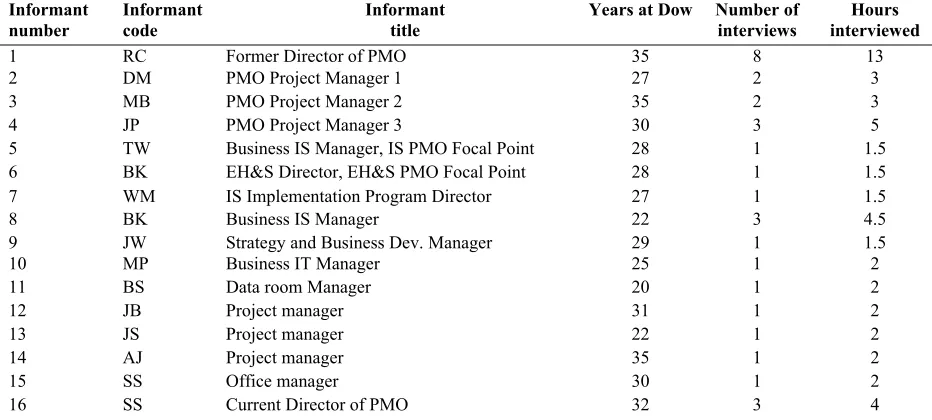
interviews with informants directly responsible for corporate development (see Table 2 for more
information about informants). Each interview consisted of three parts: (1) background of the firm and the
importance of acquisitions, JVs, and divestitures; (2) event chronology for acquisitions, JVs, and/or
divestitures; and (3) direct questions related to learning over time. For the event chronology, we asked
open-ended questions that focused on the sequence of events (e.g., How, if at all, did your company start
formalizing the acquisition process? What did you do first? What did you do next?). We then reviewed the
actions of executives, and asked if we had covered all main activities. We also sent follow-up emails and
conducted additional interviews. Finally, we triangulated interview data with observations and archival
data to improve completeness (Jick, 1979). For example, we spent several days on site and were given
access to several hundred pages of process-related documents created by Dow executives. These
documents frequently took the form of Power Point presentations or manuals that detailed the overall flow
associated with a particular phase of a process (e.g., due diligence or implementation). Together,
supplementing interview data with archival data and relying on very knowledgeable informants (with an
average of 30 years of experience at Dow) helps mitigate informant bias5.
Our analysis involved looking for the emergence of similar themes and relationships related to
learning across acquisitions, JVs, and divestitures (Strauss and Corbin, 1990; Miles and Huberman, 1994).
From the emerging patterns, we formed tentative theoretical constructs. We then refined them by
revisiting the data to compare and verify the occurrence of specific learning mechanisms. Given the
literature’s focus on learning from more and similar experience, pacing of experience, and codification,
we examined the data for these constructs. However, we also looked for unexpected constructs, thus
combining theory elaboration and theory generation (Strauss and Corbin, 1990; Lee, 1999) in our analysis.
We then iterated between theory, data, and extant research until a strong match appeared between the data
and our theoretical framework (see Figures 1 and 2).
CONCURRENT LEARNING OF DYNAMIC CAPABILITIES
Our data show that Dow learned acquisition, JV and divestiture capabilities concurrently. This
organizational-level learning is taking place as indicated by changes in behavior (Argote and
Miron-Spektor, 2011) as it relates to Dow’s Program Management Office (to be discussed) and the activities they
are engaged in. We first describe how Dow learned acquisition, JV, and divestiture capabilities
concurrently. We then discuss how well these capabilities perform.
Initiating structure
Research suggests that knowledge codification helps in developing dynamic capabilities (Kale and
Singh, 2002; Zollo and Winter, 2002). But, this work provides little understanding of how such
5 We also attempted to mitigate informant bias by combining both real-time and retrospective data; that is, Dow not
codification comes to exist since empirical research only assesses whether codified knowledge (e.g.,
manuals or checklists) exists. Our study contributes by suggesting that the nature and order of codification
is consequential for dynamic capability development. We find that Dow executives began the concurrent
learning of multiple dynamic capabilities by “initiating structure”. “Initiating structure” emerged from our
data and is defined as the formation of a dedicated corporate group that begins knowledge codification.
Hence, our definition of structure is consistent with others who define it broadly as constraint on action
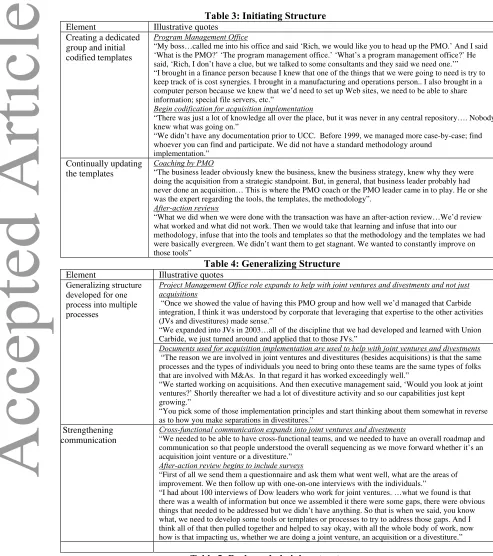
(Davis, Eisenhardt, and Bingham, 2009)6. Figure 2 and Table 3 show how “initiating structure” occurred
from 1999 to 2002 and involves (1) creating a dedicated group and initial codified templates, (2) making
the templates more granular, and then (3) continually updating the templates.
Creating a dedicated group and initial codified templates:
Dow created a dedicated group to begin knowledge codification in 1999 as it began the integration
of Union Carbide Corporation (UCC) – the company’s (and industry’s) largest acquisition up to that point
in time.7 The group was called the Program Management Office (PMO). Rich Carlisle8, the person asked
to head the PMO recalled, “At the time, my boss, the VP of Operations and a member of the board of
directors, called me into his office and said ‘Rich, we would like you to head up the PMO.’ And I said
‘What is the PMO?’ ‘The program management office.’ ‘What’s a program management office?’ He said,
‘Rich, I don’t have a clue, but we talked to some consultants and they said we need one’” (RC). Rich had
spent 25 years at Dow in manufacturing, operations and change management. Rich quickly hired three
seasoned executives within Dow, each with about 15 years of experience in the firm, to help as PMO staff
members. Rich added, “I brought in a finance person because I knew that we needed to keep track of cost
synergies. I brought in a manufacturing and operations person because we knew at that time Union
6 Structure as constraint on action is consistent with other definitions of structure including the regulated norms (e.g.,
rules, communication patterns) that shape action of firm members and the regular patterns of organization (e.g., roles, policies, manuals) through which a firm is expected to be administered (Chandler, 1962 Lawrence and Lorsch, 1967). 7
At the time of the announcement, which was August 1999, Dow was about a $19 billion company and Union Carbide was a $6 billion company. Dow was thus adding about 33 percent additional revenue into the company.
Carbide had a lot of manufacturing sites. I also brought in a computer person because we knew that we
would need to set up Web sites, we need to be able to share information; special file servers, etc.” (RC).
Between 1999 and 2001, when the Union Carbide deal closed, Rich and his group helped put
together a plan for acquisition implementation. They first spoke to business unit and functional leaders at
Dow. Although Dow had been involved in many acquisitions before the Union Carbide deal, at the time
there was no codified documentation that synthesized lessons and insights from these groups to help shape
the acquisition process. This resulted in lower-than-hoped-for outcomes. A PMO Manager expounded,
“We didn’t have any documentation prior to the Union Carbide deal. Before 1999, we managed more
case-by-case; find whoever you can find. We did not have a standard methodology around
implementation” (JP).The PMO Director added, “There was a lot of knowledge all over the place, but it
was never in any central repository… Deals were being done but basically the way it would work is that
you’d have the folks doing the negotiations and all of a sudden they said ‘We’ve just acquired a company.’
There was no planning as far as what’s the integration, what’s the implementation. It was a fire drill.
Nobody knew what the hell was going on” (RC).
One of the first codified documents the PMO created for managing acquisitions detailed team
structures. In the fall of 1999, Rich and his group outlined the different teams that would be involved in
the Union Carbide acquisition implementation. One was cross-functional teams that would work together
to ensure a smooth integration of the acquired company9. He said, “We put together a very good team
structure at the very beginning of Union Carbide and that served us well and was the model that we used
as we moved forward whether it was JVs, divestitures, or additional acquisitions” (RC).
Other codified tools were created soon thereafter. The PMO produced documentation for
“on-boarding”. This provided instruction for integrating acquired employees. The PMO also produced
9 As an example of cross-functional teams, consider the case of getting a new ID badge for acquired employees. The
documentation that specified timelines in the acquisition process. Rich recalled, “We needed an overall
roadmap to try to guide the firm. You could just envision there were thousands and thousands of different
tasks that needed to be accomplished to fully integrate Carbide into Dow. And so that was the reason for
putting together this high-level timeline.” (RC). Finally, because the Union Carbide deal was tied to the
promise of synergies, the PMO put together tools to help measure synergies along the way. Regarding
these first codified tools Rich observed, “Specifying team structure, trying to put together a good
on-boarding program, setting overall timelines and then helping with synergy estimation. Those were really
the first key codified tools that we started working on” (RC).
Making initial templates more granular:
After initially creating generic codified tools (e.g., team structures, overall timelines, on-boarding
detail), Dow then began creating more function-specific codified tools (see codified knowledge in
“initiating structure” in Figure 2). The PMO had originally not codified function-specific information
given that the role of the PMO was to supply generic templates. Rich explained, “And as far as the reason
why we didn’t initially put together the detailed functional information in our plan was the fact that we
had a lot of subject matter experts and their responsibility was to put together the detailed integration
plan for their specific function, whether it was R&D or manufacturing or purchasing, etc.” (RC).
Moreover, the functional representatives from Dow involved in acquisitions were working part-time on
the acquisitions, in addition to their other corporate responsibilities, and so did not have the time and
resources like the individuals within the PMO to focus exclusively on codifying knowledge. With some
knowledge captured in codified documents, Rich and his PMO group began to function as coaches to
business unit leaders who came to them wanting to capture an acquisition opportunity but with little or no
experience doing them. The head of the PMO said, “The business leader obviously knew the business…
But, in general, that business leader probably had never done an acquisition… They were basically
play. He or she was the expert regarding the tools, the templates, the methodology, where the pitfalls
would be, etc. And having those two people plan and work side by side was absolutely critical” (RC).
Continually updating the templates:
After Rich and his team started coaching business unit leaders, they also started performing
after-action reviews. These reviews became the main means to update codified tools and methodologies. Rich
said, “What we did when we were done with the transaction was have an after-action review. This would
be the PMO, the business leader and some of the other key players in that transaction. We would review
what worked and what did not work. And then we would take that learning and infuse that into our
methodology, infuse that into the tools and templates so that the methodology and the templates we had
were basically evergreen. We really didn’t want them to get stagnant. We wanted to constantly improve on
those tools” (RC). After-action reviews occurred in a large-group format, where the PMO joined with
most functional leaders to discuss actions and outcomes. After-action reviews also occurred via
one-on-one reviews with key functional leaders like human resources, finance, safety, or manufacturing since “the
success or failure of the acquisition is so dependent upon those specific functions.”
How initiating structure contributes to concurrent learning:
Overall, we find that initiating structure facilitates the learning of multiple dynamic capabilities. One
reason is that the formation of a dedicated group (a PMO in our case) to start codification focuses
attention and provides coherence and direction. Having a dedicated group synchronizes geographically
dispersed and functionally diverse work groups with each other. This lowers the likelihood of confusion,
fatigue, and wasted effort, and it allows organization members to regulate the tempo of their actions and
allocate time and resources accordingly (Martin, 2011). As the PMO Director commented, “The reason
why we formed the PMO was to make sure that we have good alignment with all of our M&A activities,
points, roles, and responsibilities” (AJ). Without a dedicated group, like the PMO, to coordinate activity,
firm members may overlap in roles and thus become confused about what to do and when.
The formation of a dedicated group also saves time. The group’s creation of initial codified tools
speeds capability creation as it allows executives to build off the past. For example, the PMO Director
remarked how the timeline for acquisitions made future acquisitions more efficient: “Speed is so critical
in an acquisition… So when we announced [acquisition target], we pulled that timeline off the shelf, I put
the name on top, I made a couple other tweaks here and there and we had it within 24 hours” (RC). A
PMO Project Manager concurred, “Acquisitions follow a fairly similar path, so documenting those and
being able to pull that off the shelf is helpful. That’s probably the key advantage. You’re not reinventing
the wheel… That enables us to move a lot more quickly, a lot more efficiently, a lot more effectively than
we had prior” (JP). Codification may therefore be particularly foundational to dynamic capabilities in less
or moderately dynamic industries where efficiencies exist from using common action steps, since prior
theoretical and empirical research suggests that less codified structures like ‘simple rules’ or ‘heuristics’
are foundational to dynamic capabilities in highly dynamic environments where executing common action
steps becomes problematic (Eisenhardt and Martin, 2000; Bingham and Eisenhardt, 2011).
Finally, the creation of a dedicated group that begins knowledge codification limits errors. The
dedicated group formulates rough initial structure for how organization members should act. This reduces
mistakes. As support, the PMO Director stated, “Prior to 1999, we didn’t have a core group. Whenever
there was an M&A deal, you just grabbed whoever. So no one was really trying to focus those resources”
(RC). We find that the dedicated group first creates generic (vs function-specific) structure. In our study,
initial generic structure took the form of codified tools about team structures, on-boarding detail, overall
timelines, implementation milestones, and performance metrics and tracking (see evolution of codified
knowledge in Figure 2). These initial codified documents help facilitate the creation of capabilities, since
just one. Thus, while the PMO was initially formed to help manage a focal acquisition (UCC), members of
the PMO quickly began to see that they were developing lessons that could apply to many future
acquisitions. One PMO leader involved remembered, “We were very specifically formed to do the Carbide
deal, period. Once we did that, we went to management and said, ‘We have some capability here, do you
want to keep us around to work on other acquisitions?’ The answer came back, ‘yes!’” (JP).
Generalizing structure
Research on capabilities suggests the need for maintaining a dedicated corporate function to oversee
a particular process. For example, Kale, Dyer, and Singh (2002) found that firms with a dedicated alliance
function (a dedicated group of individuals overseeing alliances) performed better in their alliances than
firms that did not have a dedicated alliance function. While our first finding on initiating structure also
suggests the importance of a dedicated corporate function for developing one dynamic capability in
isolation (e.g., acquisition capability) our second finding suggests the importance of transitioning
dedicated corporate functions to non-dedicated ones to help firms develop multiple dynamic capabilities in
parallel. In particular, we find that after Dow leaders set up a PMO (program management office) and the
PMO created some codified tools for acquisition implementation (1999-2002), the PMO then began using
those same codified tools for JVs and divestitures (2003-2005). We label this activity “generalizing
structure”. Generalizing structure emerged from the data and is defined as a firm leveraging initial
structure for one process (e.g., acquisition) into multiple processes (e.g., JV and divestiture) concurrently.
Figure 2 and Table 4 show how “generalizing structure” involves (1) generalizing structure developed for
one process into multiple processes and (2) strengthening communication.
Generalizing structure developed for one process into multiple processes:
Through 2002, Dow’s PMO focused on the implementation of acquisitions.But, in 2003, acquisition
activity slowed down and corporate management asked the PMO to help codify knowledge for how to
discipline that we had developed and learned with Union Carbide, we just turned around and applied that
to those JVs” (RC). Similarly, a PMO leader added that once the PMO demonstrated its value for
facilitating acquisition implementations, senior executives at Dow were able to see how “leveraging that
expertise” to facilitate implementation in JVs made strategic sense.
As PMO leaders began to see similarities between the implementation of acquisitions and the
implementation of JVs they also began to see the similarities between the implementation of acquisitions
and the implementation of divestitures. An IT manager involved with the PMO noted the broad link
among them when he said, “When we acquire, and we go through implementation, you could somewhat
put those items in reverse on the divestiture side” (MP). Hence, after applying the codified tools from
acquisition implementation to JV implementation starting in 2003, Dow continued to learn by applying the
same codified tools to divestitures in 2004. There were two specific drivers of this timing. One was that,
as a result of Union Carbide, Dow was forced to do some divestitures because of FTC concerns. The other
driver was that 2004 marked the beginning of a major business downturn. The firm thus needed cash to
pay off the debt from Union Carbide. Hence, Dow began applying its acquisition implementation
documents (e.g., team structures, on-boarding detail, timelines, function-specific plans) to divestitures
starting in 2004. A PMO Manager noted: “So pretty much whether we are doing acquisitions or
divestitures or JVs, we all form cross-functional teams” (JP). He continued, “The reason we are involved
in JVs and divestitures besides acquisitions is that the same processes and the types of individuals you
need to bring onto these teams are the same types of folks that are involved with M&As. In that regard it
has worked exceedingly well” (JP). The PMO Director said, “We started working just on acquisitions.
And shortly thereafter executive management said, ‘Would you look at JVs?’ Shortly thereafter we had a
lot of divestiture activity and so our capabilities just kept growing” (RC).
The value of cross-functional communication, initiated for acquisitions in early 2002, became
re-emphasized as Dow began to formalize its knowledge for JVs (2003) and divestitures (2004-2005). The
PMO Director said: “What we found then was that with JVs and divestitures there were so many
cross-functional interdependencies that we needed to be able to have cross-cross-functional teams, and we needed to
have an overall roadmap and communication so that people understood the overall sequencing as we
move forward, whether it’s an acquisition, JV, or a divestiture” (RC). While Dow continued to rely on
cross-functional teams for acquisitions, JVs, or divestitures PMO leaders noticed that the amount of
communication across the cross-functional teams evolved – i.e., it increased at the start of a deal and
decreased towards the end. At the start, the cross-functional team would meet several times a week to put
together the overall plan, and ensure everybody understood timelines and responsibilities. But, once they
had their plan, cross-functional teams would meet every three or four weeks. At the end of the deal
(implementation phase) the time was lengthened such that cross-functional teams only met monthly.
Dow also strengthened communication through after-action reviews. To further develop their
codified tools, PMO leaders started sending surveys to those involved in JVs and divestitures, and then
conducting extensive one-on-one interviews with those individuals to understand survey insights and
answers. These changes in behavior provide further evidence of learning. The PMO Director explained:
“I think when we started to codify it, you obviously codify what you know. But once we do that, we then have the opportunity to sit back and say, are we missing something? As an example, we have put together a joint venture strategic guidance document. The way that we assembled it is, first of all we send them a questionnaire and ask them what went well, what are the areas of improvement. We then follow up with one-on-one interviews with the individuals. I had about 100 interviews of Dow leaders who work for joint ventures. So I would come into your office and you would tell what you knew about joint ventures. And actually what we found is that there was a wealth of information but once we assembled it there were some gaps, there were obvious things that needed to be addressed but we didn’t have anything. So that is when we said, we need to develop some tools or templates or processes to try to address those gaps…[this is now our process] whether we are doing a joint venture, an acquisition, or a divestiture” (RC).
Overall, we find that generalizing structure fosters the learning of multiple dynamic capabilities
concurrently. One reason is that it allows the recurrent use of knowledge. Scholars contend that
acquisitions, JVs, and divestitures relate to one another, as they are alternative ways to shape firm
boundaries, with divestitures and JVs being ways of contracting them, and acquisitions and JVs being
ways of expanding them (Villalonga and McGahan, 2005). Plus, one can be the flip side of another; an
acquisition for one firm often represents a divestiture for another. Given links among JVs, acquisitions and
divestitures, PMO managers felt that lessons gained in acquisition implementation were generalizable
beyond acquisitions. One stated, “We understood that there would be some commonality in the other
processes, namely JVs and divestitures, but it took us a while to build that experience” (JP). Similarly, the
PMO Director said, “We took a lot of the documents, the templates that we had used with Union Carbide
(acquisition) and then modified those for JVs and likewise for divestitures” (RC). This role of the PMO in
making modifications not only provides evidence of learning (via changes in behavior) but also suggests
that while codified knowledge is helpful for effective experience transfer, it alone may be insufficient.
More broadly, generalizing structure improves the learning of multiple dynamic capabilities
concurrently because it helps executives create expertise across multiple areas concurrently. Keeping
constant the PMO members while changing the deal type facilitates learning as PMO members can readily
identify similarities and differences across projects. This increases opportunities for positive experience
transfer (Haleblian and Finkelstein, 1999). As the PMO Director explained, “It’s all those types of things
that start building on each other and you say: ‘Ah, there is something I just learned from a JV that maybe
I can apply next time I do a divestiture or next time I do an acquisition.’ So there is tremendous
commonality regarding some of the work process discipline that we’ve developed and that we use” (RC).
Finally, generalizing structure allows for concurrent learning because it maintains momentum in the
development of dynamic capabilities. Since practice with one process is often relatively sporadic (e.g.,
and testing it out in related processes (e.g., JVs and divestitures) speeds the accumulation of experience
and allows leaders to quickly understand the usefulness of initial codified tools. A PMO Project Manager
stated, “We did take advantage if there were downtimes relative to acquisitions to focus on codifying and
documenting our processes and taking what we began to learn from acquisitions and apply that as we
started to do JVs” (JP). Likewise, another PMO Project Manager corroborated, “Greenfield JVs, where
you start from nothing and you build something, was not something that the group really had targeted for,
but when asked, they just stepped into that space. And so I think you take whatever opportunity early on
that you have to fill voids that the business would have, to see how the methodology could apply in ways
that really you hadn’t contemplated but works pretty well” (AJ).
Backward-chainingstructure
Empirical work suggests that capabilities are likely to be developed as leaders codify knowledge for
each phase of a corporate development process – i.e., the transaction phase, the due diligence phase, and
the implementation phase (Kale and Singh, 2007; Zollo and Singh, 2004). But, this work is silent on the
order in which phases are codified and why that order may be important for capability development. Our
work suggests that learning multiple dynamic capabilities concurrently is facilitated when firms codify
phases in reverse chronological order, not in chronological order as might be implicitly assumed. We term
this activity “backward-chaining structure.” Backward-chaining structure emerged from the data and is
defined as starting codification with the last phase and then working back to the first phase. We find that
the PMO started codifying documents for the implementation phase of acquisitions, JVs, and divestitures.
This focused attention on the phase that is often considered the most critical and most complex, but that is
also associated with many mistakes (Graebner, 2002). The PMO then codified the due diligence phase for
acquisitions, JVs, and divestitures - the phase before implementation. Finally, the PMO codified the
transaction phase for acquisitions, JVs, and divestitures - the phase before due diligence and the first phase
involves (1) sequencing codification based on importance and complexity as well as unmet firm needs,
and (2) enhancing knowledge transfer via coaching and cross-fertilization.
Sequencing codification based on importance, complexity and unmet organizational needs:
Several studies identify the implementation phase of acquisitions as the most complex and critical
phase influencing acquisition performance (Heimeriks, Schijven, & Gates, 2012; Larson & Finkelstein,
1999)10. Likewise, we find that before 2006 Dow’s top management saw implementation as the key phase
of acquisitions, JVs and divestitures and so focused exclusively on codifying knowledge for this phase.
The PMO Director noted, “Our role is to make business unit heads successful. It’s really about the
understanding and the vision as far as how are you going to implement something.”
In 2006, the PMO group began to see a need for its expertise outside of the implementation phase.
Leaders noticed that the due diligence phase in acquisitions, JVs and divestitures lacked process
discipline. Said the PMO Director, “And the person in charge of the deal would say, ‘Well, I guess we
have to do a due diligence. Who do we need?’ And it was not coordinated. They had no idea who to even
contact. There was no process discipline, they didn’t have a checklist, they didn’t train people…They had
never done a due diligence. In fact, they couldn’t even spell due diligence” (RC). This lack of process
discipline and codified tools caused the firm problems. The Director of the PMO recounted, “As an
example we bought a company. And actually when we went in after we acquired it, and this is before my
group was engaged, there was not a lot of due diligence done but our executive management really just
wanted to do this deal and it turned out terrible. We have either shut down or divested every piece of it
because it was a flawed strategy, there was nothing there” (RC).
Just as the PMO group began to see how implementation tools created for acquisitions were relevant
to JVs and divestitures, so they began to see how due diligence tools, such as corporate and
10 For example, the implementation phase for a large acquisition involves coordinating hundreds of professionals and
specific due diligence checklists and value assessment documents, had relevance for all three deal types.
Given their credibility and experience, the PMO offered to oversee the due diligence phase, rather than
just the implementation phase, for acquisitions, JVs, and divestments. This proposed action met little
resistance within Dow because it not only exploited the knowledge base of the PMO but also addressed a
critical need. The PMO Director said, “Frankly, it was such a pain for our business and corporate leaders
to put together a due diligence team that they welcomed anybody who was willing to help them pull
together those groups of individuals” (RC). The Director added, “We said, ‘Hey, guys, we have the time,
we have this experience and can take the lead on due diligence. We’ll make sure that we get the right
people, we get the right function at the right time and make sure that their people are trained and that they
have the appropriate checklists and that they know what to do from a due diligence standpoint.’” (RC).
Dow’s top management team authorized the PMO to begin codifying tools for the due diligence
phase of acquisitions, JVs and divestitures. This additional evidence of learning was described by a PMO
Project Manager who noted the movement from codifying implementation tools for acquisitions, JVs, and
divestitures to codifying due diligence tools for acquisitions, JVs, and divestitures. He said, “We first
engaged in the acquisition integration phase. After we documented that phase we created and worked on
the JV process and what we call the JV guidance document. We then put together our divestiture process
and divestiture guidance document...We used our implementation expertise across the three types
(acquisition, JV, divestiture). Then we saw a place for ourselves in the due diligence phase” (JP). Another
senior leader added more detail about how something that was learned doing due diligence for acquisitions
was subsequently applied in JVs when he commented, “We have codified our due diligence process and
due diligence checklists when we do acquisitions. We would apply basically those same processes and
checklists in a JV if a partner we’re getting together with is contributing their own manufacturing assets
look at those things that the party brings to the JV. Much like when we would look at those if we were
looking to fully acquire a 100% acquisition” (SS).
As the PMO gained competence and credibility for handling both the implementation and due
diligence phases of acquisitions, JVs, and divestitures, it saw an opportunity to further extend its role into
the transaction phase – the phase preceding the due diligence phase and one that also had unmet firm
needs. Part of the value of having the PMO assist with and create codified tools for the transaction phase
(in addition to tools for the implementation and due diligence phases) came from the high level of
turnover in the people working in the transaction phase, which made capturing lessons from the past
difficult. The PMO Director recollected, “There was a tremendous turnover of people in the transaction
phase. You’d have the corporate director of M&A who’s responsible for the transaction. He or she will
only be there for two years and then move on to another job and then they would bring somebody else
then who had never had any experience. So there was really a lack of process discipline” (RC). Further,
the personnel in charge of the transaction phase at Dow seemed to place less emphasis on capturing
knowledge. Instead, they appeared to be more concerned with timely execution. The PMO Director
remembered, “The finance guys don’t have a really good appreciation of some of the operations issues
that we run into. They’re not as process-oriented. They worry about doing the deal and then they move on
to the next, whereas our group is a lot more into trying to capture the knowledge” (RC).
Because of the PMO’s reputation, the PMO was able to help Dow address an unmet need in the
transaction phase. Hence, in 2007, after codifying tools for the implementation phase and the due
diligence phase, the PMO started to codify tools for the transaction phase. The PMO Director said, “We
started to codify some of the things that our transaction people were doing” (RC). Another PMO leader
added, “We talk about acquisitions, JVs, divestitures and we talk about phases of each– transaction
phase, due diligence phase, and implementation phase. So each type has all three of those phases.
leaders of the due diligence phase of acquisition, JV, divestiture. Now we support the transaction phase”
(JP).
These tools included a transaction proposal, a business support document, a negotiations template, board
approval guidelines, and documents detailing how to perform a post-process review (see codified
knowledge under Transaction tools in Figure 2). A PMO Manager involved elaborated, “Our focus was
acquisitions first, and we were just focusing on the implementation of the acquisitions. Then we segued
into JVs… then, we went into divestitures, and then we started saying: ‘not only can our group help with
the implementation but why don’t you let us drive and lead the due diligence effort?’ So we do the due
diligence for acquisitions, we do due diligence for JVs, we assemble all the information for due diligence
on divestitures. Then more and more we’re spending time working with the transaction teams11” (JP).
Enhancing knowledge transfer through coaching and cross-fertilization:
As the PMO gained experience across acquisitions, JVs, and divestitures and across deal phases
(implementation, due diligence, and transaction), it gained expertise managing any type and facet of those
deals. This increased the PMO’s ability to transfer knowledge across the firm. One way this occurred was
through improved coaching of business unit leaders and functional leaders who lacked experience in
acquisitions, JVs, or divestitures. An information systems (IS) functional leader recounted:
“They call Rich with a new deal. Rich launches a team with his direct staff, which includes his project leaders and the functional leaders – I am one of the functional leaders and I’m invited to participate as the IS central point for the PMO… I am in a coaching and counseling mode for IS managers as they go through the steps of the methodology… One of my roles is to have a monthly meeting with each of the business IS managers who are on projects to discuss where they are in the methodology. That
communication is one way how we are constantly reinforcing the use of the methodology” (TW).
11 Backward-chaining structure assumes a reverse chronological pattern. Dow also started from the most important phase
Another PMO Project Manager supported this view. She detailed her ongoing coaching with
functional leaders within business units looking to acquire, joint venture, or divest. Said she, “It’s an
ongoing dialogue. So I’ll be with an HR representative from a business unit and be their shadow all along
the way. And they will create things like an HR strategy document, an HR internal due diligence
document, a document that states ‘here are our desired starting positions for negotiations,’ an
implementation plan. That person will create those things, but I’m doing the support all along the way. So
they’ll create it, I’ll look at it, we’ll sit down and talk about it … they’ve got a project, and a coach
assigned to them and you work it together. Issues come up, questions come up, the unexpected comes up,
and you have a dialogue around that to help them think through what they would do” (AJ).
Through their coaching, PMO leaders also encouraged knowledge transfer by promoting
cross-functional communication within business units. This occurred in several ways. First, the PMO initiated a
hand-over meeting from the due diligence team to the implementation team. Here, all of the insights from
each of the functions in the due diligence phase are communicated. Second, the PMO made sure
functional people that are handing over due diligence information to the implementation team did not
disappear but rather remained on the steering team for the implementation project and involved in
consulting for another three to twelve months to ensure a smooth implementation. The continuity of
functional leaders across phases mitigated knowledge loss since Dow employees frequently moved from
one assignment and team to another. A PMO IS functional leader stated this benefit when he said, “We
can document as much as we can in our methodology... But losing that key person who has that
experience with the deal and some of the softer points of the deal, that’s a problem. So we try to keep key
people in there throughout the steering team part of the implementation project. That is something that
has evolved over time” (TW). Collectively, our data on the PMO’s coaching provide further evidence of
Knowledge transfer also occurred through the cross-fertilization of ideas within the PMO. As PMO
members were located close together and were connected through shared goals and activities, Dow’s PMO
appeared to meet the formal definition of a group (Edmondson, 2002). Consequently, PMO members
frequently communicated with each other to share insights as they gained experience across deal types.
Importantly, this activity allowed knowledge to move from an individual level to a collective level. One
senior PMO member at Dow stated, “We have folks that are experienced with all three project types and
they can leverage their experience in one type and apply it to another. Then we have sharing from PMO
project manager to PMO project manager so we keep that learning alive. And we keep that capability
strong. So aside from the documentation, there is a very important aspect of people in all of this and
having that continuity and experience across multiple project managers here is highly valuable” (SS).
Communication among PMO members helped indicate which codified tools needed updating. While
the updating of tool did not account for as much time as it did when the PMO was created in 1999, it still
was an important element of each PMO member’s responsibilities. As one PMO functional leader stated,
“Part of my responsibility as a functional leader in the PMO is to keep the tools updated… In the times of
PMO formation, we created templates as we were running projects. That was around 40 percent of our
time. Today, updating takes 5-10 percent of my time, including evaluation with the project team” (TW).
How backward-chaining structure contributes to concurrent learning:
Overall, we find that backward-chaining structure is another activity that facilitates the learning of
multiple dynamic capabilities concurrently. One reason is that acquisitions, JVs, and divestitures can all be
organized in terms of similar phases: transaction, due diligence, and implementation. A PMO manager
stated, “We divide all our processes in three phases… The transaction phase – target identification,
negotiation, document phase with lawyers, getting the agreements in place, etc. Second, due diligence.
When we are buying, we need due diligence, and when we are divesting we need to do an internal due
A second reason backward-chaining structure helps facilitate concurrent learning is that working on
documentation for common phases across acquisitions, JVs, and divestitures allows leaders to better see
how lessons from one process may be transferred to another. Dow’s PMO Director said, “Sometimes,
when we’re doing a divestiture, there are some things that we can learn on the acquisition side and vice
versa.” (RC). For example, acquisitions, JVs, and divestitures all benefited from using a “white paper
document12” in the transaction phase. Whereas with acquisitions and JVs the white paper document
specifies the motivation for resource integration, in the case of divestitures it outlines the motivation for
resource de-integration. Another executive explained: “We have a white paper template…as you’re going
through acquisitions, JVs, or divestitures, you’re going to say: ‘That looks pretty similar. I saw that with
acquisitions or JVs or divestitures. There is commonality across these different types of processes” (RC).
Finally, backward-chaining structure further fosters the learning of multiple dynamic capabilities
because it gradually increases the centrality and applicability of the PMO. The PMO Director
summarized: “My goal for my staff was that those individuals would be able to do acquisitions,
divestitures, or JVs. I did not try to have one person just only focused on JVs or one only focused on
acquisitions because I really felt there was tremendous value for a member of the PMO to understand all
three” (RC). The implication is that as groups like Dow’s PMO extend their structure across different
phases (e.g., transaction, due diligence, and implementation), they can better coordinate the development
of dynamic capabilities concurrently because they create continuities between phases. That is, often when
firms engage in acquisitions, JVs, or divestitures the present and future become disconnected. Some
executives concentrate on the transaction phase, while others focus on the due diligence phase or
implementation phase. Backward-chaining brings the present and future together in orderly ways that help
firms get into a cadence and create guidance for action that is both powerful and efficient. Regarding this,
a senior PMO leader stated, “We’re engaged in all those activities all the time. Our project managers are
12 A “white paper” is an informational document that explicates the strategic rationale, key value drivers, and risks for
multi-capable with respect to managing any type of those projects” (SS). The PMO Director added, “One
of the beauties of having my group involved in due diligence is we’re also involved with driving
implementation…We’ve really tried to improve the linkage between transaction, due diligence and
implementation.”
The performance effects of Dow’s dynamic capabilities
Thus far, we have focused on how Dow created multiple dynamic capabilities in parallel. We have
also avoided the tautology of equating a capability with its performance by first ascertaining the
characteristics of Dow’s capabilities and how they developed (i.e., initiating structure, generalizing
structure, and backward-chaining structure) without assessing performance. We now assess how well
Dow’s dynamic capabilities perform in terms of technical and evolutionary fitness.
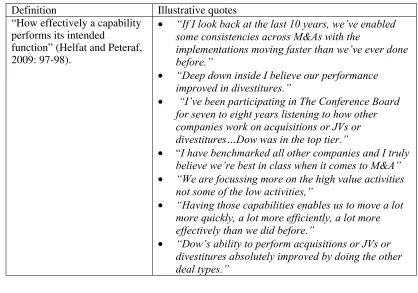
Technical fitness denotes “how effectively a capability performs its intended function” (Helfat and
Peteraf, 2009: 97-98). We assessed technical fitness through qualitative statements of informants (see
Table 6A). These statements emerged without prompting, as executives described the performance of
acquisitions, JVs, and divestitures. Examples include, “If I look back at the last 10 years, we’ve enabled
some consistencies across different types of M&As with definitely a lot of the implementations moving
faster than we’ve ever done before,” and “Deep down inside I believe our performance improved in
divestitures.” Broadly, leaders felt that their JVs, acquisitions, and divestitures were largely performing
their intended functions. As the PMO Director said, “I have been participating in The Conference Board
for seven to eight years and sitting around the table, listening to how other companies work on
acquisitions or JVs or divestitures, what they were doing and what they were struggling with. I personally
believe Dow was in the top tier” (RC). Additional qualitative data suggests that Dow’s dynamic
capabilities are self-reinforcing as the ability to do acquisitions, JVs, and divestitures seemed to improve
divestitures absolutely improved by doing the other deal types” (RC). In sum, our data appear to provide
evidence of technical fitness.
After assessing technical fitness, we then assessed evolutionary fitness. Evolutionary fitness denotes
“how well a dynamic capability enables an organization to make a living by creating, extending, or
modifying its resource base” (Helfat and Peteraf, 2009: 97-98; see also Helfat et al., 2007: 7). Stock
market returns are useful measures of evolutionary fitness since they reflect investor forecasts of future
financial returns and so reflect how well the capabilities (are likely to) enable firms to make a living from
these capabilities. Accordingly, we assess evolutionary fitness through a quantitative event study (see
Table 6B). We used Thomson Financial’s SDC Platinum database to look up all the acquisitions, JVs, and
divestitures that Dow had engaged in between 1990 and 2010. We gathered stock-market data from the
CRSP database and computed the abnormal returns associated with each of these events. Finally, we used
event-study methodology to assess for each acquisition, JV, and divestiture whether this performance
measure tended to increase with experience and thus, whether our empirical setting exhibited evidence of
a capability improving firm outcomes over time. Using event windows of three 1,1), five 2,2), seven
(-3,3), and nine (-4,4) days surrounding the announcement dates, we found consistent statistical patterns
suggesting positive performance effects of experience in the context of acquisitions (p < .01), JVs (p <
.001), and divestitures (p < .10). Overall, our quantitative event study provides evidence of evolutionary
fitness. Together, assessments of technical and evolutionary fitness are important since they suggest that
while all of Dow’s dynamic capabilities we studied (i.e., acquisitions, JVs and divestitures) seem to
perform their intended function, these capabilities also seem to enable Dow to make a living from them.
DISCUSSION
Research in strategy indicates the importance of dynamic capabilities (Teece et al., 1997; Eisenhardt
empirical work has invariably focused on a single dynamic capability in isolation, thus overlooking how
firms might learn multiple dynamic capabilities concurrently. We explore this gap.
Framework: Concurrent learning
Our primary contribution is an emergent theoretical framework for how firms learn multiple
dynamic capabilities concurrently (see Figures 1 and 2). First, concurrent learning starts as firms initiate
structure. Dow created a Program Management Office (PMO), a dedicated group that began knowledge
codification. While existing literature also highlights the role of codified knowledge in the creation of
dynamic capabilities (e.g., Zollo and Winter, 2002), we add by showing how the order of creation appears
to be consequential. The PMO first created generic documents for acquisition implementation (e.g., team
structures and on-boarding detail) and then created more function-specific ones (e.g., HR strategy
documents). This sequence helped the PMO generate documents relevant to future acquisitions vs. just the
focal one in particular. Moreover, we find that the PMO complemented their codification with coaching to
business unit and functional leaders to help them understand which codified tools to use and when. As a
whole, the initial codified tools gave needed guidance and so helped Dow improve efficiency. Yet at the
same time the PMO coaching helped the firm adjust to the idiosyncrasies of each particular event (e.g.,
each acquisition) and so helped Dow preserve flexibility. Together, these actions helped Dow extend its
resource base by using acquisitions to strengthen its position in commodity chemicals.
Second, concurrent learning continues as firms generalize structure. Existing research finds that
executives often bias activity towards one particular growth process such as acquisitions or JVs (Argyres
and Liebeskind, 1999; Folta and Miller, 2002). By contrast, we find that Dow created more symmetry than
asymmetry across acquisition, JV, and divestiture experience since PMO leaders began to see how the
structure used to shape acquisition implementation could also help guide implementation in JVs and
divestitures. As one member of the PMO remarked, “At a high level, acquisitions follow a fairly similar