http://wrap.warwick.ac.uk
Original citation:
Debattista, Kurt, Bashford-Rogers, Thomas, Selmanovic, Elmedin, Mukherjee, Ratnajit
and Chalmers, Alan. (2015) Optimal exposure compression for high dynamic range
content. The Visual Computer, 31 (6-8). pp. 1089-1099.
Permanent WRAP url:
http://wrap.warwick.ac.uk/75757
Copyright and reuse:
The Warwick Research Archive Portal (WRAP) makes this work by researchers of the
University of Warwick available open access under the following conditions. Copyright ©
and all moral rights to the version of the paper presented here belong to the individual
author(s) and/or other copyright owners. To the extent reasonable and practicable the
material made available in WRAP has been checked for eligibility before being made
available.
Copies of full items can be used for personal research or study, educational, or not-for
profit purposes without prior permission or charge. Provided that the authors, title and
full bibliographic details are credited, a hyperlink and/or URL is given for the original
metadata page and the content is not changed in any way.
Publisher’s statement:
“The final publication is available at Springer via
http://dx.doi.org/10.1007/s00371-015-1121-z
”."
A note on versions:
The version presented here may differ from the published version or, version of record, if
you wish to cite this item you are advised to consult the publisher’s version. Please see
the ‘permanent WRAP url’ above for details on accessing the published version and note
that access may require a subscription.
CGI2015 manuscript No.
(will be inserted by the editor)
Optimal Exposure Compression for High Dynamic Range
Content
Kurt Debattista · Thomas Bashford-Rogers · Elmedin Selmanovic ·
Ratnajit Mukherjee · Alan Chalmers
Abstract High dynamic range (HDR) imaging has be-come one of the foremost imaging methods capable of capturing and displaying the full range of lighting per-ceived by the human visual system in the real world. A number of HDR compression methods for both images and video have been developed to handle HDR data, but none of them has yet been adopted as the method of choice. In particular the backwards-compatible meth-ods that always maintain a stream/image that allow part of the content to be viewed on conventional dis-plays make use of tone mapping operators which were developed to view HDR images on traditional displays. There are a large number of tone mappers, none of which is considered the best as the images produced could be deemed subjective. This work presents an al-ternative to tone mapping based HDR content com-pression by identifying a single exposure that can re-produce the most information from the original HDR image. This single exposure can be adapted to fit within the bit depth of any traditional encoder. Any addi-tional information that may be lost is stored as a resid-ual. Results demonstrate quality is maintained as well, and better, than other traditional methods. Further-more, the presented method is backwards-compatible, straightforward to implement, fast and does not require choosing tone mappers or settings.
Kurt Debattista, Thomas Bashford-Rogers, Ratnajit
Mukherjee, Alan Chalmers WMG
University of Warwick
Elmedin Selmanovic University of Sarajevo
1 Introduction
Traditional imaging techniques are incapable of accu-rately capturing or displaying the wide range of lighting that exists in the real world. The areas of the image out-side the limited range, or Low (sometimes also termed Standard) Dynamic Range (LDR), of traditional cam-eras and displays, are either under or over exposed. High Dynamic Range (HDR) imaging technologies al-low for the capture, storage, processing and delivery of a wider range of real-world lighting to provide an en-hanced experience.
Unlike LDR data, in order to account for the wider dynamic range HDR delivers, uncompressed data is not stored as a byte per channel. Typical raw HDR im-ages or frames would require the use of 32-bit floating point values per channel. This equates to 96-bits per pixel (bpp) when compared with the 24 bpp required by traditional LDR images. At an HD resolution of 1,920
which of these methods are the best as a large number of evaluation methods appear to produce different results [1]. All the tone mappers have different settings so it is difficult for a non-expert user to set the correct param-eters consistently. Related work also provides reason to believe that tone mappers are not necessarily superior to viewing a single exposure of an HDR image [2, 3], have an affect on the compressed content [4] and also on visual attention [5].
In this paper a straightforward HDR compression method is proposed which extracts a single optimal ex-posure that is able to fit within a single stream that a traditional encoder can encode. The philosophy of this process is akin to what modern automatic cameras do and identify the best exposure to be taken without the user needing to struggle with complex settings avail-able on more professional cameras. A secondary stream, if required, is used to store the residual. In order to avoid confusion, the extraction of the optimal exposure is termed Optimal Exposure Extraction (OEE) and the overall compression Optimal Compression (OC). OC is straightforward to implement, it is backwards-compatible, it is computationally fast, it produces sim-ilar quality (and sometimes better) results when com-pared with other backwards-compatible methods and is not burdened by the issues that arise from tone map-pers in general.
2 Background and Related Work
A number of image formats have emerged to handle HDR images. These include the Radiance .hdr/.pic for-mat [6] that requires 32 bpp, the OpenEXR forfor-mat that can store full or half float for 96 bpp or 48 bpp respectively and the LogLUV format that supports 24 bpp and 32 bpp [7]. These formats are frequently com-pressed using lossless compression methods to achieve modest gains in terms of storage. However, such meth-ods are still insufficient to handle HDR still images and video data efficiently.
Another aspect to consider about HDR imaging is that HDR content cannot be natively displayed on LDR displays. A single exposure of the HDR image can be displayed on an LDR display; or tone mapping opera-tors can be applied to the HDR content to convert it to LDR content that is suitable to be viewed on a tradi-tional LDR display [1]. There are a large number of tone mappers in existence, and they predominantly attempt to convey the same perceptual response to the viewer as the original HDR content. Tone mapping methods at-tempt to convert the pixels in the image such that the luminance range is compressed into one that is com-patible with the viewing device, typically reducing the
content to 8-bit depth. Global tone mappers do this by applying a fixed function to all the pixels in the image; local tone mappers adjust each individual pixel accord-ing to its neighbourhood. As no objective metrics exist to evaluate tone mappers a large number of subjective methods have been presented but no consensus has yet been reached on the best possible methods and practice. An alternative has been proposed [8]. This method at-tempts to automatically select an exposure of an HDR image with a goal and algorithm not dissimilar to OEE. However, this work was targeted at computer graphics imagery, worked only on a sample of the pixels, was based on computing histograms from multiple colour channels and was not dedicated or applied to compres-sion.
HDR compression methods for both still images and video can be broadly divided into two categories, those that are backwards-compatible and those that are not. The backwards-compatible methods produce a format which can be, partially, directly viewed by a traditional LDR viewer without any modifications to the legacy software. The content that an LDR player displays for the backwards-compatible method is an LDR stream (or image) which is sub-part of the full stream (or im-age). Alternately, if a specialised player is available, the HDR content can be extracted; typically, by in-verting the tone mapping process and using informa-tion imbedded in the format in addiinforma-tion to the video stream. The non-backwards compatible methods can-not be displayed with existing LDR viewers and instead use proprietary viewers to display the HDR content on either an LDR or HDR display. The method proposed here is a backwards-compatible method.
2.1 Still Images
Optimal Exposure Compression for High Dynamic Range Content 3
based on the identified parameters and re-combines this with the residuals.
Xu, Pattanaik and Hughes [11] presented a non-backwards compatible HDR method that used JPEG2000. The method involves using the native 16 bit per channel storage facility of JPEG2000. In order to make use of this, the method converts the floating point values of the original HDR image to 16 bit in-tegers. The results are encoded using the JPEG2000 except for the wavelet domain sub-band quantisation where the perception-related factor is omitted because HDR images were scene referred as opposed to being display referred.
2.2 HDR Video Compression
The backwards-compatible methods for video include Mantiuk et al. [12] and Lee and Kim [13]. These two methods follow the same overall method proposed by Ward and Simmons [9] for still images. Mantiuk et al. (2006) tone map the image, restore the tone mapped frame backwards to a compatible colour space to com-pare with the original, generate a mapping from LDR to HDR and compute a residual representing differences between the reconstructed HDR and original HDR in terms of luminance. The tone mapped frame and the residual frame are temporally compressed using LDR video compression methods and a reconstruction func-tion is also compressed using lossless encoding. The de-coding involves reconstructing the HDR from the tone mapped version using the reconstruction function and re-combining with the residual.
Lee and Kim’s method [13] follows a similar method to Ward and Simmons [9]. The HDR frames are tone mapped using a temporally coherent tone mapper that extends the gradient domain tone mapping operator. A residual is constructed by computing the logarithm of the division of the original HDR luminance by the de-coded LDR luminance. This stream is cross-bilaterally filtered [14] with the original to reduce noise. The tone mapped and residual stream are encoded sepa-rately. To reduce distortions of both the TM and recon-structed HDR sequences the quantisation parameters of the LDR and ratio sequences was controlled. They are then reconstructed by decoding the two streams and re-combining them.
A number of non-backwards compatible methods for HDR video compression have also been proposed. Man-tiuk, Krawczyk, Myszkowski and Seidel [15] suggested an early method for compressing HDR videos. They mofidied the capabilities of the MPEG-4 video codec and extended it to work with HDR video data. The
main characteristic of the proposed algorithm is quan-tisation of luminance where errors were kept below the just noticeable threshold values of the human visual system. To facilitate HDR data, MPEG-4 data struc-tures were expanded from 8 to 11 bits and an efficient coding scheme for DCT blocks was introduced.
Adaptive bit-depth transformation of HDR data was explored by Motra and Thoma [16] and Zhang et al. [17]. Motra and Thoma [16] transformed HDR images to LogLuv format, which they have optimised for 16 bit floating point numbers. Then quantisation errors were minimised by adaptively utilising levels which were left unused after transformation. Zhang et al. [17] extended the method by optimising bit-depth quantisation via the Lloyd-Max algorithm. In addition invisible high fre-quency noise was reduced by transforming frames into the wavelet domain where a contrast sensitivity func-tion weighted wavelet subbands.
3 Optimal Exposure Compression
The backwards-compatible methods use some form of tone mapping to compress the luminance range of an HDR stream or still image to LDR before encoding it. This enables the encoded still-image/stream to be back-wards compatible and it makes it possible to use legacy viewers. However, tone mapping can result in different types of artefacts, requires a choice of tone mapper and an understanding of the settings. The presented method proposes an alternative technique towards backwards-compatible HDR compression. Instead of relying on tone mapping to produce an LDR image/frame, the best continuous luminance range is extracted, and this is augmented with additional information to store and eventually reconstruct the original HDR image/frame.
3.1 Motivation
studies have been conducted and they differ on the re-sults as can be seen in Banterle et al.’s overview of eval-uation methods [1]. While there is little doubt that with the right settings and right tone mapper an expert can create realistic tone mapped images, the vast plethora of tone mappers and settings is definitely an issue for the general user; furthermore, there is no guarantee that even the best tone mappers consistently produce better results than a single exposure. Akyuz et al. [2] found no significant difference between single exposed images and tone mapped images in an experiment that compared tone mapped images, single exposure images and HDR images. Similarly, a recent study [18] of 38 participants found no significant difference among tone mapped im-ages and a single exposure, chosen as the zero expo-sure, when compared with the reference HDR; this is not necessarily the best exposure to show, yet the par-ticipants still did not prefer the tone mapped images over the single exposure. There is also evidence that tone mapped images can change the visual attention of an image [19] and of the compressed content [4]. Fur-thermore, different tone mappers can perform better on different images/frames or even on different parts of the same image / frame as demonstrated by Banterle et al. [20] whereby hybrid TMOs outperformed dedicated TMOs in participant experiments. The choice of tone mappers and the setting of the individual parameters for any given tone mapper is thus quite a difficult task for non-experts. A correctly chosen single exposure cor-responds to the type of images users expect to see from an imaging system and avoids the artefacts common to tone mapping algorithms.
The proposed method avoids the problems with tone mapping by extracting a single exposure designed to fit the size of the encoder. The size of the extracted range equates to the bit-depth supported by a given encoder. Typically this will be 8-bit for most encoders but support for other 10-,12-,14-bit profiles do exist and the method natively adapts to be able to support these profiles. If the HDR content is not a very high dynamic range, the residuals would be very small, so the size of the final compressed image/video would be relatively small too.
3.2 Method
Figure 1 illustrates the encoding method and Figure 2 the decoding method that define OC. The encoding process commences by identifying a single exposure of the HDR image. The single exposure is computed by selecting the contiguous area of luminance to fit within a required bit depth; this is typically the bit depth per-missable by the LDR encoder. In the method presented
Residual
Data
Optimal Exposure HDR Frame ResidualExtract LDR and Temporal
Compression
Extract Optimal Exposure
Optimal Exposure
LDR and Temporal Compression
Fig. 1 OC encoding process.
Residual
Data
Optimal Exposure
HDR Frame Composite
Decode and Expand Residual
Decode and Expand Residual
Expanded Optimal Exposure Expanded
Residual
Fig. 2 OC decoding process.
here and in the subsequent section, the logarithm of the luminance rather than the luminance itself, is used to conform with the human visual system’s response to lu-minance. Thus, it is the log encoded largest contiguous area of luminance which fits in a single exposure or to occupy the bit-depth of the encoder that is identified. Once the single exposure is chosen it is compared to the original HDR and residuals are computed.
The contiguous area of luminance is computed by maximising the luminance for a number of pixels such that the luminance fits within the encoders bit depth:
maxE(f(I(E))) (1)
where the function f() counts the number of well ex-posed pixels in an HDR image I at exposure E. The functionf() is defined as follows:
f(I(E)) = X
p pixels (
1 if,(2BD−1)×Ip(E)[a . . . b]
0 otherwise .
This calculates for each pixel in the image,p, if the pixel value at the current exposureIp(E) scaled by the
bit depthBD of the encoder is within a predetermined acceptable range [a . . . b]. Section 3.3 presents an algo-rithm for computing Equation 1.
[image:5.595.300.534.85.288.2]Optimal Exposure Compression for High Dynamic Range Content 5
After computing the optimal exposure frame, an HDR frame is reconstructed from the optimal exposure frame and the difference between the original and the reconstructed HDR constitute the residuals. The resid-uals are stored in another channel, or in a subband in the case of images, after quantisation and compression. The residuals are stored in a single context for images and a single stream for video. Alternatively, the residu-als may residu-also be stored in two separate sets, representing the higher dynamic range and the lower dynamic range. Values in the higher dynamic range can be quantised more aggressively due to the human visual systems abil-ity to notice changes in luminance at lower values more than at higher values. For the case of this paper we use one residual which is log encoded to account for such characteristics of the human visual system. The data for the chosen exposure, as well as any other practi-cal arguments required for reconstruction are stored as part of the header or a separate stream. The choice of the single exposure takes temporal data into account via temporal filtering of the chosen exposure locations, to ensure the encoded LDR stream does not contain sudden jumps in luminance or flickering.
The decoding procedure on a traditional LDR viewer will show only the single exposure image that has been stored in the encoded still image/stream (see Figure 2). When viewed on a specialised HDR viewer, the single exposure is scaled back up to the original values and the residuals are composited back onto the image.
3.3 An algorithm for computing Optimal Exposure Extraction
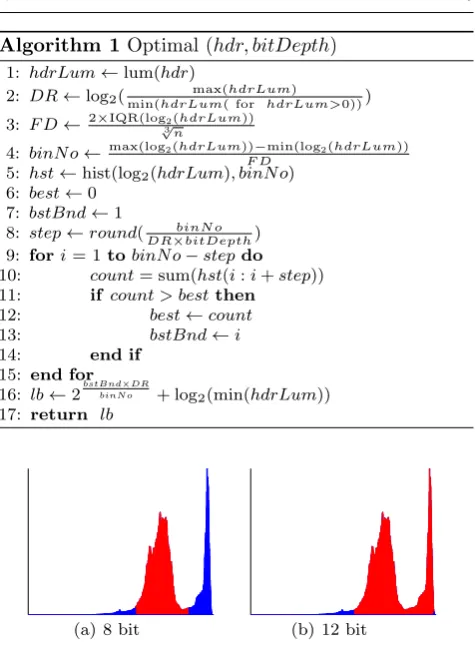
Algorithm 1 provides an overview of the method used to solve Equation 1, although other solutions are possible. The HDR image (hdr) and the bit depth (bitDepth) are input as parameters. The luminance for the HDR image is first computed (hdrLum) as is the dynamic range (DR). The number of bins to construct the his-togram (binN o) is calculated by means of the Freed-manDiaconis rule [21] (see Line 3) which is a relatively robust method suitable for finding the size of a num-ber of bins in the histogram, where IQR() computes the interquartile range. Starting at the first bin, the value of all the bins within a given range is checked. This value then represents the current maximum and is stored (best). The process then cycles through all the bins doing the same thing (calculating total overall lu-minance in that range) and checking if the new value is greater than the stored maximum. If it is it becomes the new maximum. The point in the bin representing
Algorithm 1Optimal (hdr, bitDepth)
1: hdrLum←lum(hdr)
2: DR←log2(min(hdrLummax(( forhdrLumhdrLum>) 0)))
3: F D← 2×IQR(log2(hdrLum)) 3
√
n
4: binN o← max(log2(hdrLum))−min(log2(hdrLum)) F D
5: hst←hist(log2(hdrLum), binN o)
6: best←0
7: bstBnd←1
8: step←round(DR×binN obitDepth) 9: fori= 1tobinN o−stepdo 10: count= sum(hst(i:i+step)) 11: if count > bestthen
12: best←count
13: bstBnd←i
14: end if
15: end for
16: lb←2bstBndbinN o×DR + log2(min(hdrLum))
17: return lb
(a) 8 bit (b) 12 bit
Fig. 3 Histogram showing luminance for basement scene
shown for different bit depths. Red bars mark the area chosen by the proposed method.
the minimum luminancelb is stored. This value is suf-ficient to be able to identify the range of luminance that the optimal compression method will make use of. The end of the range representing the maximum lu-minance of the chosen range could also be stored, or could be calculated later by taking into accountlband the bit depth. The presented algorithm is linear in the number of bins chosen. Once the luminance range is chosen, the backwards-compatible optimal channel is reconstructed per channel. Figure 3 shows how the lu-minance of the Basement image (Figure 5.d) for four different bit depths. The red bars demonstrate the se-lected luminance range for the given bit depth. Note that Algorithm 1 is presented with readability in mind and optimisations should be applied in a given imple-mentation.
4 Results
[image:6.595.298.536.74.402.2]Decoded HDR Frames Original HDR Frames
Encoded streams intermediate format (YUV)
CM Encoder LDR Encoder
Encoded Streams
Decoded streams intermediate format (YUV)
LDR Decoder CM Decoder
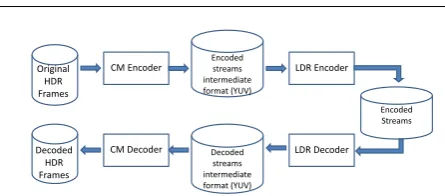
Fig. 4 Pipeline used for comparing results across
compres-sion methods (CMs).
stream and another secondary stream. In addition they usually maintain some extra per scene or per frame pa-rameters in a third stream; this amount of data is of the order of a few bytes per frame and can be considered negligible. The backwards compatible methods chosen for comparison were: the rate-distortion method [13] (Rate Distortion), HDR MPEG [22] (HDR MPEG), a video version of the JPEG HDR method [9] (Ward) and a straightforward inverse tone mapping method (In-verse). The choice of methods of HDR MPEG, Ward and Rate Distortion represent state of the art back-wards compatible methods; Ward was originally pro-posed for static images, however it produced good re-sults when modified for video. This version performs better than the other backwards compatible methods and thus an alternative version of Ward was added to the results. The alternative version (Ward (OEE)) was selected to use OEE instead of its traditional tone map-ping technique to have another method which is not just using tone mapping. The motivation behind this is to show that OC gives good comparable results to more complex methods that may also be using OEE; effectively this serves highlight that the contribution of this work is in the combination of OC via OEE and not just OEE. Inverse, like OC, is a relatively straight-forward method, and was chosen to broadly represent the methods that tone map and then inverse tone map the HDR content and to act as an alternative to op-timal’s choice. Implementation details of the methods are presented below.
4.1 Results’ Method
The method of testing results for video is outlined in Figure 4. The chosen sequences of 120 frames each com-pressed at 24 frames per second are shown in Figure 5, Each method compresses a series of individual HDR frames using the proposed method resulting into two YUV blocks of frames which are then compressed by a traditional encoder at various bit rates. They are then decoded by the traditional encoder’s decoding counter-part to produce decoded YUV blocks. The resultant
YUV blocks are then decoded using the appropriate method to produce a new set of HDR frames. The orig-inal and output HDR frames are compared for each frame across all bit rates and for all scenes using PSNR across all channels.
Results are presented across a wide range of bit rates using two different LDR encoders: h.264 representing current technology and the upcoming standard h.265/HEVC. For all methods the same bit rate is used for both the backwards compati-ble and residual streams. Bit rates were computed by changing quantisation parameters for settings of 1,2,5,10,15,20,25,30,35. x264 and x265 were used for compression with parameters set to the default maxi-mum quality compression preset settings (very slow).
4.2 Compression Methods
All compression methods were implemented from the source materials by ourselves in Matlab and used the exact same framework for undertaking results. OC is present in two guises which have the optimal backwards-compatible stream compressed at the tradi-tional 8-bit and 10-bit referred to OC and OC (10-bit) respectively. For Rate Distortion the original video tone mapper employed in their article was used [23]. The optimisation for bit rate originating from this method is not employed to maintain equality in the encoding of all methods since the actual encoder and decoder was being tested. A fixed bit rate for both streams was used; in addition the benefits of the bit rate op-timisation used in rate distortion could potentially be employed by all methods. For HDR MPEG and Ward, Reinhard’s TMO was used [24] due to it frequently do-ing well in comparison tests [1]. Inverse also made use of the Reinhard TMO and at the decoding stage made use of the inverse Reinhard tone mapper [25, 26]. The Ward method is represented with two sets of results. In the more traditional version (Ward) the Reinhard tone mapper was used. For Ward (OEE) the tone map-ping part is replaced with OEE. Secondary streams for Ward, Ward(OEE) and Inverse are encoded using log encoding to maintain similarity with OC as no specific solutions for storing secondary streams were given in the original work. The use of log encoding was found to produce better results than alternative methods of storing the residuals.
4.3 Quantitative Results
[image:7.595.46.269.77.175.2]Optimal Exposure Compression for High Dynamic Range Content 7
(a) Mercedes; DR = 4.28 (b) Tears; DR = 5.54 (c) Jag; DR = 5.35 (d) Base; DR = 8.37
(e) Machine; DR = 5.62 (f) Seine; DR = 6.30 (g) Disco; DR = 5.52 (h) Weld; DR = 6.48
Fig. 5 Scenes used for video results. Dynamic range (DR) calculated aslog10(maxmin−min).
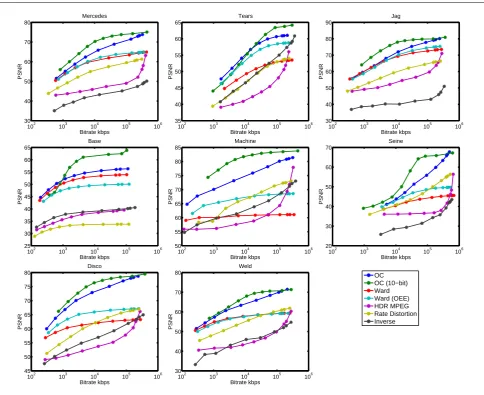
h.265/HEVC results. Results demonstrate that OC and OC (10-bit) outperform the other methods. The Ward method also does well, and in particular Ward (OEE) produces results that further demonstrate how useful the use of computing the optimal can be; they also demonstrate that there is no need of complex encoding and decoding methods to take advantage of OEE, as the straightforward method OC competes favourably with Ward (OEE). Rate Distortion also does well for most scenes. We expect HDR MPEG to perform better if the data were calibrated to real world luminance.
4.4 Still Image Results
The method can also be applied directly to compress still images using JPEG compression. Following Ward and Simmons’ JPEG HDR method [9] the backwards compatible component constitutes the image part of the JPEG format and the residual is stored in the subband. Results, see Figure 9, are presented for OC against the JPEG HDR method using Reinhard’s TMO (la-belled as JPEG HDR) and the JPEG HDR method using OEE (labelled as JPEG HDR (OEE)). Results represent PSNR at various compression qualities con-trolled by the traditional JPEG quality parameter for values of 1,4,16,32,48,64,80,96 for encoded then de-coded HDR images compared against the original un-compressed HDR image. 20 HDR images, shown in Fig-ure 8 were used to obtain the results; OEE was used to choose the exposure shown for each image. The PSNR results are averaged across all images. As with the re-sults for videos OC performs best, closely followed by JPEG HDR (OEE) and then JPEG HDR.
0 20 40 60 80 100
35 40 45 50 55 60 65
Still Image Results
Quality
PSNR
OC
JPEG HDR (Reinhard) JPEG HDR (OEE)
Fig. 9 JPEG Results. Quality represents different JPEG
quality encodings values. Results averaged over 20 HDR im-ages shown in Figure 8.
5 Discussion and Limitations
The presented results demonstrate the usefulness of OC and OEE. In the presented results, it is OC that leads in terms of quality and followed closely by Ward (OEE) (this also applies to JPEG HDR (OEE) which is the still image version). This serves to highlight the effec-tiveness of OEE but also demonstrate that by itself it is insufficient and the straightforward OC implementa-tion combines well to provide better results than when using OEE with other more established methods.
[image:8.595.49.537.75.255.2] [image:8.595.318.513.297.459.2]102 103 104 105 106 35
40 45 50 55 60 65 70 75
Mercedes
Bitrate kbps
PSNR
102 103 104 105 106 35
40 45 50 55 60 65
Tears
Bitrate kbps
PSNR
102 103 104 105 106 30
40 50 60 70 80 90
Jag
Bitrate kbps
PSNR
102 103 104 105 106 20
30 40 50 60 70
Base
Bitrate kbps
PSNR
102 103 104 105 106 55
60 65 70 75 80 85
Machine
Bitrate kbps
PSNR
103 104 105 106 20
30 40 50 60 70
Seine
Bitrate kbps
PSNR
102 103 104 105 106 45
50 55 60 65 70 75 80
Disco
Bitrate kbps
PSNR
102 103 104 105 106 35
40 45 50 55 60 65 70 75
Weld
Bitrate kbps
PSNR
OC OC (10−bit) Ward Ward (OEE) HDR MPEG Rate Distortion Inverse
Fig. 6 h.264 Results.
which can be seen as a positive compared to OC and most other methods. Inverse can be quite straightfor-ward but cannot make use of all tone mappers, only those that have an inverse; moreover, it did not per-form too well. It must be remembered that computation speed plays a fundamental role in activities such as real life transmission of HDR content which is fundamental if HDR is to play a role in broadcast media.
A limitation of the results presented here may be attributed to the lack of comparison with other tone mapping methods. The results were intended to be a comprehensive comparison of backwards-compatible methods and in this regard this has been achieved and demonstrated; using different tone mapping meth-ods would lead to a significant increase in the number of tests which would have made achieving such com-prehensive results impractical. Secondly, the choice of the vast number of tone mappers and possible settings would have been a very complex issue. Importantly, this
is the exact point why OC was developed. Furthermore, the chosen tone mapper (Reinhard) is considered one of the best and is one of the most popular. If other tone mappers were chosen and produced slightly su-perior results the same issues with such tone mapping based methods remain. Also, certain other tone map-pers can be significantly more complex even in terms of computation. OC provides an alternative which is straightforward, fast and maintains good quality.
6 Conclusions
[image:9.595.46.528.76.470.2]Optimal Exposure Compression for High Dynamic Range Content 9
102 103 104 105 106 30
40 50 60 70 80
Mercedes
Bitrate kbps
PSNR
102 103 104 105 106 35
40 45 50 55 60 65
Tears
Bitrate kbps
PSNR
102 103 104 105 106 30
40 50 60 70 80 90
Jag
Bitrate kbps
PSNR
102 103 104 105 106 25
30 35 40 45 50 55 60 65
Base
Bitrate kbps
PSNR
102 103 104 105 106 50
55 60 65 70 75 80 85
Machine
Bitrate kbps
PSNR
102 103 104 105 106 20
30 40 50 60 70
Seine
Bitrate kbps
PSNR
102 103 104 105 106 45
50 55 60 65 70 75 80
Disco
Bitrate kbps
PSNR
102 103 104 105 106 30
40 50 60 70 80
Weld
Bitrate kbps
PSNR
OC OC (10−bit) Ward Ward (OEE) HDR MPEG Rate Distortion Inverse
Fig. 7 h.265 Results.
encoding and decoding stage. While tone mappers do provide a very important role for HDR imaging their use in compression is useful but, on occasions, it can be cumbersome and problematic. We hope OC can be considered as an alternative to the status quo of current HDR compression methods.
Acknowledgements
The Mercedes footage was provided by the Univer-sity of Stuttgart, the Seine scene by Technicolor and Tears of Steel is an open movie project li-censed under Creative Commons Attribution 3.0 by Blender (https://mango.blender.org/about/). Debat-tista is partially supported by a Royal Society Indus-trial Fellowship. Chalmers is partially supported by a Royal Society Industrial Fellowship.
References
1. F. Banterle, A. Artusi, K. Debattista, A. Chalmers, Ad-vanced High Dynamic Range Imaging: Theory and Prac-tice, A K Peters/CRC Press, 2011.
2. A. O. Aky¨uz, E. Reinhard, Noise reduction in high
dy-namic range imaging, Journal of Visual Communication and Image Representation 18 (5) (2007) 366–376.
3. M. Strgar Kureˇci´c, A. Poljiˇcak, L. Mandi´c, A
sur-vey on the acceptance and the use of hdr photog-raphy among croatian photographers, Acta Graphica
znanstveni ˇcasopis za tiskarstvo i grafiˇcke komunikacije
24 (1-2) (2013) 13–18.
4. M. Narwaria, M. P. Da Silva, P. Le Callet, R. Pepion, et al., Impact of tone mapping in high dynamic range image compression, Procceding of VPQM 2014.
5. M. Narwaria, M. Perreira Da Silva, P. Le Callet, R. Pe-pion, Tone mapping based hdr compression: Does it affect visual experience?, Signal Processing: Image Communi-cation.
[image:10.595.48.533.78.473.2]Fig. 8 Images used for still image results.
7. G. Ward, LogLuv Encoding for Full-Gamut, High-Dynamic Range Images, Journal of Graphics Tools 3 (1) (1998) 15–31.
8. L. Neumann, K. Matkovic, W. Purgathofer, Automatic exposure in computer graphics based on the minimum information loss principle, in: Computer Graphics Inter-national, 1998. Proceedings, IEEE, 1998, pp. 666–677. 9. G. Ward, M. Simmons, Subband encoding of high
dy-namic range imagery, in: Proceedings of the 1st Sympo-sium on Applied perception in graphics and visualization - APGV ’04, ACM Press, New York, New York, USA, 2004, p. 83.
10. M. Okuda, N. Adami, Two-layer coding algorithm for high dynamic range images based on luminance compen-sation, Journal of Visual Communication and Image Rep-resentation 18 (5) (2007) 377–386.
11. R. Xu, S. N. Pattanaik, C. E. Hughes, High-dynamic-range still-image encoding in jpeg 2000, Computer Graphics and Applications, IEEE 25 (6) (2005) 57–64. 12. R. Mantiuk, K. Myszkowski, H.-P. Seidel, Lossy
compres-sion of high dynamic range images and video, in: Elec-tronic Imaging 2006, 2006, pp. 60570V–60570V–10. 13. C. Lee, C. Kim, Rate-distortion optimized compression
of high dynamic range videos, in: Proceedings of the 16th European Signal Processing Conference (EUSIPCO 2008), 2008.
14. E. Eisemann, F. Durand, Flash photography enhance-ment via intrinsic relighting, in: ACM transactions on graphics (TOG), Vol. 23, ACM, 2004, pp. 673–678. 15. R. Mantiuk, G. Krawczyk, K. Myszkowski, H.-P. Seidel,
Perception-motivated high dynamic range video encod-ing, ACM Transactions on Graphics 23 (3) (2004) 733. 16. A. Motra, H. Thoma, An adaptive Logluv transform for
High Dynamic Range video compression, in: 2010 IEEE International Conference on Image Processing, 2010, pp. 2061–2064.
17. Y. Zhang, E. Reinhard, D. Bull, Perception-based high dynamic range video compression with optimal bit-depth transformation, in: 8th IEEE International Conference on Image Processing, 2011, pp. 1321–1324.
18. M. Narwaria, M. P. D. Silva, P. Le Callet, R. Pepion, Single exposure vs tone mapped high dynamic range im-ages: A study based on quality of experience, in: Signal Processing Conference (EUSIPCO), 2013 Proceedings of the 22nd European, IEEE, 2014, pp. 2140–2144. 19. M. Narwaria, M. P. Da Silva, P. Le Callet, R. Pepion,
Effect of tone mapping operators on visual attention de-ployment, in: SPIE Optical Engineering+ Applications, International Society for Optics and Photonics, 2012, pp. 84990G–84990G.
20. F. Banterle, A. Artusi, E. Sikudova, T. Bashford-Rogers, P. Ledda, M. Bloj, A. Chalmers, Dynamic range compres-sion by differential zone mapping based on psychophysi-cal experiments, in: Proceedings of the ACM Symposium on Applied Perception, ACM, 2012, pp. 39–46.
21. D. Freedman, P. Diaconis, On the histogram as a den-sity estimator: L 2 theory, Probability theory and related fields 57 (4) (1981) 453–476.
22. R. Mantiuk, A. Efremov, K. Myszkowski, Design and Evaluation of Backward Compatible High Dynamic Range Video Compression, Tech. Rep. April (2006). 23. C. Lee, C.-S. Kim, Gradient Domain Tone Mapping of
High Dynamic Range Videos, in: 2007 IEEE Interna-tional Conference on Image Processing, IEEE, 2007, pp. III – 461–III – 464.
24. E. Reinhard, M. Stark, P. Shirley, J. Ferwerda, Photo-graphic tone reproduction for digital images, ACM Trans-actions on Graphics 21 (3) (2002) 267–276.
25. F. Banterle, P. Ledda, K. Debattista, A. Chalmers, In-verse tone mapping, Proceedings of the 4th international conference on Computer graphics and interactive tech-niques in Australasia and Southeast Asia - GRAPHITE ’06 (2006) 349.
[image:11.595.54.521.76.301.2]