warwick.ac.uk/lib-publications
Original citation:
Onah , D. F. O and Sinclair, Jane (2016) Design Science MOOC : a framework of good practice
pedagogy in a novel E-Learning platform eLDa. In: 28th Annual World Conference on
Educational Media and Technology (EDMEDIA2016), Vancouver, British Columbia, Canada,
28-30 Jun 2016. Published in: Proceedings of 28th Annual World Conference on Educational
Media and Technology (EDMEDIA2016) pp. 1-7.
Permanent WRAP URL:
http://wrap.warwick.ac.uk/79746
Copyright and reuse:
The Warwick Research Archive Portal (WRAP) makes this work by researchers of the
University of Warwick available open access under the following conditions. Copyright ©
and all moral rights to the version of the paper presented here belong to the individual
author(s) and/or other copyright owners. To the extent reasonable and practicable the
material made available in WRAP has been checked for eligibility before being made
available.
Copies of full items can be used for personal research or study, educational, or not-for-profit
purposes without prior permission or charge. Provided that the authors, title and full
bibliographic details are credited, a hyperlink and/or URL is given for the original metadata
page and the content is not changed in any way.
Publisher statement:
A note on versions:
The version presented here is a working paper or pre-print that may be later published
elsewhere. If a published version is known of, the above WRAP URL will contain details on
finding it.
Design Science MOOC: A Framework of Good Practice Pedagogy in a
Novel E-Learning Platform eLDa
D.F.O.Onah, J.E. Sinclair Department of Computer Science
The University of Warwick Coventry, CV4 7AL
United Kingdom
[email protected], [email protected]
Abstract:
Massive open online courses (MOOCs) have taken higher educational establishments of the westernworld by storm with large amounts of funding diverted into developing and delivering a wide variety of online, mass-participation courses. Many claims have been made relating to their potential for providing free, high quality education to everyone, no matter what their situation or geographical position. In practice however, there is little evidence as yet of the desired democratisation of education, with lack of support for students, an absence of pedagogy and very high drop out rates. This project is concerned with MOOC evaluation. It aims to understand the reasons why students drop out and to implement and assess the effectiveness of measures to address specific areas relating to attrition. The theoretical framework of this study is applying design science research methodology (DSRM) in creating and developing a learning tool as an instrument for the research investigation. My research goal is on designing, implementing and evaluating solutions to mitigate these problems.
Enabled by developing network and Cloud technologies, MOOCs are credited with the potential to provide free, open, high quality (yet low cost) education for large classes. However, current efforts are lacking in the necessary pedagogy and framework necessary to provide suitable materials for different learners and supporting individuals in their different learning paths. This is one of the major contributory factors to the extremely high drop out rates currently observed.
This research exposes the learners’ choice of studies from the perspective of analytics and survey responses. It further described the features in the tool and the good practice to be considered while developing an online learning system.
Keywords: eLDaMOOC, Self-regulated learning, self-study, e-learning development, motivation
Introduction
Online education systems such as massive open online courses (MOOCs) have gained large popularity. However, the common occurrence with this system is the high dropout rates as mentioned by Onah et al., [1]. MOOC learners represents the vast online learning community with diverse motivational interest [2, 3, 4 ]. The low completion rate in MOOC is as a result of lack of enthusiasm in the course engagement to motivate learners toward participation. However, some issues of low completion rates in MOOC might not be because the learners are not motivated to participate, but as claimed by Onah et al., [1] some of the learners are engaging with the course at their own pace. In this new innovative context, MOOC completion rate can be related to learners expectations and motivation which are imperative to understanding learner’s goals [5].
This research introduces a new learning platform known as “eLDa”, designed to investigate and mitigate against the problem of low achievement in a MOOC. The eLDa platform is developed to incorporate and analyse the effects of novel features to improve motivation, support and self-regulation.
Self-regulation in an online perspective is the process of the learner developing and enhancing skills in order to achieve set goals [6, 7]. eLDaMOOC has introduced lesson prerequisites to support the learners to make their own informed choices and prepare ahead of a lesson at their own pace, and to provide the motivational pattern to engage with the course. The prerequisite introduced was to guide and motivate the learner in an instructional path to achieve a better knowledge and full understanding of the content. It motivated the learners to prepare beforehand, what their set goals were so as to work towards achieving them.
eLDa is an online MOOC platform, which gives the learners the ability to decide the pattern of their studying habits as explained in self-regulatory study [7]. The course is a guided structured learning, which allows the users to navigate as they wish or follow the instructional steps provided to accomplish their learning and set goals. The course however focuses on three areas: computing concepts, Python programming, and how to teach computing curriculum.
learners to content necessary and suitable for their current state of learning with the help of recommended prerequisites which were incorporated in the lessons of each sessions. There is security against intruders and login attempts limited to three to enforce and prevent unauthorized access to the learning platform.
This paper is structured as follows: Firstly, a review of statof-thart of the problem, online learning analytics and e-learning course development. Secondly, an introduction of a novel eLDaMOOC e-learning platform and its features. Finally, conclusion and suggestions of further research work.
Related Review
There are several e-learning course platforms in existence, but little has been known or discussed about the development of MOOC platform components and features. MOOCs platform was known to incorporate a one-size-fit-all mode of learning. According to [8], who mentioned that Moodle platform was designed to support a particular learning style known as “Social Constructionism”. This style of learning according to the author is a way of interacting with the learning materials and the other participants in the course.
According to [9], the purpose of most e-learning platform is focused on developing courses and learning resources. However, the success of any e-learning course platform are the learners’ whole learning experience, the strategies used in developing the course content, the planning of the course delivery and the methods of delivery. Therefore, all e-learning platforms should focus mainly on the way students learn to enhance their own e-learning skills and regulate their learning habits. In another related study on the successful implementation of e-learning platform [10], the author mentioned that the success of any e-learning course implementation is the careful consideration of the course underlying pedagogy and how the learner engaged with the online content. However, this has been one of the most important factors lacking in the majority of MOOC learning platform.
Learning analytics has been known to be a significant area of technology-enhanced learning and support to learners so as to decide their patterns of study and also to inform the instructor of their self-study modes, thus in most cases this knowledge acquisition is based on their navigating patterns [11]. Learning analytics is said to be a technique to track learners’ activities and event logs in an online learning system. The analytics reveals learner’s pages visited, videos watched and the duration spent in a course page. The usage of ‘Google analytics’ as a tool for learning analytics in any e-learning platform can in real-time show the users engaging online with the course content and how they navigate within the course.
Why Learning Analytics?
The role of leaning analytics according to [12] has a significant role to play in the future of higher education. One of the roles helps in guiding reform in education by assisting the educators in improving the learning and better delivery of the course content. This helps to support the improvement of self-study of the participants when the course is improved based on their learning patterns which can lead to the learners achieving their personal goals, this can be motivating and encouraging consistency in participation. Learning analytics helps in transforming both the instructors to develop a better course platform and delivery as well as motivate the participants to further improve in their roles as learners in education [13].
Analytics Feedback
In another instance some authors [14] developed a course which signals as an intervention solution that allows the instructor to provide a real-time feedback to students in order to improve their performance and success rates. The system relies on grades, demographic, academic history and the students’ interactive efforts with the course. The outcomes are delivered to the participating students as feedback through email to help them understand their progress within the course and in turn will help them to prepare ahead to achieve a better grade.
eLDa Platform Tool
This research will be discussing a new learning platform known as “eLDa”, designed to mitigate against these prevalent dropout issues in a MOOC. eLDa platform is developed to motivate learners to participate in the course to the end. eLDa is an online MOOC platform which gives the learners the ability to decide the patterns of their studying habits. The course is a guided structured course, which allows the users to navigate as they so wish or follow the instructional way provided to accomplish their learning and set goals. The platform has two major modes, the self-mode and the instructor system led mode. These two modes, the first is sorely based on the learners’ choice of learning pattern, while the second is the instructor led system prerequisites with recommended lessons in order for the learners to understand the full course curriculum.
eLDa Interactive Components
Private Messaging: This feature was introduced to help the students discuss with the tutor privately for support in their studies and help in explaining the concepts in the course. Research shows that while researchers encounter low collaboration in online courses between learners and their peers, it was because most students do not want to discuss in public forums for fear of demonstrating a lack of knowledge [18].
Comment: Study has shown that a discussion forum has a significant social aspect of facilitating learning [19].
Measuring learning in eLDa
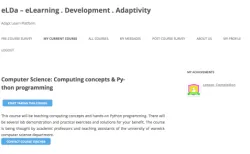
The lesson prerequisites were introduced to recommend content to learners which are relevant to their current mode and module of study. A Pre-entry survey, in course surveys and a post-survey were applied to obtain the knowledge of learners’ following the guided route of the lesson prerequisite, and also the quizzes are used to capture their understanding of the subject. Figure 1 illustrates the course and module interface architecture.
eLDa System Workability
eLDa learning system is developed to meet learners’ needs. The idea was to design a self-mode study and instructor led support mode, and a means of communicating with the tutor by way of private messages to resolve any leaner concerns. The course has two main unique features of self-mode study incorporating self-regulation and the instructor led system support in the form of content prerequisites. The preliminary results from eLDaMOOC platform will be retrieved from two cohorts. The first trial cohort will have the two modes of study; self-mode and instructor led system prerequisites. The second trial cohort will not have the system led prerequisites; hence learners are free to navigate as they wish. The course is been developed to be adaptable to the learner and display visually in order for learners to make their choice (as seen in Figure 1).
Figure 1 . eLDa course interface
Security Issues in eLDa
In order to make the platform free from intruders and unwanted hackers, the researcher installed some security plugins to defend against hackers and intruders who are using the default admin user name and an IP address to access the control panel (Cpanel) to get to the back-end database and login into the learning platform. Plugins such as ‘limit login attempts’ restrict the number of times a user can login into the platform. The number of times a user can try login is thrice, after the third time the user is block from login until after 24 hours or the password reset by the course author or developer. Another plugin used was ‘wordfence’, which prevents malicious software and hackers from gaining access to the course platform. Wordfence scans the eLDa learning platform for any threat and weak user’s password so that the administrator could request password change from the user.
There was a loophole in the design because of the default admin user name used to create the course at the initial stage. Although the password was changed before publishing the course from the local host to the domain and web-hosting company. In addition, this loophole has been resolved successfully.
eLDa Learning Analytics
[image:4.612.243.368.401.478.2]Kenya although there were only about 20 users in the database. Following this issue, we investigated and discovered the admin user name can be hacked by malicious users using IP addresses of the site domain to login into the backend of the database to gain access to the course platform through the control panel (Cpanel). This has led to the researcher’s thorough investigation about the referral traffics and mode of accessing the course content. Thus, the researcher successfully created a defence mechanism to prevent these problems. Figure 2 below reviews the activities observed within the first few weeks of the course going live and the real time users (3 learners live) in Figure 3. Figure 4 illustrated the summary of activities while Figure 5 shows the users locations. This trial phase of the preliminary data represents our pilot study for the first two weeks of launching eLDaMOOC live in May 7, 2015. The learning analytics represents a continuous part of the research agenda.
Figure 2 . eLDa visit analytics
Figure 3. eLDa real-time analysis
Figure 4. Analytics summary
Figure 5. Learners’location analytics
Results & Findings
Preliminary Pilot Study Results
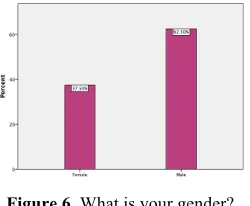
This pilot study was conducted over a period of two months of the course going live (mid May – mid July 2015). eLDa initially had 24 enrolled participants of which only 8 took part in the pre-entry survey. The learners’ demographic and learning preferences were collected from the 8 respondents. The results from the survey shows that about 62.50% (5 male) of the participants were male while the rest 37.50% (3 female) were female (as seen in figure 6).
Figure 6. What is your gender?
[image:5.612.362.486.425.532.2]In terms of age demographics, the results shows that the young generation within the age ranges of 25-34 years comprises 37.50% and the second is the age range between 35-44 years which has 25.00% as shown in figure 7. The majority of the participants are Postgraduate students and Graduates from University.
Figure 7. What is your age?
[image:5.612.129.254.544.647.2] [image:5.612.361.488.601.690.2]When participants were asked about their experience with Python programming, it was observed that 62.50% said ‘yes’ they had some experience while the remaining 37.50% of respondents said they never had any experience of Python programming as seen in Figure 8.
In relation to the survey question ‘have you had any experience in computing concepts’, this question reveals 87.50% said ‘yes’, they had experience in computing concepts and 12.50% said they never had any experience as seen in Figure 9.
Figure 9. Have you had any experience in computing concepts?
[image:6.612.128.255.128.218.2] [image:6.612.362.487.261.351.2]There was a survey question on learners expectations, which shows majority of the respondents about 23.33% participated in this course in order to observe the online education and MOOC, while 16.67% said the wanted to learn more about Python programming and learn new ideas as seen in figure 10.
[image:6.612.127.255.312.403.2]Figure 10. What are your expectations? In the survey question ‘what motivates you to take this course?’, 40.00% of the respondents selected to learn new skills, 33.33% said ‘out of curiosity’ while 13.33% said to ‘learn computing and programming’ and ‘interested in the course’ as seen in Figure 11.
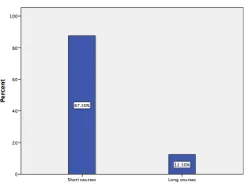
Figure 11. What motivates you to take this course? In another survey question about the type of course most participants prefer, the results shows that 87.50% said they prefer short courses in a MOOC and only a handful of 12.50% of respondents said they prefer long courses (as seen in Figure 12). This shows that majority or greater percentage of the 8 respondents in the eLDa pilot study will want to engage properly in the course when the learning resources are delivered with short concepts.
Figure 12. What kind of courses do you prefer? Since this is a pilot study, most of the participants heard about the course from the author and developer. In Figure 13, it shows that 55.56% of respondents heard of this course from the course tutor and 22.22% of respondents heard about the course from both ‘online resources’ and ‘word of mouth from friends’.
[image:6.612.361.488.413.506.2]Figure 13. How did you hear about this course? It was observed from one of the survey questions that an equal number of learners, (50%) wanted to spend days and weeks each on the course as seen in Figure 14.
Figure 14. How long do you intend to spend in this course?
In another response from the survey question ‘how much of time do you intend to spend a day in the course?, The results reveals 62.50% said they will spend ‘less than an hour’ in the course as seen in Figure 15.
[image:6.612.129.255.475.565.2] [image:6.612.361.486.587.678.2]In a similar question to the previous one about the duration in terms of days, weeks and months on participating in the course, the results reveal 50.00% of respondents said they will spend more than 5 days, while 25.00% of respondents said they will send more than 2 weeks as seen in Figure 16.
Figure 16. How long do you intend to spend on this course?
The response to the survey question, ‘do you prefer short courses to long courses?’, shows that 75.00% of the respondents said that they prefer short courses to long ones and 25.00% of respondents said they prefer long courses as discussed earlier. This also reveals that the participants in this pilot study are mostly interested in short online courses as revealed earlier (seen in Figure 17).
Figure 17. Do you prefer short courses to long courses?
[image:7.612.361.489.159.255.2]The survey results also shows that 87.50% of respondents prefer watching short lecture videos as compared to 12.50% of respondents who prefer long lecture videos as seen in Figure 18. This shows that learners will be more inclined and encouraged watching more videos if they are short in delivery time and get discouraged if they observe the lecture videos are very long.
Figure 19. Do you prefer watching short lecture videos to long lecture videos?
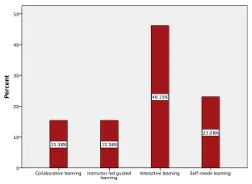
The final pre-entry survey question on ‘what kind of online course delivery do you prefer?’ reveals that about 46.15% of respondents prefer interactive learning and 25.08% prefers self-mode learning as seen in Figure 20.
Figure 20. What kind of online course delivery do you prefer?
Conclusion & Further Work
Online systems have been around for a long time now. While little has been addressed about the initial preparation by learners before participating in an online course. This idea led to the researcher’s motivation to investigate the self-regulated learning of online participants. This self-self-regulated learning habit is in relation to the instructor led system prerequisites that will help to reveal if there exists better or improve completion rates in the eLDa platform.
The researcher will be investigating the ability of the learners to self-regulate their studying habits and observe if eLDaMOOC can motivate and help them increase their skills. Self-regulation in an online context is the process of both the course improvement and learners developing and enhancing skills in order for them to achieve their aims [6,7]. eLDaMOOC has incorporated learning content prerequisites to contribute towards the learners making their own informed choices and prepare ahead of a lesson in a self-pace mode with adequate preparation to engage with the course content. eLDa platform tool allows the learners to self-direct their studies using preferred routes, or otherwise follow the instructional mode provided. The prerequisites introduced were to guide the learners through an instructional route in the course so as to acquire the full understanding of the learning resources. Developing a self-regulation is an important aspect of learning. It allows the learners to prepare beforehand to set their goals so as to better plan towards achieving them. It helps the learners to develop a time management skills, task strategies and self-evaluate their learning habits
[image:7.612.361.487.332.424.2] [image:7.612.127.255.344.435.2]this study help to further developed the full eLDa system design. In addition, a self-regulated learning survey question was conducted using existing instrument to investigate the learners’ self-regulated learning strategies.
Acknowledgment
The first author wishes to acknowledge Mr. Adakole. S. Onah’s financial support in his research, and family members and friends for their moral support.
References
[1] Onah, D. F. O., Sinclair, J., & Boyatt, R. (2014a). Dropout Rates of Massive Open Online Courses: Behavioural Patterns. EDULEARN14 Proceedings, 5825-5834.
[2] Kizilcec, R. F., Piech, C., & Schneider, E. (2013, April). Deconstructing disengagement: analyzing learner subpopulations in massive open online courses. In Proceedings of the third international conference on learning analytics and knowledge (pp. 170-179). ACM.
[3] Pardos, Z. A., Bergner, Y., Seaton, D. T., & Pritchard, D. E. (2013). Adapting Bayesian Knowledge Tracing to a Massive Open Online Course in edX. In Proceedings of the 6th International Conference on Educational Data Mining. http://www. educationaldatamining.org/IEDMS/EDM2013 (accessed August 21, 2014).
[4] Veeramachaneni, K., Dernoncourt, F., Taylor, C., Pardos, Z., & O’Reilly, U. M. (2013, June). Moocdb: Developing data standards for mooc data science. In AIED 2013 Workshops Proceedings Volume (p. 17).
[5] Wang, Y . (2014). MOOC learner motivation and learning pattern discovery. The 7th international conference on
education data mining (EDM2014) , 452 - 454.
[6] Barnard, L., Paton, V., & Lan, W. (2008). Online self-regulatory learning behaviors as a mediator in the relationship between online course perceptions with achievement. The International Review of Research in Open and Distributed Learning, 9(2).
[7] Barnard, L., Lan, W. Y., To, Y. M., Paton, V. O., & Lai, S. L. (2009). Measuring self-regulation in online and blended learning environments. The Internet and Higher Education, 12(1), 1-6.
[8] Rice, W. (2011). Moodle 2.0 E-Learning Course Development. Packt Publishing Ltd.
[9] Alexander, S. (2001). E-learning developments and experiences. Education+ Training, 43(4/5), 240-248.
[10] Govindasamy, T. (2001). Successful implementation of e-learning: Pedagogical considerations. The Internet and Higher Education, 4(3), 287-299.
[11] Ferguson, R. (2012). Learning analytics: drivers, developments and challenges. International Journal of Technology Enhanced Learning, 4(5-6), 304-317.
[12] Siemens, G., & Long, P. (2011). Penetrating the Fog: Analytics in Learning and Education. EDUCAUSE review, 46(5), 30.
[13] Siemens, G. (2010). What are learning analytics. Retrieved March, 10, 2011.
[14] Arnold, K. E., & Pistilli, M. D. (2012, April). Course signals at Purdue: using learning analytics to increase student success. In Proceedings of the 2nd International Conference on Learning Analytics and Knowledge (pp. 267-270). ACM.
[15] Parr, C. (2013). MOOC Completion Rates ‘Below 7 %’, Available at:
http://www.timeshighereducation.co.uk/news/mooc-completion-rates-below-7/2003710.article. [Accessed: 08/08/2015].
[16] Jordan, K. (2013). MOOC Completion Rates: The Data, Available at: http://www.katyjordan.com/MOOCproject.html [Accessed: 8/08/2015].
[17] Onah, D. F., & Sinclair, J. E. (2015, June). Learners Expectations and Motivations using Content Analysis in a MOOC. In EdMedia: World Conference on Educational Media and Technology (Vol. 2015, No. 1, pp. 185-194).
[18] Greener, S. (2009). E-Modelling–Helping Learners to Develop Sound e-Learning Behaviours. In 4th International Conference on E-Learning: University of Toronto, Canada, 16-17 July 2009 (p. 158). Academic Conferences Limited.