Assessing Predictors and
Consequences of
Video-on-Demand Streaming
Behaviour.
An Experience Sampling Study
Bachelor Thesis
Josefine Sundermann
1814907
University of Twente
Department of Psychology, Health & Technology
First supervisor
: Dr. P. M. ten Klooster
1
Abstract
Background. Spending time watching video content online with various Video-on-demand (VOD) services is becoming more and more common. This study examines the different predictors of watching behaviour and its impact on happiness by using an experience
sampling method (ESM). It was expected that exhaustion increases streaming VOD content if the individuals expect to feel better afterwards. Moreover, literature suggested that increased watching of VOD content has a negative impact on happiness but only if individuals feel they are neglecting daily obligations.
Method. The study involved 45 participants, who answered questionnaires targeting their mood and watching behaviour over the course of 15 days using ESM. Individuals were asked to answer questions about watching behaviour as well as perceived neglection of daily tasks retrospectively. Mood, level of exhaustion and happiness were assessed three times a day, while watching behaviour was assessed once a day. The longitudinal data were analysed using linear mixed models, simple correlation analyses and multivariate regression.
Results. Exhaustion was not a significant predictor of watching time. The expectancy of feeling better after watching was significantly linked to watching time, indicating that individuals watch more VOD-streaming content when expecting a positive outcome.
Moreover, the perceived neglection of daily tasks was identified as a significant covariate of happiness. There was a negative, but non-significant correlation between obligation
neglection and happiness, indicating that individuals who are happy, tend to perceive less neglection of daily obligations and vice versa. Watching time was a significant covariate of the level of happiness in longitudinal mixed model analysis but this could not be confirmed using simple correlation analysis of averaged values.
Conclusion. This study identified individuals with a positive outcome expectancy as a predictor for an increased time of streaming VOD-content. Moreover, individuals who perceive to neglect daily obligations, experience a lowered level of happiness. If watching time increases the feeling of neglecting tasks, it is likely that consequences for happiness follow. Future research should focus on individuals with a positive outcome expectancy towards VOD-streaming, as these tend to display greater amounts of watching time.
2
Introduction
“In a few decades, linear TV will be the fixed-line telephone: no longer mainstream.” (Netflix, 2018).
On the plane, the train, at home or the library. Video-on-demand (VOD) services make it possible to watch series, movies or documentaries at any time and anywhere. Streaming services, such as Netflix and Amazon Prime Video, offer the opportunity to watch an unlimited number of episodes or whole series without advertisements in-between (Netflix, 2018). According to Netflix (2018), the internet entertainment branch is expanding quickly due to fast and reliable internet connections, user flexibility as well as the freedom to decide to watch personalised content on any device. Furthermore, the possibility of rapid innovations and improvements through updates is emphasized. All these factors seem to distinguish internet entertainment services from linear TV watching. The availability as well as the scope of services such as Netflix or Amazon Prime Video, steadily rises. The on-demand streaming service Netflix, for instance, increased its operating status from 50 countries in 2010 to 190 countries in 2017 (Brennan, 2018), now covering nearly the whole world. Besides the growing reach of Netflix, the number of subscribers of the VOD service is likely to follow a similar trend. Netflix’s ambitions to grow even further remain high (Netflix, 2018).
The massive availability and popularity of such VOD services give rise to a new phenomenon called “binge-watching”. Binge-watching has been defined as watching two or more episodes of a series in one sitting or in a short amount of time (Davis, 2016; Flayelle et al., 2019; Walton-Pattison, Dombrowski, & Presseau, 2018). However, various definitions of binge-watching exist. The binging-phenomenon seems to be more prominent than many might expect. Young adults are especially likely to engage in binge-watching behaviour. A report by Shannon-Missal (2013) suggests that individuals aged under 40 are more prone to use streaming services compared to older individuals. Moreover, the article states that 62% of individuals in the US who make use of VOD services frequently view multiple episodes of a TV show in a row (Shannon-Missal, 2013). Trouleau, Ashkan, Ding, & Eriksson (2016) similarly demonstrated that 64% of their participants engaged in binge-watching at least once, while 7.6% of the participants engage exclusively in binge-watching sessions.
Walton-Pattison, Dombrowski and Presseau (2018) reported that their participants binge-watched a mean of 1.42 days per week (SD=1.42).
3
the user does not have to wait for the upload of the next episode but is able to choose freely when to continue watching, which facilitates binge-viewing even more (Trouleau et al., 2016; Shim, Lim, Jung, & Shin, 2018).
However, despite its popularity in society nowadays, research examining the antecedents and consequences of binge-watching seems to be rather limited until now. As indicated by the term “binge”, which carries a substantially negative connotation,
consequences associated with binge-watching are not to be underestimated. Poor sleep quality (Exelmans & van den Bulck, 2017) and reduced physical activity (Flayelle et al., 2019; Walton-Pattison, Dombrowski, & Presseau, 2018) are only a few of many potential consequences research has linked to binge-watching behaviour. Nevertheless, only a few studies were able to identify predictors or motives, which could help to get a clearer picture of the phenomenon “binge-watching”. Thus, it is difficult to analyse patterns or possible risk groups/factors of binge-watching. The identification of such risk factors allows targeting special groups who are at risk and help adjust behaviour before severe consequences in terms of psychological or physical health issues develop. Therefore, this study will investigate predictors of binge-watching as well as their consequences.
Theoretical framework
The definition most commonly used for the term “binge-watching” is oftentimes criticized for being imprecise or not capturing the phenomenon appropriately (Davis, 2016; Shim et al., 2018; Walton-Pattison, Dombrowski, & Presseau, 2018). Often, binge-watching is simply defined as “two to six episodes of the same show in one sitting” (Davis, 2016). However, this definition disregards the duration of episodes as well as the types of
programmes (Davis, 2016). According to this definition, watching two shows lasting for 20 minutes will be equally classified as a binge-watching session as watching two shows lasting for 1-hour. Similarly, Shim et al. (2018) criticised that a definition of the number of episodes as a threshold for binge-watching is a questionable practice with no clear conclusion.
4
“marathon-viewing”, since current research is still ambiguous about the consequences of binge-watching (Perks, 2014). However, according to Pittman and Sheehan (2015), this new term is likely to be associated with television marathons which also had a negative
connotation in research. Nevertheless, the scientific literature so far could not confirm that the consequences of this phenomenon are completely negative.
In line with these points, Walton-Pattison, Dombrowski and Presseau (2018) suggest defining binge-watching as watching more than three episodes in one sitting, rather than two, as following the traditional television programming, which regularly includes two-part episodes. Hence, the researchers imply that a refinement of the definition would benefit the research field. The new definition should focus on finding a consensus on “cut-offs of time and/or the number of episodes” (Walton-Pattison, Dombrowski, & Presseau, 2018, p. 22).
Most of the existing research raises the question of whether binge-watching has been defined well enough. Hence, this study will focus on the time spent watching VOD content and whether this increases under specific circumstances.
Research regarding the predictors of an increased watching time is still very limited. However, as VOD-watching is becoming more and more prevalent, it is important to investigate possible motives leading to such behaviour. Netflix itself states on their website that consumers of their VOD service engage in watching in order “to relax, enjoy a shared experience with friends and family, or [because they are] bored” (Netflix, 2018), indicating a
broad range of motivations and predictors of VOD consumption. Similarly, the study by Steiner and Xu (2018) identified cultural inclusion in terms of interacting with others and relaxation as reasons for an increased amount of watching time. Additionally, catching up, sense of completion and an improved viewing experience were found as motivational factors for users to watch.
5
maximise positive emotions. Based on this theory, individuals who search for mood enhancement in VOD-watching are likely to engage in an increased behaviour on a regular basis and incorporate it into their daily routines. In line with this, as cited in Steiner and Xu (2018), Rubin (1983, 2002) suggests that lower levels of activity, such as experienced in relaxation, escape and passing time, are associated with ritualised media use. Hence, individuals who engage in media on a regular basis are likely to experience lower activity levels.
One possible determinant of VOD-watching, which has not yet been explored
concerning its link to VOD-watching, is exhaustion. In general, the concept of exhaustion can be defined as “a feeling of being emotionally overextended and exhausted by one's
work/studies. It is manifested by both physical fatigue and a sense of feeling psychologically
and emotionally ‘drained’." (Wright & Cropanzano, 1998, p. 486). Accordingly, it can be linked to high demands in different settings, for instance in the job or in university. The connection between an increased VOD-streaming time and exhaustion in terms of mental or emotional exhaustion is unexplored by research until now.
The study by Reinecke and Hofmann (2016) investigated the relationship between media use and the state of mental and physical exhaustion, using the experience sampling method. The most frequent media used in this sample was the internet, followed by television watching. Participants mentioned streaming services as the second most common category used throughout periods of using internet services. The results indicate a positive correlation between media use for recovery and exhaustion. Hence, the results suggest a situational state influence on media use in terms of a tendency indicating a higher media use when
experiencing exhaustion. Furthermore, the results imply that situational well-being is enhanced by recovery-related media use since the individual experiences increased media entertainment (Reinecke & Hofmann, 2016).
A similar study by Zacher, Schmitt, Jummieson, and Rudolph (2019) found a relationship between positive mood and emotional exhaustion. Individuals who are in a positive mood are less mentally exhausted compared to people in a negative mood. People who are mentally exhausted are likely to be in need of mood enhancement in order to feel less exhausted. In line with the mood management theory, emotionally exhausted individuals are more likely to engage in an increased VOD watching time due to the need for mood
enhancement.
6
affected mental exhaustion through mood. Greater time pressure leads to a negative mood which increases mental exhaustion. Applied to the field of VOD consumption, it could be suggested that the individual may perceive engagement in VOD-streaming content to increase mood and thereby indirectly influence mental exhaustion. At the same time, if streaming VOD-content leads to a negative mood it likely increases the perceived emotional exhaustion.
The evidence clearly suggests that VOD consumption can be related to an individual’s well-being. However, the relationship is not clear-cut. It seems that VOD watching can be linked both positively and negatively to well-being (Granow, Reinecke, & Ziegele, 2018). On the one hand, as long as the individual perceives autonomy in terms of deciding what to watch or what to engage in during their leisure time, streaming VOD content may influence well-being positively. On the other hand, if the VOD-streaming interferes with certain goals or tasks are neglected, it will be negative for well-being, due to feelings of guilt. Accordingly, VOD consumption is perceived as influencing well-being positively in terms of media entertainment. However, this effect will decline when certain obligations are neglected (Granow, Reinecke, & Ziegele, 2018).
7
The current study
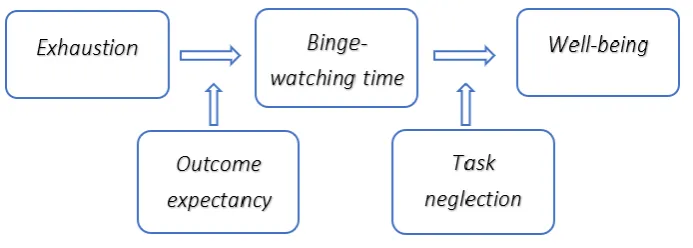
Based on the theoretical framework, this study will focus on two research questions. The theoretical model is visualised in figure 1. Firstly, the question “To what extent is mental exhaustion associated with the amount of VOD- watching?” will be examined by evaluating the following hypothesis:
Hypothesis 1: Individuals who feel mentally exhausted show an increased time of
VOD-watching behaviour.
1 a. This relationship is moderated by the expected mood increase through
VOD-watching. Individuals who expect that watching VOD-streaming content will lead to a
better mood will engage in more VOD-watching when exhausted.
1 b. Contrarily, individuals who do not expect to feel better after VOD-watching, will
engage in less VOD-watching, when exhausted.
This hypothesis is proposed since individuals who feel exhausted due to high demand in their professional setting are suggested to be in need of mood enhancement. If individuals expect a mood enhancement through streaming VOD content, they are likely to engage in increased watching behaviour during times of mental exhaustion. However, if the individual does not believe in such an effect, an increased amount of VOD-streaming is less likely.
Secondly, this research will investigate the question: ”To what extent is streaming VOD content related to well-being?”. Therefore, the following hypothesis will be examined:
Hypothesis 2: The amount of streaming VOD content is negatively associated with an
individual’s perceived well-being.
2a. This relationship is moderated by perceived task neglection. Individuals who are
neglecting other obligations while engaging in binge-watching behaviour will
experience poorer well-being afterwards.
2b. Individuals who are not neglecting other obligations will experience heightened
well-being after engaging in VOD-watching behaviour.
This hypothesis is proposed as individuals are expected to experience heightened well-being due to a perceived autonomy without having the feeling of neglecting important
8 Figure 1: Theoretical model
Methods
Participants
The study involved 45 (64.4% female, 35.6% male) participants, aged between 17 and 30 (Mean age= 22.69; SD age= 2.34). The participants had different nationalities, including
German (91.1%), Dutch (2.2%) Kurdish (2.2%) and Mexican (2.2%). Most participants were students (84.4%), five individuals worked as full-time employees (11.1%), four individuals indicated their occupation as a part-time employee (8.8%) and two participants were pupils (4.4%). Some participants indicated two occupations. The participants were recruited using convenience sampling either via social contacts or via the SONA platform, where students of Psychology or Communication studies at the University of Twente could assign themselves to the study. The participation was voluntary but facilitated by providing an incentive in the form of SONA-credits. SONA-credits are mandatory to obtain for students studying
Psychology or Communication studies throughout their Bachelor programme. The study was approved by the Ethics Committee of the University of Twente. Every participant agreed to an online active informed consent (Appendix 1.4) prior to the participation, fulfilling the
guidelines of this committee.
Design
To measure the daily real-life watching behaviour of participants, an experience sampling method (ESM) design was chosen. Participants were assessed daily using three short
9
This also allows for comparisons between the days. Accordingly, respondents were assessed in the morning (9 a.m.), in the afternoon (3 p.m.) as well as in the evening (9 p.m.). The study took place between the 29th of April and 13th of May 2019, hence, the study length was 15 days, which is described as the average study length for ESM studies (van Berkel et al., 2017). Additionally, the quality of data is likely to decline after 2-4 weeks (Stone, Kessler, & Haythomthwatte, 1991). By assessing 15 days of viewing, watching patterns or cycles could be easily examined without causing too much inconvenience for the participants. Due to the high number of repeated measurements throughout the week, a small sample size of about 30 participants is generally considered sufficient for reliable estimates in ESM studies (Kreft & de Leeuw; 1998).
Procedure
Subsequent to the approval given by the Ethics Committee of the University of Twente, participants were recruited. The gathering of participants was done via social contacts and SONA, the test subject pool of the University of Twente. The participants were informed about the longitudinal nature of the study. After signing up online, they received a
confirmatory email (Appendix 1.1) which contained more detailed information and a step-by-step guide for downloading the TIIM app and the following procedure. They also received a confirmatory email after creating an account and signing in on the app (Appendix 1.2). Participants were allowed to withdraw from the study at any time, without giving a reason.
10
Materials
This research project was part of a joint effort of four individual bachelor-projects regarding VOD-watching behaviour. For this study, only the measures used to investigate the relation between exhaustion and watching behaviour and the consequences for well-being were used. The utilized questionnaires were the baseline (one assessment in the beginning), the
retrospective assessment (one assessment a day) and the momentary assessment (three assessments a day).
All questionnaires were provided to the participant via the TIIM application of the University of Twente (BMSlab University of Twente, n.d.). The application provides opportunities for researchers to create questionnaires with various answer categories as well as interventions for participants. The software is based on the LimeSurvey software, however, with an improved backend to enable and facilitate new functionalities (BMSlab University of Twente, n.d.). To answer the questions, participants were asked to use their own mobile phones (iOS and Android).
Baseline questionnaire. The baseline questionnaire included six different questions. First, participants were asked to indicate their age, gender (male/female/other), their
occupation (pupil/student/employed full-time/employed part-time/unemployed/other) and their nationality (German/Dutch/Other). To gain an overview of the used VOD streaming platforms, the question “Which video-streaming-platform(s) do you use on at least a weekly basis?” (Answers: YouTube/Netflix/Amazon Prime/Hulu/HBOgo/Other) was asked.
The fifth question targets the participant’s expectations of their mood after watching VOD sessions. Participants were asked to indicate their agreement to the statement
“Generally, I am in a better mood after binge-watching.” on a 5-point Likert scale. The
answer categories range from “strongly agree” to “strongly disagree”. The whole
questionnaire took participants approximately 3 minutes.
Retrospective assessment. The retrospective assessment, including 18 items, measured amongst others the participants watching behaviour in the last 24 hours
retrospectively by asking three specific questions about the total time watching behaviour on VOD streaming platforms. In addition, other variables such as the context and genre of watching, reasons for watching as well as feelings after watching were included. The first question was “Did you watch video-streaming content?”, which had to be answered by
indicating “yes” or “no”.
11
“more than seven episodes”. The episodes were coded to fit the number of episodes indicated.
Hence, for instance, “one episode” was translated into 1 and “two episodes” was coded as a 2.
The answer possibility “less than one episode” was coded as 0.5 and the category “more than seven” was translated into 7.5. Special answer categories were “I did not watch” and “I watched a movie(s)” which both were translated into a 0 while coding.
The third question was “how many minutes did you watch?”, which could be answered
on a drop-down scale from “I did not watch”, over the interval between “1-30 minutes” to
“more than seven hours” in steps of 0.5 hours (0.5 hour, 1 hour, 1.5 hours, 2 hours, 2.5 hours,
etc.). Watching time was coded in minutes. The first answer category “1-30 minutes” was
translated into a 15. After that each category was translated in minutes, for instance, “1 hour”
was translated into 60, “1,5 hours” was coded into 90. The answer possibility “I did not watch” was coded as a 0.
The respondents were not expected to know exactly how much time they spend
watching. Instead, they were asked to indicate the best fitting time frame. A broad subdivision of 30-minute intervals was chosen, the individual would indicate the cumulative watching time. A 30-minutes interval is a typical length for an episode of a series (Rigby, Brumby, Cox, & Gould, 2018), which should facilitate the estimations of watching time.
Task neglection question. Part of the retrospective assessment was the examination of retrospectively perceived task neglection. By using a number slider, participants could indicate the extent of neglection of daily tasks, answering the question “To what degree did you neglect responsibilities/obligations of your daily life?”. Answer categories range from
“not at all” (1) to “very much” (10).
Momentary assessment. In order to get an overview of states experienced by the participants throughout the day, participants were asked to answer three items regarding their well-being and level of exhaustion three times a day using an interval of 4 to 5 hours.
Reminders were sent to the participants after two hours to reduce the probability of missing data.
12
Schmiedek, Richter, & Brose, 2018) as well as of core affect (Inkinen, Lonka, Hakkarainen, Muukkonen, Litmanen, & Salmela-Aro, 2014). These studies have shown that the emotion quadrant can be used as a reliable measure of well-being and affect in daily life situations. Accordingly, the emotion quadrant was used as a measurement in this ESM study. To
facilitate the use of the quadrant, an instruction was added describing how to use it correctly. The scores can range from -100 to 100 and are presented in coordinates (pleasure, arousal).
The emotion quadrant was supplemented with an item which measured the level of happiness experienced explicitly. By using a number slider, individuals are able to answer the item “Right now,I am happy.”. Answer categories are ranging from “not at all”, indicated by
using the number one, to “very much”, indicated by using the number 10. The item used in
this study was reformulated based on ESM fundamentals, which suggest that single diary items are to be used since they measure states rather than traits, imitate an internal dialogue and are effortlessly comprehensible (Delespaul, 1995). Further items were formulated in a similar way due to ensure a manageable and simple usability.
Another area of interest was mental exhaustion. In order to simplify the measurement as well as reducing the workload for participants, a single item was used. This was an
adaption of the ESM fundamentals (Delespaul, 1995). Exhaustion was measured by the item “Right now, I feel exhausted.”, which was derived from the Maslach Burnout Inventory (MBI)
item focused on emotional exhaustion (‘I feel mentally exhausted from my work’), which showed a factor loading of .75 (Sonnenschein, Mommersteeg, Houtveen, Sorbi, Schaufeli, & Doornen, 2007). This item was already used in an ESM study by Sonnenschein, et al. (2007) in order to measure momentary exhaustion. Accordingly, it was used for this study as well. Participants could indicate their level of exhaustion by using a number slider ranging from 1 (“not at all”) to 10 (“very much”). To ensure the participant’s understanding of the concept of
exhaustion a description was added. Exhaustion was defined as “a feeling of being emotionally overextended and exhausted by one's work/studies. It is manifested by both
physical fatigue and a sense of feeling psychologically and emotionally ‘drained’." (Wright & Cropanzano, 1998, p. 486).
Data Analysis
13
exhaustion were moved one cell up in the dataset. Accordingly, this allowed to include exhaustion as a predictor of watching time as the indicated watching time no longer preceded the measurement of exhaustion.
The data collected through the momentary questionnaires, namely the variables measuring the level of exhaustion and happiness daily, means were computed by using Microsoft Office Excel (version 1904). Each participant obtained one value per variable, summarising his/her daily average level of happiness and exhaustion. Regarding the data gathered through the emotion quadrant, coordinates were split into two variables, namely level of pleasure and level of arousal. For each of these variables, a daily mean was computed.
Due to the longitudinal nature of the data set, a series of Linear Mixed Model (LLM) analyses with an autoregressive covariance structure was conducted. This model is able to take the unique nested structure of longitudinal data into account. Missing data was taken into consideration in the linear mixed model analysis by the calculation of estimated marginal means. The dependent variables in each linear mixed model analyses were the time
individuals spend in VOD-streaming content, the perceived neglection of daily obligations, as well as the daily means of exhaustion, happiness, pleasure and arousal. The time point, as well as the subject ID, were set as fixed independent factors. The output provided estimated means for each dependent variable per time point and per participant. The estimated means were used for further analyses.
First, Microsoft Office Excel was used for exploratory graphical analyses of the relationships between variables. The estimated marginal means per participant as well as per time point were used subsequently to compute correlations between the used variables.
Correlations were interpreted according to Cohen (1998). A weak correlation is considered by a correlation coefficient of .10, a moderate relationship is suggested at .30 and a strong
correlation is set when the correlation coefficient is higher than .50.
After the calculation of estimated marginal means, a series of multivariate regression analyses was conducted to analyse the relations between the variables of interest. A
multivariate regression was used to investigate the relationship of exhaustion and outcome expectancy and on watching time. In this analysis, exhaustion, outcome expectancy as well as their interaction (exhaustion*outcome expectancy) act as independent variables whereas watching time acts as the dependent variable (Baron & Kenny, 1986).
14
watching time act as an independent variable. Both variables also operate in an interaction term (perceived task neglection*watching time) to model the interaction effect on well-being. The variable well-being is entered as the dependent variable (Baron & Kenny, 1986).
For all analyses, a significance level of .05 was used, meaning accepting a probability of about 5% of rejecting the null hypothesis even though there is no effect present in the data.
Results
A number of 45 students completed the ESM study on a regular basis. One participant, who was not able to answer more than two of the 59 questionnaires, was omitted from the dataset before analysing the data. In total, 72% of the administered questionnaires were completed during the 15 days of measurement.
Observed expectations, watching behaviour and mood
In the baseline questionnaire, participants had to indicate their expectancy concerning how they feel after watching VOD-streaming content. A mean of 3.08 (SD= .67) was observed on a scale from 1 to 5, indicating that on average the individuals were either unsure or have a neutral opinion about their feelings after watching VOD content. Personal scores varied from 2 to 4. No extreme answers were given regarding the expectation to be in a better mood after watching VOD content. A question targeted the VOD streaming platforms used on a daily basis. In the sample, 87% of individuals indicated that they watched Netflix on a weekly basis. 77% of the sample reported to use YouTube and 35% used Amazon Prime Video on a weekly basis. Minor streaming platforms indicated by participants were, for instance, Sky go, Vivo, and Kinox.
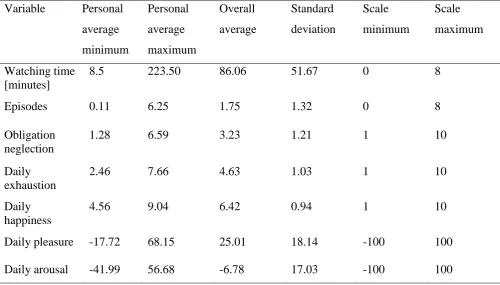
The retrospective measurement asked participants once a day about their watching behaviour, and their perceived obligation neglection. In this sample, participants reported watching VOD-streaming content on about 10.8 days (72%) of the 15 days. On average, 86.06 minutes (SD= 51.67) watching time of VOD-content was observed per individual per day. Accordingly, as seen in table 1, individuals watched around 1.43 hours (SD=.86) a day. Moreover, participants watched 1.76 episodes (SD= 1.32) a day on average. On average, the perceived obligation neglection was 3.26 (SD= 1.87) and daily averages ranged on a personal level from 1.31 to 6.54 on a scale of 1 to 10. This indicates that individuals in this sample experienced little neglection of obligations.
15
[image:16.595.72.573.261.546.2]4.63 (SD= 1.03) on a scale from 1 to 10. The mean average level of happiness per person differed on a range from 4.56 to 9.04. An overall mean of 6.42 (SD=.94) was observed on a scale of 1 to 10. The emotion quadrant indicated a personal average of pleasure ranging from -17.72 to 68.15 with an overall average pleasure level of 25.01 (SD= 18.14). Regarding the individual’s arousal level, an overall mean of -6.78 (SD= 17.03) was observed with a personal mean that ranged from -41.99 to 56.68. Both scales ranged on a scale from -100 to 100.
Table 1
Marginal estimated means per participant
Variable Personal average minimum
Personal average maximum
Overall average
Standard deviation
Scale minimum
Scale maximum
Watching time [minutes]
8.5 223.50 86.06 51.67 0 8
Episodes 0.11 6.25 1.75 1.32 0 8
Obligation neglection
1.28 6.59 3.23 1.21 1 10
Daily exhaustion
2.46 7.66 4.63 1.03 1 10
Daily happiness
4.56 9.04 6.42 0.94 1 10
Daily pleasure -17.72 68.15 25.01 18.14 -100 100
16
Covariation over time and people (LLM)
17
Table 2
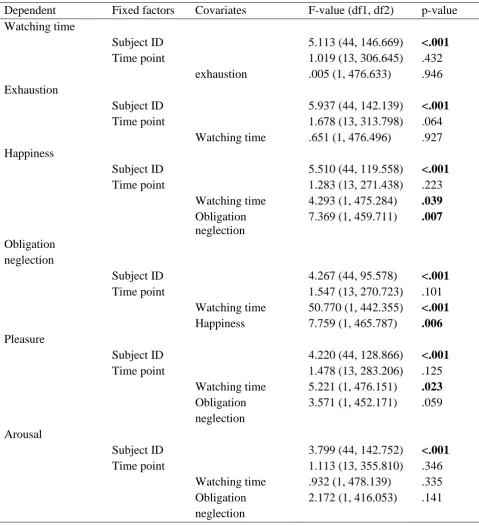
Results Linear Mixed Models with covariates
Dependent Fixed factors Covariates F-value (df1, df2) p-value Watching time
Subject ID 5.113 (44, 146.669) <.001
Time point 1.019 (13, 306.645) .432
exhaustion .005 (1, 476.633) .946 Exhaustion
Subject ID 5.937 (44, 142.139) <.001
Time point 1.678 (13, 313.798) .064
Watching time .651 (1, 476.496) .927 Happiness
Subject ID 5.510 (44, 119.558) <.001
Time point 1.283 (13, 271.438) .223
Watching time 4.293 (1, 475.284) .039
Obligation neglection
7.369 (1, 459.711) .007
Obligation neglection
Subject ID 4.267 (44, 95.578) <.001
Time point 1.547 (13, 270.723) .101
Watching time 50.770 (1, 442.355) <.001
Happiness 7.759 (1, 465.787) .006
Pleasure
Subject ID 4.220 (44, 128.866) <.001
Time point 1.478 (13, 283.206) .125
Watching time 5.221 (1, 476.151) .023
Obligation neglection
3.571 (1, 452.171) .059 Arousal
Subject ID 3.799 (44, 142.752) <.001
Time point 1.113 (13, 355.810) .346
Watching time .932 (1, 478.139) .335 Obligation
neglection
2.172 (1, 416.053) .141
To check whether exhaustion is a predictor of watching time. The daily exhaustion mean was adjusted to be in line with the watching time of the same day. Since the question for
18
dependent variable and exhaustion as a fixed covariate was used. The covariate turned out to be non-significant [F (1, 476.633) = .005; p= .946]. Exhaustion as a covariate and watching time were not linked. This result is a first indication that not enough evidence for hypothesis 1 is available. Additionally, the analysis of exhaustion showed that in the sample, the level of exhaustion tended to increase over the time, however, not yet statistically significant [F(13, 313.798)= 1.678, p= .064].
Additionally, the linear mixed model involving the daily happiness mean as a dependent variable and the perceived neglection of obligations as well as watching time as fixed covariates was conducted. The model indicated the neglection of obligations as well as the watching time as a significant covariate [F obligation neglection (1, 459.711) =7.369, p=.007] [F watching time (1, 475.284) =4.293, p=.039]. The results indicate that the perceived neglection of
obligations and the watching time were associated with daily happiness scores. Similarly, this was confirmed when using obligation neglection as dependent variable. Both covariates, happiness and watching time, are significantly related to the neglection obligations [F watching time (1, 442.355)=50.770; p<.001] [F happiness (1, 465.787)=7.759; p= .006]. First evidence
points in favour of hypothesis 2, 2a and 2b. Accordingly, these relations are explored in more detail.
Almost identical results were seen in a linear mixed model in which pleasure was the dependent variable. The covariate watching time [F (1, 476.151)=5.221; p=.023] tended to be related to pleasure, although the p-value of perceived obligation neglection [F (1,
19
Post-hoc correlations
Simple post-hoc correlations were employed to examine the relationship between the
[image:20.595.72.526.237.459.2]variables further. Two perspectives were used to explore the associations. Correlations using means of each participant as well as the means per time point. The participant level is focused on the mean of all days per participant whereas the time point level incorporates the means per day of all participants.
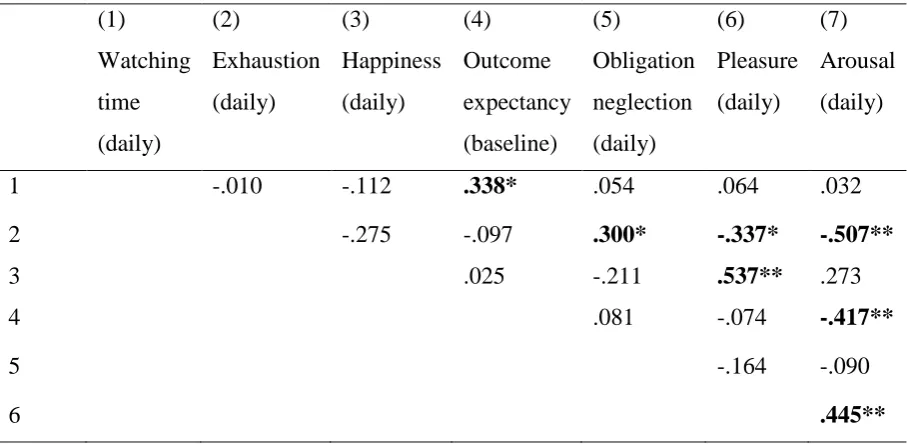
Table 3
Correlation between variables per participant
(1) Watching time (daily) (2) Exhaustion (daily) (3) Happiness (daily) (4) Outcome expectancy (baseline) (5) Obligation neglection (daily) (6) Pleasure (daily) (7) Arousal (daily)
1 -.010 -.112 .338* .054 .064 .032
2 -.275 -.097 .300* -.337* -.507**
3 .025 -.211 .537** .273
4 .081 -.074 -.417**
5 -.164 -.090
6 .445**
Note. * p < .05 level (2-tailed); **p <.01 level (2-tailed).
Table 4
Correlations between variables per time point
(1) Watching time (daily) (2) Exhaustion (daily) (3) Happiness (daily) (4) Obligation neglection (daily) (5) Pleasure (daily) (6) Arousal (daily)
1 -.179 .167 .075 .215 .468
2 -.594* .536* -.544* -.757**
3 -.371 .720** .573**
4 -.202 -.682**
5 .421
[image:20.595.71.525.537.730.2]20
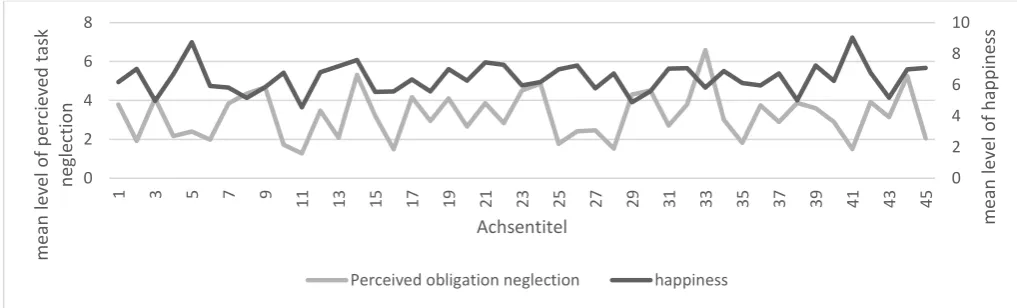
Considering the high correlation between happiness and pleasure on individual level and over time, both concepts appear to be very similar and resemble a similar construct of well-being (table 2; table 3). Therefore, the results will focus on happiness as a measure of well-being. To further examine the results of the linear mixed models, simple correlations were computed. A Pearson’s correlation was computed to test the assumption that the perceived neglection of obligations would be negatively correlated with happiness per participant. There was a non-significant, negative correlation between the two variables (r= -.211, n= 45, p= .165), indicating that individuals who have a high daily level of happiness tend to experience less neglection obligation (figure 2).
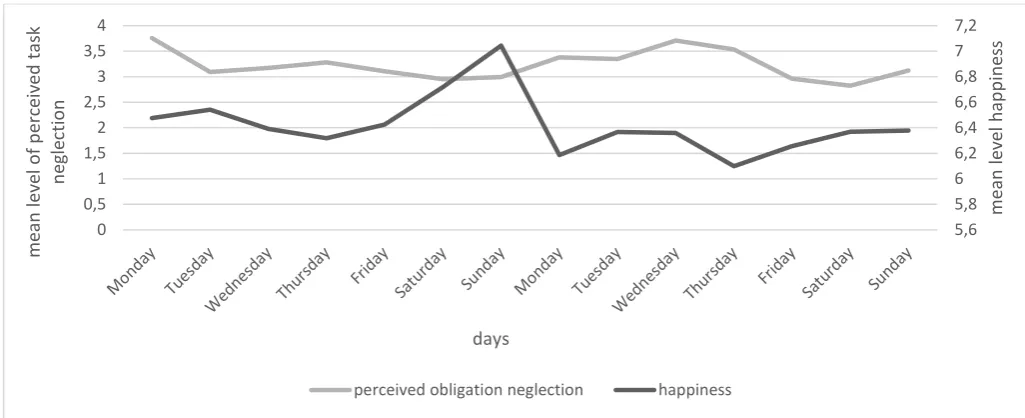
[image:21.595.69.578.381.535.2]From the time point level, another Pearson’s correlation analysis was used to observe the relationship between the same variables per day. A moderate, but, again, no significant association could be identified (r= -.371, n=14, p=.192). Accordingly, the higher the level of happiness over all time points, the lower the overall perceived neglection of obligations tended to be (figure 3).
Figure 2: Mean level of happiness (dark grey) and mean level of perceived neglection of obligations (light grey) per participant.
0 2 4 6 8 10 0 2 4 6 8
1 3 5 7 9 11 13 15 17 19 21 23 25 27 29 31 33 35 37 39 41 43 45
m ean le ve l o f h ap p in es s m ean le ve l o f p ercie ve d ta sk n egle ctio n Achsentitel
21 Figure 3: Mean level of happiness (dark grey) and mean level of perceived obligation
neglection (light grey) over the time points.
To assess the relationship between watching time and happiness per participant, another Pearson’s correlation analysis was computed. The correlation was a weak and non-significant (r= -.112, n=45, p= .464) (figure 4).
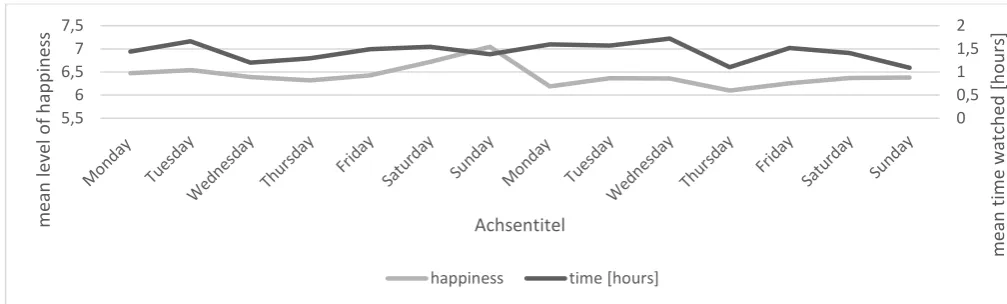
The same analysis with the same variables was employed for observations per time point. Only a weak correlation was identified between the level of happiness and the time watched per day (r=.167, n=14, p= .569) (figure 5).
Figure 4: Mean level of watching time in hours (dark grey) and mean level of happiness (light grey) per participant.
5,6 5,8 6 6,2 6,4 6,6 6,8 7 7,2 0 0,5 1 1,5 2 2,5 3 3,5 4 m ean le ve l h ap p in es s m ean le ve l o f p erce iv ed ta sk n egle ctio n days
perceived obligation neglection happiness
0 1 2 3 4 0 2 4 6 8 10
1 3 5 7 9 11 13 15 17 19 21 23 25 27 29 31 33 35 37 39 41 43 45 mean
time wat ch ed [h o u rs ] m ean le ve l o f h ap p in es s Achsentitel
[image:22.595.69.580.463.621.2]22 Figure 5: Mean level of watching time in hours (dark grey) and mean level of happiness (light grey) per time point.
Since the outcome expectancy was assessed only once in a baseline questionnaire, it was not used as a covariate in a linear mixed model. Accordingly, only a Pearson’s correlation was employed to check the relationship between the variable outcome expectancy and
[image:23.595.69.586.457.649.2]watching time between individuals. There was a significant positive and moderate correlation between outcome expectancy and watching time (r=.338, n=45, p=.023), indicating that participants who expect a positive outcome after VOD-watching tended to watch more VOD content (figure 6).
Figure 6: Mean level of watching time (dark grey) and individual scores of baseline outcome expectancy (light grey) per participant.
0 0,5 1 1,5 2 5,5 6 6,5 7 7,5 m ean time wat ch ed [ h o u rs ] m ean le ve l o f h ap p in es s Achsentitel
happiness time [hours]
0 0,5 1 1,5 2 2,5 3 3,5 4 4,5 0 0,5 1 1,5 2 2,5 3 3,5 4
1 3 5 7 9 11 13 15 17 19 21 23 25 27 29 31 33 35 37 39 41 43 45
m ean time wat ch ed [ h o u rs ] scores o u tco m e exp ecta n cy participants
23
Interaction effects between variables
To test a potential interaction effect of exhaustion and the individual’s outcome expectancy, a multivariate regression was conducted. For this analysis, the marginal estimated means per participant were used. An interaction effect was modelled, which had no significant effect [F (3, 41) = 1.995; p=.130]. The total R2 of the model was .127, meaning 12.7% of the variance in the dependent variable could be explained by the model at hand. Respectively, the
interaction of exhaustion and outcome expectancy was also no main predictor of time
individuals watched VOD content. This result is in line with the correlation analysis as well as the linear mixed model. There was not enough evidence to reject the null hypotheses. Hence, no effect was found in the sample confirming hypothesis 1, 1a and 1b.
To examine the interaction effect of watching time and the perceived neglection of obligations, a multivariate regression was utilised. The results indicate that no interaction effect was present [F (3,40) = .816; p = .493]. The R2 of the model was .058, meaning that 5.8% of the variance in the dependent variable could be explained by the model. Accordingly, the perceived neglection of obligations as well as the watching time did not affect the level of happiness. Due to this result, the null hypotheses could not be rejected in favour of the
hypotheses 2, 2a and 2b. It appears, that no effect could be identified in the sample, concerning these three hypotheses.
Discussion
In this study predictors as well as consequences of VOD streaming behaviour were
investigated using ESM. In a nutshell, the results indicated that exhaustion was not a predictor for watching time. However, the expectation to feel better after watching was positively associated with watching time later on, indicating that baseline outcome expectancy is a significant covariate of the amount of VOD-watching. Happiness, obligation neglection and watching time seemed to be related based on linear mixed model analyses. However, conventional statistical procedures were not able to confirm any robust effects.
24
Zacher, Schmitt, Jummieson, and Rudolph (2019) it was assumed that individuals who are mentally exhausted search for recovery to enhance mood. However, in this sample, recovery from exhaustion seemed to have a different effect on the participants’ behaviour. Instead of engaging in watching behaviour when being exhausted, individuals may search for other ways of mood increasing processes, even if mood enhancement through binge-watching is expected by the individuals.
This could be explained through different processes. It might be the case that
individuals who experience feelings of exhaustion are not able to actively process the episode or movie as their cognitive capacities/resources are depleted. However, one can assume that individuals want to watch VOD content attentively out of curiosity and interest in how the storyline will proceed. This assumption is in line with the results found by Pittman and Sheehan (2015), who suggest that engagement in the story and the characters is the strongest motive for watching VOD content. Accordingly, a commitment to a series rises with the level of engagement, which in turn increases the frequency of watching behaviour. Moreover, Flayelle et al. (2019) indicated that social factors also play a role in streaming habits on platforms such as Netflix. Individuals could have an intention to watch a certain series to relate to others in conversations. Therefore, being active and attentive may be a requirement which cannot be fulfilled when being exhausted. Accordingly, watching VOD-streaming content may not be the first-choice coping mechanism employed to recover from mental exhaustion, when individuals want to actively and attentively follow the storyline.
Another reason which can explain this result could be that the concept of exhaustion is not directly linked to mood enhancement, but to levels of energy. Accordingly, exhausted individuals might be prone to increase energy levels, for instance by sleeping, instead of engaging in a low energy activity such as watching online streaming content. A moderate correlation per time point between the daily level of arousal and watching time has been identified. Accordingly, on days where the daily level of arousal was generally low, the overall watching time tended to be low as well.
25
1998). The results of this study confirm that individuals who expect to feel better after watching also engage more often in such behaviour in the future.
It seems that exhaustion itself is not a good predictor of watching time. However, the desire for mood improvement appears to be more constant. Even though the literature has not explored this phenomenon so far, this assumption can explain some of the findings of this study. Respondents who believe to feel better after watching, show an increased watching time, regardless if they actually feel better or worse afterwards. One explanation of this could be that individuals strive to improve their current mood. Individuals are possibly less in contact with their own emotions and mood. Therefore, the exhaustion in itself might not be a predictor, but the desire to constantly improve mood is. Accordingly, individuals who assume to be in a better mood after watching VOD streaming content, are also more likely to show an increased amount of watching time, in an attempt to improve their mood. People without that expectation therefore may seek other ways of improvement.
Moreover, the linear mixed model indicated that happiness was linked to watching time and neglection of obligations. This link could not be supported with other conventional simple correlations methods. This can be due to a weak effect present or small sample size for the simple correlation analyses. Furthermore, linear mixed models tend to carry substantially more power, when the assumptions are met. This facilitates finding an effect in longitudinal data. The correlation analysis did provide an indication of direction on the individual level as well as over time and shows that obligation neglection might be negatively correlated to happiness. Accordingly, the less an individual perceives neglection of daily obligations, the happier he/she is and vice versa. This is in line with suggestions that individuals who perceive that obligations of their daily life are neglected are likely to experience feelings of guilt. These should have an impact on the feeling of well-being and happiness (Granow, Reinecke, & Ziegele, 2018).
26
should be further investigated by the incorporation of character traits, such as impulsivity (Riddle, Peebles, Davis, Xu, & Schroeder, 2018) or sensation seeking (Shim & Kim, 2017). Such traits might act as potential moderators when it comes to watching behaviour.
The research design included some limitations, which have to be taken into
consideration. One limitation concerns a possibly small effect size in the sample. An effect can be small which makes it more difficult to grasp through conventional statistical
procedures, even though it constitutes a crucial part of the model. This can be the case, for instance, in regard to the relationships between the level of happiness and watching time, as well as between neglection of obligations and happiness. This is especially true for the more conventional methods, carrying substantially less power, compared to the linear mixed models. These linear mixed models can take the nested and longitudinal structure of the dataset into consideration, which is likely to be the reason why an effect was found in these models but not in simple correlations and regression analyses. However, even though an effect could be detected in the linear mixed model, these effects seemed rather small. The power is likely to be too low with typical statistical procedures since only estimated marginal means can be taken into account. Accordingly, collecting more data from more individuals should facilitate the detection of an effect and thereby aid in precluding this limitation.
Another limitation which should be considered is that the study design may in itself act as an intervention. By indicating each day how much VOD-streaming content was consumed, individuals were made aware of their consumption behaviour. Accordingly, and due to the negative connotation of binge-watching, participants might have the feeling that it is necessary to reduce their watching behaviour in general. This is suggested as the
participants were increasingly made aware of their time spent on Netflix and similar platforms. However, a study by Hufford, Shields, Shiffman, Paty, and Balabanis (2002) indicated that a reaction to an ESM study was generally only weak. The article also mentioned that further research is necessary.
The last limitation concerns the generalisability of the results due to a
27
bias, which has to be taken into consideration. For future studies, either a more diverse sample or a sample of the at-risk population should be collected.
Besides the limitations, also strengths were observed in the research design. Especially the longitudinal nature of the data is an advantage of the research design. This data collection method allows for the collection of large amounts of data which, in turn, provides a more accurate, momentary and holistic representation of behaviours and feelings (van Berkel et al., 2017). Particularly regarding watching behaviour, longitudinal data can facilitate the
recognition of individual patterns in watching behaviour.
In line with the longitudinal data collection, the usage of experience sampling is another strength of the research design. The ESM can generate more accurate data when encountering changes in patterns of mood/internal processes or watching behaviour over time (van Berkel et al., 2017). Moreover, cross-sectional designs are prone to include biases and errors, such as social desirability, confirmation bias or recollection error, which can distort the data (van Berkel et al., 2017; Lindell & Whitney, 2001). By using ESM, variables such as exhaustion and watching behaviour are assessed separately at different time points, which reduces bias and method effects.
A last advantage of the study design was that it was unobtrusive and easily useable. Participants could use the application in their daily life, without entering a laboratory setting. Hence, it was simple for individuals to take part in the study even when they are at home. The application took about 8 minutes time, which was spread over the day. Moreover, they were notified and reminded of the availability of a questionnaire. Accordingly, it could be easily integrated into daily life and ensured a high response rate. The application was easily usable for everyone, except for one technical difficulty, which was fixed one hour after its
occurrence.
Further research should investigate the link between watching time and happiness as well as obligation neglection. Although links between watching time and happiness as well as a perceived neglection of obligations and happiness were indicated in the employed linear mixed model, this could not be confirmed using conventional statistical procedures. However, since linear mixed modelling can incorporate the nature of longitudinal data, they are
considered to have substantially more power. This suggests that these links should not be underestimated, only because less powerful methods could not confirm the findings. In future studies, this link should be further explored to get a clear picture of the phenomenon of binge-watching or an increased binge-watching time, its consequences or predictors. The level of
28
of VOD streaming. Therefore, a recommendation is to collect more data in relation to these links. Further clarifications concerning the influence of watching time and obligation neglection on an individual’s well-being or vice versa will prove valuable.
The association between the expectancy of outcome after watching and VOD-streaming time should be investigated further. Individuals who believe to feel better after streaming VOD-content are likely to engage more strongly in Netflix, Amazon Prime Video and other platforms. This link should be further investigated. It could be the case that
individuals are constantly striving to improve own mood states regardless of their current mood. Therefore, people with the expectancy to feel better after watching are more prone to watch longer sessions than people who do not expect a mood change afterwards. In the long run, such information can be used to address and design specific interventions.
To get deeper insights into watching patterns and risk groups, analysis on an
individual level can be beneficial. Identifying extreme patterns in the sample, for instance, in terms of individuals who watch VOD-streaming content extensively, can lead to new valuable insights. Accordingly, future research should not only focus on group level analyses but also be aware of individuals watching patterns, that give indications of certain risk groups and predictors at hand. Specifically, employing linear mixed models in such studies should prove beneficial, as these can facilitate such longitudinal analyses.
Since the data gathered regarding the watching time of VOD content still incorporates a retrospective component, future studies should try to further decrease the reliance on the memory of participants. This could be done by assessing every 5 to 6 hours whether the participant watched VOD-content. Participants could be notified to answer the questions on their smartphone. To decrease the inconvenience for the participants, the item should be formulated as clear as possible with the options to indicate “no” or “yes, I watched ___ minutes”. Accordingly, a more accurate picture of watching patterns is achieved since researchers could identify for instance, how watching time is distributed throughout the day and how this could be linked to moods (e.g. exhaustion or happiness). Most importantly, the reliance on the memory is decreased, which should create even more precise data. However, it should be taken into account that using this method is more obtrusive.
To conclude, the results indicated that people who expect to be in a better mood after watching VOD-streaming content are likely to show an increased watching time. This result implies that such an outcome expectancy can be seen as a risk factor for increased streaming on VOD-platforms such as Netflix, which should be further explored. Moreover, if
29
Accordingly, if an increased watching time leads to the neglection of daily obligation, negative consequences for the individual’s well-being are likely to follow. Lastly, other predictors and consequences need more investigation, such as the link between watching time and happiness. Other, yet unexplored, more stable or situational predictors are likely to exist, which increase the need for further research in the field of binge-watching.
The consumption of VOD-streaming in quantities is a growing phenomenon that will not disappear in the near future. These findings highlight the current lack of knowledge and scientific engagement concerning this topic. To make sure that the benefits of this
30
References
Baron, R. M., & Kenny, D. A. (1986). The moderator–mediator variable distinction in social psychological research: Conceptual, strategic, and statistical considerations. Journal of personality and social psychology, 51(6), 1173.
BMSlab University of Twente (n.d.) TIIM (The Incredible Intervention Machine). Retrieved from: https://bmslab.utwente.nl/knowledgebase/tiim/
Brennan, L. (2018). How Netflix Expanded to 190 Countries in 7 Years. Retrieved on 12th March 2019 from: https://hbr.org/2018/10/how-netflix-expanded-to-190-countries in-7-years
Conner, T. S. and Lehman, B. (2007). “Getting Started: Launching a Study in Daily Life” in
The Handbook of Research Methods for Studying Daily Life ed. Mehl, M.R., and Conner, T.S. (Guilford Press: New York).
Davis, B. C. (2016). The Netflix Effect and Defining Binge-Watching.
Delespaul, P. A. (1995). Assessing schizophrenia in daily life: The experience sampling method. Maastricht university.
Exelmans, L., & Van den Bulck, J. (2017). Binge viewing, sleep, and the role of pre-sleep arousal. Journal of Clinical Sleep Medicine, 13(08), 1001-1008.
Flayelle, M., Canale, N., Vögele, C., Karila, L., Maurage, P., & Billieux, J. (2019). Assessing binge-watching behaviors: Development and validation of the “Watching TV Series Motives” and “Binge-watching Engagement and Symptoms” questionnaires.
Computers in Human Behavior, 90, 26-36.
Flayelle, M., Maurage, P., & Billieux, J. (2017). Toward a qualitative understanding of binge watching behaviors: A focus group approach. Journal of behavioral addictions, 6(4), 457-471.
Granow, V. C., Reinecke, L., & Ziegele, M. (2018). Binge-Watching and Psychological Well Being: Media Use Between Lack of Control and Perceived Autonomy.
Communication Research Reports, 35(5), 392-401.
Huang, P. H. (2008). Authentic happiness, self-knowledge and legal policy. Minn. JL Sci. & Tech., 9, 755.
Hufford, M. R., Shields, A. L., Shiffman, S., Paty, J., & Balabanis, M. (2002). Reactivity to ecological momentary assessment: An example using undergraduate problem drinkers. Psychology of addictive behaviors, 16(3), 205.
Inkinen, M., Lonka, K., Hakkarainen, K., Muukkonen, H., Litmanen, T., & Salmela-Aro, K. (2014). The interface between core affects and the challenge–skill relationship.
Journal of Happiness Studies, 15(4), 891-913.
31
Lindell, M. K., & Whitney, D. J. (2001). Accounting for common method variance in cross sectional research designs. Journal of applied psychology, 86(1), 114.
Möwisch, D., Schmiedek, F., Richter, D., & Brose, A. (2018). Capturing affective well-being in daily life with the day reconstruction method: A refined view on positive and negative affect. Journal of Happiness Studies, 1-23.
Myin-Germeys, I., Oorschot, M., Collip, D., Lataster, J., Delespaul, P., & Van Os, J. (2009). Experience sampling research in psychopathology: opening the black box of daily life. Psychological medicine, 39(9), 1533-1547.
Netflix (2018). Netflix's View: internet entertainment is replacing linear TV. Retrieved on 15th March from: https://www.netflixinvestor.com/ir-overview/long-termview/default.aspx Perks, L. G. (2014). Media marathoning: Immersions in morality. Lexington Books.
Pittman, M., & Sheehan, K. (2015). Sprinting a media marathon: Uses and gratifications of binge-watching television through Netflix. First Monday, 20(10).
Reinecke, L., & Hofmann, W. (2016). Slacking off or winding down? An experience sampling study on the drivers and consequences of media use for recovery versus procrastination. Human Communication Research, 42(3), 441-461.
Riddle, K., Peebles, A., Davis, C., Xu, F., & Schroeder, E. (2018). The addictive potential of television binge watching: Comparing intentional and unintentional binges.
Psychology of Popular Media Culture, 7(4), 589.
Rigby, J. M., Brumby, D. P., Cox, A. L., & Gould, S. J. (2018, April). Old Habits Die Hard: A Diary Study of On-demand Video Viewing. In Extended Abstracts of the 2018 CHI Conference on Human Factors in Computing Systems (p. LBW016). ACM.
Russell, J. A., Weiss, A., & Mendelsohn, G. A. (1989). Affect grid: a single-item scale of pleasure and arousal. Journal of personality and social psychology, 57(3), 493. Shannon-Missal, L. (2013). Americans Taking Advantage of Ability to Watch TV on Their
Own Schedules. Retrieved on 15th March 2019 from: https://theharrisp oll.com/new york-n-y-april 8-2013-video-on-demand-dvrs-streaming-content-entire-seasons-of television-shows-collected-in-dvd-box-sets-americans-tv-viewing-habits-were-once at-the-mercy-of-network/
Shim, H., & Kim, K. J. (2018). An exploration of the motivations for binge-watching and the role of individual differences. Computers in Human Behavior, 82, 94-100.
32
Steiner, E., & Xu, K. (2018). Binge-watching motivates change: Uses and gratifications of streaming video viewers challenge traditional TV research. Convergence,
1354856517750365.
Stone, A. A., Kessler, R. C., & Haythomthwatte, J. A. (1991). Measuring daily events and experiences: Decisions for the researcher. Journal of personality, 59(3), 575-607. Teuchmann, K., Totterdell, P., & Parker, S. K. (1999). Rushed, unhappy, and drained: an
experience sampling study of relations between time pressure, perceived control, mood, and emotional exhaustion in a group of accountants. Journal of occupational health psychology, 4(1), 37.
Trouleau, W., Ashkan, A., Ding, W., & Eriksson, B. (2016, August). Just one more: Modeling binge-watching behavior. In Proceedings of the 22nd ACM SIGKDD International Conference on Knowledge Discovery and Data Mining (pp. 1215-1224). ACM. Van Berkel, N., Ferreira, D., & Kostakos, V. (2018). The experience sampling method on
mobile devices. ACM Computing Surveys (CSUR), 50(6), 93.
Walton-Pattison, E., Dombrowski, S. U., & Presseau, J. (2018). ‘Just one more episode’: Frequency and theoretical correlates of television binge watching. Journal of health psychology, 23(1), 17-24.
Wright, T. A., & Cropanzano, R. (1998). Emotional exhaustion as a predictor of job performance and voluntary turnover. Journal of applied psychology, 83(3), 486. Zacher, H., Schmitt, A., Jimmieson, N. L., & Rudolph, C. W. (2019). Dynamic effects of
personal initiative on engagement and exhaustion: The role of mood, autonomy, and support. Journal of Organizational Behavior, 40(1), 38-58.
33
Appendices
Appendix 1.1
Welcome e-mail
Hey there!
Thank you very much for agreeing to participate in our study about the “Antecedents and Consequences of Binge-watching”!!! This project will be conducted from the 29th of April
until the 13rd of May (2 weeks in total). In general, our goal is to explore the sparsely
researched topic of binge-watching. The world of science is rather undecided on a clear definition of this phenomenon. Hence, we will provide you with our definitions down below to make sure we’re on the same page. Most importantly, in order to participate in this study, it is necessary that you follow the steps in the “What You Need To Do” section. We recommend you mark this Email as “important” in your inbox, so you can easily find it again.
What you need to do:
In the next 2 weeks you need to answer three different questionnaires a day at: - 9:00 a.m. (max. 5 minutes)
- 9:00 a.m. (max. 2 minutes) - 3:00 p.m. (max. 2 minutes) - 9:00 p.m. (max. 2 minutes)
Conveniently enough, this will be done via the TIIM app. In order to participate in this study, you need to click on the link down below and download the TIIM app in the respective app store:
34
2. Download the TIIM app
→ Google Play Store:
https://play.google.com/store/apps/details?id=nl.bmslab.utwente.tiimapp → iTunes App Store:
https://itunes.apple.com/de/app/tiim/id1229896853?l=en&mt=8 3. Open the App
4. Log in with your Email address and your password 5. Make sure your notifications for this app are turned on
If you have done everything correctly, you should receive the first notification at 9:00 a.m. on the 29th of April. If you do not get any questionnaire around 9:00 a.m., please contact us
instantly.
The questionnaires are going to take you max. 10 minutes in total each day.
Keep in mind that we cannot reward you with any SONA credits if you fail to answer the questionnaires regularly. We understand that you miss out one or two days in a row, since some days are very busy or you will not have internet all the time, but please try to set aside some minutes every day. We will send you notifications regularly to remind you of the questionnaires, but it is very important that you check your phone around the times mentioned above.
If you have any questions, comments, or doubts about the study feel free to contact us at
[email protected]. We will reply as soon as possible. Best regards,
35
Appendix 1.2
Sign-up email
Thank you for signing up!
You have been added to the list of participants.
Remember to turn the notifications on for the TIIM app and check your phone around 9:00 am, 3 p.m., and 9 p.m. for the next two weeks. Your effort is greatly appreciated!
Best regards,
Hannah, Josie, Laura, Florian
Appendix 1.3
Study starts e-mail
Heyo,
The study has started! If you have received a notification by the TIIM app, you have done everything correctly. In case you have not, please check again whether your notifications are turned on. Feel free to contact us anytime at [email protected] if you run into any problems or if you have questions about the study which haven’t been answered by our initial Email.
We’re looking forward to the next two weeks with you! Best regards,
Hannah, Josie, Laura, Flo
Appendix 1.4
Informed consent
INFORMED CONSENT
Florian Cordts, Laura Seifert, Josefine Sundermann, Hannah Troles Contact: [email protected], [email protected] 1st supervisor: Dr. P. M. ten Klooster
2nd supervisor: Dr. M. E. Pieterse
Antecedents and consequences of binge-watching: an experience sampling study
PURPOSE OF STUDY
36
STUDY PROCEDURES
If you participate in this study, you have to fill out one questionnaire concerning your demographics and four questionnaires including questions about your behaviour and mood related to your VOD watching behaviour, and questions concerning your mood and emotions in general.
For this, you will be asked to download the TIIM application on your mobile device. You will use this application for a period of two weeks to answer short daily questionnaires (approximately 3-5 minutes). For the purpose of this study, it is important that you answer the questionnaires in the given time frames. Make sure that you have switched on your
notifications on your mobile device, as you will receive a notification on your mobile device about when to fill in the questions.
CONFIDENTIALITY
The information that we collect from this research project will be kept confidential. This means that only the researchers have insight into your answers. All personal data (such as e-mail, age, gender etc.) will be anonymized and will not be published and/or given to a third party.
CONTACT INFORMATION
If you have questions at any time about this study, you may contact the researchers.
VOLUNTARY PARTICIPATION
Your participation in this study is voluntary. You are free to withdraw from this study at any time and without giving a reason.
CONSENT
I have read and understood the information provided and had the opportunity to ask questions. I understand that my participation is voluntary and that I am able to withdraw at any time, without a reason or cost. I hereby voluntarily agree to take part in this study.
Appendix 2
Baseline questionnaire “Who are you?”
38
Appendix 3
40
Appendix 4
Momentary measurement “How do you feel?”
Appendix 5