warwick.ac.uk/lib-publications
A Thesis Submitted for the Degree of PhD at the University of Warwick
Permanent WRAP URL:
http://wrap.warwick.ac.uk/80000
Copyright and reuse:
This thesis is made available online and is protected by original copyright.
Please scroll down to view the document itself.
Please refer to the repository record for this item for information to help you to cite it.
Our policy information is available from the repository home page.
Coal, coal mining and the enterprise culture. A study of
Doncaster
Richard Beresford
A thesis submitted in partial fulfilment of the requirements for the
degree of Doctor of Philosophy in Business and Management
University of Warwick, School of Business
Table of contents
1 Introduction ... 1
2 Path dependency or path contingency? ... 13
2.1 Introduction ... 13
2.2 Path dependency or path contingency ... 15
2.3 Corporate entrepreneurship and business choices ... 22
2.4 Political entrepreneurship and policy choices ... 23
2.5 Policy choices and political consensus ... 25
2.6 Critical junctures and decision making windows ... 28
2.7 Conclusion ... 29
3 Coal and coal mining ... 31
3.1 Introduction ... 31
3.2 The long decline of the coal industry ... 37
3.3 Mining and entrepreneurship ... 68
4 Doncaster ... 92
4.1 Introduction ... 92
4.2 The early period 1900-1945 ... 99
4.3 Mature period 1946-1970 ... 141
4.4 Decline 1971-2000 ... 177
4.5 Conclusion ... 212
5 Impact of mining on Doncaster ... 215
5.1 Understanding the process of regional lock in ... 217
6 Bibliography ... 225
6.1 Newspapers ... 261
6.2 Doncaster Archives ... 262
6.3 Sheffield Archives ... 263
Appendix 1: The 24 Regional Factors of Competitiveness as used by IFO (1990) ... 264
Appendix 2: The 41 Regional Competitiveness Factors as used by Bowes (2000) ... 265
Appendix 3: Occupational category list ... 266
Appendix 4: The Doncaster Area ... 267
Appendix 5: Doncaster wards 1910 ... 268
Appendix 6: Doncaster ward map 1914 ... 269
Appendix 7: Doncaster Borough ward map 2004 ... 270
Appendix 8: Doncaster industrial estates showing motoway development ... 271
Appendix 9: The eight Divisions of the National Coal Board 1 January 1947 ... 272
Appendix 10: Yorkshire coalfield showing Doncaster area 1967 ... 273
Appendix 11: Doncaster coalfield statistics 1972-73 & 1983-84 ... 274
Appendix 12: Businesses registered in local business directories (all periods) ... 275
Appendix 13: Change in estimated unemployment rate from 1981 census base to 1991 census base by Ward for DMBC at April 1991 ... 277
List of tables
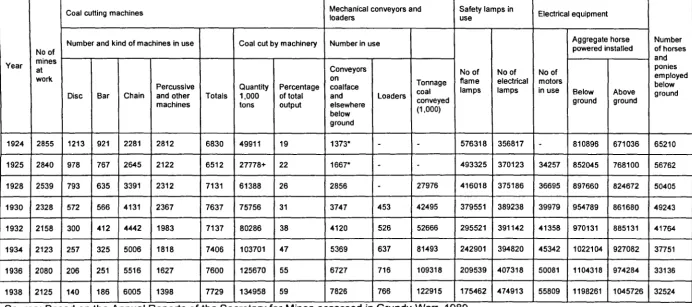
Table 3:1 - Mechanical and electrical machinery in use in coal mines, 1924-38, (including
number of horses and ponies) ... 40
Table 3:2 - Employment by occupation in the UK mining machinery industry in Yorkshire and Humberside 1978-87 ... 56
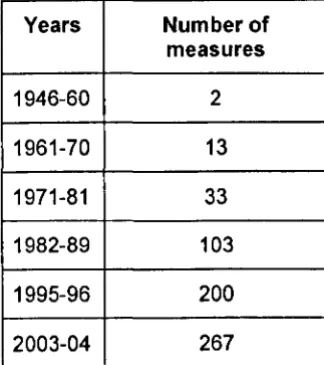
Table 3:3 - UK policy measures to support small businesses 1946-2004 ... 58
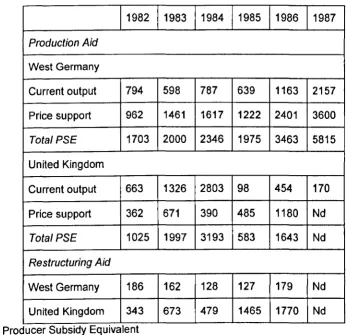
Table 3:4 - The British and West German coal industries: the cost of public policy (Nominal US
$
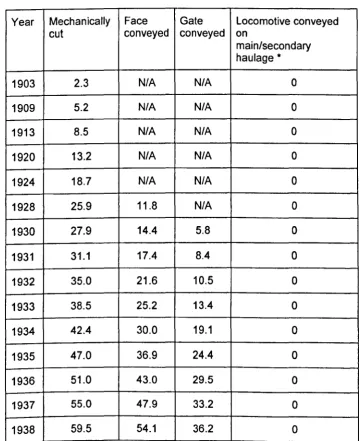
million) ... 63Table 3:5 - Percentage of coal mechanically cut and conveyed in British mines 1903-38 ... 70
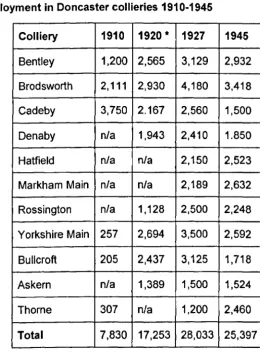
Table 4:1 - Employment in Doncaster collieries 1910-1945 ... 101
Table 4:2 - Population increases in selected mining villages in the Doncaster coalfield .... 103
Table 4:3 - Professional and trade businesses registered in the local directories 1900-1936 ... 107
Table 4:4 - Mining related businesses registered in the Local Business Directories ... 110
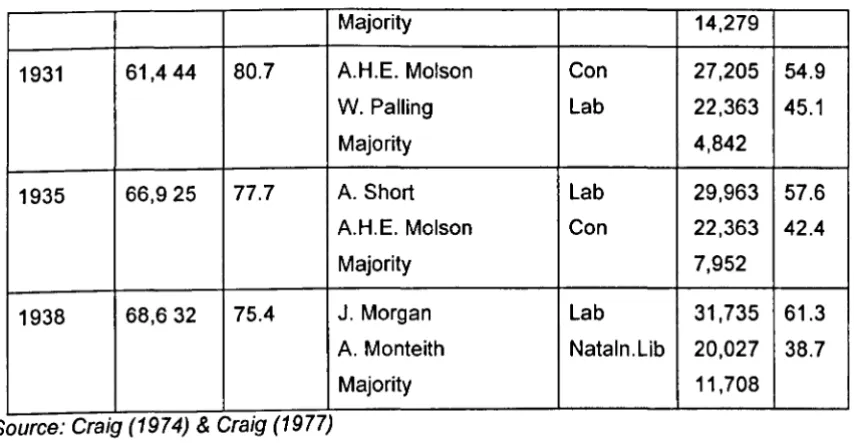
Table 4:5 - General election results 1918-1938 ... 134
Table 4:6 - Local election results, 1928-36 (selected Wards) ... 136
Table 4:7 - Employment by sector 1951-67 ... 143
Table 4:8 - Decline in employment in coalmining 1959-1967 ... 143
Table 4:9 - Employment changes 1959-1967: Summary ... 144
Table 4:10 - Employment and gender, 1976 ... 145
Table 4:11 - Food and confectionery manufacturers registered in the local business directory 1967 ... 146
Table 4:12 - Coal productivity at Doncaster area collieries 1963-68 ... 150
Table 4:13 - Average weekly earnings of adult manual workers April 1969 ... 151
Table 4:14 - Housing (rateable value) 1968 ... 153
Table 4:15 - General election results 1950 - 1970 ... 154
Table 4:16 - Local election results. Doncaster wards, 1945-1972 ... 157
Table 4:17 - Analysis of fifty three manufacturing units established between 1946-68 ... 160
Table 4:18 - Advantages of location pre and post 1945 ... 161
Table 4:19 - Employment by job category (males) 1966 ... 168
Table 4:20 - Students completing further education in 1961 ... 169
Table 4:21 - Unemployment by age group, 1967 (%) ... 170
Table 4 :22 - Housing stock, 1991 ... 181
Table 4:23 - Location quotients: Doncaster 1981 and 1984 ... 184
Table 4:24 - Large firms, 1993 ... 185
Table 4:25 - Key sectors and key companies 1984-88 ... 187
Table 4:26 - Employment in service sector: Comparison Doncaster and GB 1991 ... 188
Table 4:27 - Sub sectors: Comparison Doncaster and GB 1991 ... 189
Table 4:28 - Decline in employment in Doncaster collieries 1981-92 ... 189
Table 4:29 - Employment by sector: Comparison Doncaster and GB 1971-91(%) ... 190
Table 4:30 - Mining related businesses registered in local business directories. All periods ... 191
Table 4:31 - Unemployment 1973 - 1999 ... 195
Table 4:32 - Claimants by skills category 1993 ... 197
Table 4:33 - Redundant miners experiences, 1993 ... 198
Table 4:34 - Businesses supported 1990-92 ... 203
Table 4:35 - New businesses 1996 ... 205
Table 4:36 - Net growth of VAT registered businesses 1981-1991 ... 205
List of figures
Figure 3:1 - Productivity 1947-75 Investment (£ million) ... 43
Acknowledgements
During the course of the past seven years I have drawn on the support of numerous
members of family and friends all of which I would like to acknowledge. A special word of
thanks to Nicolette without whose encouragement and sacrifice I'm not sure I would have
reached this stage. I would also like to thank my supervisors Professors Steven Roper and
David Storey for their patient advice and guidance. The two people I am unable to thank are
my parents who sadly both died before this thesis was submitted. I would like dedicate this
Declaration
The thesis is the product of my own work and the result of nothing done in collaboration. The
thesis has not been submitted for a degree at any other University.
Abstract
This study adopts an historical approach to explore the impact of coalmining on the town of
Doncaster. It finds that although Doncaster was not a typical mining town nevertheless coal's
impact was widespread, and extended beyond direct employment to impact on socio-political
factors including the town's external image. Whilst the study explores the impact over the
entire one hundred years of mining around Doncaster, the rationale and focus of the study is
an assessment of the legacy of the local mining industry, and the extent to which it has
inhibited the town's economic competitiveness in what is today called an enterprise
economy. In this regard the study contributes to a wider understanding of the nature of
change in old industrial regions as well as considering the efficacy of current regional
enterprise policy. In particular the study has explored the extent to which path contingency
captures the transition from growth to decline in former industrial regions, more adequately
than does that of path dependency (Hudson, 2005). The key distinction drawn between the
two concepts is human agency which is identified as operating at a range of decision-making
levels. Analysis comes through two related case studies which show that the coal industry
provided the basis for diversification in to new products and markets offering the possibility
to extend the industry's lifecycle and that of towns such as Doncaster which had come to
depend on it. It is shown the fact that these opportunities were not taken was due to
institutional failure associated with cognitive lock-in. This rather than any specifically industry
1 Introduction
Numerous studies exist which focus on the impact traditional industries have had on
localities. Checkland (1976) for example used the analogy of the Upas tree to describe the
destructive effect that the heavy engineering sector exerted on the growth of other industries
in and around Glasgow.1 Other studies have focused on the steel and chemicals industries
in Cleveland (Hudson, 1989; Macdonald & Coffield, 1991; Beynon et ai, 1994), the steel
industry in Sheffield (Tweedale, 1995), and the fishing industry in Grimsby (Thompson et ai,
1983). However the mining industry and its communities have tended to be studied as an
industry apart. The uniqueness of the coalfields derives in large part from the pace and
intensity of industrial decline (Bennett et ai, 2000). Between 1984 and 1997, 170,000 miners
lost their jobs representing one quarter of the total male workforce in the English coalfields
(DCLG, 2007). The legacy of closure continues to have a profound social, psychological and
economic impact on many of the former UK coalfield communities (see Hudson & Sadler,
1990; Turner 1995; Beatty et ai, 2005). Given that coalmining is an extractive industry the
decline and closure of particular collieries and the communities dependent upon them is an
inevitable fact of life, nevertheless there remains some debate as to the reasons for closure
with it is argued more pits closed in the last decades of the 20th century for economic and
political reasons rather than for reasons of geology or exhaustion of reserves (Bennett et ai,
2000, pp. 2-3). This thesis contributes to this debate by re-thinking the decline of the UK coal
industry through the experiences of the town of Doncaster.
It has long been recognised that the concentration of a single industry and/or employer
within a town, city or region could lead to a degree of economic vulnerability once that
industry declined. Writing at the time of the Depression in the 1930's, Alien (1933, p. 25)
states that the development of such highly specialised industrial areas might reduce the
1 The Upas tree was a tree native to Java, and according to legend was able to blight the growth of other tress in a radius of up to 15 miles.
range of its industrial interests in order to confine itself to what at that time were considered
to be the more profitable trades. Such established industries were usually carried on in
specialised rather than variegated areas, and in the event of their decay, would make the
development of new economic trajectories more difficult. The narrow and highly localised
character of the great British industries was, therefore, satisfactory only so long as the
demand for their products continued to expand. The shift from first industrial revolution
industries such as coal to second industrial revolution industries such as chemicals and
engineering began to herald new considerations. Already in the immediate post World War
One years, the tendency for industries to become concentrated in the proximity of coal
mines was being modified by new influences. Economies in the use of coal and the
introduction of alternative sources of power were already reducing the value of sites in the
neighbourhood of the coalfields. At the same time improvements in urban transport were
allowing employers to abandon the central and specialist labour centres, and seek sites for
factories in smaller towns and districts where space was available and rates were lower.
Thus a decentralising movement was in sharp contrast to the 19th century trend towards
increased concentration at the coal supplies. Olsen (1982) warned of the potential impact
associated with industrial decline. He suggests that the decline of a region leads to an
organisational and cultural hardening of the arteries, what he called 'institutional sclerosis'.
These places, he suggests, which grow and prosper in one era find it difficult, often
impOSSible, to adapt to new organisations and cultural patterns regardless of how beneficial
they might be. Amin & Thrift (1994) have discussed this in terms of regions possessing an
inappropriate institutional thickness that underpinned and supported economic activities
located within a region, and which helped reproduce regionally specific competencies, tacit
knowledge and trust, regarded as critical determinants of continuing economic well-being,
but which came to be seen as barriers to moving a regional economy onto a new and more
promising developmental trajectory (Hudson, 1994). The coal industry, probably more than
judged as bequeathing a particular set of legacies (e.g. Fothergill, 1992). Some, such as the
strict gender division of labour which had been established as a necessary part of the 'old'
industrial economy, have proven to be relatively permeable and transformable and have
subsequently broken down (Hudson, 2005). In UK coalfields, as male employment declined
in the mines, many of the new jobs attracted to replace them were in industries which
targeted female wage labour. Whereas domestic service had previously provided the
majority of female employment, new job opportunities were developed for example in
factories but more latterly in the growing public sector, in hospitals, schools and local
government. In other respects established habits and routines proved much more resistant
to change (Hudson, 2005).
These instituted legacies are said to remain in three main ways: in respect to peoples
commuting behaviour; activity spaces; and aspirations and expectations about employment
and work (Hudson, 2005). All three ways it is argued represent ways of cognitive lock-in in
the way that people think of their labour market and their possibilities in it. Firstly, there is a
marked reluctance to commute even modest distances for work. In many ways the region
remains a series of small, discrete, and spatially bounded labour markets, rather than
forming an integrated labour market in which people are linked to employment opportunities
across the region. Secondly, there is a legacy of recruitment into 'traditional' industries with
sons following dads resulting in limited aspiration and low skills levels (SBS, 1993; Bennett
et ai, 2000; Troni & Kornblatt, 2006). Thirdly, there is an enduring culture of waged labour.
People expect to be employed rather than self-employed. This is not to say that they lack an
entrepreneurial attitude or spirit, but that these endeavours are not funnelled into the more
conventional channels of small business formation (Rees & Thomas, 1991; Meegan, 1990;
Henderson & Shutt, 2004). This concern has become particularly apparent and relevant to
policy makers and academics alike with the shift from the managed economy to the
entrepreneurial economy, typically associated with greater levels of self-employment, a small
business-dominated economy and by levels of organisational flexibility (Audretsch & Thurik,
2004).
This study focuses on the impact of coalmining on the town of Doncaster over the course of
the 20th century, with a view to understanding the extent to which the legacy of the mining
industry has inhibited the town's economic competitiveness in the entrepreneurial or
enterprise economy. The_development of the coal industry in the surrounding villages from
1900 can in many regards be interpreted as heralding in a new progressive phase in the
town's economic history, breaking as it did the industrial dominance of the local railways
whilst also adding a degree of permanence for local businesses, which had become reliant
on agricultural trade. However, the decline of the coal industry and in particular the pit
closure programme of the 1980's and 1990's had a devastating effect on the town's
economy. By the end of the 20th century Doncaster was one of the most 'business deprived'
districts in England, performing poorly in comparison to other areas across all traditional
indicators of enterprise (IPPR, 2006). Whilst Doncaster would remain untypical of most coal
towns, having a fairly diversified, if ultimately precarious industrial base, the town's problems
were very much identified with its association with coal mining.
In assessing the impact of mining on Doncaster the principal question in this study is how
should decline be understood? Theoretically, path dependency has been used to explain the
evolution of a particular industry in a given location. The explanatory power of path
dependency has however been questioned, including recently in Hudson's (2005) rethinking
of change in the North East of England. Drawing on evolutionary approaches in economics
that eschew biological analogy and which emphasise that path dependency is socially
constituted (Metcalfe, 1998), Hudson concludes that path contingency captures the
character of the growth process, and in particular the transition from growth to decline, more
adequately than does that of path dependency. Specifically he argues that the State had a
facilitate new developmental trajectories (Hudson, 2005, p. 590). This study extends the
focus beyond the North East and therefore contributes to a fuller understanding of the extent
to which continuity and change in economic development trajectory can be understood in
terms of path contingency.
In particular it will assess the varying engagement of the State, and its principal agent, the
National Coal Board, with issues of socio-economic development and change. In doing so it
highlights the contribution made by key decision makers and following Hudson (2005) shifts
the focus from industry- specific determinants for lock-in to policy makers and policy choices.
However, whereas Hudson limited his application of the concept of cognitive lock-in to
inhabitants of former coal communities, this study extends the concept to focus on key
decision makers within the context of the UK coalfield. It has been argued that cognitive, or
political locks (Grabher, 1993) form when certain polices become entrenched as common
practice and when reversal from them becomes unlikely (Forestiere & Alien, 2011). In
exploring political lock-in, this study limits itself to highlighting examples of policy decisions
which played a significant role in determining the trajectory of the UK coal industry and
mining dominated areas, but is associated with entrepreneurial failure at an institutional
level. In this regard the study contributes to those calling for a re-conceptualization of
entrepreneurship beyond narrow definitions to enable a fuller understanding of enterprise
and enterprise cultures (see e.g. Hjorth & Steyaert, 2003; Mazzucato, 2011)
To explore and locate entrepreneurial failure, decisions are considered at three distinct but
interrelated levels: macro, meso and micro. Macro level analysis focuses on the role of the
State and its engagement with the coal industry. Meso level analysis focuses on decisions
taken at an industry level, whilst micro level analysis focuses on decision making at a local
level. Given the importance of the coal industry to the UK economy and the nature of its
development over the course of the century, it is recognised that at times the scope of
agency between these three levels may change, with one level reducing the agency of
another. For example local agency might be reduced by national public policy or where an
employer is dominant in a particular locality. Of particular focus will be the role of State
involvement in the nationalised industry and the related impact on the economic trajectories
of coal dominated areas.
Analysis is framed within two related historical case studies. The first focuses on the nature
of decline in the UK coal industry and provides a reassessment of the history of the UK coal
industry over the course of the 20th century. In particular it focuses on the industry's
transition from growth to decline. The key contribution here is in its assessment of the
contributory role played by key decision makers to determining a particular development
trajectory. In this regard it focuses on the 'long decline' of the industry and argues that the
nature, timing and impact of decline can be understood as contingent on institutional inertia
which manifested itself through the development and maintenance of self- sustaining
coalitions (Grabher, 1993; Hudson, 1994), rather than the inexorable outcome of the decline
in coal usage. Evidence is drawn from across the 20th century and highlights critical
junctures when alternative trajectories were possible but not taken. The second case study
forms the empirical part of the study and considers the impact of mining and its subsequent
decline on the town of Doncaster. Whilst never a classic mining town in the way for example
Barnsley was, Doncaster nevertheless over time came to be dependent upon the fortunes of
the surrounding collieries whether directly in terms of employment or indirectly through
various inter-linkages and multipliers. The extent of dependence is evident in numerous local
economic reports including post-coal studies, and which indicate a specific mining legacy
detrimental to the town's subsequent economic development. Any legacy however was not
inexorable but on the contrary the dangers associated with lock-in were known, and
alternative trajectories were possible. The overall conclusion that lock-in occurred because
of institutional inertia associated with political lock-in shows the key importance when
studying regional lock-in in old industrial regions of engaging with an institutional context at
all spatial levels. It thus throws light on how and why regions become associated with
There are those who have argued that it is futile to use case studies as the basis for studying
the processes of contingency arguing instead that only simulation, experiments or
counterfactuals are appropriate to study and test path dependency (Vergne & Durand,
2010). This study rejects this conclusion, instead following Garud et al (2010, p. 767) who
argue conversely that "the theoretical substance of path dependency would be more readily
applicable to situations where the complexity of the observed system can be circumscribed
to a small and finite set of properties".
The structure of the study is therefore cumulative. Taken together the two case studies
contribute to a reassessment of how we understand decline in former industrial regions. Both
cases assess whether there were windows of opportunity available when industry and/or
regional trajectories could have been altered and new paths created. These windows of
opportunities are discussed in terms of critical junctures, which despite their theoretical and
practical importance have received little attention in analyses of path dependence (Capoccia
& Keleman, 2007; Pierson, 2004). In particular there has been little application of the
concept of critical junctures to regional economic trajectories. This study seeks to address
this gap by extending its range of application to focus on the decline of the UK coal industry,
and in particular to the experiences of the town of Doncaster. Where critical junctures were
apparent and alternative trajectories available within the coal industry, through for example
diversification into new markets, might these have enabled new or alternative economic
paths to have been created which could have enabled the town to break any dependence on
coal mining and launch a new economic path? Whilst this question suggests the
consideration of a series of 'what if scenarios, the study avoids the temptation to engage in
counterfactuals. Its aim is both more focused and more limited, focusing on whether
alternatives/opportunities were available, and on whether these alternatives were evident at
the time. This we describe as forseeability - that publically available evidence existed of both
threats and opportunities. Where both conditions, i.e. opportunities and forseeability can be
demonstrated, the broad conclusion is that, rather than industries and regions sowing the
seeds of their own decline (Lamoreaux et al ,2007), the nature of decline is better understood as being contingent upon human agency (in this case at the level of policy decision makers). Whilst recent studies have suggested that many former coalfields have not entered a spiral of economic decline (Beatty et ai, 2005), there nevertheless remain intractable and embedded problems with many of these localities (Gore et ai, 2007). The study therefore has both practical as well as theoretical implications.
Working within a broad tradition recently populated by economic geographers and evolutionary economists, the study remains essentially a local history study. As such it adopts an historical non-linear narrative style and draws on the case study approach initially developed by the Annales School during the 1920's with their focus on communities and regions, and with the non-positivist historical approaches more latterly developed by social historians such as E.P Thompson, Raphael Samuel and the History Workshop. Both schools eschew quantitative data in favour of integrating a wide variety of local and often novel sources of information. Whilst not fundamentalist in any particular regard, drawing for example on statistical information to identify broad trends, these data are treated as indicators. What is important is the historically-informed awareness of other factors, which may affect the figures (Tosh, 2002). Consistency is a particular problem when collecting data over such a lengthy period and measures have been taken to control for such change where possible. Specifically, measures have been taken to address issues of geographic coverage,2 industrial classification,3 4 and multiple indicators of regional competitiveness
(e.g. Bowes, 2003; IFO, 1990).
2 As with any historical study it is not always easy to ensure exact continuity as geographic areas have been subject to change
(Halsey 2000). However, broadly the study focuses on Doncaster's six central wards as they are designated today. That is the central wards existing in 1900. plus other wards drawn into the town as result of boundary changes in 1914 (8alby with Hexthorpe and Wheatley urban district) and in 1951 (Cantley including 8essacarr). This sample is largely urban and includes Wheatley Hall Road but not other industrial areas
3 Whilst comparability between successive censuses is clearly desirable. nevertheless such comparability is problematiC. One
The latter have been aggregated but are not used in any standardised way. There are no
hard and fast theories of regional competitiveness and therefore variables are not weighted
equally nor are they organised into an 'ideal' type or model. Instead variables are discussed
as part of themes which relate to other coalfield studies. These themes are: economic;
infrastructural; social; educational; and political/institutional (Bowes, 2003).5
The principal primary source will be local newspapers published at the time. Newspapers
represent public documents easily accessible to local people and would form a key source of
people's information and understanding. The use of this source will help guard against what
Lucian Febvre's (a founder of Annales School), called psychological anachronism: the
unthinking assumption that the mental framework with which people interpreted their
experience in earlier periods was the same as our own. Newspapers provide a direct
connection with the particular period studied, offering a rich source of information on the
political, social, economic and cultural activities of the town over the century, as well as
capturing the habits, everyday local events, and a vast array of personal news items. The
advertisements sections alone can yield rich socio-economic data as to changing levels of
business activity and employment profiles, whilst the editorials offer insight into key local
debates. Given the focus on decision making and the related concept of cognitive lock-in,
particular attention will be focused on how the local coal industry was reported in the local
newspapers. Specifically were there any indications of the nature and extent of the impact of
mining on the town? In short were there any warning signs of any negative impact caused by
the local mining industry? If so when were these warnings reported, what was the nature of
concern and how if at all did these concerns change over time? Specifically the study
approximate (Gallie in Halsey 2000). For the inter war period there was variations in whether those out of work were included or excluded from census tables. Even in the post war period, obtaining a consistent series of figures for employment in different industries is far from straightforward. The Standard Industrial ClaSSification (SIC) was heavily recast In 1968. There was a further
adjustment of the industry categories for the 1980 Classification which required reallocation of particular industrial categories to maintain consistency (so have decided to use 1980 claSSification)
4 Although business classifications were taken down as they appeared in the appropriate Trade Directories, in order to standardise information the study has used the claSSification index to classify earlier periods in accordance with the 1980 SIC.
5 IFO and Bowes regional competiveness indicators are provided in appendix 1 and 2 respectively
explores the extent to which there were any indications of the dangers associated with
lock-in, and its causes. For the purpose of this study the Doncaster Gazette (OG) and its
successors the Doncaster Evening Post (OEP) and Doncaster Star (OS) have been selected
to provide consistency over the course of the century, although other local press will also be
consulted where appropriate.
In addition to local newspapers the study also draws on local business directories.6 Whilst
their limitations are well documented,1 they provide a complementary source to the more
"homogenous, industry-as-SIC-code world of empirical analysis" (Klepper & Thompson, 2006, p. 862), and therefore in conjunction with other primary data such as census returns,
provide the basis for a fuller mapping of the changing industrial/occupational profile of a town
(Rimmer, 1967). Business directories for example have the potential to identify the extent to
which groups of inter-related or complementary industries and activities are linked by either
direct supply chain relationships or by various indirect dependencies especially spending
multipliers. In reality even in the most heavily industrialised and seemingly single industry
regions, economies are typically ensembles of sectors in which growth is linked by income
and expenditure flows (Metcalfe et ai, 2006). An understanding of the interrelationships
between coalmining and the town's economy is therefore crucial to understanding long term
impact, as the net result of the intersection and interaction of these linkages is often the
creation and reproduction of the conditions underpinning a particular growth trajectory for a
regional economy (Hudson, 2005). Given our interest in the extent to which mining's legacy
has impacted Ooncaster's ability to compete in the enterprise economy, currently typified by
self-employment and small businesses, of particular focus will be the extent to which local
directories suggest that the local coal industry supported wider spin-out and/or
self-employment opportunities.
e Businesses registered in the local directories largely relate to the boundaries of the town at the time of publication. That is the town geographic boundaries as designated in 1900; 1914; 1948 and 1983 (see 4.1 for fuller description).
7 See for example http://www.historicaldirectories.org/hd/ud/usingdir8.asp accessed 3/4/2006 for discussion of advantages and
The study is presented in three main chapters. The first provides an assessment of the
merits of path contingency as an alternative explanatory concept to path dependency.
Drawing on a range of disciplinary traditions it will establish a broad conceptual framework
and extends discussion of key related concepts such as critical junctures as well as
considering political lock-in within the context of institutional inertia. Having established a
conceptual framework the second chapter extends its range of application to focus on the
experiences of the UK coal industry. This is divided into two related sections which together
explore macro, meso and micro level issues related to the nature of industrial decline. Macro
issues are particularly associated with the way in which national government viewed the role
and purpose of the UK coal industry, and related policy choices. Meso issues are closely
associated with corporate decisions within the National Coal Board but also consider the role
of coal owners prior to nationalisation. Specifically it assesses the extent to which there were
any potential opportunities to extend the lifecycle of the industry through for example product
or sectoral diversification. This assessment is considered in relation to micro level impact. As
coal declined so too did the fortunes of areas that came to depend on mining. Therefore
where the coal industry could have adapted so too could have these localities. This micro
level analysis is related in particular to the fortunes of the town of Doncaster.
The final chapter focuses on the development of the town of Doncaster over the entire
period of the 20th century. For practical reasons this chapter has been divided into three
broad chronological periods in the development of the Doncaster area coal industry. These
are: pre and early coal, which is associated with the period from 1900 when most of the
collieries were first sunk around the town but also includes the inter-war years; the post
Second World War years, which focuses on the 1950's and 1960's, and which we suggest
represents a mature industry and a period of considerable expansion; and finally decline and
post-coal from the 1970's through to the closure programmes of the 1980's and 1990's.
These periods, whilst not directly comparable in any particular sense, do relate to similar
sociological typologies associated with coal communities which define the three periods as:
2 Path dependency or path contingency?
2.1 Introduction
Former UK coalfields have experienced some of the most dramatic declines in prosperity
levels of any equivalent Western European region. Although no longer an industry of any
standing, this decline in mining and the manner in which it was brought about continues to
have a profound social, psychological and economic impact on the former UK coalfield
communities (e.g. Hudson & Sadler, 1990; Beatty et ai, 2005; Troni & Kornblatt, 2005; Gore
et ai, 2007). Even where progress is reported, regional winners and losers are evident (Gore
et ai, 2007), and stubborn problems associated with hidden unemployment often hides the
extent of the problem (Beatty et ai, 2005). Whilst most former coal areas have shifted
towards service sector-dominated economies, often seen as an indicator of progress,
studies have shown that few have managed to do so whilst maintaining comparative levels
of affluence, a factor which might explain their inability to re-orient themselves within the
current dominant economic milieu - the enterprise economy. Understanding the lessons of
decline is therefore of practical as well as academic interest.
In order to understand regional trajectories in all of their manifestations, it is necessary to
draw upon a variety of theoretical and disciplinary perspectives, notably history. The
recognition of the importance of history in understanding regional trajectories is nothing new.
Marxist analysis for example has been used to explain uneven development as an historical
process (e.g. Massey, 1984). That 'history matters' has certainly become prominent in more
recent analysis of regional development. Perhaps the most prominent theory that has sought
to take history seriously in studies of regional development is that of path dependency, which
has been defined in terms of "complex processes that are unable to shake free of their
history" (David, 2001, p. 19). Simply put this means that current and future states, actions, or
decisions depend upon the path of previous states, actions or decisions (Page, 2006).
Numerous theoretical, historical and empirical studies of path dependence are available,
covering topics ranging from the selection of institutions (North, 1991), to the formation of
government policies (Hacker, 2002), to the choice of technology (David, 1985; Arthur, 1994),
to the location of cities (Arthur, 1994; Page, 1998). Whilst in many disciplines path
dependency has come to dominate thinking (Boschma & Martin, 2010), many of its
assumptions are not unproblematic. Particularly, its overly deterministic nature, which
suggests a council of despair, and results in processes which have an irreversible and
inexorable influence on the ultimate trajectory of industries and economies. This leaves
limited scope for human agency.
Alternative approaches question the value of path dependency for assessing the nature of
growth and decline in former industrial regions. Economic geographers for example are keen
to assess the extent to which path dependence can be seen as a process or effect that is
locally contingent. Coal areas have tended to be described as places apart, dominated by
strong cultures, which have both negative institutional and cognitive impacts on regional
trajectories, and in particular their ability to forge new and sustainable development paths.
The focus on path contingency therefore provides an alternative perspective highlighting the
possibility of actors at a micro (local) level affecting the overall trajectory of any given region.
Where economic geographers focus on locally contingent processes, it is also important to
recognise the potential contribution of wider structural issues and the role played by actors at
both a me so (industry) and macro (government) level. In reality agency at a micro level is
often constrained by decisions taken at either or both meso and macro levels. In the case of
the UK nationalised industries it is also important to recognise that industry level agency may
also be contingent on decisions made at the level of the State.
Whilst we know something of the cause and impact of industrial decline we know less about
the contributory processes at play. The central question here is do regions sow the seeds of
explanatory merits of path dependency. Its value is considered in relation to path
contingency. The chapter highlights the room for human agency as the key distinguishing
factor between the two concepts, and places agency within a range of political and economic
contexts. The chapter also explores the extent to which agency can work as both enabler
and constrainer in determining regional economic trajectories, identifying that opportunities
to intervene, to 'nudge' development trajectories and regional economies onto new and
different paths are time limited but are available. That these opportunities are not taken
suggests that development paths are not inexorable in their emergence and consequences,
but contingent upon other factors such as institutional inertia or political lock-in.
2.2 Path dependency or path contingency
Concepts of path dependence are clearly useful in understanding the development of
regional trajectories. Hudson (2005) for example shows that the North East's long period of
growth from the early 19th century to the 1920's was based on close and mutually reinforcing
links of intraregional traded dependences between the mining of coal, the production of iron
and steel, and a wide range of engineering products manufactured from iron and steel.
However he concludes this path dependent trajectory of growth was ultimately based on
conditions which were contingent and conjunctional, and that therefore path contingency
captures the character of the growth process, and in particular the transition from growth to
decline, more adequately than does that of path dependency (2005, p. 583). Others have
also criticised path dependency as being too deterministic. Within the domain of economic
geography for example Martin and Sunley (2006; 2010) seek to reconceptualise path
dependency as a dynamic open historical process by which technologies, industries and
institutions, and therefore regions, evolve along unfolding trajectories. These trajectories,
they argue, are shaped not only by the sequences of prior developments and influence, but
also by the evolution of processes of path dependency themselves. This perspective has
important implications for our understanding of both product and industry life cycles, with
recent explanations identifying generic forms of path dependency in a range of industries but
which are not deterministic.
For example, important departures from the life cycle model have been found in some
industries, as new markets and niches are repeatedly constructed and exploited. A case
illustrated by Klepper & Thompson (2006) who suggest that the continual rise in the number
of new entrants in the laser industry may be because of the importance of specialised
submarkets. These submarkets can be differentiated along numerous dimensions such as
the technology they use, the geographical areas in which they operate or the services that
they provide, and that the number will change over time. However, investment decisions
through for example research and development provide new opportunities for firm
diversification and growth, whereas firms which choose to remain specialised in a single
market or submarket can be expected to vanish when that market dies. Further evidence of
the 'enabling' forms of path dependency, often also referred to as 'path creation', is that
product innovation does not always wane during the mature phase of some industries.
Instead it may rise sharply. For example in the mature automobile industry, Japanese and
some European producers gained an innovative lead over American producers through both
process and product innovations (Hefferman, 2003; Klepper, 1997). Such cases of
'resurgent innovation' have been described as evidence of a phase of 'dematurity' (Storper,
1985). Processes of this sort would seem to fit a less deterministic development model in
which an industry (and that part of a local or regional economy dependent upon it)
undergoes radical adaption, in effect renewing (or extending) the industry's (regions)
development path (Martin & Sunley, 2010). However, recent empirical evidence suggests
that new development pathways are more evident in regions which do not have long
industrial histories (Simmie et ai, 2008).
In order to understand why some mature industries (and therefore regions) succumb to
(2003) identified five possible factors of which three are relevant to this study. These are
firstly: increasing returns whereby the more profits that can be made from the selling of a
particular product or service, the more producers are inclined to produce it. This factor
results in firms, consumers and regions being locked into repetitive patterns of production,
consumption and employment and hence limiting the opportunity for the development of new
products, services, regional economic trajectories and career opportunities. From this
study's perspective the focus is the extent to which the National Coal Board maintained a
commitment to the production of coal but which was to the longer-term detriment of the
coalfields and their communities. Given the close relationships developed between large
enterprises such as the Coal Board and its supply chain, any assessment should consider
any negative impact, and in particular the ability of suppliers to develop what has been called
boundary-spanning functions such as research and development and marketing (Hassink,
2010), and diversify into new markets. The second and related factor is technological lock-in
whereby regions are tied to existing technologies. This can be either a good or a bad thing.
One recent comparative study conducted across UK regions found for example that whereas
Cambridge had developed a trajectory of 'cumulative innovation' fuelled by the co-evolution
of a highly entrepreneurial environment and based on a high-tech economy, the opposite is
true of the old industrial city of Swansea which remains locked into a low skill economy
(Simmie et ai, 2008, pp. 59-61). Within the context of this study the focus is the extent to
which an entrepreneurial environment was evident within the coal industry whereby
technological innovation was encouraged, supported and exploited. The third factor relevant
to this study is institutional inertia which is associated with governmental, organisational or
cultural systems which lag behind economic change. This institutional inertia or political
lock-in (Grabher, 1993) has been described as the development over time of thick lock-institutional
tissues aimed at preserving existing structures, and therefore unnecessarily slowing down
industrial restructuring, as well as indirectly hampering the development of new development
trajectories (Hassink, 2010). Institutional tissues consist both of networks of organisations,
such as trade unions, business support agencies but particularly political administrations at
all spatial levels, and large enterprises, and who through the development of self-sustaining
coalitions (Grabher, 1993; Hudson, 1994) influence disproportionately regional patterns of
behaviour, such as norms, rules and written and unwritten laws, and subsequently a region's
development path. In such a situation, large companies might not want to give up sites for
the attraction of inward investment, as they might be concerned that they will lose qualified
employees to competitors. Local authorities might not see the point of attracting inward
investment or promoting restructuring in another way, as large tax incomes are paid by
traditional industries (Hassink, 2010). In some regions, the spirit of entrepreneurship might
dwindle because of increasing industrial concentration and the domination of large
companies. These self-sustaining coalitions are also influential and are able to lobby for
sectoral interventions often at a national level, which hamper the restructuring process more
than they support it (Hamm & Wienert, 1989 in Hassink, 2010). Institutional milieus also
change more slowly than industries, and therefore a sclerotic milieu can remain embedded
within networks often constraining efforts to enable new trajectories (Callon, 1998).
Institutional inertia or political lock-in is the central focus of this study as it suggests that the
development trajectory of industries and regions is not just the result of economic factors,
but better understood as much as a socio-cultural and political phenomena and one that can
operate at all spatial levels. Although this factor is less well documented (Hassink, 2010;
Simmie et ai, 2008) it could be argued that all factors are dependent upon it.
Two examples can illustrate this point. Swansea has witnessed two phases of economic
development. The first developed during the 19th century and was based on extractive
industries such as coal and tin (Simmie et ai, 2010). The second triggered by decline in
these industries was developed in the 1970's and focused on electronics. However both led
to a negative trajectory. The decline of Swansea's traditional extractive sectors left it with
pools of unemployed labour with limited re-training potential. Yet a combination of foreign
investment in electronics, mass production branch plants and growing public sector
this particular set of knowledge and skills limited both the range of possibilities that may have led to newer and more sustainable trajectories (Simmie et ai, 2008, p. 63). The case can be made that in failing to learn the lessons of history those actors responsible for key investment and policy decisions and embedded within self sustaining coalitions, were responsible for locking the city into a narrow and ultimately unsustainable development pathway. Arguably this is currently happening in the UK's defence industry. Championed by successive governments as a British success story, the defence industry has in fact been operating in a declining market and one increasingly constrained by ethical considerations. Yet arguments that have been promoted which challenge the industry to break with the current trajectory and utilise the current workforce's skills to diversify into civil manufacturing and Jor emerging technologies have so far met with little support at either industry or
governmental level (see e.g. The Guardian letters page 30 Sept, 2011). Both examples are illustrative of how institutional inertia, through political lock-in, can determine narrow technological and developmental trajectories which eschew new opportunities for shorter term objectives.
Whereas path dependency tends to suggest that industries (and regions) are buffeted by a series of unpredictable, non purposive and somewhat random events resigned to being locked in through self reinforcing mechanisms that we have no control over (Garud et ai, 2010, p. 765), path contingency leaves a space for human agency. This is the key distinction this study draws between the two concepts, and is one that has to date received limited investigation (Simmie et ai, 2008). It is argued that agency can be used to lock regions into declining development pathways but equally that it can be used positively to create new paths and trajectories. Path contingency therefore envisages the possibility of agents or entrepreneurs searching for new opportunities, re-using resources, transferring competences as the basis of new growth previously referred to as path creation. These entrepreneurs (as key agents) it is argued are embedded in paths but not completely constrained by them: indeed they demonstrate 'mindful deviation' from prevailing ideas and
accepted ways of doing things (Garud & Karnoe, 2001). Whilst studies of entrepreneurship
over the past forty years or so have tended to limit analysis to easily measureable units of
assessment, principally new business start up (rates), this study adopts the Schumpeterian
point of departure that entrepreneurship exists in all types of settings (1934/1994),
irrespective of size or type (Burgelman, 1983; Miller, 1983; Gartner, 1985), and including the
public as well as the private sector (Kearney et ai, 2007).
The notion that there is a strong connection between entrepreneurship and the private sector
has resulted in entrepreneurship in the public sector being underestimated resulting in
theoretical, practical and political shortcomings. Entrepreneurship and entrepreneurs, are
important for the development of society in other ways than through starting businesses, for
example, through effecting change (Sundin & Tillmar, 2008), or as a catalyst for innovation
(Mazzucato, 2011). Entrepreneurial behaviour is here defined not only as the identification
and discovery of opportunities (Shane & Venkataraman, 2000), but also the shaping and crafting of the necessary institutional infrastructure in order to capitalise on and exploit these
opportunities (Djelic & Quack, 2003). Where organisational and institutional contexts are
engineered such that they create enabling conditions, they can also themselves create
further opportunities for entrepreneurship (Alvarez & Barney, 2007). This might manifest
itself in terms of new businesses started within a locality but equally could result in the
development of what Burns (2005) calls an entrepreneurial architecture.8 Entrepreneurial
behaviour in the public sector differs from that of private sector entrepreneurship in that the
profit motive is not its primary goal (Forster et aI, 1996), although this is a distinction of type
and not of the value of its economic and social contribution. In this study the profitable
exploitation of coalmining and in particular the ability to exploit new or emerging
opportunities is related not only to the strengthening of the industry's position and the
fortunes of coal owners, but more specifically in relation to the fortunes of communities that
8 Bums reference is to the entrepreneurial DNA of an organisation which he argues is built on the three pillars of leadership.
became dependent on the industry, whether through employment (direct or indirect), or
spending multipliers. To this end entrepreneurship, and an enterprise culture, is
reconceptualised and related to an individual or institutional behaviour which is socially as
well as economically useful (Hjorth & Steyaert, 2003), and one which may result in negative
short term effects but with a view to longer term benefits. Conceptualised within this space,
entrepreneurship and enterprise cultures are locally and historically situated and preclude
the tendency towards one sized-fits-all policy approaches.
This study explores the role of enterprise within two related contexts; corporate
entrepreneurship and political entrepreneurship. The term corporate entrepreneurship has
been used to describe entrepreneurship within large organisations (Burgelman, 1983). In this
study the focus is on the coal industry , predominately but not exclusively under State
ownership, and explores actions which might have been taken to diversify and change the
industry's linear decline, and which might also have enabled regions dependent upon mining
to change their economic trajectory. Political entrepreneurship is associated with state
agents operating at both a national and local level. The notion of state agency is not novel: it
has previously been addressed by economists and sociologists, particularly those studying
developing economies. For example Evans (1995) noted that whilst the classical role of the
State is seen in terms of regulation enforcer, in more recent times a more critical and
proactive role has come to the forefront, highlighting the key enabling role of the State in the
creation of new opportunities. The transformative role involves "eliciting entrepreneurship
and facilitating the creation of productive capacities" (Evans, 1995, p. 6), often through its
role as a funder of organisations (Mazzucato, 2011). Whilst largely discussed in relation to
national government, the concept has also been applied to local levels (see Schneider &
Teske, 1992). Both corporate and political entrepreneurship are explored more fully below.
2.3 Corporate entrepreneurship and business choices
The creation of new paths of technology and industrial development is critical to the survival
of both firms and regions. The alternative has been described as being associated with
lock-in. Decisions taken within existing organisations are therefore crucial. A range of options are
open to the corporate entrepreneur. Patel & Pavitt (1997) argue that firms can launch new
paths by modifying processes, or by branching out of existing industries into new but
technologically related activities. Some firms such as 3M are renowned for this (Bartlett &
Mohammed, 1999; Robinson, 2001). New paths can also be created by upgrading, renewing
or revitalising existing industries through the introduction of new technologies, or the setting
up of new products divisions. Whilst there is a strong argument to suggest that firms can
only do a few things well at anyone time (Nelson, 1995, p. 79), there is an equally strong
argument, as shown by the case of 3M, that long term and sustainable competitive
advantage emerges from organisations institutionalising innovative and stimulating
environments which recognise and incentivise staff and encourage new developments
across a wide range of product areas. These firms have been described as having an
'entrepreneurial orientation' (Miller, 1983), that is they have a heightened risk orientation, a
commitment to innovation and a proactive approach to developing opportunities. Typically,
firms which demonstrate an entrepreneurial orientation develop most of their new
technologies in-house, a process leading to what Patel and Pavitt (1997) call technological
accumulation. Others working in the domain of organisational learning suggest similarly that
the key to sustainable innovative organisational cultures is the development of a strong
in-house knowledge base. This would be evident for example through a commitment to
research and development. The underlying ability to create new knowledge through
innovation is the ability to recognise, understand and use relevant knowledge. These
attributes have come to be known as absorptive capacity which is identified as being
Whilst Mazzucato (2011) has argued recently that State funded organisations can be nimble
and innovative, which help to transform economies, these organisational characteristics
have been less apparent in the public sector where larger, hierarchical and relatively rigid
organisations are typical, and which have conflicting but well understood objectives and
generally less control over resources (Sadler, 2000). Further the external environment of a
public organisation is littered with political considerations (Nutt, 2005, p. 5), which often
means they have less freedom to react as they see fit to the circumstances they face
(Boyne, 2002). As a result of political constraints there are frequent changes in policy, and
the imposition of short-term time horizons on key corporate decision makers. The views of
opinion leaders, outright manipulation by legislators and interest groups, and opposition to
organisational prerogatives are more important than economic issues (Levine et ai, 1975).
In assessing the extent to which the nature of the mining industry's decline was contingent
on decision making this study will explore the extent to which this was this true of the coal
industry. Specifically was there evidence of such entrepreneurial leadership in the industry?
Were decisions taken which enabled the industry to develop existing or new business
opportunities be they through diversification into new markets or products and services, or
was it constrained by wider political factors? And if so, why and what was the impact on both
industry and dependent areas?
2.4 Political entrepreneurship and policy choices
The idea that innovative individuals contribute to institutional change has a long history in
political science although it is less evident in other disciplines (where there is a tendency to
view political activity as playing a largely unproductive role in entrepreneurship e.g. Baumol,
1990). In his case study of political power in New Haven USA, Dahl (1961) introduced the
term "political entrepreneurs," to describe these agents, which he defined as individuals who
recombine resources in the policy arena to bring about change. Policy interventions can
emerge at a local, national and increasingly today at a supranational level. This study
focuses on local (micro) and macro (national) but recognises the growing importance of the
supranational level. Levels of regional autonomy may determine agency but local political
entrepreneurs can be elected politicians, such as Mayors or members of town councils,
leaders of established interest groups, or creators of new bodies (Schneider & Teske, 1992).
Local level decisions might include the granting of planning permission for new commercial
development, the provision of appropriate housing, or the provision of local tax incentives to
attract factory location. A more recent example would be the decision to apply for or award
Enterprise Zone status. These interventions can have intended and unintended
consequences, which in turn can have both positive and negative impacts on a region both
in the short and in the long term. Positive impacts might include the introduction of policies
which lead to greater local and regional connectivity. A good example of this would be the
UK government's motorway building programme during the 1950's which proved to be the
catalyst for private sector developments in the depressed regions (Bale, 1974). Connectivity
more broadly has consistently been identified has having a positive effect on regional
competitiveness, including as part of efforts to regenerate former coalfield areas (Bowes,
2003; Troni & Kornblatt, 2006; Gore et ai, 2007). Conversely, policy decisions can also have
negative effects on regional trajectories. These can often be contradictory in nature. For
example the very fact that regional connectivity is improved can often lead to the out
migration of the younger, more skilled, members of the population, something which often
"strips communities of their most dynamic and prosperous element" (DETR, 1998, p. 10-11).
Similarly the granting of Enterprise Zone status to one region may have a negative impact on
neighbouring regions in the short-term and for the recipients of Enterprise Zone status in the
long-term once the tax relief disappears (Sissons & Brown, 2011).
The negative implications of policy interventions are not new and in fact can be dated back
to the origins of UK regional planning. Possibly the best example being that prior to the late
1970's, regional policy interventions were predominately associated with the steering of
an enlightened policy, it has subsequently been shown to have had negative consequences
for affected regions, commonly referred to as 'branch plant syndrome'. Research on the
branch plant question from the 1970s has found that externally controlled branch plants
typically lacked managerial authority and were functionally 'truncated', i.e. they concentrated
on production activities whilst 'higher functions' such as research and development were
conducted elsewhere within the parent firm (Watts, 1981). As a consequence of these
features, regions with a high concentration of branch plants were likely to be deficient in
white collar and high-skilled occupations (e.g. Townroe, 1975; Hayter, 1982) and
technologically dependent, lacking innovative and entrepreneurial activity (e.g. Firn,1975;
Hayter, 1982; Scott, 2009). Branch plants themselves were also criticised for their lack of
linkages with local companies (e.g. McDermott, 1976; Stewart, 1976; Hoare, 1978; Stopford
& Turner, 1985) and for their apparent vulnerability to closure during recessionary periods
(e.g. Harris, 1988; Fothergill & Guy, 1990; ScoU, 2009). Whilst there has been some shift in
understanding in recent years it is still generally concluded that a high concentration of
branch plants in a region is a risky strategy without some degree of local autonomy and local
embedding in local supply chains and networks (Simmie et ai, 2008). The experience of
Swansea again illustrates this point. As does Northern Ireland whose role as a low cost
production location seems to have owed much to a government assisted wave of branch
factory inward investment that characterised the region in the 1960's and 1970's (Crone,
2000). Branch plant syndrome is therefore illustrative of a negative impact that policy-makers
decisions can have on the longer term development of a region.
2.5 Policy choices and political consensus
In seeking to highlight that economic and regional trajectories are contingent on decisions
and decision-makers often operating as part of self-sustaining coalitions, it should be
recognised that the line between economic adjustment and renewal can be thin (Boschma &
Lambooy, 1999; Martin & Sunley, 2006), and that in most instances regional economic