http://go.warwick.ac.uk/lib-publications
Original citation:
Kirk, Paul, Griffin, J. E., Savage, Richard S., Ghahramani, Z. and Wild, D. L. (2012)
Bayesian correlated clustering to integrate multiple datasets. Bioinformatics.
Permanent WRAP url:
http://wrap.warwick.ac.uk/50805
Copyright and reuse:
The Warwick Research Archive Portal (WRAP) makes the work of researchers of the
University of Warwick available open access under the following conditions.
This article is made available under the Creative Commons
Attribution-NonCommercial-NoDerivs 3.0 Unported (CC BY-NC-ND 3.0) license and may be reused according to the
conditions of the license. For more details see:
http://creativecommons.org/licenses/by-nc-nd/3.0/
A note on versions:
The version presented in WRAP is the published version, or, version of record, and may
be cited as it appears here.
Bayesian correlated clustering to integrate multiple datasets
Paul Kirk
1, Jim E. Griffin
2, Richard S. Savage
1, Zoubin Ghahramani
3and
David L. Wild
1∗1Systems Biology Centre, University of Warwick, Coventry, CV4 7AL, UK
2School of Mathematics, Statistics and Actuarial Science, University of Kent, CT2 7NF, UK 3Department of Engineering, University of Cambridge, Cambridge, CB2 1PZ, UK
ABSTRACT
Motivation: The integration of multiple datasets remains a key
challenge in systems biology and genomic medicine. Modern high-throughput technologies generate a broad array of different data types, providing distinct – but often complementary – information. We present a Bayesian method for the unsupervised integrative modelling of multiple datasets, which we refer to as MDI (Multiple Dataset Integration). MDI can integrate information from a wide range of different datasets and data types simultaneously (including the ability to model time series data explicitly using Gaussian processes). Each dataset is modelled using a Dirichlet-multinomial allocation (DMA) mixture model, with dependencies between these models captured via parameters that describe the agreement among the datasets.
Results:Using a set of 6 artificially constructed time series datasets,
we show that MDI is able to integrate a significant number of datasets simultaneously, and that it successfully captures the underlying structural similarity between the datasets. We also analyse a variety
of realS. cerevisiaedatasets. In the 2-dataset case, we show that
MDI’s performance is comparable to the present state of the art. We then move beyond the capabilities of current approaches and integrate gene expression, ChIP-chip and protein-protein interaction data, to identify a set of protein complexes for which genes are co-regulated during the cell cycle. Comparisons to other unsupervised data integration techniques – as well as to non-integrative approaches – demonstrate that MDI is very competitive, while also providing information that would be difficult or impossible to extract using other methods.
Availability: A Matlab implementation of MDI is available1 from
https://sites.google.com/site/mdipackage/.
Contact:[email protected]
1 INTRODUCTION
The wide range of modern high-throughput genomics technologies has led to a rapid increase in both the quantity and variety of functional genomics data that can be collected. For example,
large-scale microarray (Schena et al., 1995; Lockhart et al., 1996),
chromatin immunoprecipitation (ChIP) chip (Solomonet al., 1988),
and tandem affinity purification (TAP) (Rigautet al., 1999; Puig
et al., 2001) datasets are available for a broad selection of organisms, providing measurements of mRNA expression, protein-DNA binding, and protein-protein interactions. In the forthcoming era of personal genomic medicine, we may reasonably expect genome sequences and other forms of high-throughput data (such as gene expression, alternative splicing, DNA methylation, histone acetylation, and protein abundances) to be routinely measured for
∗to whom correspondence should be addressed
1 this website is an anonymous one for peer review
large numbers of people. The development of novel statistical and computational methodology for integrating diverse data sources is therefore essential, and it is with this that the present work is concerned.
As is common in statistics and machine learning, data integration
techniques can be broadly categorised as eithersupervised(where a
training/gold-standard set with known labels is used in order to learn
statistical relationships) orunsupervised(where there is no training
dataset, but we nevertheless seek to identify hidden structure in the observed data; e.g. by clustering). Our proposed method is unsupervised, but there are are also a number of supervised learning algorithms that are designed to integrate multiple data sources; we now briefly mention these for the sake of completeness. These have proven highly successful in several contexts, often when predicting whether a link or interaction exists between two genes or proteins. Depending on the application, the link might represent (to provide just a few examples) protein-protein binding (Jansen
et al., 2003; Rhodes et al., 2005), or a synthetic sick or lethal
interaction (Wonget al., 2004), or might indicate that the two genes
have been implicated in the same biological process (Myers and Troyanskaya, 2007). Approaches for predicting these links often proceed by collecting a gold-standard set of positive and negative
interactions (see, for contrasting examples, Jansen et al., 2003;
Leeet al., 2004; Myerset al., 2005), and then training statistical models (e.g. decision trees, naive Bayes classifiers) that predict the presence/absence of these interactions. These models may then be applied in order to predict the presence/absence of previously unknown interactions. Since training and prediction are performed on the basis of information collected from multiple different data sources, these approaches provide a form of data integration. Such supervised data integration techniques have proven highly effective for predicting interactions, some of which may then be verified
experimentally (e.g. Rhodeset al., 2005; Huttenhoweret al., 2009).
Moreover, the work of Huttenhower et al. (2009) demonstrates
that such approaches may be used to integrate whole-genome scale
datasets. The Bayesian network approach of Troyanskaya et al.
(2003) was a precursor to many of these supervised approaches, but differs from the others in that it uses knowledge from human experts in order to integrate predictions derived from diverse datasets.
Here we propose a novel unsupervised approach for the
integrative modelling of multiple datasets, which may be of different types. For brevity, we refer to our approach as MDI, simply as a shorthand for “Multiple Dataset Integration”. We model each dataset using a Dirichlet-multinomial allocation (DMA) mixture model (see Section 2.1), and exploit statistical dependencies between the datasets in order to share information (Section 2.2). MDI permits the identification of groups of genes that tend to cluster together in one, some, or all of the datasets. In this way, our method is able to use the information contained within diverse
1
Associate Editor: Dr. Olga Troyanskaya
© The Author(s) 2012. Published by Oxford University Press.
This is an Open Access article distributed under the terms of the Creative Commons Attribution License
(http://creativecommons.org/licenses/by/3.0/), which permits unrestricted reuse, distribution, and reproduction in
Bioinformatics Advance Access published October 9, 2012
at University of Warwick on October 18, 2012
http://bioinformatics.oxfordjournals.org/
datasets in order to identify groups of genes with increasingly specific characteristics (e.g. not only identifying groups of genes that are co-regulated, but additionally identifying groups of genes
that are both co-regulatedandwhose protein products appear in the
same complex).
Informally, our approach may be considered as a “correlated clustering” model, in which the allocation of genes to clusters in one dataset has an influence upon the allocation of genes to clusters in another. This contrasts with “simple” clustering approaches (such
as k-means, hierarchical clustering, etc.) in which the datasets
are clustered independently (or else concatenated and treated as a single dataset). It also clearly distinguishes our methodology from biclustering (e.g. Cheng and Church, 2000; Reiss et al., 2006). Biclustering is the clustering of both dimensions in a single dataset (for example, both genes and experiments in a gene expression dataset). MDI, in contrast, clusters a single dimension (for example genes) across multiple datasets. Biclustering is not applicable here as the datasets can be arbitrarily different, making any clustering across all features difficult. MDI avoids the problem of comparing different data types by instead learning the degree of similarity between the clustering structures (i.e. the gene-to-cluster allocations) in different datasets (see Section 2.2).
MDI makes use of mixture models, which have become
widespread in the context of unsupervised integrative data
modelling (e.g. Barash and Friedman, 2002; Liuet al., 2006, 2007),
gaining increased popularity in recent years (Savageet al., 2010;
Rogerset al., 2010). The principal advantages of using mixture
models are: (i) they provide flexible probabilistic models of the data; (ii) they naturally capture the clustering structure that is commonly present in functional genomics datasets; and (iii) by adopting different parametric forms for the mixture components, they permit different data types to be modelled (see also Section 2.1). An early application to data integration is provided by Barash and Friedman (2002), who performed integrative modelling of gene expression and binding site data.
As part of our approach, we infer parameters that describe the levels of agreement between the datasets. Our method may thus be
viewed as extending the work of Balasubramanianet al. (2004).
In this regard, MDI is also related to the approach of Wei and Pan (2012), which models the correlation between data sources as part of a method that classifies genes as targets or non-targets of a given transcription factor (TF) using ChIP-chip, gene expression and DNA binding data, as well as information regarding the position of genes on a gene network. Perhaps most closely related to MDI
(in terms of application) are the method of Savageet al. (2010)
and iCluster (Shen et al., 2009). Savage et al. (2010) adopt a mixture modelling approach, employing a hierarchical Dirichlet process in order to perform integrative modelling of 2 datasets. As well as significant methodological differences, the principal practical distinction between this approach and MDI is that we are able to integrate more than 2 datasets, any or all of which
may be of different types (see Section 2). Like MDI, theiCluster
method of Shen et al. (2009) permits integrative clustering of
multiple (≥ 2) genomic datasets, but uses a joint latent variable
model (see Shenet al., 2009, for details). In contrast to MDI,
iClusterseeks to find a single common clustering structure for all
datasets. Moreover,iClustermust resort to heuristic approaches in
order to estimate the number of clusters, whereas MDI infers this automatically (see Section 2.1). We demonstrate that MDI provides results that are competitive with the 2-dataset approach of Savage
et al.(2010) in Section 3.2, and provide a comparison of results
obtained using MDI,iClusterand simple clustering approaches in
the Supplementary Material.
The potential biological applications of our approach are quite diverse, since there are many experimental platforms that produce measurements of different types, which might be expected to possess similar (but not necessarily identical) clustering structures. For example, in the 2-dataset case, related methodologies have
been used to discover transcriptional modules (Liuet al., 2007;
Savageet al., 2010) and prognostic cancer subtypes (Yuanet al.,
2011) through the integration of gene expression data with TF binding (ChIP-chip) data and copy number variation data, respectively. A related approach was also employed by Rogers
et al. (2008) in order to investigate the correspondence between transcriptomic and proteomic expression profiles. In the example presented in this paper, we focus on the biological question of identifying protein complexes whose genes undergo transcriptional co-regulation during the cell cycle.
The outline of this paper is as follows. In Section 2, we briefly provide some modelling background and present our approach. Inference in our model is performed via a Gibbs sampler, which is provided in the Supplementary Material. In Section 3, we describe three case study examples, in all of which we use publicly availableS. cerevisiae(baker’s yeast) datasets. We present results in Section 4, and a discussion in Section 5.
2 METHODS
In this section, we provide some background regarding Dirichlet-multinomial allocation mixture models (Section 2.1), and consider how these may be extended to allow us to perform integrative modelling of multiple datasets (Section 2.2). Inference in the resulting model (which we henceforth refer to as MDI) is performed using a Gibbs sampler (see Supplementary Material). We briefly describe in Section 2.4 how the resulting posterior samples may be effectively summarised.
2.1 Dirichlet-multinomial allocation mixture models
We model each dataset using a finite approximation to a Dirichlet process mixture model (Ishwaran and Zarepour, 2002), known as a Dirichlet-multinomial allocation mixture model (Green and Richardson, 2001). Such models have the following general form:
p(x) =
N X
c=1
πcf(x|θc). (1)
In the above,p(x)denotes the probability density model for the data, which is here anNcomponent mixture model. Theπc’s are mixture proportions, fis a parametric density (such as a Gaussian), andθcdenotes the vector
of parameters associated with thec-th component. Importantly, different choices for the densityf allow us to model different types of data (for example, a normal distribution might be appropriate for continuous data, while a multinomial might be appropriate for categorical data).
Given observed datax1, . . . , xn, we wish to perform Bayesian inference
for the unknown parameters in this model. As is common in mixture modelling (e.g. Dempsteret al.1977; see also Friedmanet al.2004 for a graphical model perspective), we introduce latentcomponent allocation variablescj ∈ {1, . . . , N}, such thatciis the component responsible for
observationxi. We then specify the model as follows:
xi|ci,θ∼F(θci),
ci|π∼Multinomial(π1, . . . , πN),
π1, . . . , πN∼Dirichlet(α/N, . . . , α/N), (2)
θc∼G(0),
2
at University of Warwick on October 18, 2012
http://bioinformatics.oxfordjournals.org/
whereFis the distribution corresponding to densityf,π= (π1, . . . , πN)
is the collection of N mixture proportions, α is a mass/concentration parameter (which may also be inferred), and G(0) is the prior for
the component parameters. Bayesian inference for such models may be performed via Gibbs sampling (Neal, 2000). Note that a realisation of the collection of component allocation variables, (c1, . . . , cn), defines a
clusteringof the data (i.e. ifci=cj, thenxiandxjare clustered together).
Since eachcjis a member of the set{1, . . . , N}, it follows that the value
ofNplaces an upper bound on the number of clusters in the data. The Dirichlet process (DP) mixture model may be derived by considering the limitN → ∞in Equation (1) (Neal, 1992; Rasmussen, 2000). In the present paper, it is convenient to persist with finiteN (see Section 2.2). The important point is thatN just places an upper bound on the number of clusters present in the data (since, as in the infinite DP case, not all of the components need to be “occupied”; i.e. not all components need to have observations associated with them), and henceNdoes not specify the precise number of clustersa priori. ProvidedNis taken sufficiently large, the number of clusters present in the data will be (much) less thanN, and we will retain the ability to identify automatically the number of clusters supported by the data. Theoretical justifications for “large” mixture models such as this (in which the number of components in the mixture is larger than the true number of clusters in the data) are provided by Rousseau and Mengersen (2011). A choice ofN =nwould set the upper bound on the number of clusters to be equal to the number of genes. As a tradeoff with computational cost, we takeN=dn/2ethroughout this paper.
2.2 Dependent component allocations
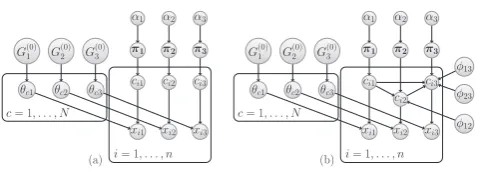
We are interested in the situation where we have a collection ofngenes, for each of which we have measurements fromKdifferent data sources. One possible modelling approach would be to fitKindependent DMA mixture models, represented graphically in Figure 1a for the caseK= 3. However, this neglects to consider (and fails to exploit) structure within the data that may be common across some or all of the different sources. For example, a set of co-regulated genes might be expected to have similar expression profiles, as well as having a common collection of proteins that bind their promoters. We therefore propose a model in which we allow dependencies betweendatasets at the level of the component allocation variables,ci.
We considerKmixture models (one for each dataset), each defined as in Equations (1) and (2). We add right subscripts to our previous notation in order to distinguish between the parameters of theKdifferent models (so thatαkis the mass parameter associated with modelk, etc.) and take Nk =Nin all mixture models. Note that each model is permitted to have
a different mass parameter,αk. MDI links these models together at the level
of the component allocation variables via the following conditional prior:
p(ci1, ci2, . . . , ciK|φ)∝
K Y
k=1
πcikk
K−1
Y
k=1 K Y
`=k+1
(1 +φk`I(cik=ci`)),
(3) whereIis the indicator function,φk`∈R≥0is a parameter that controls the
strength of association between datasetskand`, andφis the collection of allK(K−1)/2of theφk`’s. For clarity, note thatcik∈ {1, . . . , N}is the
component allocation variable associated with geneiin modelk, and that
πcikkis the mixture proportion associated with componentcikin modelk. Informally, the largerφk`, the more likely it is thatcikandci`will be the
same, and hence the greater the degree of similarity between the clustering structure of datasetkand dataset`. In Figure 1b, we provide a graphical representation of our model in the caseK = 3. If allφk` = 0, then we
recover the case ofKindependent DMA mixture models (Figure 1a). Note that(1+φk`I(cik=ci`))≥1, hence ifφk`>0then we are up-weighting
the prior probability thatcik=ci`(relative to the independent case).
Linking the mixture models at the level of the component allocation variables provides us with a means to capture dependencies between the datasets in a manner that avoids difficulties associated with the datasets being of different types and/or having different noise properties.
α1 α2 α3
π1 π2 π3
ci1 ci2 ci3 θc3
θc2 θc1
c= 1, . . . , N G(0)1 G
(0) 2 G
(0) 3
(a)
xi2 xi1
i= 1, . . . , n xi3
α1 α2 α3
π1 π2 π3
ci1 ci2
ci3 θc3
θc2 θc1
c= 1, . . . , N G(0)1 G
(0) 2 G
(0) 3
φ23 φ13
φ12 xi2 xi1
i= 1, . . . , n xi3
[image:4.595.307.547.91.177.2](b)
Fig. 1:Graphical representation of 3 DMA mixture models. (a) Independent case. (b) The MDI model. In both (a) and (b), xik denotes the i-th
observation in dataset k and is generated by mixture component cik.
The prior probabilities associated with the distinct component allocation variables, [c1k, . . . , cN k], are given in the vector πk, which is itself
assigned a symmetric Dirichlet prior with parameter αk. The parameter
vector, θck, for componentcin datasetkis assigned aG0kprior. In (b),
we additionally haveφk`parameters, each of which models the dependence
between the component allocations of observations in datasetkand`
An important feature of our model is that there is a correspondence between the component labels across the datasets. That is, our model implicitly “matches up” Component cin Dataset k with Component c
in Dataset`. This allows us to identify groups of genes that tend to be allocated to the same component (i.e. which tend to cluster together) in multiple datasets (see Section 2.4). It is this desire to “match up” components across datasets that motivates our use of finite approximations to Dirichlet process mixture models. Had we used an infinite mixture model, matching components across datasets would be more problematic. We reiterate that the finiteN that appears in our mixture models merely places an upper bound on the number of clusters in each dataset (since not all components need to be occupied), and hence is not restrictive in practice. Note that while this upper bound is the same for each data set, the actual number of occupied components (i.e. clusters) is inferred separately for each dataset and in general will be different for each one.
2.3 Modelling different data types
To specify our model fully, we must provide parametric densities, f, appropriate for each data source. It is important to note that we may tailor our choice off to reflect the data sources that we seek to model. In the present work, we use Gaussian process (GP) models (Rasmussen and Williams, 2006; Kirk and Stumpf, 2009; Cookeet al., 2011) for gene expression time course data, and use multinomial models for categorical data (e.g. discretised gene expression levels). For comparison with the results of Savageet al.(2010), we also consider in our second example (Sections 3.2 and 4.2) a bag-of-words model for ChIP-chip data. Full details of all of these models are given in the Supplementary Material, where we also provide a Gibbs sampler for performing inference. As in Nieto-Barajaset al.(2004), posterior simulation for our model is aided by the strategic introduction of an additional latent variable (see Supplementary Material for details).
2.4 Extracting fused clusters from posterior samples
We wish to identify groups of genes that tend to be grouped together in multiple datasets. Suppose we have a collection ofKdatasets, which we label as Dataset 1, . . . , DatasetK. We are interested in identifying groups of genes that tend to cluster together amongst some subcollection of the datasets. Let{k1, k2, . . . , km}be a subset of{1, . . . , K}. Our aim is
to identify groups of genes that cluster together in all of Datasetk1, . . . ,
Datasetkm. Adapting terminology from Savageet al.(2010), we define the
probability of thei-th gene beingfusedacross datasetsk1, . . . , kmto be
the posterior probability thatcik1 = cik2 = . . . = cikm.For brevity, we denote this posterior probability byp(cik1 = cik2 = . . . =cikm). We calculate this quantity as the proportion of posterior samples for which
cik1, cik2, . . . , cikmare all equal. We may clearly calculate these posterior
fusion probabilities for any combination of the datasets (pairs, triplets, etc.), simply by considering the appropriate subset of{1, . . . , K}. We say that
at University of Warwick on October 18, 2012
http://bioinformatics.oxfordjournals.org/
thei-th gene is fused across datasetsk1, k2, . . . , kmifp(cik1 =cik2 =
. . . = cikm) > 0.5, and we denote the set of all such fused genes by
Fk1,k2,...,km.
If genei is a member ofFk1,k2,...,km, this simply tells us that the component allocation variablescik1, cik2, . . ., cikm tend to be equal (i.e. genei tends to be allocated to the same component across datasets
k1, k2, . . . , km). We also wish to identify the clustering structure that exists
amongst these fused genes. From our Gibbs sampler, we have a collection of sampled component allocations for each member ofFk1,k2,...,km. We identify a final clustering for the set of fused genes by searching amongst the sampled component allocations in order to find the one that maximises the posterior expected adjusted Rand index (see Fritsch and Ickstadt, 2009). The resultingfused clusterscontain groups of genes that tend to cluster together across datasetsk1, k2, . . . , km.
3 EXAMPLES
To demonstrate the usage and utility of MDI, we consider 3
examples using publicly availableS. cerevisiaedatasets. We specify
the priors adopted for unknown parameters and provide MCMC running specifications in the Supplementary Material. Each of our examples serves a different purpose. In the first (Section 3.1), we consider an easily interpretable synthetic dataset, which allows us to illustrate the types of results that can be obtained using MDI. In the second (Section 3.2), we seek to compare our method to the present state of the art in data integration (namely, the approach of Savageet al., 2010). Although this approach is limited to integrating 2 datasets only, it provides a useful benchmark for MDI. Finally, in Section 3.3, we provide an example that allows us to explore the benefits offered by MDI that go beyond the existing state of the art. We consider the integration of 3 datasets, two of which comprise static measurements (ChIP-chip and PPI), and the other of which comprises gene expression time course data.
3.1 6-dataset synthetic example
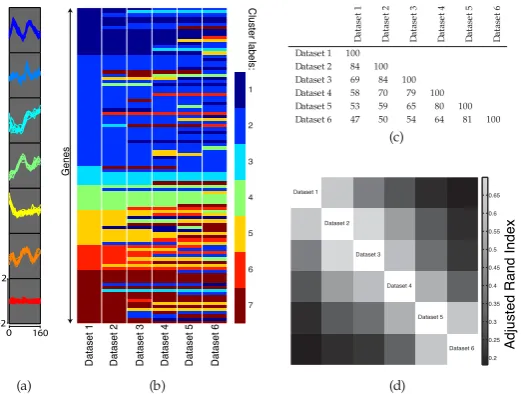
To illustrate the properties of our model, we start with a 6-dataset synthetic example. Dataset 1 is constructed by taking a 100-gene
subset of the gene expression time course data of Cho et al.
(1998), and may be partitioned into 7 easily distinguishable clusters (Figure 2a). We therefore associate with each time course a cluster label,Z ∈ {1, . . . ,7}. Fori = 1, . . . ,5, we form Dataseti+ 1
by randomly selecting 25 time courses from Datasetiand randomly
permuting their associated gene names (but not their cluster labels). Thus, for a maximum of 25 genes, the cluster label associated
with genegin Dataset imay be different from the cluster label
associated with the same gene in Dataseti+ 1. Figures 2b and
2c further illustrate this dataset. A formal approach for comparing the allocation of genes to clusters is to calculate the adjusted Rand index (ARI) between each pair of clustering partitions (Rand, 1971; Hubert and Arabie, 1985). Figure 2d provides a heatmap depiction of the similarity matrix formed by calculating pairwise ARIs.
3.2 Integrating expression and ChIP data
To compare our method to an existing approach for unsupervised data integration, we apply MDI to an example previously considered
by Savage et al.(2010) in the context of transcriptional module
discovery. We take expression data from a 205-gene subset of the
galactose utilisation data of Idekeret al.(2001), which we integrate
with ChIP-chip data from Harbisonet al. (2004). The expression
data were discretised, as in Savageet al.(2010). The 205 genes
appearing in this dataset were selected in Yeunget al.(2003) to
reflect four functional Gene Ontology (GO) categories. Although this functional classification must be used with some degree of
caution (see Yeunget al., 2003), it provides a reasonable means by
which to validate the groupings defined by our method. We use the
same version of the Harbisonet al.dataset as considered by Savage
et al.(2010) (significance thresholdp = 0.001), which provides binding information for 117 transcriptional regulators. For brevity,
we henceforth refer to the data of Harbisonet al.as “ChIP data”,
although we emphasise that this dataset comprises measurements corresponding to a compendium of 117 TFs, rather than to a single
Dataset 1 Dataset 2 Dataset 3 Dataset 4 Dataset 5 Dataset 6 1
2
3
4
5
6
7
Cluster labels:
Genes
0 160 -2
2
(b)
Datase
t1
Datase
t2
Datase
t3
Datase
t4
Datase
t5
Datase
t6
Dataset 1 100
Dataset 2 84 100
Dataset 3 69 84 100
Dataset 4 58 70 79 100
Dataset 5 53 59 65 80 100
Dataset 6 47 50 54 64 81 100
(c)
Dataset 1
Dataset 2
Dataset 3
Dataset 4
Dataset 5
Dataset 6 0.2 0.25 0.3 0.35 0.4 0.45 0.5 0.55 0.6 0.65
(d)
Adjusted Rand Index
(a)
Fig. 2: (a) The data for the 6-dataset synthetic example, separated into 7 clusters. (b) A representation of how the cluster labels associated with each gene vary from dataset to dataset. Genes are ordered so that the clustering of Dataset 1 is the one that appears coherent. (c) A table
showing the number of genes having the same cluster labels in datasetsiandj. (d) A heatmap depiction of the similarity matrix formed by
calculating the adjusted Rand index between pairs of datasets.
4
at University of Warwick on October 18, 2012
http://bioinformatics.oxfordjournals.org/
[image:5.595.169.430.495.692.2]particular TF. Discretising the data (both expression and ChIP-chip) might seem like an unnecessary simplification (since our model can accommodate continuous static measurements through
an appropriate choice of component density function,f), but it helps
to ensure that our comparison to the results of Savageet al.(2010) is fair. Moreover, discretisation of the ChIP data simplifies modelling
and interpretation of the data (theij-entry of our ChIP data matrix
is 1 if we have high confidence that TFjis able to bind the promoter
region of genei, and 0 otherwise), although we acknowledge that
this is likely to incur some small information loss.
3.3 Integrating expression, ChIP and PPI data
For an example with 3 diverse data types, we integrate the ChIP data
of Harbisonet al.with binary protein-protein interaction (PPI) data
obtained from BioGRID (Starket al., 2006) and a gene expression
time course dataset of Granovskaia et al.(2010), with the initial
intention of identifying protein complexes whose genes undergo transcriptional co-regulation during the cell cycle. We consider the
Granovkskaiaet al.cell cycle dataset that comprises measurements
taken at 41 time points, and which was obtained from cells synchronised using alpha factor arrest. We considered only genes
identified in Granovskaiaet al.(2010) as having periodic expression
profiles. After removing those for which there was no ChIP or PPI data, we were left with 551 genes. Our binary PPI data matrix then has rows indexed by these 551 genes, and columns indexed by all of the proteins for which physical interactions identified via yeast 2-hybrid or affinity capture assays have been reported
in BioGRID. Theij-entry of the PPI data matrix is 1 if there is
a reported interaction between proteinj and the protein product
of genei(and 0 otherwise). In an effort to reduce the number of
uninformative features, we removed columns containing fewer than five 1’s, leaving 603 columns.
4 RESULTS
4.1 6-dataset synthetic example
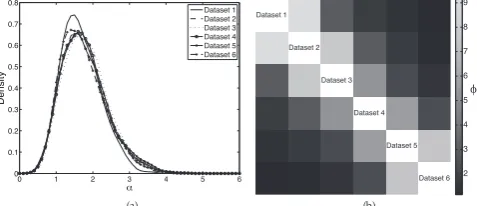
Figure 3a shows estimated posterior densities for the mass
parameters,αk(obtained from the samples generated by our Gibbs
sampler using kernel density estimation). Since each of our datasets is identical (up to permutation of gene names), these distributions should be close to identical, as is the case. For each pair of datasets, we used the posteriorφk`samples to estimate posterior means,φ¯k`.
We used these to form a similarity matrix whosek`-entry is φ¯k`
(with φ¯k`defined to beφ¯`kwheneverk > `, and withφ¯kk left undefined). This is shown as a heatmap in Figure 3b. Although they do so in different ways, both the ARI and the dataset association parameters quantify the degree of similarity between the allocation of genes to clusters in pairs of datasets. The similarity of Figures 2d and 3b is therefore reassuring.
To test our ability to identify fused genes, we calculated pairwise fusion probabilities, p(cik = ci`), for each geneiand each pair of datasets(k, `). If the true cluster label of geneiis the same in
datasetskand`, thenp(cik = ci`)should be high (greater than
0.5) so that the gene may be correctly identified as fused. Across all pairs of datasets, the minimum pairwise fusion probability for such genes was 0.90 and the mean was 0.97. Conversely, for genes
having differentcluster labels in datasets k and `, the maximum
pairwise fusion probability was 0.05 and the mean was 0.01. Since our fusion threshold is 0.5, we are in this case able to identify the fusion status correctly for all genes.
0 1 2 3 4 5 6
0 0.1 0.2 0.3 0.4 0.5 0.6 0.7 0.8
_
Density
Dataset 1 Dataset 2 Dataset 3 Dataset 4 Dataset 5 Dataset 6
Dataset 1
Dataset 2
Dataset 3
Dataset 4
Dataset 5
Dataset 6 2 3 4 5 6 7 8 9
(a) (b)
q
Fig. 3: (a) Densities fitted to the sampled values ofαk. (b) Heatmap
representation of the matrix withk`-entryφ¯k`, the posterior mean
value forφkl.
4.2 Expression + ChIP example
We ran MDI using a multinomial likelihood model for both the discretised expression data and the binary ChIP-chip data. We estimated pairwise fusion probabilities and extracted fused clusters, as described in Section 2.4. We identified 52 fused genes, grouped into 3 clusters. We compared these clusters to the functional classes
defined in Yeunget al.(2003). Within each cluster, all genes had
the same functional classification, while genes in different clusters possessed different classifications.
In Savageet al.(2010), a bag-of-words model was used to model
TF binding data. To permit a fair comparison of the two approaches, we therefore re-ran MDI using a bag-of-words likelihood model for
the ChIP data. Following Savageet al.(2010), we then calculated
the Biological Homogeneity Index (BHI; Datta and Datta, 2006) for the resulting fused clusters. To calculate the BHI scores, we used
the R packageclValid(Brocket al., 2008) together with the GO
annotations in theorg.Sc.sgd.dbBioconductor package (Carlson
et al., 2010). TheclValidpackage provides 4 different BHI scores, depending on which GO functional categories are used to define the set of annotations. All categories may be considered, or just one of: biological process (bp), cellular component (cc), and molecular function (mf). We report all 4 BHI scores in Table 1, for the fused
clusters defined by: (i) the method of Savageet al.(2010); (ii) MDI
using a bag-of-words likelihood; and (iii) MDI using a multinomial likelihood. The BHI scores for MDI (bag-of-words) and the method
of Savageet al.(2010) are almost identical, although MDI
(bag-of-words) identifies a greater number of fused genes.
Table 1. BHI scores for the fused clusters obtained using the method of Savageet al.(2010), together with those obtained using MDI.
BHI BHI BHI BHI Number
(all) (bp) (mf) (cc) of genes
Savageet al.(2010) 0.98 0.85 0.71 0.98 72
MDI (bag-of-words) 0.98 0.85 0.72 0.97 172
MDI (multinomial) 1.00 0.89 0.77 1.00 52
4.3 Expression + ChIP + PPI example
We applied MDI to the example of Section 3.3 (using GP models for the gene expression time courses, and multinomial models for the ChIP and PPI datasets), in order to identify groups of genes that are co-regulated during the yeast cell cycle, and whose protein products appear in the same complex. We identified genes fused across all 3 datasets, as well as genes fused across pairs of datasets. We then determined the fused clusters for each of these combinations (see Section 2.4). Additionally, we identified clusters
at University of Warwick on October 18, 2012
http://bioinformatics.oxfordjournals.org/
[image:6.595.308.547.101.204.2]for the “single dataset fusion” case (which amounts to identifying a single clustering partition for each of our 3 datasets considered separately). We assess the quality of our clusterings using GO Term Overlap (GOTO) scores (Mistry and Pavlidis, 2008). These assign a score to a pair of genes according to how many GO terms they have in common. This contrasts with BHI, which just assigns a score of 0 or 1 to gene pairs depending on whether or not they share a common GO term. The GOTO scores therefore provide a more finely grained assessment, which implicitly takes into account the hierarchical structure of the Gene Ontology. This is invaluable here, since (as a result of selecting only genes found to have periodic expression profiles during the cell cycle) any 2 randomly selected genes are likely to share some high-level GO terms (see the Supplementary Material for more details).
Table 2. GOTO scores for fused clusters obtained for all combinations of the expression, ChIP and PPI datasets.
GOTO GOTO GOTO Number
(bp) (mf) (cc) of genes
ChIP 6.36 0.97 8.53 551
PPI 11.04 1.51 11.11 551
Expression 7.66 1.15 9.48 551
ChIP+PPI 27.04 3.47 18.99 31
ChIP+Expression 24.46 2.93 16.87 48
PPI+Expression 26.04 3.69 22.35 32
ChIP+PPI+Expression 34.81 2.46 26.70 16
The GOTO scores generally increase as we require agreement across more datasets, while the number of fused genes decreases. Note that this decrease is simply a consequence of requiring agreement among a larger collection of datasets. For example,
since the setS1 ={genes that are co-regulatedandhave protein
products that appear in the same complex} is a subset ofS2 =
{genes that are co-regulated}, it is inevitable that the number of
genes of the former type will be less than or equal to the number of genes of the latter type. In other words, requiring agreement across multiple datasets enables us to identify clusters of genes that have increasingly specific shared characteristics. This is reflected in the increasing GOTO scores, which indicate that genes in the same cluster tend to share a greater number of lower-level (more specific) GO terms.
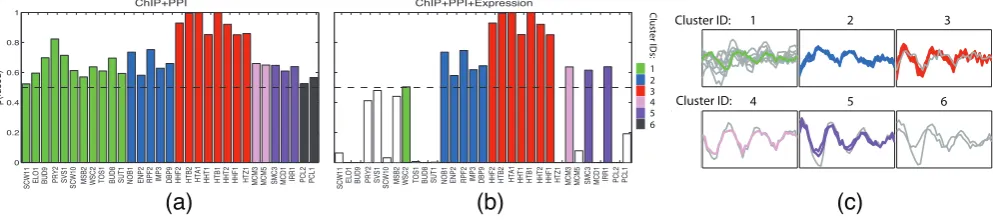
In Figure 4, we compare the clusters formed by the genes fused across all 3 datasets with those formed by the genes fused across
[image:7.595.311.543.280.464.2]just the PPI and ChIP datasets. Figures 4a and 4b illustrate fusion probabilities for the 31 genes identified as fused across the PPI and ChIP datasets. Each bar in Figure 4a corresponds to a particular gene (as labelled), and represents the posterior probability of that gene being fused across the ChIP and PPI datasets. The corresponding bar in Figure 4b represents the probability of the gene being fused across all 3 datasets. Figure 4c shows the expression profiles for genes identified as fused across the PPI and ChIP datasets, with genes fused across all three datasets shown in colour. Supplementary Figure 2 further illustrates the fused clusters, while Table 3 shows the fused cluster labels and provides descriptions for the genes fused across all 3 datasets.
Table 3.Clusters formed by the genes fused across all 3 datasets. Descriptions were derived from the Saccharomyces Genome Database (Cherryet al., 1998). The IDs in this table correspond to the cluster IDs in Figure 4, with singletons omitted.
ID Gene Brief description
2 NOB1 Involved in synthesis of 40S ribosomal subunits
2 ENP2 Required for biogenesis of the small ribosomal
subunit
2 RPF2 Involved in assembly of 60S ribosomal subunit
2 IMP3 Component of the SSU processome
2 DBP9 Involved in biogenesis of 60S ribosomal subunit
3 HHF2 Histone H4, core histone protein
3 HTB2 Histone H2B, core histone protein
3 HTA1 Histone H2A, core histone protein
3 HHT1 Histone H3, core histone protein
3 HTB1 Histone H2B, core histone protein
3 HHT2 Histone H3, core histone protein
3 HHF1 Histone H4, core histone protein
5 SMC3 Subunit of the cohesin complex
5 IRR1 Subunit of the cohesin complex
We can see from Figures 4a and 4b that the integration of the expression data in addition to the ChIP and PPI data results in Cluster 1 (green) and Cluster 6 (black) being effectively removed. Although many of the genes in Cluster 1 are annotated as cell wall proteins (see Supplementary Material), and although the two genes in Cluster 6 are both cyclins, the genes within these clusters have different expression patterns to one another (Figure 4c, panels 1 and 6). Genes are also lost from Clusters 4 and 5 (shown pink and purple). However, further analysis suggests that this is due to data
0 0.2 0.4 0.6 0.8 1
ChIP+PPI
p(fused)
SCW11 ELO1 BUD9 PRY2 SVS1 SCW10 MSB2 WSC2 TOS1 BUD8 SUT1 NOB1 ENP2 RPF2 IMP3 DBP9 HHF2 HTB2 HTA1 HHT1 HTB1 HHT2 HHF1 HTZ1 MCM3 MCM5 SMC3 MCD1 IRR1 PCL2 PCL1
ChIP+PPI+Expression
SCW11 ELO1 BUD9 PRY2 SVS1 SCW10 MSB2 WSC2 TOS1 BUD8 SUT1 NOB1 ENP2 RPF2 IMP3 DBP9 HHF2 HTB2 HTA1 HHT1 HTB1 HHT2 HHF1 HTZ1 MCM3 MCM5 SMC3 MCD1 IRR1 PCL2 PCL1
(a)
(b)
Clust
er IDs:
1 2 3 4 5 6
1 2 3
Cluster ID:
4 5 6
Cluster ID:
(c)
Fig. 4: (a) Pairwise fusion probabilities for the 31 genes identified as fused across the ChIP and PPI datasets in the “Expression + ChIP + PPI” example. Colours correspond to fused clusters and the dashed line indicates the fusion threshold. (b) Three-way fusion probabilities for the same 31 genes. Genes that do not exceed the fusion threshold have white bars. (c) The expression profiles for genes identified as fused according to the ChIP and PPI datasets. The coloured lines indicate genes that are also fused across the expression dataset as well.
6
at University of Warwick on October 18, 2012
http://bioinformatics.oxfordjournals.org/
[image:7.595.52.549.588.698.2]normalisation effects (see Supplementary Material). Cluster 2 (blue) is robust to the additional inclusion of expression data, indicating that there is no significant disagreement amongst the three datasets regarding the existence of this cluster. Cluster 3 (red) is also relatively robust, with only one fewer gene when we consider the fusion of all 3 datasets, compared to the fusion of just the ChIP and PPI datasets (see Figures 4a and 4b). We note that the genes in Clusters 2 and 3 all have key roles, either encoding core histone proteins or being involved in ribosome biogenesis (see Table 3).
Interestingly, the gene lost from Cluster 3 (the histone cluster) is
HTZ1, which encodes the variant histone H2A.Z (Jacksonet al.,
1996; Santistebanet al., 2000). The function of H2A.Z is different
to that of the major H2As (e.g. Jackson and Gorovsky, 2000).We can see from Figure 4c (panel 3) that the expression of this gene (shown grey) is subtly different to the expression of others in the cluster.
4.4 Comparison to other methods
In Section G of the Supplementary Material, we provide a comparison of MDI to other clustering methods, both in terms of performance and the types of results that can be obtained. The key properties of MDI that distinguish it from other clustering methods
are: (i) the clustering of genes in dataset k influences (and is
influenced by) the clustering in dataset`, to an extent determined
by the inferredφk`parameter; (ii) each dataset is permitted to have
a different clustering structure (so each dataset may, for example, have a different number of clusters); (iii) the number of clusters is determined automatically as part of the inference procedure; and (iv) there is a correspondence between the cluster labels in different datasets, which enables us to identify clusters of genes that exist across some or all of the datasets. Simple clustering
methods (such ask-means and hierarchical clustering) can be used
to cluster each of the datasets independently, but do not model the dependence/similarity between clustering structures in different datasets and do not enable clusters that exist across multiple datasets to be identified automatically. More sophisticated methods such as
iCluster(Shenet al., 2009) often share some of MDI’s properties, but do not allow for the identification of subsets of genes that cluster together across multiple datasets. The results of Section G of the Supplementary Material demonstrate that the ability to share information across datasets typically provides improvements in clustering quality, while MDI’s ability to pick out clusters that exist across multiple datasets permits the identification of groups of genes with very specific shared characteristics. Increasing the number of datasets across which we seek agreement in cluster assignment has the effect of increasing the specificity of these shared characteristics (which typically reduces the size of the gene subset – see Section 4.3 for further explanation).
4.5 Scaling and run-times
For typical examples (where the number of datasets, K, is
relatively small), the scaling of MDI will be O(KN n) (see
Supplementary Section D.5 for further details and specific run-times). MDI is particularly appropriate for applications in which a gene pre-selection step is performed (e.g. on the basis of differential expression). We anticipate applications to collections
of∼5 datasets, each comprising∼1000 genes. Parallelising MDI
using an approach such as the one described by Suchardet al.(2010)
should be possible, and we are currently investigating this.
5 DISCUSSION
We have presented MDI, a novel Bayesian method for the unsupervised integrative modelling of multiple datasets.We have established that MDI provides competitive results with an existing method for integrating 2 datasets (Section 4.2), and is also able to integrate collections of more than 2 datasets (Sections 4.1 and 4.3). Our application to a 3-dataset example (Section 4.3) demonstrated that requiring agreement across multiple datasets of different types can enable us to identify clusters of genes with increasingly specific shared characteristics. Moreover, we have found that sharing information across multiple datasets can improve cluster quality.
MDI adopts a modelling approach distinctly different from those adopted by existing integrative modelling methods. For example,
the model of Savageet al. (2010) performs integrative modelling
of 2 datasets only, achieved by introducing a “fused context” (in which the 2 datasets are modelled together via a product of likelihoods) in addition to 2 “unfused contexts” in which the 2 datasets are modelled separately. This is analogous to introducing – and modelling – an additional dataset. In contrast, MDI introduces
just a single parameter,φk` ∈ R≥0, for each pair of datasets (see
Section 2.2), and it is this that provides MDI with the flexibility to
perform integrative modelling ofmultipledatasets. The scalability
of MDI may be further improved through parallelisation of the type
described by Suchardet al.(2010). This is an important direction
for future work.
ACKNOWLEDGEMENTS
We thank John Pinney for help with GO Term Overlap, and Maxime
Huvet for useful discussions. Funding: PK, JEG, ZG and DLW
acknowledge support from the EPSRC (grant EP/I036575/1). RSS was supported by an MRC Biostatistics Fellowship.
REFERENCES
Balasubramanian, R., LaFramboise, T., Scholtens, D., and Gentleman, R. (2004). A graph-theoretic approach to testing associations between disparate sources of functional genomics data.Bioinformatics,20(18), 3353–62.
Barash, Y. and Friedman, N. (2002). Context-specific Bayesian clustering for gene expression data.J Comput Biol,9(2), 169–91.
Brock, G., Datta, S., Pihur, V., and Datta, S. (2008). clValid: An R package for cluster validation.J Stat Softw,25(4), 1–22.
Carlson, M., Falcon, S., Pages, H., and Li, N. (2010). org.Sc.sgd.db: Genome wide annotation for Yeast. R package version 2.6.3.
Cheng, Y. and Church, G. M. (2000). Biclustering of expression data.Proceedings of ISMB,8, 93–103.
Cherry, J. M., Adler, C., Ball, C., Chervitz, S. A., Dwight, S. S., Hester, E. T., Jia, Y., Juvik, G., Roe, T., Schroeder, M., Weng, S., and Botstein, D. (1998). SGD: Saccharomyces Genome Database.Nucleic Acids Res,26(1), 73–9.
Cho, R. J., Campbell, M. J., Winzeler, E. A., Steinmetz, L., Conway, A., Wodicka, L., Wolfsberg, T. G., Gabrielian, A. E., Landsman, D., Lockhart, D. J., and Davis, R. W. (1998). A genome-wide transcriptional analysis of the mitotic cell cycle.Mol Cell,
2(1), 65–73.
Cooke, E. J., Savage, R. S., Kirk, P. D., Darkins, R., and Wild, D. L. (2011). Bayesian hierarchical clustering for microarray time series data with replicates and outlier measurements.BMC Bioinformatics,12(1), 399.
Datta, S. and Datta, S. (2006). Methods for evaluating clustering algorithms for gene expression data using a reference set of functional classes.BMC Bioinformatics,7, 397.
Dempster, A., Laird, N., and Rubin, D. (1977). Maximum Likelihood From Incomplete Data via Em Algorithm.Journal Of The Royal Statistical Society Series B-Methodological,39(1), 1–38.
Friedman, J., Hastie, T., Rosset, S., Tibshirani, R., and Zhu, J. (2004). Consistency in boosting: Discussion.The Annals of Statistics,32(1), 102–107.
at University of Warwick on October 18, 2012
http://bioinformatics.oxfordjournals.org/
Fritsch, A. and Ickstadt, K. (2009). Improved criteria for clustering based on the posterior similarity matrix.Bayesian Anal,4(2), 367–391.
Granovskaia, M. V., Jensen, L. J., Ritchie, M. E., Toedling, J., Ning, Y., Bork, P., Huber, W., and Steinmetz, L. M. (2010). High-resolution transcription atlas of the mitotic cell cycle in budding yeast.Genome Biol,11(3), R24.
Green, P. and Richardson, S. (2001). Modelling heterogeneity with and without the Dirichlet process.Scand J Stat,28(2), 355–375.
Harbison, C. T., Gordon, D. B., Lee, T. I., Rinaldi, N. J., Macisaac, K. D., Danford, T. W., Hannett, N. M., Tagne, J.-B., Reynolds, D. B., Yoo, J., Jennings, E. G., Zeitlinger, J., Pokholok, D. K., Kellis, M., Rolfe, P. A., Takusagawa, K. T., Lander, E. S., Gifford, D. K., Fraenkel, E., and Young, R. A. (2004). Transcriptional regulatory code of a eukaryotic genome.Nature,431(7004), 99–104.
Hubert, L. and Arabie, P. (1985). Comparing partitions.Journal of Classification,2, 193–218.
Huttenhower, C., Haley, E. M., Hibbs, M. A., Dumeaux, V., Barrett, D. R., Coller, H. A., and Troyanskaya, O. G. (2009). Exploring the human genome with functional maps.Genome research,19(6), 1093–1106.
Ideker, T., Thorsson, V., Ranish, J. A., Christmas, R., Buhler, J., Eng, J. K., Bumgarner, R., Goodlett, D. R., Aebersold, R., and Hood, L. (2001). Integrated genomic and proteomic analyses of a systematically perturbed metabolic network. Science,
292(5518), 929–34.
Ishwaran, H. and Zarepour, M. (2002). Exact and approximate representations for the sum Dirichlet process.Can J Stat,30(2), 269–283.
Jackson, J. D. and Gorovsky, M. A. (2000). Histone H2A.Z has a conserved function that is distinct from that of the major H2A sequence variants. Nucleic Acids Res,
28(19), 3811–6.
Jackson, J. D., Falciano, V. T., and Gorovsky, M. A. (1996). A likely histone H2A.F/Z variant in Saccharomyces cerevisiae.Trends Biochem Sci,21(12), 466–7. Jansen, R., Yu, H., Greenbaum, D., Kluger, Y., Krogan, N. J., Chung, S., Emili,
A., Snyder, M., Greenblatt, J. F., and Gerstein, M. (2003). A Bayesian networks approach for predicting protein-protein interactions from genomic data. Science,
302(5644), 449–53.
Kirk, P. D. W. and Stumpf, M. P. H. (2009). Gaussian process regression bootstrapping: exploring the effects of uncertainty in time course data. Bioinformatics,25(10), 1300–6.
Lee, I., Date, S. V., Adai, A. T., and Marcotte, E. M. (2004). A probabilistic functional network of yeast genes.Science,306(5701), 1555–8.
Liu, X., Sivaganesan, S., Yeung, K. Y., Guo, J., Bumgarner, R. E., and Medvedovic, M. (2006). Context-specific infinite mixtures for clustering gene expression profiles across diverse microarray dataset.Bioinformatics,22(14), 1737–44.
Liu, X., Jessen, W. J., Sivaganesan, S., Aronow, B. J., and Medvedovic, M. (2007). Bayesian hierarchical model for transcriptional module discovery by jointly modeling gene expression and ChIP-chip data.BMC Bioinformatics,8, 283. Lockhart, D. J., Dong, H., Byrne, M. C., Follettie, M. T., Gallo, M. V., Chee, M. S.,
Mittmann, M., Wang, C., Kobayashi, M., Horton, H., and Brown, E. L. (1996). Expression monitoring by hybridization to high-density oligonucleotide arrays.Nat Biotechnol,14(13), 1675–80.
Mistry, M. and Pavlidis, P. (2008). Gene Ontology term overlap as a measure of gene functional similarity.BMC Bioinformatics,9, 327.
Myers, C. L. and Troyanskaya, O. G. (2007). Context-sensitive data integration and prediction of biological networks.Bioinformatics,23(17), 2322–2330.
Myers, C. L., Robson, D., Wible, A., Hibbs, M. A., Chiriac, C., Theesfeld, C. L., Dolinski, K., and Troyanskaya, O. G. (2005). Discovery of biological networks from diverse functional genomic data.Genome Biol,6(13), R114.
Neal, R. M. (1992). Bayesian mixture modeling. InMaximum Entropy and Bayesian Methods: Proceedings of the 11th International Workshop on Maximum Entropy and Bayesian Methods of Statistical Analysis, pages 197–211.
Neal, R. M. (2000). Markov Chain Sampling Methods for Dirichlet Process Mixture Models.Journal of Computational and Graphical Statistics,9(2), 249–265. Nieto-Barajas, L., Pr¨unster, I., and Walker, S. (2004). Normalized random measures
driven by increasing additive processes.Ann Stat,32(6), 2343–2360.
Puig, O., Caspary, F., Rigaut, G., Rutz, B., Bouveret, E., Bragado-Nilsson, E., Wilm, M., and S´eraphin, B. (2001). The tandem affinity purification (TAP) method: a
general procedure of protein complex purification.Methods,24(3), 218–29. Rand, W. (1971). Objective criteria for the evaluation of clustering methods.Journal
of the American Statistical Association,66(336), 846–850.
Rasmussen, C. E. (2000). The Infinite Gaussian Mixture Model. InAdvances in Neural Information Processing Systems 12, pages 554–560.
Rasmussen, C. E. and Williams, C. K. I. (2006). Gaussian Processes for Machine Learning (Adaptive Computation and Machine Learning). The MIT Press, MA. Reiss, D. J., Baliga, N. S., and Bonneau, R. (2006). Integrated biclustering
of heterogeneous genome-wide datasets for the inference of global regulatory networks.BMC Bioinformatics,7, 280.
Rhodes, D. R., Tomlins, S. A., Varambally, S., Mahavisno, V., Barrette, T., Kalyana-Sundaram, S., Ghosh, D., Pandey, A., and Chinnaiyan, A. M. (2005). Probabilistic model of the human protein-protein interaction network. Nat Biotechnol,23(8), 951–9.
Rigaut, G., Shevchenko, A., Rutz, B., Wilm, M., Mann, M., and S´eraphin, B. (1999). A generic protein purification method for protein complex characterization and proteome exploration.Nat Biotechnol,17(10), 1030–2.
Rogers, S., Girolami, M., Kolch, W., Waters, K. M., Liu, T., Thrall, B., and Wiley, H. S. (2008). Investigating the correspondence between transcriptomic and proteomic expression profiles using coupled cluster models.Bioinformatics,24(24), 2894–900. Rogers, S., Klami, A., Sinkkonen, J., Girolami, M., and Kaski, S. (2010). Infinite
factorization of multiple non-parametric views.Mach Learn,79(1-2), 201–226. Rousseau, J. and Mengersen, K. (2011). Asymptotic behaviour of the posterior
distribution in overfitted mixture models.Journal Of The Royal Statistical Society Series B-Statistical Methodology,73(5), 689–710.
Santisteban, M. S., Kalashnikova, T., and Smith, M. M. (2000). Histone H2A.Z regulates transcription and is partially redundant with nucleosome remodeling complexes.Cell,103(3), 411–22.
Savage, R. S., Ghahramani, Z., Griffin, J. E., de la Cruz, B. J., and Wild, D. L. (2010). Discovering transcriptional modules by Bayesian data integration. Bioinformatics,
26(12), i158–67.
Schena, M., Shalon, D., Davis, R. W., and Brown, P. O. (1995). Quantitative monitoring of gene expression patterns with a complementary DNA microarray. Science,
270(5235), 467–70.
Shen, R., Olshen, A. B., and Ladanyi, M. (2009). Integrative clustering of multiple genomic data types using a joint latent variable model with application to breast and lung cancer subtype analysis.Bioinformatics,25(22), 2906–12.
Solomon, M. J., Larsen, P. L., and Varshavsky, A. (1988). Mapping protein-DNA interactions in vivo with formaldehyde: evidence that histone H4 is retained on a highly transcribed gene.Cell,53(6), 937–47.
Stark, C., Breitkreutz, B.-J., Reguly, T., Boucher, L., Breitkreutz, A., and Tyers, M. (2006). BioGRID: a general repository for interaction datasets.Nucleic Acids Res,
34(Database issue), D535–9.
Suchard, M. A., Wang, Q., Chan, C., Frelinger, J., Cron, A., and West, M. (2010). Understanding GPU Programming for Statistical Computation: Studies in Massively Parallel Massive Mixtures.J Comput Graph Stat,19(2), 419–438.
Troyanskaya, O. G., Dolinski, K., Owen, A. B., Altman, R. B., and Botstein, D. (2003). A Bayesian framework for combining heterogeneous data sources for gene function prediction (in Saccharomyces cerevisiae).Proc Natl Acad Sci USA,100(14), 8348– 53.
Wei, P. and Pan, W. (2012). Bayesian Joint Modeling of Multiple Gene Networks and Diverse Genomic Data to Identify Target Genes of a Transcription Factor. Annals Of Applied Statistics,6(1), 334–355.
Wong, S. L., Zhang, L. V., Tong, A. H. Y., Li, Z., Goldberg, D. S., King, O. D., Lesage, G., Vidal, M., Andrews, B., Bussey, H., Boone, C., and Roth, F. P. (2004). Combining biological networks to predict genetic interactions.Proc Natl Acad Sci USA,101(44), 15682–7.
Yeung, K. Y., Medvedovic, M., and Bumgarner, R. E. (2003). Clustering gene-expression data with repeated measurements.Genome Biol,4(5), R34.
Yuan, Y., Savage, R. S., and Markowetz, F. (2011). Patient-specific data fusion defines prognostic cancer subtypes.PLoS Comput Biol,7(10), e1002227.
8
at University of Warwick on October 18, 2012
http://bioinformatics.oxfordjournals.org/