University of Twente
Bachelor Thesis
____________________________________________________
Assessing the risk perception of microplastics
____________________________________________________
Author:
Supervisor:
Inga Maren Floer Jan M. Gutteling
Peter De Vries
Department of psychology
Conflict, risk and safety
Abstract
Since the last century, the use of plastic has increased dramatically. Plastic invading the environment is breaking into smaller pieces called mesoplastic, larger microplastic, and small microplastic particles. These pieces have been found in flora and fauna which is likely ending up in our food. In order to prevent more damage, a change in consumer behaviour is necessary. Nevertheless, plastic consumption has increased even though statistics indicate an increasing seriousness in the population, hence the it got more relevant to the individual. This might
indicate an increased concern as well as risk awareness, but does this eventually lead to a change in consumer behaviour?
Content
Introduction ... 3
Conceptual framework ...4
Risk perception ... 5
Concern ... 5
Psychological distance ... 6
Behavioural intention ... 7
Hypothesis and conceptual framework ... 8
Methods ...9
Design ... 9
Participants ... 9
Materials ... 9
Questionnaires ... 9
Reliability check and descriptives ... 10
Results ... 12
Pearson correlations ... 12
Hypothesis ... 13
Additional analysis ... 18
Conclusion and discussion ... 20
Conclusion ... 20
Discussion ... 21
Limitations ... 23
Implications... 24
Recommendations and future research ... 24
References ... 25
Introduction
Since synthetic organic polymers, also known as plastic, were invented just over a century ago (Gorman, 1993), the use of it increased dramatically. In 2016, the worldwide production increased to 335 million tons of plastic (PlasticsEurope, 2019), Asia being the largest manufacturer (50%) followed by Europe (19%), and North America (18%). Plastic is
lightweight, strong, durable, and cheap (Laist, 1987). These properties make it suitable for the manufacture of a wide range of products. Unfortunately, these characteristics are the same reasons why plastic is such a serious threat to the environment (Pruter, 1987; Laist, 1987). Alone in 2010, about 4.8–12.7 Million metric tons of plastic waste was not taken care of and as a consequence, entered our oceans. There are many ways in how plastic invades the marine
environment, due to plastic producing companies, fisheries (Wilber, 1987) or beachgoers (Pruter, 1987).
These large plastic items (also called macro fragments) break up into smaller pieces due to mechanical, biological, photic, and/or thermal degradation (Andrady, 2011, Cole et al., 2011, Thompson et al., 2004, Eriksson and Burton, 2003) and are the majority of plastic found in the ocean (Gregory and Andrady, 2003). The most common small fragments are called mesoplastic (5 - 10 mm), larger microplastic (2 - 5 mm) and small microplastic particles (.2 - 2 mm). These pieces of microplastic are invading the marine environment dramatically and are widely
distributed since they are buoyant, accumulate on the surface and are able to float long distances. Estimations indicate that 0 -7290 items per hectare exist in the aquatic environment (Barnes, Galgani, Thompson, and Barlaz, 2009), which is around five trillion pieces and above 250,000 tons of plastic (Eriksen et al., 2014).
Research shows that these plastic particles impact the marine flora and fauna (e.g., Anastasopoulou et al., 2013, Cole et al., 2013, Farrell and Nelson, 2012; von Moos et al, 2012, Murray and Cowie, 2011, Van Franeker et al., 2011, Graham and Thompson, 2009, Fossi et al, 2012, Carpenter et al., 1972) and that smaller pieces are likely to be absorbed by marine life (Carson, 2013, von Moos et al, 2012, Andrady, 2011, Ng and Obbard, 2006).
might gain the impression that political actions have failed or fade into the background. Actions have dealt with the symptoms but not the source of the problem (Blühdorn, 2007) Hence, sustainability has shifted to private action (Grunwald, 2010). Also, the marketplace is perceived as the ‘dominant ground for change’, which is understood in a more self-interested way, but it distracts the focus from collectivist approaches to enhance meaningful change.
Science proves that the negative impact of microplastic is severe and increasing, but the consumption of plastic is still an ongoing process. For this reason, the responsibility for change lies within our society, which means that our (consumer) behaviour has to change. Statistics show that at least in Europe plastic recycling has been taken more seriously and got more relevant to the individual (psychologically is more close) (Ipos, 2018), even though the plastic production increased (PlasticsEurope, 2017). This might give an indication of an increased concern due to higher risk perception within the citizens. But does this affect the individual’s intention to change their behaviour? Therefore, the general research question is:
Can the intention to change one's consumer behaviour be predicted by an individual’s risk
perception, concern and psychological distance?
For that, risk perception, concern, psychological distance and the behavioural intention to change about microplastic is going to be measured in order to predict the intention to change consumer behaviour.
Conceptual framework
Risk perception In a social context, risk is defined as ‘the likelihood of an adverse effect
Literature conceptualises the concept of risk perception in several ways. In this study, we focus on the two dimensions that are identified by Janmaimool and Watanabe (2014), namely the cognitive dimension and the perceptive dimension. The cognitive dimension relates to an
individual's present knowledge and understanding of the risk itself, including the personal need to acquire more information on the microplastic issue and magnitude of which its existence is denied based on knowledge as well. The perceptive dimension, on the other hand, focuses on how individuals feel about the risk probability, by emphasizing individuals’ feelings as seen on a moral and emotional dimension and to which extent they show disinterest regarding the topic. The aspect difficult to quantify in this case is ‘thinking’ and ‘feeling’, both having an impact on risk perception (Hansen, Holm, Frewer, Robinson and Sandoe, 2003). Experts are more prone to base their perception and resulting thoughts on knowledge. Ordinary people do not possess expert knowledge and rely more on their personal feelings to come to risk perception. This is a well-known issue that leads ‘communicators’ to influence these feelings, e.g. by focusing on the troubling and scaring consequences of plastic pollution (Hansen et al; 2003).
The perceptive dimension includes the perceived probability of environmental contamination and receiving the impacts of this environmental contamination, as well as the perceived severity of catastrophic consequences (Janmaimool & Watanabe, 2014). The cognitive dimension consists of the perceived ability to control the risk, the person’s concerns about the social surrounding, previous experiences facing, here case the microplastic problems, and the perceived benefits of industrial development (Janmaimool & Watanabe, 2014).
microplastics (Stern, 2000). Considering the information above, if concern increases, behavioural intentions should increase as well.
Psychological distance Liberman, Trope, & Stephan (2007) described psychological distance as an indicator of how relevant an issue, here the microplastic issue, is to an individual. There are four defined dimensions of psychological distance that are interrelated: temporal, social, spatial, and uncertainty/hypothetical (Trope and Liberman, 2003). Temporal psychological distance describes the distance in time, for example, climate change outcomes are seen as something far away in the future, even though some are likely to happen in 2020. Social distance describes the personal relevance towards an issue, it can be seen as the perceived closeness or similarity between an individual and another, who are experiencing direct effects of an issue (f.e. Destroyed houses due to rising sea level). Spatial distance is explained as the geographical distance between an individual and, to stay with the previous example, the sea itself and therefore the rising sea levels. The last dimension is the Uncertainty/hypothetical (here, uncertainty)distance, that appears due to a degree of uncertainty about an event happening. Individuals are using “themselves as a standard to judge and evaluate other objects, events and actions” (Liberman et al, 2007, p.354) in their subjective environment. If an individual is not well informed about a specific topic, its perception can be that an event is unlikely to happen and is therefore distanced from the topic itself.
On the one hand, if psychological distance increases, thoughts are turning to be more abstract and less concrete, resulting in more abstract representations. In the case of temporal distance, there is less motivation to change behaviour in order to prevent a problem to happen in the future. On the other hand, if psychological distance is decreasing, these representations become more concrete, and individuals focus on the details of an event or action and are more concerned. It is important to note that concern does not influence psychological distance since the issue has to be relevant to a person to be concerned in the first place. In the matter of microplastics, psychological distance might be an influence on the behavioural intention of people to change their behaviour as consumers, in order to decrease the microplastic impact.
behaviour (TPB) by Ajzen (2002). In there, behavioural intention is defined as an “individual’s readiness to perform a given behaviour.” as well as being the only direct determinant of
behaviour (Ajzen, 2002, p.12).
In a study that measures willingness to pay a higher prize for non-counterfeit goods, concern and knowledge serve as a direct influence (Marcketti & Shelley, 2009) Albayrak, Aksoy and Caber (2013) showed in their study that environmental sensitive consumer behaviour is determined by environmental concern. Nevertheless, it can be considerably decreased by scepticism which philosophical position holds the possibility of knowledge being limited by the mind or the accessibility of its object. This aligns with the definition of psychological distance, therefore, serves in this study as scepticism.
Considering this, concern, as well as psychological distance, have to be measured in relation to behavioural intention to change one’s consumer behaviour in order to decrease the microplastic issue.
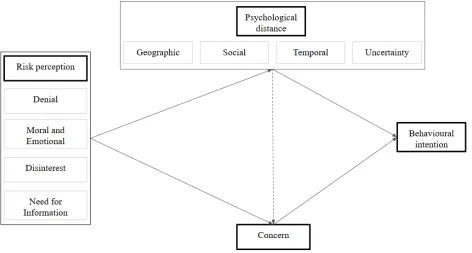
[image:8.612.73.545.408.661.2]The preceding arguments result in the following 5 hypotheses. Hypothesis:
I. High risk perception leads to lower psychological distance II. High risk perception leads to higher concern
III. Lower psychological distance leads to higher concern
IV. Lower psychological distance leads to higher behavioural intentions V. Higher concern leads to higher behavioural intentions
Expectancies If the risk perception towards microplastic is higher -the knowledge increases - the issue should get more concrete, hence the psychological distance decreases (HI) and the concern increases due to both variables (HII, HIII). In turn, the behavioural intention to change consumer behaviour should become higher (HIV, V).
In HI and HII, the independent variable is risk perception influencing the dependent variables psychological distance and concern. Hypothesis III and IV are describing psychological distance as an independent variable causing the dependent variables concern and behavioural intention to be high. The last hypothesis shows concern being the independent variable influencing behavioural intentions.
Methods
Design
This online survey study is used to measure risk perception, psychological distance, behavioural intentions and concern towards the microplastic issue. Then a regression analysis is going to be made to estimate the relationship between the given concepts. In order to ensure that the
participants took the study voluntarily, they had to agree to the informed consent given prior to the survey itself. Participants responded to 31 questions involving four different variables: risk perception, concern, behavioural intentions, and psychological distance.
Participants
Overall, 103 participants participated in the survey. Nevertheless, 12 participants had to be excluded due to not responding to the questions after agreeing to the consent form. Hence, no data was available from these participants.
max. 63). Partly, undergraduate psychology students at the University of Twente received a sona credit for participating in the study. The survey has been answered by 23 different nationalities, the majority were German with a quantity of 53, followed by 10 Dutch participants, 28
participants indicated other nationalities.
Materials
Questionnaires. The questionnaire consists of 31 questions in total. In there, 4 scales including 7 subscales are measuring the concepts. The questions were based on several other questionnaires, but have been modified to the topic of microplastic, therefore, no comparison is possible. The reliability check of this study can be found below.
The variable risk perception is answered with a 5-point Likert scale, with the values 1= ‘strongly agree’ to 7 = ‘strongly disagree’ and has 4 subscales (Whitmarsh, 2011). The first subscale measured ‘denial’ with 6 different questions and includes statements like “The evidence for microplastic is unreliable”. The second subscale is measuring the moral and emotional dimension which incorporates 4 questions f.e. “I feel a moral duty to do something about the microplastic problem”. Disinterest is covering disinterest with two statements like “Microplastic is too complicated for me to understand”. The last subscale ‘need for information’ embodies two statements e.g. “I need more information to form a clear opinion about microplastic” (see Appendix I)
The variable concern consists out of 3 questions with a 4-point Likert scale (1= Very concerned– 4 = Not at all concerned) (Spence, Poortinga and Pidgeon, 2012). Questions are e.g. “How concerned, if at all, are you about microplastic?” and “Considering any potential effects of microplastic which there might be on you personally, how concerned, if at all, are you about microplastic?”
The next variable being assessed is behavioural intention (Muscavage, 2016). There, the participant has to provide answers on a scale from 1- 5 (1. Not at all - 2. A little bit - 3
The last variable is called psychological distance (Spence, Poortinga and Pidgeon, 2012). In there, the geographical-, social - and temporal distance, as well as uncertainty/scepticism, is measured. The one geographical distance question is “The microplastic issue will mostly affect areas that are far away from here.”, answered by 5-point scale (Strongly agree–Strongly
disagree). Social distance consists out of two questions including “Microplastic will mostly affect developing countries.”.
“When, if at all, do you think humanity will start feeling the effects of plastic in the ocean/microplastic?”, is a temporal distance question and is measured with a 7-point scale (We are already feeling the effects–Never). Uncertainty is using a 5-point scale (Strongly agree– Strongly disagree), with three questions like “I am uncertain that microplastic is really happening.”.
Reliability check and descriptives Question 13 (“I often talk about microplastic to family or friends.”) and 25 (“Most scientists agree that microplastic ends up in our food.”) were re-coded.
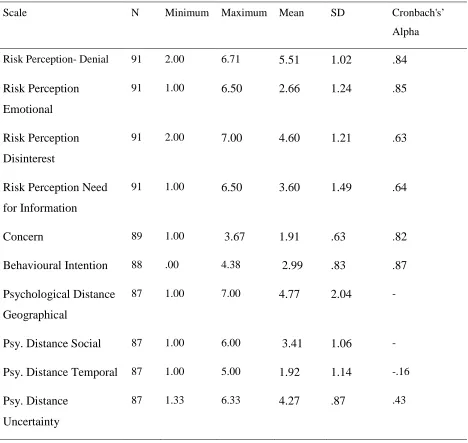
In order to measure the reliability, the Cronbach’s alpha for all scales and subscales are going to be measured. The alpha for risk perception - denial is .84 (M= 5.51, SD = 1.02) and for risk perception - moral and emotional dimension the alpha is .85 (M= 2.66, SD = 1.24). Both subscales are therefore reliable. Unfortunately, the alpha for risk perception - disinterest (M = 4,60; SD = 1.21) and -need for more information (M = 3.60; SD = 1.49) ranges between .63 and .64, hence the reliability is acceptable. The second scale ‘concern’ has an alpha of .820 with a mean of 1.91 and a standard deviation of .63. The third scale behavioural intention has a significant alpha of .868 (M = 2.99; SD = .83).
The subscales for psychological distance - geographical and - temporal consist out of one item, therefore an alpha cannot be measured. The mean for the geographical subscale is 4.77 with a standard deviation of SD = 2.04. The subscale psychological distance temporal has a mean of 1.92 and a standard deviation of 1.14. Even after recoding, psychological distance temporal has a negative alpha (-.16; M = 3.41; SD = 1.06). And psychological distance
Table 1, Descriptives
Scale N Minimum Maximum Mean SD Cronbach's’
Alpha
Risk Perception- Denial 91 2.00 6.71 5.51 1.02 .84
Risk Perception Emotional
91 1.00 6.50 2.66 1.24 .85
Risk Perception Disinterest
91 2.00 7.00 4.60 1.21 .63
Risk Perception Need for Information
91 1.00 6.50 3.60 1.49 .64
Concern 89 1.00 3.67 1.91 .63 .82 Behavioural Intention 88 .00 4.38 2.99 .83 .87 Psychological Distance
Geographical
87 1.00 7.00 4.77 2.04 -
Psy. Distance Social 87 1.00 6.00 3.41 1.06 -
Psy. Distance Temporal 87 1.00 5.00 1.92 1.14 -.16
Psy. Distance Uncertainty
87 1.33 6.33 4.27 .87 .43
Results
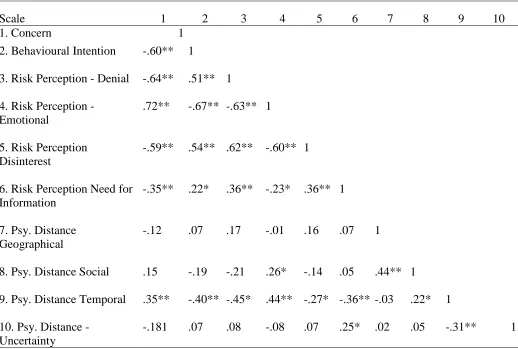
Pearson correlation In order to assess the extent to which the subscales exert an impact on each other, the Pearson correlation was calculated.
Concern (r =.72) also indicated to be significantly correlated to the subscale risk perception emotional (p < .00).
Moreover, risk perception disinterest appeared to exhibit an influence on concern r = -.59 (p < .001) Risk perception need for information could be correlated to concern r = -.35 (p = .00). However, psychological distance geographical does not show any correlations to any other scale. The subscales risk perception emotional r = .260 (p = .02) and psychological distance
geographical r = .44 (p < .00) are lowly correlated to psychological distance social.
[image:13.612.75.593.353.702.2]The subscale psychological distance temporal has the strongest correlations. Psychological distance temporal is correlated to concern r= .35 (p = .00), behavioural intentions r= -.40 (p <.00), to risk perception denial r = -.46 (p <.00), risk perception emotional r = .44 (p <.00), risk perception disinterest r= -.27 (p = .01), risk perception need for information r = -.36 (p = .00), and psychological distance social r = .22 (p = .04).
Table 2. Correlations
Scale 1 2 3 4 5 6 7 8 9 10
1. Concern 1 2. Behavioural Intention -.60** 1
3. Risk Perception - Denial -.64** .51** 1 4. Risk Perception -
Emotional
.72** -.67** -.63** 1
5. Risk Perception Disinterest
-.59** .54** .62** -.60** 1
6. Risk Perception Need for Information
-.35** .22* .36** -.23* .36** 1
7. Psy. Distance Geographical
-.12 .07 .17 -.01 .16 .07 1
8. Psy. Distance Social .15 -.19 -.21 .26* -.14 .05 .44** 1
9. Psy. Distance Temporal .35** -.40** -.45* .44** -.27* -.36** -.03 .22* 1 10. Psy. Distance -
Uncertainty
*. Correlation is significant at the .05 level (2-tailed).
Hypothesis I. High-Risk Perception, low Psychological Distance
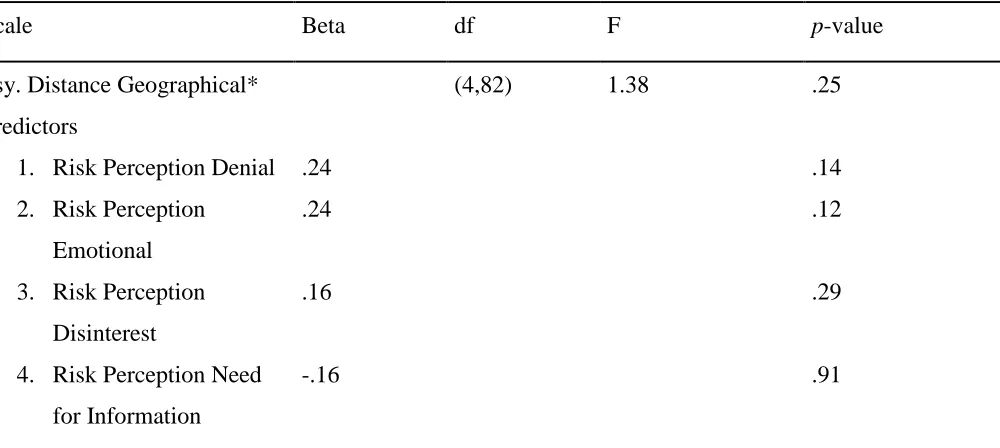
[image:14.612.91.591.322.546.2]To test the first hypothesis, multiple linear regressions for each of the four independent variables (Risk Perception) on all four dependent variables (Psychological Distance) were performed. The results of the regressions only partially support the hypothesis. More precisely, there was only a significant regression found between risk perception emotional (p =.03) and need for information (p =.01) on temporal psychological distance (p < .001), with both subscales having the strongest impact on psychological distance (B = .26/B= -.26) (see table 3).
Table 3, Regression HI
dependent variable: the subscales of psychological distance, predictors: subscales RP.
Scale Beta df F p-value
Psy. Distance Geographical* Predictors
1. Risk Perception Denial 2. Risk Perception
Emotional 3. Risk Perception
Disinterest
4. Risk Perception Need for Information
.24 .24
.16
-.16
(4,82) 1.38 .25
.14 .12
.29
Psy. Distance Social Predictors
1. Risk Perception Denial 2. Risk Perception
Emotional 3. Risk Perception
Disinterest
4. Risk Perception Need for Information
-.11 .23
.03
.13
(4,82) 1.91 .12
.48 .13
.85
.26
Psy. Distance Temporal Predictors
1. Risk Perception Denial 2. Risk Perception
Emotional 3. Risk Perception
Disinterest
4. Risk Perception Need for Information
-.26 .26
.16
-.26
(4,82) 8.16 < .00
.07 .03
.21
.01
Psy. Distance Uncertainty Predictors
1. Risk Perception Denial 2. Risk Perception
Emotional 3. Risk Perception
Disinterest
4. Risk Perception Need for Information
-.04 -.07
-.04
.26
(4,82) 1.03 .25
.80 .63
.80
II. High Risk Perception, high Concern
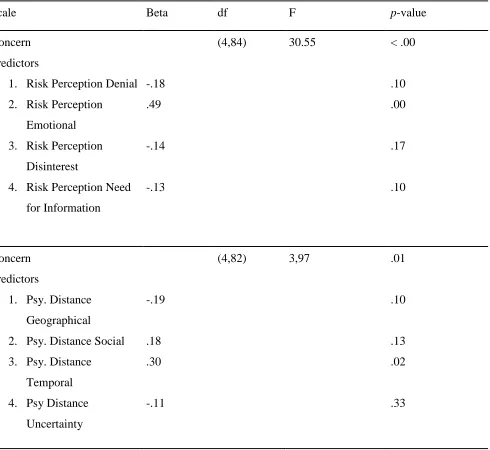
The multiple regression analysis for the second hypothesis (high-risk perception, high concern) yielded an overall p-value of <.001, therefore, supporting the hypothesis. Important to note is that the subscale emotional risk perception showed a p-value of < .001 and the strongest Beta ( .49) (see table 4).
III. Low Psychological Distance, high Concern
Table 4, Regression HII
dependent variable: concern, predictors: subscales of risk perception and psychological distane
Scale Beta df F p-value
Concern Predictors
1. Risk Perception Denial 2. Risk Perception
Emotional 3. Risk Perception
Disinterest
4. Risk Perception Need for Information
-.18 .49
-.14
-.13
(4,84) 30.55 < .00
.10 .00
.17
.10
Concern Predictors
1. Psy. Distance Geographical 2. Psy. Distance Social 3. Psy. Distance
Temporal 4. Psy Distance
Uncertainty
-.19
.18 .30
-.11
(4,82) 3,97 .01
.10
.13 .02
.33
IV. Low Psychological Distance, high Behavioural Intention
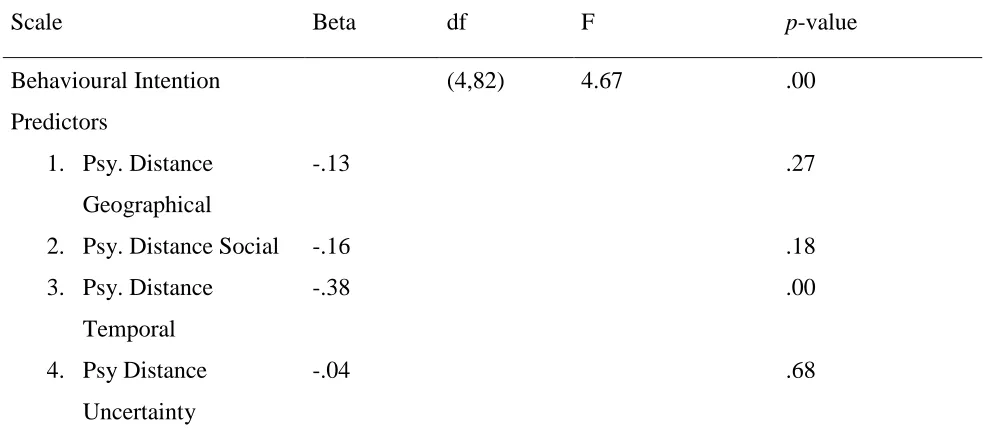
Table 5, Regression HIV
dependent variable: behavioural intentions, predictors: the subscales of psychological distance
Scale Beta df F p-value
Behavioural Intention Predictors
1. Psy. Distance Geographical 2. Psy. Distance Social 3. Psy. Distance
Temporal 4. Psy Distance
Uncertainty
-.13
-.16 -.38
-.04
(4,82) 4.67 .00
.27
.18 .00
.68
V. High Concern, high Behavioural Intention
A linear regression analysis was performed to measure the possible influence of Concern on Behavioural Intention. The results show a p-value of .001 and the hypothesis is therefore supported (see Table 7).
Table 7, Regression HV
dependent variable: behavioural intention, predictors: concern
Scale Beta df F p-value
Behavioural Intention Predictor
1. Concern -.60
(1.86) 48.49 .00
.00
Additional Analysis
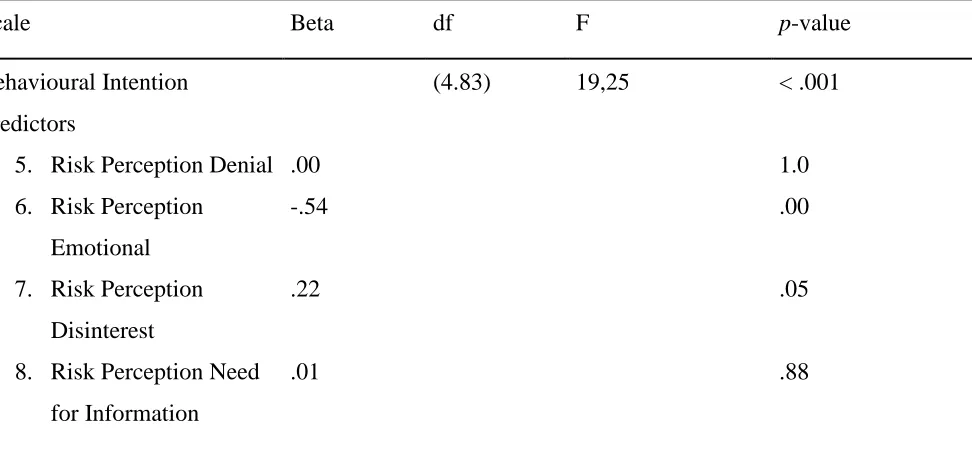
[image:18.612.73.556.517.617.2]behavioural intentions. The analysis showed a significant p-value of <.001. In there, the subscales risk perception emotional (p = .00) and disinterest (p = .05) showed a significant influence, with disinterest having the highest beta of -.54 (see Table 8).
Table 8, Regression analysis
Dependent variable: behavioural intention, predictor: subscales of risk perception
Scale Beta df F p-value
Behavioural Intention Predictors
5. Risk Perception Denial 6. Risk Perception
Emotional 7. Risk Perception
Disinterest
8. Risk Perception Need for Information
.00 -.54
.22
.01
(4.83) 19,25 < .001
1.0 .00
.05
.88
Conclusion and Discussion
Conclusion The study aimed to understand people’s risk perception towards microplastic, by conducting a survey. A total of 103 participants filled out an online survey to assess various subscales about risk perception, concern, behavioural intentions and psychological distance. This data has been analysed and showed various significant results.
microplastic is affecting them personally but nevertheless lack the intention to engage in the necessary change behaviours. Most of the participants share the notion of microplastic being a problem that exerts an increasing impact on them, however, opinions still diverge. Therefore, it can be said that the majority of people is certain about microplastic being a problem in reality, and have an awareness of the manifestation of its effects on society.
Hypothesis one assumes that high-risk perception is inducing a lower psychological distance. This study only confirms that partially for temporal psychological distance.
It is important to note, that the need for information subscale for risk perception is showing a significant impact on psychological distance uncertainty as well, while the risk perception denial subscale has the strongest impact.
With regard to the second hypothesis, it was revealed that high-risk perception leads to a higher concern about the implications of microplastic. Where risk perception emotional shows the strongest impact on concern.
The third hypothesis suggested lower psychological distance to influence higher concern. This hypothesis has been accepted. Important to note is that temporal psychological distance exerts a significant influence on concern, as well as the strongest impact.
The fourth hypothesis presumes lower psychological distance to increase behavioural intentions. The results showed a significant regression and can be therefore be accepted.
Especially psychological distance temporal has a significant impact as well as the strongest one. In line with what was expected by the fifth hypothesis, the results showed a higher concern to increase the intention of individuals to change their behaviour, and therefore the hypothesis is accepted.
Discussion The results yield a confirmation that the intention to change one's consumer behaviour is predicted by an individual’s risk perception, concern and psychological distance.
distance increases, the decline of the value of the outcome is steep at first but becomes more moderate after time. The results also show that risk perception denial has the strongest influence on psychological distance overall. This aligns with the correlation, that shows that risk
perception denial has an impact on psychological distance temporal as well as concern. This means, the more denialistic a person is, the more abstract the problem gets (Trope and Libermann, 2003) and the less concerned the person is (McCright and Dunlap, 2011).
The second hypothesis shows that risk perception is influencing concern. As Schultz stated, concern is influenced due to an awareness of the harmful consequences (2001). Furthermore, risk perception’s cognitive dimension consists, among other things, of concern about a person’s social surrounding (Janmaimool & Watanabe, 2014). Both theories, therefore, imply, to be concerned about a topic, in this case, the microplastic problem, individuals have to acquire a certain awareness or risk perception about it. The subscale risk perception disinterest is also correlated to concern, which means that the more interested the person is in a topic, the more knowledge is acquired (hence, less concrete) and the more concern the individual shows in turn (Trope and Liberamann, 2003).
The third hypothesis shows psychological distance influencing concern, where temporal psychological distance is having the strongest impact on concern. Trope and Liebermann stated, that a low psychological distance makes representations more concrete and individuals are able to focus on the problem’s details (2003). Time plays an important role, as the participants are aware of the effects showing now, psychological distance is already low, hence the overall concern about microplastic increases.
Hypothesis four predicts that psychological distance has an impact on behavioural intentions. This aligns with Trope and Lieberman (2003), who proposed that the less distant a problem, in this case, the microplastic problem, is, the more concrete it gets. Therefore it is more urgent to change the behaviour, hence the intention is higher. This fits also to the findings of Albayrak et al. (2013) who found that behavioural intention can be significantly influenced by scepticism, which is being served here as psychological distance (2013). Especially temporal psychological distance showed significance which can be related to the fact that microplastic effects are getting closer in time (Gibbens, 2019).
as Marcketti and Shelly (2009), both stating that individual’s environmental concern is influencing the behaviour, in specific, the consumption behaviour.
In general, psychological distance geographic shows no correlations which means that the participants are aware that the effects of microplastic are not just centred on a particular place, but everywhere. Since it has been found in the fish that have been sold for food or even tap water (Gibbens, 2019) Psychological distance temporal shows correlations to concern and all subscales of risk perception. Since the participants already indicated that the effects are already showing, the problem is getting more concrete and they focus more on the details of the problem (Trope and Liberman, 2003). Furthermore, temporal psychological distance is affecting the intention, however, intention overall is shown to be little.
The additional analysis showed that risk perception has an impact on behavioural intentions as well. This aligns with Ajzen's theory of planned behaviour where risk perception serves as attitude, which is influencing intention directly (2002).
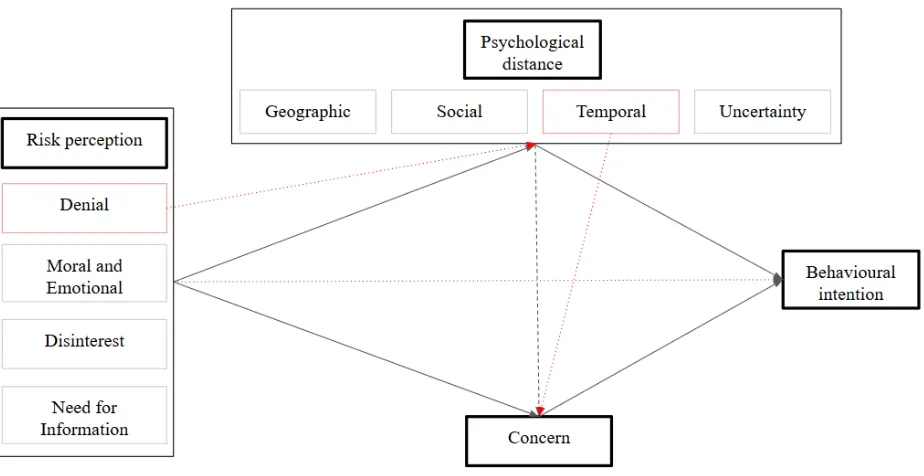
Taking into account, the hypothesis being accepted, the conceptual model can be
Figure 2, Concept model conclusion
Limitations The sample size is with max. 91 very low, which indicates that the answers must not be presumed to reflect the population.
Cronbach’s alpha has been used to analyse the reliability of the survey’s items. The majority turned out to be reliable. Unfortunately, the subscale risk perception disinterest has a
questionable alpha. This might be due to the small number of items measuring the subscale (Cortina, 1996). This fits also to the fact that there is no alpha for the subscale psychological distance geographical and temporal since it consists of one item. The subscale psychological distance social has a negative alpha which means the items are not able to grasp the essence of the construct being evaluated. The psychological distance uncertainty scale is having a low alpha. This puts into question if the scales are measuring what they are supposed to measure.
References
Ajzen, I. (1985). From intentions to actions: A theory of planned behaviour. In Action control
(pp. 11-39). Springer, Berlin, Heidelberg.
Ajzen, I. (2002). Perceived behavioural control, self‐efficacy, locus of control, and the theory of
planned behaviour 1. Journal of applied social psychology, 32(4), 665-683.
Albayrak, T., Aksoy, Ş., & Caber, M. (2013). The effect of environmental concern and
scepticism on green purchase behaviour. Marketing Intelligence & Planning, 31(1), 27–39. doi:10.1108/02634501311292902
Anastasopoulou, A., Mytilineou, C., Smith, C. J., & Papadopoulou, K. N. (2013). Plastic debris ingested by deep-water fish of the Ionian Sea (Eastern Mediterranean). Deep Sea
Research Part I: Oceanographic Research Papers, 74, 11-13.
Andrady, A. L., & Neal, M. A. (2009). Applications and societal benefits of plastics.
Philosophical Transactions of the Royal Society B: Biological Sciences, 364(1526), 1977-1984.
Andrady, A. L. (2011). Microplastics in the marine environment. Marine pollution bulletin,
62(8), 1596-1605.
Barnes, D. K., Galgani, F., Thompson, R. C., & Barlaz, M. (2009). Accumulation and
fragmentation of plastic debris in global environments. Philosophical Transactions of the Royal Society B: Biological Sciences, 364(1526), 1985-1998.
Berndt, Adele, and Lucy Gikonyo. "Environmental concern behaviours in Africa: An exploratory study." J. Mgmt. & Sustainability 2 (2012): 1.
simulation. Environmental politics, 16(2), 251-275. https://doi.org/10.1080/09644010701211759
Carpenter, E. J., Anderson, S. J., Harvey, G. R., Miklas, H. P., & Peck, B. B. (1972). Polystyrene spherules in coastal waters. Science, 178(4062), 749-750.
Carson, H. S. (2013). The incidence of plastic ingestion by fishes: From the prey’s perspective.
Marine pollution bulletin, 74(1), 170-174.
Cole, M., Lindeque, P., Halsband, C., & Galloway, T. S. (2011). Microplastics as contaminants in the marine environment: a review. Marine pollution bulletin, 62(12), 2588-2597.
Cole, M., Lindeque, P., Fileman, E., Halsband, C., Goodhead, R., Moger, J., & Galloway, T. S. (2013). Microplastic ingestion by zooplankton. Environmental science & technology,
47(12), 6646-6655.
Cortina, J.M. (1993). "What is coefficient alpha? An examination of theory and applications".
Journal of Applied Psychology. 78: 98–104. CiteSeerX 10.1.1.527.7772. doi:10.1037/0021-9010.78.1.98.
Diamantopolous, A., Schlegelmilch, B. B., Sincovics, R. R., & Bohlen, G. M. (2003). Can socio demographics still play a role in profiling green consumers? A review of the evidence and an empirical investigation. Journal of Business Research,56, 465–480.
http://dx.doi.org/10.1016/S0148-2963(01)00241-7
Eriksson, C., & Burton, H. (2003). Origins and biological accumulation of small plastic particles in fur seals from Macquarie Island. AMBIO: A Journal of the Human Environment, 32(6), 380-385.
weighing over 250,000 tons afloat at sea. PloS one, 9(12), e111913.
Farrell, P., & Nelson, K. (2013). Trophic level transfer of microplastic: Mytilus edulis (L.) to Carcinus maenas (L.). Environmental Pollution, 177, 1-3.
Fishbein, M., & Ajzen, I. (1977). Belief, attitude, intention, and behavior: An introduction to theory and research.
Fossi, M. C., Panti, C., Guerranti, C., Coppola, D., Giannetti, M., Marsili, L., & Minutoli, R. (2012). Are baleen whales exposed to the threat of microplastics? A case study of the Mediterranean fin whale (Balaenoptera physalus). Marine Pollution Bulletin, 64(11), 2374-2379.
Gibbens, S. (2019, June 05). You eat thousands of bits of plastic every year. Retrieved June 14, 2019, from https://www.nationalgeographic.com/environment/2019/06/you-eat-
thousands-of-bits-of-plastic-every-year/
Gorman, M. (1993). Environmental hazards: marine pollution. ABC-CLIO, Incorporated.
Graham, E. R., & Thompson, J. T. (2009). Deposit-and suspension-feeding sea cucumbers (Echinodermata) ingest plastic fragments. Journal of Experimental Marine Biology and Ecology, 368(1), 22-29.
Gregory, M. R., & Andrady, A. L. (2003). Plastics in the marine environment. Plastics and the Environment, 379, 389-90.
Hansen, J., Holm, L., Frewer, L., Robinson, P., & Sandøe, P. (2003). Beyond the knowledge deficit: recent research into lay and expert attitudes to food risks. Appetite, 41(2), 111-121.
Ipsos. (n.d.). Level of concern with the use of disposable, non-recyclable products among people in selected countries in Europe in 2018*. In Statista - The Statistics Portal. Retrieved June 11, 2019, from https://www-statista-com.ezproxy2.utwente.nl/statistics/972195/plastic and-non-recyclable-products-usage-concern-in-europe/.
Janmaimool, P., & Watanabe, T. (2014). Evaluating determinants of environmental risk perception for risk management in contaminated sites. International journal of environmental research and public health, 11(6), 6291-6313.
Laist, D. W. (1987). Overview of the biological effects of lost and discarded plastic debris in the marine environment. Marine pollution bulletin, 18(6), 319-326.
Liberman, N., Trope, Y., & Stephan, E. (2007). Psychological distance. Social psychology: Handbook of basic principles, 2, 353-383.
Marcketti, S. B., & Shelley, M. C. (2009). Consumer concern, knowledge and attitude towards counterfeit apparel products. International Journal of Consumer Studies, 33(3), 327-337.
McCright, A. M., & Dunlap, R. E. (2011). Cool dudes: The denial of climate change among conservative white males in the United States. Global environmental change, 21(4), 1163-1172.
Muskavage, B. A. (2016). Exploring the Effects of Psychological Distance and Action-Related Knowledge on Wildlife Conservation.
norvegicus (Linnaeus, 1758). Marine pollution bulletin, 62(6), 1207-1217.
Ng, K. L., & Obbard, J. P. (2006). Prevalence of microplastics in Singapore’s coastal marine environment. Marine Pollution Bulletin, 52(7), 761-767.
Plastics- Facts PlasticsEurope (2017)
https://www.plasticseurope.org/application/files/5715/1717/4180/Plastics_the_facts_2017 _FINAL_for_website_one_page.pdf, Accessed 3rd Dec 2018
PlasticsEurope (PEMRG). (n.d.). Global plastic production from 1950 to 2017 (in million metric tons). In Statista - The Statistics Portal. Retrieved June 11, 2019, from https://www- statista-com.ezproxy2.utwente.nl/statistics/282732/global-production-of-plastics-since- 1950/.
Popkin, R. H. (1968). The History of Scepticism from Erasmus to Descartes, rev. ed.
Pruter, A. T. (1987). Sources, quantities and distribution of persistent plastics in the marine environment. Marine Pollution Bulletin, 18(6), 305-310.
Read, D., Loewenstein, G., & Kalyanaraman, S. (1999). Mixing virtue and vice: Combining the immediacy effect and the diversification heuristic. Journal of Behavioural Decision Making, 12(4), 257-273.
Renn, O., & Benighaus, C. (2013). Perception of technological risk: insights from research and lessons for risk communication and management. Journal of Risk Research, 16(3-4)
293–313. doi:10.1080/13669877.2012.729522
Schultz, P. W. (2001). The structure of environmental concern: Concern for self, other people, and the biosphere. Journal of environmental psychology, 21(4), 327-339.
Risk Analysis: An International Journal, 32(6), 957-972
Stern, P. C., & Dietz, T. (1994). The value basis of environmental concern. Journal of social issues, 50(3), 65-84.
Stern, P. (2000). Towards a Coherent Theory of Environmentally Significant Behaviour. Journal of Social Issues, 56 (3), 407–424. http://dx.doi.org/10.1111/0022-4537.00175
Thompson, R. C., Olsen, Y., Mitchell, R. P., Davis, A., Rowland, S. J., John, A. W. &
Russell, A. E. (2004). Lost at sea: where is all the plastic?. Science, 304(5672), 838-838.
Trope, Y., & Liberman, N. (2003). Temporal construal. Psychological Review, 110(3), 403.
Van Franeker, J. A., Blaize, C., Danielsen, J., Fairclough, K., Gollan, J., Guse, N., ... & Olsen, B. (2011). Monitoring plastic ingestion by the northern fulmar Fulmarus glacialis in the North Sea. Environmental Pollution, 159(10), 2609-2615.
Von Moos, N., Burkhardt-Holm, P., & Köhler, A. (2012). Uptake and effects of microplastics on cells and tissue of the blue mussel Mytilus edulis L. after an experimental exposure.
Environmental science & technology, 46(20), 11327-11335.
Whitmarsh, L. (2011). Scepticism and uncertainty about climate change: Dimensions, determinants and change over time. Global environmental change, 21(2), 690-700.
Appendix I - Questionnaire
Welcome to this research study!
We are assessing the risk perception of microplastics. You will be presented with information relevant to microplastic and asked to answer some questions about it. Please be assured that your responses will be kept completely confidential.
The study should take you around 10 minutes to complete. Your participation in this research is voluntary. You have the right to withdraw at any point during the study, for any reason, and without any prejudice. If you would like to contact the Principal Investigator in the study to discuss this research, please e-mail Inga Maren Floer ([email protected]).
By clicking the button below, you acknowledge that your participation in the study is voluntary, you are 18 years of age, and that you are aware that you may choose to terminate your participation in the study at any time and for any reason.
Please note that this survey will be best displayed on a laptop or desktop computer. Some features may be less compatible for use on a mobile device.
● I accept
● I do not acceptImport Questions From...
Risk PerceptionBlock Options
Q1
I do not believe microplastic is a real problem
Strongly
agree Agree
Somewhat agree
Neither agree nor
disagree
Somewhat
disagree Disagree
Strongly disagree
Q2
Strongly agree Agree Somewhat agree Neither agree nor disagree Somewhat disagree Disagree Strongly disagree Q3
It is too early to say whether microplastic is really a problem
Strongly agree Agree Somewhat agree Neither agree nor disagree Somewhat disagree Disagree Strongly disagree Q4
The evidence for microplastic is unreliable
Strongly agree Agree Somewhat agree Neither agree nor disagree Somewhat disagree Disagree Strongly disagree Q5
Too much fuss is made about microplastic
Strongly agree Agree Somewhat agree Neither agree nor disagree Somewhat disagree Disagree Strongly disagree Q6
The media is often too alarmist about issues like microplastic
Strongly agree
Somewhat agree
Talking about microplastic is boring Strongly agree Agree Somewhat agree Neither agree nor disagree Somewhat disagree Disagree Strongly disagree Q8
Microplastic is something that frightens me
Strongly agree Agree Somewhat agree Neither agree nor disagree Somewhat disagree Disagree Strongly disagree Q9
I feel a moral duty to do something about the microplastic problem
Strongly agree Agree Somewhat agree Neither agree nor disagree Somewhat disagree Disagree Strongly disagree Q10
The effects of microplastic are likely to be very severe for humanity
Strongly agree Agree Somewhat agree Neither agree nor disagree Somewhat disagree Disagree Strongly disagree Q11
Strongly agree Agree Somewhat agree Neither agree nor disagree Somewhat disagree Disagree Strongly disagree Q12
Microplastic is too complicated for me to understand
Strongly agree Agree Somewhat agree Neither agree nor disagree Somewhat disagree Disagree Strongly disagree Q13
I often talk about microplastic to family or friends
Strongly agree Agree Somewhat agree Neither agree nor disagree Somewhat disagree Disagree Strongly disagree Q14
It is difficult to know which products are better for the environment
Q15
I need more information to form a clear opinion about microplastic
Strongly
agree Agree
Somewhat agree
Neither agree nor
disagree
Somewhat
disagree Disagree
Strongly disagree
Concern Block Options
Q16
How concerned, if at all, are you about microplastic?
Very concerned Concerned Neutral Not at all concerned
Q17
Considering any potential effects of microplastic which there might be on you PERSONALLY, how concerned, if at all, are you about microplastic?
Very concerned Concerned Neutral Not at all concerned
Q18
Considering any potential effects of microplastic there might be on humanity in GENERAL, how concerned are you about microplastic?
Very concerned Concerned Neutral Not at all concerned
Q19
Please answer the following questions based on the scale provided.
1. Not at all
2. A little bit
3. Somewhat
4. Quite a bit
5. Very much
How willing are you to perform the following behaviors that help reducing microplastic?
● Donate money to a respected organization cleaning up the beaches and ocean. ● Research about companies that do not use plastic in their cosmetic products. ● Reduce plastic usage in order to decrease plastic pollution.
● Write a letter to companies that use microplastic in their products to urge them toward more sustainable practices
● Use cotton bags instead of plastic bags.
● Inform friends and family members about threats of microplastic.
● Share your knowledge about how microplastic is affecting the nature through social media (e.g., Facebook, Twitter, Instagram).
● Cleaning up beaches during vacation
Psychological DistanceBlock Options
Q20
The microplastic issue will mostly affect areas that are far away from here.
Strongly
agree Agree
Somewhat agree
Neither agree nor
disagree
Somewhat
disagree Disagree
Q21
Microplastic will mostly affect developing countries.
Strongly agree Agree Somewhat agree Neither agree nor disagree Somewhat disagree Disagree Strongly disagree Q22
Microplastic is likely to have a big impact on people like me.
Strongly agree
Somewhat agree
Neither agree nor disagree Somewhat disagree Strongly disagree Q23
When, if at all, do you think humanity will start feeling the effects of plastic in the ocean/microplastic?
We are already feeling the
effects
We are going to feel the effects in
the near future
We will feel the effects in the distant future
We will feel the effects in the future,
I am not sure when Never
Q24
I am uncertain that microplastic exists.
Q25
Most scientists agree that microplastic ends up in our food.
Strongly
agree Agree
Somewhat agree
Neither agree nor
disagree
Somewhat
disagree Disagree
Strongly disagree
Q26
It is uncertain what the effects of microplastic will be.
Strongly
agree Agree
Somewhat agree
Neither agree nor
disagree
Somewhat
disagree Disagree
Strongly disagree
DemographicsBlock Options
Q28
Please indicate your gender
● Male ● Female ● Genderqueer
Q31
Please indicate your age
Q32