www.wjpr.net Vol 7, Issue 12, 2018. 841
ANTIMICROBIAL ACTIVITY OF FLAXSEED (
L.USITATISSIMUM)
OIL AND LIMESTONE WATER AGAINST PATHOGENIC
MICROORGANISMS
2
Neha Borkar and*1Kshama Murarkar
1
Assistant Professor Kamla Nehru Mahavidyalaya, Nagpur.
2
Kamla Nehru Mahavidyalaya, Nagpur.
ABSTRACT
Traditional medicines make use of natural products and are of great
importance. The aim of present study is to investigate in vitro
antimicrobial activity of flaxseed oil, flaxseed, and flaxseed powder
and limestone water with various formulations against pathogenic
Escherichia coli, Staphylococcus aureus, Klebsiella pneumoniae,
Pseudomonas aeruginosa, and Proteus vulgaris. From the literature
survey it is found that flaxseed oil, flaxseed and limestone can be used
on wounds, burning wounds, cuts. The experimental result showed that
the mixture of flaxseed oil and limestone water remarkable have
antimicrobial activity against pathogenic microorganisms except Proteus vulgaris, and
therefore have great potential to use in pharmaceutical formulations of ointments.
KEYWORDS: Antimicrobial activity, flaxseed oil, limestone water, test pathogenic
microorganisms
INTRODUCTION
Traditional medicines make use of natural products, and are of great importance. Such forms
of medicine as traditional Chinese medicine, Ayurveda, Kampo, traditional Korean medicine
and Unani employ natural products and have been practiced all over the world for hundreds
or even thousands of years, and they have blossomed into orderly-regulated system of
medicine(Yuan H. 2016). Plants have long provided mankind with a source of medicinal
agents, with natural products serving as the source of all drugs (Balandrin et al.
Volume 7, Issue 12, 841-849. Research Article ISSN 2277–7105
Article Received on 30 April 2018,
Revised on 20 May 2018, Accepted on 10 June 2018
DOI: 10.20959/wjpr201812-12671
*Corresponding Author Kshama Murarkar
Assistant Professor Kamla
Nehru Mahavidyalaya,
www.wjpr.net Vol 7, Issue 12, 2018. 842
1993).Medicinal plants form the backbone of traditional medicine, have in the last few
decades been the subject of very intense pharmacological studies.
Flaxseed (L.usitatissimum) and flaxseed oil have been valued as foods and for medicinal
purposes since ancient times(Vaisey-Genser and Morris 2003). Flaxseed is now attracting
increased interest as a food due to its high fibre content, high content of bioactive phenolic
compounds(mainly lignans) and high content of the essential omega -3 fatty acid
alphalinolenic acid(ALA)(Dean 2003). Flaxseed lignin such as secoisolariciresinols(SDG),
the mammalian lignans such as enterodiol and enterolactone acts as antioxidant(Kitts D.D. et
al 1999). Its growing popularity is due to health imparting benefits in reducing cardiovascular
diseases, decreased risk of cancer, particularly of the mammary and prostate gland,
anti-inflammatory activity, laxative effect, and alleviation of menopausal symptoms and
osteoporosis.
Flaxseed raw oil is used as an astringent in fungicidal lotion and as an insecticide and has
moderate insect repellent properties(The wealth of India 2006). In earlier studies the
L.usitatissimum fixed oil has been reported to exhibit significant anti-inflammatory(Kaithwas
G. et al 2011) antiarthritic(Kaithwas G. and Majumdar D.K.2010), antiulcer(Kaithwas G. and
Majumdar D.K.2010), and antidiebetic (Kaithwas G. and Majumdar D.K.2012) properties.
The antimicrobial activity of L.usitatissimum oil and its therapeutic efficacy in bovine
mastitis, an inflammatory disorder caused by microbial infection has been reported
recently(Kaithwas G. et al., 2011).
The Limestone is anti-biotic, anti-pyretic, anti-fungal and anti-inflammatory.
Regular-controlled use of limestone is effective in fighting hepatitis (all types, i.e. A, B, C, D, E),
Jaundice primary infertility, height, breast development, eye vision, osteoporosis,
musculoskeletal pains – arthritis – spinal cord related problems – sciatica pain, hair fall
problems menopause, teeth
sensitivity(http://www.theayurveda.org/ayurveda/herbal-medicine/5-natural-treatment-can-using-limestone/). It is reported apart from healing pain
from internal injuries, limestone is also excellent at treating and curing external cuts and
wounds if honey and limestone thick paste applied on the cut. It will not only stop the
bleeding, but also help in healing the cut
faster(https://i0.wp.com/deveev.com/wp-content/uploads/2016/09/It-can-heal-wounds.jpg?w=650). It is reported that limestone
powder and honey paste cure all the pain anywhere in the body i.e. hands and legs swells due
www.wjpr.net Vol 7, Issue 12, 2018. 843
In the present work we studied the antimicrobial activity of flaxseed, flaxseed oil and
limestone water individually and in a mixture form.
METHODS AND MATERIAL
Test pathogens
Pure culture of Escherichia coli, Staphylococcus aureus, Klebsiella pneumoniae,
Pseudomonas aeruginosa, Proteus vulgaris were used in this study. It was subcultured on
nutrient agar slant for 24 hours before use.
Collection of flaxseed and limestone
Flaxseed, flaxseed oil and limestone were purchased from local market.
Preparation of limestone water
Limestone was dissolved in water for 3 days; water was separated to remove all the unwanted
impurities from it. Then limestone was again dissolved in water and mixed well. This
mixture was stand for 15 minutes to settle down the limestone at the bottom. The limestone
water floats at upper surface was separated, and stored in a glass container for further use.
Procedure for preparation of different extracts
(A) Hundred ml (100ml) flaxseed oil and 25 ml limestone water (4:1 v/v) was mixed for few
minutes to get yellow colour. (B) Hundred grams (100 grams) of flaxseed was soaked in 50
ml distilled water (2:1 w/v) for making of paste.(C) Pretreated limestone water.(D) Two
grams flaxseed and 2 ml distilled water was mixed for making powder extract (1:1w/v).(E)
Two grams flaxseed paste and 1ml distilled water (2:1w/v).(F) Flaxseed oil.
All the extracts were stored in air tight glass containers for testing antimicrobial activity.
Antimicrobial activity
Antimicrobial activity was tested by Kirby-Bouer method using Muller Hingtone agar.
Twenty four hours old one loopful culture was inoculated in 25 ml sterilized nutrient broth,
and incubated overnight. This 0.1 ml test broth culture was used for spread plate method. The
well size for this experiment was 2 mm. The volume of extract was 0.1 ml in one well.
Control was also set for this experiment. Plates were kept in the incubator at 37°C for 24 hrs
for the observation of zone of inhibition. All the extracts (A-F) were tested against each
www.wjpr.net Vol 7, Issue 12, 2018. 844 EXPERIMENTAL RESULTS
(a) E. coli (b) S. aureus (c) K. pneumoniae (d) Ps. aeruginosa
Photograph 1: Antimicrobial activity of flaxseed oil and limestone water mixed extract
against test pathogenic microorganisms.
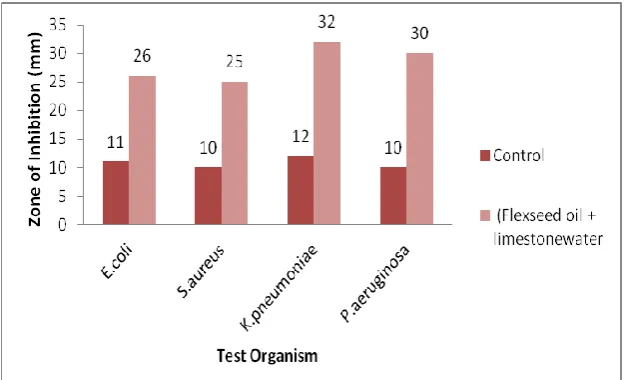
Figure 1: Antimicrobial activity of flaxseed oil and limestone water (A) against test
pathogenic microorganisms.
(a)E. coli (b) S. aureus (c) K. pneumoniae (d) Ps. aeruginosa (e) P. vulgaris
Photograph 2: Antimicrobial activity of flaxseed paste (B) against test pathogenic
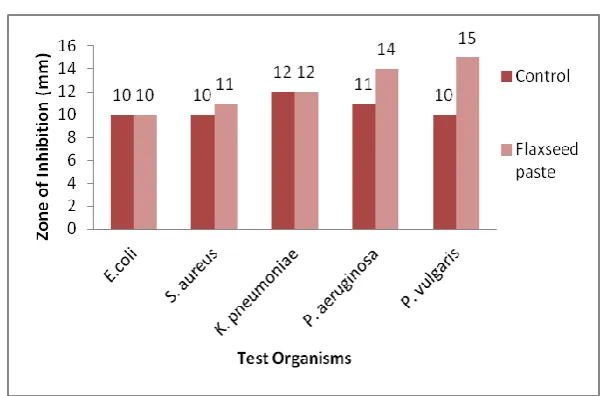
[image:4.595.142.455.251.441.2]www.wjpr.net Vol 7, Issue 12, 2018. 845 Figure 2: Antimicrobial activity of flaxseed paste (B) against test pathogenic
microorganisms.
(a) E. coli
Photograph 4.Antimicrobial activity of flaxseed powder and distilled water (D) against
[image:5.595.146.448.65.263.2]test pathogenic microorganisms.
Figure 4: Antimicrobial activity of flaxseed powder and distilled water (D) against test
[image:5.595.150.447.470.646.2]www.wjpr.net Vol 7, Issue 12, 2018. 846
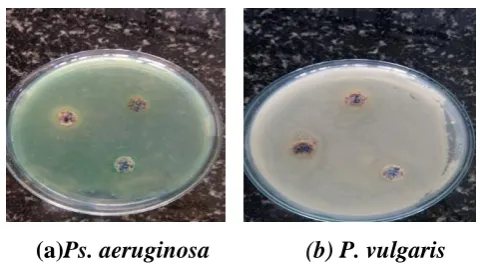
(a)Ps. aeruginosa (b) P. vulgaris
Photograph 5: Antimicrobial activity of flaxseed paste and distilled water (E) against
test pathogenic microorganisms.
Figure 5: Antimicrobial activity of flaxseed paste and distilled water (E) against test
pathogenic microorganisms.
Figure 6: Antimicrobial activity of flaxseed oil (F) against test pathogenic
[image:6.595.177.418.68.200.2] [image:6.595.145.452.261.456.2]www.wjpr.net Vol 7, Issue 12, 2018. 847 DISCUSSION
The antibacterial activity of test organism was observed in the form of zone of inhibition
measured in millimeter (mm) is shown in figures. Depending upon the active ingredient
and diffusion capacity into agar media, flaxseed oil and limestone water mixture (figure 1)
had shown the highest antimicrobial activity against the test microorganism except for
proteus vulgaris.
The extracts of flaxseed powder and water had shown the antimicrobial activity only
against Escherichia coli(figure 4 ). The extracts of flaxseed paste (figure 2) and flaxseed
paste with distilled water (figure 5) had shown very low antimicrobial activity against
Pseudomonas aeruginosa and Proteus vulgaris. Flaxseed oil was very effective against E.coli
than Pseudomonas aeruginosa and S.aureus respectively. The limestone water extract had
not shown any antimicrobial activity against any test microorganisms.
Joshi Y. (2014) has been reported that linseed oil synergies the antimicrobial potential of
gemifloxacin when used simultaneously in various combinations. Alaa A. Gaafar (2013)
published a paper on in vitro antioxidant and antimicrobial activities of lignan flax seed
extract against Bacillus subtilis NRRL B-94, Escherichia coli NRRL B-3703, Psedumonas
aeruginosa NRRL, Staphylococcus aureus NRRL, Aspergillus niger NRRL313, and Candida
albicans NRRL 477, and the results were considered as most important and promising
finding in pharmaceutical properties of lignans. Firas A. Al-Bayati (2007) was studies on
antibacterial activity of Linum usitatissimum L. seeds and active compound detection against
the Staphylococcus aureus, Bacillus cereus, Klebsiella pneumoniae and Pseudomonas
aeruginosa using agar-well diffusion method, and compared their antibacterial activities with
the antibiotics Ampicillin, Cefalexin, Chloramphenicol and Tetracycline. Flaxseed oil is
highly valued in folk medicine. It is very effective when applied externally, on the skin. It is
used for healing scars, burns, inflammation, eczema, psoriasis; skin rash
(https://www.ncbi.nlm.nih.gov/pmc/articles/PMC2935806/).It is mentioned in Ayurveda
flaxseed oil also helps in speeding up the healing of skin lesion. (http://home of ayurveda.org/
flex-seeds-in ayurveda/and ht=en –gif).It is reported limestone apart from healing pain from
internal injuries it is also excellent at treating and curing external cuts and wounds if honey
and limestone thick paste applied on the cut. It will not only stop the bleeding, but also help
in healing the cut faster
www.wjpr.net Vol 7, Issue 12, 2018. 848 CONCLUSION
The present study suggested that mixture of flaxseed oil and limestone water have a great
potential as antimicrobial agents against selected enteric pathogenic microorganisms,
and they can be used as an alternative medicines in the treatment or control of enteric
bacterial infection.The results of antimicrobial activity of this mixture reveals the presence
of medicinally important constituent in this mixed extract. Many evidences gathered in
earlier studies which confirmed the bioactivity of flaxseed oil and limestone water.
Therefore mixture of flaxseed oil and the limestone water extract could be seen as a good
source for useful drug, and could be helpful for wounds, burning wounds and cuts skin
pathogens.
ACKNOWLEGMENT
The authors are thankful the management of Kamla Nehru Mahavidyalaya for providing
facilities to complete this work.
REFERENCES
1. Alaa A. Gaafar (2013) In Vitro antioxidant and antimicrobial activities of Lignan flax
seed extract (Linumusitatissimum, L.)
https://www.researchgate.net/publication/272158603.page1 to 8.
2. Balandrin M., Kinghorn A., Farnsworth N.1993. Plant-derived natural products in drug
discovery and development. In: Kinghom, A.D., Balandrin, M.F.(Eds.), Human medicinal
Agents from plants. American Chemical Society, Washington, DC.
3. Dean, J.R. 2003. Current market trends and economic importance of oilseed flax, In:
Muir, A.D. and Westcott, N.D.(eds) Flax-The genus Linum.Taylor and Francis, New
York,N.Y,USA.PP.275-291.
4. Firas A. and Al-Bayati. 2007. Antibacterial activity of Linnum usitatissimum L.seeds and
active compound detection. Raf. Jour.Sci. Vol 18, No2, 27-36.
5. http://home of ayurveda .org/ flex-seeds-in ayurveda/and ht=en –gif.
6. http://www.theayurveda.org/ayurveda/herbal-medicine/5-natural-treatment-can-using-
imestone/
7.
https://i0.wp.com/deveev.com/wp-content/uploads/2016/09/It-can-heal-wounds.jpg?w=650.
www.wjpr.net Vol 7, Issue 12, 2018. 849
9. Yuan H.,Ma Q.,Ye Li.,and Piao G.2016.The traditional medicine and modern medicine
from natural products.Molecules. 21;559,pp2-18.
10.Joshi Y., Garg R.,and Juyal D.2014.Evaluation of synergistic antimicrobial activity of
gemifloxacin with Linum usitatissimum seed oil. The Journal of Phytopharmacology,
3(6): 384-388. Online at: www.phytopharmajournal.com.
11.Kaithwas G. and Majumdar D.K.2010.Evaluation of antiulcer and antisecretory potential
of Linum usitatissimum fixed oil and possible mechanism of
action.Inflammopharmacology, 18(3): 137-145.
12.Kaithwas G. and Majumdar D.K. 2010. Therapeutic effect of Linum usitatissimum
(flaxseed/linseed) fixed oil on acute and chronic arthritic models in albino
rats.Inflammopharmacology, 18(3): 127-136.
13.Kaithwas G. and Majumdar D.K.2012.In vitro antioxidant and in vivo antidiabetic,
antihyperlipidemic activity of linseed oil against streptozotocin-induced toxicity in albino
rats. European Journal of Lipid Science and Technology, 144: 1237-1245.
14.Kaithwas G. and Mukerjee A., Kumar P., Mujumdar D.K. 2011.Linum
usitatissimum(linseed/flaxseed)fixed oil: antimicrobial activity and efficacy in bovine
mastitis.Inflammopharmacology, 19(1): 45-52.
15.Kaithwas G., Mukherjee A., Chaurasia K.,and Majumdar D.K. 2011. Antiinflammatory,
analgesic and antipyretic activities of inflammation L.usitatissimum
(flaxseed/linseed)fixed oil. Indian Journal of experimental Biology, 49(12): 932-938.
16.Kitts D.D., Yuan YV, Wijewickreme A. N. Thompson LU.1999. Antioxidant activity of
the flaxseed lignin secoisolariciresinoldiglycoside and its mammalian lignin metabolites
enterodioland enterolactone. Mol. Cell. Biochem, 202; 91-100.
17.The wealth of India, A Dictionary of Indian Raw Materials and Industrial Products.2006.,
vol 4 of 1st supplement series. National Institute of Science Communication and
information Resources, CSIR, New Delhi.
18.Vaisey-Genser M., and Morris D.H.2003.Introduction-History of the cultivation and uses
of flaxseed.In: Muir, A.D.and Westcott, N.D.(eds) Flax-Thegenus Linum. Taylor and