Task repetition and second language speech processing Authors:
Craig Lambert
Curtin University, School of Education Kent Street, Bentley
Perth, West Australia 6845, Australia
Judit Kormos
Lancaster University
Department of Linguistics and English Language Lancaster, United Kingdom
LA1 4YL
Danny Minn
Kitakyushu University, Center for Fundamental Education, Kokura Minami-ku Kitagata 4-2-1
Kitakyushu-shi, Fukuoka-ken 802-8577, Japan <[email protected]>
TO BE PUBLISHED IN STUDIES IN SECOND LANGUAGE ACQUISITION
Abstract
This study examines the relationship between the repetition of oral monologue tasks and immediate gains in L2 fluency. It considers the effect of aural-oral task repetition on speech rate, frequency of clause-final and mid-clause filled pauses, and overt
self-repairs across different task types and proficiency levels and relates these findings to specific stages of L2 speech production (conceptualization, formulation and
monitoring). Thirty-two Japanese learners of English sampled at three levels of proficiency completed three oral communication tasks (instruction, narration and opinion) six times. Results revealed that immediate aural-oral same task repetition was related to gains in oral fluency regardless of proficiency level or task type. Overall gains in speech rate were the largest across the first three performances of each task type, but continued until the fifth performance. More specifically, however, clause-final pauses decreased until the second performance, mid-clause pauses to the fourth, and
self-repairs decreased only after the fourth performance indicating that task repetition may have been differentially related to specific stages in the speech production process.
BACKGROUND AND MOTIVATION
A primary issue for research on incidental SLA is how to optimize learners’ ability to use language in conjunction with communicative task performance. Definitions of such tasks have varied, but for the purpose of the present study, the term “task” will be used, following Ellis (2009), to refer to L2 learning activities that meet four criteria:
1. There is a primary focus on meaning,
3. Learners must draw on their own resources to complete it,
4. There is a communicative outcome beyond the use of language for its own sake. When these criteria are met, tasks can be argued to play an important role in L2
pedagogy in that they provide learners with opportunities to employ their linguistic repertoire under relatively natural conditions.
One factor in the implementation of such tasks that has been argued to play a crucial role in optimizing language use and that has received considerable theoretical and empirical attention in the L2 literature is the planning processes that learners engage in in conjunction with the performance of these tasks (see Pang & Skehan, 2014, for a recent overview). Ellis (2005) identifies two points in the pedagogic process at which opportunities for planning might be manipulated. The first is before the task begins. At this stage, learners might either be allowed time to plan the language or content that they will use during the task (either in the L1 or in the L2) or given the opportunity to rehearse their performance of the task. In the latter case, they complete a sequence of tasks in which they either repeat the exact same task or a parallel version of the task with slightly different content (Bygate, 2001). The second point at which learners’ opportunity to plan their performance might be controlled is during the task
performance itself. Learners can either be allowed unlimited time to complete the task, or time limits might be imposed on their performances (Maurice, 1983; Nation, 1989).
In line with the definition of task outlined above, however, task repetition might be argued to necessitate a different interlocutor each time the task is repeated. A change in interlocutor preserves task integrity by requiring learners to create original meanings each time the task set is performed. In the present study, for example,
a different interlocutor each time as they might if they were repeating the tasks in a classroom or real-world setting. This approach could be argued to add to the external validity of the repetition process in that the exposure that learners receive involves both input-based and output-based versions of the task. The construct of task repetition as it is operationalized in the present study thus represents a combination of task repetition and interlocutor input. It is thus referred to as aural-oral task repetition.
Task repetition of this sort might help learners improve their performances by allowing them to activate, refine, and optimize their linguistic resources for the purpose of successfully completing a given task in line with the specific communicative
demands that it entails. Empirical studies on task repetition have asked learners to repeatedly engage in exactly the same task (e.g. Ahmadian & Tavakoli, 2011; Bygate, 1996, 1999, 2001), in the same type of task with slightly different content (Gass, Mackey, Alvarez-Torres & Fernandez-Garcia, 1999), or in a task that has the same communicative goal but different content and interlocutors each time (Lynch & Maclean, 2000, 2001). Several empirical studies have also examined the effects of repetition in conjunction with decreasing the time available on consecutive
performances (e.g., de Jong & Perfetti, 2011; Nation, 1989; Arevart & Nation, 1991, 1993). Furthermore, repetition effects have been investigated immediately (e.g. Lynch & Maclean, 2000, 2001; Wang, 2014) or after days (Gass et al., 1999) or weeks (e.g. Ahmadian & Tavakoli, 2011; Bygate, 1996, 1999, 2001). Finally, speakers have
repeated their performance once (e.g. Bygate, 1996, 1999, 2001; Wang, 2014) or several times ranging from 3 or 4 (Gass et al., 1999) to 11 (Ahmadian, 2011).
Tavakoli, 2011; Arevart & Nation, 1991, 1993; Bygate, 2001; Lynch & Maclean, 2000; Nation, 1989; Wang, 2014). Fluency is generally defined as skilled L2 performance, referring to rapid, smooth and accurate communication of one’s intentions during on-line processing (Lennon, 2000, p. 26). Fluent performance thus entails the efficient functioning of speech production processes under the constraints of real-time oral interaction.
The modular model of L1 speech production proposed by Levelt (1989, 1999) and adapted to L2 speech production by de Bot (1992) and Kormos (2006) postulates three primary stages of speech production. The first is a conceptualization stage in which the speaker selects information from world knowledge to include in a message and organizes it into an information structure to create a pre-verbal plan. The second is a complex set of procedures referred to as a formulation stage in which the pre-verbal plan is encoded grammatically and phonetically. Concepts and their relational structure are argued to be projected onto a phrase structure driven by lemmas drawn from the speaker’s mental lexicon that have associated semantic, syntactic, morphological, and phonological properties. This phrase structure is then encoded with phonetic and prosodic information to produce a phonetic plan. The third and final stage of speech production is then articulation in which the phonetic plan is buffered and parsed as syllables at the motor level.
The essence of this model, as it relates to L2 fluency, is that these three stages are assumed to operate in parallel. Although each module is expected to work on
automatic and allow for parallel processing with other modules, whereas
conceptualization and monitoring may both require attention and thus rely on serial processing. For lower proficiency speakers, however, lexical retrieval and grammatical encoding might also require attentional resources and hence might result in varying degrees of breakdown in parallel processing (de Bot, 1992; Kormos, 2006). L2 learners thus face a number of challenges in the processes leading from conceptualization to articulation, one of the most important being limitations in attention and working memory capacity which are essential in managing speech production (Kormos, 2011). The fluency of L2 performance reflects the efficient functioning of speech production mechanisms including the automaticity of encoding processes, the conceptual demands in planning the content of the message, and the skillful handling of performance
breakdowns. This aspect of fluency is referred to as cognitive fluency by Segalowitz (2010).
these fluency measures to a specific speech production mechanism, it can be argued that filled and unfilled pauses between clauses are indicators of conceptualization and
content planning whereas filled and unfilled pauses within clauses signal breakdowns in lexical and syntactic encoding (Butterworth, 1975), and the frequency of overt
self-repairs might be argued to reflect the availability of attentional resources for
monitoring (Kormos, 1999). Finally, speech rate is an overall measure of the speed with which an utterance is produced, but it is not a pure indicator of encoding speed as it includes hesitation time (see Götz, 2013).
Particularly relevant to the present study is Wang’s (2014) research which compared various approaches to providing learners with opportunities to plan and found much larger effect sizes for repeating a task once than for other types of planning (see also Skehan, Xiaoyue, Quian & Wang, 2012). However, in Wang’s (2014) study, speech rate increased and the average length of unfilled pauses at clause boundaries decreased, whereas the average length of unfilled pauses within clauses and the frequency of reformulations were unaffected by repetition. The question arises of why this might have been the case and whether subsequent repetitions of the task might not have improved other aspects of learners’ L2 fluency. Wang’s findings suggest that one task repetition enhances the speed with which students can deliver their message as well as reduces the time needed to pause at clause boundaries for generating ideas.
Based on Levelt’s (1989, 1999) speech production model, Bygate (2001) argues that when L2 learners perform a task for the first time, their speech production system needs to execute all the relevant processing steps under time pressure. Hence, based on the limited attentional model of speech production (Kormos, 2006; Skehan, 2009), it could be argued that upon the first performance of a given task learners have to distribute their attentional resources strategically between conceptualization,
formulation, and monitoring. They also have to handle performance breakdowns due to incomplete lexical or syntactic knowledge representation or slow speed of access to these representations (Dörnyei & Kormos, 1998). Task repetition allows L2 learners to rely on previously conceptualized task content and to activate recently used linguistic constructions to express their message. This might reduce the attentional demands on learners to conceptualize, encode and monitor their messages simultaneously.
The effects of task repetition on speech processing might also vary depending on the proficiency level of the speakers who complete the tasks. As the automaticity of linguistic encoding is strongly associated with L2 proficiency (Segalowitz, 2010), higher proficiency L2 speakers might have more attentional resources available for conceptualizing task content. For this reason, task repetition might result in fewer gains for more advanced learners as one of its primary functions is to allow learners to activate relevant content and linguistic encoding processes. Furthermore, language proficiency may interact with task demands so that higher proficiency learners, for example, would improve as a result of repeating tasks that are high in conceptualization demands, but not on those in which conceptual planning requires less attention. In addition to task demands, it is thus necessary to consider the possible role of proficiency level in moderating the effects of task repetition. To our knowledge, no previous
research has investigated how task characteristics and learner proficiency,
independently and in interaction with each other, affect fluency gains in repeated task performance.
THE STUDY
repetitions are actually needed for learners to optimize the different aspects of their L2 fluency in the short term and how this might vary with task type and learner proficiency level. On the other hand, task repetition might also result in boredom and fatigue
(Bygate, 2001). It is thus also important to investigate learners’ reactions to repeating tasks and the value that they perceive in doing it. The present study attempts to address both of these issues by considering language production together with the reactions of 32 Japanese learners of English at three proficiency levels to performing three types of tasks six times each within the time frame of a typical L2 lesson.
Research Questions
1. How does repeating the same task as speaker and listener (i.e., aural-oral task repetition) with different interlocutors affect L2 fluency in the short term?
2. Do the demands of different tasks moderate the effects of aural-oral task repetition on L2 fluency?
3. Do speakers' proficiency levels moderate the effects of aural-oral task repetition on L2 fluency?
4. What are the learners' perceived value of aural-oral task repetition, the optimum number of repetition times, as well as the extent to which repetition brings about boredom or fatigue?
METHODS
The study employed a three-way repeated-measures design. The first within-subjects factor was task repetition at six levels, and the second was task type at three levels (instruction, narration, and opinion). The third between-subjects factor was proficiency level which was established based on band levels of the TOEIC test (Educational Testing Service, 2008). The four dependent variables in the study were: (1) speech rate, operationalized as the number of syllables per second based on pruned transcriptions of oral discourse; (2) clause-final pausing, operationalized as the ratio of filled pauses between clause boundaries to the total number of pruned syllables produced; (3) mid-clause pausing, operationalized as the ratio of filled pauses within clause
boundaries to the total number of pruned syllables produced; and (4) overt self-repairs, operationalized as the total number of self-corrections or rephrasing to the total number of pruned syllables produced. Post-performance questionnaires were also used to triangulate the findings for speech production, gain deeper insight into the range of variables that might be involved in task repetition, and better understand the responses of learners at different levels of proficiency to repeating the tasks used in the study.
Participants
level on the CEFR; and the low-level learners to A2 level on the CEFR. The
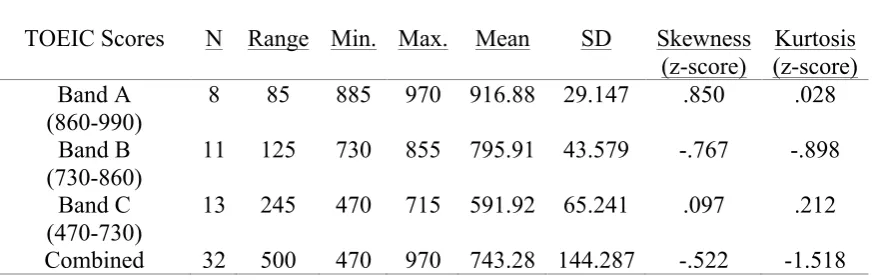
participants’ TOEIC scores were approximately normally distributed both within and across the three proficiency bands (see Table 1).
Insert Table 1 around here
Materials
In addition to the inherent differences in discourse demands between the instruction, narration, and opinion genres (for discussions see Berman, 2008; Yule, 1997), the format of the tasks could also be argued to differ in terms of the amount of conceptual and linguistic structure that they provided. The instruction and narration tasks had a clear sequential information structure. In the instruction task, learners were given pictures that supplied the specific content to complete the task, and each
successive step allowed them to recycle the same lexis and sentence frames. The narration task was similar in that it provided learners with the specific content to be related, but it allowed far less repetition of language from one frame of the story to the next. Finally, the opinion task required learners to supply the content required to
complete the task themselves (i.e., what they saw in the pictures, what they thought was happening, who they thought took them, and why they thought they were taken). In other words, the opinion task did not provide a clear information structure in the way that the instruction and narration tasks did (see Tavakoli & Foster, 2008, on the effects of content structure on L2 speech performance). The open nature of the opinion task might also be expected to result in less sense of a clear outcome.
Procedures
Advertisements were circulated to all English learners at the university offering payment in cash for participation in a two-hour English conversation research project. Participants were accepted in the order in which they applied and allocated to groups based on their proficiency level and availability. They all received information about the aims of the research and signed a consent form.
In addition to the three monologue tasks reported in the present study (instruction, narration, and opinion), a dialogue opinion task was also included in a balanced Latin square design when the data was collected. The order in which these four tasks were performed was counterbalanced into four task sets which were then performed six times each. In other words, the 32 participants were allocated to one of four groups and each group of eight performed one task set six times during a separate recording session.
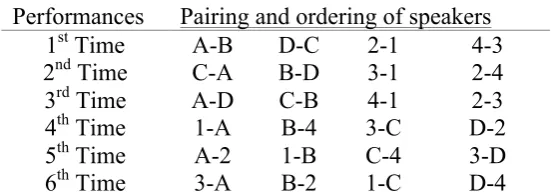
number (A-B-C-D-1-2-3-4). They were then systematically alternated in terms of partner and speaker-listener order across the six performances of their task set. Table 2 indicates the specific pairings of learners and the order of speakers used in the study.
Insert Table 2 around here
It can be seen in Table 2 that proficiency level was generally distributed across the design. Each participant worked with six of the seven other participants in the study, but the order in which they worked with speakers of different levels varied across the design. Furthermore, the order in which the participants performed initially in the role of speaker or listener in each pair was alternated across the design so that each
participant initially functioned as the speaker or listener a comparable number of times across the design as a whole. However, interlocutor factors (proficiency and order) could not be counterbalanced perfectly. Even if they had, interlocutor effect would only have been distributed across the design rather than controlled. The design used in the study thus combines the effect of task repetition with that of interlocutor input. The advantages and disadvantages of the design will be considered in the Discussion and Conclusions section of the paper.
Finally, participants were given 120 seconds to complete each task for the first and second repetitions. Performance time was reduced to 90 seconds for the remaining four repetitions as piloting in classes with similar learners had shown this time was adequate for completing the tasks at their own pace. This was confirmed in the
sequence cannot be argued to have constituted a pressured performance, reducing or eliminating during-task planning time, as participants generally did not use all of the time that they had available.
Each participant thus performed the three monologue tasks in the role of the speaker 18 times (six performances of the four task types) and in the role of the listener 18 times within a period of approximately 90 minutes or the length of a typical
university-level English class.
Analysis
The study is based on 576 task performances constituting approximately 16 hours of oral data. Each of the 32 participants produced approximately 30 minutes of speech (18 task performances). These performances were transcribed into AS-units following the procedures of Foster, Tonkyn, and Wigglesworth (2000). Speech rate was then
calculated as the number of pruned syllables per second from the first syllable after the prompt sentence to the end the task performance (Ellis & Barkhuizen, 2005).
As automated analysis of unfilled pause data proved impossible due to background noise in the classroom, the frequency of filled pauses was counted manually. Filled pauses were identified as “non-lexical fillers such as er and uhm and elongations of sounds (drawls)” (Gut 2009, p. 80). The ratio of clause-final and
313). 1 The ratio to total pruned syllables was then calculated (see Appendix for an example of the data analysis).
Of the 576 task performances, 36 (6.25%) were selected across tasks and speakers and double coded for pause and self-repair frequencies by the second author and a research assistant. Two-tailed Pearson correlations revealed inter-coder reliability to be very high for clause final pauses (r =.956, N=36, p <.0001), mid-clause pauses (r =.952, N=36, p <.0001), and self-repairs (r =.966, N=36, p <.0001). The research assistant then coded the remainder of the performances.
0.8 as large, and these benchmarks have provided the standard for interpreting effect sizes in social science research. However, based on a comprehensive survey of research in the field of SLA, Plonsky and Oswald (2014) argue that Cohen’s scale
underestimates the range of effects typically obtained in L2 research, and recommend field-specific benchmarks of small (d = .40), medium (d = .70), and large (d = 1.00) in interpreting effect sizes in SLA research. We have adopted the latter criteria for interpreting the effect sizes of the pairwise comparisons in the present paper.
RESULTS
Using Pillai’s trace, multivariate analysis of variance revealed a significant main effect and a very large effect size for aural-oral task repetition on L2 speech fluency, V = 0.957, F (20, 10) = 11.163, p = .000, partial η2 = .957. Cohen (1988, see also Tabachnick
& Fidell, 2007), for example, recommends using .01, .09 and .25 in interpreting small, medium and large effects of partial η2 , respectively.Furthermore, this analysis revealed
no significant interactions between this form of repetition, task type, and proficiency level individually or in combination with small effect sizes in all of these comparisons: (1) repetition*proficiency, V = 0.280, F (40, 580) = 1.092, p = .326, partial η2 = .070, (2)
repetition*task, V = 0.150, F (40, 1160) = 1.130, p = .268, partial η2 = .038, and (3)
repetition*proficiency*task, V = 0.244, F (80, 1160) = .940, p = .627, partial η2 = .061.
statistically significant across all four aspects of L2 fluency, but with a very large effect size for speech rate, and medium effect sizes for the other pause and self-repair
phenomena observed: (1) speech rate, F = 122.092, p = .000, partial η2 = .808, (2)
clause-final filled pauses, F = 6.306, p = .000, partial η2 = .179, (3) mid-clause filled
pauses, F = 9.243, p = .000, partial η2 = .242, and (4) self-repair, F = 3.072, p = .019,
partial η2 = .096. In the following sections, pair-wise comparisons with Fischer’s LSD
tests are discussed in order to elucidate the specific nature of the repetition effect on these four aspects of L2 fluency.
Speech Rate
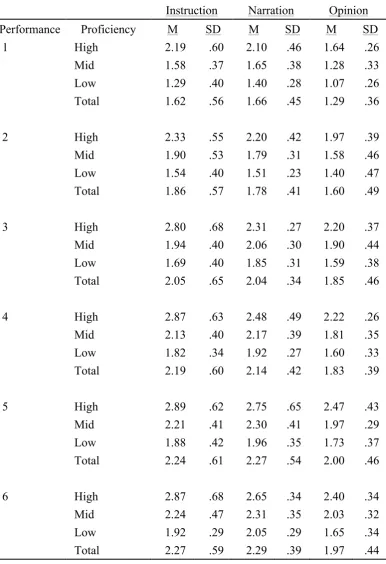
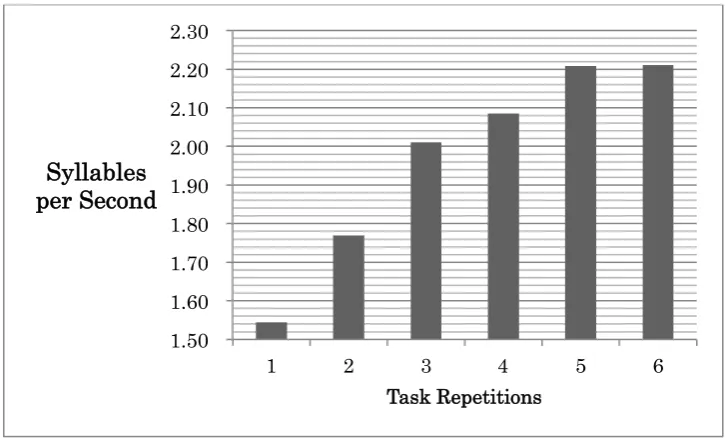
Pairwise comparisons revealed that the aural-oral repetition effect on the rate of L2 speech production was due to differences between all performances (1-2 p = .000, d = 1.53; 2-3 p = .000, d = 1.48; 3-4 p = .016, d = 0.48; 4-5 p = .000, d = 0.84) except Performance 5 and 6 which was not significant (p = .943, d = 0.05). In other words, the effect of immediate aural-oral task repetition as speaker and listener with different interlocutors on speech rate continued to increase significantly through the fifth performance of the tasks in the study. However, the effect size was large according to the criteria posited by Plonsky and Oswald (2014) across the first three performances only and small to medium thereafter through the fifth performance (see Figure 1 and Table 3).
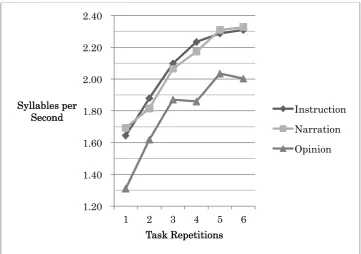
Not only did gains in speech rate begin to level off after the third repetition, but the pattern of development also began to diverge across the task types with the opinion task showing a less linear pattern of development than either the instruction or the narration task (see Figure 2 and Table 3).
Insert Figure 2 around here
Furthermore, the pattern observed for this form of task repetition on speech rate was very consistent across all three proficiency levels (see Figure 3 and Table 3).
Insert Figure 3 and Table 3 around here
The results thus indicate a robust connection between task repetition and speech rate and point to the possibility of a ceiling effect for immediate practice on speech rate at five repetitions.
Clause-Final Pausing
Insert Figure 4 around here
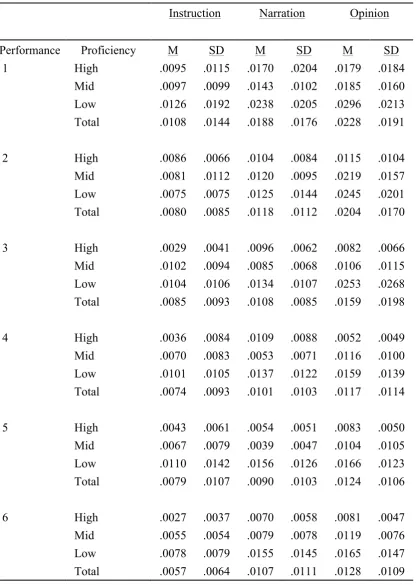
Furthermore, there was considerable variation in clause-final pausing across tasks. The largest gains were between the second and third repetition for the opinion tasks, between the first and second repetition of the narration task, and negligible on all repetitions the instruction task (see Figure 5 and Table 5). However, we see a generally descending pattern until the fourth performance on all task types after which non-linear patterns of development begin to emerge (see Figure 5).
Insert Figure 5 around here
Finally, comparison of clause-final pauses across the three proficiency levels revealed that the two higher proficiency groups showed a consistent pattern of decreased pausing across their first four performances of the task set (see Figure 6 and Table 4). This pattern is consistent with the pattern in Figure 4. The lowest proficiency speakers, on the other hand, showed fluctuating progress after their second performance of the task set (see Figure 6 and Table 4).
Insert Table 4 and Figure 6 around here
Mid-Clause Pausing
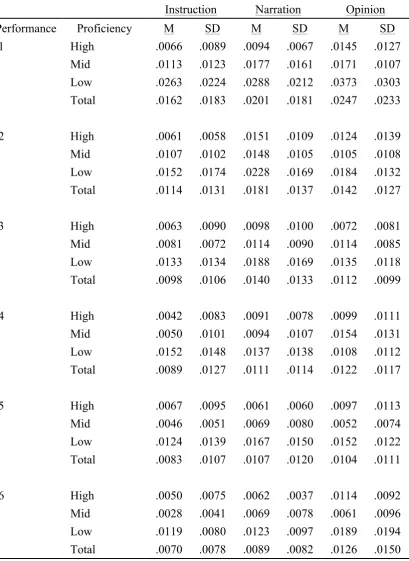
performances were statistical significant at the .05 level (1-2 p = .095, d = 0.52; 2-3 p = .110, d = 0.34; 3-4 p = .272, d = 0.13; 4-5 p = .307, d = 0.14; 5-6 p = .840, d = 0.04). Although the effect size for the first repetition was larger than the others, it was still small according to the benchmarks proposed by Plonsky and Oswald (2014). On the other hand, the difference between every second performance up to the fifth performance did reach statistical significance (1-3 p = .001, d = .71; 2-4 p = .003, d = .50; 3-5 p = .049, d = .30), whereas the difference between Performances 4-6 did not (p = .595, d = .12). Thus, the effects of aural-oral task repetition on mid-clause pausing did not dissipate until the fourth performance but the effect size decreased from medium to small (Plonsky and Oswald, 2014) (see Figure 7 and Table 5).
Insert Figure 7 around here
Nevertheless, the effects observed in Figure 7 were generally representative of participants’ performance on all three of the tasks (see Figure 8 and Table 5). With the exception of the second performance of the narration task, we see a clearly descending pattern through the third performance on all task types after which mid-clause pausing behavior begin to fluctuate (see Figure 8).
Insert Figure 8 around here
performances of the task set after which all groups show a generally descending pattern in mid-clause pausing until the fourth performance (see Figure 9 and Table 5).
Insert Figure 9 and Table 5 around here
Self-Repair
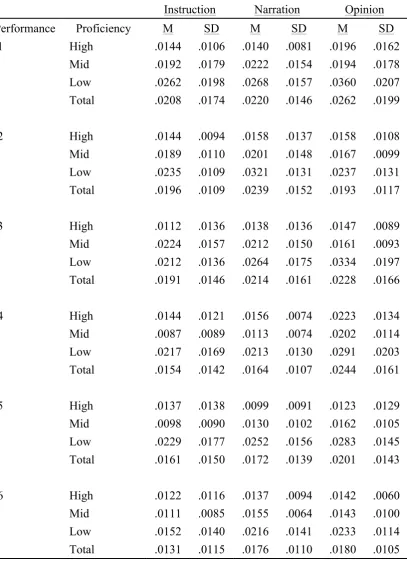
Finally, pairwise comparisons revealed that the frequency of self-repairs and reformulations followed a pattern that was quite distinct from either pause phenomenon. None of the differences between any combinations of the first four performances reached statistical significance at the .05 level (1-2 p = .922, d = .02; 2-3 p = .356, d = .14; 3-4 p = .614, d = .16; 4-5 p = .216, d = .14; 5-6 p = .980, d = .08). However, the differences between the fifth repetition and the first two performances 1-5 (p = .017, d = 0.45), 2-5 (p = .01, d = 0.48), and the differences between the sixth performance and the first three performances were significant: 1-6 (p = .017, d = 0.50), 2-6 (p = .015, d = 0.51), 3-6 (p = .020, d = 0.49) although the effect sizes were small according to Plonsky and Oswald (2014). Thus, significant gains in L2 fluency due to decreased self-repair (see Figure 10 and Table 6) did not begin until decreases in both clause-final and mid-clause pausing had dissipated.
Insert Figure 10 around here
repetitions, but their performance on the opinion task showed a sudden decrease in fluency due to an increase in self-repair during Performance 4 (see Figure 11).
Insert Figure 11 around here
However, there was considerable variability between proficiency levels with respect to self-repair (see Figure 12 and Table 6). The frequency of self-repairs is stable between the first two performances of the task set for all groups when clause-final pausing effects were significant (see Figure 4), and relatively stable through the third performance when mid-clause pausing effects were the largest (see Figure 7). However, there is considerable fluctuation in self-repair behavior between groups in the latter performances of the task set when significant differences in self-repair behavior began to emerge, indicating that self-repair may be a fluency variable that is dependent to some extent on proficiency.
Insert Figure 12 and Table 6 around here
Speaker Perceptions
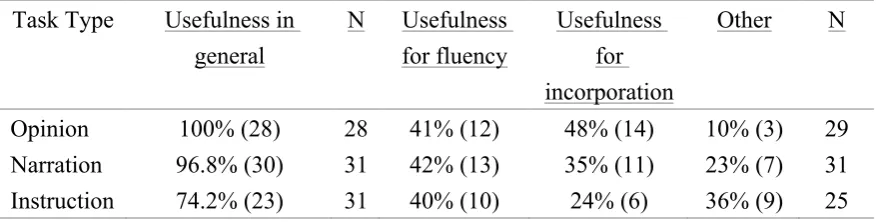
Participants’ impressions were elicited regarding: (a) the value of repeating each task type, (b) the optimal number of task repetitions for each task type, and (c) the value of repeating tasks with different partners. Table 7 summarizes the results of this analysis.
Overall, participants felt repetition to be helpful. Nearly all of them reported that repeating the task was useful on the opinion and narration tasks, and three-quarters of them indicated that it was beneficial on the instruction task. The majority of their comments fell into two categories. Approximately 40% mentioned that repetition improved their fluency on the tasks. Furthermore, between a quarter and half of the learners (24% instruction; 35% narration; 48% opinion) indicated that repetition assisted them in recalling useful words and expressions or that they were able to learn useful words and expressions from their partners. It is interesting to note that usefulness in terms of incorporation was felt to be the most relevant for the opinion task where task content was open and lowest for the instruction task where the task was structured and relatively inflexible with the narration task falling in between.
Other comments did not fit into these two categories, but provided information on participants’ perceptions on the tasks and other situational variables. One participant, for example, said that speaking with a high proficiency interlocutor helped her improve her English speaking skills. Only three of the 32 participants (9.4%) expressed boredom after the fourth performance. On the opinion and instruction tasks, all three were in the high-level group. On the narration task, one participant from each group expressed boredom. In addition, a few participants recalled that during the later repetitions, they stopped incorporating new linguistic constructions into their performance.
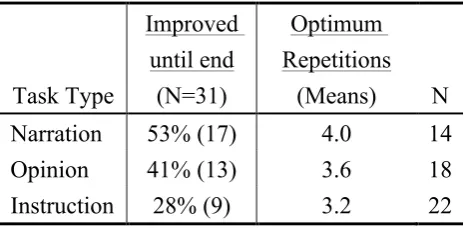
Insert Table 8 around here
indicated that six repetitions of the tasks were useful in improving their performance. The participants who reported that their performance did not continue to improve until the end were asked to specify the number of repetitions that they thought was sufficient in each case. As reflected in Table 8, the sub-set of respondents (47% on the narration, 59% on the opinion; 72% on the instruction) indicated that three or four performances were sufficient. This thus triangulates the results of the fluency analysis which showed improvement most clearly across the first four performances of each task. Furthermore, it indicates that participants generally did not become bored or fatigued, but appreciated the chance to complete the same tasks with different partners across the time frame of a typical lesson.
DISCUSSION AND CONCLUSIONS
The findings suggest that up to five performances of a task may be required to prime, activate and optimize students’ linguistic encoding processes on a task so that they can avoid breakdown and monitor their performance efficiently. Our results for speech rate provide additional evidence for the beneficial effects task repetition on enhancing fluency. They are in line with previous research that has found significant gains in speech rate when tasks were repeated once (Ahmadian & Tavakoli, 2011; Arevart & Nation, 1991, 1993; Bygate, 2001; Lynch & Maclean, 2000; Wang, 2014) and several times (Ahmadian, 2011). However, speech rate is likely to reflect efficiency in carrying out all aspects of L2 speech production: content planning, linguistic encoding, articulation, and monitoring (Götz, 2013; Kormos, 2006). Performance of the task for the first time builds a macro-structure conceptual plan for the content to be conveyed (Skehan, 2014). It also assists the speaker in the linguistic formulation of their message (Levelt, 1989, 1999) in terms of priming lemmas in the mental lexicon as well as the syntactic, morphological and phonological information associated with them, and activating syntactic building procedures (Skehan, 2014). Wang (2014), for example, has shown that even the articulation phase of speech production benefits from previous performance. These positive effects of previous performance on all three major processes of speech production are reflected in the large gains in speech rate in the present study. However, the other measures of fluency observed provide more nuanced insights into the benefits of repetition.
With regard to the frequency of overt self-repairs, decreases were only observed in the fifth and sixth performances. It can be argued that the frequency of self-repairs is indicative of how much attention speakers devote to monitoring processes of L2 speech production (Kormos, 1999). As participants optimize their conceptualization and encoding processes, it could be argued that they need to pay less attention to monitoring. The results for the present study provide some support for this hypothesis. The reduced frequency of self-repairs in the fifth and sixth performances suggests that the participants’ accuracy and efficiency in linguistic encoding had improved by this point so that fewer reformulations and overt self-corrections were necessary.
level learners, the allocation of attentional resources and the benefits of task repetition for conceptual and linguistic processing vary at different levels of proficiency. Therefore, future research which investigates the linguistic production of students together with their pausing profile is needed to uncover potential proficiency-related benefits of task repetition pertaining to the division of attentional resources at different stages of speech production.
instruction task is much easier than the other two tasks due to the fact that the content is very repetitive across the picture frames, and the plateau effect might have been felt at an earlier stage. Participants’ responses thus generally triangulate the results of the L2 production data.
Two primary limitations need to be kept in mind in interpreting the findings of the study. First, the decision to collect the data in a classroom context with students working in pairs with each other rather than being recorded performing the monologue tasks alone in a laboratory environment resulted in a level of background noise that made it impossible to analyze the location and duration of unfilled pauses reliably with automated software. The results of the study are thus limited in that only filled clause-final and mid-clause pauses were considered. Furthermore, controlled studies are now needed to reveal how additional features of fluency such as the mean length of runs and the length of unfilled pauses are affected by massed task repetition. Second, the decision to have learners work with each other and alternate roles of speaker and listener across the task sequence resulted in the observed effects for task repetition being combined with the effects of interlocutor input and any number of other interlocutor variables such as gender, personality, conversation style, etc. Although efforts were made to distribute these effects across the design through partial counterbalancing (see Procedures above), the study combines the effect of task repetition with that of interlocutor input. The decision to have students work in pairs and alternate speaker and listener roles might also have contributed to the lack of boredom and fatigue expressed in participants’ responses to the tasks.
also adds external or ecological validity to the results in that they are more reflective of task repetition as it is likely to occur inside and outside the classroom. Nevertheless, it is necessary that the results be interpreted in terms of optimizing speech production in the short term when input-based and output-based tasks are repeated with different interlocutors in a classroom situation as the order in which learners received input from speakers of different proficiency levels varied across the six repetitions of the task set, and this variation could have affected uptake at different points in the sequence. Future research on the effects of repetition independent of interlocutor input and other interlocutor effects is now needed to provide a more fine-grained picture of the effects of repetition as ‘practice’ rather than repetition as ‘communication’ on the efficiency of L2 speech production.
ACKNOWLEDGEMENTS
We are grateful for the support of the Research Fund of Lancaster University’s Faculty of Arts and Social Sciences. This publication is supported by datasets, which for ethical and legal reasons cannot be publicly shared.
NOTES
1. Covert repairs, when errors are intercepted before articulation, are very difficult to
identify reliably because they might not be directly observable in spontaneous speech
REFERENCES
Ahmadian, M.J., & Tavakoli, M. (2011). The effects of simultaneous use of careful online planning and task repetition on accuracy, fluency, and complexity of EFL learners’ oral production. Language Teaching Research, 15, 35–59.
Arevart, S. (1989). Grammatical change through repetition. RELC Journal, 20, 42-60.
Arevart, S. & Nation, P. (1991). Fluency improvement in a L2. RELC Journal, 22, 84-94.
Arevart, S. & Nation, P. (1993). Adjusting fluency and grammar through repetition. In Oller, J. (Ed.), Methods that work: Ideas for language teachers (2nd edition) (pp. 298-308). Boston: Heinle & Heinle.
Bosker, H., Pinget, A., Quené, H., Sanders, T., & De Jong, N. (2013). What makes speech sound fluent? The contributions of pauses, speed and repairs. Language Testing, 30, 159–175.
Butterworth, B. (1975) Hesitation and semantic planning in speech. Journal of Psycholinguistic Research, 4, 75-87.
Bygate, M. (1996). Effects of task repetition: appraising the developing language of learners. In Willis, J. and Willis, D. (Eds.), Challenge and change in language teaching (pp. 136-146). London: Heinemann.
Bygate, M. (2001). Effects of task repetition on the structure and control of oral
language. In Bygate, M., , P. & Swain, M. (Eds.) Researching pedagogic tasks (pp. 23-48). Harlow: Longman.
Cohen, J. (1988). Statistical power analysis for the behavioral sciences (2nd ed.).
Mahwah, NJ: Lawrence Erlbaum.
Council of Europe. (2001). Common European Framework of reference of languages: Learning, teaching, assessment. Cambridge: Cambridge University Press.
de Jong, N., & Perfetti, C. (2011). Fluency training in the ESL classroom: An
experimental study of fluency development and proceduralization. Language Learning, 61, 533–568.
De Jong, N. H., Steinel, M. P., Florijn, A. F., Schoonen, R., & Hulstijn, J. H. (2012).
Linguistic skills and speaking fluency in a L2. Applied Psycholinguistics, 33,
1-24.
Dörnyei, Z., & Kormos, J. (1998). Problem-solving mechanisms in L2 communication:
A psycholinguistic perspective. Studies in L2 Acquisition, 20, 349-385.
Educational Testing Service. (2008). TOEIC Test Data and Analysis 2007: Number of
Examinees and Scores in FY2007. Tokyo: The Institute for International
Ellis, N. C. (2002). Frequency effects in language acquisition: A review with
implications for theories of implicit and explicit language acquisition. Studies in
L2 Acquisition, 24, 143–188.
Ellis, R. (2003). Task-based language learning and teaching. Oxford: Oxford
University Press.
Ellis, R. (2005). Planning and task-based research: Theory and research. In R. Ellis
(Ed.), Planning and task-performance in a L2 (pp. 3–34). Amsterdam: John
Benjamins.
Ellis, R. (2009). Task-based language teaching: Sorting out the misunderstandings.
International Journal of Applied Linguistics, 19, 221-246.
Ellis, R. & Barkhuizen, G. (2005). Analysing learner language. Oxford: Oxford
University Press.
Foster, P., Tonkyn, A., & Wigglesworth, G. (2000). Measuring spoken language: A unit
for all reasons. Applied Linguistics, 21, 354–75.
Gass, S. Mackey, A., Alvarez-Torres, M. & Fernandez-Garcia, M. (1999). The effects
of task repetition on linguistic output. Language Learning, 49, 549-581.
Götz, S. (2013). Fluency in native and nonnative English speech (Vol. 53).
Kormos, J. (1999). Monitoring and self-repair in L2. Language Learning, 49, 303-342.
Kormos, J. (2006). Speech production and L2 acquisition. Mahwah, N.J.: Lawrence
Erlbaum.
Kormos, J. (2011). Speech production and the Cognition Hypothesis. In P. Robinson
(Ed.), L2 task complexity: researching the cognition hypothesis of language
learning and performance (pp. 39-60). Amsterdam: John Benjamins.
Lennon, P. (2000). The lexical element in spoken L2 fluency. In H. Riggenbach (Ed.),
Perspectives on fluency (pp. 25–42). Ann Arbor, MI: University of Michigan
Press.
Levelt, W. J. M. (1989). Speaking: From intention to articulation. Cambridge, MA:
MIT Press.
Levelt, W. J. M. (1999). Producing spoken language: a blueprint of the speaker. In C.
Brown & P. Hagoort (Eds.), Neurocognition of language (pp. 83-122). Oxford,
England: Oxford University Press.
Lynch, T. & Maclean, J. (2000). Exploring the benefits of task repetition and recycling
Lynch, T. & Maclean, J. (2001). A case of exercising: effects of immediate task
repetition on learners’ performance. In M. Bygate, P. Skehan & M. Swain.
(Eds.) Researching pedagogic tasks (pp. 141-162). Harlow: Longman.
Maurice, K. (1983). The fluency workshop. TESOL Newsletter, 17, 429.
McDonough, K., & Trofimovich, P. (2009). Using priming methods in second language
research. London: Taylor & Francis.
Nihon Eigo Kentei Kyokai [The Eiken Foundation of Japan] (2009). Eiken jun 1 kyuu
zenmondaishuu [Eiken Pre-1 Level: Complete Questions Collection]. Tokyo:
Oubunsha.
Pang F., & Skehan P. (2014). Self-reported planning behaviour and L2 performance in
narrative retelling. In P. Skehan (Ed.), Processing perspectives on task
performance (pp. 95-128). Amsterdam: John Benjamins.
Pickering M.J., & Ferreira V.S. (2008). Structural priming: A critical review.
Psychological Bulletin, 134, 427-459.
Plonsky, L., & Oswald, F.L. (2014). How big is big? Interpreting effect sizes in L2
research. Language Learning 64, 878-912.
Skehan, P. (2009). Modelling L2 performance: Integrating complexity, accuracy,
fluency and lexis. Applied Linguistics, 30, 510–32.
Skehan, P. (2014). Limited attentional capacity, second language performance and
task-based pedagogy. In P. Skehan (Ed.), Processing perspectives on task
performance (pp. 211-260). Amsterdam: John Benjamins.
Skehan, P., Xiaoyue, B., Quian, L., & Wang, Z. (2012). The task is not enough: Processing approaches to task-based performance. Language Teaching Research, 16, 170-187.
Tabachnick, B. & Fidell, S. (2007). Using multivariate statistics 5th
ed. Boston: Pearson
Tavakoli, P., & Foster, P. (2008). Task design and second language performance: The
effect of narrative type on learner output. Language Learning, 61, 37-72.
Tavakoli, P., & Skehan, P. (2005). Strategic planning, task structure and performance testing. In R. Ellis (Ed.), Planning and task performance in a L2 (pp. 239-277). Amsterdam: John Benjamins.
Tomasello, M. (2003). Constructing a language: A usage-based theory of language
acquisition. Cambridge, MA: Harvard University Press.
Wang Z. (2014). On-line time pressure manipulations: L2 speaking performance under
five types of planning and repetition conditions. In P. Skehan (Ed.), Processing
Wigglesworth, J. (1997). An investigation of planning time and proficiency level on
oral test discourse. Language Testing, 14, 85–106.
Yuan, F. & Ellis, R. (2003). The effect of pre-task planning and online planning on
fluency, complexity, and accuracy in L2 oral production. Applied Linguistics,
24, 1–27.
Appendix. Sample of pausing and overt self-repair analyses
…because they have a trouble with er (FP mid) a graffiti problem. And it’s just it is
not just (REP) at this time. They had this problem before. So uhm (FPbound)
then, they tried to solve this problem. So they have a meeting with er (FP mid) shop
owners. But they think about the solutions. But the security cameras and street
patrol is good way to solve it, but it’s it needs (REP) too much cost. So they can’t get
nice idea at this meeting. But that night, a woman go went (REP) back her home.
And when she find found (REP) she’s her (REP) son is was (REP) writing some
picture, suddenly she come up with nice idea which er (FP mid) she think graffiti is
problem, but if it’s art, it doesn’t it’s not (REP) problem. er (FPbound) so they gather
children a month later er (FPbound) and make children write some picture on her
shop’s wall before er (FP mid) graffiti problem comes again.
Table 1.
Descriptive Statistics for TOEIC Scores across Groups
TOEIC Scores N Range Min. Max. Mean SD Skewness (z-score)
Kurtosis (z-score) Band A
(860-990)
8 85 885 970 916.88 29.147 .850 .028 Band B
(730-860)
11 125 730 855 795.91 43.579 -.767 -.898 Band C
(470-730)
Table 2
Pairing and Ordering of Participants for Each Performance of the Task Set
[image:42.595.79.355.168.266.2]Table 3
Speech Rate Means and Standard Deviations across Tasks, Performances and Proficiency Levels (n=32)
Instruction Narration Opinion Performance Proficiency M SD M SD M SD
1 High 2.19 .60 2.10 .46 1.64 .26
Mid 1.58 .37 1.65 .38 1.28 .33 Low 1.29 .40 1.40 .28 1.07 .26 Total 1.62 .56 1.66 .45 1.29 .36
2 High 2.33 .55 2.20 .42 1.97 .39
Mid 1.90 .53 1.79 .31 1.58 .46 Low 1.54 .40 1.51 .23 1.40 .47 Total 1.86 .57 1.78 .41 1.60 .49
3 High 2.80 .68 2.31 .27 2.20 .37
Mid 1.94 .40 2.06 .30 1.90 .44 Low 1.69 .40 1.85 .31 1.59 .38 Total 2.05 .65 2.04 .34 1.85 .46
4 High 2.87 .63 2.48 .49 2.22 .26
Mid 2.13 .40 2.17 .39 1.81 .35 Low 1.82 .34 1.92 .27 1.60 .33 Total 2.19 .60 2.14 .42 1.83 .39
5 High 2.89 .62 2.75 .65 2.47 .43
Mid 2.21 .41 2.30 .41 1.97 .29 Low 1.88 .42 1.96 .35 1.73 .37 Total 2.24 .61 2.27 .54 2.00 .46
6 High 2.87 .68 2.65 .34 2.40 .34
Table 4.
Clause-final pausing means and standard deviations across tasks, performances and proficiency levels (n=32)
Instruction Narration Opinion
Performance Proficiency M SD M SD M SD 1 High .0095 .0115 .0170 .0204 .0179 .0184
Mid .0097 .0099 .0143 .0102 .0185 .0160 Low .0126 .0192 .0238 .0205 .0296 .0213 Total .0108 .0144 .0188 .0176 .0228 .0191
2 High .0086 .0066 .0104 .0084 .0115 .0104 Mid .0081 .0112 .0120 .0095 .0219 .0157 Low .0075 .0075 .0125 .0144 .0245 .0201 Total .0080 .0085 .0118 .0112 .0204 .0170
3 High .0029 .0041 .0096 .0062 .0082 .0066 Mid .0102 .0094 .0085 .0068 .0106 .0115 Low .0104 .0106 .0134 .0107 .0253 .0268 Total .0085 .0093 .0108 .0085 .0159 .0198
4 High .0036 .0084 .0109 .0088 .0052 .0049 Mid .0070 .0083 .0053 .0071 .0116 .0100 Low .0101 .0105 .0137 .0122 .0159 .0139 Total .0074 .0093 .0101 .0103 .0117 .0114
5 High .0043 .0061 .0054 .0051 .0083 .0050 Mid .0067 .0079 .0039 .0047 .0104 .0105 Low .0110 .0142 .0156 .0126 .0166 .0123 Total .0079 .0107 .0090 .0103 .0124 .0106
[image:44.595.86.503.159.745.2]Table 5
Mid-clause pausing means and standard deviations across tasks, performances and proficiency levels (n=32)
Instruction Narration Opinion Performance Proficiency M SD M SD M SD
1 High .0066 .0089 .0094 .0067 .0145 .0127 Mid .0113 .0123 .0177 .0161 .0171 .0107 Low .0263 .0224 .0288 .0212 .0373 .0303 Total .0162 .0183 .0201 .0181 .0247 .0233
2 High .0061 .0058 .0151 .0109 .0124 .0139 Mid .0107 .0102 .0148 .0105 .0105 .0108 Low .0152 .0174 .0228 .0169 .0184 .0132 Total .0114 .0131 .0181 .0137 .0142 .0127
3 High .0063 .0090 .0098 .0100 .0072 .0081 Mid .0081 .0072 .0114 .0090 .0114 .0085 Low .0133 .0134 .0188 .0169 .0135 .0118 Total .0098 .0106 .0140 .0133 .0112 .0099
4 High .0042 .0083 .0091 .0078 .0099 .0111 Mid .0050 .0101 .0094 .0107 .0154 .0131 Low .0152 .0148 .0137 .0138 .0108 .0112 Total .0089 .0127 .0111 .0114 .0122 .0117
5 High .0067 .0095 .0061 .0060 .0097 .0113 Mid .0046 .0051 .0069 .0080 .0052 .0074 Low .0124 .0139 .0167 .0150 .0152 .0122 Total .0083 .0107 .0107 .0120 .0104 .0111
[image:45.595.90.500.196.758.2]Table 6
Self-repair means and standard deviations across tasks, performances and proficiency levels (n=32)
Instruction Narration Opinion Performance Proficiency M SD M SD M SD
1 High .0144 .0106 .0140 .0081 .0196 .0162 Mid .0192 .0179 .0222 .0154 .0194 .0178 Low .0262 .0198 .0268 .0157 .0360 .0207 Total .0208 .0174 .0220 .0146 .0262 .0199
2 High .0144 .0094 .0158 .0137 .0158 .0108 Mid .0189 .0110 .0201 .0148 .0167 .0099 Low .0235 .0109 .0321 .0131 .0237 .0131 Total .0196 .0109 .0239 .0152 .0193 .0117
3 High .0112 .0136 .0138 .0136 .0147 .0089 Mid .0224 .0157 .0212 .0150 .0161 .0093 Low .0212 .0136 .0264 .0175 .0334 .0197 Total .0191 .0146 .0214 .0161 .0228 .0166
4 High .0144 .0121 .0156 .0074 .0223 .0134 Mid .0087 .0089 .0113 .0074 .0202 .0114 Low .0217 .0169 .0213 .0130 .0291 .0203 Total .0154 .0142 .0164 .0107 .0244 .0161
5 High .0137 .0138 .0099 .0091 .0123 .0129 Mid .0098 .0090 .0130 .0102 .0162 .0105 Low .0229 .0177 .0252 .0156 .0283 .0145 Total .0161 .0150 .0172 .0139 .0201 .0143
Table 7.
Perceptions of task repetition
Task Type Usefulness in general
N Usefulness for fluency
Usefulness for incorporation
Other N
[image:47.595.80.520.155.266.2]Table 8
Perceptions of Number of Productive Repetitions
Task Type
Improved until end
(N=31)
Optimum Repetitions
Figure 1 Repetition and speech rate 1.50
1.60 1.70 1.80 1.90 2.00 2.10 2.20 2.30
1 2 3 4 5 6
Syllables per Second
Figure 2 Repetition, task and speech rate 1.20
1.40 1.60 1.80 2.00 2.20 2.40
1 2 3 4 5 6 Syllables per
Second
Task Repetitions
Figure 3 Repetition, proficiency and speech rate 1.2
1.7 2.2 2.7
1 2 3 4 5 6
Syllables per Second
Task Repetitions
Figure 4 Repetition and clause-final pausing 0.005
0.006 0.007 0.008 0.009 0.010 0.011 0.012
1 2 3 4 5 6
Pauses per Syllable
Figure 5 Repetition, task and clause-final pausing 0.002
0.004 0.006 0.008 0.010 0.012 0.014 0.016
1 2 3 4 5 6
Pauses per Syllable
Task Repetitions
Figure 6 Repetition, proficiency and clause-final pausing 0.0020
0.0040 0.0060 0.0080 0.0100 0.0120 0.0140 0.0160
1 2 3 4 5 6 Pauses per
Syllable
Task Repetitions
Figure 7 Repetition and mid-clause pausing 0.004
0.005 0.006 0.007 0.008 0.009 0.010 0.011 0.012 0.013 0.014
1 2 3 4 5 6
Pauses per Syllable
Figure 8 Repetitions, task and mid-clause pausing 0.002
0.004 0.006 0.008 0.010 0.012 0.014 0.016 0.018
1 2 3 4 5 6
Pauses per Syllable
Task Repetitions
Figure 9 Repetitions, proficiency and mid-clause pausing 0.0000
0.0050 0.0100 0.0150 0.0200 0.0250
1 2 3 4 5 6 Pauses per
Syllable
Task Repetitions
Figure 10 Repetition and self-repair 0.012
0.013 0.014 0.015 0.016 0.017 0.018
1 2 3 4 5 6
Repairs per Syllable
Figure 11 Repetitions, task and self-repair 0.008
0.010 0.012 0.014 0.016 0.018 0.020 0.022
1 2 3 4 5 6 Repairs per
Syllable
Task Repetitions
Figure 12 Repetitions, proficiency and self-repair 0.0050
0.0100 0.0150 0.0200 0.0250 0.0300
1 2 3 4 5 6 Repairs per
Syllable
Task Repetitions