i
~€==
2
==P':::::7;7~~
fTT~6 ~')3so
r
N~SLZIO*
lS
SOl~~J N~SM
OBI
~010 A~~~911
land
3sor NVS
BZ9~B££9ZT
,)3S
Sl~,)IOOI~3dCD
Computer Simulates Workin
g
of Inner Ear
SCIENCE
&
TECHN~S;~
June,
1970
.
m
lESt And
one-Ie new
eSP-30
I
~
10 MHz to perform
e high-resolution
sampling rates up to
The eSP-30. Built
1
not fugit fast enough.
Processors, Inc.
The 16th Annual Edition
0/
the
COMPUTER DIRECTORY
AND
BUYERS' GUIDE
will be published jointly by
The New York Times Book and Educational Division and Computers and Automation as the Midyear issue of Computers and Automation (in soft cover)
and as Volume 4 of WHO'S WHO IN COMPUTERS AND DATA PROCESSING (in hard cover)
CONTENTS
- A Roster of Organizations in the Electronic Computing and Data Processing Industry
- A Buyers' Guide to Products and Services in the Electronic Computing and Data Processing Field - Special Geographic Rosters of:
1. Organizations selling computing and data processing services 2. Organizations selling commercial time-shared computing services 3. Commercial organizations offering courses, seminars or instruction in
computing, programming, or systems
4. Organizations selling consulting services to the computer field
5. Organizations offering computing and data processing equipment on a lease basis 6. Organizations selling software or computer programs
- Characteristics of General Purpose Digital and Analog Computers - A Roster of College and University Computer Centers
- Rosters of Computer Associations and Computer Users' Groups - A Roster of Programming Languages
- A List of Over 1700 Applications of Electronic Computing and Data Processing Equipment - A World Computer Census
- A Summary of Binary Arithmetic and Related Number Systems - Some Binary, Octal, and Decimal Conversion Tables
- A Summary of Boolean Algebra (Contrasted with Elementary Algebra) - Ranges of Current Computer Speeds
A Glossary of Key Ideas in the Computer Field ... and much more
PRICE
for the COMPUTER DIRECTORY AND BUYERS' GUIDE, 1970 in SOFT COVER:- Price for subs<?ribers to Computers and Automation whose present subscription. . . $ 9.00 does not include the Directory (magazine address label is marked *N)
- Special prepublication price for non-subscribers (effective through June 30, 1970). . . . . . • . $12.00 (After publication, price to non-subscribers is $14.50)
- The Directory is included in the $18.50 full annual subscription (13 issues) to Computers and Automation (magazine address label is marked *D)
Send prepaid orders to: COMPUTERS AND AUTOMATION, 815 Washington Street, Newtonville, Mass. 02160
Letters To The Editor
Complimentary Subscriptions
For more than ten years while I was Head Librarian at the Ai Research Man-ufacturing Company's Phoenix plant, your company very kindly sent a sub-scription of
Computers and
Automa-tion
to us in the Library. It was made available to all employees. A large number of its articles were indexed, and it was regularly bound for per-manent retention on our shelves. Your kindness was appreciated by the staff in the Library and by the many readers in the company's several engi-neering groups.My son has recently been assigned duty as Commanding Officer of Naval Shore Electronics Engineering Activity in Japan. He has told me that he is setting up an engineering science li-brary for the use of the staff immedi-ately under his direction and for use by readers throughout the area.
Would it be possible for you to send him a courtesy subscription?
MRS. ALBERT H. MACKENZIE 1632 E. Claremont
Phoenix, Ariz. 85016
Ed. Note - We are glad that Ai Research Manufacturing Company's employees made good use of our magazine. However, it was sent to your library because it was a sub-scription paid for by AiResearch. As a paid-circulation magazine, we do not regularly have free or complimentary or controlled subscriptions. We would be glad to welcome your son as a regular paid subscriber.
March Front Cover - Comments
I want to tell you how much enjoyed your front cover picture of children learning the computer by tele-printer and the follow-up story on page 50 of your March 1970 issue. I t is very refreshing. This picture depicts the real meaning of data processing to me. The honest-to-goodness hard work it is and a very satisfying and meaning-ful contribution to society computers are.
Being a woman, in data processing, I've been embarrassed at many pic-tures shown in magazines advertising data processing machines by the way the models show various parts of their bodies so that you cannot get your mind on the subject for the intrusion of the model.
Now, maybe for men, perhaps this is okay, but there are other women in data processing too who also read these magazines and I'm sure some of them have been embarrassed for 0 ur sex as I have. I'm not knocking pretty
4
girls for advertisements, for I'm sure they do a lot of selling.
We, as adults, should lean more toward building a desire for all to learn and work toward a better future of good morale and honest labor and lean away from the "poor books, movies and bad photos which adorn our maga-zines" syndrome.
It's a good feeling to know your .company is portraying something good and wholesome and right for th is generation to work toward. We have so I ittle of it nowadays.
I commend you.
MRS. IRENE S. MCDOWELL Box 3051
Shawnee, Kansas 66203
Ed. Note - Thank you for your kind com-ments. Your letter is but one more indica-tion that the machine will never totally replace man - or woman!
The February Issue
I thought you might like to know how much I enjoyed three of the articles in your February, 1970 issue. I refer to: "The Tale of Crazy Freddie" [page 14] , "A Hypothetical Interview Between the President of a Computer Software Company and a Patent At-torney Specializing in Protection of Computer Programs" [page 16], and' "The Internal Revenue Service Looks at Computer Software" [page 20] .
The "Crazy Freddie" article was especially amusing, but it also made its point very clear. The situation has really changed now that patenting of programs is possible and I BM has un-bundled.
CHARLES FORSYTHE
Mutual Life Ins. Co. of New York 1740 Broadway (55th St.) New York, NY 10019
Numbles
Well, you finally came through, ole buddy; you issued a Numble that was, to a degree, somewhat more worthy of your readers' talents. The message con-tained in Numble 703 is: "He Who Thinks Well, Need Not Think Much." Time to solve required about 0.3 X 1
0-
3years, due to omission of the intermediate letters of the multiplica-tion part.
G. P. PETERSEN /s/ Numble Master General Electric Co. P. O. Box 11508
St. Petersburg, Fla. 33733
Editor Edmund C. Berkeley
/l.r.rociate Editor Sharry Langdale
Assistant Editors Linda Ladd Lovett Neil D. Macdonald
Software Editor Stewart B. Nelson
AdzJertising Director Bernard Lane
/11'1 Directol's Ray W. Hass
Daniel T. Langdale
Contributing Editors John Bennett
Fulfil/mell! Manager
Moses M. Berlin Andrew D. Booth John W. Carr III Ned Chapin
Alston S. Householder Peter Kugel Leslie Mezei
Rod E. Packer Jean E. Sammet Ted Schoeters
Richard E. Sprague
T. E. Cheatham, Jr. James J. Cryan Richard W. Hamming
Alston S. Householder Victor Paschkis
William J. McMillan
Arhertising RejJresentatives
BOSTON 02116, Phillip E. Nutting
1127 Statler Office Bldg., 617-542-7720
NEW YORK 10001 Bernard Lane
254 West 31 St., 212-279-7281
ELSEWHERE, The Publisher Berkeley Enterprises, Inc.
815 Washington St., 617-332-5453 Newtonville, Mass. 02160
Ed ito rial Offices
BERKElEY ENTERPR ISES, INC. 815 WASHINGTON STREET, NEWTONVILLE, MASS. 02160
CIRCULATION AUDITED BY AUDIT BUREAU OF CIRCULATIONS
Computers and Automation is published. 13 tim~s a year (12 monthly issues plus an. annual directory I~sue
published in June) at 815 Washtngton St., New.tonvII17,
Mass. 02160, by Berkeley Ente.rprises, Inc. Printed In U.S.A. Subscription rates: Unlte~ Sta~es, $18.50 f~r
1 year, $36.00 for 2 years, Includtng annual di-rectory issue - $9.50 'f~r 1 year, $18.00 for two years without annual directory; Canada, add 50¢ a year for postage; Foreign, a~d. $3.50. a year for postage. Addre·ss all U.S. subSCription mall to: Be~ke
ley Enterprises, Inc., 815 Washington St,! Newtonville, Mass. 02160. Second Class Postage paid at Boston,
~:sSt~;aster: Please send all forms 3579 to Berk~ley Enterprises, Inc., 815 Washington St., NewtonVille, Mass. 02160. (1J Copyright 1970, by Berkeley
Enter-~~~~~e I~¥. address: If your address changes, please send us both your new addr~ss and you~ ol~ address (as it appears on the magaztne address Imprint), and allow three weeks for the change to be made.
computers
and automation
Vol. 19, No.6 - June, 1970 The magazille of the desigll, applications, {[nd implicatiolls of illformatioll processing systems.
Special Feature:
Computers and Medicine
16 REAL·TlME ANALYSIS OF ELEC1-ROCARDIOGRAMS BY COMPUTER
by Dr. G. A. Kien, T. V. Balacek, l. l. linka, and W. V. Murphy
How an on-line multiprocessing computer facility which analyzes electrocardiograms can relieve physicians of time-consuming work, eliminate possible errors, and decrease variability in interpretations.
19 A CASE HISTORY: IMPLEMENTATION OF A COMPUTER·BASED PATIENT
ACCOUNTING SYSTEM
by J. Peter Singer and Frank A. Petro
The planning, installation, and follow-up for the implementation of the Shared Hospital Accounting System (SHAS) at Stanford University Hospital.
24 COMPUTERS IN THE LABORATORY
by Moses M. Berlin
What factors determine the success of the use of computers in the laboratory?
28 THE HOSPITAL COMPUTER COMES OF AGE
by ,Morton Ruderman and A. Neil Pappalardo
How the evolution of the computerized hospital can be hastened by the delivery of total computer services to the hospital by commercial companies.
33'
THE ROLE OF ADMINISTRATORS AND PHYSICIANS IN THE DEVELOP·
MENT OF HOSPITAL INFORMATION SYSTEMS
by Geoffrey G. Jackson
Why - and how - doctors and hospital administrators should help coordinate, auto-mate, and control their hospital information systems.
36 In the Year 2001: SURGERY BY COMPUTER
by Dr. Robert Fondiller
An imagined tale in which Mr. Star Bright (a human) receives a new kidney with the assistance of Dr. Sawbones (a computer-controlled robot) - with some implications about the not-too-distant future of computers and medicine.
Regular Features
Editorial
6 The limitations of Computers, by Edmund C. Berkeley
C&A Worldwide
23 Report from Great Britain, by Ted Schoeters
The Profession of Information Engineer and His Bridges to Society
41 What We Must Do, by John Platt
Multi-Access Forum
8 "The Invasion of Privacy" - Comments, by Richard W. Rosenbaum, F. R. Montgomery, and the Editor
9 "Computers, language, and Reality" - Comment, by Eric Brodheim
9 To Help liberate One's Mind from Newspeak, by Edmund C. Berkeley
14 Apollo 13: A lesson Re Safeguard, by Daniel D. McCracken
14 "The Assassination of President John F. Kennedy: The Application of Computers to the Photo-graphic Evidence" - Comment, by Charlene Hofer
14 The Case for the Awareness of the Social Implications of Computers is Presented to the Candi-dates for National ACM Office, by Paul Armer, William S. Dorn, and Daniel D. McCracken
15 Addendum to "Guidelines for Contracting for Computer Related Services" 22 Postage Stamps Designed by Computer in the Netherlands, by Erik Albarda
22 Correction
The front cover picture
shows Dr. Alfred
Insel-berg, a mathematician at
IBM's Los Angeles
Scien-tific Center, with a model
of the human ear. Dr.
Inselberg has programmed
a computer to simulate the
intricate workings of the
inner ear; his purpose
is
to
help specialists learn more
about harLO it works. For
more information, see page
49.
NOTICE
* 0 ON YOUR ADDRESS IMPRINT MEANS THAT YOUR SUBSCRIP-TION INCLUDES THE COMPUTER DIRECTORY. * N MEANS THAT YOUR PRESENT SUBSCRIPTION DOES NOT INCLUDE THE COM-PUTER DIRECTORY. SEE PAGE 3.
Departments
'48 Across the Editor's Desk-Computing and Data Processing Newsletter
62 Advertising Index 7 As We Go To Press
61 Calendar of Coming Events
62 Classified Advertisements
4 Letters to the Editor
60 Monthly Computer Census
58 New Contracts
59 New Installations
40 Numbles
by Neil Macdonald
35 Problem Corner
by Walter Penney, COP
27 Punch Lines . • •
EDITORIAL
The Limitations of Computers
Every now and then, people who are as excited about computers as we are and who work as hard and concen-tratedly in the computer field as we do, should stop and look around them - and remind themselves of the limita-tions of computers: what computers cannot do and what computers cannot be expected to do.
I believe that the computer is one of the most remarkable machines that human beings have ever designed -but it is less remarkable than the machine designed by evolution that most of us carry around in our heads and by means of which we do our thinking and deciding, our recognizing and talking, etc.
I believe that a computer of the most modern genera-tion, in which electronic components are packed together almost microscopically, is a fantastic device - but the packing density of nerve connections in the human brain is far more remarkable.
In Poughkeepsie, N.Y., I have watched Gardner-Denver wiring machines programmed by an existing computer wire up the pins in the back frames of another computer coming into existence. But the way in which new human beings come into existence and grow useful brains, subject to the directions of mothers and fathers, teachers and society, is far more remarkable still. I t really will be an extraordinary day when human beings can manufacture (not using the regular process) an arbitrary computer with versatile general programming by causing a little artificial seed of protein and nucleic acids to grow.
Not only are there serious limitations in the design and construction and programming of computers, but there are serious Ii mitations in the powers of computers.
I can tell a boy in a telegraph office (though there are very few such boys left any more) to go to such and such an address and deliver such and such telegram and to use his common sense about how to get there. But I cannot give any robot programmed by any computer such simple and direct instructions.
I do not know how to program a mobile computer equipped with a photoelectric eye, so that it will move up to a traffic intersection, determine which light is the traffic I ight, wait for it to turn green, and then cross through the intersection, without hitting any jaywalking pedestrian or erring vehicle.
6
And I cannot imagine anyone being able for years to. come to program a computer so that it will act like a newspaper reporter: visiting a place where an important event has happened (such as the crash of an airplane loaded with some hydrogen bombs that did not explode, as in Palomares, Spain, 1966); talk to various persons nearby; put the information together; and send back a series of sensible dispatches for publication in a city newspaper.
We have now had our own DEC PDP-9 computer here in our office for just about two years. Its entire duties are research, development, instruction, training, education -and changing people's minds about computers. Of these duties, the most useful and exciting for us is the last one -changing people's minds, showing them that something thought not possible for a computer to do is actually possible. For every now and then we meet a person who thinks that computers have created more problems than they've solved; or who is baffled at the magic black box; or who is annoyed that he had received a computerized bill for someth ing he did not buy. We seize the opportunity to take him to our computer, and let him there experiment with some interesting and entertaining interaction between him-self and the computer.
But this machine and its programs are still acutely and inevitably susceptible to a large number of undesirable variations and factors. For example, every now and then, the fuse no. 2 from the bottom located in the back panel blows (the rate about once in ten days). And neither we nor the careful and intelligent servicemen who look after our computer are able to deal with this intermittent bug - for it happens too rarely for any of us to track it down. So our only solution for the time being is to keep extra fuses on hand - and if the machine starts to have a temper, be disobedient, or be obstinate, we go look at the second fuse from the bottom and see if it has blown.
The outcome of all this experience, and the philosophy derived therefrom, is essentially this:
1. The computer-assisted man and the man-assisted computer have a reasonable chance of doing some-th ing useful.
2. A man by himself has a reasonable chance of doing something useful.
3. But a computer by itself - watch out!
~
..
~
Editor \
THE ASSASSINATION OF PRESIDENT JOHN F. KENNEDY: THE APPLICATION OF COMPUTERS TO THE PHOTOGRAPHIC EVIDENCE
- REPORT NO. 1
The May 1970 issue of Computers and Automation contained the longest and probably one of the most important articles that we have ever published,
"The Assassination of President Kennedy: The
Appli-cation of Computers to the Photographic Evidence". In this article Richard E. Sprague, President, Per-sonal Data Services, Hartsdale, N.Y., stated that an analysis of the evidence proved:
that the Warren Commission conclusions (that Lee Harvey Oswald was the sole assassin and that there was no conspiracy) are false; that there were at least four gunmen firing
from four locations, none of which was Oswald;
that the conspiracy to kill Kennedy involved over 50 persons (of whom several are identi-fied in the article), including members of the Dallas police, and elements of the Cen-tral Intelligence Agency of the United States.
The evidence published in this article included eleven important photographs, of which one shows Jim Hicks, who admitted he was the radio communica-tor among the firing teams at Dealey Plaza, with his radio transmitter in his back left pocket. The article also included a tabulation of over 500 pho-tographs (counting a movie sequence as one photo) taken in and around Dealey Plaza, Dallas, Texas, Nov. 22, 1963, at the time of President Kennedy's assassination and shortly thereafter.
The assassination of President Kennedy was the most photographed murder in history. Of the 500 photographs, the Warren Commission looked at 26. Both a spatial chart and a timing chart of the events and photographs are included in the article.
Sprague, a computer professional for over 24 years, has, as an avocation, studied both the old and new evidence for over 6 years, and has analyzed over 400 of the 500 photographs. The work in com-puterized analysis of over 300 still photos and over 25,000 frames of movie sequences has been started.
This article has drawn an unusual amount of atten-tion. Some of the attention it has received includes:
a United Press dispatch on May I; an Associated Press dispatch on May I;
more than 20 interviews of the author over the telephone by radio and TV stations, result-ing in many broadcasts;
a considerable number of letters, requests, and orders in regard to the article; and
publication of newspaper accounts in a~ least
16 newspapers.
The list of these newspapers so far is the fol-lowing:
Birmingham News, Birmingham, Ala., May 2 Boston Globe, Boston, Mass., May 1 Detroit Free Press, Detroit, Mich., May 2 Fort Worth Star Telegram, Fort Worth, Texas,
May 2
Ledger Star, Norfolk, Va., May 2
Milwaukee Journal, Milwaukee, Wisc., May 1 Minneapolis Star, Minneapolis, Minn., May I Nashville Banner, Nashville, Tenn., May I News-Free Press, Chattanooga, Tenn., May 2 Philadelphia Inquirer, Phila., Pa., May 3 Reporter Dispatch, White Plains, N.Y., May 2 San Francisco Examiner, San Francisco,
Calif., May 2
Staten Island Advance, Staten Island, N.Y., May 2
Tennesseean, Nashville, Tenn., May 3 Washington Post, Washington, D.C., May 3 York Gazette and Daily, York, Pa., May 6 Conspicuous by their absence are newspapers of New York, Los Angeles, and Chicago.
Computers and Automation has been informed that agents of the Central Intelligence Agency of the United States have been installed in these cities
(and in other places) to prevent many kinds of news about political assassinations from being
pub-lished in these cities and elsewhere. It is
cer-tainly interesting to see the confirmation of this quite unproved hypothesis by the failure to publish any information about the article in almost all major newspapers of New York, Los Angeles, and Chicago.
AS WE GO TO PRESS
HONEYWELL, INC. AND GENERAL ELECTRIC CO. HAVE AGREED IN PRINCIPLE TO FORM A NEW SUBSIDIARY which will in-clude the present Honeywell computer operations and General Electric business computer equipment
opera-tions. Honeywell will own 82 l/~/o of the subsidiary
and GE will own 18 l/~/o; the new company will be
managed by Honeywell. The proposed agreement covers
both domestic and international computer equipment interests, including the transfer to the new company of the GE shares in the Bull-GE companies.
In announcing the new company, Honeywell Board
Chairman James H. Binger said: "The combined cus-'
tomer base is one of the most significant aspects of the transaction. We are dedicated to using the full resources of both organizations to enhance customer support worldwide." Additional announce-ments of plans to combine the computer operations of Honeywell and GE, which on a worldwide basis are now about equal in size, are expected.
SENATE HEARINGS ARE UNDERWAY ON A BILL WHICH WOULD SEVERELY LIMIT THE NON-BANKING ACTIVITIES OF
ONE-BANK HOLDING COMPANIES. If the bill (H.R. 6778)
should pass, it would be considered a victory for
for the Association of Data Processing Service Or-ganizations (ADAPSO), which has long been seeking a means to prevent banks from selling EDP services to the public. ADAPSO officials maintain that the federal and state charters under which banks are or-ganized gives them an unfair competitive advantage.
HERBERT R. J. GROSCH HAS BEEN REPLACED AS DIRECTOR OF THE CENTER FOR COMPUTER SCIENCES AND TECHNOLOGY AT THE NATIONAL BUREAU OF STANDARDS by James P.
Ni-gro, a former deputy. Grosch, who during his term
as Director has been involved in standards disputes with several leading computer companies, will retain the title of Senior Research Fellow.
Copies of the May issue containing the article by Richard E. Sprague, "The Assassination of
President Kennedy: The Application of
Comput-ers to the Photographic Evidence" are avail-able. The price is $4.00, but a special price of $1.00 has been established for students and non-profit organizations.
MULTI-ACCESS FORUM
liTHE INVASION OF PRIVACY
I I-
COMMENTS
I. From Richard W. Rosenbaum
Systems and Industrial Relations Research 2618 Colonial Way
Bloomfield Hills, Mich. 48013
You have given your readers an unexpected and valuable fringe benefit through your enlightened "Invasion of Pri-vacy" editorial in the April issue of your magazine.
I, for one, feel more pity than contempt for the poor paranoids who devote the major part of their miserable lives earning a subsistence collecting private trivia.
The most depressing element of the whole issue, in my judgment, is that Americans allow these psychopathic sores on the tail of progress to be supported out of the publ ic treasury.
Hooray for your unstinting courage.
II. From F. R. Montgomery
7615 E. 53rd
Indianapolis, Ind. 46226
I read with deep interest your April editorial on "The I nvasion of Privacy." This subject has been one to which I have given serious consideration for several years.
Having spent several years as a member of the Armed Forces, having owned and operated various automobiles since 1937, having held (or maybe it holds me) a Social Security Account Number since 1939, having been the recipient of many credit cards (some unsolicited), and having used credit to purchase a home, cars, furniture, etc. - I can realize that the wealth of information concerning my private affairs that is in the hands of government and other agencies is not too desirable. Based upon this realiza-tion, I believe constructive action needs to be taken to assure that these files are not misused.
Your editorial does make some constructive suggestions in regard to "safe-guarding privacy and giving the American people rights"; however you have used the main portion of your editorial to blast the FBI, to attempt to impose your political thinking about Vietnam on your subscribers, and to suggest ways to confuse any data bank.
I agree with part of your editorial, but, as you have realized by now, I disagree with much of it. I especially would not consider any list of potential Fifth Column ists (the ones to be placed in concentration camps in the event of a national emergency) as being repugnant. If you had made any study of Fifth Column activities in the Central European nations during the 1930's and 1940's, then surely you would realize that we need this safeguard. The matter of a law to force notification being made to individuals placed on such a list, to give them opportunity to refute the reasons for their being placed thereon, which cou Id result in possibly their name being taken off, I am all for.
8
Considering the fact that you are the Editor, and as such are in a position to express certain views, why not use your position to suggest constructive change? I receive the indication from this editorial that you are caught up in the thinking of many present-day radicals that the only way to change is by means of destruction; this, therefore, would suggest that you are incapable of suggesting constructive change. I hope I am wrong in this thought, and that you will come up with some constructive suggestions in this area!
III. From the Editor
The invasion of privacy is being greatly hastened by the advent of large computerized data banks, combined wi th the interests of two kinds of government: efficient govern-ment whether or not dictatorial, and dictatorial governgovern-ment even if Jlot efficient.
Of all subjects connected with computer.s, the invasion of privacy appears to be stirring the most interest, atten-tion, and concern, because everyone has h is privacy at stake - and that is very valuable to him.
I do not bel ieve, nor do I seek to imply, that the only way to bring about change is through destructive changes. I n the April editorial "The I nvasion of Privacy," for example, we urge citizens to seek constructive change: to seek the passage of laws regulating the control and use of any personal data file ma intained by any agency, govern-mental or not. We suggest another constructive change: that they can prevent additional information being collected about them by rejecting unsol icited credit cards. And if constructive changes fail to happen, we suggest (only slightly with tongue-in-cheek) ways to confuse any data bank.
When some part of the government of the United States advocates a single, national, computerized data bank, with promised safeguards, this raises questions in the minds of many citizens. Many people have lost faith in the state-ments and promises of the United States government because of the stream of untruths (or covers, or credibility gap, or lies) which the government has told in the years 1960 to the present - from the U 2 flight over the Soviet Union by the CIA pilot Gary Francis Powers under Presi-dent Dwight D. Eisenhower, to the reasons now offered for the United States invasion of Cambodia under President Richard Nixon. There are other people who are still accepting the statements and promises of the United States government.
I n regard to the inter-relation of computers and privacy,
Computers and Automation
welcomes and tries to give a fair hearing to all points of view and all reasonable sugges-tions that need to be considered in coming to rational proposals and safe legislation, in the interests of all peopleof the United States.
0
IICOMPUTERS, LANGUAGE, AND REAUTYII - COMMENT
Eric Brodheim, President PDA Systems, Inc. 12 E. 86th St.
New York, N.Y. 10028
Your editorial on "Computers, Language, and Real ity" [March, 1970 issue] re-emphasizes the fact that language is a very ambiguous method of expressing a thought or concept. This is not only a hurdle to be surmounted in effectively understanding the operation of computers, but is a root cause of the seemi ngly irrational behavior that we ascribe to other nations.
While we, as human beings, tend to think of an algebraic. symbol as a variable, a computer will think of that symbol as a storage location. A high-level language programmer might be oblivious to this fundamental distinction and rely on the compiler to effectively translate from his thought process to the computer's. If the compiler has been well designed and if the program is "routine", the chances are that this will work. However, as everyone who has dealt with computers has learned (usually the hard way), relying on translators without also understanding the "thinking" process of the computer is very dangerous, especially when an "unusual" program is involved.
This is a very good analogy to human experience. We tend to assume that a thought expressed in English by a person brought up under the Western system can be translated into (say) Russian and still convey the original thought. Given a reasonably competent interpreter and "routine" conversation, such as in barter, discussion of the weather, etc., this is true.
However, once the subject matter swi tches to abstract topics, such as "peace", this process breaks down. To us peace implies the absence of war. To the Russians it means the tranquility that will result after the (inevitable) triumph of socialism. Perhaps the closest in the Russian vocabulary to the Western concept of "peace" is "peaceful coexis-tence" - a state in which the process of true "peace" is held in abeyance. Therefore, we can both truly insist that our desire is peace and yet mean al most contradictory things. Therefore, when we continually accuse each other of being "irrational", all too often it is not irrationality but lack of effective understanding that is the cause.
The above point is certainly true in the case of the computer. All too often the computer is faithfully execut-ing its instructions, as the computer understands them, while the programmer insists that it is not doing what he instructed it to do, as he understands it. All too often both will be right. The trouble is that the programmer is not thinking like the computer but as himself. Similarly, when we wish to effectively communicate with people of a different background, we can learn a lesson from our computer experience: we must learn to think as they do.
Once we do that, perhaps our frustration, as with the computer, will diminish, and the
effective
interchange of ideas, rather than words, can commence. Failure to resolve ,this difficulty will have the same effects as with a com-puter. As the level of the required communication rises without the mechanics of communication being resolved, the level of frustration and of mistrust will rise until efforts at communication will cease - alas, very possibly for thewrong reason.
0
TO HELP LIBERATE ONE'S MIND FROM NEWSPEAK
Edmund C. Berkeley, Editor Computers and Automation 815 Washington St.
Newtonville, Mass. 02160
In the editorial "Computers, Language, and Reality" in the March 1970 issue of
Computers and Automation,
I proposed the thesis that we human beings greatly need more adaptable, less conventional patterns in our minds so as to think better and to escape limitations from culture, history, language, propaganda, etc. And I quoted George Orwell's remark in 1984:The purpose of Newspeak was not only to provide a medium of expression for the world view and mental habits proper to the devotees of Ingsoc, but to make all other modes of thought impossible.
I also said that when a computer professional enl ists hi mself in the service of society and humanity one of the questions he is faced with is:
How do I escape from the provincial world-view, mental habits, cultural conventions, biases, "New-speak", etc., of my own country, community, and associations?
Referring to a list of a dozen books that I had thought useful to help liberate one's mind from the overwhelming propaganda and Newspeak of today, I offered a copy of the list to readers who circled a certain number.
Over 300 readers have asked for this list. With evidence of that much interest, it is appropriate to publish the bibliography (with some notes) in
Computers and
Automa-tion
rather than send individual copies through the mail to the persons who have requested it.Following is the list. Some of these books are, in the edition referred to, out of print, but may be back in print in another edition.
1. In General
Russell, Bertrand /
Sceptical Essays /
W. W. Norton and Company, Inc., 70 Fifth Ave., New York, N.Y. 10011 / 1928, hardbound, $?Bertrand Russell, of course, was one of the greatest men of the 20th century. This book of his sheds a great deal of light in many directions. Take for one example this quota-tion:
A hundred years ago there lived a philosopher named Jeremy Bentham, who was universally recog-nized to be a very wicked man. I remember to this day the first time that I came across his name when I was a boy. It was in a statement by Rev. Sydney Smith to the effect that Bentham thought people ought to make soup of their dead grandmothers. This practice seemed to me as undesirable from a cui inary point of view as from a moral point of view, and I therefore conceived a bad opin ion of Bentham. Long afterwards, I discovered that the statement was one of those reckless I ies in which respectable people are wont to indulge in the interests of virtue. I also discovered what was the really serious charge against him: that he deemed a "good" man as a man who does good. This definition, as the reader will perceive
at once if he is right-minded, is subversive of all true morality ....
The 18 chapters include: On the Value of Scepticism; Is Science Superstitious?; Can Men be Rational?; The Harm that Good Men Do; The Recrudescence of Puritanism; Free Thought and Official Propaganda; the Danger of Creed Wars.
Flesch, Rudolf / The Art of Clear Thinking / Harper and
Brothers, 49 East 33 St., New York, N.Y. 10016/1951, hardbound, 212 pp, $2.75
This is an interesting, useful, and original book filled with fresh and stimulating examples. Part of the book gives good techniques for spotting fallacies, analyzing propagan-da, and arriving at the truth.
The 21 chapters include: Do You See What I See?; Danger - Language at Work; The Pursuit of Translation; How Not to be Bamboozled; Why Argue?; The More or Less Scientific Method; The Harnessing of Chance; Think-ing Begins at Home; Freedom from Error?
Little, Winston W., W. Harold Wilson, and W. Edgar Moore
/ Applied Logic / Houghton Mifflin Co., 2 Park St.,
Boston, Mass. 02108 /1952, hardbound, 351 pp, $? This text is the outgrowth of long experimentation with a course in effective thinking, which has been for nineteen years an integral part of the program of general education at the University of Florida ....
The purpose of this text is to help you improve your thinking. Thinking is effective when it is based on adequate evidence, when it follows sound pro-cedures and when it produces satisfactory results in the form of problems solved or sound decisions made. Part 1 (pages 1 to 62) contains a useful, interesting, and important discussion of 38 fallacies, many of which have standard names; all of these fallacies are I eft out of discussion in courses in symbolic logic, Boolean algebra, etc.
Beardsley, Monroe C. / Thinking Straight: Principles of Reasoning for Readers and Writers: Second Edition /
Prentice-Hall, Inc., Englewood Cliffs, N.J. 07632 / 1956, softbound, 332 pp, $?
If anything is to be found out, whether positive or negative - if any progress is to be made toward dealing with the unpleasant and dangerous situation that started the whole thing off [smog is the sample situation the author is discussing] - it is evidently going to take a good deal of thinking .... Truth is what thinking is after .... Thinking is good thinking when it eventuates in knowledge.
The thirty chapters include: The Nature of Deduction; Meaning and Context; Designation and Connotation; E.mo-tive Language; Slanted Discourse; The Appeal to Emotion. Nineteen fallacies are listed in an appendix.
Miller, George A. / Language and Communication /
Mc-Graw-Hili Book Company, Inc. 330 West 42 St., New York, N.Y. 10036/ 1951, hardbound, 298 pp, $?
This book is aimed at .... courses in the psy-chology of communication .... The spread of infor-mation through a group of people is one of the most important social events that can occur ....
The chapters include: The Phonetic Approach; The Statistical Approach; Rules for Using Symbols; The Verbal Behavior of Children; Verbal Habits; Words, Sets, and Thoughts; The Social Approach. The last mentioned chap-ter discusses: communications nets; commun ication in small groups; communication in large groups; the
effective-10
ness of mass media (including an interesting and important discussion of the measurement of propaganda); and rumor. The author is deservedly famous, and is a past president of the American Psychological Association.
Postman, Nei I and Charles Weingartner / Teaching as a Subversive Activity / Delacorte Press, 750 Third Ave.,
New York, N.Y. 10017 / 1969, hardbound, 219 pp, $? Our intellectual history is a chroni cle of the anguish and suffering of men who tried to help their contemporaries see that some part of their fondest beliefs were misconceptions, faulty assumptions, su-perstitions, and even outright lies. The mi leposts along the road of our intellectual development signal those points at which some person developed a new perspective, a new meaning, or a new metaphor. We have in mind a new education that would set out to cultivate just such people.
The 13 chapters include: The Inquiry Method; Pursuing Relevance; What's Worth Knowing:; Meaning Making; Lan-guaging; New Teachers; Strategies for Survival.
2. On Propaganda, Fads, Crusades, and Lies in General
Lee, Alfred McClung, and Elizabeth Briant Lee, editors, and the Institute of Propaganda Analysis / The Fine Art of Propaganda, A Study of Father Coughlin's Speeches /
Harcourt, Brace and Company, Inc. 757 Third Ave., New York, N.Y. 10017 / 1939, softbound, 140 pp, $0.75
I f American citizens are to have a clear under-standing of conditions and what to do about them, they must be able to recognize propaganda, to ana-lyze it, and to appraise it .... This study reports what scientific investigation has revealed regarding the pres-ent devices of undemocratic propagandists and the tests by which these techniques can be detected. The chapters include: Our Bewildering Maze of Propa-ganda; The Tricks of the Trade; Name Calling; Glittering Generality; Transfer; Testimonial; Plain Folks; Card Stack-ing; Band Wagon; The Tricks in Operation.
Gardner, Martin / Fads and Fallacies in the Name of Science: 2nd edition / Dover Publications, Inc., 180
Varick St., New York, N.Y. 10014/ 1957, softbound, 363 pp, $1.50
The author is a well-known writer and well-regarded scientific writer. He points out his subject in his statement: One curious consequence of the current boom in science is the rise of the promoter of new and strange 'scientific' theories. He is riding into prominence, so to speak, on the coat-tails of reputable investigators. The chapters include: In the Name of Science; Flying Saucers; Down with Einstein!; Dowsing Rods and Doodle-bugs; Geology vs. Genesis; Lysenkoism; Apologist for Hate; Medical Cults; Food Faddists; General Semantics, Etc.; From Bumps to Handwriting.
Hoffer, Eric / The True Believer: Thoughts on the Nature of Mass Movements / Mentor Books, 501 Madison Ave.,
New York, N.Y. 10022/ 1962 (first published 1951), softbound, 160 pp, $.60
This book deals with some peculiarities common to all mass movements ... All mass movements generate in their adherents a re~diness to die and a proclivity for un ited action; all of them ... breed fanaticism, enthusiasm, fervent hope, hatred, and intolerance; all
movements ... draw their early adherents from the same types of humanity .... This book passes no judgments .... it merely tries to explain.
There are four parts: The Appeal of Mass Movements; The Potential Converts; United Action and Self-Sacrifice; Beginning and End. The 18 chapters include: The Desire for Change; The I nterchangeabil ity of Mass Movements; Misfits; The Ambitious Facing Unlimited Opportunities; Unifying Agents.
McGaffin, William, and Erwin Knoll/Anything but the Truth: The Credibility Gap - How the News is Managed in Washington / G. P. Putnam's Sons, 200 Madison Ave.,
New York, N.Y. 10002 / 1968, hardbound, 250 pp, $5.95
Newspaper reporters began tal king about the Cred-ibil ity Gap in the mid-1960's when they were too shy to speak of lies - the lies that increasingly, alarming-Iy, emanate from their government through its offi-cial spokesmen, including the President of the United States. It is a new idea to Americans - the idea that the government lies to them - and one that does not go down easily. I t runs counter to the American grain. It does not square with what the civic text-books say about democracy, or what the Founding Fathers said about the people's right to know, the people's need to know.
The nine chapters include: The Gap and How it Grew; The Vanishing Press Conference; Fa'lsehoods and Foreign Affairs; The Saigon Follies; To Close the Gap.
3. Some Particular Struggles Between Doctrine and Reality
Fulbright, J. William / The Arrogance of Power / Vintage
Books, 33 West 60 St., New York, N.Y. 10023 / 1966, softbound, 264 pp, $1 .95
Having done so much and succeeded so well, America is at that historical point at wh ich a great nation is in danger of losing its perspective on what exactly is within the real m of its power and what is beyond it. Other great nations reaching this critical juncture have aspired to too much, and by overexten-sion of effort have declined and then fallen. The causes of the malady are not entirely clear, but its recurrence is one of the uniformities of history: power tends to confuse itself with virtue, and a great nation is peculiarly susceptible to the idea that its power is a sign of God's favor, conferring upon it a special responsibility for other nations - to make them richer and happier and wiser, to remake them, that is, in its own shining image. Power confuses itself with virtue and tends also to take itself for omnipo-tence ...
The four parts (and 11 chapters) include: The Higher Patriotism; America and Revolution; The Revolution in Latin America; The Vietnamese Revol uti on; The Vietnam Fallout; Reconciling Hostile Worlds;. Human Nature and I nternational Relations.
The author is Chairman of the Senate Foreign Relations Committee of the United States Senate.
Frank, Jerome D. / Sanity and Survival/Vintage Books, 33
West 60 St., New York, N.Y. 10023/1967, softbound, 330 pp, $1.95
After about half a million years of effort, man has finally created the ultimate weapon. The amount of destructive power at every nation's disposal is now
limited only by the amount of resources it is willing to invest in nuclear warheads and del ivery systems. At least two countries have stockpiled enough fissionable material to wipe out mankind ....
I n the past, the more weapons a nation had, the safer and more powerful it was. But today th is behavior increases the insecurity of all nations. This· behavior is strangely simi lar to that shown by many mental patients: they too try to cope with threats to their personal security. by behavior that aggravates them, and do so for the same reason ....
One major theme .... is that everyone's percep-tions are influenced by his world view, based on his particular cultural background, personal experience, and training. These determine which features of his environment catch his attention, the importance he attaches to them, and how he describes them to others ...
The 12 chapters include: The New Predicament - Geno-cidal Weapons; No More War?; Why Men Kill - Biological Roots; Why Men Fight - Psychosocial Determinants; Why Nations Fight; The I mage of the Enemy; Psychological Aspects of Prewar Crises and War.
The author is a distinguished psychologist and psychia-trist.
Bristol, James E., and 7 other authors / Anatomy of Anti-Communism: A Report Prepared for the Peace
Education Division of the American Friends Service 'Committee / Hill and Wang, 141 Fifth Ave., New York,
N.Y.10010/1969,softbound,138pp,$1.50
The arguments we make are essentially strategic. As we see it, blind fanatical anti-Communism is and has been disadvantageous to our country and to its people. It has not stopped "Communism"; it has not advanced human liberty abroad or at home ... . Anti-Communism in one form or another has been tried, and tried, and tried - and has failed. The ultimate penalty of doctrinaire anti-Communism is I
our own destruction - along with that of the Com-munists.
This book is an important, thorough study (not in the least pro-Soviet or pro-Commun ist) of a doctrine (a set of beliefs pushed forward by an establishment) which has cost over one trillion dollars and hundreds of thousands of deaths. The doctrine is still deeply imbedded in American thought, but not in the thought of many other Western countries such as England, France, or Canada.
The chapters include: How We Got That Way: History of Anti-Communism; What Is It? The Anti-Communism Complex; What It Does To Us: Consequences of Anti-Com-munism in Domestic and Foreign Policy; What it Really Is: Anti-Communism - Myth and Reality; What We Can Do About It: Alternatives to Anti-Communism. There is a "Selected Bibliography" including 25 references, some of them are books by Dwight D. Eisenhower, J. William Fulbright, George F. Kennan, and the Staff of the Senate Republican Committee.
Lane, Mark / A Citizen's Dissent / Fawcett Publications
Inc., Greenwich, Conn. 06830/ 1968, paperbound, 320 pp, $.95
APOLLO 13: A LESSON RE SAFEGUARD
Daniel D. McCracken, Chairman Computer Professionals Against ABM 7 Justamore Dr.
Ossining, N.Y. 10562
(The following letter was sent to the members of the
United States Senate, I think it may be of interest to your
readers.)
"Surely, if we can wal k on the moon, we can make the Safeguard program work." - Senator Henry M. Jackson, Senate floor, August 6, 1969
Few people will ever forget what they were doing during the critical hours when the crippled Apollo 13 spacecraft was being guided homeward. Somethfng went wrong with the system, and suddenly the lives of three brave explorers were hanging by a thread.
The Safeguard ABM system is, from a computer stand-point, very much more complex than Apollo. And unlike Apollo, which is fired only after exhaustive systems checks and week-long countdowns, Safeguard would have to stand poised in hair-trigger mode for years at a time. Unlike Apollo, which is operated by large teams of graduate engineers, Safeguard would be operated by relatively junior mi I itary personnel.
Year after year, every minute of every year, the most complex assemblage of electromechanical devices ever de-vised by man would be scanning the skies, ready at every instant to fire nuclear megaton-warhead missiles over American cities.
Apollo 13 shows us that complex systems can and do fail. With Safeguard millions of lives, not three, would be
hanging by a thread. 0
liTHE ASSASSINATION OF PRESIDENT JOHN F. KENNEDY: THE APPLICATION OF
COMPUTERS TO THE PHOTOGRAPHIC EVIDENCE
I I-
COMM ENT
Charlene HoferBox 276
Freeman, S. Dak. 57029
I was impressed by the publication in your May issue of the article by Richard E. Sprague, "The Assassination of President John F. Kennedy: The Application of Computers to the Photographic Evidence."
Although the primary question which Mr. Sprague im-plies may be "Who killed John F. Kennedy and why?", there is certainly a secondary question of "Who is concealing the truth about that event and why?" Why have man'y Warren Commission documents been locked up in the National Archives of the United States to remain there for 75 years? Why did the chief autopsy surgeon personally burn his preliminary draft of his report on Kennedy's autopsy? Why has the complete Zap ruder film never been shown on national television? Etc., etc.
I am convinced that the evidence in Sprague's article does show that literally hundreds of people have partici-pated in the suppression of truth about the assassination of John F. Kennedy. From that premise, I raise three ques-tions:
1. Is it conceivable that all of the people who have in one way or another withheld, concealed, or sup-pressed important information about the events of the assassination are knowingly involved in a conspiracy surrounding this evil act?
2. Is it conceivable that the suppression of truth is the result of the machinations of individuals in positions of power whose possession of power would be threatened or lost if the truth were revealed?
3. Or, as is suggested in the editorial in that issue, is it not more possible that the suppression of truth has resulted from a "concert" or combination of ideas or attitudes - which resulted in a series of actions giving the appearance of organized con-ceal ment or a common goal, but wh ich in fact are based on many differing, individual motives? The concept of a "concert" of ideas or attitudes may be significant in understanding not only the suppression of truth about the assassination of John F. Kennedy; it may also be significant in better understanding the power struc-ture in our country. When simi lar, individual ideas are developed and exercised by people in power, the result may not be the desired goal of any of the individuals whose ideas were combined in "concert". When that happens, the individuals may not be aware of the effect of their ideas. The people implementing the ideas may not be aware of the distortion of goals which resulted from the combination of ideas or attitudes, at least until some drastic, seemingly irreversible action has occurred. The ideas which are com-bined may originate either with in the power structure or outside of it; the net result can be the same.
Examining events in terms of their being the result of a "concert" of ideas or attitudes may offer a more accurate and more believable explanation than either the notion that events are planned by a high-level conspiracy, or that they are totally accidental. Many aspects of the current history of this country could be considered in these terms: the war in Vietnam, the flourishing of the mi litary-industrial complex, the suppression of minority groups, air pollution -and the conceal ment of the truth about the assassinations of John F. Kennedy, Martin Luther King, and Robert F.
Kennedy. 0
THE CASE FOR THE AWARENESS OF THE SOCIAL IMPLICATIONS OF COMPUTERS
IS PRESENTED TO THE CANDIDATES FOR NATIONAL ACM OFFICE
Paul Armer, William S. Dorn, and Daniel D. McCracken 7 Justamere Dr.
Ossining, N.Y. 10562
The letter below was sent to the 32 candidates for national ACM office nominated by the nominating
commit-14
tee. There were 21 replies. Several of those who did not reply in writing had indicated that they planned to do so, and may simply have missed the deadline.
We would characterize the responses as highly encourag-ing from our point of view. Not that everyone agreed with us 100% - we didn't expect that. But a majority did
express a sincere sympathy with the idea that computer professionals should adopt a habit of seeing technical activities in social context.
We would not want to misrepresent the situation: there was disagreement with some of our points by some candi-dates. Some, for instance, said that social concerns should be expressed individually and through organizations other than the ACM. A number were concerned that if our ideas were carried .to the extreme it would amount to transform-ing the ACM into a lobbytransform-ing organization; we fully agree that th is must not happen.
After careful consideration we have decided against issuing a list of endorsements, since in many cases all the candidates for an office were in general agreement with each other.
In summary: without suggesting that everyone agreed with us on every point, we can say that we were very pleasantly surprised and encouraged by the generally posi-tive nature of the candidates' positions. If this is an accurate indication of things to come, we look forward to a new era of social consciousness in the ACM.
Letter to All Nominees for National AMC Office
It is our conviction that one of the major problems facing our society, one approaching cnsls proportions, is the tendency for technical people to ignore or deny the social implications of their work. We believe that this is true of too many computer professionals as individuals, and, unhappily often, with the ACM as an organization.
We look toward a day when the stance of the ACM will be to promote acceptance of responsibil ity for the social implications of work with computers as a major function of the organization,
as well as
maintaining the more narrowly defined technical activities that are its legitimate primary concern. Toward this end, we seek your response to these ideas so that we may be guided in our voting for ACM candidates in May. We also plan to release a summary of the responses to the technical press in the field.So that you may know more precisely the position on which we solicit your comments, we offer the following sketch of the logic of the situation as we see it.
1. Technological change almost always has social con-sequences. The automobile is changing our fami I ies and our cities. The Pill is changing our population growth rate and our sexual mores. Computers have led to more effective government but also to a loss of privacy; to better eco-nomic forecasts but also to the exploitation of the poor and the ignorant through computer astrology; to more effective education in the colleges but also to fraudulent data processing schools.
2. These social side effects are sometimes positive and sometimes negative. The benefits are usually the primary motivation for technological innovation in the first place, and things sometimes work out just as hoped.
3. But not always. There are all too often negative side effects. These are seldom anticipated; they may sometimes in a certain sense be unpredictable.
4. Technical people have an obligation, simply as a part of being human, to be concerned with the social conse-quences of their professional efforts. They have an added responsibility placed on them because of their technical competence, since they may sometimes be in a better
position to evaluate the potential consequences of innova-tion than others. They have, at an absolute minimum, the obligation to decide for themselves whether the projects to which they lend their skills and energies further worthwhile goals, and to desist from the work if not.
5. ACM members, both as individuals and as a body, ought to devote a part of their energies to the study of the social side effects of their work; to seek to correct or minimize the negative side effects; to seek the adoption of ameliorative legislation where appropriate; to speak out against projects that are technically feasible but socially destructive.
If we were to try to reduce this position to one sentence it might be this: we believe that technical people, both as indivi<;luals and through their professional organizations, must adopt a habit of seeing technical activities in a very much larger social context than has been our usual practice in the past. The narrow compartmentalized thinking that we see as the root of part of our present ills represents sub-optimization with a vengeance. What is efficient, inter-esting to work on, and even "useful" if viewed narrowly enough, may in a larger context be seen to solve one problem at the expense of creating or worsening others, or to solve a technical problem at the cost of human dignity, for instance.
We invite your reaction to these ideas, in terms of how you view the future role of the Association: how it should seek to urge its members to act as individuals, and how it should seek to operate as a body.
Please understand: we have not elected ourselves to the position of ACM conscience. Each human being answers to his own conscience. But
our
consciences tell us that the ACM should change, and we wish to be guided in our voting for candidates by the responses we hope you wi II give.We speak in this matter strictly as individuals, and not as spokesmen for any organization.
Responses may be directed to the address shown on the letterhead. The press release will be based on replies
received by April 1. D
ADDENDUM TO "GUIDELINES FOR CONTRACTING FOR COMPUTER RELATED
SERVICES"
Following is the biography of Robert Martin, the author of "Guidelines for Contracting for Computer Related Ser-vices", page 18, April, 1970 issue of
Computers and
Automation.
Robert Martin is a member of the Program Devel-opment Staff at Computer Science Corp., 1920 L St. N.W., Washington, D.C. Since entering the computer field in 1962, he has been active in technical and marketing roles with Honeywell, I nco and Computer
Usage Company. He has been marketing to federal: state, and local governments since 1965, and has a special interest in the effective and efficient use of computer hardware and software by government. He received a Master's Degree in Philosophy from Baylor University in 1960, and has completed one year of study toward a Doctorate at Brown University. He is a member of the National Association for State
REAL-TIME ANALYSIS
OF ELECTROCARDIOGRAMS BY COMPUTER
Dr. G. A. Kien, T. V. 8alacek,
L. L. Linka, and W. V. Murphy Telemed Corp.
9950 W. Lawrence Ave. Schiller Park, III. 60176
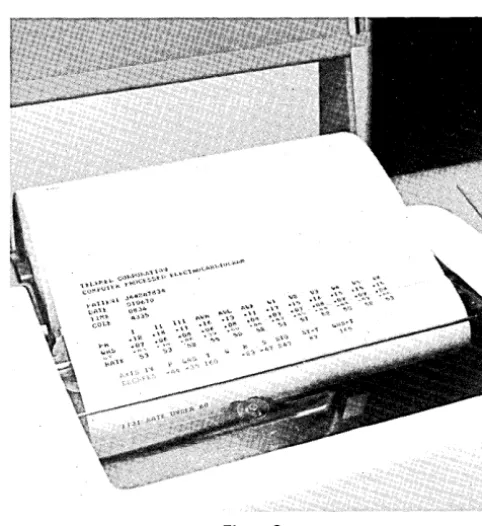
The medical profession has for many years attempted to inspire the general population of the United States to receive thorough physical examinations routinely. They have met with limited success because many of the routine tests involved, such as electrocardiograms (ECG) and spiro-grams, are relatively time consuming and represent a te-dious task when they are included as part of a regular physical exami nation. Also, the in-depth interpretations of the analyses of such tests as ECGs require a physician, preferably a Cardiologist, who is well-trained in that area of - medicine - and even then interpretive judgements may vary. To remedy this situation and relieve physicians of time consuming work, eliminate possible error, and de-crease variability in interpretations, TELEMED Corporation has established an on-line multiprocessing computer facility for real-time analysis of electrocardiograms.
An Electrocardiogram Defined
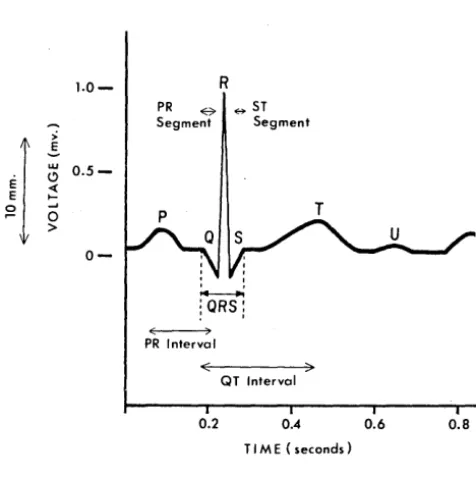
An electrocardiogram is a record, taken from the body surface, of variations in electrical potential produced by the heart. The muscular activity or pumping action of the heart is caused by an inward and outward flow of ions through membranes of the heart muscle. These alternating or pulsat-ing flows of ions precede muscular contraction and relaxa-tion, producing a polarization of the heart. Vectorally speak ing, the resultant of these various waves with their combined strength and direction is called the electrical axis of the heart. The electrical axis is affected by the patient's present physique and the condition of the heart, whether normal or damaged or diseased.
Alteration of any segment(s) of the heart will produce a corresponding change to the electrical axis of the heart, as well as to the vital parameters measured. Analysis of the component parts (waves) that make up the electrical axis of the heart will reveal the location of the damaged area. The overall measurement of the heart action is classically ac-complished through the 12 lead scalar electrocardiogram.
In approx imately 1962, a method whereby th is classical procedure could be computerized was proposed. The prog-ress which has occurred since then has resulted in the evolution of the computer analysis format described in this article.
Hardware
A duplex arrangement of Xerox Data Systems Sigma 5 computers has been programmed to measure and interpret the waves of the standard 12 lead electrocardiogram. These computer systems in their present configuration are capable of handling up to 8600 ECGs a day by accommodating simu Itaneous transmis~ion and analysis of data.
16
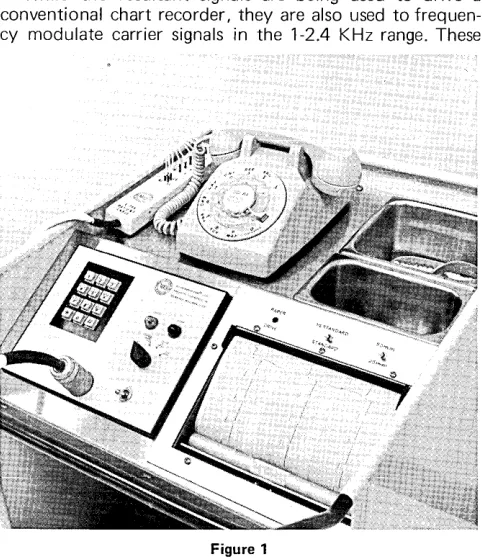
A mobile electrocardiograph unit is installed at the location (hospital, clinic, nursing home, doctors office, etc.) where the ECG is to be taken. The electrocardiograph unit is an automatic three channel data acquisition unit. It utilizes the 10 inputs of the classical 4 limb and 6 chest electrodes. A patient is wired with leads on both arms and legs (the lead on the right leg is ground), and leads on the chest. Switching circuits in the electrocardiograph unit make appropriate combinations, 12 in total, for sequential recording on three channels.
The first three combinations include the 3 possible pairs-combinations of the active limb electrodes. The next three combinations include the same pair combinations as the first three, except each combined signal is attenuated and mi xed with the remaining unattenuated limb electrode signal. Finally, the six chest electrodes are each mi xed with the attenuated signals from all three limb electrodes com-bined.
While the resultant signals are being used to drive a conventional chart recorder, they are also used to frequen-cy modulate carrier signals in the 1-2.4 KHz range. These
Figure 1
The mobile ECG car provides a classical 12 lead scalar trace while frequency modulated signals in the 1-2.4 KHz range are simu Ita-neously transmitted to the computer center over normal voice-grade telephone lines.
[image:14.612.318.559.439.718.2]