© 2019, IRJET | Impact Factor value: 7.211 | ISO 9001:2008 Certified Journal | Page 1057
Analysis of Effects of High-Density and Low-Density Polyethylene
Wastes on Bitumen for Highway Construction
Amit Kumar Sarkar
Department of Civil Engineering, College of Technology, Pantnagar, G.B. Pant University of
Agricultural & Technology
---***---Abstract - The object of this paper is to examine andcompare the effects of waste plastics namely High-density polyethylene (HDPE) and Low-density polyethylene (LDPE) in base bitumen. For this purpose, four modified bitumen with polymer content 1%, 2%, 3% and 4% and pure bitumen were prepared and tested. Rheological parameters were recorded of each specimen to draft the deviation from the base bitumen. It was observed that the bitumen with HDPE has more impact on the viscosity, softening, penetration, Marshall Stability, and ductility than the bitumen with LDPE as a modifier. The use of waste commodity plastics in binder modification carries the advantage of a cheap and effective means of enhancing conventional bitumen binder performance characteristics and is an alternative way to utilizes plastic waste.
Key Words: High Density Polyethylene, Low Density Polyethylene, Modified Bitumen, Rheological Parameters, Plastic Wastes.
1. INTRODUCTION
In the entire world, the disposal of plastic waste is a major problem. In India, people are using plastic in the form of bags, packaging material, floor tiles, pen, bottles & other products. People use them and throw them away without thinking about its hazardous effects on our beautiful environment which leads to the clogging of drains, causes flooding, chokes animals, block germination, prevent rainwater absorption by soils and release harmful gases and smell into the atmosphere. Polyethylene Terephthalate (PET) and High-Density Polyethylene (HDPE) are used in most bottling applications of water, and soft drinks. On one hand, India is developing with an increase in traffic and Indian roads have not sufficient strength to bear this load. Constructing conventional roads is uneconomical as materials used are costly and these roads do not have strengthens to fulfill the purpose.
Plastic proves to be a material which strengthens the road pavement in a considerably large amount and is also cheaper than other materials or we can say free of cost if waste materials are used. Use of plastic is also eco-friendly as in this way plastic can easily be disposed of without causing harm to the environment. One such initiative was taken in Jamshedpur in India to construct roads with waste plastics. Jamshedpur Utility and Services Company
(JUSCO) had constructed few miles in four cities of Jharkhand state of India. JUSCO said around 10 percent of bitumen can be substituted by plastic. One tonne of bitumen costs Rs 50,000 whereas the same volume of waste plastic comes for Rs 10,000. For every kilometer of a 4m wide road, using plastic wastes saves you one tonne of bitumen or Rs 40,000 net. Back in 2015, the government made it mandatory to use plastic waste in the construction of highways in India. 11 states across India have used the technology to build some 100,000 km of roads is a testament to its strength and durability.
This study will focus on using waste plastic with bitumen to construct roads. For this purpose HDPE and LDPE were used as additives and tests like penetration, softening, viscosity, ductility, and Marshall Stability was performed. With results, we drafted the deviation in respective values of mixed bitumen when the concentration of polymer was increased as 1%, 2%, 3%, and 4%. Finally, there was a comparison of the effects of HDPE and LDPE on bitumen.
2. LITERATURE REVIEW
Mahesh M Barad(2015) Explains that modified bitumen by polymer shows good properties as compare to normal bitumen. But if we add more percent of the plastic in bitumen the blend gets separates on cooling. And which finally affect the properties of bitumen. The aggregate coated with plastic shows the improved binding properties as due to an increased area of contact between bitumen and polymer.
Bright Aforlaetal (2015) He cites that the property of bitumen has increased by adding waste plastics. 2% of polymer with AC-10 bitumen can give properties which will finally help in improving the marshal stability and other desirable property. The use of waste plastic in the bituminous pavement construction is a pragmatic solution.
© 2019, IRJET | Impact Factor value: 7.211 | ISO 9001:2008 Certified Journal | Page 1058
Bindu and Beena (2010) In their study they performedvarious tests like Marshall Stability, tensile strength, compressive strength, and triaxial tests. They drafted that plastic acts as a stabilizing additive in stone mastic asphalt. The high performance and durability of flexible pavement can be achieved with 10% shredded plastic.
3. MATERIALS AND METHOD:
3.1 MATERIALS_
3.1.1 Bitumen
Indian Standard Institution defines Bitumen as a black or dark brown non-crystalline soil or viscous material having adhesive properties derived from petroleum crude either by natural or by refinery processes.
The cardinal use of bitumen is in road construction and its maintenances. Other main uses of bitumen are in products of waterproofing.
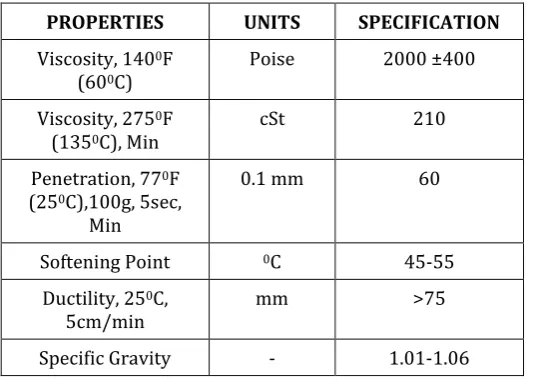
[image:2.595.309.563.176.331.2]The base bitumen was obtained from a local road contractor in U.S.Nagar, India. Physical properties of this bitumen are presented below in the table.
Table -1: Properties of Base Bitumen.
3.1.2 Fine Aggregates
Fine aggregates must pass through 2.36mm Indian standard sieve and retain on the 75-micron Indian standard sieve. Aggregates should be clean, hard, durable, and free from dust, dry and soft, organic or other deleterious matter.
3.1.3 Coarse Aggregates
The coarse aggregates must be retained on the 2.36mm sieve. Aggregates should be clean, hard, and durable, free from dust and soft, organic or other deleterious matter.
3.1.4 Additive
In India, around 70% of total plastic consumption is discarded as waste. Around 5.6 million tonnes per annum of plastic waste is generated, which is about 15,342 tonnes per day.
Chart -1: Per capita consumption of plastics.
The plastic in this study was collected from the waste plastics which people usually throw in dustbins. Two kinds of polymers were used in this study, namely High-density polyethylene (HDPE) and Low-density polyethylene (LDPE).
HDPE was collected as banners, bottle caps, coax cable inner insulator, ballistic plates, and stone papers.
LDPE was collected as juice & milk cartons, plastic wraps, packaging.
Table -2: Properties of HDPE and LDPE.
PROPERTY HDPE LDPE
Density(g/cm3) 0.96 0.917-0.930 Melting Point (0C) 220-310 220-260
Tensile Strength (MPa) 32 10
Linear Expansion (/0C*10-5)
12 20
3.2 METHOD:
3.2.1 PREPARATION OF MODIFIED BITUMEN
The wet process was implemented. Samples were prepared, using the melt-blending technique. Bitumen (500 g) was heated in the oven then the polymer was added. The mixer speed was kept around 120 rpm and temperature 160 °C-170 °C. The concentration of LDPE and HDPE ranged from 1% −4% by weight of blend with an increment of 1%. The mixing process was carried for around 60 min to produce homogenous mixtures. The PROPERTIES UNITS SPECIFICATION
Viscosity, 1400F (600C)
Poise 2000 ±400
Viscosity, 2750F (1350C), Min
cSt 210
Penetration, 770F (250C),100g, 5sec,
Min
0.1 mm 60
Softening Point 0C 45-55
Ductility, 250C,
5cm/min mm >75
[image:2.595.30.300.407.598.2]© 2019, IRJET | Impact Factor value: 7.211 | ISO 9001:2008 Certified Journal | Page 1059
polymer modified bitumen was then sealed in containersand stored for further testing. Then the following tests were carried out on this sample. For viscosity test, sample was heated at respective temperatures then it was poured on the apparatus to calculate viscosity.
4. LABORATORY TESTING:
4.1 PENETRATION TEST
It measures the hardness or softness of bitumen by measuring the depth in tenths of a millimeter to which a standard loaded needle will penetrate vertically in 5 seconds. BIS had standardized the equipment and test procedure. The Penetrometer consists of a needle assembly with a total weight of 100g and a device for releasing and locking in any position. The bitumen is softened to a pouring consistency, stirred thoroughly and poured into containers at a depth at least 15 mm in excess of the expected penetration. The test should be conducted at a specified temperature of 25 C.
Graph -1: Average penetration of HDPE and LDPE.
4.2 SOFTENING POINT
Softening point denotes the temperature at which the bitumen attains a particular degree of softening under the specifications of the test. The test is conducted by using the Ring and Ball apparatus. A brass ring containing test sample of bitumen is suspended in liquid like water or glycerin at a given temperature. A steel ball is placed upon the bitumen sample and the liquid medium is heated at a rate of 5 C per minute. Temperature is noted when the softened bitumen touches the metal plate which is at a specified distance below. Generally, higher softening point indicates lower temperature susceptibility and is preferred in hot climates.
Graph -2: Softening point of HDPE and LDPE.
4.3 VISCOSITY TEST
Viscosity is reverse of fluidity. It is a measure of the resistance to flow. Higher the viscosity of liquid bitumen, the more nearly it approaches a semi-solid state inconsistency. Thick liquid is said to be more viscous than a thin liquid of the road pavement. The bitumen binders of low viscosity, simply lubricate the aggregate particles instead of providing a uniform thin film for binding action, similarly, high viscosity does not allow full compaction and the resulting mix exhibits heterogeneous character and thus low stability values. The absolute and kinematic viscosity measurements were made at 60 °C and 135 °C respectively.
Graph -3a: Viscosity @ 600C of HDPE and LDPE.
Graph -3b: Viscosity at 1350C of HDPE and LDPE. 0
10 20 30 40 50 60 70 80 90
1 2 3 4
HDPE
LDPE SOFTENING
POINT (0C)
POLYMER PERCENTAGE (%)
0 200 400 600 800 1000 1200 1400 1600
1 2 3 4
HDPE
LDPE VISCOSITY
@ 1350 C (CST)
© 2019, IRJET | Impact Factor value: 7.211 | ISO 9001:2008 Certified Journal | Page 1060
4.4 DUCTILITY TESTDuctility of bitumen is its property to elongate under traffic load without getting cracked in road construction works. Ductility test on bitumen measures the distance in centimeters to which it elongates before breaking.
Melt the bituminous test material completely at a temperature of 75°C to 100° C above the approximate softening point until it becomes thoroughly fluid. After about 30-40 minutes, keep the plate assembly along with the sample in a water bath. Maintain the temperature of the water bath at 27° C for 1 hour. Remove the sample and mold assembly from the water bath and trim the specimen by leveling the surface using a hot knife. Replace the mold assembly in the water bath for 80 to 90 minutes. Remove the sides of the mold. Hook the clips carefully on the machine without causing any initial strain. Pull clips horizontally at a speed of 50 mm per minute. Note the distance at which the bitumen thread of specimen breaks.
Graph -4: Ductility of HDPE and LDPE.
4.5 MARSHALL STABILITY TEST
Stability can be simply described as the ability of the bituminous mixture to resist excessive permanent deformation. Stability problems typically occur within a few years or even months after construction. Stability problems often require complete removal and replacement of the rutted mixture—an expensive undertaking. Premature cracking, although costly over the life cycle of the pavement, does not present the same type of safety problem and typically occurs later in the life of the pavement. Specimen with 1, 2, 3, 4% modifier were tested each of LDPE and HDPE.
Graph -5: Marshall Stability of HDPE and LDPE.
5. RESULTS AND DISCUSSION:
5.1 There is a decrease in penetration values for both HDPE and LDPE mixed bitumen; this shows the increase in hardness and consistency of bitumen. The hardening of the bitumen can be beneficial as it increases the stiffness of the material. This is good in one sense since it might improve the rutting resistance of the mix, but on the other hand, this may affect the flexibility of the bitumen by making the asphalt much stiffer, thus the resistance to fatigue cracking can be affected.
5.2 There is an increase in softening point for both HDPE and LDPE mixed bitumen; this is because of the formation of a thermodynamically stable internal structure formed by the polymer. The increase in softening point for HDPE mixed is more than LDPE mixed. This phenomenon indicates that the resistance of the binder to the effect of heat has increased and it will reduce its tendency to soften in hot weather. The increase in softening point is an indication of greater temperature susceptibility.
5.3 There is an increase of viscosity of both HDPE mixed and LDPE mixed bitumen. There is an increment viscosity values for both graphs, viscosity @ 600 C (P) and viscosity @ 1350 C (CST). HDPE mixed shows many changes than the LDPE mixed primarily because HDPE mixed has more complex internal structures. Though there are other factors which influence viscosity, like temperature, in this study complex structure was taken into considerations.
5.4 The ductility values of both the mixed bitumen decreases. In LDPE mixed bitumen the decrease is significant throughout whereas in HDPE mixed bitumen the decrease is significant till 3% polymer then there is a gradual decrease. Optimum percentage of these polymers is necessary for the desired value of ductility of bitumen that is needed for construction work.
0 20 40 60 80 100 120 140
1 2 3 4
HDPE
LDPE DUCTILITY
(mm)
POLYMER PERCENTAGE (%)
0 1 2 3 4 5 6 7 8
1 2 3 4
HDPE
LDPE STABILITY
(kN)
© 2019, IRJET | Impact Factor value: 7.211 | ISO 9001:2008 Certified Journal | Page 1061
5.5 There is a gradual increase in the Marshall Stabilityvalue of HDPE mixed till 2% polymer where the increase in the value of LDPE mixed is significant. After 2%, the increase in value for HDPE mixed is significant whereas for LDPE mixed it is gradual. The increase in stability can be attributed to improved adhesion between the aggregate, additives, and bitumen.
6. CONCLUSION
The small percentage of additives in bitumen will definitely improve the performance of the constructed roads. Different roads at different locations will face different cardinal external influencing factors like temperature, the load on road etc, and different parameters discussed above will attain their optimum values at different percentages of the additive. So it is prominent to decide what percent of polymer must be used for a particular road construction keeping all the factors in mind. Also, the major problem which India is facing is an augmentation of waste plastics. These polymers are deleterious for our environment. Using these polymers in road construction will surely mitigate the consequences caused by these waste materials.
REFERENCES
[1] Indian Roads Congress IRC: 37-2012 - Guidelines
for the design of flexible pavements-August 2012
[2] Kandhal, P. S., & Cross, S. A. (1993). Effect of
aggregate gradation on measured asphalt content. Auburn: National Center for Asphalt Technology.
[3] Vasudevan, R., Utilization of waste plastics for
flexible pavement, Indian High Ways (Indian Road Congress), Vol. 34, No.7. (July 2006).
[4] Official website of Indian Oil about bitumen
https://iocl.com
[5] Public work department Uttrakhand, India
http://pwd.uk.gov.in
[6] Walter j. Tappeinier, “Performance and Economical
Advantage of Polymer Modified Asphalt”, Richard Felisinger, Vienna, Austria 1999.
[7] Test processes steps from NPTEL websites
https://nptel.ac.in
[8] Shiva Prasad K, Manjunath K. R, K. V R Prasad
(2012), Study on Marshall Stability Properties of BC Mix Used In Road Construction by Adding Waste Plastic Bottles, ISSN: 2278-1684 Volume 2, Issue 2 (Sep.-Oct.Aug 2012), PP 12-23
[9] Mohammad T. Awwad and Lina Shbeeb (2007),
The Use of Polyethylene in Hot Asphalt Mixtures, American Journal of Applied Sciences 4 (6): 390-396, 2007 ISSN 1546-9239
[10] Ministry of Road Transport and High Ways, Manual