warwick.ac.uk/lib-publications
Original citation:Lonsdale, Chris, Hoque, Kim, Kirkpatrick, I. and Sanderson, J.. (2017) Knowing the price of everything? Exploring the impact of increased procurement professional involvement on management consultancy purchasing. Industrial Marketing Management, 65. pp. 157-167
Permanent WRAP URL:
http://wrap.warwick.ac.uk/87769
Copyright and reuse:
The Warwick Research Archive Portal (WRAP) makes this work by researchers of the University of Warwick available open access under the following conditions. Copyright © and all moral rights to the version of the paper presented here belong to the individual author(s) and/or other copyright owners. To the extent reasonable and practicable the material made available in WRAP has been checked for eligibility before being made available.
Copies of full items can be used for personal research or study, educational, or not-for-profit purposes without prior permission or charge. Provided that the authors, title and full bibliographic details are credited, a hyperlink and/or URL is given for the original metadata page and the content is not changed in any way.
Publisher’s statement:
© 2017, Elsevier. Licensed under the Creative Commons
Attribution-NonCommercial-NoDerivatives 4.0 International http://creativecommons.org/licenses/by-nc-nd/4.0/
A note on versions:
The version presented here may differ from the published version or, version of record, if you wish to cite this item you are advised to consult the publisher’s version. Please see the ‘permanent WRAP URL’ above for details on accessing the published version and note that access may require a subscription.
1
Knowing the Price of Everything? Exploring the Impact of Increased Procurement
Professional Involvement on Management Consultancy Purchasing
Abstract
Much of the estimated $554 billion annual expenditure on management consultancy services
is accounted for by projects with a direct link to client profitability. As such, it is critical for
clients (and arguably the wider economy) that the purchase process for such services is
managed effectively. For many within the management consultancy literature, this requires
close, bilateral buy-side service end-user / supplier engagement. In recent years, however,
this bilateral engagement has been modified by a significant increase in procurement
professional involvement. This has caused concern within the management consultancy
literature as it is believed it will inevitably lead to a cost-focused approach that disrupts close
end-user / supplier engagement and causes sub-standard service outcomes. In this paper, we
explore, via qualitative research, whether this concern is justified. In the event, the analysis
suggested partial justification. However, examples of positive procurement involvement were
also reported, suggesting that existing models and assumptions within the management
consultancy literature regarding the impact of increased procurement involvement require
modification.
Keywords
2
Knowing the Price of Everything? Exploring the Impact of Increased Procurement
Professional Involvement on Management Consultancy Purchasing
1. Introduction
Much of the estimated $554 billion annual expenditure on management consultancy services
(IBIS World, 2016) is accounted for by important strategy and organisational improvement
projects that have a direct link to the future profitability of client organisations (Management
Consultancies Association, 2010; O’Mahoney et al., 2013). As such, it is critical for client
organisations (and arguably the wider economy) that the purchase process for such services is
managed effectively. Historically, it has been argued (particularly within Europe) that what
constitutes the effective management of this process is close engagement between buy-side
service end-users and representatives of suppliers – what O’Mahoney (2010) refers to as a
‘personal engagement model’.
Close engagement of this type, which incorporates considerable levels of
‘co-production’ (Bovaird, 2006), is deemed important as it enables the client organisation to
interact knowledgably with the supplier at the needs assessment (Petersen et al., 2005;
Zsidisin and Smith, 2005), sourcing (Eriksson and Pesamaa, 2007; Rousseau, 1989) and
contract management (Colling, 2005; Dyer 1997) stages of the purchase process. It is argued
that this increases the likelihood that management consultancy services, characterised as they
are by ‘intangibility … [and] high levels of transactional uncertainty’ (Glücker and
Armbrüster, 2003 p.270), will meet client need and fulfil service objectives (Bronnenmayer
3
In recent years, however, evidence has emerged suggesting that this ‘bilateral’
engagement between end-users and suppliers has been modified by a significant increase in
the involvement of buy-side procurement professionals in the management consultancy
purchase process. While such professionals have always been involved in the process in an
administrative capacity, much deeper levels of involvement have recently been reported
(O’Mahoney et al., 2013; Werr and Pemer, 2007). This is seen as part of a wider trend within
professional services (Capgemini, 2010; Hodges, 2012; World Federation of Advertisers,
2014), with around 60 per cent of respondents to one recent survey reporting ‘procurement
influence’ over professional services expenditure (AT Kearney, 2010).
This increased procurement involvement has been met with considerable concern
from within the management consultancy literature. The fear is that it will inevitably lead to
an ill-informed, over-formalised, cost-focused approach to the purchase process that disrupts
critical close, end-user / supplier engagement (O’Mahoney et al., 2013; Patel, 2005; Radnor
and O’Mahoney, 2013) and delivers standardised and sub-standard service outcomes as part
of a process of service ‘commodification’ (Hansen et al., 1999; O’Mahoney et al., 2013).
Emergent evidence suggesting procurement’s excessive rigidity over service specification
(Gelderman et al., 2015) and dismissiveness towards supplier distinctiveness (O’Mahoney et
al., 2013) has been presented in support of this view.
However, there are reasons to question these concerns, not least given that the
negative depiction of procurement professional attitudes and actions within the management
consultancy literature is at odds with their depiction within the wider purchasing and supply
management literature. Here, while variation in practice is acknowledged (Rozemejer, 2008),
procurement professionals are seen as frequently pursuing ‘value for money’ (not simply
4
as possessing a more rounded skill set (including relational skills) (Cousins et al., 2006;
Paulraj et al., 2008) than is suggested within the management consultancy literature.
As such, this paper uses qualitative research to explore whether the above-stated
concerns regarding increased procurement involvement expressed within the management
consultancy literature are in fact justified. It does this via two research questions: first, how
has increased procurement professional involvement impacted upon the purchasing process;
and, second, how can this impact be explained? The article is divided into four further
sections: a review of the extant literature, a discussion of the research approach adopted, the
presentation of the research findings and a concluding section assessing the implications for
theory and practice.
2. Close buyer-supplier engagement, procurement involvement and management
consultancy
As suggested above, the intangibility, complexity, uncertainty and bespoke nature of
management consultancy services (Glücker and Armbrüster, 2003; Mouzas and Blois, 2013;
Sturdy et al., 2009) has led many commentators to argue that the purchase process for such
services should be based upon a personal engagement model (Lian and Laing, 2007;
O’Mahoney, 2010; O’Mahoney et al., 2013; Reid, 2008). This model consists of two
connected principles. The first, drawing upon relational contracting theory (Macaulay, 1963;
Macneil, 1978; Schepker et al., 2014), is close buyer-supplier engagement at the needs
assessment, sourcing and contract management stages of the purchase process, wherein the
contract is as much concerned with promoting the co-ordination and adaptation activities that
ensure the service is customised to client need as it is with providing legal protection
(O’Mahoney et al., 2013; Zsidisin and Smith, 2005). The second is ‘bilateral’ contact
5
minor administrative role (Lian and Laing, 2007; O’Mahoney, 2010). Such end-user primacy
on the buy-side is viewed as necessary as end-users are believed to uniquely possess the
knowledge and expertise required to both identify and select suppliers that have the necessary
technical (File et al., 1994) and co-operative capabilities (O’Mahoney, 2010) and participate
meaningfully in close relationships with suppliers.
These principles are seen as relevant to all stages of the management consultancy
purchasing process. Where the needs assessment stage is concerned, end-users are seen as
best placed to determine whether external assistance is necessary (O’Mahoney, 2010) and to
define project scope (objectives, outputs and business functions involved, for example (Laing
and Lian, 2005)), often with the assistance of suppliers that are personal contacts. Where the
sourcing stage is concerned, end-users are seen as ideally placed to identify potential
suppliers, again often using personal contacts (File et al., 1994), and to evaluate and negotiate
with potential suppliers, using the negotiation process to shape potential service solutions,
establish co-production methods and develop social capital (Lian and Laing, 2007). The
outcome of these actions is often an incomplete and informal ‘psychological contract’
(Rousseau, 1989) jointly developed with the successful supplier. Where the contract
management stage is concerned, this is seen as best handled by end-users working closely
with the supplier to ‘co-produce’ (Bettencourt et al., 2002; Bovaird, 2006) the management
consultancy service (Mitchell, 1994) via a process of ‘shared learning’ (Fincham, 2006).
Supplier performance here will often be assessed as much via indirect measures such as
relationship quality as by whether the original (often no longer relevant) objectives have been
met (Mitchell, 1994). This approach accords with the ‘social learning model’ of management
consultancy, with suppliers playing the role of ‘helpers’ as opposed to ‘experts’, thus
6
However, as reported earlier, there is evidence that procurement professionals are
becoming increasingly involved in the purchase process for management consultancy
services (O’Mahoney et al., 2013; Werr and Pemer, 2007). This has been met with concern
from within much of the management consultancy literature, which, in line with Malhotra
and Murnighan (2002), views the formal controls engendered by (allegedly ill-informed)
procurement professionals as inevitably diminishing the close end-user / supplier engagement
and ‘rapport’ (Macintosh, 2009; O’Mahoney et al., 2013; Patel, 2005) upon which the
personal engagement model depends. As such, the fear is that increased procurement
involvement will result in an inappropriately cost-focused and adversarial purchase process,
leading to sub-standard ‘commodified’ services that are not customised to client need and do
not meet client objectives (O’Mahoney et al, 2013). O’Mahoney et al. (2013, p.230) argue
that this process of procurement-led commodification ‘helps procurers to reduce prices, but
also reduces the ambiguity, or “interpretative viability”, that many scholars argue is central to
the successful diffusion of consulting wares’.
There is some emergent evidence in support of these concerns. For example, at the
needs assessment stage, O’Mahoney et al. (2013) provide examples of procurement
professionals that are unwilling to listen to end-user arguments concerning service
uncertainty and complexity, while Gelderman et al. (2015) highlight excessive rigidity
towards specification. At the sourcing stage, O’Mahoney et al. (2013) report that
procurement professionals frequently display a disregard for supplier distinctiveness, leading
to cost-driven preferred supplier lists that fail to cover end-user needs. Echoing the concerns
of professional services industry bodies (Owens, 2014), several scholars (O’Mahoney et al.,
2013; Patel, 2005; Radnor and O’Mahoney, 2013) highlight examples of aggressively
7
However, there are grounds for questioning these concerns. First, while the
management consultancy literature in support of the personal engagement model is extensive,
the research on the specific issue of the recent increase in procurement involvement is as yet
limited, being confined to a small number of studies (Gelderman et al., 2015; O’Mahoney et
al., 2013; Radnor and O'Mahoney, 2013, for example). This in itself suggests further research
is warranted.
Second, as mentioned above, procurement professional attitudes and actions are
depicted in a considerably more positive light within the wider purchasing and supply
management literature than within the management consultancy literature. While it is
accepted within this literature that professional standards vary (Cousins et al., 2006;
D’Antone and Santos, 2016; Rozemeijer, 2008), procurement professionals are nevertheless
viewed as ‘trusted advisors’ who seek to support end-users, not replace them (Ellram and
Tate, 2015; Russill, 2007), and to obtain multi-faceted value for money (including
innovation), not lowest cost (D’Antone and Santos, 2016; Van Weele, 2014; Walker and
Brammer, 2009). In addition, they are seen as proponents of far-sighted category
management policies, not just short-term tactical gains (O’Brien, 2015), and, contrary to
claims within the management consultancy literature, capable of handling the uncertainty and
contractual incompleteness associated with management consultancy services, not least as
such transactional characteristics are both common to purchase processes in many other
sectors in which they are routinely involved (information technology and aerospace, for
example) and managed via techniques such as agile supply (Christopher, 2000), credible
commitments (Williamson, 1985) and close engagement with suppliers (Cox, 1996).
It might be argued, therefore, that increased procurement professional involvement
will not inherently damage the management consultancy purchasing process, but could
8
at the needs assessment stage, procurement involvement might involve providing end-users
with assistance with project scoping (Ellram and Tate, 2015). It might also involve
co-ordinating demand across the organisation, thereby aiding the development of deeper
relationships with commonly-used suppliers (Vincent, 2010; Werr and Pemer, 2007). At the
sourcing stage, procurement might (often as part of a category management exercise
(O’Brien, 2015)) assist end-users by: implementing formal supplier identification processes
(without preventing end-user exploratory discussions with suppliers); developing preferred
supplier lists that address end-user needs (Sieweke et al., 2012); establishing formal ‘request
for proposal’ exercises; getting involved earlier in negotiations (without ‘crowding out’
end-user involvement) (Gotto, 2008); and ensuring appropriate contractual protection
(Czerniawska and Smith, 2010). At the contract management stage, while end-users would
take the lead in day-to-day engagement (Ellram and Tate, 2015), procurement professionals
might nevertheless add significant value via important but ‘hands off’ activities including:
ensuring that payment matches performance in accordance with contracts (assisting with
disputes should they arise); providing suppliers with regular performance feedback (an
important aspect of close engagement); and collating and circulating end-user views on
supplier performance (to minimise adverse selection and support close engagement by
identifying co-operative suppliers) (Gotto, 2008).
As such, this paper uses qualitative research to address two research questions. First,
how has increased procurement professional involvement impacted upon the management
consultancy purchasing process? Specifically, has increased procurement involvement (as
argued in the management consultancy literature) indeed led to an ill-informed,
over-formalised, cost-focused approach that has disrupted close, end-user / supplier engagement
and, as a consequence, delivered sub-standard service outcomes that do not meet client need?
9 3. Data and Methods
As Wagner et al. (2010) argue, research design is a critical issue for business-to-business
research. The research design for this study follows what Meyer and Lunnay (2013) refer to
as an ‘abductive’ logic, where the objective is to refine and develop theories and models. As
with deductive approaches, abduction moves from theory to data. However, greater emphasis
is placed upon incorporating insights from the data that lie outside the initial theoretical
frame. Timmermans and Tavory (2012, p173) comment: ‘Rather than engaging with the
scholarly literature at the end of the research project, as inductivist approaches have often
advised, abduction assumes extensive familiarity with existing theories at the outset and
throughout every research step … [without] advocating a return to deduction based on
existing theories’. In this case, the authors took propositions that inform the personal
engagement model and, with further guidance from the purchasing and supply management
literature, refined them iteratively as the data analysis unfolded.
Within this abductive approach, the collection of qualitative data was deemed
appropriate given that the research aims were to develop a nuanced understanding of how
increased procurement professional involvement is impacting the management consultancy
purchasing process and the reasons for that impact (Bryman and Bell, 2015). Building this
understanding required accessing the perceptions of those involved directly or indirectly in
the purchasing process.
The qualitative data itself, collected between 2010 and 2012, comprises
semi-structured interviews with 50 experienced respondents (at which point saturation had been
reached, with only marginal new themes or sub-themes being raised (Guest et al., 2006)). The
respondents were identified using a purposive sampling method (Patton, 1990) aimed at
10
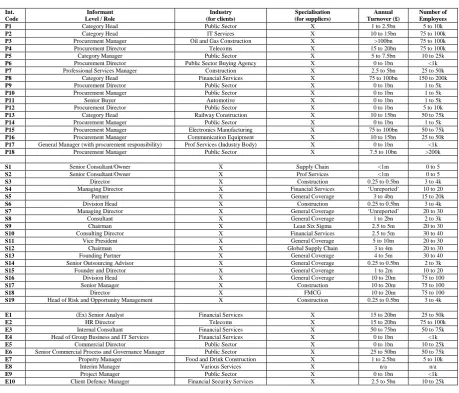
775-776). In this context, this required the inclusion within an expert sample of those directly
participating at each point of the purchase ‘triad’: buy-side procurement professionals (P, 18
in total), buy-side end-users (E, 10) and management consultancy supplier representatives (S,
19) (due to commercial concerns expressed by most of the initial interviewees, it was decided
that the supplier interviewees would not be the suppliers to the buy-side interviewees). Data
were also collected from representatives of both buy-side and supply-side peak organisations
(PO), i.e. those with indirect experience of the topic of interest. The sample, therefore,
covered all of the main relevant standpoints.
The authors were also conscious of the issue of sample balance. To this end, a similar
number of buy-side procurement and supply-side respondents were interviewed. Balance was
also furthered by the choice of peak organisations. One of the peak organisations (PO1) was
from the buy-side, one (PO3) was from the supplier-side and the third (PO2) was from a
networking organisation that acted as an intermediary between buyers and suppliers of
management consultancy services. That said, there was the potential for bias on the part of
buy-side end-users to unbalance the sample. Such managers, while possessing a duty to their
buy-side employer, may also possess both counter-balancing vested interests in meeting their
own personal objectives (risking price insensitivity) and professional affinities with supplier
representatives (via, for example, previous employment as management consultants). To help
minimise the impact of this potential bias on overall sample balance, the interview process
consciously sought to encourage these respondents to look beyond narrow vested interests.
The potential for bias was also kept firmly in mind when interpreting and coding the data.
All interviewees were UK-based (although about a third was working within
multinational corporations). On the buy-side, the sample contains respondents from public
and private sector organisations from a range of industries. On the supply-side, the sample
11
versus general coverage, for example). Full details are found in Table 1. In line with the
paper’s research questions, the interviews explored interviewee perceptions about how
increased procurement involvement has impacted upon the three stages of the management
consultancy purchasing process (needs assessment, sourcing and contract management) and
the reasons for that impact. In line with abductive reasoning, the interviewing was informed
by theoretical knowledge, but not hidebound or prejudiced by it (Timmermans and Tavory,
2012). The average length of interview was 40 minutes and all interviews were transcribed.
The interviews were conducted by telephone (40) and in person (10).
The data on interviewee perceptions were (in line with the abductive research design)
coded using a priori and grounded codes (Sang and Sitko, 2014), with the coded data then transferred to a central database to be systematically compared for themes and then
sub-themes, thereby enabling common and differentiating themes and insights to be identified (in
particular, from the different groups of interviewees) (Lichtman, 2013). Two of the authors
were involved in the interviewing and coding process. Procedures were put in place to
provide consistency in interpretation, thereby ensuring that the use of two authors in the
coding process was not to the detriment of coding reliability (Saldana, 2013). Specifically,
the two authors concerned developed a common format for the interview transcripts.
Discussions between the two authors then took place regarding both the a priori codes to which certain interview data was assigned and the grounded coding decisions made in
relation to other interview data.
INSERT TABLE 1 ABOUT HERE
In terms of the industry from which the sample was drawn, the global revenues of the
12
(IBIS World, 2016). The UK part of this market (from which the data here are drawn) was
estimated at £5.2 billion in 2014, with market growth estimated at over 8 per cent per annum,
nearly four times the growth rate of the UK economy (Management Consultancies
Association, 2015). Given the low barriers to entry, there is considerable variation between
consultancies. In 2007, small and medium-sized enterprises accounted for 98 per cent of
management consultancy firms and 78 per cent of consultants, yet the top ten largest firms by
revenue secured over 50 per cent of global revenues (O’Mahoney, 2010). The biggest
purchasers of management consultancy services are firms in the finance, manufacturing and
public sectors (O’Mahoney, 2010).
4. Empirical findings
4.1 Impact of increased procurement involvement on the management consultancy
purchasing process
In accordance with the first research question, the authors explored, via the perceptions of the
expert sample, how increased procurement involvement has impacted upon the management
consultancy purchase process, in particular whether (in line with the concerns expressed
within the management consultancy literature) it has been excessively cost-focused,
adversely affected close end-user / supplier engagement and resulted in a commodification of
management consultancy services with negative consequences for client needs and
objectives. Concerns of this nature were indeed shared by respondents across all groups
within the sample. However, the data also revealed considerable variation in procurement
impact both within and between the different stages of the purchase process, as the ensuing
13 Needs assessment
Considerable concerns were raised by some end-users regarding the impact of procurement at
the needs assessment stage. This was often in relation to the service specification. For
example, E1 commented that procurement professionals ‘never quite get the complexity of
the requirement’, adding: ‘When you get to anything that is an important ingredient [to
service delivery] it becomes hard for a central function to run with the subtleties’. E6 agreed,
saying that procurement often simplified the requirement to enable it to be specified more
precisely, while S6, S9 and S13 viewed it as an attempt to commoditise the service. Where
the procurement professionals within the sample were concerned, P2 accepted that
procurement had a reputation for ‘just buying laptops or desks and chairs’ and not
understanding services as complex as management consultancy, not least because, according
to PO2, ‘the centre of gravity for a procurement manager [in the case of management
consultancy services] … is in a different place to where it is for more tangible purchases’. P3
admitted that, to a large degree, this reputation had until recently been justified in her
organisation, as the procurement professionals involved had not stayed in post long enough to
gain a proper understanding of service complexity.
Against this, however, respondents from all three groups in the sample claimed that
increased procurement involvement at the needs assessment stage had on many occasions
significantly enhanced service outcomes. With regard to this, procurement interviewees
focused in particular upon project scoping. According to P3, ‘scope is the most important
factor’ in ensuring value for money, with P2 arguing that, historically, scoping had often been
undertaken by end-users who were technical experts, not project managers, and thus often
handled badly.
Disciplined project scoping was, in part, about protecting the client from significant
14
actions. With regard to this, P3 commented: ‘[End-users] often don’t really know what they
want and hope discussions [with consultants] will come up with something … [Procurement
doesn’t provide] technical advice, but we will look for objectives and deliverables … phases,
with milestones’. P7 added: ‘We have to buy what the business needs, [but] we bring in
structure. Across businesses there can often be a free-for-all … [so we] bring in controls and
standards’. The role of procurement professionals in mitigating potential supplier
opportunism was also raised by supply-side interviewees, with S8 noting ‘fruitful’
procurement involvement in ‘defining requirements’, this being viewed as especially
important when the end-user lacks discipline (S11). Some end-users also acknowledged
procurement’s contribution in increasing commercial protection – via ‘suggested changes and
timescales’ (E9) and shaping the requirement (E6).
Procurement involvement with project scoping did not, however, just concern the
mitigation of opportunism. It was also suggested that it could give both parties greater clarity
concerning the parameters of the project and thus provide a better basis for successful (close)
interaction between suppliers and end-users (P13). P9 commented: ‘We can try to stop …
project failure ... [which] can usually be traced back to the original method of commissioning
the project’. Greater clarity, however, did not necessarily mean being over-prescriptive. For
example, P1 had helped end-users utilise ‘outcome-based specifications’ (where appropriate)
to encourage supplier innovation. E6 concurred, highlighting the importance of such
assistance from her procurement team. A number of supplier interviewees also made similar
comments. S6, for example, remarked that procurement involvement often increased the
feasibility of the end-user specification, while S9 admitted that it had forced small consulting
firms like his to improve their service offerings and S14 said it had helped address the
15
requirements and outcomes. Procurement professionals were achieving this, according to S8,
by ‘talking through a deliverable suite of services … and asking pertinent questions’.
Overall, therefore, while some negative perceptions were reported by respondents
concerning service commodification (of a manner predicted within the management
consultancy literature), there was also widespread acceptance across the sample that
procurement professionals were often playing a valuable role at the needs assessment stage
via their involvement in project scoping.
Sourcing
Perceptions regarding the impact of increased procurement involvement also varied
considerably at the sourcing stage. In terms of specific actions, increased involvement
manifested itself in: ‘framework agreements containing agreed rate cards’ (P16); ‘a formal
tender process’ (P11); e-auctions (P12); standard-template contracts (P3); and project plans
containing formal roles and responsibilities (P9). Procurement involvement of this type could
concern single contracts or be part of a category management exercise for management
consultancy expenditure.
For some, such actions were a necessary response to sourcing problems under the
previously-dominant personal engagement model. While it was widely reported that this
model’s facilitation of close engagement between end-users and suppliers was vital for
successful service outcomes, it was also reported that such engagement could become too
close or ‘embedded’ (P1), with P9 describing arrangements where consultants were ‘engaged
on the basis of being a friend of a friend’. P3 encapsulated the mixed blessing of the personal
engagement model’s facilitation of deep and enduring end-user / supplier engagement by
describing it as a ‘double-edged sword’. She explained: ‘On the one hand, they [favoured
16
other, there can be complacency on both sides, less value-add and a need for competition’.
This created a challenge for procurement professionals, as P8 explained: ‘…you have [client
organisation] and consultancies swapping personnel, so this can be a pressure on procurement
to use a certain organisation. It is quite incestuous … you know, the FD worked in [supplier].
There are strong relationships between partners of consultancies and directors in [client
organisation]. It is all extremely political’.
These problems with the personal engagement model were also noted by end-users.
E8 insisted that close relationships were necessary, but added: ‘Partners [in supplier
organisations] … tend to be very keen on selling stuff that they can deliver. So you can, as a
client, get a very narrow view’. E7 went further and argued that a lack of proper process and,
in particular, the lack of separation of end-users from suppliers created problems of probity
similar to those described by P8 above. This lack of professional separation was also
highlighted by supplier interviewees. For example, S8 commented that ‘[E]nd-users have
their favourites that they want to use … they have prejudices or they are alumni of a provider
… there is a huge network, a social community, affiliations and this affects choices’. S2
added that supplier selection decisions were often made on the basis that the end-user
‘worked for them before or plan to work for them in the future’. In some cases, end-users
would either slant the specification in order to favour their ‘best buddies’ (S6) or allow a
favoured supplier to actually write the request for proposal – ‘you know when a competitor
has been involved in writing the RFP, you just know’ (S8). As a consequence, S8 argued that
non-incumbents often ‘need an extraordinary bid to dislodge the favourite’ and needed ‘to
speak the right language and get to the same level of trust’ that the incumbent has established.
While there was widespread agreement regarding the shortcomings of the personal
engagement model, for some, however, increased procurement involvement had merely
17
tendency to insist, against end-user wishes, on selecting lowest-cost suppliers (or only being
willing to pay low prices). S4 commented on this narrow cost focus: ‘I have never known a
conversation with procurement that has not come down to benchmarking on day rates ...
Before I would not take the call if procurement rang. Now I take the call and bore them to
death about the complexity of consulting’. S9 believed that procurement professionals were
more varied, but agreed that some did devalue and commoditise consultancy, as did S8, who
complained that they often ‘don’t have the conversation about value’. On the part of
end-users, E6 complained about procurement’s frequent pre-occupation with fixed prices, while
E3 reported its tendency to produce ‘savings reports [that were] considered irrelevant by the
business’.
This narrow procurement cost focus was seen by end-user and supplier interviewees
to have two adverse consequences. First, it resulted in the selection of suppliers that did not
possess the capabilities (including relational capabilities) necessary for delivering a service
that met client need. E8, for example, complained about being ‘forced by procurement to get
it from the wrong place’, while S7 added: ‘[Procurement] make foolish choices in terms of
suppliers that … are not qualified for the particular project’. S2 (previously a buyer of
management consultancy services), suggested that procurement indifference to supplier
distinctiveness ran deep: ‘If I could not identify the best [supplier] … I would die of shame.
But I have never met a management consulting category manager who knows it’.
Second, it led to some suppliers, seeing the low prices on offer, exiting the purchasing
process or reducing their level of engagement. For example, S10 and S11 only pursued
contracts where they could use personal engagement, as against joining a procurement-driven
formal competition. Others were prepared to enter procurement-driven competitions, but
lowered both their commitment to the contract and the quality of delivery team in line with
18
team’. PO2 similarly called on procurement professionals to ‘get in tune with the dynamics of
the requirement’ and not ‘lose the opportunity to get the “A” team.’
Procurement’s shortcomings at the sourcing stage were recognised by some of the
procurement interviewees themselves. For example, P18 commented: ‘From the procurement
view, the benefits have been a reduction in contractors and costs. From the business view,
there is a perception that they can’t get the individual they want’. Similarly, P9 reported that
his team’s sourcing actions were ‘not consistent, patchy’ in terms of their effectiveness and
P5 confessed that procurement was running the sourcing process without adding any value:
‘we’ve not nailed it yet … [we are] not driving performance’.
Yet while respondents were discernibly less positive about procurement involvement
at this stage (as against the needs assessment stage), there were still reports from all groups in
the sample that procurement had improved value for money outcomes on at least some
occasions. A number of the procurement interviewees, not surprisingly, provided evidence of
positive involvement. P8, for example, described more proactive ‘global category
management’ involving procurement ‘looking at the market in advance of the end-user
indicating a requirement, finding specialist suppliers … interviewing suppliers … and
developing selection criteria’. He reported that this had led to ‘better lead times, less project
creep or overspend and … savings reports’, adding that ‘end-users are happy that these
savings have been made without projects being affected’. P3, meanwhile, reported
double-digit price reductions within her organisation, again without affecting service quality, during
an ongoing move towards category management: ‘We agree criteria with stakeholders before
the RFP … [and] help with knowledge of other similar projects within the company and
market knowledge – about capacity in the market, when we can [negotiate] a lower or pro
19
Where end-users were concerned, E2 reported that a category management exercise
within her organisation, in particular the negotiation of a preferred supplier list, had
demonstrated that there was no conflict between attention to cost and service quality: ‘[We]
became more conscious about what we were paying … [but also] quality-wise, the PSL
[preferred supplier list] allows consistency and allows us to see which suppliers are the best’.
E4 likewise believed that savings of between 10 to 20 per cent could be negotiated on many
occasions without service quality being damaged, while E7 reported both improved and more
transparent supplier selection and more systematic contract management, interventions that
had led to (audited) improvements on both sides of the value for money equation. On the
supply-side, S8 reported that ‘some [client organisations] have done category management
and developed a strategic panel of suppliers … These firms have definitely moved on’. The
positive procurement involvement in sourcing was said to be particularly in the case of the
less complex ‘body-shopping’ (P5) management consultancy projects (E8 and S10, for
example), a reminder that the management consultancy service category is itself varied.
Overall, therefore, while procurement involvement was viewed less positively at this
stage than at the needs assessment stage, the expert sample nevertheless reported positive as
well as negative interventions, with numerous reports of the positive effects of category
planning. Furthermore, given the considerable reported shortcomings of the personal
engagement model at the sourcing stage, there were doubts as to whether a return to this
model would be an appropriate response to procurement shortcomings.
Contract management
As outlined above (Ellram and Tate, 2015), even in the context of increased procurement
involvement, the procurement function would be expected to perform a largely ‘hands off’
20
actions were reported by respondents. P8, for example, described providing ‘a framework to
support project management … [containing] clear deliverables, target dates and milestones
[linked] to invoice payments’. Periodic progress checking as to ‘whether the consultants have
delivered the deliverable’ (P3) was also widely reported (although E7 said that end-users took
over after a few months and S7 and P5 noted end-users often being ‘reluctant to be open
about the performance of an assignment’). E9, meanwhile, commented positively on
procurement’s role of being available to end-users when required: ‘[We were] a genuine team
… [Procurement] was very happy with the role … They were happy to step out. We were
involving them, rather than them trying to get involved with us’. When procurement was
called in, E4 and E6 both recalled that it was to assist with contractual disputes between
end-users and suppliers, procurement being deemed as better qualified to deal with such matters.
Some procurement professionals, however, were going beyond this ‘hands off’ role
and engaging in day-to-day contract management. This was viewed by many within the
sample as frequently being harmful to close buyer-supplier engagement and service
outcomes. S4, for example, reported procurement ‘getting in between and in the way of the
client and consultant’ during contract execution, while E10 added: ‘[Procurement is] a barrier
between the supplier and the end-user’. According to S19, this barrier was being created
because procurement involvement here was often too administrative and lacking in
understanding of service delivery and, as a result, was leading to very simplistic forms of
monitoring. S8 agreed, adding that some procurement professionals ‘want to get involved,
but can’t add value and don’t really understand the project … and can easily create a bad
situation for the rest of us’. E8 argued that this lack of understanding was then exacerbated by
poor relational skills: ‘You need someone who knows how to deal with “partners” as against
companies. You have to incentivise and manage partners differently to get a good deal’.
21
procurement ‘needs to recognise that close relationships are not necessarily bad’ and P1
warned that procurement needed to be careful to avoid ‘no-go areas’ that could affect
end-user relationships with suppliers.
At the contract management stage, therefore, respondent views concerning the impact
of procurement involvement were again varied. Problems arose when ill-equipped
procurement professionals ventured beyond their recommended supportive role and disrupted
close buyer-supplier engagement. However, there were also reports of important ‘hands off’
procurement involvement which added value to end-users during contract execution.
Summary
The paper’s first research aim was to explore how increased procurement involvement has
impacted upon the management consultancy purchasing process. The respondents’
perceptions regarding this suggest that its impact has varied both between and within the
three stages of the purchasing process. While many of the concerns expressed within the
management consultancy literature were reported by the respondents, there were also
examples of positive procurement involvement. This was particularly the case at the needs
assessment stage, where procurement involvement in project scoping was often regarded as
beneficial. Where the sourcing stage was concerned, while respondents were noticeably less
positive, there were nevertheless indications that procurement has a potentially important role
to play by, for example, supporting category planning via assistance with request for proposal
exercises, negotiations and, in particular, flexible preferred supplier lists. At the contract
management stage, procurement’s contribution was viewed positively where it recognised the
need for an important but ‘hands off’ role, but negatively where it attempted to become more
22
Having outlined the perceived variation in the impact of increased procurement
involvement, therefore, the paper now proceeds to the second research question – how might
the impact of procurement involvement be explained?
4.2 Explaining the reported variation in procurement impact
Explaining variation in procurement impact between purchasing stages
As outlined above, procurement involvement was viewed most positively at the needs
assessment stage and least positively at the sourcing stage. In explaining this, a number of
insights were provided by the respondents as to why there were often very positive views of
procurement involvement at the needs assessment stage. First, there was a perception on the
part of some respondents that certain aspects of increased procurement involvement at this
stage were inherently less threatening to end-users (and suppliers) than involvement at the
sourcing and contract management stages. This was because, particularly in the case of
project scoping, procurement was seeking to shape rather than overturn end-user (and
supplier) preferences. As a result, end-users (and suppliers) appeared often to be quite
receptive to procurement involvement, with this promoting productive joint-working. PO3,
from the supply-side peak organisation, described this complementary role as procurement
‘getting the internal client [end-user] to better frame the brief and the specification and help
the consultancies understand what they are being asked to pitch for, the need and the
context’. Second, because the very nature of project scoping requires relatively little
service-specific knowledge on the part of procurement professionals, more such professionals were
able to contribute in a manner that was valued by end-users (and suppliers). Procurement
23
A very different situation existed, however, at the sourcing stage. First, end-users and
(favoured) suppliers saw a significant inherent threat in procurement involvement. There
were, as E8 and S7 commented above, fears of being forced by procurement into
inappropriate supplier choices. Second, much higher levels of service-specific knowledge are
required for successful procurement involvement at this purchasing stage – for example, P12
commented: ‘It is about knowing your market’. However, as has been shown above, not all
procurement professionals possess such knowledge. As a result of these two factors,
procurement involvement was regarded less favourably and, indeed, often resisted at this
stage of the process.
Procurement involvement at the contract management stage had the potential to be
similarly problematic, with end-users (and suppliers) again perceiving procurement as a
threat and there again being a requirement for high levels of service-specific knowledge.
Indeed, examples were provided of procurement disrupting vital co-production relationships
between end-users and suppliers – as mentioned, E10 described procurement as a ‘barrier’,
for example. However, perceptions of procurement involvement at this stage were less
negative than those regarding involvement at the sourcing stage because of a further factor –
namely, that, in line with the purchasing and supply management literature (Ellram and Tate
(2015), for example), many procurement professionals saw ‘hands-on’ contract management
as the domain of end-users. P8 commented, for example: ‘Procurement does not and should
not be involved in [hands-on] contract management, either now or before’. His reasoning was
that, even if procurement professionals possessed service-specific knowledge, end-user
‘personal relationships with providers are a big part of [management consultancy]’. Instead,
at this stage, many procurement professionals (even where they possessed significant levels
of service-specific knowledge) were accepting of a more limited, although still important,
24
meetings with them on high value contracts’. This acceptance on the part of many
procurement professionals of a limited ‘hands off’ role reduced the scope for negative
perceptions on the part of end-users (and suppliers).
Explaining variation in procurement impact within purchasing stages
Variation in procurement impact was also perceived within each process stage. Three main
explanations for this were suggested by the interviewees. First, in order for increased
procurement involvement to have a positive impact, procurement professionals were seen to
require service-specific knowledge. Some procurement professionals, for example P10, had
built up such knowledge over time, having had long experience of buying management
consultancy. However, service-specific knowledge within procurement functions had also
been enhanced via the hiring of former management consultants into procurement roles.
Former management consultants were seen as particularly useful in combatting the supplier
opportunism that, as reported earlier, the personal engagement model could facilitate. P3
reported: ‘[Ex-management consultants] understand credible rates and have an appreciation
of how consultants work – they understand the black arts of how they organise themselves’,
while P2 added that such a person ‘knows how the game works … whether you need one
person for this task or two’ and P6 reported that they ‘know the tricks’. According to P8,
these tricks could often be far-reaching and involved ‘massive intelligence gathering from
end-users about rates paid in [firm name]. We call it “terrorist activity”. And as they are on
site there is lots of opportunity for this. They can really feather their nests if they try hard’.
Some supply-side respondents (S6, S8 and S18), not surprisingly, also spoke
positively about the procurement professionals that were former members of their industry
(notwithstanding that they might limit their ‘terrorist activity’) and the growing number of
25
some procurement functions were showing greater maturity (S15), the result being that they
were procuring ‘more intelligently … [taking] account of differences between firms’ (S7).
PO3, from the supply-side peak organisation, summarised thus: ‘Having ex-consultants in the
buying team can even things up a bit. It eases the worry that the consultant is going to outwit
[the client] at every stage’.
A second explanation reported for variation within each of the purchasing stages was
the ability (or otherwise) of procurement professionals to develop the social capital necessary
for positive working relationships with end-users and suppliers. With respect to this, while
E2, for example, reported positively about procurement building ‘personal relationships and
understanding’, the development of social capital with end-users was seen as a problem for
procurement by many within the sample. Procurement professionals in many organisations
were seen to be still operating as ‘outsiders’ within the triad. S2 commented: ‘On how many
occasions does the internal stakeholder talk to [procurement] before talking to the supplier?
The standard for category management [in general] is ninety per cent plus. Very few are there
[in management consultancy]’. E1 believed much of this was due to a lack of social skills:
‘Firms need to recruit a procurement head that is clubbable, part of the team. But many come
over as actually quite odd in the financial environment and do not get how the business
operates … Most do not have the personality to get heard’.
In this context, it was widely agreed that ‘credibility is key with internal end-users’
(P8) and that procurement professionals ‘need to find a way to have credibility’ (S2).
With respect to this, P1 (central government) reported running sessions on ‘commercial
awareness’ aimed at changing end-user impressions of procurement as a ‘blocker’, while P3
argued that the aforementioned former management consultants were ‘useful in building
credibility with stakeholders’ because of their service-specific knowledge and relevant
26
record of results, a route which P2 described: ‘We saved 17 to 18 per cent on a six-year
contract [in a different professional service category] - this gave us credibility’.
A third explanation for variation within purchasing stages related to the way in which
procurement professionals perceived their role. Particularly important here was whether
procurement professionals sought to support rather than displace end-users within the
purchase process. With respect to this, some procurement interviewees described themselves
as seeking to ‘assist’ (P11) and be ‘a critical friend’ (P9). Explaining this mind-set further, P3
commented that ‘you come in when [the end-users] have been given a budget and want
guidance’, while P8 said: ‘It is not the job of procurement to tell end-users who to use … We
support not lead’. On a more ‘political’ note, P7 talked of the need to ‘bring along
stakeholders’, describing it as ‘the only way to make it stick in the implementation phase’.
PO2 (recounting a former procurement role) provided an example of what this supportive
role could mean for sourcing practice: ‘We would break the market into bits, niches, etc., and
then ask stakeholders who they wanted in each part of the market. The list would be the first
port of call on a project, but we were flexible if the list couldn’t meet their needs’.
There was some appreciation that many procurement professionals perceived their
role in this manner among the end-users within the sample, with, as mentioned, E9
commenting positively about procurement being ‘happy to step out’ and E2 reporting
similarly about an arrangement whereby she would call in procurement for assistance. Where
supplier interviewees were concerned, S3 and S6 were somewhat scornful of this supportive
role, as they were not cognisant that many procurement professionals actually aspired to it. In
other cases, however, they did understand this and referred to the positive impact of
procurement providing support to end-users in the form of advice and guidance (S15). This
was in relation to, for example, executing process formalities appropriately (S12), increasing
27
The respondents, therefore, reported that procurement involvement tended to be more
positive when procurement professionals possessed service-specific knowledge, were able to
develop social capital with end-users and were content to perform a supportive role as against
seeking to replace end-users. In the procurement literature, these are often referred to as
elements of ‘procurement maturity’ (D’Antone and Santos, 2016). Also notable was the
considerable degree of unanimity between the procurement professionals, end-users and
suppliers within the sample with regard to this, suggesting an emergent common view of
procurement ‘best practice’ in management consultancy purchasing.
Summary
The paper’s second research question concerned how the impact of increased procurement
involvement might be explained. With respect to this, the respondents viewed the reported
variation in procurement impact between purchasing stages to be explained by differences in
the degree to which end-users (and suppliers) felt procurement involvement to be a threat to
their interests (with a lower threat perceived at the needs assessment stage than at the other
two stages) and the level of service-specific knowledge required at each stage (with lower
levels of such knowledge required at the needs assessment stage than at the other two stages).
In terms of the reported variation within purchasing stages, the respondents reported that
procurement involvement tended to be more positive when procurement professionals
possessed service-specific knowledge, social capital and acceptance of a supportive role.
5. Discussion and Conclusions
This article has explored, via qualitative research, the concerns expressed within the
management consultancy literature about the increased involvement of procurement
28
procurement involvement is ill-informed, excessively cost-focused, disruptive of close
buyer-supplier engagement and, as a result, detrimental to service outcomes (O’Mahoney et al.,
2013; Radnor and O’Mahoney, 2013). These concerns are part of a wider argument in the
literature in favour of the continued use of the personal engagement model for management
consultancy purchasing (Lian and Laing, 2007; O’Mahoney, 2010; O’Mahoney et al., 2013;
Reid, 2008). The analysis makes several contributions to this literature.
First, the research findings corroborate some of the concerns outlined above regarding
the impact of increased procurement involvement. There was considerable agreement across
the different groups within the sample that procurement involvement frequently led to the
selection of inappropriate suppliers and the undermining of close end-user / supplier
engagement, and was often part of a damaging attempt to commoditise management
consultancy in the cause of cost reduction (O’Mahoney et al., 2013). However, more positive
views were also expressed, particularly at the needs assessment stage where procurement
assistance with project scoping was widely seen as improving both commercial risk
management and, in line with Ellram and Tate (2015), end-user / supplier interaction.
Interviewee perceptions of procurement were less positive at the sourcing and contract
management stages, but even here there were reports of beneficial involvement with respect
to, for example, preferred supplier lists and contract management frameworks. As such, the
first contribution of the paper, in line with the wider purchasing and supply management
literature (Cousins et al., 2006; Ellram and Tate, 2015, for example), is to call into question
the widespread view within the management consultancy literature that an increase in
procurement involvement will automatically have negative consequences for the purchasing
process.
The paper’s second contribution is that it provides explanations for why increased
29
terms of the more positive perceptions of involvement at the needs assessment stage, as
against the sourcing and contract management stages, this was seen as due to procurement
involvement here posing less of a threat to end-user interests and requiring lower levels of
service-specific knowledge. The analysis also identified variation in the perceptions of
increased procurement involvement within each process stage. This was explained with
respect to procurement professional possession of service-specific knowledge, an ability to
develop social capital with end-users and an appreciation of the need to play an important yet
supportive role to end-users. The latter finding reinforces the view of those within the
purchasing and supply management literature (Ellram and Tate, 2015; Fitzsimmons et al.,
1998), and certain voices in the management consultancy literature (Czerniawska and Smith,
2010; Pemer et al, 2014; Vincent, 2010), who argue that there is a role for procurement in
complex services purchasing, but that the task is qualitatively different from, for example,
production, commodity services and construction procurement tasks and hence requires
specific expertise, sophisticated managerial qualities and targeted involvement.
The paper’s third contribution is that it suggests, at least where the purchase of
management consultancy services is concerned, that the historically-favoured personal
engagement model suffers from significant shortcomings, particularly at the sourcing stage of
the purchase process. Respondents within the expert sample reported that many service
purchases made under the personal engagement model were affected by governance problems
(Day et al., 2011), relating in particular to personal affinities affecting supplier selection
decisions. Such problems can have adverse commercial consequences and are increasingly
deemed unacceptable as a matter of principle (Chartered Institute of Purchasing and Supply,
2013). As such, the research supports the minority concerns in the literature about the use of
the personal engagement model in the purchase of management consultancy services
30
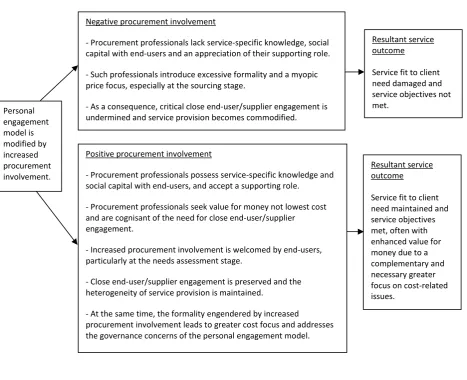
Bringing these contributions together, this paper calls into question the established
view within the management consultancy literature, illustrated in Figure 1(a), that movement
away from the personal engagement model will automatically have a deleterious impact on
the management consultancy purchase process and outcomes (for example, O’Mahoney et al.,
2013; Owens, 2014). Instead, the paper posits an alternative view of how increased
procurement involvement is impacting the management consultancy purchase process and
why (see Figure 1 (b)). In this view, the impact of increased procurement involvement is
varied.
Inthe first scenario within Figure 1(b), increased procurement involvement is a
negative development (as argued in the extant management consulting literature), with
ill-equipped managers pursuing excessive formality and a myopic price focus. Here, critical
close buyer-supplier engagement is undermined and services commodified, with deleterious
consequences for service outcomes. This scenario was indeed observed in our research and it
remains a key concern that greater procurement involvement in management consultancy
purchasing is on many occasions having negative effects of this nature. Against this,
however, the research also observed a second scenario (also outlined in Figure 1(b)). In this
scenario, procurement professionals have relevant service-specific knowledge and significant
social capital, and appreciate the need to play a supportive role in pursuit of a balanced value
for money objective. As such, critical close buyer-supplier engagement is preserved and even
enhanced, with positive consequences for service outcomes.
Accordingly, the paper advances three propositions for future research into
management consultancy services purchasing. The first is that there is potential for
procurement to impact positively the management consultancy purchase process in a manner
that complements close end-user / supplier engagement. The second is that procurement
31
and contract management stages. The third is that the extent to which procurement has a
positive impact on the purchasing process depends on the extent to which procurement
professionals possess service-specific knowledge, an ability to develop social capital with
end-users and an acceptance of a supportive role to end-users.
It might also be argued that the second observed scenario within (b) is preferable to
the currently dominant personal engagement model as a normative model for the
management consultancy purchasing process (Lian and Laing, 2007; O’Mahoney, 2010;
O’Mahoney et al., 2013; Reid, 2008). This is because the supportive procurement
involvement in this scenario not only preserves close buyer-supplier engagement and positive
service outcomes, but also has a necessary greater (yet balanced) focus on the cost side of the
value for money equation and is able to address the governance concerns associated with the
personal engagement model within the area of management consultancy (Czerniawska and
Smith, 2010; Pemer et al, 2014; Vincent, 2010; Werr and Pemer, 2007). This accords with
D’Antone and Santos (2016, pp. 180-182) who argue that procurement, where there is
significant ‘maturity … and orientation to innovation’, does have a role to play within
management consultancy purchasing and that, while there is no single model for procurement
involvement, it ‘should interact intensively’ with end-users and suppliers as part of a triad.
INSERT FIGURE 1 ABOUT HERE
The analysis presented here has several implications for management practice. First,
the personal engagement model (O’Mahoney, 2010) has been shown in the research here to
possess shortcomings with respect to management consultancy purchasing, particularly with
32
might, therefore, be important in addressing these shortcomings within organisations where
the personal engagement model still prevails.
Second, it is important that any increased procurement involvement should not just
involve the transfer of staff from other procurement roles, especially if this increased
involvement extends to the sourcing and contract management stages. Instead, specific
investment in recruitment (possibly targeting former management consultants) and /or
management consultancy-specific training will be required. Where levels of management
consultancy expenditure do not warrant such an investment, it may be necessary to limit
procurement involvement to the needs assessment stage. A further option would be to engage
third-party assistance.
Third, the research shows that the management consultancy services end-user
community within buying organisations is very diverse and includes senior managers and
executives. As a result, if procurement professionals are to engage meaningfully in the
procurement process they need to adopt a supportive role and possess significant social
capital and credibility with end-users. The latter again suggests the need for the recruitment
of former management consultants. It also suggests a role for interpersonal skills training
(Tassabehji and Moorhouse, 2008) and cross-functional team working in order to develop
greater empathy and understanding between procurement professionals and end-users
(Driedonks et al., 2014; Kiratli et al., 2016).
Several caveats and avenues for future research also need to be kept in mind with
regard to the research presented here. First, as mentioned earlier, the sample in this study was
not entirely balanced in its composition, due to the potentially skewed perspective of buy-side
end-users. Second, the research reported here, for reasons of commercial confidence, did not
include buy and sell-side participants of the same service purchase. Future research might
33
procurement involvement in Figure 1(b), further research is needed to identify whether there
are additional factors not present in the research here that impact upon effective procurement
involvement in management consultancy services purchasing, allowing a development of the
positive scenario in Figure 1(b). Such research could also identify whether the depiction of
procurement involvement in 1(b) was observed in a wider range of service and geographical
contexts. Finally, further research might investigate specific aspects of the research, in
particular the apparent buy-side trend of recruiting former management consultants that
appears to be enhancing procurement ‘maturity’ in management consultancy purchasing.
Such research would make a valuable contribution to not only the management consultancy
literature, but also the literature (Ellram and Tate, 2015; Schoenherr et al., 2012, for example)
on services purchasing more broadly.
References
AT Kearney (2010). Higher Visibility, Greater Expectations. Chicago: AT Kearney.
Bettencourt, L., A. Ostrom, S.Brown and R. Roundtree (2002). ‘Client co-production in
knowledge-intensive business services’, California Management Review, 45, pp.
100–128.
Bovaird, T. (2006). ‘Developing new forms of partnership with the ‘market’ in the
procurement of public services’, Public Administration, 84, pp. 81-102.
Bronnenmayer, M., B. Wirtz and V. Gottel (2016). ‘Determinants of perceived success in
management consulting: an empirical investigation from the consultant
perspective’, Management Research Review, 39, pp. 706 – 738.
Bryman, A. and E. Bell (2015). Business Research Methods. Oxford: Oxford University
34
Capgemini (2010). Global Chief Procurement Officer Survey 2010. London: Capgemini.
Chartered Institute of Purchasing and Supply (2013). Code of Conduct.
Easton-on-the-Hill: Chartered Institute of Purchasing and Supply.
Christopher, M. (2000). ‘The agile supply chain: competing in volatile markets’,
Industrial Marketing Management, 29, pp. 37-44.
Colling, T. (2005). ‘Managing human resources in the networked organisation’. In S.
Bach (ed), Managing Human Resources, pp. 90-112. London: Blackwell.
Cousins, P., B. Lawson and B. Squire (2006). ‘An empirical taxonomy of purchasing
functions’, International Journal of Operations and Production Management, 26,
pp. 775-794.
Cox, A. (1996). ‘Relational competence and strategic procurement management’,
European Journal of Purchasing and Supply Management, 2, pp. 57-70.
Czerniawska, F. and P. Smith (2010). Buying Professional Services. London: The
Economist.
D’Antone, S. and J. Santos (2016). ‘When purchasing professional services supports
innovation’, Industrial Marketing Management, 58, pp. 172-186.
Day, M., M. Webb and J. Hughes (2011). ‘The value of value in supplier relationships’,
Dilf Orientering, 48, pp. 5-13.
Driedonks, B., J. Gevers and A. van Weele (2014). ‘Success factors for sourcing teams:
how to foster sourcing team effectiveness’, European Management Journal, 32,