warwick.ac.uk/lib-publications
Manuscript version: Author’s Accepted Manuscript
The version presented in WRAP is the author’s accepted manuscript and may differ from the
published version or Version of Record.
Persistent WRAP URL:
http://wrap.warwick.ac.uk/120117
How to cite:
Please refer to published version for the most recent bibliographic citation information.
If a published version is known of, the repository item page linked to above, will contain
details on accessing it.
Copyright and reuse:
The Warwick Research Archive Portal (WRAP) makes this work by researchers of the
University of Warwick available open access under the following conditions.
Copyright © and all moral rights to the version of the paper presented here belong to the
individual author(s) and/or other copyright owners. To the extent reasonable and
practicable the material made available in WRAP has been checked for eligibility before
being made available.
Copies of full items can be used for personal research or study, educational, or not-for-profit
purposes without prior permission or charge. Provided that the authors, title and full
bibliographic details are credited, a hyperlink and/or URL is given for the original metadata
page and the content is not changed in any way.
Publisher’s statement:
Please refer to the repository item page, publisher’s statement section, for further
information.
The Reachability Problem for Petri Nets Is Not Elementary
∗
Wojciech Czerwiński
University of Warsaw Poland
Sławomir Lasota
University of Warsaw Poland [email protected]
Ranko Lazić
University of Warwick UK
Jérôme Leroux
CNRS & University of Bordeaux France
Filip Mazowiecki
University of Bordeaux France
filip.mazowiecki@u- bordeaux.fr
ABSTRACT
Petri nets, also known as vector addition systems, are a long estab-lished model of concurrency with extensive applications in
mod-elling and analysis of hardware, software and database systems, as well as chemical, biological and business processes. The central
algorithmic problem for Petri nets is reachability: whether from the given initial configuration there exists a sequence of valid execution
steps that reaches the given final configuration. The complexity of the problem has remained unsettled since the 1960s, and it is one of the most prominent open questions in the theory of verification.
Decidability was proved by Mayr in his seminal STOC 1981 work, and the currently best published upper bound is non-primitive
re-cursive Ackermannian of Leroux and Schmitz from LICS 2019. We establish a non-elementary lower bound, i.e. that the reachability
problem needs a tower of exponentials of time and space. Until this work, the best lower bound has been exponential space, due to
Lipton in 1976. The new lower bound is a major breakthrough for several reasons. Firstly, it shows that the reachability problem is much harder than the coverability (i.e., state reachability) problem,
which is also ubiquitous but has been known to be complete for exponential space since the late 1970s. Secondly, it implies that
a plethora of problems from formal languages, logic, concurrent systems, process calculi and other areas, that are known to admit
reductions from the Petri nets reachability problem, are also not ele-mentary. Thirdly, it makes obsolete the currently best lower bounds
for the reachability problems for two key extensions of Petri nets: with branching and with a pushdown stack.
At the heart of our proof is a novel gadget so called the
facto-rial amplifier that, assuming availability of counters that are zero
∗
This research has been supported by the ERC project ‘Lipa’ within the EU Horizon 2020 research and innovation programme (No. 683080), NCN grants ’Separation problems in automata theory’ (2016/21/D/ST6/01376) and ‘Automatic analysis of concurrent systems’ (2017/27/B/ST6/02093), ANR programmes IdEx Bordeaux (ANR-10-IDEX-03-02) and BraVAS (ANR-17-CE40-0028), and the Leverhulme Trust Research Fellowship ‘Petri Net Reachability Conjecture’ (RF-2017-579).
Permission to make digital or hard copies of all or part of this work for personal or classroom use is granted without fee provided that copies are not made or distributed for profit or commercial advantage and that copies bear this notice and the full citation on the first page. Copyrights for components of this work owned by others than the author(s) must be honored. Abstracting with credit is permitted. To copy otherwise, or republish, to post on servers or to redistribute to lists, requires prior specific permission and /or a fee. Request permissions from [email protected].
STOC ’19, June 23–26, 2019, Phoenix, AZ, USA
© 2019 Copyright held by the owner/author(s). Publication rights licensed to ACM. ACM ISBN 978-1-4503-6705-9/19/06. . . $15.00
https://doi.org/10.1145/3313276.3316369
testable and bounded byk, guarantees to produce arbitrarily large
pairs of values whose ratio is exactly the factorial ofk. We also
de-velop a novel construction that uses arbitrarily large pairs of values
with ratioRto provide zero testable counters that are bounded byR.
Repeatedly composing the factorial amplifier with itself by means
of the construction then enables us to compute in linear time Petri nets that simulate Minsky machines whose counters are bounded
by a tower of exponentials, which yields the non-elementary lower bound. By refining this scheme further, we in fact establish hardness
forh-exponential space already for Petri nets withh+13 counters.
CCS CONCEPTS
•Theory of computation→Computability.
KEYWORDS
Petri nets, vector addition systems, reachability problems
ACM Reference Format:
Wojciech Czerwiński, Sławomir Lasota, Ranko Lazić, Jérôme Leroux, and Filip Mazowiecki. 2019. The Reachability Problem for Petri Nets Is Not Elemen-tary. InProceedings of the 51st Annual ACM SIGACT Symposium on the
Theory of Computing (STOC ’19), June 23–26, 2019, Phoenix, AZ, USA.ACM,
New York, NY, USA,10pages.https://doi.org/10.1145/3313276.3316369
1
INTRODUCTION
Petri nets [45], also known as vector addition systems [23], [18,
cf. Section 5.1], [20], are a long established model of concurrency
with extensive applications in modelling and analysis of hardware
[7,28], software [6,17,21] and database [4,5] systems, as well as
chemical [1], biological [2,44] and business [36,50] processes (the
references on applications are illustrative). The central algorithmic problem for Petri nets is reachability: whether from the given initial
configuration there exists a sequence of valid execution steps that reaches the given final configuration.
There are several presentations of Petri nets, and a number of
variants of their reachability problem, all of which are equivalent.
One simple way to state the problem is: given a finite setTof integer
vectors ind-dimensional space and twod-dimensional vectorsv
andwof nonnegative integers, does there exist a walk fromvto
wsuch that it stays within the nonnegative orthant, and its every
step modifies the current position by adding some vector fromT?
Brief History of the Problem.Over the past half century, the com-plexity of the Petri nets reachability problem has remained
activity. After an incomplete proof by Sacerdote and Tenney [47],
decidability of the problem was established by Mayr [39,40], whose
proof was then simplified by Kosaraju [24]. Building on the further
refinements made by Lambert in the 1990s [25], there has been
substantial progress over the past ten years [29–31], culminating
in the first upper bound on the complexity [32], recently improved
to Ackermannian [33].
In contrast to the progress on refining the proof of decidability
and obtaining an upper bound on the complexity, Lipton’s landmark result that the Petri nets reachability problem requires exponential
space [37] has remained the state of the art on lower bounds for over
40 years. Moreover, in conjunction with an apparent tightness of
Lipton’s construction, this has led to the conjecture that the problem
is ExpSpace-complete becoming common in the community.1
Main Result and Its Significance.We show that the Petri nets reachability problem is not elementary, more precisely that it is hard for the class Tower of all decision problems that are solvable in time or space bounded by a tower of exponentials whose height
is an elementary function of the input size [48, Section 2.3]. We see
this result as important for several reasons:
•It refutes the conjecture of ExpSpace-completeness,
estab-lishing that the reachability problem is much harder than the
coverability (i.e., state reachability) problem; the latter is also ubiquitous but has been known to be ExpSpace-complete
since the late 1970s [37,46].
•It narrows significantly the gap to the best known upper
bound [33] in terms of the Ackermannian function, which
is among the slowest-growing functions that dominate all primitive recursive functions.
•It implies that a plethora of problems from formal languages
[9], logic [8,10,11,22], concurrent systems [14,16],
pro-cess calculi [42], linear algebra [19] and other areas (the
references are again illustrative), that are known to admit
reductions from the Petri nets reachability problem, are also not elementary; for more such problems and a wider
discus-sion, we refer to Schmitz’s recent survey [49].
•It makes obsolete the Tower lower bounds for the
reachabil-ity problems for two key extensions of Petri nets: branching
vector addition systems [26] and pushdown vector addition
systems [27].
Petri Nets and Exponential Space Hardness.Before we present the main ideas involved in the proof of the non-elementary lower bound for the reachability problem, let us introduce some key aspects of
Petri nets by recalling the crux of Lipton’s construction for the exponential space hardness.
Minsky machines, which can be thought of as deterministic
finite-state machines equipped with several registers, are one of
the classical universal models of computation [43, Chapter 14].
The registers, which are called counters, store natural numbers (initially 0) and can be manipulated by only two simple operations:
increments (x+= 1), and conditionals that either jump if a counter
is zero or decrement it otherwise (ifx=0then gotoLelsex−=
1). With appropriate restrictions, the halting problem for Minsky
1
For an interesting post by Lipton about his exponential space hardness result, we refer the reader tohttps://rjlipton.wordpress.com/2009/04/08/an- expspace- lower- bound/.
machines is complete for various time and space complexity classes.
Lipton’s proof proceeds by reducing from the following
ExpSpace-complete problem (cf. [15, Theorems 3.1 and 4.3]): given a Minsky
machine of sizenwith 3 counters, does it halt after a run in which
the counters remain bounded by 22n?
Petri nets can be construed as similar to Minsky machines, but with two important differences. Firstly, Petri nets can increment a counter always, and can decrement a counter if positive, but
cannot test whether a counter is zero. Secondly, Petri nets are nondeterministic. Thus, a decrement of a counter either succeeds
and the run continues (if the counter was positive), or fails and the current nondeterministic branch is blocked (if the counter was zero).
It is the lack of zero tests that makes decidable [40] the reachability
problem: given a Petri net and a subset of its counters, does it halt
in a configuration where all the counters from the subset are zero? To construct a Petri net that simulates the given Minsky machine
of sizenas long as its 3 counters are bounded by 22n, the main
task is therefore checking that such a counterxis zero. Lipton
observed that it suffices to introduce a counter ˆx, set up and maintain
the invariantx+xˆ = 22n, and implement a macroDecn xˆthat
decrements ˆxand incrementsx(i.e., performs the code ˆx−= 1
x+= 1) exactly 22
n
times. That is because the codeDecnˆx Decnx
(where, in the latter instance of the macro,xand ˆxare swapped)
then checks that counterxis zero: it either succeeds and leavesx
and ˆxunchanged ifxwas zero (i.e. ˆxwas 22
n
), or fails otherwise. Lipton’s construction meets that goal inductively, by setting up
pairs of counters such thatxi+ˆxi=22
i
=yi+yiˆ and
implement-ing a macroDeci that decrements a counter and increments its
complement exactly 22
i
times, fori=0,1, . . . ,n. Doing it fori=0
is easy. To step fromitoi+1, consider the following code, where
the loops are repeated nondeterministic numbers of times:
loop
xi += 1 xiˆ −= 1 loop
yi += 1 yˆi −= 1 ˆ
xi+1−=1 xi+1+= 1 Deciyi
Decixi.
Assuming thatxi andyi are zero at the start, there is a unique
nondeterministic branch that runs the code completely (without
getting blocked): it repeats the outer loop 22
i
times with the final
Deci xi both checking thatxi equals 22i (i.e. ˆxi equals zero) and
resetting it to zero, and in each iteration similarly the inner loop is
repeated also 22itimes. Hence, by squaring 22i, the code decrements
the counter ˆxi+1and increments the counterxi+1exactly 2
2i+1 times,
as required for an implementation ofDeci+1xˆi+1.
Obtaining theTowerLower Bound. To prove that the Petri nets reachability problem requires a tower of exponentials of time and space, we have to tackle two major obstacles:
(1) The fact that Lipton’s construction applies also to the
cover-ability problem, which has an ExpSpace upper bound [46],
means that a construction that achieves a lower bound
The Reachability Problem for Petri Nets Is Not Elementary STOC ’19, June 23–26, 2019, Phoenix, AZ, USA
we cannot hope to implement a macro whose unique
com-plete execution performs some given counter operations exactly a triply exponential number of times.
(2) It has been known for many years how Petri nets can com-pute various functions weakly, in the sense that the result
may be nondeterministically either correct or smaller [34,
41]2. Most notably, for all natural numbersn, Grzegorczyk’s
function [38]Fn is computable weakly by a Petri net of
sizeO(n). However, even supposing that we have means of
simulating zero tests of several counters bounded by somek,
it has been unknown how to compute exactly a value
expo-nential inkwithout usingΩ(k)extra counters.
To overcome the ExpSpace barrier, we devise a novel
construc-tion for simulating zero tests of counters bounded by someR:
in-stead of relying on an ability to repeat some counter operations
exactlyRtimes, it assumes that a pair of counters have been set
to sufficiently large values whose ratio is exactlyR, and it ensures
that the simulations of zero tests are correct by testing that one of
the two auxiliary counters is zero in the final configuration of the reachability problem instance.
In overcoming the second obstacle, surprisingly a central role
is played by the simple identityÎk−1
i=1(i+1)/i =k. We devise a
gadget, so called the factorial amplifier, that sets two countersc
anddto arbitrarily large values such thatd=c·k! as follows. After
initialising both counters to a same value, the main loop uses some
extra machinery and a constant number of auxiliary counters to
attempt to multiplycanddby each of the fractions 1/iand(i+1)/i
(respectively) fori = 1, . . . ,k−1. Since the multiplications are
implemented by repeated additions and subtractions, and since the factorial amplifier cannot zero-test counters that are not bounded
byk, we have that the resulting values ofcanddare not necessarily
correct. Nevertheless, the construction (and here an appropriate
intertwining of the operations oncanddin the main loop is key) is
such that the computation is correct if and only if the final value of
dis at least (and thus exactly)ktimes the initialised one. Thenchas
necessarily been divided by(k−1)!, yielding the ratiok! between
counterscanddas required.
Organisation of the Paper.After the preliminaries in Section2, our scheme for simulating zero tests of bounded counters is
devel-oped in Section3, and the factorial amplifier for setting up
arbitrar-ily large pairs of Petri net counters with ratiok! is programmed in
Section4.
In Section5, we put the pieces together to obtain the main result,
and then also show how the construction can be refined to establish
that, for each positive integerh, we haveh-ExpSpace-hardness
(tower of exponentials of heighth) of the reachability problem
already for Petri nets withh+13 counters.
The last refinement (toh+13 counters) is mostly relegated to
the appendix available online.
2
COUNTER PROGRAMS
Proving the main result of this paper, namely that solving the Petri
nets reachability problem requires a tower of exponentials of time
2
In their article, Mayr and Meyer establish that the containment problem between finite sets of reachable configurations of two given Petri nets is ‘the first uncontrived decidable problem which is not primitive recursive’.
and space, involves some intricate programming. For ease of
presen-tation, instead of working directly with Petri nets or vector addition systems, our primary language will be imperative programs that
operate on variables which are called counters, and that range over the naturals (i.e. the nonnegative integers).
To streamline the main constructions and proofs, it will be useful to allow the programs to have two types of counters:
tested counters are bounded by a fixed positive integerBand may be tested for equality with the end points of their range,
i.e. 0 andB;
untested countersare unbounded and the testing commands may not be applied to them.
We remark that the availability of the testing commands will not
make counter programs more expressive than Petri nets, because the finiteness of the range of tested counters means that their
values can be seen as components of net places (or of states in vector addition systems). However, such an enumerative translation
involves a blow up proportional to the boundB.
Concretely, a counter program is a sequence of commands, each of which is of one of the following five kinds:
x+= 1 (increment counterx)
x−= 1 (decrement counterx)
gotoLorL′ ( jump to either lineLor lineL′)
zero?x (continue if counterxequals 0),
max?x (continue if counterxequalsB),
except that the last command is of the form:
halt ifx1, . . . ,xl =0 (terminate provided all the listed counters are zero).
Note that the two types of counters are not declared explicitly:
without loss of generality, a counterxis regarded as tested (and
thus has the range{0, . . . ,B}) if and only if it occurs in azero?x
ormax?xcommand in the program.
We use a shorthandhaltwhen no counter is required to be zero
at termination.
To illustrate how the available commands can be used to express
further constructs, additionx+=mand substractionx−=mof a
natural constantmcan be written asmconsecutive incrementsx+=
1 and decrementsx−= 1 (respectively). As another illustration,
conditional jumpsifx=0then gotoLelsex−=1 which feature
in common definitions of Minsky machines can be written as:
1: goto2or4
2: zero?x
3: gotoL 4: x−=1,
wheregotoLis a shorthand for the deterministic jumpgotoLor
L.
We emphasise that counters (both tested and untested) are not
permitted to have negative values. In the example we have just
seen, that is why the decrement in line4works also as a non-zero
test.
Two more remarks may be useful. Firstly, our notion of counter
programs only serves as a convenient medium for presenting both Petri nets and Minsky machines with bounded counters, and the exact syntax is not important; we were inspired here by Esparza’s
although thehalt ifx1, . . . ,x
l =0 commands could be expressed
by zero tests followed by justhalt, having them as atomic
com-mands makes it possible to require untested counters to be zero at
termination. The latter feature makes untested counters correspond to Petri net counters, which are unbounded, and can be zero tested
only at the start and finish of runs by specifying initial and final configurations in instances of the reachability problem.
2.1
Runs and Computed Relations
AB-runof a program from an initial valuation of all its counters is a run in which all values of all counters are at least 0, all values of
all tested counters are at mostB, and the max tests are interpreted
as checks for equality withB.
We say that such a run ishaltedif and only if it has successfully
executed itshaltcommand (which is necessarily the program’s
last); otherwise, the run is eitherpartialorinfinite. Observe that,
due to a decrement that would cause a counter to become negative, or due to an increment that would exceed the bound of a tested
counter, or due to an unsuccesful zero or max test, or due to an unsuccessful terminal check for zero, a partial run may be maximal because it is blocked from further execution. Moreover, due to
nondeterministic jumps, the same program from the same initial
valuation may have variousB-runs in each of the three categories:
halted runs, maximal partial runs, and infinite runs. We are mostly going to be interested in final counter valuations that are reached
by halted runs.
We regard a run ascompleteif and only if it is halted and its
initial valuation assigns zero to every counter. Letx1, . . . ,xl be
some (not necessarily all) of the counters in the program. We say
that therelationB-computed inx1, . . . ,x
l by a program is the set
of all tuples⟨v1, . . . ,vl⟩such that the program has a completeB
-run whose final valuation assigns to every counterxi the natural
numbervi.
We may consider the same program with more than one bound
for its tested counters. When the boundBis clear, or when it is
not important because there are no tested counters, we may write
simply ‘run’ and ‘computed’ instead of ‘B-run’ and ‘B-computed’
(respectively).
2.2
Examples
Example1. Consider the following program, whereCis a natural constant, and we observe that all the counters are untested:
1: x′+= C 2: goto6or3
3: x+= 1 x′−= 1 4: y+= 2
5: goto2
6: halt ifx′=0.
It repeats the block of three commands in lines3–4some
num-ber of times chosen nondeterministically (possibly zero, possibly
infinite) and then halts provided counterx′is zero. Replacing the
two jumps by more readable syntactic sugar, we may write this code as:
1: x′+= C 2: loop
3: x+= 1 x′−= 1
4: y+= 2
5: halt ifx′=0.
It is easy to see that there is a unique complete run (and there
are no infinite runs), in which the loop is iterated exactlyCtimes.
Thus, the relation computed inx,yis the set with the single tuple
⟨C,2C⟩.
Example2. We shall need to reason about properties of counter valuations at certain points in programs. As an example which will be useful later for simulating tested counters by untested ones,
consider a fixed positive integerBand assume that
x+xˆ≤Bandd≥c·B (1)
holds in a run at the entry to (i.e., just before executing) the program fragment
loop
x+= 1 xˆ−=1
d−=1
c−= 1.
The number of times the loop has been iterated by a run that also exits (i.e., completes executing) the program fragment is
nondeter-ministic, so let us denote it byK. It is easy to see that property (1)
necessarily also holds at the exit, since:
• the sumx+xˆis maintained by each iteration of the loop,
• we have thatK≤B, and
• countersdandchave been decreased byKand 1
(respec-tively).
Continuing the example, if we additionally assume that the exit
counter valuation satisfiesd=c·B, then we deduce that:
• necessarilyK=B,
• d=c·Balso held at the entry, and
• x=0 and ˆx=Bat the entry, and their values at the exit are
swapped.
We have thus seen two small arguments, one based on
propagat-ing properties of counter valuations forwards through executions of program fragments, and the other backwards. Both kinds will
feature in the sequel.
2.3
Petri Nets Reachability Problem
It is well known that Petri nets [45], vector addition systems [23],
and vector addition systems with states [18, cf. Section 5.1], [20]
are alternative presentations of the same model of concurrent pro-cesses, in the sense that between each pair there exist
straightfor-ward translations that run in polynomial time and preserve the reachability problem; for further details, see e.g. the recent survey
[49, Section 2.1].
Since counter programs without tested counters can be seen as presentations of vector addition systems with states, where the
latter are required to start with all vector components zero and
to finish with vector components zero as specified by thehalt
command, the Petri nets reachability problem can be stated as: Input A counter program without tested counters. Question Does it have a complete run?
We remark that restricting further to programs where no counter
The Reachability Problem for Petri Nets Is Not Elementary STOC ’19, June 23–26, 2019, Phoenix, AZ, USA
halt) turns this problem into the Petri netscoverabilityproblem. In
the terminology of vector addition systems with states, the latter problem is concerned with reachability of just a state, with no
requirement on the final vector components. Lipton’s ExpSpace
lower bound [37] holds already for the coverability problem, which
is in fact ExpSpace-complete [46].
2.4
A
Tower
-Complete Problem
Let us write !nfor thenthiterate of factorial, so thata!n =a
n
z}|{ !· · ·! .
To prove that the Petri nets reachability problem is not elemen-tary, we shall provide a linear-time reduction from the following canonical problem. It is complete for the class Tower of all decision
problems that are solvable in time or space bounded by a tower of exponentials whose height is an elementary function of the input
size [48, Section 2.3], with respect to elementary reductions.
InputA counter program of sizen, without untested counters. Question Does it have a complete 3!n-run?
For confirming that this problem is Tower-complete, we refer to
[48, Section 4.1] and [48, Section 4.2] for the robustness of the class
with respect to the choices of the fast-growing function hierarchy (here based on the factorial operation) and of the computational
model (here nondeterministic Minsky machines), respectively.
3
SIMULATING TESTS
We now introduce our central notion of amplifier for a ratio, and
de-fine a special operator for composing them with programs. Provided the ratio of the amplifier is the same as the bound of the program’s
tested counters, the resulting composition will be an equivalent program in which those counters have become untested. That is
accomplished through eliminating the original program’s zero and max tests by simulating them and using the amplifier to check that the simulations are correct, where a price to pay is introducing an
extra untested counter for each of the original tested ones. The amplifiers themselves may have tested counters. An
ampli-fier whose tested counters are bounded byBand whose ratio is
a larger numberR, called aB-amplifier byR, can then be seen, in
conjunction with the composition operator, as a means for
trans-forming programs whose tested counters are bounded byRinto
equivalent programs whose tested counters are bounded byB. In
the special case when the amplifier has no tested counters, the same will be true of the resulting programs.
Another feature, which will be key in Section5, is that more
powerful amplifiers will be obtainable by composition: applying
the operator to aB-amplifier byB′, andB′-amplifier byB′′, will
produce aB-amplifier byB′′.
3.1
Construction
Suppose that:
•BandRare positive integers;
• Ais aB-amplifier byR, i.e. a program such that the relation
itB-computes in countersb,c,dis
{⟨b,c,d⟩ : b=R, c>0, d=c·b};
• Pis a program.
Example3. As an example to be used later, whenRis sufficiently
small to writeRconsecutive increments explicitly, it is very easy
to code an amplifier byR:
1: b+= R →setbto constantR
2: c+= 1 d+= R 3: loop
4: c+= 1 d+= R 5: halt.
Observe that this amplifier does not have any tested counters and
so, for every positive integerB, it is aB-amplifier byR.
Under the stated assumptions, we now define a construction of a
programA◃PwhichB-computes any relation that isR-computed
byP. The idea is to turn each tested counterxofPinto an untested
one through supplementing it by a new counter ˆxand ensuring
that the invariantx+xˆ=Ris maintained, so that zero tests ofx
can be replaced by loops thatRtimes incrementxand thenRtimes
decrementx, and similarly for max tests. Counterbprovided by
Ais employed to initialise each complement counter ˆx, whereasc
anddare used to ensure that ifdis zero at the end of the run then
all the loops in the simulations of the zero and max tests iteratedR
times as required. Concretely, the programA◃Pis constructed
as follows:
(i) counters are renamed if necessary so that no counter occurs
in bothAandP;
(ii) lettingx1, . . . ,xlbe the tested counters ofP, new counters ˆx1, . . . , ˆx
lare introduced and the following code is inserted at the
beginning ofP:
loop ˆ
x1+= 1 · · · xˆl += 1
b−= 1 d−= 1
c−=1
(we shall show that complete runs necessarily iterate this loop
Rtimes, i.e. until counterbbecomes zero);
(iii) everyxi += 1 command inPis replaced by two commands
xi += 1 ˆxi −= 1;
(iv) everyxi −= 1 command inPis replaced by two commands
xi −= 1 ˆxi += 1;
(v) everyzero?xi command inPis replaced by the following
code: loop
xi += 1 xˆi −= 1
d−= 1
c−=1 loop
xi −= 1 xˆi += 1
d−= 1
c−=1
(we shall show that complete runs necessarily iterate each of
the two loopsRtimes, i.e. they check thatxi equals 0 through
checking that ˆxiequalsRby transferringRfrom ˆxitoxiand
then back);
(vi) everymax?xicommand inPis replaced analogously, i.e. by
the code as forzero?xibut with the increments and
decre-ments ofxiand ˆxiswapped;
(vii) lettingy1, . . . ,ym (respectively,z1, . . . ,z
h) be the counters
P), the code ofA◃Pconsists of the code ofAconcatenated
with the code ofPmodified as stated, both without theirhalt
commands, and ending with the command halt ifd,y1, . . . ,ym,z1, . . . ,zh=0.
We remark that simulating zero tests of counters bounded by
someRusing transfers from and to their complements is a
well-known technique that can be found already in Lipton [37]; the
novelty here is the cumulative verification of such simulations,
through decreasing appropriately the two countersdandcwhose
ratio isR, and checking thatdis zero finally.
3.2
Correctness
Correctness.The next proposition states that the construction
ofA◃Pis correct in the sense that itsB-computed relations in
counters ofPare the same as thoseR-computed byP. (We shall
treat any renamings of counters in step (i) of the construction as
implicit.) In one direction, the proof proceeds by observing that
A◃Pcan simulate faithfully any completeR-run ofP. In the other
direction we argue that although some of the loops introduced
in steps (v) and (vi) may iterate fewer thanR times and hence
erroneously validate a test, the ways in which counterscandd
are set up byAand used in the construction ensure that no such
run can continue to a complete one. Informally, as soon as a loop
in a simulation of a test iterates fewer thanRtimes, the equality
d=c·Rturns into the strict inequalityd>c·Rwhich remains for
the rest of the run, preventing counterdfrom reaching zero.
Proposition 1. For every valuation of counters ofP, it occurs
after a completeB-run ofA◃Pif and only if it occurs after a complete
R-run ofP.
Proof. The ‘if ’ direction is straightforward: from a complete
R-run ofPwith a total ofqzero and max tests, obtain a complete
B-run ofA◃Pwith the same final valuation of counters ofPby
•runningAto termination withb=R,c=2q+1,d=c·R
and all ofy1, . . . ,ym equal to 0, where the latter counters
will remain untouched for the rest of the run and hence
satisfy the requirement to be zero finally (cf. step (vii) of the
construction),
•iterating the loop in step (ii)Rtimes to initialise each
com-plement counter ˆxi toR, which also subtractsRand 1 from
dandc(respectively) as well as decreasesbto 0, and
•in place of every zero or max test inP, iterating both loops in
step (v) or (vi) (respectively)Rtimes, which subtracts 2Rand
2 fromdandc(again respectively), eventually decreasing
them both to 0.
For the ‘only if ’ direction, consider a completeB-run ofA◃
P. Extracting from it a completeR-run ofPwith the same final
valuation of counters ofPis easy once we show that, for each
simulation of azero?xiormax?xi command by the code in step
(v) or (vi) of the construction, the values ofxi at the start and at the
finish of the code are 0 orR(respectively).
Firstly, by step (vii) and the fact that countersy1, . . . ,ym are
not used after executing the part of code fromA, we have that the
values ofb,canddthat have been provided byAsatisfyb=R
andd=c·R. After the code in step (ii) we therefore have that
xi +xiˆ ≤R for alli. Recalling the reasoning in Example2and
arguing forwards through the run, we infer that
xi+xiˆ ≤Rfor alli, andd≥c·R
is an invariant that is maintained by the rest of the run.
Now, due to step (vii) again,dis zero finally, and so the
inequal-ityd ≥c·Ris finally an equality. Therefore,cis zero finally as
well. Recalling again the reasoning in Example2and arguing
back-wards through the run, we conclude that in factd=c·Rhas been
maintained and that, for each simulation of azero?xi ormax?xi
command, each of the two loops has been iterated exactlyRtimes,
and hence the values ofxi at its start and at its finish have been as
required. Also, the loop introduced in step (ii) has been iteratedR
times, andbis zero finally.
4
FACTORIAL AMPLIFIER
This section is the technical core of the paper. It provides a single
programFcalled the factorial amplifier which is, for any positive
integerk, ak-amplifier byk!. Together with the composition
op-erator from Section3, we shall then have all the tools needed for
obtaining our main result in Section5: chains of compositions of
F with itself will yield amplifiers by ratios which are towers of
exponentials.
4.1
A simple program
As a warm up for the presentation of the main program and the
proof of its correctness, let us consider a simpler programE
spec-ified in AlgorithmI. Two macros are used to aid readability, and
we now expand them, noting that hidden within them is another counteri′:
x−= i: To subtract the current value of counteri, we employ
the auxiliary counteri′to which the value ofiis transferred
and then transferred back. At the start of the code,i′is
assumed to be zero, and the same is guaranteed at the finish. loop
i−=1 i′+= 1 x−=1 zero?i
loop
i′−= 1 i+= 1 zero?i′
x′+= i+1: This is very similar, except for the extra increment
ofx′.
x′+= 1 loop
i−=1 i′+= 1 x′+= 1 zero?i
loop
i′−= 1 i+= 1 zero?i′
ProgramEhas untested countersx,x′andy, and tested counters
iandi′. Assuming that the bound for the tested counters is a positive
integerk, the program does the following:
• initialisesxandyto some positive integerachosen
nonde-terministically, which will be kept unchanged in countery
until the final loop;
• in each iteration of the main loop, uses counterx′to attempt
The Reachability Problem for Petri Nets Is Not Elementary STOC ’19, June 23–26, 2019, Phoenix, AZ, USA
Algorithm ICounter programE.
//Untested counters:x,y,x′ //Tested counters:i,i′ 1: i+= 1 x+= 1 y+= 1 2: loop
3: x+= 1 y+= 1
4: loop
5: loop
6: x−= i x′+= i+1
7: loop
8: x′−=1 x+= 1
9: i+= 1 10: max?i
11: loop
12: x−= i y−= 1
13: halt ify=0
•by the final loop and the terminal check that counteryis
zero, halts provided the value ofxis at leasta·k(in which
case it will be exactlya·k).
The first and easier part of the exercise is to show that, for any
positivea, there exists a completek-run ofEthat initialisesxand
ytoa, then multipliesxexactly by all the fractions(i+1)/ifor
i=1, . . . ,k−1, and finally checks thatxequalsa·k.
The second part is to show the converse, i.e. that any complete
k-run ofEis of that form. As a hint, we remark that this is the case
because as soon as a multiplication ofxby a fraction(i+1)/idoes
not complete accurately (because either the first inner loop does
not decreasexto exactly zero, or the second inner loop does not
decreasex′to exactly zero), it will not be possible to repair that
error in the rest of the run, in the sense that the value ofxat the
end of the main loop will necessarily be strictly smaller thana·k
and thus it will be impossible to complete the run. We also remark
that this vitally depends on the fact that all the fractions(i+1)/i
are greater than 1.
4.2
Amplifiers
The definition ofF in AlgorithmIIis presented at a high level
for readability. In addition to the two macros for subtractingiand
addingi+1 presented in the previous subsection, one further macro
is used:
loop at mostbtimes<body>: To express this construct, we
employ the auxiliary counterb′to which the value ofbis
transferred and then transferred back. Providedb′is zero at
the start, the body is indeed performed at mostbtimes.
loop
b−=1 b′+= 1 loop
b′−= 1 b+= 1
<body>
Observe that the untested counters of programF areb,b′,c,c′,
d,d′,xandy, and the tested ones areiandi′(counteri′is hidden
in the macros).
Algorithm IIFactorial AmplifierF.
//Untested counters:b,b′,c,c′,d,d′,x,y //Tested counters:i,i′
1: i+= 1 b+= 1 c+= 1 d+= 1 x+= 1 y+= 1 2: loop
3: c+= 1 d+= 1 x+= 1 y+= 1
4: loop
5: loop
6: c−= i c′+= 1
7: loop at mostbtimes
8: d−=i x−= i d′+= i+1
9: loop
10: b−= 1 b′+= i+1
11: loop
12: b′−=1 b+= 1
13: loop
14: c′−=1 c+= 1 15: loop at mostbtimes
16: d′−= 1 d+= 1 x+= 1 17: i+= 1
18: max?i 19: loop
20: x−= i y−= 1
21: halt ify=0
4.3
Correctness
Before proving that, for any positive integerk, the programFis
ak-amplifier byk!, which is the main technical argument in the
paper, we provide some intuitions:
• the counterdis used to preserve the value ofxat the end of
the main loop, sincexis modified in the final loop;
• the counterd′acts as the auxiliary counter for bothdandx,
so there is no need to havex′as well;
• the countercis initialised to the same positive integeraas
d,xandy, whereas the counterbis initialised to 1;
• at the start of any iteration of the main loop in a complete
run, the invariantd=c·bwill hold, and so the first inner
loop will dividecbyiaccurately;
• in order for the last inner loop to transferd′fully todand
x, the middle two inner loops will necessarily multiplybby
i+1 accurately;
• at the end of the main loop,d,candbwill have values
a·k,a/(k−1)! andk! (respectively), and in particularais
necessarily divisible by(k−1)!.
Lemma 2. For any positive integerk, the programFis ak-amplifier byk!, i.e. the relation itk-computes in countersb,c,dis
{⟨b,c,d⟩ : b=k!,c>0,d=c·b}.
Proof. We shall be consideringk-runs ofF whose initial
valu-ation assigns zero to every counter, and which are either halted or
blocked at thehaltcommand becauseyis not zero. In particular,
any such run will have completed the main loop, which runs for
for counter values during theithiteration of the loop, wherevis any of the countersb,b′,c,c′,d,d′:
¯
vi: the final value ofvafter lines5–10;
vi: the final value ofvafter lines11–16.
It will also be convenient to writev0for the value ofvat the start
of the first iteration of the main loop. We emphasise that these
notations are relative to the run under consideration, which for readability is not written explicitly.
The proof works for any positive integerkand consists of two
parts, that establish the two inclusions between the relationk
-computed byF in countersb,c,dand the relation in the statement
of the lemma.
The first part, where we assumeb=k!,c>0 andd=c·b, and
argue thatFhas a completek-run whose final values of counters
b,c,dare exactlyb,c,d, is the easier part.
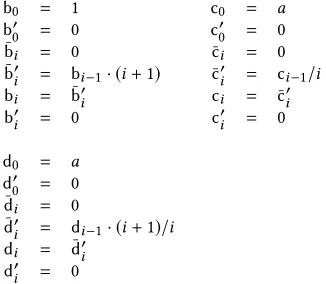
Claim1. For anyadivisible by (k−1)!, the programF has a
[image:9.612.93.256.334.476.2]completek-run which satisfies the equalities in Table1.
Table 1: Equalities for counter values in completek-runs of programF, for alli=0, . . . ,k−1.
b0 = 1 c0 = a
b0′ = 0 c
′
0 = 0
¯
bi = 0 ¯ci = 0
¯
bi′ = bi−1· (i+1) ¯c′i = ci−1/i
bi = ¯bi′ ci = c¯′
i
bi′ = 0 c′
i = 0
d0 = a
d0′ = 0 ¯
di = 0 ¯
di′ = di−1· (i+1)/i
di = ¯
d′i di′ = 0
Proof of Claim1. Such a run can be built by iterating each
in-ner nondeterministic loop the maximum number of times. Namely,
during iterationiof the main loop:
•the loop at line5is iteratedci−1/itimes and in each pass
the loop at line7is iteratedbi−1times;
•the loop at line9is iteratedbi−1times;
•the loop at line11is iteratedbi¯ times;
•the loop at line13is iterated ¯c′
itimes and in each pass the
loop at line15is iteratedbitimes.
The divisibility ofaby(k−1)! ensures that all divisions in the
statement of the claim yield integers.
To see that the run thus obtained can be completed, observe that
from the equalities in Table1it follows that
bk−1=
k−1 Ö
i=1
(i+1)=k! c
k−1=a·
k−1 Ö
i=1 1
i = a
(k−1)!
dk−1=a·
k−1 Ö
i=1
i+1
i =a·k.
In particular, at the start of the final loop (at line19), counterx
equals counterdand hence has valuea·k, and counter yhas
valuea. Iterating the final loopatimes therefore reducesy(andx)
to zero as required.
To obtainb,c,das the final values of countersb,c,d, we apply
Claim1witha=c· (k−1)!.
We now turn to the remaining second part of the proof of the
lemma, where we consider any completek-run and need to show
that the final valuesb,c,dof countersb,c,dsatisfyb=k!,c >0
andd=c·b.
Claim2. For alli=1, . . . ,k−1, we have: • ¯
di+¯
di′≤ (di−1+d
′
i−1) · (i+1)/i; • ¯d
i+d¯i′=(di−1+d
′
i−1) · (i+1)/iif and only if ¯
di =d′i−1=0; • di+di′=d¯i+d¯′i.
Proof of Claim2. Straightforward calculation based on(i+
1)/i>1.
Letadenote the value of countersc,d,xandyat the start of the
main loop.
Claim3. The equalities in Table1for the values of countersdand
d′are satisfied.
Proof of Claim3. First, recall that at the start of the final loop
(at line19) countersxanddare equal, and by Claim2they have
value at mosta·k. Since counteryhas valueaat that point and the
run is complete, it must actually be the case that the value ofxhere
equalsa·k. By Claim2again, we infer that for alli=1, . . . ,k−1,
we indeed have:
¯
di =0 ¯d′
i=di−1·
i+1
i di =d¯′i d ′
i =0.
Claim4. We have thatais divisible by(k−1)! and that the equalities
in Table1for the values of countersb,b′,candc′are satisfied.
Proof of Claim4. Thatais divisible by(k−1)! will follow once
we establish the equalities for the values ofcandc′, since they
involve dividingaby(k−1)!.
For the rest of the claim, we argue inductively, where the
hy-pothesis is that the equalities for the values ofb,b′,candc′are
satisfied for all indices less thani. Consequently, recalling Claim3,
we have that
di−1=ci−1·bi−1. (2)
Consider the iterationiof the main loop. We infer from Claim3
that the commands in line8must have been performeddi−1/itimes.
Hence, as the values of countersbandb′remain unchanged until
line9, using equation (2) we deduce that the commands in line6
must have been performedci−1/itimes, and we have:
¯
ci =0 c¯′
i =ci−1/i.
Also by Claim3, the commands in line16must have been performed
¯
d′i =di−1· (i+1)/itimes. From what we have just shown, that
number equals ¯c′
i·bi−1· (i+1), and so we conclude that indeed:
¯
bi = 0 bi = b¯′
i ci = ¯c
′ i
¯
bi′ = bi−1· (i+1) b
′
i = 0 c
′
The Reachability Problem for Petri Nets Is Not Elementary STOC ’19, June 23–26, 2019, Phoenix, AZ, USA
As in the first part, we now conclude that the final valuesb,c,d
of countersb,c,darek!,a/(k−1)!,a·k, and in particularc·b =
a·k!/(k−1)!=d.
5
MAIN RESULT
As already indicated, the bulk of the work for our headline result, namely Tower-hardness of the reachability problem for Petri nets, is showing how to construct an amplifier without tested counters
and for a ratio which is a tower of exponentials. Most of the pieces
have already been developed in Sections3and4, and here we
put them together to obtain a linear-time construction (although any elementary complexity of the reduction would suffice for the
Tower-hardness).
Lemma 3. An amplifier by3!nwithout tested counters is computable
in timeO(n).
Proof. LettingAbe a trivial amplifier by 3 (cf. Example3), the
program
ncompositions
z }| { ((A◃F )◃F )◃· · · F
is an amplifier by 3!nwithout tested counters by Proposition1and
Lemma2, and it is computable in timeO(n)by the definition of the
composition operator (cf. Section3).
Theorem 4. The Petri nets reachability problem isTower-hard.
Proof. We reduce in linear time from the Tower-complete
halt-ing problem for counter programs of sizenwith all counters tested
and bounded by 3!n(cf. Section2).
LetMbe such a program, and letT be an amplifier by 3!n
with-out tested counters which is computable in timeO(n)by Lemma3.
We have that the composite programT ◃Mis without tested
counters, and that by Proposition1it has a complete run if and
only if the given programMdoes.
Corollary 5. For any positive integerh, the Petri nets reachability problem withh+13counters ish-ExpSpace-hard.3
Proof. We reduce in linear time from theh-ExpSpace-complete
halting problem for counter programs of sizenwith 3 counters,
which are all tested and bounded byn!h+1(cf. [15, Theorems 3.1
and 4.3]).
The reduction builds on the following refinement of Lemma3,
whose proof is in the full version available online:
Lemma 6. For everyh ≥0, an amplifier byn!h+1without tested
counters is computable in timeO(n+h), such that:
•it hash+13untested counters,
•h+1counters are required to be zero by the terminalhalt
command,
•9out of the12counters not appearing in thehaltcommand
are zero at termination of every complete run of the amplifier.
3
We remark that, in the terminology of the classical definition of Petri nets [45], the number of places will beh+16 due to 3 extra places for encoding the control of counter programs.
According to the last condition, the nine counters areforcedto be
zero at termination of every complete run, without being tested to be so.
Given a counter programMof sizenwith 3 counters, which are
all tested and bounded byn!h+1, the reduction builds the composite
programT◃Mwhere the amplifierTis given by Lemma6,
anal-ogously as in the proof of Theorem4. In order to keep the number
of counters inT◃Mnot greater thanh+13, we reuse 6 out of the
9 counters not appearing in thehaltcommand ofT(and forced to
be zero at termination ofT) for simulation of the three counters of
M.
6
CONCLUDING REMARKS
We have focussed on presenting clearly the result that the Petri
nets reachability problem is not elementary, leaving several arising directions for future consideration. The latter include investigating implications for the reachability problem for fixed-dimension flat
vector addition systems with states (cf. [3,12,35]).
ACKNOWLEDGEMENTS
We thank Alain Finkel for promoting the study of one-dimensional
Petri nets with a pushdown stack, and Matthias Englert, Piotr Hof-man and Radosław Piórkowski for working with us on open
ques-tions about those systems. The latter efforts led us to discovering the non-elementary lower bound presented in this paper.
We are also grateful to Marthe Bonamy, Artur Czumaj, Javier Esparza, Marcin Pilipczuk, Michał Pilipczuk, Sylvain Schmitz and Philippe Schnoebelen for helpful comments.
REFERENCES
[1] David Angeli, Patrick De Leenheer, and Eduardo D. Sontag. 2011. Persistence Results for Chemical Reaction Networks with Time-Dependent Kinetics and No Global Conservation Laws.SIAM Journal of Applied Mathematics71, 1 (2011), 128–146. https://doi.org/10.1137/090779401
[2] Paolo Baldan, Nicoletta Cocco, Andrea Marin, and Marta Simeoni. 2010. Petri nets for modelling metabolic pathways: a survey.Natural Computing9, 4 (2010), 955–989. https://doi.org/10.1007/s11047- 010- 9180- 6
[3] Michael Blondin, Alain Finkel, Stefan Göller, Christoph Haase, and Pierre McKen-zie. 2015. Reachability in Two-Dimensional Vector Addition Systems with States Is PSPACE-Complete. InLICS. IEEE Computer Society, 32–43. https: //doi.org/10.1109/LICS.2015.14
[4] Mikołaj Bojańczyk, Claire David, Anca Muscholl, Thomas Schwentick, and Luc Segoufin. 2011. Two-variable logic on data words.ACM Trans. Comput. Log.12, 4 (2011), 27:1–27:26. http://doi.acm.org/10.1145/1970398.1970403
[5] Mikołaj Bojańczyk, Anca Muscholl, Thomas Schwentick, and Luc Segoufin. 2009. Two-variable logic on data trees and XML reasoning.J. ACM56, 3 (2009), 13:1– 13:48. http://doi.acm.org/10.1145/1516512.1516515
[6] Ahmed Bouajjani and Michael Emmi. 2013. Analysis of Recursively Parallel Programs. ACM Trans. Program. Lang. Syst.35, 3 (2013), 10:1–10:49. http: //doi.acm.org/10.1145/2518188
[7] Frank P. Burns, Albert Koelmans, and Alexandre Yakovlev. 2000. WCET Analysis of Superscalar Processors Using Simulation With Coloured Petri Nets.Real-Time Systems18, 2/3 (2000), 275–288. https://doi.org/10.1023/A:1008101416758
[8] Thomas Colcombet and Amaldev Manuel. 2014. Generalized Data Automata and Fixpoint Logic. InFSTTCS (LIPIcs), Vol. 29. Schloss Dagstuhl, 267–278. https: //doi.org/10.4230/LIPIcs.FST TCS.2014.267
[9] Stefano Crespi-Reghizzi and Dino Mandrioli. 1977. Petri Nets and Szilard Lan-guages.Information and Control33, 2 (1977), 177–192. https://doi.org/10.1016/ S0019- 9958(77)90558- 7
[10] Normann Decker, Peter Habermehl, Martin Leucker, and Daniel Thoma. 2014. Or-dered Navigation on Multi-attributed Data Words. InCONCUR (LNCS), Vol. 8704. Springer, 497–511. https://doi.org/10.1007/978- 3- 662- 44584- 6_34
[12] Matthias Englert, Ranko Lazić, and Patrick Totzke. 2016. Reachability in Two-Dimensional Unary Vector Addition Systems with States is NL-Complete. InLICS. ACM, 477–484. http://doi.acm.org/10.1145/2933575.2933577
[13] Javier Esparza. 1998. Decidability and Complexity of Petri Net Problems — An Introduction. InLectures on Petri Nets I (LNCS), Vol. 1491. Springer, 374–428.
https://doi.org/10.1007/3- 540- 65306- 6_20
[14] Javier Esparza, Pierre Ganty, Jérôme Leroux, and Rupak Majumdar. 2017. Ver-ification of population protocols. Acta Inf.54, 2 (2017), 191–215. https: //doi.org/10.1007/s00236- 016- 0272- 3
[15] Patrick C. Fischer, Albert R. Meyer, and Arnold L. Rosenberg. 1968.Counter Machines and Counter Languages. Mathematical Systems Theory2, 3 (1968), 265–283. https://doi.org/10.1007/BF01694011
[16] Pierre Ganty and Rupak Majumdar. 2012. Algorithmic verification of asyn-chronous programs. ACM Trans. Program. Lang. Syst.34, 1 (2012), 6:1–6:48.
http://doi.acm.org/10.1145/2160910.2160915
[17] Steven M. German and A. Prasad Sistla. 1992. Reasoning about Systems with Many Processes.J. ACM39, 3 (1992), 675–735.http://doi.acm.org/10.1145/146637. 146681
[18] Sheila A. Greibach. 1978. Remarks on Blind and Partially Blind One-Way Multi-counter Machines.Theor. Comput. Sci.7 (1978), 311–324.https://doi.org/10.1016/ 0304- 3975(78)90020- 8
[19] Piotr Hofman and Sławomir Lasota. 2018. Linear Equations with Ordered Data. InCONCUR (LIPIcs), Vol. 118. Schloss Dagstuhl, 24:1–24:17. https://doi.org/10. 4230/LIPIcs.CONCUR.2018.24
[20] John E. Hopcroft and Jean-Jacques Pansiot. 1979. On the Reachability Problem for 5-Dimensional Vector Addition Systems.Theor. Comput. Sci.8 (1979), 135–159.
https://doi.org/10.1016/0304- 3975(79)90041- 0
[21] Alexander Kaiser, Daniel Kroening, and Thomas Wahl. 2014. A Widening Ap-proach to Multithreaded Program Verification.ACM Trans. Program. Lang. Syst. 36, 4 (2014), 14:1–14:29. http://doi.acm.org/10.1145/2629608
[22] Max I. Kanovich. 1995. Petri Nets, Horn Programs, Linear Logic and Vector Games.Ann. Pure Appl. Logic75, 1–2 (1995), 107–135. https://doi.org/10.1016/ 0168- 0072(94)00060- G
[23] Richard M. Karp and Raymond E. Miller. 1969. Parallel Program Schemata.J. Comput. Syst. Sci.3, 2 (1969), 147–195. https://doi.org/10.1016/S0022- 0000(69) 80011- 5
[24] S. Rao Kosaraju. 1982. Decidability of Reachability in Vector Addition Systems (Preliminary Version). InSTOC. ACM, 267–281. http://doi.acm.org/10.1145/ 800070.802201
[25] Jean-Luc Lambert. 1992. A Structure to Decide Reachability in Petri Nets.Theor. Comput. Sci.99, 1 (1992), 79–104. https://doi.org/10.1016/0304- 3975(92)90173- D
[26] Ranko Lazić and Sylvain Schmitz. 2015. Nonelementary Complexities for Branch-ing VASS, MELL, and Extensions.ACM Trans. Comput. Log.16, 3 (2015), 20:1–20:30.
http://doi.acm.org/10.1145/2733375
[27] Ranko Lazić and Patrick Totzke. 2017. What Makes Petri Nets Harder to Verify: Stack or Data?. InConcurrency, Security, and Puzzles — Essays Dedicated to Andrew William Roscoe on the Occasion of His 60th Birthday (LNCS), Vol. 10160. Springer, 144–161. https://doi.org/10.1007/978- 3- 319- 51046- 0_8
[28] Hélène Leroux, David Andreu, and Karen Godary-Dejean. 2015. Handling Ex-ceptions in Petri Net-Based Digital Architecture: From Formalism to Imple-mentation on FPGAs.IEEE Trans. Industrial Informatics11, 4 (2015), 897–906.
https://doi.org/10.1109/TII.2015.2435696
[29] Jérôme Leroux. 2010. The General Vector Addition System Reachability Problem by Presburger Inductive Invariants.Logical Methods in Computer Science6, 3 (2010). https://doi.org/10.2168/LMCS- 6(3:22)2010
[30] Jérôme Leroux. 2011. Vector addition system reachability problem: a short self-contained proof. InPOPL. ACM, 307–316. http://doi.acm.org/10.1145/1926385. 1926421
[31] Jérôme Leroux. 2012. Vector Addition Systems Reachability Problem (A Simpler Solution). InTuring-100 (EPiC Series in Computing), Vol. 10. EasyChair, 214–228.
http://www.easychair.org/publications/paper/106497
[32] Jérôme Leroux and Sylvain Schmitz. 2015. Demystifying Reachability in Vector Addition Systems. InLICS. IEEE Computer Society, 56–67. https://doi.org/10. 1109/LICS.2015.16
[33] Jérôme Leroux and Sylvain Schmitz. 2019. Reachability in Vector Addition Systems is Primitive-Recursive in Fixed Dimension. InLICS. https://arxiv.org/ abs/1903.08575
[34] Jérôme Leroux and Philippe Schnoebelen. 2014. On Functions Weakly Com-putable by Petri Nets and Vector Addition Systems. InRP (LNCS), Vol. 8762. Springer, 190–202. https://doi.org/10.1007/978- 3- 319- 11439- 2_15
[35] Jérôme Leroux and Grégoire Sutre. 2004. On Flatness for 2-Dimensional Vector Addition Systems with States. InCONCUR (LNCS), Vol. 3170. Springer, 402–416.
https://doi.org/10.1007/978- 3- 540- 28644- 8_26
[36] Yuliang Li, Alin Deutsch, and Victor Vianu. 2017. VERIFAS: A Practical Verifier for Artifact Systems.PVLDB11, 3 (2017), 283–296. http://www.vldb.org/pvldb/ vol11/p283- li.pdf
[37] Richard J. Lipton. 1976. The reachability problem requires exponential space. Technical Report 62. Yale University.http://cpsc.yale.edu/sites/default/files/files/ tr63.pdf
[38] Martin H. Löb and Stanley S. Wainer. 1970. Hierarchies of number-theoretic functions. I.Archiv für mathematische Logik und Grundlagenforschung13, 1–2 (1970), 39–51. https://doi.org/10.1007/BF01967649
[39] Ernst W. Mayr. 1981. An Algorithm for the General Petri Net Reachability Problem. InSTOC. ACM, 238–246. http://doi.acm.org/10.1145/800076.802477
[40] Ernst W. Mayr. 1984. An Algorithm for the General Petri Net Reachability Problem.SIAM J. Comput.13, 3 (1984), 441–460. https://doi.org/10.1137/0213029
[41] Ernst W. Mayr and Albert R. Meyer. 1981. The Complexity of the Finite Containment Problem for Petri Nets. J. ACM28, 3 (1981), 561–576. http: //doi.acm.org/10.1145/322261.322271
[42] Roland Meyer. 2009. A theory of structural stationarity in thepi-Calculus.Acta Inf.46, 2 (2009), 87–137. https://doi.org/10.1007/s00236- 009- 0091- x
[43] Marvin L. Minsky. 1967.Computation: finite and infinite machines. Prentice-Hall, Inc. https://dl.acm.org/citation.cfm?id=1095587
[44] Mor Peleg, Daniel L. Rubin, and Russ B. Altman. 2005. Research Paper: Using Petri Net Tools to Study Properties and Dynamics of Biological Systems.JAMIA 12, 2 (2005), 181–199. https://doi.org/10.1197/jamia.M1637
[45] Carl Adam Petri. 1962. Kommunikation mit Automaten. Ph.D. Dissertation. Universität Hamburg. http://edoc.sub.uni- hamburg.de/informatik/volltexte/ 2011/160/
[46] Charles Rackoff. 1978. The Covering and Boundedness Problems for Vector Addition Systems.Theor. Comput. Sci.6 (1978), 223–231. https://doi.org/10.1016/ 0304- 3975(78)90036- 1
[47] George S. Sacerdote and Richard L. Tenney. 1977. The Decidability of the Reacha-bility Problem for Vector Addition Systems (Preliminary Version). InSTOC. ACM, 61–76. http://doi.acm.org/10.1145/800105.803396
[48] Sylvain Schmitz. 2016. Complexity Hierarchies beyond Elementary.TOCT8, 1 (2016), 3:1–3:36. http://doi.acm.org/10.1145/2858784
[49] Sylvain Schmitz. 2016. The complexity of reachability in vector addition systems. SIGLOG News3, 1 (2016), 4–21. http://doi.acm.org/10.1145/2893582.2893585