warwick.ac.uk/lib-publications
Manuscript version: Author’s Accepted ManuscriptThe version presented in WRAP is the author’s accepted manuscript and may differ from the published version or Version of Record.
Persistent WRAP URL:
http://wrap.warwick.ac.uk/98791
How to cite:
Please refer to published version for the most recent bibliographic citation information. If a published version is known of, the repository item page linked to above, will contain details on accessing it.
Copyright and reuse:
The Warwick Research Archive Portal (WRAP) makes this work by researchers of the University of Warwick available open access under the following conditions.
Copyright © and all moral rights to the version of the paper presented here belong to the individual author(s) and/or other copyright owners. To the extent reasonable and
practicable the material made available in WRAP has been checked for eligibility before being made available.
Copies of full items can be used for personal research or study, educational, or not-for-profit purposes without prior permission or charge. Provided that the authors, title and full
bibliographic details are credited, a hyperlink and/or URL is given for the original metadata page and the content is not changed in any way.
Publisher’s statement:
Please refer to the repository item page, publisher’s statement section, for further information.
Not so Harmless After All: The Fixed-Effects Model
Thomas Plümper+and Vera E. Troeger*1
+Vienna University of Economics and Business
*University of Warwick, Department of Economics
Abstract:
The fixed effects estimator is biased in the presence of dynamic misspecification and omitted within-variation correlated with one of the regressors. We argue and demonstrate that fixed effects estimates
can amplify the bias from dynamic misspecification and that with omitted time-invariant variablesand
dynamic misspecifications, the fixed effects estimator can be more biased than the ‘naïve’ OLS model.
We also demonstrate that the Hausman-test does not reliably identify the least biased estimator when time-invariant and time-varying omitted variables or dynamic misspecifications exist. Accordingly, em-pirical researchers are ill-advised to rely on the Hausman-test for model selection or use the fixed effects model as default unless they can convincingly justify the assumption of correctly specified dynamics.
Our findings caution applied researchers to not overlook the potential drawbacks of relying on the fixed effects estimator as a default. The results presented here also call upon methodologists to study the prop-erties of estimators in the presence of multiple model misspecifications. Our results suggest that scholars ought to devote much more attention to modelling dynamics appropriately instead of relying on a default solution before they control for potentially omitted variables with constant effects using a fixed effects specification.
1 We thank Jonathan Kropko and the participants of the workshop “Modeling Politics & Policy in Time and Space” orga-nized by Guy Whitten and Scott Cook at Texas A&M for helpful comments and input.
1. Introduction
The reputation of the fixed effects estimator2is better than its finite sample properties. Among the panel
and pooled analysis textbooks that we are aware of, Wooldridge has perhaps the most precise description
of the conditions under which fixed effects models are unbiased: “Under a strict exogeneity assumption
on the explanatory variables, the fixed effects estimator is unbiased.” (Wooldridge 2002: 442) This in
turn means that if the variables included in the model are correlated with a model misspecification other
than omitted variables with constant effects, the fixed effects model is not unbiased. For example, recent
research has argued that in the presence of dynamic misspecification, fixed effects estimates are biased
and inconsistent (Harris et al. 2009; Lee 2012; Ahn et al. 2013 see also Nickell 1981).3
We take this literature one step further and demonstrate that fixed effects estimates amplify the bias from
dynamic misspecification4 relative to pooled-OLS estimates. This finding has two implications: In the
absence of omitted time-invariant variables and the presence of dynamic misspecification, the
pooled-OLS model is strictly less biased than the fixed effects model. And second, in the simultaneous presence
of omitted variables with both constant and time-varying effects, the fixed effects model ismorebiased
than the pooled-OLS model (and the random effects model) if the correlation between the variable of
2 The good reputation the fixed effects model enjoys among econometricians and increasingly among applied researchers, is perhaps best summarized with the following claim: “With panel data, always model the fixed effects using dummy variables (…). Do not estimate random-effects models without ensuring that the estimator is consistent with respect to the fixed-effects estimator (using a Hausman test).” (Antonakis et al. 2010: 1113) This quote demonstrates a common misperception of the Hausman-test (Hausman 1978, see also Ahn and Low 1996, Frondel and Vance 2010). The Haus-man-test does not test the consistency of the random effects model, it tests whether the random effects model generates estimates that significantly differ from the fixed effects model. This would be an indirect test of the random effects models consistency if and only if omitted time-invariant variables were the only reason that could produce such a signif-icance difference in estimates. We will later demonstrate that with more than one model misspecification the Hausman-test does not reliably identify the less biased estimator.
3 Bell and Jones (2015) discuss possibility of different effect strengths for level and changes, which can also be interpreted as dynamic misspecification (Bell and Jones 2015). For a discussion of fixed versus random effects see also Clark and Linzer (2015). Note that for our specification of the data-generating process in the Monte Carlo analyses, random effects and pooled-OLS give identical point estimates and very similar standard errors. We therefore do not report random effects results but everything we say about pooled-OLS also applies to random effects.
interest and the omitted time-invariant variance is smaller than the correlation between the variable of
interest and the omitted time-varying variance. Accordingly, relative to the naïve pooled-OLS
bench-mark, the fixed effects model solves the problem of omitted variables with constant effects at the expense
of rendering other problems worse.5
We use the pooled-OLS estimator as a benchmark for the fixed effects model in the following sense: The
properties of the pooled-OLS estimator in the presence of omitted invariant variables, omitted
time-varying variables, and dynamic misspecifications are known to be poor. Pooled OLS gives biased
esti-mates in the presence of omitted time-invariant variables, omitted time-varying variables and other
dy-namic misspecifications.
By demonstrating that the fixed effects model often performs worse than the pooled-OLS estimator when
dynamic misspecifications exist, we try to alert applied researchers about the importance of choosing the
correct dynamic specification when relying on fixed effects estimates. Of course, we do not argue that
ignoring dynamics and using the pooled-OLS model is an appropriate alternative. Optimally, scholars
would use the correct dynamic specification for their model. However, in many applications, the chances
of getting the dynamic specification right remain slim (Keele and DeBoef 2008, Wilson and Butler 2007,
Adolph et al. 2005, Plümper et al. 2005). Our findings also suggest that a difference in pooled-OLS and
fixed effects estimates cannot with certainty be attributed to time constant unit heterogeneity.6 It may
equally be caused by, inter alia, omitted time-varying variables, wrong assumptions about the functional
forms of the treatment effect, and misspecified lag structures.
5 These statements are based on the assumption that within and between effects are the same. If this is not the case it depends whether the researcher is interested in between or within or average effects across time and space. We discuss this issue in more detail later on.
The article studies the consequences of dynamic misspecification that occur in static models or when
applied researchers use simple econometric patches instead of a correct dynamic specification. Our
for-mal and simulation analyses support previous arguments that fixed effects estimates are biasedif the
model suffers from excluded time-varying variables and if trends and dynamics are not correctly
mod-elled. We also demonstrate that the widely shared assumption, the fixed effects model is superior to our
naïve benchmark, pooled-OLS, does not necessarily hold in the presence of dynamic misspecifications.
We provide evidence that under identifiable and plausible conditions the fixed effects estimator may
actually exacerbate the bias in comparison to a naïve estimator even in presence of omitted time-invariant
variables, because dropping the between variation increases the influence of dynamic misspecifications
on parameter estimates.
We examine the overall logic of dynamic misspecifications based on three simple examples: the
exist-ence of omitted time-invariant and time-varying variance (experiment 1), trends in both an omitted
iable and the variable of interest (experiment 2), and a misspecified lag structure of the explanatory
var-iable of interest (experiment 3). Our results confirm that the fixed effects estimator is biased in the
pres-ence of omitted variables which either vary over time or exert a time-lagged effect on the outcome – a
result known from theoretical work (Lee 2012; Ahn et al. 2013). We go one step further and demonstrate
that using fixed effects in the presence of time-varying and time-invariant omitted variables can under
plausible assumptions increase the bias relative to a naïve estimation with pooled-OLS or the random
effects estimator. Our results also invalidate the common interpretation of the Hausman-test, namely that
if the fixed and random effects (or pooled OLS) estimates significantly differ, then researchers should
use the (consistent) fixed effects model (Hausman 1978; Baltagi 2001: 65-70). This interpretation of the
Hausman-test assumes the absence of any other model misspecification that influences fixed effects and
pooled-OLS estimates differently.7 The results of our analyses bring a common problem to attention:
econometric solutions to a single specification issue can impede the accuracy of estimates even though
the econometric patch solves the problem it has been invented for. For example, the fixed effects
estima-tor has been developed to eliminate bias from ‘unobserved heterogeneity’8due to constant unit-specific
effects, but by doing so it can amplify the bias resulting from un-modelled dynamics.9Our findings stress
the importance of developing model specifications for multiple simultaneous model misspecifications.
Biases generated by different model misspecifications are often not additive, which implies that solving
one problem can exacerbate the bias emanating from another misspecification.10
2. The Sources of and Potential for Dynamic Misspecification
Applied researchers often perceive serially correlated errors as noise rather than information (Keele and
DeBoef 2008). Yet, serially correlated errors clearly indicate a potentially severe model misspecification,
which can result from various sources (Neumayer and Plümper 2017). Perhaps most obviously, serially
correlated errors are caused by incompletely or incorrectly modelled persistency in the dependent
varia-ble, time-varying omitted variables or changes in the effect strengths of time-invariant variables, or
mis-specified lagged effects of explanatory variables. Conditionality makes modelling dynamics more
com-plicated (Franzese 2003a,b, Franzese and Kam 2009). Few empirical analyses model all potential
condi-tioning factors of the variables of interest. If, however, treatment effects are conditioned by unobserved
time-varying factors – as for example the effect of higher education on income is conditioned by
struc-tural change of the economy and ruptures in economic policies – then treatment effects vary over time,
and the strength of these effects also changes over time as un-modelled conditioning factors change.
8 It also does not help that econometric textbooks usually do not define the term ‘unobserved heterogeneity’, tend to be imprecise about the conditions under which the fixed effects estimator is consistent, and hardly ever discuss the condi-tions under which the fixed effects model generates biased and inconsistent estimates – at least not in a way that non-econometricians understand easily (Baltagi 2001; Hsiao 2014; Wooldridge 2002, Hendry 1995). Interestingly, identifi-cation’ textbooks discuss the FE model’s properties in greater detail, see Angrist and Pischke 2009 and the excellent discussion in Morgan and Winship 2007.
9 Variables that are usually treated as time-invariant including culture (Kayser and Satyanath 2013), distance (Wegener 1912), institutions (North 1990), genetic markers (Hedrick 2005), tend to vary at least slowly over time. The only truly time-invariant variable is ‘inheritance’. However, still in this case the effects of inherited factors are not likely to be constant over time. Park (2012) develops a procedure that allows testing the assumption that unobserved heterogeneity is indeed time-invariant.
Finally, serially correlated errors may result from misspecification that at first sight have little to do with
dynamics, for example from spatial dependence. Yet, spatial effects are certainly misunderstood if they
are perceived as time-invariant, ignoring spatial dependence causes errors to be serially correlated
(Franzese and Hays 2007). Virtually all of these complications depend on an arbitrary decision that no
researcher can avoid: the periodization of continuous time that is a necessary condition if researchers
wishing to study ‘periods’. If researchers chose relatively short periods, effects do no longer necessarily
occur in the same period as the treatment. If periods cover a long stretch of time, the probability that
estimates are biased by confounders rises quickly. In the social sciences, the lengths of a period is rarely
chosen to optimize the analysis. Instead, social scientists often have to accept data that is collected on a
daily, monthly or – most often – annual basis.
At least in an optimal world these model misspecifications should be avoided: dynamics should be
di-rectly modelled to obtain unbiased estimates. This proves to be difficult. Since dynamic misspecifications
are manifold and complex, econometric tests for ‘dynamics’ at best reveal serially correlated errors, but
they are usually unable to identify the underlying root causes of autocorrelation. Often, these tests are
also weak and do not reveal the true dynamic structure of the data-generating process, which may lead
to overfitting of the data (Keele et al. 2017) Thus, empirical researchers are probably best advised to
simplify their empirical model and to treat problems such as serially correlated errors with
straightfor-ward econometric patches such as lagged dependent variables, period dummies, and simple
homogene-ous lag structures.
Yet, using misspecification patches should not mislead researchers into believing that the dynamics of
their model are correctly specified. Econometric fixes are not correct per se because they are usually not
modelling the true dynamic process in the underlying data generating process. For example, periods do
not exert a direct effect on the dependent variable but period dummies capture variation over time which
can help to “clean” residuals. Perhaps even worse, more than one econometric specification allows
sufficiently similar results. Empirical researchers should also not expect that so called ‘dynamic
econo-metric models’, e.g. the Arellano-Bond (A-B) estimator (Arellano and Bond 1991), solve various
prob-lems of dynamics. Dynamic panel models only eliminate Nickell-bias. Period dummies control for
com-mon trends, comcom-mon shocks, and comcom-mon breaks, but they do not perfectly account for unit-specific,
heterogeneous trends, shocks, and breaks. Including a lagged dependent variable to the right-hand-side
of the estimation equation without including lags of the explanatory variables (x) assumes that the
dy-namics of all independent variables are identical. These assumptions are convenient, but not always
plau-sible.
Still, the vast majority of panel data analyses pushes serially correlated errors into uninformative
econo-metric patches: lagged dependent variables and period fixed effects appear to be the most common
solu-tions, but they are not the only ones. More often than not analysts seem to “adopt restrictive dynamic
specifications on the basis of limited theoretical guidance and without empirical evidence that restrictions
are valid, potentially biasing inferences and invalidating hypothesis tests.” (Keele and DeBoef 2008:
184)11A review of recent political science publications reveals that a large majority of panel data
anal-yses rely on of the following four strategies: do nothing and ignore the potential for dynamics
(Hum-phreys and Weinstein 2006; and Ross 2008), assume that all dynamics are captured by period fixed
ef-fects (Besley and Reynal-Querol 2011, Menaldo 2012, Egorov et al. 2009 among many others), try to
capture dynamics by a lagged dependent variable (e.g. Lupu and Pontusson 2011; Kogan et al. 2016;
Acemoglu et al. 2008, 2009; Guisinger and Singer 2010), or finally follow Beck and Katz (1995) and
model dynamics by a combination of period fixed effects and a lagged dependent variable (e.g.
Lips-meyer and Zhu 2011; Getmansky and Zeitzoff 2015). Significantly fewer authors rely on GLS estimators
(Mukherjee 2009, Lupu and Pontusson 2011), distributed lag models (e.g. Gerber et al. 2011) or error
correction models (Kayser 2009; Lebo et al. 2007; Soroka et al. 2015).12Overall, the vast majority of
panel data analyses in political science assumed rather simple dynamics.13This finding is consistent with
DeBoef and Keele (2008: 185), who also conclude that the vast majority of authors do not test for the
underlying dynamic structure. Thus, social scientists often model the dynamic aspects with very little
theoretical guidance (Keele and Kelly 2006; DeBoef and Keele 2008),14 use ad hoc econometric
solu-tions, which make rather rigid assumpsolu-tions, do not try to model the true data-generating process, and do
not report results of minimal tests for serial correlation.
One strategy that may reduce the size of the problem is to use less constrained econometric solutions.
Distributed lag models, models with a unit-specific lagged dependent variable, panel co-integration
mod-els, models with heterogeneous lag structure (Plümper et al. 2005), more attention to periodization
(Franzese 2003a), better specified spatial models (Franzese and Hays 2007, Neumayer and Plümper
2016) may all reduce the size of the problem. However, as the number of possible dynamic specifications
increases, a higher order problem of model selection arises: since all these different models likely
gen-erate different estimates and often demand different inferences, the question becomes how empirical
researchers select their preferred model. To eliminate or at least reduce the arbitrariness of model
selec-tion, DeBoef and Keele (2008: 187) suggest a testing down approach, starting with a full autoregressive
distributive lag model and stepwise removing parameters according to pre-determined criteria, often the
significance of parameters. This procedure will result in a dynamic specification that maximizes the
var-12 When political scientists employ distributed lag or error correction models, they often do not include unit dummies, and when they use fixed effects, they rarely control for complex dynamics. Exceptions exist, e.g. Treisman (2015) and Haber and Menaldo (2011) combine unit and period fixed effects with an error correction model.
13 We do not wish to suggest here that error correction models and distributed lag models allow social scientists to model dynamics correctly. These models do assume homogeneous dynamic processes which neither capture omitted time-var-ying variables nor unobserved time-vartime-var-ying conditionality of the variable of interest, they remain limited in their ability to capture functional forms of effects which do not simply diminish at a constant rate, and they de facto rely on homo-geneous lag structures.
iance absorbed by the minimum number of parameters. As with all testing-down approaches, this
ap-proach suffers from the arbitrariness in the choice of a start model because we do not have an infinite
number of degrees of freedom. DeBoef and Keele recommend starting with a general autoregressive
distributed lag (ADL) model. They argue that this model has ‘no constraints’. Yet, the model still assumes
a homogenous lag structure and it will run quickly out of degrees of freedom if the number of controls is
large because a finite number of distributed lag parameters has to be estimated for each regressor.
Ac-cordingly, these models only work if the number of periods is much larger than the number of variables
– a criterion that is not necessarily met in panel data analyses. Since the specification includes a lagged
dependent variable, the estimator is inconsistent when unit fixed effects are included, though the bias
declines if the number of periods increases (Nickell 1981, Kiviet 1995). Gerber et al. (2011) thus prefer
an alternative strategy. Rather than relying on a single ‘best’ dynamic specification, they report the result
of various different dynamic specification and they demonstrate that their results are robust “for varying
lag lengths and polynomial orders.” (Gerber et al. 2011: 143) Relying on robustness tests has at least two
advantages: First, it largely reduces the necessity to make arbitrary dynamic modelling assumptions, and,
second, it helps identifying possible relevant model uncertainties (Neumayer and Plümper 2017).
For our purposes and in the remainder of this article, the problem is not so much which techniques
min-imizes the potential for dynamic misspecification. Instead, we assume that dynamic misspecifications
exist and analyse the performance of the fixed effects model in the presence of various dynamic
mis-specifications – some of which could be dealt with easily, others are more difficult though not impossible
to eliminate if only researchers knew the true data-generating process. But of course the whole point of
estimation is that researchers do not know the true data-generating process and that theory, econometric
tests, and testing-down procedures cannot identify the optimal model beyond reasonable doubt. Having
said this, we do not claim that social scientists inevitably misspecify dynamics, but we emphasize that in
the presence of dynamic misspecifications, the fixed effects model has problematic properties. Needless
3. The Bias of the Fixed Effects Estimator with Dynamic Misspecification
This section analyses how dynamic misspecifications cause fixed effects estimates to be biased and we
demonstrate that the bias of the fixed effects estimator can exceed the bias of the naïve pooled-OLS
estimator under plausible assumptions. We are not the first to do so. Lee (2012) analytically demonstrates
that the fixed effects estimator is biased when the lag order is not correctly chosen and stresses that
“existing bias corrections would not work properly because the correction formulae assume correct
model specification. In fact, attempts to adjust for the bias using formulae that correct for AR(1)
dynam-ics would be wrong and may even exacerbate the bias when the true lag order is larger than one.” (Lee
2012: 57)
Misspecified lag structures are clearly not the only dynamic misspecification that biases fixed effects
estimates. Rather, fixed effects estimates are likely to be biased in the presence of any dynamic
misspec-ification or omitted time-varying variables.15 Ahn et al. (2013) argue that the fixed effects estimator is
biased when omitted variables vary over time and develop a generalized method of moments procedure
that accounts for multiple factorial time-varying fixed effects. This estimator, however, requires the
ex-istence of instruments which are correlated with the dynamic fixed effects but not with the errors – an
assumption that is unlikely to be satisfied and that cannot be tested properly since errors remain
unob-served. Finally, Park (2012) at least implicitly confirms the existence of bias in fixed effects models with
structural breaks and develops a Bayesian estimator that seeks to identify these structural breaks. As one
would expect, a model that corrects for ‘turning points’ fits the data better than the classical fixed effects
estimator. We build on these contributions and prove that that the bias from dynamic misspecifications
can be larger for the fixed effects estimator than for pooled-OLS. As we’ve already mentioned, we make
this comparison not so much because we intend to rehabilitate the pooled-OLS estimator. Rather, we use
this comparison to demonstrate how poorly the fixed effects estimator performs in the presence of
dy-namic misspecifications.
Bias of the Fixed Effects Estimator Induced by Correlated Within Variance
Fixed effects estimation accounts for potential bias from unobserved time-invariant variables by
elimi-nating all between-variation from the estimation. Obviously, the effect of variance that is dropped from
the estimation cannot be biased by correlated confounders. And the correlation between the remaining
within-variation and omitted time-invariant cross-sectional variation is zero. Therefore, if the effect of
omitted variables is really exclusively time-invariant, the estimates which rely on an analysis of the
re-maining time-varying variance does not suffer from omitted variable bias. This, of course, immediately
changes when the aggregate effect of omitted variables is not strictly time-invariant.
In this section, we derive the causes of the bias of the dynamic fixed effects estimator using a
time-varying omitted variable as an example. We demonstrate that the bias of the fixed effects estimate of
exceeds the bias of the pooled-OLS estimate of when the correlation betweenx and omitted
within-variation is larger than the correlation betweenxand omitted between-variation.
Assume that
it it i it
y x u (1)
is the true data-generating process with xit a time-varying observed variable, ui a vector of
time-invari-ant unobserved variables, and it an i.i.d. error component. Note that the data-generating process is
static. Estimating this model by a ‘naïve’ OLS estimator leads to bias if var( , )x ui i 0, or var(xit,it)0
.
it i it i i i it i
y y x x u u (2)
which is equivalent to
it i it i it i
y y x x , (3)
because ui ui 0.
Assume now the following data generating process
1 2 ; 2 1
it it it i it
y x w u with (4)
where xit and wit are time varying right-hand-side variables and ui is a unit-specific effect.
The omitted variablewis correlated with the included right-hand side variable xit. 1 and 2 indicate
the strength of the correlation between wit and the within variance of xit and wit and the between
varia-tion of xit, respectively:
1 2
it it i it
w x x (5)
with
1
1 ,
T
i it it it i t
x x x x x
T
Finally, the unit specific effect ui covaries with the between variance of xit to a degree of delta.
1
i i i
u x (6)
We omit wit from the estimation and can easily derive the biases for the fixed effects and the pooled
certain conditions the bias of fixed-effects estimates exceeds that of pooled-OLS estimates. Needless to
say that neither of these two estimators is unbiased in case of time-varying omitted variables.16
Conditional on all of the xit, equation (7) derives the bias for the pooled OLS estimator:
1 1 1 2 2 1 2 1 1 21, 2 2 2 2
1 1 1 1 1 1
ˆ
N T N N
it i i
i t i i
OLS N T N N T N
it i it i
i t i i t i
x T x T x
Bias
x T x x T x
(7)
Equation (7) indicates that the OLS bias depends both on the correlation between xit and wit as well as
the correlation between ui and xit.
As usual the bias for the FE estimator is given by:
ˆ1,FE
1Bias (8)
The bias of the fixed effects estimator depends on the correlation between xit and w ,it but not on the
covariance between the unit specific effects ui and x ,it because the within-transformation on which FE
estimation relies, effectively eliminates all, endogenous and exogenous, between-variation from the
es-timation.
If we assume that10 (no correlation between u and xi i) and2 0(no correlation between w and xit i
), then,
1 1 2
1, 1 2 2 1 1,
1 1 1
ˆ ˆ
N T
it
i t
OLS N T N FE
it i
i t i
x
Bias Bias
x T x
(9)
16 If bias exclusively results from correlation of the within-variation of xit and wit, it is of course possible to throw away
In this case, for any given T , the bias of the FE estimator that results from the omission of wit is
larger than that of OLS. This is so because the fraction term of the OLS bias in equation (9) is always
smaller than 1.
This case might seem rare in real data but can emerge when neither xit nor wit have a specific dynamic
structure (autocorrelation or trends) but only the variation over time and not across units of these two
variables is related. An exogenous shock could have this property. Alternatively, wit has no
between-variation and represents an omitted common trend. More often, however, applied researchers specify
empirical models that suffer from both, omitted between-variation correlated with the regressors and
omitted within-variation correlated with the regressors. In these cases, one cannot say whether the fixed
effects or the pooled-OLS estimator gives less biased estimates. One can ex ante know that both
estima-tors give biased results, but which one is more reliable (or less unreliable) depends on the relative
strengths of the correlations with the omitted variance. Unfortunately, these correlations cannot be
ob-served. Researchers may often know that a relevant variable has been omitted, but one cannot know with
certainty that no relevant variable has been omitted. Still, one can evaluate whether omitted variables are
potentially more problematic for the included within or between variation by estimating how much of
the within and between variance of the dependent variable remains unexplained.
Now consider a situation where xit (andwit) follows a deterministic trend so that its within variance
grows with increasing number of time periods, and approaches infinity as T . In this case, even if
1 0
(non-zero correlation between u and xi i) the second term of the OLS bias equation (7) approaches
zero because the within variation (xit2) grows but only appears in the denominator while the between
variance (xi2) does not change. The bias that is caused by the correlation between wit and xit increases
with T because of the trend and will outweigh the bias induced by omitted time-invariant variables if T
Bias from Dynamic Miss-specification
Correlated within variation and common trends of included and excluded explanatory variables are
ob-vious sources of omitted variable bias occurring in fixed effects estimates. Yet, there are many examples
of dynamic misspecifications that can cause bias. Assume a data-generating process representing the
simplest form of dynamic misspecification, an explanatory variable that does not exert a
contemporane-ous effect on the dependent variable but a one period lagged effect:
1
it it i it
y x u (10)
If we estimate equation (10) ignoring the lagged effect of xit, the probability limit (plim) of the OLS
estimator ofβin the regression yit xitit is given by:
1
, , ,
it it it it i it
it it it
Cov y x Cov x x Cov u x
Var x Var x Var x
(11)
The second term of equation (12) is similar to the bias of estimating a model without fixed effects while
the true DGP has correlated unit effects: the estimatedβwrongly captures the unit specific effects (unless
0 i
x ).
The probability limit of the fixed effects estimator equals:
it,it it
it 1it, it
i,itit
Cov y x Cov x x Cov u x
Var x Var x Var x
(12)
The second term now vanishes since xithas no unit-specific mean. We can rewrite equation (12) so that
1
1
, , ,
it it it it it i
it it it
Cov y x Cov x x Cov x x
Var x Var x Var x
(13)
it,it it
it 1it, it
itiCov y x Cov x x Var x
Var x Var x Var x
The second term of equation (14) equals multiplied by the between variance of xit divided by its total
variance. The result will fall between 0 and 1. It follows that the probability limit of the within estimator
(FE) is smaller than . The estimate will thus be downward biased and this bias increases as the share
of ignored between-variation in xit increases.
The total bias of the OLS estimator depends on the autocorrelation of xit and the bias induced by the
omission of the unit specific effects. If the majority of autocorrelations in real world data generation
processes is positive (which seems to be the case), the bias of a fixed effects estimator exceeds the bias
of pooled OLS. It is of course possible to estimate whether xit1and xitare positively correlated and how
strong this correlation is. However, it is much more complicated to identify the correct lag structure of
explanatory variables (Adolph et al. 2005, Plümper et al. 2005). Time series test such as information
criteria (BIC, AIC etc.) have low power in complex models and usually predict diverging lag lengths
depending on the number of lags and right-hand side variables included. The problem of misspecified
lag length is exacerbated if the lag length is not uniform but varies across units which can occur frequently
in political science data, for example because institutional settings will usually influence responsiveness
of actors (Plümper et. al 2005). We analyse the effect of unit specific lag length in the Monte Carlo
experiments below.
Discussion
We have demonstrated that biases from two different sources of model misspecification are not simply
additive. Rather, the solution to one problem, time-invariant omitted variables, can easily make another
problem, say omitted time-varying variables, worse. In the following section we use Monte Carlo
anal-yses to compare the bias of the fixed effects estimator to the bias of the estimator that econometricians
call naïve, pooled-OLS17. We do so to identify some of the conditions under which the fixed effects
estimator has poor properties. As we have mentioned before, we use pooled-OLS to have a benchmark
for ‘poor properties’ – and not to recommend the choice of the pooled-OLS estimator in applied research.
4. Design of the Monte Carlo Experiments18
Bias in fixed effects estimation can result, inter alia, from omitted time-varying variables, from omitted
trends, a miss-specified lag structure, and other – more complex – dynamic misspecifications. Since
social scientists often rely on standard dynamic specifications rather than on explicitly modelling the
dynamics, bias may be reduced, but is unlikely to disappear. As we have shown in the previous section,
the existence of any form of unaccounted within-variation correlated with the regressors biases fixed
effects estimates. The Monte Carlo analyses in this section aim at exploring the relevance of the problem.
To benchmark the bias of the fixed effects estimator, we use the pooled-OLS estimator which is known
to have poor properties in the presence of omitted time-invariant variables and dynamic
misspecifica-tions. Naively, one could expect that, since pooled-OLS suffers from (at least) two problems while the
fixed effects estimator solves the problem of omitted time-invariant variables, the bias of the fixed effects
estimator is always strictly smaller than the bias of pooled-OLS. However, this perspective ignores the
fact that the fixed effects estimator solely uses the within-variation and is therefore more vulnerable to
dynamic misspecification than pooled-OLS that uses both, the within- and the between variation. As we
demonstrate analytically, it is thus possible that fixed effects estimates are more biased than the
pooled-OLS estimates under identifiable conditions. To study the properties of the fixed effects estimator with
potential dynamic misspecification and to reveal the conditions under which the use of fixed effects
produces larger bias than the naïve pooled OLS estimator, we employ a set of Monte Carlo experiments.
Our data generating process follows a straightforward set-up:
1 2 ( )
it it it i it
y x x u (15)
with 1
it
x , 2 it
x , it, and ui being drawn from a standard normal probability density function.
We use three rather straightforward types of model misspecification as examples: an omitted
time-vary-ing variable, an omitted time trend when the variable of interest 1
it
x is trended, and the simple dynamic
miss-specification analysed formally in the previous section – a one period lagged effect of 1
it
x . We
distinguish three levels of correlation between our variable of interest 1
it
x and an omitted strictly
time-invariant, constant effect variable ui. We set this correlation between
1 it
x and ui to 0.0 (absent), 0.2
(weak), and 0.5 (substantive). Higher correlation between 1
it
x and ui implies higher bias of the
pooled-OLS estimator, while the correlation between 1
it
x and ui does not bias the fixed effects estimator. The
higher the correlation between 1
it
x and ui, the larger the bias advantage of the fixed effects model before
we consider a dynamic misspecification. Obviously, in the absence of dynamic misspecification the fixed
effects estimates are unbiased. Throughout all specifications we assume that between and within effects
are equal. We acknowledge that this is a strong assumption and that pooled OLS gives an average
esti-mate of the two effects while the fixed effects estimator provides a clean estiesti-mate for the within effect
only. For a discussion of dealing with different within and between effects see Bell and Jones (2015).
We refrain from adding a discussion of different effects across units and over time since it would distract
from the focus on bias stemming from dynamic misspecification.
We are of course aware that social scientists could be able to correctly model these simple dynamic
misspecifications. But this argument misses the point: we do not seek to identify dynamic
misspecifica-tions which are so difficult to model that social scientists probably fail to fully eliminate them. Instead,
we are analysing the consequences of dynamic misspecifications. The advantage of simple dynamic
second step will we generate complex data-generating processes for which simple solutions are not
avail-able. None of the data-generating processes we study here are likely to be as complex as true
data-gen-erating processes. Given that we include simple dynamics, we do not just use a simple fixed effects
specification, but rather compare fixed effects estimation with dynamic specifications that applied
re-searchers are likely to use as econometric solutions for potential dynamic misspecifications:19 a lagged
dependent variable (or Arellano-Bond dynamic panel model20), the Prais-Winsten transformation, or
pe-riod fixed effects. This also allows us to demonstrate that these simple fixes, which are widely used in
panel and pooled analyses, do not sufficiently eliminate simple dynamic misspecifications. In addition
to these simple but commonly employed dynamic fixes, we use more general dynamic specifications as
offered by Autoregressive Distributed Lag (ADL) models and show that capturing the most salient
dy-namic elements of a DGP can reduce the bias considerably. This is consistent with Pickup (2017).
For our first two experiments, 2
it
x is the omitted part of the data-generating process. We first directly
manipulate the correlation between the within variation of 1
it
x and 2 it
x and the unit heterogeneity, e.g. the
covariance of the between variance of 1
it
x and the unobserved unit specific effects ui with
1 2
, 0.2, 0.5, 0.8
it it
corr x x .
The second set of experiments aims at demonstrating the logic of our argument without ex ante assuming
that 1
it
x and 2 it
x are correlated. We generate a dynamic misspecification by merely trending both variables
so that the correlation results from the trends only. We discuss two different variants of this second Monte
19 See Acemoglu et al. 2008 for the choice of an Arellano-Bond model, Beck and Katz (1995) for the use of the lagged dependent variable (but see Achen 2000 and Keele and Kelly 2006), Huber and Stevens (2012) for the Prais-Winsten transformation, and Becker and Woessmann (2013) for the inclusion of period dummies. For a broader discussion see DeBoef and Keele 2008.
Carlo experiment.21 The first variant assumes common trends across all units: Both included and
ex-cluded right-hand-side (RHS) variables are continuous with a common trend of 0.1 increase per time
period:
1,2
0,1 0.1* , 1,...,
it
x N t t T (16)
The second variant relaxes this assumption and allows for unit-specific trends,22 which merely means
that trends are conditioned by other factors – a plausible assumption for social scientists, since trends are
unlikely to be homogeneous across units. Specifically, we randomly draw a third of the units that receives
a positive trend of 0.1 per time period (see equation 16), a third of the units remains untrended (
1,2
0,1 it
x N ), and the last third of units has a negative trend of 0.1 per time period
1,2
0,1 0.1* , 1,...,
it
x N t t T).23
The third experiment is based upon a slightly different DGP to account for a misspecified lag-structure
of 1
it
x :
1 1
it it i it
y x u (17)
We compare the bias generated by a static OLS estimator ( 1
it it it
y x ) to that of a static FE estimator (
1 it it it
y x
) where the lagged effect of 1
it
x is not taken into account.
21 We have conducted additional experiments. Since findings remain consistent with the results discussed here, we do not report additional findings.
22 In experiments not shown here we also studied bias of the fixed effects model with a binary treatment variable (Beck and Katz 2001; Green et al. 2001). Binary treatments can be trended if the probability of treatment increases or declines over time. Epidemics may serve as the most obvious example. Furthermore, most studies of treatment effects only ob-serve two periods: pre-treatment and post-treatment. In this situation, the probability of treatment increases from zero to a probability determined by the share of the treated cases to the total cases. In such a case, every omitted trended variable will bias the results unless the effect of this variable is strictly identical for treatment and control group. Because of limited space we relegate the results for binary treatment variables to an online appendix.
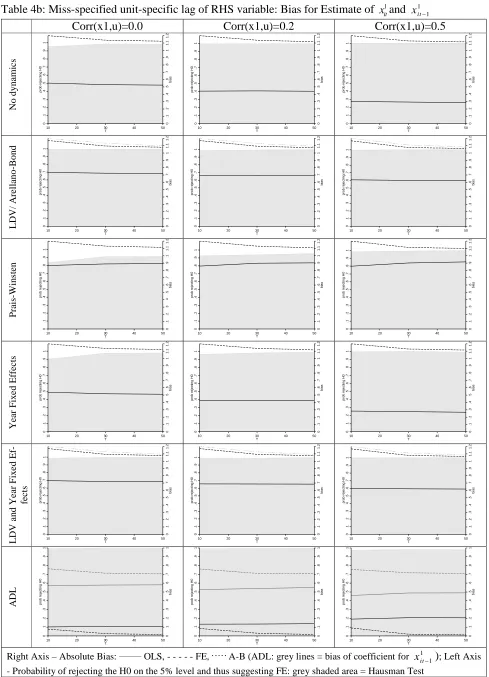
Finally, we also allow the lag length of 1 it
x to vary across units in the following way: for one randomly
drawn third of the units 1
it
x exerts a one period lagged effect on yitas in equation (17), for the second
randomly drawn third of units we observe a two period lagged effect yit xit12 ui it and for the last
third we model a three period lagged effect yit xit13 ui it.
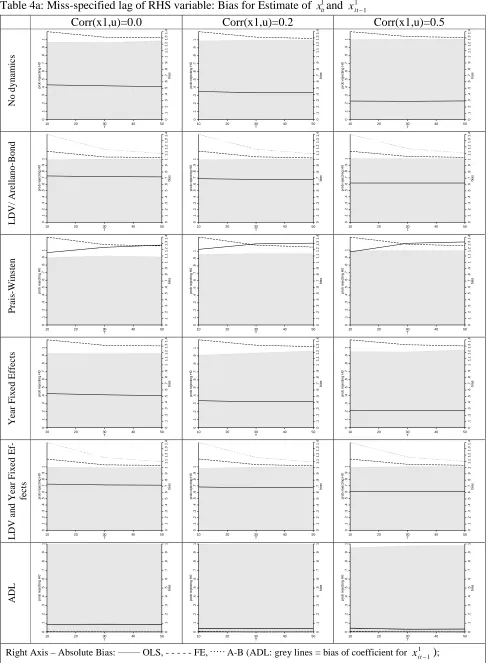
We vary the number of periods [T={10, 30, 50}] but we hold the number of units constant at 20
through-out all experiments. Note that increasing the number of units increases the between-variation and favours
pooled-OLS over the fixed effects (Plümper and Troeger 2007, 2011). In each permutation of the
exper-iments we estimate 500 models with independently drawn errors.
Since econometricians have developed different solutions for models with potential dynamic
misspeci-fications, we incorporate these variants of the fixed effects and the pooled-OLS estimators into the
sim-ulation. The most commonly used ‘solutions’ to dynamic misspecification are the inclusion of the lagged
dependent variable (LDV: 1
1 1 2
it it it it
y y x ),24and period fixed effects ( 1
2 it t it it
y x ) or
a combination of the two ( 1
1 1 2
it t it it it
y y x ). Less often researchers employ a Prais-Winsten
transformation (PW:
yityit1
2
xit1xit11
it it1
)25, or an autoregressive distributedlag (ADL (1,1): 1 1
1 1 2 3 1
it it it it it
y y x x ) model.
Though it seems to increasingly be the case that scholars estimate fixed effects models without
justifica-tion and thus as default, econometric textbooks suggest a variant of the Hausman specificajustifica-tion test
(Haus-man 1978) to decide whether to estimate a fixed effects or a random effects/ OLS specification. The
Hausman-test (and its variants) have been shown to be consistent (for a short overview see Baltagi 2001,
65-70), therefore, if fixed effects estimates are significantly different from random effects or pooled-OLS
24 Since the combination of unit fixed effects and a lagged dependent variable induces additional bias, the so called Nickell-bias (Nickell 1981), we also run dynamic panel models that allow for the combination of unit specific effects and a lagged dependent variable.
estimates, the latter are biased because of unit heterogeneity.26However, the asymptotic properties of the
Hausman-test do not necessarily translate into favourable finite sample characteristics especially when
other misspecifications do exist and are not accounted for. We also present Monte Carlo results for the
performance of this test. This is related to our main research interest, because we intend to demonstrate
that pooled-OLS may be less biased than the fixed effects model in situations in which the Hausman-test
favours a fixed effects specification. These instances may occur frequently and under plausible
condi-tions.
5. Results
Applied researchers should select estimators according to their reliability for the sample at hand. The
root mean squared error has been suggested as the appropriate criterion for selecting estimators in finite
samples. The root mean squared error provides information on the average deviation of an estimator from
the true relationship. This average deviation results from bias and inefficiency of an estimator. We show
the bias for our MC experiments because whenever the bias of the fixed effects estimates exceeds the
bias of the benchmark, the pooled-OLS estimator, the root mean squared error is also larger. Since OLS
is using both within and between variation for estimation it is the more efficient estimator as compared
to Fixed Effects.
We run five sets of experiments that examine different dynamic misspecifications: i) omitted
time-vary-ing variable, ii) omitted common trend, iii) unit specific trend, iv) misspecified common lag-structure,
and v) misspecified unit-specific lag-structure. For each of the misspecifications we estimate six different
fixed effects and pooled OLS models with different dynamic specification: no dynamics, lagged
depend-ent variable (LDV, or Arellano-Bond (A-B) model), Prais-Winsten GLS transformation, period fixed
effects, a combination of LDV/A-B and period fixed effects, and an autoregressive distributed lag (ADL
(1,1)) model. Finally we vary the correlations between the unit specific effects uiand the interesting RHS
variable 1
it
x (as described above), as well as the number of periods.
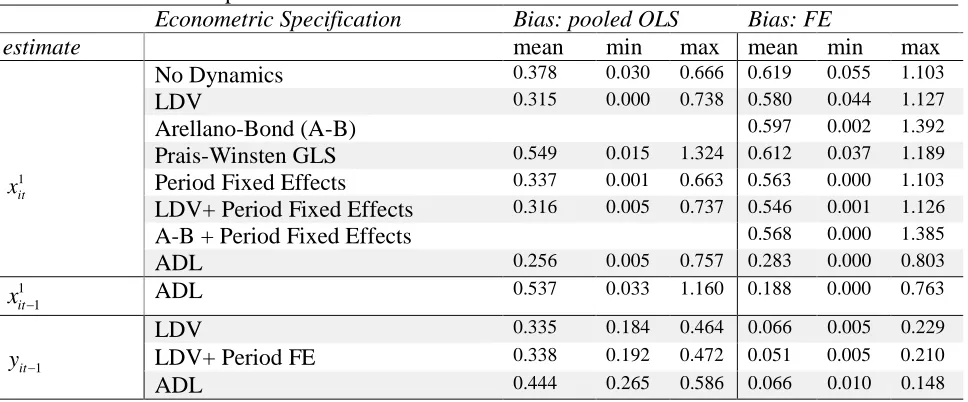
Table 1 summarizes the findings of all conducted experiments. We show the average, minimum and
[image:24.595.59.543.210.411.2]maximum bias generated by pooled OLS and the fixed effects model for each dynamic specification.
Table 1: Bias over all Experiments
Econometric Specification Bias: pooled OLS Bias: FE
estimate mean min max mean min max
No Dynamics 0.378 0.030 0.666 0.619 0.055 1.103
LDV 0.315 0.000 0.738 0.580 0.044 1.127
Arellano-Bond (A-B) 0.597 0.002 1.392
Prais-Winsten GLS 0.549 0.015 1.324 0.612 0.037 1.189
1 it
x Period Fixed Effects 0.337 0.001 0.663 0.563 0.000 1.103
LDV+ Period Fixed Effects 0.316 0.005 0.737 0.546 0.001 1.126
A-B + Period Fixed Effects 0.568 0.000 1.385
ADL 0.256 0.005 0.757 0.283 0.000 0.803 1
1
it
x ADL 0.537 0.033 1.160 0.188 0.000 0.763
1
it y
LDV 0.335 0.184 0.464 0.066 0.005 0.229
LDV+ Period FE 0.338 0.192 0.472 0.051 0.005 0.210
ADL 0.444 0.265 0.586 0.066 0.010 0.148
Table 1 gives a first impression of the general performance of pooled OLS and fixed effects models with
different econometric patches when dynamic misspecifications are present in the DGP but not necessarily
properly accounted for in the specification of the estimation equation. Overall, the average bias of the
coefficient for 1
it
x (the RHS variable of interest) produced by pooled OLS is up to 45 percent smaller than
that generated by the fixed effects estimator. In addition, the maximum bias of OLS is usually
consider-ably smaller than the maximum bias of the fixed effects estimates (except when a Prais-Winsten GLS
transformation is applied). An ADL(1,1) model estimates coefficients for both 1
it
x and the one period
lagged 1
1 it
x . The ADL model produces on average less biased estimates for 1
1 it
x when unit fixed effects
are included. However, the computed average bias for estimates of 1
it
x and 1 1 it
x in the ADL(1,1) model
is somewhat misleading because in experiments 1 and 2 1
it
x should be included in the estimation but 1
1 it
is not part of the DGP, while in experiment 3 only 1 1 it
x has an effect on the outcome. Three of the
dynamic specifications we test (LDV, LDV+period FE, ADL) also estimate coefficients for yit1. This
coefficient should be zero because yit1 is never part of the DGP. Specifications that include unit fixed
effects on average produce coefficients for the LDV that are closer to zero. In a pooled-OLS specification
the LDV on average seems to pick up potential unit specific effects that remain un-modelled.27 If
re-searchers are interested in persistency of the dependent variable or long term effects and unit effects are
indeed present, a fixed effects specification produces less biased estimates of the LDV coefficient. This
often comes at the expense of a more biased estimate for the interesting explanatory variables when
dynamic misspecifications are present. To unpack the relative performance of both estimators in the
presence of different dynamic misspecifications we will present disaggregated results for each
misspec-ification and different econometric controls for dynamics.
Experiment 1: Omitted Time-varying Variable
We start with examining the effect of omitted time varying variables for different levels of correlated
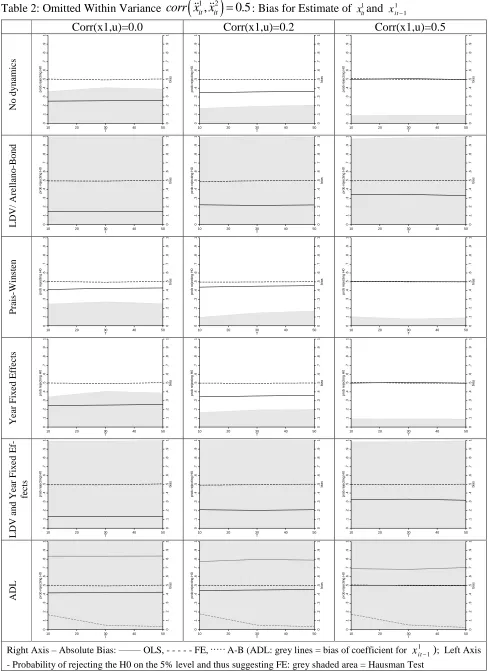
unit specific heterogeneity. The results confirm the theoretical results in section 3. Table 2 depicts the
bias of OLS (solid line) and FE (dashed line) with an assumed within-correlation between included and
omitted time varying variables of 0.5. We include the results for eighteen combinations for the level of
correlation of 1
it
x and ui and a dynamic specification. Each single figure displays the bias for the OLS
estimates and the bias for the fixed effects estimates (right axis) plus the probability that the
Hausman-test finds a significant difference between the OLS and the FE estimates (at the 95 percent level - grey
shaded area, left axis). The larger the grey shaded area, the higher the probability that the Hausman-test
recommends the FE model. We show results for each of the six specifications that political scientists
frequently use to control for dynamics: no control for dynamics, lagged dependent variable (with
Arel-lano-Bond estimator – dotted line28), Prais-Winsten transformation, period fixed effects, the combination
of the LDV and period fixed effects, and an ADL specification. For the ADL(1,1) model (last
specifica-tion in each table) we display bias for estimates of 1
it
x (black lines) and 1
1 it
x (grey lines). The columns
depict these results for different levels of correlation between the unit specific effects ui and the included
treatment 1
it
x .
Table 2: Omitted Within Variance
corr x x
1it,
it2
0.5
: Bias for Estimate of 1 itx and 1 1 it
x
Corr(x1,u)=0.0 Corr(x1,u)=0.2 Corr(x1,u)=0.5
N o d y n am ic s L D V / A re ll an o -B o n d P ra is -W in st en Y e ar F ix e d E ff ec ts L D V a n d Y ea r F ix e d E f-fe ct s A D L
Right Axis – Absolute Bias:_______OLS, - - - FE,. . . . .A-B (ADL: grey lines = bias of coefficient for 1 1 it
x ); Left Axis - Probability of rejecting the H0 on the 5% level and thus suggesting FE: grey shaded area = Hausman Test
0 .1 .2 .3 .4 .5 .6 .7 .8 .9 1 b ia s 0 .1 .2 .3 .4 .5 .6 .7 .8 .9 1 p ro b re je c ti n g H 0
10 20 30 40 50
T 0 .1 .2 .3 .4 .5 .6 .7 .8 .9 1 b ia s 0 .1 .2 .3 .4 .5 .6 .7 .8 .9 1 p ro b re je c ti n g H 0
10 20 30 40 50
T 0 .1 .2 .3 .4 .5 .6 .7 .8 .9 1 b ia s 0 .1 .2 .3 .4 .5 .6 .7 .8 .9 1 p ro b re je c ti n g H 0
10 20 30 40 50
T 0 .1 .2 .3 .4 .5 .6 .7 .8 .9 1 b ia s 0 .1 .2 .3 .4 .5 .6 .7 .8 .9 1 p ro b re je c ti n g H 0
10 20 30 40 50
T 0 .1 .2 .3 .4 .5 .6 .7 .8 .9 1 b ia s 0 .1 .2 .3 .4 .5 .6 .7 .8 .9 1 p ro b re je c ti n g H 0
10 20 30 40 50
T 0 .1 .2 .3 .4 .5 .6 .7 .8 .9 1 b ia s 0 .1 .2 .3 .4 .5 .6 .7 .8 .9 1 p ro b re je c ti n g H 0
10 20 30 40 50
T 0 .1 .2 .3 .4 .5 .6 .7 .8 .9 1 b ia s 0 .1 .2 .3 .4 .5 .6 .7 .8 .9 1 p ro b re je c ti n g H 0
10 20 30 40 50
T 0 .1 .2 .3 .4 .5 .6 .7 .8 .9 1 b ia s 0 .1 .2 .3 .4 .5 .6 .7 .8 .9 1 p ro b re je c ti n g H 0
10 20 30 40 50
T 0 .1 .2 .3 .4 .5 .6 .7 .8 .9 1 b ia s 0 .1 .2 .3 .4 .5 .6 .7 .8 .9 1 p ro b re je c ti n g H 0
10 20 30 40 50
T 0 .1 .2 .3 .4 .5 .6 .7 .8 .9 1 b ia s 0 .1 .2 .3 .4 .5 .6 .7 .8 .9 1 p ro b re je c ti n g H 0
10 20 30 40 50
T 0 .1 .2 .3 .4 .5 .6 .7 .8 .9 1 b ia s 0 .1 .2 .3 .4 .5 .6 .7 .8 .9 1 p ro b re je c ti n g H 0
10 20 30 40 50
T 0 .1 .2 .3 .4 .5 .6 .7 .8 .9 1 b ia s 0 .1 .2 .3 .4 .5 .6 .7 .8 .9 1 p ro b re je c ti n g H 0
10 20 30 40 50
T 0 .1 .2 .3 .4 .5 .6 .7 .8 .9 1 b ia s 0 .1 .2 .3 .4 .5 .6 .7 .8 .9 1 p ro b re je c ti n g H 0
10 20 30 40 50
T 0 .1 .2 .3 .4 .5 .6 .7 .8 .9 1 b ia s 0 .1 .2 .3 .4 .5 .6 .7 .8 .9 1 p ro b re je c ti n g H 0
10 20 30 40 50
T 0 .1 .2 .3 .4 .5 .6 .7 .8 .9 1 b ia s 0 .1 .2 .3 .4 .5 .6 .7 .8 .9 1 p ro b re je c ti n g H 0
10 20 30 40 50
T 0 .1 .2 .3 .4 .5 .6 .7 .8 .9 1 b ia s 0 .1 .2 .3 .4 .5 .6 .7 .8 .9 1 p ro b re je c ti n g H 0
10 20 30 40 50
T 0 .1 .2 .3 .4 .5 .6 .7 .8 .9 1 b ia s 0 .1 .2 .3 .4 .5 .6 .7 .8 .9 1 p ro b re je c ti n g H 0
10 20 30 40 50
T 0 .1 .2 .3 .4 .5 .6 .7 .8 .9 1 b ia s 0 .1 .2 .3 .4 .5 .6 .7 .8 .9 1 p ro b re je c ti n g H 0
10 20 30 40 50
Table 2 illustrates that the bias of the fixed effects model increases as the correlation between the variable
of interest and an omitted time-varying variable increases (see tables A1 and A2 in appendix for
com-parison). The fixed effects estimator is not immune against different sources of unobserved or omitted
heterogeneity, it merely shelters estimates from omitted time-invariant variables with constant effects
(which is referred to as ‘unobserved heterogeneity’ in most econometric textbooks). The bias of the fixed
effects estimates remains unaffected by changes in the correlation between the variable of interest and
an omitted time-invariant variable.
The omission of a time-varying variable that is correlated with included right-hand-side variables may
lead to serially correlated errors and it will induce bias. As we have explained in section 2, social
scien-tists use various econometric solutions to control for the serial correlation of errors potentially resulting
from omitted time-varying variables. We find that these solutions have virtually no effect on the bias of
the fixed effects estimate in the presence of omitted time-varying variables. Yet, omitted time-varying
variables are a common problem in the social sciences – arguably more common than the omission of
variables with time-invariant effects that vary across units.
A comparison between the properties of the fixed effects model and the benchmark pooled-OLS
estima-tor reveals that the fixed effects model is more (less) biased if the correlation of the variable of interest
with the omitted within variation is larger (smaller) than the correlation with the omitted between
varia-tion. Of course, if no omitted time-invariant variable exists but the model is dynamically misspecified,
pooled-OLS is strictly less biased than the fixed effect estimator. This confirms the results from section
3. The results for the ADL(1,1) model show the same bias differential between OLS and FE estimates
for 1
it
able to deal much better with elements that are not included in the DGP since it produces a much smaller
bias for the unnecessarily added 1
1 it
x (grey lines) .
Table 2 also reveals the low power of the Hausman-test in the presence of dynamic misspecification. It
gives erratic results and in the worst case with no omitted time-invariant variables but a correlated
omit-ted time-varying variable, the Hausman-test always suggests the use of the fixed effects model – even if
no omitted between variation exists. We also find that the Hausman-test is sensitive to the choice of
dynamic specification. If applied researchers include a lagged dependent variable, the Hausman-test is
biased towards the fixed effects model – a finding that confirms previous research (Godfrey 1997,
Hoechle 2007, Arellano 1993, Baltagi 2001, 66-69, Ahn and Low 1996). In other words, the
‘con-sistency’ of the Hausman-test is conditional on a perfectly specified model that suffers solely from
omit-ted between variation with constant unit effects.
Finally, in our MC analyses all results are largely independent of the number of periods, because we hold
the within correlation constant. If, in reality, adding periods leads to a change in the correlation, the bias
will also change. As adding time periods increases the probability of correlated time varying omitted
variables, the bias will increase over-proportionally for fixed effects estimates.
Experiment 2. Correlated Common and Unit-specific Trends
In the second experiment, we study the bias of the fixed effects model and the pooled-OLS estimator
when both the variable of interest 1
it
x and an omitted time-varying variable 2
it
x are trended. Two trended
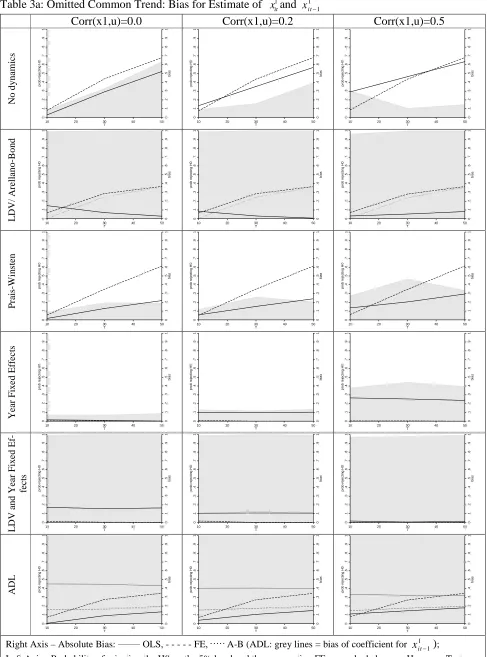
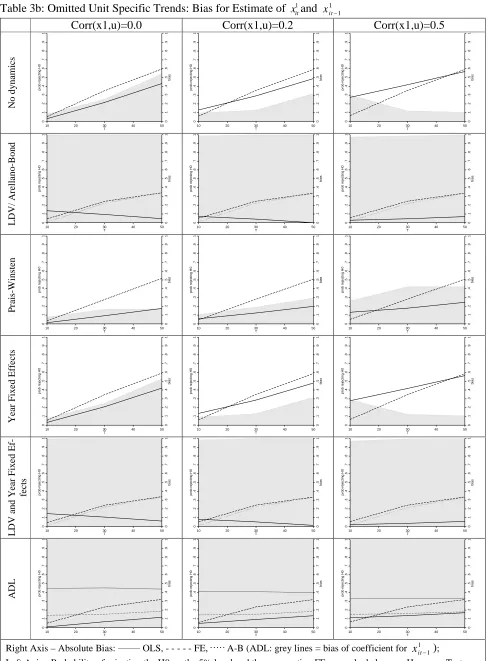
variables tend to be correlated even if they are independent of each other. Table 3a displays the results
for an excluded trended variable, while table 3b provides the results for experiments in which the trend
is assumed to be unit-specific.
This experiment confirms that the static fixed effects model is biased, but this bias – expectedly –
can be achieved by the inclusion of splines, but period fixed effects follow the functional form of the
omitted trended variable more closely. Unfortunately, period fixed effects also capture the trend of other
trended variables. Hence, if scholars aim at analysing dynamic processes, period fixed effects only leave
unit-specific deviations from the common trend for variables of interest, since period fixed effects
ac-count for all common trends. This does not mean that we suggest leaving out period fixed effects in
general, we advocate a less ad hoc approach to modelling of the salient dynamic features of the data
generating process and a far more cautious interpretation of the estimation results.
With omitted trended variables and no period FE, pooled-OLS tends to outperform the fixed effects
model unless the number of periods remains small and the correlation between a time-invariant omitted
variable ui and the variable of interest
1 it
x is high. As we have demonstrated in section 3, trends increase
the within variation of included and omitted RHS variables when T grows larger. As a consequence, the
bias resulting from omitted trends increases in T, which affects fixed effects models more strongly than
pooled-OLS models because FE solely relies on within variation for estimation. This observation holds
true for the ADL (1,1) estimation of 1
it
x . However, as in experiment 1, including unit fixed effects allows
estimating zero effects of unnecessary components ( 1
1 it
x ) more precisely though not without bias.
In the likely case that omitted trends are not common to all units (table 3b), period dummies can no
longer guarantee the unbiasedness of the fixed effects model. In this case, the period fixed effects capture
the mean of these unit-specific trends so that residuals for other units, units that follow a different trend,
still show serial correlation, which of course can be correlated with the variable of interest and, indeed,
will almost certainly be correlated if the variable of interest is also trended in a unit-specific fashion. Our
results thus run directly counter to Allan and Scruggs (2004: 505) belief that “fixed effects do allow us
to reduce the possibility that the substantive estimates are in fact attributable to country-specific trends.”
We find this statement unlikely to be correct. Instead, the presence of unit-specific trends that are not
In general, these Monte Carlo analyses provide ample evidence that the bias of the fixed effects model
depends on the existence of dynamic misspecificationsandon the degree to which econometric solutions
capture the dynamic misspecification. The inclusion of the correct dynamic model provides of course a
solution but it is usually hard to test for the source of dynamic misspecifications, especially when
differ-ent dynamic issues occur jointly. Differdiffer-ent dynamic misspecifications can lead to similar manifestations
in the residuals, e.g. serial correlation. However, not every econometric model controlling for
autocorre-lation (e.g. LDV, ADL, Prais-Winsten) will treat the source of the problem successfully and might