Original citation:
Froud, Robert J., Rajendran, Dévan, Patel, Shilpa, Bright, Philip, Bjørkli, Tom, Eldridge, Sandra, Buchbinder, Rachelle and Underwood, M. (Martin) M.D.. (2016) The power of low back pain trials : a systematic review of power, sample size, and reporting of sample size calculations over time, in trials published between 1980 and 2012. Spine.
Permanent WRAP URL:
http://wrap.warwick.ac.uk/81942
Copyright and reuse:
The Warwick Research Archive Portal (WRAP) makes this work of researchers of the University of Warwick available open access under the following conditions.
This article is made available under the Creative Commons Attribution-NonCommercial 4.0 (CC BY-NC 4.0) license and may be reused according to the conditions of the license. For more details see: http://creativecommons.org/licenses/by-nc/4.0/
A note on versions:
The version presented in WRAP is the published version, or, version of record, and may be cited as it appears here.
1
The power of low back pain trials: A systematic review of power, sample
2
size, and reporting of sample size calculations over time, in trials published
3
between 1980 and 2012
4
5
Robert Froud, PhD1,2*, Dévan Rajendran, MSc1,3, Shilpa Patel, CPsychol2, Philip
6
Bright, MSc3, Tom Bjørkli, BSc1, Sandra Eldridge, PhD4, Rachelle Buchbinder,
7
PhD5, Martin Underwood, MD2
8
9
*Corresponding author [email protected]
10
11
1. Kristiania University College, Prinsens Gate 7-9, 0152,Oslo, Norway 12
2. Warwick Medical School, University of Warwick, Gibbet Hill Road, Coventry, 13
CV4 7AL, UK 14
3. European School of Osteopathy, The Street, Boxley, Maidstone, Kent. ME14 15
3DZ, UK 16
4. Monash Department of Clinical Epidemiology, Cabrini Institute and 17
Department of Epidemiology and Preventive Medicine, Monash University, Suite 18
41, Cabrini Medical Centre, 183 Wattletree Road, Malvern, 3144, Melbourne, 19
Victoria, Australia 20
5. Barts and the London School of Medicine and Dentistry, Queen Mary 21
University of London, 2 Newark Street, Whitechapel, London, E1 2AT, UK 22
1
Abstract 2
3
Study design 4
A systematic review of non-specific low back pain (LBP) trials published 5
between 1980 and 2012. 6
7
Objectives 8
To explore what proportion of trials have been powered to detect different 9
bands of effect size; whether there is evidence that sample size in LBP trials is 10
increasing with time; what proportion of trial reports include a sample size 11
calculation; and whether likelihood of reporting sample size calculations is 12
increasing with time. 13
14
Summary of background data 15
Clinical trials should have a sample size sufficient to detect a minimally 16
important difference for a given power and type I error rate. An underpowered 17
trial is one within which probability of type II error is too high. Meta-analyses do 18
not mitigate underpowered trials. 19
20
Methods 21
Reviewers independently abstracted data on sample size at point of analysis, 22
whether a sample size calculation was reported, and year of publication. 23
Results 4
We included 383 trials. Only one-third were powered to detect a standardised 5
mean difference of 0.5 or less. Average sample size was 153 people, which 6
increased only slightly (~4 people/year) from 1980 to 2000, and declined 7
slightly (~4.5 people/year) from 2005 to 2011 (P<0.00005). Sample size 8
calculations were reported in only 41% of trials. The odds of reporting a sample 9
size calculation (compared to not reporting one) increased until 2005 and then 10
declined (ORyear=1.06, ORyear^2=0.99; P<0.00005).
11
12
Conclusions 13
14
Trialists should make LBP trial samples sizes large enough to detect realistic 15
effect sizes, and report sample size calculations. It may be justifiable to power a 16
trial to detect only large effects in the case of novel interventions. Funders, peer-17
reviewers, editors, and readers should be vigilant for and critical of 18
underpowered trials. 19
20
21
Key words 22
23
Key points
1. Only around one-third of trials are powered to detect an effect size of 0.5 or less. The vast majority (95%) do not have the power to detect realistic effect sizes.
2. Sample size in back pain trials has only increased by trivial magnitudes since 1980 and has been declining since 2005.
3. Sample size calculations are reported by only 41% of trials, and since 2005 the proportion reporting sample size calculations has fallen.
Précis 1
Froud et al systematically reviewed non-specific low back pain trials published 2
between 1980 and 2012, and show most are not powered to detect realistic 3
effect sizes and that the majority do not report sample size calculations. They 4
discuss the ethical implications, possible mitigating circumstances, and outline a 5
strategy for improvement. 6
7
8
9
10
11
12
13
14
15
16
17
18
19
20
21
22
23
Introduction 1
2
Statistical tests in clinical trials generally test null hypotheses that differences 3
between populations are zero.1 Customarily, type I error rate (or alpha) is set at
4
0.05, i.e. rejection of the null hypothesis if there is <5% probability it is true, 5
given the observed result. Also customarily, the power of the study, i.e. the 6
probability of detecting a difference if one truly exists in the population, is 7
usually set at 80% or 90%. 8
9
The magnitude a study is powered to detect should be based on the population-10
difference that is perceived as worthwhile.2 Non-specific low back pain (LBP)
11
trials utilise many different outcome measures, in different units, but outcomes 12
can be standardised by dividing the between-group difference by the standard 13
deviation to produce a standardised effect size (ES).3-5 Conventionally, ESs of 0.2
14
are considered small, 0.5 medium, and 0.8 large.6 Whether or not the magnitude
15
can be considered worthwhile, at a population level, may depend on the cost of 16
providing the treatment in question.7,8 Large, high-quality trials suggest that
17
effective interventions may have a 'typical' ES of around 0.3.3,9,10
18
19
If a trial is underpowered then there is a greater risk of type II error; i.e. failing to 20
detect a difference when one exists in the population.1 Thus, assuming good
21
internal validity, it is difficult to interpret outcomes in trials reporting null 22
results, in cases where sample sizes are small. It has been suggested that in these 23
cases meta-analyses of underpowered studies provide remedy.11 However, LBP
24
effects models, and random-effects models make assumptions about population 1
distributions that may be unrealistic.12-15 Additionally, pooling of different
2
outcomes purporting to measure the same domains, with outcomes described in 3
terms of ES may be unsafe.16 Further, therapist-delivered interventions testing
4
the same basic intervention may be so dissimilar, and poorly specified, that it is 5
not possible to describe the intervention evaluated by the meta-analysis in a 6
manner that would allow replication. 7
8
There is a risk that underpowered trials have very limited value and contribute 9
little to the evidence base. There have been several calls to increase sample sizes 10
in trials over the past decades, and the importance of undertaking sample size 11
calculations has been emphasised.1,17-19 The impact that calls and checklists have
12
had on practice relating to power and reporting sample size calculations in back 13
pain trials is unclear. 14
15
Our aims were to explore: 1) what proportion of LBP trials have been powered to 16
detect bands of effect size ranging between small (d=0.2), ‘typical’ (d=0.3), 17
medium (d=0.5), or large (d=0.8); 2) whether there is evidence that sample size 18
in LBP trials is increasing with time; 3) what proportion of trial reports include a 19
sample size calculation, by year; and 4) whether the likelihood of reporting a 20
Materials and methods 1
2
Two reviewers (RF, SP) independently identified randomised controlled trials 3
(RCTs), published from 1980 inclusive, of interventions for non-specific low back 4
pain (nsLBP) from COST-B13's European Guidelines for the Management of Low 5
Back Pain (EGLBP) and from the systematic reviews reported in the EGLBP.20
6
The EGLBP search was extended in two phases. In 2007, two reviewers (RF, SP) 7
searched from November 2002, when the COST-B13 search finished, to the end 8
of December 2006, using the Cochrane library, PubMed, Embase, HTA, and Lilacs 9
databases. In 2012, three reviewers (PB, DR, TB) searched from January 2007 to 10
January 2012, using PubMed, Embase, and the Cochrane library, within which 11
the majority of LBP trials are indexed. Supplemental Digital Content file 1 (PDF) 12
We combined material from the EGLBP and extended searches, removing 1
duplicates, and short-listing by title and abstract. Full-texts were obtained if the 2
titles and abstract alone contained insufficient information for assessment 3
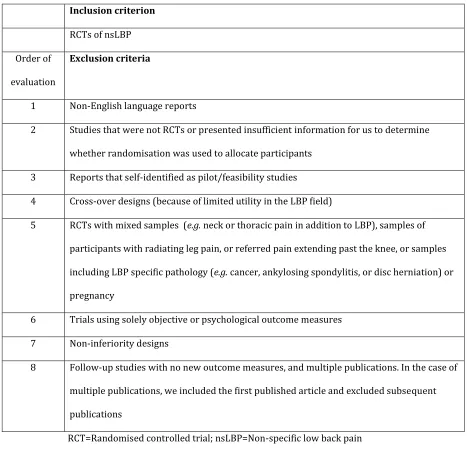
against Table 1 criteria. 4
5
All five reviewers abstracted data from the LBP trials on numbers analysed for 6
the primary outcome for the pre-specified main comparison, details of whether 7
or not a sample size calculation was reported, and the year of publication. An 8
outcome was identified as ‘primary' if (1) the outcome was nominated as such; if 9
no outcome was nominated, or if multiple outcomes were nominated, we used 10
(2) the outcome measure on which the sample size calculation was based; if this 11
was not reported, we identified (3) the first outcome measure referred to in the 12
abstract; and if this was not identified, we used (4) the first outcome mentioned 13
in the paper. This approach has been taken in several other methodological 14
reviews.21-23 We identified the primary end-point, or used the first follow-up
15
time point in cases when this was not clear. Disagreements were resolved 16
through discussion and, if necessary, with arbitration and a fourth reviewer (RF, 17
SE, or MU). Reporting of sample size calculation was judged present if, as a 18
minimum, it was reported how many participants were estimated as required to 19
detect a given between-group difference, or if the latter was not reported, if the 20
detectable between-group difference could be readily calculated from what was 21
reported. The calculations needed to be a priori (i.e. post hoc power calculations 22
For all data abstraction we used expert validation of 20% of papers, as has been 1
done in other methodological reviews.24 It was decided a priori that in the case of
2
agreement being less than 80%, full independent abstraction would be 3
undertaken. Validation disagreements were settled by arbitration involving an 4
independent reviewer. 5
6
For each trial, the average sample size by arm was calculated and compared to 7
the threshold of participants needed to detect an ES of small (Cohen's d=0.2), 8
small-to-medium (d=0.3), medium (d=0.5), or large (d=0.8), under the 9
assumption of comparisons to groups of approximately equal size. Trials were 10
categorised according to their ability to detect within these bands.4
11
12
The proportion of trials reporting sample size calculations was calculated by 13
year. To explore our objective of whether sample size is increasing with time, we 14
used linear regression with a log-transformation of sample size to control for the 15
heteroschedasticity (i.e. the changing variance) of sample size on year. To 16
explore the likelihood of reporting a sample size calculation by time, we fitted a 17
logit model, regressing reporting of sample size (binary) on year. Non-linear 18
relationships between predictor and outcome variables were explored through 19
fitting polynomial terms in predictor variables and log rank tests were used to 20
test these terms for statistical significance (α=0.05). Model fit was examined 21
using residual plots, and in the case of the logit model, a combination of Pseudo 22
R2, AIC, and residual plots. Locally weighted least squares (Lowess) smoothers
23
were added if they aided interpretations of trends over time. All analyses were 24
Results 1
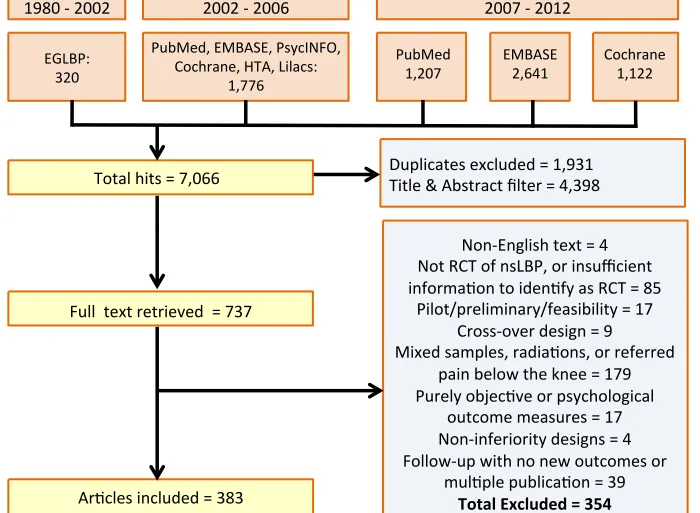
From our combined searches, we sifted a total of 7,066 hits, removing 4,398 of 2
these based on titles and abstracts and 1,931 duplicates, and assessed 737 3
papers at full-text level. We rejected 354 papers that did not fit our inclusion 4
criteria.10,25-377 We included 383 trials (Figure 1). 378-760 [Note: this makes for a
5
large reference list. References can be included with the supplemental digital
6
content tables if preferred.] Supplemental Digital Content file 2 (PDF) shows a
7
table of the characteristics of included studies, and Supplemental Digital Content 8
file 3 (PDF) shows a table of the characteristics of excluded studies. 9
10
Ability of trials to detect effect sizes
11
Across all trials, the average total sample size was 152.8 (IQR=126; range 12 to 12
2,594). Figure 2 shows histograms of average group size and logged average 13
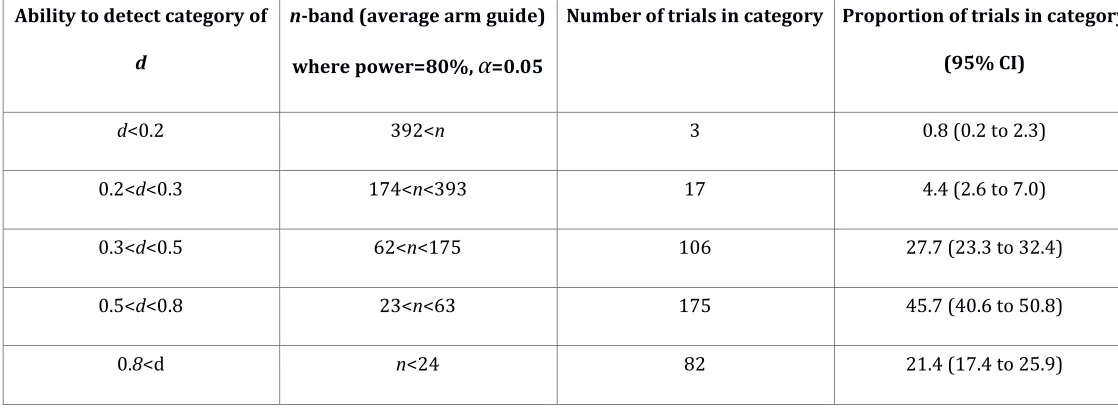
group size, with reference guidelines for ES detection ability. Table 2 shows the 14
frequency of trials by ES detection category. The majority (67.1%) of trials were 15
only powered to detect ES of greater than 0.5 (medium). 16
17
Sample size over time
18
A quadratic term in year was required to adequately model sample size over 19
time (i.e. the relationship follows a quadratic curve rather than a line 20
(P<0.0005)). Linear regression of sample size on year and year2 explained 4.6%
21
of the variance in sample size. For use in estimation, βyear=-0.0131702, βyear^2 =-22
0.0027846 (centered around the average in year, of 2002.141), with a constant of 23
0.0131702)+((2000-2002.141)2*-0.0027846)=4.82; i.e. a total sample size of
1
around 124 people. Other years may be inserted into this equation, as required. 2
Figure 3 shows a plot of the model with 95% CIs fitted, and a Lowess smoother, 3
which more clearly highlights the turning point and fall in sample size after 2005. 4
5
The reporting of sample size calculations in general
6
Across the whole time period of interest, the proportion of trials in which a 7
sample size calculation was reported is 41% (95%CI 36.3 to 46.4). 8
9
The likelihood of reporting sample size calculations by time
10
From the logit model, the odds ratio for reporting a sample size calculation by 11
year is 1.093 (1.06 to 1.13), P<0.00005, Pseudo R2=6.7% (i.e. very strong
12
evidence of an increase in odds of reporting sample size calculation of 9% per 13
year). However, model fit is improved by adding quadratic term in year (i.e. the 14
increase in odds of reporting sample size calculation curves over time), 15
P=0.0001. In the quadratic model, βyear=0.057851 (OR=1.060, 95% CI 1.017 to 16
1.104), βyear^2=-0.0099829 (OR=0.990, 95% CI 0.984 to 0.996), P<0.00005, and 17
Pseudo R2=9.7%. For use in prediction (i.e. where Pr=exb/1+exb and xb is the
18
linear predictor), the constant, when year is unadjusted and year2 is centered on
19
its average, is -115.806. Figure 4 shows the proportion of trials reporting sample 20
size calculations, by year, and weighted by the number of trials per year, with 21
fitted values for the probability of reporting a sample size calculation. It shows 22
2005 marks a turning point toward deterioration in terms of the proportion 23
1
Discussion 2
Main findings
3
Only around one-third of trials are powered to detect an ES of 0.5 or less. Only 4
around 5% of trials are powered to detect ‘typical’ magnitudes of 0.3 or less. 5
There is evidence of an increase of sample size over time from 1980, but the 6
increase is trivial, and slips into decline from 2005. Sample size calculations are 7
reported in only 41% of trials published between 1980 and 2012. The likelihood 8
of reporting sample size calculation increases by several percent each year, but 9
begins to decrease after 2005. 10
11
Implications
12
Large, high quality trials of interventions for back pain that have convincingly 13
demonstrated effectiveness, suggest a typical ES for LBP interventions is around 14
0.3.3,9,10 However, between 1980 and 2012, 95% of published trials have not had
15
sufficient power to detect such magnitudes. There is a culture of conducting 16
underpowered trials in the field of nsLBP research that needs to be addressed – 17
the distribution of sample size shown in Figure 2 needs to be right-shifted. 18
Underpowered trials have limited utility and are ethically questionable. 19
20
As explained at the introduction, meta-analytic techniques do not mitigate 21
underpowered trials, as even in random effects models assumptions must be 22
rather than clinical heterogeneity.15 That said, there might be a place for smaller
1
trials. As many larger high-quality trials of interventions for low back pain 2
demonstrate only small-to-moderate differences, a counter-argument can be 3
made that continuing to do these will do little to progress the field. Smaller well-4
conducted trials of novel interventions that are only powered to detect larger 5
effect sizes could indicate promising avenues for intervention development. 6
However, in such cases there should be clear rationale for this and great care to 7
describe the novel intervention for subsequent replication. 8
9
Only 41% of trials even report sample size calculations. In 1992, Cohen pointed 10
out that while there is no disagreement between methodologists on the utility of 11
such calculations, progress over the last 25 years had been slow.1 It is regrettable
12
that in the back pain field, in the quarter-century that followed his observation, 13
progress continues to be slow. From 2005, it has even deteriorated. 14
15
As change must be affected at the level of individual trialists, the implications are 16
that trialists, funders, peer-reviewers, and journal editors each have a role to 17
play in helping to improve the situation. 18
19
Comparisons to existing research
20
Castellini et al, in 2016, reviewed RCTs of mechanical low back pain published 21
after 1968.761 Among 222 included studies, they found that 36% reported a
22
sample size calculation, but only 16% reported what they deemed complete 23
calculations. They found that both reporting and completeness of reporting 24
reporting sample size calculations since 2005. This is consistent with our data. 1
Their point estimate that 36% report sample size calculations is slightly less than 2
ours. We suggest the following possible reasons; 1) Castellini's work dates back 3
to publications in the late 1960s, which predates several calls for improvements 4
in sample size (although only eight trials (3.6%) predate 1980); 2) our sample is 5
based on 58% more trials; 3) Castellini’s search used the terms ‘rehabilitation’, 6
so the population may have been slightly different to ours; and 4) we required a 7
priori reporting of the number of participants required to detect a given
8
between-group difference, as minimum criteria to judge reporting the 9
calculation. While it is clear how Castellini judged completeness of reporting of 10
sample size calculations, it is not clear whether minimal criteria were used to 11
judge reporting of a basic sample size calculation. 12
13
Moher et al reviewed 383 trials, published between 1975 and 1990, exploring 14
their power to detect 25% and 50% relative differences if null results were 15
reported.17 They found that 25% reported null results, and of these only 16%
16
and 36% had the power to detect these magnitudes of difference. They observed 17
that these percentages did not increase over time. Whilst our results are not 18
directly comparable, we found that sample size in general has increased over 19
time, albeit by a trivial amount, until 2005. Moher also found that in trials 20
reporting null results, 32% reported sample size calculations, and that this 21
increased from 0% in 1975 to 43%, in 1990. Since we did not separately explore 22
reporting in trials reporting null results, our results are not directly comparable, 23
reporting a sample size calculation seems greater if the trial reported a null 1
result. 2
3
Strengths and limitations
4
This work provides a useful account of trends of sample sizes in back pain trials 5
and reporting of sample size calculations. It comes from a comprehensive review 6
of trials that were published between 1980 and 2012, during which time there 7
were several calls to ensure such trials had appropriate sample sizes. 1,17-19
8
9
One limitation of our work is that we did not consider the extent of the reporting 10
of sample size calculations or likelihood of reporting by positive or negative 11
results. This work was part of a larger systematic review addressing several 12
other methodological research questions and these aspects were not prioritized; 13
however, we acknowledge Castillini’s and Moher’s useful contributions here.17,761
14
15
Caution should be noted in using the quadratic models for future prediction, as 16
trajectories of falls will be predicted to continue along the quadratic curve, which 17
peaked in 2000 and 2005, respectively. Should any authors like to update the 18
model we will be happy to share our data. We could have described our findings 19
descriptively, but model fitting was useful insofar as it demonstrates the trend 20
Conclusions
1
That the vast majority (95%) of trials are not powered to detect realistic effect 2
sizes might be considered unethical, unless novel interventions are being tested 3
and the small size is clearly justified. Increases in sample sizes have been trivial, 4
and decline after 2005. The majority of authors still do not report sample size 5
calculations. 6
7
Trialists should plan to make the size of LBP trials large enough to detect 8
realistic effect sizes and report sample size calculations. It may be justifiable to 9
power a trial only to detect large effect sizes in the case of testing a novel 10
intervention. Funders, peer-reviewers, editors, and readers should be vigilant for 11
Conflicts of Interest and Source of Funding: RF and MU are directors and
1
shareholders of Clinvivo Ltd, a company that provides health outcome data 2
collection services. These services were not used in this study. Høyskole 3
Kristiania received funding from University of Warwick and Monash University 4
to complete this research. Barts and The London Charity provided funding for 5
References
1
1. Cohen JW. Statistical power analysis. Current directions in psychological 2
science 1992;1:98-101.
3
2. Froud R, Eldridge S, Lall R, et al. Estimating the number needed to treat 4
from continuous outcomes in randomised controlled trials: methodological 5
challenges and worked example using data from the UK Back Pain Exercise and 6
Manipulation (BEAM) trial. BMC Med Res Methodol 2009;9:35. 7
3. Froud R. Improving interpretation of patient-reported outcomes in low 8
back pain trials: Queen Mary, University of London, 2009. 9
4. Cohen JW. Statistical power analysis for the behavioral sciences. Second ed. 10
Hillsdale, New Jersey: Lawrence Erlbaum Associates, 1988. 11
5. Froud R, Patel S, Rajendran D, et al. A systematic review of outcome 12
measures use, analytical approach and reporting methods in low back pain trial 13
reports published between 1980 and 2012: Respice, adspice, et prospice. 14
Unpublished work 2016.
15
6. Cohen JW. A power primer. Psychological bulletin 1992;112. 16
7. Froud R, Underwood M, Eldridge S. Improving the reporting and 17
interpretation of clinical trial outcomes. Br J Gen Pract 2012;62:e729-31. 18
8. Froud R ed. How we currently measure back pain ed: O’Dowd FRCS Orth , J. 19
and Hlavsova MSc, MCSP, HPC, A. Back Pain Management: Physical and 20
Psychological Treatments, The Biomedical & Life Sciences Collection. Henry 21
Stewart Talks. http://hstalks.com/?t=BL1984087, 2015. 22
9. United Kingdom back pain exercise and manipulation (UK BEAM) 23
10. Lamb SE, Lall R, Hansen Z, et al. A multicentred randomised controlled 1
trial of a primary care-based cognitive behavioural programme for low back 2
pain. The Back Skills Training (BeST) trial. Health Technol Assess 2010;14:1-253, 3
iii-iv. 4
11. Guyatt G, Mills E, Elbourne D. In the Era of Systematic Reviews, Does the 5
Size of an Individual Trial Still Matter? PLoS Medicine 2008;5. 6
12. Admundsen P, Evans D, Rajendran D, et al. How consistent are inclusion 7
and exclusion criteria in non-specific low back pain trials? A systematic review of 8
trials published between 2006 and 2012. Unpublished work 2016. 9
13. Heymans MW, van Tulder MW, Esmail R, et al. Back schools for 10
nonspecific low back pain: a systematic review within the framework of the 11
Cochrane Collaboration Back Review Group. Spine (Phila Pa 1976) 12
2005;30:2153-63. 13
14. Wang XQ, Zheng JJ, Yu ZW, et al. A meta-analysis of core stability exercise 14
versus general exercise for chronic low back pain. PloS one 2012;7:e52082. 15
15. Cochrane. Incorporating heterogeneity into random-effects models. In 16
Green JHaS ed. The Cochrane handbook for systematic reviews of interventions: 17
The Cochrane Collaboration, 2011. 18
16. Morris T, Hee SW, Stallard N, et al. Can we convert between outcome 19
measures of disability for chronic low back pain? Spine (Phila Pa 1976) 20
2015;40:734-9. 21
17. Moher D, Dulberg CS, Wells GA. Statistical power, sample size, and their 22
reporting in randomized controlled trials. Jama 1994;272:122-4. 23
18. Keen HI, Pile K, Hill CL. The prevalence of underpowered randomized 24
19. Moher D, Schulz KF, Altman DG, et al. The CONSORT Statement: Revised 1
Recommendations for Improving the Quality of Reports of Parallel-Group 2
Randomized Trials, 2001:657-62. 3
20. Airaksinen O, Brox JI, Cedraschi C, et al. Chapter 4. European guidelines 4
for the management of chronic nonspecific low back pain. Eur Spine J 2006;15 5
Suppl 2:S192-300. 6
21. Froud R, Bjorkli T, Bright P, et al. The effect of journal impact factor, 7
reporting conflicts, and reporting funding sources, on standardized effect sizes in 8
back pain trials: a systematic review and meta-regression. BMC musculoskeletal 9
disorders 2015;16:370.
10
22. Diaz-Ordaz K, Froud R, Sheehan B, et al. A systematic review of cluster 11
randomised trials in residential facilities for older people suggests how to 12
improve quality. BMC Med Res Methodol 2013;13:127. 13
23. Froud R, Patel S, Rajendran D, et al. A systematic review of outcome 14
measures use, analytical approach and reporting 15
methods in low back pain trial reports published between 1980 and 2012: 16
Respice, 17
adspice, et prospice. Unpublished work 2016. 18
24. Eldridge SM, Ashby D, Feder GS, et al. Lessons for cluster randomized 19
trials in the twenty-first century: a systematic review of trials in primary care. 20
Clinical trials (London, England) 2004;1:80-90.
21
25. Adamczyk A, Kiebzak W, Wilk-Franczuk M, et al. Effectiveness of holistic 22
physiotherapy for low back pain. Ortop Traumatol Rehabil 2009;11:562-76. 23
27. Ansari NN, Ebadi S, Talebian S, et al. A randomized, single blind placebo 1
controlled clinical trial on the effect of continuous ultrasound on low back pain. 2
Electromyogr Clin Neurophysiol 2006;46:329-36.
3
28. Arden NK, Price C, Reading I, et al. A multicentre randomized controlled 4
trial of epidural corticosteroid injections for sciatica: the WEST study. 5
Rheumatology (Oxford) 2005;44:1399-406.
6
29. Arkuszewski Z. The efficacy of manual treatment in low-back pain: a 7
clinical trial. Manual Medicine 1986;2:68-71. 8
30. Arts MP, Peul WC, Brand R, et al. Cost-effectiveness of microendoscopic 9
discectomy versus conventional open discectomy in the treatment of lumbar disc 10
herniation: a prospective randomised controlled trial [ISRCTN51857546]. BMC 11
Musculoskelet Disord 2006;7:42.
12
31. Atkinson JH, Slater MA, Wahlgren DR, et al. Effects of noradrenergic and 13
serotonergic antidepressants on chronic low back pain intensity. Pain 14
1999;83:137-45. 15
32. Atkinson JH, Slater MA, Williams RA, et al. A placebo-controlled 16
randomized clinical trial of nortriptyline for chronic low back pain. Pain 17
1998;76:287-96. 18
33. Barker KL, Elliott CJ, Sackley CM, et al. Treatment of chronic back pain by 19
sensory discrimination training. A Phase I RCT of a novel device (FairMed) vs. 20
TENS. BMC Musculoskelet Disord 2008;9:97. 21
34. Basler HD, Bertalanffy H, Quint S, et al. TTM-based counselling in 22
physiotherapy does not contribute to an increase of adherence to activity 23
recommendations in older adults with chronic low back pain--a randomised 24
35. Basmajian JV. Acute back pain and spasm. A controlled multicenter trial of 1
combined analgesic and antispasm agents. Spine 1989;14:438-9. 2
36. Belavy DL, Armbrecht G, Gast U, et al. Countermeasures against lumbar 3
spine deconditioning in prolonged bed rest: resistive exercise with and without 4
whole body vibration. J Appl Physiol 2010;109:1801-11. 5
37. Bendix AE, Bendix T, Haestrup C, et al. A prospective, randomized 5-year 6
follow-up study of functional restoration in chronic low back pain patients. 7
Eur.Spine J 1998;7:111-9.
8
38. Bendix AF, Bendix T, Vaegter K, et al. Multidisciplinary intensive 9
treatment for chronic low back pain: a randomized, prospective study. Cleve Clin 10
J Med 1996;63:62-9.
11
39. Bendix T, Bendix A, Labriola M, et al. Functional restoration versus 12
outpatient physical training in chronic low back pain: a randomized comparative 13
study. Spine 2000;25:2494-500. 14
40. Bergholdt K, Fabricius RN, Bendix T. Better backs by better beds? Spine 15
(Phila Pa 1976) 2008;33:703-8.
16
41. Berry H, Hutchinson DR. A multicentre placebo-controlled study in 17
general practice to evaluate the efficacy and safety of tizanidine in acute low-18
back pain. J Int Med Res 1988;16:75-82. 19
42. Blazek M, Keszthelyi B, Varhelyi M, et al. Comparative study of Biarison 20
and Voltaren in acute lumbar pain and lumbo-ischialgia. Ther Hung 1986;34:163-21
6. 22
43. Blomberg S, Svardsudd K, Tibblin G. A randomized study of manual 23
44. Bogefeldt J, Grunnesjo MI, Svardsudd K, et al. Sick leave reductions from a 1
comprehensive manual therapy programme for low back pain: the Gotland Low 2
Back Pain Study. Clin Rehabil 2008;22:529-41. 3
45. Bonetti M, Fontana A, Cotticelli B, et al. Intraforaminal O(2)-O(3) versus 4
periradicular steroidal infiltrations in lower back pain: randomized controlled 5
study. AJNR Am J Neuroradiol 2005;26:996-1000. 6
46. Borenstein DG, Lacks S, Wiesel SW. Cyclobenzaprine and naproxen versus 7
naproxen alone in the treatment of acute low back pain and muscle spasm. Clin 8
Ther 1990;12:125-31.
9
47. Brinkhaus B, Becker-Witt C, Jena S, et al. Acupuncture Randomized Trials 10
(ART) in patients with chronic low back pain and osteoarthritis of the knee - 11
design and protocols. Forsch Komplementarmed Klass Naturheilkd 2003;10:185-12
91. 13
48. Bronfort G. Chiropractic versus general medical treatment of low back 14
pain: a small scale controlled clinical trial. Am J Chin Med 1989;2:145-50. 15
49. Bronfort G, Maiers MJ, Evans RL, et al. Supervised exercise, spinal 16
manipulation, and home exercise for chronic low back pain: A randomized 17
clinical trial. Spine Journal 2011;11:585-98. 18
50. Browder DA, Childs JD, Cleland JA, et al. Effectiveness of an extension-19
oriented treatment approach in a subgroup of subjects with low back pain: a 20
randomized clinical trial. Phys Ther 2007;87:1608-18; discussion 577-9. 21
51. Brown KC, Sirles AT, Hilyer JC, et al. Cost-effectiveness of a back school 22
52. Bru E, Mykletun R, a Bwe. Effects of different psychological interventions 1
on neck, shoulder and low back pain in female hospital staff. Psychol Health 2
1994;9:371-82. 3
53. Bruce B, Lorig K, Laurent D, et al. The impact of a moderated e-mail 4
discussion group on use of complementary and alternative therapies in subjects 5
with recurrent back pain. Patient Education and Counseling 2005;58:305-11. 6
54. Bruehl S, Burns JW, Chung OY, et al. Anger management style and 7
emotional reactivity to noxious stimuli among chronic pain patients and healthy 8
controls: the role of endogenous opioids. Health Psychol 2008;27:204-14. 9
55. Bruehl S, Chung OY, Burns JW, et al. Trait anger expressiveness and pain-10
induced beta-endorphin release: support for the opioid dysfunction hypothesis. 11
Pain 2007;130:208-15.
12
56. Buchbinder R. Population based intervention to change back pain beliefs 13
and disability: three part evaluation. Brit med J 2001;322:1516-20. 14
57. Buenaver LF, McGuire L, Haythornthwaite JA. Cognitive-Behavioral Self-15
Help for Chronic Pain. Journal of Clinical Psychology 2006;62:1389-96. 16
58. Buhrman M, Faltenhag S, Strom L, et al. Controlled trial of Internet-based 17
treatment with telephone support for chronic back pain. Pain 2004;111:368-77. 18
59. Buttagat V, Eungpinichpong W, Chatchawan U, et al. The immediate 19
effects of traditional Thai massage on heart rate variability and stress-related 20
parameters in patients with back pain associated with myofascial trigger points. J 21
Bodyw Mov Ther 2011:15-23.
22
60. Buynak R, Etropolski M, Lange B, et al. Dose stability of tapentadol er for 23
61. Cabitza P, Randelli P. Efficacy and safety of eperisone in patients with low 1
back pain: a double blind randomized study. Eur Rev Med Pharmacol Sci 2
2008;12:229-35. 3
62. Cambron JA, Gudavalli MR, Hedeker D, et al. One-year follow-up of a 4
randomized clinical trial comparing flexion distraction with an exercise program 5
for chronic low-back pain. J Altern Complement Med 2006;12:659-68. 6
63. Carette S, Marcoux S, Truchon R, et al. A controlled trial of corticosteroid 7
injections into facet joints for chronic low back pain. N Engl J Med 8
1991;325:1002-7. 9
64. Carlsson CP, Sjolund BH. Acupuncture for chronic low back pain: a 10
randomized placebo-controlled study with long-term follow-up. Clin J Pain 11
2001;17:296-305. 12
65. Carson JW, Keefe FJ, Lynch TR, et al. Loving-kindness meditation for 13
chronic low back pain: results from a pilot trial. J Holist Nurs 2005;23:287-304. 14
66. Carter JM, Beam WC, McMahan SG, et al. The effects of stability ball 15
training on spinal stability in sedentary individuals. J Strength Cond Res 16
2006;20:429-35. 17
67. Casserley-Feeney S H-ODA. The ACCESS trial -- randomised controlled 18
trial of public hospital-based versus private clinic-based physiotherapy for low 19
back pain: clinical outcomes. Spine 2007;37:72-3. 20
68. Celestini M, Marchese A, Serenelli A, et al. A randomized controlled trial 21
on the efficacy of physical exercise in patients braced for instability of the lumbar 22
spine. Eura Medicophys 2005;41:223-31. 23
69. Cevik R, Bilici A, Gur A, et al. Effect of new traction technique of prone 24
application of heating therapy in low back pain. Journal of Back and 1
Musculoskeletal Rehabilitation 2007;20:71-7.
2
70. Chair SY, Taylor-Piliae RE, Lam G, et al. Effect of positioning on back pain 3
after coronary angiography. J Adv Nurs 2003;42:470-8. 4
71. Christensen FB, Hansen ES, Eiskjaer SP, et al. Circumferential lumbar 5
spinal fusion with Brantigan cage versus posterolateral fusion with titanium 6
Cotrel-Dubousset instrumentation: a prospective, randomized clinical study of 7
146 patients. Spine 2002;27:2674-83. 8
72. Christiansen S, Oettingen G, Dahme B, et al. A short goal-pursuit 9
intervention to improve physical capacity: A randomized clinical trial in chronic 10
back pain patients. Pain 2010;149:444-52. 11
73. Clark D, Chu L. Tolerance and opioid-induced hyperalgesia in clinical 12
populations. European Journal of Pain Supplements 2010;4:29. 13
74. Clauw DJ, Harris RE. Is acupuncture more effective than sham 14
acupuncture in relieving pain in patients with low back pain? Nat Clin Pract 15
Rheumatol 2006;2:362-3.
16
75. Cleland JA, Fritz JM, Childs JD, et al. Comparison of the effectiveness of 17
three manual physical therapy techniques in a subgroup of patients with low 18
back pain who satisfy a clinical prediction rule: study protocol of a randomized 19
clinical trial [NCT00257998]. BMC Musculoskelet Disord 2006;7:11. 20
76. Coan RM, Wong G, Ku SL, et al. The acupuncture treatment of low back 21
pain: a randomized controlled study. Am J Chin Med 1980;8:181-9. 22
77. Codding C, Levinsky D, Hale ME, et al. Efficacy and safety evaluation of 12 23
with chronic low back pain (CLBP) by prior opioid use. Pain Medicine 1
2009;10:260. 2
78. Cohen SP, Stojanovic MP, Crooks M, et al. Lumbar zygapophysial (facet) 3
joint radiofrequency denervation success as a function of pain relief during 4
diagnostic medial branch blocks: a multicenter analysis. Spine Journal 5
2008;8:498-504. 6
79. Cole C. Does acupuncture or massage work in people with persistent back 7
pain? The Journal of family practice. 2001;50:799. 8
80. Corcoll J, Orfila J, Tobajas P, et al. Implementation of neuroreflexotherapy 9
for subacute and chronic neck and back pain within the Spanish public health 10
system: Audit results after one year. Health Policy 2006;79:345-57. 11
81. Corey D, Koepfler L, Etlin D, et al. A limited functional restoration program 12
for injured workers: A randomized trial. Journal of Occupational Rehabilitation. 13
1996;6:239-50. 14
82. Costantino C, Marangio E, Coruzzi G. Mesotherapy versus Systemic 15
Therapy in the Treatment of Acute Low Back Pain: A Randomized Trial. Evid 16
Based Complement Alternat Med 2011;2011.
17
83. Cox JM. Letter to the Editor: A randomized controlled trial comparing 2 18
types of spinal manipulation and minimal conservative medical care for adults 19
55 years and older with subacute or chronic low back pain. J Manipulative Physiol 20
Ther 2009;32:601.
21
84. Critchley DJ, Ratcliffe J, Noonan S, et al. Effectiveness and cost-22
effectiveness of three types of physiotherapy used to reduce chronic low back 23
pain disability: a pragmatic randomized trial with economic evaluation. Spine 24
(Phila Pa 1976) 2007;32:1474-81.
85. Curnow D, Cobbin D, Wyndham J, et al. Altered motor control, posture and 1
the Pilates method of exercise prescription. J Bodyw Mov Ther 2009;13:104-11. 2
86. Dagenais S, Yelland MJ, Del Mar C, et al. Prolotherapy injections for 3
chronic low-back pain. Cochrane Database Syst Rev 2007:CD004059. 4
87. Day IJ, Kent CF, Burnham RS. Can topical anesthetic reduce the pain 5
associated with diagnostic blocks of the lumbosacral spine? Pain Med 6
2008;9:675-9. 7
88. del Pozo-Cruz B, Hernandez Mocholi MA, Adsuar JC, et al. Effects of whole 8
body vibration therapy on main outcome measures for chronic non-specific low 9
back pain: a single-blind randomized controlled trial. J Rehabil Med 2011;43:689-10
94. 11
89. Demoulin. Benefits of a Physical Training Program After Back School for 12
Chronic Low Back Pain Patients. Journal of Musculoskeletal Pain 2006;14:21-31. 13
90. Deshpande A, Furlan A, Mailis-Gagnon A, et al. Opioids for chronic low-14
back pain. Cochrane Database Syst Rev 2007:CD004959. 15
91. Desmoulin GT, Yasin NI, Chen DW. Initial results using Khan Kinetic 16
Treatment(trademark) as a low back pain treatment option. Journal of 17
Musculoskeletal Pain 2007;15:91-102.
18
92. Dianne Liddle S, Gracey JH, David Baxter G. Advice for the management of 19
low back pain: A systematic review of randomised controlled trials. Manual 20
Therapy 2007;12:310-27.
21
93. Dickens C, Jayson M, Sutton C, et al. The relationship between pain and 22
depression in a trial using paroxetine in sufferers of chronic low back pain. 23
Psychosomatics 2000;41:490-9.
94. Donaldson S, Romney D, . DM, et al. Randomized study of the application 1
of single motor unit biofeedback training to chronic low back pain. J Occup 2
Rehabil 1994;4.
3
95. Eisenberg DM, Post DE, Davis RB, et al. Addition of choice of 4
complementary therapies to usual care for acute low back pain: a randomized 5
controlled trial. Spine (Phila Pa 1976) 2007;32:151-8. 6
96. Engers A, Jellema P, Wensing M, et al. Individual patient education for low 7
back pain. Cochrane Database Syst Rev 2008:CD004057. 8
97. Enthoven P, Skargren E, Oberg B. Clinical course in patients seeking 9
primary care for back or neck pain: a prospective 5-year follow-up of outcome 10
and health care consumption with subgroup analysis. Spine. 2004;29:2458-65. 11
98. Erhard RE, Delitto A, Cibulka MT. Relative effectiveness of an extension 12
program and a combined program of manipulation and flexion and extension 13
exercises in patients with acute low back syndrome. Phys Ther 1994;74:1093-14
100. 15
99. Etropolski M, Rauschkolb-Loffler C, Shapiro D, et al. A randomized, 16
double-blind, placebo- and active-controlled phase III study of tapentadol ER for 17
chronic low back pain: Analysis of efficacy endpoint sensitivity. Journal of Pain 18
2009;10:S51. 19
100. Etropolski MS, Okamoto A, Shapiro DY, et al. Dose conversion between 20
tapentadol immediate and extended release for low back pain. Pain Physician 21
2010;13:61-70. 22
101. Evans C, et al. A randomized controlled trial of flexion exercises, 23
education, and bed rest for patients with acute low back pain. Physiotherapy 24
Canada 1987;39:96-101.
102. Evans DD, Carter M, Panico R, et al. Characteristics and Predictors of 1
Short-Term Outcomes in Individuals Self-selecting Yoga or Physical Therapy for 2
Treatment of Chronic Low Back Pain. PM and R 2010;2:1006-15. 3
103. Evans DP, Burke MS, Newcombe RG. Medicines of choice in low back pain. 4
Curr Med Res Opin 1980;6:540-7.
5
104. Faas A, et al. A randomized, placebo-controlled trial of exercise therapy in 6
patients with acute low back pain. Spine 1993;18:1388-95. 7
105. Facci LM, Nowotny JP, Tormem F, et al. Effects of transcutaneous electrical 8
nerve stimulation (TENS) and interferential currents (IFC) in patients with 9
nonspecific chronic low back pain: randomized clinical trial. Sao Paulo Med J 10
2011;129:206-16. 11
106. Fanello S. Evaluation of a training program for the prevention of lower 12
back pain among hospital employees. Nursing and health sciences 2002;4. 13
107. Farrell JP, Twomey LT. Acute low back pain. Comparison of two 14
conservative treatment approaches. Med J Aust 1982;1:160-4. 15
108. Flynn TW, Childs JD, Fritz JM. The audible pop from high-velocity thrust 16
manipulation and outcome in individuals with low back pain. J Manipulative 17
Physiol Ther 2006;29:40-5.
18
109. Foster L, Clapp L, Erickson M, et al. Botulinum toxin A and chronic low 19
back pain: a randomized, double-blind study. Neurology 2001;56:1290-3. 20
110. Friedrich M, Gittler G, Halberstadt Y, et al. Combined exercise and 21
motivation program: effect on the compliance and level of disability of patients 22
with chronic low back pain: a randomized controlled trial. Arch.Phys.Med Rehabil 23
111. Fritz JM, Delitto A, Erhard RE. Comparison of classification-based physical 1
therapy with therapy based on clinical practice guidelines for patients with acute 2
low back pain: a randomized clinical trial. Spine. 2003;28:1363-71; discussion 72. 3
112. Fritz JM, Lindsay W, Matheson JW, et al. Is there a subgroup of patients 4
with low back pain likely to benefit from mechanical traction? Results of a 5
randomized clinical trial and subgrouping analysis. Spine (Phila Pa 1976) 6
2007;32:E793-800. 7
113. Fritzell P, Hagg O, Jonsson D, et al. Cost-effectiveness of lumbar fusion and 8
nonsurgical treatment for chronic low back pain in the Swedish Lumbar Spine 9
Study: a multicenter, randomized, controlled trial from the Swedish Lumbar 10
Spine Study Group. Spine 2004;29:421-34; discussion Z3. 11
114. Fritzell P, Hagg O, Wessberg P, et al. Chronic low back pain and fusion: a 12
comparison of three surgical techniques: a prospective multicenter randomized 13
study from the Swedish lumbar spine study group. Spine 2002;27:1131-41. 14
115. Frost H, Lamb SE, Klaber Moffett JA, et al. A fitness programme for 15
patients with chronic low back pain: 2-year follow-up of a randomised controlled 16
trial. Pain 1998;75:273-9. 17
116. Galantino ML, Bzdewka TM, Eissler-Russo JL, et al. The impact of modified 18
Hatha yoga on chronic low back pain: a pilot study. Altern Ther Health Med 19
2004;10:56-9. 20
117. Gale GD, Rothbart PJ, Li Y. Infrared therapy for chronic low back pain: a 21
randomized, controlled trial. Pain Res Manag 2006;11:193-6. 22
118. Gatti R, Faccendini S, Tettamanti A, et al. Efficacy of trunk balance 23
exercises for individuals with chronic low back pain: a randomized clinical trial. J 24
Orthop Sports Phys Ther 2011;41:542-52.
119. Gemignani G, Olivieri I, Ruju G, et al. Transcutaneous electrical nerve 1
stimulation in ankylosing spondylitis: a double-blind study. Arthritis Rheum 2
1991;34:788-9. 3
120. George SZ, Childs JD, Teyhen DS, et al. Brief psychosocial education, not 4
core stabilization, reduced incidence of low back pain: results from the 5
Prevention of Low Back Pain in the Military (POLM) cluster randomized trial. 6
BMC Med 2011;9:128.
7
121. George SZ, Hirsh AT. Distinguishing patient satisfaction with treatment 8
delivery from treatment effect: a preliminary investigation of patient satisfaction 9
with symptoms after physical therapy treatment of low back pain. Archives of 10
physical medicine and rehabilitation. 2005;86:1338-44.
11
122. George SZ, Teyhen DS, Wu SS, et al. Psychosocial education improves low 12
back pain beliefs: results from a cluster randomized clinical trial (NCT00373009) 13
in a primary prevention setting. Eur Spine J 2009;18:1050-8. 14
123. George SZ, Wittmer VT, Fillingim RB, et al. Comparison of graded exercise 15
and graded exposure clinical outcomes for patients with chronic low back pain. J 16
Orthop Sports Phys Ther 2010;40:694-704.
17
124. George SZ, Zeppieri G, Jr., Cere AL, et al. A randomized trial of behavioral 18
physical therapy interventions for acute and sub-acute low back pain 19
(NCT00373867). Pain 2008;140:145-57. 20
125. Gerner P, Kao G, Srinivasa V, et al. Topical amitriptyline in healthy 21
volunteers. Regional anesthesia and pain medicine. 2003;28:289-93. 22
126. Gilbert FJ, Grant AM, Gillan MG, et al. Does early imaging influence 23
randomised controlled trial. Health technology assessment (Winchester, England) 1
2004;8:iii, 1-131. 2
127. Giles LG, Muller R. Chronic spinal pain syndromes: a clinical pilot trial 3
comparing acupuncture, a nonsteroidal anti-inflammatory drug, and spinal 4
manipulation. J Manipulative Physiol Ther 1999;22:376-81. 5
128. Giles LG, Muller R. Chronic spinal pain: a randomized clinical trial 6
comparing medication, acupuncture, and spinal manipulation. Spine. 7
2003;28:1490-502; discussion 502-3. 8
129. Glaser JA, Baltz MA, Nietert PJ, et al. Electrical muscle stimulation as an 9
adjunct to exercise therapy in the treatment of nonacute low back pain: A 10
randomized trial. Journal of Pain 2001;2:295-300. 11
130. Godfrey CM, Morgan PP, Schatzker J. A randomized trial of manipulation 12
for low-back pain in a medical setting. Spine 1984;9:301-4. 13
131. Goodkin K, Gullion CM, Agras WS. A randomized, double-blind, placebo-14
controlled trial of trazodone hydrochloride in chronic low back pain syndrome. J 15
Clin Psychopharmacol 1990;10:269-78.
16
132. Goossens ME, Rutten-Van M\"o, lken, M. P., Kole-Snijders AM, et al. Health 17
economic assessment of behavioural rehabilitation in chronic low back pain: a 18
randomised clinical trial. Health Econ 1998;7:39-51. 19
133. Goossens ME, Vlaeyen JW, Hidding A, et al. Treatment expectancy affects 20
the outcome of cognitive-behavioral interventions in chronic pain. Clin J Pain 21
2005;21:18-26; discussion 69-72. 22
134. Gould EM, Jensen MP, Victor TW, et al. The pain quality response profile of 23
oxymorphone extended release in the treatment of low back pain. Clin J Pain 24
135. Grunnesjo MI, Bogefeldt JP, Svardsudd KF, et al. A randomized controlled 1
clinical trial of stay-active care versus manual therapy in addition to stay-active 2
care: functional variables and pain. J Manipulative Physiol Ther 2004;27:431-41. 3
136. Guthrie RJ, Grindstaff TL, Croy T, et al. The Effect of Traditional Bridging 4
or Suspension Exercise Bridging on Lateral Abdominal Thickness in Individuals 5
with Low Back Pain. J Sport Rehabil 2011. 6
137. Haas M, Groupp E, Kraemer DF. Dose-response for chiropractic care of 7
chronic low back pain. The spine journal : official journal of the North American 8
Spine Society. 2004;4:574-83.
9
138. Hagg O, Fritzell P, Nordwall A. The clinical importance of changes in 10
outcome scores after treatment for chronic low back pain. Eur Spine J 11
2003;12:12-20. 12
139. Hale M, Khan A, Kutch M, et al. Once-daily OROS hydromorphone ER 13
compared with placebo in opioid-tolerant patients with chronic low back pain. 14
Curr Med Res Opin 2010;26:1505-18.
15
140. Hale ME, Ahdieh H, Ma T, et al. Efficacy and safety of OPANA ER 16
(oxymorphone extended release) for relief of moderate to severe chronic low 17
back pain in opioid-experienced patients: a 12-week, randomized, double-blind, 18
placebo-controlled study. J Pain 2007;8:175-84. 19
141. Hale ME, Dvergsten C, Gimbel J. Efficacy and Safety of Oxymorphone 20
Extended Release in Chronic Low Back Pain: Results of a Randomized, Double-21
Blind, Placebo- and Active- Controlled Phase III Study. Journal of Pain 2005;6:21-22
142. Hall T, Hardt S, Schafer A, et al. Mulligan bent leg raise technique--a 1
preliminary randomized trial of immediate effects after a single intervention. 2
Man Ther 2006;11:130-5.
3
143. Hamza MA, Ghoname EA, White PF, et al. Effect of the duration of 4
electrical stimulation on the analgesic response in patients with low back pain. 5
Anesthesiology 1999;91:1622-7.
6
144. Hancock. letter. 2010. 7
145. Hasegawa TM, Baptista AS, De Souza MC, et al. Acupuncture for acute non-8
specific low back pain: A randomized, controlled, placebo trial. Arthritis and 9
Rheumatism 2009;60:1497.
10
146. Helmhout PH, Harts CC, Staal JB, et al. Comparison of a high-intensity and 11
a low-intensity lumbar extensor training program as minimal intervention 12
treatment in low back pain: a randomized trial. European spine journal : official 13
publication of the European Spine Society, the European Spinal Deformity Society,
14
and the European Section of the Cervical Spine Research Society. 2004;13:537-47.
15
147. Helmhout PH, Harts CC, Viechtbauer W, et al. Isolated lumbar extensor 16
strengthening versus regular physical therapy in an army working population 17
with nonacute low back pain: a randomized controlled trial. Arch Phys Med 18
Rehabil 2008;89:1675-85.
19
148. Helmhout PH, Staal JB, Heymans MW, et al. Prognostic factors for 20
perceived recovery or functional improvement in non-specific low back pain: 21
secondary analyses of three randomized clinical trials. Eur Spine J 2010;19:650-22
149. Hemmila HM, Keinanen-Kiukaanniemi SM, Levoska S, et al. Does folk 1
medicine work? A randomized clinical trial on patients with prolonged back pain. 2
Arch.Phys.Med Rehabil 1997;78:571-7.
3
150. Henchoz Y, Pinget C, Wasserfallen JB, et al. Cost-utility analysis of a three-4
month exercise programme vs usual care following multidisciplinary 5
rehabilitation for chronic low back pain. J Rehabil Med 2010;42:846-52. 6
151. Herzog W, Conway PJ, Willcox BJ. Effects of different treatment modalities 7
on gait symmetry and clinical measures for sacroiliac joint patients. J 8
Manipulative Physiol Ther 1991;14:104-9.
9
152. Heymans MW, Anema JR, Vet HC, et al. Does flexion-distraction help treat 10
chronic low back pain? Nat Clin Pract Rheumatol 2006:360-1. 11
153. Hides JA, Stanton WR, Mendis MD, et al. Effect of Motor Control Training 12
On Muscle Size and Football Games Missed From Injury. Med Sci Sports Exerc 13
2011. 14
154. Hlobil H, Staal JB, Twisk J, et al. The effects of a graded activity 15
intervention for low back pain in occupational health on sick leave, functional 16
status and pain: 12-month results of a randomized controlled trial. J Occup 17
Rehabil 2005;15:569-80.
18
155. Hlobil H, Uegaki K, Staal JB, et al. Substantial sick-leave costs savings due 19
to a graded activity intervention for workers with non-specific sub-acute low 20
back pain. Eur Spine J 2007;16:919-24. 21
156. Hollinghurst S, Sharp D, Ballard K, et al. Randomised controlled trial of 22
Alexander technique lessons, exercise, and massage (ATEAM) for chronic and 23
157. Holm I. Fusion surgery is slightly better than non-surgical treatment in 1
patients with severe chronic non-specific low back pain. The Australian journal of 2
physiotherapy. 2002;48:133.
3
158. Hsieh CY, et al. Functional outcomes of low back pain: comparison of four 4
treatment groups in a randomized controlled trial. J Manipulative Physiol Ther 5
1992;15. 6
159. Hubley-Kozey CL, Vezina MJ. Muscle activation during exercises to 7
improve trunk stability in men with low back pain. Arch Phys Med Rehabil 8
2002;83:1100-8. 9
160. Hurley DA, Minder PM, McDonough SM, et al. Interferential therapy 10
electrode placement technique in acute low back pain: a preliminary 11
investigation. Arch.Phys.Med Rehabil 2001;82:485-93. 12
161. Hurley DA, O'Donoghue G, Tully MA, et al. A walking programme and a 13
supervised exercise class versus usual physiotherapy for chronic low back pain: 14
a single-blinded randomised controlled trial. (The Supervised Walking In 15
comparison to Fitness Training for Back Pain (SWIFT) Trial). BMC Musculoskelet 16
Disord 2009;10:79.
17
162. Hurwitz EL, Morgenstern H, Chiao C. Effects of Recreational Physical 18
Activity and Back Exercises on Low Back Pain and Psychological Distress: 19
Findings From the UCLA Low Back Pain Study. American Journal of Public Health 20
2005;95:817-1824. 21
163. Hurwitz EL, Morgenstern H, Harber P, et al. The effectiveness of physical 22
modalities among patients with low back pain randomized to chiropractic care: 23
Findings from the UCLA low back pain study. Journal of Manipulative \& 24
Physiological Therapeutics 2002;25:10-20.
164. Hurwitz EL, Morgenstern H, Kominski GF, et al. A randomized trial of 1
chiropractic and medical care for patients with low back pain: Eighteen-month 2
follow-up outcomes from the UCLA low back pain study. Spine 2006;31:611-21. 3
165. Hush J. TENS of unknown value in the treatment of chronic low back pain. 4
Aust J Physiother 2006;52:64.
5
166. Ijzelenberg H, Meerding WJ, Burdorf A. Effectiveness of a back pain 6
prevention program: A cluster randomized controlled trial in an occupational 7
setting. Spine 2007;32:711-9. 8
167. Ikegami S, Kamimura M, Uchiyama S, et al. ANTI-nociceptive effects of 9
elcatonin injection for postmenopausal women with back pain: A randomized 10
controlled trial. Osteoporosis International 2010;21:S197-S8. 11
168. Inoue M, Hojo T, Nakajima M, et al. Comparison of the effectiveness of 12
acupuncture treatment and local anaesthetic injection for low back pain: a 13
randomised controlled clinical trial. Acupunct Med 2009;27:174-7. 14
169. Itoh K, Katsumi Y, Hirota S, et al. Effects of trigger point acupuncture on 15
chronic low back pain in elderly patients--a sham-controlled randomised trial. 16
Acupunct Med 2006;24:5-12.
17
170. Jamison RN, Raymond SA, Slawsby EA, et al. Opioid therapy for chronic 18
noncancer back pain. A randomized prospective study. Spine (Phila Pa 1976) 19
1998;23:2591-600. 20
171. Jans MP, Korte d EM, Heinrich J, et al. Intermittent follow-up treatment 21
with Cesar exercise therapy in patients with subacute or chronic aspecific low 22
back pain: results of a randomized, controlled trial with a 1.5-year follow-up. Ned 23
Tijdschr Fysiother 2006:111-6.
172. Jensen IB, Bergstrom G, Ljungquist T, et al. A 3-year follow-up of a 1
multidisciplinary rehabilitation programme for back and neck pain. Pain 2
2005;115:273-83. 3
173. Ju WD, Krupa DA, Walters DJ, et al. (211) A Placebo-Controlled Trial of 4
Rofecoxib in the Treatment of Chronic Low Back Pain. Pain medicine 2001;2:242-5
3. 6
174. Kaapa EH, Frantsi K, Sarna S, et al. Multidisciplinary group rehabilitation 7
versus individual physiotherapy for chronic nonspecific low back pain: a 8
randomized trial. Spine 2006;31:371-6. 9
175. Karjalainen K. Mini-Intervention for Subacute Low Back Pain Two-Year 10
Follow-up and Modifiers of Effectiveness. Spine 2004;29. 11
176. Karjalainen K, Malmivaara A, Mutanen P, et al. Mini-intervention for 12
subacute low back pain: two-year follow-up and modifiers of effectiveness. Spine 13
(Phila Pa 1976) 2004;29:1069-76.
14
177. Karjalainen K, Malmivaara A, Pohjolainen T, et al. Mini-intervention for 15
subacute low back pain: a randomized controlled trial. Spine 2003;28:533-40; 16
discussion 40-1. 17
178. Kasis AG, Marshman LAG, Krishna M, et al. Significantly improved 18
outcomes with a less invasive posterior lumbar interbody fusion incorporating 19
total facetectomy. Spine 2009;34:572-7. 20
179. Katz J, Pennella-Vaughan J, Hetzel RD, et al. A randomized, placebo-21
controlled trial of bupropion sustained release in chronic low back pain. J Pain 22
180. Katz N, Borenstein D, Birbara C, et al. Tanezumab, an Anti-Nerve Growth 1
Factor (NGF) antibody, for the treatment of chronic low back pain (CLBP) - A 2
randomized, controlled, double-blind, phase 2 trial. Journal of Pain 2009;10:S42. 3
181. Katz N, Rauck R, Ahdieh H, et al. A 12-week, randomized, placebo-4
controlled trial assessing the safety and efficacy of oxymorphone extended 5
release for opioid-naive patients with chronic low back pain. Current Medical 6
Research and Opinion 2007;23:117-28.
7
182. Katz N, Rodgers DB, Krupa D, et al. Onset of pain relief with rofecoxib in 8
chronic low back pain: results of two four-week, randomized, placebo-controlled 9
trials. Curr Med Res Opin 2004;20:651-8. 10
183. Kavanagh S, Lange B, Ashworth J, et al. Tapentadol extended release (ER) 11
for chronic low back pain: Results of euroqol-5 dimension (EQ-5D) and short 12
form-36 (SF-36) health status questionnaires. Value in Health 2009;12:A376. 13
184. Keijsers JF, Groenman NH, Gerards FM, et al. A back school in The 14
Netherlands: evaluating the results. Patient Educ Couns 1989;14:31-44. 15
185. Kendrick D. The role of radiography in primary care patients with low 16
back pain of at least 6 weeks duration: a randomised (unblinded) controlled trial. 17
Health Technology Assessment 2001;5.
18
186. Kerry S, et al. Radiography for low back pain: a randomised controlled 19
trial and observational study in primary care. British Journal of General Practice 20
2002;52. 21
187. Kettenmann B, Wille C, Lurie-Luke E, et al. Impact of continuous low level 22
heatwrap therapy in acute low back pain patients: subjective and objective 23
188. Kinalski R, Kuwik W, D P. The comparison of the results of manual 1
therapy versus physiotherapy methods used in treatment of patients with low 2
back pain syndromes. Journal of manual medicine 1989;4. 3
189. Kleinbohl D, Gortelmeyer R, Bender HJ, et al. Amantadine sulfate reduces 4
experimental sensitization and pain in chronic back pain patients. Anesth Analg 5
2006;102:840-7. 6
190. Koes BW, Bouter LM, van Mameren H, et al. The effectiveness of manual 7
therapy, physiotherapy, and treatment by the general practitioner for 8
nonspecific back and neck complaints. A randomized clinical trial. Spine 9
1992;17:28-35. 10
191. Koes BW, Bouter LM, van Mameren H, et al. A blinded randomized clinical 11
trial of manual therapy and physiotherapy for chronic back and neck complaints: 12
physical outcome measures. J Manipulative Physiol Ther 1992;15:16-23. 13
192. Koes BW, Bouter LM, van Mameren H, et al. Randomised clinical trial of 14
manipulative therapy and physiotherapy for persistent back and neck 15
complaints: results of one year follow up. Bmj 1992;304:601-5. 16
193. Kominski GF, Heslin KC, Morgenstern H, et al. Economic evaluation of four 17
treatments for low-back pain: results from a randomized controlled trial. Medical 18
care. 2005;43:428-35.
19
194. Konrad K, Tatrai T, Hunka A, et al. Controlled trial of balneotherapy in 20
treatment of low back pain. Ann Rheum Dis 1992;51:820-2. 21
195. Kool J, Bachmann S, Oesch P, et al. Function-centered rehabilitation 22
increases work days in patients with nonacute nonspecific low back pain: 1-year 23
results from a randomized controlled trial. Arch Phys Med Rehabil 2007;88:1089-24
196. Kovacs F, Abraira V, Santos S, et al. A comparison of two short education 1
programs for improving low back pain-related disability in the elderly: a cluster 2
randomized controlled trial. Spine (Phila Pa 1976) 2007;32:1053-9. 3
197. Kovacs FM, Llobera J, Abraira V, et al. Effectiveness and cost-effectiveness 4
analysis of neuroreflexotherapy for subacute and chronic low back pain in 5
routine general practice: a cluster randomized, controlled trial. Spine 6
2002;27:1149-59. 7
198. Kucera M, Barna M, Hor‡cek O, et al. Topical symphytum herb concentrate 8
cream against myalgia: a randomized controlled double-blind clinical study. 9
Advances in therapy. 2005;22:681-92.
10
199. Kullich W, Schwann H, Machreich K, et al. Additional outcome 11
improvement in the rehabilitation of chronic low back pain after nuclear 12
resonance therapy. Rheumatologia 2006;20:7-12. 13
200. Kullich W, Schwann H, Walcher J, et al. The effect of MBST-14
NuclearResonanceTherapy with a complex 3-dimensional electromagnetic 15
nuclear resonance field on patients with low back pain 23. Journal of Back and 16
Musculoskeletal Rehabilitation 2006:79-87.
17
201. L A, B F, D A, et al. Activity of tetrazepam in low back pain. Clinical Trials 18
Journal 1990:258?67.
19
202. Lang E, Liebig K, Kastner S, et al. Multidisciplinary rehabilitation versus 20
usual care for chronic low back pain in the community: effects on quality of life. 21
Spine J. 2003;3:270-6.
22
203. Lee JW, Shin HI, Park SY, et al. Therapeutic trial of fluoroscopic 23