REGIONAL DIFFERENCES IN CUTICULAR PERMEABILITY
IN THE DESERT CICADA DICEROPROCTA APACHE:
IMPLICATIONS FOR EVAPORATIVE COOLING
BY NEIL F. HADLEY
1, ERIC C. TOOLSON
2 AND MICHAEL C. QUINLAN1^Department of Zoology, Arizona State University, Tempe, Arizona 85287-1501, USA and 2Department of Biology, University of New Mexico, Albuquerque,
New Mexico 87131, USA
Accepted 13 July 1988
Summary
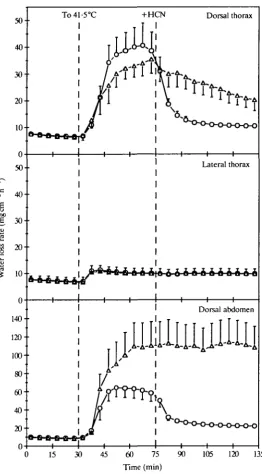
The cuticular permeability of the desert cicada Diceroprocta apache was measured in vivo from three regions of the dorsal surface: (1) the midline of the thorax (= dorsal thorax), a region that contains large pores (7-8 ^m in diameter) located in a central tract; (2) the lateral thorax, a region in which large pores are absent, and (3) the midline of the abdomen, a region in which large pores are uniformly distributed over the surface. Transcuticular water flux rates were similar for all three areas at 27-0°C; however, at 41-5°C rates increased sharply for the dorsal thorax and abdomen, with tracings showing numerous irregular peaks that represent cycles of water extrusion. Transcuticular water flux for the lateral thorax, in contrast, was relatively unaffected by the temperature increase and the tracings remained relatively flat. Death of the animal at the higher temperature resulted in a significant decrease in water loss rates and a loss of the cycling pattern in both the dorsal thorax and abdomen, whereas water loss through the lateral thorax did not change. The active extrusion of water begins at 39-2-39-3°Cin both male and female cicadas. Our findings confirm that the large pores are the routes by which water reaches the surface and that the temperature at which this active extrusion of water begins corresponds to the point where cicadas must seek milder microclimates to prevent body temperature from reaching lethal levels.
Introduction
220 N. F . H A D L E Y , E . C. TOOLSON AND M . C. Q U I N L A N
in the cricket Acheta domesticus, the cuticle of the abdomen is thinner than that of the thorax owing to a reduction in the thickness of the lamellae associated with the endocuticle in the abdomen (Hendricks & Hadley, 1983). More pronounced differences occur when sclerotized (stiffened) cuticle is compared with arthrodial membrane (soft cuticle) which is found between metameric segments and at the joints of appendages. Arthrodial membrane lacks the well-defined exocuticle that is characteristic of sclerotized cuticle (Neville, 1975). Moreover, in the scorpion
Hadrurus arizonensis, there are also marked differences in the fine structure of the
epicuticle in arthrodial membrane, in the arrangement of the pore/wax canal complex, and in the percentage of short-chain n-alkanes (Filshie & Hadley, 1979; Hadley & Quinlan, 1987). Although differences in cuticular permeability between sclerotized and soft cuticle were not significant in H. arizonensis when measured
in vivo, a 2-5-fold higher permeability of soft cuticle versus sclerotized cuticle was
noted in the tropical scorpion species Pandinus imperator (Hadley & Quinlan, 1987).
The question of regional differences in cuticular permeability assumes special significance in species such as the desert cicada Diceroprocta apache, whose inordinately high transcuticular water loss rates provide some degree of evaporat-ive cooling (Toolson, 1987). The mechanisms and patterns involved in this physiological process have recently been studied by Toolson & Hadley (1987). They found that this species actively facilitates water flux through its thoracic integument as temperatures reach and exceed 39°C. Large-diameter pores located in tracts on the thorax were proposed to be the route through which the water flux is facilitated.
In the present investigation, we used in vivo techniques to examine transcuticu-lar water loss in the thorax midline, in the lateral thorax where transcuticu-large pores are absent, and in the abdomen where pores are randomly distributed and are quite numerous. Permeability of the sclerotized cuticle in these three distinct regions is compared. We also examined the architecture and distribution of these pores and other surface openings and correlated water flux with body temperature regulation in this unusual desert insect.
Materials and methods
Cicadas were collected from the Arizona State University campus (Maricopa County) daily during July and August 1987 and returned immediately to the laboratory in a small cooler. The animals were generally used immediately but some were transferred to an incubator for later use. Animals kept in the incubator were given freshly cut branches of the desert fern Lysiloma micropylla as a food source. Cicadas were kept in this fashion for as long as 2 days but most were used within 6h of capture. Equal numbers of both sexes were used in the experiments whenever possible.
operation of the transpiration monitor and geometry of the capsule have been extensively described elsewhere (Hadley et al. 1982, 1986; Hadley & Quinlan, 1987; Toolson & Hadley, 1987), so the descriptions that follow are brief. The transpiration monitor is a flow-through instrument that electronically senses the water vapour density of a sample gas stream. Dry air was directed over the specimen via the capsule and returned to the transpiration monitor where the transpired water was measured (flow rate 3-71 mlmin"1). The capsule mouth was fitted with a silicone gasket 0-25 mm thick to provide a gas-tight seal with respect to the atmosphere. The area covered by the gasket averaged 0-82mm2 (S.D. 0-077 mm2) and was measured after each run with a dissecting microscope.
Cicadas were mounted to the capsule with a great deal of care to ensure that they would be minimally disturbed. The animals were first cooled briefly to 5°C and then taped to a movable holding platform. The wings were then clipped off at the base and the stubs secured with beeswax. A slow stream of CO2 was directed over the animals throughout the mounting process to keep them anaesthetized. The capsule was fixed rigidly to a ring stand, aperture downwards, and the holding platform raised and rotated (if necessary) to bring the appropriate area of the animal's body in contact with the capsule opening. The platform was then locked in position and a quick-drying epoxy cement was applied liberally around the capsule. The animals did not seem to be adversely affected by this cement which was selected because it formed a strong, but not permanent, bond between capsule and cuticle. After the cement had set, the animal was cut free from the platform and allowed to recover from the CO2. The capsule opening was placed over one of three areas: the dorsal midline of the mesonotum (= dorsal thorax), the dorsolateral area of the same segment (= lateral thorax) or the dorsal midline of the 1st ($) or 2nd (d") abdominal segment (= dorsal abdomen) (see Fig. 1A). Capsule placement on the dorsal abdomen differed for the sexes because the first segment in males is greatly reduced in size and nearly covered by the larger second segment, whereas the first and second segments are of nearly equal size in females. Copper-constantan thermocouples (0-25 mm diameter) were used to measure air (Tair) and thorax (Tth) temperatures. The air temperature thermocouples were fixed to the capsule approximately 1 mm above the animal's cuticle. The thoracic thermocouples were inserted dorsolaterally into the flight muscles to a depth of 4 mm (see Fig. 1A) and secured with beeswax while the animals were anaesthe-tized. Thermocouple outputs were connected to a calibrated thermocouple thermometer (Bailey BAT-12).
222 N . F . H A D L E Y , E . C. TOOLSON AND M. C. Q U I N L A N
transpiration rate, approximately half the animals from each 'group' (i.e. cuticle region) were injected intrathoracically with a saturated NaCN solution (0-05 ml) 45min after insertion into the high-temperature box.
Continuous tracings of water loss and Tth were made on a strip-chart recorder and air temperatures (Tair) were noted by hand as appropriate. The thoracic temperatures associated with the onset of water extrusion were determined from these tracings after making corrections for the flow lag of the transpiration monitor. The tracings were digitized, divided into 5-min intervals and integrated by computer. The water loss rates derived from these tracing segments were summed through longer intervals, called phases, to give mean values for each run (Fig. 2). The first phase consisted of the last 15min of the room-temperature period; phase 2 consisted of the 15min interval beginning 30min after insertion into the high-temperature box, and phase 3 consisted of the last 30min of each run.
The cuticle surface enclosed by the ventilated capsule during permeability measurements was examined by scanning electron microscopy in six cicadas selected at random from each of the three test groups. The entire thorax or abdomen was excised from the air-dried cicada and the underlying tissue removed by gentle scraping. The portion of the cuticle surface containing the measurement area was mounted on a specimen stub and gold-coated in a d.c. sputtering device. Micrographs were taken on a AMR 1000A scanning electron microscope. The total number of pores beneath the capsule was determined either by counting them all using a magnifying glass placed over a low-magnification print (large pores) or by extrapolation from a portion of the total capsule area using high-magnification prints (small pores).
Unless otherwise stated, all results are presented as means ± S.E. Statistical comparisons of data were conducted using appropriate nonparametric statistical procedures.
Results
224 N. F. HADLEY, E. C. TOOLSON AND M. C. QUINLAN
0 15 30 45 60 75
Time (min)
[image:6.451.82.373.64.367.2]90 105 120 135
Fig. 2. Representative in vivo water loss tracings from the dorsal thorax (DT), lateral thorax (LT) and dorsal abdomen (DA). Shown at the top are mean air temperatures for each phase. Intervals used to calculate phase means are indicated with horizontal hatched bars. See text for explanation of phases and treatments applied to the animals during the runs. TM, transpiration monitor.
present over the entire surface of the mesonotum, including the tracts that contain the large pores. The surface density of the small pores beneath the ventilated capsule is 36 880 ±424 pores cm"2; the ratio of large to small pores within the midline tract is 2-6 ±0-08 (N= 5).
The distribution of large pores in the lateral thorax and abdomen is quite different. As indicated above, mesonotal cuticle (outside the tracts) contains only the smaller pores; no large pores are visible in the lateral thorax at magnifications of 51 x (Fig. 1C). In the abdomen (Fig. ID), both large and small pores are present. The surface density of large pores on the abdominal surface (53 650 ± 2840 pores cm"2) is nearly twice that of the dorsal thorax; however, the ratio of large to small pores in the abdomen (1-6 ± 0-43, N — 5) is lower than that found within the central tract of the thorax.
Table 1. Regional breakdown of pore densities and water loss rates (WLRs) from Diceroprocta apache Region Dorsal thorax Lateral thorax Dorsal abdomen Pore density 26 887 ±3370
(6) 0 (6) 53 650 ±2840
(6) 6 6 8 Phase WLR •6 ±0-60* •9 ±0-66 •5 ±0-85 1 Tt h 27-5 ±
0-27-6 27-0 ±0-10 13 15 37 (17) 9 (10) 85 (14) Phase WLR •l±4-40t •9 ±0-91 •1± 15-14 2 40 40 40 To, •5 ±0-15 •l±0-17 •8 ±0-10
Thoracic temperatures (Tth) have been provided for comparison. Mean phase 1 T ^ = 27-2°C;
mean phase 2 T ^ = 41-5°C.
Values are expressed as means ± S.E. with sample sizes in parentheses.
WLR values, Tth values and pore densities are in mgcm~2h~1, °C and porescm"2,
respectively.
*Mean WLR values for the three cuticle regions at 27-2°C are not significantly different. tMean WLR values for the three cuticle regions at 41-5°C are significantly different from their corresponding values at 27-2°C (P < 0-01) and are significantly different from one another
226
N. F. HADLEY, E. C. TOOLSON AND M. C. QUINLAN5 0
-4 0 - '
3 0 - •
2 0 - •
10- ,
0
To41-5°C +HCN Dorsal thorax
> &
H
1-Lateral thorax
a a -ita-a-i-a a a a a a-a-i-a
H 1 h
140
120
100-
80-
60-
40-
20-Dorsal abdomen
o-a a a-a-a
form*
I
\0 •+- •+- •+-
4-0 15 34-0 45 64-0 75 94-0 14-05 124-0 135
[image:8.451.103.366.86.561.2]Time (min)
phase 2 WLRs of the two dorsal abdomen subgroups; this discrepancy was due primarily to extraordinarily high rates exhibited by two cicadas (227 and 160mgcm~2h~1) in the alive subgroup. This difference does not alter our interpretation of the data, as the remaining animals of this subgroup also showed constant or increasing WLRs through phases 2 and 3, although at lower levels. As noted above, water loss from the lateral thorax was unaffected by either time or death.
Active extrusion was initiated from both the dorsal thorax and the dorsal abdomen within a relatively narrow range of body temperatures. Extrusion of water from the dorsal thorax started at a Tth of 39-3 ±0-29°C (N= 15, range 37-6-41-8°C); flux from the dorsal abdomen began at a Tth of 39-2 ± 0-24°C
(N = 13, range 37-l-40-4°C). There were no significant differences between males
and females with respect to these temperatures.
Discussion
Adults of the desert cicada Diceroprocta apache are active during the wannest summer months and during the hottest periods of the day in the southwest United States (Glinski & Ohmart, 1984). Indeed, males often sing from perches high in mesquite or palo verde trees in mid-afternoon when air temperatures (Tair) exceed 48°C. Heath & Wilkin (1970) attributed this unusual behaviour to the cicada's tolerance of high body temperatures (Tb) and a tendency to seek shade and, hence, cooler microclimates, when Tair exceeds 39°C. Although the importance of this thermoregulatory behaviour cannot be denied, Toolson (1987) also demon-strated that the cicadas can maintain Tb< Ta i r evaporatively even when cooler microclimates are unavailable. Prolonged evaporative cooling requires a ready source of water (obtained from the xylem of the plants on which they feed) and the ability to generate high water loss rates when temperature must be regulated to prevent Tb from reaching lethal levels. Preliminary evidence recently reported by Toolson & Hadley (1987), combined with data from the present study, show how
D. apache is able to achieve the very high water loss rates needed to maintain
subambient Tb.
The mean WLRs from each region clearly reflect the effects of temperature. Water flux at 27°C (phase 1) was similar from all three regions, indicating an absence of extrusion at this temperature. Water loss increased significantly when the animals were exposed to 41-5°C (phase 2) although the magnitude of the increase depended on the region. Both the dorsal thorax and the dorsal abdomen showed large increases in water loss at the higher temperature (Q10 values of 3-77 and 5-31, respectively), whereas the lateral thorax responded weakly to tempera-ture (Q1 0= 1-33).
228 N . F . H A D L E Y , E . C. TOOLSON AND M . C. Q U I N L A N
the density of large pores in the abdomen is approximately twice that of the dorsal thorax. Moreover, there was no significant difference in water loss rates for the dorsal versus lateral thorax, even though large pores are absent from the lateral thorax. However, at 41-5°C water loss rates from the dorsal abdomen were 2-3 times those measured from the dorsal thorax and 8-6 times those from the lateral thorax. In addition, the bouts or cycles of water loss that often occurred at the higher temperature were noted only for those regions of the cuticle that contain the large pores. These findings clearly support the earlier hypothesis (Toolson & Hadley, 1987) that these large pores are the routes by which the water, which is responsible for the abrupt and marked increase in cuticular transpiration at high temperatures, reaches the cuticle surface. It is also clear that water flux through the large pores is either absent or minimal at low temperatures.
We cannot yet establish if water is also lost through the small pores; however, we can estimate the amount of transpiration that occurs via large pores, relative to that which diffuses across the general cuticle surface, if we assume that water loss for cuticle containing only the small pores is the same over the entire thorax (values at 27 °C indicate this is so) and that this cuticle type responds to increased temperature in a similar manner. Thus, water flux across the lateral thorax increases from 6-9 mg c m "2h "1 at 27-2°C to 9-9mgcm"2h"1 at 41 • 5°C, a factor of 1-43. Multiplying this factor by the water loss for the dorsal thorax at 27-2°C yields a flux rate of 9-4mgcm~2h~1 at 41-5°C through the general cuticle surface, leaving 27-7mgcm~2h- 1 through the large pores. Given the measured pore density (26 887 pores cm~2) of the dorsal thorax, the flux per pore is 1-03 fig pore"1 h"1.
The water loss rates exhibited by D. apache are extremely high, regardless of temperature or the means by which the transpired water reaches the surface. At 27-2°C, water loss rates, corrected for saturation deficit, are 0-244, 0-255 and 0-314mgcm"2h^mmHg"1 (lmmHg = 133-3Pa) for the dorsal thorax, lateral thorax and dorsal abdomen, respectively. This in vivo rate for abdominal cuticle is approximately 18 times higher than that exhibited by the desert tenebrionid beetle
Eleodes armata (whole animals; Ahearn & Hadley, 1969) and 455 times greater
than rates exhibited by the desert scorpion Hadrurus arizonensis (in vivo; Hadley & Quinlan, 1987). In fact, transcuticular water flux in the cicada exceeds the surface-specific water loss rates for most terrestrial arthropods listed by Edney (1977), regardless of their habitat. At 41-5°C, transcuticular water flux across the dorsal abdomen of the cicada increases to 1-421 mgcm"2h"1 mmHg"1. This rate is comparable to cutaneous water loss (CWL) rates exhibited by several species of nonarboreal frogs at 25 °C and 38 % relative humidity (Wygoda, 1984) when CWL is corrected for saturation deficit. Despite the cicada's ability to tolerate substantial water deficits (30-35 % of total body water; Toolson, 1987), this rate of water loss would soon lead to dehydration and death were it not for the water source provided by the xylem.
begin seeking shade in the field (Heath & Wilkin, 1970) and also falls in the temperature range (39-40°C) where the Tb of live cicadas begins to deviate from those of dead individuals (Toolson, 1987). Although Toolson (1987) reported Tair—Tb differences of 2-9°C after a 1-h exposure to 45-5°C, the body temperature depression in our study averaged only about 1°C at a Tair of 41-5°C. Higher transcuticular water loss can be expected at higher temperatures which, in turn, may result in greater evaporative cooling. For example, Toolson & Hadley (1987) noted an increase in water loss from 36-lmgcm~2h~1 at 41 °C (compared with 37-lmgcm~2h~1 in this study) to 61-4mgcm~2h~1 at 43°C. More important, however, is the experimental design used in our study. Much of the middorsal thorax containing the large pores was covered with epoxy cement to ensure a complete seal of the ventilated capsule to the cuticle surface. This certainly reduced transcuticular water flux from this body region, thus preventing effective cooling of the thoracic musculature.
In addition to its energy-dependence and thermoregulatory function, facili-tation Of transcuticular water flux in cicadas exhibits a number of other similarities to thermoregulatory sweating in mammals. At high temperatures, area-specific rates of water loss through the regions of the cuticle containing large pores are at least equal to those measured during sweating in humans (approximately 3 0 m g c m "2h- 1 at ambient and skin temperatures of 39-0°C; Mountcastle, 1980). Also, the discontinuous release of water through the large pores in D. apache is similar to the release of sweat in man and other mammals (Kraning & Sturgeon, 1983). We are presently conducting a microanatomical study of the tissue underlying the cuticle that contains large ducts to determine if it possesses glandular structures that could be involved in the extrusion of water.
This research was supported by NSF grant DCB 8601817 to NFH.
References
AHEARN, G. A. & HADLEY, N. F. (1969). The effects of temperature and humidity on water loss in two desert tenebrionid beetles, Eleodes armata and Cryptoglossa verrucosa. Comp.
Biochem. Physiol. 30, 739-749.
EDNEY, E. B. (1977). Water Balance in Land Arthropods. Berlin: Springer-Verlag.
FILSHIE, B. K. & HADLEY, N. F. (1979). Fine structure of the cuticle of the desert scorpion,
Hadrurus arizonensis. Tissue Cell 11, 249-262.
GLINSKI, R. L. & OHMART, R. D. (1984). Factors of reproduction and population densities in the Apache cicada (Diceroprocta apache). Southwest. Nat. 29, 73-79.
HADLEY, N. F. (1981). Cuticular lipids of terrestrial plants and arthropods: a comparison of the their structure, composition, and waterproofing function. Biol. Rev. 56, 23-47.
HADLEY, N. F., MACHIN, J. & QUINLAN, M. C. (1986). Cricket cuticle water relations: permeability and passive determinants of cuticular water content. Physiol. Zool. 59, 84-94.
HADLEY, N. F. & QUINLAN, M. C. (1987). Permeability of arthrodial membrane to water: a first measurement using in vivo techniques. Experientia 43, 164-166.
HADLEY, N. F., STUART, J. L. & QUINLAN, M. (1982). An air-flow system for measuring total transpiration and cuticular permeability in arthropods: studies on the centipede Scolopendra
polymorpha. Physiol. Zool. 55, 393-404.
HEATH, J. E. & WILKIN, P. J. (1970). Temperature responses of the desert cicada, Diceroprocta
230 N. F. HADLEY, E. C. TOOLSON AND M. C. QUINLAN
HENDRICKS, G. M. & HADLEY, N. F. (1983). Fine structure of the cuticle of the cricket Acheta
domesticus with reference to lipids. Tissue Cell 15, 761-779.
KRANING, K. K. & STURGEON, D. A. (1983). Measurement of sweating rate with capacitance sensors. Ann. Biomed. Engin. 11, 131-146.
MOUNTCASTLE, V. B. (1980). Medical Physiology, 14th edn. St Louis: C. V. Mosby.
NEVILLE, A. C. (1975). Biology of the Arthropod Cuticle. Berlin: Springer-Verlag.
TOOLSON, E. C. (1987). Water profligacy as an adaptation to hot deserts: water loss rates and evaporative cooling in the Sonoran Desert cicada, Diceroprocta apache (Homoptera: Cicadidae). Physiol. Zool. 60, 379-385.
TOOLSON, E. C. & HADLEY, N. F. (1987). Energy-dependent facilitation of transcuticular water flux contributes to evaporative cooling in the Sonoran Desert cicada, Diceroprocta apache (Homoptera: Cicadidae). J. exp. Biol. 131, 439-444.