1 3 figures
Printed in Great Britain
THE ACTIVITY AND CHARACTERISTICS OF THE
Ca
2+ATPase OF FISH GILLS IN RELATION TO
ENVIRONMENTAL CALCIUM
CONCENTRATIONS
BY K. L. SHEPHARD
From the Department of Zoology, Reading University, White/mights, Reading, England
(Received 14 February 1980)
SUMMARY
The concentration of plasma calcium and the activity of the gill Ca2+ -ATPase has been measured in roach from several waters. Plasma calcium concentrations in these fish vary very little (2-62 ± 0-17 mM) despite great variation in the external calcium concentration between waters (0-40 to 2-92 mM). There is, however, a close correlation between Ca2+ATPase activity and external calcium concentration, consistent with the view that differences in the requirement for calcium transport are accommodated by variation in the Ca^ATPase system.
These results are discussed in relation to those of a previous experiment, where the short term effects of changing external calcium were considered. It is suggested that variation in the absolute level of Ca2+ATPase activity represents the long term adaptation of the roach to different calcium concen-trations.
INTRODUCTION
The skin of freshwater teleost fishes is now recognized to be a major site for the exchange of calcium between the fish and its surroundings (Berg, 1968). The gills and fins are reported to be responsible for a large component of this translocation (Ma3hiko & Jozuka, 1964).
in a way likely to minimise their effect on internal calcium concentrations. This is air important concept and is likely to have a major ecological bearing in situations where natural populations of fish are exposed to varying concentrations of external calcium; proposed river transfer schemes or waters subjected to nutrient enrichment are examples. Previous experiments have, however, been concerned with the short term effects of changing calcium. This paper attempts to extend these observations to a consideration of long term influences by relating the short term effects to existing relationships between the ATPase of natural roach populations and the external calcium levels to which they are exposed.
METHOD
Roach were collected by seine netting, electrofishing or by rod and line from various waters in southern England (Table i). Normally eight fi9h weighing between 30 g and 120 g were taken from each water. They were transported in oxygenated water and between 4 and 6 healthy fish were used in the assays immediately on return to Reading. Roach from Kew Garden pond, however, were kept in running tap water for periods of 1 to 2 years before use. Water samples were removed from each water for determination of calcium by atomic absorption spectrophotometry (Varian Tectron AA175).
The gills from each fish were dissected out, weighed and enzyme homogenates were prepared and assayed by the methods described previously (Shephard & Simkiss,
1978). The enzyme preparations from fish from Dawlish pond, Kew Garden pond and the River Thames at Reading were assayed at a range of incubation calcium concentrations. Maximum activity was found to occur at 2 mM-Ca2+ in each case and this concentration was used in all other assays. Fish from Kew Garden pond, kept in tap water, were assayed for enzyme activity at various times throughout the year, after a 1 year acclimatization to tap water.
The concentration of plasma calcium was also determined in fish from several of the waters. The technique is described elsewhere (Shephard, in preparation). Four fish from each water were assayed. The concentration of plasma calcium in fish from Kew Garden pond was also measured, again at intervals throughout the year after a 1 year acclimatization to tap water.
Table 1. Waters from which roach were collected. Values of calcium concentration are the means of duplicate determinations on each of 3 samples from each water, and are given as mM
(Values in brackets are as mg dm-' (mean± I x SEM).)
Water Description Month sampled Calcium concentration
1 River Thames at Reading 2 Bookham Gt pond, Surrey 3 Betchworth pit, Surrey 4 Binfield lake, Berkshire 5 Dawlish pond, Devon 6 Kenton pond, Devon 7 Kew garden pond, London 8 Badshot Lea pit, Hampshire
Reading tap water
—
Village pond Disused marl pit Estate lake Village pond Trout lake Ornamental pond Disused gravel pit
Activity and characteristics of the Ca
ATPase offish gills 117
River Thames, Reading
—= * •
-Kew Gardens pond
Dawlish pond
3 4 5 iCaJ+(mM)
[image:3.451.102.338.43.392.2]10
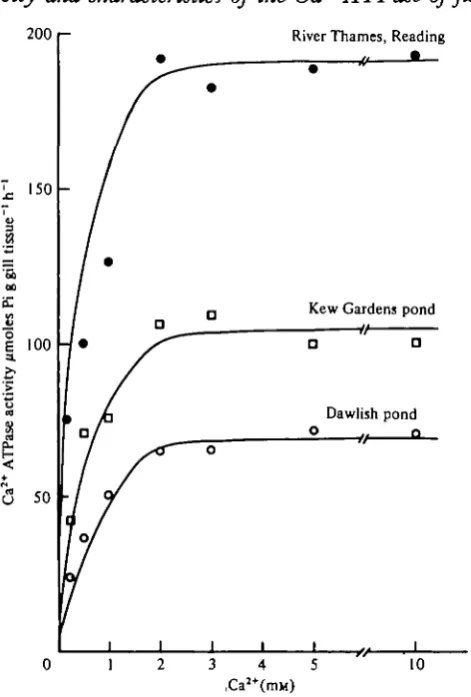
Fig. 1. The effect of various calcium concentrations in the incubation medium on the Ca1+ -ATPase activities of roach from Dawlish pond, Kew garden pond and the River Thames. Each point represents the mean of duplicate estimates of activity on two fish from each water.
RESULTS
Ca2+ATPase activities of fish from Dawlish pond, Kew Garden pond and the River Thames are presented in Fig. 1 and are shown to vary with the calcium concen-tration in the incubation medium. Despite differences in the calcium concenconcen-trations of the water from which these fish originated, the enzymes are in all cases maximally activated by 2 mM-Ca2+.
The Ca2+ATPase activities of the roach from each water are shown graphically in Fig. 2, in relation to external calcium concentrations. It is clear that the Ca^ATPase activity of most of these fish is closely correlated to external calcium concentrations. Fish from Badshot Lea pit and Kew Garden pond have been omitted from the correlation estimate. Their case is discussed below.
200
1 ISO
•£,'•
I ioo
•a
3
50
1 0 •20 13-0
Ca2+(mM)
Fig. 2. T h e relationship between water calcium concentration and Ca*+ATPase activities of fish from various waters. T h e circled number refers to sites described in Table i. Each value represents the mean of duplicate assays on the enzyme preparations of 4 or 6 fish from each water, ± 1 x SUM. All enzymes were incubated with 2 mM-Ca1+. T h e slope was fitted by linear regression analysis but does not include points 7 and 8 (see text), r =• 0 9 2 7 , signifi-cantly correlated at P < 0 0 1 .
120
110
100
1
£ 83
| 90 a.
I 80
70
30
2-9 |
c
o
2-8 |
§
2-7 §
E 2-6 |
Cti
2-5 I o-2-4
J F M A M J J A S O N D
[image:4.451.55.391.53.302.2]Time of year
[image:4.451.61.398.375.605.2]Activity and characteristics of the Ca
ATPase offish gills 119
Table 2. The concentration of plasma calcium in roach from various waters. Values are the mean ± 1 x SEM of duplicate determinations on 4 fish from each water and are given as
HIM
Water Plasma calcium concentration
River Thames Bookham pond Betchworth pit Badshot Lea pit Kew garden pond
2-0410-31 2-74 + 0-23 2-6910-31 265 +0-21 2-0610-34
The concentration of plasma calcium in fish from other waters is shown in Table 2. These analyses were all done in June. There is no significant correlation between the level of plasma calcium and either external calcium concentration or Cas+ATPase activity.
DISCUSSION
Roach can exist in waters with a wide range of calcium concentrations. Fish in this survey were taken in water with Ca2+ concentrations ranging from 0-40 mM to 2-92 mM. The River Thames at Reading occasionally contains up to 3-68 mM-Ca^ (Thames Water Authority data). Moreover, the roach maintain plasma calcium within a narrow range of concentrations (2-62 ± 0-172 mM) despite these external variations.
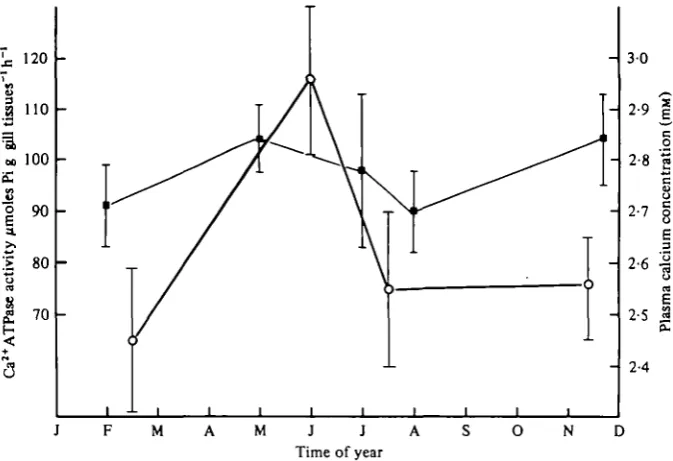
The close relationship between external calcium concentration and the activity of the Ca2+ATPase of the roach does suggest a possible mechanism for the fish's apparent indifference to environmental calcium, bearing in mind the implied involve-ment of Ca2+ATPase in calcium transport (Melancon & Deluca, 1970; Schatzman, 1975). Higher levels of ATPase activity are encountered with high concentrations of calcium; the inference is that more ATPase activity is present to satisfy a greater requirement for calcium transport. Presumably this calcium transport is in an outward direction, to compensate for greater inward diffusion at high external calcium concen-trations. The minor seasonal variations in Ca2+ATPase activities measured in fish from Kew Garden pond suggest that seasonal changes did not contribute to the measured relationship between activity and external calcium. The peak in plasma calcium in Kew roach in June is also unlikely to have influenced the measurements of plasma calcium in fish from the various waters, as calcium was also measured in these fish in June. Elevated plasma calcium levels occur frequently in female Osteichthyes during the breeding season (Urist & Schjeide, 1961), and this is likely to be the cause of the observed peak here, as roach spawn in May and June in southern England.
optimum while high calcium raised it. In contrast, fish that permanently exist HI waters with various calcium concentrations seem to maintain absolute enzyme activities in proportion to external calcium levels yet appear to be optimally activated by 2 mM-Ca2+, irrespective of external calcium.
A further insight into the association between Ca2+ATPase and environmental calcium is provided by the results from Badshot Lea pit and Kew Garden pond. Badshot Lea pit is a disused gravel pit with a fairly impoverished water chemistry. Prior to 1977 it had a calcium concentration of i-oo mM. In an attempt to improve the water as a fishery, the angling authorities artificially fertilized the water in 1977. Ground chalk was added to the extent that the dissolved calcium concentration rose in 1978 to as much as 4 mM. As reported in Table 1, this has now decreased to 1-35 mM. Despite the large variation in external calcium concentration in the previous season, roach removed for this survey in June 1979 exhibited a Ca^ATPase activity which was not significantly different from that anticipated if the water had remained with low calcium concentration. This point is shown also by fish from Kew Garden pond. These fish were removed from Kew, with a moderate calcium concentration (1-33 mM) and kept in Reading tap water (2-65 mM) for one year. The Ca^ATPase activity of 104-08 ft mol Pi g gill tissue"1 h- 1 is much less than would be expected in Reading tap water, on the basis of calcium concentration, but does correspond closely to the concentration in the original Kew pond water. Thus, both Kew Garden fish and Badshot Lea fish have shown constant Ca2+ATPase activities despite large changes of external calcium.
It would seem pertinent at this stage to suggest an overall view of the relationship between Ca2+ATPase and external calcium. The enzyme system is evidently capable of a short term response to a changing calcium regime; this is largely exhibited as a change in the characteristics of enzyme activity. On the other hand, the close relation-ship between the level of enzyme activity and calcium concentration, shown by fish from various waters, does indicate that it is the absolute enzyme activity that is susceptible to long term changes. It is possible that this is an adaptation rather than an acclimatization; this is supported by the observations on the roach from Badshot Lea and Kew Gardens.
I would like to express thanks to both the Thames and the South West Water Authorities for valuable help in this survey; in particular to Drs P. B. Spillet (TWA)^ and R. M. Hamilton (SWWA) and to Mr Alan Sheppard (SWWA). I am indebted to Dr Millington and Mr R. T. Frost of Farnham Angling Society for information about Badshot Lea pit.
REFERENCES
BERG, A. (1968). Studies on the metabolism of calcium and strontium in freshwater fish. i. Relative contribution of direct and intestinal absorption. Mem. ist ital. Idrobiol. 33, 161-196.
BURDICK, C. J., MKNDLINOER, S.( PANG, R. K. & PANG, P. K. T. (1976). Effects of environmental calcium & Stannius corpuscle extracts on Ca-ATPase in killiftsh, Fimduhu heteroclitus, Am. Zool., 16, 224.
FENWICK, J. C. (1976). Effect of stanniectomy on calcium activated adenosine-triphosphatase activity in the gills of freshwater adapted North American eels, Anguilla rottrata Le Sueur. Gen. comi
Activity and characteristics of the Ca
ATPase offish gills 121
FENWICK, J. C. & So, Y. P. (1974). A perfusion study of the effect of stanniectomy on the net influx of calcium 45 across an isolated eel gill. J. exp. Zool. 188, 123-131.
MA, S. W. Y., SHAMI, Y., MESSER; H. H. & COPP, D. H. (1974). Properties of Caa+-ATPase from the
gill of rainbow trout. (Salmo gairdneri). Biochim. biophys. Ada 345, 243-251.
MASHIKO, K. & JOZUKA, K. (1964). Absorption and excretion of calcium by teleost fishes with special reference to the routes followed. Annotnes. zool. jap. 37, 41-50.
MELANCON, M. J. & DELUCA, H. F. (1970). Vitamin D stimulation of calcium-dependent adenosine triphosphatase in chick intestinal brush borders. Biochemistry 9, 1658-1664.
SCHATZMANN, H. J. (1975). Active calcium transport and calcium activated ATPase in human red cells. In, Current Topics in Membranes and Transport, vol 6 (ed. Bonner, F. and Kleinzeller, A.), pp. 125—168, New York: Academic Press.
SHEPHARD, K. L. & SIMKISS, K. (1978). The effect of heavy metal ions on Ca'+ATPase extracted from fish gills. Comp. Biochem. Physiol. 61B, 69-72.