Phosphorus is an essential mineral in growth and
development of poultry.
Poultry diets are usually based on cereals in which
50–70% of total phosphorous is present in the form
of phytate (Ravindran
et al
., 1995). This
phospho-rous is unavailable to monogastric animals because
they lack endogenous phytase. One way to solve
this problem is the addition of inorganic
phospho-rus sources to diets. On the one hand, this approach
increases the cost of production and on the other, it
does not solve the problem of phosphorous
excre-tion into the environment.
Supplementation of enzyme phytase to poultry
diets has proven to be an efficient solution when
addressing these problems. Numerous studies
showed that supplemental phytase increased body
weight gain – BWG (Qian
et al
., 1996a; Sebastian
et
al
., 1996a; Yi
et al
., 1996), phosphorus bioavailability
(Sebastian
et al
., 1996b; Windisch and Kirchgessner,
1996) as well as bioavailability of amino acids, Zn,
Ca, Mg (Ravindran
et al
., 1999; Um and Paik, 1999),
improved biomineralization (Sebastian
et al
., 1996a)
and decreased phosphorus and nitrogen excretion
(Yi
et al
., 1996; Edens
et
al
., 1999).
Effect of phytase supplementation in
maize-soybean meal based diets has been studied
thor-oughly, but investigations of diets based on other
cereals are scarce. Zyla
et al
. (2000) showed that
supplementation of 750 PU/kg to wheat based diet
increased body weight gain, feed consumption and
phosphorus retention. Supplementation of phytase
(1 200 PU/kg) improved the digestibility of protein
and amino acids in maize, sorghum and wheat based
diets, but the magnitude of response varied between
cereals (Ravindran
et al
., 1999). Normal broiler bone
mineralization was supported by supplementing
1 000 PU/kg to diets based on wheat, barley, oat and
soybean meal with low or zero inorganic
phospho-rus content (Kiiskinen
et al
., 1994).
The aim of this investigation was to determine
and compare effects of phytase supplementation to
diets based on maize, wheat, barley and triticale on
broiler performance, nutrient retention and
excre-tion as well as bone mineralizaexcre-tion. In this paper
Effects of supplemental phytase on performance and
tibia ash of broilers fed different cereals based diets
J. P�����
1, B. H����
1, K. G����
1, D. G�����
1, M. S������
1,2, T. ����
11
Department of Animal Nutrition, Faculty of Agriculture, University of Zagreb, Croatia
2Laboratory of Radiochemistry, Ruđer Bošković Institute, Zagreb, Croatia
ABSTRACT: A 21-day experiment with day-old broilers was conducted in order to assess the effect of phytase supplementation to different cereals-soybean meal based diets on broiler performance and tibia ash. Diets were formulated to contain 4 different cereals (maize, wheat, triticale and barley), 2 levels of dietary calcium (0.6 and 1.0%) and 3 levels of supplemental phytase (0, 500 and 1 000 PU/kg). Supplemented phytase had beneficial effects on broiler performance. It significantly increased body weight gain (P < 0.0003) and feed consumption (P < 0.0361) by 6 and 7% in comparison with the control groups, respectively. No influence on feed conversion ratio and tibia ash was detected. Both body weight gain and feed intake were also significantly influenced by different cereals (P
< 0.0001 and 0.0348, respectively). The increasing dietary calcium level resulted in a significant increase in body weight gain (P < 0.0024) and tibia ash (P < 0.0016). Effects of 500 and 1 000 PU/kg were not statistically different between themselves.
Keywords: phytase; maize; wheat; triticale; barley; body weight gain; feed consumption; feed conversion ratio; tibia ash
effects on bird performance and tibia ash are
pre-sented.
MATERIAL AND METHODS
Materials and manipulation
. Two hundred
forty-five day-old commercial male broiler
chick-ens (Ross) were randomly distributed in 24 pchick-ens.
Chickens were weighed on Me�ler electrical
bal-ance (± 0.1 g). Average body weights in different
groups were not statistically different.
The broilers were maintained in wire-floored
pens with separated excreta trays, placed in an
en-vironmentally controlled room. The birds received
constant electrical illumination.
Diets
. Feed and water were made available for
ad libitum
consumption. The study was conducted
as a 4 × 3 × 2 factorial arrangement of treatments to
evaluate the effects of four different cereals (maize,
wheat, triticale and barley), three levels of
sup-plemental phytase (0, 500 and 1 000 PU/kg) and
2 levels of dietary calcium (0.6 and 1.0%) on broiler
response.
Diet ingredients were obtained in bulk. NOVO CT
(Novo Nordisk) phytase was used. Both ingredients
and diets were analysed for moisture, ash, protein,
fat, fibre, calcium and total phosphorus by usual
methods (ISO 6496, 1999; ISO 5984, 2002; ISO 5983,
1997; ISO 6492, 1999; ISO 5498, 1999; ISO 6490–1,
1985; ISO 6491, 1998). Phytate phosphorus content
was determined by Sooncharernying and Edwards
(1993) procedure. In brief, phytate was selectively
precipitated with FeCl
3× 6 H
2O from an extract
obtained a�er 24 hours of sample extraction with
the solution of HCl and Na
2SO
4. The obtained
pre-cipitate was degraded in a mixture of concentrated
H
2SO
4and HNO
3(2 : 3). The content of phytate
phosphorus in the obtained solution was
deter-mined by the usual spectrophotometric method for
phosphorous determination (ISO 6491, 1998).
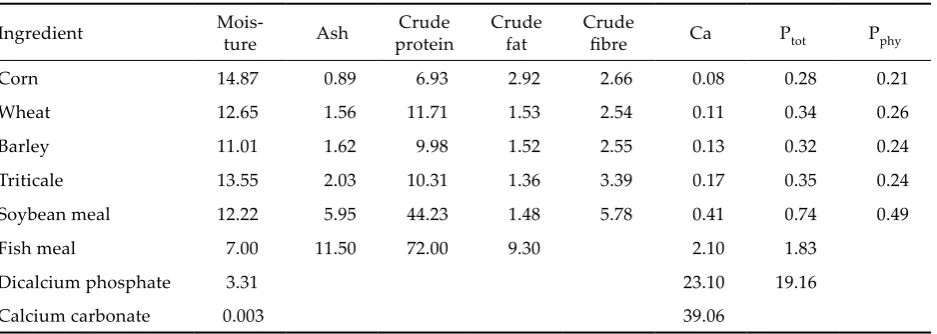
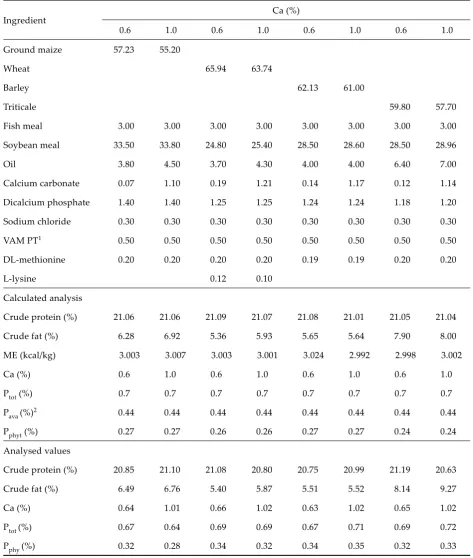
Chemical compositions of feeds and experimental
diets are given in Tables 1 and 2, respectively.
Broiler performance
.
Body weights were measured
weekly and additionally at the first three days of the
2nd and 3rd week. Feed consumptions were
deter-mined in the first three days of the 2nd and 3rd week
of study. Feed conversion was then calculated as a feed
consumption to body weight gain (BUG) ratio. Only
the results of the 3rd week of trial are presented.
Tibia ash
.
At the termination of the study all birds
were killed and le� tibias of three birds per
treat-ment were removed. Tibias were dried to constant
weight at 105°C, defa�ed and then ashed in a muffle
furnace at 550°C.
Statistics
. Three-way ANOVA was used to
de-termine main effects (cereals, phytase and calcium
levels) and their interactions by using General
Linear Models procedure. Mean differences were
separated by Tukey’s test. The level of significance
was set at
P
< 0.05. All analyses were performed
using statistical so�ware SAS 8.00.
RESULTS
[image:2.595.65.534.566.733.2]Statistical analyses of the effects of phytase,
dif-ferent cereal and calcium contents on average body
Table 1. Composition of feeds (in %)
Ingredient Mois-ture Ash proteinCrude Crude fat Crude fibre Ca Ptot Pphy
Corn 14.87 0.89 6.93 2.92 2.66 0.08 0.28 0.21
Wheat 12.65 1.56 11.71 1.53 2.54 0.11 0.34 0.26
Barley 11.01 1.62 9.98 1.52 2.55 0.13 0.32 0.24
Triticale 13.55 2.03 10.31 1.36 3.39 0.17 0.35 0.24
Soybean meal 12.22 5.95 44.23 1.48 5.78 0.41 0.74 0.49
Fish meal 7.00 11.50 72.00 9.30 2.10 1.83
Dicalcium phosphate 3.31 23.10 19.16
Calcium carbonate 0.003 39.06
Table 2. Composition of experimental diets (%)
Ingredient Ca (%)
0.6 1.0 0.6 1.0 0.6 1.0 0.6 1.0
Ground maize 57.23 55.20
Wheat 65.94 63.74
Barley 62.13 61.00
Triticale 59.80 57.70
Fish meal 3.00 3.00 3.00 3.00 3.00 3.00 3.00 3.00
Soybean meal 33.50 33.80 24.80 25.40 28.50 28.60 28.50 28.96
Oil 3.80 4.50 3.70 4.30 4.00 4.00 6.40 7.00
Calcium carbonate 0.07 1.10 0.19 1.21 0.14 1.17 0.12 1.14
Dicalcium phosphate 1.40 1.40 1.25 1.25 1.24 1.24 1.18 1.20
Sodium chloride 0.30 0.30 0.30 0.30 0.30 0.30 0.30 0.30
VAM PT1 0.50 0.50 0.50 0.50 0.50 0.50 0.50 0.50
DL-methionine 0.20 0.20 0.20 0.20 0.19 0.19 0.20 0.20
L-lysine 0.12 0.10
Calculated analysis
Crude protein (%) 21.06 21.06 21.09 21.07 21.08 21.01 21.05 21.04
Crude fat (%) 6.28 6.92 5.36 5.93 5.65 5.64 7.90 8.00
ME (kcal/kg) 3.003 3.007 3.003 3.001 3.024 2.992 2.998 3.002
Ca (%) 0.6 1.0 0.6 1.0 0.6 1.0 0.6 1.0
Ptot (%) 0.7 0.7 0.7 0.7 0.7 0.7 0.7 0.7
Pava (%)2 0.44 0.44 0.44 0.44 0.44 0.44 0.44 0.44
Pphyt (%) 0.27 0.27 0.26 0.26 0.27 0.27 0.24 0.24
Analysed values
Crude protein (%) 20.85 21.10 21.08 20.80 20.75 20.99 21.19 20.63
Crude fat (%) 6.49 6.76 5.40 5.87 5.51 5.52 8.14 9.27
Ca (%) 0.64 1.01 0.66 1.02 0.63 1.02 0.65 1.02
Ptot (%) 0.67 0.64 0.69 0.69 0.67 0.71 0.69 0.72
Pphy (%) 0.32 0.28 0.34 0.32 0.34 0.35 0.32 0.33
1Vitamin and trace mineral premix provided (kg): vitamin A 13 500 i.u., vitamin D
3 2 000 i.u., vitamin E 30 mg,
vitamin K3 2 mg, vitamin B1 1 mg, vitamin B2 6 mg, niacin 30 mg, pantothenic acid 12 mg, vitamin B6 3 mg, vitamin B12 10 µg., biotin 0.1 mg, choline chloride 500 mg, Fe 50 mg, Cu 8 mg, Mn 80 mg, Zn 60 mg, I 0.5 mg, Co 0.2 mg, Se 0.15 mg, monensin sodium 100 mg, flavophospholipol 3 mg
2Based on analysed values of total and phytate phosphorus content of experimental diets
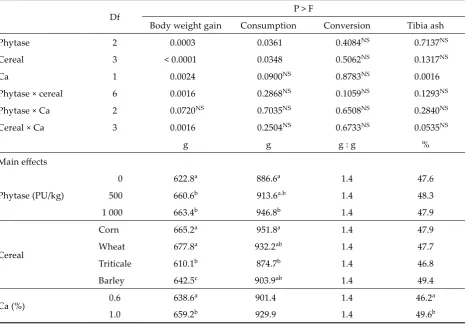
weight gain, feed consumption, feed conversion and
tibia ash in the period 0–21 days are summarised
in Table 3.
Body weight gain
All three main effects had a significant influence
on body weight gains of broilers fed different diets.
Phytase supplementation caused a 6.0% increase in
BWG in comparison with the control (
P
< 0.0003).
But there was no significant difference between
BWG of broilers fed diets containing 500 and 1 000
PU/kg. BWG of broilers fed maize and wheat based
diets were significantly higher than those of
broil-ers fed barley, which were significantly higher than
BWG of broilers fed triticale based diets. The
in-creased level of Ca (1.0%) improved BWG
signifi-cantly (
P
< 0.0024).
Significant interactions between phytase and
cereals (
P
< 0.0016) and between cereals and Ca
(
P
< 0.0016) were observed, indicating that the
ef-fects of these factors are not independent. BWG
of broilers fed wheat and triticale based diets
in-creased with increasing phytase supplement,
broil-ers fed barley based diet had the highest BWG when
500 PU/kg was supplemented to the diets, while
BWG of broilers fed maize based diet decreased
with increasing supplemental phytase. BWG of
broilers fed maize, triticale and barley based diets
increased with increasing Ca level, while those of
broilers fed wheat based diets decreased.
Feed consumption
[image:4.595.66.535.401.725.2]Feed consumption was significantly affected
by phytase supplementation (
P
< 0.0361) and
dif-ferent cereals (
P
< 0.0348). Broilers fed diets
con-taining 1 000 PU/kg had significantly higher feed
consumption (7.0%) than those fed diets without
supplemented phytase. But the feed consumption
Table 3. Effects of phytase, different cereals and calcium content on average body weight gain, feed consumption, feed conversion and tibia ash in the period 0–21 day
Df P > F
Body weight gain Consumption Conversion Tibia ash
Phytase 2 0.0003 0.0361 0.4084NS 0.7137NS
Cereal 3 < 0.0001 0.0348 0.5062NS 0.1317NS
Ca 1 0.0024 0.0900NS 0.8783NS 0.0016
Phytase × cereal 6 0.0016 0.2868NS 0.1059NS 0.1293NS
Phytase × Ca 2 0.0720NS 0.7035NS 0.6508NS 0.2840NS
Cereal × Ca 3 0.0016 0.2504NS 0.6733NS 0.0535NS
g g g : g %
Main effects
Phytase (PU/kg)
0 622.8a 886.6a 1.4 47.6
500 660.6b 913.6a.b 1.4 48.3
1 000 663.4b 946.8b 1.4 47.9
Cereal
Corn 665.2a 951.8a 1.4 47.9
Wheat 677.8a 932.2ab 1.4 47.7
Triticale 610.1b 874.7b 1.4 46.8
Barley 642.5c 903.9ab 1.4 49.4
Ca (%) 0.6 638.6
a 901.4 1.4 46.2a
1.0 659.2b 929.9 1.4 49.6b
NS not significant, means with same le�er are not significantly different
of broilers fed diets supplemented with 500 PU/kg
was not significantly different from that of broilers
fed diets without phytase and diets with 1 000 PU
per kg. The highest feed consumption was observed
in broilers fed maize based diets, and the lowest
in broilers fed triticale based diets. Feed intakes of
broilers fed wheat and barley based diets were not
significantly different between them and from feed
intakes of broilers fed both maize and triticale based
diets. No significant interactions were observed
in-dicating that the main effects are independent.
Feed conversion
There were no significant differences in feed
con-version between broilers fed different diets.
Tibia ash
The main effect of dietary Ca level on tibia ash
of broilers fed different diets was the only one
ob-served. As expected, broilers fed diets containing a
higher Ca level had significantly higher tibia ash.
DISCUSSION
Beneficial effects of supplemented phytase on
BWG and feed consumption of the broilers fed diets
based on different cereals and soya, obtained in this
research, are in accordance with numerous studies.
Simons
et al
. (1990) and Sebastian
et al
. (1996a,b)
re-ported increased BWG and feed intake of broilers
fed maize-soybeans based diets upon the addition of
supplemental phytase. Yi
et al
. (1996) achieved 11 to
22% increase in BWG and 6–25% increase in feed
con-sumption, of both male and female chickens, when
phytase was supplemented to the diets. Windisch
and Kirchgessner (1996) found that phytase
addi-tion to broiler diets based on maize and wheat also
increased bird performance. The magnitude of the
supplemental phytase effect in this study depended
on the cereal on which the diet was based, similar
to the findings of Ravindran
et al
. (1999).
There were no significant differences in feed
conversion between different groups, similar to
the results obtained by Edwards (1993), Broz
et
al
. (1994), Sebastian
et al
. (1996a), Yi
et al
. (1996),
Huyghebaert (1996, 1997) and Harter-Denis (1999).
On the contrary, Ravindran
et al
. (1995) reported
better feed conversion when 800 PU/kg were added
to the diets. Sebastian
et al
. (1996a) also established
that be�er feed conversion could be obtained by
phytase supplementation to the diets with low Ca
content.
Supplemental phytase did not influence tibia ash,
which is in accordance with the results of Perney
et
al
. (1993), but in contrast to the results obtained by
Sebastian
et al
. (1996a), Sohail and Roland (1999),
Qian
et al
. (1996b), Huyghebaert (1996, 1997) and
Broz
et al
. (1994). These results were obtained for
maize-soybeans based diets. Zyla
et al.
(2000) showed
that phytase addition to wheat-soya based diets had
no significant effect on bone mineralization. This
dif-ferent observation can be explained by Underwood’s
finding (1981) that the Ca to nonphytate phosphorus
ratio beyond 2 : 1 reduces bioavailability of Ca and P
due to the formation of insoluble calcium-phosphate
complex in the chicken gut.
Several explanations of be�er bird performance
due to the phytase supplementation to the diets
have been given. Simons
et al
. (1990) ascribed this
effect to the release of minerals from their complex
with phytate and/or utilisation of inositol. Other
possible reasons are an increase in starch
digest-ibility (Knuckles and Betschart, 1987) and
bioavail-ability of proteins (Smith and Rackis, 1957).
In conclusion, we have shown beneficial effects
on broiler performance of phytase supplemented
to diets based on different cereals and soya, but
the difference between the effects of different
sup-plemented levels is not clear. In their recent study
Shirley and Edwards (2003) showed that
maxi-mum of broiler performance was achieved when
12 000 PU/kg wa supplemented to diets. Both these
results indicate the need to re-evaluate current
rec-ommendations for phytase supplementation taking
into account on which cereal the diet is based.
Acknowledgment
We are grateful to prof. Željko Berić for useful
dis-cussions and to Mrs. Ivana Brnić and Jelena Kutnjak
for help with chemical analyses.
REFERENCES
broiler chickens fed a low phosphorus diet without addition of inorganic phosphates. Brit. Poultry Sci., 35, 273–280.
Edens F.W., Parkhurst C.R., Havenstein G.B. (1999): En-zyme phytase reduces phosphorus and nitrogen excre-tion by caged broilers and by broilers in convenexcre-tional housing. Under the Microscope, Focal Points for the New Millennium, Biotechnology in the Feed Industry, Proceeding of Alltech’s 15th Annual Symposium, 491–509.
Edwards H.M., Jr. (1993): Dietary 1,25-Dihydroxychole-calciferol supplementation Increases Natural Phytate Phosphorus Utilization in Chickens. J. Nutr., 123, 567–577.
Harter-Dennis J.M., Sterling K. (1999): Evaluation of phytase in corn based diets in male broilers from 21–42 days of age. Dept. of Agriculture, University of Maryland Eastern Shore, Princess Anne, MD. SPSS Abstracts S169.
Huyghebaert G. (1996): The response of broiler chicks to phase feeding for P, Ca and phytase. Arch. Geflügelkde,
60, 132–141.
Huyghebaert G. (1997): Effect of dietary calcium, phos-phorus, Ca/P-ratio and phytase on zootechnical per-formances and mineralization in broiler chicks. Arch. Geflügelkde, 61, 53–61.
ISO 5498 (1999): Agricultural food products – Determina-tion of crude fibre content – General method.
ISO 5983 (1997): Animal feeding stuffs – Determination of nitrogen content and calculation of crude protein content – Kjeldahl method.
ISO 5984 (2002): Animal feeding stuffs – Determination of crude ash.
ISO 6490–1 (1985): Animal feeding stuffs – Determination of calcium content – Part 1: Titrimetric method. ISO 6491 (1998): Animal feeding stuffs – Determination
of phosphorus content – Spectrometric method. ISO 6492 (1999): Animal feeding stuffs – Determination
of fat content.
ISO 6496 (1999): Animal feeding stuffs – Determination of moisture and other volatile ma�er content.
Kiiskinen T., Piironen J., Hakonen T. (1994): Effects of supplemental microbial phytase on performance of broiler chickens. Agric. Sci. Finland, 3, 457–465. Knuckles B.E., Betschart A.A. (1987): Effect of phytate
and other myo-inositol esters on α-amylase digestion of starch. J. Food Sci., 52, 719–721.
Perney K.M., Cantor A.H., Straw M.L., Herkelman K.L. (1993): The effect of dietary phytase on growth perform-ance and phosphorus utilization of broiler chickens. Poultry Sci., 72, 2106–2114.
Qian H., Kornegay E.T., Denbow D.M. (1996a): Phospho-rus equivalence of microbial phytase in turkey diets as
influenced by calcium to phosphorus ratios and phos-phorus levels. Poultry Sci., 75, 69–81.
Qian H., Veit H.P., Kornegay E.T., Ravindran V., Denbow D.M. (1996b): Effects of supplemental phytase and phosphorus on histological and other tibial bone char-acteristics and performances of broilers fed semi-puri-fied diets. Poultry Sci.,75, 618–626.
Ravindran V., Bryden W.L., Kornegay E.T. (1995): Phytates: occurrence, and implications in poultry nutrition. Poul-try Avian Biol. Rev., 6, 125–143.
Ravindran V., Cabahug S., Ravindran G., Bryden W.L. (1999): Influence of microbial phytase on apparent ileal amino acid digestibility of feedstuffs for broilers. Poul-try Sci., 78, 699–706.
SAS Institute Inc. (1999): The SAS System for Windows. Release 8.00.
Sebastian S., Touchburn S.P., Chavez E.R., Lague P.C. (1996a): Efficacy of supplemental microbial phytase at different dietary calcium levels on growth performance and mineral utilisation of broiler chickens. Poultry Sci.,
75, 1516–1523.
Sebastian S., Touchburn S.P., Chavez E.R., Lague P.C. (1996b): The effects of supplemental microbial phytase on the performance and utilisation of dietary calcium, phosphorus, copper and zinc in broiler chickens fed corn-soybean diets. Poultry Sci., 75, 729–736.
Shirley R.B., Edwards H.M., Jr. (2003): Graded levels of phytase past industry standards improves broiler per-formance. Poultry Sci., 82, 671–680.
Simons P.C.M., Versteegh H.A.J., Jongbloed A.W., Kemme P.A., Slump P., Bos K.D., Wolters M.G.E., Beudeker R.F., Verschoor G.J. (1990): Improvement of phosphorus availability by microbial phytase in broilers and pigs. Brit. J. Nutr., 64, 525–540.
Smith A.K., Rackis J.J. (1957): Phytin elimination in soy-bean protein. J. Am. Chem. Soc., 79, 633–637.
Sohail S.S., Roland D.A. (1999): Influence of supplemen-tal phytase on performance of broilers four to six weeks of age. Poultry Sci., 78, 550–556.
Sooncharernying S., Edwards H.M., Jr. (1993): Phytate contents of excreta and phytate retention in the gas-trointestinal tract of young chickens. Poultry Sci., 72, 1906–1916.
Um J.S., Paik I.K. (1999): Effects of microbial phytase sup-plementation on egg production, eggshell quality, and mineral retention of laying hens fed different levels of phosphorus. Poultry Sci., 78, 75–79.
Underwood E.J. (1981): The Mineral Nutrition of Livestock. 2nd Ed. Commonwealth Agricultural Bureau X. Yi Z., Kornegay E.T., Ravindran V., Denbow D.M. (1996):
calculation of phosphorus equivalency values for phytase. Poultry Sci., 75, 240–249.
Windisch W., Kirchgessner M. (1996): Effect of microbial phytase supplementation on performance data and metabolism of phosphorus, calcium and nitrogen at different levels of calcium supply in broilers. Arch. Geflügelkde, 60, 42–47.
Zyla K., Korelski J., Swiatkiewicz S., Wikiera A., Kujaw-ski M., Piironen J., Ledoux D.R. (2000): Effect of
phos-phorylitic and cell wall-degrading enzymes on the performance of growing broilers fed wheat-based diets containing different calcium levels. Poultry Sci.,79, 66–76.
Received: 04–02–13 Accepted a�er corrections: 04–10–07
ABSTRAKT
Vliv doplňkové fytázy na užitkovost a obsah popelovin v holenní kosti brojlerů dostávajících krmné
směsi na základě různých obilovin
Uskutečnili jsme 21denní pokus s jednodenními brojlery, abychom zhodnotili vliv doplňku fytázy do krmných směsí sestavených na základě různých obilovin a extrahovaného sójového šrotu na užitkovost brojlerů a obsah popelovin v holenní kosti. Krmné směsi obsahovaly 4 různé druhy obilovin (kukuřici, pšenici, triticale a ječmen), 2 hladiny vápníku (0,6 a 1,0 %) a 3 hladiny doplňkové fytázy (0, 500 a 1 000 PU/kg). Doplněk fytázy měl příznivé účinky na užitkovost brojlerů. Ve srovnání s kontrolními skupinami došlo k významnému zvýšení přírůstku tělesné hmotnosti (P < 0,0003) a spotřeby krmiva (P < 0,0361) o 6% resp. o 7%. Nezaznamenali jsme žádný vliv na konverzi krmiva ani na obsah popelovin v holenní kosti. Jednotlivé druhy obilovin také významně ovlivnily přírůstek tělesné hmotnosti a příjem krmiva (P < 0,0001 resp. P < 0,0348). Vyšší hladina vápníku v krmné směsi vedla k významnému zvýšení přírůstku tělesné hmotnosti (P < 0,0024) a obsahu popelovin v holenní kosti (P < 0,0016). Účinky hladiny 500 a 1 000 PU/kg nebyly statisticky rozdílné.
Klíčová slova: fytáza; kukuřice; pšenice; triticale; ječmen; přírůstek tělesné hmotnosti; spotřeba krmiva; konverze krmiva; obsah popelovin v holenní kosti
Corresponding Author
Jasna Pintar, Ph.D., Department of Animal Nutrition, Faculty of Agriculture, University of Zagreb, Svetošimunska 25, 10 000 Zagreb, Croatia