Influence of surface integrity on bonding process
M. Müller
Faculty of Engineering, Czech University of Life Sciences Prague, Prague, Czech Republic
Abstract
Müller M., 2011. Influence of surface integrity on bonding process. Res. Agr. Eng., 57: 153–162.
Adhesive bonding technology is successfully applied partly in the primary production, partly in the renovation in vari-ous fields of human activities. This fact emphasizes the importance of the partial factors research, which influence is essential for the quality, reliability and necessarily the usable life of bonded joints. The mechanical preparation of bonded surface is a varied process which influences directly the resultant bonded joint quality. The aim of the bonded surface mechanical preparation is the adhesion improvement in the adhesive – adherend interface. For mechanical prepara-tion we use tools of defined cutting edge, by means of which we get the uniform surface texture, e.g. by milling. On the contrary such methods are more often used when the uniform surface cannot be reached. Shot blasting and grinding are significant representatives of these methods. The manual grinding can be significantly applied mainly in the agriculture. The absence of connected areas availability for the mechanical tooling and impossibility of their work clamping are the reasons for that. The breakwater in the sprinkler cistern restricting the liquid motion is the example.
Keywords: bonding; mechanical preparation; parameter Ra/Rz; renovation
In single industrial branches the production process varies. However, one element is common, namely the joint creation at the contemporary mon-itoring of the whole production process simplicity and effectiveness; the continual development and search for new perspective technologies are related to these. In this way the production process will be easier (Lancaster 2001).
The significant representative of jointing technol-ogies is the adhesive bonding, which is the process of materials jointing with the help of the substance acting as the chemical factor according to Messler (2004); it is able to keep the materials together by means of surface attractive forces. Forces, which make the attraction possible, result from one or more sources. These sources are mostly originally chemical, but some can be mechanical or electro-static. These forces are the cause of what is called
adhesion, i.e. different materials bonding together (Messler 2004).
Attractive forces depend to a great extent on the bonded surface mechanical preparation and their task is to reach the definite integrity degree of the surface (Shahid, Hashim 2002). As the term “surface integrity” the complex of factors is meant which describes the machined or tooled surface properties. The parameters of surface roughness are ranked among significant factors influencing the surface integrity.
The surface roughness parameters are often used as the bonded joints model parameter and a number of scientists conducted a study of their effect on the bonded joints strength and durability using various adherends and adhesives (Katona, Batterman 1983; Matsui 1990; Sargent 1994; Gritchlow, Brewis 1995). The relation between roughness and
adhesion is not simple. The optimum surface pro-file depends on the loading type and on the adhe-sive type (Shahid, Hashim 2002).
The adequate surface preparation of bonded parts gives rise to the adhesive strength increase (Chen et al. 1997; Uehara, Sakurai 2002; Bjorgum et al. 2003; Lunder et al. 2004; Prolongo et al. 2006). To obtain right and tenacious joint it is sub-stantial to start with the adherend surface cleaning, because the adherends surface preparation is one of the most important operations in the bonding process (Messler 2004; Kašpar 2005). If the sur-face preparation is insufficient, the bonded joint necessarily and unpredictably breaks down in the area between the material and the adherend (Loc-tite 1998). At the right surface preparation every contingent failure will be always cohesive.
The surface preparation is made with the target to reach the maximal surface wettability of the cho-sen adhesive. In this way the ideal conditions for the adhesive – adherend contact and the initiation of adhesive bonds are created. The bonded surface wettability depends on the surface energy and on the surface integrity, which is represented above all by the roughness (Bumbálek et al. 1989, Packham 2003). The more the bonded joint surface partici-pates in the adhesive bonds the higher is the bonded joint strength (Peterka 1980; Habenight 2002; Elbing et al. 2003). Harris and Beever (1999) do not agree with this statement. Sometimes it is men-tioned that the greater roughness creates the greater surface for the connection. While these mechanisms interpret some of general characteristics of adhe-sion to the roughened surface, the more detailed analyses indicate that the roughing process can start the physical-chemical changes, which influence the surface energy and wettability. But Messler (2004) confirms the above mentioned theory and states that a measure of mechanical “encapsulation” con-tributes nearly always to the bonded joint strength increase. Wenzel (1936) draw in its works conclu-sions that the wettability and adhesive extension over the surface are rather more influenced by the effective surface area, which can really interact with the liquid i.e. adhesive than by the surface integrity characteristic. The importance and necessity of the surface roughness analyzing at the bonding technol-ogy application is presented in their works by a row of authors (Baker, Chester 1992; Sargent 1994; Gritchlow, Brewis 1995; Harris, Beevers 1999; Shahid, Hashim 2002; Packham 2003; Brožek, Müller 2004; Müller et al. 2007a b).
In compliance with this statement, Packham (2005) mentions that at surfaces of higher values of roughness parameters the increase in the surface area can lead to the adhesion relative increase as long as the surface roughness does not lower the contact between surfaces. With the bonded surface mechanical preparation, the adherend roughness increases and largely increases the bonded joint surface thanks to the greater surface effective area for the bond (Jennings 1972).
Gent and Lai (2003) also agree to the mentioned statement. Gent and Lai (2003) compared the ad-hesion of smooth and blasted steels and they ob-served the 2 to 3 times spalling energy increase, what they described to the surface increase.
Tamai and Aratanic (1972) found out that in frame of definite limits the specimen roughing evokes their wettability. It is possible to explain that the peaks of the slow eminence are barriers which avoid the drops spreading.
At adherends the surface energy influences the liquid running over the surface. In this way the sur-face wetting occurs. If the optimal sursur-face wetting should be reached, the surface energy of the adhe-sive must be lesser that of the adherend.
The degree of the adherend surface coverage by the adhesive depends on its consistency (viscosity), on the surface cleanliness and on the surface asper-ity form. In the time of the adhesive application the adhesive viscosity must be so low so that the time of the asperity and cavity filling is sufficiently short compared with the time of the adhesive curing.
As a result of various technological operations use the asperities are formed on the bonded surface. The technological factors causing the asperities influence at the same time the surface properties. The form of asperities is very various (Bumbálek et al. 1989).
At the bonded surfaces mechanical preparation we start with two basic theories, namely of abrasive and erosive wears.
The abrasive wear is typical in the case of the bonded surface mechanical preparation using grinding methods. The grinding proceeds at the cut of big number of grains of irregular geometry, namely above all at the negative rake angle, rela-tively big edge radius, broken grain edge of differ-ent angle caused by the whole grains or their parts breaking off (Holešovský et al. 2007).
relative-ly small moving of particles in the softer worn-out surface of a metal (Suchánek et al. 2007).
From the abrasion theory it follows the possibil-ity of a surface roughness change at the influence of the load and path length change at the manual grinding by various persons. This presumption leads to the question of results comparability at the method application of the bonded surface prepara-tion by the way of manual grinding. Also Messler (2004) draws attention to the possibility of different surface roughness reaching at the bonded surface preparation using abrasive cloth.
The erosive wear is characteristic for the cases of the bonded surface mechanical preparation by blasting. The erosive wear mechanism is similar to the abrasive wear, i.e. the knurling and cutting of material occurs (Pošta et al. 2002).
The erosive wear is caused by the impact of par-ticles included in the streaming medium on the surface. If the impacted particle is of the sufficient energy, in dependence on the impact angle the replacement or detachment of material from the surface occur (Pošta et al. 2002). For the erosive wear the non-uniform surface failure is typical. The surface is undulating and corrugated (Pošta et al. 2002).
Blasting is a good method for the large surfaces cleaning. In this way the reached surface roughness offers good results of bonding if the very rough or on the contrary the very fine blasting material (abrasive material) is used (Loctite 1998).
Harris and Beevers (1999) targeted themselves to the dry blasting process using abrasive medium from aluminium of different grain size in order to discover and quantify the possible correlation be-tween the surface roughness, surface energy and adhesion. At their research they elicited that the fine differences in the blasted grains types rep-resent the measurable component of the surface characteristic. The primary surface integrity meas-uring confirmed their expectation that the coarse abrasive induces rougher surface and generally the more rough surfaces show themselves by the lower surface energies. The same conclusions are pre-sented by (Varacalle et al. 2006; Chandler et al. 2009). They made partially clear the geometri-cal surface features effect on the drops widening and the contact angle change. Next they confirmed that the blasting process represents the chemical changes on the adherend surface which influences the surface energy. The same statements are sup-ported by Shahid and Hashim (2002).
Other authors (Harris, Beevers 1999) found out that although the blasting conduces to the higher strength of bonded joints compared to other mechanical processes of adherend surfaces prepa-ration, at blasting using rough and fine grains no difference of bonded joints strength was taken.
Considering the published pieces of knowledge and following evaluation of the dependence be-tween the bonded joint strength characteristics and roughness parameters Ra and Rz, their relationship at single methods applicable at the bonded surface mechanical preparation were the aim of experi-ments.
MATERIAL AND METHODS
The influence of the bonded surface integrity was analyzed on the basis of laboratory experi-ments carried out according to the Czech technical standards. The comparability of foreign authors’ re-sults appeared as problematic. But it was excluded by laboratory experiments carried out by Marek (2002) who proved that the foreign and Czech standards engaged in problems of bonded joints destructive testing are comparable and offer com-parable results. On the basis of this presumption it was possible to pick up again on research and con-clusions published in the contemporary scientific papers. The carrying out of the tests according to the standard ČSN EN 1465 (1997) was the basis of bonded joints laboratory testing. According to the report elaborated by Broughton et al. (1999) from the Centre for Materials Measurement & Technol-ogy, Teddington, UK the above mentioned test is the most used method of destructive tests having the relationship to the concrete manufacturing program. The authors carried out tests according to the standard BS EN 1465: 1995 which is identical with the standard ČSN EN 1465 (1997).
The bonded surface mechanical preparation was carried out using methods recommended by liter-ary sources, namely using manual grinding with abrasive cloth and blasting. Next, the face milling and rolling (i.e. surface without mechanical prepa-ration) were evaluated.
conduced to the use of two independent sets made by two persons. Each set contained 200 values of the abrasive cloth given grit. On prepared specimens the surface roughness parameters Ra and Rz were meas-ured with the aim to determine if the surface rough-ness of these two sets was comparable.
For the comparability examination one of para-metric tests was used, namely the t-test of the hy-pothesis about the conformity of two means tested for the significance level α = 0.05. Before the t-test execution the execution of the F-test was necessary. The F-test is the test of the hypothesis about two scatterings conformity, when we verify the scatter-ings conformity of the basic sets Ra2 and Rz2.
The surface of the standard test specimen was prepared using the abrasive cloths of P 40, P 120, P 180, P 240 and P 320 grit. Thanks to the identical material structure it was possible to consider the influence of different grits on the change of the me-chanical prepared specimen surface roughness. The grinding was carried out perpendicular to the load force direction. The length of path was of 600 mm. The value of the load forcing the test specimen to the abrasive cloth was from 15 to 16 N.
The experiments intent on the bonded surface preparation by blasting put mind to the evalua-tion of the blasted corundum different grain size influence on the steel specimens surface roughness and on the influence on the bonded joints strength characteristics. Blasting is ranged among the most often used methods of surface preparation before the bonding technology application.
Before the bonding the specimens surface was mechanically prepared by the artificial corun-dum blasting. The used grits were F 40, F 80 and F 100. The specific grain size of the main fraction is determined by the standard FEPA “F” 42-D-86. The blasting was carried out using the pressure of 4 MPa. The nozzle slope to the specimen surface was of 90°, the distance between the nozzle and the specimen surface was of 100 mm.
The bonded surface preparation by milling is not the conventional method with regard to the time demands and high costs. In practice the technolog-ical operation of the surface mechantechnolog-ical prepara-tion is in some cases totally omitted. This fact led to the inclusion of specimens, which surface was reached by the metallurgical semi-product fabrica-tion, i.e. by the rolling process.
The laboratory experiments were carried out using the test specimens from the constructional carbon steel S235.J0 (old marking 11 373) made
according to the standard ČSN EN 1465 (1997). The test assemblies are made by adhesive bond-ing of two adherends of dimensions 100 ± 0.25 × 25 ± 0.25 × 1.6 ± 0.1 mm. The lapping length was of 12.5 ± 0.25 mm. For bonding the constructional epoxy adhesive was used.
By the laboratory experiments it was proved that the optimal values at the use of epoxy adhesives were reached at the adhesive layer thickness about 0.1 mm (Messler 2004; Müller et al. 2006, 2008; Müller, Herák 2010). This fact led to this thick-ness use at next experiments.
After the bonded joint fracture the maximum force is read, the actual lapping length was meas-ured and the type of fracture according to ČSN ISO 10365 (1995) was determined. Then the bonded joint surface S (1) and afterwards the bonded joint strength τ (2) are calculated.
(1)
where:
S – bonded joint surface (mm2)
lu – lapping length (mm)
b – lapping width (mm)
(2)
where:
τ – tensile lap-shear strength (MPa)
F – acting force (N)
S – bonded joint surface (mm2)
At the study of the fracture mechanism the frac-ture area will be qualitatively and quantitatively evaluated using the video analysis.
The mechanically prepared surfaces were evalu-ated by means of two surface roughness parame-ters according to the standard ČSN EN ISO 4287 (1999), namely:
– Ra – the arithmetic mean of the departures of the profile from the mean line (µm),
– Rz – sum of the height of the highest peaks and depths of the deepest valley in the range of sam-pling lengths (µm).
Before the surface roughness measuring the specimens were cleaned using the ultrasound in the perchlorethylene bath. The surface roughness parameters were measured using the profilom-eter Surftest 301. The roughness paramprofilom-eters were
b l S u
S F
measured in five points of each specimen using the cut-off of 0.8 mm. The bonded joint strength was determined by the destructive test using the uni-versal tensile-strength testing machine.
For the experiments evaluation the parameter Ra/Rz was used, where the relationship between the arithmetic mean of the departures and the average of five maximum peak-to-valley lengths shows itself. The statement of Tamai and Arantanic (1972) about the influence of considerable and occidental eminences, which create the barriers for wetting, led to the use of this criterion. Higher numerical values of this relationship eliminate contingent sur-face departures and decrease the contingent bar-riers. At the lower values of the parameter Ra/Rz it is possible to assume the parameter Rz values
in-crease, which shows itself by the local occurrence of peak-to-valley lengths.
RESULTS AND DISCUSSION
Analyzing obtained data of Ra and Rz parameters measured at manual grinding methods by the use of abrasive cloth the statistical investigation was performed in order to express relevant conclusions and to neglect the outer acting factors influence limiting the resultant surface roughness.
At the F-test application following hypotheses were respected:
– H0: σ12 = σ 2
[image:5.595.62.537.102.307.2]2, zero hypothesis asserts that no differ-ence between scatters exists,
Table 1. Statistical evaluation of two sampling sets congruence (abrasive cloth P 40)
Roughness parameter
Ra Rz
Measurement variant Person A Person B Person A Person B
Arithmetic mean (µm) 2.382 2.451 16.242 16.676
Standard deviation (s) 0.439 0.428 2.586 2.549
Scattering (s2) 0.193 0.183 6.686 6.498
Measuring number (m, n) 200 200 200 200
F-test 1.05 1.03
F0.05 – tables 1.26 1.26
Fα(0.05) > F hypothesis H0 confirmation hypothesis H0 confirmation
t-test 1.58 1.69
t0.05 – tables 1.96 1.96
t < tα(0.05) hypothesis H0 confirmation hypothesis H0 confirmation
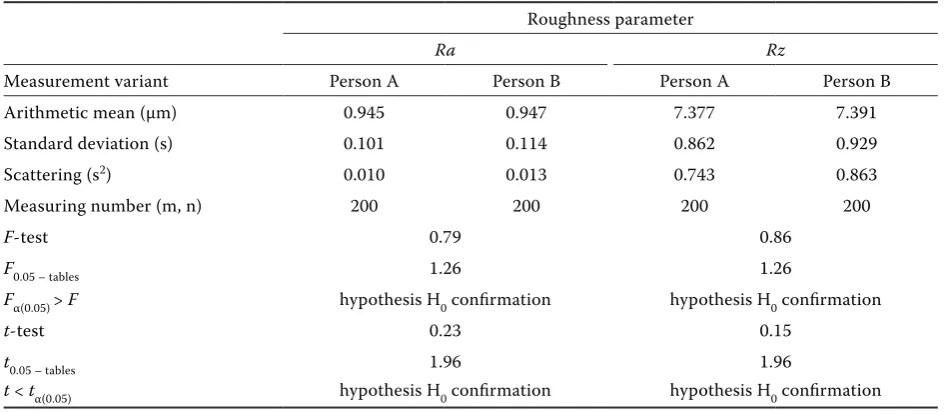
Table 2. Statistical evaluation of two sampling sets congruence (abrasive cloth P 120)
Roughness parameter
Ra Rz
Measurement variant Person A Person B Person A Person B
Arithmetic mean (µm) 0.945 0.947 7.377 7.391
Standard deviation (s) 0.101 0.114 0.862 0.929
Scattering (s2) 0.010 0.013 0.743 0.863
Measuring number (m, n) 200 200 200 200
F-test 0.79 0.86
F0.05 – tables 1.26 1.26
Fα(0.05) > F hypothesis H0 confirmation hypothesis H0 confirmation
t-test 0.23 0.15
t0.05 – tables 1.96 1.96
[image:5.595.62.536.553.759.2]– H1: σ12 ≠ σ
22, alternative hypothesis asserts that scatters are not identical.
At the t-test application following hypotheses were respected:
– H0: µ1 = µ2, zero hypothesis asserts that no differ-ence between means exists,
– H1: µ1 ≠ µ2, alternative hypothesis asserts that the means are not identical.
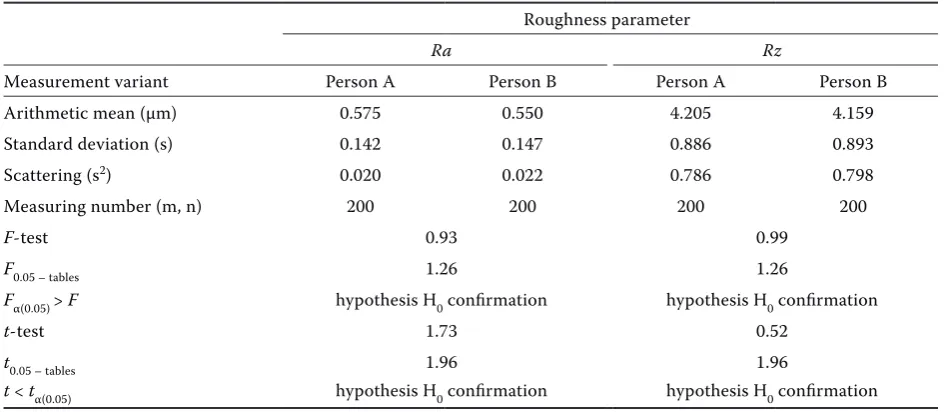
On the basis of carried out statistical tests confirm-ing the H0 hypothesis, presented in Tables 1 to 5 it is proved that the determined roughness parameters (Ra and Rz) of two independent sets are comparable, i.e. from statistical view it is not decisive whether the specimens were prepared by one or more persons.
This presumption enables following evaluation of the acquired data and the optimum conditions
reaching at the manual grinding with the use of abrasive cloth.
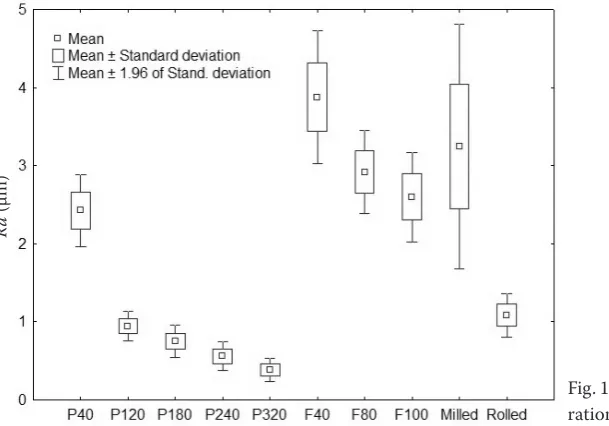
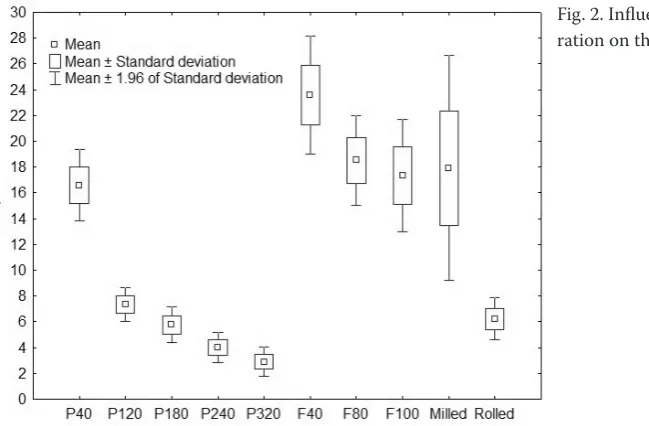
The influence of the relationship between the Ra and Rz roughness parameters and the surface me-chanical preparation is presented in Figs 1 and 2.
From the experimental results of P 40 grit pre-sented in Figs 1 and 2, different influence of the surface mechanical preparation at the identical co-rundum grains grit keeping is evident.
[image:6.595.62.534.101.305.2]Bonded joints were prepared according to the above mentioned standards and destructive tests. As the result of the destructive testing the de-structive force and the bonded joint surface were determined according to the Eq. (1). These two parameters were used for the strength calculation according to the Eq. (2).
Table 3. Statistical evaluation of two sampling sets congruence (abrasive cloth P 180)
Roughness parameter
Ra Rz
Measurement variant Person A Person B Person A Person B
Arithmetic mean (µm) 0.741 0.740 5.903 5.806
Standard deviation (s) 0.157 0.141 1.111 1.165
Scattering (s2) 0.024 0.020 1.235 1.356
Measuring number (m, n) 200 200 200 200
F-test 1.24 0.91
F0.05 – tables 1.26 1.26
Fα(0.05) > F hypothesis H0 confirmation hypothesis H0 confirmation
t-test 0.05 0.86
t0.05 – tables 1.96 1.96
t < tα(0.05) hypothesis H0 confirmation hypothesis H0 confirmation
Table 4. Statistical evaluation of two sampling sets congruence (abrasive cloth P 240)
Roughness parameter
Ra Rz
Measurement variant Person A Person B Person A Person B
Arithmetic mean (µm) 0.575 0.550 4.205 4.159
Standard deviation (s) 0.142 0.147 0.886 0.893
Scattering (s2) 0.020 0.022 0.786 0.798
Measuring number (m, n) 200 200 200 200
F-test 0.93 0.99
F0.05 – tables 1.26 1.26
Fα(0.05) > F hypothesis H0 confirmation hypothesis H0 confirmation
t-test 1.73 0.52
t0.05 – tables 1.96 1.96
[image:6.595.62.537.553.759.2]Single mechanical preparations were ordered ascending according to the Ra/Rz parameter and graphically demonstrated in Fig. 3. The relationship between the Ra/Rz parameter and the used surface mechanical preparation is represented by the poly-nomial curve of the 2nd degree, which corresponds best to the correlation field of measured points.
Parallel, bonded joints strength is graphically demonstrated. The relationship between the bond-ed joint strength and the usbond-ed surface mechanical preparation is represented by the polynomial curve of the 2nd degree, too.
For the right evaluation, the intensity of the given dependence was also determined using the correla-tion analysis through the confidence coefficient R2
yx. The confidence coefficient takes the values from
0 to 1. The more the value R2
yx tends to number 1, the closer the given dependence is to the deter-mined equation.
From the results presented in Fig. 3 the decreas-ing trend of the strength of different prepared bonded joints at the decreasing parameter Ra/Rz is evident.
The curves behavior presented in Fig. 3 is de-scribed by the Eqs (3) and (5). The Eq. (3) describes the dependence between the bonded surface me-chanical preparation (MP) and the roughness pa-rameter Ra/Rz presented in Fig. 3 and at the same time the confidence coefficient (4).
Ra/Rz = 0.0004 × MP2 + 0.0012 × MP + 0.1279 (3)
[image:7.595.62.537.102.307.2]RRa/Rz = 0.994 (4)
Fig. 1. Influence of surface mechanical
[image:7.595.71.376.546.759.2]prepa-ration on the roughness parameter Ra
Table 5. Statistical evaluation of two sampling sets congruence (abrasive cloth P 320)
Roughness parameter
Ra Rz
Measurement variant Person A Person B Person A Person B
Arithmetic mean (µm) 0.375 0.385 2.952 2.991
Standard deviation (s) 0.095 0.104 0.683 0.622
Scattering (s2) 0.009 0.011 0.466 0.387
Measuring number (m, n) 200 200 200 200
F-test 0.85 1.21
F0.05 – tables 1.26 1.26
Fα(0.05) > F hypothesis H0 confirmation hypothesis H0 confirmation
t-test 1.04 0.61
t0.05 – tables 1.96 1.96
t < tα(0.05) hypothesis H0 confirmation hypothesis H0 confirmation
Ra
Fig. 2. Influence of surface mechanical prepa-ration on the roughness parameter Rz
The Eq. (5) describes the relationship between the bonded surface mechanical preparation (MP) and the bonded joint strength (τ) presented in Fig. 3 and at the same time the confidence coefficient (6).
Τ = –0.1362 × MP2 + 0.6917 × MP + 17.087 (5)
Rτ = 0.860 (6)
The bonded joints test results show evident influ-ence of different bonded surface mechanical prep-aratio. This fact contradicts the theory of Harris and Beevers (1999), which tells that at blasting using different grain size, no expressive differences of bonded joints strengths occur. The statement of Tamai and Aratanic (1972) about the influence of accidental and considerable peaks imposing the wetting barriers was not proved. The higher nu-merical values of the Ra/Rz parameter eliminate the pertinent profile departures and cut down the pertinent barriers. But from the results presented
in Fig. 3 the decreasing trend of the bonded joints strength at the increasing Ra/Rz parameter is evi-dent. The measurement results are supported by the fracture area evaluation, too. At all bonded joints the surface of which was mechanically prepared by blasting and manual grinding the fracture area was of cohesive type. The fracture area of bonded joints of rolled or milled surfaces was of adhesive type. This fact decreases the bonded joints strength, which is secondarily evident from Fig. 3.
CONCLUSION
At the bonded surface mechanical preparation the specific roughness occurs. The presumption of authors (Peterka 1980; Habenight 2002; Elbing et al. 2003) being related to the increasing function surface part thanks to increased values of surface roughness were confirmed. Higher values of
bond-Fig. 3. Influence of the bonded joint surface me-chanical preparation on the bonded joint strength and on the parameter
Ra/Rz (Pxx – abrasive cloth grit, Fxx – abrasive grit at blasting)
0 10 20
0.10 0.15 0.20
P120 P180 P320 P240 P40 F100 F80 F40 rolled milled
Bo
nd
ed
jo
in
t s
tren
gt
h
(MPa
)
Ra/
Rz
Ra/Rz
Bonded joint strength – optimum adhesive layer thickness
Rz
(μm)
Ra
/
Rz
[image:8.595.72.495.591.758.2]ed joint strength were reached at lower parameter Ra/Rz, which proved about the increasing trend of the overlap surface.
Problems of bonded surface mechanical prepa-ration using the manual grinding by abrasive cloth are on the research periphery today; minimum uti-lization in the lot manufacture is the reason. Yet, this method can be of use especially in various craftsman work. The generally spread premise that different results may be reached using the identical abrasive cloth is the next significant reason. This premise is presented e.g. by Messler 2004. At the manual grinding using abrasive cloth the hazard of different load acting on the abrasive cloth occurs, together with conjoined different quantity of abra-sive grains. At manual grinding the abrasion theory shows the possible change of the surface roughness parameters at the load and path length change. By the statistical examination of two independent sets, this presumption was not met and it is possible to state that the determined roughness parameters Ra and Rz of specimens prepared by different per-sons are comparable. This conclusion is important especially for the objectivity of presented results concerning the manual grinding method and the mentioned knowledge acceptance in practice. This problem has not been experimentally solved so far. Only general premises and theories were taken into consideration.
References
Baker A.A., Chester R.J., 1992. Minimum surface treat-ments for adhesively bonded repairs. International Journal of Adhesion & Adhesives, 12: 73–78.
Bjorgum A., Lapique F., Walmsley J., Redford K., 2003. Anodising as pre-treatment for structural bonding. Inter-national Journal of Adhesion & Adhesives, 23: 401–412. Broughton W.R., Mera R.D., Hinopoulos G., 1999.
Environmental degradation of adhesive joints single-lap joint geometry.Available at http://www.adhesivestoolkit. com/Docu-Data/NPLDocuments/P%20A%20J/PAJ%20 Reports/PAJ3%20Reports/PAJ3%20Report%206%20 CMMT(A)196.pdf
Brožek M.,Müller M., 2004. Mechanické vlastnosti spojů lepených sekundovými lepidly. (Mechanical properties of joint bonded by quick-setting adhesives). Strojírenská technologie, 9: 9–15.
Bumbálek B., Odvody V., Ošťádal B., 1989. Drsnost pov-rchu (Surface Roughness). Prague, SNTL.
Chander P.K., Vashista M., Sabiruddin K., Paul S., Bandyopadhyay P.P., 2009. Effects of grit blasting on
surface properties of steel substrates. Materials & Design,
30: 2895–2902.
Chen S., Ono S., Teii S., Yoshino T., 1997. Improvement of the adhesion of the resin to the metal surface by using plas-ma jet. Surface and Coating Technology, 97: 378–384. ČSN EN 1465, 1997. Lepidla – Stanovení smykové pevnosti
v tahu tuhých adherendů na přeplátovaných tělesech (Adhesive – Determination of tensile lap-shear strength to rigid-to-rigid bonded assemblies).
ČSN EN ISO 4287, 1999. Geometrické požadavky na výrobky (GPS) – Struktura povrchu: Profilová metoda – Termíny, definice a parametry struktury povrchu (Geometrical product specifications (GPS) – Surface texture: Profile method – Terms, definitions and surface texture param-eters).
ČSN ISO 10365, 1995. Lepidla – Označení hlavních typů porušení lepeného spoje (Adhesives – Designation of main failure patterns).
Elbing F., Anagreh N., Dorn L., Uhlmann E., 2003. Dry ice blasting as pretreatment of aluminum surfaces to improve the adhesive strength of aluminium bonding joints. Interna-tional Journal of Adhesion & Adhesives, 23: 69–79. Gent A.N., Lai S.M., 2003. Interfacial bonding, energy
dis-sipation, and adhesion. Journal of Polymer Science Part A: Polymer Chemistry, 32: 1543–1555.
Gritchlow G.W., Brewis D.M., 1995. Influence of surface macroroughness on the durability of epoxide-aluminium joints. International Journal of Adhesion & Adhesives,
15: 173–176.
Habenight G., 2002. Kleben: Grundlagen, Technologien, Anwendung (Adhesive Bonding: Principles, Technologies, Application). Berlin, Springer-Verlag.
Harris A.F., Beevers A., 1999. The effects of grit-blasting on surface properties for adhesion. International Journal of Adhesion & Adhesives, 19: 445–452.
Holešovský F., Novák M., Michna Š., 2007. Studium změn broušené povrchové vrstvy při dynamickém zatěžování (Study of grinded surface changes at dynamic loading). Strojírenská technologie, 12: 73–77.
Jennings C.W., 1972. Surface roughness and bond strength of adhesives. The Journal of Adhesion, 4: 25–38.
Kašpar Z., 2005. Lepení konstrukčních materiálů v zemědělství (Adhesive Bonding of Construction Materials in Agri-culture). [Ph.D. Thesis.] Prague, Czech University of Life Sciences Prague.
Katona T.R., Batterman S.C., 1983. Surface roughness ef-fects on the stress analysis of adhesive joints. International Journal of Adhesion & Adhesives, 3: 85–91.
Lancaster J.F., 2001. Metallurgy of Welding. Cambrige, Abington Publishing.
Lunder O., Lapique F., Johnsen B., Nisancioglu K., 2004. Effect of pre-treatment on the durability of epoxy-bonded AA6060 aluminium joints. International Journal of Adhe-sion & Adhesives, 24: 107–117.
Marek P., 2002. Porovnání tuzemských a zahraničních norem v oblasti zkoušení pevnosti lepených spojů (Comparison of inland and foreign standards in the field of bonded joints strength testing). [Ph.D. Thesis.] Prague, Czech University of Life Sciences Prague.
Matsui K., 1990. Size-effects on average ultimate shear stresses of adhesive-bonded rectangular or tubular lap joint under tension-shear. The Journal of Adhesion, 10: 81–89. Messler R.W., 2004. Joining of Materials and Structures
from Pragmatic Process to Enabling Technology. Burling-ton, Elsevier.
Müller M., Herák D., 2010. Dimensioning of the bonded lap joint. Research in Agricultural Engineering,56: 59–68. Müller M., Hrabě P., Chotěborský R., Herák D., 2006.
Evaluation of factors influencing adhesive bond strength. Research in Agricultural Engineering,52: 30–37. Müller M., Hrabě P., Valíček J., Kušnerová M., Hloch
S., 2007a. Hodnocení vlivu integrity lepeného povrchu na změnu pevnostních charakteristik lepeného spoje (Evalu-ation of bonded surface integrity influence on the bonded joint strength characteristics), Strojírenská technologie,
12: 177–180.
Müller M., Chotěborský R., Krmela J., 2007b. Techno-logical and constructional aspects affecting bonded joints. Research in Agricultural Engineering, 53: 67–74. Müller M., Hrabě P., Chotěborský R., 2008.
Optimiza-tion of surface treatment parameters in adhesive bonding technology. In: 7th International Scientific Conference
Engineering for Rural Development. Jelgava, Latvia Uni-versity of Agriculture.
Packham D.E., 2003. Surface energy, surface topography and adhesion. International Journal of Adhesion & Adhesives,
23: 437–448.
Packham D.E., 2005. Handbook of Adhesion. Chichester, John Wiley and Sons.
Peterka J., 1980. Lepení konstrukčních materiálů ve stro-jírenství (Adhesive Bonding of Construction Materials in Engineering). Prague, SNTL.
Pošta J., Veselý P., Dvořák M., 2002. Degradace strojních součástí (Machine Parts Degradation). Prague, Czech University of Life Sciences Prague.
Prolongo S.G., Rosario G., Unreña A., 2006. Compara-tive study on the adhesive properties of different epoxy resins. International Journal of Adhesion & Adhesives,
26: 125–132.
Sargent J.P., 1994. Adherend surface morphology and its influence on the peel strength of adhesive joints bonded with modified phenolic and epoxy structural adhesives. In-ternational Journal of Adhesion & Adhesives, 14: 21–30. Shahid M., Hashim S.A., 2002. Effect of surface roughness
on the strength of cleavage joints. International Journal of Adhesion & Adhesives, 22: 235–244.
Suchánek J., Kuklík V., Zdravecká E., 2007. Abrazivní opotřebení materiálu (Abrasive Wear of Material). Prague, Czech Technical University in Prague.
Tamai Y., Aratanic K., 1972. Experimental study of the relation between contact angle and surface roughness. The Journal of Physical Chemistry, 76: 3267–3271.
Uehara K., Sakurai M., 2002. Bonding strength of ad-hesives and surface roughness of joined parts. Journal of Materials Processing Technology, 127: 178–181.
Varacalle D.J., Guillen D.P., Deason D.M., Rhodab-erger W., Sampson E., 2006. Effect of grit-blasting on substrate roughness and coating adhesion. Journal of Thermal Spray Technology, 15: 348–355.
Wenzel R.N., 1936. Resistance of solid surfaces to wetting by water. Journal of Industrial and Engineering Chemistry,
28: 988–994.
Received for publication October 26, 2010 Accepted after corrections June 13, 2011
Corresponding author:
doc. Ing. Miroslav Müller, Ph.D., Czech University of Life Sciences Prague, Faculty of Engineering, Department of Material Science and Manufacturing Technology, Kamýcká 129, 165 21 Prague-Suchdol, Czech Republic