JOURNAL OF FOREST SCIENCE, 52, 2006 (5): 208–216
European beech, one of the most frequent and widespread autochthonous broadleaved tree spe-cies in the region of Central European, takes up ap-proximately 30% of the forest stand area of the Slovak Republic (Collective 1998). It is sensitive to conti-nental climate because of very low temperature and drought vulnerability. The species prefers moderate climate without extremities (Zlatník 1978).
In connection with the global climate change influencing also the European continent we have expected such effects as unbalanced temperature and precipitation regime during the year, higher probability of frost damage as well as altered com-petitive balance between tree species (Kramer 1995; Gansert et al. 1999; Bolliger et al. 2000). Fagus sylvatica, a typical representative of the temperate zone tree species, belongs to woody plants subjected to phenological observations running in the frame-work of the International Phenological Gardens program (Chmielewski 1996). It is known that
phenological events reflect biological characteristics (endogenous factors) of the species in relation to the course of climatic factors. According to Reed et al. (1994) and Lechowicz (1995) the exogenous factors influencing phenology of plants include photoperiod duration, soil moisture and temperature, air temper-ature, solar illumination, snow cover, etc. However, the details of the physiological control of spring phe-nophases such as budburst are not still clear. The rest is the period in which tree buds remain dormant due to physiological conditions in the buds (physiologi-cal dormancy) while the quiescence is the period in which buds remain dormant due to unfavourable environmental conditions (enforced dormancy). Physiological dormancy is removed when the buds are exposed to chilling temperatures below 10°C for a certain period likewise to long days (Heide 1993). Enforced dormancy release takes place when the buds are exposed to forcing temperatures (above 0°C) for a prolonged period (Sarvaš 1974). The
Supported by the Scientific Grant Agency VEGA of the Ministry of Education, Slovak Republic, Project No. 2/4167/04.
Spring phenology of European beech (Fagus sylvatica L.)
in a submountain beech stand with different stocking
in 1995–2004
B. Schieber
Institute of Forest Ecology of the Slovak Academy of Sciences, Zvolen, Slovak Republic
ABStrAct: Two spring phenophases (bud-burst and leaf unfolding) of a parent stand and naturally regenerated undergrowth of European beech were observed in conditions under different stand density over the last 10 years. The results proved the unequal onset of phenophases of the parent stand individuals in relation to their sociological status. In the case of codominant and dominant trees the delay of 2–5 days was observed in comparison with subdominant trees. The influence of the parent stand structure on the onset of the undergrowth phenophases was also observed. The onset of phenophases differed by 2–20 days among individuals grown under different density of the parent stand. The onset and course of phenophases also differed between the years. The trend of the average onset of leafing in the period 1995–2004 shows a shift to earlier dates by about three days. Temperature summation of average daily temperatures with the base temperature of 8°C, in the framework of the model predicted bud-burst of beech, showed the lowest variability in comparison with other temperatures.
influence of the structure of a parent stand (density, canopy, etc.) on phenology, morphology and anato-my of a subsequent beech population was studied by Cicák and Štefančík (1993), Collet et al. (2002), Schieber (2005). Expected effects of global changes interfere with the survival and the distribution of trees. Therefore it is important to study the phenol-ogy as a good indicator of the influences of climate changes on the development of the vegetation.
The aim of the paper is the analysis of two spring phenophases of beech parent trees and naturally regenerated seedlings in a managed submountain beech forest stand of different density during period of 10 years.
MAtEriAL And MEthodS
Study site
The study site was established at the Beech Eco-logical Experimental Station (BEES) in the SE part of the Kremnické vrchy Mts. (φ = 48°38´N, λ = 19°04´E, H = 450–520 m a.s.l.). The BEES is located on a slope 5–15° oriented to the west-southwest in a climatically moderate warm area with average an-nual temperature of 6.8°C and anan-nual precipitation 780 mm. The investigated stand was about 90 years old with 85% of European beech (Fagus sylvatica), and fir (9%), oak (6%) and hornbeam (1%) as as-sociated species. After the intervention in 1989, the station consisted of 5 partial plots (PP) with various degrees of stocking. According to Barna (2004) the values of stocking in 1996 were as follows: PP K – 0.87 – original stocking; PP M – 0.78; PP S – 0.62; PP I – 0.4. PP H was the cleared area, at the present time with intensive development of natural regen-eration (Kodrík 1997). The plots are separated by isolation strips. Skeletal Cambisols with moderate acid reaction create the soil cover (Kukla 1993) of BEES. According to Kontriš et al. (1995) the veg-etation cover at the locality is primarily composed of patches of Carici pilosae-Fagetum and Dentario bulbiferae-Fagetum associations.
Phenological observations
The beginning and the course of the spring phe-nophases (bud-burst and leaf unfolding) on trees from natural regeneration were separately studied on four PP (PP M was excluded) of the BEES, the parent stand representing one homogeneous group. There were in total 80 parent trees with different socio-logical status: 20 subdominant (sd), 30 codominant (cd) and 30 dominant (d) trees. The group of natural
regeneration was represented by 100 trees, 25 on each PP. Observations (for the 1995–2004 period) started on 1 March and they were repeated weekly, later in April twice a week. The date when this stage could be observed on 50% of the studied trees was taken as the bud-burst (BB) beginning (Bejdeman 1974). Leaf unfolding is defined as a phenological phase when the normal, unwrinkled leaf surface has already been developed, however, the final leaf size has not been attained yet. L1 (L2) were the phases when 50% of the trees had 10% (50%) of their crowns with unfolded leaves. As to the temperature summa-tion model, the temperature sums from 1 February (supposed possible beginning of quiescence stage) to the date of average onset of parent stand BB were calculated for each year of observations separately. Temperatures 0°C, 5°C, 8°C and 10°C were regarded as the base temperatures in TS0, TS5, TS8 and TS10, respectively. Temperature sums (TS) were calculated using the relation TSi= Σ adtk,where adtk is the average daily air temperature (Lieth 1974). Air temperature was measured with thermographs localised in meteorological cabins (at the standard height 2 m above the ground level) at the BEES and was analysed from thermograms.
rESULtS And diScUSSion
Bud-burst and leaf unfolding in parent stand and natural regeneration trees
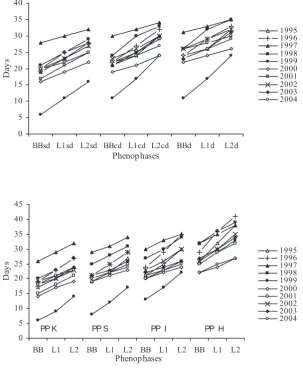
The course of phenophases BB, L1 and L2 observed on natural regeneration is illustrated in Fig. 1. The earliest coming of BB phenophase was always ob-served on PP K with the highest value of stocking. The time interval within which the beginning of BB phase was located on this plot in the period under observation was 20 days: the earliest observation in the midst of the first decade of April in 1999, the latest observation in the midst of the third decade of this month in 1997. On the other partial plots we observed the following time delays of BB onset: on PP S 2–5 days in the individual years, ranging within 21 days in total for all the studied period. The cor-responding values for PP I and PP H were 3–7, 17 and 4–19, 10, respectively. The onset of phenophases L1 and L2 was also observed first on PP K. The time interval for L1 in the whole observation period was 20 days on this plot. On the other PPs we observed the following delays for L1 phase: PP S 1–5 days within total 19 days, PP I 2–8 days within 16 days, PP H 4–20 days within 12 days. In the case of L2 phase, the starting was timed within an 18-day interval on PP K. The delays observed on the other experimental
plots were: 1–6 days within 17 days in total on PP S, 2–8 days within 13 days on PP I and 4–19 days within 14 days in total on PP H.
[image:3.595.71.375.64.437.2]Based on the described results we can conclude that the earliest beginning of phenophase BB of par-ent trees was detected on subdominant trees. The codominant and dominant trees had time delays. According to Engler (1911) this can be explained by morphological differences between shaded and sunlit leaf buds. The sunlit buds are in general greater than the shaded ones and have thicker coat scales which can cause the delay in the opening. On the other hand, subdominant trees growing under the crowns of trees of the other layers have probably buds with thinner coat scales which can promote their ear-lier development. A similar trend was observed by Priwitzer and Miňďáš (1998), who also detected earlier bud-burst on the subdominant beech trees. On the other hand, according to Beňa (1970) the early beginning of foliage development does not strictly correspond to a tree sociological status in the stand, however the author admitted that most trees with early developed foliage belonged to the Fig. 1. The onset of the phenophases of parent stand (above) and natu-rally regenerated seedlings (below) since the 1 April (for a description of the phases see Methods)
0 5 10 15 20 25 30 35 40
BBsd L1sd L2sd BBcd L1cd L2cd BBd L1d L2d Phenophases
D
ay
s
1995 1996 1997 1998 1999 2000 2001 2002 2003 2004
0 5 10 15 20 25 30 35 40 45
BB L1 L2 BB L1 L2 BB L1 L2 BB L1 L2 Phenophases
D
ay
s
1995 1996 1997 1998 1999 2000 2001 2002 2003 2004
category of subdominant trees. As for phenology on juvenile trees, Augspurger and Bartlett (2003) observed differences in leaf phenology between juve-nile and adult trees in some tree species. Our results confirmed the fact that the parent stand structure influenced the phenology of juvenile natural regen-eration of beech. The earliest start was observed on trees growing under the crowns of parent stand with the highest density (PP K). Time delay in the onset of BB phase between PP K and PP H ranged from 4 to 19 days between the compared years. Similar results were also obtained by Cicák and Štefančík (1993). These authors observed that the bud-burst on trees from natural regeneration on a plot with the high-est parent stand density (0.9) always preceded the bud-burst in the parent stand itself. According to the authors the cause of this phenomenon cannot always be explained by the bud morphology alone but it is necessary to try to reason it also on the basis of eco-morphophysiological responses of beech trees to different phyto-climatic conditions closely con-nected with the parent stand density. Also according to Hejtmánek (1958) the bud-burst on regenerated natural seedlings under a parent stand preceded the
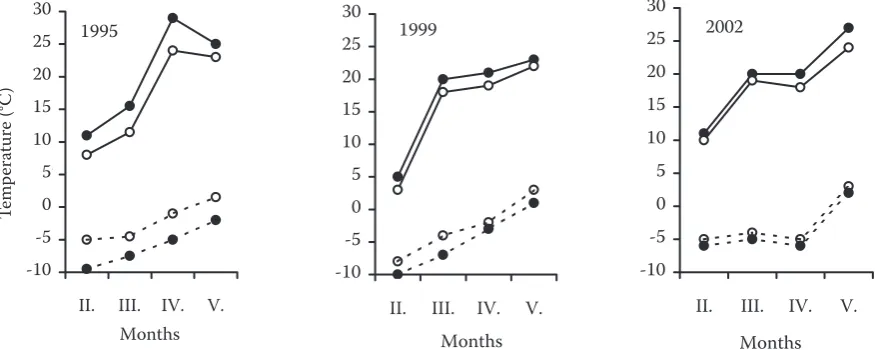
bud-burst on natural seedlings exposed to direct solar radiation. In the latter case the bud-burst on seedlings was even retarded compared to the parent stand. Because beech is a woody species with natu-ral regeneration under a parent shelter, we can say that natural seedlings growing on the plot of former cleared area (H plot) are exposed to several “stress” factors. First of all it is a wider temperature range (Fig. 3) connected with considerable warming dur-ing the day followed by stronger cooldur-ing durdur-ing the night. Among other factors we mention here strong solar radiation reaching considerably higher values on plots without parent stand (Střelec 1992). This condition probably influences the morphology of coat scales (thickening) on individuals growing on this plot, which may also cause the later bud-burst.
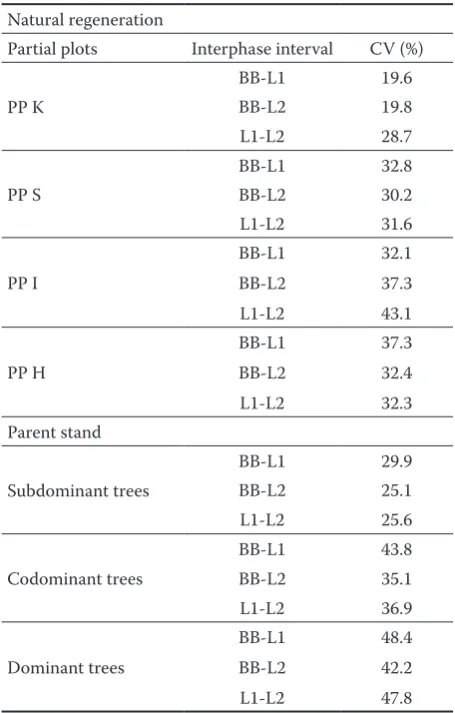
[image:4.595.64.358.58.192.2]Analysing the onset of L1 and L2 phenophases on the parent stand we found that, similarly like in BB, the first were subdominant trees again and the trees belonging to the other stand layers showed time de-lays. In the case of natural regeneration, the earliest start of L1 and L2 was detected on the plot with the highest stand density and the other plots kept the same order as in the case of BB. Table 1 shows the Fig. 2. The trend of average onset of leaf-ing in 1995–2004
Fig. 3. The values of absolute minimum (dashed line) and maximum (full line) air temperatures measured on two plots of BEES in selected years (PP K – open circle, PP H – full circle)
y = –0.3333x + 116.93 R2 = 0.057
100 110 120 130
1995 1996 1997 1998 1999 2000 2001 2002 2003 2004 Year
D
ay
o
f y
ea
r
-10 -5 0 5 10 15 20 25 30
II. III. IV. V. Months
Tem
perature
(o
C)
1995
5
-10 -5 0 5 10 15 20 25 30
II. III. IV. V. Months 1999
-10 -5 0 5 10 15 20 25 30
II. III. IV. V. Months 2002
Te
m
pe
ra
tu
re
(°
C
[image:4.595.65.503.549.724.2]variability of the time behaviour of phenophases on natural regeneration and parent stand expressed by differences in the number of days of interphase inter-val. It is evident that the lowest variability was found out in the case of natural regeneration growing on PP K and in subdominant trees of parent stand. As for differences in the onset of phenophases on par-ent trees as well as on natural regeneration between the years, we can suppose the influence of climatic factors, especially of the course of air temperatures. The onset of the individual phenophases (BB, L1 and L2) was situated between the fifth pentad of April and the end of the first pentad of May. In 1997 relatively cold March and very cold April caused the delayed onset of phenophases. On the other hand, in 1999 the corresponding interval was from the
[image:5.595.66.367.62.349.2]second pentad of April up to the end of the fifth pentad of April. This acceleration in 1999 can be ex-plained by favourable temperature conditions when in 1999 (since the third pentad of March) the mean air temperature was the highest. The temperatures in the third decade of the month were higher by 2 to 6 degrees compared to the other years, and in the end there was a steep increase in temperatures dur-ing the last pentad of March (Fig. 4). As for the trend of the leafing onset in 1995–2004, there was a shift to an earlier date by about three days. Some authors reported a shift towards the earlier occurrence of phenophases for the period of the last 50 years. They assumed this trend was probably connected with global climate changes (Defila, Clot 2005; Menzel 2000).
Fig. 4. Average pentad air temperature at the BEES in the period from February to May
Fig. 5. Late spring frosts in April in 1995–2004 and the on-set of bud-burst phenophases of naturally regenerated under-growth in some risky years -10
-6 -2 2 6 10
II1 II2 II3 II4 II5 II6 III1 III2 III3 III4 III5 III6 Months
Te
m
pe
ra
tu
re
(o
C
)
1995 1997 1999 Average (95-03)
0 4 8 12 16 20
IV1 IV2 IV3 IV4 IV5 IV6 V1 V2 V3 V4 V5 V6
Months
Te
m
pe
ra
tu
re
(o
C
)
1995 1997 1999 Average (95-03)
-14 -12 -10 -8 -6 -4 -2 0
1 3 5 7 9 11 13 15 17 19 21 23 25 27 29
Days of April
Te
m
pe
ra
tu
re
(
°C
)
20
00
20
02
20
03
19
99
19
9
19
98
19
96
20
01
19
97
BB 19 April
20
04
BB 6 April
BB 28 April BB 15 April
BB 15 April
Te
m
pe
ra
tu
re
(°
C
)
Te
m
pe
ra
tu
re
(°
C
)
Average (1995–2003)
Average (1995–2003)
19
95 200
[image:5.595.71.407.608.752.2]In connection with the tree leafing, it is also nec-essary to consider the danger of late spring frosts, primarily after the bud-burst when the assimilatory apparatus is not protected with the scales any more. In the case when the frost is strong or long lasting, the frost damage can be severe, even causing the freezing of the whole young leaves. This danger is more important primarily for young trees, because, in comparison with the parent trees, their leaves are situated at lower stand layers near the soil surface, which entails a higher risk of freezing. The second
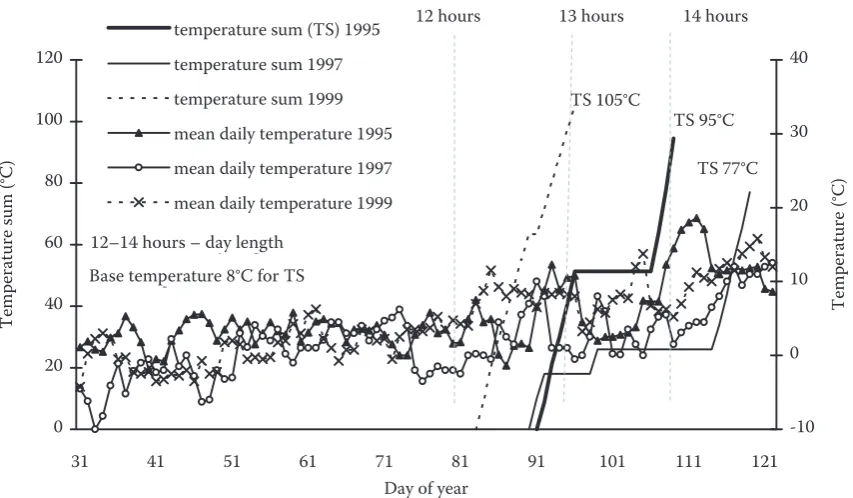
factor causing higher vulnerability in young trees follows, as we could already see, from their earlier bud-burst – in general a few days before the parent stand. However, in the period of observations we did not observe any damage to tree leaves caused by late spring frosts. A frost of –1°C recorded on the control PP K in 1999 (in the period of the leafing of natural regeneration) did not cause any damage to the developing foliage. On the other hand, in the bud-burst period of the critical years 1997 and 2001, the morning frost measured at the standard level of 2 m above the ground reached the value of –4°C, and in the case of fully developed foliage it could have caused serious frost damage to leaves. The highest intensity frost in April before the leafing period was recorded in 2003, and it reached the value of –10°C (Fig. 5). This frost was observed about ten days be-fore the beech leafing onset, but in the case of cur-rent leafing or full-leafed trees, the damage would certainly have been considerable. In the next month (May) no frost was observed that would cause any damage to the assimilatory apparatus of naturally regenerated trees.
temperature summation for bud-burst onset
The beginning and course of phenophases in the individual years largely depend on the courses of climate variables, first of all on temperature, pre-cipitation and photoperiod duration (Häkkinen, Hari 1988; Heide 1993; Hoffmann 1995; Falusi, Calamassi 1997). The thermal time model elabo-rated by Cannel and Smith (1983) is based on the influence of forcing temperatures above the base temperature. Forcing temperatures are accumulated after a starting date till the beginning of the corre-sponding phenophase (in this case BB). According to Kramer (1994), for the species growing in the temperate zone, after a cold period a period of forc-ing temperatures is necessary to start the bud-burst process. Rötzer et al. (2004) described the model that calculated the timings of the beech leafing on the basis of the daily maximum temperature. Ac-Table 1. Variability of the time behaviour of phenophases
on natural regeneration and parent stand from 1995 to 2004 (CV– coefficient of variation)
Natural regeneration
Partial plots Interphase interval CV (%)
PP K
BB-L1 19.6
BB-L2 19.8
L1-L2 28.7
PP S
BB-L1 32.8
BB-L2 30.2
L1-L2 31.6
PP I
BB-L1 32.1
BB-L2 37.3
L1-L2 43.1
PP H
BB-L1 37.3
BB-L2 32.4
L1-L2 32.3
Parent stand
Subdominant trees
BB-L1 29.9
BB-L2 25.1
L1-L2 25.6
Codominant trees
BB-L1 43.8
BB-L2 35.1
L1-L2 36.9
Dominant trees
BB-L1 48.4
BB-L2 42.2
L1-L2 47.8
Table 2. The values of temperature sums (oC) with various base temperatures from 1995 to 2004 (CV– coefficient of variation)
Years
Mean CV (%) 1995 1996 1997 1998 1999 2000 2001 2002 2003 2004
TS 0 304 192 219 315 208 239 314 338 208 312 265 21.3
TS 5 148 115 121 250 120 185 248 218 141 202 175 30.2
TS 8 94 98 77 99 105 102 110 104 104 130 102 12.9
[image:6.595.63.291.93.450.2] [image:6.595.64.531.670.757.2]cording to Roloff (1987), the rest period for beech trees lasts approximately up to the second decade of February. Then the stage of quiescence follows when beech trees can sprout under favourable conditions. On the basis of this fact we calculated temperature sums from 1 February to the onset of BB. The thresh-old temperature value has not been unified (Murray et al. 1989; VonWuehlisch et al. 1995; Wielgo-laski 1999). We used the values of 0°C, 5°C, 8°C and 10°C for this purpose. Table 2 shows the values of temperature sums accumulated in the individual years. It is evident that the temperature sums differed between the years. The lowest variability was found out when TS 8 was applied (coefficient of variation 12.9%), in the other cases these values ranged from 21.3 to 36.8%. The course of average air temperatures and temperature sums with the base temperature of 8°C in selected years (1995 as a typical “normal” year, 1997 the latest date of bud-burst, 1999 the earliest date of bud-burst) is shown on Fig. 6. We suppose that this model of temperature summation would be appropriate for the analysis of beech phenology in our conditions.
concLUSion
The results of the analysis of spring phenological phases observed in the beech stand prove an interan-nual variability in the onset of phases as well as the influence of the parent stand structure on naturally
regenerated seedlings. The unequal onset of pheno-phases among the individuals of parent stand was also observed in relation to their sociological status. Using temperature summation with various base temperatures for the period from 1 February to the date of the bud-burst onset in 1995–2004, the lowest variability of temperature sum was found out by the application of the base temperature 8°C.
Because phenological observations provide useful information in the context of forest research, and also in connection with the influence of climate changes on forest ecosystems, it is necessary to monitor and analyse the phenological manifestations of forest tree species in relation to climate factors.
references
AUGSPURGER C.K., BARTLETT E.A., 2003. Differences in leaf phenology between juvenile and adult trees in a tem-perate deciduous forest. Tree Physiology, 23: 517–525. BARNA M., 2004. Adaptation of European beech (Fagus
sylvatica L.) to different ecological conditions: leaf size
variation. Polish Journal of Ecology, 52: 35–45.
BEJDEMAN I.N., 1974. Metodika izučenija fenologii rastenij i rastiteľnych soobšestv. Novosibirsk, Nauka: 156. BEŇA Š., 1970. Štúdium niektorých fenologických prejavov
buka. Les, 26: 439–443.
[image:7.595.83.510.57.306.2]BOLLIGER J., KIENAST F., ZIMMERMANN N.E., 2000. Risk of global warming on montane and subalpine forests in Switzerland – a modelling study. Regional Environmental Change, 1: 99–111.
Fig. 6. The course of daily air temperatures and temperature sums in selected years
TS 95°C
TS 77°C TS 105°C
0 20 40 60 80 100 120
31 41 51 61 71 81 91 101 111 121
Day of year
Temperature
sum
(°C
)
-10 0 10 20 30 40
Te
m
pe
ra
tu
re
(°
C
)
temperature sum (TS) 1995 temperature sum 1997 temperature sum 1999 mean daily temperature 1995 mean daily temperature 1997 mean daily temperature 1999
Base temperature 8oC for TS
12 hours 13 hours 14 hours
CANNEL M.G.R., SMITH R.I., 1983. Thermal time, chill days and prediction of budburst in Picea sitchensis. Journal of Applied Ecology, 20:951–963.
CICÁK A., ŠTEFANČÍK I., 1993. Phenology of bud breaking of beech (Fagus sylvatica L.) in relation to stocking of its tree component. Ekológia (Bratislava), 12: 441–448. COLLECTIVE, 1998. Green Report. Bratislava, Ministry of
Agriculture, Food, Forestry and Water Management of the Slovak Republic: 169.
COLLET C., LANTER O., PARDOS M., 2002. Effect of canopy opening on the morphology and anatomy of naturally re-generated beech seedlings. Trees, 16: 291–298.
DEFILA C., CLOT B., 2005. Phytophenological trends in the Swiss Alps, 1951–2002. Meteorologische Zeitschrift,
14: 191–196.
ENGLER A., 1911. Untersuchungen über Blattausbruchund das sontige verhalten von Schatten- und Lichpflanzen der Buche. Mitteilungen des Schweizerische Zentralanstalt für das forstliche Versuchswessen, 10: 106.
FALUSI M., CALAMASSI R., 1997. Bud dormancy in Fagus
sylvatica L. I. Chilling and photoperiod as factors
determin-ing budbreak. Plant Biosystems, 131: 67–72.
GANSERT D., BACKES K., KAKUBARI Y., 1999. Altitudinal and seasonal variation of frost resistance of Fagus crenata
and Betula ermanii along the Pacific slope of Mt. Fuji, Japan.
Journal of Ecology, 87: 382–390.
HÄKKINEN R., HARI P., 1988. The efficiency of time and temperature driven regulation principles in plants at the be-ginning of the active period. Silva Fennica, 22:163–170. HEIDE O.M., 1993. Daylength and thermal time responses
of budburst during dormancy release in some northern deciduous trees. Physiologia Plantarum, 88: 531–540. HEJTMÁNEK J., 1958. K fenologické variabilitě buku. Práce
výzkumných ústavů lesnických ČSR. Praha, SZN, 15: 193–210.
HOFFMANN F., 1995. FAGUS, a model for growth and development of beech. Ecological Modelling, 83: 327– 348.
CHMIELEWSKI F.M., 1996. The international phenological gardens across Europe. Present state and perspectives. Phenology and Seasonality, 1: 19–23.
KODRÍK M., 1997. Height diversity and species biomass on a clear felling site in conditions of a submontane beech forest. Folia Dendrologica, 1–2:39–45.
KONTRIŠ J., KONTRIŠOVÁ O., GREGOR J., 1995. Die Ergebnisse der phytozönologischen Erforschung auf dem Gebiet Kremnické vrchy. Acta Facultatis Ecologiae, Zvolen,
2: 193–209.
KRAMER K., 1994. Selecting a model to predict the onset of growth of Fagus sylvatica. Journal of Applied Ecology,
31:172–181.
KRAMER K., 1995. Phenotypic plasticity of the phenology of seven European tree species in relation to climatic warming. Plant, Cell and Environment, 18:93–104.
KUKLA J., 1993. The direct determination of the geobioce-nosis edaphic-trophic orders and interorders. Ekológia (Bratislava), 12: 373–385.
LECHOWICZ M.J., 1995. Seasonality of flowering and fruit-ing in temperate forest trees. Canadian Journal of Botany,
73: 175–182.
LIETH H., 1974. Phenology and Seasonality Modelling. Eco-logical Studies 8. New York, Springer Verlag: 444. MENZEL A., 2000. Trends in phenological phases in Europe
between 1951 and 1996. International Journal of Biomete-orology, 44: 76–81.
MURRAY M.B., CANNEL M.G.R., SMITH R.I., 1989. Date of budburst of fifteen tree species in Britain fol-lowing climate warming. Journal of Applied Ecology, 26: 693–700.
PRIWITZER T., MIŇĎÁŠ J., 1998. Výsledky fenologic-kých pozorovaní lesných drevín v rokoch 1993–1997 na lokalite Poľana-Hukavský Grúň. Vedecké práce LVÚ,
42:17–32.
REED B.C., BROWN J.F., VANDERZEE D., LOVELAND T.R., MERCHANT J.W., OHLEN D.O., 1994. Measuring phenological variability from satellite imagery. Journal of Vegetation Science, 5: 703–714.
ROLOFF A., 1987. Morphologie der Kronenetwicklung von
Fagus sylvatica L. (Rotbuche) unter besonderer
Beruchsich-tigung nenartiger Veranderungen. I. Morphogenetischen Zyklus, Anomalien infolge Prolepsys und Blattfall. Flora,
179: 355–378.
RÖTZER T., GROTE R., PRETZSCH H., 2004. The timing of bud burst and its effect on tree growth. International Journal of Biometeorology, 48: 109–118.
SARVAŠ R., 1974. Investigations on the annual cycle of de-velopment of forest trees II. Autumn dormancy and winter dormancy. Communicationes Instituti Forestalis Fenniae,
84:1–101.
SCHIEBER B., 2005. Onset and course of selected phenologi-cal phases in European beech (Fagus sylvatica L.) over the last 10 years. Meteorologický časopis – Meteorological Journal, 8: 9–12.
STŘELEC J., 1992. Vplyv ťažbového zásahu v bukovom poraste na zmeny osvetlenia. Lesnícky časopis – Forestry Journal,
38: 551–558.
VON WUEHLISCH G., KRUSCHE D., MUHS J., 1995. Varia-tion in temperature sum requirement for flushing of beech provenances. Silvae Genetica, 44: 343–346.
WIELGOLASKI F.E., 1999. Starting dates and basic tempera-tures in phenological observations of plants. International Journal of Biometeorology, 42:158–168.
ZLATNÍK A., 1978. Lesnická fytocenologie. Praha, Academia: 495.
V súčasnom období sa opäť začína venovať väčšia pozornosť štúdiu fenologických prejavov lesných drevín. Tento trend nepochybne súvisí aj s avi-zovanými klimatickými zmenami, ktoré začínajú ovplyvňovať aj lesné ekosystémy. Pri výbere vhod-ných „indikačvhod-ných“ fenologických fáz pre dlhodobý monitoring v nadväznosti na spomenuté zmeny je dôležité, aby sa tieto dali ľahko a spoľahlivo identi-fikovať. Rozpuknutie pupeňa a zalisťovanie u buka predstavujú vhodné fenofázy pre spomenutý cieľ.
V práci sa uvádzajú výsledky desaťročného pozo-rovania dvoch jarných fenofáz (rozpuknutie pupeňa a zalisťovanie) materského porastu ako aj prirodze-ného zmladenia buka v podmienkach rôznej denzi-ty materského porastu. Výskum bol realizovaný na BEES v Kremnických vrchoch v submontánnej buči-ne. V rámci materského porastu bol vybraný súbor 80 jedincov rôzneho sociologického postavenia. Prirodzené zmladenie bolo tvorené súborom 100 je-dincov na štyroch plochách s rôznou denzitou mater-ského porastu. Fenologické pozorovania boli doplne-né aj klimatickými meraniami teploty vzduchu.
Z výsledkov vyplynulo, že nástup a priebeh feno-fáz u jedincov materského porastu bol rozdielny
v závislosti od ich sociologického postavenia. Naj-skorší priemerný nástup fenofáz bol pozorovaný u podúrovňových jedincov. U jedincov prirodze-ného zmladenia nástup a priebeh fenofáz varíroval v závislosti od štruktúry materského porastu, pod ktorým rástli. Najskoršie rašili a zalisťovali jedin-ce pod materským porastom s najvyššou denzi-tou, kým jedince rastúce na ploche bez materské-ho porastu (na pôvodnej materské-holine) výrazne zaostávali v nástupe uvedených fenofáz. Trend v nástupe prie-merného zalisťovania materského porastu v období rokov 1995–2004 poukázal na posun ku skoršiemu termínu približne o tri dni. Sumačnou metódou priemerných denných teplôt s rozdielnou hodnotou prahovej teploty pre obdobie od začiatku februára do nástupu rozpuknutia pupeňa sme zistili, že naj-nižšia variabilita v desaťročnom období bola v prí-pade teplotnej sumy s prahovou teplotou 8 °C.
Na záver možno konštatovať, že aj naďalej bude potrebný systematický a dlhodobý fenologický mo-nitoring lesných drevín, ktorého výsledky pomôžu pri objektívnom zhodnotení reálneho stavu lesných porastov ako aj ich ďalšieho managementu v súvis-losti s očakávanými globálnymi zmenami klímy.
Jarné fenofázy buka v submontánnej bučine s rozdielnym zakmenením
v rokoch 1995–2004
B. Schieber
Ústav ekológie lesa SAV, Zvolen, Slovenská republika
ABStrAKt: V práci sa uvádzajú výsledky desaťročného pozorovania dvoch jarných fenofáz (rozpuknutie pupeňa a zalisťovanie) materského porastu ako aj prirodzeného zmladenia buka v podmienkach submontánnej bučiny s rôz-nou denzitou materského porastu. Výsledky poukázali na rozdielny nástup fenofáz u jedincov materského porastu v závislosti od ich sociologického postavenia v poraste ako aj na vplyv štruktúry materského porastu na fenológiu pučania a zalisťovania prirodzeného zmladenia. U úrovňových a nadúrovňových jedincov bolo zistené opozdenie fenofáz v priemere o 2–5 dní v porovnaní s podúrovňovými jedincami. Začiatok a priebeh fenofáz sa odlišoval medzi jedincami prirodzeného zmladenia v priemere o 2 až 20 dní v závislosti od štruktúry materského porastu, pod ktorým rástli. Takisto bola zistená aj medziročná variabilita v nástupe a priebehu fenofáz. Trend priemerného zalisťovania jedincov materského porastu v rokoch 1995–2004 poukazuje na posun ku skorším termínom asi o tri dni. Použitím sumačnej metódy priemerných denných teplôt s rozdielnou hodnotou prahovej teploty pre obdobie od začiatku februára do nástupu rozpuknutia pupeňa sme zistili, že najnižšia variabilita bola zistená v prípade teplotnej sumy s prahovou teplotou 8 °C.
Kľúčové slová: Fagus sylvatica; fenológia; rozpuknutie pupeňa; zalisťovanie; teplotná suma
Corresponding author: