JOURNAL OF FOREST SCIENCE, 52, 2006 (10): 446–456
National Park (NP) Šumava Mts. (Bohemian Forest Mts.) together with the Bavarian National Park on the border with Germany and with buffering zone has been declared as Protected Landscape Area (90,000 ha). It represents the largest protected area in the Europe, with forest coverage 66% (Chábera et al. 1987). Majority of the forest stands is over 120 years old presently (Zatloukal 1998), as a consequence of bark-beetle calamities in 1860’s–70’s (Jelínek 1988) and consequent forest management. Also other an-thropogenic factors influenced this area. Acid rains with high immission loads in the 80’s of the 20th cen-tury affected soil conditions of mountain ecosystems and forest stability decreased due to nutrients looses (Pasuthová, Lomský 1998). Forests influenced and changed by anthropogenic factors are more susceptible to insect attacks, e.g. bark beetle attack.
About 4,000–5,000 ha of declined spruce forests was a consequence of these conditions and bark beetle calamity since 1995 (Vinš et al. 1999).
Natural regeneration is one of the basic factors for management and future development of mountain forests in protected areas (Tesař, Tesařová 1996), including such as those declined during bark beetle calamity in the NP Šumava Mts. There are some special problems with natural regeneration in the mountain zones: higher influence of climatic and microclimatic factors and in consequence longer periods between seed years – usually 8–14 years (Šerá et al. 2000), lower germination, slower growth of the seedlings. Higher seedlings mortality is caused by drought, frost, movement of snow cover during the spring, ground vegetation competition, or game damages (Vacek, Podrázský 2003).
Supported by the Czech Science Foundation, Project No. 526/03/D220 Natural Regeneration in the Mountain Spruce Forests, and the Ministry of Education, Youth and Sports of the Czech Republic, Project No. 2B06012 Biodiversity Management of the Giant Mts. and the Šumava Mts.
Development of the spruce natural regeneration
on mountain sites in the Šumava Mts.
I. Ulbrichová, J. Remeš, D. Zahradník
Faculty of Forestry and Environment, Czech University of Agriculture in Prague, Prague,
Czech Republic
ABSTRACT: The aim of this study was the evaluation of the spruce natural regeneration growth and development in Modrava and Plechý areas, which represent the first and late bark beetle attack areas. Study was done on 13 permanent research plots, partly with vital tree layer and canopy cover and partly characteristic by open or none canopy, due to bark beetle attack. Actually amount of this regeneration is sufficient (average over 12,000 pcs/ha in the living stands and almost half of this amount in the declined stands) on the both types of plots. Faster growth is usually on the declined plots, with saplings larger amount and height increments, in the higher height classes. Particular interest was aimed to the microhabitat conditions, especially herbal cover influence. There were statistically important differences in the amounts and height growth of the first height class on the different microhabitats. As the most sufficient for the seed-lings occurrence appeared to be the dead wood and the least suitable were fern and grasses. For the height growth the least suitable was vital tree foot with litter cover. The results indicate, that declined stands, without vital mature trees and without seed source, will likely develop into more or less even-aged forest.
In the cases of plots with low potential of natural regeneration, the management measures could be taken to prevent ecological and environmental dam-ages – replanting pioneer or missing climax species to improve unfavorable microclimatic conditions, changing the dead wood amount left on the site, ac-celeration of succession (Podrázský et al. 1999).
The aim of the article was to evaluate potential of natural regeneration on the vital and declined plots in the most affected area by bark beetle calamity. It is also an attempt to find microhabitat characteristics important for the natural regeneration occurrence and growth.
METHODS
Study area
Permanent research plots (PRP) were located in the Forest Districts Modrava and in the Forest District Plechý area, in the I. and II. zone of the NP Šumava Mts. (Podrázský 1997). Modrava area rep-resents one of the first parts affected by bark beetle outbreak in 1990s, Plechý area has been affected just in the last years.
The altitude of the plots varied between 1,120 to 1,370 m. The climate is cool and wet with mean annual precipitation 900–1,380 mm, mean annual temperature 3.5–5°C, and mean length of annual vegetation period is 60–100 days. The bedrock is biotitic granite partly combined with gneiss, soils are mainly podzolic soils of ranker or humic type. Plot differences due to the slope gradients, exposition and water regime are described in Tables 1 and 2.
The tree layer is dominated by Norway spruce (Picea abies L.), with some (up to 600 pcs/ha) admixture of rowan (Sorbus aucuparia L.) or pubescent birch (Betula pubescens Ehrh.) (up to 130 pcs/ha) in the waterlogged and more open stands.
Plots are distributed basically in 4 localities and include two types of plots:
First type, “vital stands”, are partly endangered stands with vital mature tree layer, so far with rela-tively scarce bark beetle sanitation: Plots Mo 1, 4, close to Modrava (49°N, 13°30´E), on the slope under the Studená Mt., and plots Pl 18–20 on the Plechý Mt. (48°05´N, 13°50´E) and plots Tr 1–3 close to this locality, in the saddle between Plechý Mt. and Trojmezná Mt.
Second type are “declined stands”, plots with declined mature trees since 1996–1998: Plots Py 1, 2 in Pytlácký roh locality in the Modrava area, and plots Lu 1–3 on the slope of Velká Mokrůvka Mt. at the end of the Luzen valley, also close to Modrava. These are located in the area of former large scale bark beetle calamity in the 1870-ies, so stands were previously relatively even-aged, prob-ably not with fully autochthonous ecotypes. Thick grass cover and abundant log breakage are typical on this plot.
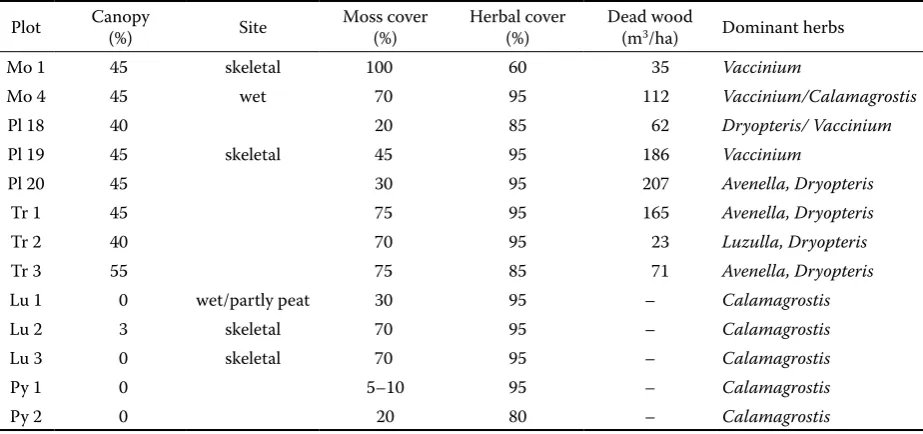
Herbal cover on the particular plots depends mainly on the canopy and humidity of the site (Ta- ble 2). Main species are: Vaccinium myrtillus, Ca-lamagrostis villosa, Avenella flexuosa, Anthyrium distentifolium. Lower abundance species are: Trien-talis europea, Homogyne alpina, Oxalis acetosella, Lycopodium annotinum, Maianthemum bifolium, and on the declined plots Chamaerion
angustifo-Table 1. Site characteristics of the particular plots
Plot Stand Forest type Altitude (m) Exposition Age/Stand characteristics
Mo 1 68B4 8N3 1,140 E, slope 60° age 134, vital, occasionally bark beetle sanitation Mo 4 68B 8R1 1,120 flat age 120, vital, occasionally bark beetle sanitation Pl 18 4A1/6 7N3 1,250 SE, slope 25° age 190, vital, occasionally bark beetle sanitation Pl 19 5A 8Y2 1,300 SE, slope 40° age 150, vital, occasionally bark beetle sanitation
Pl 20 5A 8Y2 1,370 flat top age 150, vital mature trees, occasionally bark beetle sanitation Tr 1 47A 8Y2 1,300 NW, slope 5° age 180, vital mature trees
Tr 2 47A 8Y2 1,300 NW, slope 5° age 180, vital mature trees Tr 3 47A 8Y2 1,300 NW, slope 5° age 180, vital mature trees
[image:2.595.64.528.541.756.2]lium. In the highest elevations, the main species are Polytrichum formosum, Dicranum scoparium, Sphagnum sp.
Grass cover, especially of Calamagrostis villosa, largely prevails on the plots with declined mature trees (Lu 1–3, Py 1, 2) or on the plots with open can-opy. High herbal cover can be also on the plots with intact canopy, but there is typical another species – Vaccinium myrtillus (situation on the plots Mo 1 and Pl 19). Usually there is typical mixture of grasses (Luzulla, Avenella, Calamagrostis) fern, Vaccinium on the sites surrounding stumps or mature trees, and few dicotyledonous plats and litter cover on the main part of plots (Tr 1–3, Pl 18, 20, Mo 4).
The 13 permanent research plots were established in the representative parts of the selected stands. The area of each of research plot is 50 × 50 m and they are used for complex forest ecosystem study, including the natural regeneration dynamics. Its first evaluation was done in 1997 (Podrázský 1997), last one in 2005. For detail natural regeneration evalua-tion purpose, transects of 5 × 50 m were established through these plots.
Basic characteristics of regeneration were deter-mined: spatial structure, i.e. its location on transects, increments for the last 3 years, height structure – sap-lings were divided into height categories sorted by 10 cm (with the accuracy of 0.5 cm), and the average height of regeneration on the plot was counted as a height of saplings to 5 m (that year seedlings were excluded). Also there were recorded health state (yellowing) and damages (by deer browsing e.g.). On the research plots with relatively intact mature tree layer, microhabitat pattern was characterized
by vegetation and decaying wood cover (estimated to the 10% ground cover) on the plot and by immediate surroundings of each particular seedling: stumps, tree foot, logs, vegetation cover. Rare ground cover, not typical, or mixture of a few different types, was described as “other” category. Declined stands were excluded from the microhabitat evaluation, because of almost 100% grass cover and high grass invasion – which led to the relatively too low stability of micro-habitat pattern in previous years and no real differ-ences in the conditions within the plot nowadays.
Microhabitat influence to the seedlings and saplings growth was estimated like relative proportion of natu-ral regeneration amount on the specific microhabitat to total amount of regeneration (tree foot microhabitat was associated with “other” category for increment calculation). Relative influence of specific microhabi-tat to natural regeneration was calculated like relative occurrence of natural regeneration on the specific microhabitat, to the relative proportion of microhabi-tat on transect. Expected occurrence of regeneration with neutral effect of this microhabitat should have values about one, microhabitat with negative influence should have values below one and values over one shows how many times is amount of saplings on the specific microhabitat higher, than is expected from the relative area of this microhabitat on the plot.
Dead wood on the stand was also described just on the plots with vital mature trees, on the snags with more than 10 cm diameter, including visibly deter-mined stumps. Relative “wood cover” of the stand was estimated like average log length and its width.
[image:3.595.65.527.73.290.2]Spatial structure (horizontal distribution of re-generated trees) was analyzed in relation to the tree Table 2. Herbal cover site characteristics
Plot Canopy (%) Site Moss cover (%) Herbal cover (%) Dead wood (m3/ha) Dominant herbs
Mo 1 45 skeletal 100 60 35 Vaccinium
Mo 4 45 wet 70 95 112 Vaccinium/Calamagrostis
Pl 18 40 20 85 62 Dryopteris/ Vaccinium
Pl 19 45 skeletal 45 95 186 Vaccinium
Pl 20 45 30 95 207 Avenella, Dryopteris
Tr 1 45 75 95 165 Avenella, Dryopteris
Tr 2 40 70 95 23 Luzulla, Dryopteris
Tr 3 55 75 85 71 Avenella, Dryopteris
Lu 1 0 wet/partly peat 30 95 – Calamagrostis
Lu 2 3 skeletal 70 95 – Calamagrostis
Lu 3 0 skeletal 70 95 – Calamagrostis
Py 1 0 5–10 95 – Calamagrostis
Py 2 0 20 80 – Calamagrostis
species composition and substrate on a soil cover with the use of the Ripley’s K-function (calculated by original software developed by D. Zahradník).
Ripley’s K-function: 1 K(r) =
∑
0<|xi – xj|≤r λ 2s(|| x
i – xj|| )
where: r – the sociability,
λ – the mean number of trees per unit area
(stand density),
s(r) = ab – r(2a + 2b – r) – the edge correction factor, π
a, b – dimensions of the rectangle (sample plot),
|| xi – xj|| – distance between i-th and j-th tree.
Foliar samples were collected to assess nutrient state in the end of October. Needles were collected from adventitious last year shots from the 4th whirl on the sunny part of crown. Samples were collected from 30 individuals per plot. Chemical analyses were conducted at the Tomáš laboratory, a. s., in Research Station Opočno by flame photometry.
Statistical analyses for the differences in seedlings numbers and their height increments on the particu-lar plots and microhabitats were performed by one way ANOVA (S PLUS version 6).
RESULTS
Amount of natural regeneration
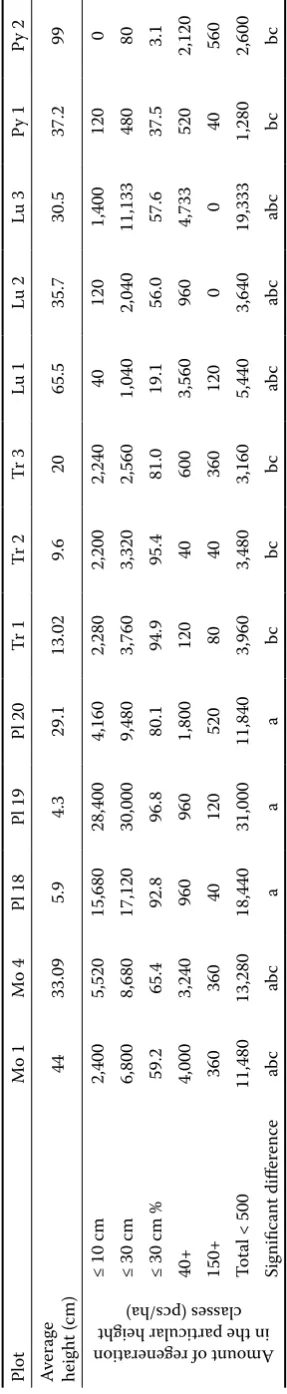
Average numbers of natural regeneration on the particular plots are presented in Table 3, and show relatively great variability within plots. Range is relatively wide and covers 1,300 to 31,000 pcs/ha. There is statistically significant difference between plots with vital mature tree layer – 12,080 pcs/ha (± 9,409) and declined stands with low canopy and none parent trees 5,929 pcs/ha (± 6,706). The highest proportion of natural regeneration is in the seedling phase (to 80%) especially on the vital plots with ma-ture trees as a seed source.
Spatial structure
Two typical samples of Ripley’s K-function for spatial structure characterizations are presented in Fig. 1. Thin irregular line shows K-function for real trees on the stand. Central of the three curves demonstrate K-function for random spatial pattern and both lateral curves demonstrate 95% confidence interval for random spatial pattern. In our case K-function for real situation run over this interval, which indicate strong aggregation of natural
regen-eration, in whole spatial scale (given by the size of Table 3. S
pr uc e na tural r egenera tion heig ht di str ibution Plot M o 1 M o 4 Pl 18 Pl 19 Pl 20 Tr 1 Tr 2 Tr 3 Lu 1 Lu 2 Lu 3 Py 1 Py 2
Average heig
ht ( cm) 44 33.09 5.9 4.3 29.1 13.02 9.6 20 65.5 35.7 30.5 37.2 99
Amount of r egenera
tion ular heig artic in the p ht cs/ha) sses (p cla
≤ 10 c
m 2,400 5,520 15,680 28,400 4,160 2,280 2,200 2,240 40 120 1,400 120 0
≤ 30 c
m 6,800 8,680 17,120 30,000 9,480 3,760 3,320 2,560 1,040 2,040 11,133 480 80
≤ 30 c
m % 59.2 65.4 92.8 96.8 80.1 94.9 95.4 81.0 19.1 56.0 57.6 37.5 3.1 40+ 4,000 3,240 960 960 1,800 120 40 600 3,560 960 4,733 520 2,120 150+ 360 360 40 120 520 80 40 360 120 0 0 40 560 Tot
al < 500
[image:4.595.345.489.61.760.2]transects). There are no real differences between vital and declined stands.
Height structure
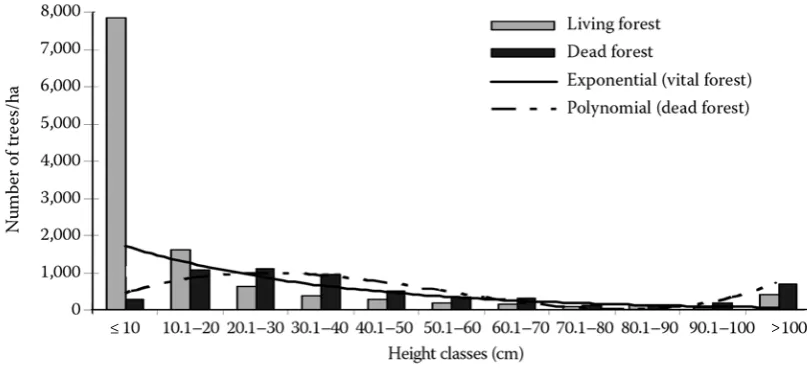
Height structure (Table 3) depends not only on the growth conditions and increment, but also on the age structure. Age composition of spruce re-generation depends on the type of the plot – with vital or declined parent trees. On the plots with seed source, there is very high number of seedlings (Fig. 2), and the height distribution of regeneration makes exponential curve with many young seedlings and lower number of older saplings. Distribution of regeneration on the plots with declined mature trees (and none or strictly reduced source of seeds) is more Gaussian, with low number of seedlings and higher of saplings. For the average height of saplings on the plot, there are again great differences: on the
plots with declined mature trees layer is average height about 64.9 (± 37.9) cm and on the vital 19.8 (± 14.3) cm. For the older regeneration, with low competition of high grass herbal cover, there are average of saplings (over 1 m), 460 (± 416) per ha on the vital plots and 669 (± 761) per ha on the declined plots. Differences are probably given by the canopy (different intensity of radiation) and number of the youngest regeneration.
Seedling growth
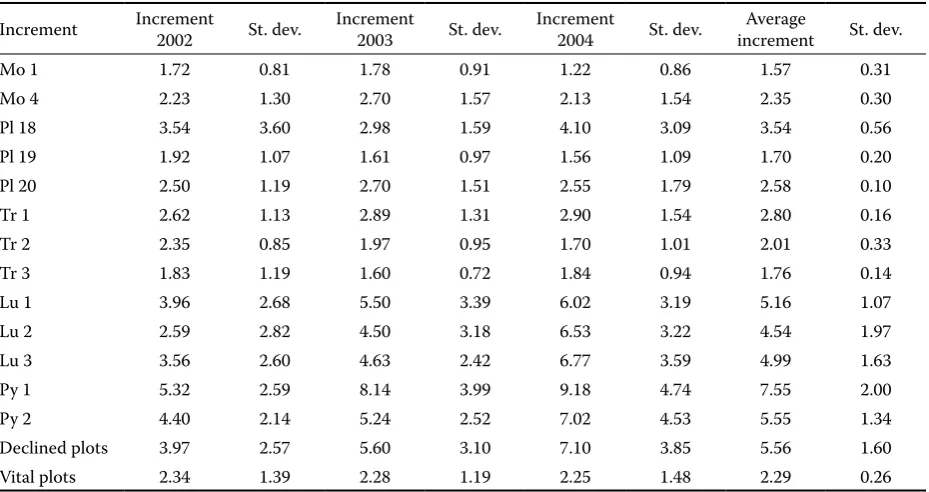
For the saplings growth, there are significant differ-ences between plots with declined and vital mature trees layer (Table 4). For the last 3 height increments of saplings (seedlings excluded), the average on the declined plots is almost twice higher, than on the vital plots. The results could be influenced by dif-ferent proportion of regeneration in the particular
[image:5.595.80.508.61.235.2]1 2 3 4 5
Fig. 1. Spatial structure of the spruce natural regeneration by Ripley’s K-function. Plot Lu 3 (left) – declined forest, plot Pl 20 (right) – intact forest
Fig. 2. Norway spruce regeneration height distribution, comparison of vital and declined stands
[image:5.595.68.472.554.741.2]age categories, but the effect of higher radiation is evident.
Microhabitat influence
The occurrence of seedlings depends strongly on microhabitat conditions. There are no saplings found in the Dryopteris dilalata cover, irrespective of its occurrence in the plots on the Plechý and Troj-mezná locality. The results show relative proportion of natural regeneration in the specific microhabitat on the particular plots (first six columns of Table 5). There is also rate of really found and expected (from the ground cover proportion) amount of seedlings and saplings in the particular microhabitat (last 5 co- lumns Table 5). Significantly lower proportion of seedlings was found in the stands of fern, grass, and
bilberry, on the opposite, decaying wood was the most favorable microhabitat.
Average annual height increment during last 3 years (Table 6) is only slightly related to the ground micro-habitat type. Significant differences was only in the last year, as a relative better microhabitat for spruce saplings growth appeared dead wood, tree foot, and category “other” including thin herbal cover or mixture of litter and moss cover. So the main part of favorable microhabitats is (slightly) uplifted in comparison with surrounding terrain. Less suitable is microhabitats of moss, litter and bilberry.
Nutrient and health state
[image:6.595.67.532.72.318.2]There are only small differences in nutrient content in foliar samples (Table 7) between vital and declined Table 4. Average annual height increments for natural regeneration on the different plots
Increment Increment 2002 St. dev. Increment 2003 St. dev. Increment 2004 St. dev. incrementAverage St. dev.
Mo 1 1.72 0.81 1.78 0.91 1.22 0.86 1.57 0.31
Mo 4 2.23 1.30 2.70 1.57 2.13 1.54 2.35 0.30
Pl 18 3.54 3.60 2.98 1.59 4.10 3.09 3.54 0.56
Pl 19 1.92 1.07 1.61 0.97 1.56 1.09 1.70 0.20
Pl 20 2.50 1.19 2.70 1.51 2.55 1.79 2.58 0.10
Tr 1 2.62 1.13 2.89 1.31 2.90 1.54 2.80 0.16
Tr 2 2.35 0.85 1.97 0.95 1.70 1.01 2.01 0.33
Tr 3 1.83 1.19 1.60 0.72 1.84 0.94 1.76 0.14
Lu 1 3.96 2.68 5.50 3.39 6.02 3.19 5.16 1.07
Lu 2 2.59 2.82 4.50 3.18 6.53 3.22 4.54 1.97
Lu 3 3.56 2.60 4.63 2.42 6.77 3.59 4.99 1.63
Py 1 5.32 2.59 8.14 3.99 9.18 4.74 7.55 2.00
Py 2 4.40 2.14 5.24 2.52 7.02 4.53 5.55 1.34
Declined plots 3.97 2.57 5.60 3.10 7.10 3.85 5.56 1.60
Vital plots 2.34 1.39 2.28 1.19 2.25 1.48 2.29 0.26
Table 5. Microhabitat importance for the spruce natural regeneration occurrence
M. type Proportional amount of regeneration on the microhabitat (%) Relative proportion, real to expected moss bilberry grass wood other tree foot moss bilberry grass wood other
Mo 1 39.70 9.80 0 37.6 25.4 13.5 0.40 0.10 0 5.64 5.08
Mo 4 0.30 9.00 0 55.3 32.4 12.4 0.00 0.18 0 38.40 1.12
Pl 18 54.50 12.00 1.10 4.0 28.1 4.2 2.73 0.80 0.16 1.15 0.37
Pl 19 23.00 0.00 0 73.4 3.5 0.7 0.51 0 0 10.95 1.75
Pl 20 5.40 6.00 2.50 75.0 11.2 10.1 0.18 0.17 0.05 10.06 2.24
Tr 1 0 0 1.00 88.5 10.4 9.4 0 0 0.02 33.20 0.35
Tr 2 0 18.70 2.70 25.3 53.3 50.7 0 2.67 0.04 9.25 3.55
Tr 3 0 1.90 1.50 42.9 53.7 41.1 0 0.38 0.02 8.09 3.58
[image:6.595.64.533.594.741.2]stands. Amount of nitrogen, phosphorus and cal-cium is higher in declined stands, due to nutrients leaching from the decaying wood. Temporary im-mission load is probably relatively low, as reflects the sulphur content in the last year foliar samples.
Health state of spruce saplings is good in both types of stands, on the vital stands no color change (yellowing) is observed, on the declined stands little bit more – up to 10% of saplings. Grouse damage was reported mainly on the spruce regeneration on the declined stands. Deer and elk browsing damage were low on the spruce and abundant on the broadleaves, e.g. 70% for the rowan tree.
DISCUSSION
Amount of natural regeneration
Amount of spruce natural regeneration in the mountain spruce forests of similar conditions like in the Šumava Mts. was already previously evaluated (Jonášová, Prach 2004; Šerá et al. 2000; Zatlou-kal 2000; Hunziker, Brang 2005; Saniga, Szanyi 1996). There are not detailed long term studies of regeneration demands to the microhabitat condi-tions yet.
Amount of natural regeneration on the selected plots was affected by crop year in 2002–2003 and 2003–2004, so number of seedlings was relatively high in the vital stands. Average numbers of
regener-ation on vital plots correspond with previous results from the similar areas of the Šumava Mts. (Zatlou-kal 2000), although the number was twice lower in our case on the plots declined before 1998, than according to this author. It could be result of com-petition with grass cover and declining last paternal trees during the time and so very low occurrence of the new seedlings on such type of plots.
Spatial structure
High sociability of regeneration indicates the concentration of individuals on microhabitats with favorable conditions. This trend is typical for natural regeneration in mountain forest (Vacek et al. 1995). No real differences between vital and declined stands indicate strong changes of microhabitats on the declined plots in the past or strong influence of the conditions under surface.
Height structure
[image:7.595.63.535.72.219.2]For the plots with natural height distribution is typi-cal highest number of the young seedlings or saplings and relatively very strong influence of the selection factors as are light conditions, intraspecific compe-tition, competition with herbal layer (Jonášová, Prach 2004; Šerá et al. 2000) which lead to the high mortality till the age of 4–5 years (Zatloukal 2000). This was typical pattern for the main part of Table 6. Average annual height increments of the natural regeneration in the different microhabitat
Year 2002 2003 2004
Height increment increment (cm) st. dev. increment (cm) st. dev. increment (cm) st. dev.
Bilberry 2.45 1.38 2.34 1.59 1.96 c 1.43
Bilberry on the wood 2.33 1.27 2.62 1.42 2.33 b 1.59
Litter 1.54 1.01 1.87 1.27 1.72 c 1.17
Log 2.28 1.10 2.44 1.38 2.15 b 1.56
Moss 2.00 1.17 2.12 1.37 1.38 c 0.92
Tree foot 2.33 1.20 2.29 1.34 2.69 b 5.77
Grass 2.37 1.05 2.26 1.69 15.95 a 22.73
Other 2.84 4.77 2.21 1.07 3.62 b 10.05
Table 7. Nutrient state of spruce natural regeneration on the vital and declined plots
Nutrient N (%) P (%) K (%) Ca (%) Mg (%) S (%)
Vital
stands 1.42 (± 0.108) 0.15 (± 0.019) 0.63 (± 0.076) 0.13 (± 0.023) 0.07 (± 0.009) 0.15 (± 0.032) Declined
stands 1.56 (± 0.065) 0.19 (± 0.026) 0.54 (± 0.081) 0.23 (± 0.075) 0.07 (± 0.011) 0.14 (± 0.024) Defficience
[image:7.595.62.537.251.345.2]selected vital plots, with exception of Trojmezná locality, probably due to missing crop year and thus low number of seedlings there. Age structure is also connected with proportion of regeneration in the particular height classes. Previous results from the Šumava Mts. for the total proportion of seedlings are 42.4–76.3% (Zatloukal 2000), which is com-parable to average 60% and maximum 95% on our plots. Proportion of regeneration older than 10 years could be 10–15% on the Šumava Mts. declined plots (Jonášová 2001), and in our case this proportion was similar. For the secure regeneration in the close to nature mountain forest in the stage of declina-tion, there should be 320–3,100 trees over 1.3 m height (Korpeľ 1993). This could be a problem on the plots with declined tree layer in our case, because of low actual proportion of higher trees, due to fast declination and probably high grass competition for further seedlings.
Seedling growth
Growth of saplings in the plots with declined ma-ture tree layer was two times faster, than on the vital plots, apparently due to better light conditions. Simi-lar experience were also reported by Hunziker and Brang (2005), Jonášová (2001), Jonášová and Prach (2004), Diaci (2002), Zatloukal (2000). Low increments, about 1–2 cm/year for the 1st class off regeneration under canopy and about 3 cm on the sites without canopy cover, in similar condition, were also reported (Hunziker, Brang 2005). The height increment of saplings was related to microhabitat and was relatively low due to high altitude and harsh climatic factors.
Microhabitat influence
Species composition of ground vegetation and its type has a strong influence on initial seedling den-sity as well as mortality during the first age stage. Influence of microhabitat conditions – growth substrate, canopy and herbal vegetation is widely discussed problem (Rumpf, Pampe 2003; Šerá et al. 2000; Jonášová, Prach 2004; Hunziker, Brang 2005), although not all authors have the same ex-periences. Some appreciate the litter as a favorable substrate for germination of seeds (Šerá et al. 2000; Hunziker, Brang 2005), although there is slightly higher mortality than in the bilberry cover (60:40%) (Šerá et al. 2000). A little different experiences were also (Jonášová, Prach 2004), who noticed the fastest decreasing of seedling numbers in the spruce litter. Litter was intermediate microhabitat
in relation to particular plots in our case. Probably litter influence to the seedling mortality depends on the climatic factors, e.g. humidity or high tempera-tures. Bilberry cover have also ambiguous results, it could protect seedlings in the winter, but usually is also reported like microhabitat with a low ger-mination rate in comparison with other one (Šerá et al. 2000; Rumpf, Pampe 2003). Last favorable conditions are on microhabitat with high grasses, as a Calamagrostis villosa and Avenella flexuosa, or Deschampsia flexuosa (Šerá et al. 2000; Rumpf, Pampe 2003). It corresponds with our results and the lowest proportion of grasses microhabitat in regeneration occurrence (Table 5). In our plots the microhabitat and herbal vegetation appeared as a statistically significant factor for the seedlings occurrence and probably less important for the seedlings growth.
Dead and decaying wood appeared as a favorable microhabitat for seedlings occurrence in our plots and it is in the mountain conditions often consid-ered as the most favorable microsite (Hunziker, Brang 2005; Jonášová, Prach 2004; Svoboda 2005).
Not only abiotic characteristics like humidity and slightly uplift terrain are connected with this sub-strate – also lower herbal competition and special ectomycorrhizal types present on the decaying wood can improve seedlings germination and further growth (Uhliarová et al. 1999). On the declined plots majority of the dead standing logs are already broken and on the ground. Changes were very rapid in last years, depends on the weather, and ground cover evaluation could not be correct. On this type of plots seedlings or saplings were not found on the logs. Logs without bark have the very dry and hard surface unfavorable for seedling occurrence on the declined plots.
Nutrient and health state
Nutrient state of the spruce natural regeneration is in accordance to relatively poor nutrient soil status on granite rock. Critical could be phosphorus and magnesium content, which is just on the limit and deficiency is already reported from the other parts of the Šumava Mts. (Podrázský, Vacek 2004). But this is not limiting factor for the saplings in the 1st height class now.
CONCLUSION
between stand with vital and declined mature tree layer is in the amount of seedlings and natural re-generation in the first age class, due to seed source on the vital stands.
Accordingly, there are differences in the natural regeneration age and height structure between the vital and declined stands. Space structure of natural regeneration is similar on the vital and declined stands, trees growth in clusters, which comport with altitude and character of mountain spruce forests. Microhabitat conditions and growth substrate have significant influence to the amount and growth of natural regeneration, especially microhabitat with dead wood. There are great differences in the ex-ploitation of this woody microhabitat on the plots with and without canopy cover. Temporary state of natural regeneration on the declined stands is strongly dependent on the missing seeds source and unfavorable grass cover and could lead in the future to the unstable even-aged forest.
References
DIACI J., 2002. Regeneration dynamics in a Norway spruce plantation on a silver fir-beech forest site in the Slovenian Alps. Forest Ecology and Management, 161: 27–38. HUNZIKER U., BRANG P., 2005. Microsite patterns of
coni-fer seedling establishment and growth in a mixed stands in the southern Alps. Forest Ecology and Management, 210: 67–79.
CHÁBERA S. et al., 1987. Příroda na Šumavě. České Budě-jovice, Jihočeské nakladatelství: 54–63.
JELíNEK J., 1988. Větrná a kůrovcová kalamita na Šumavě z let 1868 až 1878. Brandýs nad Labem, Lesprojekt: 40. JONÁŠOVÁ M., 2001. Regenerace horských smrčin na
Šu-mavě po velkoplošném napadení lýkožroutem smrkovým. In: Sborník Aktuality šumavského výzkumu, Srní 2. 4. 2000. Vimperk, Správa NP a CHKO Šumava: 161–164.
JONÁŠOVÁ M., PRACH K., 2004. Central-European moun-tain spruce (Picea abies (L.) Karst.) forests: regeneration of tree species after a bark beetle outbreak. Ecological Engineering, 23: 15–27.
KORPEĽ Š. et al., 1993. Hospodárenie v lesoch horských oblastí. Praha, VŠZ: 356.
PASUTHOVÁ J., LOMSKÝ B., 1998. Nutrition of young spruce stands with various pollutant load. Lesnictví-For-estry, 44: 385–391.
PODRÁZSKÝ V., 1997. Obnova biodiverzity a stability lesních ekosystémů v pásmu přirozeného výskytu smrku na území NP Šumava. [Výroční zpráva.] Praha, ČZU, FLE: 37. PODRÁZSKÝ V., VACEK S., MOSER W.K., 1999. Návrh
kritérií pro ponechání částí lesa přirozenému vývoji
v podmínkách II A zón Národního parku Šumava. Journal of Forest Science, 45: 430–436.
PODRÁZSKÝ V., VACEK S., 2004. Vliv hnojení na zdravotní stav porostů. In: DVOŘÁK L., ŠUSTR P. (eds.), Aktuality šumavského výzkumu II., Srní 4.–7. 10. 2004. Vimperk, Správa NP a CHKO Šumava: 275–279.
RUMPF S., PAMPE A., 2003. Investigations of the initial phase of natural regeneration of spruce. Forst- und Holzwirt, 58: 384–389.
SANIGA M., SZANYI O., 1996. Dynamika prirodzenej ob-novy vo vybraných typoch výberného lesa. Acta Facultatis Forestalis Zvolenensis, 38: 101–114.
SVOBODA M., 2005. Množství a struktura mrtvého dřeva a jeho význam pro obnovu lesa ve smrkovém horském lese v oblasti rezervace Trojmezná. Zprávy lesnického výzkumu, 50: 34–45.
ŠERÁ B., FALTA V., CUDLíN P., CHMELíKOVÁ E., 2000. Contribution to knowledge of natural growth and devel-opment of mountain Norway spruce seedlings. Ekológia, 19: 420–434.
TESAŘ V., TESAŘOVÁ J., 1996. Odrůstání smrku s jeřábem v mladých uměle založených porostech v Krkonoších. In: Sborník Monitoring, výzkum a management ekosystémů na území Krkonošského národního parku, Opočno, 15.–17. 4. 1996. Opočno, VS: 201–209.
UHLIAROVÁ Š., ŠKRDLA P., POUSTKA V., LEPŠOVÁ A., 1999. Mrtvá dřevní hmota a její význam pro obnovu lesa. In: Konference Monitoring, výzkum a management ekosystémů NP Šumava, 1.–2. 12. 1999, Kostelec nad Černými lesy. Praha, ČZU, FLE: 81–87.
VACEK S., PODRÁZSKÝ V., 2003. Forest ecosystems of the Šumava Mts. and their management. Journal of Forest Sci-ence, 49: 291–301.
VACEK S., LOKVENC T., SOUČEK J., 1995. Podsadby lesních porostů. Metodika použití podsadeb pro obnovu a stabilizaci porostů ohrožených a poškozených imisně ekologickými vlivy zejména v horských polohách. Praha, ÚZPI: 31.
VINŠ B. et al., 1999. Ochrana přírody a péče o les v Národním parku Šumava. Praha, MŽP: 56.
ZATLOUKAL V., 1998. Historické a současné příčiny ků-rovcové kalamity v Národním parku Šumava. Silva Gabre- ta, Vimperk: 327–357.
ZATLOUKAL V., 2000. Dynamika přirozeného zmlazení a umělých podsadeb v závislosti na stanovištních pomě-rech v horských lesích Šumavy. In: Konference Monito-ring, výzkum a management ekosystémů NP Šumava, 1.–2. 12. 1999, Kostelec nad Černými lesy. Praha, ČZU, FLE: 74–78.
Téma přirozené obnovy smrku v oblasti NP Šu-mava, zejména v oblastech postižených kůrovcovou kalamitou a z těchto důvodů s odumřelým dospě-lým porostem, je stále ještě široce diskutováno. I tento příspěvek se vztahuje k uvedenému tématu a k hodnocení stavu přirozené obnovy smrku na lokalitách v oblasti Modravy, Luzného a Plechého. Hodnocení bylo prováděno na 13 trvalých zkusných plochách (tab. 1 a 2) na čtyřech základních lokali-tách dvou typů. Do prvního typu – vitálních poros-tů s jen mírným ovlivněním kůrovcem – patří loka-lita Modravy (Mo 1, 4), a vrcholové části Plechého a sousedícího sedla Trojmezné (Pl 18–20, Tr 1–3). Druhý typ – s odumřelými porosty – je zastoupen lokalitou Pytláckého rohu (Py 1, 2) a Velké Morův-ky (Lu 1–3). U ploch s odumřelým porostem (před rokem 1989) je charakteristický hustý travní pokryv tvořený zejména Calamagrostis a časté zlomy souší v poslední době, takže většina (2/3) mrtvého dřeva je již na povrchu půdy a má stejnorodý charakter. U ploch s živým (i když místy asanací již ovlivně-ným) mateřským porostem je bylinný pokryv pod-statně variabilnější a zahrnuje borůvčí, mech, opad a porosty kapradin, ležící mrtvé dřevo je v různém stadiu rozkladu.
Na všech pokusných plochách (0,25 ha) byly pro podrobnější hodnocení obnovy vytyčeny dva tran-sekty 5 × 25 m, na kterých byla zaznamenávána cha-rakteristika povrchu a přirozené obnovy. V rámci celého souboru ploch pak byly porovnávány celkové počty zmlazení v jednotlivých výškových třídách
(po 10 cm), relativní podíl zmlazení na jednotlivých typech mikrostanoviště a průměrné přírůsty na jeho jednotlivých typech. Dále byl hodnocen i stav výži-vy pomocí směsných listových vzorků odebraných na podzim r. 2004.
Počty zmlazení v jednotlivých výškových třídách byly poměrně dosti variabilní (tab. 3, obr. 2) a pohy-bovaly se od 1 200 do 30 000 ks/ha s výrazněji niž-šími (polovičními) počty na plochách s odumřelým mateřským porostem, kde s výjimkou jedné plochy nepřesahovaly výrazněji 5 000 ks/ha. Na plochách s živým mateřským porostem převažovala nej-mladší obnova (vzhledem k semennému roku 2003 a 2004 ve sledované oblasti) a největší počet zmla-zení byl ve výškové třídě do 30 cm (okolo 80 % proti 50 % v odumřelých porostech).
Průměrná výška zmlazení byla vyšší na plochách s odumřelým porostem stejně jako přírůsty (tab. 4), kde byly rozdíly v přírůstu pro výškovou třídu do 30 cm dokonce dvojnásobné.
Vliv mikrostanoviště na výskyt obnovy se projevil statisticky významně; jako nejméně vhodný se jevil po-rost kapradí, trav a borůvčí. Nejvhodnější (tab. 5) bylo především tlející dřevo v živém porostu. V odumře-lém porostu obnova na kládách zaznamenána nebyla. Zatímco v živém porostu jsou klády často pokryté by-linnou vegetací nebo mechem, snadněji se rozkládají a jsou dostatečně vlhké, u odumřelých porostů dochází často k usychání nastojato a na povrch půdy se dostá-vají odkorněné, na povrchu vyschlé klády, na kterých se semenáčky zatím nemají šanci uchytit.
Vývoj přirozené smrkové obnovy v horských oblastech Šumavy
I. Ulbrichová, J. Remeš, D. Zahradník
Fakulta lesnická a environmentální, Česká zemědělská univerzita v Praze, Praha, Česká republika
ABSTRAKT: Příspěvek se vztahuje k tématu přirozené obnovy smrku v oblasti NP Šumava a jejímu hodnocení na lokalitách s vitálním a odumřelým dospělým porostem v oblasti Modravy, Luzného a Plechého. Podrobněji byl hodnocen počet jedinců v jednotlivých výškových třídách, charakter zmlazení vzhledem k jeho sociabilitě a vliv mikrostanoviště (mrtvé dřevo, porost bylinné vegetace). Základní rozdíl mezi stanovištěm s vitálním a odumřelým porostem je v počtech zmlazení (průměr 12 tisíc) v živém porostu a poloviční v odumřelém porostu, ve výškovém rozdělení obnovy a výrazněji chybějícím množství nejmladších semenáčků na odumřelých plochách. Naopak růst zmlazení je na odumřelých plochách díky dostatečnému osvětlení rychlejší. Vzhledem k mikrostanovištním podmín-kám má na výskyt zmlazení pozitivní vliv mrtvé dřevo, relativně negativní vliv má porost kapradí a trav. Vzhledem k přírůstům může negativně působit i silné zastínění na mikrostanovišti u kořenových náběhů.
Vliv mikrostanoviště na přírůsty (tab. 6) byl méně výrazný, i když mrtvé dřevo nebo kořenové náběhy (zejména souší) mají podmínky pro růst semenáč-ků poměrně výhodné. Jako nejméně vhodný se jevil porost mechu, těsné sousedství klády, která stano-viště mohla stínit, a volný opad, kde pravděpodobně hrají roli nepříznivé vlhkostní poměry.
Prostorová struktura zmlazení je podle předpo-kladu ve shlucích (obr. 1) a na obou typech stanovišť – v živém i odumřelém porostu – velmi podobná.
Hodnocení stavu výživy (tab. 7) ukázalo relativ-ně malé kolísání obsahů základních živin mezi jed-notlivými plochami a lokalitami. Rozdíl mezi živým
a odumřelým porostem (po 8–10 letech) se projevil významněji jen u draslíku (vyšší v živých porostech) a vápníku (vyšší v odumřelých porostech) a statis-ticky méně významný byl rozdíl v obsahu N (mír-ně vyšší v odumřelých porostech). Problémem do budoucna mohou být hraniční hodnoty v obsahu fosforu a hořčíku, i když se zatím nejedná o limitu-jící faktor.
Rozdíly mezi plochami s živým a odumřelým ma-teřským porostem spočívají zejména v odlišném výškovém (a do budoucna věkovém) rozdělení při-rozené obnovy a ve využití mrtvého dřeva jako růs-tového substrátu.
Corresponding author:
Ing. Iva Ulbrichová, Ph.D., Česká zemědělská univerzita v Praze, Fakulta lesnická a environmentální, 165 21 Praha 6-Suchdol, Česká republika